
Keywords:
companion animal; family dynamics; genogram; family; psychotherapy; pet
Short Communication • Cienc. Psicol. 14
(01)
• June 2020 • https://doi.org/10.22235/cp.v14i1.2112 linkcopy
 Pets in family genogram
About the authors
person
Marcelo Rodríguez Ceberio
school
Universidad de Flores. ArgentinaUniversidad de Flores. ArgentinaEscuela Sistémica ArgentinaEscuela Sistémica ArgentinaLaboratorio de Investigación en Neurociencias y Ciencias Sociales (LINCS). Argentina marceloceberio@hotmaill.com, mdiazvidela@hotmail.comLaboratorio de Investigación en Neurociencias y Ciencias Sociales (LINCS). Argentina marceloceberio@hotmaill.com, mdiazvidela@hotmail.com
About the authors
person
Marcos Díaz Videla
school
Universidad de Flores. ArgentinaUniversidad de Flores. ArgentinaLaboratorio de Investigación en Neurociencias y Ciencias Sociales (LINCS). Argentina marceloceberio@hotmaill.com, mdiazvidela@hotmail.comLaboratorio de Investigación en Neurociencias y Ciencias Sociales (LINCS). Argentina marceloceberio@hotmaill.com, mdiazvidela@hotmail.com
SCImago Institutions Rankings
Universidad de Flores. ArgentinaUniversidad de FloresArgentinaArgentinaUniversidad de Flores. Argentina
Laboratorio de Investigación en Neurociencias y Ciencias Sociales (LINCS). Argentina marceloceberio@hotmaill.com, mdiazvidela@hotmail.comLaboratorio de Investigación en Neurociencias y Ciencias Sociales (LINCS)ArgentinaArgentinaLaboratorio de Investigación en Neurociencias y Ciencias Sociales (LINCS). Argentina marceloceberio@hotmaill.com, mdiazvidela@hotmail.com
Figures
 Thumbnail
 Thumbnail
 Thumbnail
 Thumbnail
 Thumbnail
 Thumbnail
 Thumbnail
 Thumbnail
 Thumbnail
 Thumbnail
 Thumbnail
 Thumbnail
 Thumbnail
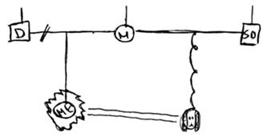
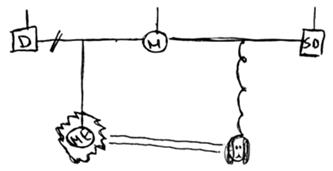
imageFigure 1: Little child genogram, showing her relationship with her dog inside a stepfamily structure. The graphic was made by a girl who had a strength link with her dog, with which she lives at home with her mother and stepfather. From Walsh (2009, p. 491). Copyright©Family Process Institute and John Wiley and Sons. open_in_new
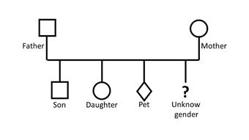
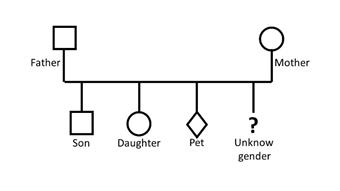
imageFigure 2: Generally proposed symbols for representing family members in genograms. Copied from GenoPro© http://genopro.com open_in_new
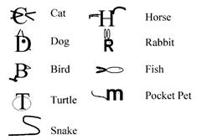
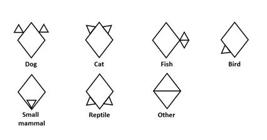
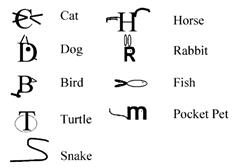
imageFigure 3: Symbols for different types of companion animals. Taken from Hodgson and Darling (2011). Copyright© American Animal Hospital Association. open_in_new
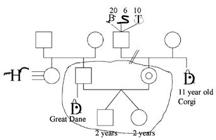
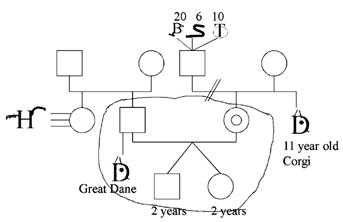
imageFigure 4: An example of the inclusion of pets in the family genogram according to the proposal of Hodgson and Darling (2011). The index woman is married, and she has twin children. The family shares the home with a great breed Danish dog belonging to her husband. His parents are divorced. His mother has an 11-year-old Corgi dog; his father has 20 birds, 6 snakes and 10 turtles. Her husband's parents do not have pets, but her sister has an intense bond with his horse. Taken from Hodgson and Darling (2011). Copyright© American Animal Hospital Association. open_in_new
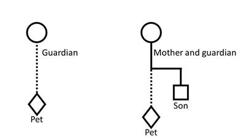
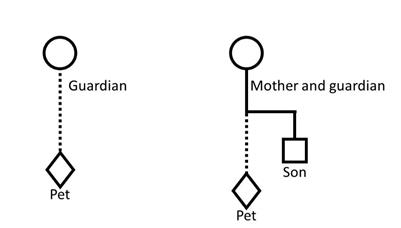
imageFigure 5: Graphic representation of a pet linked to a one-person home or single-parent guardian. In the first case, the animal is related to a woman guardian without kids, and the second one with a son. open_in_new
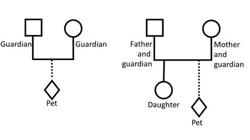
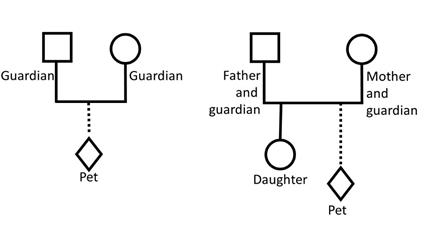
imageFigure 6: Graphic representation of a pet linked to a couple. In the first case without children, and in the second one with a daughter open_in_new
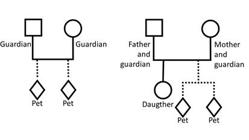
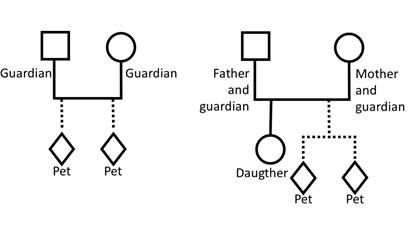
imageFigure 7: Graphic representation of two pets linked to a guardian couple. In the first case a couple without children, in the second one with a daughter. open_in_new
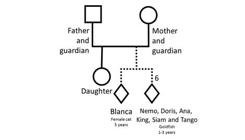
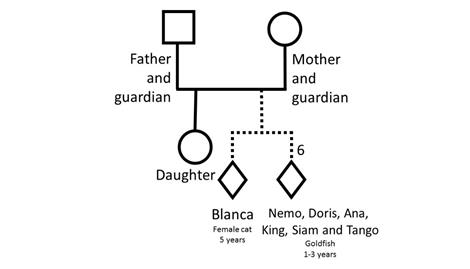
imageFigure 8: Graphic representation of a family structure conformed by a couple with a daughter, a cat and six goldfish. open_in_new
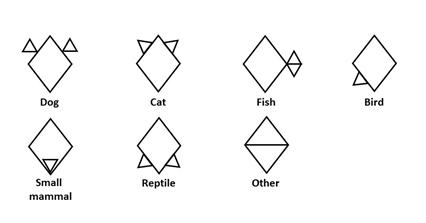
imageFigure 9: Different types of symbols used to differentiate types of companion animals. Based on the proposed symbol (i.e., rhombus) one or two additional triangles are added with iconic value representative of the type of animal. open_in_new
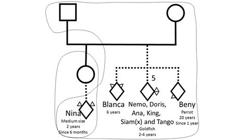
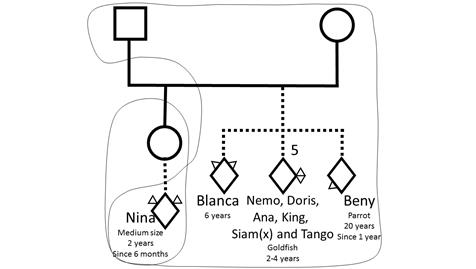
imageFigure 10: Example of registering basic information of a human-animal family configuration with multiple types of animals. Taking the previous case, one year later, we observe that the daughter no longer lives with her parents and 6 months ago she adopted a toy dog (Nina) of two years. One of their parents' fish (Siam) has died, and additionally, they have adopted a 20-year-old parrot (Beny) a year ago. While the guardian of Nina is the daughter, the dog spends much of the day with the young woman's parents and, on occasions, full weekends. open_in_new
imageFigure 11: Graphic representation of different relational types suggested for Ceberio (2005). open_in_new
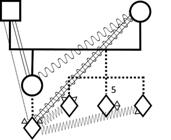
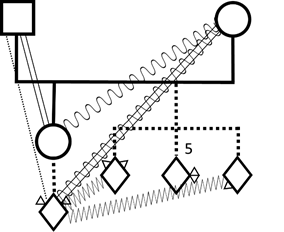
imageFigure 12: Example of graphic representation of different relational types in a family genogram. We incorporate the dynamics into the case mentioned in the Figure 10. Here, Nina, the daughter's dog is frequently in charge of the mother of the young guardian. While the young woman's father does not establish a bond with the dog, the mother has developed a close relationship, although conflicting with this. Also, Nina is aggressive towards others house animals. This situation has triggered conflicts between the young woman and her mother, who complains of having to take on the responsibilities of his daughter. On the other hand, the father is affectionate and forgiving towards the young woman. open_in_new
imageCuadro:open_in_new
How to cite
location_on
Facultad de Psicología de la Universidad Católica del Uruguay, Damaso A. Larrañaga
Av. 8 de Octubre 2738, Montevideo - Uruguay. CP 11600., Telefonos: (598) 2487 27 17 int. 6567/6568 -
E-mail: cienciaspsi@ucu.edu.uy
rss_feed
Acompañe los números de esta revista en su lector de RSS
Artículos relacionados
Lista de links para artigos relacionados. Os links abrem em nova aba.
Versões e tradução automática
Escolha a versão original do texto ou utilize um serviço de tradução automática.
Como citar
Escolha um formato para exportar ou selecione um estilo de citação. O conteúdo abaixo pode ser atualizado após a seleção.