Parental Stress and Personal Network of Mothers of Children with Cerebral Palsy
Abstract:
Introduction/Objective: This research aimed to investigate the level of parental stress experienced by mothers of children with cerebral palsy and to analyze the particularities of the personal networks of the high and low stress groups. Method: Fifty mothers selected by convenience participated in this study. The instruments used were the Biosociodemographic Inventory, the Parenting Stress Index and the Social Network Questionnaire. Results: The main results showed that most mothers experience a high level of total parental stress. The high stress group presented cohesive personal networks, with low centrality indices, low durability, frequency of contact and intensity of relationships. The low stress group presented less cohesion, a higher centrality index, with greater durability, frequency of contact and intensity of relationships. Conclusions: The results indicate the need for family-centered interventions, with the strengthening and diversification of personal networks and the systematic provision of psychosocial support from the time of diagnosis, promoting greater access to resources, better maternal adjustment, and reduced parental stress.
Keywords:
psychological stress; cerebral palsy; social network analysis; interpersonal relations; social support
Resumo:
Introdução/Objetivo: Esta pesquisa objetivou investigar o nível de estresse parental vivenciado por mães de crianças com paralisia cerebral e analisar as particularidades das redes pessoais dos grupos com alto e baixo estresse. Método: Participaram deste estudo 50 mães selecionadas por conveniência. Os instrumentos utilizados foram Inventário biosociodemográfico, Parenting Stress Index e o Questionário de Rede Social. Resultados: Os principais resultados mostraram que a maioria das mães vivenciam alto nível de estresse parental total. O grupo com alto estresse apresentou redes pessoais coesas, com baixos índices de centralidade, baixa durabilidade, frequência de contato e intensidade das relações. O grupo de baixo estresse apresentou menor coesão, maior índice de centralidade, com maiores durabilidade, frequência de contato e intensidade das relações. Conclusões: Os resultados indicam a necessidade de intervenções centradas na família, com fortalecimento e diversificação das redes pessoais e oferta sistemática de suporte psicossocial desde o diagnóstico, favorecendo maior acesso a recursos, melhor ajuste materno e redução do estresse parental.
Palavras-chave:
estresse psicológico; paralisia cerebral; análise de rede social; relações interpessoais; apoio social
Resumen:
Introducción/Objetivo: Esta investigación tuvo como objetivo investigar el nivel de estrés parental experimentado por madres de niños con parálisis cerebral y analizar las particularidades de las redes personales de grupos con alto y bajo estrés. Método: Participaron de este estudio 50 madres seleccionadas por conveniencia. Los instrumentos utilizados fueron el Inventario Biosociodemográfico, el Índice de Estrés Parental y el Cuestionario de Redes Sociales. Resultados: Los principales resultados mostraron que la mayoría de las madres experimentan un alto nivel de estrés parental total. El grupo de alto estrés presentó redes personales cohesivas, con bajos índices de centralidad, baja durabilidad, frecuencia de contacto e intensidad de relaciones. El grupo de bajo estrés mostró menor cohesión, mayor índice de centralidad, con mayor durabilidad, frecuencia de contacto e intensidad de relaciones. Conclusiones: Los resultados indican la necesidad de intervenciones centradas en la familia, con el fortalecimiento y la diversificación de las redes personales, y la provisión sistemática de apoyo psicosocial desde el momento del diagnóstico, promoviendo un mayor acceso a recursos, un mejor ajuste materno y una reducción del estrés parental.
Palabras clave:
estrés psicológico; parálisis cerebral; análisis de redes sociales; relaciones interpersonales; apoyo social
Social relationships have come to play an important role in individuals’ health. Interactions with members of one’s social network-such as family members, friends, and neighbors-facilitate the exchange of resources that can promote physical and mental well-being, including stress management (Veningston et al., 2020). However, the benefits of social networking can be affected by challenging circumstances, such as those that shape the lives of mothers of children with cerebral palsy. The obstacles posed by developmental delays, combined with the potential difficulties encountered in fulfilling the role of caregiver, can impact both the health and social networks of caregivers (Pereira et al., 2014).
The concept of a social network, which can be understood as structures composed of groups of individuals who are connected collectively or individually with one another, serves as a metaphor to illustrate the connections between individuals (Nunes et al., 2020). These relationships function as a means for the exchange or sharing of resources and represent an intentional engagement between one or more parties (Dias et al., 2020). Graphically, networks are represented by nodes, which indicate the actors, and lines that denote an actor’s knowledge, connections, bonds, relationships, or the exchange of information between them. The stronger the connection between actors, the more they can influence one another (Simplício, 2023).
The totality of relationships constitutes sociocentric networks, while networks generated from an individual’s perspective on their relationships consist of egocentric networks (Wasserman & Faust, 1994). Distinct from these two types of networks is the personal social network, the subject of investigation in this study. In this case, there are characteristics of both egocentric and sociocentric networks; that is, it encompasses all the people with whom an individual interacts and who contribute to the establishment of the person’s identity and self-image, their well-being, competence, health care habits, and ability to adapt during a crisis (McCarty, 2010).
The structure of networks and the way it bidirectionally impacts the behaviors of its members can be understood through Social Network Analysis (SNA) (Lazega & Higgins, 2014). This methodological approach enables the calculation of metrics that reveal the circumstances in which relationships occur. Newman (2003) describes five metrics he considers fundamental in studies of personal social networks. Density measures the number of existing connections relative to the total number of possible connections. Transitivity allows for the identification of a tendency toward the formation of strongly connected groups. The clustering coefficient measures the probability of group or cluster formation. Degree centrality allows for identifying the number of connections of a node. Intermediation locates an actor’s intervention through control and mediation of information within the network.
Knowledge of these metrics can provide a view of the network as a whole, but it can also reveal characteristics of the various subgroups that make up the network, that is, of the clusters (Silveira & Farina, 2012). One of these, considered significant and demonstrating high interconnection, is the family. In fact, relatives are the main components of social networks, and relationships among members are predominantly characterized by strong ties, involving members who know one another. Thus, family relationships are direct, strong, and facilitate the sharing of resources, such as social support (Silva et al., 2020).
The characteristics of personal networks are also subject to the particularities of the ego. This represents the reference person who operates within the network and upon whom the network operates. In the present study, the figure of mothers of children with cerebral palsy occupies this position. Given this, maternal specificities are relevant to understanding the relationships established by these women within their personal networks.
Mothers, in the exercise of parenthood, demonstrate a desire and dedication to provide physical and emotional support for their children’s needs throughout their growth. However, this does not always occur as expected. The birth of a child with developmental differences creates a moment of transition for families who must adapt to new demands (Le et al., 2016; Scheibner et al., 2024). In particular, cerebral palsy causes a shock that leads parents of affected children to exhibit irrational thinking, a desire to escape, and denial of reality (Ferrari & Morete, 2018; Hickey et al., 2025).
Resulting from brain damage during the prenatal, perinatal, or postnatal period, cerebral palsy manifests as a persistent, though non-progressive, disorder of muscle tone, posture, and movement. Associated with this may be cognitive, sensory, and perceptual impairments, as well as emotional, behavioral, and social maladjustment-that is, aspects that render affected children more vulnerable (Carvalho et al., 2017; Wilson et al., 2023).
In this context, the impairments experienced by the child can affect mothers as they assume most of the tasks related to their children’s daily care, resulting in negative feelings such as social isolation and stress (Ferreira et al., 2016; Liu et al., 2023). To make matters worse, there is evidence that younger children and those with more severe impairments require greater care from their caregivers. Furthermore, communication problems in children with cerebral palsy have been a contributing factor to high levels of parental stress (Silva & Pontes, 2016).
The stress resulting from the parental role constitutes an adverse psychological reaction stemming from the demands of parenting, which leads to negative feelings about oneself and the child. Stress arises from the difficulties encountered in the relationship with children and manifests as a lack of resources to cope with stressful situations, as well as social withdrawal. The need for personal adjustments associated with caring for children with developmental differences can represent risk factors for elevated stress levels (Abidin, 1992; Veiga, 2022).
Research with mothers of children with cerebral palsy has revealed high levels of parental stress (Fritz & Sewell-Roberts, 2020). This high rate has been linked to children’s behavioral problems (difficult child) (Cunha et al., 2017) and the experience of parenting (parental distress) (Ribeiro et al., 2014).
In addition to high stress levels, it has been observed that maternal support networks may diminish in size due to stigma or prejudice regarding the child’s disability (Baltor et al., 2014; Lei & Wang, 2025). In investigating the physical and mental health of caregivers of people with chronic illnesses, Marques et al. (2011) highlight the breakdown of social networks and a lack of support, as well as conflicts arising from family dissatisfaction with the care provided or financial issues. Empirical evidence highlights that the exercise of the parenting role becomes more difficult due to overload, isolation, and a lack of support sensitive to actual parental needs (Prime et al., 2020).
Motherhood, however, becomes less stressful when the demands arising from cerebral palsy are incorporated into the family’s routine (Lima et al., 2016). This idea is evidenced by the fact that high levels of parental stress do not occur universally among mothers. Dezoti et al. (2015) highlight the role of support networks as an important protective factor, as they facilitate personal and family adjustments for mothers of children with cerebral palsy. Within the family context, the presence of a partner who is sensitive to mothers’ support needs has been highlighted as a factor promoting maternal well-being (Araújo et al., 2013; Vrankić Pavon et al., 2024).
Given the circumstances described, the stress generated by the intense routine of parenting is moderated by the caregiver’s personal network, which, in turn, may have implications for parental interaction (Pinquart, 2018). The relationship between stress and support networks is already well-documented in the literature. Unger and Powell (1980) suggest that social networks exert a strong influence on families’ adaptation to stress, especially during times of crisis, such as wars or economic recessions, indicating that families supported by friends, relatives, and neighbors tend to cope better with these adversities. Isolated families, on the other hand, tend to be more vulnerable to stress. It is also noted that mothers in stressful situations demonstrate greater involvement with their children when they maintain regular contact with relatives and friends and receive material support (Unger & Powell, 1980).
In this sense, the concept of a personal network is directly linked to that of social support, since it is through this network-composed of significant contacts such as family members, friends, colleagues, and neighbors-that support is effectively provided and perceived. The personal network functions as the relational structure that underpins different types of support, including emotional, instrumental, informational, and material support (Wellman & Wortley, 1990). Sluzki (1997) emphasizes that the configuration, density, and quality of relationships within the personal network directly influence not only access to social support but also the way in which this support is interpreted and internalized by the individual. Thus, broader, more diverse, and more cohesive networks tend to provide greater protection in stressful situations, while more restricted or fragile networks may limit the available support.
Cohen and Wills (1985) introduced two complementary explanations regarding the impact of social support on stress: the buffering model and the direct effect model. The buffering model suggests that social support acts as a buffer against the negative effects of stress, helping individuals better cope with challenges and adversity. The direct effect model, on the other hand, proposes that social support provides benefits regardless of the presence of stressful events, as it offers a continuous sense of belonging and security.
Recent studies demonstrate that perceived stress plays a mediating role in the relationship between family support and the variables of positive affect, anxiety, and depression. The support provided by family and other significant others tends to reduce perceived stress, increasing positive affect and decreasing anxiety and depression (Acoba, 2024; Tang et al., 2025). However, the studies do not present data specifically on the participants’ personal social networks. Furthermore, data on the structural characteristics of the network have not yet been associated with aspects of caregivers’ mental health, such as stress. Thus, based on structural measures of the ARS, this study aims to analyze the personal social networks of mothers of children with cerebral palsy, linking them to high and low levels of stress.
Method
Participants
The participants in this study were 50 mothers of children with cerebral palsy, selected by convenience. The following inclusion criteria were adopted: being a resident of Belém do Pará or the metropolitan area; having a son or daughter diagnosed with cerebral palsy between the ages of 0 and 12; and accompanying their child to rehabilitation sessions offered at one of the two referral centers for people with disabilities in the state of Pará, Brazil, selected for this study, namely: Betina Ferro de Souza University Hospital and the Specialized Rehabilitation Center.
The mothers in this study were, on average, 32 years old (SD 7.79). Most participants (74 %) reported having a spouse through marriage or a stable union, while 26 % stated they lived without a partner, classifying themselves as single or widowed. Regarding education, the majority (64 %) had completed or were currently enrolled in high school, followed by 24 % who had completed or were currently enrolled in elementary school. A minority had attained higher education, representing 12 % of mothers who had completed or were currently enrolled in higher education. Most reported being “homemakers” (74 %), and incomes ranged from two to three minimum wages for 54 % of the participants.
Regarding the children, it was found that 54 % were female and 46 % were male. Among these, 38% were in the 1- to 4-year-old age group, 36 % were between 5 and 8 years old, followed by 26 % of children in the 9- to 12-year-old age group. Regarding birth order, 52 % of the children were firstborns. Regarding the cause of cerebral palsy, 44 % of the children sustained the injury during the perinatal period, with anoxia being the most prevalent factor. Next, 32 % sustained injuries during the prenatal period, citing prematurity as the main cause. Injuries occurring in the postnatal period (6 %) were caused by conditions such as infection and trauma. Additionally, 18 % of the mothers stated that they could not explain why their child had been affected by cerebral palsy.
According to the Gross Motor Function Classification System, 38 % of the mothers had a son or daughter at Level V, that is, the most severe level on the scale. Next, 34 % had children at Levels III and IV, while 28% were at Levels I and II, which indicate the least severe motor impairment. In addition to these functional conditions, 24 % of the children had associated health problems, such as low vision, epilepsy, and heart disease. Although these data indicate a high degree of health impairment, most families (58 %) could rely only on the public health system, while 42 % had access to the private system through supplemental health insurance plans.
Instruments
Biosociodemographic Inventory: a participant profiling tool developed by the Developmental Ecology Laboratory, part of the Graduate Program in Behavioral Theory and Research at the Federal University of Pará, and used in other studies on social networks (Braum, 2021; De Souza et al., 2018; Freire et al., 2017). It consists of questions regarding the child with cerebral palsy and the caregiver. Some items include: identification of family members, parents’ educational level, income, and occupation, and health characteristics of the son or daughter with cerebral palsy.
Parenting Stress Index - Short Form (PSI/SF): an instrument developed by Abidin (1995) designed to measure the parental stress perceived by parents. The short form consists of 36 items on a Likert scale ranging from 1 (strongly agree) to 5 (strongly disagree). The PSI/SF comprises three dimensions, each with 12 items, namely: Parental Distress, which assesses perceptions of the feelings experienced by the parent in their role as a father/mother; Dysfunctional Parent-Child Interaction, which examines whether parents’ perceptions of their children align with their expectations, as well as whether their interactions with the child reinforce their role as a parent; and Difficult Child, which refers to behaviors that make children easy or difficult to manage. The version of the instrument translated into Brazilian Portuguese was adopted; its adaptation showed good reliability indices, with Cronbach’s alpha ranging from .85 to .86, making it suitable for use in Brazil (Minetto, 2010). For the PSI/SF analysis, the total raw scores and those of the dimensions were summed and compared with the percentile table. In both cases, higher scores correspond to higher levels of stress. Minetto (2010) indicates that the normal range for general stress scores is between 15 and 80 percent. Stress scores considered high reach the 85th percentile and above.
Social Network Questionnaire (SNQ): consists of 18 closed-ended questions divided into three subcategories: Ego Attributes (mothers), Alter Attributes (network members), and Structural Data between the ego and the alters and among the alters. The measures of personal social networks proposed by McCarthy (2002), such as size, density, composition, and interconnection patterns, do not constitute psychometric indices of a latent scale, as they are not based on measurement models using latent variables nor do they result from the aggregation of items intended to infer psychological constructs. Unlike classical psychometric scales, these metrics do not presuppose unidimensionality, measurement error at the item level, or properties such as internal consistency; rather, they are structural descriptors calculated directly from the observed relational configuration. From an epistemological perspective, these are emergent properties of the network’s topology, not reflective indicators of hidden individual traits. Thus, in this study, the personal social network is conceived as a structural empirical object, whose metrics are used as descriptive or explanatory variables, and may relate to psychometrically measured psychological constructs, but do not, in themselves, constitute a latent scale or a psychometric index in the traditional terms of psychometrics. The prompt used to construct the personal network was “List 30 people with whom you interact on a daily basis, by phone or other forms of contact” (De Souza et al., 2018). In this stage, a list of names (alters) was generated based on the ego’s identification. Subsequently, each of the alters was classified according to developmental stage (child, adolescent, adult, elderly), gender, duration of the relationship (months or years), frequency of contact (daily, a few times a week, a few times a month, and a few times a year), and intensity of the relationship (weak, moderate, and strong). Finally, to identify the structure of relationships among the alters, the following question was asked: “Do you know if A (name of the first alter) is related to B (name of the second alter)?” This question was asked successively until all mentioned names were covered. The personal social network data were initially organized and analyzed using EgoNet in the form of matrices, which were subsequently imported into UCINET to calculate the various structural metrics of the network.
Data collection procedures
Data collection was conducted with mothers who agreed to participate in the study and met the inclusion criteria. The questionnaires were completed in the waiting room of the selected facilities with the assistance of the principal investigator or a research assistant. Some data were collected at the participants’ homes when it was not possible to complete all the questionnaires at the facility.
Data analysis procedures
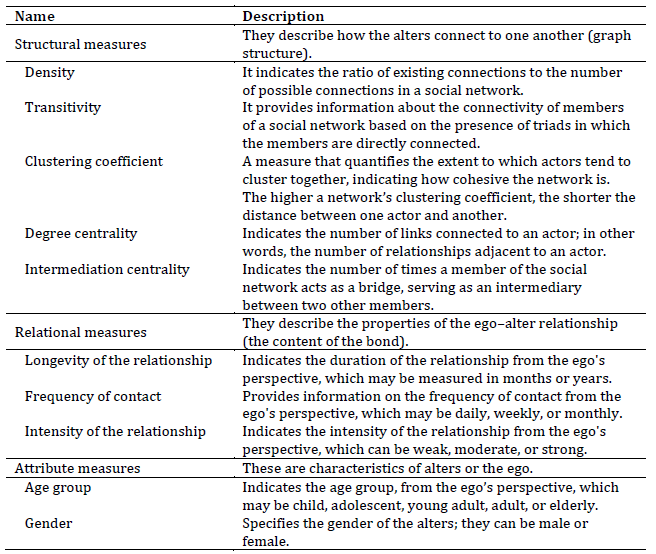
The data from the instruments used in this study were analyzed to construct indices using Principal Component Analysis. This step enabled Correspondence Analysis to be performed based on Total Stress scores, as well as on Personal Network Characteristics, which are specific dimensions of the personal network provided by the instrument, namely: a) Structural measures (Density, Transitivity, Clustering, Degree Centrality, and Betweenness); b) Relational measures (Relationship Duration; Contact Frequency; Relationship Intensity); c) Attribute measures (Age Group; Gender). Table 1 defines the respective variables.
Initially, the results of the PSI/SF and QRS enabled the construction of indices using Principal Component Analysis. The primary objective of this multivariate technique is to reduce the number of original variables and to identify which principal components (indices) explain a high proportion of the total variation associated with the original dataset. The number of Principal Components used to compose the indices developed in this study was determined based on the proportion of variance explained, with a minimum requirement of 70 % (Varella, 2008). After obtaining the indices of the stress variables, it was possible to calculate the scores for each family, which allowed for the standardization of the obtained values so that they could be evaluated on a scale of 0 to 1 or 0 to 100%. Next, the mothers were classified into two distinct groups according to the theory of sample quartiles, using the 3rd quartile (Q3) value as the cutoff point (Bussab & Morettin, 2017). The groups were named (1) Low: the group of mothers with the lowest 75 % of stress scores, and (2) High: the group of mothers with the highest 25 % of stress scores. The gender variable was categorized as Female and Male. These analyses were performed using Minitab version 18.0 and Excel.
Subsequently, Correspondence Analysis (CA) was conducted to associate the overall stress index with the indices of structural variables in the social network. CA is an exploratory technique used to verify associations between qualitative variables or categorized continuous variables (Fávero et al., 2009). Its main feature is the reduction of data to be analyzed by the researcher with minimal loss of information, transforming the rows and columns of tables into corresponding units that can be represented jointly. Correspondence analysis was performed using the Statistica software, version 6.0. In all tests, α = 5 % (p ≤ .05) was set for rejection of the null hypothesis.
Ethical considerations
This project was reviewed by the Ethics Committee of the Institute of Health Sciences at the Federal University of Pará (ICS) and received approval for its implementation (protocol no. 473.140). Participants selected based on the inclusion criteria were informed about the confidentiality of their information, the objectives of the study, and the potential risks and benefits of participation. Upon agreeing to participate in the study, they were asked to sign the Informed Consent Form.
Results
The internal consistency of the parental stress scale data was assessed using Cronbach’s alpha. The scale demonstrated good reliability, with α = .83 (95 % CI (.78, .88)).
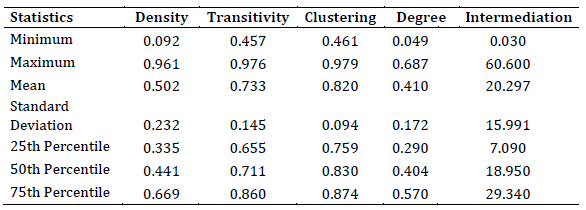
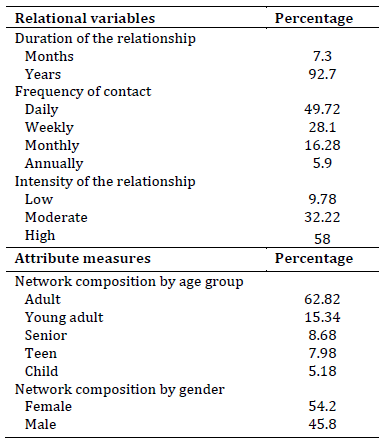
Analysis of the reported networks revealed the structural statistical parameters presented in Table 2, while the relational and attribute parameters are shown in Table 3. The data on total parental stress indicate difficulties experienced by mothers or fathers in fulfilling their roles with their sons and daughters. In this study, the mean score was 106 (SD 19.07), exceeding the cutoff point for high stress, that is, percentiles starting at 85 (P85). These results indicate that most mothers experience high levels of stress resulting from caring for children with disabilities.
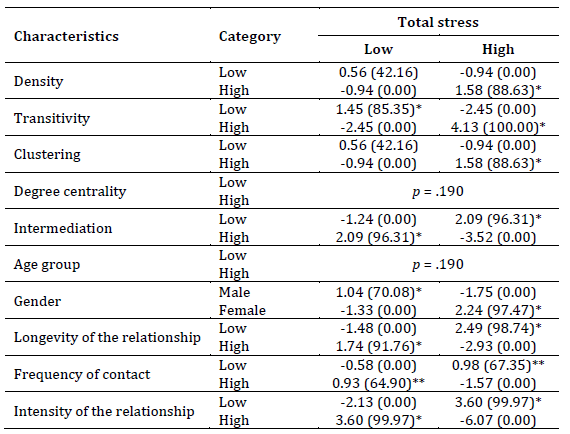
The association between total stress data and indices of structural network variables is summarized in Table 4, where the results of the correspondence analysis were applied. An association was observed between the characteristics of the personal network (density, transitivity, clustering, degree centrality, and betweenness) and the variables: age group, gender, relationship duration, contact frequency, and relationship intensity in two groups of mothers: those with low stress and those with high stress. The first group exhibits personal network characteristics with low transitivity, high intermediation, consisting of males, high relationship duration, high contact frequency, and high relationship intensity. Density and clustering were not significant.
The first group of mothers of children with cerebral palsy who reported low stress levels exhibited network characteristics of low transitivity, high intermediation, a network composed primarily of men, high relationship durability, high contact frequency, and high relationship intensity. Network density and clustering were not significant.
Mothers experiencing high levels of parental stress, in turn, exhibit greater cohesion in their personal networks. In fact, the analysis revealed high network density, high transitivity, a high clustering index, and low betweenness centrality. Furthermore, this group was predominantly composed of women and exhibited low relationship durability, low contact frequency, and low relationship intensity.
Discussion
This study highlights important findings regarding the association between stress and social networks, based on the specific characteristics revealed in the structural measures of the social networks of the high-stress and low-stress groups. Initially, it was found that most of the women studied experience high levels of total parental stress. This result is consistent with previous studies that found high levels of parental stress among caregivers of children with cerebral palsy (Méio & Morsch, 2023), as well as among caregivers of children with other developmental disorders (Bemister et al., 2021; Mokarin, 2023).
Mothers’ perception of high parental stress was significantly associated with cohesive networks and low centrality indices. This structure is justified, in particular, by family relationships. In a way, when considering that most of the network is composed of family members, it is noted that the established relationships are direct, since the members know one another, and may be permeated not only by the sharing of resources but also by shared stress, as described by Silva et al. (2020).
In this regard, although the formation of groups within the network is beneficial, for example, for providing support to mothers of children with cerebral palsy, the presence of strong connections among the actors results in a narrower range of resources and greater control within the relationships (Silveira & Farina, 2012). In other words, being part of highly cohesive groups can be a source of stress for mothers due to the limitations on contact with external people and environments.
These results contradict most of the literature, which tends to associate cohesive networks with predominantly positive effects on well-being and stress coping. Studies show that dense networks foster greater emotional support, stability, and reciprocity, serving as an important resource for mothers in high-demand situations, such as caring for children with disabilities (Cassel, 1976; Domínguez & Hollstein, 2014; Sluzki, 1997; Zhang & Yu, 2022). However, Love & Zelikowsky’s (2020) perspective offers a possible interpretive framework for understanding this finding: very dense networks tend to restrict the diversity of resources and reinforce internal social controls, which can generate stress and limit access to new forms of support.
The perception of high stress by most mothers was also associated with low levels of relationship durability, contact frequency, and relationship intensity, indicating levels opposite to the findings among mothers with low stress. These results indicate that the fragility of social ties, mediated by mothers’ difficulties in both expanding their networks and maintaining relationships, is a factor that generates or reinforces parental stress. In fact, investing in personal network relationships depends, above all, on available energy and time-aspects that mothers sacrifice because they are overwhelmed by the demands of caring for a child with cerebral palsy, as noted by Freitag et al. (2018).
The results also revealed that the predominance of women in the personal network was associated with high stress levels, while the prevalence of men was associated with low stress. These findings can be understood in light of gender differences in the dynamics of social support. The literature shows that women tend to assume a greater emotional and relational burden in interactions, which can make predominantly female networks more demanding and emotionally intense, contributing to higher levels of stress (Belle, 1987; Rose et al., 2022; Taylor et al., 2000). These bonds, while offering support, also carry higher expectations of reciprocity and a greater likelihood of emotional contagion.
In contrast, networks with a greater male presence tend to provide more instrumental support, which is less emotionally charged and involves fewer demands for relational maintenance, which may reduce perceived stress (Antonucci et al., 2014; Cutrona & Russell, 1990). Furthermore, male relationships often involve less emotional vigilance, resulting in less affective pressure.
Low stress was also associated with personal networks characterized by low transitivity (a tendency toward the formation of tightly-knit groups) and high intermediation (control and mediation of information within the network). These data indicate that greater relationship variability, with the presence of individuals in the network who play important roles in providing support, in particular, creates a relational environment with lower stress for mothers of children with cerebral palsy. These characteristics of the networks of mothers with low stress are essential for understanding the favorable context for the exercise of motherhood, since the task of caring for a child with a disability is arduous not only due to the overload but also due to the lack of support sensitive to actual parental needs, as stated by Afonso (2016). Given the data presented, it is noted that the perception of parental stress is linked to impairments in personal characteristics that are reinforced by the network effect. It is observed that, while on the one hand the strength and resources of mothers to engage in relationships and care for their children are compromised, on the other hand the network may consist of insufficient people and resources for well-being, thus generating high levels of parental stress. From another perspective, mothers with low stress are subject to a more diverse relational environment, which helps mitigate the effects of the burden of child care. In this sense, efforts to understand the stress arising from the exercise of the parental role and the respective structure of the personal network of mothers of children with cerebral palsy may reveal conditions that contribute to and result from the vulnerability experienced by these mothers.
The aspects elucidated in this study, however, are limited to the investigated population. In this sense, its limitations are associated with the use of convenience sampling, which does not allow for the generalization of results to the rest of the population. It is therefore suggested to advance knowledge of the personal networks of family members of children with other disabilities in the Amazonian context, using probabilistic sampling. Such investigations can help understand the dynamics governing the relationships of mothers of children with developmental disabilities, as well as contribute to the development of public policies aimed at these families, where mothers of children with disabilities can find support to alleviate parental stress.
The results of this study indicate that the family adaptation process following a disability diagnosis is not limited to an initial period of crisis but involves continuous adjustments in family dynamics, the division of roles, and the organization of daily life. In this sense, the findings suggest the need for family-centered interventions from the moment of diagnosis, with systematic psychosocial support and longitudinal follow-up, especially in the first years after the child’s birth.
Furthermore, by identifying factors associated with better family functioning, this study contributes to the planning of more targeted clinical practices, such as parental guidance programs, strengthening of social support networks, and intersectoral coordination between health, social assistance, and education. Such implications are particularly relevant in contexts where access to specialized services is limited, reinforcing the importance of integrated care models that are sensitive to the cultural and socioeconomic specificities of families.
References
-
Abidin, R. R. (1992). The determinants of parenting behavior. Journal of Clinical Child Psychology, 21(4), 407-412. https://doi.org/10.1207/s15374424jccp2104_12
» https://doi.org/10.1207/s15374424jccp2104_12 - Abidin, R. R. (1995). Parenting stress index (3rd ed.): Professional manual Psychological Assessment Resources.
-
Acoba, E. F. (2024). Social support and mental health: the mediating role of perceived stress. Frontiers in Psychology, 15, 1330720. https://doi.org/10.3389/fpsyg.2024.1330720
» https://doi.org/10.3389/fpsyg.2024.1330720 -
Afonso, T. (2016). Práticas de cuidado, redes de apoio e satisfação social de cuidadores primários de crianças com paralisia cerebral (Tese de doutorado). http://ppgtpc.propesp.ufpa.br/ARQUIVOS/teses/Tatiana%20Afonso%202016.pdf
» http://ppgtpc.propesp.ufpa.br/ARQUIVOS/teses/Tatiana%20Afonso%202016.pdf -
Antonucci, T. C., Ajrouch, K. J., & Birditt, K. S. (2014). The convoy model: Explaining social relations from a multidisciplinary perspective. The Gerontologist, 54(1), 82-92. https://doi.org/10.1093/geront/gnt118
» https://doi.org/10.1093/geront/gnt118 -
Araújo, Y. B., Reichert, A. P. S., Vasconcelos, M. G., & Collet, N. (2013). Fragilidade da rede social de famílias de crianças com doença crônica. Revista Brasileira de Enfermagem, 66(5), 675-81. https://doi.org/10.1590/S0034-71672013000500006
» https://doi.org/10.1590/S0034-71672013000500006 -
Baltor, M. R. R., Borges, A. A., & Dupas, G. (2014). Interação com a criança com paralisia cerebral: comunicação e estigma. Escola Anna Nery Revista de Enfermagem, 18(1), 47-53. https://doi.org/10.5935/1414-8145.20140007
» https://doi.org/10.5935/1414-8145.20140007 - Belle, D. (1987). Gender differences in the social moderators of stress. Em R. C. Barnett, L. Biener & G. K. Baruch (Eds.), Gender and stress (pp. 257-277). Free Press.
-
Bemister, T. B., Brooks, B. L., Dyck, R. H., Kirton, A., & Zewdie, E. (2021). Parent and family impact of raising a child with cerebral palsy: A systematic review. Developmental Medicine & Child Neurology, 63(11), 1309-1320. https://doi.org/10.1111/dmcn.14923
» https://doi.org/10.1111/dmcn.14923 -
Braum, S., Nascimento, R. G. do, Pires, S., Cunha, K., & Silva, S. (2021). Práticas de cuidado de mães de crianças com paralisia cerebral. Mudanças - Psicologia Da Saúde, 29(1), 1-8. https://doi.org/10.15603/2176-1019/mud.v29n1p1-8
» https://doi.org/10.15603/2176-1019/mud.v29n1p1-8 - Bussab, W. O., & Morettin, P. A. (2017). Estatística Básica (9ª ed.). Saraiva.
-
Carvalho, J. T. M, Rodrigues, N. M., da Silva, L. V. C., & Oliveira, D. A. (2017). Qualidade de vida das mães de crianças e adolescentes com paralisia cerebral. Fisioterapia em Movimento, 23(3). https://doi.org/10.1590/S0103-51502010000300006
» https://doi.org/10.1590/S0103-51502010000300006 -
Cassel J. (1976). The contribution of the social environment to host resistance: the Fourth Wade Hampton Frost Lecture.American journal of epidemiology,104(2), 107-123. https://doi.org/10.1093/oxfordjournals.aje.a112281
» https://doi.org/10.1093/oxfordjournals.aje.a112281 -
Cohen, S., & Wills, T. A. (1985). Stress, social support, and the buffering hypothesis. Psychological Bulletin, 98(2), 310-357. https://doi.org/10.1037/0033-2909.98.2.310
» https://doi.org/10.1037/0033-2909.98.2.310 -
Cunha, K. D. C., Pontes, F. A. R., & Silva, S. S. D. C. (2017). Pais de crianças com paralisia cerebral pouco estressados. Revista Brasileira de Educação Especial, 23(1), 111-126. https://doi.org/10.1590/S1413-65382317000100009
» https://doi.org/10.1590/S1413-65382317000100009 - Cutrona, C. E., & Russell, D. W. (1990). Type of social support and specific stress: Toward a theory of optimal matching. Em B. R. Sarason, I. G. Sarason & G. R. Pierce (Eds.), Social support: An interactional view (pp. 319-366). Wiley.
-
De Souza, Y. L. D. C., Freire, V. R. B. P., Cunha, K. D. C., & Silva, S. S. da C. (2018). Rede de suporte social de mães de crianças com paralisia cerebral em Belém do Pará. Mudanças - Psicologia Da Saúde, 26(1), 1. https://doi.org/10.15603/2176-1019/mud.v26n1p1-10
» https://doi.org/10.15603/2176-1019/mud.v26n1p1-10 -
Dezoti, A. P., Cosvoski Alexandre, A. M., de Souza Freire, M. H., Alves das Mercês, N. N., & de Azevedo Mazza, V. (2015). Apoio social a famílias de crianças com paralisia cerebral. Acta Paulista de Enfermagem, 28(2). https://doi.org/10.1590/1982-0194201500029
» https://doi.org/10.1590/1982-0194201500029 -
Dias, B. C., Marcon, S. S., Reis, P. D., Lino, I. G. T., Okido, A. C. C., Ichisato, S. M. T., & Neves, E. T. (2020). Dinâmica familiar e rede social de famílias de crianças com necessidades especiais de cuidados complexos/contínuos. Revista Gaúcha de Enfermagem, 41, e20190178. https://doi.org/10.1590/1983-1447.2020.20190178
» https://doi.org/10.1590/1983-1447.2020.20190178 - Domínguez, S., & Hollstein, B. (Eds.). (2014). Mixed methods social networks research: Design and applications Cambridge University Press.
- Fávero, L. P., Belfiore, P., Silva, F. D., & Chan, B. L. (2009). Análise de dados: Modelagem multivariada para tomada de decisões Elsevier.
- Ferrari, J. P., & Morete, M. C. (2018). Reações dos pais diante do diagnóstico de paralisia cerebral em crianças com até 4 anos. Cadernos de Pós-graduação em Distúrbios do Desenvolvimento, 4(1).
- Ferreira, M. C., Di Naccio, B. L., Otsuka, M. Y. C., de Melo Barbosa, A., Corrêa, P. F. L., & Gardenghi, G. (2016). Avaliação do índice de sobrecarga de cuidadores primários de crianças com paralisia cerebral e sua relação com a qualidade de vida e aspectos sócioeconômicos. Acta Fisiátrica, 22(1), 9-13.
-
Freire, V. R. B. P., Valente, M. D. R., Pontes, F. A. R., Silva, S. S. da C., & Käppler, C. de O. (2017). Models of self in families of people with spina bifida. Paidéia (Ribeirão Preto), 27(68), 263-271. https://doi.org/10.1590/1982-43272768201703
» https://doi.org/10.1590/1982-43272768201703 -
Freitag, V. L., Milbrath, V. M., & Motta, M. D. G. C. (2018). Mãe-cuidadora de criança/adolescente com Paralisia Cerebral: O cuidar de si. Enfermería Global, (50). https://doi.org/10.6018/eglobal.17.2.265821
» https://doi.org/10.6018/eglobal.17.2.265821 - Fritz, H. L., & Sewell-Roberts, C. (2020). Family stress associated with cerebral palsy. En F. Miller, S. Bachrach, N. Lennon & M. O’Neil (Eds.), Cerebral palsy (pp 515-545). Springer Nature Press.
-
Hickey, L., Shepherd, D. A., Bornemisza, A., Sutherland, I., Lucia, A., Yates, M., Nguyen, H. T. D., & Baikie, G. (2025). Family life and the integration of care of a child with neurodevelopmental disability: Parental experiences and predictive factors of family functioning, adjustment and understanding disability. Child: Care, Health and Development, 51(6), e70172. https://doi.org/10.1111/cch.70172
» https://doi.org/10.1111/cch.70172 - Lazega, E., & Higgins, S. S. (2014). Redes sociais e estruturas relacionais Fino Traço.
-
Le, Y., McDaniel, B. T., Leavitt, C. E., & Feinberg, M. E. (2016). Longitudinal associations between relationship quality and coparenting across the transition to parenthood: A dyadic perspective. Journal of Family Psychology, 30(8), 918. https://doi.org/10.1037/fam0000217
» https://doi.org/10.1037/fam0000217 -
Lei, X., & Wang, T. (2025). Face concern and affiliate stigma in caregivers of children with disabilities: social exclusion and network impacts. International Journal of Disability, Development and Education, 72(1), 112-130. https://doi.org/10.1080/20473869.2025.2511667
» https://doi.org/10.1080/20473869.2025.2511667 -
Lima, M. B. S.; Cardoso, V. D. S., & Silva, S. S. D. C. (2016). Parental stress and social support of caregivers of children with cerebral palsy. Paidéia, 26(64), 207-214. https://doi. org/10.1590/1982-43272664201608
» https://doi. org/10.1590/1982-43272664201608 -
Liu, F., Shen, Q., Huang, M., & Zhou, H. (2023). Factors associated with caregiver burden among family caregivers of children with cerebral palsy: a systematic review. BMJ Open, 13(4), e065215. https://doi.org/10.1136/bmjopen-2022-065215
» https://doi.org/10.1136/bmjopen-2022-065215 -
Love, J., & Zelikowsky, M. (2020). Stress Varies Along the Social Density Continuum. Frontiers in Systems Neuroscience, 14, 582985. https://doi.org/10.3389/fnsys.2020.582985
» https://doi.org/10.3389/fnsys.2020.582985 -
Marques, A. K. M. C., Landim, F. L. P., Collares, P. M., & Mesquita, R. D. (2011). Apoio social na experiência do familiar cuidador. Ciências e saúde coletiva, 16(1), 945-955. https://doi.org/10.1590/S1413-81232011000700026
» https://doi.org/10.1590/S1413-81232011000700026 - McCarthy (2002). A thematic guide to optimality theory Cambridge University Press.
-
McCarty, C. (2010). La estructura en las redes personales. Redes. Revista Hispana Para El Análisis de Redes Sociales, 19(2), 242-271. https://doi.org/10.5565/rev/redes.262
» https://doi.org/10.5565/rev/redes.262 -
Méio, M. D. B. B., & Morsch, D. S. (Orgs.). (2023). Nascimento Prematuro: repercussões no desenvolvimento integral FIOCRUZ. https://doi.org/10.7476/9786557082195
» https://doi.org/10.7476/9786557082195 -
Minetto, M. D. F. J. (2010). Práticas educativas parentais, crenças parentais, estresse parental e funcionamento familiar de pais de crianças com desenvolvimento típico e atípico (Tese de doutorado). Repositorio Institucional. https://repositorio.ufsc.br/handle/123456789/94159
» https://repositorio.ufsc.br/handle/123456789/94159 -
Mokarin, G. B. (2023). Estigma e estresse na maternagem de pessoas com transtorno do espectro do autismo (Tese de doutorado). Universidade Federal de Minas Gerais. https://repositorio.ufba.br/handle/ri/38295
» https://repositorio.ufba.br/handle/ri/38295 -
Newman, M. E. J. (2003). The structure and function of complex networks. SIAM Review, 45, 167-256. https://doi.org/10.1137/S003614450342480
» https://doi.org/10.1137/S003614450342480 -
Nunes, T. G. R., Pontes, F. A. R., & Silva, L. I. da C. (2020). Juventude e apoio social: um olhar sobre as redes sociais de estudantes paraenses. Praxis Educativa, 15, 1-21. https://doi.org/10.5212/praxeduc.v15.13534.017
» https://doi.org/10.5212/praxeduc.v15.13534.017 -
Pereira, A. R. P. de F., Matsue, R. Y., Vieira, L. J. E. de S., & Pereira, R. V. S. (2014). Análise do cuidado a partir das experiências das mães de crianças com paralisia cerebral. Saúde e Sociedade, 23(2), 616-625. https://doi.org/10.1590/S0104-12902014000200021
» https://doi.org/10.1590/S0104-12902014000200021 -
Pinquart, M. (2018). Parenting stress in caregivers of children with chronic physical condition-A meta‐analysis. Stress and Health, 34(2), 197-207. https://doi.org/10.1002/smi.2780
» https://doi.org/10.1002/smi.2780 -
Prime, H., Wade, M., & Browne, D. T. (2020). Risk and resilience in family well-being during the COVID-19 pandemic. American Psychologist, 75(5), 631-643. https://doi.org/10.1037/amp0000660
» https://doi.org/10.1037/amp0000660 - Ribeiro, M. F. M., Sousa, A. L. L., Vandenberghe, L., & Porto, C. C. (2014). Estresse parental em mães de crianças e adolescentes com paralisia cerebral. Revista Latino-Americana de Enfermagem, 22, 440-447.
-
Rose, A. J., Schwartz-Mette, R. A., Glick, G. C., Smith, R. L., & Luebbe, A. M. (2022). Co-rumination and adjustment: A meta-analytic review. Psychological Bulletin, 148(3-4), 163-191. https://doi.org/10.1037/bul0000351
» https://doi.org/10.1037/bul0000351 -
Scheibner, C., Scheibner, M., Hornemann, F., Arélin, M., Hennig, Y. D., Kiep, H., Wurst, U., Merkenschlager, A., & Gburek-Augustat, J. (2024). Parenting stress in families of children with disabilities: Impact of type of disability and assessment of attending paediatricians. Child: Care, Health and Development, 50(1), e13193. https://doi.org/10.1111/cch.13193
» https://doi.org/10.1111/cch.13193 - Silva, I. M. D., Schmidt, B., Lordello, S. R., Noal, D. D. S., Crepaldi, M. A., & Wagner, A. (2020). As relações familiares diante da COVID-19: recursos, riscos e implicações para a prática da terapia de casal e família. Pensando famílias, 24(1), 12-28.
-
Silva, S. S. C., & Pontes, F. A. R. (2016). Rotina de famílias de crianças com paralisia cerebral. Educar em Revista, 32(59), 65-78. https://doi.org/10.1590/0104-4060.44688
» https://doi.org/10.1590/0104-4060.44688 - Silveira, M. A. P., & Farina, M. C. (2012). Análise de redes sociais como ferramenta que contribui para a melhoria das relações entre empresas participantes de um APL de eventos. Redes, 17(1), 33-54.
-
Simplício, J. P. D. S. (2023). Proposta de um modelo de representação de ecossistemas empreendedores baseado na teoria das redes complexas (Tese de doutorado). Universidade Federal da Bahia. https://repositorio.ufba.br/handle/ri/38295
» https://repositorio.ufba.br/handle/ri/38295 - Sluzki, C. (1997). A rede social na prática sistêmica: Alternativas terapêuticas Casa do Psicólogo.
-
Tang, L., Zhang, C., & Cui, Y. (2025). The association between social connectedness and psychological well‐being among international students: Social support moderates the mediating effects of loneliness and perceived stress. Psychology in the Schools, 62(5), 1434-1452. https://doi.org/10.1002/pits.23405
» https://doi.org/10.1002/pits.23405 -
Taylor, S. E., Klein, L. C., Lewis, B. P., Gruenewald, T., Gurung, R. A. R., & Updegraff, J. A. (2000). Biobehavioral responses to stress in females: Tend-and-befriend, not fight-or-flight. Psychological Review, 107(3), 411-429. https://doi.org/10.1037/0033-295X.107.3.411
» https://doi.org/10.1037/0033-295X.107.3.411 -
Unger, D. G., & Powell, D. R. (1980). Supporting families under stress: The role of social networks. Family Relations, 29(4), 566. https://doi.org/10.2307/584473
» https://doi.org/10.2307/584473 - Varella, C. A. A. (2008). Análise de componentes principais Universidade Federal Rural do Rio de Janeiro.
-
Veiga, I. N. (2022). Sentidos atribuídos à paternidade em famílias de crianças com paralisia cerebral (Tese de doutorado). Universidade Católica do Salvador. https://ri.ucsal.br/handle/123456789/4812
» https://ri.ucsal.br/handle/123456789/4812 -
Veningston, K., Kadry, S., Kalash, H. S., Balamurugan, B., & Sathiyaraj, R. (2020). Intelligent social network based data modeling for improving health care. Health and Technology, 10(1), 321-332. https://doi.org/10.1007/s12553-019-00303-w
» https://doi.org/10.1007/s12553-019-00303-w -
Vrankić Pavon, M., Wagner Jakab, A., & Löw, A. (2024). Exploring relationship satisfaction in mothers of children with disabilities: The predictive role of interparental conflicts and moderating role of dyadic coping. Frontiers in Psychiatry, 14, 1307827. https://doi.org/10.3389/fpsyt.2023.1307827
» https://doi.org/10.3389/fpsyt.2023.1307827 - Wasserman, S., & Faust, K. (1994). Social Network Analysis: Methods and Applications Cambridge University Press.
-
Wellman, B., & Wortley, S. (1990). Different strokes from different folks: Community ties and social support. American Journal of Sociology, 96(3), 558-588. https://doi.org/10.1086/229572
» https://doi.org/10.1086/229572 -
Wilson, J. L., Aravamuthan, B., & O’Malley, J. A. (2023). Cerebral palsy Em D. M. Kamat & L. Sivaswamy (Eds.). Symptom-Based Approach to Pediatric Neurology (pp. 541-564). Springer. https://doi.org/10.1007/978-3-031-10494-7_29
» https://doi.org/10.1007/978-3-031-10494-7_29 -
Zhang, J., & Yu, Z. (2022). Network structural diversity and access to social resources: Evidence from personal networks in urban China. Social Networks, 71, 19-29. https://doi.org/10.1016/j.socnet.2022.01.002
» https://doi.org/10.1016/j.socnet.2022.01.002