Emotional effects elicited by football images: A study on fanaticism
Abstract:
The present study investigated the effects of the favorite and rival team visualization on valence and emotional arousal indicators, verifying for possible interactions with the fanaticism level in soccer fans. Twenty-seven volunteers (Mage = 22; SD= 3.25) participated in this experiment, who evaluated the pleasantness (hedonic valence) and the emotional arousal (activation) triggered by a set of neutral, positive and negative images of the International System of Affective Pictures (IAPS) plus 30 experimental images of the favorite and rival team. Evaluations were performed using the Self Assessment Manikin (SAM) scale and the Football Supporter Fanatism Scale (FSFS). Comparative analysis revealed that fanaticism did not influence the assignment of hedonic valence to the images. However, individuals with higher levels of fanaticism exhibited greater arousal in response to neutral (p< .01; d= 0.914), favorite (p< .01; d= 1.49), and rival images (p< .01; d= 0.83). The dispersion analysis suggested the involvement of appetitive and aversive motivational systems in response to images of the favorite and rival teams, respectively. The study findings lead to a better understanding of the fanaticism in soccer.
Keywords:
fanaticism; soccer; affective valence; emotional arousal; sport psychology
Resumo:
O presente estudo investigou os efeitos da visualização de imagens de times favoritos e rivais nos indicadores de valência e ativação emocional, averiguando possíveis interações com os níveis de fanatismo em torcedores de futebol. Participaram deste experimento 27 voluntários (M= 22 anos; DP= 3,25), que avaliaram a agradabilidade (valência hedônica) e a excitação emocional (ativação) desencadeada por um conjunto de imagens neutras, positivas e negativas do Sistema Internacional de Figuras Afetivas (IAPS), acrescido de 30 imagens experimentais pareadas, sendo 15 do time favorito e 15 do time rival. As avaliações foram realizadas através da escala Self Assessment Manikin (SAM) e da Escala de Fanatismo em Torcedores de Futebol (EFTF). Análises comparativas demonstraram que o nível de fanatismo não influenciou na atribuição da valência hedônica às imagens. Contudo, o grupo com níveis mais altos de fanatismo apresentou maior excitação emocional em resposta a imagens neutras (p< 0,01; d= 0,914), do time favorito (p< 0,01; d= 1,49) e do time rival (p< 0,01; d= 0,83). A análise de dispersão sugeriu o envolvimento dos sistemas motivacionais apetitivo e aversivo em reação às imagens do time favorito e rival, respectivamente. Os resultados do estudo auxiliam na compreensão do fenômeno do fanatismo no futebol.
Palavras-chave:
f fanatismo; futebol; valência afetiva; ativação emocional; psicologia do esporte
Resumen:
El presente estudio investigó los efectos de la visualización de imágenes de equipos favoritos y rivales en los indicadores de valencia y activación emocional para averiguar la interacción con los niveles de fanatismo de los hinchas de fútbol. Veintisiete voluntarios (M= 22 años; DE= 3.25) participaron en este experimento, quienes evaluaron la agradabilidad (valencia hedónica) y la excitación emocional (activación) desencadenada por un conjunto de imágenes neutrales, positivas y negativas del International System of Affective Pictures (IAPS), con más de 30 imágenes experimentales del equipo favorito y el rival. Las evaluaciones se realizaron utilizando la escala Self Assessment Manikin (SAM) y la Escala de Fanatismo en Hinchas de Fútbol (EFHF). Análisis comparativos demostraron que el nivel de fanatismo no influyó en la atribución de la valencia hedónica de las imágenes. Sin embargo, las personas con niveles más altos de fanatismo presentaron una excitación superior ante imágenes neutras (p< .01; d = 0.914), imágenes del equipo favorito (p< .01; d= 1.49) e imágenes del equipo rival (p< .01; d= 0.83). El análisis de dispersión sugirió la implicación de los sistemas motivacionales apetitivos y aversivos en respuesta a las imágenes del equipo favorito y rival, respectivamente. Los resultados del estudio ayudan a comprender el fanatismo en el fútbol.
Palabras clave:
fanatismo; fútbol; valencia afectiva; excitación emocional; psicología del deporte
Football is a globally popular sport, establishing itself as a transcultural phenomenon capable of generating significant impacts on our society (Wann & James, 2018). Beyond the economic dimension and other social impacts, conflicts between fans have required public policies in the areas of social security and urban mobility, with relevant socioeconomic implications (Louis, 2023). When it comes to violence in football, Brazil has alarming rates. Evidence suggests that Brazil may be considered one of the main countries in the world where the most people are killed for soccer-related reasons (Brandão et al., 2020; Murad, 2017). Data also show a trend of increasing trials held by the Supreme Court of Sports Justice regarding cases related to stadium violence (Castro, 2014).
The literature has shown that the mere visual processing of affective stimuli is already capable of influencing parameters such as human physiology and behavior (Mulckhuyse, 2018; Polo et al., 2024; Zsidó, 2024). More specifically regarding the football context, research has demonstrated that simply observing images related to this sport can trigger the activation of emotional circuits in the brains of fans (Duarte et al., 2017; Kelly et al., 2009; Park et al., 2009). Park et al. (2009) demonstrated that the perception of a favorite team in victory circumstances can trigger asymmetrical activation of limbic structures, such as the amygdala, predominantly in the left hemisphere. In defeats, the researchers detected a brain activation pattern indicative of emotional suppression.
Behavioral studies have already found that football stimuli can also modulate cognition and motor behavior (Conde et al., 2011; Conde et al., 2018; Oliveira et al., 2021). Through a reaction time measurement protocol, known as the stimulus-response compatibility task, it is possible to verify significant temporal differences in responses to the favorite and rival teams. More specifically, using images representing soccer players from the main teams in Rio de Janeiro as target stimuli, Conde et al. (2011) adapted the stimulus-response compatibility task to study whether the variable "preference" could modulate the response times to stimuli representing the participant’s favorite and rival teams. The stimuli could appear on either the left or right side of the fixation point, and the responses had to be made with response keys positioned ipsilaterally or contralaterally. In a balanced manner, participants were instructed to respond with the key on the same side for the preferred team (compatible condition) and with the opposite side key (incompatible condition) for the rival team. In the second block, they performed the opposite pairing. The researchers reported a classic spatial compatibility effect for the favorite team stimuli, with spatially corresponding responses being faster than spatially incompatible ones. Meanwhile, for the rival team, an inversion of the compatibility effect was observed, with manual responses being faster when pressed on the opposite side of the appearance of the stimulus representing the rival team. These results were interpreted as evidence that responses to the favorite and rival teams were mediated by approach and avoidance mechanisms, respectively.
Additional studies (Conde et al., 2014; Oliveira et al., 2021; Proctor, 2013) have demonstrated that there are also temporal differences between the two practice blocks. More specifically, in the block where responses are ipsilateral to the preferred team and contralateral to the rival team, responses are faster than those executed to the opposite pairing (incompatible condition for the preferred team and compatible response for the rival team).
Oliveira et al. (2021) adapted the task to verify whether emotional effects triggered by football stimuli could also influence response patterns in another attentional test, known as the Simon task. In the Simon task, participants need to select the correct response as quickly as possible, based on processing an intrinsic attribute of the stimulus (such as shape or color). Even though the stimulus location is not considered for response selection, spatial codes appear to require automatic processing, which can affect motor responses. In this sense, faster responses are observed in the spatially compatible condition compared to the incompatible condition. This temporal difference between the two conditions is called the Simon effect. In Oliveira et al.'s (2021) study, it was shown that the Simon effect varies according to the preference for football teams, being greater for the favorite team. The authors interpreted the research results by indicating that the valence of positive and negative stimuli facilitates and/or inhibits motor responses. They also estimated that the increased effect for the favorite team could be an indicator that the stimulus affective valence facilitates the spatially corresponding response for the favorite team and the contralateral responses for the rival team.
Despite the aforementioned studies providing important insights into how specific football images can influence the affect, cognition, and behavior of fans, other variables need further understanding in this context, such as fanaticism. Although there are different theoretical and philosophical perspectives on fanaticism (Battaly, 2023; Cassam, 2023; Katsafanas, 2024), this construct has been widely understood as a dysfunctional psychosocial phenomenon, characterized by intense and devotional involvement with ideologies, institutions, doctrines, objects, and/or even other people (such as idols or martyrs) who represent them or share their values/ideals (Tietjen, 2023a). Currently, the study of fanaticism holds great social relevance as this phenomenon has been implicated in coercive behavior, violent and hostile actions, and even wars and extremism in various contexts (Tietjen, 2023b).
Specifically in the context of sports, fanaticism has also been widely associated with episodes of aggression, hostility, widespread violence, murders, and public disorder (Bandeira & Ramos, 2020; Conde & Coriolano, 2019; Coriolano & Conde, 2017; Louis, 2023; Zeferino et al., 2021). Given the many gaps still existing in the full understanding of this phenomenon, the present study aimed to investigate how the visualization of football team images, with antagonistic affective valence (favorite and rival), can influence emotional indicators. The research design also aimed to investigate whether different levels of fanaticism can influence the scores attributed to the dimensions of valence (whether of pleasure or displeasure) and emotional arousal (alerting or relaxing) when presented with images.
Methods
The present research can be characterized as a quasi-experimental approach, designed with independent variable control and adopting validated procedures to investigate emotional parameters resulting from the visualization of images of the favorite and rival football teams. The study used as dependent variables the measures of hedonic valence and emotional arousal, attributed to different categories of images. Adopting a comparative perspective, two levels of fanaticism were considered as an intergroup categorical variable, allowing the analysis of differences between fans classified as high and low fanaticism. The intragroup variables were established in five image categories, which included not only the favorite and rival teams but also stimuli from the International Affective Picture System (IAPS), including positive, negative, and neutral images, providing important valence and arousal parameters in comparison with the experimental images.
Participants
This study included 27 participants, 22 women and 5 men (M age = 22 years, SD = 3.25). The study was advertised on social media and through flyers placed in public areas of the Institute of Social Sciences and Regional Development (Fluminense Federal University) in Campos dos Goytacazes (Rio de Janeiro, Brazil). People were also invited in person during class breaks and while passing through the Institute, characterizing a convenience sample composed of students from various periods and undergraduate courses, as well as service providers and technical staff of the University. For the analysis, participants were divided into two distinct groups based on the levels of fanaticism verified using the Football Fanaticism Scale. More specifically, the high fanaticism group consisted of 13 people (10 women, 3 men), and the low fanaticism group consisted of 14 people (12 women, 2 men). Volunteers did not receive remuneration or academic benefits for their participation. All signed the Free and Informed Consent Form (FICF). The research was approved by the Ethics and Research Committee of the Federal University of Pernambuco (Opinion No. 2.140.159).
Instruments
Football Fanaticism Scale (FFS). This instrument allows the assessment of fanaticism levels in football/soccer fans (Wachelke et al., 2008). The 11 items of the scale evaluate behaviors, beliefs, and situations that may reflect how the person supports their football team. The instrument demonstrated acceptable psychometric indicators in a study on factorial validity and internal consistency in Brazil (Wachelke et al., 2008), such as KMO = 0.94, significant Bartlett’s test of sphericity (p < .001), eigenvalue = 6.14, and Cronbach's alpha (α = .91). The unidimensional scale has a Likert-type format with 7 points, ranging from 1 (strongly disagree) to 7 (strongly agree).
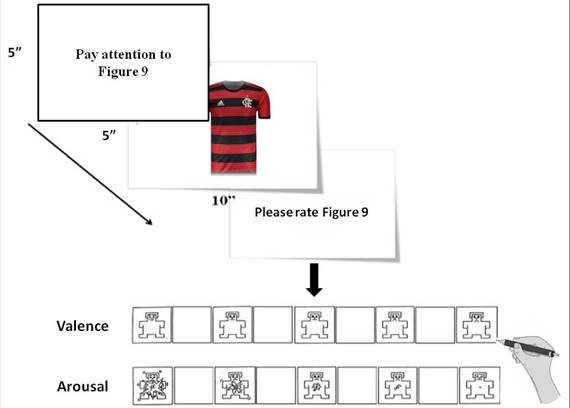
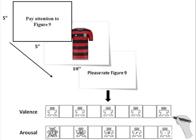
Self-Assessment Manikins Scale (SAM): This instrument uses a non-verbal pictorial perspective that is easy and quick to apply for evaluating images with emotional content (Bradley & Lang, 1994; Bynion & Feldner, 2020). With this instrument, it is possible to obtain information about two emotional dimensions: valence and arousal. The first dimension measures the degree of pleasantness of the figure presented, while the second indicates the level of alertness, arousal, or emotional excitement experienced by the volunteer when observing the image. In the scale, participants must indicate how positive or negative an image is (emotional valence) and the level of psychophysiological arousal (emotional activation) triggered by observing the images. To do so, horizontally arranged manikins are presented as graphical indicators of emotional states, with 9 response levels (Figure 1). Following the evaluation norms of the IAPS in Brazil (Lasaitis et al., 2008), each volunteer received an instruction booklet to classify the images and a pen for completion. Participants were informed that they could also use the spaces between the manikins, representing intermediate options. Thus, participants respond by classifying the images presented through SAM, marking an X on or between the five manikins.
International Affective Picture System (IAPS) and experimental stimuli: The image bank used for evaluation was composed, in a balanced manner, of positive, negative, and neutral images from the IAPS. The IAPS is a database containing 960 images, divided into 16 sets of 60 items (Branco et al., 2023). These hundreds of high-resolution photographs represent various aspects of real life (sports, fashion, landscapes, violence, etc.) (Lang et al., 2005). Many studies have already shown that IAPS images are capable of inducing a wide range of emotional states that can be easily presented in the experimental laboratory context. The present study used 60 IAPS images, with 15 negative images randomly selected, equally distributed among the subcategories of mutilation, venomous animals, and violence; 15 positive images equally distributed among erotic, sports, and family relationship with babies; and 30 neutral images equally distributed among household objects, abstract art, and indifferent faces. In addition to the IAPS images, each evaluation block included 30 paired experimental images, consisting of 15 of the favorite team and 15 of the rival team. Images from the four main football teams in Rio de Janeiro (Fluminense, Flamengo, Vasco da Gama, and Botafogo) were used. The experimental images were carefully selected from the internet considering the demand for contextual pairing, background colors, situational and symbolic for both teams. Thus, the images of each team included, in a balanced manner, categories such as flags, mascots, supporters, uniforms, objects with team symbols, and popular players.
Procedures
After signing the Free and Informed Consent Form (FICF), participants filled out a document with their personal information, where data such as date of birth, gender identity, education level, information on pathologies diagnosed by a doctor, drug and/or psychotropic medication use, possible ophthalmological issues, and whether they used corrective glasses were collected.
After filling out the sociodemographic information, participants were invited to complete the Football Fanaticism Scale (FFS) (Wachelke et al., 2008). They were also asked to rank, in order of preference, the four main football teams from Rio de Janeiro, Brazil (Fluminense, Flamengo, Vasco da Gama, and Botafogo). This procedure was used to select the visual stimuli to be used as experimental conditions, with the first and fourth teams being considered the preferred and rival teams, respectively.
Next, participants were directed to a room with controlled temperature and adequate lighting to watch a video with instructions on how to participate in the experiment. Afterward, they proceeded to the evaluation of the images and the completion of the SAM scale. The instructional video provided directions and examples on how to respond to the SAM scale for each studied dimension (valence and arousal). Participants were instructed to select only one of the nine possible responses for each image, for each of the studied dimensions, starting with valence and then arousal. They were also guided to carefully observe the images presented for the entire time they were displayed on the screen and, only afterward, mark their responses on the SAM scale, indicating how they would classify the image and how they felt while viewing the previous image. Instructions were also given not to speak during the research, not to copy other participants' responses, and to turn off electronic devices.
The evaluation began with the presentation of a slide showing the image number and informing participants that it would be displayed for 5 seconds. The image to be evaluated was then projected onto the screen for another 5 seconds. Subsequently, no slide was projected for 10 seconds, giving participants time to classify the viewed image according to the studied dimensions, starting with valence and then arousal (Figure 1). Participants were instructed to evaluate the affective valence of each image, considering that the left end of the response booklet represented the maximum positive valence (pleasant), and the right end represented the maximum negative valence (unpleasant). For the arousal evaluation, they were told to consider the left end as the maximum level of arousal and the right end as the minimum level of arousal.
Statistical Analysis
The responses obtained from the evaluation of each image (positive, negative, and neutral categories from the IAPS, as well as experimental images of the favorite and rival teams) were tabulated and organized to calculate the mean and standard deviation of the values assigned to the two dimensions measured by the SAM (emotional arousal and valence). The level of fanaticism was estimated based on the scores obtained on the Football Fanaticism Scale (FFS). To define the two groups with distinct levels of fanaticism (high and low) as a categorical variable, the median score on the FFS was established as the cutoff point. This model for defining different fanaticism groups through the FFS follows protocols previously adopted (Conde et al., 2018; Coriolano & Conde, 2017).
Next, the data were analyzed using repeated measures analysis of variance (ANOVA) with the Statistica® software (StatSoft, version 6.0). The ANOVA design included the level of fanaticism (high and low fanaticism) as the intergroup variable and the image categories as the intragroup variables: (a) favorite team; (b) rival team; (c) IAPS images with negative emotional valence; (d) IAPS images with neutral emotional valence; (e) IAPS images with positive emotional valence.
Planned contrast comparisons were used as additional analyses to minimize the risk of type I error when investigating previously formulated hypotheses, and to allow specific analyses comparing the variables of interest in isolation. The significance level for comparisons between groups was set at p ≤ 0.05. Eta squared (η²) was used to estimate the effect size indicated by the ANOVA, and Cohen's d for planned comparisons.
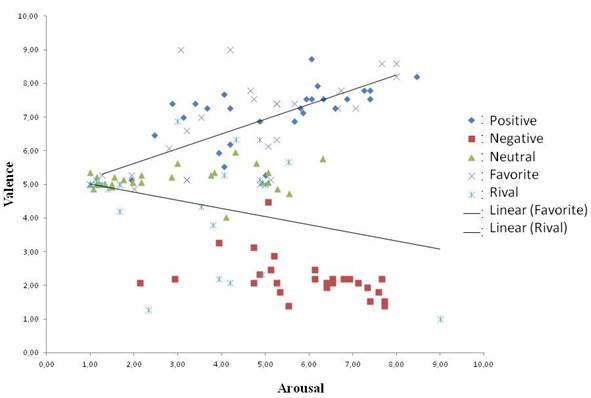
Finally, a dispersion analysis was conducted to examine the distribution of data across the dimensions of valence and emotional arousal. The data were organized to represent hedonic valence on the Y-axis and emotional arousal on the X-axis. For each category of experimental images, a linear regression line was fitted to verify the presence of the pattern described in the literature as the "boomerang pattern" (Branco et al., 2023; Lemos et al., 2024). This pattern is characterized by the distribution of data in two opposing directions, reflecting the non-linear relationship between valence and arousal (Versace et al., 2023). The boomerang pattern is commonly observed in scatterplot analyses with IAPS images, as positive and negative valence images are associated with high levels of arousal, while neutral valence images tend to show low levels of arousal (Branco et al., 2023; Lemos et al., 2024). Thus, this model defines a bidimensional affective space on the Cartesian plane, capturing motivational patterns organized into two main branches of the distribution. Based on this model, behavioral and psychophysiological evidence has enabled the identification and validation of images that evoke appetitive and aversive motivational systems, corresponding to the two arms of the boomerang pattern (Bradley et al., 2001; Branco et al., 2023; Lemos et al., 2024; Versace et al., 2023).
Results
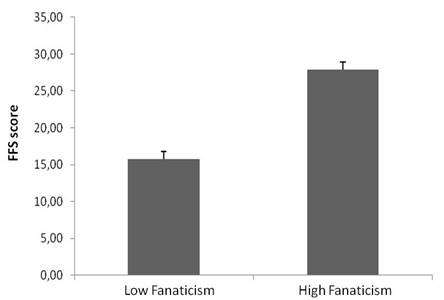
With the FFS data organized in ascending order, it was possible to use the median as a cutoff point to distinguish between the high (mean score of 27.93, SD = 9.80) and low fanaticism groups (M = 15.77, SD = 3.03), with their scores being statistically different from each other (p < .001; d = 1.67) (Figure 2).
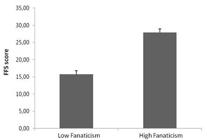
Mean scores of the high and low fanaticism groups, considering the scores on the FFS scale
Valence Analysis
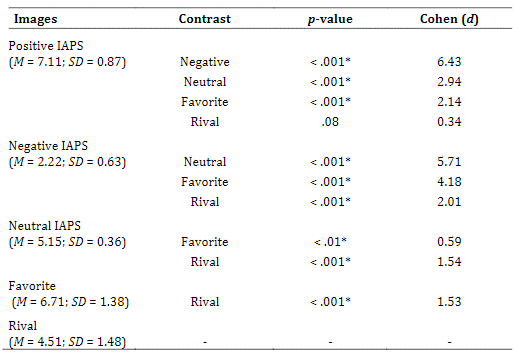
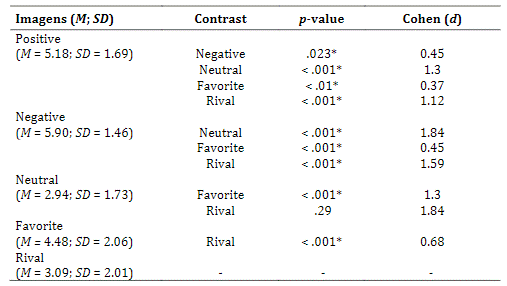
The ANOVA revealed a significant effect for the variable "Images," indicating that the categories (favorite team; rival team; positive, neutral, and negative IAPS images) differed from each other (F₄,₁₀₄ = 4.127; p< .001; η² = 0.746) regardless of the level of fanaticism. Additional planned comparisons indicated significant differences for the valence dimension between all image categories, except between the neutral IAPS images and rival team images (p = .08; d = .34). The values obtained in each comparison are specified in Table 1.
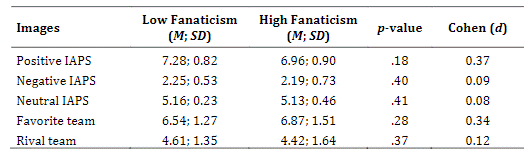
The ANOVA did not show significant interactions between the level of fanaticism and the image categories (F₄,₁₀₄ = 0.315; p = .867; η² = 0.003), indicating that the valence attributed to the images did not vary according to the level of fanaticism. Additional planned analyses confirmed the absence of significant differences between the two groups (Table 2).
Arousal Analysis
In the analysis of emotional arousal, the ANOVA revealed a significant effect for the variable "Images," showing that the different categories (favorite team; rival team; positive, neutral, and negative IAPS images) differed from each other (F₄,₁₀₄ = 27.12; p < .01; η² = 0.303) in terms of emotional arousal. Additional planned comparisons demonstrated that these differences occurred in most comparisons, except between the rival team images and neutral IAPS figures (p = .29; d = 1.84). The detailed results can be observed in Table 3.
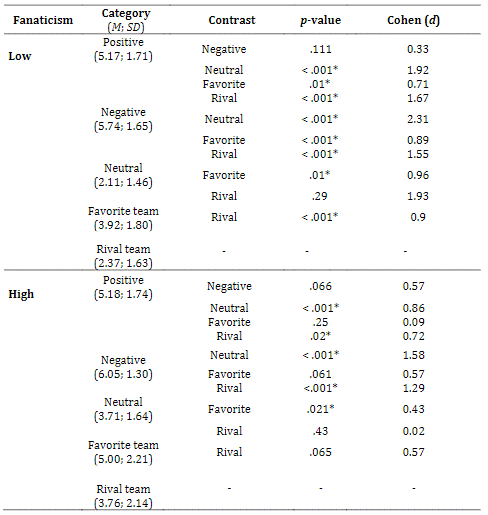
Although no interaction was found between the level of fanaticism and the emotional arousal attributed to the image categories (F4,104 = 1.92; p = .113; η2 = 0.021), planned contrast comparisons revealed distinct patterns in specific comparisons within and between high and low fanaticism groups. When analyzing the results obtained in within-group comparisons, isolating the Fanaticism factor, it was observed that both groups demonstrated that positive images do not differ from negative ones in terms of emotional arousal. This pattern was also observed between neutral images and those of the rival team. Additionally, in both groups, it was possible to identify that both positive and negative images elicited higher arousal when compared to neutral images.
However, important differences were also identified when analyzing response patterns within the groups. More specifically, it was observed that, only in the high fanaticism group, the emotional arousal triggered by the favorite team was comparable to that of positive and negative figures from the IAPS, as well as the arousal elicited by rival team images (Table 4).
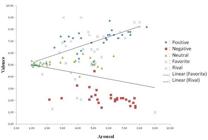
The planned analyses also revealed the existence of significant differences between the groups in terms of emotional arousal levels. More specifically, the high fanaticism group showed higher arousal levels in response to neutral images (p < .01; d = 0.914) compared to the low fanaticism group. Higher emotional arousal values were also found in the high fanaticism group in response to both rival (p < .01; d = 0.83) and favorite team images (p < .01; d = 1.49). Other between-group comparisons did not show statistical significance. Finally, the scatter plot analysis using linear regression showed a pattern consistent with the motivational vector theory (Figure 3). This theory suggests that images related to the favorite team follow a dispersion pattern similar to that of highly appetitive stimuli, while rival team images resemble the pattern of negative images. The boomerang pattern was identified through a visual inspection of the scatter plot, which was established based on the valence and arousal of the IAPS images.
Discussion
Emotions play a fundamental role in understanding sports phenomena and their impacts on society. Emotional processes not only influence athletes and teams but also have a considerable effect on fans and enthusiasts (Furley et al., 2023). The competition context seems to facilitate the cathartic expression of intense and collective emotions, which are obviously modulated by the symbolic representation of victory, defeat, identification with the favorite team, and aversion to the rival team. Therefore, understanding the psychological variables related to psychosocial phenomena such as fanaticism, mass mobilization, and herd behavior at major sporting events becomes an important challenge for the human and social sciences.
Given the various emotional conditions elicited when cheering for a team, the valence attributed by fans (positive or negative) seems to be linked to harmonious or obsessive involvement with their team (Schellenberg et al., 2024). These aspects can help in understanding emotional behavior, both celebratory and hostile, among fans (Furley et al., 2023; Schellenberg et al., 2024).
Some studies propose that valence classification in the SAM may reflect the activation of basic motivational systems, whether for reward or aversion (Bradley et al., 2001; Versace et al., 2023). This model is based on the understanding that emotional behavior involves these two basic motivational subsystems (Bradley et al., 2001; Lemos et al., 2014). In the present study, the measures obtained for affective valence in the reference figures from IAPS showed a pattern consistent with the literature (Bradley et al., 2001; Branco et al., 2023), with positive images rated as pleasant, neutral ones, and negative ones as unpleasant, with significant differences between these categories. The IAPS figures served as essential references for better contextualizing the values assigned to the experimental images of the favorite and rival teams. It was found that images of the favorite team stood out for presenting a high level of pleasantness, while images of the rival team were rated as unpleasant.
Study models from the dimensional perspective of emotions consider that measures of emotional arousal complement affective valence indicators by representing the level of motivational activation (Bradley et al., 2001; Branco et al., 2023). Considering these two emotional dimensions, valence and arousal, it would be possible to graphically represent motivational vectors on a Cartesian plane, varying in intensity (Lemos et al., 2024; Versace et al., 2023). The results reported here showed the expected pattern for the standardized IAPS images, with high levels of emotional arousal for positive and negative figures compared to neutral ones (Bradley et al., 2001; Branco et al., 2023; Lemos et al., 2024; Versace et al., 2023). The negative IAPS images were emotionally even more arousing than the positive ones. Regarding the experimental images, without considering the level of fanaticism, it was observed that the images of the favorite team elicited less arousal than the positive and negative IAPS images but more arousal than neutral and rival team images. Meanwhile, the rival team images showed a pattern of arousal similar to neutral images, being less exciting than all other categories.
However, when considering the influences of fanaticism levels, distinct patterns of emotional arousal were identified between the two groups. More specifically, the fact that the high fanaticism group showed higher levels of emotional arousal in response to neutral and experimental images, whether of the rival or favorite team, may be interpreted as evidence that this group may be more prone to emotional arousal and/or have a lower capacity for emotional regulation.
Many studies have indicated that visual stimuli with emotional or affective components can trigger significant increases in brain activity in visual, emotional, and motor circuits (Bradley et al., 2001; Carretié et al., 2022; Lin et al., 2020; Onigata & Bunno, 2020; Pereira et al., 2010; Zsidó, 2024). In line with this reasoning, the results obtained prompt reflection on the possibility that these primitive appetitive and aversive circuits may mediate fans' interactions with stimuli representing the favorite and rival teams, respectively. After all, the boomerang pattern can be observed in the scatter analysis, where it is possible to verify that the trend line established by linear regression for the arousal and valence values for the favorite team is positioned in the upper part of the graph, in the same direction as the motivational vectors for the appetitive system. Meanwhile, the linear regression line observed for the rival team images outlined a motivational vector consistent with parameters observed for the aversive motivational system. It is important to emphasize that the boomerang pattern becomes even more defined for fans with higher levels of fanaticism, due to the higher levels attributed to emotional arousal for the images of both the favorite and rival teams.
The results obtained from the analyses of fanaticism levels, along with indicators of emotional reactions to images of favorite and rival teams, reinforce the understanding that more fanatical individuals are more prone to emotional arousal. In attempting to understand the practical implications of this study, it is worth considering complementary evidence showing that increased activity in emotional circuits competes for processing resources with neural networks responsible for cognition and so-called rational behaviors (Dolcos & McCarthy, 2006). This condition may trigger emotional contagion and herd behavior, both of which are prevalent phenomena in competitive sports contexts (Neuman, 2024).
Additionally, we must consider that images of favorite and rival teams activate limbic regions, phylogenetically ancient areas known to modulate affective and motivational behavior, and that fanaticism is positively correlated with the activation of these circuits (Duarte et al., 2017). Although some evidence has suggested that interaction with visual stimuli representing favorite and rival teams recruits the appetitive and aversive motivational systems respectively (Conde et al., 2011; Conde et al., 2018; Oliveira et al., 2021), this understanding is not yet universally accepted (Proctor, 2013; Yamaguchi & Chen, 2019). In this regard, the characterization of motivational vectors for favorite and rival team images in the present study serves as further evidence indicating the involvement of appetitive and aversive systems when processing affective stimuli related to football teams.
While this investigation offers relevant contributions, it is important to carefully analyze the results presented here, considering some limitations of the study. The first and main limitation to highlight is that the sample was composed by convenience, resulting in a predominance of women in both groups. Although the use of the median to form high and low fanaticism groups has some support in the literature (Conde et al., 2018; Coriolano & Conde, 2017), this procedure made it difficult to distribute genders equally in each group, leading to an even more pronounced imbalance in the low-fanaticism group. Although the ideal sample design was not implemented, this condition does not compromise the results presented here, since the research objectives were focused on comparing different fanaticism profiles rather than gender comparisons. Additionally, Zeferino et al. (2021) did not identify gender differences in terms of fanaticism and aggression in a study that evaluated 210 fans using the FFS and the Aggression Scale (Buss & Perry, 1992). Nevertheless, it is important to recognize that further studies are needed to better understand gender differences regarding the constructs measured here, especially in terms of hedonic valence attribution and emotional arousal in response to soccer images of favorite and rival teams. Finally, this study also did not investigate potential moderating effects arising from other sociodemographic variables, such as affiliation with organized fan groups and age, which also appear to significantly influence fan behavior (Zeferino et al., 2021).
Conclusions
The crowd has been considered an important variable in supporting football culture and economy. Groups known as "organized supporters" were historically established in Brazil by fans with the aim of creating and developing bonds, celebrating, as well as strengthening feelings of rivalry and opposition. However, some of these fans are identified in the literature as more likely to be involved in violent incidents in Brazilian soccer (Louis, 2023; Ribeiro & Fernandes, 2021). In this context, it is highlighted that the impacts of soccer fanaticism have socioeconomic implications, affect urban mobility, and cause impacts on public safety and psychosocial processes. Furthermore, according to Brandão et al. (2020), violence in stadiums is established as a complex and multivariate phenomenon.
The research results provide a pioneering understanding of fanaticism and its emotional implications, with the main findings characterized by the identification of significant differences in emotional arousal levels between highly and less fanatic supporters. For the first time, it was observed how images of football teams with antagonistic affective valence are perceived by their fans and rivals, particularly regarding pleasantness (valence dimension) and emotional arousal. Additionally, motivational patterns were identified that stimulate the engagement of appetitive and aversive motivational systems, as a result of the mere observation of images representing the favorite team and the main rival, respectively. This verification supports a better understanding of why competitions mobilize thousands of people and move large amounts of money (Oliveira et al., 2021). Moreover, considering the involvement of the aversive emotional system in response to the representation of the rival team seems a plausible possibility for understanding hostility and rivalry between favorite teams and their rivals.
Given the aforementioned facts, the present study suggests that security approaches in football games should also consider the psychosocial processes and the singularities of emotional expression by fans in the relationship they establish with their team and their main rivals. In this sense, there is a demand for new planning models and the implementation of public policies to ensure the safety of fans in stadiums and pedestrians in the vicinity of the matches, considering that the most commonly adopted measures have been restricted to intelligence operations combined with visible policing as prevention during the games (Barbosa & Bueno, 2023; Rodrigues & Santos, 2024). The use of police force has also been observed in conflict situations between fans. Although there are no validated intervention models with proven effectiveness in aggressive fan behavior, Neuman's (2024) work offers reflections and innovative ideas that inspire alternative behavioral approaches to understand and deal with crowd dynamics. This alternative approach to policing might allow for more effective strategies for preventing and managing violent behaviors. It is cautiously envisioned that through psychoeducational campaigns, it may be possible to raise awareness among fans about how fanaticism manifests in their lives, addressing its emotional, behavioral implications, and its impact on social interactions, as well as helping them develop more functional emotional reactions and non-violent behaviors in sports environments, as proposed by some works (Galily et al., 2024; Neuman, 2024; Newson et al., 2023). It would also be important to consider more humanized approaches, such as psychological assessment and care for those involved in violent episodes, since simple visual stimuli, whether neutral images or especially images of the rival team, appear capable of triggering higher emotional arousal in more fanatic supporters. This proposition is based on the fact that violence among fans does not only occur inside stadiums but also in public squares, subways, busy streets, and many other public spaces. Being a multifaceted topic, new research, from a multidisciplinary perspective, may help to understand and complement the current knowledge of soccer fanaticism and its psychosocial implications. The results of the present study contribute to broadening the understanding of how fanaticism can influence the way emotional stimuli from the football context are perceived, representing the favorite-rival affective polarity inherent in sporting clashes.
References
-
Bandeira, V. F., & Ramos, D. G. (2020). Aspectos sociodemográficos relacionados à agressividade e ao fanatismo em uma torcida de futebol. Psicologia Revista, 29(1), 246-272. https://doi.org/10.23925/2594-3871.2020v29i1p246-272
» https://doi.org/10.23925/2594-3871.2020v29i1p246-272 -
Barbosa, D. S., & Bueno, V. L. A. (2023). Inteligência da Polícia Militar do Paraná como ferramenta na diminuição de confrontos violentos entre torcidas organizadas de futebol em estádios paranaenses. Brazilian Journal of Development, 9(1), 4973-4988. https://doi.org/10.34117/bjdv9n1-341
» https://doi.org/10.34117/bjdv9n1-341 -
Battaly, H. (2023). Can fanaticism be a liberatory virtue? Synthese, 201(6), 1-27. https://doi.org/10.1007/s11229-023-04174-7
» https://doi.org/10.1007/s11229-023-04174-7 -
Bradley, M., & Lang, P. (1994). Measuring emotion: The self-assessment manikin and the semantic differential. Journal of Behavioral Therapy and Experimental Psychiatry, 25, 49-59. https://doi.org/10.1016/0005-7916(94)90063-9
» https://doi.org/10.1016/0005-7916(94)90063-9 -
Bradley, M., Codispoti, M., Cuthbert, B., & Lang, P. (2001). Emotion and motivation I: defensive and appetitive reactions in picture processing. Emotion, 1, 276-298. https://doi.org/10.1037//1528-3542.1.3.276
» https://doi.org/10.1037//1528-3542.1.3.276 -
Branco, D., Goncalves, O. F., & Badia, S. B. I. (2023). A systematic review of international affective picture system (IAPS) around the world. Sensors, 23(8), 3866. https://doi.org/10.3390/s23083866
» https://doi.org/10.3390/s23083866 -
Brandão, T., Murad, M., Belmot, R., & Dos Santos, R. (2020). Álcool e violência: Torcidas organizadas de futebol no brasil. Movimento, 26, e26001. https://doi.org/10.22456/1982-8918.90431
» https://doi.org/10.22456/1982-8918.90431 -
Buss, A. H., & Perry, M. (1992). The aggression questionnaire. Journal of Personality and Social Psychology, 63(3), 452-459. https://doi.org/10.1037/0022-3514.63.3.452
» https://doi.org/10.1037/0022-3514.63.3.452 -
Bynion, T. M., & Feldner, M. T. (2020). Self-assessment manikin. Encyclopedia of Personality and Individual Differences, 4654-4656. https://doi.org/10.1007/978-3-319-24612-3_77
» https://doi.org/10.1007/978-3-319-24612-3_77 -
Carretié, L., Fernández-Folgueiras, U., Álvarez, F., Cipriani, G. A., Tapia, M., & Kessel, D. (2022). Fast unconscious processing of emotional stimuli in early stages of the visual cortex. Cerebral Cortex, 32(19), 4331-4344. https://doi.org/10.1093/cercor/bhab486
» https://doi.org/10.1093/cercor/bhab486 -
Cassam, Q. (2023). Fanaticism: for and against. Em L. Townsend, R. Tietjen, H. Schmid, & M. Staudigl (Eds.), The Philosophy of Fanaticism. Epistemic, Affective, and Political Dimensions (pp. 19-38). Routledge. https://doi.org/10.4324/9781003119 371
» https://doi.org/10.4324/9781003119 371 - Castro, C. O. (2014). Morte organizada: os bárbaros O Globo.
-
Conde, E. F. Q., Cavallet, M., Torro-Alves, N., Matsushima, E. H., Fraga-Filho, R. S., Jazenko, F., Busatto, G. & Gawryszewski, L. G. (2014). Effects of affective valence on a mixed spatial correspondence task: A reply to Proctor (2013). Psychology & Neuroscience, 7(2), 83. https://doi.org/10.3922/j.psns.2014.021
» https://doi.org/10.3922/j.psns.2014.021 - Conde, E. F. Q., & Coriolano, A. M. (2019). O fanatismo no contexto do esporte. Em K. Rubio & J. Camilo (Orgs.), Psicologia social do esporte (pp. 169-182). Képos.
-
Conde, E. F. Q., Jazenko, F., Fraga Filho, R. S., Costa, D. H. D., Torro-Alves, N., Cavallet, M., & Gawryszewski, L. G. (2011). Stimulus affective valence reverses spatial compatibility effect. Psychology & Neuroscience, 4, 81-87. https://doi.org/10.3922/j.psns.2011.1.010
» https://doi.org/10.3922/j.psns.2011.1.010 -
Conde, E. F. Q., Lucena, A. O. D. S., da Silva, R. M., Filgueiras, A., Lameira, A. P., Torro-Alves, N., Gawryszewski, L. G., & Machado-Pinheiro, W. (2018). Hemispheric specialization for processing soccer related pictures: The role of supporter fanaticism. Psychology & Neuroscience, 11(4), 329. https://doi.org/10.1037/pne0000147
» https://doi.org/10.1037/pne0000147 -
Coriolano, A. M., & Conde, E. F. Q. (2017). Fanatismo e agressividade em torcedores de futebol. Revista Brasileira de Psicologia do Esporte, 6(2). https://doi.org/10.31501/rbpe.v6i2.7092
» https://doi.org/10.31501/rbpe.v6i2.7092 -
Dolcos, F., & Mccarthy, G. (2006). Brain Systems Mediating Cognitive Interference by Emotion al Distraction. The Journal of Neuroscience, 26(7), 2072-2079. https://doi.org/10.1523/jneurosci.5042-05.2006
» https://doi.org/10.1523/jneurosci.5042-05.2006 -
Duarte, I. C., Afonso, S., Jorge, H., Cayolla, R., Ferreira, C., & Castelo-Branco, M. (2017). Tribal love: the neural correlates of passionate engagement in football fans. Social Cognitive and Affective Neuroscience, 12(5), 718-728. https://doi.org/10.1093/scan/nsx003
» https://doi.org/10.1093/scan/nsx003 - Furley, P., Laborde, S., Robazza, C., & Lane, A. (2023). Emotion s in sport. Em J. Schüler, M. Wegner, H. Plessner, & R. Eklund (Eds.), Sport and exercise psychology: theory and application (pp. 247-279). Springer International Publishing.
-
Galily, Y., Pack, S., & Tamir, I. (2024). Spectator sport and fan behavior: a sequel. Frontiers in Psychology, 15, 1414407. https://doi.org/10.3389/fpsyg.2024.1414407
» https://doi.org/10.3389/fpsyg.2024.1414407 -
Katsafanas, P. (2024). What’s so bad about fanaticism? Synthese , 203(6), 205. https://doi.org/10.1007/s11229-024-04647-3
» https://doi.org/10.1007/s11229-024-04647-3 -
Kelly, K. J., Murray, E., Barrios, V., Gorman, J., Ganis, G., & Keenan, J. P. (2009). The effect of deception on motor cortex excitability. Social Neuroscience, 4(6), 570-574. https://doi.org/10.1080/17470910802424445
» https://doi.org/10.1080/17470910802424445 - Lang, B., Bradley, M., & Cuthbert, B. (2005). International affective picture system (IAPS): Digitized photographs, instruction manual and affective ratings (Technical report N0 A-6). University of Florida, Center for Research in Psychophysiology.
-
Lasaitis, C., Ribeiro, R. L., & Bueno, O. F. A. (2008). Brazilian norms for the International Affective Picture System (IAPS): comparison of the affective ratings for new stimuli between Brazilian and North-American subjects. Jornal Brasileiro de Psiquiatria, 57, 270-275. https://doi.org/10.1590/s0047-20852008000400008
» https://doi.org/10.1590/s0047-20852008000400008 -
Lemos, T. C., Silva, L. A., Gaspar, S. D., Coutinho, G. M., Stariolo, J. B., Oliveira, P. G., Conceição, L., Volchan, E., & David, I. A. (2024). Adaptation of the normative rating procedure for the International Affective Picture System to a remote format. Psicologia: Reflexão e Crítica, 37(1), 41. https://doi.org/10.1186/s41155-024-00326-x
» https://doi.org/10.1186/s41155-024-00326-x -
Lin, H., Müller-Bardorff, M., Gathmann, B., Brieke, J., Mothes-Lasch, M., Bruchmann, M., Miltner, W. H. R. & Straube, T. (2020). Stimulus arousal drives amygdalar responses to emotional expressions across sensory modalities. Scientific Reports, 10(1). https://doi.org/10.1038/s41598-020-58839-1
» https://doi.org/10.1038/s41598-020-58839-1 - Louis, S. (2023). Football fandom in France and Italy. Em B. Buarque de Hollanda & T. Busset (Eds.), Football Fandom in Europe and Latin America: Culture, Politics, and Violence in the 21st Century (pp. 59-80). Springer International Publishing.
-
Mulckhuyse, M. (2018). The influence of emotional stimuli on the oculomotor system: A review of the literature. Cognitive, Affective, & Behavioral Neuroscience, 18, 411-425. https://doi.org/10.3758/s13415-018-0590-8
» https://doi.org/10.3758/s13415-018-0590-8 - Murad, M. (2017). A violência no futebol: novas pesquisas, novas ideias, novas propostas (Rev. ampliada). Selo Benvirá.
- Neuman, Y. (2024). Betting Against the Crowd Springer.
-
Newson, M., White, F., & Whitehouse, H. (2023). Does loving a group mean hating its rivals? Exploring the relationship between ingroup cohesion and outgroup hostility among soccer fans. International Journal of Sport and Exercise Psychology, 21(4), 706-724. https://doi.org/10.1080/161219 7x.2022.2084140
» https://doi.org/10.1080/161219 7x.2022.2084140 - Oliveira, L. F. D., Antunes, F. C. C. S., Jazenko, F., Conde, E. F. Q., Fraga-Filho, R. S., & Gawryszewski, L. (2021). Interaction between affective and spatial polarities: soccer preferences and stimulus-response compatibility. Psicologia em Pesquisa, 15(3), 1-17.
-
Onigata, C., & Bunno, Y. (2020). Unpleasant visual stimuli increase the excitability of spinal motor neurons. Somatosensory & Motor Research, 37(2), 59-62. https://doi.org/10.1080/08990220.2020.1724087
» https://doi.org/10.1080/08990220.2020.1724087 -
Park, H. J., Kim, J., Kim, S., Moon, D., Know, M. H., & Kim, W. (2009). Neural correlates of winning and losing while watching soccer matches. International Journal of Neuroscience, 119 (1), 76-87. https://doi.org/10.1080/00207450802480069
» https://doi.org/10.1080/00207450802480069 -
Pereira, M., Oliveira, L., Erthal, F., Jofilly, M., Mocaiber, I., Volchan, E., & Pessoa, L. (2010). Emotion affects action: Midcingulate cortex as a pivotal node of interaction between negative emotion and motor signals. Cognitive And Affective Behavioral Neuroscience, 1(10), 94-106. https://doi.org/10.3758/CABN.10.1.94
» https://doi.org/10.3758/CABN.10.1.94 -
Polo, E. M., Farabbi, A., Mollura, M., Mainardi, L., & Barbieri, R. (2024). Understanding the role of emotion in decision making process: using machine learning to analyze physiological responses to visual, auditory, and combined stimulation. Frontiers in Human Neuroscience, 17, 1286621. https://doi.org/10.3389/fnhum.2023.1286621
» https://doi.org/10.3389/fnhum.2023.1286621 -
Proctor, R. W. (2013). Stimulus affect valence may influence mapping-rule selection but does not reverse the spatial compatibility effect: Reinterpretation of Conde et al. (2011). Psychology & Neuroscience, 6, 3-6. https://doi.org/10.3922/j.psns.2013.1.02
» https://doi.org/10.3922/j.psns.2013.1.02 - Ribeiro, M. J., & Fernandes, P. H. C. (2021). A violência no futebol brasileiro: da emoção no gol ao luto pelas vítimas. Revista GeoPantanal, 16(30), 245-257.
-
Rodrigues, J., & Dos Santos, C. P. (2024). Uma revisão de literatura acerca da inteligência da polícia militar no âmbito da violência das torcidas organizadas no futebol profissional. Revista Científica Multidisciplinar, 5(2), e514857. https://doi.org/10.47820/recima21.v5i2.4857
» https://doi.org/10.47820/recima21.v5i2.4857 -
Schellenberg, B. J., Verner-Filion, J., & Gaudreau, P. (2024). How do passionate sport fans feel? An examination using a quadripartite approach. Motivation andEmotion , 48(5), 684-699. https://doi.org/10.1007/s11031-024-10087-w
» https://doi.org/10.1007/s11031-024-10087-w - Tietjen, R. R. (2023a). On the social constitution of fanatical feelings. Em L. Townsend, R. Tietjen, H. Schmid, & M. Staudigl (Eds.), The Philosophy of Fanaticism Epistemic, Affective, and Political Dimensions (pp. 111-129). Routledge.
-
Tietjen, R. R. (2023b). Fear, fanaticism, and fragile identities. The Journal of Ethics, 27(2), 211-230. https://doi.org/10.1007/s10892-023-09418-9
» https://doi.org/10.1007/s10892-023-09418-9 -
Versace, F., Sambuco, N., Deweese, M. M., & Cinciripini, P. M. (2023). Electrophysiological normative responses to emotional, neutral, and cigarette-related images. Psychophysiology, 60(3), e14196. https://doi.org/10.1111/psyp.14196
» https://doi.org/10.1111/psyp.14196 - Wachelke, J., Andrade, A., Tavares, L., & Neves, J. (2008). Mensuração da identificação com times de futebol: evidências de validade fatorial e consistência interna de duas escalas. Arquivos Brasileiros de Psicologia, 60(1), 96-111.
- Wann, D., & James, J. (2018). Sport fans: The psychology and social impact of fandom Routledge.
-
Yamaguchi, M., & Chen, J. (2019). Affective influences without approach-avoidance actions: On the congruence between valence and stimulus-response mappings. Psychonomic Bulletin & Review, 26, 545-551. https://doi.org/10.3758/s13423-018-1547-1
» https://doi.org/10.3758/s13423-018-1547-1 -
Zeferino, G. G., Silva, M. A., & Alvarenga, M. A. S. (2021). Associations between sociodemographic and behavioural variables, fanaticism and aggressiveness of soccer fans. Ciencias Psicológicas, 15(2), e-2390. https://doi.org/10.22235/cp.v15i2.2390
» https://doi.org/10.22235/cp.v15i2.2390 -
Zsidó, A. N. (2024). The effect of emotional arousal on visual attentional performance: A systematic review. Psychological Research, 88(1), 1-24. https://doi.org/10.1007/s00426-023-01852-6
» https://doi.org/10.1007/s00426-023-01852-6