Relationships between socioemotional skills, adaptability and self-efficacy in the school-work transition
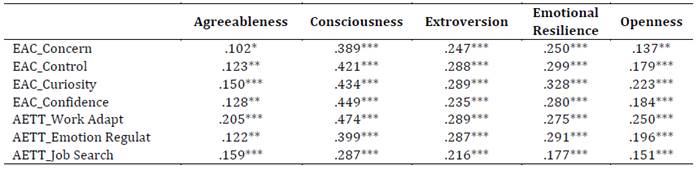
The aim of this study was to investigate possible correlations between socioemotional competencies, career adaptability and self-efficacy in the school-work transition. The sample consisted of 505 young apprentices aged between 14 and 24, 39.4 % male (n = 199), 60.6 % female (n = 306), participating in an apprenticeship program. Four online instruments were used: the Socio-Emotional Skills Assessment Tool (SENNA 2.0), the Career Adaptability Scale (CAT), the Self-Efficacy Scale for the School-Work Transition (AETT-BR), the Identification Questionnaire and the Brazil Economic Classification Criterion. Confirmatory factor analysis, reliability analysis, descriptive analysis and Pearson's r correlations were carried out. The results indicate significant correlations between all the variables, except for socioemotional competencies, kindness and engagement with others. The results of the AETT-BR and CAT show a relationship between trust and adaptation. The findings show implications for practice and avenues for further research.
Keywords:
socioemotional competencies; career adaptability; self-efficacy; school-to-work transition; apprentices