Development, validation, and experimental evidence of a prosociality dictionary
Abstract:
The availability of large textual datasets enables automated analysis of psychological constructs. To facilitate this, programs have been developed to categorize words and identify various aspects such as cognitive styles, linguistic features, and emotional content. This study consists of two parts that provide evidence of content and external validity for a dictionary designed to assess prosociality, which is compatible with LIWC software. Study 1 is based on a corpus of terms drawn from both natural and specialized sources, evaluated by seven judges, resulting in a definitive list. In Study 2, a public goods game was conducted in which 160 participants faced a dilemma between self-interest and collective well-being. Participants also described the strategies they used in the game and the emotions they experienced. These written responses were analyzed using the dictionary developed in Study 1. The results showed that prosociality, as measured by the dictionary, was positively associated with cooperative behavior in the game. Additionally, cognitive style II was found to predict prosocial behavior. Together, these studies demonstrate the dictionary's utility in evaluating prosociality through linguistic analysis and its potential for estimating this construct in various contexts.
Keywords:
public goods game; language analysis; LIWC; cooperation
Resumen:
La presencia de grandes datos textuales permite el análisis automatizado de constructos psicológicos. Para ello, se han desarrollado programas que categorizan palabras e identifican, entre otros, estilos cognitivos, lingüísticos o contenido emocional. Este trabajo consta de dos estudios que presentan evidencia de validez de contenido y externa de un diccionario para estimar la prosocialidad, compatible con el software LIWC. El Estudio 1 parte de un corpus de términos construido con base en fuentes naturales y especializadas, que fue evaluado por siete jueces, lo que dio paso a la conformación de una lista definitiva. En el Estudio 2 se utilizó un juego de bienes públicos, en el que 160 participantes eligieron en un dilema económico interés propio versus bienestar colectivo. Adicionalmente, los participantes respondieron por escrito qué estrategia habían utilizado en el juego y qué emociones experimentaron. Estos textos fueron analizados con el diccionario construido en el Estudio 1. Se evidenció que la prosocialidad estimada con el diccionario se relacionó positivamente con el comportamiento cooperativo en el juego. Se encontró que el estilo cognitivo tipo II predice el comportamiento prosocial en el juego. Los dos estudios muestran la utilidad del diccionario para evaluar la prosocialidad a través del análisis lingüístico y la posibilidad de ser usado para estimar este constructo en diferentes escenarios.
Palabras clave:
juego de bienes públicos; análisis lingüístico; LIWC; cooperación
Resumo:
O A presença de grandes bases de dados textuais permite a análise automatizada de construtos psicológicos. Para isso, foram desenvolvidos programas que categorizam palavras e identificam, entre outros, estilos cognitivos, linguísticos ou conteúdo emocional. Este trabalho é composto por dois estudos que apresentam evidências de validade de conteúdo e de validade externa de um dicionário destinado a avaliar a pró-socialidade, compatível com o software LIWC. O Estudo 1 partiu de um corpus de termos extraídos de fontes naturais e especializadas, avaliados por sete juízes, resultando em uma lista definitiva. No Estudo 2, utilizou-se um jogo de bens públicos no qual 160 participantes enfrentaram um dilema entre interesse próprio e bem-estar coletivo. Adicionalmente, os participantes responderam por escrito qual estratégia haviam utilizado no jogo e quais emoções experimentaram. Essas respostas foram analisadas com o dicionário construído no Estudo 1. Evidenciou-se que a pró-socialidade, medida pelo dicionário, relacionou-se positivamente com o comportamento cooperativo no jogo. Verificou-se também que o estilo cognitivo tipo II prediz o comportamento pró-social no jogo. Os dois estudos mostram a utilidade do dicionário para avaliar a pró-socialidade por meio da análise linguística e a possibilidade de ser usado para estimar esse construto em diferentes contextos.
Palavras-chave:
jogo de bens públicos; análise linguística; LIWC; cooperação
Study 1
Prosociality, traditionally defined as a set of voluntary behaviors that benefit others, such as helping, comforting, or sharing (Spinrad & Eisenberg, 2014), has occupied a central place in developmental psychology, social psychology, and, more recently, in the psychology of language. Its study has expanded to include emotional, cultural, and communicative approaches, as well as Spanish-speaking youth populations (Marín-Escobar et al., 2024; Martínez-González et al., 2010). This theoretical development has enabled the integration of dimensions such as empathy, life satisfaction, and social exclusion as significant correlates of prosocial behavior (Hou et al., 2024; Veloso et al., 2015). Furthermore, several studies have highlighted the role of prosociality as a marker of psychosocial adjustment, mental health, and community cohesion, even in contexts of vulnerability (Toro et al., 2023). On a cognitive level, recent research has linked prosocial behavior with reflective processing styles, suggesting that its activation may be associated with complex thinking schemas and cooperative decision-making (Quiroga-Rojas et al., 2020). Within this expansion, the need has emerged to develop automated linguistic tools to explore prosociality in natural texts, academic documents, political discourse, and educational settings, among others.
In this context, and with the advent of automated processing of large textual corpora over the last decades, psychology has shown interest in the study of word use in contexts of spontaneous linguistic production, either in written or oral modalities. This interest is based on the fact that linguistic spontaneous output involves relatively low cognitive control, as it occurs in socially situated verbal interactions, in contrast with the potential biases of desirability or the low reliability of self-knowledge that affect self-report instruments (Pennebaker et al., 2003).
One of the automated tools used for analyzing word frequency is the Linguistic Inquiry and Word Count (LIWC), developed by James Pennebaker, Roger Booth, and Martha Francis (Pennebaker et al., 2001). The automated count of the program is based on comparing the frequency of each detected word to the total number of words present in the text, using a built-in dictionary. The incorporated dictionary includes 16,485 words organized into 108 categories, among which are linguistic variables, cognitive and emotional psychological processes, and mood states, among others. Based on relative frequency, the program reports, in percentage, the participation of each word in the categories to which it is classified (Castiblanco, 2018; LIWC INC, 2022).
In a three-study investigation, Donohue et al. (2014) reported the validity of LIWC. In the first study, expert judges identified the number of factors (categories) and words they detected, for example, 'looking forward,' 'looking backward,' 'power,' 'affiliation,' 'trust,' and 'distrust,' in the speeches of negotiation meetings that led to the Oslo I agreements. They then proposed word lists associated with each construct based on dictionaries and thesauri. Subsequently, 249 communication students assessed whether the words presented in the list effectively reflected the evaluated construct. Once the results were obtained, three different data reduction strategies were applied: mean, t-test, and shared variance. Finally, an exploratory factor analysis was conducted on all the constructs to determine the number of factors that comprised the dictionary categories. In the second study, 300 university students were asked to write an essay about what each construct meant to them in a political context. The result was essays ranging from 59 to 662 words, with a mean of 206 words. These essays were analyzed using the lists generated in Study 1, and it was found that there was greater participation in the discourse of dictionaries related to specific topics in the essays compared to those that were unrelated. Finally, in the third study, trained coders were asked to analyze 40 speeches from social leaders, comprising 20 speeches from Palestinians and 20 speeches from Israelis. The goal was to find the percentage of words related to the evaluated constructs and then compare this information from human coding with the results obtained from the six LIWC dictionaries on the constructs analyzed by the automatic coder.
Although LIWC has been used in multiple studies to analyze affective and social components in language, its application in Spanish requires specific, culturally validated dictionaries. In this regard, Ramírez-Esparza et al. (2007) translated the English version of the dictionary and, in a second study, compared the capture rate of the Spanish dictionary with that of the English version, analyzing the language used by women in a virtual forum on depression and breast cancer. Both dictionaries showed agreement in the words captured. However, the Spanish version obtained a 4 % higher word count than the English one (66.32 % vs. 61.85 %), a difference attributable to the fact that Spanish consists of more words and conjugations than English. According to the results, the validated Spanish dictionary for LIWC fulfills the same purpose as the English version and is therefore a valuable tool for linguistic analysis in this language.
LIWC has been utilized for text analysis in various fields, including politics and mental health, in both Spanish and English. Additionally, there are areas where English has a greater number of studies on a specific topic, such as prosociality or prosocial behavior. In English, the use of linguistic style analysis stands out in the works of Frimer et al. (2015), Overduin (2015), and Rand and Epstein (2014), among others. In these studies, linguistic analysis is employed as a strategy to identify the structures of textual productions characteristic of prosocial discourse and to assess the degree to which they are related to the participants' prosocial behavior.
In Spanish, there are no studies linking the LIWC program with prosocial behavior, nor are there any that develop compatible dictionaries to address related topics. Study 1 addresses this need by creating and validating a Spanish prosociality dictionary that assesses the prosociality construct using the Spanish version of LIWC. For this, we relied on the validation strategies described above (Donohue et al., 2014) to obtain a dictionary that allows the automatic estimation of dispositions toward collaboration, cooperation, altruism, among other prosocial references, based on word frequency in any text or transcription. The dictionary is expected to contribute to the identification of linguistic styles centered on prosocial discourse and to predict such behaviors in different social contexts.
Methods
Study type and design
This is an instrumental study (Montero & León, 2007) that employs a Rasch model analysis. According to Cerdas et al. (2017), the Rasch model is "a psychometric approach for the construction, validation, and interpretation of measurement instruments related to the behavioral sciences" (p. 3). The Rasch model, as part of Item Response Theory, places both items and individuals on the same logit scale to estimate the probability that a person will answer an item correctly as a function of their ability and the item's difficulty (Ilhan, 2016). In this case, the probability of accepting a word in the list is analyzed based on the judge's ability to assess its relevance and the scores obtained by each word. The model enables the estimation of the probability that a judge will accept a word as relevant, based on two parameters: item difficulty (understood here as the overall level of acceptance of the word by the panel) and judge ability (their tendency to accept or reject words according to their own criteria). This approach allows for the detection of words with higher or lower consensus among judges, as well as atypical judges-that is, those whose decisions do not follow a pattern consistent with the group, which may indicate bias or inconsistencies.
Procedure
Phase 1. Documentary study. An exploratory-descriptive documentary study was conducted to build a set of terms linked to prosociality. Twenty highly cited key documents were consulted in Scopus and Google Scholar, prioritizing Spanish-language sources that addressed prosociality from psychological and social perspectives and that characterized or defined the construct. Texts with a clinical or philosophical focus that did not offer a linguistic operationalization for semantic construction were excluded. Based on these criteria, 17 articles, one doctoral dissertation, one book chapter, and one book were included to construct a definition of prosocial behavior that integrated most of the characteristics mentioned regarding this form of social relating.
The purpose of selecting a definition was (1) to guide the dictionary judges regarding the construct to be evaluated, and (2) to provide context for the set of words included in the word list for content evaluation. The baseline definition was "a voluntary behavior intended to benefit others and, therefore, promotes positive, empathetic, cooperative, and responsible relationships with others" (Eisenberg et al., 2006 in Inglés et al., 2011, p. 452). This definition emphasizes a relational perspective, making it possible to identify, within prosocial discourse, the members, relationships, and characteristics of prosocial interaction.
Phase 2. Identification of prosocial vocabulary. To identify the words to be validated in relation to prosocial behaviors, we began with the words reported by Frimer et al. (2015), who proposed a prosocial dictionary in English. Although some words were not directly translatable, 104 Spanish equivalents were obtained from the 117 words in the original English dictionary. Subsequently, words were identified in the Harvard IV Dictionary, the LIWC Dictionary, Lasswell's Values Dictionary, the General Inquirer Basic, the Thesaurus of the American Psychological Association, and the Dictionary of Colombianisms. Blogs and accounts on X (formerly Twitter) publishing information on prosocial and solidarity initiatives were also reviewed. As a third strategy of Phase 2, a digital form (Google Forms) was administered to a purposive sample of Colombian university students to collect spontaneous terms related to prosocial behaviors. Participants were presented with brief hypothetical scenarios illustrating helping, cooperation, care, and empathy, and were asked to write freely words or expressions that, in their opinion, described these behaviors. Responses were compiled and linguistically normalized (lemmas and regional variants), with duplicates and out-of-context entries removed. This strategy enabled the incorporation of the natural lexical production of native Spanish speakers and the addition of more words to those already extracted from dictionaries, as well as from Frimer et al. (2015) and the documentary study.
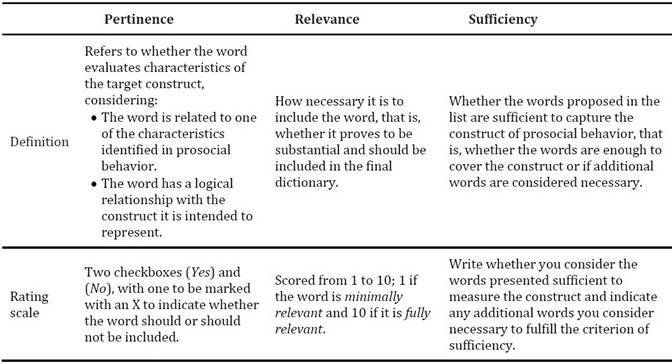
Phase 3. Expert judge validation. Seven judges, psychologists with experience in prosociality research and users of digital social networks, evaluated 617 words according to three criteria described in Table 1.
Results
Judges’ evaluation based on the Rasch model
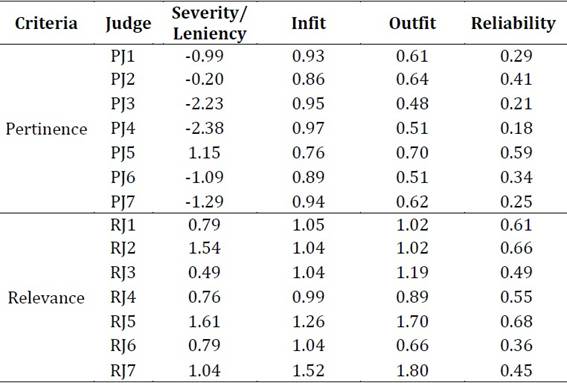
To assess the quality and fit of the evaluation, the Rasch model was applied, which provides information on severity/leniency, infit and outfit, and judges' reliability across the criteria of relevance and pertinence (Table 2). This model specification was carried out in accordance with the framework proposed by Unesco (2010).
Severity and Leniency. According to the Rasch model, the mean value is set at 0. A judge is considered severe in their ratings when scores exceed one standard deviation above the mean (1), and lenient when scores fall one standard deviation below the mean (-1).
Infit and Outfit. Infit represents the weighted internal fit of the information, which is more sensitive to unexpected behavior based on the observed and expected performance of the model for items or individuals. The value of perfect fit is 1.00; values below .5 indicate that the judge tends to assign the same rating to multiple words, and values above 1.5 indicate greater variation in ratings. However, when values exceed 2, it means that noise overwhelms the valuable information for the model.
Reliability. This refers to the consistency of judges' ratings across the two proposed criteria (relevance and pertinence). It is expected that all judges apply the same criteria when making their decisions regarding the ratings they provide. The minimum expected value for reliability is .15; values of .20 and above are desirable, since the higher the values, the greater the consistency.
The judges considered relatively more severe within the expert group are, in ascending order, Six (J6), Five (J5), and Seven (J7). For the relevance criterion, those identified as severe are Judges Five (J5) and Two (J2), with values of 1.61 and 1.54, respectively. Judge Seven (J7) is identified as relatively less severe, with a value of 1.04. With respect to leniency in the relevance criterion, Judges Three (J3) and Four (J4) are the most lenient, with scores of -2.23 and -2.38, followed by Judge Six (J6) with -1.09 and Judge Seven (J7) with -1.29. In the relevance criterion, no judge was classified as lenient.
In terms of infit, all judges obtained acceptable values for the measure, which indicates an adequate correspondence between the data and the internal fit, without interference from noise or 'external variables' between the expected and observed values. Regarding outfit, Judges Five (J5) with 1.70 and Seven (J7) with 1.80 exceeded the acceptable range of 1.50; however, although these judges surpassed the acceptable threshold for this criterion, the amount of added random noise is not significant enough to affect the analysis.
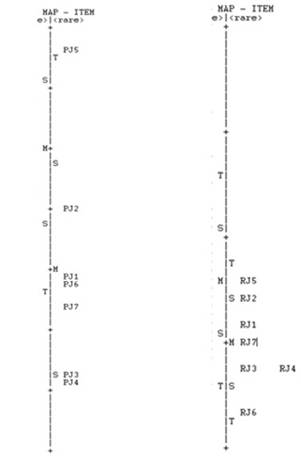
In the relevance dimension, judges show values within the acceptable range for this criterion. Judges Five (J5), One (J1), and Two (J2) stand out, with values of 0.68, 0.66, and 0.61, respectively, which exceed the threshold of 0.60, evidencing a high degree of consistency. The alignment map presents the comparison of coherence in judges' scores for both criteria, relevance (right side of Figure 1) and pertinence (left side of Figure 1).
Regarding judges' severity and leniency, taking the mean difficulty (M) as a reference point, the most severe judges are Judge Five (J5) and Judge Two (J2). Judge One (J1) remains within one standard deviation (s) for both criteria, as does judge seven (J7) for the relevance criterion, since in this case the latter shows a perfect fit at the sample mean. This indicates that these judges are more neutral in their assessments, neither too severe nor too lenient.
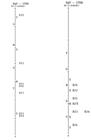
Judges Three (J3) and Four (J4) are the most flexible in the relevance criterion; however, in the pertinence criterion, they are relatively more neutral. Finally, Judge Six (J6) varies in position across both criteria, showing limited consistency in relation to their measure.
To evaluate the reliability of the ratings, Cronbach's alpha analysis and the separation index reported by the Rasch model were used, yielding a reliability of .99 and a real separation of 1.30. This is considered optimal reliability for the model, with a maximum expected value of 1.00, thereby confirming the judges' decisions.
Assessment for word choice
The criteria for word selection were: first, the words with the highest level of inter-judge agreement-that is, those to which all seven judges assigned the highest score-and second, the words that exceeded an agreement level of .71 (five out of seven judges). In total, 459 words were selected from the relevance list and 575 from the pertinence list.
Once the words were selected, a comparison was carried out between the word lists for the relevance and pertinence criteria to confirm that the words showing the highest agreement in one criterion matched the words in the other list. As a result, 117 words were excluded, and 458 overlapped across the lists.
Sufficiency criterion
The judges' responses were compiled in an Excel file to determine whether they considered the criterion met and whether the words presented were sufficient to represent the construct. Four of the seven judges responded to this criterion; however, those who did respond unanimously agreed that the words presented in this validation are sufficient to measure prosociality as a construct. For this criterion, they were also asked to indicate which words they suggested should be included in the dictionary but were not part of the validation. The judges proposed 19 words; however, since no overlap was found among the suggestions, these were not considered for the final version of the prosociality dictionary.
Discussion
The objective of this study was to gather evidence of content validity for a prosocial behavior dictionary compatible with the LIWC software in Spanish, which allows the detection of words related to collaboration, cooperation, altruism, and other references to prosociality in any document. To achieve this objective, the procedure outlined by Donahue et al. (2014) was followed.
In evaluating the quality of expert judges in the task of rating words, using the criteria of severity/leniency, infit/outfit, and reliability (Unesco, 2010), it was determined that they met the acceptable values to consider the rating scores as reliable. The reliability of the judges' assessments constitutes evidence supporting the inference of the final word list for this validation. However, for future validations with expert judges, it is recommended that words be presented in blocks with varying orders to compensate for the fatigue effect caused by the large number of words (617) and to reduce the bias of words being differentially evaluated at the end of the list. Alternatively, a block design could be employed, in which not all words are necessarily rated by every judge; instead, each word is assessed by at least three judges (Garzón-Velandia et al., 2020). On the other hand, regarding the validation methodology used, it is worth noting that, unlike the English dictionary taken as reference (Frimer et al., 2015), the Rasch model was chosen, as it is a psychometric model for test validation, which generates reliability in the results obtained by incorporating the calculated percentage of chance into its analysis.
The results obtained in this study align with previous findings on the bifactorial structure of prosociality, as reported by Martí-Vilar et al. (2020) and Luengo-Kanacri et al. (2021), who validated a prosociality instrument in five countries, including Chile and Spain. In their model, a general prosociality factor is distinguished alongside two specific dimensions: prosocial actions and prosocial feelings. This structure reflects the coexistence of behavioral and affective components, which is consistent with the semantic categorization carried out in the present dictionary. Furthermore, this study highlights the importance of having culturally sensitive instruments to assess prosociality in Spanish-speaking populations. While their approach relies on psychometric self-reports, the present work complements this line of research through an automated linguistic tool that enables the analysis of spontaneous texts. This methodological convergence enhances the validity of the dictionary as a resource for regional research on prosocial behavior.
As the first validated prosocial behavior dictionary for LIWC in Spanish, some of its potential applications are expected to relate to the predictive power of words associated with prosocial behavior in contexts of objective prosociality measurement. From a strategic perspective, it is pertinent to consider publishing the dictionary in open access. This would facilitate its use by researchers, educators, and Spanish-speaking professionals, promoting replicability, methodological transparency, and the democratization of academic resources. As the first LIWC dictionary validated in Spanish with a psychosocial focus, its free availability would enhance its integration into software initiatives, regional corpora, and educational settings.
A dictionary capable of detecting prosocial behavior has enormous potential in various fields of study, including evaluating the effectiveness of psychological therapies, estimating the prosocial classroom climate, analyzing political discourse, and assessing dynamics in digital social networks. Although additional studies will always be necessary to test the validity of the dictionary in other contexts, the evidence presented here demonstrates the possibility of estimating prosociality through linguistic analysis, opening a range of questions about the relationship between cognitive processes, language, and cooperative behaviors under automated data collection and processing techniques.
In this regard, the final version of the dictionary presented here, comprising 458 words, was utilized in Study 2 to assess its ability to estimate prosociality in an experimental context.
Study 2
Cooperation is a crucial aspect of human behavior, closely tied to the maintenance of social systems, the resolution of group conflicts, and the establishment of norms of coexistence. Although its behavioral manifestation has been widely documented (Hayes & Sanford, 2014; Rand & Nowak, 2013; Simpson & Willer, 2015), the cognitive processes underlying prosocial decision-making remain the subject of ongoing empirical and theoretical debate. Studying these dynamics requires the development of robust methodologies that connect observed behavior with indirect indicators of reflective processing, strategic reasoning, inhibitory control, or moral deliberation. Identifying reliable signals that reflect these processes is crucial to advancing our understanding of how cooperation is activated in complex contexts and enriching the dialogue between cognitive psychology, social psychology, and other fields of the behavioral sciences.
In this regard, Study 2 applied the prosociality dictionary obtained in Study 1 to written texts produced by 160 participants in Public Goods Games (PGGs), to evaluate whether the estimation of prosociality generated by the dictionary was associated with the amount of donations made in the experimental task. Public Goods Games (or dilemmas) have traditionally been used to estimate cooperation and typically involve four participants who receive an endowment of money or another resource from the researchers. Participants must decide what percentage of this endowment they donate to a shared pool, which is then increased and redistributed equally among participants. Thus, this paradigm simulates situations in which participants must decide how much to contribute to the group, even when doing so implies sacrificing part of their individual gain. The resource units each person decides to keep remain as individual gain. In contrast, the units contributed to the pool are multiplied by a factor (e.g., ×1.5) and then distributed equally among all players, regardless of how much each contributed. This dynamic generates a classic social dilemma: if all cooperate, the group benefits more; if someone behaves selfishly and keeps their units, they obtain greater individual benefit but reduce the common good. This dilemma between individual interest and collective benefit activates cognitive, emotional, and discursive mechanisms associated with prosociality, which can be studied in different contexts (Bailey et al., 2012; Brandt et al., 2005; Catola et al., 2023; Grayson et al., 2025; Li et al., 2024; Skatova & Ferguson, 2013; Struwe et al., 2024; van Hoorn et al., 2014).
Some variations of the game show that increasing the number of participants or the entry of new members decreases contributions (Alencar et al., 2008; Otten et al., 2022), and that repeated iterations of the game among the same participants also reduce cooperation (Goeschl & Lohse, 2016). The effect of the multiplier factor has been less explored; in most cases, the shared pool is doubled before redistribution (Goeschl & Lohse, 2016; Rostovtseva et al., 2020), but in other studies, the multiplier differs (Burton-Chellew et al., 2016; Fischbacher & Gächter, 2010).
PGGs have been used to explore hypotheses concerning the cognitive processes underlying cooperative decision-making, often within the context of the dual-process model, which distinguishes between intuitive and reflective cognition. Intuitive processes, also called type 1, are fast and consume few cognitive resources, whereas reflective processes, or type 2, are slower as they require greater cognitive effort (Conway-Smith & West, 2023; Evans, 2008; Evans & Stanovich, 2013; Grehl & Tutić, 2022; Kahneman, 2011). In this context, some studies have manipulated the time available for participants to make their decisions in the game, showing that with less time to decide, contributions increase (Cone & Rand, 2014; Rand et al., 2012). Such results have led to the claim that cooperative decisions rely more on intuitive, rapid, and impulsive processes (type 1). In contrast, deliberation and reflection, which involve more abstract and complex thinking (type 2), may hinder cooperative behavior.
However, some authors highlight methodological aspects of time-pressure designs that complicate the interpretation of results (Capraro & Cococcioni, 2016), and alternative methodological strategies have found evidence in the opposite direction-namely, that reflective thinking promotes cooperation, whereas impulsive decisions reduce it (Martinsson et al., 2014; Myrseth et al., 2015). Other studies propose that type 1 processes underlie both prosocial and selfish decisions (Bago et al., 2021) and that the relationship between intuitive responses and prosocial behavior is context-dependent (Teoh & Hutcherson, 2022). This discussion is relevant not only to understanding the cognitive and evolutionary processes associated with prosocial behaviors but also to informing public and educational strategies that promote cooperative behavior, which is essential for peaceful coexistence, environmental preservation, and the survival of the species.
For all these reasons, in the second study, we sought to contribute to this debate by proposing a design that estimates cognitive styles-intuitive and reflective-through linguistic analysis. To this end, we considered function words, which are used independently of the topic of discussion, as their role is to connect words and phrases, thereby giving structure to discourse or text. Function words include articles, prepositions, pronouns, conjunctions, negations, adverbs, and auxiliary verbs. Although these words have no meaning in themselves, they are related to specific psychological states and cognitive traits of the speaker. For example, greater use of negations and first-person pronouns has been associated with clinical depression (Rude et al., 2004); the use of articles with formal writing (Biber, 1988); and lower use of adverbs with higher scores on the openness factor of the Big Five personality model (Lee et al., 2007).
The authors who developed LIWC further recognized that the use of articles is positively correlated with the use of prepositions. In contrast, both categories are negatively correlated with the use of pronouns, conjunctions, negations, adverbs, and auxiliary verbs (Pennebaker et al., 2003). In addition, these last five categories covary positively. Based on this, they constructed an index that integrates all function-word categories into a continuous measure, where the negative pole represents a narrative, dynamic, time-based style referring to personal stories. In contrast, the positive pole is associated with elevated abstract thought, analytical reasoning, emotional detachment, and greater cognitive complexity. This index has been termed the Categorical-Dynamic Index (CDI) (Pennebaker et al., 2014) and has proven helpful in various studies (Boyd & Pennebaker, 2015; Hawkins & Boyd, 2017; Logan & Hall, 2019; Markowitz & Hancock, 2017; Zasiekin et al., 2022). To the authors' knowledge, the present study is the first to use this index to estimate cognitive styles associated with the expression of prosocial behaviors.
Considering the above, the second study aimed to achieve two main objectives. The first was to test the hypothesis that donations in the PGG would be positively associated with the estimation of prosociality made by the dictionary based on participants' written texts. This would provide evidence for the validity of the dictionary proposed in Study 1 as a tool for estimating the expression of prosocial behaviors through linguistic analysis. Second, given the existing debate over the evidence, we sought to explore the relationship between the CDI and donations in the PGG, thereby contributing to the discussion on the cognitive processes involved in prosocial behaviors. Additionally, we aimed to control for the possible effect of the multiplier factor in the PGG on the relationship between cognitive styles and cooperation. This is important because the multiplier is not typically included as a variable in studies examining prosocial decision-making, and because, in our literature review, we found that some studies reaching contradictory conclusions had applied different return rates (Martinsson et al., 2014; Rand et al., 2012).
Methods
Study type and design
This study was a quasi-experimental field study within the areas of behavioral economics and experimental economics, as classified by Montero and León (2007) according to their taxonomy.
Participants
This study involved 160 undergraduate students (55 % women), with a mean age of 19.68 years (SD = 2.20), who were randomly assigned to two conditions that differed only in the return rate in the PGG: 0.5 in condition 1 and 0.4 in condition 2. All participants participated voluntarily in the recruitment process and completed the corresponding informed consent form.
Procedures
All experiments were conducted in the laboratories of the Universidad Católica de Colombia. The PGG always included four participants, who watched a video of approximately seven minutes explaining the game's dynamics and providing examples. The research team developed the video to ensure that all participants received the same instructions. After the video, each participant completed a form in which, in addition to reporting age and sex, they answered the following control questions: i) To maximize your earnings, how should each player's endowment be allocated to the shared pool? ii) To minimize your earnings, how should each player's endowment be allocated to the shared pool? iii) For the group to maximize its earnings, how should each player's endowment be allocated to the shared pool?
Subsequently, the PGG was presented with 10,000 Colombian pesos (approximately US$2.89), and participants were asked whether they had played before or were familiar with this or other similar games. In all cases, these two questions received negative responses.
Finally, the written production was collected by asking each participant to respond to the following questions, with the instruction: "Describe with as much detail as possible: What strategy did you follow in the game? What did you consider when making your decision in the game? What emotions did you experience during the game?". All participants received their game earnings in cash on the same day of their participation, after approximately one hour in the laboratory.
Measurements
In addition to age, sex, and condition, the following measures were recorded in this second study:
-
- Donation. The donation of money to the shared pool was the dependent variable of the study and is expressed as a percentage throughout the presentation of results.
-
- Prosociality. The written production derived from the three open-ended questions provided this measure, using the prosociality dictionary presented in Study 1. This variable is a continuous measure expressed as the percentage of words recognized by the dictionary out of the total words written in response to the three questions. In this study, the mean number of words written was 52.43 (SD = 28.11).
-
- CDI. The written production also allowed for the construction of this index as follows: (articles + prepositions) - (pronouns + conjunctions + negations + adverbs + auxiliary verbs) + 30. This constant was included to avoid negative values. As mentioned above, lower values correspond to a dynamic linguistic style, associated with type 1 cognitive processes, whereas higher values correspond to a categorical linguistic style, associated with type 2 cognitive processes.
Ethical conditions
The study was approved by the Ethics Committee of the Universidad Católica de Colombia, as recorded in Minute No. 5 of the Ethics Committee, dated October 25, 2018. Each participant approved participation conditions through an informed consent form, which specified the voluntary nature of participation and the classification of the study as involving less than minimal risk.
Results
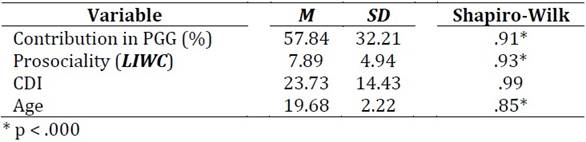
No significant differences were found in donations, nor in any other variable, between the two conditions; therefore, the descriptive data in Table 3 correspond to the entire sample. Of the 160 participants, 106 (66.3 %) answered the three control questions correctly. A Chi-square test revealed no association between treatment and the probability of understanding the game. When comparing the 106 participants who answered the control questions correctly with the 54 who did not understand the game, the only difference found was that the first group obtained higher prosociality scores using the dictionary (Z = -2.13, p = .033). When the analyses were restricted to the 66.3 % of participants who answered the control questions correctly, the similarities between the two conditions were maintained. However, since failing any of the control questions is a strong indication of not having understood the game, the possible relationships between cognitive processes and cooperative behaviors in the PGG were explored only in the 106 participants who answered all three control questions correctly. Additionally, no sex-related differences were found.
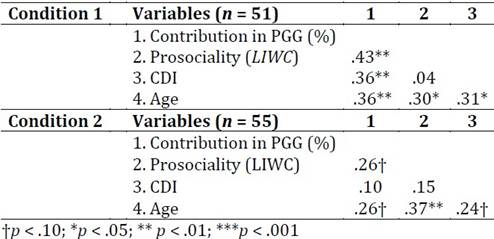
The percentage of money contributed in the PGG correlated positively with prosociality estimated by the dictionary (r = .341; p < .000), with the CDI (r = .256; p = .008), and with age (r = .320; p = .001). These associations differed between the two treatments: while in the condition with a return rate of .4 they remained strong, in the condition with a return rate of .5 they weakened or disappeared (Table 4).
Subsequently, a multiple linear regression model was conducted using the Enter method. In the model, the dependent variable was the donation in the PGG, and the predictors entered were prosociality estimated by the dictionary, the CDI, age, and condition as a dummy variable (Table 5).
The multiple linear regression model was highly significant (Adjusted R 2 = .149; p < .000) and explained 15% of the variance in cooperative behavior in the PGG. The effects of prosociality, as estimated by the dictionary and the CDI, were significant. In contrast, the effect of age was only marginally significant, whereas condition did not contribute to explaining the dependent variable.
Discussion
The purpose of the second study was to estimate the relationship between the prosociality measure, calculated using the dictionary presented in Study 1, and cooperation in the Public Goods Game (PGG). Secondly, the relationship between cooperative behavior and the CDI-an index associated with cognitive styles derived from analyzing the use of function words-was explored. Indeed, the dictionary demonstrated the ability to predict cooperative behavior in the game significantly. At the same time, the CDI was also positively associated with the percentage of money donated in the PGG, showing that a more categorical linguistic style, associated with abstract and complex cognitive processing (type 2), favors this type of prosocial behavior.
Regarding the results of the PGG, the finding that the CDI was positively associated with contributions supports the idea that reflective and deliberative processes foster the expression of prosocial behaviors, particularly in contexts where strategic calculation and inhibition of automatic responses play a relevant role. This finding aligns with previous studies that have linked reflective thinking with cooperation and strategic altruism (Martinsson et al., 2014; Myrseth et al., 2015). Nevertheless, this result raises new questions about the nature of the link: is cooperation a decision motivated by moral reasoning, or does it reflect a cost-benefit evaluation that requires a greater cognitive load? In this sense, it is suggested that future research contrast different methods for estimating cognitive style (time pressure, linguistic analysis, psychometric tests), as well as differentiate types of prosocial behavior (e.g., structured cooperation vs. spontaneous altruism) according to the cognitive demands involved.
A particularly relevant finding was that the return rate used in the PGG-that is, the multiplier applied to the shared pool-modulated the strength of the relationship between the CDI and cooperation. The correlation was stronger under the .4 return condition than when the pool was doubled (return 1.0). This difference may be explained by the greater cognitive effort required in the first condition, where group benefit is not immediate and participants must project future scenarios involving a higher degree of strategic reasoning. This suggests that seemingly minor experimental variables, such as the return rate, can activate different underlying cognitive systems and may account for some of the inconsistencies across previous studies (Rand et al., 2012).
From a methodological perspective, the use of the CDI as an estimator of cognitive style offers relevant advantages, since, unlike linguistic content that can be relatively controlled in its production, the use of function words is less consciously monitored. This makes it less manipulable and more reliable for assessing internal states through language analysis. Although this index has been applied in several studies, its full potential remains to be developed; future research should therefore evaluate its convergence with different related cognitive processes, such as inhibition, attentional control, reflective thinking, and self-control. In this line, the work of Rand and Epstein (2014) used the LIWC software to examine whether, in the discourse of Carnegie Hero Medal Recipients (CHMR)-individuals who performed altruistic acts-words consistent with deliberative or intuitive processes appeared, finding that intuitive cognitive styles (type 1) were more strongly associated with risky altruistic acts. This suggests that the relationship between cognitive styles and prosocial behaviors depends on both the type of prosocial behavior (e.g., cooperation, altruism) and the cost-benefit evaluation involved in deciding to act prosocially.
Age also showed a marginal relationship with cooperative behavior, suggesting that the cognitive processes involved may vary across different stages of development. The maturation of brain structures related to executive control, as well as the progressive development of social and moral priorities, may influence the expression of prosociality. It is therefore necessary to consider the life span as a moderating variable in future designs exploring the cognitive bases of cooperation.
The findings of this study reinforce the notion that the expression of prosocial behaviors involves not only affective motivations but also complex cognitive processes such as strategic reasoning, reflective thinking, and inhibitory control. Understanding how these mechanisms are articulated in different contexts-such as cooperative games, moral dilemmas, or spontaneous helping scenarios-is key to deepening knowledge of the mental architecture underlying prosocial conduct. This line of research not only enriches psychological understanding of socio-cognitive functioning but also provides practical implications for fields such as ethics education, the design of collaborative environments, the development of empathetic technologies, and intervention in clinical or community settings. Ultimately, studying how we think when we decide to help is also studying how we collectively construct more cooperative, inclusive, and humane environments.
References
-
Alencar, A. I., de Oliveira Siqueira, J., & Yamamoto, M. E. (2008). Does group size matter? Cheating and cooperation in Brazilian school children. Evolution and Human Behavior, 29(1), 42-48. https://doi.org/10.1016/j.evolhumbehav.2007.09.001
» https://doi.org/10.1016/j.evolhumbehav.2007.09.001 -
Bago, B., Bonnefon, J. F., & De Neys, W. (2021). Intuition rather than deliberation determines selfish and prosocial choices. Journal of Experimental Psychology: General, 150(6), 1081-1094. https://doi.org/10.1037/xge0000968
» https://doi.org/10.1037/xge0000968 -
Bailey, D. H., Winegard, B., Oxford, J., & Geary, D. C. (2012). Sex differences in in-group cooperation vary dynamically with competitive conditions and outcomes. Evolutionary Psychology, 10(1), 102-119. https://doi.org/10.1177/147470491201000112
» https://doi.org/10.1177/147470491201000112 - Biber, D. (1988). Variation across speech and writing Cambridge University Press.
-
Boyd, R., & Pennebaker, J. (2015). Did Shakespeare write double falsehood? Identifying individuals by creating psychological signatures with text analysis. Psychological Science, 25(5), 570-582. https://doi.org/10.1177/0956797614566658
» https://doi.org/10.1177/0956797614566658 -
Brandt, H., Hauert, C., & Sigmund, K. (2005). Punishing and abstaining for public goods. PNAS, 103(2), 495-497. https://doi.org/10.1073/pnas.0507229103
» https://doi.org/10.1073/pnas.0507229103 -
Burton-Chellew, M., Mouden, C., & West, S. (2016). Conditional cooperation and confusion in public-goods experiments. Proceedings of the National Academy of Sciences (PNAS ), 113(5), 1291-1296. https://doi.org/10.1073/pnas.1509740113
» https://doi.org/10.1073/pnas.1509740113 -
Capraro, V., & Cococcioni, G. (2016). Rethinking spontaneous giving: Extreme time pressure and ego-depletion favor self-regarding reactions. Nature, 6. https://doi.org/10.1038/srep27219
» https://doi.org/10.1038/srep27219 -
Castiblanco, P. T. (2018). Estilo y contenido lingüístico de conversaciones en Twitter ® durante un proceso de transición a la paz (Tesis de maestría). Universidad Católica de Colombia. https://repository.ucatolica.edu.co/bitstream/10983/19060/2/RAE.pdf
» https://repository.ucatolica.edu.co/bitstream/10983/19060/2/RAE.pdf -
Catola, M., D’Alessandro, S., Guarnieri, P., & Pizziol, V. (2023). Multilevel public goods game: Levelling up, substitution and crowding-in effects. Journal of Economic Psychology, 97, https://doi.org/10.1016/j.joep.2023.102626
» https://doi.org/10.1016/j.joep.2023.102626 -
Cerdas, D., Núñez, E., & Rojas, M. (2017). Uso del modelo de Rasch para la construcción de tablas de especificaciones: Propuesta metodológica aplicada a una prueba de selección universitaria. Revista Electrónica Actualidades Investigativas en Educación, 17(1), 1-16. https://doi.org/10.15517/aie.v17i1.27299
» https://doi.org/10.15517/aie.v17i1.27299 -
Cone, J., & Rand, D. (2014). Time pressure increases cooperation in competitively framed social dilemmas. Plos one, 9(12). https://doi.org/10.1371/journal.pone.0115756
» https://doi.org/10.1371/journal.pone.0115756 -
Conway-Smith, B., & West, R. L. (2023). Clarifying system 1 & 2 through the Common Model of Cognition. arXiv https://doi.org/10.48550/arXiv.2305.10654
» https://doi.org/10.48550/arXiv.2305.10654 -
Donohue, W. A., Liang, Y., & Druckman, D. (2014). Validating LIWC Dictionaries: The Oslo I Accords. Journal of Language and Social Psychology, 33(3), 282-301. https://doi.org/10.1177/0261927X13512485
» https://doi.org/10.1177/0261927X13512485 -
Evans, J. (2008). Dual-processing accounts of reasoning, judgment, and social cognition. Annual Review of Psychology, 59(3), 255-278. https://doi.org/10.1146/annurev.psych.59.103006.093629
» https://doi.org/10.1146/annurev.psych.59.103006.093629 -
Evans, J., & Stanovich, K. (2013). Dual-process theories of higher cognition: Advancing the debate. Perspectives on Psychological Science, 8(3), 223-241. https://doi.org/10.1177/1745691612460685
» https://doi.org/10.1177/1745691612460685 -
Fischbacher, U., & Gächter, S. (2010). Social preferences, beliefs, and the dynamics of Free riding in public goods experiments. American Economic Review, 100(1), 541-556. https://doi.org/10.1257/aer.100.1.541
» https://doi.org/10.1257/aer.100.1.541 -
Frimer, J. A., Aquino, K., Gebauer, J. E., Zhu, L., & Oakes, H. (2015). A decline in prosocial language helps explain public disapproval of the US Congress. Proceedings of the National Academy of Sciences, 112(21), 6591-6594. https://doi.org/10.1073/pnas.1500355112
» https://doi.org/10.1073/pnas.1500355112 -
Garzón-Velandia, D. C., Barreto, I., & Medina-Arboleda, I. F. (2020). Validación de un diccionario de LIWC para identificar emociones intergrupales. Revista Latinoamericana de Psicología, 52, 149-159. https://doi.org/10.14349/rlp.2020.v52.15
» https://doi.org/10.14349/rlp.2020.v52.15 -
Goeschl, T., & Lohse, J. (2016). Cooperation in public good games. Calculated or confused? European Economic Review, 107, 185-203. https://doi.org/10.1016/j.euroecorev.2018.05.007
» https://doi.org/10.1016/j.euroecorev.2018.05.007 -
Grayson, S., Feinberg, M., Willer, R., & Zaki, J. (2025). Ironic effects of prosocial gossip in driving inaccurate social perceptions. Journal of Experimental Social Psychology, 116 https://doi.org/10.1016/j.jesp.2024.104682
» https://doi.org/10.1016/j.jesp.2024.104682 -
Grehl, S., & Tutić, A. (2022). Intuition, reflection, and prosociality: Evidence from a field experiment. Plos one, 17(2). https://doi.org/10.1371/journal.pone.0262476
» https://doi.org/10.1371/journal.pone.0262476 -
Hayes, S. C., & Sanford, B. T. (2014). Cooperation came first: Evolution and human cognition. Journal of the Experimental Analysis of Behavior, 101(1), 112-129. https://doi.org/10.1002/jeab.64
» https://doi.org/10.1002/jeab.64 -
Hawkins, R. C. II, & Boyd, R. L. (2017). Such stuff as dreams are made on: Dream language, LIWC norms, and personality correlates. Dreaming, 27(2), 102-121. https://doi.org/10.1037/drm0000049
» https://doi.org/10.1037/drm0000049 -
Hou, C., Li, S., Shi, H., & Liu, Z. (2024). The influence of social exclusion on prosocial behavior of college students: the role of relational need threat and regulatory focus. Frontiers in Psychology, 15 https://doi.org/10.3389/fpsyg.2024.1384279
» https://doi.org/10.3389/fpsyg.2024.1384279 -
Ilhan, M. (2016). A comparison of the results of many-facet Rasch analyses based on crossed and judge pair designs Educational Sciences: Theory & Practice, 16(2), 579-601. https://doi.org/10.12738/estp.2016.2.0390
» https://doi.org/10.12738/estp.2016.2.0390 -
Inglés, J., Martínez, A. E., Valle, A., García, J., & Ruiz, C. (2011). Conducta prosocial y motivación académica en estudiantes españoles de Educación Secundaria Obligatoria. Universitas Psicológica, 10(2), 451-466. https://doi.org/10.11144/Javeriana.upsy10-2.cpma
» https://doi.org/10.11144/Javeriana.upsy10-2.cpma - Kahneman, D. (2011). Thinking, fast and slow Macmillan.
-
Lee, C. H., Kim, K., Seo, Y. S., & Chung, C. K. (2007). The relations between personality and language use. Journal of General Psychology, 134(4), 405-413. https://doi.org/10.3200/GENP.134.4.405-414
» https://doi.org/10.3200/GENP.134.4.405-414 -
Li, S., Du, C., Li, X., Shen, C., & Shi, L. (2024). Antisocial peer exclusion does not eliminate the effectiveness of prosocial peer exclusion in structured populations. Journal of Theoretical Biology, 576 https://doi.org/10.1016/j.jtbi.2023.111665
» https://doi.org/10.1016/j.jtbi.2023.111665 -
LIWC INC. (2022). LIWC https://www.liwc.app/help/howitworks
» https://www.liwc.app/help/howitworks -
Logan, M., & Hall, M. (2019). Comparing crime types: a linguistic analysis of communiqués associated with the animal and earth liberation movement. Dynamics of Asymmetric Conflict, 12(2), 164-181. https://doi.org/10.1080/17467586.2019.1613554
» https://doi.org/10.1080/17467586.2019.1613554 -
Luengo Kanacri, B. P., Eisenberg, N., Tramontano, C., Zuffiano, A., Caprara, M. G., Regner, E., Zhu, L., Pastorelli, C., & Caprara, G. V. (2021). Measuring prosocial behaviors: Psychometric properties and cross-national validation of the prosociality scale in five countries. Frontiers in Psychology, 12 https://doi.org/10.3389/fpsyg.2021.693174
» https://doi.org/10.3389/fpsyg.2021.693174 -
Marín-Escobar, J. C., Marín-Benítez, A. C., Maury-Mena, S. C., Guerrero, C. M., & Maury, A. (2024). La prosocialidad: estrategia de educación integral frente a la violencia. Revista Latinoamericana de Ciencias Sociales, Niñez y Juventud, 22(1), 120-143. https://doi.org/10.11600/rlcsnj.22.1.5681
» https://doi.org/10.11600/rlcsnj.22.1.5681 -
Markowitz, D., & Hancock, J. (2017). The 27 club: Music lyrics reflect psychological distress. Communication Reports, 30(1), 1-13. https://doi.org/10.1080/08934215.2016.1210663
» https://doi.org/10.1080/08934215.2016.1210663 -
Martí-Vilar, M., Merino-Soto, C., & Rodriguez, L. M. (2020). Measurement invariance of the prosocial behavior scale in three Hispanic countries (Argentina, Spain, and Peru). Frontiers in Psychology, 11(29). https://doi.org/10.3389/fpsyg.2020.00029
» https://doi.org/10.3389/fpsyg.2020.00029 - Martínez-González, A. E., Inglés Saura, C., Piqueras Rodríguez, J. A., & Oblitas Guadalupe, L. A. (2010). Papel de la conducta prosocial y de las relaciones sociales en el bienestar psíquico y físico del adolescente. Avances en Psicología Latinoamericana, 28(1), 74-84.
-
Martinsson, P., Myrseth, K. O. R., & Wollbrant, C. (2014). Social dilemmas: When self-control benefits cooperation. Journal of Economic Psychology, 45, 213-236. https://doi.org/10.1016/j.joep.2014.09.004
» https://doi.org/10.1016/j.joep.2014.09.004 -
Montero, I., & León, O. G. (2007). A guide for naming research studies in Psychology. International Journal of Clinical and Health Psychology, 7(3), 847-862. https://www.redalyc.org/pdf/337/33770318.pdf
» https://www.redalyc.org/pdf/337/33770318.pdf -
Myrseth, K. O. R., Riener, G., & Wollbrant, C. E. (2015). Tangible temptation in the social dilemma: Cash, cooperation, and self-control. Journal of Neuroscience, Psychology, and Economics, 8(2), 61-77. https://doi.org/10.1037/npe0000035
» https://doi.org/10.1037/npe0000035 -
Otten, K., Frey, U. J., Buskens, V., Przepiorka, W., & Ellemers, N. (2022). Human cooperation in changing groups in a large-scale public goods game. Nature Communications, 13(1), 6399. https://doi.org/10.1038/s41467-022-34160-5
» https://doi.org/10.1038/s41467-022-34160-5 - Overduin , J. (2015). Online interventions in consumer conflicts (Tesis de maestría). Universidad de Twente.
-
Pennebaker, J. W., Chung, C., Frazee, J., Lavergne, G., & Beaver, D. (2014). When small words foretell academic success: The case of college admissions essays. Plos one, 9(12). https://doi.org/10.1371/journal.pone.0115
» https://doi.org/10.1371/journal.pone.0115 - Pennebaker, J. W., Francis, M. E., & Booth, R. J. (2001). Linguistic inquiry and word count: LIWC 2001 Lawrence Erlbaum Associates.
-
Pennebaker, J. W., Mehl, M. R., & Niederhoffer, K. G. (2003). Psychological aspects of natural language use: Our words, Our selves. Annual Review of Psychology, 54(1), 547-577. https://doi.org/10.1146/annurev.psych.54.101601.145041
» https://doi.org/10.1146/annurev.psych.54.101601.145041 -
Quiroga-Rojas, A. T., Ardila-Cubillos, D. C., Rojas, D., Monroy, C., Mendoza, A., Manrique, V., Montoya, S., & Sarmiento, L. (2020). Bases cognitivas subyacentes al altruismo en adolescentes y adultos jóvenes. En I. F. Medina-Arboleda, I. Barreto, D. R. Aguilar-Pardo, & M. C. Sandoval-Escobar (Eds.), Perspectivas y contextos de la prosocialidad (pp. 177-195). Editorial Universidad Católica de Colombia & Konrad Lorenz Editores. https://doi.org/10.14718/9789585133471.2020
» https://doi.org/10.14718/9789585133471.2020 - Ramírez-Esparza, N., Pennebaker, J., García, A., & Suriá, R. (2007). La psicología del uso de las palabras: Un programa de computadora que analiza textos en español. Revista Mexicana de Psicología, 24(1), 85-99.
-
Rand, D. G., & Epstein, Z. G. (2014). Risking your life without a second thought: Intuitive decision-making and extreme altruism. PLOS One, 9(10). https://doi.org/10.1371/journal.pone.0109687
» https://doi.org/10.1371/journal.pone.0109687 -
Rand, D., Greene, J., & Nowak, M. (2012). Spontaneous giving and calculated greed. Nature, 489, 427-430. https://doi.org/10.1038/nature11467
» https://doi.org/10.1038/nature11467 -
Rand, D. G., & Nowak, M. A. (2013). Human cooperation. Trends in Cognitive Sciences, 17(8), 413-425. https://doi.org/10.1016/j.tics.2013.06.003
» https://doi.org/10.1016/j.tics.2013.06.003 -
Rostovtseva, V., Weissing, F., Mezentseva, A., & Butovskaya, A. (2020). Sex differences in cooperativeness-An experiment with Buryats in Southern Siberia. PLOS One, 15(9). https://doi.org/10.1371/journal.pone.0239129
» https://doi.org/10.1371/journal.pone.0239129 -
Rude, S. S., Gortner, E.-M., & Pennebaker, J. W. (2004). Language use of depressed and depression-vulnerable college students. Cognition and Emotion, 18(8), 1121-1133. https://doi.org/10.1080/02699930441000030
» https://doi.org/10.1080/02699930441000030 -
Simpson, B., & Willer, R. (2015). Beyond altruism: Sociological foundations of cooperation and prosocial behavior. Annual Review of Sociology, 41(1), 43-63. https://doi.org/10.1146/annurev-soc-073014-112242
» https://doi.org/10.1146/annurev-soc-073014-112242 - Spinrad, T. L., & Eisenberg, N. (2014). Empathy, prosocial behavior, and positive development in schools. In M. J. Furlong, R. Gilman, & E. S. Huebner (Eds.), Handbook of positive psychology in schools (2nd ed.) (pp. 82-98). Routledge/Taylor & Francis Group.
-
Skatova, A., & Ferguson, E. L. (2013). Individual differences in behavioral inhibition explain free riding in public good games when punishment is expected but not implemented. Behavioral and Brain Functions, 9, 3. https://doi.org/10.1186/1744-9081-9-3
» https://doi.org/10.1186/1744-9081-9-3 -
Struwe, N., Blanco, E., & Walker, J. M. (2024). Increasing benefits in one-time public goods does not promote cooperation. Proceedings of the National Academy of Sciences, 121(41). https://doi.org/10.1073/pnas.2410326121
» https://doi.org/10.1073/pnas.2410326121 -
Teoh, Y. Y., & Hutcherson, C. A. (2022). The games we play: Prosocial choices under time pressure reflect context-sensitive information priorities. Psychological Science, 33(9), 1541-1556. https://doi.org/10.1177/09567976221094782
» https://doi.org/10.1177/09567976221094782 -
Toro, R., Barreto-Zambrano, M. L., Garzón-Velandia, D. C., Sandoval-Escobar, M., Pineda-Marín, C., O’Sullivan, C., Taylor, L., Kerezsy-Morales, G. K., Giraldo-Puerto, M. A., Cárdenas-Ruiz, S., Ramírez-Sierra, Y. V., Alfonso, D., Duarte, J. V., & Niño Amézquita, J. L. (2023). Empatía, agresividad y perdón en contextos de vulnerabilidad, hostilidad y seguridad en niños y adolescentes. Revista Latinoamericana de Psicología, 55, 18-28. https://doi.org/10.14349/rlp.2023.v55.3
» https://doi.org/10.14349/rlp.2023.v55.3 -
Unesco. (2010). Compendio de los Manuales del SERCE https://unesdoc.unesco.org/ark:/48223/pf0000191940
» https://unesdoc.unesco.org/ark:/48223/pf0000191940 -
van Hoorn, J., Van Dijk, E., Meuwese, R., Rieffe, C., & Crone, E. A. (2014). Peer influence on prosocial behavior in adolescence. Journal of Research on Adolescence, 26(1), 90-100. https://doi.org/10.1111/jora.12173
» https://doi.org/10.1111/jora.12173 -
Veloso, C., Muñoz, N., Palza, A. L., Roa, C., Tapia, C., & Lee, S. L. (2015). Asociación de inteligencia emocional, satisfacción vital con conducta prosocial en jóvenes escolarizados de la XV región. LÍMITE Revista Interdisciplinaria de Filosofía y Psicología, 10(34). https://revistalimite.uta.cl/index.php/limite/article/view/49
» https://revistalimite.uta.cl/index.php/limite/article/view/49 -
Zasiekin, S., Kuperman, V., Hlova, I., & Zasiekina, L. (2022). War stories in social media: Personal experience of Russia-Ukraine war. East European Journal of Psycholinguistics, 9(2), 160-170. https://doi.org/10.29038/eejpl.2022.9.2.zas
» https://doi.org/10.29038/eejpl.2022.9.2.zas