Family Support, Work Engagement and Turnover Intention: A study of Women with Young Children
Abstract:
Work for women with young children can be very difficult. Therefore, the support policies offered by the organization can represent a form of support for these women so that they can balance family and work. Thus, the objective was to test the relationships between two organizational support policies (work-family support policy and family support supervisor behavior) with turnover intention, and the mediation of work engagement in these relationships. A sample of 442 Brazilian workers with children up to four years old participated in the study. Structural Equation Modeling showed a negative relationship between organizational support policies and turnover intention. Additionally, work engagement fully mediated the relationships between work-family support policies and both contemplation of leaving the current job and job search behavior, as well as between family-supportive supervisor behavior and job search behavior. A partial mediation was also found in the association between family-supportive supervisor behavior and contemplation of leaving. It was concluded that workers with young children who have organizational support feel more engaged in their work and tend not to think about leaving it, which can bring advantages to companies that adopt such policies.
Keywords:
maternity leave; work-family support policies; work engagement; social support
Resumo:
O trabalho para mulheres com filhos pequenos pode ser muito difícil. Logo, as políticas de suporte oferecidas pela organização podem representar para essas mulheres uma forma de apoio para que consigam equilibrar a família e o trabalho. Assim, objetivou-se testar as relações entre duas políticas de suporte organizacional (política de suporte trabalho-família e comportamento de suporte do supervisor de apoio à família) com a intenção de turnover, e a mediação do engajamento do trabalho nessas relações. Participaram do estudo 442 trabalhadoras brasileiras com filhos de até quatro anos. A Modelagem de Equações Estruturais evidenciou uma relação negativa das políticas de suporte organizacional com a intenção de turnover. Ademais, o engajamento no trabalho mediou totalmente as relações das políticas suporte trabalho-família com a reflexão sobre sair do emprego atual e com o comportamento de busca de emprego, bem como a relação do comportamento de suporte do supervisor à família com o comportamento de busca de emprego, e parcialmente a associação do comportamento de suporte do supervisor à família com a reflexão sobre sair do emprego. Concluiu-se que trabalhadoras com filhos pequenos que têm suporte organizacional se sentem mais engajadas em seu trabalho e tendem a não pensar em deixá-lo, o que pode trazer vantagens às empresas que adotam tais políticas.
Palavras-chave:
licença-maternidade; políticas de suporte trabalho-família; engajamento no trabalho; suporte social
Resumen:
El trabajo para mujeres con niños pequeños puede resultar muy difícil. Por tanto, las políticas de apoyo que ofrece una organización pueden representar una forma de apoyo a estas mujeres para que puedan conciliar familia y trabajo. Así, el objetivo de esta investigación fue probar las relaciones entre dos políticas de apoyo organizacional (política de apoyo trabajo-familia y comportamiento del supervisor de apoyo familiar) con la intención de rotación, y la mediación del compromiso laboral en estas relaciones. Participaron del estudio 442 trabajadoras brasileñas con niños de hasta cuatro años. El modelo de ecuaciones estructurales mostró una relación negativa entre las políticas de apoyo organizacional y la intención de rotación. Además, se identificó que el compromiso laboral medió totalmente las relaciones entre las políticas de apoyo trabajo-familia y la reflexión sobre dejar el empleo actual y el comportamiento de búsqueda de empleo, así como entre el comportamiento del supervisor de apoyo familiar y la búsqueda de empleo. También se observó una mediación parcial entre el comportamiento del supervisor y la reflexión sobre dejar el empleo. Se concluyó que las trabajadoras con hijos pequeños que cuentan con apoyo organizacional se sienten más comprometidas con su trabajo y tienden a no pensar en abandonarlo, lo que puede traer ventajas para las empresas que adopten este tipo de políticas.
Palabras clave:
licencia de maternidad; políticas de apoyo trabajo-familia; compromiso en el trabajo; apoyo social
The entry of women into the labor market intensified from the 1970s onward, a period marked by economic growth, especially in the industrial sector. This increase in female participation in the workforce continued until the 1990s, when a rise in female unemployment began to be observed. This scenario indicates that the labor market was not sufficient to absorb the entire economically active female population (Alves, 2023). However, when analyzing the profile of women in the labor market during the 1970s, most were young and single, whereas by the 1990s, women over the age of 25 and married began to predominate (Bernardo, 2023). This shift suggests that women began entering the labor market with the intention of remaining, regardless of age or marital status, indicating a prioritization of professional careers over pregnancy and motherhood (Salvagni et al., 2023). Machado and Penna (2022) attribute this trend of women's continued presence in the workforce to social and cultural changes that have transformed the structure of families. Evidence of this is the decreasing number of children over the decades, alongside a growing number of female-headed households. Thus, it is understood that women tend to have fewer children in favor of their careers.
It is also important to note that women's participation in the labor market has had an ambivalent nature: while it enabled women to achieve parity with men in terms of social production, it did not mean they were no longer responsible for domestic and family spheres, highlighting the issue of the double shift (Salvagni et al., 2023). The children of these women are seen as major obstacles to female productivity, as they demand time and energy that could otherwise be directed toward work. Consequently, working women with young children often experience reduced productivity.
However, the domestic role of women remains invisible and undervalued in the eyes of organizations (De Oliveira Silva & Da Costa, 2022). Moreover, it becomes difficult for women to reconcile the spheres of family and work. This challenge can also be considered another form of violence against women, which García and González (2022) define as workplace violence. Although motherhood is perceived as a burden for women, they do not give up on having children or remaining engaged in their jobs, which also provide them with a sense of professional fulfillment and wholeness (Palma & da Silva Gonçalves, 2022). A critical period for working mothers is when they have young children, who require more attention. During this time, women face unique difficulties that may hinder their work engagement, such as separation from the child (Salvagni et al., 2023), physical exhaustion, worries, psychological conflicts, among others (Garcia & Viecili, 2018). Faced with these difficulties, many women feel unmotivated and choose to leave their jobs (Lagunes-Córdoba et al., 2021). This is because mothers face a dilemma: in order to be considered good mothers, they must put their family first, at the expense of their careers; yet, to fulfill their roles as working women, they must prioritize work over family. Faced with these conflicting demands, many mothers end up stepping away from conventional career paths, taking breaks, reducing their work hours, or even leaving the workforce indefinitely-decisions that compromise their career advancement opportunities (Torres et al., 2024).
Regarding research on women who work and have children, studies have addressed policies that may be developed to support these women (Campos-Garcia et al., 2021). For example, research by Riyono and Rezki (2022) showed that organizational support is effective in reducing burnout among working mothers. Additionally, recent studies (Aldrighi et al., 2021; Garcia & Viecili, 2018) have confirmed that many women, upon returning from maternity leave, feel the weight of the double shift and therefore must choose between returning to work or embracing their role as mothers. In this regard, organizational support policies may be effective by providing conditions that enable these women to remain in their jobs while also fulfilling their maternal responsibilities.
However, a gap has been observed regarding quantitative research on this topic in Brazil. This may be explained by the lack of appropriate and validated instruments related to the theme. Nonetheless, a quantitative study on the topic is justified by the need to evaluate a theoretical model in a broad and representative sample, with standardized data, replicability, statistical precision, and generalizability-essential aspects for confirmatory studies with practical implications for public policy and organizational management. Accordingly, the present study used the Work-Family Support Policies Scale for Working Women, which was recently adapted to the Brazilian context (Rodrigues & Martins, 2024).
One of the focuses of this study was the investigation of family support policies for women with young children. Additionally, it examined whether these women give up the idea of quitting their jobs or seeking another organization that better fits their new lifestyle, since such support policies may help reconcile personal and professional life, leading to improvements in contextual performance and preventing turnover (Segala, 2024). To this end, the study employed the Job Demands-Resources (JD-R) Model (Bakker et al., 2023) as its main theoretical framework. According to this model, job resources (such as feedback, autonomy, and social support from the organization) are associated with work engagement and, consequently, with a motivational process, leading individuals to experience positive work outcomes, such as better job performance, reduced absenteeism, and lower turnover intention (Bakker et al., 2023).
Thus, the general objective of the present investigation was to analyze the relationships between two organizational support policies for women after maternity leave (work-family support policy and family-supportive supervisor behavior) and turnover intention (reflections on leaving the current job and job search behavior). Additionally, the study sought to test the mediating role of work engagement in these relationships.
Job Resources and Turnover Intention
This study tested the relationships proposed by the JD-R Model regarding job resources and work-related outcomes. The selected outcome was turnover intention, as this construct can be considered a work-related result, similar to job performance. In this sense, a reduction in turnover intention can be considered one of the consequences of the motivational process outlined in the JD- R Model (Bakker et al., 2023).
According to the JD-R Model, job resources refer to work characteristics such as physical, psychological, social, and organizational aspects that facilitate goal achievement, enhance job performance, and contribute to employees' personal and professional development and learning (Bakker et al., 2023). This study adopted a job resource associated with an organizational aspect, namely the work-family support policy, which consists of policies implemented by organizations to support women after maternity leave (Costantini et al., 2020).
Turnover intention, in turn, can be defined as the intention to leave the organization (Pratama et al., 2022), and presents different dimensions, including job search behavior and reflection on leaving the current job. Job search behavior is defined as the active behavior of looking for another job (Santos & Oliveira-Silva, 2021), while reflection on leaving the current job refers to the intention to resign, which can negatively affect the organization through either workforce loss or behavioral deviations resulting from such considerations (Kuhn et al., 2024).
Some studies (Gonçalves & Neto, 2022; Duarte et al., 2021; Tews et al., 2020) have addressed how work-family support policies can be important for employees, as they receive organizational support to balance their professional and personal spheres-particularly during the return from maternity leave. According to the JD-R Model, job resources are functional for achieving work goals and are responsible for stimulating personal growth and development. For this reason, they are associated with better work outcomes, such as improved job performance and lower levels of turnover intention (Bakker & Demerouti, 2017). Therefore, it is expected that in organizations where work-family support policies are in place, female employees are better able to balance work and family responsibilities and report lower turnover intention. Accordingly, the following hypothesis was formulated:
Hypothesis 1: Work-family support policy has a negative relationship with turnover intention (reflection on leaving the current job and job search behavior).
Another resource examined in this study refers to family-supportive supervisor behavior, which concerns supervisor behaviors that support employees in balancing their work and family roles (Vieira & Gabardo-Martins, 2024). This variable was included in the model because it is one of the organizational context variables that help promote a balance between work and family responsibilities and may enhance employees' quality of life in the workplace (Hammer et al., 2013).
Accordingly, supervisor support behavior can be studied as a job resource, referring to a positive social aspect that may contribute to the personal and professional development of employees (Bakker & Demerouti, 2017). Moreover, this construct is associated with well-being, health, and organizational outcomes, and can enhance the competitiveness of organizations where such supervisors operate. In other words, it can serve as a protective factor for women in balancing work and family responsibilities (Hammer et al., 2013; Vieira & Gabardo-Martins, 2024).
Previous studies (Campos-Garcia et al., 2021; Hammer et al., 2013; Vieira & Gabardo-Martins, 2024) show that the role played by supervisors within organizations can directly impact both the personal and professional lives of workers. Furthermore, as previously mentioned, the JD-R Model posits that job resources are positively related to work outcomes (Bakker & Demerouti, 2017). Therefore, when supervisors provide support for the family-related issues of employees with young children, they offer these employees greater flexibility to manage both work and family demands (Hammer et al., 2013). In other words, employees who perceive concern and empathy from their supervisors regarding domestic matters are more likely to experience lower turnover intention, even during critical periods of personal conflict. Accordingly, the following hypothesis was formulated:
Hypothesis 2: Family-supportive supervisor behavior has a negative relationship with turnover intention (reflection on leaving the current job and job search behavior).
The Mediating Role of Work Engagement
In line with the JD-R Model, work engagement was adopted as a mediator in the relationships between job resources and turnover intention. This construct is defined as a positive state characterized by feelings of vigor, dedication, and absorption (Schaufeli et al., 2006). It was selected as a mediating variable not only due to its theoretical importance within the JD-R Model but also because it represents a critical construct for organizations: engaged employees tend to exhibit high levels of energy and enthusiasm and show greater focus on their work responsibilities. As a result, they often seek out activities beyond their assigned duties, as they feel capable of pursuing new goals-making them less likely to consider leaving the organization. Therefore, engagement can improve performance and contribute to organizational competitive advantage (Bakker et al., 2023).
Previous empirical evidence (Lobburi, 2012; Paro et al., 2024; Tews et al., 2020; Yeosock, 2020) indicates that when workplaces offer support policies, employees go through a motivational process that leads to greater well-being at work, as reflected in job satisfaction and work engagement. According to the JD-R Model, work engagement acts as a mediator in the relationship between job resources and work-related outcomes (Bakker et al., 2023). In other words, job resources support the fulfillment of basic needs (physical or psychological) in the workplace, which promotes engagement, and this engagement is responsible for enhancing work outcomes and reducing turnover intention.
Therefore, it is expected that women who receive support from their supervisors in managing work and family responsibilities perform their job duties with more vigor and feel more absorbed in their tasks. The tendency is that women who are engaged in their work are less likely to consider leaving or changing organizations. Accordingly, the following hypotheses were formulated:
-
Hypothesis 3: Work engagement mediates the relationship between work-family support policy and turnover intention.
-
Hypothesis 4: Work engagement mediates the relationship between family-supportive supervisor behavior and turnover intention.
Method
Ethical Procedures and Data Collection
Initially, the study was submitted to the Research Ethics Committee of the authors' institution and was approved under CAAE number 52195721.4.0000.5289. Participants agreed to take part in the study by signing the Informed Consent Form (ICF). A form was created using Google Forms, including the ICF and the instruments to be applied. Data collection occurred between May and July of 2022. To control for common method bias, the questionnaire was administered at two different time points (Podsakoff et al., 2012). In Time 1, the independent variables and the sociodemographic questionnaire were assessed. In Time 2, the mediating and dependent variables were measured. To match responses across both time points, participants were asked to provide their email address and/or phone number. For the second stage of the study, new messages were sent via WhatsApp or email with the link to access the follow-up questionnaire.
Participants
A total of 565 Brazilian working women initially responded to the study. The second part of the study was completed by 442 participants, indicating a sample attrition rate of 21.8 % between the two collection points. Thus, the final sample size remained above expectations, as according to Hair et al. (2009), a minimum of 10 respondents per estimated parameter is recommended. The sample was non-probabilistic and convenience-based, consisting of 442 Brazilian working women from 17 states and the Federal District, with the highest representation from São Paulo (36.9 %) and Rio de Janeiro (18.1 %). Regarding marital status, the majority (91.3 %) were married or living with a partner. The average number of children was 1.46 (SD = 1.67). Most participants held a postgraduate degree (57.0 %), followed by those with an undergraduate degree (29.2 %). Participants' ages ranged from 20 to 47 years (M = 33.5; SD = 4.77). Tenure in their current job ranged from 1 to 21 years (M = 5.5; SD = 4.12), while total work experience ranged from 1 to 26 years (M = 11.4; SD = 5.64). Inclusion criteria for the study were: identifying as female, availability to participate in the study, being employed at the time of data collection, having returned from maternity leave within the past four years, and having at least one child up to four years old.
Instruments
Work-Family Support Policies Scale (Costantini et al., 2020; adapted to the Brazilian context by Rodrigues & Martins, 2024). This instrument consists of 25 items, divided into five first-order factors (Organizational Facilities, Flexible Work, Parental and Pregnancy Policies, Communication and Psychological Support, Work Management) and one second-order factor (Work-Family Support Policies). Participants were asked to indicate whether each listed policy was available in their organizations using dichotomous response options. Example item: “Flexible lunch break.” In the present study, internal consistency indices, calculated using Cronbach’s Alpha and McDonald’s Omega, were 0.85 and 0.86, respectively, for the general factor.
Brief Version of the Family Supportive Supervisor Behavior Measure (Hammer et al., 2013; adapted to the Brazilian context by Vieira & Gabardo-Martins, 2024). This is a unidimensional instrument composed of four items, rated on a five-point Likert-type scale ranging from 1: Strongly disagree to 5: Strongly agree. Example item: “My supervisor makes me feel comfortable talking with them about my personal and work-related conflicts.” In the present study, internal consistency indices, calculated using Cronbach’s alpha and McDonald’s omega, were both .90.
Utrecht Work Engagement Scale (Schaufeli et al., 2006; adapted to the Brazilian context by Ferreira et al., 2016). This is a unidimensional instrument composed of nine items. Responses are given on a seven-point Likert-type scale ranging from 1: Never to 7: Always. Example item: “My job inspires me.” In the current study, the internal consistency index calculated using Cronbach’s alpha was .92.
“Reflections on Leaving the Current Job” and “Job Search Behavior” factors from the Turnover Intention and Job Search Behavior Scale (Da Silva et al., 2018). Each factor consists of three items. A five-point Likert-type scale was used, ranging from 1: No chance to 5: 100% chance. Example item from the “Reflections on Leaving the Current Job” factor: “I intend to resign from my current job.” Example item from the “Job Search Behavior” factor: “I have been looking for other jobs since I joined this organization.” In the current study, internal consistency indices calculated using Cronbach’s alpha were 0.95 for the “Reflections on Leaving the Current Job” factor and .88 for the “Job Search Behavior” factor.
In addition to the scales, a sociodemographic questionnaire was applied to collect descriptive characteristics of the sample.
Data Analysis Procedures
The collected data were entered into the statistical software Jamovi (version 2.2.5), followed by analyses conducted using MPlus (version 8). To assess the reliability of each scale, internal consistency indices were calculated using Cronbach’s alpha (α) and McDonald’s omega (ω), with α ≥ .70 and ω ≥ .70 considered acceptable for research purposes (Kalkbrenner, 2024).
Initially, Confirmatory Factor Analysis (CFA) was conducted for each instrument to verify their internal structures. Next, Structural Equation Modeling (SEM) was performed to examine the relationships among the study constructs. SEM is a technique that combines factor analysis and regression analysis, with a focus on investigating latent constructs.
The WLSMV (Weighted Least Square Mean and Variance Adjusted) estimator was used, with items treated as categorical variables. To evaluate model fit, the following goodness-of-fit indices were adopted: ꭓ²/df < 5; CFI > .95; TLI > .95; RMSEA < .08 (Goretzko et al., 2024).
Results
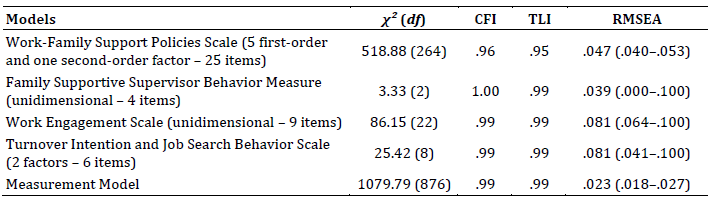
To assess the internal structure of the instruments used, confirmatory factor analyses (CFAs) were first conducted for each scale, followed by analysis of the measurement model. The structure of all instruments was confirmed, and good fit indices were obtained. Specifically, the following structures were deemed adequate: Work-Family Support Policies Scale - 25 items equally divided into five first-order factors (Organizational Facilities, Flexible Work, Parental and Pregnancy Policies, Communication and Psychological Support, Work Management) and one second-order factor (Work-Family Support Policies); Brief Version of the Family Supportive Supervisor Behavior Measure - 4 items and one factor; Utrecht Work Engagement Scale - nine items and one factor; and the Turnover Intention and Job Search Behavior Scale - six items equally divided into two factors (Reflections on Leaving the Current Job and Job Search Behavior). The measurement model also demonstrated good fit indices and adequate factor loadings (ranging from .43 to .98; M = .76). Thus, the items were appropriately explained by their respective latent variables (Table 1).
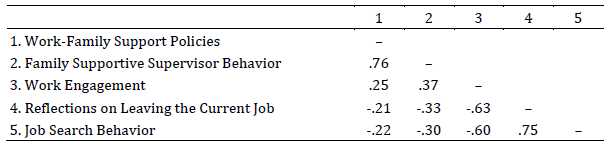
Factorial correlations among the study variables were also analyzed. As shown in Table 2, significant correlations (p < 0.001) were found among all study variables. That is, the null hypothesis-stating that no relationship exists between two variables-was rejected in all bivariate correlation tests.
To test the hypotheses, the direct relationships between the independent variables (IVs: work-family support policies and family-supportive supervisor behavior) and the dependent variables (DVs: reflections on leaving the current job and job search behavior) were initially assessed. The results showed that, when both IVs were simultaneously included in the model, only family-supportive supervisor behavior demonstrated significant relationships with the DVs. This result may be explained by the strong correlation found between the two IVs (.76; p < .001). Thus, it was considered that high collinearity (Kondylis & Whittaker, 2010) between the variables may have prevented both from showing significant relationships with the DVs when analyzed together. Therefore, two separate models were tested: one including work-family support policies as the independent variable, and another including family-supportive supervisor behavior as the antecedent variable.
In the first model (IV: work-family support policies), without the inclusion of the mediating variable (work engagement), the results indicated a direct, negative, and significant relationship between work-family support policies and both reflections on leaving the current job and job search behavior. These findings confirmed Hypothesis 1 (see Table 3). In the second model, family-supportive supervisor behavior also showed a direct, negative, and significant relationship with reflections on leaving the current job and job search behavior. These results supported Hypothesis 2 (see Table 4).
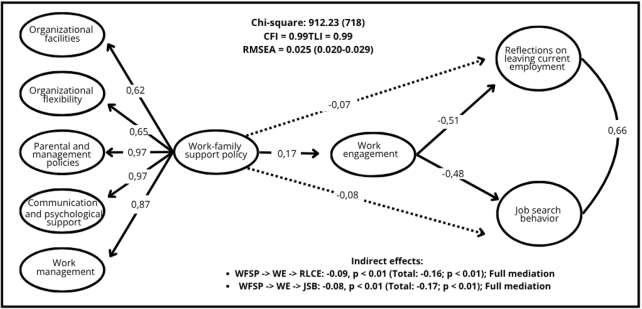
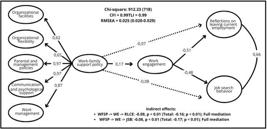
The next step involved including the mediating variable in the research models. With work engagement present, the relationship between work-family support policies and reflections on leaving the current job weakened and became nonsignificant. The same was observed for the relationship between work-family support policies and job search behavior (see Table 3). Additionally, the associations between work engagement and both reflections on leaving the current job (β = -0.51; p< .001) and job search behavior (β = -0.48; p < .001) were significant. Furthermore, the relationship between work-family support policies and work engagement was also significant (β = 0.17; p < .01), as were the indirect and total effects: i) Work-family support policies → work engagement → reflections on leaving the current job: -.09; p < .01; total: -.16; p < .01. ii) Work-family support policies → work engagement → job search behavior: -.08; p < .01; total: -.17; p < .01.
These results indicate that work engagement fully mediated the relationships between work-family support policies and both reflections on leaving the current job and job search behavior, confirming Hypothesis 3. Table 3 presents a summary of these relationships, and Figure 1 illustrates the final version of the model with standardized parameters.
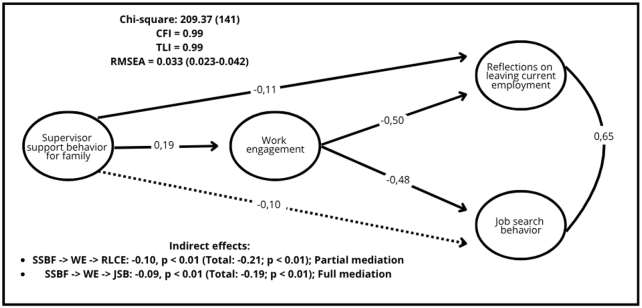
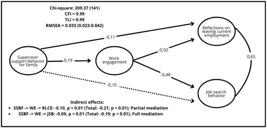
In the other model, when the mediating variable work engagement was included, the association between supervisor family-supportive behaviors and thinking about leaving the current job was reduced, yet remained statistically significant. On the other hand, the relationship between supervisor family-supportive behaviors and job search behavior decreased and was no longer significant (Table 4). Furthermore, the associations between work engagement and thinking about leaving the current job (β = -0.50; p < .001), and between work engagement and job search behavior (β = -0.48; p < .001), were significant. The same was true for the relationship between supervisor family-supportive behaviors and work engagement (β = -0.19; p < .001). Finally, the indirect effects of the independent variable on the dependent variables, as well as the total effects (supervisor family-supportive behaviors → work engagement → thinking about leaving the current job: -0.10; p < .001; total: 0.21; p = .001; supervisor family-supportive behaviors → work engagement → job search behavior: -0.09; p < .001; total: -0.19; p< .001), were significant.
These results indicate that work engagement partially mediated the relationship between supervisor family-supportive behaviors and thinking about leaving the current job, and fully mediated the relationship between supervisor family-supportive behaviors and job search behavior, which supports Hypothesis 4. Table 4 summarizes the relationships found. Figure 2 presents the final version of the model, with standardized parameters.
Discussion
The present study evaluated, based on the JD-R Model, how organizations can provide support to women with children up to four years old by analyzing the relationships between work-family supportive policies and supervisor family-supportive behaviors and turnover intention. In addition, it examined the mediating role of work engagement in these relationships. The results indicated a direct and negative relationship between work-family supportive policies and supervisor family-supportive behaviors and turnover intention. Furthermore, they showed that work engagement mediates these relationships. These empirical findings carry important theoretical and practical implications, as this study demonstrates how organizations and supervisors can adopt a more supportive stance toward women returning from maternity leave so that they are more likely to remain in the organization.
The main contribution of this study was to demonstrate that women returning from maternity leave may choose to stay in their jobs if they experience a supportive work environment. Therefore, one way to prevent these women from leaving their jobs is to increase the availability of work-family supportive policies, such as offering flexible schedules, the possibility of remote work, or even on-site childcare. Accordingly, the results showed a negative relationship between work-family supportive policies and turnover intention-that is, the more work-family support a woman receives, the less likely she is to intend to leave her organization and her job. This relationship provided empirical support for Hypothesis 1.
These findings are consistent with previous studies (Gonçalves & Neto, 2022; Lobburi, 2012; Oliveira et al., 2018), which investigated the relationship between worker support policies and positive work-related outcomes. The results also provide further empirical evidence that when an organization offers work-family supportive policies, it enables women with young children to manage their professional careers, even during emotionally delicate periods (Costantini et al., 2020). This, in turn, reduces conflict (Lemos et al., 2021) and increases the desire to remain in the organization, as it helps them meet their demands (Costantini et al., 2020).
Another way to prevent women returning from maternity leave from leaving their jobs relates to supervisor family-supportive behaviors, as a negative relationship was found between supervisor support and both thinking about leaving the current job and job search behavior, confirming Hypothesis 2. These findings reinforce previous conclusions (Campos-Garcia et al., 2021; Hammer et al., 2013) regarding the importance of supervisor support for family responsibilities in encouraging employees to remain in their jobs. Moreover, supervisors’ actions can influence how women experience maternity leave, making them feel understood and supported, which in turn prevents them from leaving the organization (Lemos et al., 2021). In this way, the present study provides additional insights into the assumptions of the JD-R Model (Bakker & Demerouti, 2017), which posits that nonwork resources can enhance positive outcomes, as such resources contribute to the extrinsic motivational process, one of whose consequences is a reduction in turnover intention (Bakker et al., 2023).
The results of this study also demonstrated the mediating role of work engagement, which allowed for the confirmation of Hypotheses 3 and 4. These findings are consistent with previous research (Lobburi, 2012; Tews et al., 2020; Yeosock, 2020) on the mediating role of work engagement in the relationship between job resources and turnover intention. Furthermore, they contribute to clarifying the critical role of work engagement in linking contextual workplace variables to work-related outcomes. In this regard, it was identified that, beyond the direct effects of work-family supportive policies and supervisor family-supportive behaviors on reducing turnover intention, these variables also enhance work engagement, which in turn decreases turnover intention (Yeosock, 2020).
It is worth noting, however, that work engagement fully mediated the relationships between work-family supportive policies and both thinking about leaving the current job and job search behavior, as well as the relationship between supervisor family-supportive behaviors and job search behavior, and partially mediated the association between supervisor family-supportive behaviors and thinking about leaving the current job.
This means that work-family supportive policies have only indirect relationships with thinking about leaving the current job and job search behavior, through work engagement. Likewise, the fact that the supervisor supports the family-related concerns of mothers with children up to four years old affects job search behavior only indirectly, through work engagement (Rijnhart et al., 2021). When the organization offers supportive policies and the supervisor provides support to help mothers of young children balance work and family responsibilities, they tend to become more engaged in their work activities. And the fact that these women are engaged in their activities reduces the likelihood that they will actively seek another job (Yeosock, 2020).
However, when supervisors display family-supportive behaviors, such as expressing trust in the work of these women, they tend not to consider seeking other jobs, regardless of their level of work engagement, since the direct relationship remained significant even in the presence of this construct. One possible explanation is that, when a supervisor helps a woman balance her professional and family roles, it fosters a psychological obligation that discourages her from thinking about leaving the organization (Campos-Garcia et al., 2021). For instance, she may feel that she is treated so well by her supervisor that it would be unfair to leave her position (Nguyen et al., 2020).
The findings regarding the mediating role of work engagement are aligned with the JD-R Model, which proposes that job resources initiate a motivational process that promotes goal achievement, personal development, and growth. This is expressed in higher levels of engagement, which, in turn, lead to better work outcomes and reduce turnover intention (Bakker et al., 2023). Moreover, the results show that when employees are more engaged, the likelihood of turnover decreases, as they feel satisfied with their current job.
Accordingly, the present study suggests that organizations should increase their supportive policies and train supervisors to provide effective support to women with young children, in order to retain human capital and foster greater work engagement. In this way, companies can develop strategies that promote a healthy balance between work and personal life.
Regarding the limitations of the present study, one notable aspect is the use of self-report instruments, which may lead to response bias depending on the respondent’s current situation and emotional state. If the responses do not accurately reflect reality, the results may not be generalizable to other contexts or populations. However, this bias may have been minimized through anonymity assurances and by informing participants that there were no right or wrong answers. Another limitation is that most female respondents were from the Southeast region of Brazil, were married, and had higher education levels. Therefore, the results may not be generalizable to other groups, limiting the extrapolation of the findings. A third limitation concerns the cross-sectional design of the study. The conclusions may not reflect long-term dynamics, such as fluctuations in turnover intention over different time periods. Nevertheless, to reduce this effect, the study was conducted at two time points, in an effort to minimize common method variance. Finally, although the JD-R Model advocates for the combined use of job resources, personal resources, and job demands, this study considered only job resources, thus neglecting the potential influence of personal resources and job demands in preventing turnover intention. As a result, the findings may not be applicable to contexts in which personal resources or job demands play a significant role.
As for future research, it is recommended that studies incorporate other types of job resources, in addition to examining the role of personal resources and job demands in the balance between work and personal life. For this purpose, a methodological approach different from that used in the present study is suggested-for example, a longitudinal design, in which the same participants are followed across multiple waves of data collection over time. This would allow researchers to observe intra- and interindividual changes and infer causal relationships with greater precision. Additionally, a diverse sample is recommended in future studies to enhance the generalizability of the findings beyond the initially studied group.
Furthermore, it is recommended to investigate how organizational factors such as corporate culture and human resources policies may moderate the effects of the JD-R model on mothers returning from maternity leave. For example, examining whether the availability of gradual return policies, pre-return communication, and psychological support can increase work engagement and the desire to remain employed at the company. Another practical aspect is to study return-to-work practices, such as “runway back” programs and “Keep in Touch” days, which can facilitate reconnection with the company during leave, mitigating feelings of isolation and being out of touch. Finally, including variables such as shift flexibility, remote work, and mentoring by mothers who have already returned to work may reveal how these resources influence motivation and retention within this specific group.
Final Considerations
It is concluded that organizational work-family supportive policies and supervisor family-supportive behaviors are not only beneficial for the women who receive them but also for the organization as a whole. Such actions improve workplace relationships and conditions, and they distinguish the organization by the presence of these practices, potentially attracting other women seeking employment.
References
-
Aldrighi, I. A. C., Lemes, R. S., & Da Silva, F. M. (2021). A mulher e o mercado de trabalho: uma discussão sobre a (re) inserção após a licença-maternidade. Saber Humano: Revista Científica da Faculdade Antonio Meneghetti, 11(18). https://doi.org/10.22409/1984-0292/v30i2/5541
» https://doi.org/10.22409/1984-0292/v30i2/5541 -
Alves, P. J. M. (2023). A proteção ao trabalho da mulher e seu impacto adverso: reflexos da divisão sexual do trabalho (Dissertação de mestrado). Universidade Nove de Julho https://bibliotecatede.uninove.br/handle/tede/3232
» https://bibliotecatede.uninove.br/handle/tede/3232 -
Bakker, A. B., & Demerouti, E. (2017). Job demands-resources theory: Taking stock and looking forward. Journal of Occupational Health Psychology, 22(3), 273, https://doi.org/10.1037/ocp0000056
» https://doi.org/10.1037/ocp0000056 -
Bakker, A. B., Demerouti, E., & Sanz-Vergel, A. I. (2023). Job demands-resources theory: Ten years later. Annual Review of Organizational Psychology and Organizational Behavior, 10, 25-53. https://doi.org/10.1146/annurev-orgpsych-120920-053933
» https://doi.org/10.1146/annurev-orgpsych-120920-053933 -
Bernardo, V. C. D. S. (2023). Diferenciais raciais entre mulheres sem filhos ao final do período reprodutivo no mercado de trabalho nordestino em 2015 (Dissertação de mestrado). Universidade Federal do Rio Grande do Norte https://repositorio.ufrn.br/handle/123456789/58293
» https://repositorio.ufrn.br/handle/123456789/58293 -
Campos-Garcia, X., Guevara, R., & Idrovo-Carlier, S. (2021). The effect of family supportive supervisor behaviors and work-family culture on turnover intention and work-family conflict. Management Science Letters, 11(9), 2377-2390. https://doi.org/10.5267/j.msl.2021.5.003
» https://doi.org/10.5267/j.msl.2021.5.003 -
Costantini, A., Dickert, S., Sartori, R., & Ceschi, A. (2020). Return to work after maternity leave: the role of support policies on work attitudes of women in management positions. Gender in Management: An International Journal, 36(1), 108-130. https://doi.org/10.1108/GM-06-2019-0085
» https://doi.org/10.1108/GM-06-2019-0085 -
Da Silva, A. A., Machado, W. d. L., Souza, L. A. S. d., Barbosa, N. M. S., Assis, R. S. d., & Oliveira, M. Z. d. (2018). Adaptação e propriedades psicométricas da Escala de Intenção de Turnover e Busca de Emprego. Avaliação Psicológica, 17(4), 462-472. https://doi.org/10.15689/ap.2018.1704.6.06
» https://doi.org/10.15689/ap.2018.1704.6.06 -
De Oliveira Silva, M. N., & Da Costa, A. B. (2022). O papel da mulher na produção e reprodução do trabalho no capitalismo à luz de alguns conceitos. Cadernos de Ciências Sociais Aplicadas, 19(33), 180-195. https://doi.org/10.22481/ccsa.v19i33.10474
» https://doi.org/10.22481/ccsa.v19i33.10474 -
Duarte, N., Jorge, M. S. B., da Silva, D. M. F., de Souza, D. B. C., Oliveira, R. S., Barroso, P., & Lourinho, L. (2021). Estratégias de promoção da saúde mental na atenção primária à saúde no contexto da Covid-19: uma revisão integrativa. Research, Society and Development, 10(11), 527-540. https://doi.org/10.33448/rsd-v10i11.19527
» https://doi.org/10.33448/rsd-v10i11.19527 -
Ferreira, M. C., Valentini, F., Damásio, B. F., Mourão, L., Porto, J. B., Chinelato, R. S. de C., Novaes, V. P., & Pereira, M. M. (2016). Evidências adicionais de validade da UWES-9 em amostras brasileiras. Estudos de Psicologia, 21(4). https://doi.org/10.5935/1678-4669.20160042
» https://doi.org/10.5935/1678-4669.20160042 -
Garcia, C. F., & Viecili, J. (2018). Implicações do retorno ao trabalho após licença-maternidade na rotina e no trabalho da mulher. Fractal: Revista de Psicología, 30, 271-280. https://doi.org/10.22409/1984-0292/v30i2/5541
» https://doi.org/10.22409/1984-0292/v30i2/5541 -
García, M. E. A., & González, A. M. V. (2022). Violencia de Género: Una Revisión de Instrumentos de Medida. Revista Iberoamericana de Diagnóstico y Evaluación Psicológica, 5(66), 141-156. https://doi.org/10.21865/RIDEP66.5.11
» https://doi.org/10.21865/RIDEP66.5.11 - Gonçalves, P., & Neto, H. V. (2022). Condições psicossociais de trabalho em enfermeiros, médicos e assistentes operacionais de um serviço de internamento cirúrgico. Cesqua-Cadernos de Engenharia de Segurança, Qualidade e Ambiente, 1(5), 1-24.
-
Goretzko, D., Siemund, K., & Sterner, P. (2024). Evaluating model fit of measurement models in confirmatory factor analysis. Educational and Psychological Measurement, 84(1), 123-144. https://doi.org/10.1177/00131644231163813
» https://doi.org/10.1177/00131644231163813 - Hair, J. F., Black, W., Babin, B., & Anderson, R. (2009). Multivariate data analysis 7th edition Pearson Prentice Hall.
-
Hammer, L. B., Ernst Kossek, E., Bodner, T., & Crain, T. (2013). Measurement development and validation of the family supportive supervisor behavior short-form (FSSB-SF). Journal of Occupational Health Psychology, 18(3), 285. https://doi.org/10.1037/a0032612
» https://doi.org/10.1037/a0032612 -
Kalkbrenner, M. T. (2024). Choosing between Cronbach’s coefficient Alpha, McDonald’s coefficient Omega, and coefficient H: Confidence intervals and the advantages and drawbacks of interpretive guidelines. Measurement and Evaluation in Counseling and Development, 57(2), 93-105. https://doi.org/10.1080/07481756.2023.2283637
» https://doi.org/10.1080/07481756.2023.2283637 -
Kondylis, A., & Whittaker, J. (2010). Adaptively preconditioned Krylov spaces to identify irrelevant predictors. Chemometrics and Intelligent Laboratory Systems, 104(2), 205-213. https://doi.org/10.1016/j.chemolab.2010.08.010
» https://doi.org/10.1016/j.chemolab.2010.08.010 -
Kuhn, P., Taube, M. E., & Carlotto, M. S. (2024). Intenção de abandono profissional em professores brasileiros: Revisão sistemática. Revista Psicologia em Pesquisa, 18(3), 1-27. https://doi.org/10.34019/1982-1247.2024.v18.37834
» https://doi.org/10.34019/1982-1247.2024.v18.37834 -
Lagunes-Cordoba, E., Davalos, A., Fresan-Orellana, A., Jarrett, M., Gonzalez-Olvera, J., Thornicroft, G., & Henderson, C. (2021). Mental health service users’ perceptions of stigma, from the general population and from mental health professionals in Mexico: A qualitative study. Community Mental Health Journal, 57, 985-993. https://doi.org/10.1007/s10597-020-00706-4
» https://doi.org/10.1007/s10597-020-00706-4 -
Lemos, A. H. D. C., Barbosa, A. D. O., & Monzato, P. P. (2021). Mulheres em home office durante a pandemia da Covid-19 e as configurações do conflito trabalho-família. Revista de Administração de Empresas, 60, 388-399. https://doi.org/10.1590/S0034-759020200603
» https://doi.org/10.1590/S0034-759020200603 -
Lobburi, P. (2012). The influence of organizational and social support on turnover intention in collectivist contexts. Journal of Applied Business Research, 28(1), 93-104. https://doi.org/10.19030/jabr.v28i1.6687
» https://doi.org/10.19030/jabr.v28i1.6687 -
Machado, J. S. D. A., & Penna, C. M. D. M. (2022). As políticas públicas de saúde e a fragmentação do corpo feminino em útero e peito. Physis: Revista de Saúde Coletiva, 32, 320-341. https://doi.org/10.1590/S0103-73312022320221
» https://doi.org/10.1590/S0103-73312022320221 -
Nguyen, L. V., Haar, J., & Smollan, R. (2020). Family supportive supervisor behaviours and turnover intentions: testing a multiple mediation model in the New Zealand hospitality industry. Labour & Industry: A Journal of the Social and Economic Relations of Work, 30(2), 156-173. https://doi.org/10.1080/10301763.2020.1730674
» https://doi.org/10.1080/10301763.2020.1730674 -
Oliveira, Á. de F., Gomide Júnior, S., Poli, B. V. dos S., & Oliveira-Silva, L. C. (2018). Análise dos fatores organizacionais determinantes da intenção de rotatividade. Trends in Psychology, 26(2), 1031-1042. https://doi.org/10.9788/TP2018.2-18Pt
» https://doi.org/10.9788/TP2018.2-18Pt -
Palma, E. D. S. B., & Da Silva Gonçalves, M. C. (2022). Mulheres de negócios: um estudo de caso sobre o desafio de gênero em João Pinheiro-MG. Altus Ciência, 14(14), 247-277. https://doi.org/10.5281/zenodo.6363670
» https://doi.org/10.5281/zenodo.6363670 -
Paro, M. L., da Silva, O. N., de Carvalho, R. R., Pizzio, A., & Rodrigues, W. (2024). Qualidade de vida no trabalho dos juízes de direito no Tocantins. Conjecturas, 24(1), 1-24. https://doi.org/10.53660/CONJ-2127-2X01
» https://doi.org/10.53660/CONJ-2127-2X01 -
Podsakoff, N. P., Podsakoff, P. M., MacKenzie, S. B., & Klinger, R. L. (2012). Are we really measuring what we say we're measuring? Using video techniques to supplement traditional construct validation procedures. Journal of Applied Psychology, 98(1), 99. https://doi.org/10.1037/a0029570
» https://doi.org/10.1037/a0029570 -
Pratama, E. N., Suwarni, E., & Handayani, M. A. (2022). Effect of job satisfaction and organizational commitment on turnover intention with person organization fit as moderator variable. APTISI Transactions on Management, 6(1), 74-82. https://doi.org/10.33050/atm.v6i1.1722
» https://doi.org/10.33050/atm.v6i1.1722 -
Rijnhart, J. J., Lamp, S. J., Valente, M. J., MacKinnon, D. P., Twisk, J. W., & Heymans, M. W. (2021). Mediation analysis methods used in observational research: a scoping review and recommendations. BMC Medical Research Methodology, 21, 1-17. https://doi.org/10.1186/s12874-021-01426-3
» https://doi.org/10.1186/s12874-021-01426-3 -
Riyono, B., & Rezki, G. (2022). Burnout among working mothers: The role of work-life balance and perceived organizational support. Humanitas: Indonesian Psychological Journal, 19(2), 109-121. https://doi.org/10.26555/humanitas.v19i2.31
» https://doi.org/10.26555/humanitas.v19i2.31 - Rodrigues, F. S., & Martins, L. M. D. (2024). Adaptação brasileira da Escala de Políticas de Suporte Trabalho-Família em Mulheres Trabalhadoras. Revista Brasileira de Orientação Profissional, 25(1), 17-27.
-
Salvagni, J., Azambuja, M., Reichert, F. M., & Veronese, M. V. (2023). Maternidade e mercado de trabalho: A trajetória das mulheres no desenvolvimento de carreiras. Confluências. Revista Interdisciplinar de Sociologia e Direito, 25(1), 18-42. https://doi.org/10.22409/conflu.v25i1.57084
» https://doi.org/10.22409/conflu.v25i1.57084 -
Santos, K. M. D. O., & Oliveira-Silva, L. C. (2021). Marcadas pelo mercado: inserção profissional e carreira de mulheres transexuais e travestis. Cadernos Pagu, 62 https://doi.org/10.1590/18094449202100620021
» https://doi.org/10.1590/18094449202100620021 -
Schaufeli, W. B., Bakker, A. B., & Salanova, M. (2006). The measurement of work engagement with a short questionnaire: A cross-national study. Educational and Psychological Measurement, 66, 701-716. https://doi.org/10.1177/0013164405282471
» https://doi.org/10.1177/0013164405282471 -
Segala, D. (2024). Mapeamento das competências dos servidores Técnico-Administrativos em Educação lotados nos setores da gerência administrativa da Escola de Administração da Universidade Federal do Rio Grande do Sul (Dissertação de mestrado). Universidade Federal do Rio Grande do Sul http://hdl.handle.net/10183/274491
» http://hdl.handle.net/10183/274491 -
Tews, M. J., Michel, J. W., & Stafford, K. (2020). Social support and turnover among entry‐level service employees: Differentiating type, source, and basis of attachment. Human Resource Management, 59(3), 221-234. https://doi.org/10.1002/hrm.21989
» https://doi.org/10.1002/hrm.21989 -
Torres, A. J. C., Barbosa-Silva, L., Oliveira-Silva, L. C., Miziara, O. P. P., Guahy, U. C. R., Fisher, A. N., & Ryan, M. K. (2024). The impact of motherhood on women's career progression: A scoping review of evidence-based interventions. Behavioral Sciences (Basel, Switzerland
),
14(4), 275. https://doi.org/10.3390/bs14040275
» https://doi.org/10.3390/bs14040275 -
Vieira, B. A., & Gabardo-Martins, L. M. D. (2024). Medidas abrangente e reduzida de comportamento de suporte do supervisor à família. Psico-USF, 28, 799-810. https://doi.org/10.1590/1413-82712023280411
» https://doi.org/10.1590/1413-82712023280411 -
Yeosock, A. (2020). The mediating role of work engagement on the relationship between perceived supervisor support and turnover intention (Tese de mestrado). San Jose State University https://scholarworks.sjsu.edu/cgi/viewcontent.cgi?article=8664&context=etd_theses
» https://scholarworks.sjsu.edu/cgi/viewcontent.cgi?article=8664&context=etd_theses