Road to a new fatherhood: Perspectives regarding the role of the father in Chilean two-parent families
Abstract:
In the last three decades in Chile, variations have been observed in paternal participation in family reproduction tasks, with the appearance of roles that are more in line with current times and at the same time of insufficient equity. The main objective of this research was to know the changes in the parental role within Chilean two-parent families. A voluntary sample of male participants from Ñuble, Chile, who exercise parenthood, was used. Thirteen semi-structured face-to-face and online interviews were conducted, which were subjected to a narrative analysis to observe the life stories through the people's accounts and to know their experiences from the subjectivity, which allowed to deepen and interpret the exposed content. The results indicated that there are updates to the parental role, evidencing the importance of the new type of role together with the presence of the traditional role, which are determined by the experiential, sociocultural and generational context of each participant. The repetition of parenting patterns observed in the family of origin and the slow incorporation of new models of parenting suggest that this should be a relevant issue for the future implementation of public policies that promote participation and equity in parental relationships in the current family.
Keywords:
fatherhood; participation; family roles; family; gender inequality
Resumen:
En las últimas tres décadas en Chile se han observado variaciones en la participación paternal en las labores de reproducción de la familia con la aparición de roles más ajustados a la época actual y al mismo tiempo de equidad insuficiente. Esta investigación tuvo como principal objetivo conocer los cambios en el rol parental dentro de las familias biparentales chilenas. Se utilizó una muestra voluntaria de participantes varones de Ñuble, Chile, que ejercen la paternidad. Se realizaron 13 entrevistas semiestructuradas, presenciales y online. Estas fueron sometidas a un análisis narrativo para observar las historias de vida a través del relato de las personas y conocer sus experiencias desde la subjetividad, lo que permitió ahondar e interpretar en el contenido expuesto. Los resultados indicaron que existen actualizaciones al rol paterno, que evidencian la importancia del rol de nuevo tipo junto a la presencia del rol tradicional, los cuales están determinados por el contexto vivencial, sociocultural y generacional de cada participante. La repetición de patrones de crianza observados en la familia de origen y la lenta incorporación de nuevos modelos de paternidad sugieren que este debe ser un tema relevante para la futura implementación de políticas públicas que promuevan la participación y la equidad en las relaciones parentales de la familia actual.
Palabras clave:
paternidad; participación; roles familiares; familia; inequidad de género
Resumo:
Nas últimas três décadas, no Chile, observaram-se variações na participação paterna nas tarefas de reprodução da família, com o aparecimento de papéis mais alinhados com os tempos atuais e, ao mesmo tempo, de insuficiente equidade. O objetivo principal desta investigação foi conhecer as mudanças no papel parental nas famílias biparentais chilenas. Foi utilizada uma amostra voluntária de participantes do sexo masculinos de Ñuble, Chile, que exercem a paternidade. Foram realizadas 13 entrevistas semiestruturadas presenciais e on-line, que foram submetidas a uma análise narrativa para observar as histórias de vida através dos relatos das pessoas e conhecer suas experiências a partir da subjetividade, o que permitiu aprofundar e interpretar o conteúdo exposto. Os resultados indicaram que existem atualizações no papel paterno, evidenciando a importância do novo tipo de papel junto a presença do papel tradicional, que são determinados pelo contexto vivencial, sociocultural e geracional de cada participante. A repetição de padrões de criação observados na família de origem e a lenta incorporação de novos modelos de paternidade sugerem que esta deve ser uma questão relevante para a futura implementação de políticas públicas que promovam a participação e a equidade nas relações parentais das famílias atuais.
Palavras-chave:
paternidade; envolvimento; papéis familiares; família; desigualdade de género
This study analyzes the traditional and new roles associated with the figure of the father in Chilean two-parent families, as they are presented through the social imaginary called symbolic representations. The roles of the father figure in transition were addressed, as a result of social transformations experienced in Chile in recent decades that affected the daily lives of its inhabitants.
Different authors (Comas, 2016; Fonseca, 2019; Vera, 2022) have contributed to the study of male parenthood, indicating significant advanced which are linked, among other factors, to the drive of women's movements for their incorporation into the public sphere, which also involves new positions and changes in traditional family roles and adjustments to the requirements and social representations of fatherhood and motherhood.
Male parenthood is shaped by the unique social and cultural expectations of each society at specific points in history. These ideas about fatherhood evolve alongside the sociocultural changes occurring at that time. There is no single model of fatherhood for all human cultures and societies (Olavarría & Parrini, 2000), so we can continue observing the traditional role of the father as the main economic provider of the household, a figure of authority in the family and with little participation in raising the children, a task that falls heavily on the mother, who within her role assumes parenting, emotional support and household chores. This shows little attention to equity in domestic and reproductive tasks in parenting, based on household responsibilities. However, the new type of role is also advancing (Olavarría & Parrini, 2000; Vera, 2022), which can be observed in young fathers, who, while maintaining the characteristic of providing financially for the home, have greater responsibility in raising and caring for their children, going from being only an authority figure to being included as a close and collaborative person in the tasks derived from parenting. The main objective of this research was to understand the changes in the parental role within Chilean biparental families, addressing the perspective of parents from the city of Chillán, Ñuble region. The specific objectives were: 1) To define the characteristics of the traditional father role in Chilean biparental families, 2) to define the characteristics of the new type of father role in Chilean biparental families, and 3) to highlight the changes in the traditional and new type of father role in Chilean biparental families.
Bronfenbrenner's Bioecological Theory
This study uses as a conceptual basis aspects of Bronfenbrenner's bioecological theory (1987), explaining the different realities, whether individual, family, social and cultural, as systems that must be conceived in an articulated manner within other systems composed of different subsystems, which, in turn, relate to each other in a dynamic way. Bronfenbrenner (1987) points out the existence of five systems: Microsystem, Mesosystem, Exosystem, Macrosystem and Chronosystem. From this theory, the father role can be considered within the biparental system, which is composed of the experiences, social and family realities and representations given by the same parents who have seen and developed paternity.
Family
We understand the family as a social and demographic constitution, where different systems and subsystems are distributed, which fulfill certain functions and roles, which allow the configuration of a family structure (Irueste et al., 2020).
Now, the conceptualization of family in the first half of the 20th century corresponded to nuclear families or biparental families, made up of a married couple and their children in common. However, over the years, important changes have occurred in postmodern society, which has led us to the deinstitutionalization of what we know today as family. The legitimacy of divorce, assisted reproduction, advances in technological means, and changes in social representations have generated a new vision of the role of mother, fatherhood, sexual diversity, among others (Irueste et al., 2020). Given all these transformations, there is a need to diversify and investigate current family models and structures.
Guzmán et al. (2019) point out that families can be divided into typologies according to their structure and dynamics, for example: a) nuclear families, b) extended families, c) single-parent families, and d) homoparental families. In the present research, we worked with two-parent nuclear families. These are established by both parents and children (Guzmán et al., 2019) and they are characterized by meeting criteria such as marriage and heterosexuality. These characteristics mark certain differences with other current family structures that show greater openness to the requirements of society (Irueste et al., 2020).
The choice of this type of family in this research is based on the fact that it corresponds to the most common type in our country, with 1,626,370 households with two-parent nuclear families, out of a total of 5,651,637 households in Chile (National Institute of Statistics, 2017). However, beyond the type of family chosen, the interest lies mainly in the roles exercised within families, and in particular the father role.
Family roles and father role
Family roles correspond to the way in which a family interacts within the culture in which it is immersed. Through these roles, families are constituted and developed, with society taking on a fundamental role, since it governs the patterns of family functioning and stability (Delfín et al., 2021).
Regarding the father role, Oliveros (2019) mentions that it is composed of a domestic axis and a public axis, where the first refers to the functions of paternity, and the second is made up of work. Aguayo et al. (2021) highlight the importance of the father role in the lives of children, since active fatherhood would have positive effects on their well-being, even when it is exercised with the father figure residing outside the home. Likewise, responsible fatherhood benefits in aspects of gender equality, and in terms of the sense of self-realization of parents. In Chile, it can be observed how family roles are delimited, establishing the father as the head of the household, an active and hard-working man; while the mother is responsible for raising the children (Undurraga & López, 2021; Uribe, 2020). This is how the idea of a family where the father is the provider and the mother is in charge of caring for the children has been perpetuated over the years (Delfín et al., 2021).
Through public policies, society has restricted the exercise of certain rights of men and women, so they have been limited in carrying out tasks of caring for and raising children (Vera, 2022). In fact, in Chile, the father only has the right to seven days of postnatal leave, which does not sufficiently promote the conditions for active fatherhood from birth. On the other hand, and despite significant social advances, culture continues to assign women the role of caring mother and protector of children and home, interrupting development in other areas of their lives (Uribe, 2020; Vera, 2022).
The inequity between the rights that men and women have within family tasks and roles is notorious. The traditional family model, derived from the existing culture, society and policies, restricts the action of fathers and mothers within their parenting role, but also within their personal development.
Caregiving tasks have been naturalized by society as a task proper to women, who would have moral and affective aspects intrinsic in their nature for this role, (Comas, 2016). This limits the development of women in other important areas of their personal development, with the responsibility of being the one who dedicates a large part of her life to raising children falling on the figure of the woman-mother.
In the case of men, Comas (2016) states that they are at a disadvantage with respect to child-rearing, mainly as a consequence of existing social policies, and due to the naturalization of men as the economic provider of home. Existing job opportunities tend to be mostly favorable to men, who also enjoy, in most cases, higher salaries than that given to women who perform in the same positions. This is why the performance of men as the person in charge of caring for and raising children becomes ineffective for the development of a family (Comas, 2016; Uribe, 2020; Vera, 2022).
On the Encuesta de Caracterización Socioeconómica Nacional (National Socioeconomic Characterization Survey), presented in 2017, it is mentioned that men were the main income earners in 61.5 % of Chilean households, compared to 38.5 % where women were the main income earners. In other words, in Chile men are the main economic breadwinners of the household (Ministerio de Desarrollo Social y Familia. Observatorio Social, 2017). Due to inequalities in salary, men are forced to continue in the role of economic provider, leaving aside their role as father and caregiver, in order to ensure greater economic income for the household, and therefore, better living conditions.
Role of the traditional father and the new type
The traditional role of the father is characterized by being a classic and archaic model of fatherhood, in which the man responds to the predominant culture within the patriarchal framework, which imposes the figure of the father as hegemonic, dominant and superior over the other members of the family group (Márquez et al, 2021; Olavarría & Parrini, 2000; Valdés et al., 2023).
Garzón (2020) mentions that these characteristics of fatherhood are formed from the observation and repetition of patterns learned both from the social group and from the culture in which the father is immersed. Taking up the same idea, Fonseca (2019) explains that the men of each family internalize generational patterns, which they incorporate following the model of their father figures, these are perpetuated according to the mandates of society, which demands and pressures men to demonstrate manliness through their actions. Within these guidelines, the man, when assuming the role of father, must provide financially for the home, and take control of the family, demonstrating his strength and independence, while at the same time presenting few gestures of affection or love, and fragility (Olavarría & Parrini, 2000).
However, various authors linked to family research (Fonseca, 2019; Madrid et al., 2020) describe the presence and development of a new role of father called a new type of role with distinctive characteristics compared to the previous one. Quintero (2021) mentions that, although traditional characteristics maintain linked to fatherhood, the transformational changes that have occurred around the family have generated that the role of father must evolve. These characteristics refer to the fact that the father must be a participant in the affective and parenting processes within the family nucleus, that he can generate channels of communication with the children in order to promote spaces of bonding, in addition to modifying the ways of exercising authority.
On the other hand, Quiroz and López (2019) refer to the changes that the father role has incorporated following the transformations of contemporary society, including the active participation of the father in raising children, assertive dialogue and gestures of affection in communication. In addition, it promotes a comprehensive and supportive paternal figure, which fosters bonds in an active and comprehensive manner.
Symbolic representations
Finally, the concept of symbolic representations was used to create the methodological framework, which was the basis for the data collection instrument of this research. Symbolic representations, according to Pichón-Riviére (1985), refer to shared representations that exist in society about a specific aspect, playing a fundamental role within the collective imagination. This concept contains three topics that make it up, which are divided into: a) ideas, defined as mental representations that arise from reasoning or imagination, created about an aspect of the real or imaginary world in which the subject is located, b) images, which refer to representations originating from the perception or memory of a subject, which are born from an experience lived or imagined by the subject, c) stereotypes, these are fixed ideas, images or immutable beliefs that are held about a collective, which are accepted by a group or by society itself.
According to Bruner (2000), human beings recreate reality through symbolic representations in their relationships with the world. Culture defines these symbolic updates of each era, given by the individual human capacity to grasp symbolic relationships of "representation" through constructed symbolic codes. Additionally, in a more "intersubjective" way, symbolic representation is focused on how humans develop the ability to understand others' thoughts, intentions, and beliefs. Thus, parenthood itself is a social construct adapted to the individual nature of the subject, mediated by social influence.
Method
To reach the research objectives, a qualitative approach was adopted, which is characterized by studying the topic under investigation based on the meanings that individuals assign to certain experiences in a natural context, from a comprehensive perspective in which discursive and narrative resources are at the service of constructing people's meanings (Hernández & Mendoza, 2020). The qualitative paradigm allows language to be understood as symbolic production, thus playing an essential role in the construction of personal and social meanings of parenthood.
Additionally, a narrative analysis was conducted, specifically within the analysis of the sample participants' interviews. This allows the researcher to study the narrative of the participants' discourse in order to observe life stories, social and cultural perspectives, as well as family and individual experiences, reflecting each participant's subjectivity, and allowing for in-depth interpretation of the content presented (Rodríguez, 2020; Schöngut-Grollmus & Pujol, 2015).
Design
The research is empirical and phenomenological in nature, as it aims to explore the shared parental experiences of the participants, with a primary focus on the essence of these experiences (Hernández & Mendoza, 2020).
Participants
The invitation to the sample participants was based on their proximity to shared work and educational contexts, as well as an individual approach process through social networks and databases from the CEPSICO Psychological Care Center, affiliated with the University of Bío-Bío and its multiple community engagement connections.
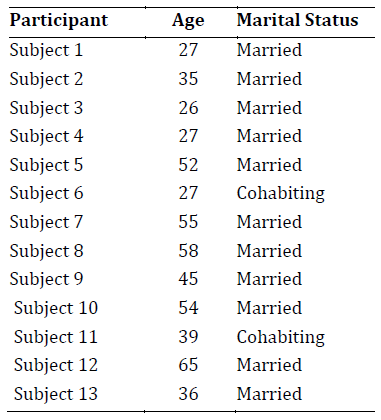
The participants belong to the following places: neighborhood associations of Chillán; administrative workers at the University of Bío-Bío in Chillán; and people referred by acquaintances. The population required for the study had to meet the inclusion and exclusion criteria of being men aged twenty-five or older, who have completed full secondary education, who exercise the paternal role, belong to a biparental family, maintain close and regular physical cohabitation with their partner and children, have exercised paternity for at least three years, and reside in the urban area of Chillán. The list of participants can be seen in Table 1.
Procedures
The process began by directly contacting some fathers, including administrative staff from the University of Bío-Bío and other men interested in participating. Subsequently, network sampling was used (Hernández & Mendoza, 2020), asking interested fathers to identify new participants who could be included in the sample.
Once the proper number of participants was reached, a screening was conducted based on the established criteria, selecting 13 fathers for the study. These participants were divided into two age groups: 7 fathers aged 20 to 39 and 6 fathers aged 40 to 65.
The semi-structured interview format contains a total of 16 questions, which, for better information gathering, were divided into items on stereotypes, ideas, and images, derived from the concept of symbolic representations presented in the theoretical review.
Subsequently, the semi-structured interviews were conducted, with two interviews carried out online for participants’ convenience, while the rest were conducted in person. It is important to mention that ethical research safeguards, such as informed consent, were included to ensure respect for the participant, freedom and tolerance towards the opinions shared, security, and responsibility (Inguillay et al., 2020).
After this, the interviews were transcribed into text to conduct a categorical analysis, with the goal of gathering the content and analyzing each participant’s perspective in the study.
The interpretive analysis of the information provided in the interviews was conducted using the principles of narrative analysis (Schöngut-Grollmus & Pujol, 2015), which allows us to recognize the actions narrated by the subject. Through this, individuals articulate events that construct meanings and add value to social learning (Rodríguez, 2020). Initially, an approximate reading of the participants' narratives was done, involving listening to their discourses, reading interview records, and analyzing the initial information provided. Then, a deeper and more consistent structural analysis was carried out by reading dialogues and repeatedly listening to the interview transcriptions, engaging in an interpretive process related to recognizing convergent and divergent conceptual elements shared by each participant in their narratives. This enabled a systematic study of each personal experience and the meanings conveyed through the conjunction of the stories (Sparkes & Devís, 2007).
From this analysis, organized conceptual frameworks were developed, allowing the identification and definition of emerging themes related to the paternal role. These frameworks also provided narratives aligned with the study’s objectives regarding the most recurrent characteristics of traditional and new types of paternal roles, revealing new thematic connections in the information provided across different discourses, where categories like the role of the mother, generational changes, and adaptability emerged (Silva, 2017).
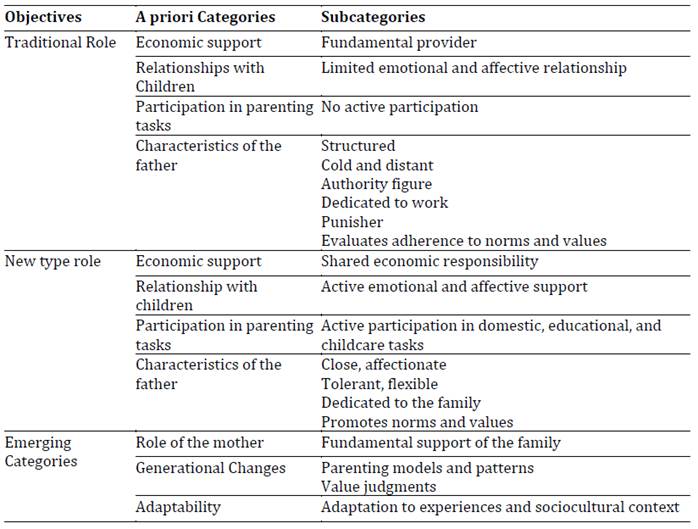
Finally, a triangulation process was performed to identify patterns of convergence, aiming for a global interpretation of the subject of study through consensus among researchers and the data source provided (Okuda & Goméz, 2005). The information gathered from the sample’s narratives was triangulated with the a priori and posteriori categories found in the previously reviewed literature in the study’s theoretical framework. The categorical analysis phase is presented in Table 2.
Results
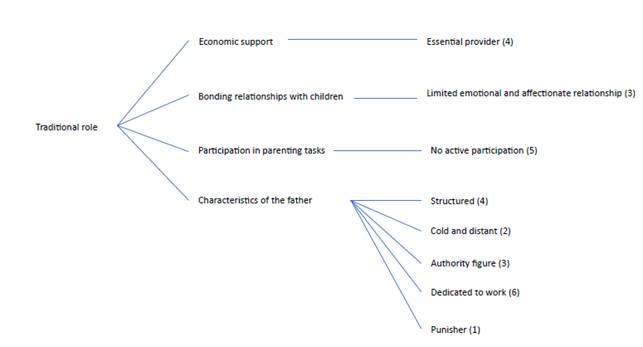
As shown in Table 2, the first specific objective of the research aimed to define the characteristics of the traditional father role in Chilean biparental families. From this objective, the following a priori categories were identified: economic support, bonding relationships with children, participation in parenting tasks, and characteristics of the father. These same a priori categories were included in the second specific objective, which corresponds to defining the characteristics of the new type of father role in Chilean biparental families. However, the subcategories present differences for each specific objective.
The economic support category refers to the father's role as a fundamental provider within the family. Participants expressed that, in family settings, the father was responsible for fulfilling this obligation as part of caring for the children.
My father was born in '45, and his role as a father was basically just to provide; that was the most basic part-being a provider (Subject 9).
My father’s upbringing was very much centered around work, and he passed that onto me, because work is extremely important (…). My dad was very focused on work, as far as I know, so his way of showing love was making sure we didn’t lack anything (Subject 6).
The bonding relationships with children category reflects a limited emotional-affective relationship within the father-child bond, characterized by a lack of emotional support and care, as well as the absence of gestures of affection and love.
My dad? Well, I called him dad… because I heard everyone else calling their fathers dad. I mean, in that sense, it was good because I never went hungry or was cold. But I think he didn’t dedicate enough time to us. He wasn’t very affectionate (…) I would have liked it to be different. Because really… he never showed love (Subject 5).
Regarding participation in parenting tasks, the father is described as having limited or nonexistent involvement in family dynamics, such as spending little time playing with his children, assisting with school tasks, participating in social activities, or spending time in family settings.
A very providing dad, but at the same time quite absent in that role. He was gone all day and came back at night. That was just how it was, and we didn’t really have moments to say, 'Dad, let’s share, let’s play...' (Subject 6).
In the past, many dads didn’t go out alone with their kids. Now I go to the park with my daughters, carrying them in my arms, holding hands, or in the stroller, but you didn’t see that before. It was always the mom who took the kid out, while the dad was working or off playing soccer, drinking, and all that (Subject 6).
Finally, in terms of characteristics of the father, the traditional role is associated with a structured, emotionally distant father figure who represents the main authority and disciplinarian, dedicated entirely to the role of economic and material provider.
My father, I’d say, was from another generation. He was more of an economic provider for the family, not emotionally close, at least initially. He was a more distant, colder father, so to speak, in terms of emotions. He wasn’t very present; he worked a lot and was very focused on making sure we had everything necessary, but he didn’t develop the emotional side very well at first. (Subject 11)
I always remember, I’ll never forget, that we had to go to bed at ten, no matter what. And who goes to bed at ten in the summer? Well, we had to. Whatever he said was what we did; there was only one voice of command, and that was my father’s. (Subject 12)
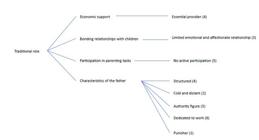
Figure 1 contains the analysis of the results of the first specific objective, highlighting the recurrence of subcategories within each participant's interviews. In this traditional paternal role category, recurrences were primarily found in the interviews of participants aged 40 to 65.
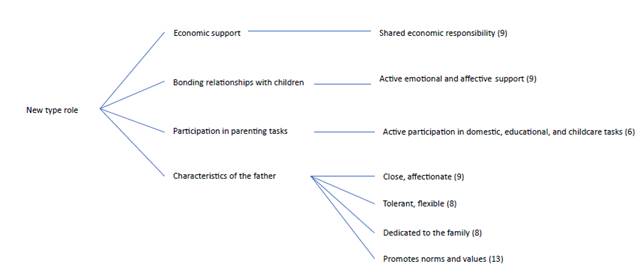
Regarding the second specific objective, the first category refers to shared economic support, which proposes that both father and mother, in an equitable manner, are involved in financially supporting the home.
Both me and my girlfriend can be the breadwinner of the house, in many places it happens that the woman is the one who works and the man stays at home, so it depends a lot on what role or how you carry out the functions with your partner, or what is best for the family in general (Subject 6).
We also share the economic issue, it is not just me who is the breadwinner or just my partner, but we both focus, we divide the household bills a bit and we both contribute equally to financially maintaining the house (Subject 11).
The bonding relationship with the children corresponds to the father maintaining an emotional and affective bond in an active and daily manner with his children, thus being an emotional support within the family.
A loving father, who can always be willing to talk to his children. If possible, be their friend. Because I think that is very important for children today, because we are living through a very difficult stage in youth. So (…) parents need a greater connection with their children (Subject 3).
I feel that society today also expects that one, apart from providing material things, also commits more to a more emotional upbringing. It is no longer enough to provide material things, but also to provide other types, to satisfy other types of more emotional needs (Subject 11).
Participation in parenting tasks proposes that parents have active and daily participation in the tasks carried out with their children at home, such as housework, participation in educational tasks with their children, game dynamics, and the care that is given within parenting.
In a family, I think that... Sharing the chores with your partner mainly, (…)suddenly one does one thing, one does another, depending on the time, according to the desire and according to what they like or suddenly prefer. For example, (…) I wash the dishes, I wash the clothes, and so on(…). With the children, the same, (…) taking her to school, leaving her, suddenly one can, the other can't, or suddenly it's hard for both of us. (…) That finally, as a team I think (Subject 1).
My father shared a lot with us, he played a lot. I think he was just another child with us. What I remember about him is that, if we had to go out, we went out. If we had to play, we played. An excellent father. He never hit me or hit us. Always a piece of advice (Subject 7).
Likewise, in the characteristics of the father, these are described as a close, affectionate figure, who promotes norms and values towards the family, in addition to presenting flexibility and tolerance towards situations that occur within the family nucleus.
Trying to solve problems in a conversational way at home, keeping everything in harmony through dialogue, conversation, agreements. (…) concerned about the emotional area, the academic area (…). Always trying to be very aware of what happens with his children, very close to them, always generating a lot of confidence to say things. (…) I would define that the ideal father is not a perfect father, but rather a father who tries to be aware of situations and who assumes the limitations of his children and his own (Subject 11).
I try to be as understanding as possible, that is why we also apply respectful parenting, so we try to make sure that you relax first, regulate yourself, and then talk to the child, because if not, you will not be able to (…) so in that sense it is like an effective way (…) I say that... as a protector, but at the same time very much about connecting, very much about conversation (Subject 6).
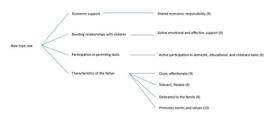
Figure 2 presents a summary of the analysis of the results of the second specific objective. In this case, within the category of new type of role, the recurrences were found mainly in the interviews of the age range of 20 to 39 years.
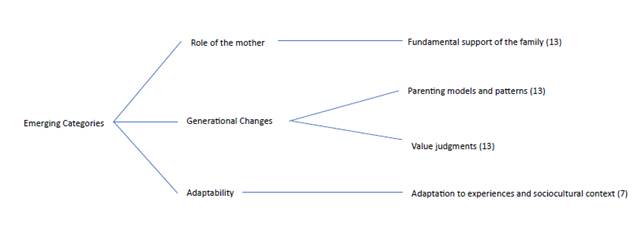
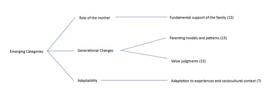
The third and final specific objective is defined as highlighting the changes in the traditional and new type of paternal role in Chilean biparental families. This objective was intended to contain the emerging categories that were presented within the research. The categories collected were: 1) Role of the mother. 2) Generational changes. 3) Adaptability.
The role of the mother is described as a figure that represents the fundamental support of the family nucleus, referring to the fact that she is present in all tasks, both in the emotional, material, social, and psychological areas, supporting each member of the family.
In the concern for the children, that they do not lack anything, (…) that they do not get sick. The mother, I believe that she has a very big responsibility. I take my hat off to them, for their concern for their children. (…) They have a big commitment. Very big. Above the commitment that one has with the children. That they are mothers, they are everything (Subject 7).
She took care of us, she cleaned the house too. That more than anything, she cared about our health, if we had to go to the doctor, she would take us to the hospital (…) There was much more trust, I could talk to her about everything I couldn't talk to my dad about (Subject 4).
Regarding generational changes, parenting models and patterns were identified, which were marked by the differentiation between the old (traditional) and new (new type) roles described by the participants. In addition, these same participants presented value judgments regarding the characteristics, attitudes and actions of the father's role, characterizing it as adequate or inadequate in relation to the situations described. Based on the above, according to these same value judgments, the parents marked changes in their way of parenting and within the family dynamic, with the purpose of perpetuating their own perspective of the father's role.
Well, I've experienced that. I think I lacked more with my father. And I think that maybe that's what I want to transmit to my son. That he trusts me. They can tell me about their problems and all that. (…) Because you see different realities, you kind of want to weigh those things up (Subject 3).
Before, the father figure was more fearsome, (…) as they say in English, close-minded, a closed mentality. And now the mentality is more open, there is more tolerance. That is good because it inspires or helps young people to feel good about their way of thinking. (…) An older person will generally talk about fatherhood in a different way. Maybe they will say that violence or physical punishment is justifiable. There are also many people who are not like that, obviously, but depending on their age, depending on where they live, they will talk about fatherhood in a different way (Subject 4).
Finally, the last emerging category corresponds to adaptability, which considers the sociocultural context and the parents' own experiences when exercising their role, implying that each parent will adapt based on these two influences when raising and getting involved in the family dynamic.
Society transmits to parents through the media the role models to follow. Novels, movies, series, like this type of prototype of father, protector, provider. And (…) these are things that are transmitted like in generations, like certain features of generations. Of this model, of this character who cares, who guides, who orients (Subject 4).
And suddenly, there is the same thing with the eldest son (…) maybe we clash in that sense. (…) There are things that now shock you, that in your time were not done or given, but you also have to evolve, that it is a little bit from one part and a little bit from the other. That is why I say that they have to adopt it (Subject 5).
Figure 3 shows the analysis of the results of the third specific objective, which includes the mention of emerging categories in each interview. It is noteworthy that both age groups of the sample are included in these results.
Discussion and Conclusions
In response to the general objective of understanding the changes in the parental role within Chilean biparental families, it was observed that the participants in this study consider the existence of significant changes within parenthood, in relation to the exercise of the father's role that took place decades ago, and yet they perceive little participation in raising children and household chores (Fonseca, 2019). The changes evidenced have been driven mainly by two aspects: the personal sphere of each parent's life, where the personal experiences and experiences that the participants themselves have had as children stand out (Quintero, 2021), and on the other hand, the sociocultural sphere, where social mandates and inherited generational patterns are found, influenced by Chilean society and culture, in which the sample is demographically located (Comas, 2016; Fonseca, 2019; Márquez et al, 2021; Olavarría & Parrini, 2000; Quiroz & López, 2019; Valdés et al., 2023; Vera, 2022).
Changes in the social representations of the father and mather roles vary from era to era as a result of the historical, political and cultural evolution of each country derived from the processes of social change that impact the constructs of father and mother roles, as well as the narratives of men and women who perform them (Olavarría, 2017; Oliveros, 2019; Quintero, 2021). These changes converge, on one hand, subjective dimensions contained in the historical, social and family development of each individual and, on the other hand, objective elements given by the sociopolitical and cultural transformations of the nation that do not follow a straight line, often implying advances and setbacks with individual and group dimensions, despite living in the same time space for each of the people interviewed. The new ways of assuming fatherhood have to do with this sometimes-contradictory encounter of elements of the role and with individual or social disagreements, creating in turn new individual representations and practices of said role functions where the new and the change are born under the wing of the old, of the traditional that contains it and in some way projects it, dynamizes it. Change must be understood as a spiral with dialectical advances and setbacks that are sometimes contradictory (Olavarría, 2017).
Through objectives one and two, which seek to define the characteristics of the traditional and new type of paternal role in Chilean two-parent families, the main actions and attitudes that, according to Oliveros (2019), fathers exercise within the domestic and public axes were distinguished, highlighting in the traditional role a father who is a fundamental economic provider (Garzón, 2020); and in the new type of role, the incorporation of the father in the emotional and affective plane (Quiroz & López, 2019). Regarding objective number three, to highlight the changes in the traditional and new type of paternal role in Chilean two-parent families, emerging variables were identified that directly influence the models and patterns that fathers exercise within parenthood.
To account for the first specific objective, various authors such as Fonseca (2019), Garzón (2020) and Olavarría (2017), indicate that the traditional role of the father represents a strong, brave, unemotional man, who operates from rationality and independence. Likewise, fathers are peripheral participants in child-rearing and domestic tasks at home, highlighting their main task as economic provider and authority figure over the family. In this same way, the results indicated that fathers over 40 years of age significantly show the presence of characteristics described by the authors, being fathers dedicated mainly to work, with little participation in childcare and household tasks, thus distinguishing themselves by instructing their children and family in general, from a rational perspective and with little affection.
On the other hand, and in relation to the second specific objective, Quiroz and López (2019) and Quintero (2021) present as the main characteristic of the new type of father the inclusion of the paternal figure in the affective processes, and parenting tasks within the family nucleus, promoting the development of stronger bonds with the children. From this, within the sample, it was observed that the youngest participants, between 20 and 37 years old, represented such characteristics, stating that they contribute to parenting by carrying out tasks such as playing, dressing, feeding and helping with the educational tasks of their children. Likewise, they commented on the importance of exercising parenting from affection, in order to offer their children confidence and emotional support, which they lacked in their childhood.
Finally, regarding the third specific objective, the results obtained in this research coincide with the characteristics that the authors refer to parenting. However, and considering the studies by Fonseca (2019) and Garzón (2020), the guidelines, models and social mandates that are part of parenting become relevant when delving into this topic, since observing the participating sample, it can be mentioned that each of the members of this study integrated into their parenting characteristics of both the traditional and new type of paternal role, alluding to the repetition of parenting patterns observed in their parents, in addition to following the operating guidelines within the family structure (Delfín et al., 2021). Through this, a difference is made in the inclusion of new parenting models, in order to adapt to today's society and the paternal experience itself. This is why, despite the distinction that exists between traditional and new type of paternal role, what will mark the way of exercising paternity will be given by the life experiences and the sociocultural context in which each individual develops, marking the paternal figure, as a subsystem in constant interaction with its individual, family, cultural and representational reality, demonstrating dynamism and transformational tendency in its patterns and operating guidelines (Bronfenbrenner, 1987).
Considering the results obtained, it is suggested that future research add other members of the family nucleus, such as mother and children, to the sample for the study of parenthood, since they can complement the vision regarding the modifications in paternal roles in relation to functions and dynamics within the family. Additionally, incorporating children could provide another perspective regarding the changes in their own upbringing. These insights would contribute to a more comprehensive and systemic understanding of parental roles and their impact on family functioning.
References
-
Aguayo, F., Mendoza, D., & Bravo, S. (2021). Paternidad activa: la participación de los hombres en la crianza y los cuidados Iniciativa Spotlight; Fondo de Población de las Naciones Unidas. https://lac.unfpa.org/sites/default/files/pub-pdf/paternidadactiva.pdf
» https://lac.unfpa.org/sites/default/files/pub-pdf/paternidadactiva.pdf - Bronfenbrenner, U. (1987). La Ecología del Desarrollo Humano: Experimentos en Entornos Naturales y Diseñados Paidós.
- Bruner, J. (2000). La educación, puerta de la cultura Aprendizaje.
-
Comas, D. (2016). Hombres cuidadores: Barreras de género y modelos emergentes. Psicoperspectivas, 15(3), 10-22. https://doi.org/10.5027/psicoperspectivas-vol15-issue3-fulltext-750
» https://doi.org/10.5027/psicoperspectivas-vol15-issue3-fulltext-750 -
Delfín, C., Saldaña, C., Cano, R., & Peña, E. (2021). Caracterización de los roles familiares y su impacto en las familias de México. Revista de Ciencias Sociales, 27(3), 128-138. https://doi.org/10.31876/rcs.v27i.36497
» https://doi.org/10.31876/rcs.v27i.36497 -
Fonseca, C. (2019). Jóvenes padres costarricenses: cambios y continuidades de la masculinidad tradicional. Revista Espiga, 18(37), 14-39. https://doi.org/10.22458/re.v18i37.2426
» https://doi.org/10.22458/re.v18i37.2426 -
Garzón, C. (2020). El rol del padre sustituto frente al proceso de crianza de adolescentes con discapacidad cognitiva. Revista Latinoamericana de Estudios de Familia, 12(2), 130-152. https://doi.org/10.17151/rlef.2020.12.2.8
» https://doi.org/10.17151/rlef.2020.12.2.8 -
Guzmán, K., Bastidas, B., & Mendoza, M. (2019). Estudio del rol de los padres de familia en la vida emocional de los hijos. Revista de Investigación Apuntes Universitarios, 9(2), 61-72. https://doi.org/10.17162/au.v9i2.157
» https://doi.org/10.17162/au.v9i2.157 - Hernández, R., & Mendoza, C. (2020). Metodología de la investigación, las rutas cuantitativa, cualitativa y mixta McGraw Hill.
- Inguillay, L., Tercero, S., & López, J. (2020). Ética en la investigación científica. Imaginario Social, 3(1), 42-51.
-
Instituto Nacional de Estadística. (2017). Censo de Población y Vivienda https://www.ine.gob.cl/estadisticas/sociales/censos-de-poblacion-y-vivienda/censo-de-poblacion-y-vivienda
» https://www.ine.gob.cl/estadisticas/sociales/censos-de-poblacion-y-vivienda/censo-de-poblacion-y-vivienda - Irueste, P., Guatrochi, M., Pacheco, S., & Delfederico, F. (2020). Nuevas configuraciones familiares: Tipos de familia, funciones y estructura familiar. Revista REDES, (41), 11-18.
-
Madrid, S., Valdés, T., & Celedón, R. (2020). Masculinidades en América Latina. Veinte años de estudios y políticas para la igualdad de género Universidad Academia de Humanismo Cristiano. https://creaequidad.cl/images/Publicaciones/LibroMasculinidades.pdf
» https://creaequidad.cl/images/Publicaciones/LibroMasculinidades.pdf -
Márquez, F., Lucchini, C., & Bertolozzi, M. (2021). Significado y participación social del hombre al transformarse en padre por primera vez. Andes pediátrica, 92(1), 50-58. https://doi.org/10.32641/andespediatr.v92i1.1757
» https://doi.org/10.32641/andespediatr.v92i1.1757 -
Ministerio de Desarrollo Social y Familia. Observatorio Social. (2017). Encuesta de Caracterización Socioeconómica Nacional. Equidad de Género. Síntesis de resultados http://observatorio.ministeriodesarrollosocial.gob.cl/encuesta-casen-2017
» http://observatorio.ministeriodesarrollosocial.gob.cl/encuesta-casen-2017 - Okuda, M., & Gómez, C. (2005). Métodos de investigación cualitativa: Triangulación. Revista Colombiana de Psiquiatría, 34(1), 118-124.
- Olavarría J. (2017). Sobre Hombres y Masculinidades: “ponerse los pantalones” Universidad Academia de Humanismo Cristiano.
- Olavarría, J., & Parrini, R. (2000). Masculinidad/es. Identidad, sexualidad y familia Primer Encuentro de Estudios de Masculinidad. Universidad Academia de Humanismo Cristiano.
-
Oliveros, I. (2019). Masculinidad hegemónica y su influencia en el desempeño del rol paterno de 56 agentes de la 16a zona policial de Pacora (Tesis de grado, Universidad de Panamá). Repositorio Centroamericano SIIDCA - CSUCA. http://up-rid.up.ac.pa/3151/
» http://up-rid.up.ac.pa/3151/ - Pichón-Rivière, E. (1985). Teoría del vínculo Paidós.
-
Quintero, C. (2021). Cambios y transformaciones en el rol paterno dentro del contexto familiar actual (Proyecto de grado, Universidad Pontificia Bolivariana). Repositorio Institucional - Pontificia Universidad Bolivariana. https://repository.upb.edu.co/handle/20.500.11912/8131
» https://repository.upb.edu.co/handle/20.500.11912/8131 -
Quiroz, M., & López, G. (2019). Configuración del rol paterno a partir de la significación dada a los patrones de crianza tradicionales y a las formas de paternidad contemporáneas (Trabajo de grado, Universidad de Antioquia). Repositorio institucional Universidad de Antioquia. https://bibliotecadigital.udea.edu.co/bitstream/10495/14353/1/QuirozMelisa_2019_ConfiguracionRolPaterno.pdf
» https://bibliotecadigital.udea.edu.co/bitstream/10495/14353/1/QuirozMelisa_2019_ConfiguracionRolPaterno.pdf -
Rodríguez A. (2020). La narrativa como un método para la construcción y expresión del conocimiento en la investigación didáctica. Sophia, 16(2), 183-195. https://doi.org/10.18634/sophiaj.16v.2i.965
» https://doi.org/10.18634/sophiaj.16v.2i.965 - Schöngut-Grollmus, N., & Pujol, J. (2015). Relatos metodológicos: Difracción de experiencias narrativas de investigación. Forum: Qualitative Social Research, 16(2), 24.
- Silva, M. (2017). El transitar en la investigación narrativa y su empleo en la construcción de teoría. Revista de Investigación, 41(91), 124-142.
- Sparkes, A., & Devís, J. (2007). Investigación narrativa y sus formas de análisis: una visión desde la educación física y el deporte. Expomotricidad, 43-68.
-
Undurraga, R., & López, N. (2021). (Des)articuladas por el cuidado: trayectorias laborales de mujeres chilenas. Revista de estudios sociales, 75, 1-16. https://doi.org/10.7440/res75.2021.06
» https://doi.org/10.7440/res75.2021.06 -
Uribe, P. (2020). Masculinidades alternativas: Varones que se narran al margen del modelo hegemónico y generan cambios a través de la educación. Revista Latinoamericana de Educación Inclusiva, 14(2), 115-129. https://doi.org/10.4067/s0718-73782020000200115
» https://doi.org/10.4067/s0718-73782020000200115 -
Valdés, E., Spencer-Contreras, R., & Cárcamo, R. (2023). Impacto del padre en el desarrollo de la conducta prosocial de niños y niñas durante la primera infancia: una revisión sistemática. Terapia psicológica, 41(3), 301-325. https://doi.org/10.4067/s0718-48082023000300301
» https://doi.org/10.4067/s0718-48082023000300301 -
Vera, D. (2022). Políticas de permisos parentales en Chile y Suiza desde una mirada institucional y de género. Revista científica internacional CUHSO, 32(1), 121-151. https://doi.org/10.7770/cuhso-v32n1-art2718
» https://doi.org/10.7770/cuhso-v32n1-art2718