
 Adaptive management of applications across multiple clouds: The SeaClouds Approach
Abstract
Resumen: Uno de los problemas que han emergido con el auge de la computación en la nube (cloud computing), es todo aquello relacionado con el despliegue y la gestión, de manera eficiente y adaptativa, de aplicaciones complejas sobre móltiples plataformas cloud heterogéneas. En este artículo, presentamos el contexto, motivaciones y objetivos del proyecto de investigación Europeo SeaClouds, que se centra en permitir una gestión fluida y adaptativa de los módulos de una aplicación sobre múltiples plataformas cloud heterogéneas. Tras posicionar SeaClouds con respecto a iniciativas cloud relacionadas, presentamos la arquitectura de SeaClouds y discutimos algunos de sus aspectos, tales como el uso del estandar de OASIS, TOSCA, y la compatibilidad con la iniciativa también de OASIS, CAMP.
Multi-cloud deployment; service orchestration; monitoring; dynamic reconfiguration; cloud interoperability; cloud application management
Abstract
Abstract How to deploy and manage, in an efficient and adaptive way, complex applications across multiple heterogeneous cloud platforms is one of the problems that have emerged with the cloud revolution. In this paper we present context, motivations and objectives of the EU research project SeaClouds, which aims at enabling a seamless adaptive multi-cloud management of complex applications by supporting the distribution, monitoring and migration of application modules over multiple heterogeneous cloud platforms. After positioning SeaClouds with respect to related cloud initiatives, we present the SeaClouds architecture and discuss some of its aspect, such as the use of the OASIS standard TOSCA and the compatibility with the OASIS CAMP initiative. Resumen Uno de los problemas que han emergido con el auge de la computación en la nube (cloud computing), es todo aquello relacionado con el despliegue y la gestión, de manera eficiente y adaptativa, de aplicaciones complejas sobre múltiples plataformas cloud heterogéneas. En este artículo, presentamos el contexto, motivaciones y objetivos del proyecto de investigación Europeo SeaClouds, que se centra en permitir una gestión fluida y adaptativa de los módulos de una aplicación sobre múltiples plataformas cloud heterogéneas. Tras posicionar SeaClouds con respecto a iniciativas cloud relacionadas, presentamos la arquitectura de SeaClouds y discutimos algunos de sus aspectos, tales como el uso del estandar de OASIS, TOSCA, y la compatibilidad con la iniciativa también de OASIS, CAMP.
Multi-cloud deployment; service orchestration; monitoring; dynamic reconfiguration; cloud interoperability; cloud application management
Antonio Brogi, Michela Fazzolari, Ahmad Ibrahim, Jacopo Soldani, PengWei Wang
Dipartimento di Informatica, University of Pisa, Italy
{
Jose Carrasco, Javier Cubo, Francisco Durán, Ernesto Pimentel
Universidad de Malága, Departamento de Lenguajes y Ciencias de la Computación, Spain
{
Elisabetta Di Nitto
Dipartimento di Elettronica, Informazione e Bioingegneria, Politecnico di Milano, Italy
Francesco D’Andria
ATOS, Spain
Abstract
Resumen: Uno de los problemas que han emergido con el auge de la computación en la nube (cloud computing), es todo aquello relacionado con el despliegue y la gestión, de manera eficiente y adaptativa, de aplicaciones complejas sobre móltiples plataformas cloud heterogéneas. En este artículo, presentamos el contexto, motivaciones y objetivos del proyecto de investigación Europeo SeaClouds, que se centra en permitir una gestión fluida y adaptativa de los módulos de una aplicación sobre múltiples plataformas cloud heterogéneas. Tras posicionar SeaClouds con respecto a iniciativas cloud relacionadas, presentamos la arquitectura de SeaClouds y discutimos algunos de sus aspectos, tales como el uso del estandar de OASIS, TOSCA, y la compatibilidad con la iniciativa también de OASIS, CAMP.
Palabras clave: Despliegue Multi-cloud, orquestación de servicios, monitorización, reconfiguración dinámica, interoperabilidad cloud, gestión de aplicaciones cloud.
How to deploy and manage, in an efficient and adaptive way, complex applications across multiple heterogeneous cloud platforms is one of the problems that have emerged with the cloud revolution. In this paper we present context, motivations and objectives of the EU research project SeaClouds, which aims at enabling a seamless adaptive multi-cloud management of complex applications by supporting the distribution, monitoring and migration of application modules over multiple heterogeneous cloud platforms. After positioning SeaClouds with respect to related cloud initiatives, we present the SeaClouds architecture and discuss some of its aspect, such as the use of the OASIS standard TOSCA and the compatibility with the OASIS CAMP initiative.
Resumen
Uno de los problemas que han emergido con el auge de la computación en la nube (cloud computing), es todo aquello relacionado con el despliegue y la gestión, de manera eficiente y adaptativa, de aplicaciones complejas sobre múltiples plataformas cloud heterogéneas. En este artículo, presentamos el contexto, motivaciones y objetivos del proyecto de investigación Europeo SeaClouds, que se centra en permitir una gestión fluida y adaptativa de los módulos de una aplicación sobre múltiples plataformas cloud heterogéneas. Tras posicionar SeaClouds con respecto a iniciativas cloud relacionadas, presentamos la arquitectura de SeaClouds y discutimos algunos de sus aspectos, tales como el uso del estandar de OASIS, TOSCA, y la compatibilidad con la iniciativa también de OASIS, CAMP.
Keywords. Multi-cloud deployment, service orchestration, monitoring, dynamic reconfiguration, cloud interoperability, cloud application management.
Palabras clave: Despliegue Multi-cloud, orquestación de servicios, monitorización, reconfiguración dinámica, interoperabilidad cloud, gestión de aplicaciones cloud.
Received: 2014-07-29 Revised: 2015-02-26 Accepted: 2015-02-26
[1
[2[3[4[5[6[7http://www.enstratius.com/http://www.bmc.com/http://www.abiquo.com/[8
[99 10 11
- Orchestration and adaptation of services distributed over different cloud providers. SeaClouds aims at providing the assisted design, synthesis, and simulation of service orchestrations on cloud providers, distributing modules from a cloud-based application over multiple and heterogeneous cloud offerings.
- Monitoring and run-time reconfiguration operations of services distributed over multiple heterogeneous cloud providers. Monitoring will be in charge of detecting the possible need of redistributing services on several cloud providers. As a consequence of monitoring, dynamic reconfiguration will be used to evolve the orchestration by considering all the changes required. Reconfiguration may imply updating a service, dynamically replacing malfunctioning services or migrating them to a different cloud provider to leverage its advantages or avoid the shortcomings of another cloud provider.
- Offer unified application management of services distributed over different cloud providers. SeaClouds will be able to deploy, manage, scale and monitor services over technologically diverse clouds providers. Such operations will be performed by taking into account the synchronization requirements of the application as a whole and by providing developers with support beyond the handling of single services.
- Compliance with major standards for cloud interoperability. SeaClouds will manage applications deployed on technologically diverse cloud platforms, unifying operations such as monitoring and lifecycle management, promoting the adoption of OASIS standards for cloud interoperability, in particular TOSCA 7] and CAMP 4].


2345
1
- The Main Webpage gives clients access to the cloud application. Technically speaking, it is a web application providing an HTML-accessible graphical user interface. Its purpose is to show available products by grouping them into categories, and to provide a shopping cart where clients can add products and place orders.
- The User Database records clients data, such as login info and current account data.
- The Stock Database stores information about shopping products and the corresponding stock.
- The Payment module is in charge of handling client payments. It communicates with the User Database to validate the login and the account info.
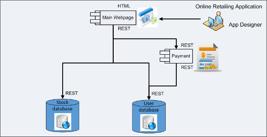
Figure 1: A component diagram for the online retailing system.
- The modules of the application communicate through REST interfaces.
- The User and Stock databases are encoded in MySQL.
- The application is totally written in Java, with no specific version/API.
- Availability of databases has to be greater than 99%.
- Error Rate for every separate component should be less than 5%.
- Average Response Time for the Payment component has to be less than 1s.
- Response Time of the Main Webpage has to be less than 500ms.
2
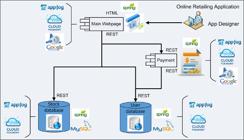
Figure 2: Different deployment alternatives for the online retailing system.
- Some of the cloud platforms possibly fail. The original cloud provider claims high availability rates but their services are not entirely exempt of failures.
- The elastic resources cause unexpected costs. Resources transparently scale as need, but this may provoke cost spikes.
- The business model of the original cloud provider changes (volatile market). The application hosted on that cloud provider could require rearranging it to exploit services, platforms and infrastructures which present the most beneficial cost/value ratio.
- to perform this migration process as automatically as possible,
- to minimise the downtime (viz., the time period in which the application will not be available),
- to take care of synchronising or coordinating the rest of the application with the newly deployed service(s), and
- to manage dynamically the new deployment of the application.


 1

 [12 13 14 15 16
- Adaptation contracts need to take into account cloud providers characteristics and Service Level Agreement (SLA).
- Violations of Quality of Service (QoS) properties need to be monitored across different cloud platforms.
- Dynamic architecture reconfiguration might involve migrating some components of the application to other cloud providers at runtime.


http://www.cloud4soa.eu
http://www.appsecute.comhttp://deltacloud.apache.org/http://www.rightscale.comhttp://www.newrelic.com

- With respect to the IaaS level, SeaClouds will simply reuse what is available (e.g., Deltacloud).
- With respect to the PaaS level, SeaClouds aims at augmenting the set of metrics currently available from Cloud4SOA (response time and up-time).
- Being able to monitor each of application component, and at
- Combining and aggregating the above mentioned data to highlight performance problems and their impact.
http://brooklyn.iohttp://whirr.apache.org/http://www.jclouds.org/
- SeaClouds’ discovery functionality may use and extend existing matchmaking functionalities to match application requirements with PaaS offerings.
- SeaClouds management will use the REST harmonized API for the deployment, management and monitoring of simple cloud-based applications across different and heterogeneous cloud PaaS offerings.
4
7[17
[18
3
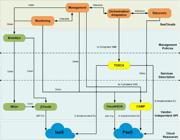
http://www.broker-_cloud.eu/
http://www.modaclouds.eu/
http://www.paasage.eu/
http://www.mosaic-_cloud.eu/
http://www.remics.eu/
http://4caast.morfeo-_project.org/
http://www.cloudtm.eu/
[19http://www.ow2.org/view/Cloud/http://www.opencloudware.org/
4
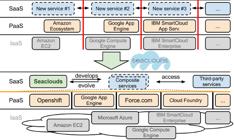
- Support for application deployment and migration to different providers. Provide support for deploying and migrating applications composed of several services taking care of the synchronization of the services and their reconfiguration, without requiring the user to manually intervene.
- Management and monitoring of underlying providers. Using standardized and unified metrics and automated auditing, properties over application and services can be ensured (on multiple clouds in a unified and standardized way).
- Increased availability and higher security. The usage of formal models to support the management of service-based applications over multi-clouds environments gives more flexibility to reconfigure the distribution as a SLA violation occurs.
- Performance and cost optimization. The framework gives users freedom to distribute application requirements over different cloud offerings by using needed options in a flexible manner. Organizations can take advantage of useful and powerful services provided by each platform and avoiding its weaknesses. Optimization requirements can also be modelled to take cost as the main decision parameter.
- Low impact on the code and user-friendly interface. SeaClouds will tackle different problems for developers and administrators of cloud applications thanks to the proposed orchestration model. First, by simplifying the development process with SeaClouds’ range of tools and framework that require minor impact on the code, and second, by simplifying the management of already deployed complex cloud applications thanks to with SeaClouds dashboard.
5
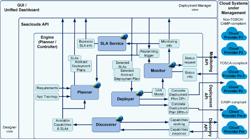
Figure 5: Architecture of the SeaClouds Platform.
26
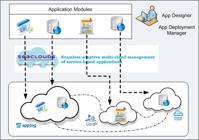
Figure 6: Example of SeaClouds multi-cloud deployment for the online retailing system.
17
[1] P. Mell, T. Grance, “The NIST definition of cloud computing,” NIST Special Publication, http://csrc.nist.gov/publications/nistpubs/800-_145/SP800-_145.pdf, 2011.
[2] M. Armbrust, A. Fox, R. Griffith, A. D. Joseph, R. Katz, A. Konwinski, G. Lee, D. Patterson, A. Rabkin, I. Stoica, M. Zaharia, “A view of cloud computing,” Commun. ACM, no. 4, p. 50–58, April 2010.
[3] N. Loutas et al, “D1.1 Requirements Analysis Report,” Cloud4SOA Project Deliverable, http://www.cloud4soa.eu/sites/default/files/Cloud4SOA%20D1.1%20Requirements%20Analysis.pdf, 2011.
[4] OASIS, “CAMP 1.1 (Cloud Application Management for Platforms), Version 1.1,” http://docs.oasis-_open.org/camp/camp-_spec/v1.1/camp-_spec-_v1.1.pdf, 2014.
[5] DMTF, “Cloud Infrastructure Management Interface (CIMI) Model and REST Interface over HTTP, An Interface for Managing Cloud Infrastructure v1.0.0,” http://dmtf.org/sites/default/files/standards/documents/DSP0263\_1.0.0.pdf, 2012.
[6] ——, “Virtualization Management (VMAN),” http://dmtf.org/standards/vman, 2014.
[7] OASIS, “TOSCA 1.0 (Topology and Orchestration Specification for Cloud Applications), Version 1.0,” http://docs.oasis-_open.org/tosca/TOSCA/v1.0/TOSCA-_v1.0.pdf, 2013.
[8] A. Parameswaran and A. Chaddha, “Cloud Interoperability and Standardization,” SETLabs Briefings - Infosys, vol. 7, no. 7, pp. 19–26, 2012.
[9] A. Brogi, J. Carrasco, J. Cubo, F. D’Andria, A. Ibrahim, E. Pimentel, and J. Soldani, “SeaClouds: Seamless adaptive multi-cloud management of service-based applications,” in XVII Ibero-American Conference on Software Engineering (CibSE ’14), April 2014.
[10] A. Brogi, A. Ibrahim, J. Soldani, J. Carrasco, J. Cubo, E. Pimentel, and F. D’Andria, “SeaClouds: a European project on seamless management of multi-cloud applications,” ACM SIGSOFT Software Engineering Notes, vol. 39, no. 1, pp. 1–4, January 2014.
[11] A. Brogi, J. Carrasco, J. Cubo, F. D’Andria, A. Ibrahim, E. Pimentel, and J. Soldani, “EU Project SeaClouds: Adaptive Management of Service-Based Applications Across Multiple Clouds,” in 4th International Conference on Cloud Computing and Services Science (CLOSER ’14), April 2014, pp. 758–763.
[12] A. Brogi, J. Camara, C. Canal, J, Cubo and E. Pimentel, “Dynamic contextual adaptation,” in In Proc. of Fifth International Workshop on the Foundations of Coordination Languages and Software Architectures 2006 (FOCLASA’06), vol. 175, no. 2. Elviser, 2007, pp. 81–95.
[13XCanal2008] C. Canal, P. Poizat, and G. Salaun, “Model-Based Adaptation of Behavioural Mismatching Components,” IEEE Transactions on Software Engineering, vol. 34, no. 4, pp. 546–563, 2008.
[14] J. Cámara, J.A. Martín, G. Salaün, J. Cubo, M. Ouederni, C. Canal and E. Pimentel, “Itaca: An integrated toolbox for the automatic composition and adaptation of web services,” in Proc. of International Conference on Software Engineering 2009 (ICSE’09). IEEE Computer Society Press, 2009, pp. 627–630.
[15] H. Nezhad, G.Y. Xu and B. Benatallah, “Protocol-aware matching of web service interfaces for adapter development,” in Proc. of 19th International Conference on World Wide Web 2010 (WWW’10). ACM, 2010, pp. 731–740.
[16] J. Cubo and E. Pimentel, “DAMASCo: A framework for the automatic composition of component-based and service-oriented architectures,” in In I. Crnkovic, V. Gruhn, M. Book (editors), European Conference on Software Architecture 2011 (ECSA’11), Lecture Notes in Computer Science 6903. Springer-Verlag, 2011, pp. 388–404.
[17] A. Brogi, J. Soldani, and P. Wang, “TOSCA in a Nutshell: Promises and perspectives,” in Service-Oriented and Cloud Computing, ser. Lecture Notes in Computer Science, M. Villari, W. Zimmermann, and K.-K. Lau, Eds. Springer Berlin Heidelberg, 2014, vol. 8745, pp. 171–186. [Online]. Available: http://dx.doi.org/10.1007/978-_3-_662-_44879-_3_13
[18] OASIS, “Cloud Application Management for Platforms (CAMP) Technical Committee Charter,” https://www.oasis-_open.org/committees/camp/charter.php, 2013.
[19] F. Paraiso, N. Haderer, P. Merle, R. Rouvoy, and L. Seinturier, “A federated multi-cloud PaaS infrastructure,” in IEEE 5th International Conference on Cloud Computing, 2012, pp. 392–399.
