Spray nozzle performance on wheat
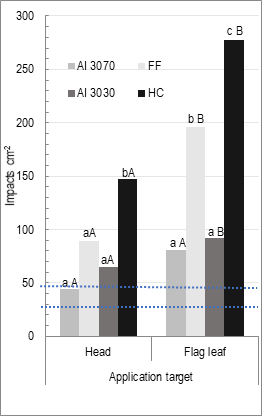
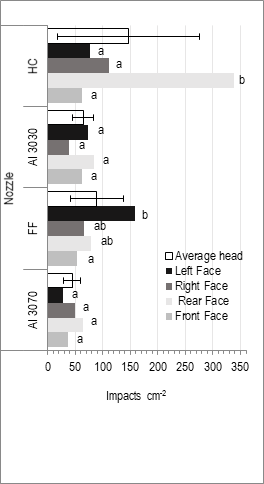
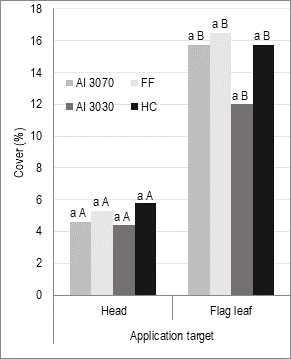
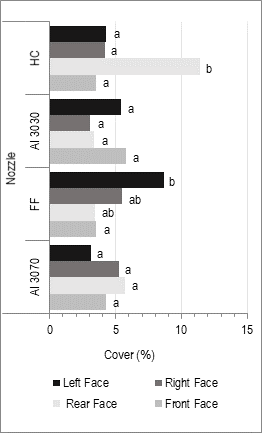
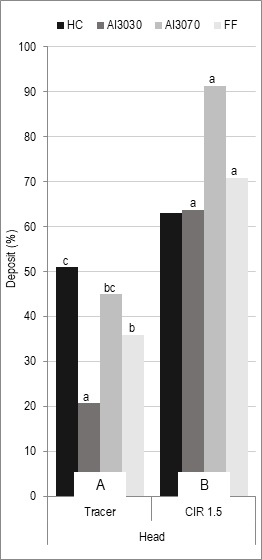
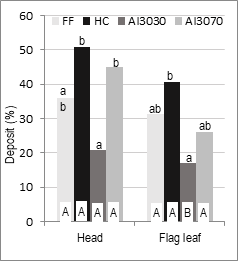
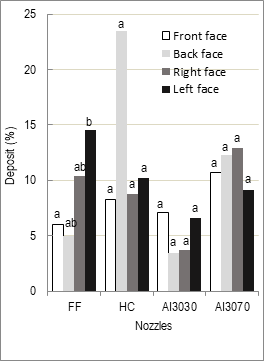
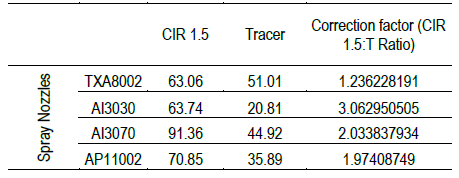
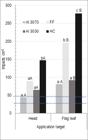
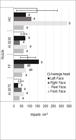
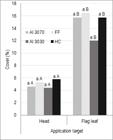
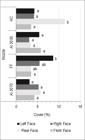
Fungal diseases in wheat crops (Triticum aestivum) cause significant yield and quality grain losses worldwide. The increase in the crop production area under no-tillage and environmental changes has favored residue-borne fungal survival and, therefore, disease development. Field trials were carried out at the beginning of anthesis on wheat crops (state z61), in order to evaluate different spray nozzle performance. The test was arranged in a 4x2 factorial design with ten repetitions. Factors consisted in four nozzles: flat-fan (xr11002), air induction asymmetrical dual flat-fan (ai3070-02), air induction symmetrical dual flat-fan (gat11002), hollow cone (txa8002), and two artificial targets, one vertical and another horizontal related to head and flag leaf location, respectively. Water-sensitive cards and cir 1.5® software were used to determine droplet density (dd), coverage, and deposition. The latter was contrasted using Brilliant Blue tracer. Data were subjected to anova and means were compared by Tukey test (p≤0,05). The use of fine droplets and multiple directions such as txa8002 increases coverage and deposition in the vertical and horizontal target, under optimum environmental conditions. The methodologies used to evaluate spraying performance are complementary to completely characterize the application parameters.
Keywords:
coverage; deposition; air induction; twin nozzles: tracer
 Thumbnail
 Thumbnail
 Thumbnail
 Thumbnail
 Thumbnail
 Thumbnail
 Thumbnail