Potassium Fertilization in Soybean: Association of Crop Response with Edaphic and Topographic Properties
Abstract
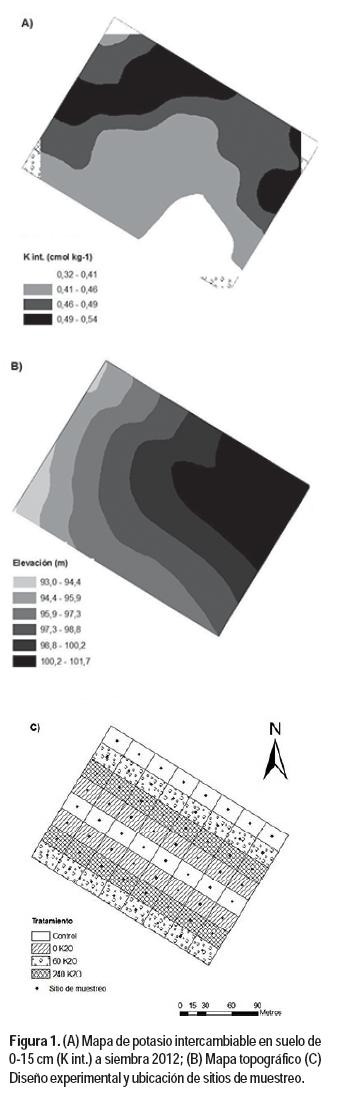
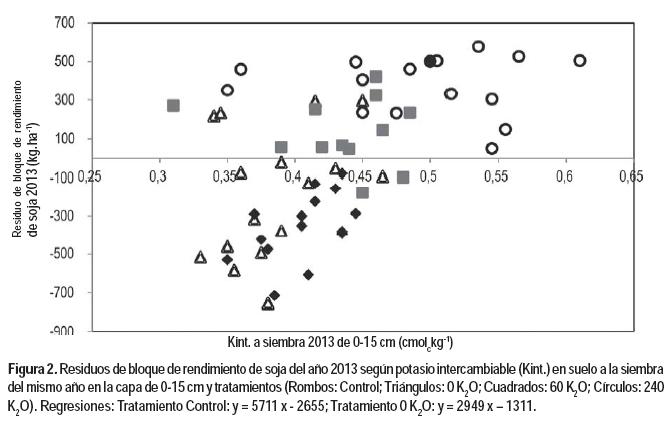
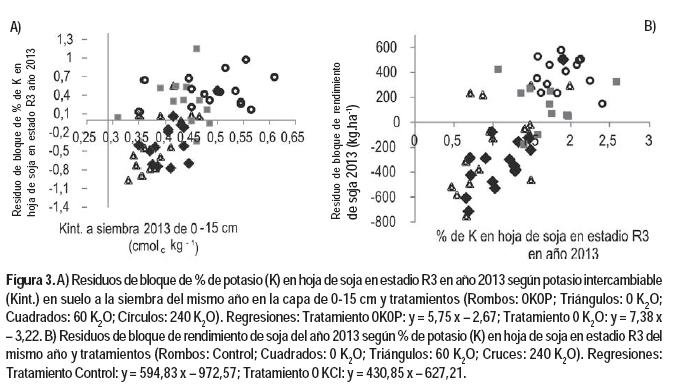
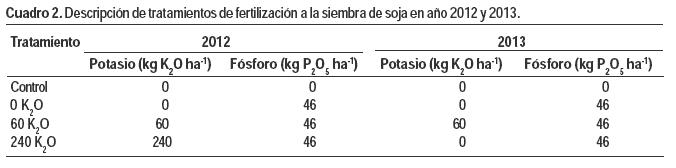
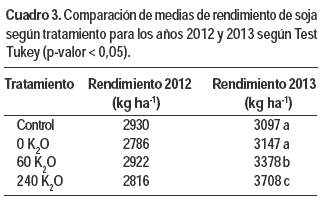
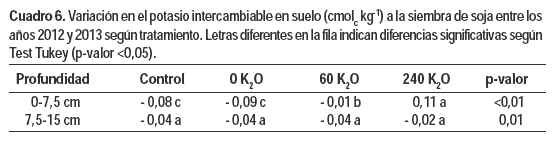
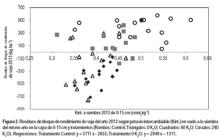
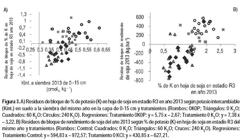
Our objectives were to quantify the soybean crop response to potassium (K) fertilization under variations of soil K supply, and to study the association of this reponse with other soil and topographic properties. A strip fertilization experiment was evaluated during two years in soybean. In 2012 treatments were established with K rates (0, 60 and 240 kg K2O ha-1) without phosphorus (P) limitations, and a control treatment without fertilization. In 2013, plots were refertilized with P and the 60 kg K2O ha-1 rate in the corresponding treatments. A 30 x 22 m regular sampling grid was delineated. Determinations included nutrients in soil, organic matter, texture, soil penetration resistance, electrical conductivity, terrain attributes, foliar K concentration (R2-R3) and grain yield. Exchangeable K (ex. K) in treatments without K fertilization was 0.46 cmol kg-1 in 2012, and 0.40 cmol kg-1 in 2013. There were significant yield responses to K fertilization only in 2013, when the highest yield was in the 240 kg K2O ha-1 treatment. In 2013, ex. K interacted with treatments, with significant relationship in no K fertilization treatments, and without relationship where K was added. No other additional properties were identified to complement the interpretation of the soil K test and to better understand crop response to fertilization.
</="font-weight: normal"GLYCINE MAX; </="font-weight: normal"URUGUAY; NUTRITIONAL CONSTRAINTS; YIELD
 Thumbnail
 Thumbnail
 Thumbnail