Chemicals Applied in Fall and Defoliation on Dormancy Evolution and Release in Low-chill Peach ‘Flordaking’
Abstract
The aim of this work was to study the effect of fall defoliation and chemical application on the progression and release of dormancy, and phenology, of low-chill peach ‘Flordaking’ under temperate climate conditions. At the onset of leaf fall, ‘Flordaking’ peach (Prunus persica L. Batsch) trees were defoliated or treated with hydrogen cyanamide (2.5 g L-1 a.i), norflurazon (46 g L-1 a.i.) or ethephon (20 mg L-1 a.i.). Untreated trees were used as the control. The rate of budbreak and the mean time to budbreak (MTB) was tested on stem isolates in a phytotron, whereas tree phenology and vegetative and reproductive traits were evaluated in a field experiment. Defoliation and chemical treatments significantly affected the rate of budbreak evolution of floral, but not of vegetative, buds. Treatments also significantly affected the evolution of the MTB of both vegetative and floral buds, but with a greater effect on the latter. In the field, the phenology of Flordaking was more affected by treatments that modified the depth of dormancy than those which affected the percentage of budbreak in excised shoots. Defoliation and hydrogen cyanamide treatments advanced sprouting (15 and ten days, respectively) and blooming (16 and four days, respectively), whereas ethephon delayed flowering and fruit set by three days each. Fall defoliation at the beginning of leaf abscission appears to be a strong tool to manipulate the evolution of dormancy and the time of spring bloom of Flordaking, mainly when insufficient chilling accumulation is forecasted.
STONE FRUITS; CHILLING REQUIREMENTS; PHYSIOLOGY OF DORMANCY
Resumen
El objetivo de este trabajo fue estudiar el efecto de la defoliación otoñal anticipada y la aplicación de sustancias químicas sobre el progreso y ruptura de la dormición, y la fenología del duraznero, cv. ‘Flordaking’ en condiciones de clima templado. Al comienzo de la caída de las hojas, un grupo de árboles de duraznero (Prunus persica L. Batsch) fue defoliado o tratado con cianamida de hidrógeno (2.5 g L-1 i.a.), norflurazona (46 g L-1), o etefón (20 mg L-1). Se utilizaron árboles no tratados como control. La tasa de la brotación y el tiempo medio de brotación (TMB) fue cuantificado en varetas aisladas en una cámara de crecimiento; mientras que la fenología del árbol y características vegetativas y reproductivas se evaluaron en un experimento de campo. La defoliación y los tratamientos químicos modificaron la evolución del porcentaje de floración pero no el de brotación. Los tratamientos también afectaron significativamente la evolución del TMB, tanto para la brotación como para la floración, aunque el efecto fue más marcado sobre la floración. En el campo, la fenología de Flordaking fue más modificada por los tratamientos que fueron capaces de afectar la profundidad de la dormición (valor de TMB) que por aquellos que modificaron el porcentaje de brotación y/o floración. La defoliación y la aplicación de cianamida de hidrógeno avanzaron la brotación (15 y 10 días, respectivamente) y la floración (16 y 4 días, respectivamente), mientras que el etefón retrasó la floración y el cuajado del fruto en tres días cada uno. La defoliación otoñal al comienzo de la abscisión de las hojas parece ser una poderosa herramienta para manipular la evolución de la dormición y el momento de la floración en el cv. Flordaking, fundamentalmente cuando se pronostica una insuficiente acumulación de frío.
FRUTALES DE CAROZO; REQUERIMIENTOS DE FRÍO; FISIOLOGÍA DE LA DORMICIÓN
Introduction
In the central-eastern area of the Santa Fe province (Argentina), average chilling accumulation is around 300 hours (Gariglio et al., 2006a), with high variability between years. The low chill peach variety ‘Flordaking’ requires 450 chilling hours (CH), being the variety with the highest chilling requirement of those recommended for cultivation; nevertheless, despite the excellent adaptation of Flordaking to different regions of Argentina, we observed that it shows variable vegetative and reproductive traits between years (Gariglio et al., 2009). Varieties with higher chilling requirements (> 500 CH) have an inadequate release of dormancy and poor fruit set and yield, whereas varieties with lower chill requirements (< 350 CH) showed high flower density as well as an adequate yearly fruit set and yield (Gariglio et al., 2009). Thus, Flordaking was the peach variety that showed the highest sensitivity to changes in chilling accumulation between years, and so it seems to be the most appropriate variety in which to study dormancy induction, evolution and release in the central area of Argentina.
For temperate-zone deciduous fruit trees, the release of dormancy is mediated by the accumulation of a certain amount of chilling (Lang, 1996; Myking, 1998) that can be partially replaced by cultural practices or chemicals compounds (Erez, 1987; Mohamed, 2008). Fall defoliation modifies the time of spring bloom, but the results are contradictory (Couvillon and Lloyd, 1978; Walser et al., 1981). On the other hand, winter application of hydrogen cyanamide (HC) is widely used in subtropical areas to induce budbreak and to improve uniformity of bloom (Erez, 1987; Yuan et al., 2003), but it causes high abortion of floral buds and fruit drop (Mahmood et al., 2000). Potassium nitrate is recommended to improve budding of floral buds (Erez, 1987). Norflurazon is a bleaching herbicide that inhibits abscisic acid biosynthesis (Feldman and Sun, 1986), which is involved in bud dormancy (Debeaujon and Koornneef, 2000). Fall application of gibberellins and ethephon delayed blooming of both peach (Luna et al., 1990) and apricot trees (Ganji Moghadam and Mokhtarian, 2006).
Despite this, the effect of cultural practices and chemicals used to modify budbreak is not well known. The aim of this work was to study the progression of dormancy, and its modification, by the effect of fall defoliation and the application of HC, norflurazon and ethephon on Flordaking under temperate climate conditions.
Materials and methods
The study was carried out in Esperanza (latitude 31° 26' S, longitude 60° 56' W, altitude 40 m), Santa Fe, Argentina. Seven-year-old peach trees (Prunus persica L. Batsch) cv. ‘Flordaking’ were used, planted at 5 x 3 m apart in abruptic argiudoll soil and grafted onto ‘Cuaresmillo’ seedling rootstock, with complementary drip irrigation, and trained to the standard open vase system. Fertilization, pest management and pruning were in accordance with normal commercial practices.
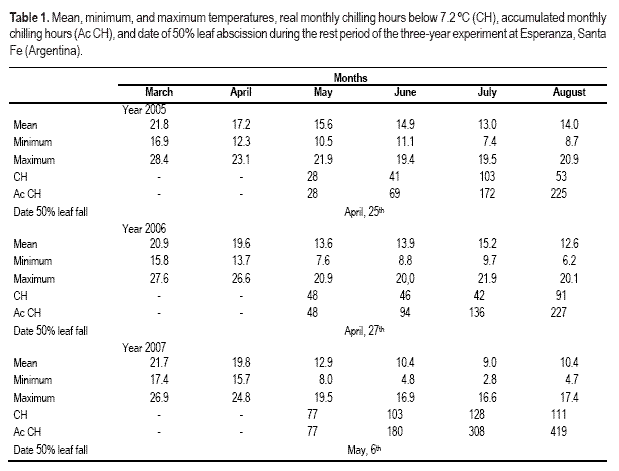
The experiment was conducted over three consecutive years (2005-2007); temperatures during the rest period were hourly recorded with an automatic experimental station (Pegasus EP 2000) and summarized in Table 1. Plants were selected for their uniformity in size and trunk diameter. At the beginning of natural leaf fall (30-40% defoliation, according to the BBCH scale for stone fruit) (Meier, 2001), plants were manually defoliated or treated with different chemical compounds: hydrogen cyanamide (HC), at a concentration of 2.5 g L-1 a.i., norflurazon ([4-chloro-5-(methylamino)-2-(alpha, alpha, alpha-trifluoro-m-tolyl)-3 (2H)-pyridazinone), at a concentration of 46 g L-1 a.i., and ethephon (2-chloroethyl phosphonic acid), at a dose of 20 mg L-1 a.i. Eight trees were used as the control. A spraygun was used to spray each tree with 10 L of the solution. A nonionic wetting agent (nonylphenyl polyethyleneglycol ether 20 % w/w) at 0.05 % was included in all treatments.
Dormancy evolution
From leaf fall to the end of July, ten twigs per tree and ten twigs per treatment were periodically and randomly collected (20, 50, 65 and 90 days after leaf fall). Twigs were cut into 15 cm long segments, each containing three axillary buds (two floral buds and one central vegetative bud, with the removal of excess buds), resulting in 80 stem cuttings per treatment.
Excised shoots were placed with their basal tip in water and placed in a phytotron for an 8-hour (h) photoperiod [22.5 mmol (m-2 s-1)] (Citadin et al., 2001), and 20.0 ± 1.0 ºC. The basal ends of the shoots were cut weekly and water was replaced daily (Balandier et al., 1993; Citadin et al., 1998). The occurrence of floral and leaf budbreaks were observed three times a week. The number of buds that reached the balloon or green tip stage was recorded (Citadin et al., 2001). Results were expressed as percentage of vegetative and floral budbreak and as the medium time that excised shoots needed to reach vegetative and/or floral budbreak; this last variable is called mean time to budbreak (MTB), and was expressed in days (arithmetic mean of all eight groups of ten excised shoots per group) (Balandier et al., 1993).
This trial was conducted in a completely randomized design with eight replicates per treatment, being a group of ten cuttings the experimental unit. Budbreak was treated as the qualitative variable at two levels (‘negative’ and ‘positive’), and the statistical design for analyzing the evolution of the rate of budbreak with time (days) was the logistic model: Lijk = β0 + β1Di + β 2Di2 + β3Di3 + «βTkTk + «βYlYl + εijkl, where Lijkl is the variable logit, i.e., ln [Pijkl/(1- Pijkl)]; Pijkl is the probability of a ‘positive’ result; 1- Pijkl is the probability of a ‘negative’ result; β0, β1, β2 and β3 are coefficients estimated for the logistic regression models; Di: is the effect of the time from the beginning of leaf fall; Di2 is the effect of the time from the beginning of leaf fall squared; Di3 is the effect of the time from the beginning of leaf fall cubed; Tk is the effect of chemical and defoliation treatment in terms of dummy variables (control: T1 = 0, T2 = 0, T3 = 0, T4 = 0, HC-Treatment: T1 = 1, T2 = 0, T3 = 0, T4 = 0, norflurazon-Treatment: T1 = 0, T2 = 1, T3 = 0, T4 = 0, Defoliation-Treatment: T1 = 0, T2 = 0, T3 = 1, T4 = 0, Ethephon-Treatment: T1 = 0, T2 = 0, T3 = 0, T4 = 1); βTk is the correction of the coefficient β0 witness due to the effect of the kth treatment; Yl: is the effect of the year in terms of dummy variables (Year 3: T1 = 0, T2 = 0, Year 2: T1 = 1, T2 = 0, Year 1: T1 = 0, T2 = 1); βYl is the correction of the coefficient β0 witness due to the effect of the lth year; εijkl is the residual error.
The results were achieved using the STEPWISE option from the LOGISTIC procedure of SAS.
Field experiment
In winter, ten homogeneous fruiting shoots per treated plant were randomly selected at 1.8 m above ground level, and their length was measured. They were monitored weekly, establishing the phenological stages of 50% of vegetative budbreak (green tip stage), beginning of flowering, full flowering and fruit set, using the BBCH scale for stone fruit (Meier, 2001). The number of vegetative shoots, flowers and fruits were measured weekly on the selected twigs, from the release of dormancy to pit hardening. Data were expressed as the mean number of flowers per meter of shoot length, percentage of leaf-bud break, and percentage of fruit set. The number of fruits per tree was recorded at harvest.
A randomized complete-block design was used, with one tree per treatment in each plot and eight plots in total. The data of the MTB and those from the field experiment were analyzed using analysis of variance (ANOVA), and comparisons of means were made using the Tukey test. Percentages were analyzed after arc-sine transformation of the data.
Results
Dormancy evolution
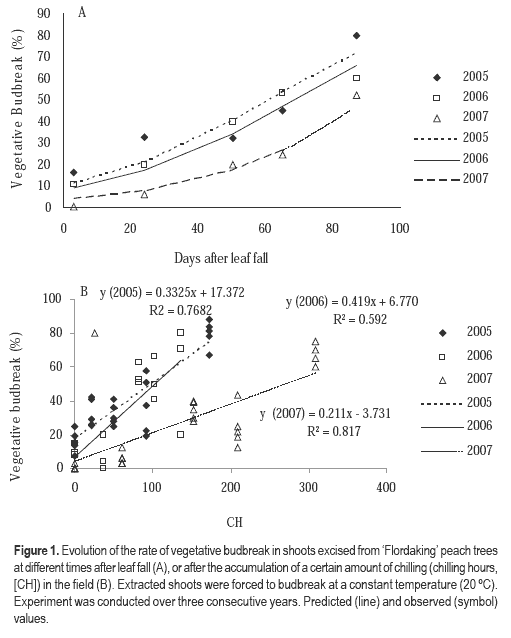
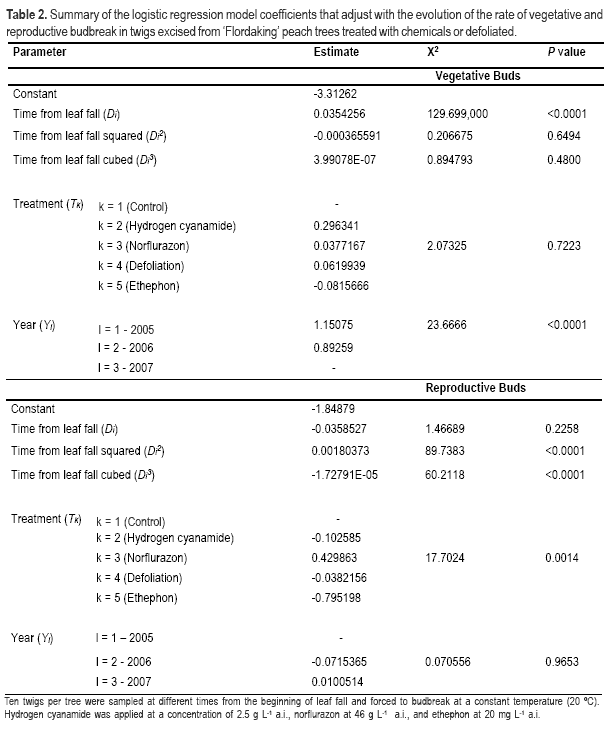
The evolution of the rate of vegetative budbreak was significantly affected by the time elapsed from the beginning of dormancy (leaf fall) but was not affected by defoliation or chemical treatments (Table 2). The rate of vegetative budbreak increased with time from leaf fall during the three years of study, but the pattern of evolution was significantly different both in terms of time from leaf fall (Figure 1A) and chilling accumulation (Figure 1B).
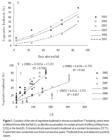
The rate of vegetative budbreak with time from leaf fall was lowest during the year 2007 (Figure 1A), which was the coldest year (Table 1). Furthermore, during the year 2007 the accumulation of chilling from leaf fall to 50% vegetative budbreak was 2.5-fold higher in comparison with the previous years (Figure 1B).
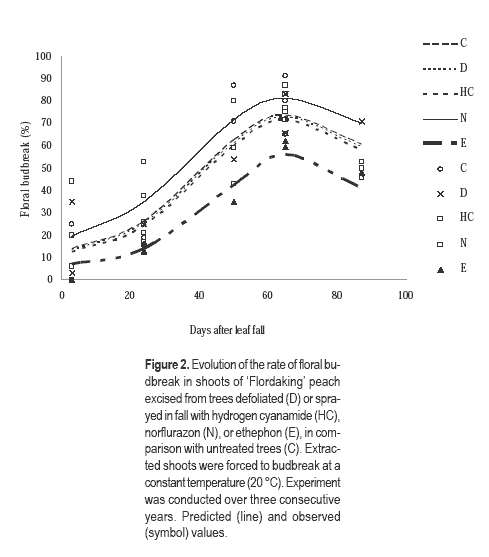
Unlike vegetative buds, the evolution of the percentage of floral budbreak was significantly affected by defoliaton and chemical treatments, but not by the variable of year (Table 2). Norflurazon increased, and ethephon reduced, the rate of floral budbreak, whereas hydrogen cyanamide and defoliation did not affect rate of budbreak (Figure 2). The time at which shoots were excised from the tree significantly affected the evolution of the percentage of floral budbreak but in a different way compared with vegetative buds. The highest rate of floral budbreak was reached 65 days after the onset of dormancy, but then declined for all treatments (Figure 2), whereas vegetative budbreak increased with time (Figure 1A).
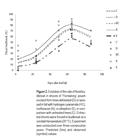
Buds that did not break dormancy remained latent or aborted (the latter being negligible in number), except until 65 days after leaf fall, when aborted floral buds were observed but were not quantified.
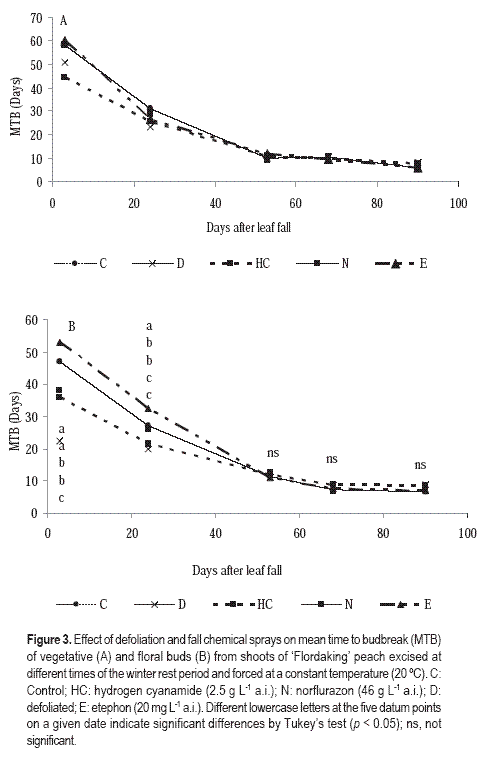
The MTB of leaf buds from shoots excised during the winter rest was highest at leaf fall and decreased over 50 days, remained constant during the next 15 days and then decreased slightly again (Figure 3A). At leaf fall, defoliated and HC-treated trees had lower MTB for leaf buds, 51 and 45 days respectively, than control trees (58 days) (Figure 3A). Vegetative buds of excised shoots from defoliated trees also had a significantly lower MTB (20 days after leaf fall) as compared to the control. Differences between treatments were not significant from 50 days after leaf fall until the end of dormancy (Figure 3A).
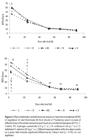
The timeline of MTB for floral buds showed a similar pattern to leaf buds (Figure 3B), declining significantly during the first 50 days after leaf fall, and remaining almost constant until the end of dormancy. The MTB of floral buds was more strongly affected by defoliation and chemicals than the MTB of leaf buds (Figure 3). Defoliation reduced the depth of dormancy (MTB value) of floral buds at leaf fall by 50%. HC and norflurazon also significantly reduced the MTB value of floral buds (-10 and -8 days, respectively) compared to the control, whereas ethephon increased it (+6 days) (Figure 3B). Differences between treatments diminished one month later, but remained significant with regard to the control, except for norflurazon. Differences between treatments were not significant from 50 days after leaf fall to the end of dormancy (Figure 3B).
Field experiment
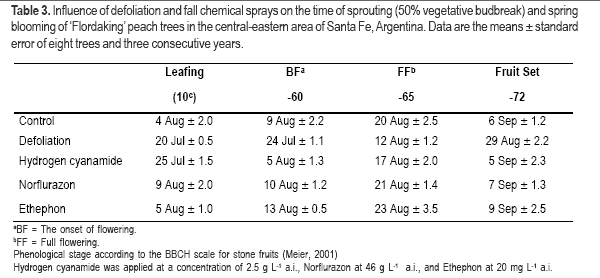
Chemical treatments did not affect the time of leaf fall, which occurred in late April in 2005 and 2006, and at the beginning of May in 2007. At the beginning of the next growing season, defoliated and HC treated trees reached 50% of vegetative budbreak 15 and 10 days earlier, respectively, than control trees, whereas norflurazon delayed sprouting by five days (Table 3). Defoliation and HC also advanced flowering (16 and four days, respectively) and full flowering (eight and three days earlier, respectively) with regard to the control. Fruit set was only advanced by defoliation. Norflurazon did not differ from the control on time to reach flowering and fruit set, and ethephon delayed flowering and fruit set by three days each (Table 3). At harvest (end of October for each of the three years), differences were not observed between treatments (data not shown).
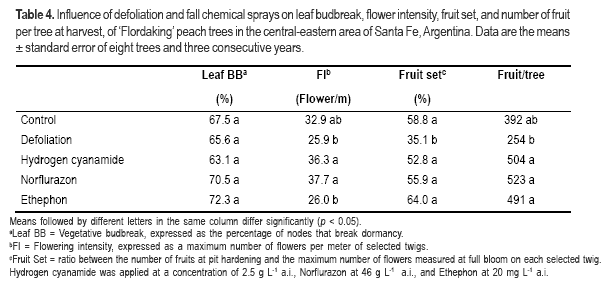
The treatments did not result in different percentages for vegetative budbreak when measured in the field (Table 4), showing that dormancy was released at the end of July with the accumulation of only 136 and 172 CH in 2006 and 2005, respectively (Table 1). Floral buds were affected by defoliation and chemical treatments (Table 4). Flower intensity was significantly higher for norflurazon and HC treated trees in comparison to defoliated and ethephon-treated trees. However, none of the treatments differed significantly from the control. Fruit set and fruit load were only affected by defoliation (Table 4).
Discussion
At leaf fall, budbreak is low and dormancy is deepest both in vegetative and floral buds, this effect being common to all species (Myking, 1998). The fact that the depth of dormancy decreases and the rate of budbreak increases with time during the rest period in both floral and vegetative buds is also a common physiological response due to chilling accumulation (Arora et al., 2003; Lang, 1996).
The pattern of the depth of dormancy (MTB) and the rate of budbreak evolution in relation to time from leaf fall, or with chilling accumulation, has been well described for vegetative buds; a linear increase in the rate of leaf budbreak during the rest period has been reported in the past (Siller-Cepeda et al., 1992). However, the evolution rate of floral budbreak with time, or in response to chilling accumulation (as observed in this work), are not well known because medium and high chilling Prunus varieties show high floral bud abortion when plants or excised shoots are forced into insufficient chilling accumulation conditions (Alburquerque et al., 2004; Mahmood et al., 2000; Stephenson, 1981).
Unlike medium and high chilling varieties, low-chilling peach can reach high proportions of budbreak with low floral bud abortion, even under conditions where there is no chilling accumulation (Gariglio et al., 2006b). However, in contrast to traditional varieties, Flordaking and other low chilling peach varieties showed a decrease in the rate of floral budbreak after a certain accumulation of chilling at the end of the dormancy period (Gariglio et al., 2006b), as occurred in this work (Figure 3B). Thus, floral bud abortion of low chilling peach varieties does not occur as a consequence of chilling deficiency as in medium and high chilling requirements varieties; in contrast, floral bud abortion in low-chilling peach is commonly observed when isolated shoots receive excessive cold (Citadin et al., 2001).
When buds receive sufficient chilling they reach the eco-dormant stage (Balandier et al., 1993), which means that budbreak is controlled by environmental factors and not by internal bud factors as occurs during endo-dormancy. During eco-dormancy, the depth of dormancy of vegetative buds is equal to, or lower than, that of the floral buds (Gariglio et al., 2006b) and consequently, leafing occurs quickly and before flowering, increasing the strength of the vegetative sink over the reproductive one. This would be a similar phenomenon to floral abortion observed in peach trees treated with HC (Arora et al., 2003; Lang, 1996; Siller-Cepeda et al., 1992).
Mohamed (2008) found that fall defoliation advanced the release of dormancy in the low-chill ‘Anna’ apple variety, reducing its depth of dormancy throughout the rest period. However, defoliation of Flordaking peach modified the depth of dormancy only on shoots excised from the trees during the first 40-45 days after leaf fall, but not of those excised later, as occurred in the Anna apple (Mohamed, 2008). However, the period of endodormancy of Flordaking peach is short, and buds reached eco-dormancy in only 45-50 days after leaf fall; this is because the depth of dormancy (MTB value) of its buds does not decrease further over time (Figure 3), which is the same as saying that the MTB response to cold is saturated, indicating that buds are under eco-dormancy (Balandier et al., 1993; Dennis, 2003). This could explain why no difference between fall defoliation and chemical treatments were observed 45-50 days after leaf fall, and also explains the differences in dormancy evolution when compared with the Anna apple. Defoliation also reduced fruit set, and consequently, fruit load with regard to chemicals, as in the Anna apple (Mohamed, 2008).
Norflurazon increased floral budbreak, whereas ethephon reduced it, in comparison with the control; nevertheless, these differences were not clearly observed in the field experiment. In contrast, the depth of dormancy in the isolated shoots correlated with changes in the phenology observed in the field experiment, with an exception, norflurazon treatment. It is accepted that the end of the rest period occurs when 50% of the buds on excised shoots are capable of growing after a period of appropriate temperature (Dennis, 2003). As low chilling peach varieties overcome dormancy with 100 CH for floral buds and 200 CH for vegetative buds (Gariglio et al., 2006b), it is unusual under our climatic conditions that treatments that improve budbreak produce visible effects in the phenology of the trees in the field, as occurred in our work. In fact, in this study Flordaking peach reached 50% of vegetative budbreak with an accumulation of only 136 CH during the second year of experimentation. In contrast, treatments that modified the depth of dormancy also affected tree phenology at the following spring, as was observed in this experiment with defoliation, HC, and ethephon treatments.
It is accepted that MTB is indicative of the heat requirement of buds to budbreak (Citadin et al., 2001; Gariglio et al., 2006b), because MTB is the quantification of the time at constant temperature that buds needs to reach budbreak. Defoliation and chemical agents affect the depth of dormancy during the first 45 days after leaf fall, which represent the true period of endodormancy. In addition, the depth of dormancy of low chill peach varieties is not deep enough to prevent sprouting and/or flowering (Citadín et al., 2001; Gariglio et al., 2006b) when forced under appropriate conditions (Figure 3). Thus, climatic conditions from leaf fall to 40-45 days after, can affect the time needed to reach spring bloom and sprouting for the following spring of each treatment, varying according to the depth of dormancy. High temperatures during the first period of dormancy may accentuate phenological differences between treatments, advancing blooming and/or sprouting of those treatments associated with a low depth of dormancy. On the contrary, low temperature occurrence at this time causes a reduction of the MTB and a decrease in the difference of its value between treatments because of the effect of chilling accumulation (Figure 3). Consequently, the treatments´ phenology would be more homogeneous compared to the previous situation. These observations should be considered when explaining the influence of treatments on the bloom time (Citadin et al., 2001; Egea et al., 2003; Ganji Moghadam and Mokhtarian, 2006).
It is remarkable that the response of vegetative budbreak during the coldest year of this experiment (2007), exhibited lower budbreak in comparison with the previous years. Budbreak of excised shoots sampled at the beginning of dormancy showed high variability (data not shown). Some years, excised shoots showed relatively high sprouting (24% to 50%) (Gariglio et al., 2006b), but others did not. Defoliation at the onset of leaf fall, or small changes in the time of leaf fall occurrence between years, can greatly affect the depth of dormancy as observed in this work. The presence of leaves in fall plays an important role in the onset and progression of dormancy; leaves receive the photoperiod stimulus via phytochrome-mediated signaling that trigger the onset of dormancy of deciduous trees under a shorter photoperiod (Böhlenius et al., 2006; Rinne and Van der Schoot, 2004), mainly by the stimulation of the synthesis of abscisic acid (ABA) and other growth inhibitors (Tanino, 2004). Furthermore, in the growing area of Santa Fe, the period from the beginning of natural leaf abscission to complete defoliation can take up to 30 days. It may change the period of tree exposition to the short day inductive condition, and can explain the physiological mechanism of defoliation on the dormancy of low chilling peach varieties. According to this hypothesis, we expected an important modification of the pattern of dormancy evolution by the application of norflurazon, an inhibitor of ABA synthesis (Debeaujon and Koornneef, 2000). Despite of norflurazon reduced the depth of dormancy, its effect on the phenology, and the vegetative and reproductive traits of the tree were not observed in the field experiment.
The year 2007 was the coldest time of our experiment during the winter period, but it had the highest minimum temperature during the two months before leaf fall, and the highest medium temperature during the last month before leaf fall, in comparison with the previous years. This highest fall temperature could explain the longer leaf retention (7-10 days) observed during 2007 in comparison with the previous years, allowing a longer exposition of the tree to short day inductive-dormancy conditions (Böhlenius et al., 2006; Heide, 2008; Rinne and Van der Schoot, 2004). It could explain the higher dormancy depth on vegetative buds observed during 2007 and chilling availability to reach the same vegetative budbreak level (Figure 1B).
In conclusion, the evolution of vegetative budbreak of Flordaking peach showed a positive linear relationship with time or with chilling accumulation. However, a more complex pattern was observed on floral budbreak. Defoliation and chemicals applied in fall at the beginning of leaf fall significantly affected the evolution of dormancy, the effect being more pronounced in floral than in vegetative buds. The phenology of peach trees in the field experiment was mainly affected by treatments that change the depth of dormancy. Defoliation had a strong influence on the evolution of dormancy. Thus, defoliation at the beginning of leaf fall can be used as an agronomic tool to manipulate dormancy evolution and release for low-chill peach varieties, mainly when a winter period with insufficient chilling accumulation is forecasted.
Alburquerque N, Burgos L, Egea J. 2004. Influence of flower bud density, flower bud drop and fruit set on apricot productivity. Scientia Horticulturae, 102: 397 – 406.
Arora R, Rowland LJ, Tanino K.2003. Induction and release of bud dormancy in woody perennials : a science comes of age. HortScience, 38: 911 – 921.
Balandier P, Bonhomme M, Rageau R, Capitan F, Parisot E.1993. Leaf bud endodormancy release in peach trees : evaluation of temperature models in temperate and tropical climate. Agricultural and Forest Meteorology, 67: 95 – 113.
Böhlenius H, Huang T, Charbonnel-Campaa L, Brunner AM, Jansson S, Strauss SH, Nilsson O.2006. COIFT regulatory module controls timing of flowering and seasonal growth cessation in trees. Science, 312: 1040 – 1043.
Citadin I, Raseira MCB, Verter FG, Baptista da Silva J. 2001. Heat requirement for blooming and leafing in peach. HortScience, 36: 305 – 307.
Citadin I, Raseira MCB, Quezada AC.1998. Substrato para conservacao de ramos destacados de pessegueiro Prunus persica L. (Bastch). Agropecuaria Clima Temperado, 1: 55 – 59.
Couvillon G, Lloyd D.1978. Summer defoliation effects on spring bud development. HortScience, 13: 53 – 54.
Debeaujon I, Koornneef M.2000. Gibberellin requirement for Arabidopsis seed germination is determined both by testa characteristics and embryonic Abscisic Acid. Plant Physiology, 122: 415 – 424.
Egea J, Ortega E, Martínez-Gómez P, Dicenta F. 2003. Chilling and heat requirement of almond cultivars for flowering. Environmental and Experimentl Botany, 50: 79 – 85.
Feldman LJ, Sun PS.1986. Effects of norflurazon, an inhibitor of carotenogenesis, on abscisic acid and xanthoxin in the caps of gravistimulated maize roots. Physiologia Plantarum, 67: 472 – 476.
Ganji Moghadam A, Mokhtarian A. 2006. Delaying apricot (cv Shahroudi) flower induction by growth regulators application. Journal Applied Sciences, 6: 266 – 269.
Gariglio N, Mendow M, Weber M, Favaro MA, González-Rossia D, Pilatti RA.2009. Phenology and reproductive traits of peaches and nectarines in central-east Argentina. Scientia Agricola, 66: 757 – 763.
Gariglio NF, Dovis VL, Leva PE, García MS, Bouzo CA.2006a. Acumulación de Horas de Frío en la zona centro-oeste de Santa Fe (Argentina) para frutales caducifolios. Horticultura Argentina, 25: 26 – 32.
Gariglio NF, González-Rossia DE, Mendow M, Reig C, Agustí M. 2006b. Effect of artificial chilling on the depth of endodormancy and leaf and flower budbreak of peach and nectarine cultivars using excised shoots. Scientia Horticulturae, 108: 371 – 377.
References
- Lang GA. 1996. Plant dormancy : Physiology, biochemistry and molecular biology. Wallingford: CAB International. 408p.
- Luna V, Lorenzo E, Reinoso H, Tordable M, Abdala G, Pharis RP, Bottini R. 1990. Dormancy in peach (Prunus persica L.) flower buds : I. Floral morphogenesis and endogenous gibberellins at the end of the dormancy period. Plant Physiology, 93: 20 – 25.
- Mahmood K, Karew JG, Hadley P, Battey NH. 2000. The effects of chilling and post-chilling temperature on growth and flowering of sweet cherry (Prunus avium L.). Journal of Horticultural Science & Biotechnology, 75: 598 – 601.
-
Meier U. 2001. Growth stages of mono-and dicotyledonous plants [On line]. 2nd ed. Federal Biological Research Centre for Agriculture and Forestry. (BBCH Monograph) Cited September 2005. Available from: http://www.jki.bund.de/fileadmin/dam_uploads/_veroeff/bbch/BBCH-Skala_englisch.pdf.
» http://www.jki.bund.de/fileadmin/dam_uploads/_veroeff/bbch/BBCH-Skala_englisch.pdf - Mohamed AKA. 2008. The effect of chilling, defoliation and hydrogen cyanamide on dormancy release, bud break and fruiting of Anna apple cultivar. Scientia Horticulturae, 118: 25 - 32.
- Myking T. 1998. Interrelations between respiration and dormancy in buds of three hard-wood species with different chilling requirements for dormancy release. Trees, 12: 224 – 229.
- Siller-Cepeda JH, Fuchigami LH, Chen THH. 1992. Hydrogen cyanamide-induced budbreak and phytotoxicity in ´Redhaven´ peach buds. HortScience, 27: 874 – 876.
- Stephenson AG. 1981. Flower and fruit abortion : Proximate causes and proximate functions. Annual Review of Ecology And Systematics, 12: 253 – 279.
- Tanino KK. 2004. Hormones and endodormancy induction in Woody plants. In: Arora R. [Ed.]. Adaptations and responses of woody plants to environmental stresses. Binghamton : The Haworth Press. pp. 157 – 199.
- Walser R, Walker D, Seeley S. 1981. Effect of temperature, fall defoliation and gibberelic acid on the rest period of peach buds. Journal of the American Society for Horticulural Science, 106: 91 – 94.
- Yuan Z, Li X, Li L, Han X, Yan T. 2003. Effects of temperature and several chemicals on metabolic changes during dormancy release in NJ72 nectarine. Agricultural Science in China, 2: 549 - 555.