Fertilization with Potassium in Crops Under no-tillage in Uruguay: Yield Response Based on Soil Testing
Abstract
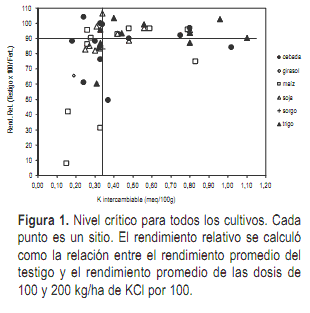
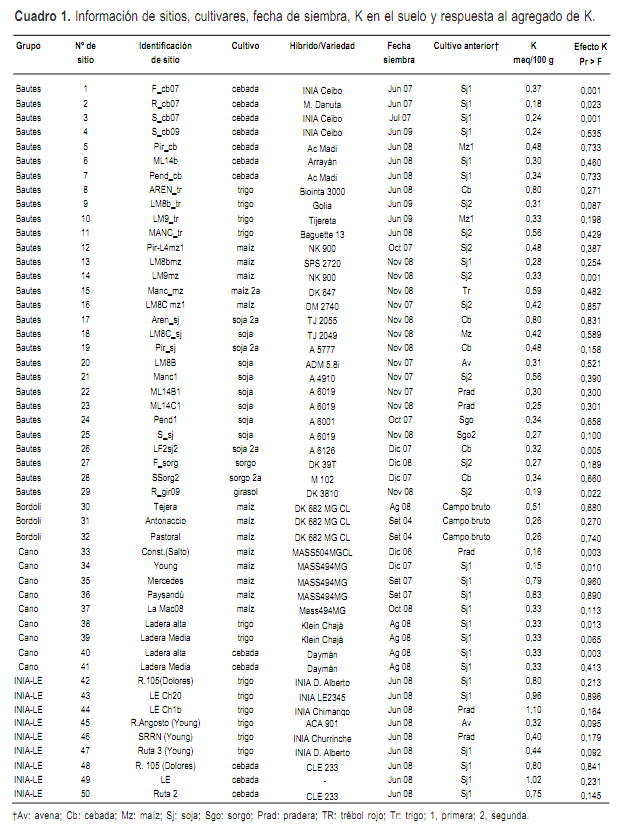
The objectives of this study were to summarize the recent information generated in the country related to the potassium fertilization and find a tentative critical level of Potassium (K) in soil for various crops in Uruguay, using the most widely used K soil test. The data come from 50 K–response experiments in barley, wheat, corn, soybeans, sorghum, and sunflower, conducted by different working groups from 2004 to 2010, in soils with different texture and exchangeable K levels. The fertilizer rates ranged from 0 to 240 kg/ha of K2O and in all cases the source of K was broadcasted KCl at planting date. Potassium fertilizer increased crop yield in 15 of 50 sites (Pr < 0.10). To determine the critical level, we included the control treatments (without K) and the average of the rates of 60 and 120 kg/ha of K2O. Across all sites and crops, the critical level of exchangeable K was 0.34 meq/100 g soil. This value should be taken as a preliminary indicator of K deficiency in soils. The results demonstrate the need for further studies of the dynamics of this nutrient in soils of Uruguay.
EXCHANGEABLE K; CRITICAL LEVEL; CEREAL; OILSEED
 Thumbnail