Optimizing protocol of plantain propagation cv. CEMSA ¾ in Temporary Immersion Bioreactors
Abstract
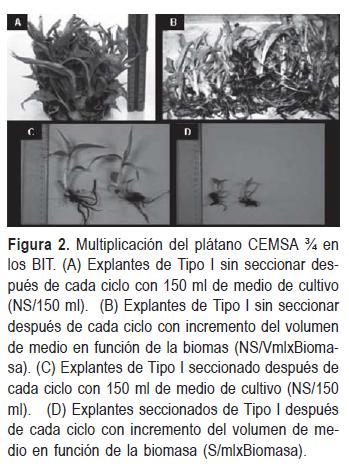
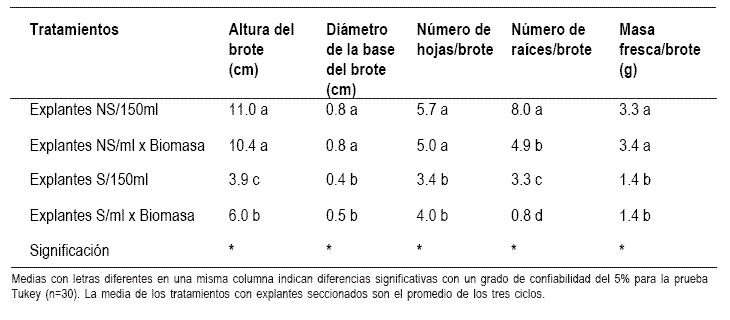
The automation of the production of plants with the use of Temporary Immersion Bioreactors (TIB) is an effective tool for in vitro propagation, with which rates of multiplication and increases the quality of the material spread are increased. Some factors influencing this process are the characteristics of the explants used to inoculate the BIT, the manipulation of the data and the physiological state. These factors, coupled with efficiency indicators of the system, are elements to be considered in the study of morphogenesis in crops such as plantain, which has low growth rate in semisolid medium. In order to optimize the protocol described by Roels, et al. (2005), we evaluated the effect of management of the explants (with division and without division), thevolume of culture medium for three cycles of shoot proliferation of banana cv. ¾ CEMSA on the coefficient of multiplication and their quality. The highest multiplication rate was achieved with the treatment which increased the volume of culture medium in terms of biomass without severing the explants during the three cycles of propagation. Since they reduce the manipulation of the explants for each crop cycle, and they increase the multiplication rate making it more efficient and simple, these modifications to the protocol of Roels, et al. (2005), make more applicable the propagation of plantain on a large scale.
metatopolina; morphogenesis; Musa; mass propagation
 Thumbnail
 Thumbnail