Effects of Silvilcultural Management on Leaf Area and Evapotranspiration in Pinus taeda in Northeastern Uruguay
Abstract
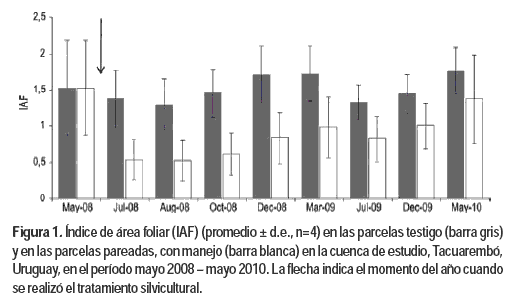
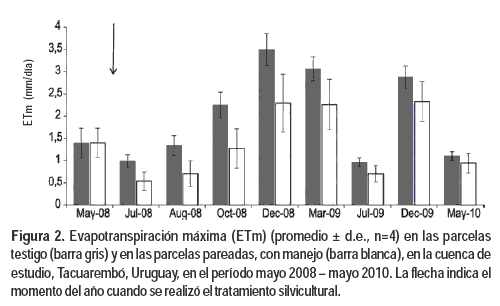
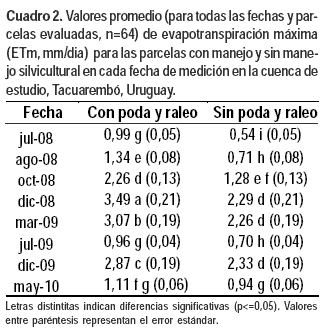
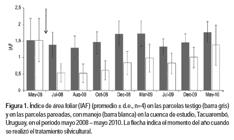
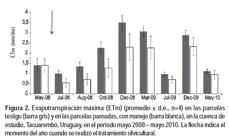
Pruning and thinning are silvicultural practices that seek to increase the productivity of the stands. These practices also affect structural and functional variables of forest systems. This study evaluated the effect of thinning and pruning on a structural variable, leaf area index (LAI), and on a functional variable, evapotranspiration, in a Pinus taeda stand in Uruguay. We evaluated two growing seasons (2008-2009 and 2009-2010) in a stand planted in 2003 at an initial density of 1000 trees/ha. In June 2008, 40% of the trees were thinned and the remaining tops were pruned (50%). LAI was estimated using digital hemispherical photography in treated and control plots. LAI values were used to calculate superficial resistance and this term was then included in the Penman-Monteith equation to estimate maximum evapotranspiration (ETm). Silvicultural treatment caused an average reduction of 61% of the IAF and this resulted in a 45% average decrease of ETm. The silvicultural management explained 55% of the variation in the IAF and 3% of the variation in the ETm. The ETm was 32% and 15% lower in treated plots than in control ones in the first and second growing season respectively. The increase in the leaf area was higher in treated trees during the two years after the treatment compared to trees in the control plots.
LEAF AREA INDEX; EVAPOTRANSPIRATION; PRUNING AND THINNING; PINUS TAEDA
 Thumbnail
 Thumbnail