Decontamination Procedure for Sorghum and Coffee Leaves Sprayed With Zinc and a Surfactant
Abstract
Decontaminating leaf samples from crops sprayed with pesticides and nutrient solutions is important for foliar analysis. This study evaluated the effect of different washing methods in coffee and sorghum foliage that had been sprayed with zinc (with or without surfactant). The plants were sprayed with a 3 g L-1 zinc sulfate solution, with and without surfactant. Seven days later, leaves were collected and washed. The experiment was completely randomized in a 2 x 2 x 3 + 2 factorial, with three replications. The first factor represents foliar zinc applications with or without surfactant, the second represents the number of washes (1 or 2) and the third represents the concentration of the wash solution (detergent + hydrochloric acid) at (0 + 0 mL L-1; 1.0 + 3.5 mL L-1 and 2.0 + 7.0 mL L-1). The last one represents two additional treatments without washing (zinc sprayed with and without surfactant). Surfactant strengthens contact between zinc and foliage and enhances absorption. Washing is an indispensable pretreatment for leaf analysis and our study showed that a single wash with detergent + hydrochloric acid (1.0 + 3.5 mL L-1) was the most effective washing method for coffee and sorghum
FOLIAR FERTILIZER; LEAF WASHING METHODS; SAMPLE DECONTAMINATION; FOLIAR ANALYSIS
Resumen
La descontaminación de las muestras de hojas de cultivos pulverizados con pesticidas y soluciones nutritivas es importante para el análisis foliar. Este estudio evaluó el efecto de diferentes métodos de lavado en hojas de café y de sorgo que habían sido pulverizadas con zinc, con y sin surfactante. Siete días más tarde, las hojas se recogieron y se lavaron. El diseño experimental fue completamente aleatorizado, en esquema factorial 2 x 2 x 3 + 2, con tres repeticiones. El primer factor representa aplicaciones foliares de zinc con o sin surfactante; el segundo representa el número de lavados (1 ó 2), y el tercero la concentración de la solución de lavado (detergente + ácido clorhídrico) en (0 + 0 mL L-1; 1,0 + 3,5 mL L-1 y 2,0 + 7,0 mL L-1). El último factor representa dos tratamientos adicionales sin lavar (zinc rociado con y sin surfactante). El surfactante refuerza el contacto entre el zinc y el follaje y mejora la absorción. El lavado es un tratamiento previo indispensable para el análisis foliar, y nuestro estudio mostró que un solo lavado con detergente + ácido clorhídrico ( 1,0 + 3,5 mL L-1) fue el método de lavado más eficaz para el café y el sorgo
FERTILIZANTE FOLIAR; MÉTODOS DE LAVADO DE HOJA; DESCONTAMINACIÓN DE MUESTRAS; ANÁLISIS FOLIAR
Introduction
Brazilian soils generally lack zinc and therefore require applications of this mineral to maximize productivity (
Foliar application is the most common application method for crops deficient in zinc because it allows more efficient uptake (
Foliar fertilization is possible because plants are capable of absorbing nutrient solutions directly from the leaf surface, and is an effective and economical way to deal with micronutrient deficiencies in coffee and sorghum (
However, applications of foliar zinc and other nutrients can produce erroneous leaf analyses because some of the applied nutrients are not absorbed by the plant, but are adsorbed into the leaf surface. Thus,
The detergent solution is used primarily to eliminate dust and contaminants whereas the acidic solution (hydrochloric acid) removes metals such as those applied during foliar applications and adsorbed to the leaf surfaces (
Washing leaf samples prior to analysis is important to reliably measure nutrient concentrations (
It is worth noting that the efficiency of a washing method may be affected by leaf morphology and anatomy (
Thus, we evaluated foliar levels of zinc in coffee and sorghum crops due to washing methods of leaf samples that had been sprayed with zinc, with and without surfactant.
Materials and Methods
The study was conducted at the Educational Farm, Research and Extension (FEPE) at the School of Agriculture and Veterinary Sciences (FCAV/UNESP), Jaboticabal Campus, located in Jaboticabal, Brazil.
Sorghum and coffee were used due to the distinct morphological and anatomical structures of their leaves and because these crops typically receive foliar zinc applications. The crops were sprayed with a solution containing 3 g of zinc sulfate per liter of water (
Samples of 10 leaves per parcel were collected seven days after spraying. Once collected, the leaves were immediately sent to the laboratory and subjected to treatments. The experiment was completely randomized in 2 x 2 x 3 + 2 factors and three repetitions. The treatments were: (2) leaves sprayed with zinc in the presence and absence of surfactant, (2) one and two washes and (3) concentrations of detergent + hydrochloric acid (0 + 0 mL L-1; 1.0 + 3.5 mL L-1 and 2.0 + 7.0 mL L-1), and two additional treatments without rinsing (zinc spray with and without surfactant).
Prado (2008) recommends a standard concentration of detergent + HCl at 1.0 + 3.5 mL L-1. Thus, in this experiment the wash concentrations of detergent + HCl used were: deionized water with neither detergent nor HCl, a standard concentration (1.0 mL L-1 of detergent and 3.5 mL L-1 of HCl) and double the standard concentration (2.0 mL L-1 of detergent with 7.0 mL L-1 of HCl).
All of the samples were immersed and washed for 30 seconds. Washing duration was standardized in order to eliminate time as a variable.
After collecting the leaves, the samples were prepared as previously described. After washing, the samples were dried in a forced air oven (65 to 70 ºC) until reaching a constant weight. The dried samples were then ground and zinc levels were determined by the methodology described by
The resulting data were analyzed by analysis of variance and averages were compared by the Tukey test (5 %). These calculations were made with the statistical program AgroEstat using the proposed experimental design.
Results and Discussion
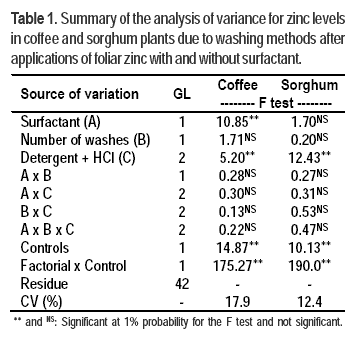
There was no significant interaction between any of the factors for any of the crops (P>0.05). However, there was an isolated effect from the surfactant for coffee leaves and for detergent + HCl for both species (P<0.01). There was also a significant effect between the controls (P<0.01) and between the average of the factorial versus the average of the control treatments (P<0.01). The number of washings was not significant (P>0.05) (Table 1).
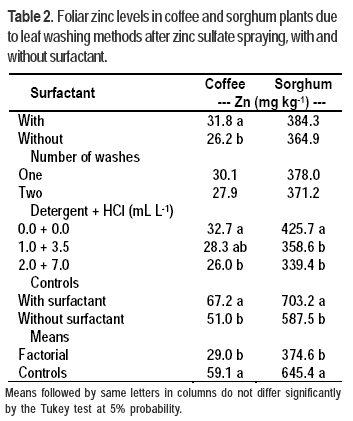
Applications of foliar zinc with surfactant produced higher levels of zinc in the leaf samples from coffee, but the same result was not observed for sorghum (Table 2). Higher levels of foliar zinc in coffee can be attributed to greater absorption due to surfactant and the zinc that was not removed by washing and remained on the leaf surface. Spray runoff is greater with coffee because its leaves are smoother and waxier than those of sorghum. Thus, the surfactant caused the spray droplets to spread out more, which maximized leaf wetting, minimized runoff, as highlighted by Prado et al. (2003) and Martins et al. (2010), and decreased losses. This result shows that leaf structure interferes with absorption.
Faifer et al. (2012) observed the effect of surfactant on foliar zinc retention in greenhouse-grown corn plants. The authors noted that adding surfactant to the zinc spray resulted in higher micronutrient levels in plant tissue regardless of washing method. They also noted that the most effective wash consisted of two immersions in the same standard concentration of detergent and hydrochloric acid used in the present study.
The wash consisting of only deionized water produced the highest levels of zinc in both crops and did not effectively remove surface zinc because it lacked detergent and HCl (0 + 0 mL L-1). This result agrees with
Using twice the standard concentration of detergent + HCl had no effect compared to the standard concentration. Thus, increasing the concentration of detergent + HCl in the wash is unnecessary. It should be noted that detergent and hydrochloric acid in the wash solution at the standard concentration (1.0 + 3.5 mL L-1) decreased zinc content by 13.5 % for coffee and 15.8 % for sorghum compared to washing only with deionized water (0 + 0 mL L-1).
Finally, the importance of leaf washing can be seen in the average zinc levels, which were 104 % (coffee) and 72 % (sorghum) higher than those in the treatments with leaf washing. Within the control treatments, average foliar zinc was 32 % (coffee) and 20 % (sorghum) higher when zinc was applied with surfactant than when surfactant was not used.
Therefore, higher foliar zinc levels in both crops can be attributed to the absence of washing. This increase was enhanced by surfactant, which may have caused greater foliar absorption and/or adhesion of zinc.
Vale et al. (2008) found that washing Mango leaves twice with deionized water followed by a single wash with the standard solution used in the present study, maximized the decontamination of leaf samples that had been sprayed with zinc. The authors further stated that the addition of acid reduced zinc content by about 30 %.
The number of washes in this study did not influence zinc levels. Therefore, one wash is recommended, because it will increase efficiency, decrease labor and reduce the consumption of washing solution. In addition, Martins and Reissmann (2007) indicate the need to consider immersion and washing time to maximize cleaning and decontamination. In the present study, this variable was standardized at 30 seconds.
The average zinc levels obtained in this study for coffee are above those considered adequate by
Conclusions
Surfactant enhances the contact and absorption of foliar zinc applications.
Washing is indispensable as a pretreatment for foliar analysis.
A single wash with detergent + hydrochloric acid at a concentration of 1.0 + 3.5 mL L-1, was the most suitable method for both species.
References
- Álvarez-Fernández A, Pérez-Sanz A, Lucena JJ. 2001. Evaluation of effect of washing procedures on mineral analysis of orange and peach leaves sprayed with seaweed extracts enriched with iron. Communications Soil Science and Plant Analysis, 32(1-2): 157 - 170.
- Bataglia OC, Furlani AMC, Teixeira JPF, Furlani PR, Gallo JR. 1983. Métodos de análise química de plantas. Boletim Técnico, 78: 48p.
- Boaretto AE, Rosolem CA. 1989. Adubação Foliar. Campinas: Fundação Cargill. 669p.
- Chamel AR, Marcelle RD, Eloy JF. 1982. Cuticular retention in vitro and localization of Zn after a foliar application of zinc-containing fungicides. Journal of American Society for Hoticultural Science, 107(5): 804 – 807.
- Faifer AT, Caione G, Guirra APP, Prado RM. 2012. Métodos de lavagem de folhas de milho pulverizadas com zinco na ausência e presença de surfactante [On line]. Tecnologia & Ciência Agropecuária, 6(2): 17 - 21. Cited July 14 2012. Available from: http://www.emepa.org.br/revista/volumes/tca_v6_n2_jun/tca6204.pdf.
- Faquin V. 2005. Nutrição mineral de plantas. Lavras : UFLA, FAEPE. 183p.
- Faquin V. 2002. Nutrição mineral de plantas. Lavras : UFLA, FAEPE. 77p.
-
Malakouti MJ. 2008. The effect of micronutrients in ensuring efficient use of macronutrients [On line]. Turkish Journal of Agriculture and Forestry, 32(3): 215 - 220. Cited November 04 2012. Available from: http://journals.tubitak.gov.tr/agriculture/issues/tar-08-32-3/tar-32-3-7-0801-41.pdf.
» http://journals.tubitak.gov.tr/agriculture/issues/tar-08-32-3/tar-32-3-7-0801-41.pdf - Malavolta E. 1992. ABC da análise de solos e folhas. São Paulo : Ceres. 124p.
- Malavolta E, Vitti GC, Oliveira SA. 1997. Avaliação do estado nutricional das plantas : princípios e aplicações. 2 ed. Piracicaba : Potafós. 319p.
- Mann EM, Resende PM, Mann RS, Carvalho JG, Pinho ÉVRV. 2002. Efeito da aplicação de manganês no rendimento e na qualidade de sementes de soja. Pesquisa Agropecuária Brasileira, 37(12): 1757 - 1764.
- Martins APL, Reissmann CB. 2007. Material vegetal e as rotinas laboratoriais nos procedimentos químico-analíticos. Scientia Agraria, 8(1): 1 - 17.
- Orioli Júnior V, Prado RM, Leonel CL, Cazetta DA, Silveira CM, Queiroz RJB, Bastos JCHAG. 2008. Modos de aplicação de zinco na nutrição e na produção de massa seca de plantas de trigo. Revista de la Ciencia del Suelo y Nutrición Vegetal, 8(1): 28 - 36.
- Peryea FJ. 2005. Sample washing procedures influence mineral element concentrations in zinc sprayed apple leaves. Communications in Soil Science and Plant Analysis, 36(19-20): 2923 – 2931.
- Pozza AAA, Guimarães PTG, Silva EB, Bastos ARR, Nogueira FD. 2009. Adubação foliar de sulfato de zinco na produtividade e teores foliares de zinco e fósforo de cafeeiros arábica. Acta Scientiarum. Agronomy, 31(1): 49 - 57.
- Prado RM. 2008. Nutrição de plantas. São Paulo: UNESP. 407p.
- Prado AM, Solar CE, Soto P, Coger C, Soza JA, Depallens D. 2003. Adyuvantes, sus propiedades e efectos en las aplicaciones de fitorreguladores. Santiago de Chile: Pontificia Universidad Católica de Chile.
- Raij Bvan, Cantarella H, Quaggio JA, Furlani AMC. 1997. Recomendações de adubação e calagem para o Estado de São Paulo. Boletim Técnico, 100: 285p.
- Souza HA, Rozane DE, Hernandes A, Romualdo LM, Natale W. 2010. Variação no teor de macronutrientes de folhas de goiabeira, em função do tipo e tempo de armazenamento. Biotemas, 23(3): 25 - 30.
- Vale DW, Prado RM, Souza HA, Corradi MM. 2008. Métodos de lavagem de folhas de mangueira pulverizadas com zinco. Revista de Agricultura, 83: 92 - 97.
- Velini ED, Martins D, Silva MAS. 2000. Efeito de concentrações de espalhante adesionante e doses de glyphosate no controle de Brachiaria decumbens e Panicum maximum. Planta Daninha, 18(2): 349 – 366.
- Volkweiss SJ. 1991. Fontes e métodos de aplicação. In: Simpósio sobre Micronutrientes na Agricultura, 1988, Jaboticabal: Anais. Piracicaba: POTAFOS, CNPQ. pp. 391 - 412.