Economical evaluation in family farm: a typology of subjectivities
Abstract
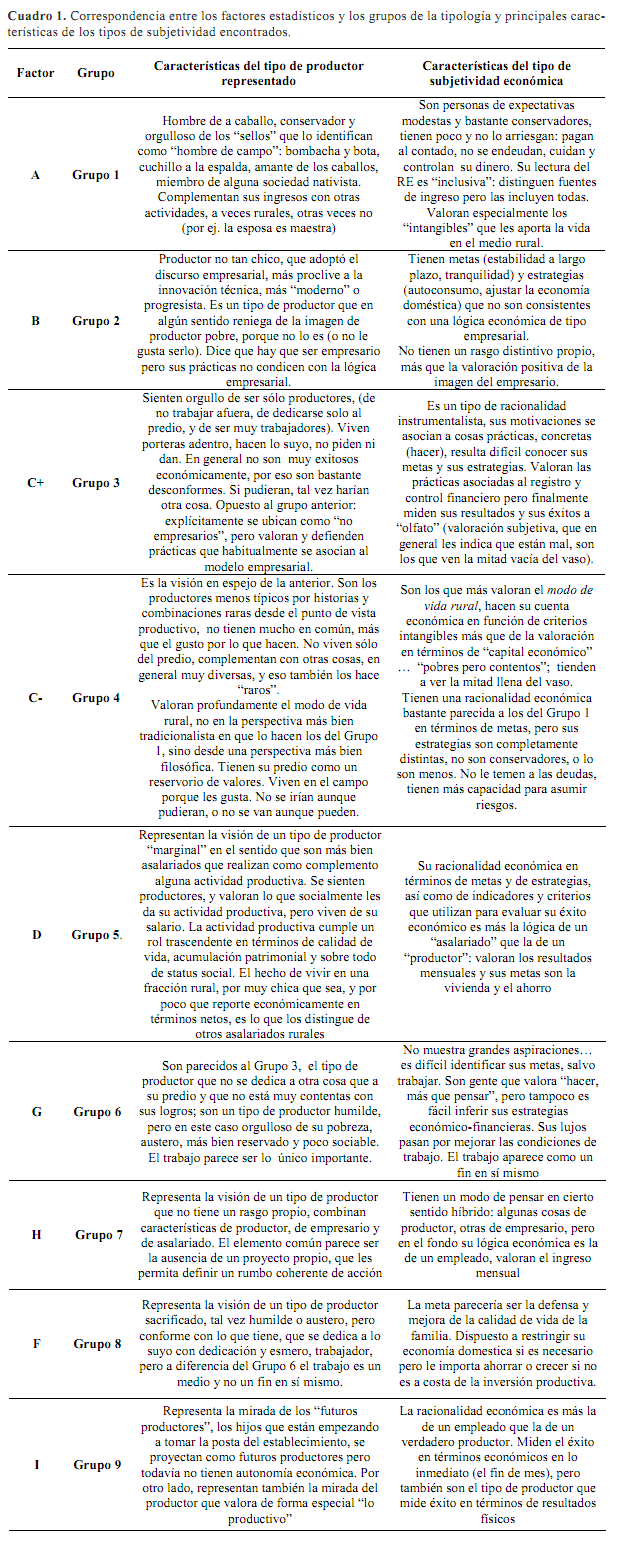
Economical evaluation of agricultural establishment results in Uruguay and other countries is done basically through classical indicators as gross margin, net income and profitability. This approach has shown strong limitations when it is applied in family establishments. This is due to the fact that: i) it is difficult to calculate those indicators with the existing data, and ii) family farmers have a different rationality from those producers labeled as entrepreneurs. As a result, perceptions of economical situation in beneficiaries of development projects may not be the same as the situation that emerges from applying those indicators. There is a need to design new ways to calculate economical evaluation to reflect these differences. This research was oriented to study the subjectivity of farmers when they evaluate their economical situation. The work has been done in 2007 within a rural development project carried out in Paysandu, Uruguay. The general objective was to characterize types of economical subjectivity that can be understood as the main social representations. In this sense, 9 different types emerged from applying factorial analysis and in deep interviews.
indicators; economical subjectivity; rationality; development projects
 Thumbnail