Survey of natural mortality agents of aphids in forage legumes in Uruguay
Abstract
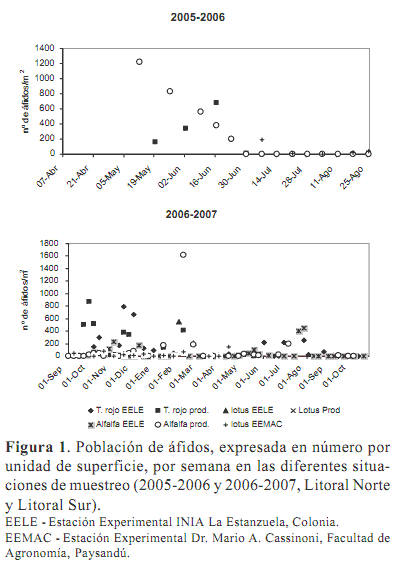
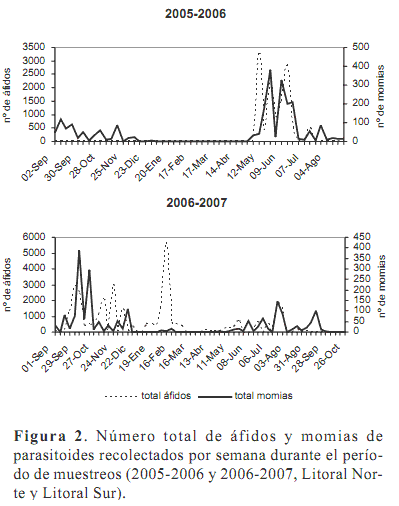
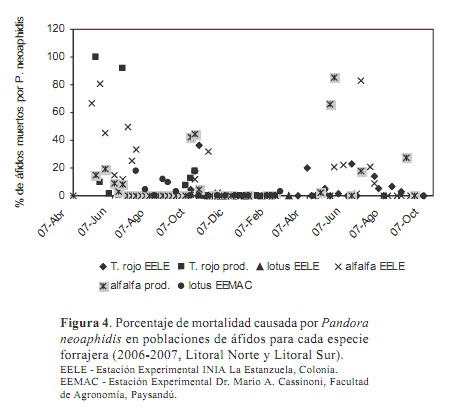
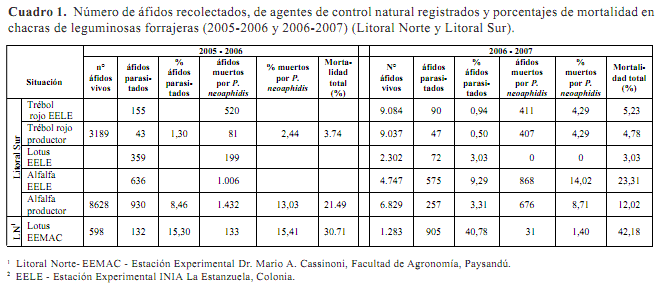
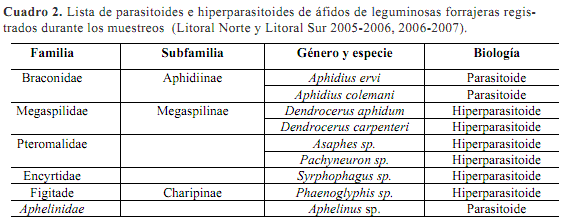
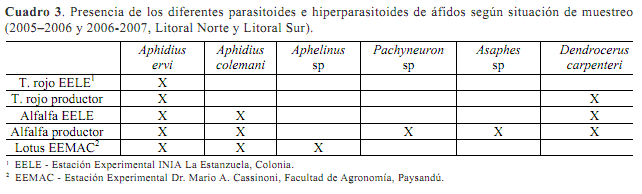
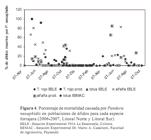
Between August of 2005 and September of 2007 a survey of natural enemies of aphids in lucerne (Medicago sativa L.), red clover (Trifolium pratense L.) and birdsfoot trefoil (Lotus corniculatus L.) was carried out. Commercial crops of each legume were sampled at La Estanzuela (Colonia) and one area of birdsfoot trefoil at EEMAC (Paysandú). Thirty 30 x 30 cm plant samples were cut every two weeks. In the lab, dead aphids were separated from the plants, and individually maintained until cause of mortality was defined. Aphid species were identified and an estimate of population density was made using a volumetric method. Aphid species recorded in the different crops during the period were: Therioaphis trifolii (Monnell), Acyrthosiphon pisum (Harris), Acyrthosiphon kondoi Shinji, Aphis craccivora Koch and Nearctaphis bakeri (Cowen). Main mortality factors were parasitoids and the fungus Pandora neoaphidis (Remaudière and Hennebert) Humber (Entomophthoromycotina: Entomophthorales). Aphid abundance as well as natural mortality varied widely between years and sampling situations. P. neoaphidis caused higher mortality rates than parasitoids though its action was restricted to autumn and winter, in both years. Parasitoids were found through all sampling period. In birdsfoot trefoil, in both years and regions, total number of collected parasitoids was equal or similar to the number of aphids killed by fungi. On the contrary, in red clover and lucerne, the number of aphids killed by fungi was always significantly higher than those affected by parasitoids.
aphids; Lotus corniculatus; Medicago sativa; natural enemies; Trifolium pratense
 Thumbnail
 Thumbnail
 Thumbnail