Apparent Electrical Conductivity to Delineate Management Zones in an Agricultural Soil with Reduced Variability in Physico-chemical Properties
Abstract
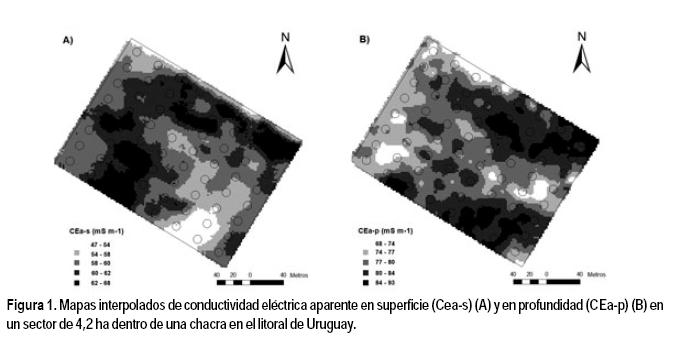
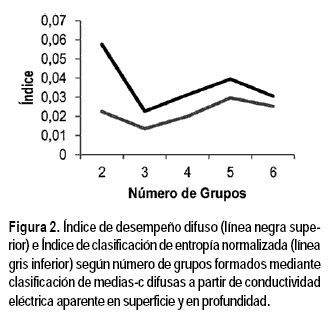
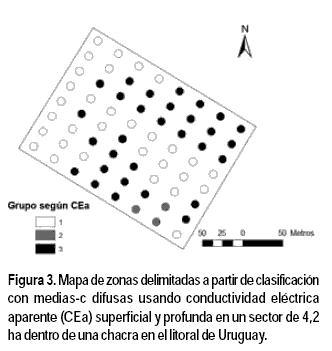
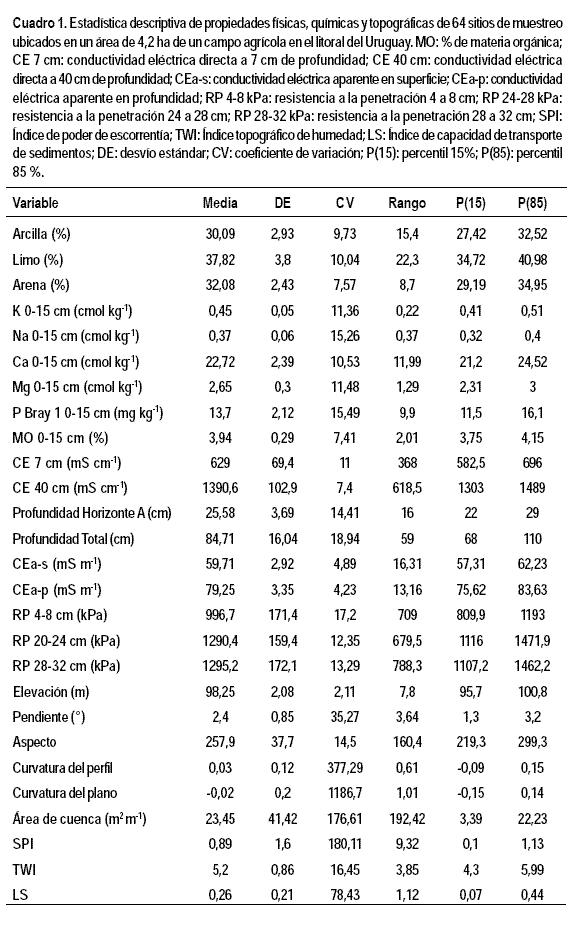
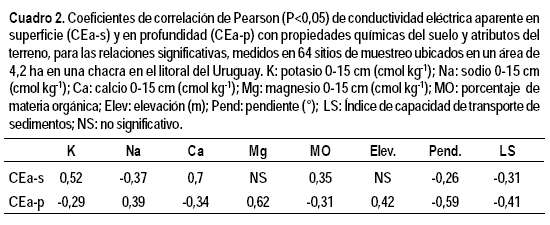
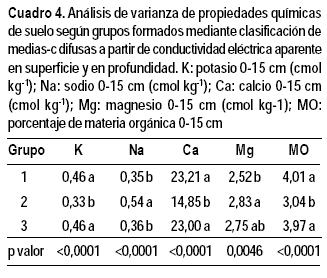
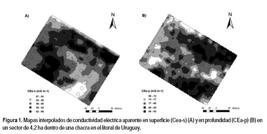
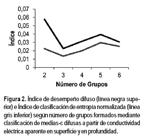
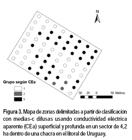
The spatial variation in soils and crops could be included into agricultural management systems to optimize the use of resources within fields. This requires a spatial characterization of agroecological resources. Apparent soil electrical conductivity (ECa) has been proposed as a reliable way to characterize the variation in soil properties. In this study the objectives were: i) quantify ECa relationships with terrain attributes and soil physical and chemical properties, and ii) determine if ECa can be used to delineate zones with differences in edaphic and topographic properties in an agricultural soil of Uruguay. A grid soil sampling was conducted in an area of 4.2 ha in a field. Exchangeable bases, organic matter, available phosphorus, texture, penetration resistance, direct electrical conductivity of the soil, soil depth, ECa at two depths, and terrain attributes were determined. The management zones were delineated using a fuzzy c means clustering analysis with the ECa data at two depths. The ECa showed medium to low correlations (P value £ 0.05) with various soil physical and chemical properties and terrain attributes. Three zones were identified according ECa, two of which had similar characteristics and differed from the third to present more exchangeable potassium, calcium, magnesium and soil organic matter and lower exchangeable sodium. Under the conditions of the study ECa proved be useful for identifying zones with different soil properties, and potentiality to be incorporated into precision farming schemes.
PRODUCTIVITY ZONES; VERIS SENSOR; TOPOGRAPHICAL ATTRIBUTES; EDAPHIC ATTRIBUTES
 Thumbnail
 Thumbnail
 Thumbnail