Mass propagation of Vaccinium corymbosum in bioreactors
Abstract
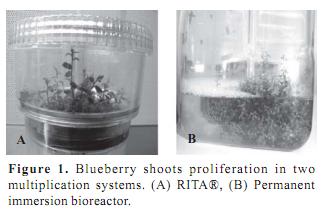
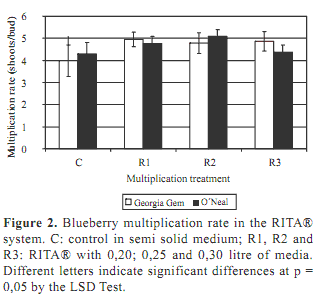
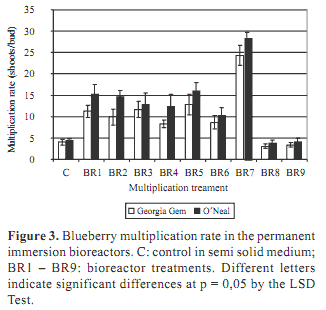
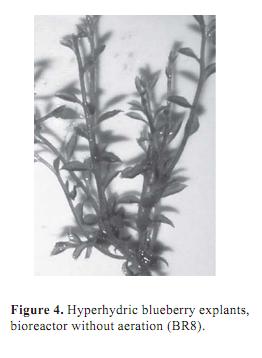
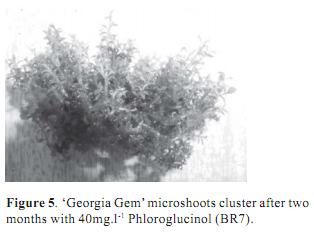
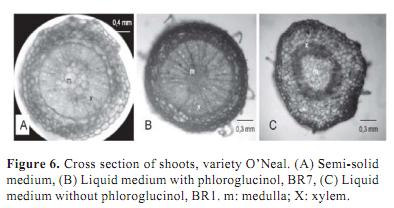
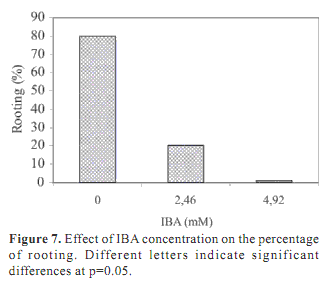
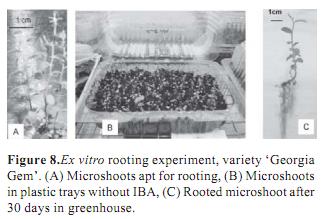
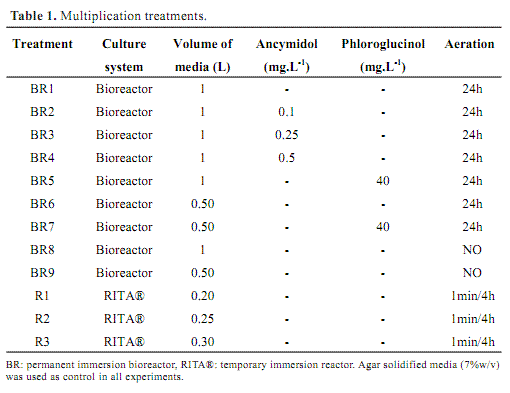
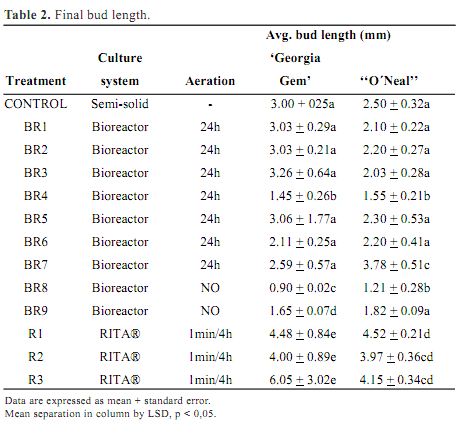
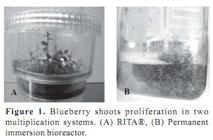
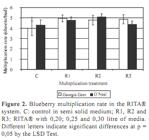
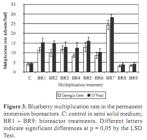
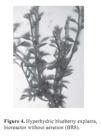
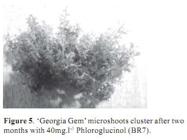
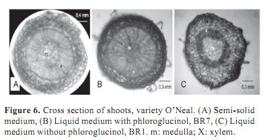
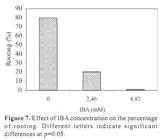
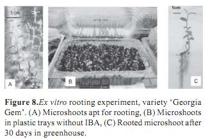
Two kinds of bioreactors were evaluated for in vitro propagation of Vaccinium corymbosum: a temporary immersion system (RITA®) and a permanent immersion reactor. Results were compared with the system currently used of micropropagation in semi-solid medium, used as control for this study. Two varieties, ‘O’Neal’ and ‘Georgia Gem’, of the triple hybrid Vaccinium corymbosum, V. ashei and V. darrowii were employed. Explants were cultured in WPM medium (Lloyd and Mc Cown, 1981) containing 0.01mM ascorbic acid, 0.22mM adenine sulphate, 2% sucrose and 20mM 2iP. To minimize hyperhydricity of explants, the effect of ancymidol (0.4, 0.9 and 2.0 µM) as growth retardant and phloroglucinol (0.32mM) as promoter of lignin biosynthesis was tested. The highest multiplication rates were 28 and 24 shoots per bud for the varieties ‘O’Neal’ and ‘Georgia Gem’ respectively, and were achieved in the permanent immersion system containing phloroglucinol. Light microscopy of the shoots showed a more developed and lignified xylem in the phloroglucinol-derived plants. Shoots obtained from the multiplication system that were 3 or more centimeters long were rooted ex vitro in a mixture of soil, peat and perlite (1:1:1) resulting in 80% rooting. Plants acclimatized well and exhibited normal development in the greenhouse. Abbreviations: IBA – Indol-3-butyric acid, 2iP – 6-(g, g-dymethilamino) purine, WPM – Woody Plant Medium (Lloyd and McCown, 1981).
ancymidol; blueberry; hyperhydricity; micropropagation; phloroglucinol
 Thumbnail
 Thumbnail
 Thumbnail
 Thumbnail
 Thumbnail
 Thumbnail
 Thumbnail
 Thumbnail