Segregative phase separation in aqueous systems of whey protein and carboxymethylcellulose under isoionic conditions
Abstract:
Whey, a byproduct of cheese production, contains valuable proteins such as whey protein (WP), which are key in the food industry due to their functional properties, especially the ability to form gels. When combined with polysaccharides like carboxymethylcellulose (CMC), WP can undergo phase separation, affecting properties like viscosity and texture in food products. This separation can be segregative, when the macromolecules are incompatible, or associative, when oppositely charged macromolecules attract each other and form networks. This study focuses on phase separation in WP and CMC mixtures under isoionic conditions, evaluating the effect of the molecular weight of CMC and the rheological properties of the mixtures. The tests included measurements of electrokinetic potential, microscopic analysis, and rheology of individual solutions and mixtures of WP with low- and high-viscosity CMC. It was found that mixtures with high-viscosity CMC tend to form segregated phases more easily. The flow and gelation properties also depended on the concentration of WP and the type of CMC, with higher concentrations of WP resulting in stronger gels. The results provide key insights for controlling the structure and functionality in food systems.
Keywords:
whey protein; carboxymethylcellulose; rheology; macromolecules; phase separation
Resumen:
El suero de leche, subproducto de la producción de queso, contiene proteínas valiosas como la proteína de suero (WP), que es clave en la industria alimentaria por sus propiedades funcionales, especialmente la capacidad de formar geles. En combinación con polisacáridos, como la carboximetilcelulosa (CMC), la WP puede experimentar separación de fases, lo que afecta propiedades como la viscosidad y la textura de los alimentos. Esta separación puede ser segregativa, cuando las macromoléculas son incompatibles, o asociativa, cuando macromoléculas de cargas opuestas se atraen y forman redes. Este estudio se enfoca en la separación de fases en mezclas de WP y CMC bajo condiciones isoiónicas, evaluando el efecto del peso molecular de la CMC y las propiedades reológicas de las mezclas. Las pruebas incluyeron mediciones del potencial electrocinético, análisis microscópico y reología de soluciones individuales y mezclas de WP con CMC de baja y alta viscosidad. Se encontró que las mezclas con CMC de alta viscosidad tienden a formar fases segregadas más fácilmente. Las propiedades de flujo y gelación también dependieron de la concentración de WP y el tipo de CMC, con mayores concentraciones de WP resultando en geles más fuertes. Estos resultados proporcionan información clave para el control de la estructura y la funcionalidad en sistemas alimentarios.
Palabras clave:
proteína de lactosuero; carboximetilcelulosa; reología; macromoléculas; separación de fases
Resumo:
O soro de leite, subproduto da produção de queijo, contém proteínas valiosas (WP), que são fundamentais na indústria alimentícia devido às suas propriedades funcionais, especialmente a capacidade de formar geis. Em combinação com polissacarídeos, como a carboximetilcelulose (CMC), a WP pode passar por separação de fases, o que afeta propriedades como a viscosidade e a textura dos alimentos. Essa separação pode ser segregativa, quando as macromoléculas são incompatíveis, ou associativa, quando macromoléculas de cargas opostas se atraem e formam redes. Este estudo foca na separação de fases em misturas de WP e CMC sob condições isoiónicas, avaliando o efeito do peso molecular da CMC e as propriedades reológicas das misturas. Os testes incluíram medições do potencial eletrocinético, análise microscópica e reologia de soluções individuais e misturas de WP com CMC de baixa e alta viscosidade. Foi encontrado que misturas com CMC de alta viscosidade tendem a formar fases segregadas mais facilmente. As propriedades de fluxo e gelificação também dependeram da concentração de WP e do tipo de CMC, com concentrações mais altas de WP resultando em géis mais fortes. Esses resultados fornecem informações chave para o controle da estrutura e funcionalidade em sistemas alimentares.
Palavras-chave:
proteína do soro de leite; carboximetilcelulose; reologia; macromoléculas; separação de fases
1. Introduction
Whey, a byproduct of cheese production, accounts for approximately 85-90% of the total milk volume processed, retaining a significant portion of the original nutrients from milk, including lactose, fats, mineral salts, and soluble proteins. Whey proteins (WP), which constitute around 20% of the protein content in bovine milk, are recognized for their high nutritional value and versatile functional properties, making them a key ingredient in the food industry. One of their most important functional characteristics is their ability to form gels, particularly through thermal treatment, which has been extensively studied and applied in food product development1.
Protein-polysaccharide colloidal systems are commonly used to modify the texture, viscosity, and other essential properties of food products. These systems can undergo phase separation, which is a key phenomenon in determining their functionality. Phase separation in protein-polysaccharide systems can be classified into two main types: segregative and associative2. Segregative phase separation occurs when the two macromolecules -such as proteins and polysaccharides- are thermodynamically incompatible, leading to their separation into distinct phases, each enriched in one of the components3. In contrast, associative phase separation involves the attraction between oppositely charged macromolecules, resulting in the formation of complexes or networks that remain in a mixed phase4. The type of phase separation that occurs depends on various factors, including the charge, concentration, and molecular characteristics of the biopolymers, as well as the environmental conditions, such as pH, ionic strength, and temperature5.
Segregative phase separation generally occurs when the macromolecules involved carry similarcharges, or when one of them is uncharged. In this case, repulsion between the molecules leads to the formation of two immiscible phases, one enriched in protein and the other in polysaccharide. This type of separation is typically favored at higher macromolecule concentrations and under conditions where the macromolecules do not interact strongly with each other6. Associative phase separation, on the other hand, occurs when the macromolecules carry opposite charges, resulting in electrostatic attraction between them. This leads to the formation of either two liquid phases (coacervation) or a combination of a liquid and solid phase (precipitation), with one phase rich in both macromolecules and the other rich in solvent. This type of separation is typically favored at lower ionic strengths and concentrations, and is largely determined by the isoelectric point of the protein and the pKa of the polysaccharide7.
The functional properties of protein-polysaccharide mixtures, such as their ability to form gels or influence viscosity, are highly dependent on the type of phase separation that occurs. Whey protein concentrate is a common functional ingredient in food products8, whereas carboxymethylcellulose (CMC), a water-soluble anionic polysaccharide, is widely used in combination with proteins to form mixed systems with specific structural and functional properties9. Understanding the interactions between WP and CMC is essential for predicting and controlling the phase behavior of these systems, which in turn determines the texture, water-holding capacity, and sensory properties of the final food product.
In recent years, research has focused on the role of phase separation in mixed protein-polysaccharide systems and its implications for food structure and stability10)(11) . Studies have shown that the phase behavior of such systems is influenced by a variety of factors, including the molecular weight and concentration of the macromolecules, the ionic strength of the medium, and the presence of co-solutes such as sugars and salts12)(13) . Similarly, changes in pH can alter the charge of the macromolecules and thus affect their interactions and phase behavior. The type and extent of phase separation also influence the rheological properties of the system, such as its viscosity and gel strength, which are critical for the development of food products with desirable textures and stability14.
The objective of this study is to investigate the phase behavior of WP-CMC mixtures under isoionic conditions, evaluating the effect of the molecular weight of the polysaccharide. In addition, by assessing the rheological properties of these mixtures, this research aims to provide a deeper understanding of how WP and CMC interact under isoionic conditions.
2. Materials and Methods
2.1 Materials
Whey protein concentrate (Star Nutrition, Argentina) with a protein content of 82% was purchased in a local market. Carboxymethylcellulose (CMC) sodium salt was obtained from Sigma-Aldrich (USA), with two different samples utilized: low-viscosity CMC (CMCl) and high-viscosity CMC (CMCh).
2.2 Electrokinetic potential
The electrokinetic potential of individual systems (WP, CMCh, and CMCl) and mixed systems (WP-CMCh and WP-CMCl) was measured by dynamic light scattering using a particle size analyzer (Horiba NanoPartica SZ100, Japan)15. To determine the ζ-potential, samples were prepared at the pH range from 2 to 6. The concentration of WP was maintained at 0.82%, while the concentration of CMC was set at 0.5%.
2.3 Phase behavior evaluation
The phase behavior of WP and CMC in aqueous solutions was evaluated using systems with varying concentrations of both components. Two experiments were conducted: one with CMCh and the other with CMCl. Stock solutions of WP at 16.4% and CMC at 1% were prepared at isoionic pH and mixed thoroughly to achieve the desired concentrations, with the appropriate amount of water added. Phase separation was assessed after 24 and 72 h of incubation by visually inspecting the upper and lower layers formed in each system16.
The microstructure of six WP-CMC systems after 24 h incubation was assessed using confocal laser scanning microscopy (CLSM), labelling the WP with Rhodamine B. Fluorescence excitation was achieved with a laser light source at a wavelength of 488 nm, while fluorescent emission was recorded at 568 nm. The systems were observed using a 60× oil immersion objective on a Nikon Eclipse TE-2000-E confocal microscope (Japan). Images were captured with a pixel resolution of 1024×1024 using Nikon's EZ-C1 software17.
2.4 Rheological measurements
The flow behavior of the individual stock solutions and the apparent viscosity of the selected mixed samples were measured. A dynamic rheometer (TA-Discovery HR30 series, USA) was used to perform flow tests by conducting a flow ramp with increasing shear up to 100 s⁻¹ at constant temperature (25 °C)18.
To analyze the gelation process of the selected mixed systems, samples were prepared by mixing the appropriate quantities of each stock solution to achieve the following WP and CMC concentrations: 14.76% WP - 0.1% CMC, 8.2% WP - 0.5% CMC, and 16.4% WP - 0.9% CMC. The samples were subjected to a controlled temperature ramp, and gelation was evaluated using parallel plate geometry, by monitoring the viscoelastic properties during heating and cooling. A rheometer operated in oscillatory mode at a frequency of 0.5 Hz and a strain of 0.1% was used for this analysis. The mixed solutions were maintained at 25 °C for 3 min before being heated to 90 °C at a rate of 5 °C/min. The temperature was held at 90 °C for 300 s, followed by cooling from 90 °C to 25 °C at the same rate of 5 °C/min. The storage modulus (G') and loss modulus (G'') were recorded, with the crossover of these moduli serving as the criterion for gelation18. The gel reinforcement (Gr), representing the strengthening of the gel network, was calculated as the difference in G′ at 25 °C (after cooling) and G′ at 90 °C (before cooling)19.
2.5 Statistical analysis
Two or more independent trials were carried out on each sample. The average and standard errors were then calculated from this data. ANOVA (post hoc Holm-Sidak test) was employed to ascertain significant differences between samples (p < 0.05).
3. Results
3.1 Rheological characterization of the biopolymer suspensions
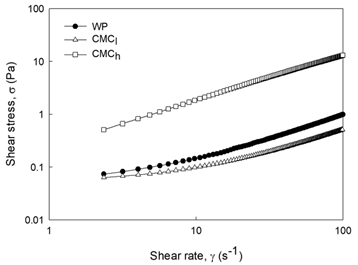
The flow behavior of the stock solutions of WP and both types of CMC was evaluated at 25 °C, as shown in Figure 1. Both WP and CMCl showed Newtonian flow, whereas the CMCh solution demonstrated pseudoplastic behavior under the tested conditions. The CMCh solution exhibited a significantly higher viscosity, approximately one order of magnitude greater than that of WP, while the viscosity of the CMCl solution was slightly lower than that of WP.
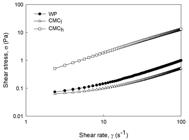
Flow behavior curves of the stock solutions of WP 16.4% and both types of CMC, 1%, measured at 25 °C
3.2 Electrokinetic potential determination
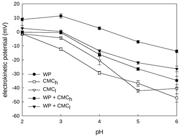
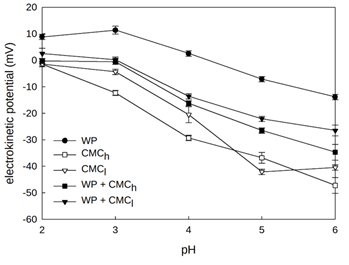
Electrokinetic potential of aqueous solutions of WP 0.82%, CMCh 0.5%, CMCl 0.5%, and mixtures WP 0.82% - CMC 0.5%, measured at 25 °C
The electrophoretic mobility of proteins and polysaccharides in aqueous dispersions is influenced by their intrinsic properties, such as amino acid or carbohydrate composition, shape, and size, as well as external factors like pH and ionic strength. The colloidal suspensions were analyzed under acidic conditions, with pH values ranging from 6 (isoionic pH) to 2, to assess the behavior around the isoelectric point of the main whey proteins -reported as 5.4 for β-lactoglobulin and 4.3 for α-lactalbumin. As shown in Figure 2, the WP exhibited a positive ζ-potential below pH 4 and a negative ζ-potential above that pH, consistent with previous findings20. Both CMC samples showed negative ζ-potential between pH 3 and 6, becoming nearly neutral around pH 2. The magnitude of the ζ-potential was higher for CMCh than for CMCl. In WP-CMC mixed systems, only one population was detected, i.e., the distribution resulted monomodal, with the ζ-potential values intermediate between those corresponding to WP or CMC alone.
3.3 Phase behavior evaluation
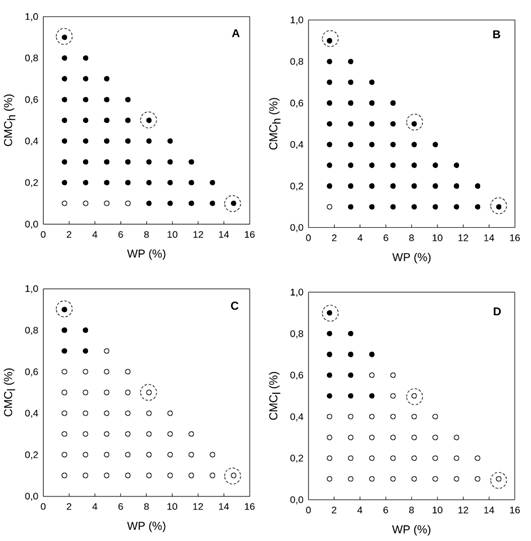
Figure 3 presents the phase behavior of aqueous systems composed by WP and CMC at isoionic pH, incubated for 24 or 72 h. Each graph highlights two distinct regions: one where systems remained homogeneous and another where phase separation occurred. At low concentrations of WP and CMC, the systems were homogeneous, indicating the co-solubility of these biopolymers in that condition; however, at increasing biopolymer concentration, segregative phase separation is induced. Both phases are liquid: the upper is concentrated in CMC, and the lower is enriched in WP.
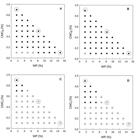
Bulk phase separation in aqueous mixtures of WP and CMCh (A and B) or CMCl (C and D), as determined by visual inspection after 24 h (A and C) or 72 h (B and D) of incubation
To further deepen the understanding of these systems, a selection of them was studied in greater detail, as indicated by the dashed circles in Figure 3. One of these systems is characterized by having the highest WP-to-CMC ratio (R = 14.76/0.1 = 174.6), another by having the lowest (R = 1.64/0.9 = 1.82), and an additional one with an intermediate ratio (R = 8.2/0.5 = 16.4) was also selected.
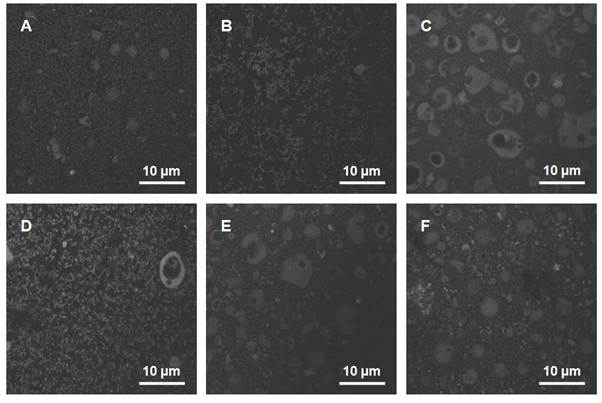
Confocal laser scanning microscopy (CLSM) was employed to elucidate the microstructure of the WP-CMC aqueous samples, as shown in Figure 4. WP are stained with Rhodamine B and appear as bright areas in the micrographs.
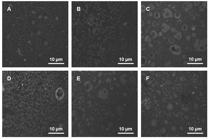
CLSM micrographs for aqueous mixtures of WP and CMCh (A, B and C) or WP and CMCl (D, E and F), as determined after 24 h of incubation
3.4 Rheological determinations
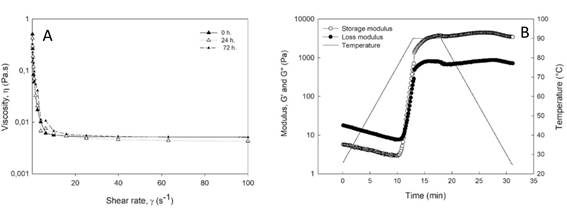
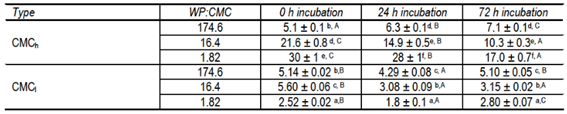
Further insights into the phase separation phenomenon were gained by measuring the apparent shear viscosity (Figure 5A). All biopolymer solutions behaved as pseudoplastic fluids within the shear rate range of 0.1-100 s⁻¹, where the apparent shear viscosity decreased with increasing shear rate. Rheograms were generated for dispersions by varying WP:CMC ratio, CMC type, and incubation time. To clarify the effects of these variables, the apparent shear viscosity at a fixed shear rate (100 s⁻¹) is presented in Table 1.
The initial apparent viscosity of the system containing 4.76% WP - 0.1% CMC (R = 147.6) is similar for systems with either CMCl or CMCh. However, as incubation time increases, the effect differs: the system with CMCh shows an increase in viscosity over time, indicating greater structural rearrangements. In contrast, systems with lower WP concentrations display a decrease in viscosity over incubation time, suggesting that structural changes occur, weakening inter- and intramolecular interactions or reducing their extent.
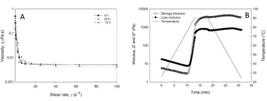
(A) Dynamic flow behavior at different incubation times. (B) Storage (G’) and loss (G’’) moduli as a function of time during the temperature ramp. Both graphs correspond to the system composed of 14.76% WP - 0.1% CMCl (R = 147.6)
The process of gelation during heating, as indicated by changes in the storage modulus (G') while heating (at 5 °C/min) and holding at 90 °C for 5 minutes, is shown in Figure 5B. The development of the storage modulus follows the typical aggregation/gelation behavior of globular proteins. An increase in the elastic modulus relative to the loss modulus during heating signals the formation of a gel network, which was observed near 90°C for all gels. Elasticity continued to increase throughout the heating and holding phases, reflecting a gradual strengthening of the gel network due to the incorporation of additional molecules or changes within the network structure. Upon cooling, G' increased further, driven by the formation of additional non-covalent interactions among the denatured proteins.
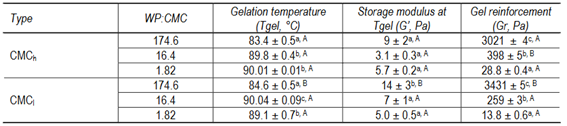
The results from the gelation analysis of the WP systems containing CMCh or CMCl (Table 2) show that the WP concentration significantly affects the thermal and mechanical properties of the resulting gels. At higher WP concentrations, gelation is reached before, and higher storage and loss moduli were observed, indicating stiffer and more resistant gels. Conversely, at lower WP concentrations, the gelation time increased, and the modulus values decreased, suggesting that these gels are weaker. A notably higher Gr value was found in gels with higher WP concentrations, with significant differences observed compared to the other samples. This suggests that attractive forces, such as van der Waals interactions and hydrogen bonding, were more prominent in systems with higher WP concentrations, leading to the formation of stronger gels.
4. Discussion
The CMCh solution exhibited a much higher viscosity than both WP and CMCl, suggesting CMCh forms more entangled and larger macromolecular networks in aqueous solution. This behavior influences the overall flow properties of WP-CMC mixtures, as viscosity differences between the components affect their phase separation tendencies and stability. The CMCh solution demonstrated pseudoplastic behavior, which aligns with existing literature for this shear rate range21. In contrast, both WP and CMCl showed Newtonian flow under the tested conditions, as previously reported22)(23) .
The ζ-potential measurements across a pH range from 6 to 2 provided critical information about the charge properties of WP and CMC. WP displayed a negative ζ-potential above pH 4 and positive values below this pH, consistent with the isoelectric points of its major protein components (β-lactoglobulin and α-lactalbumin). Both CMC types maintained a negative ζ-potential over the entire pH range, though CMCh had a greater magnitude of charge than CMCl, in agreement with Daubert and others24, who found a direct relationship between ζ-potential and colloidal diameter in particles with the same chemical composition. This difference is crucial for understanding the interactions between these biopolymers, as the higher magnitude of negative charge of CMCh could lead to stronger electrostatic repulsion between WP and CMC, promoting segregative phase separation. In contrast, the weaker charge on CMCl may favor more subtle interactions, potentially affecting the extent of phase separation or even leading to partial associative interactions under specific conditions.
When WP and CMC were combined, the ζ-potential of the mixed system was intermediate between the values of the individual components, indicating a partial interaction between WP and CMC. This is consistent with the findings of Huan and others17, who reported similar trends. This intermediate ζ-potential suggests that, at the assayed diluted conditions, WP and CMC may exhibit weak attractive interactions, suggesting some degree of association. As was previously reported, the electrostatic interaction between WP and CMC gives place to soluble WP-CMC complexes in acid media, since they carry opposite electrical charges. Although at isoionic pH each isolated macromolecule possesses net negative charge, it has been proposed that the charge regulation phenomenon allows the association of WP with CMC25. The negative ζ-potential of the soluble complexes resulted in higher magnitude for WP-CMCh than for WP-CMCl, as was previously observed for heated WP-CMC complexes at neutral pH17.
According to the Flory-Huggins theory, the segregative phase separation appears when the interaction parameter between WP and CMC (the biopolymers composing the system) is positive, indicating a net repulsion between them26. In this study, the pH of the systems was 6, and, according to the ζ-potential values, negative for both biopolymers, it can be assumed that the interaction parameter is always positive. Notably, CMCh extends the phase separation region compared to CMCl, meaning that higher concentrations of CMCl are required to induce phase separation in WP-CMC aqueous systems, while much lower concentrations of CMCh are sufficient to trigger segregation. For phase separation to occur, the enthalpic advantage of segregation must outweigh the entropic advantage of mixing. The higher the molecular weight of CMC, the lower the entropy of mixing; thereby promoting phase separation. Additionally, longer incubation times resulted in a greater number of systems exhibiting phase separation. It is well established that phase separation in protein-polysaccharide systems is a kinetic process driven by local fluctuations in biopolymer concentrations27. Although not all the systems present macroscopic phase separation, the mixed systems exhibit microdomains containing WP and a continuous phase without WP. The spatial arrangement of WP in these systems seems to correspond to a CMC-continuous phase with WP aggregates dispersed there.
The shear-thinning behavior of the assayed systems can be attributed to the progressive disruption, disentanglement, and elongation of biopolymer molecules, aggregates, or particles at higher shear rates28. As the shear rate increases sufficiently to overcome Brownian motion, the particles become more aligned in the flow direction. Consequently, the flow resistance of the biopolymer dispersions decreases, leading to a reduction in shear viscosity. The increase in viscosity over incubation time in systems with high WP concentrations and CMCh can be attributed to the formation of denser and more resilient viscoelastic networks, driven by stronger WP-WP and WP-CMC interactions. In other cases, where WP concentrations are lower, the interactions are insufficient to maintain a stable structure, and phase separation may lead to a redistribution that reduces viscosity29.
The gelation experiments provided further insights into the thermal and mechanical properties of the WP-CMC mixtures. As expected, the gels formed at higher WP concentrations were stronger, with lower gelation time and higher storage and loss moduli, indicating stiffer networks. The observed increase in the elastic modulus during heating and cooling phases reflects the progressive formation and reinforcement of the gel network. Systems with higher WP concentrations exhibited significantly higher gel reinforcement (Gr), suggesting that stronger intermolecular interactions, such as van der Waals forces and hydrogen bonds, were responsible for the formation of more robust gels30.
5. Conclusions
The rheological and phase separation behavior of WP and CMC aqueous systems, both high and low viscosity, were evaluated under isoionic conditions. The results demonstrated that systems with higher WP concentrations and CMCh exhibited increased viscosity over time due to the formation of denser, viscoelastic networks facilitated by stronger protein-protein and protein-CMC interactions. Conversely, systems with lower WP concentrations or those containing CMCl showed a decrease in viscosity, indicating weaker structures.
Phase separation was induced in systems with lower total biopolymer concentrations containing CMCh compared to CMCl. This is attributed to the lower entropy of mixing in the case of CMCh, which promotes segregation. Incubation time also played a critical role in extending the phase separation region, further demonstrating the kinetic nature of the process in protein-polysaccharide systems.
Rheological measurements highlighted the pseudoplastic behavior of all biopolymer solutions, with shear-thinning characteristics driven by biopolymer alignment at higher shear rates. Systems with higher WP concentrations exhibited stronger thermal gelation properties, forming stiffer, more resistant gels with lower gelation times and higher storage moduli. This suggests that, during heat treatment, attractive interactions, such as van der Waals forces and hydrogen bonding, were more prevalent in systems with higher protein content, leading to enhanced gel strength and stability.
Acknowledgements:
This work was supported by grants from CONICET (PIP 2022-2024 GI 11220210100490CO) and UNR (80020210200112UR).
References:
-
1. El-Aidie SAM, Khalifa GSA. Innovative applications of whey protein for sustainable dairy industry: Environmental and technological perspectives: a comprehensive review. Compr Rev Food Sci Food Saf. 2024;23(2):e13319. Doi: 10.1111/1541-4337.13319.
» https://doi.org/10.1111/1541-4337.13319 -
2. Yang X, Li A, Li D, Guo Y, Sun L. Applications of mixed polysaccharide-protein systems in fabricating multi-structures of binary food gels: a review. Trends Food Sci Technol. 2021;109:197-210. Doi: 10.1016/j.tifs.2021.01.002.
» https://doi.org/10.1016/j.tifs.2021.01.002 -
3. Esquena J. Recent advances on water-in-water emulsions in segregative systems of two water-soluble polymers. Curr Opin Food Sci. 2023;51:101010. Doi: 10.1016/j.cofs.2023.101010.
» https://doi.org/10.1016/j.cofs.2023.101010 -
4. Zeng X, Pappu RV. Developments in describing equilibrium phase transitions of multivalent associative macromolecules. Curr Opin Struct Biol. 2023;79:102540. Doi: 10.1016/j.sbi.2023.102540.
» https://doi.org/10.1016/j.sbi.2023.102540 -
5. Dignon GL, Best RB, Mittal J. Biomolecular phase separation: from molecular driving forces to macroscopic properties. Annu Rev Phys Chem. 2020;71:53-75. Doi: 10.1146/annurev-physchem-071819-113553.
» https://doi.org/10.1146/annurev-physchem-071819-113553 -
6. Gentile L. Protein-polysaccharide interactions and aggregates in food formulations. Curr Opin Colloid Interface Sci. 2020;48:18-27. Doi: 10.1016/j.cocis.2020.03.002.
» https://doi.org/10.1016/j.cocis.2020.03.002 -
7. Zhou L, Shi H, Li Z, He C. Recent advances in complex coacervation design from macromolecular assemblies and emerging applications. Macromol Rapid Commun. 2020;41(21):e2000149. Doi: 10.1002/marc.202000149.
» https://doi.org/10.1002/marc.202000149 -
8. Morr CV, Ha EY. Whey protein concentrates and isolates: processing and functional properties. Crit Rev Food Sci Nutr. 1993;33(6):431-76. Doi: 10.1080/10408399309527643.
» https://doi.org/10.1080/10408399309527643 -
9. Xie L, Shen M, Wang Z, Xie J. Structure, function and food applications of carboxymethylated polysaccharides: a comprehensive review. Trends Food Sci Technol . 2021;118:539-57. Doi: 10.1016/j.tifs.2021.09.016.
» https://doi.org/10.1016/j.tifs.2021.09.016 -
10. Ouyang H, Kilcawley KN, Miao S, Fenelon M, Kelly A, Sheehan JJ. Exploring the potential of polysaccharides or plant proteins as structuring agents to design cheeses with sensory properties focused toward consumers in East and Southeast Asia: a review. Crit Rev Food Sci Nutr . 2022;62(16):4342-55. Doi: 10.1080/10408398.2021.1874869.
» https://doi.org/10.1080/10408398.2021.1874869 -
11. Bourouis I, Pang Z, Liu X. Recent advances on uses of protein and/or polysaccharide as fat replacers: textural and tribological perspectives: a review. J Agr Food Res. 2023;11:100519. Doi: 10.1016/j.jafr.2023.100519.
» https://doi.org/10.1016/j.jafr.2023.100519 -
12. Igartúa DE, Cabezas DM, Palazolo GG. Effects of pH, protein: polysaccharide ratio, and NaCl-added concentration on whey protein isolate and soluble soybean polysaccharides electrostatic-complexes formation. Food Chem Adv. 2022;1:100123. Doi: 10.1016/j.focha.2022.100123.
» https://doi.org/10.1016/j.focha.2022.100123 -
13. Spyropoulos F, Portsch A, Norton IT. Effect of sucrose on the phase and flow behaviour of polysaccharide/protein aqueous two-phase systems. Food Hydrocoll. 2010; 24(2-3):217-26. Doi: 10.1016/j.foodhyd.2009.09.008.
» https://doi.org/10.1016/j.foodhyd.2009.09.008 -
14. Tanaka H. Viscoelastic phase separation in soft matter and foods. Faraday Discuss. 2012;158:371-406; discussion 493-522. Doi: 10.1039/c2fd20028g.
» https://doi.org/10.1039/c2fd20028g -
15. Harnsilawat T, Pongsawatmanit R, McClements DJ. Characterization of β-lactoglobulin-sodium alginate interactions in aqueous solutions: a calorimetry, light scattering, electrophoretic mobility and solubility study. Food Hydrocoll . 2006;20(5):577-85. Doi: 10.1016/j.foodhyd.2005.05.005.
» https://doi.org/10.1016/j.foodhyd.2005.05.005 -
16. Chun JY, Hong GP, Surassmo S, Weiss J, Min SG, Choi MJ. Study of the phase separation behaviour of native or preheated WPI with polysaccharides. Polymer. 2014;55(16):4379-84. Doi: 10.1016/j.polymer.2014.06.082.
» https://doi.org/10.1016/j.polymer.2014.06.082 -
17. Huan Y, Zhang S, Vardhanabhuti B. Effect of CMC molecular weight on acid-induced gelation of heated WPI-CMC soluble complex. J Food Sci. 2016;81(2):N502-7. Doi: 10.1111/1750-3841.13209.
» https://doi.org/10.1111/1750-3841.13209 -
18. He Z, Liu C, Zhao J, Li W, Wang Y. Physicochemical properties of a ginkgo seed protein-pectin composite gel. Food Hydrocoll . 2021;118:106781. Doi: 10.1016/j.foodhyd.2021.106781.
» https://doi.org/10.1016/j.foodhyd.2021.106781 -
19. López DN, Ingrassia R, Busti P, Wagner J, Boeris V, Spelzini D. Effects of extraction pH of chia protein isolates on functional properties. LWT Food Sci Technol. 2018;97:523-9. Doi: 10.1016/j.lwt.2018.07.036.
» https://doi.org/10.1016/j.lwt.2018.07.036 -
20. Ince-Coskun AE, Ozdestan-Ocak O. Effects of salt ions and heating on the behaviour of whey protein particle dispersions. Food Hydrocoll . 2020;101:105433. Doi: 10.1016/j.foodhyd.2019.105433.
» https://doi.org/10.1016/j.foodhyd.2019.105433 -
21. Benchabane A, Bekkour K. Rheological properties of carboxymethyl cellulose (CMC) solutions. Colloid Polym Sci. 2008;286:1173-80. Doi: 10.1007/s00396-008-1882-2.
» https://doi.org/10.1007/s00396-008-1882-2 -
22. Benoit SM, Afizah MN, Ruttarattanamongkol K, Rizvi SSH. Effect of pH and temperature on the viscosity of texturized and commercial whey protein dispersions. Int J Food Prop. 2013;16(2):322-30. Doi: 10.1080/10942912.2011.552015.
» https://doi.org/10.1080/10942912.2011.552015 -
23. Michaelis JU, Kiese S, Amann T, Folland C, Asam T, Eisner P. Thickening properties of carboxymethyl cellulose in aqueous lubrication. Lubricants. 2021;11(3):112. Doi: 10.3390/lubricants11030112.
» https://doi.org/10.3390/lubricants11030112 -
24. Daubert CR, Hudson HM, Foegeding EA, Prabhasankar P. Rheological characterization and electrokinetic phenomena of charged whey protein dispersions of defined sizes. LWT Food Sci Technol . 2006;39(3):206-15. Doi: 10.1016/j.lwt.2004.12.013.
» https://doi.org/10.1016/j.lwt.2004.12.013 -
25. Torres P, Bojanich L, Sanchez-Varretti F, Ramirez-Pastor AJ, Quiroga E, Boeris V, Narambuena CF. Protonation of β-lactoglobulin in the presence of strong polyelectrolyte chains: a study using Monte Carlo simulation. Colloids Surf B Biointerfaces. 2017;160:161-8. Doi: 10.1016/j.colsurfb.2017.09.018.
» https://doi.org/10.1016/j.colsurfb.2017.09.018 -
26. Ercelebi EA, Ibanoğlu E. Influence of hydrocolloids on phase separation and emulsion properties of whey protein isolate. J Food Eng. 2007;80(2):454-9. Doi: 10.1016/j.jfoodeng.2006.05.027.
» https://doi.org/10.1016/j.jfoodeng.2006.05.027 -
27. Turgeon SL, Beaulieu M, Schmitt C, Sanchez C. Protein-polysaccharide interactions: phase-ordering kinetics, thermodynamic and structural aspects. Curr Opin Colloid Interface Sci . 2003;8(4-5):401-14. Doi: 10.1016/S1359-0294(03)00093-1.
» https://doi.org/10.1016/S1359-0294(03)00093-1 -
28. Kontogiorgos V, Tosh SM, Wood PJ. Phase behaviour of high molecular weight oat β-glucan/whey protein isolate binary mixtures. Food Hydrocoll . 2009;23(3):949-56. Doi: 10.1016/j.foodhyd.2008.07.005.
» https://doi.org/10.1016/j.foodhyd.2008.07.005 -
29. Ryu J, Xiang X, Hu X, Rosenfeld SE, Qin D, Zhou H, McClements DJ. Assembly of plant-based meat analogs using soft matter physics: A coacervation-shearing-gelation approach. Food Hydrocoll . 2023;142:108817. Doi: 10.1016/j.foodhyd.2023.108817.
» https://doi.org/10.1016/j.foodhyd.2023.108817 -
30. Ge J, Sun C, Chang Y, Sun M, Zhang Y, Fang Y. Heat-induced pea protein isolate gels reinforced by panda bean protein amyloid fibrils: gelling properties and formation mechanism. Food Res Int. 2022;162(Pt A):112053. Doi: 10.1016/j.foodres.2022.112053.
» https://doi.org/10.1016/j.foodres.2022.112053