Effect of untreated and stabilized dairy effluent applications on soil fertility and associated health risks
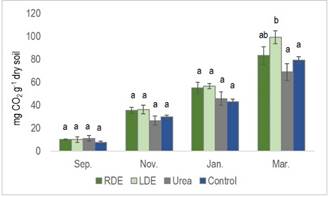
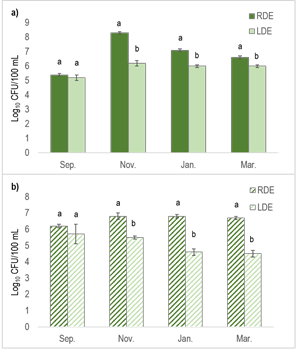
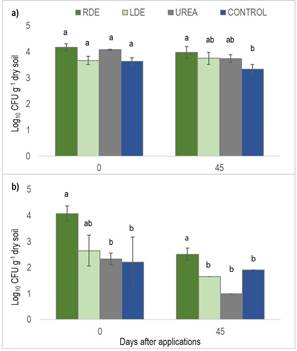
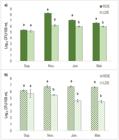
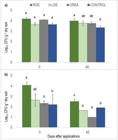
The intensification of dairy production in Uruguay generates increasing volumes of organic waste that are difficult to handle and may entail health risks. Irrigation with farm dairy effluents (DE) is a recommended agricultural practice to improve soil fertility. The objective of this work was to evaluate the effect of the application of raw (RDE) and two-lagoon stabilized effluents (LDE), urea fertilization, or non-amendment toFestuca arundinaceaon soil and plant nutrient content, as well as pathogenic bacterial indicators and persistence of antimicrobial resistance genes. In a greenhouse trial, four seasonal applications were made with a total dose equivalent to 200 kg N ha-1. Soil Na content increased after DE applications. There was no increase in the nutrient content of tall fescue caused by DE applications. The persistence ofE. coli was low but still detected in soil receiving RDE. Beta-lactam genesblaTEM andblaOXA were detected in both DE, being highest in LDE. However, they were not detected in the soil. DE applications demonstrated effects comparable to those of control and urea fertilization on tall fescue biomass and nutrient content, and slightly altered the soil's chemical status. LDE reduced pathogenic bacteria load to the soil, underlining the safety of its application.
Keywords:
antibiotic resistance genes; dairy effluent application; plant biomass; pathogenic bacterial indicators; soil fertility
 Thumbnail
 Thumbnail
 Thumbnail