A graduated methodology for mitigating GHG emissions and nutrient losses in Integrated Crop-Livestock Production Systems
Abstract:
The agricultural sector must mitigate losses in greenhouse gas (GHG) emissions, nutrients, and inputs within the context of climate change and ecosystem degradation. Integrated crop-livestock production systems can enhance carbon and nutrient circularity. A holistic methodology is proposed to guide producers in developing strategies that reduce environmental impacts while improving system resilience through circular and ecosystem-based practices.
Developed as part of the Integrity project (EraNet), this methodology presents a graduated approach organized into four stages. These stages correspond to different levels of the production system, starting from production processes (animal and plant) and culminating at the agroecosystem level.
The first stage focuses on maximizing efficiency in both animal and crop management by identifying key leverage points to enhance production and quality. The second stage develops strategies to reduce nutrient losses and emissions, including effluent management and enteric emissions. The third stage promotes the integration of animals and crops within the production system, optimizing spatial arrangements, internal nutrient circularity, and minimizing external inputs. The fourth stage involves developing carbon sequestration strategies to achieve carbon neutrality and promote ecosystem services.
By guiding producers through these stages, the methodology helps identify high-impact actions that can be implemented immediately or that require longer-term structural changes, serving as a valuable tool for initiating transitions toward more resilient agricultural systems.
Keywords:
agroecosystems; integrated crop-livestock production systems; GHG emissions; nutrient losses, transition
Resumen:
El sector agrícola debe reducir las pérdidas de emisiones de gases de efecto invernadero (GEI), nutrientes e insumos debido al cambio climático y la degradación de ecosistemas. Los sistemas de producción integrados de agricultura y ganadería pueden mejorar la circularidad del carbono y los nutrientes. Se propone una metodología holística para ayudar a los productores a desarrollar estrategias que reduzcan el impacto ambiental y aumenten la resiliencia del sistema mediante prácticas circulares y basadas en ecosistemas.
Esta metodología, parte del proyecto Integrity (EraNet), se organiza en cuatro etapas. La primera se centra en maximizar la eficiencia en la gestión de cultivos y animales, buscando mejorar la producción y la calidad. La segunda etapa desarrolla estrategias para reducir pérdidas de nutrientes y emisiones, incluyendo la gestión de efluentes y emisiones entéricas. La tercera promueve la integración entre animales y cultivos, optimizando la circularidad de nutrientes e insumos. Finalmente, la cuarta etapa se enfoca en estrategias de secuestro de carbono para alcanzar la neutralidad de carbono y fomentar soluciones basadas en servicios ecosistémicos.
Al guiar a los productores a través de estas etapas, la metodología identifica acciones de alto impacto que pueden implementarse rápidamente o que requieren cambios estructurales a largo plazo, proporcionando una herramienta valiosa para iniciar la transición hacia sistemas agrícolas más resilientes.
Palabras clave:
agroecossistemas; sistemas integrados agrícola-ganadera; emisiones de GEI; pérdidas de nutrientes; transición
Resumo:
O setor agrícola precisa mitigar as perdas de emissões de gases de efeito estufa (GEE), nutrientes e insumos devido à mudança climática e à degradação dos ecossistemas. Sistemas de produção integrados de culturas e pecuária podem aumentar a circularidade do carbono e dos nutrientes. Uma metodologia holística foi proposta para orientar produtores na redução dos impactos ambientais e melhorar a resiliência do sistema por meio de práticas circulares e baseadas em ecossistemas.
Desenvolvida no projeto Integrity (EraNet), a metodologia é organizada em quatro etapas que abrangem diferentes níveis do sistema de produção, desde os processos produtivos até o agroecossistema. O primeiro estágio foca na maximização da eficiência na gestão de animais e culturas, buscando melhorar a produção e a qualidade. O segundo estágio desenvolve estratégias para reduzir perdas de nutrientes e emissões, incluindo a gestão de efluentes e emissões entéricas. O terceiro estágio promove a integração entre animais e culturas, otimizando arranjos espaciais e a circularidade de nutrientes. Por fim, o quarto estágio envolve o desenvolvimento de estratégias de sequestro de carbono para alcançar a neutralidade de carbono e promover soluções baseadas em serviços ecossistêmicos.
Ao acompanhar os produtores em cada etapa, a metodologia ajuda a identificar ações de alto impacto que podem ser rapidamente implementadas ou que exigem mudanças estruturais a longo prazo, facilitando a transição para sistemas agrícolas mais resilientes.
Palavras-chave:
agroecossistemas; sistemas integrados de produção agropecuária; emissões de gases com efeito de estufa; perdas de nutrientes; transição
1. Introduction
The agricultural production sector is confronted with important interlinked challenges. Limiting global warming to 1.5 °C requires large and rapid reductions in greenhouse gas (GHG) emissions, increasing carbon sequestration and reaching carbon neutrality by 20501. Agricultural activities are also associated with local environmental impacts such as biodiversity degradation and ecosystem pollution, at a level beyond safe planet boundaries2. At the same time, the agricultural production system must adapt its activity to climate variability and resource availability3. Furthermore, agriculture must reduce its dependence on non-renewable resources and fossil energy, by developing circular strategies at farm and regional scale that promote nutrient reuse, carbon storage, and boosting ecosystem services4. In the case of Uruguay, these challenges are crucial, given the major economic and social roles played by the beef and dairy production and considering that these sectors are responsible for 53% of the country's emissions5.
Globally, livestock represents an important source of GHG emissions6 and nutrient loss7)(8) . One possible way of reducing emissions could be developing integrated crop-livestock production system which can promote on-farm nutrient circularity and soil carbon storage through the valorization of by-products internally or regionally4)(9)10. There are calls for transition of the sector, increasing production to respond to the population growth and, at the same time, reducing its environmental impacts. International institutions (e.g., UN’s Sustainable Development Goals, specifically Goal 13) and national governments (i.e., Paris Agreement and the Nationally Determined Contribution) are engaged to reduce the carbon footprint of the sectors. Markets are also changing, with international agrobusiness groups making commitments to reduce their carbon footprints and other environmental impacts (e.g., Nestlé, Unilever), responding to consumers new demands and generating new requirement for the agricultural production systems. Yet, it is hard for the producer to initiate its transition for many reasons: lack of financial incentives, perceived limited agency, cultural changes, regime resistance, unclear vision and ambition, etc.11)(12) . We believe that the lack of clear vision in the transition process and tools for projecting feasible scenarios is an important barrier.
The objective of the present work is to develop a methodology to guide producers in developing medium-term strategies to reduce GHG emissions and nutrient losses in a context of climate change. This work was carried out as part of the project Integrity (https://integrity-agrisystems.com). A generic methodology is proposed, illustrated using a dairy farm system as the starting point of the transition, but which could be applied to any agricultural production system. Section 2 describes the process of elaboration of the methodology and its theoretical construction. Section 3 presents guidelines to elaborate a transition plan to a more sustainable production system for producers and advisors. Finally, the limits of the methodology, the trade-off between strategies, and the implications in other levels of the sector are discussed in section 4.
2. Materials and Methods
2.1 Integrity Project
Integrity aims to conceive and evaluate alternative management of mixed crop-ruminant livestock systems to increase Carbon and Nutrient Circularity in different agro-climatic regions. Nine countries from three continents (America, Europe, and Oceania) are involved in this proposal. Organized in five Work Packages, WP3 analyzes carbon and nutrients flows in the mixed crop-ruminant livestock systems in a framework integrating methods such as Life Cycle Assessment (LCA) and the Material Circularity Indicator (MCI) for measuring the circularity of a system. More specifically, WP3.4 aims to develop and evaluate strategies and scenarios for increased circularity, climate change mitigation, and adaptation in integrated mixed crop-livestock production systems. In this context, the team in Uruguay, in collaboration with New Zealand, developed the present methodology to project different scenarios, and tested it in different case studies.
2.2 Stakeholders participation
To reach this objective, participation of the stakeholders is essential to increase the relevance and adoptability of the tool. For that purpose, two workshops were organized with different stakeholders of the dairy sector (producers, advisors, scientists, government, and consumers). For the first session, after presenting the different concepts mobilized in our research (integration, circularity, life cycle assessment, climate change, sustainability), the level of knowledge and interest was evaluated and discussed through a short on-site survey. In the second session, possible scenarios and alternatives for our case study (forthcoming paper) were introduced and discussed. This enabled us to organize practices and strategies and to place the producer’s interest and logic at the center of the approach.
2.3 Distinguishing trade-offs between product-based CO2eq, absolute emissions, and nutrient losses
GHG emissions can be expressed per unit of product (product-based emission), also called emission intensity6, or in absolute terms. The latter indicates the total amount of greenhouse gases (GHGs) emitted into the atmosphere over a specific period for a system. To make it comparable with other systems, absolute emissions could be reported per unit of land. Some practices may decrease product-based emissions, while increasing absolute emissions if total production also increases. Indeed, this is known as the rebound effect, where the increase productivity and efficiency brought about by an innovation encourages more than proportional increases in total production. Therefore, both types of indicators are complementary and needed when assessing GHG emission mitigation options.
The reduction of GHGs and nutrient loss are addressed in parallel, as practices of mitigation employed generally impact on both. For example, more intensive systems may have lower GHG product-based emissions than extensive ones, but may be subject to higher risks of nutrient losses.
2.4 From the production processes to the agroecosystem
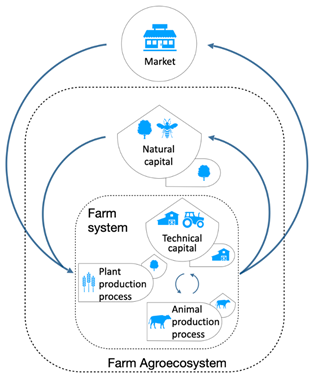
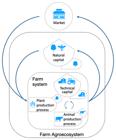
In the case of integrated crop-livestock systems, a systemic approach is particularly relevant (Figure 1). We considered the agricultural production system through four sub-systems: i) animal production process, ii) plant production process, iii) technical capital, and iv) natural capital. The main function of the two first sub-systems is to provide products, while the other two provide services13. Some strategies are directly related to specific production processes (e.g., improving efficiency, reducing direct emission), and others act at larger system scales, and in our case, at the agroecosystem scale (e.g., system integration, ecosystem services).
3. Results
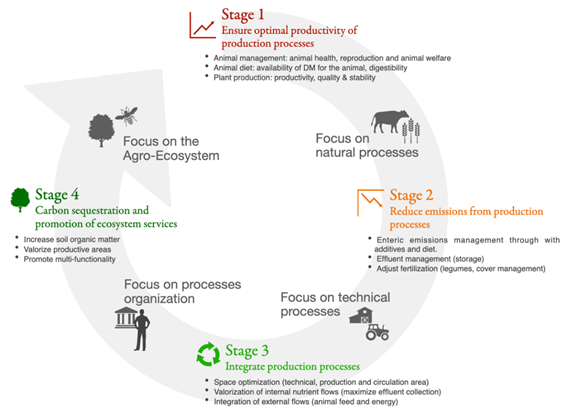
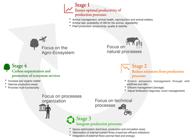
The proposed methodology is organized in four modular stages (Figure 2), with the objective of supporting producers in selecting practices and system arrangements that can reduce GHG emissions and nutrient losses, appropriate for their current system and aligned with the producer’s objectives. It is applicable to different production systems, and in combinations of natural, technical, and economic resources. Some practices can be implemented with low modification of the system, while others may require structural changes in the medium and long term. Different types of practices, changes, and interventions are grouped into bundles. These are presented below.
3.1 Stage 1: Optimize production processes
Before considering a GHG emission reduction, it is important to ensure that the system is adequately managed and achieves production levels in line with good practices. At this stage, focusing on the production processes, the farmer should have already identified strengths and weaknesses in the system. The level of productivity is the first factor influencing emission intensity; depending on the productivity level of the system, the margin of maneuver can be higher or lower.
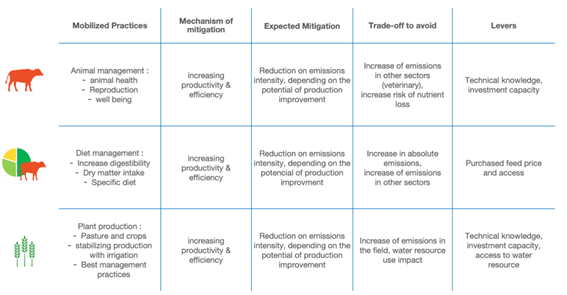
Regarding animal management, health and welfare aspects have a direct influence on the level of productivity. In the context of climate change, heat stress is an increasing issue requiring shade in grazing systems and good ventilation in indoor ones. Greater concentration of animals increases the risk of disease transmission, which implies more frequent attention and sanitary control. Animal diet, with specific attention to the animal requirements, improves animal health, reproduction performance, and may extend the longevity of dairy cows, reducing replacement rates and decreasing absolute emissions at the herd scale. Increasing feed digestibility improves milk production, but could increase absolute emissions if total dry matter intake also increases. This first step also presents the main risks of trade-off if overall production is boosted (Table 1).
Concerning plant production, stage 1 looks at optimizing Net Primary Production (NPP). This requires ensuring adequate nutrient availability and soil conditions. Feed quality and stability are other key elements. The choice of species will be determined by pedoclimatic conditions and the availability of irrigation water. Guaranteeing a high-quality forage supply will be crucial for livestock systems in a context of climate change. A risk associated with optimizing plant production is the increase of nutrient losses by leaching or nitrous oxide (N2O) field emissions, loss of soil, and depletion of water resources. Best management practices (BMP) are required to avoid those trade-offs by mobilizing precision agriculture and soil conservation practices.
3.2 Stage 2: Mitigate direct loss and emissions of production processes
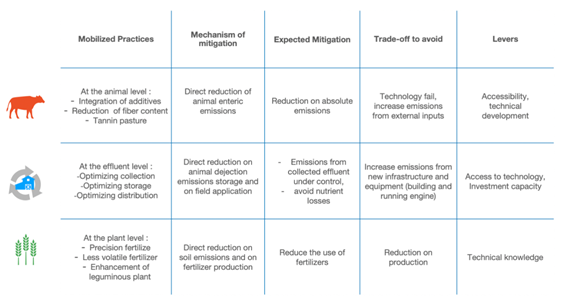
The second stage focuses on reducing nutrient losses and direct emissions from production processes. To this end, it is important to analyze and identify the practices and processes where the main emissions are generated. At the animal level, enteric emission is the largest source of GHG emissions (i.e., methane)15. This can be reduced by modifying diets16 by decreasing the forage to concentrate ratio. This practice is more oriented to confined systems, contradicting the potential of introducing grasslands in rotation with crops. However, considering the periods when the animal is in confinement (in case of beef finishing or during wet weather), minimizing fiber intake reduces emissions. Also, the use of by-products can limit consumption of animal feed that competes with human food. Another practice for reducing enteric emissions is rumen manipulation with additives. Some additives have the potential of reducing enteric emissions by up to 25%17)(18) , but require regular feed intake, a situation unsuited to pasture-based systems (Table 2). With a lower potential, tannin-containing pastures are another option for reducing enteric emissions, but they may also reduce fiber digestibility.
The other source of emissions at the technical process level (Figure 2) concerns manure management, and more specifically the collected manure19 (as it can be managed by human action). Depending on the collection and storage management, reductions can be obtained. In general, liquid manure management systems lead to anaerobic conditions and increased methane production. Switching to practices that manage manure in drier and aerobic conditions reduces methane emissions. Lower temperature also reduces microbial activity. When spreading manure and slurry in the field, proper incorporation into the soil limits GHG emissions. But the main concern about manure management would be the loss of nutrients through leaching and the resulting water eutrophication. To limit this environmental local impact, keeping animal confinement areas away from watercourses and eventually covering these areas would limit nutrient leaching and runoff during rainfall events, which is highly recommended.
At plant production level, significant emissions come from the denitrification of nitrogen fertilizers. These emissions can be reduced by applying the right dose according to soil conditions and at the right time (i.e., at the height of the growth cycle, avoiding hot weather, and mobilizing precision farming tools). In addition, the use of other slow-release fertilizer formulas reduces atmospheric losses. At the same time, introducing plants with the ability to fix atmospheric nitrogen (i.e., legumes) into the crop rotation helps reducing fertilizer inputs.
3.3 Stage 3: Integrate production processes
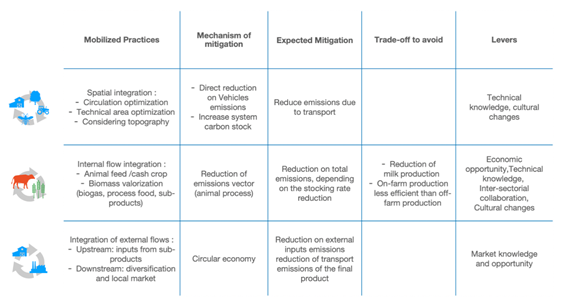
The third stage seeks to reduce emissions and nutrient losses through integration strategies, looking for synergies between the different sub-systems of the agroecosystem20. There are different dimensions behind the concept of integration. Here, we refer to: i) the spatial integration (between the processes but also at the plot scale), ii) the nutrient integration and the valorization of the internal flows, iii) the functional integration and the multi-functionality of components, and iv) the economic integration and the diversification of the farm output and the development of circular economy strategies.
Spatial integration of the production system concerns infrastructure as well as crop and livestock production. In dairy farming, feed distribution can be a major factor in diesel consumption. By centralizing feed storage and feeding areas, tractor traffic can be reduced and eventually distribution can be automated. Optimizing technical areas also frees up land for agricultural production and contributes to overall system efficiency. A good understanding of the topography of the farming system also helps to define the different land uses. For example, avoiding confinement zones or troughs in lowland areas can limit direct nutrient losses to watercourses due to animal dejection. Similarly, protected areas and buffer zones can be favored in these same lowland zones to conserve soil and reduce nutrient losses.
The integration of nutrient flows and the development of circularity strategies imply taking into account not only flow dynamics but also their valorization within the system. A better collection of animal manure reduces the need to purchase external fertilizers. Another element that increases nutrient surpluses in the system is the purchase of feed. The integration of crops for animal feed would not only minimize these surpluses, but also reduce feed costs. This is closely linked to the production system's ability to valorize the various by-products internally within its different components. For example, biodigesters enable better control of emissions from animal dejection and the production of energy and fertilizer. The valorization of by-products can also be seen at other scales, such as the sectoral level (Table 3).
Another important aspect of the integration strategy is to increase the functionality of a production process, thus enhancing synergies between the components of the farm. This multifunctionality is at the center of circularity concepts, with well-known examples all over the world, such as the milpa system in Mesoamerica21 or rice production and aquaculture22. Livestock can be seen as suppliers of products (e.g., milk, meat, leather) but also of services (pasture maintenance, traction, and fertilization). Similarly, a crop can have several functions. For example, we could imagine the production of biomass for animal bedding in lowland areas, with another function being the capture of nutrients, which would then be recycled with the manure as compost for soil fertility.
All these elements contribute to increasing system resilience, as do economic integration and diversification. Indeed, in a context of climate change and high variability, not depending on the sale of a single product means less exposure to price variations.
3.4 Stage 4: Promote carbon fixation and ecosystem-based solutions
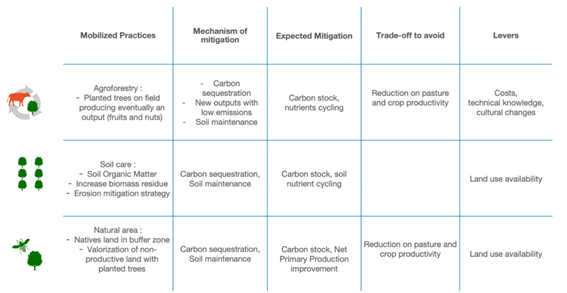
The fourth stage involves developing carbon sequestration strategies to eventually reach carbon neutrality and promote ecosystem-based solutions (Table 4). In the case of animal production systems, carbon neutrality implies ongoing and permanent carbon fixation, since animals in the system constantly emit gases. Carbon fixation through tree planting is limited to the period of growth of these trees, and its permanence to be considered as carbon stock will depend on the use given to the wood if harvested (e.g., as building material, energy, paper production, etc.). The soil is the main provider of ecosystem services in agriculture and a potential place of carbon storage depending on the initial soil organic matter (SOM)23)(24) and the plant cover management. Avoiding ploughing and managing plant cover transitions can be key elements in this process. However, the capacity of soils for carbon storage is also limited. Promoting agroforestry and planting productive trees within plots could allow dual use of the land, help limit soil erosion, and provide shade and shelter to livestock. Also, boosting biomass in non-productive areas and buffer zones with perennial plants would increase the Net Primary Production (NPP) of the system and potentially enhance the biomass reinvested into the agroecosystem to maintain its functionality.
Targeting ecosystem-based practices, limiting the use of pesticides only to exceptional events, and eliminating herbicides implies integrating service plants that will occupy land, reducing the crop and pasture area dedicated to animals. Service plants are grown with the aim to provide ecosystem services to the farm agroecosystem with no aim of providing market products25. For example, to control weeds, a plant can be grown and then crushed to generate mulch during the intercropping period. To do this, new tools will be needed (e.g., roller), and the soil may have to be worked as superficially as possible. This also could imply the introduction of new cash crops to increase temporal diversification in the crop rotation to reduce pest incidence26)(27) . Indeed, to increase pest resistance, a temporal diversification (i.e., crop rotation) and a spatial diversification (i.e., multi-species and multi-variety at plot and system scale) are required28.
4. Discussion
The present methodology proposes a staged approach to GHG emissions mitigation and nutrient losses, aligning with the practical realities faced by producers. Understanding the economic and cultural motivations behind farmer decision-making is a crucial first step in projecting practice changes. To enable producers to initiate their transition to more ecosystem-based and circular production systems, it is important to proceed in cumulative steps. For that, the methodology presents a graduated approach organized into four steps. These steps are related to the different levels of the production system, starting at the level of production processes (animal and plant) and ending at the agroecosystem level. It is gradual in terms of producer priority and in terms of complexity. For example, ensuring good performance and efficient production processes before developing carbon capture strategies. Indeed, the sustainability of a farm depends to a large extent on its economic viability, enabling farmers to project their activity in the medium and long term. In addition, the application of best practices allows reducing emissions and nutrient losses. In effect, the main factor influencing the intensity of emissions per unit of product is productivity. In this sense, access to information, decision-making tools, and support from consultants and government are important levers to facilitate the adoption of best practices. However, the emphasis on performance may tend to maintain production systems in the same “conventional” production model, based on high input mobilization, specialized production, and technologies that are in part at the origin of the problems of biodiversity losses and environmental pollution.
Different options would be presented to farmers depending on their initial situation. Highly productive systems will have a low margin in stage 1 and will have to focus on the other strategies. Intensive animal production systems are often specialized, mobilizing high levels of external input (e.g., animal feed, fertilization, medication) and would be more dependent on technological solutions to reduce their emissions. Main practices on stage 1 mitigate product-based emissions, but with a main risk of increasing absolute emissions (i.e., better digestibility increases feed intake, increasing enteric emissions and dejection). However, good management of animal replacement and increasing the longevity of milk cows can reduce animal stocking rate and thus absolute emissions. Also, a high concentration of animals increases the risk of nutrient losses29, and this is where the development of stage 2 comes into play.
In ruminant systems, global warming comes mainly from enteric emissions and urine depositions, which are and will remain part of the natural process. There are limited alternatives to reduce these sources. In the case of grazing systems, it is not possible to fully capture and manage manure. The period and season when animals are confined are important moments for manure management optimization. Moreover, in a context of climate change with more contrasted seasons, the periods when animals are unable to graze will increase, either due to lack of pasture or excess water, making confined areas an important zone for system efficiency. This is an essential consideration, particularly in terms of economic viability for biodigesters in grazing systems, in addition to other factors limiting their development, such as technological advances and the possibility of a direct use of biogas on-farm (e.g., tractors running on biogas).
Methane-reducing additives are well adapted to indoor systems, as they require being supplied constantly with the feed. But those systems mostly rely on food that can be consumed by humans, such as maize and soy, which they convert with low efficiency into animal products. This is a major global driver of land-use change and deforestation30. Additives must be adapted to the grazing system to be in line with the idea of pasture-crop rotation and not just technology suitable only for intensive animal production systems.
In the context of resource constraints and upward trends in input costs, production systems are called to mobilize more ecosystem-based solutions in their production processes. To achieve this, diversification is a main lever to generate synergy between biomass production and animals (stage 3) and promote ecosystem services. Improving self-sufficiency reduces costs and improves the resilience of the system in the face of external uncertainty. Agroforestry seems to be a promising practice, providing multi-functionality to integrated crop-livestock systems. Perennial plants support soil conservation31, offer animal shelter, and could be a source of forage biomass in dry seasons (e.g., white mulberry) or become a new source of income. Indeed, some recent studies show that diversification could increase profitability32)(33) . However, the increasing complexity may impact system management and labor requirements. New forms of organization between farmers, sharing information, land use, and work force, could be key elements in complex agroecosystem production systems34. In addition, the level of investment and its economic return will be important factors in the decision-making process. This reality is a source of constraint in the implementation of stage 3 and 4, which require longer periods to accrue the benefits. New mechanisms need to be found by governments and financial organizations to facilitate the implementation of these practices.
Moreover, land use optimization is required to promote protected areas in non-productive and buffer zones, ensuring they serve multiple functions (e.g., biodiversity reservoir, reducing nutrient losses, soil conservation, NPP promotion). A major function of these areas could be carbon sequestration (stage 4). Soil is another major carbon stock, where pastures are key elements in maintaining SOM within crop rotations and where ruminants allow valorizing grass into high nutritional human edible products. For this, regulation could help, such as the land use law proposed by the Uruguayan government (ref). However, regulations are unlikely to be enough; new forms of support for farmers would be needed to facilitate the application of a methodology like this, and initiate the transition to more environmentally sustainable production systems.
There is a multitude of indicators to measure production systems performance. For stage 1 and 2, productivity indicators (individual animal productivity, productivity per hectare) and efficiency indicators (nitrogen balance, nitrogen use efficiency) will be used to a greater extent. For stage 3, new types of indicators will be required, such as circularity, system autonomy, or the percentage of biomass reinvested internally. As for stage 4, in addition to carbon emissions, it will be of interest to consider the quantity of carbon fixed by the system. Regarding the consideration of ecosystem-based practices, the quantities of agrochemicals used and the share of service crops mobilized in total biomass production could be relevant, not only for the producer, but also for the implementation of regulations and/or certification systems.
5. Conclusions
This methodology presents a pragmatic approach to find realistic pathways to reduce GHG emissions and nutrient losses. To enable the production system to initiate the transition to more integrated models, less dependent on external inputs, resilient and sustainable, the transition must be staged so that most production typologies can assimilate these changes.
Stage 1 and 2 are strongly linked to the conventional approach of incremental improvements on current systems. Even though they remain necessary steps to guarantee the economic viability of farms, they offer a limited response to environmental sustainability issues. On the contrary, stage 3 and 4 respond more directly to environmental challenges, but require more complex system changes, with longer payback periods and requiring market and institutional conditions to support them. While technical support is necessary for all the proposed stages, more and longer-term incentives are needed for the adoption of integrated, circular, and ecosystem-based practices.
The implementation of all the practices presented does not only depend on the goodwill of farmers, but also on market conditions, conditions of supply, technological access, sectoral regulations, and education and political incentives. In this sense, the sector and government authorities have an important role to play in facilitating these changes. At the same time, societal changes and consumer behavior are also expected to condition transition processes. To what extent and in what forms these societal changes and incentive policies should be implemented are active lines of research35.
One of the difficulties for producers is the ability to organize and perceive clear paths in their transition to more sustainable practices, with gradual increase in circular and ecosystem-based practices. The methodology presented here can be a useful tool for helping producers to project and organize these changes of practices and productive objectives considering current challenges and changes to come.
Acknowledgements:
The authors acknowledge the financial support through the partners of the Joint Call of the Cofund ERA-Nets SusCrop (Grant N° 771134), FACCE ERA-GAS (Grant N° 696356), ICT-AGRI-FOOD (Grant N° 862665), SusAn (Grant N° 696231), and the MPI of New Zealand through AGRESEARCH LIMITED (NZAGRC).
References:
- 1. Allen MR, Dube OP, Solecki W, Aragón-Durand F, Cramer W, Humphreys S, Kainuma M, Kala J, Mahowald N, Mulugetta Y, Perez R, Wairiu M, Zickfeld K. Framing and Context. In: IPCC, editor. Global Warming of 1.5°C. Cambridge: Cambridge University Press; 2019. p. 49-92.
-
2. Rockström J, Edenhofer O, Gaertner J, DeClerck F. Planet-proofing the global food system. Nat Food. 2020;1(1):3-5. Doi: 10.1038/s43016-019-0010-4.
» https://doi.org/10.1038/s43016-019-0010-4 -
3. Grigorieva E, Livenets A, Stelmakh E. Adaptation of agriculture to climate change: a scoping review. Climate. 2023;11(10):202. Doi: 10.3390/cli11100202.
» https://doi.org/10.3390/cli11100202 -
4. van Zanten HHE, Simon W, van Selm B, Wacker J, Maindl TI, Frehner A, Hijbeek R, van Ittersum MK, Herrero M. Circularity in Europe strengthens the sustainability of the global food system. Nat Food . 2023;4(4):320-30. Doi: 10.1038/s43016-023-00734-9.
» https://doi.org/10.1038/s43016-023-00734-9 - 5. Ministerio de Ambiente (UY). Informe del inventario nacional de gases de efecto invernadero Uruguay: serie 1990-2022. Montevideo: MA; 2024. 517p.
- 6. FAO. Greenhouse gas emissions from agrifood systems: global, regional and country trends, 2000-2020. Rome: FAO; 2024. 11p.
-
7. McDowell RW, Rotz CA, Oenema J, Macintosh KA. Limiting grazing periods combined with proper housing can reduce nutrient losses from dairy systems. Nat Food . 2022;3(12):1065-74. Doi: 10.1038/s43016-022-00644-2.
» https://doi.org/10.1038/s43016-022-00644-2 -
8. Glibert PM. From hogs to HABs: impacts of industrial farming in the US on nitrogen and phosphorus and greenhouse gas pollution. Biogeochemistry. 2020;150(2):139-80. Doi: 10.1007/s10533-020-00691-6.
» https://doi.org/10.1007/s10533-020-00691-6 -
9. Van Zanten HHE, Van Ittersum MK, De Boer IJM. The role of farm animals in a circular food system. Glob Food Sec. 2019;21:18-22. Doi: 10.1016/j.gfs.2019.06.003.
» https://doi.org/10.1016/j.gfs.2019.06.003 -
10. Koppelmäki K, Helenius J, Schulte RPO. Nested circularity in food systems: a Nordic case study on connecting biomass, nutrient and energy flows from field scale to continent. Resour Conserv Recycl. 2021;164:105218. Doi: 10.1016/j.resconrec.2020.105218.
» https://doi.org/10.1016/j.resconrec.2020.105218 -
11. Schiller KJF, Klerkx L, Poortvliet PM, Godek W. Exploring barriers to the agroecological transition in Nicaragua: a technological innovation systems approach. Agroecol Sustain Food Syst. 2020;44(1):88-132. Doi: 10.1080/21683565.2019.1602097.
» https://doi.org/10.1080/21683565.2019.1602097 -
12. Vermunt DA, Wojtynia N, Hekkert MP, Van Dijk J, Verburg R, Verweij PA, Wassen M, Runhaar H. Five mechanisms blocking the transition towards ‘nature-inclusive’ agriculture: a systemic analysis of Dutch dairy farming. Agric Syst. 2022;195:103280. Doi: 10.1016/j.agsy.2021.103280.
» https://doi.org/10.1016/j.agsy.2021.103280 -
13. Hercher-Pasteur J, Loiseau E, Sinfort C, Hélias A. Identifying the resource use and circularity in farm systems: Focus on the energy analysis of agroecosystems. Resour Conserv Recycl . 2021;169:105502. Doi: 10.1016/j.resconrec.2021.105502.
» https://doi.org/10.1016/j.resconrec.2021.105502 - 14. Odum HT. Environment, power and society. New York: Wiley; 1971. 331p.
-
15. Beauchemin KA, Ungerfeld EM, Abdalla AL, Alvarez C, Arndt C, Becquet P, Benchaar C, Berndt A, Mauricio RM, McAllister TA, Oyhantçabal W, Salami SA, Shalloo L, Sun Y, Tricarico J, Uwizeye A, De Camillis C, Bernoux M, Robinson T, Kebreab E. Current enteric methane mitigation options. J Dairy Sci. 2022;105(12):9297-326. Doi: 10.3168/jds.2022-22091.
» https://doi.org/10.3168/jds.2022-22091 -
16. Bačėninaitė D, Džermeikaitė K, Antanaitis R. Global warming and dairy cattle: how to control and reduce methane emission. Animals (Basel). 2022;12(19):2687. Doi: 10.3390/ani12192687.
» https://doi.org/10.3390/ani12192687 -
17. Arndt C, Hristov AN, Price WJ, McClelland SC, Pelaez AM, Cueva SF, Oh J, Dijkstra J, Bannink A, Bayat AR, Crompton LA, Eugène MA, Enahoro D, Kebreab E, Kreuzer M, McGee M, Martin C, Newbold CJ, Reynolds CK, Schwarm A, Shingfield KJ, Veneman JB, Yáñez-Ruiz DR, Yu Z. Full adoption of the most effective strategies to mitigate methane emissions by ruminants can help meet the 1.5 °C target by 2030 but not 2050. Proc Natl Acad Sci U S A. 2022;119(20):e2111294119. Doi: 10.1073/pnas.2111294119.
» https://doi.org/10.1073/pnas.2111294119 -
18. van Gastelen S, Burgers EEA, Dijkstra J, de Mol R, Muizelaar W, Walker N, Bannink A. Long-term effects of 3-nitrooxypropanol on methane emission and milk production characteristics in Holstein-Friesian dairy cows. J Dairy Sci . 2024;107(8):5556-73. Doi: 10.3168/jds.2023-24198.
» https://doi.org/10.3168/jds.2023-24198 -
19. Miranda ND, Tuomisto HL, McCulloch MD. Meta-analysis of greenhouse gas emissions from anaerobic digestion processes in dairy farms. Environ Sci Technol. 2015;49(8):5211-9. Doi: 10.1021/acs.est.5b00018.
» https://doi.org/10.1021/acs.est.5b00018 - 20. Díaz de Otálora X, Amon B, Balaine L, Dragoni F, Estellés F, Ragaglini G, Kieronczyk M, Jørgensen GHM, del Prado A. Influence of farm diversity on nitrogen and greenhouse gas emission sources from key European dairy cattle systems: a step towards emission mitigation and nutrient circularity. Agric Syst . 2024;216:103902. Doi: 10.1016/j.agsy.2024.103902.
-
21. Rótolo GC, Francis C, Craviotto RM, Ulgiati S. Environmental assessment of maize production alternatives: traditional, intensive and GMO-based cropping patterns. Ecol Indic. 2015;57:48-60. Doi: 10.1016/j.ecolind.2015.03.036.
» https://doi.org/10.1016/j.ecolind.2015.03.036 -
22. Yuan J, Liao C, Zhang T, Guo C, Liu J. Advances in ecology research on integrated rice field aquaculture in China. Water. 2022;14:2333. Doi: 10.3390/w14152333.
» https://doi.org/10.3390/w14152333 -
23. Minasny B, Malone BP, McBratney AB, Angers DA, Arrouays D, Chambers A, Chaplot V, Chen Z, Cheng K, Das BS, Field DJ, Gimona A, Hedley CB, Hong SY, Mandal B, Marchant BP, Martin M, McConkey BG, Mulder VL, O'Rourke S, Winowiecki L. Soil carbon 4 per mille. Geoderma. 2017;292:59-86. Doi: 10.1016/j.geoderma.2017.01.002.
» https://doi.org/10.1016/j.geoderma.2017.01.002 -
24. Vidal Legaz B, Maia De Souza D, Teixeira RFM, Antón A, Putman B, Sala S. Soil quality, properties, and functions in life cycle assessment: an evaluation of models. J Clean Prod. 2017;140:502-15. Doi: 10.1016/j.jclepro.2016.05.077.
» https://doi.org/10.1016/j.jclepro.2016.05.077 -
25. Garcia L, Celette F, Gary C, Ripoche A, Valdés-Gómez H, Metay A. Management of service crops for the provision of ecosystem services in vineyards: a review. Agric Ecosyst Environ. 2018;251:158-70. Doi: 10.1016/j.agee.2017.09.030.
» https://doi.org/10.1016/j.agee.2017.09.030 -
26. Zhang J, Van Der Heijden MGA, Zhang F, Bender SF. Soil biodiversity and crop diversification are vital components of healthy soils and agricultural sustainability. Front Agric Sci Eng. 2020;7(3):236-42. Doi: 10.15302/J-FASE-2020336.
» https://doi.org/10.15302/J-FASE-2020336 -
27. Yang X, Xiong J, Du T, Ju X, Gan Y, Li S, Xia L, Shen Y, Pacenka S, Steenhuis TS, Siddique KHM, Kang S, Butterbach-Bahl K. Diversifying crop rotation increases food production, reduces net greenhouse gas emissions and improves soil health. Nat Commun. 2024;15(1):198. Doi: 10.1038/s41467-023-44464-9.
» https://doi.org/10.1038/s41467-023-44464-9 - 28. Tibi A, Martinet V, Vialatte A. Protéger les cultures par la diversité végétale. Versailles: Éditions Quae; 2023. 132p.
-
29. Darré E, Llanos E, Astigarraga L, Cadenazzi M, Picasso V. Do pasture-based mixed dairy systems with higher milk production have lower environmental impacts?: a Uruguayan case study. N Zeal J Agr Res. 2021;64:444-62. Doi: 10.1080/00288233.2020.1750433.
» https://doi.org/10.1080/00288233.2020.1750433 -
30. Hong C, Burney JA, Pongratz J, Nabel JEMS, Mueller ND, Jackson RB, Davis SJ. Global and regional drivers of land-use emissions in 1961-2017. Nature. 2021;589(7843):554-61. Doi: 10.1038/s41586-020-03138-y.
» https://doi.org/10.1038/s41586-020-03138-y -
31. Siddique IA, Grados D, Chen J, Lærke PE, Jørgensen U. Soil organic carbon stock change following perennialization: a meta-analysis. Agron Sustain Dev. 2023;43(5):58. Doi: 10.1007/s13593-023-00912-w.
» https://doi.org/10.1007/s13593-023-00912-w -
32. Nilsson P, Bommarco R, Hansson H, Kuns B, Schaak H. Farm performance and input self-sufficiency increases with functional crop diversity on Swedish farms. Ecol Econ. 2022;198:107465. Doi: 10.1016/j.ecolecon.2022.107465.
» https://doi.org/10.1016/j.ecolecon.2022.107465 -
33. Sánchez AC, Kamau HN, Grazioli F, Jones SK. Financial profitability of diversified farming systems: a global meta-analysis. Ecol Econ. 2022;201:107595. Doi: 10.1016/j.ecolecon.2022.107595.
» https://doi.org/10.1016/j.ecolecon.2022.107595 -
34. Martin G, Moraine M, Ryschawy J, Magne MA, Asai M, Sarthou JP, Duru M, Therond O. Crop-livestock integration beyond the farm level: a review. Agron Sustain Dev. 2016;36:53. Doi: 10.1007/s13593-016-0390-x.
» https://doi.org/10.1007/s13593-016-0390-x -
35. El Bilali H. Research on agro-food sustainability transitions: a systematic review of research themes and an analysis of research gaps. J Clean Prod . 2019;221:353-64. Doi: 10.1016/j.jclepro.2019.02.232.
» https://doi.org/10.1016/j.jclepro.2019.02.232