Effect of a multispecies fungal additive on rumen fermentation profile, degradability and kinetic gas production
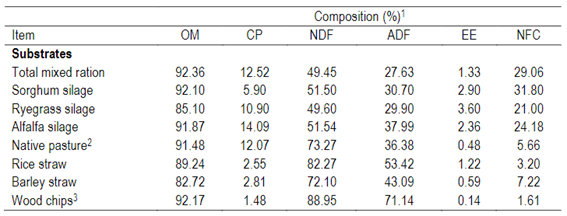
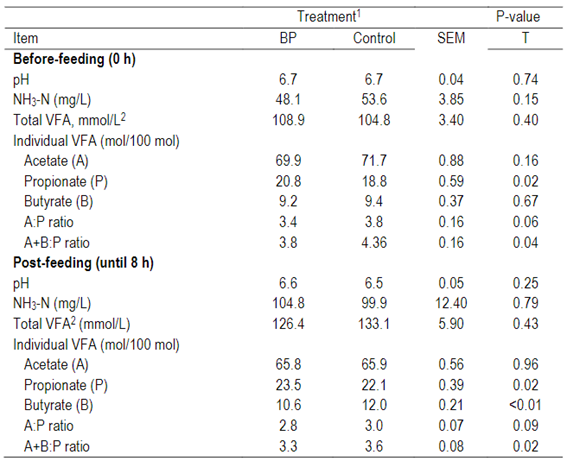
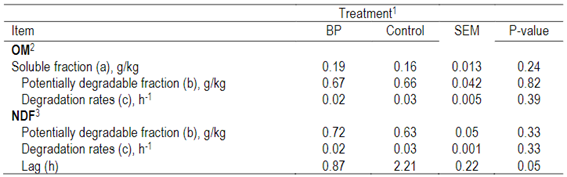
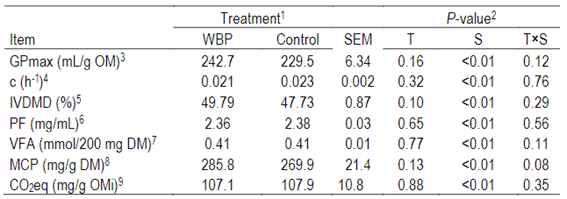
Two experiments evaluated the effect of a multispecies fungal complex (BP, BIOPREMIX MX®, Ruminal Fermentation Tech, Uruguay). In Experiment 1 (E1), the impact of adding BP to a total mixed ration (TMR) on ruminal fermentation profile and TMR in situ degradation kinetics was assessed. In Experiment 2 (E2), the effect of adding BP to various substrates on in vitro fermentability was examined. In E1, 4 Holstein cows with rumen cannulas were randomly assigned to Control (TMR with forage:concentrate ratio 75:25) or Control + 120 g/cow/d of BP (BP) and received ad libitum TMR for 30 days. Samples of TMR were ruminally incubated to estimate in situ degradation kinetic. Ruminal pH, ammonia, and volatile fatty acids (VFA) concentrations were measured just before feeding, 4 h and 8 h post feeding. In E2, a factorial arrangement included two BP levels (0 -Control or 6.5 g BP per kg dry matter incubated-WBP) and 8 substrates. In vitro gas production kinetics (GPk), dry matter digestibility (IVDMD), methanogenic potential (CH4), partitioning factor (PF), VFA, and microbial crude protein (MCP) were estimated. The BP increased proportion of propionate (P ≤ 0.05) and reduced ketogenic:glucogenic ratio and Lag phase of NDF (P ≤ 0.05). WBP tended to increase IVDMD, and substrate affected GPk, IVDMD, CH4, PF, VFA and MCP (P ≤ 0.01). Overall, BP improved ruminal metabolism favoring a more glucogenic profile, a shortening Lag phase in NDF degradation, and increasing IVDMD.
Keywords:
multifungal additive; in situ kinetic; in vitro fermentability