Sustainability assessment of family livestock systems in the Pampa biome of Brazil: A Nexus approach
Abstract:
In a context of climate change, the study of sustainability based on integrated approaches, such as the WEF Nexus (water-energy-food), has become important in assessing the efficiency of production systems. This article evaluates the sustainability of family livestock systems in Brazil's Pampa biome from the perspective of the WEF Nexus. The re-search was based on primary data collected through interviews with 83 family livestock farmers located in the Ibirapuitã River basin. The MESMIS methodology was used to construct 37 indicators, which were measured and compared between and within the WEF Nexus dimensions using Analysis of Variance (ANOVA) and Tukey's test for multiple comparisons. In an analysis between the dimensions, a significant difference was found between the averages of the sustainability indicators in the basin systems (p<0.01). The water dimension showed the highest level of sustainability, classified as “ideal”. Within the WEF Nexus, in the food dimension, a lower level of sustainability was found in the “marketing and consumption” indicators (p<0.05), classified as alert. In the energy dimension, the high level of sustainability in the use of mechanical energy in the systems stands out, in contrast to the alert situation in the use of thermal energy (p<0.05). Finally, in the water dimension, all the sustainability indicators are in an ideal situation. The study consolidated a methodology for assessing sustainability indicators based on the NEXUS approach, as well as identifying the main action points for improving the systems.
Keywords:
climate change; livestock farming; rural economics; sustainability indicators
Resumen:
En un contexto de cambio climático, el estudio de la sostenibilidad basado en enfoques integrados, como el WEF Nexus, ha cobrado importancia para evaluar la eficiencia de los sistemas de producción. Este artículo evalúa la sostenibilidad de los sistemas ganaderos familiares en el bioma pampeano de Brasil desde la perspectiva del WEF Nexus. La investigación se basó en datos primarios recogidos mediante entrevistas con 83 ganaderos familiares ubicados en la cuenca del río Ibirapuitã. Se utilizó la metodología MESMIS para construir 37 indicadores, que fueron medidos y comparados entre y dentro de las dimensiones del WEF Nexus utilizando el Análisis de Varianza (ANOVA) y la prueba de Tukey para comparaciones múltiples. En un análisis entre las dimensiones, se encontró una diferencia significativa entre los promedios de los indicadores de sostenibilidad en los sistemas de cuenca (p<0,01). La dimensión del agua mostró el nivel más alto de sostenibilidad, clasificado como «ideal». Dentro del WEF Nexus, en la dimensión alimentaria, se encontró un menor nivel de sostenibilidad en los indicadores de «comercialización y consumo» (p<0,05), clasificados como alerta. En la dimensión energía, destaca el alto nivel de sostenibilidad en el uso de energía mecánica en los sistemas, frente a la situación de alerta en el uso de energía térmica (p<0,05). Por último, en la dimensión agua, todos los indicadores de sostenibilidad se encuentran en situación ideal. El estudio consolidó una metodología de evaluación de los indicadores de sostenibilidad, además de identificar los principales puntos de acción para la mejora de los sistemas.
Palabras clave:
cambio climático; ganadería; economía rural; sustentabilidad
Resumo:
Num contexto de alterações climáticas, o estudo da sustentabilidade a partir de abordagens integradas, como o WEF Nexus (água-energia-alimentos), tornaram-se importantes na avaliação da eficiência dos sistemas produtivos. Esse artigo avalia a sustentabilidade de sistemas de pecuária familiar no bioma Pampa do Brasil, sob a perspectiva do WEF Nexus. A pesquisa baseou-se em dados primários, coletados mediante entrevistas realizadas com 83 pecuaristas familiares, situados na bacia do Rio Ibirapuitã. A metodologia MESMIS foi usada para construir 37 indicadores, que foram mensurados e comparados entre e dentro das dimensões do Nexo WEF, por meio de Análise de Variância (ANOVA) e teste de Tukey para comparações múltiplas. Em uma análise entre as dimensões, foi encontrada diferença significativa entre as médias dos indicadores de sustentabilidade nos sistemas da bacia (p<0,01). A dimensão água apresentou o maior nível de sustentabilidade, classificado como “ideal”. Dentro do Nexo WEF, na dimensão alimentação, foi encontrado um menor nível de sustentabilidade nos indicadores de “comercialização e consumo” (p<0,05), classificado como alerta. Na dimensão energia, destaca-se o elevado nível de sustentabilidade na utilização de energia mecânica nos sistemas, em contraste com a situação de alerta na utilização de energia térmica (p<0,05). Por fim, na dimensão água, todos os indicadores de sustentabilidade estão em situação ideal. O estudo consolidou uma metodologia de avaliação de indicadores de sustentabilidade baseada na abordagem NEXUS, bem como identificou os principais pontos de ação para a melhoria dos sistemas.
Palavras-chave:
mudanças climáticas; pecuária; economia rural; sustentabilidade
1. Introduction
The Pampa biome, in the southern part of the state of Rio Grande do Sul, Brazil, has beef cattle farming as an activity that has contributed to the region's economic, cultural and social formation. How the land was occupied, based on large estates, the pastoral environment conducive to cattle breeding and the previous existence of cattle (introduced by the Jesuits in the 17th century) have meant that the region has historically been economically based on this activity.
The grassland landscape of the Pampa biome1 led to the development of livestock farming. According to Reverbel1, a few regions in Brazil were “more suitable for raising cattle on a large scale.” In other words, the environment was highly favourable to cattle raising. With this trajectory, the biome has always been seen as the region of large estates, where the “estancieiros” and the “latifundio” were established, with no importance or significance given to small property exploitation or family farming. More recently, in the early 2000s, some studies (initially carried out by EMATER/RS technicians) began to identify in Rio Grande do Sul (and significantly in the Pampa) a large group of producers with small areas who are family farmers and whose main activity is beef cattle farming2.
According to Waquil and others3, there were around 60,000 family livestock farmers in Rio Grande do Sul, representing 70% of all rural enterprises dedicated to beef cattle farming. Data from Brazil's latest Agricultural Census4 allow us to update our perspective on the representativeness and importance of family livestock farming. Rio Grande do Sul has 365,094 agricultural establishments, of which 80.5% (293,892) are family farms and 19.5% (71,202) are non-family farms. Of these agricultural establishments, approximately one third (130,391) carry out livestock and other animal husbandry activities, of which 76.6% (99,846) are family farms and 23.4% (30,545) are non-family farms.
These family farmers, who raise cattle, have come to be identified as family ranchers. The characteristics of family farmers in the Pampa biome are beef cattle farming as their primary activity, with or without sheep and/or goat farming and small crops, and family labour (with the possibility of hiring occasional labour) in areas of up to 300 hectares. In addition to these characteristics, family farmers have a way of life that defines production systems that maintain a co-production relationship with nature and self-management based on their own resources5.
In the same research5, some differences between family livestock farmers and family farming are reinforced, such as using natural pastures, using low external inputs, and having cattle as a reserve commodity. This behaviour means that marketing strategies are based on the family's needs and not on the search for better prices. The cattle are managed with high stocking rates, causing low animal productivity.
Other authors6 state that family livestock farmers, through their way of life, guarantee a continuous flow of goods, matter and energy, appropriating nature in an affable and contemplative way and conserving landscapes and natural resources. They also state4 that this is a low-impact environmental production, generating ecosystem services that are important enough for “family livestock farming to be considered a strategic activity, in the sense of preserving a culture and, above all, a unique ecosystem”. The ways of life and identities of cattle ranchers in Rio Grande do Sul are linked to nature and the landscape.
Family livestock farming has been studied and highlighted as a category of environmental, cultural and economic importance7)(8)9. Other research results10 have indicated that family livestock farmers are an essential social actor in the conservation and sustainable use of Rio Grande do Sul's grasslands, capable of giving the development process in communities and regions a better balance between the environmental, social and economic dimensions. Therefore, it is extremely important to identify and deepen knowledge about the sustainability of this way of life and its production systems. This requires the existence and generation of indicators that reflect this social category and the possibilities for sustainability in the future. The recent effects of climate change require a rethink of assessing production systems' sustainability. This new approach directly involves assessing the elements that sustain human and animal life: the water, energy and food nexus (WEF Nexus)11. The Nexus approach arises from the concern of proposing articulated actions for these elements12. Although some actions and policies value the interrelationships between the WEF Nexus, there are still difficulties in measuring indicators to assess these complex relationships13.
The aim of the study was to assess the sustainability of family livestock systems in the Pampa biome of Brazil by measuring indicators of the water, energy and food nexus (WEF Nexus). The hypothesis is that family livestock systems perform better in terms of water and energy sustainability than in terms of food sustainability. This is due to certain characteristics of family livestock production, such as the preservation of the structural conditions of soils and grasslands, low demand for mechanization and low diversification of production for self-consumption.
Furthermore, the proposed study brings contributions to the field of knowledge, both by providing input for the discussion on sustainable management in similar systems and ecosystems, and by providing methodological input with indicators that allow the WEF Nexus to be evaluated in other realities. These contributions are in line with the demand to promote strategies and methodologies for evaluating the WEF Nexus, announced by the FAO14.
2. Materials and Methods
2.1 The Study Area and Methodological Approach
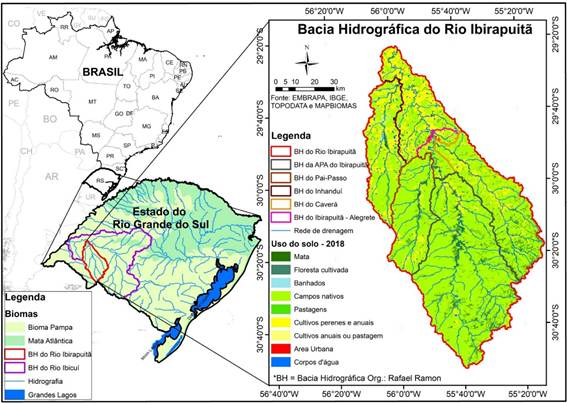
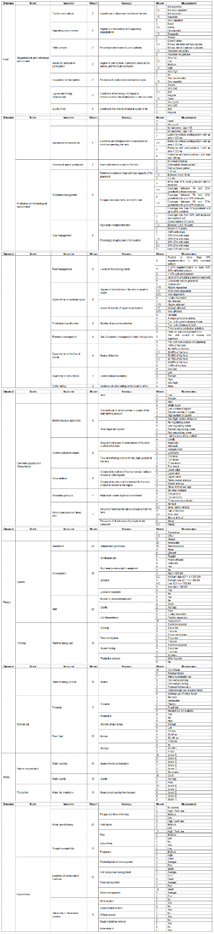
The Pampa biome is characterized by grassland vegetation, also known as southern grasslands. Its pastoral regions extend over part of Argentina (the provinces of Buenos Aires, La Pampa, Santa Fe, Entre Ríos and Corrientes), all of Uruguay, and part (63%) of Rio Grande do Sul, Brazil15. In Brazil, the Pampa biome represents 2.3% of the national territory and covers an area of approximately 19 million hectares16. In order to assess the sustainability of family livestock systems in Brazil's Pampa biome, we chose the Ibirapuitã River basin as our study area (Figure 1). The choice of this basin is justified because it contains a diversity of livestock farms that are similar to the realities of other parts of the biome.
The construction of sustainability indicators for family livestock farming was based on the MESMIS methodology17. This method indicates that sustainability should be measured from each socio-environmental and temporal context based on a systemic, participatory and interdisciplinary approach. To this end, adaptations were made to the MESMIS methodology, transforming the tripod of sustainability (social, economic and environmental) into the fundamentals of the Nexus approach (water, energy and food). The interdisciplinary and participatory approach was guaranteed by a group of 70 extension workers and researchers from different areas of knowledge, including professionals in higher education in agriculture, scientists from research institutions and professors from Brazilian public universities.
The construction of the indicators went through the six stages of the evaluation cycle proposed by MESMIS, namely: i) determining the object of evaluation; ii) determining the critical points; iii) selecting the indicators; iv) measuring and monitoring the indicators; v) integrating the results, and vi) conclusions and recommendations18. In the first stage, the type of production system to be studied was defined. In the second stage, a SWOT (strengths, weaknesses, opportunities and threats) matrix was drawn up for family livestock systems in Pampa. In the third stage, each dimension of the Nexus (water, energy and food) was discussed in working groups. In the end, each group collectively presented proposals for developing indicators within the WEF Nexus. The interdisciplinary approach was guaranteed through of participation group of extensionists and researchers from different areas of knowledge, totaling 70 members. The interdisciplinary approach enriched the process, especially when assigning indicator weights, avoiding overlapping interests in disciplinary processes. Thus, the scopes and indicators for the three dimensions were defined, totalling 37 sustainability indicators for family livestock farming.
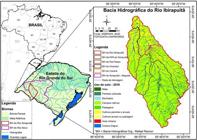
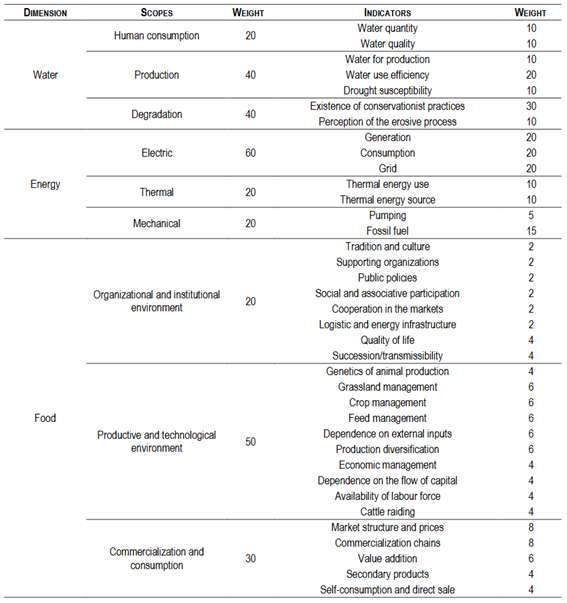
Table 1 shows each Nexus dimension, its scope and indicators. The experts in the working groups assigned different weights to the indicators for the water, energy and food dimensions. The assignment followed the criterion of the relative importance of each indicator in the sustainability of each dimension. These weights were then put to a group of livestock farmers to assess their empirical relevance. A detailed overview of the description, composition, and questionnaire questions that resulted in the measurement of each indicator can be found in the Table S1 (Supplementary material)19.
The indicators were constructed by experts and measured based on the perceptions of family livestock farmers about each variable in the survey. In the end, the composition of the variables and their respective weights in each indicator resulted in an assessment of the sustainability of family livestock systems in the Brazilian Pampa.
Sustainability indicators for the water-energy-food nexus of family livestock farming in the Pampa
2.2 Livestock Family Systems Sampling and Data Analysis
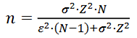
The fourth stage of the methodology involved drawing up a questionnaire to measure all the indicators. Since the study area needed data on sustainability, a pilot study was conducted with 45 previously sampled production units. After the pilot study, the survey's sampling plan was defined according to the sampling method for a finite population (Equation 1).
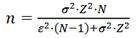
where: n = sample size; σ = standard deviation; Z = confidence level; N = population size; ε = margin of error
All the agricultural systems in the Ibirapuitã River basin (N=2,685) come from data from the Agricultural Census of the Brazilian Institute of Geography and Statistics4. A 95% confidence level was used (Z=1.96). With the data from the pilot study, it was possible to measure the sustainability indices' standard deviation and margin of error. The energy indices showed the greatest variability, so we used these indices to calculate the sample size (σ = 7.94; ε = 1.5).
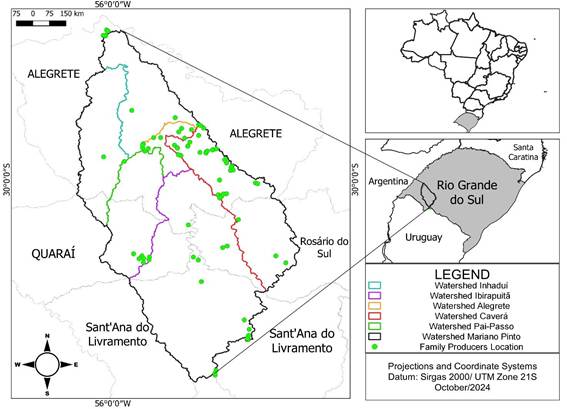
Primary data was collected through interviews. Livestock farmers were selected at random by visiting them on rural roads. Due to the long distances, it was possible to reach a maximum of two family farmers per day. Also, due to the limitations of COVID-19, the total data collection period was 15 months. Initially, the research obtained a sample of 121 agricultural systems, divided into extensive livestock systems integrated with agriculture and family livestock systems. For this investigation, only the group of family livestock farmers was considered, totalling 83 sampling units. Family livestock farmers were considered to be those systems with up to 300 hectares, which produce livestock on natural pasture, with a predominantly family workforce. All the production systems sampled were geo-referenced. Figure 2 shows a spatial view of the stratification of the sample in terms of family livestock farmers in the Ibirapuitã River basin. The interviews took place between October 2020 and December 2021.
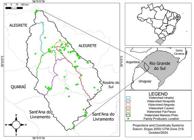
Spatial location of the farming systems sampled in each sub-basin of the Ibirapuitã River in the Brazilian Pampas
The fifth stage was integrating and analyzing the results. The sustainability indices range from 0 to 100. In a specific analysis of sustainability within the dimensions (water, energy, and food), the indices were measured from the weighted composition of each indicator. Ultimately, the closer the value is to 100, the greater the sustainability attributed to the indicator within the family system. In this way, it was possible to create a scale of sustainability levels for the WEF Nexus, as shown in Figure 3.

Levels of sustainability for the water, energy, and food nexus of family livestock farming
In all scientific disciplines, there is growing recognition of the need for more statistically robust approaches to data visualization. Plotting tools are sought that accurately and transparently convey the main aspects of statistical effects20. From this perspective, the raincloud diagram emerges. According to authors20, the raincloud diagram can visualize raw data, probability density, and key summary statistics such as median, mean, and relevant confidence intervals in an appealing and flexible format with minimal redundancy, offering “inference at a glance”. Thus, the WEF Nexus sustainability indicators were presented using raincloud diagrams. For an inferential analysis, the indicators between and within each dimension (water, energy, and food) were analyzed and compared using Analysis of Variance (ANOVA) and Tukey's test for multiple group comparisons. The maximum significance level adopted was 5%. The software used for the statistical analysis was JASP 0.18.3. Finally, the sixth stage discussed the sustainability indicators of family livestock systems with recent findings from international literature.
3. Results
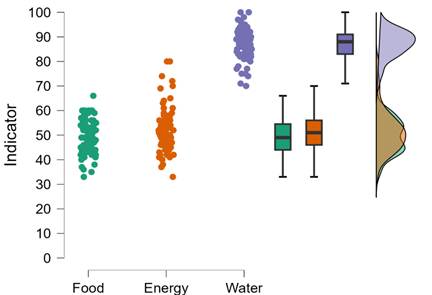
The results are presented to compare the levels of sustainability between and within the water, energy, and food nexus (WEF Nexus) in family livestock systems located in the Brazilian Pampa. Figure 4 shows the dispersion, descriptive measures, and distribution of the WEF Nexus sustainability indicators using the raincloud diagram.
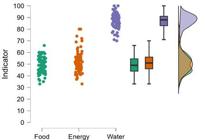
Raincloud diagram of the WEF Nexus sustainability indicators for family livestock systems in the Pampa of Brazil
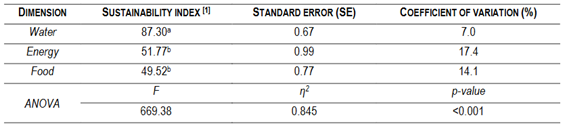
The WEF Nexus sustainability indices of the systems sampled show a distribution close to normal, favouring an inferential perspective of the results. Descriptively, we can see that family livestock systems have a higher level of sustainability in the indicators relating to the water nexus. In a lower position, the sustainability indices for the energy and food nexuses showed similar behaviour, with greater dispersion for the energy indices. Table 2 shows the results of the Analysis of Variance (ANOVA) and the multiple comparison test (Tukey's test) for the WEF Nexus sustainability index of the family livestock farmers sampled.
According to the ANOVA, there was a significant difference in the sustainability indices between water, energy and food (p<0.01), with a high effect size (η2)21. The water dimension showed the highest level of sustainability for family livestock systems (p<0.01), classified as “optimal”. On the other hand, the sustainability levels of the energy and food dimensions showed no difference between them, and were classified as “alert”.
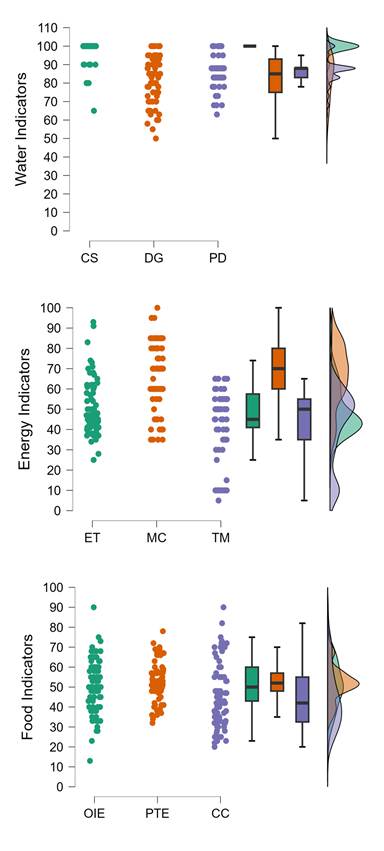
Figure 5 shows the raincloud diagram disaggregating the sustainability indicators within each Nexus (water, energy, and food). In this way, it is possible to visualize the composition of each dimension and the dispersion, descriptive measures, and distribution of the scopes that make up each WEF Nexus. Regarding water in family livestock systems in Pampa, the high sustainability of the water for consumption indicator (CS) and the high dispersion of the Degradation indicator (DG) are noteworthy. In energy, we highlight the high dispersion of family livestock farmers in the three indicators and a less sustainable average value for using thermal energy (TM). For the food dimension, we identified greater homogeneity in the values of the Productive and Technological Environment (PTE) indicators and a lower average value for the Commercialization and Consumption (CC) indicators of the family livestock systems sampled.
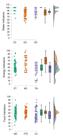
Raincloud diagram of the sustainability index of the WEF Nexus scopes* in family livestock systems in the Pampa of Brazil
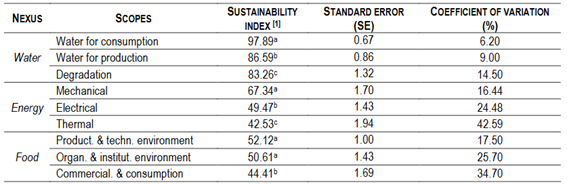
Table 3 shows the results of the Analysis of Variance (ANOVA) for comparing the sustainability scopes within each WEF Nexus of family livestock systems. We found that there is a difference in the sustainability levels of the scopes within the three dimensions of the WEF Nexus (p<0.01), with a moderate effect size (η2) for water and energy, and low for food21.
Analysis of variance (ANOVA) of the sustainability index of the WEF Nexus scopes for the family livestock systems sampled in the Pampa of Brazil
Table 4 shows the sustainability indices for each scope, which comprise the water, energy, and food dimensions of the family livestock farms sampled in the Brazilian Pampa. There was a significant difference between the averages of the indicators for the water scope in family livestock farming (p<0.05). We highlight the highest level of sustainability for the “water for consumption” scope. However, all the indicators in the water dimension were classified as “excellent”. The energy nexus also showed a significant difference between the indicators of its scope (p<0.05), emphasizing greater sustainability in using mechanical energy. In turn, the use of thermal energy in family livestock systems is a problem, with the indicator classified at the lower end of the “alert” level.
In the food nexus, the sustainability indices of the three indicators are in a “warning” situation. This result is particularly noteworthy because family livestock systems in the Ibirapuitã River basin in the Pampa mainly aim to produce food for local markets and self-consumption. Among the indicators, there was no significant difference between the Productive and Technological Environment and the Organizational and Institutional Environment. However, the Commercialization and Consumption indicator showed the lowest sustainability index (p<0.05), determining the limited capacity of family livestock farming to relate to markets and to develop fairer, higher-value commercialization strategies.
Ultimately, the results show an imbalance in the sustainability of the WEF Nexus of family livestock farming in the Ibirapuitã River basin of the Brazilian Pampa. The use of electrical and thermal energy, how food is produced, how support organizations are linked, and how products are marketed are central elements for extension and rural development policies in the region. Progress on these WEF Nexus issues is fundamental for greater sustainability and equity in family livestock farming in southern Brazil.
4. Discussion
How livestock production is exploited determines the sustainability of the food system. Livestock systems compete for scarce resources, such as land and water, and rival each other regarding meat production for the market and self-consumption. Added to this is the imperative to operate within a carbon-constrained economy. The scarcity of water resources has been a fundamental issue for a long time, and agriculture is one of the most significant uses of this resource. Therefore, highlighting why this is not a problem in the context studied allows us to reflect on possibilities, strategies, and actions in other contexts. The results show that the water dimension is highly sustainable in the family livestock systems sampled, meeting the livestock farmers' production and human consumption needs.
Water availability in agricultural systems influences production efficiency by determining the allocation of land patterns and the scale of livestock production22)(23) . Therefore, family livestock farming can be considered beneficial for water management in the biome. In addition, other authors24)(25) point out that introducing grazing in cropping systems can reduce runoff and water yield in future climate scenarios and mitigate hydrological alteration due to climate change.
Taguta and others26, from the perspective of the WEF nexus, used sustainability polygons to visualize the interactions between water use efficiency, productivity, and energy consumption, pointing out that the modernization of irrigation systems presents the best performance for promoting sustainability in agriculture in different climate zones.
The research carried out by Wu and others27 evaluated six agricultural adaptation strategies in response to climate change in the Saskatchewan region, Canada, using a Nexus model. The results showed that while some adaptations compensated for yield losses caused by climate change, they also resulted in varying impacts on water use and energy consumption. In this context, according to the authors, the WEF Nexus approach allowed for a comprehensive assessment of trade-offs between sectors, providing valuable insights for the formulation of sustainable agricultural adaptation policies.
Feng and others28 used a linear optimization model based on the WEF Nexus to allocate water resources and agricultural land in China, aiming to maximize local production and minimize CO₂ emissions. The findings highlight the integration of environmental and social factors in agricultural management, suggesting that the WEF Nexus approach can guide policy decisions to balance economic and environmental development.
Regarding the energy dimension, the mechanical energy scope has the greatest sustainability due to the low intensity of land use in family livestock farming. Low mechanization and natural field management reduce the use of fossil fuels, increasing sustainability in this area Figure 5. Family livestock farmers have little capital for improvements, machinery, and equipment (only 19% of total capital). This is because family production systems are based on pastoralism. Furthermore, in the case of family livestock farmers, most of the capital is represented by livestock (81% of capital).
It is also relevant to consider that agriculture is not only an energy producer but also a consumer, and the efficient use of energy contributes to increased productivity and the profitability and competitiveness of sustainable agriculture29. The sustainability of the electricity scope of family farmers is reduced by the poor conditions of energy distribution in rural areas, especially due to network problems and assistance from the utility company. In this sense, it is essential for the public sector to renegotiate energy concession and transmission contracts to guarantee the quality, power, and reach of the electricity grids, especially in the face of the damage caused by climatic events (storms, flooding, etc.) that have successively impacted the region.
Also noteworthy is the low level of adherence by livestock farmers to generating their own energy, and the presence of photovoltaic systems is still a far cry from this social category. Here, two fronts of action based on the creation of policies that combine credit and extension services are promising. The first is to encourage the sustainable management of existing forest areas and the planting of new forest specimens in order to meet the families' energy demands. The second is to develop effective proposals to encourage the installation of alternative energy systems that are compatible with the reality of cattle farmers. According to Silva and others30, photovoltaic energy systems installed -overhead or on the ground, with the farmer's own resources or with financing via PRONAF (National Program for Strengthening Family Farming)- have shown promise in family production units.
According to the findings31, energy input depends heavily on the cultivation practices adopted, the distance from the production field, the storage infrastructure, and processing facilities and the technology in place. Based on this logic, thermal energy stands out for its lower level of sustainability in the dimension. This is due to the intensive use of firewood for heating and cooking within family livestock systems, which lack many alternative sources. In addition, the origin of this firewood is partly from the region's native forests, hindering the sustainable exploitation of this wood.
Furthermore, it is important to consider the great potential of family livestock farming for generating agro-energy through biogas32, which could help meet the demand for thermal energy on farms. Using agricultural bioenergy helps achieve energy security without causing environmental damage33. However, despite the initiatives' success, they are still few and isolated and do not have equivalent economic and regulatory support that could act as a driver for actions of this nature. Effective promotion and technical support actions by public and private institutions can stimulate important progress in this regard.
The most limiting issue in the food dimension is marketing and consumption. Family farmers still produce little for their own consumption and are largely involved in global, commoditized production chains. There is a lack of incentive for them to work in shorter or higher value-added chains. Few initiatives exist for cooperation and joint marketing. This is a key issue for extension and rural development policies.
Regarding the consumption of family cattle farmers, one must consider “their historical and cultural peculiarities”5, which suggest that their diet is predominantly based on meat and with almost no planting or consumption of vegetables and fruit. This differentiates the family cattle rancher from the family farming traditionally described. Thus, this scope showed low sustainability because there is practically a dependence on a single form of consumption: sheep or beef.
In this respect, our results show that family farms do not produce food for consumption. To complement this statement, the study conducted by Maas and others34 investigated the prevalence of food insecurity in rural households in the municipality of Rio Grande - RS. The findings showed that 26% of households faced food insecurity, which was more prevalent in families with lower levels of schooling, a greater number of residents, no animal husbandry, and who received government assistance (Bolsa Família).
The research by Silva35 analyzed the impact of the expansion of soybean plantations on food sovereignty in 30 municipalities in the Pampa biome. The results show that, between 2010 and 2020, there was an increase of 352.31% in the area planted with soy in the municipalities analyzed, this growth significantly reduced the areas destined for family farming, agroecology, and territories of traditional communities, compromising local food diversity and food sovereignty.
From the perspective of food insecurity in the region studied, Dickel and others36 point out that the situation of food insecurity in the Pampa biome is related to the changes that have taken place in agriculture over the last 40 years, such as the modernization of agriculture and changes in land use parameters. The authors suggest public policies to stimulate the production of diversified foods by family farming and to monitor the condition of food and nutritional sovereignty and security.
The marketing indicators showed the lowest sustainability for family livestock systems. We have listed some of the characteristics that aggravate this:
i) Cattle as a reserve commodity: Producers keep their cattle in the field as a strategy to maintain their market autonomy, regulating sales according to their family's needs, and not in search of better prices.
ii) Low scale of production: Because they have smaller areas, family farmers have fewer animals to sell and, therefore, have to sell to larger neighbours or buyers who impose prices and deadlines on their products.
iii) Distance from markets: Family farmers are dispersed and located in regions far from cities and main roads. Together with the low scale of production, this distance results in a high transaction cost, keeping these family farmers away from better market conditions.
iv) Lack of institutional organization: Limited initiatives by groups or associations of family livestock farmers. These organizations could coordinate marketing and learning spaces, strengthening livestock farmers' access to higher-value markets.
The last few decades have accelerated transformations in the livestock market, mainly due to significant mergers between meatpacking companies and increased contractual relationships. This scenario has led to a duality: on the one hand, opportunities for producers with a larger scale and greater technological input; on the other hand, the exclusion of farmers who do not meet these conditions, especially family farmers37.
Sustainability in family livestock systems is directly related to the ability to balance the water, energy, and food nexus. In many livestock systems, sustainability is not just a technical concept, but a practice that involves adapting to the specific challenges of limited resources, technical knowledge, and unequal access to markets. In this perspective, the results point to complex challenges such as energy performance and food security, a common characteristic of family livestock systems being their low efficiency in energy use with the use of traditional technologies. On the other hand, these systems are potentially effective in guaranteeing food security for the regions. Despite their low energy efficiency, this is because production is generally geared towards local consumption, with a diversity of agricultural practices that favor self-consumption.
The systemic bias within family livestock systems is related to their ability to evolve, i.e. dependence on traditional practices can be seen as a strength, but also as a weakness, which is visible in Nexus foods. The lack of access to markets or differentiated prices for the products sold makes it difficult for families to improve their living conditions.
Livestock systems do not respond in the same way to the WEF Nexus challenges. Some use organic waste to generate biogas (energy), which in turn feeds irrigation systems (water) and sustains forage production (food). Others have more diversified production, raising animals, growing food, and making use of agricultural by-products, which are more resilient and efficient.
This study expands the dialogue on sustainability in livestock systems by providing insights into the emergence of possible integrative solutions to these challenges. One of the aspects we point out is adopting integrated approaches that consider not only economic and food needs, but also environmental and social conditions.
Despite these market limitations, family livestock farming in the Brazilian Pampas is crucial in preserving the biome's biodiversity. As highlighted in the literature38, livestock production on natural pastures, under appropriate management conditions, achieves a positive CO2 absorption balance, acting as a sink for greenhouse gases and contributing to environmental sustainability and conservation. Therefore, public rural extension policies must address the limitations in the use of thermal energy and the challenges of market access faced by family livestock farmers, aiming to strengthen the sustainability of these systems. This, in turn, supports the primary objectives of family livestock farming in the Pampas: maintaining capital, ensuring income, and preserving a rural lifestyle in synergy with the biome39.
5. Conclusions
The research evaluated the sustainability of family livestock systems in the Brazilian Pampas using water, energy, and food nexus indicators. Among the sampled systems, the water nexus demonstrated the highest level of sustainability. Water for consumption and production meets the needs of family livestock farmers without negatively impacting the biome. It is important to note that this result reflects the conditions of the studied watershed and does not necessarily represent the reality of the entire Brazilian Pampas biome. Other regions of the biome face challenge in storing and supplying water for human and animal needs and deserve attention from public initiatives on this issue.
The energy nexus showed an acceptable level of sustainability in the use of mechanical energy due to the low intensity of land use. Pastoral activities reflect a low consumption of fossil fuels. However, thermal energy demonstrated the lowest sustainability level within this dimension, primarily due to the exclusive reliance on firewood for cooking and thermal comfort during winter months. In this regard, it is essential to implement proposals for planting and rational management, in line with the reality of family livestock farming and the Pampa biome. Other potential alternative is to increase the diversity of energy sources, exploring photovoltaic and biogas technologies.
In the food nexus, all indicators are of concern, particularly regarding family livestock farmers' commercialization and consumption patterns. The main products for self-consumption are sheep or cattle meat, with no production of other types of food. This highlights the need to diversify food sources within these systems. Regarding commercialization, there are significant challenges in accessing more profitable markets due to low production scale, market individualism, and the distance from major consumer centres. These issues are crucial considerations for rural extension policies in the state of Rio Grande do Sul, Brazil.
Our study contributes by offering an integrated WEF Nexus methodology to the contemporary challenges of sustainability and climate emergencies. From this perspective, family livestock systems are based on practices of rational use of natural resources, low carbon emissions, preservation of local biodiversity, and traditional knowledge adapted to the ecological conditions of each territory. Above all, they comply with the Sustainable Development Goals (SDGs), such as being a source of income and rural employment (SDG 1), the production of food of animal origin, favoring local and national food security and sovereignty (SDG 2), the adoption of more sustainable and circular practices (SDG 12), and livestock systems with a smaller carbon footprint, implementing climate-adaptive strategies such as the management of native grasslands (SDG 13).
This makes family livestock farming strategic for the territorialized implementation of the 2030 Agenda, towards inclusive and sustainable systems. In terms of climate resilience, our study infers that family livestock farming can possess fundamental characteristics to face extreme climate variations. In other words, family livestock farming therefore faces the challenge of reconfiguring food systems to provide inclusive, healthy, sustainable, and equitable diets to feed future generations.
Based on the results of this study, future research could include conducting comprehensive case studies in various regional contexts to examine, for example, climate resilience and energy performance, ecosystem services, and biodiversity conservation generated by family livestock farming. On methodological issues, expanding the applicability of the sustainability indicators of the WEF Nexus approach to other agricultural contexts and dynamic assessments over time. Therefore, this research reveals the need for future studies that point to integrated and territorial solutions, and recognize the complex web of interactions between natural resources and the livelihoods of family farmers.
In addition to evaluating the systems' sustainability, the research contributes a proposed framework for analyzing the WEF Nexus that can be replicated in other rural contexts, particularly in family livestock systems in the Pampas regions of Uruguay and Argentina. This approach would enable comparisons of sustainability and the challenges faced by family livestock systems across this extensive territory, identifying both commonalities and unique characteristics.
Acknowledgements:
The authors acknowledge the FAPERGS and CNPq for providing financial support for this work. This research was funded by Research Support Foundation of the State of Rio Grande do Sul (Fundação de Amparo à Pesquisa do Estado do Rio Grande do Sul, FAPERGS) (project number 23/2551-0001874-8) and the National Council for Scientific and Technological Development (Conselho Nacional de Desenvolvimento Científico e Tecnológico, CNPq) - Brazil) (project number 408711/2023-0).
References:
- 1. Reverbel C. O gaúcho: aspectos de sua formação no Rio Grande e no Rio da Prata. Porto Alegre: L&PM; 1986. 109p.
- 2. Ribeiro CM. O modo de vida dos pecuaristas familiares no pampa brasileiro. In: Waquil PD, Matte A, Neske MZ, Borba MFS, editors. Pecuária familiar no Rio Grande do Sul: história, diversidade social e dinâmicas de desenvolvimento. Porto Alegre: Editora da UFRGS; 2016. p. 87-108.
- 3. Waquil PD, Matte A, Neske MZ, Borba MFS. Pecuária familiar no Rio Grande do Sul: a ressignificação de uma categoria social. In: Waquil PD, Matte A, Neske MZ, Borba MFS, editors. Pecuária familiar no Rio Grande do Sul: história, diversidade social e dinâmicas de desenvolvimento . Porto Alegre: Editora da UFRGS ; 2016. p. 11-6.
-
4. IBGE. Censo Agropecuário 2017: resultados definitivos (Internet). Rio de Janeiro: IBGE; 2020 (cited 2025 Jul 29). Available from: Available from: https://sidra.ibge.gov.br/pesquisa/censo-agropecuario/censo-agropecuario-2017
» https://sidra.ibge.gov.br/pesquisa/censo-agropecuario/censo-agropecuario-2017 - 5. Ribeiro CM. Estudo dos modos de vida dos pecuaristas familiares da região da Campanha do Rio Grande do Sul (doctoral dissertation). Porto Alegre (BR): Universidade Federal do Rio Grande do Sul, Faculdade de Ciências Econômicas; 2009. 300p.
- 6. Azevedo LF, Fialho MA. Pecuária familiar: uma análise do modo de apropriação da natureza a partir dos saberes e práticas tradicionais: Território do Alto Camaquã, Rio Grande do Sul. In: Waquil PD, Matte A, Neske MZ, Borba MFS, editors. Pecuária familiar no Rio Grande do Sul: história, diversidade social e dinâmicas de desenvolvimento . Porto Alegre: Editora da UFRGS ; 2016. p. 149-68.
- 7. Waquil PD, Matte A, Neske MZ, Borba MFS, editors. Pecuária familiar no Rio Grande do Sul: história, diversidade social e dinâmicas de desenvolvimento . Porto Alegre: Editora da UFRGS ; 2016. 288p.
-
8. Matte A, Spanevello RM, Lago A, Andreatta T. Agricultura e pecuária familiar: (des)continuidade na reprodução social e na gestão dos negócios. Rev Bras Gest Desenvolv Reg (Internet). 2019 (cited 2025 Jul 29);15(1). Available from: Available from: https://www.rbgdr.net/revista/index.php/rbgdr/article/view/4317
» https://www.rbgdr.net/revista/index.php/rbgdr/article/view/4317 -
9. Langbecker TB, Arbage AP, Viana JGA. Rotinas e processos inovativos na pecuária familiar na Campanha Gaúcha. Rev Conex UEPG. 2023;19(1):1-17. Doi: 10.5212/Rev.Conexao.v.19.21934.022.
» https://doi.org/10.5212/Rev.Conexao.v.19.21934.022 -
10. Nicola MP, Marques FC. Transições em direção ao uso sustentável e conservação dos campos sulinos gaúchos: o lugar da pecuária familiar. Ext Rural. 2016;23(1):58-77. Doi: 10.5902/2318179617772.
» https://doi.org/10.5902/2318179617772 -
11. Nhamo L, Mabhaudhi T, Mpandeli S, Dickens C, Nhemachena C, Senzanje A, Naidoo D, Liphadzi S, Modi AT. An integrative analytical model for the water-energy-food nexus: South Africa case study. Environ Sci Policy. 2020;109:15-24. Doi: 10.1016/j.envsci.2020.04.010.
» https://doi.org/10.1016/j.envsci.2020.04.010 - 12. Mohtar RH, Daher B. Water, energy, and food: the ultimate Nexus. In: Heldman DR, Moraru CI, editors. Encyclopedia of agricultural, food, and biological engineering. 2nd ed. Boca Raton: CRC Press; 2010. 5p.
-
13. Bizikova L, Roy D, Swanson D, David H, Mccandless V. The Water-Energy-Food Security Nexus: towards a practical planning and decision-support framework for landscape investment and risk management (Internet). Winnipeg: IISD; 2013 (cited 2025 Jul 29). 24p. Available from: Available from: https://www.iisd.org/system/files/publications/wef_nexus_2013.pdf
» https://www.iisd.org/system/files/publications/wef_nexus_2013.pdf -
14. The Water-Energy-Food Nexus: a new approach in support of food security and sustainable agriculture (Intrnet). Rome: FAO; 2014 (cited 2025 Jul 29). 28p. Available from: Available from: https://openknowledge.fao.org/handle/20.500.14283/bl496e
» https://openknowledge.fao.org/handle/20.500.14283/bl496e - 15. Suertegaray DMA, Silva LAP. Tchê Pampa: histórias da natureza gaúcha. In: Pillar VP, Müller SC, Castilhos ZMS, Jacques AVA, editors. Campos sulinos: conservação e uso sustentável da biodiversidade. Brasília: MMA; 2009. p. 42-59.
-
16. MapBiomas. Mapeamento anual da cobertura do uso da terra no Brasil (1984-2020): destaques Pampa (Internet). São Paulo: MapBiomas; 2021 (cited 2025 Jul 29). 20p. Available from: Available from: https://brasil.mapbiomas.org/wp-content/uploads/sites/4/2023/12/Fact_Sheet_Pampa_2021.pdf
» https://brasil.mapbiomas.org/wp-content/uploads/sites/4/2023/12/Fact_Sheet_Pampa_2021.pdf - 17. Masera O, Astier M, López-Ridaura S. Sustentabilidad y manejo de recursos naturales: el marco de evaluación MESMIS. México: GIRA Mundi-Prensa; 1999. 109p.
-
18. López-Ridaura S. Evaluating the sustainability of complex socio-environmental systems: the MESMIS framework. Ecol Indic. 2002;2(1-2):135-48. Doi: 10.1016/S1470-160X(02)00043-2.
» https://doi.org/10.1016/S1470-160X(02)00043-2 -
19. Viana JGA, Barros CAP, Ribeiro CG, Minella JPG, Santos CF, Ribeiro CM, Langbecker TB, Silveira VCP, Tourrand JF. Indicadores de sustentabilidade para sistemas agrícolas no bioma Pampa do Brasil: uma abordagem metodológica NEXUS-MESMIS. Span J Agric Res. 2024;22(2):e0103. Doi: 10.5424/sjar/2024222-20523.
» https://doi.org/10.5424/sjar/2024222-20523 -
20. Allen M, Poggiali D, Whitaker K, Marshall TR, van Langen J, Kievit RA. Raincloud plots: a multi-platform tool for robust data visualization. Wellcome Open Res. 2021;4:63. Doi: 10.12688/wellcomeopenres.15191.2.
» https://doi.org/10.12688/wellcomeopenres.15191.2 - 21. Cohen J. Statistical power analysis for the behavioral sciences. 2nd ed. New York: Lawrence Erlbaum; 1988. 567p.
-
22. Molden DJ, Vithanage M, Fraiture C de, Faures JM, Gordon L, Molle F, Peden DG. Water availability and its use in agriculture. In: Wilderer P, editor. Treatise on water science. Amsterdam: Elsevier; 2011. p. 707-32. Doi: 10.1016/b978-0-444-53199-5.00108-1.
» https://doi.org/10.1016/b978-0-444-53199-5.00108-1 -
23. Li H, Li M, Fu Q, Singh VP, Liu D, Xu Y. An optimization approach of water-food-energy nexus in agro-forestry-livestock system under uncertain water supply. J Clean Prod. 2023;407:137116. Doi: 10.1016/j.jclepro.2023.137116.
» https://doi.org/10.1016/j.jclepro.2023.137116 -
24. Pérez-Gutiérrez JD, Kumar S. Simulating the influence of integrated crop-livestock systems on water yield at watershed scale. J Environ Manage. 2019;239:385-94. Doi: 10.1016/j.jenvman.2019.03.068.
» https://doi.org/10.1016/j.jenvman.2019.03.068 -
25. Bawa A, Pérez‐Gutiérrez JD, Kumar S. Simulating hydrological responses of integrated crop‐livestock systems under future climate changes in an agricultural watershed. J Am Water Resour Assoc. 2021;57(3):474-92. Doi: 10.1111/1752-1688.12908.
» https://doi.org/10.1111/1752-1688.12908 -
26. Taguta C, Dirwai TL, Senzanje A, Sikka A, Mabhaudhi T. Sustainable irrigation technologies: a water-energy-food (WEF) nexus perspective towards achieving more crop per drop per joule per hectare. Environ Res Lett. 2022;17(7):073003. Doi: 10.1088/1748-9326/ac7b39.
» https://doi.org/10.1088/1748-9326/ac7b39 -
27. Wu L, Elshorbagy A, Helgason W. Assessment of agricultural adaptations to climate change from a water-energy-food nexus perspective. Agric Water Manag. 2023;284:108343. Doi: 10.1016/j.agwat.2023.108343.
» https://doi.org/10.1016/j.agwat.2023.108343 -
28. Feng M, Chen Y, Li Z, Duan W, Zhu Z, Liu Y, Zhou Y. Optimisation model for sustainable agricultural development based on water-energy-food nexus and CO2 emissions: a case study in Tarim river basin. Energy Convers Manag. 2024;303:118174. Doi: 10.1016/j.enconman.2024.118174.
» https://doi.org/10.1016/j.enconman.2024.118174 -
29. Hu Y, Duan W, Zou S, Chen Y, De Maeyer P, Van de Voorde T, Takara K, Kayumba PM, Kurban A, Goethals PLM. Coupling coordination analysis of the water-food-energy carbon nexus for crop production in Central Asia. Appl Energy. 2024;369:123584. Doi: 10.1016/j.apenergy.2024.123584.
» https://doi.org/10.1016/j.apenergy.2024.123584 -
30. Da Silva MA, Souza SV, Gimenes RMT, Lopes ACV. Energia fotovoltaica na agricultura familiar: Um estudo de caso na região de Dourados-MS. Informe Gepec. 2022;26(2):69-86. Doi: 10.48075/igepec.v26i2.26993.
» https://doi.org/10.48075/igepec.v26i2.26993 -
31. Pulighe G, Pirelli T. Assessing the sustainability of bioenergy pathways through a land-water-energy nexus approach. Renew Sustain Energy Rev. 2023;184:113539. Doi: 10.1016/j.rser.2023.113539.
» https://doi.org/10.1016/j.rser.2023.113539 -
32. Mathias JFCM, Silva SS. Agroenergia como vetor para a agricultura sustentável: oportunidades e desafios da produção de biogás no Brasil. Contrib Cienc Soc. 2023;16(6):3701-16. Doi: 10.55905/revconv.16n.6-039.
» https://doi.org/10.55905/revconv.16n.6-039 -
33. Fahmy TY, Fahmy Y, Mobarak F, El-Sakhawy M, Abou-Zeid RE. Biomass pyrolysis: past, present, and future. Environ Dev Sustain. 2020;22(1):17-32. Doi: 10.1007/s10668-018-0200-5.
» https://doi.org/10.1007/s10668-018-0200-5 -
34. Maas NM, Mendoza-Sassi RA, Meucci RD, Cesar JA. Insegurança alimentar em famílias de área rural do extremo sul do Brasil. Ciênc Saúde Coletiva. 2020;25(7):2605-14. Doi: 10.1590/1413-81232020257.26402018.
» https://doi.org/10.1590/1413-81232020257.26402018 - 35. Silva ECAD. O avanço da soja e a sua influência na soberania alimentar nos municipios do Bioma Pampa integrantes do Pan Lagoas do Sul, Rio Grande do Sul (bachelor's thesis). Santo Antônio da Patrulha (BR): Universidade Federal do Rio Grande do Sul, Faculdade de Ciências Econômicas; 2022. 57p.
-
36. Dickel MF, Santos AC dos, Souza GC de. Insegurança alimentar e a emergência climática do RS. Jornal da Universidade (Internet). 2024 Jun 4 (cited 2025 Jul 29). Available from: Available from: http://hdl.handle.net/10183/280185
» http://hdl.handle.net/10183/280185 - 37. Matte A. Mudanças produtivas no Pampa brasileiro: impactos, vulnerabilidade e estratégias de reação. In: Suzuki JC, Laurent F, Araújo VB, editor. Transições produtivas, agroecológicas e culturais no campo brasileiro. São Paulo: FFLCH/USP; 2019. p. 93-123.
-
38. Roberti DR Mergen A, Gotuzzo RA Veeck GP Bremm T, Marin L, de Quadros FLF, Jacques RJS. Sustainability in natural grassland in the Brazilian Pampa biome: livestock production with CO2 absorption. Sustainability. 2024,16(9):3672. Doi: 10.3390/su16093672.
» https://doi.org/10.3390/su16093672 -
39. Dieguez F. Estudio de las finalidades de funcionamiento de un grupo de explotaciones familiares ganaderas extensivas. Agrociencia (Uruguay). 2014;18(2):148-58. Doi: 10.31285/AGRO.18.476.
» https://doi.org/10.31285/AGRO.18.476
Transparency of Data:
Author Contribution Statement:
Editor:
Supplementary Material