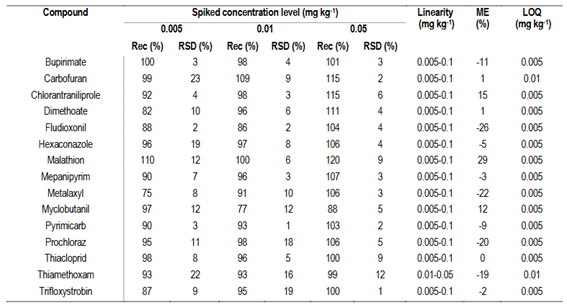
| Compound |
LOQ (mg kg-1) |
Codex MRL (mg kg-1) |
EU MRL (mg kg-1) |
Concentration range (mg kg-1) |
Residue definition |
|
Acetamiprid*
|
0.005 |
0.5 |
0.5 |
0.009-0.02 |
Sum of acetamiprid and its desmethyl (IM-2-1) metabolite, expressed as acetamiprid. |
|
Azoxystrobin
|
0.005 |
10 |
10 |
0.009-0.42 |
Expressed as azoxystrobin. |
|
Bifenthrin
|
0.005 |
Not defined |
1 |
ND |
Bifenthrin (sum of isomers). |
|
Boscalid*
|
0.010 |
3 |
6 |
<LOQ-1.2 |
Sum of boscalid and its hydroxy metabolite 2-chloro-N-(4′-chloro-5-hydroxybiphenyl-2-yl)nicotinamide (free and conjugated) expressed as boscalid. |
|
Bupirimate
|
0.005 |
Not defined |
1.5 |
ND |
Includes desethyl ethirimol, but the EU reference labs identified the reference standard for the desethyl ethirimol as commercially not available. |
|
Buprofezin
|
0.005 |
3 |
0.01 |
ND |
Expressed as buprofezin. |
|
Carbaryl
|
0.005 |
Not defined |
0.0-1 |
ND |
Expressed as carbaryl. |
|
Carbendazim
|
0.005 |
Not defined |
0.1 |
0.006-2.5 |
Sum of benomyl, carbendazim and thiophanate-methyl, expressed as carbendazim. |
|
Carbofuran
|
0.010 |
Not defined |
0.005 |
ND |
Sum of carbofuran (including any carbofuran generated from carbosulfan, benfuracarb or furathiocarb) and 3-OH carbofuran expressed as carbofuran. |
|
Chlorpyrifos*
|
0.005 |
Not defined |
0.01 |
0.007-0.04 |
Expressed as chlorpyrifos |
|
Cyproconazole*
|
0.005 |
Not defined |
0.05 |
0.02-0.11 |
Free cyproconazole and conjugated. |
|
Chlorantraniliprole
|
0.005 |
Not defined |
1 |
<LOQ |
Expressed as chlorantraniliprole. |
|
Cyprodinil
|
0.005 |
Not defined |
5 |
0.008-1.0 |
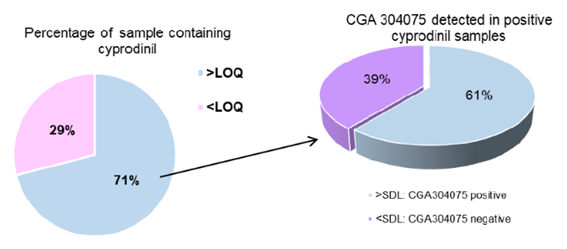
Sum of cyprodinil and CGA 304075 (free and conjugated), expressed as cyprodinil. |
|
Diazinon*
|
0.005 |
0.1 |
0.01 |
0.006 |
Expressed as diazinon. |
|
Difenoconazole
|
0.005 |
2 |
2 |
0.006-0.27 |
Expressed as difenoconazole. |
|
Dimethoate
|
0.005 |
Not defined |
0.01 |
ND |
Dimethoate and omethoate (measured and reported separately). |
|
Fenhexamid
|
0.005 |
10 |
10 |
0.007-1.0 |
Expressed as fenhexamid. |
|
Fludioxonil
|
0.005 |
3 |
4 |
0.005-0.16 |
Sum of fludioxonil and metabolites determined as 2,2-difluorobenzo(1,1)dioxole-4-carboxylic acid, expressed as fludioxonil. |
|
Haloxyfop Me
|
0.005 |
Not defined |
0.01 |
ND |
Sum of haloxyfop, including haloxyfop-P, its salts and conjugates expressed as haloxyfop (sum of the R- and S- isomers at any ratio). |
|
Hexaconazole
|
0.005 |
Not defined |
0.01 |
ND |
Expressed as hexaconazole |
|
Hexythiazox*
|
0.005 |
6 |
6 |
0.008-0.06 |
Sum of hexythiazox and all metabolites containing the trans-5-(4-chlorophenyl)-4-methyl-2-oxothiazolidine-moiety (PT-1-3), expressed as hexythiazox. |
|
Imazalil*
|
0.005 |
Not defined |
2 |
0.008 |
Free and conjugated imazalil, sum of imazalil and metabolite FK-772 (any ratio of constituent isomers), expressed as imazalil. |
|
Imidacloprid
|
0.005 |
0.5 |
0.01 |
0.02 |
Sum of imidacloprid and its metabolites containing the 6-chloropyridinyl moiety, expressed as imidacloprid. |
|
Iprodione
|
0.010 |
10 |
0.01 |
0.01-0.71 |
Sum of iprodione and all metabolites containing the 3,5-dichloroaniline moiety, expressed as iprodione. |
|
Malathion
|
0.005 |
1 |
0.02 |
ND |
Sum of malathion and malaoxon expressed as malathion. |
|
Mepanipyrim
|
0.005 |
Not defined |
3 |
ND |
Expressed as mepanipyrim. |
|
Metalaxyl*
|
0.005 |
Not defined |
0.6 |
0.007-0.20 |
Metalaxyl and metalaxyl M (sum of enantiomers) and N-(2-hydroxymethyl-6-methylphenyl)-N-(methoxyacetyl) alanine methyl ester (M8; free and conjugated; sum of enantiomers), expressed as metalaxyl. |
|
Methoxyfenozide*
|
0.010 |
2 |
2 |
0.04 |
Expressed as methoxyfenozide. |
|
Myclobutanil*
|
0.005 |
0.8 |
1.5 |
0.006 |
Sum of myclobutanil, α-(4-chlorophenyl)-α-(3-hydroxybutyl)-1H-1,2,4-triazole- 1-propanenitrile (RH-9090) and its conjugates, expressed as myclobutanil. |
|
Pirimicarb
|
0.005 |
Not defined |
1.5 |
ND |
Sum of pirimicarb, and its demethyl, demethylformamido metabolites, expressed as pirimicarb. |
|
Prochloraz*
|
0.005 |
Not defined |
0.03 |
0.02-0.07 |
Sum of prochloraz and its metabolites containing the 2,4,6-trichlorphenol moiety, expressed as prochloraz. Includes also sum of prochloraz, BTS 44595 (M201-04) and BTS 44596 (M201-03), expressed as prochloraz. |
|
Propamocarb
|
0.005 |
Not defined |
0.01 |
0.03-5.3 |
Sum of propamocarb and its salts N-oxide propamocarb; and N-desmethyl propamocarb, expressed as propamocarb. |
|
Pyraclostrobin*
|
0.005 |
1.5 |
1.5 |
0.006-0.16 |
Expressed as pyraclostrobin. |
|
Pyrimethanil
|
0.010 |
Not defined |
5 |
0.15 |
Sum of pyrimethanil and 2-(4-hydroxyanilino)-4.6-dimethylpyrimidine, expressed as pyrimethanil. |
|
Pyriproxyfen*
|
0.005 |
Not defined |
0.05 |
0.08-0.1 |
Expressed as pyriproxyfen. |
|
Spinosad
|
0.005 |
Not defined |
0.3 |
0.03 |
Sum of spinosyn A and spinosyn D. |
|
Tebuconazole
|
0.010 |
Not defined |
0.02 |
ND |
Sum of tebuconazole, hydroxy-tebuconazole, and their conjugates, expressed as tebuconazole. |
|
Tetraconazole
|
0.005 |
Not defined |
0.15 |
ND |
Expressed as tetraconazole. |
|
Thiacloprid
|
0.005 |
Not defined |
1 |
ND |
Expressed as thiacloprid. |
|
Thiamethoxam
|
0.010 |
Not defined |
0.01 |
ND |
Thiamethoxam and clothianidin (considered separately). |
|
Trifloxystrobin
|
0.005 |
1 |
1 |
ND |
Sum of trifloxystrobin and ((E,E)-methoxyimino-{2-(1-(3- trifluoromethylphenyl) ethylideneaminooxymethyl) phenyl}acetic acid) (CGA 321113), expressed as trifloxystrobin. |

 Survey of pesticide and pesticide metabolite residues in strawberries marketed in Uruguay
 Thumbnail
 Thumbnail
 Thumbnail