Relationship between strains of Holstein cows, feeding strategies and udder health
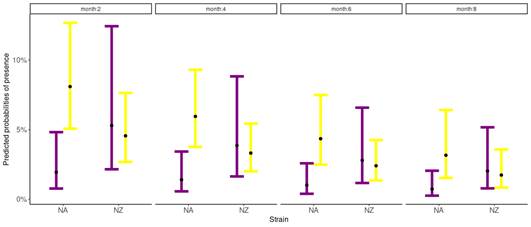
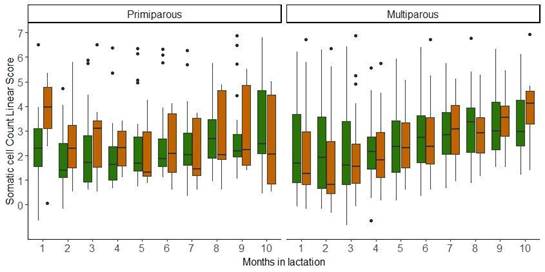
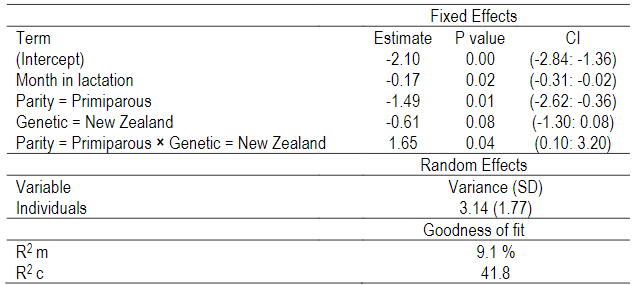
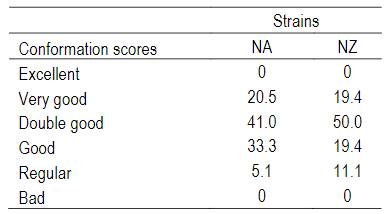
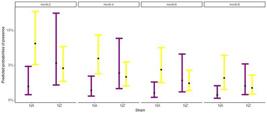
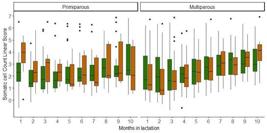
Mastitis frequency could be affected by animal and environmental conditions such as dairy cow genetics and feeding strategies. Thus, the objective of this study was to analyze the probability of clinical mastitis and somatic cell count (SCC) for New Zealand (NZ) and North American (NA) Holstein-Friesian cows maintained on two different feeding strategies (pasture or mixed). A total of 120 cows from the experimental dairy farm of the National Agricultural and Livestock Research Institute (INIA, by its Spanish acronym) (Colonia, Uruguay) were grouped into four groups derived from the combination of two feeding strategies: Grass Maximum or Grass Fixed, and two Holstein strains: NZ or NA (n=30). Clinical mastitis and SCC were evaluated monthly during a whole lactation period. There was an interaction between the Holstein strains and parity for clinical mastitis (P=0.04). The NA primiparous cows were the least likely to suffer clinical mastitis (OR: 0.003), while NA multiparous cows were the most likely to show clinical mastitis (OR: 0.12). The NZ cows reported intermediate values of OR (primiparous: 0.082, multiparous: 0.066). Feeding strategies did not affect clinical mastitis or SCC. Similar SCC was found for NZ and NA strains. In conclusion, regardless of the feeding strategy, the probability of clinical mastitis differed by the genetic origin of the Holstein cows. However, this difference was influenced by parity. The SCC was not influenced by the Holstein strain or the feeding strategy.
Keywords:
grazed pasture; milk quality; udder conformation
 Thumbnail
 Thumbnail