Antiproliferative activities of the extracts from Feijoa sellowiana and Psidium cattleyanum
Abstract:
Bladder cancer is a relevant human health problem worldwide. Although a number of chemotherapies are available, many of them present unwanted side effects and are prone to develop resistance to treatment, so they eventually become ineffective, causing low survival rates. The search for selective cytotoxic (antiproliferative) activities on cancer cells from wild plant extracts has markedly increased in recent years. In this work, the antiproliferative effect of total alcoholic extracts of leaf and flowers from feijoa or guayabo del país (Feijoa sellowiana) and arazá (Psidium cattleyanum) was evaluated. Cytotoxic activity was assessed based on resazurin and sulforhodamine B assays on RT4, HT1197 and EJ138 bladder cancer cell lines. The obtained results indicated that an extract of arazá flower (ExAF) showed a strong, concentration-dependent antiproliferative activity. Furthermore, ExAF revealed high selectivity with very low cytotoxic effects on the keratinocyte-derived HaCaT cell line. In this way, ExAF would be a promising candidate for further studying its antitumor activity. These results contribute to the valorization of these native species by expanding their potential use in new technological areas.
Keywords:
arazá; bladder cancer; cytotoxic; feijoa; guayabo del país
Resumen:
El cáncer de vejiga es un problema de salud pública relevante a nivel mundial. Si bien existen diversas quimioterapias disponibles, muchas de ellas presentan efectos secundarios indeseables y son propensas a desarrollar resistencia al tratamiento, por lo que eventualmente se vuelven ineficaces, causando bajas tasas de supervivencia. La búsqueda de actividades citotóxicas (antiproliferativas) selectivas sobre células cancerosas a partir de extractos de plantas silvestres ha aumentado notablemente en los últimos años. En este trabajo, se evaluó el efecto antiproliferativo de extractos alcohólicos totales de hojas y flores de feijoa o guayabo del país (Feijoa sellowiana) y arazá (Psidium cattleyanum). La actividad citotóxica se evaluó con base en ensayos de resazurina y sulforodamina B en las líneas celulares de cáncer de vejiga RT4, HT1197 y EJ138. Los resultados obtenidos indicaron que un extracto de flor de arazá (ExAF) mostró una fuerte actividad antiproliferativa dependiente de la concentración. Además, ExAF reveló alta selectividad con efectos citotóxicos muy bajos sobre la línea celular HaCaT derivada de queratinocitos. De esta manera, ExAF sería un candidato prometedor para un estudio más profundo de su actividad antitumoral. Estos resultados contribuyen a la valorización de estas especies nativas, ampliando su potencial de uso en nuevas áreas tecnológicas.
Palabras clave:
arazá; cáncer de vejiga; citotóxico; feijoa; guayabo del país
Resumo:
O câncer de bexiga é um problema de saúde humana relevante em todo o mundo. Embora existam várias quimioterapias disponíveis, muitas delas apresentam efeitos colaterais indesejados e são propensas a desenvolver resistência ao tratamento, de modo que eventualmente se tornam ineficazes, causando baixas taxas de sobrevivência. A busca por atividades citotóxicas seletivas (antiproliferativas) em células cancerígenas a partir de extratos de plantas selvagens aumentou significativamente nos últimos anos. Neste trabalho, o efeito antiproliferativo de extratos alcoólicos totais de folhas e flores de feijoa (Feijoa sellowiana) e araçá (Psidium cattleyanum) foi avaliado. A atividade citotóxica foi avaliada com base em ensaios de resazurina e sulforrodamina B em linhagens de células de câncer de bexiga RT4, HT1197 e EJ138. Os resultados obtidos indicaram que um extrato de flor de araçá (ExAF) mostrou uma forte atividade antiproliferativa dependente da concentração. Além disso, ExAF revelou alta seletividade com efeitos citotóxicos muito baixos na linhagem de células HaCaT derivadas de queratinócitos. Dessa forma, o ExAF seria um candidato promissor para estudos mais aprofundados de sua atividade antitumoral. Esses resultados contribuem para a valorização dessas espécies nativas ao expandir seu potencial de uso em novas áreas tecnológicas.
Palavras-chave:
araçá; câncer de bexiga; citotóxico; feijoa; goiabeira-serrana
1. Introduction
Bladder cancer is of great importance to human health according to incidence and prevalence metrics. Worldwide, an estimated number of 573,000 new cases and 212,000 deaths per year has been reported, ranking tenth in incidence1. In Uruguay, malignant neoplasms represent the second cause of death2. In particular, annual incidence of urological neoplasms, between 2012 and 2016, was 17.68 per 100,000 for men, ranking fourth in incidence, and 3.66 per 100,000 in women, with mortality rates of 4.38% and 1.64%, respectively3. Average age of onset of bladder cancer is between 60 and 70 years, and its frequency increases with age. Although the incidence is higher in developed countries, mortality is higher in developing countries4.
Conventional cancer therapies, although effective in many cases, are often accompanied by adverse side effects and treatment resistance problems5. In particular, the unwanted side effects developed by cisplatin-based neoadjuvant chemotherapy have motivated the search and development of alternative treatments. In recent years, a marked increase in research on wild plant extracts that have cytotoxic capacity against cancer cells, that is, that have antiproliferative effects, has been reported6.
The Myrtaceae species guayabo del país or feijoa, Feijoa sellowiana (Berg) Berg, and arazá or strawberry guava, Psidium cattleyanum Sabine, are woody, evergreen, fruit species, native to southern Brazil and northeastern Uruguay, that, in the case of feijoa, further include northeastern Argentina7)(8) . Both species have been shown to exhibit anti-inflammatory, antibacterial, and antifungal activities, and like other members of the myrtle family, they are highly rich in a diverse array of secondary metabolites such as terpenoids, phenolic acids, flavonoids, and tannins9)(10)11)(12)13. Currently, these groups of plant metabolites are intensively researched as candidates for the treatment of different types of cancer14)(15)16. Only recently, a reduced number of studies have reported the promising in vitro antiproliferative activity from secondary metabolite-enriched extracts of feijoa and, to a lesser extent, arazá 17)(18)19)(21)22)(23)24)(25)26)(27)28, highlighting these underutilized, diverse species as valuable and versatile sources of anticancer agents. However, bladder cancer cell lines have not yet been included in these analyses.
The current search for anticancer bioactives in feijoa and arazá plants has been mainly based on fruit extracts, while leaf and floral tissues have received less attention10)(17)18)(19)20)(21)22)(23)24)(25)26)(27)28. Notably, anticancer activities and chemical profiling of leaf extracts from arazá 23)(26) and feijoa25 have been reported. Conversely, only one report concerning arazá floral tissues, restricted to the essential oil components, referred to anticancer activity26, while for feijoa flowers, the search for anticancer agents has not been described yet, although the finding of feijoa flowers being a rich source of diverse flavonoids and ellagitannin-related metabolites17)(28) may indicate these tissues as candidate sources of anticancer compounds. Moreover, a recent transcriptome-based study on feijoa flowers predicted the activity of 15 different secondary metabolites pathways, including those related to flavonoids and terpenoids29. Indeed, floral tissues of a wide range of plant families are being increasingly studied as sources of a wide range of bioactive compounds30. Consequently, both leaf and floral tissues from arazá and feijoa plants naturally growing in Uruguay might be considered candidate sources of novel biomedical compounds.
In this work, the antiproliferative and selective cytotoxic properties of alcoholic extracts from leaves and flowers of feijoa and arazá on bladder cancer-derived lines were evaluated. First, all extracts were evaluated with RT4 and HT1197 bladder cancer lines. Then, for the most promising extract, showing the highest antiproliferative activity, the IC50 parameter was estimated, including EJ138, as an additional cell line in the experiment.
2. Materials and Methods
2.1 Leaves and Flowers Harvest
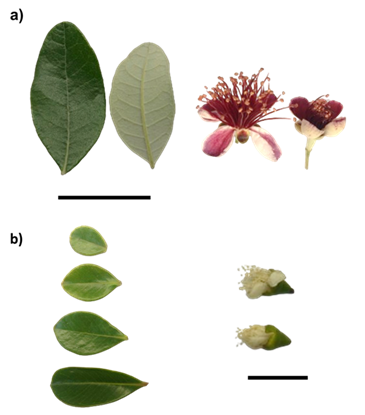
Leaves (30) and flowers (30) were collected, in triplicate, from single, 10-year-old plants of feijoa (Feijoa sellowiana) and arazá (Psidium cattleyanum f. cattleyanum; purple-red fruit morphotype), in full blooming stage, in November 2023, from the garden of Faculty of Agronomy, Universidad de la República, Montevideo, Uruguay. These plants were located in well-illuminated plots, and were not subjected to any agronomical practices. Expanded leaves and complete flowers with open petals at stages 64-65 of BBCH scale31 were chosen, as described in Figure 1. After collection, the samples were washed with distilled water and dried in an oven at 40 ºC for five days, until constant weight.
2.2 Cell Lines
Cell lines derived from bladder cancer tumors RT4 (ECACC 91091914) stage I, EJ138 (ECACC 85061108) stage III, and HT1197 (ECACC 87032403) stage IV32 were obtained from the European Collection of Authenticated Cell Cultures (ECACC). In addition, the spontaneously immortalized normal human keratinocyte cell line, HaCaT, was used33. Cell lines were grown in EMEM medium (M0643, Sigma) supplemented with 10% FBS (FBS-11A, Capricorn).
Representative flower and leaf development stages of collected samples. (a) Feijoa sellowiana (bar = 3 cm); (b) Psidium cattleyanum f. cattleyanum (bar = 2 cm)
2.3 Ethanolic Extract
Ten grams of dehydrated tissue (leaf or complete flower) were macerated in 150 mL of 95% ethanol for 48 h at 40 °C. This procedure was performed twice. The total alcoholic extracts were then concentrated in a rotary evaporator at <40 °C. Finally, the dried extracts were weighed and stored at -20 °C in the dark. Prior to inclusion in cell cultures, the extracts were resuspended with Dimethyl sulfoxide (DMSO).
2.4 Antiproliferative Activity Evaluation
RT4 and HT1197 cell lines were grown in 96-well plates, seeding 2500 cells per well in EMEM culture medium with 10% FBS, and cultured at 37 °C and 5% CO2 for 24 h. They were then treated with different concentrations of the alcoholic extracts (4, 40, and 400 μg/mL), using DMSO as vehicle control. The assay took place for 48 h, under the culture conditions described.
Cell viability was evaluated by resazurin (RZ) and sulforhodamine B (SRB) tandem assays34. Briefly, for RZ assay, after 44 h of incubation with the extract, 20 µL of 0.25 mg/mL RZ, prepared in PBS, was added, and the plate was further incubated at 37 °C, 5% CO2 for 4 h. Fluorescence was measured on a spectrofluorometer plate (BMG Clariostar Plus) using an excitation wavelength of 530-560 nm and an emission wavelength of 590 nm. After that, the same plate was then used for the SRB assay. Cells were fixed by adding 50 µL of 50% trichloroacetic acid (TCA) in distilled water for 1 h at 4 °C. The solution was then discarded, washed with distilled water three times, and dried at 37 °C for 1 h. One hundred microliter of a 0.057% (w/v) solution of SRB in 1% acetic acid was added to each well and incubated at 37 °C for 1 h. After this step, the solution was discarded and the plate was quickly washed three times by adding 200 µL of 1% v/v acetic acid in Milli-Q water and dried for 1 h at 37 °C. Finally, 100 µL of 10 mM Tris-Cl pH 10.5 was added, and the plate was shaken for 10 min on an orbital shaker at room temperature. The absorbance was measured at 510 nm on the aforementioned spectrofluorometer.
The median inhibitory concentration (IC50) of the compounds was determined as the concentration that reduces cell viability by 50% compared to the DMSO-treated control, using the SRB assay. Two additional cell lines were included in this analysis: EJ138 (derived from bladder cancer) and HaCaT (immortalized human keratinocyte line). The plating and culture conditions were the same as those already described. The extracts were assayed in a concentration range from 25 to 400 µg/mL. The IC50 was determined by linear regression analysis. The selectivity index (SI) was calculated as the ratio between the toxic concentration of a sample and its effective bioactive concentration. SI = IC50 HaCaT/ IC50 tumor cells35. Three independent experiments were performed, each including technical triplicates.
2.5 Statistical Analysis
All experiments were done in triplicate and at least two biological replicas were performed for every experimental condition. Data analyses and statistical calculations were performed using one-way ANOVA followed by Tukey’s multiple comparisons test.
3. Results
3.1 Leaves and Flowers Harvest
The fresh weights of the replicated samples of flowers and leaves from arazá were similar. The wet weights of the feijoa samples were slightly more variable, especially for flower replicates (Table 1). In both species, the dry weight was proportional to the initial fresh weight, with percentages of dry weight/fresh weight of flowers of 19.4 ±1.0% and 24.6 ±1.3%, and of leaves of 51.8 ±2.7% and 31.1 ±0.3%, for feijoa and arazá, respectively. The yields of the ethanolic extracts (dry weight of the extract/dry weight of the sample) varied between 2.26% and 10.58% (Table 1).
Sample weight and extract yield (dry weight of the extract/dry weight of the sample) of Feijoa sellowiana leaves (ExGL) and flowers (ExGF), and of Psidium cattleyanum leaves (ExAL) and flowers (ExAF)
3.2 Antiproliferative Activity
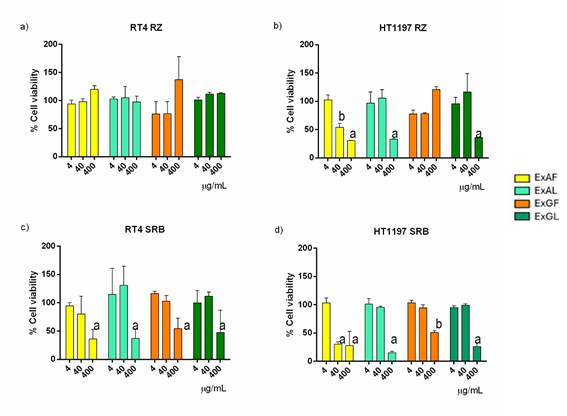
To evaluate the antiproliferative activity of leaf and floral extracts of feijoa (ExGL and ExGF) and arazá (ExAF and ExAL), RZ and SRB tandem assays were performed, using the RT4 and HT1197 lines. Based on RZ assay for HT1197 line, the most active extract was ExAF, obtaining 27% and 53% of viable cells at 400 and 40 µg/mL, respectively, while the rest of the extracts showed activity only at 400 µg/mL or did not show activity at HT1197. For RT4 cell line, none of the extracts showed activity with the RZ assay. On the other hand, for the SRB method, a concentration-dependent antiproliferative effect was observed for floral extracts ExAF and ExGF, although ExAF showed a more significant decrease in cell viability, accounting for 25% of cell viability for 40 µg/mL. In addition, for the SRB assay, all extracts showed cytotoxic activity on HT1197 and RT4, at 400 µg/mL.
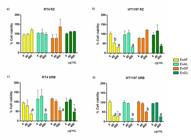
Antiproliferative activity of feijoa (Feijoa sellowiana) and arazá (Psidium cattleyanum) leaf and flower extracts, based on resazurin (RZ) and sulforhodamine B (SRB) assays, for 48 h, with RT4 (a and c) and HT1197 (b and d) cell lines
3.3 Antiproliferative Activity and Selectivity Index of ExAF
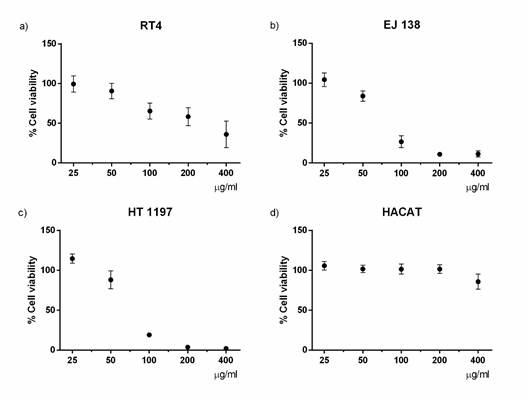
Based on the promising results obtained with ExAF, a further characterization including the estimation of the IC50 value using the SRB method was implemented. In this analysis, in addition to the RT4 and HT1197 lines, the tumor line EJ138 and a line derived from normal keratinocytes HaCaT were also included. At 48 h, ExAF showed an antiproliferative effect on all three tumor lines (Figure 3). The calculated IC50 were 127.2 ± 2.2 µg/mL for RT4, 27.9 ± 1.9 µg/mL for EJ138, and 25.37 ± 1.83 µg/mL for HT1197, demonstrating that ExAF showed the largest effects on EJ138 and HT1197 tumor lines. Conversely, ExAF showed a mild cytotoxic effect (85% cell viability) on the HaCaT cell line at 48 h, evidenced by IC50 higher than 400 µg/mL. Accordingly, the selectivity index (SI) of ExAF, with respect to HaCaT, was 3.1 for RT4, 14.3 for EJ138 and 15.8 for HT1197.
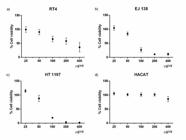
Antiproliferative effect of arazá (Psidium cattleyanum) flower extract (ExAF) determined at 48 h by the SRB assay in the bladder cancer-derived lines a) RT4, b) EJ138, c) HT1197, and d) the normal keratinocyte-derived line HaCaT
4. Discussion
Plants have been widely used in traditional medicine. More than 60% of the compounds used in anti-tumor therapies are derived from natural plant products36. Plant compounds, such as polyphenols and terpene-rich essential oils, have shown efficacy in inhibiting the growth of bacteria, fungi and cancer cells. The cell growth inhibition properties of these plant compounds have been associated with their ability to induce apoptosis and interfere with critical biological processes, such as DNA synthesis, cell proliferation and cell membrane integrity, making them valuable sources of treatments in modern medicine10)(18) . The antiproliferative activity, i.e. inhibiting the growth of cancer cells, of phytochemicals such as polyphenol, tannins and terpenoids frequently found in species of the myrtle family has been frequently reported37.
An increased research interest on anticancer activities of feijoa and arazá extracts has become evident in recent years. Antiproliferative activity against oral squamous cell carcinoma, cutaneous melanoma, and hematological, breast, cervical, colon, gastric, prostate cancer cells lines was found for feijoa leaf and fruit extracts17)(18)19)(20)21)(22)25. In the case of arazá, leaf and fruit extracts showed antiproliferative activity on breast, colon and stomach cancer cell lines9)(23) . Lately, essential oil extracts obtained from arazá flowers showed only weak cytotoxic activity with low selectivity rate for hepatic, breast and leukemia cancer cell lines26. In our study, we found that, at the highest concentration (400 µg/mL), the ethanolic extracts from arazá and feijoa leaf and flower tissues exhibited antiproliferative activity on two (feijoa extract) and three (arazá extract) different bladder cancer lines. Thus, our work expanded the search for anticancer agents in feijoa and arazá species by considering, for the first time, the ethanolic floral extracts from both species. Moreover, the inclusion of bladder cancer cell lines in this study widened the range of malignant neoplasms for which arazá and feijoa extracts were effective.
The most promising extract in this study was the extract of arazá flower (ExAF), with high cytotoxicity and selectivity at 40 µg/mL. The highest activity was observed on EJ138 and HT 1197 lines (IC50 25.4-27.9 µg/mL), which are derived from tumors at advanced cancer progression (stages III and IV, respectively) compared to RT (IC50 127.2; µg/mL, stage I). Furthermore, the IC50 values of ExAF are comparable to those obtained by Peng and others22 for feijoa fruit extracts in SRB-based assays (IC50 of 13.7 - 43.0 µg/mL). On the other hand, ExAF cytotoxic activity was high compared to that of aqueous and acetone extracts of arazá fruit on breast (MCF 7) and colon (CaCo2) cancer lines38. Therefore, the finding of strong cytotoxicity activity with high selectivity on bladder cancer cells for ExAF is a relevant contribution of this study.
Recently, Peng and others22 described for the first time the association between the phenolic composition of feijoa fruit extracts and the extent of pro-apoptosis activity against prostate cancer cells22, supporting the high anticancer potential of the polyphenolic chemical group against a wide range of cancers, including bladder carcinoma5)(6) . Moreover, a metabolomic study of methanolic leaf and fruit extracts of arazá, carried out by Zangh and others38, described four hundred sixty nine metabolites, including various phenolic subclasses predominantly flavonoids and phenolic acids38, which gives us an idea of the complexity of the alcoholic arazá extracts. Future works should be addressed to fill the gap of information on the chemical composition of ethanolic extracts of arazá flowers, as well as to further determine which molecules are responsible from arazá antiproliferative action.
The initial studies of the mechanisms underlying the antiproliferative activity of arazá and feijoa extracts, with varying chemical composition, have been recently undertaken and globally postulated the induction of programmed cell death or apoptosis associated with the caspase pathway22)(26)39 and epigenetic modulation through histone deacetylases40. Our finding of a promising extract from arazá warrant further research on its chemical composition as well as the underlying mechanisms of its cytotoxic action on bladder cell lines.
5. Conclusions
This study reported the finding of plant-derived products with biomedical potential from two myrtle tree species from the native flora of Uruguay. A description of a methodology for obtaining extracts from leaf and flowers is provided. Floral extracts from arazá revealed for the first time high, selective antiproliferative activities against bladder cancer cells.
Acknowledgements:
We are grateful to Departamento de Genética, Instituto de Investigaciones Biológicas Clemente Estable as well as to Laboratorio de Biotecnología, Departamento de Biología Vegetal, Facultad de Agronomía, Universidad de la República, for generous contributions to the implementation of this research.
References
-
1. Halaseh SA, Halaseh S, Alali Y, Ashour ME, Alharayzah MJ. A review of the etiology and epidemiology of bladder cancer: all you need to know. Cureus. 2022;14(7):e27330. Doi: 10.7759/cureus.27330.
» https://doi.org/10.7759/cureus.27330 -
2. Garau M, Musetti C, Alonso R, Barrios E. Trends in cancer incidence in Uruguay: 2002 -2015. Colomb Med (Cali). 2019;50(4):224-38. Doi: 10.25100/cm.v50i4.4212.
» https://doi.org/10.25100/cm.v50i4.4212 -
3. Barrios E, Garau M. Cáncer: magnitud del problema en el mundo y en Uruguay, aspectos epidemiológicos. An Facultad Med. 2017;4(1):4-66. Doi: 10.25184/anfamed2017.4.1.2.
» https://doi.org/10.25184/anfamed2017.4.1.2 -
4. Jubber I, Ong S, Bukavina L, Black PC, Compérat E, Kamat AM, Kiemeney L, Lawrentschuk N, Lerner SP, Meeks JJ, Moch H, Necchi A, Panebianco V, Sridhar SS, Znaor A, Catto JWF, Cumberbatch MG. Epidemiology of bladder cancer in 2023: a systematic review of risk factors. Eur Urol. 2023;84(2):176-90. Doi: 10.1016/j.eururo.2023.03.029.
» https://doi.org/10.1016/j.eururo.2023.03.029 -
5. Haung R, Saji A, Choudhury M, Konno S. Potential anticancer effect of bioactive extract of monk fruit (Siraitia grosvenori) on human prostate and bladder cancer cells. J Cancer Ther. 2023;14(5):211-24. Doi: 10.4236/jct.2023.145019.
» https://doi.org/10.4236/jct.2023.145019 -
6. Anifowose SO, Alqahtani WSN, Al-Dahmash BA, Sasse F, Jalouli M, Aboul-Soud MAM, Badjah-Hadj-Ahmed AY, Elnakady YA. Efforts in bioprospecting research: a survey of novel anticancer phytochemicals reported in the last decade. Molecules. 2022;27(23):8307. Doi: 10.3390/molecules27238307.
» https://doi.org/10.3390/molecules27238307 -
7. Rivas M, Puppo M, Baccino E, Quezada M, Franco J, Pritsch C. Phenotypic and molecular diversity of wild populations of Acca sellowiana (Berg.) Burret in the southern area of natural distribution. Horticulturae. 2024;10(4):360. Doi: 10.3390/horticulturae10040360.
» https://doi.org/10.3390/horticulturae10040360 -
8. Santos PCS, Gallo R, Nonato ERL, Santos RS, de Sousa MB, da Silva CL, Santos MM, Lira JS Jr. Psidium cattleyanum Sabine: a bibliometric approach focused on its bioactive properties and applications. For Trees Livelihoods. 2024;33(3):207-30. Doi: 10.1080/14728028.2024.2343919.
» https://doi.org/10.1080/14728028.2024.2343919 -
9. Dos Santos Pereira E, Vinholes J, Franzon R, Dalmazo G, Vizzotto M, Nora L. Psidium cattleianum fruits: a review on its composition and bioactivity. Food Chem. 2018;258:95-103. Doi: 10.1016/j.foodchem.2018.03.024.
» https://doi.org/10.1016/j.foodchem.2018.03.024 -
10. Zhu F. Chemical and biological properties of feijoa (Acca sellowiana). Trends Food Sci Technol. 2018;81:121-31. Doi: 10.1016/j.tifs.2018.09.008.
» https://doi.org/10.1016/j.tifs.2018.09.008 -
11. Beltrame BM, Klein-Junior LC, Schwanz M, Henriques AT. Psidium L. genus: a review on its chemical characterization, preclinical and clinical studies. Phytother Res. 2021;35(9):4795-803. Doi: 10.1002/ptr.7112.
» https://doi.org/10.1002/ptr.7112 -
12. de Oliveira Schmidt H, Rockett FC, Klen AVB, Schmidt L, Rodrigues E, Tischer B, Augusti PR, de Oliveira VR, da Silva VL, Flôres SH, de O Rios A. New insights into the phenolic compounds and antioxidant capacity of feijoa and cherry fruits cultivated in Brazil. Food Res Int. 2020;136:109564. Doi: 10.1016/j.foodres.2020.109564.
» https://doi.org/10.1016/j.foodres.2020.109564 -
13. Zandoná GP, Bagatini L, Woloszyn N, de Souza Cardoso J, Hoffmann JF, Moroni LS, Stefanello FM, Junges A, Rombaldi CV. Extraction and characterization of phytochemical compounds from araçazeiro (Psidium cattleianum) leaf: putative antioxidant and antimicrobial properties. Food Res Int . 2020;137:109573. Doi: 10.1016/j.foodres.2020.109573.
» https://doi.org/10.1016/j.foodres.2020.109573 -
14. Zhang Z, Shi J, Nice EC, Huang C, Shi Z. The multifaceted role of flavonoids in cancer therapy: leveraging autophagy with a double-edged sword. Antioxidants (Basel). 2021;10(7):1138. Doi: 10.3390/antiox10071138.
» https://doi.org/10.3390/antiox10071138 -
15. Antonelo FA, Rodrigues MS, Cruz LC, Pagnoncelli MG, da Cunha MAA, Bonatto SJR, Busso C, Wagner A Jr, Montanher PF. Bioactive compounds derived from Brazilian Myrtaceae species: chemical composition and antioxidant, antimicrobial and cytotoxic activities. Biocatal Agric Biotechnol. 2023;48:102629. Doi: 10.1016/j.bcab.2023.102629.
» https://doi.org/10.1016/j.bcab.2023.102629 -
16. Hilal B, Khan MM, Fariduddin Q. Recent advancements in deciphering the therapeutic properties of plant secondary metabolites: phenolics, terpenes, and alkaloids. Plant Physiol Biochem. 2024;211:108674. Doi: 10.1016/j.plaphy.2024.108674.
» https://doi.org/10.1016/j.plaphy.2024.108674 -
17. Aoyama H, Sakagami H, Hatano T. Three new flavonoids, proanthocyanidin, and accompanying phenolic constituents from Feijoa sellowiana. Biosci Biotechnol Biochem. 2018;82(1):31-41. Doi: 10.1080/09168451.2017.1412246.
» https://doi.org/10.1080/09168451.2017.1412246 -
18. Medina AL, Haas LIR, Chaves FC, Salvador M, Zambiazi RC, Da Silva WP, Nora L, Rombaldi CV. Araçá (Psidium cattleianum Sabine) fruit extracts with antioxidant and antimicrobial activities and antiproliferative effect on human cancer cells. Food Chem . 2011;128(4):916-22. Doi: 10.1016/j.foodchem.2011.03.119.
» https://doi.org/10.1016/j.foodchem.2011.03.119 -
19. Bontempo P, Mita L, Miceli M, Doto A, Nebbioso A, De Bellis F, Conte M, Minichiello A, Manzo F, Carafa V, Basile A, Rigano D, Sorbo S, Castaldo Cobianchi R, Schiavone EM, Ferrara F, De Simone M, Vietri M, Cioffi M, Sica V, Bresciani F, de Lera AR, Altucci L, Molinari AM. Feijoa sellowiana derived natural Flavone exerts anti-cancer action displaying HDAC inhibitory activities. Int J Biochem Cell Biol. 2007;39(10):1902-14. Doi: 10.1016/j.biocel.2007.05.010.
» https://doi.org/10.1016/j.biocel.2007.05.010 -
20. Russi S, Maresca V, Zoppoli P, Aieta M, Marino G, Sgambato A, Ignomirelli O, Ciuffi M, Notarangelo T, Basile A, Falco G, Laurino S. Effect of feijoa sellowiana acetonic extract on proliferation inhibition and apoptosis induction in human gastric cancer cells. Appl Sci. 2020;10(21):7756. Doi: 10.3390/app10217756.
» https://doi.org/10.3390/app10217756 -
21. Gambin LDB, Cavali M, Dresch AP, Fuhr JF, Marafon F, Bonadiman BSR, Bilibio D, Araujo L, Mibielli GM, Priamo WL, Bagatini MD, Bender JP. Phenolic compounds from feijoa (Acca sellowiana) fruits: ultrasound-assisted extraction and antiproliferative effect on cutaneous melanoma cells (SK-MEL-28). Food Biosci. 2023;55:103078. Doi: 10.1016/j.fbio.2023.103078.
» https://doi.org/10.1016/j.fbio.2023.103078 -
22. Peng Y, Bishop KS, Ferguson LR, Quek SY. Phenolic-rich feijoa extracts from flesh, peel and whole fruit activate apoptosis pathways in the LNCaP cell line. Food Chem . 2022;383:132285. Doi: 10.1016/j.foodchem.2022.132285.
» https://doi.org/10.1016/j.foodchem.2022.132285 -
23. Barradas YM, Borsoi FT, Dacoreggio MV, Moroni LS, Silva Rosa Bonadiman BD, Marafon F, Giacobbo CL, Bagatini MD, Kempka AP. Phytochemical profiling, antidiabetic, antitumoral and cytotoxic potential of Psidium cattleianum Afzel. ex Sabine leaves of red variety. Nat Prod Res. 2023;37(4):608-12. Doi: 10.1080/14786419.2022.2065484.
» https://doi.org/10.1080/14786419.2022.2065484 -
24. Munieweg FR, Poletto ALR, Boldori JR, Stopiglia CDO, de Carvalho FB, Haas SE, Rodrigues NR, Vizzotto M, Denardin CC. Antiproliferative cancer cell and fungicidal effects of yellow and red Araçá (Psidium cattleianum Sabine) fruit extract. Foods. 2023;12(23):4307. Doi: 10.3390/foods12234307.
» https://doi.org/10.3390/foods12234307 -
25. Mosbah H, Louati H, Boujbiha MA, Chahdoura H, Snoussi M, Flamini G, Ascrizzim R, Bouslema A, Achour L, Selmi B. Phytochemical characterization, antioxidant, antimicrobial and pharmacological activities of Feijoa sellowiana leaves growing in Tunisia. Ind Crops Prod. 2018;112:521-31. Doi: 10.1016/j.indcrop.2017.12.051.
» https://doi.org/10.1016/j.indcrop.2017.12.051 -
26. Elsayed HE, El-Deeb EM, Taha H, Taha HS, Elgindi MR, Moharram FA. Essential oils of Psidium cattleianum Sabine leaves and flowers: Anti-inflammatory and cytotoxic activities. Front Chem. 2023;11:1120432. Doi: 10.3389/fchem.2023.1120432.
» https://doi.org/10.3389/fchem.2023.1120432 -
27. Silva de Farias N, Mora Rave JS, Siddique I, Hoff R, Olivera Müller CM. Myrtaceae leaves grown in Agroforestry: a sustainable alternative to producing natural antioxidants extracts. Sci Plena. 2023;19(6). Doi: 10.14808/sci.plena.2023.061501.
» https://doi.org/10.14808/sci.plena.2023.061501 -
28. Montoro P, Serreli G, Gil KA, D'Urso G, Kowalczyk A, Tuberoso CIG. Evaluation of bioactive compounds and antioxidant capacity of edible feijoa (Acca sellowiana (O. Berg) Burret) flower extracts. J Food Sci Technol. 2020;57(6):2051-60. Doi: 10.1007/s13197-020-04239-2.
» https://doi.org/10.1007/s13197-020-04239-2 -
29. Oberti H, Gutierrez-Gonzalez J, Pritsch C. A first de novo transcriptome assembly of feijoa (Acca sellowiana (Berg) Burret) reveals key genes involved in flavonoid biosynthesis. Plant Genome. 2024;17(3):e20501. Doi: 10.1002/tpg2.20501.
» https://doi.org/10.1002/tpg2.20501 -
30. Meléndez-Martínez AJ, Benítez A, Corell M, Hernanz D, Mapelli-Brahm P, Stinco C, Coyago-Cruz E. Screening for innovative sources of carotenoids and phenolic antioxidants among flowers. Foods. 2021;10(11):2625. Doi: 10.3390/foods10112625.
» https://doi.org/10.3390/foods10112625 -
31. Ramírez F, Kallarackal J. Phenological growth stages of Feijoa (Acca sellowiana (O. Berg) Burret) according to the BBCH scale under tropical Andean conditions. Sci Hortic. 2018;232:184-90. Doi: 10.1016/j.scienta.2017.12.059.
» https://doi.org/10.1016/j.scienta.2017.12.059 -
32. Earl J, Rico D, Carrillo-de-Santa-Pau E, Rodríguez-Santiago B, Méndez-Pertuz M, Auer H, Gómez G, Grossman HB, Pisano DG, Schulz WA, Pérez-Jurado LA, Carrato A, Theodorescu D, Chanock S, Valencia A, Real FX. The UBC-40 Urothelial Bladder Cancer cell line index: a genomic resource for functional studies. BMC Genomics. 2015;16(1):403. Doi: 10.1186/s12864-015-1450-3.
» https://doi.org/10.1186/s12864-015-1450-3 -
33. Boukamp P, Petrussevska RT, Breitkreutz D, Hornung J, Markham A, Fusenig NE. Normal keratinization in a spontaneously immortalized aneuploid human keratinocyte cell line. J Cell Biol. 1988;106(3):761-71. Doi: 10.1083/jcb.106.3.761.
» https://doi.org/10.1083/jcb.106.3.761 -
34. Alem D, Canclini L, Castro-Sowinski S, Martínez-López W. Chemosensitizer effect of violacein on cisplatin-treated bladder cancer cells. Clin Complement Med Pharmacol. 2022;2(2):100036. Doi: 10.1016/j.ccmp.2022.100036.
» https://doi.org/10.1016/j.ccmp.2022.100036 -
35. Indrayanto G, Putra GS, Suhud F. Validation of in-vitro bioassay methods: application in herbal drug research. Profiles Drug Subst Excip Relat Methodol. 2021;46:273-307. Doi: 10.1016/bs.podrm.2020.07.005.
» https://doi.org/10.1016/bs.podrm.2020.07.005 -
36. Newman DJ, Cragg GM. Natural products as sources of new drugs over the nearly four decades from 01/1981 to 09/2019. J Nat Prod. 2020;83(3):770-803. Doi: 10.1021/acs.jnatprod.9b01285.
» https://doi.org/10.1021/acs.jnatprod.9b01285 -
37. Campos AJ, Mews MHR, Dal Magro DD, Alberton MD, De Lima DD, Pereira EM. Preclinical gastroprotective activity of an Eugenia brasiliensis Lam. (Myrtaceae) extract. Rev Fitos. 2023;17(4):540-50. Doi: 10.32712/2446-4775.2023.1555.
» https://doi.org/10.32712/2446-4775.2023.1555 -
38. Zhang L, Iannotti FA, Saber FR, Arafa RK, Moriello AS, Rasle RA, Soria-Lopez A, Abd El-Gawwad SG, Rocchetti G, Otero P, Kulinowski Ł, Skalicka-Woźniak K, Lucini L, Simal-Gandara J. The phenolic signature of psidium cattleianum fruits and leaves modulates TRPV1 and TRPA1 transient receptor potential channels: a metabolomics, in vitro, and in silico study. Food Sci Nutr. 2025;13(4):e70075. Doi: 10.1002/fsn3.70075.
» https://doi.org/10.1002/fsn3.70075 -
39. Moon JY, Mosaddik A, Kim H, Cho M, Choi HK, Kim YS, Cho SK. The chloroform fraction of guava (Psidium cattleianum sabine) leaf extract inhibits human gastric cancer cell proliferation via induction of apoptosis. Food Chem . 2011;125(2):369-75. Doi: 10.1016/j.foodchem.2010.09.007.
» https://doi.org/10.1016/j.foodchem.2010.09.007 -
40. Scafuri B, Bontempo P, Altucci L, De Masi L, Facchiano A. Molecular docking simulations on Histone Deacetylases (HDAC)-1 and -2 to investigate the flavone binding. Biomedicines. 2020;8(12):568. Doi: 10.3390/biomedicines8120568.
» https://doi.org/10.3390/biomedicines8120568