Genetic selection and livestock sustainability: A review of research and development in Uruguay
Abstract:
Genetic selection is an effective tool to improve sustainability of livestock production and contribute to greenhouse gases mitigation, particularly of enteric methane (CH4) emissions, in accordance with international agreements. Feed efficiency (FE) and CH4 emissions have been postulated as potential selection objectives to achieve mitigation goals and support sustainability. Uruguay has had genetic evaluation systems for three decades and new intensive phenotyping platforms are in place for measuring FE and CH4 in beef cattle and sheep. Recording is carried out in animals of breeds relevant to production (Hereford, Corriedale, Texel, Australian and Dohne Merino) and connected to the genetic evaluation systems. The generated databases are the basis of reference populations for genomic selection. Given that FE and CH4 are difficult-to-measure traits, the implementation of genomic selection is key to accelerate the potentially achievable genetic progress. Recording systems and protocols are described here, as well as the estimated genetic parameters and associations among feed intake, FE, CH4 and productive traits. Knowledge of these associations allows the identification of synergies and antagonisms. This is relevant to optimize genetic improvement programs that contribute to the CH4 mitigation goals, without affecting livestock production, which is key to the economic and social dimensions of livestock sustainability.
Keywords:
genomic selection; feed efficiency; enteric methane; cattle; sheep
Resumen:
La selección genética es una herramienta efectiva para mejorar la sostenibilidad de la producción ganadera y contribuir a la mitigación de gases de efecto invernadero, particularmente las emisiones de metano entérico (CH4), en concordancia con los acuerdos internacionales. La eficiencia de conversión (FE) y el CH4 han sido postulados como objetivos potenciales de selección para alcanzar las metas de mitigación y apoyar la sostenibilidad. Uruguay posee sistemas de evaluación genética desde hace tres décadas y se han implementado nuevas plataformas de fenotipado intensivo para la medición de FE y CH4 en ganado bovino y ovino. Los registros se realizan en animales de razas relevantes para la producción (Hereford, Corriedale, Texel, Merino Australiano y Merino Dohne) y están conectados a los sistemas de evaluaciones genéticas. Las bases de datos generadas son la base de poblaciones de referencia para la selección genómica. Dado que la FE y el CH4 son rasgos difíciles de medir, la implementación de la selección genómica es clave para acelerar el progreso genético potencialmente alcanzable. Los sistemas y los protocolos de registro se describen aquí, así como los parámetros genéticos estimados y las asociaciones entre el consumo de alimento, FE, CH4 y rasgos productivos. El conocimiento de estas asociaciones permite la identificación de sinergias y antagonismos. Esto es relevante para optimizar programas de mejora genética que contribuyan a las metas de mitigación de CH4, sin afectar la producción ganadera, lo cual es clave para las dimensiones económicas y sociales de la sostenibilidad ganadera.
Palabras clave:
selección genómica; eficiencia de conversión; metano entérico; bovinos; ovinos
Resumo:
A seleção genética é uma ferramenta eficaz para melhorar a sustentabilidade da produção pecuária e contribuir para a mitigação dos gases com efeito de estufa, particularmente das emissões de metano entérico (CH4), em conformidade com acordos internacionais. A eficiência de conversão (FE) e CH4 foram postuladas como objetivos potenciais de seleção para atingir metas de mitigação e apoiar a sustentabilidade. O Uruguai possui sistemas de avaliação genética há três décadas e novas plataformas intensivas de fenotipagem foram implementadas para a medição de FE e CH4 em bovinos e ovinos. Os registros são realizados em animais de raças relevantes para produção (Hereford, Corriedale, Texel, Australian Merino e Dohne Merino) e estão conectados a sistemas de avaliação genética. Os bancos de dados gerados são a base de populações de referência para seleção genômica. Como a FE e o CH4 são características difíceis de medir, a implementação da seleção genômica é fundamental para acelerar o progresso genético potencialmente alcançável. Os sistemas e protocolos de registro são descritos aqui, bem como os parâmetros genéticos estimados e as associações entre consumo de alimento, FE, CH4 e características produtivas. O conhecimento destas associações permite identificar sinergias e antagonismos. Isto é relevante para otimizar programas de melhoramento genético que contribuam para os objetivos de mitigação do CH4, sem afetar a produção pecuária, que é fundamental para as dimensões económicas e sociais da sustentabilidade da pecuária.
Palavras-chave:
seleção genômica; eficiência alimentar; metano entérico; bovinos; ovinos
1. Introduction
Mitigation of greenhouse gas (GHG) emissions and the efficient use of limiting resources are of global concern, as well as identifying effective strategies to achieve national targets in the context of the Paris Agreement and the Global Methane Pledge. Alternatives to support sustainable development of livestock production are particularly relevant for countries whose economy rely on sheep and cattle production, such as Uruguay1.
Beef and sheep industries are economically relevant in Uruguay, where 60% of the territory is dedicated to these activities with 11.3 and 5.4 million cattle and sheep in 2024, respectively. Uruguay’s economy is based mainly on the agricultural sectors, with beef exports leading the product ranking, contributing 20% of the total export income. Uruguay is within the major beef producing and exporting nations2) and is the fourth top wool exporter worldwide3. Approximately 50,000 farms are dedicated to livestock production, with livestock industries also accounting for 8% of the national employed population3. In parallel with the economic and social significance of livestock production, the National GHG inventory reported that 75% of the total GHG emissions correspond to the agricultural sector (categorized as Agriculture, Forestry and Other Land Use, AFOLU) with a significant prevalence of enteric methane (CH4) emissions from cattle and sheep (52%)4.
National public policies are being implemented to support climate change mitigation and adaptation, and GHG mitigation targets were defined in the Nationally Determined Contributions submitted in 2017 and 20225, in accordance with the Paris Agreement. Additionally, the Climate Change Index-linked Bond was first issued in 2022 by Uruguay and reopened in 2023. This is the first sovereign bond associated with environmental indicators including the GHG emission reduction. The alignment of the public financing strategy with national climate commitments adds another dimension to the implications of achieving the mitigation targets.
Animal selection can play an important role in mitigating CH4 emissions, indirectly, through the contribution to improving productivity, and directly, by selection for lower-emitting animals, which is possible as CH4 emission is a heritable trait6, leading to a permanent and cumulative change. Uruguay has in place genetic evaluation systems for the most relevant breeds, which are carried out collaboratively by public and private actors. Since the first genetic evaluations in the 90s, the number of breeds included as well as the populations evaluated have increased7. Through collaborative research and development projects between several academic institutions, innovations have been incorporated, such as genomic selection, and phenotyping platforms for feed efficiency and CH4 emissions have been recently implemented. These new traits are relevant for mitigation purposes and are being considered in breeding programs and investigated worldwide in cattle and sheep8.
The objectives of this article are: 1) to characterize the relevance of GHG emissions and mitigation targets in Uruguay and the metrics used to evaluate enteric CH4 emissions, as well as their significance for mitigation strategies; 2) to bring an overview of current cattle and sheep genetic evaluation systems, and the recent development of information nuclei; 3) to describe feed efficiency and CH4 emission measures in sheep and cattle, and 4) to present and discuss the current main results of feed efficiency and CH4 emissions, the implications for the contribution of animal breeding to CH4 mitigation and sustainability, as well as the areas of research that need to be addressed.
2. Reduction of greenhouse gas emissions and sustainability
The mitigation of GHG emissions from cattle and sheep is a relevant environmental objective that plays an important role for sustainable livestock production. However, the strategies for this objective should consider the interconnected social, economic, and environmental dimensions of sustainability. Globally, GHG mitigation in the livestock sector has focused on reducing enteric CH4 emissions produced as a byproduct of ruminal fermentation, which also represents an energy loss of 2 to 12% of the gross energy intake9.
The emphasis on reducing enteric CH4 emissions from the livestock sector relies on several facts. First, CH4 is a potent GHG with high global warming potential and a relatively short lifespan in the atmosphere. This implies that its reduction is seen as a contribution to achieving the global warming limit of 1.5 °C above preindustrial levels defined in the Paris Agreement. Accelerating the reduction of CH4 emissions is promoted by the Global Methane Pledge (www.globalmethanepledge.org) aiming to lower CH4 emissions globally by 30% from 2020 levels by 2030, and includes the livestock sector among the major CH4 emitters. Secondly, the increasing interest in enteric CH4 mitigation is associated with the fact that it accounts for 30% of global anthropogenic CH4 emissions10. Finally, the implementation of mitigation strategies is even more relevant considering the predicted increase of global population and the derived higher demand of livestock products. Improving food and fiber production represents a significant opportunity for food providers, particularly for those countries in which livestock represents an important source of income and social welfare. However, the sustainable growth of food production should take into consideration the environmental dimension of sustainability, including GHG emissions.
The GHG inventories carried out in Uruguay confirm the relevance of enteric methane emissions. The AFOLU sector was responsible for 75% of the national GHG emissions in 2020, and enteric fermentation, which is included in AFOLU, represented 52% of total emissions4. A high relevance of the livestock sector in GHG emissions is also seen in other countries and depends on the relative magnitude of other economic sectors, mainly the energy sector11.
In the First Nationally Determined Contribution (NDC), in 2017, Uruguay defined the objective of a 32% reduction of enteric CH4 emissions per unit of beef production for 202512, which has been achieved in an 88% in 2023. In 2022, the Second NDC was submitted in accordance with the Paris Agreement. Mitigation targets for 2030 were defined including a maximum total absolute CH4 emission of 818 Gg and 35% reduction in CH4 emissions per unit of product (Gg of beef in live weight)5. Additionally, genetic improvement has been included as one of the strategies to achieve this mitigation target. The aim for 2030 is to have a genetic improvement platform in place to reduce CH4 emissions from cattle and sheep without compromising productivity, to support the implementation of genomic selection, and estimate the genetic selection impact at a national scale and the potential benefits in terms of adaptation to climate change.
3. Methane metrics and mitigation strategies
There are several metrics related to CH4 emissions that are used to quantify the impact of mitigation strategies. The first one is the total production of CH4 emissions or absolute emission (g/day), also used as the basis for the calculation of the other metrics. The CH4 intensity that expresses emissions relative to livestock production (g/kg meat, milk or wool produced) is another metric used to quantify mitigation. The third metric is the CH4 yield defined as the ratio between absolute emissions and the feed intake expressed as dry matter intake (g/kg DMI). This is also related to the emission factor (Ym) that quantifies CH4 emissions expressed as the energy loss through CH4 as a percentage of the gross energy intake.
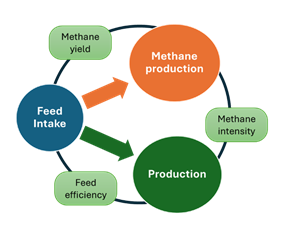
Among the mentioned methane metrics, absolute CH4 emission is the one measurable in the animal, as well as feed intake and performance. These animal traits and the resulting ratios, CH4 yield and intensity, are indicated in Figure 1. Feed efficiency is another trait included in Figure 1, which links feed intake and production, that has been suggested as an indirect trait for CH4 abatement13. The associations among these animal traits and their effect on the CH4 metrics are relevant for evaluating the impact of different mitigation strategies. Feed intake is a key trait due to its association with CH4 emissions and animal performance, and CH4 yield may reveal the efficacy of a mitigation strategy independently of feed intake13.
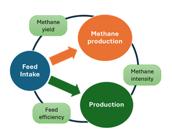
Links of feed intake with production and methane emission, as traits that can be recorded in the animal, and their connections with methane intensity, methane yield and feed efficiency
In Uruguay, CH4 mitigation targets were defined in terms of CH4 intensity, implying that they can be achieved by improving animal performance, contributing to keeping the balance between environmental, economic, and social sustainability1. The specification of the mitigation targets by sector and the paths to achieve them is quite unique4 when compared with other countries. This is also very important for aligning research and development with national policies, with such an alliance serving as a case of integration that could potentially motivate others.
Several mitigation strategies are being investigated worldwide and comprehensive reviews describing and comparing nutritional interventions, management and genetic approaches have been published13)(14)15 Although it is beyond the scope of this review, it is important to mention that several managements and nutritional strategies with significant expected effect on CH4 intensity and CH4 emissions are also being investigated in Uruguay, such as the impact of best cattle management practices on grazing conditions16, the evaluation of forage quality17)(18) , as well as the use of legumes with tannins and antimethanogenic additives19.
Livestock breeding is one of the few mitigation strategies with the advantage of being implemented at farm level in extensive grazing production systems, where nutritional alternatives are of limited applicability due to the low or inexistent use of supplements13. Additionally, potential undesirable correlations between CH4 emissions and animal productivity traits, which could be one possible limitation, could be addressed through the integration of mitigation and production traits into multi-trait selection indices or by implementing new selection criteria, such as residual CH4 emissions15.
4. Genetic evaluation systems in cattle and sheep
As previously indicated, genetic selection can contribute to both components defining emission intensity, absolute CH4 emissions and livestock production. In terms of improving animal performance, Uruguay has had genetic improvement programs in cattle and sheep for three decades, implemented through collaborative working agreements between academic institutions and private organizations. These long-term public-private partnerships involve INIA, Breeder Societies, Uruguayan Rural Association (ARU in Spanish), National Milk Improvement and Control Institute (MU in Spanish), National Milk Institute (INALE in Spanish), Uruguayan Wool Secretariat (SUL in Spanish), and the Schools of Agronomy and Veterinary of the University of the Republic (UDELAR in Spanish)7.
Estimated breeding values, which are expressed as expected progeny differences (EPD), are published every year in the main breeds of the two species and are available at their respective websites (beef cattle, www.geneticabovina.com.uy; dairy cattle, www.geneticalechera.com.uy; sheep, www.geneticaovina.com.uy). The list of breeds and the main groups of traits and selection indices in beef cattle and sheep genetic evaluation systems are summarized in Table 1 and Table 2, respectively, by breed, and show that economically relevant traits pertinent for different production systems in beef cattle and sheep are considered. Detailed descriptions of each trait can be found on the websites and are also given by Ravagnolo and others7.
The comprehensive set of economically relevant traits for the different production systems is very promising in terms of the potential contribution of selective breeding to reduce CH4 intensity by improving productivity. This is supported by the favorable trends in the different traits and selection indices7, information that is also publicly available on the websites.
Reference populations for genomic selection have been built in the context of research projects led by INIA. The biological material is processed in the National Genomic DNA Bank at INIA Las Brujas and genomic information is stored in a centralized database (MgaDBSNP) managed by INIA20. Genomic selection is already available in Angus, Hereford, Holstein and Australian Merino, while reference populations are being developed for other breeds and specifically for difficult-to-measure traits, for example, feed efficiency and CH4 emissions. The implementation of genomic selection is an important step to accelerate genetic progress and facilitate the inclusion of feed efficiency and CH4 emission into the breeding programs6)(7)21.
Current progress and future developments in these specific traits are particularly relevant for mitigation purposes, given that if improving productivity is linked to higher feed intake it may jeopardize the net contribution, given the direct association between feed intake and CH4 emissions15)(21) . In other words, productivity can be improved without increasing CH4 emissions if emission intensity is reduced sufficiently to compensate for the increase in total animal product output13. Evaluating the associations among these traits and CH4 metrics required investment in CH4 emissions, feed intake and feed efficiency phenotyping together with relevant productive, health and reproductive traits.
5. Measuring feed efficiency and methane emissions
Feed efficiency and CH4 emissions are new traits with a significant role in the mitigation of enteric CH4 emission and CH4 intensity. Both are difficult-to-measure traits that require specific equipment and methodologies for data recording and data processing, which have been possible by building phenotypic platforms within the Hereford and sheep information nuclei1. In order to optimize the value of expensive phenotyping for genetic research and development, animals in the evaluation systems, or genetically linked to it, have been recorded. Genomic information has also been obtained to develop reference populations for genomic selection7.
Measuring animals integrated into genetic evaluation systems enables the development of robust databases needed to estimate genetic correlations between CH4 emission metrics and productive traits. Understanding these associations is crucial for identifying potential trade-offs and optimizing breeding programs that balance CH4 mitigation with productivity improvements. As shown in Table 1 and Table 2, the inclusion of a broad range of economically relevant traits in genetic evaluation systems is an asset. It will allow for a comprehensive assessment when optimizing breeding strategies and designing selection indices, ensuring a holistic approach that considers both environmental sustainability and economic productivity. The conformation of information nuclei is an important step to achieve these databases in an efficient way by coordinating recording efforts.
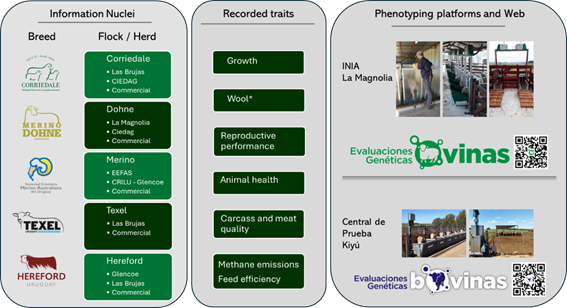
Information nuclei have been implemented in sheep breeds (Corriedale, Dohne Merino, Australian Merino, Texel) and Hereford. They are integrated by phenotyping platforms, genetically interconnected, with the aim of supporting data recording of difficult-to-measure traits to generate databases that enable robust association studies, accurate estimation of genetic correlations, and implementation of genomic selection for new traits. Figure 2 shows a general description of information nuclei, providing an overview of the relevant groups of traits being recorded that are the basis of research projects and the results described below.
Although objectives are similar, the structure and populations integrated differ between nuclei, showing that different approaches can be used adapted to the available resources, having in mind their optimal use to maximize data recording. In the case of sheep breeds, data is recorded in commercial and experimental flocks from different institutions: Las Brujas and La Magnolia from INIA, Dr. Alejandro Gallinal Research and Experimentation Center (CIEDAG in Spanish) that belongs to SUL, and Salto School of Agronomy Experimetal Station (EEFAS in Spanish) from UDELAR. Feed intake, feed efficiency and CH4 emissions are recorded in animals of commercial and experimental flocks at INIA La Magnolia. The Hereford information nucleus comprises the Central de Prueba Kiyú where feed efficiency and CH4 are measured in bulls and steers, and two experimental Hereford herds (Glencoe and Las Brujas). Sires selected by genetic merit for feed efficiency are used in both herds, which also provide steers for the feed efficiency test at finishing that are later evaluated for carcass and meat quality traits.
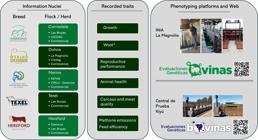
General illustration of information nuclei. Main flocks and herds that are integrated in each nucleus are indicated, as well as the intensive phenotyping platforms in INIA La Magnolia and Central de Prueba de Kiyú. A general overview of the main groups of traits recorded is also presented
5.1 Residual feed intake
Feed efficiency is an economically relevant trait, which has also been indicated as an indirect selection criterion for enteric CH4 abatement. Residual feed efficiency (RFI) is one way to assess feed efficiency, which was defined as the difference between observed and predicted feed intake22. Efficient animals (negative RFI) eat less than inefficient animals (positive RFI) at the same level of production. Consequently, improving feed efficiency by selecting for RFI is an appealing new breeding objective because it leads to improved net income by reducing feed costs without compromising animal performance. At a production system or national level, improving RFI could also be interpreted as a contribution to optimize the use of limiting resources, such as land on pasture-based production systems1.
Computing RFI relies on feed intake records that were very difficult to measure individually in large numbers of animals, until automated feed intake recording systems became available. Accurate RFI values require implementing feed efficiency tests to obtain collection of repeated feed intake and performance measures over time23)(24) . Post-weaning feed efficiency tests of Hereford bulls and steers started in 2014 at the Central de Prueba Kiyú of the Hereford Breeders Society of Uruguay, with the aim of implementing genomic tools to genetically improve RFI in the Hereford breed25. More recently, RFI at finishing (feedlot) is also evaluated in steers immediately after the post-weaning test. A similar initiative is underway at INIA Experimental Station La Magnolia, where the main wool, dual purpose and meat sheep breeds in Uruguay have been measured post-weaning since 2018: Australian Merino, Corriedale, Dohne Merino, Merilin and Texel lambs. Animals evaluated here belong to Selection Nucleus (Australian Merino), Information Nucleus (Corriedale, Dohne Merino, Texel) and commercial stud-flocks (all breeds) and are strongly connected with populations in the genetic evaluation (performance recorded)1. The main aspects of the sheep and cattle feed efficiency tests are described in more detail by Amarillo-Silveira and others24 and Pravia and others25, respectively.
Residual feed intake is estimated in both species, based on Koch and others22, using a multiple linear regression24)(25) . The dependent variable is average feed intake, expressed as dry matter intake (DMI), while the independent variables used in both species are average daily gain (ADG) (estimated by linear regression) and metabolic body weight (MBW). In Hereford the estimation of RFI also includes subcutaneous fat depth measured by ultrasound (FD) at end of the test, as proposed by Basarab and others26, to reduce potential effects on fattening traits and others related to carcass quality and female reproductive traits. In the case of sheep, Marques and others27 evaluated the impact on RFI estimation of including other traits, such as birth type, age, rib-eye area, fat thickness, and wool growth, and concluded that the most parsimonious, the one currently used, is correct.
5.2 Enteric methane emissions
Different methods and methodologies can be used to measure GHG emission, particularly CH4, although all have advantages and inherent limitations, and an important work for improving standardization within and between techniques could improve reliability, as reviewed by Tedeschi and others11. In Uruguay, CH4 and carbon dioxide (CO2) emissions are being measured in all lambs with feed intake and efficiency records using Portable Accumulation Chambers (PAC), leading to a very interesting database that is used to investigate the association between current breeding objectives and potential new ones, such as RFI with GHG emissions. Similarly, GreenFeed stations have been installed since 2021 and have been recording CH4 during the feed efficiency tests in Hereford.
With PACs, CH4 and CO2 emissions are measured twice during the last two weeks of feed efficiency tests, following protocols described by Goopy and others28)(29) and Paganoni and others30. In agreement with Robinson and others31, lambs are kept on feed until the time of measurement. Lambs were allocated to one of the 10 PACs, each with a volume of 862 liters and made of acrylic. These PACs are open at the bottom, placed on rubber mats, sealed with a thin water layer, and restrained with rope straps. Two batches are measured per day, typically between 8:00 and 10:00 AM. As a result, 20 lambs per day (1 pen) or 100 (5 pens) per week are measured, maintaining the same pen group of the RFI test. At start, 20 to 30 and 40 to 50 minutes later, concentrations of CH4, CO2 and oxygen are measured by gas monitors.
The GreenFeed units are placed in the pens used for the feed efficiency tests, and individual CH4 and CO2 emissions are recorded during the tests in Hereford, after a training period of 10 days32. The GreenFeed Emission Monitoring unit consists of a stand-alone head chamber with an overhead hopper, where the concentration of CH4 and CO2 in the breath of an animal is measured while the animal keeps its head in the chamber. A small and controlled amount of pellet is dispensed to the animal, serving as bait and facilitating voluntary visits to the unit for a period of 3 to 6 minutes, which is required to obtain a valid record32. This method is relatively easy to use and allows the measurement of a large number of animals with minimal behavior disturbance on both confined and grazing settings11. It also minimizes the impact on the animal's voluntary feed intake15.
6. Genetics of feed intake, feed efficiency and methane emissions
The potential genetic progress that can be achieved by animal selection in a specific trait depends, among other factors, on the heritability of the trait, and the impact on other traits relevant to the production systems relies on their genetic correlations with the trait. The progress of current data collection has been allowing the estimation of heritability of the new traits relevant for mitigation and sustainability, as well as some of the genetic associations of interest, as accurate estimations of genetic correlation require large datasets, which are particularly more challenging in the case of difficult-to-measure traits. However, preliminary association studies at phenotypic level have provided valuable information about the relationships between traits and provide an interesting insight into the global impact.
6.1 Heritability of RFI and associations with production traits
National estimates confirm that RFI is a moderately heritable trait in Uruguayan Hereford and Australian Merino breeds, with estimates of 0.2525 and 0.2733, respectively.
The definition of RFI as a residual indicates that it would be phenotypically correlated (rP) with DMI and independent from the variables included in the regression. However, some uncertainties have been raised regarding the magnitude of the genetic correlations (rG) because they may not be genetically independent34. Nevertheless, estimates by Pravia and others25 have shown that the genetic correlations between post-weaning RFI and the traits used for its estimation in Hereford were similar to the phenotypic associations: positive correlations with DMI (rP=0.63; rG=0.40) and very low or zero with ADG (rG=0.07; rP=-0.003) and MBW (rG=-0.12; rP=-0.001).
Post-weaning RFI measured in steers is strongly correlated with RFI measured at fattening, which is particularly relevant for the finishing sector, particularly in feedlot systems, which represent a growing sector, responsible for 16% of beef production in Uruguay35. A phenotypic correlation of 0.72 between post-weaning and fattening RFI values was reported by Silveira36 based on the analysis of data from 95 Hereford steers, whilst ADG and MBW at finishing were found to be independent of post-weaning and feedlot RFI (P>0.05). Additionally, the comparison of carcass and meat quality traits of steer classified by their RFI at finishing indicated no effect of improving feed efficiency by RFI on the quality of the final product37. These results agreed with those obtained by Pravia and others38 based on the evaluation of carcass and meat quality of steers categorized into high, medium, and low feed efficiency using post-weaning RFI information and finished on improved pasture, plus grain supplementation.
Despite studies finding a link between lower fatness and high feed efficiency (low RFI values)39)(40) , non-significant phenotypic associations between RFI and fatness measured in vivo or post-slaughter were found by Pravia and others38 and Luzardo and others37. Phenotypic and genetic correlations estimated by Pravia and others25 show independence between subcutaneous fat deposition and post-weaning RFI (rP=0.08; rG=0.01). This may be explained by the incorporation of FD in the multiple regression model used for RFI estimation, as suggested by Basarab and others26)(41) .
The difficulties of accurately recording feed intake on grazing conditions have limited the measurement of RFI in the environment where most livestock production takes place, particularly in the breeding herd. However, recent studies have analyzed the performance of progeny of sires with known EPD for feed efficiency42)(43) . In terms of growth, a first analysis included data from 436 female calves born between 2017 and 2021, progeny of 14 and 9 sires for high and low feed efficiency, respectively. Preliminary results did not show significant differences between progenies for birth weight and weaning weight. However, when comparing body weights from yearling to the first insemination, heifers sired by high-efficiency EPD were slightly heavier than those of the low-efficiency group42. Regarding the association of RFI and reproductive traits, Marin and others43 evaluated 71 and 75 heifers from the first progenies of the Hereford Information Nucleus, born in 2017 and 2018, respectively, and did not observe any major effect of paternal RFI EPD on reproductive performance during the first breeding and calving seasons.
Similar results were reported in sheep based on data recorded in the sheep information nucleus. As mentioned in cattle, RFI is strongly associated with DMI genetically (rG=0.75) and phenotypically (rP=0.79) in Merino lambs33. The comparison of lambs classified as high, medium and low RFI showed that efficient lambs ate 20% less feed than inefficient counterparts, with non-significant differences in body weight, growth and body composition measured by muscle area and fat depth using ultrasound at the end of the feed efficiency test44. When Merino ewes were evaluated on grazing conditions, which were categorized as efficient and inefficient according to their RFI values as lambs, non-significant differences were found in their reproductive performance45. Studies in Corriedale lambs have also indicated that RFI tends to be independent of growth, wool production, and genetic resistance to gastrointestinal parasites46)(47) . Likewise, the correlations between RFI and fleece weight in Australian Merino sheep were not significantly different from zero33.
6.2 Genetics of methane emissions in beef cattle and sheep
The first estimates of heritability of CH4 (0.23) and CO2 (0.27) emissions were reported by Marques and others33 for Uruguayan Australian Merino sheep33. These estimates confirm the feasibility of reducing GHG emission by genetic selection, in agreement with other in studies in sheep30 and cattle6. Furthermore, non-significant phenotypic association between RFI and CH4 and CO2 were reported in Corriedale46 and Merino lambs33. Nevertheless, favorable positive genetic correlation was estimated in Merino, indicating that most efficient lambs are also lower emitters33 and the possibility of using RFI as an indirect selection criterion for CH4 mitigation.
The comparison of absolute CH4 emissions between efficient and inefficient lambs45 and steers48 suggests that lower absolute CH4 emissions are expected in more efficient animals. These findings are promising in terms of their contribution to economic and environmental sustainability. However, both studies also showed that more efficient animals produce more CH4 per unit of dry matter intake (CH4 yield). Contradictory results regarding the relationship between RFI and CH4 emissions are found in the literature and depend on several factors discussed by Cantalapiedra-Hijar and others40.
6.3 Role of genomic selection for sustainability
The high cost and labor intensity associated with measuring CH4 emissions together with DMI to estimate RFI clearly indicate the benefits of implementing genomic selection. Due to the complexity of data recording, only a proportion of the actual selection candidates can be phenotyped, thereby restricting the number of animals with estimated genetic merit and their accuracy, if traditional genetic predictions are used. Because this limitation can be overcome by genomic predictions, RFI and CH4 emissions phenotyping platforms in sheep and beef cattle in Uruguay were designed as the initial reference populations for genomic selection based on national and international research funding. DNA samples of animals with these phenotypes were stored at INIA animal DNA bank and subsequently genotyped, mainly using medium density (50k) single nucleotide polymorphism (SNP) panels. An initial binational reference population comprising 731 Uruguayan and 1168 Canadian Hereford bulls and steers was the basis for estimating genomic expected progeny differences (GEPD), which have been published since 20177)(49) . The assessment of prediction ability using two validation strategies concluded that it is possible to predict accurate and unbiased RFI GEPDs for non-phenotyped selection candidates based on genomic prediction50.
In 2023, GEPDs for RFI and CH4 emission were made available for an Australian Merino breed as research breeding values, being a first step before incorporating routinely these traits into the breeding program. These estimates were based on 1200 lambs phenotyped for RFI and CH4 and 3000 genotyped animals. Additionally, the use of genomic information for predictions on commercial farms in Australian Merino was investigated. The objective in this case was to predict the genetic merit of individual animals or groups of animals from commercial flocks, providing an objective basis for comparing their genetics to those of stud flocks and information nucleus51. It represents a direct contribution to selection decisions by enabling a more accurate identification of the best rams, aligned with the objectives of each commercial farm. This application of genomic information has been included within the regenerative livestock farming approach proposed by Blumetto and others52. In this approach, DNA samples from relevant sires used on each farm were genotyped and compared with the population in the genetic evaluation, providing a first “snapshot” of the farm's genetics. Modeling work carried out based on Life Cycle Analysis, using the Australian Merino database, indicates a potential abatement of emission intensity associated with wool products, ranging from 6 to 20%, assuming the flock has a CH4 emission equivalent to the top 25% genetically superior (animals with lower emission)52. This was the first national estimation of the impact on CH4 mitigation in livestock production systems. Further analysis based on modeling work considering production traits and CH4 metrics is needed to determine the effect on CH4 mitigation. In this sense, the availability of accurate estimations of genetic correlations is very important. Future studies should also consider the investigation of the most appropriate CH4 metric to use given possible different associations with productivity and economic results of production systems. However, it is important to mention existing evidence in sheep selection lines for lower emitter animals of an annual 1% reduction of CH4 emissions with no impact on productivity53.
Large reference populations have a favorable impact on the accuracies of genomic predictions, serving as an incentive for breeders to invest in genotyping and RFI and CH4 phenotyping, which in turn contributes to accelerating reference population growth54. Although the expected benefits of genomic selection are more relevant in difficult-to-measure traits, the main challenge lies in the costs and complexity associated with phenotyping, which are essential for building the corresponding reference populations. The successful implementation and adoption of genomic selection will increase the number of animals in the national genetic evaluation with GEPD for RFI and CH4, with favorable implications for the inclusion of these new traits in selection indices. This will help balance potential antagonisms between productivity and GHG emissions.
7. Conclusions
Several strategies are being considered worldwide to reduce CH4 emissions, and selective breeding is an effective way to achieve national mitigation targets. Genetic improvement through selection has the advantages of being cumulative, permanent, and sustainable, indicating that benefits are obtained over generations and remain permanent.
Feed efficiency and CH4 emissions are two key heritable traits, confirming that they are under genetic control and, therefore, feasible to be improved through selective breeding. This aspect is even more relevant in the context of extensive livestock production systems, where other alternatives (supplements, additives) are difficult and costly to implement. Improving feed efficiency by RFI implies reducing feed intake, and feed costs, without compromising animal performance, which is very relevant for economic development of the livestock industry. Although there is evidence that higher feed efficiency is related to lower CH4 emissions, the results are not conclusive. This deserves further investigation given the direct association of feed intake with feed efficiency, productivity, and CH4 emissions. Unraveling these associations will provide valuable information for optimizing the contribution of breeding programs, considering all dimensions that define sustainability.
Improving productivity and reducing inefficiencies in production systems have a direct favorable impact on CH4 intensity; however, it may increase absolute emissions. On the other hand, selective breeding of low emitter animals has a positive effect on reducing total CH4 emissions, but potential trade-offs with production traits should be taken into account and accurate estimates of genetic correlations are required.
Phenotyping platforms for RFI and CH4 emissions are in place, and recorded animals are part of the information nuclei linked to genetic evaluations systems. This represents an advantage for building larger datasets of CH4 emissions, feed intake, feed efficiency and production traits for the estimation of genetic correlations and implementation of breeding programs contributing to national GHG mitigation targets and sustainable livestock systems. An important next step is to expand data recording on grazing conditions, given the relevance of pasture production systems, and to continue enhancing reference populations for genomic selection.
Acknowledgements:
This work was carried out within the framework of the projects “Fenómica y genómica en bovinos de carne” (CL_54), RUMIAR (CL_38) and GENERA (ARN_18) financed by Instituto Nacional de Investigación Agropecuaria. The authors acknowledge the funding organizations Agencia Nacional de Investigación e Innovación (RTS_1_2012_1_3489; FSA_1_2018_1_152872) and the European Union’s Horizon 2020 research and innovation program under grant agreement No 772787 (SMARTER), as well as the collaboration of the Breeder Societies.
References:
- 1. Navajas EA, Ravagnolo O, De Barbieri I, Pravia MI, Aguilar I, Lema MO, Vera B, Peraza P, Marques CB, Velazco JI, Ciappesoni G. Genetic selection of feed efficiency and methane emissions in sheep and cattle in Uruguay: progress and limitations. In: Technical and species orientated innovations in animal breeding, and contribution of genetics to solving societal challenges. Proceedings of 12th World Congress on Genetics Applied to Livestock Production (WCGALP) . Rotterdam: Wageningen Academic Publishers; 2022. p. 164-7.
-
2. Greenwood PL. An overview of beef production from pasture and feedlot globally, as demand for beef and the need for sustainable practices increase. Animal. 2021;15 Suppl 1:100295. Doi: 10.1016/j.animal.2021.100295.
» https://doi.org/10.1016/j.animal.2021.100295 -
3. Uruguay XXI. Livestock sector in Uruguay (Internet). 2024 (cited 2025 Jun 10). 40p. Available from: Available from: https://www.uruguayxxi.gub.uy/en/information-center/article/livestock-report-2024/#
» https://www.uruguayxxi.gub.uy/en/information-center/article/livestock-report-2024/# -
4. Ministerio de Ambiente (UY). Sexta comunicación nacional: a la Conferencia de las Partes en la Convención Marco de las Naciones Unidas sobre el Cambio Climático (Internet). Montevideo: MA; 2023 (cited 2025 Jun 10). 312p. Available from: Available from: https://www.gub.uy/ministerio-ambiente/sites/ministerio-ambiente/files/documentos/publicaciones/6CN-2023-COMPLETA.pdf
» https://www.gub.uy/ministerio-ambiente/sites/ministerio-ambiente/files/documentos/publicaciones/6CN-2023-COMPLETA.pdf -
5. República Oriental del Uruguay. Segunda contribución determinada a nivel nacional al acuerdo de París (Internet). 2022 (cited 2025 Jun 10). 94p. Available from: Available from: https://bit.ly/3ZUJndQ
» https://bit.ly/3ZUJndQ -
6. Dressler EA, Bormann JM, Weaber RL, Rolf MM. Use of methane production data for genetic prediction in beef cattle: a review. Transl Anim Sci. 2024;8:txae014. Doi: 10.1093/tas/txae014.
» https://doi.org/10.1093/tas/txae014 - 7. Ravagnolo O, Aguilar I, Ciappesoni G, Navajas EA. Investigación y aplicación de la mejora genética animal para una producción ganadera más sostenible. In: Aportes científicos y tecnológicos del Instituto Nacional de Investigación Agropecuaria (INIA) del Uruguay a las trayectorias agroecológicas. Buenos Aires: Fundación CICCUS; 2023. p. 373-94.
-
8. FAO. Methane emissions in livestock and rice systems: sources, quantification, mitigation and metrics. Rome: FAO; 2023. 313p. Doi: 10.4060/cc7607en.
» https://doi.org/10.4060/cc7607en -
9. Johnson KA, Johnson DE. Methane emissions from cattle. J Anim Sci. 1995;73(8):2483-92. Doi: 10.2527/1995.7382483x.
» https://doi.org/10.2527/1995.7382483x -
10. United Nations Environment Programme; Climate and Clean Air Coalition. Global Methane Assessment: benefits and costs of mitigating methane emissions (Internet). Nairobi: United Nations; 2021 (cited 2025 Jun 10). 172p. Available from: Available from: https://www.ccacoalition.org/sites/default/files/resources//2021_Global-Methane_Assessment_full_0.pdf
» https://www.ccacoalition.org/sites/default/files/resources//2021_Global-Methane_Assessment_full_0.pdf -
11. Tedeschi LO, Abdalla AL, Álvarez C, Anuga SW, Arango J, Beauchemin KA, Becquet P, Berndt A, Burns R, De Camillis C, Chará J, Echazarreta JM, Hassouna M, Kenny D, Mathot M, Mauricio RM, McClelland SC, Niu M, Onyango AA, Parajuli R, Pereira LGR, Del Prado A, Paz Tieri M, Uwizeye A, Kebreab E. Quantification of methane emitted by ruminants: a review of methods. J Anim Sci . 2022;100(7):skac197. Doi: 10.1093/jas/skac197.
» https://doi.org/10.1093/jas/skac197 -
12. República Oriental del Uruguay. Primera contribución determinada a nivel nacional al acuerdo de parís (Internet). 2017 (cited 2025 Mar 26). 29p. Available from: Available from: https://www.gub.uy/ministerioambiente/sites/ministerioambiente/files/202104/Uruguay_Primera_Contribucion_Determinada_a_nivel_Nacional_0.pdf
» https://www.gub.uy/ministerioambiente/sites/ministerioambiente/files/202104/Uruguay_Primera_Contribucion_Determinada_a_nivel_Nacional_0.pdf -
13. Beauchemin KA, Ungerfeld EM, Abdalla AL, Alvarez C, Arndt C, Becquet P, Benchaar C, Berndt A, Mauricio RM, McAllister TA, Oyhantçabal W, Salami SA, Shalloo L, Sun Y, Tricarico J, Uwizeye A, De Camillis C, Bernoux M, Robinson T, Kebreab E. Current enteric methane mitigation options. J Dairy Sci. 2022;105(12):9297-326. Doi: 10.3168/jds.2022-22091.
» https://doi.org/10.3168/jds.2022-22091 -
14. Fouts JQ, Honan MC, Roque BM, Tricarico JM, Kebreab E. Enteric methane mitigation interventions. Transl Anim Sci . 2022;6(2):txac041. Doi: 10.1093/tas/txac041.
» https://doi.org/10.1093/tas/txac041 -
15. Smith PE, Kelly AK, Kenny DA, Waters SM. Enteric methane research and mitigation strategies for pastoral-based beef cattle production systems. Front Vet Sci. 2022;9:958340. Doi: 10.3389/fvets.2022.958340.
» https://doi.org/10.3389/fvets.2022.958340 -
16. Ganadería y Clima. Informe final: análisis del impacto del proyecto en los 60 predios, en las dimensiones económico productiva, social y de género, y ambiental (Internet). Montevideo: MGAP; 2023 (cited 2025 Jun 10). 120p. Available from: Available from: https://bit.ly/4kBU51i
» https://bit.ly/4kBU51i -
17. Dini Y, Gere JI, Cajarville C, Ciganda VS. Using highly nutritious pastures to mitigate enteric methane emissions from cattle grazing systems in South America. Anim Prod Sci. 2017;58:2329-34. Doi: 10.1071/AN16803.
» https://doi.org/10.1071/AN16803 -
18. Santander D, Clariget J, Banchero G, Alecrim F, Simon Zinno C, Mariotta J, Gere J, Ciganda VS. Beef steers and enteric methane: reducing emissions by managing forage diet fiber content. Animals (Basel). 2023;13(7):1177. Doi: 10.3390/ani13071177.
» https://doi.org/10.3390/ani13071177 - 19. Ciganda V, Santander D. Mitigación de emisiones de metano entérico. In: Jornada de porteras abiertas de ganadería intensiva: herramientas para una ganadería productiva y eficiente. Montevideo: INIA; 2023. p. 21-7.
- 20. Carracelas B, Peraza P, Vergara A, Ciappesoni G, Ravagnolo O, Aguilar I, Lema M, Navajas E. Banco de ADN genómico animal - plataforma de evaluación genómica. Revista INIA. 2022;(71):38-42.
-
21. Barwick SA, Henzell AL, Herd RM, Walmsley BJ, Arthur PF. Methods and consequences of including reduction in greenhouse gas emission in beef cattle multiple-trait selection. Genet Sel Evol. 2019;51(1):18. Doi: 10.1186/s12711-019-0459-5.
» https://doi.org/10.1186/s12711-019-0459-5 -
22. Koch RM, Swiger LA, Chambers D, Gregory KE. Efficiency of feed use in beef cattle. J Anim Sci . 1963;22:486-94. Doi: 10.2527/jas1963.222486x.
» https://doi.org/10.2527/jas1963.222486x -
23. Marzocchi MZ, Sakamoto LS, Canesin RC, Dos Santos Gonçalves Cyrillo J, Mercadante MEZ. Evaluation of test duration for feed efficiency in growing beef cattle. Trop Anim Health Prod. 2020;52(4):1533-9. Doi: 10.1007/s11250-019-02161-0.
» https://doi.org/10.1007/s11250-019-02161-0 -
24. Amarilho-Silveira F, de Barbieri I, Cobuci JA, Balconi CM, de Ferreira GF, Ciappesoni G. Residual feed intake for Australian Merino sheep estimated in less than 42 days of trial. Lives Sci. 2022;258:104889. Doi: 10.1016/j.livsci.2022.104889.
» https://doi.org/10.1016/j.livsci.2022.104889 -
25. Pravia MI, Navajas EA, Aguilar I, Ravagnolo O. Evaluation of feed efficiency traits in different Hereford populations and their effect on variance component estimation. Anim Prod Sci . 2022;62(17):1652-60. Doi: 10.1071/AN21420.
» https://doi.org/10.1071/AN21420 -
26. Basarab JA, Price MA, Aalhus JL, Okine EK, Snelling WM, Lyle KL. Residual feed intake and body composition in young growing cattle. Can J Anim Sci . 2003;83(2):189-204. Doi: 10.4141/A02-065.
» https://doi.org/10.4141/A02-065 - 27. Marques C, Ciappesoni G, Velazco J, Navajas E, Ferreira G, Ramos Z, Rovira F, De Barbieri I. Evaluation of different mod-els to define a more suitable residual feed intake estimation in sheep. In: Book of Abstracts of the 72nd Annual Meeting of the European Federation of Animal Science. Wageningen: Wageningen Academic Publishers; 2021. p. 115.
-
28. Goopy JP, Robinson DL, Woodgate RT, Donaldson AJ, Oddy VH, Vercoe PE, Hegarty RS. Estimates of repeata-bility and heritability of methane production in sheep using portable accumulation chambers. Anim Prod Sci . 2016;56(1):116-22. Doi: 10.1071/AN13370.
» https://doi.org/10.1071/AN13370 -
29. Goopy JP, Woodgate R, Donaldson A, Robinson DL, Hegarty RS. Validation of a short-term methane measurement using portable static chambers to estimate daily methane production in sheep. Anim Feed Sci Technol. 2011;166-167:219-26. Doi: 10.1016/j.anifeedsci.2011.04.012.
» https://doi.org/10.1016/j.anifeedsci.2011.04.012 -
30. Paganoni B, Rose G, Macleay C, Jones C, Brown DJ, Kearney G, Ferguson M, Thompson AN. More feed efficient sheep produce less methane and carbon dioxide when eating high-quality pellets. J Anim Sci . 2017;95(9):3839-50. Doi: 10.2527/jas2017.1499.
» https://doi.org/10.2527/jas2017.1499 -
31. Robinson DL, Dominik S, Donaldson AJ, Oddy VH. Repeatabilities, heritabilities and correlations of methane and feed intake of sheep in respiration and portable chambers. Anim Prod Sci . 2020;60(7):880-92. Doi: 10.1071/AN18383.
» https://doi.org/10.1071/AN18383 -
32. Velazco J. Cuantificación de metano entérico en Kiyú: la bolilla que faltaba. In: Anuario Hereford (Internet). Montevideo: Sociedad Criadores de Hereford del Uruguay; 2022 (cited 2025 Jun 10). p. 178-82. Available from: Available from: https://issuu.com/hubmediauy/docs/issuu_-_anuario_hereford_2022
» https://issuu.com/hubmediauy/docs/issuu_-_anuario_hereford_2022 - 33. Marques CB, De Barbieri I, Velazco J, Navajas EA, Ciappesoni G. Genetic parameters for feed efficiency, gas emissions, oxygen consumption and wool traits in Australian Merino. In: Technical and species orientated innovations in animal breeding, and contribution of genetics to solving societal challenges. Proceedings of 12th World Congress on Genetics Applied to Livestock Production (WCGALP) . Wageningen: Wageningen Academic Publishers ; 2022. p. 160-3.
-
34. Kennedy BW, van der Werf JH, Meuwissen TH. Genetic and statistical properties of residual feed intake. J Anim Sci . 1993;71(12):3239-50. Doi: 10.2527/1993.71123239x.
» https://doi.org/10.2527/1993.71123239x -
35. Instituto Nacional de Carne. Informe Anuario estadístico 2022 (Internet). 2023 (cited 2025 Jun 10). 48p. Available from: Available from: https://www.inac.uy/innovaportal/file/23151/1/anuario-estadistico-2022-analsis-de-cifras.pdf
» https://www.inac.uy/innovaportal/file/23151/1/anuario-estadistico-2022-analsis-de-cifras.pdf - 36. Silveira Arburúas MB. Asociación de eficiencia de conversión del alimento con otras características de importancia económica y ambiental en la producción de carne (master's thesis). Montevideo (UY): Universidad de la República, Facultad de Agronomía; 2023. 114p.
-
37. Luzardo S, de Souza G, Brito G, Peraza P, Navajas E. Is residual feed intake associated to carcass and meat quality traits? In: 70th International Congress of Meat Science and Technology (Internet). Foz do Iguaçu: Funpec Editora; 2024 (cited 2025 Jun 10). p. 107-8. Available from: Available from: https://www.icomst2024.com/wp-content/uploads/2024/09/ICoMST_2024_Proceedings.pdf
» https://www.icomst2024.com/wp-content/uploads/2024/09/ICoMST_2024_Proceedings.pdf - 38. Pravia MI, Navajas EA, Macedo FL, Clariget J, Luzardo S. Association between feed efficiency and carcass and meat quality traits in Hereford steers. In: 11th World Congress on Genetics Applied to Livestock Production. Auckland: WCGALP; 2018. p. 604
-
39. Herd RM, Arthur PF, Bottema CDK, Egarr AR, Geesink GH, Lines DS, Piper S, Siddell JP, Thompson JM, Pitchford WS. Genetic divergence in residu-al feed intake affects growth, feed efficiency, carcass and meat quality characteristics of Angus steers in a large commercial feedlot. Anim Prod Sci . 2014;58:164-74. Doi: 10.1071/AN13065.
» https://doi.org/10.1071/AN13065 -
40. Cantalapiedra-Hijar G, Abo-Ismail M, Carstens GE, Guan LL, Hegarty R, Kenny DA, McGee M, Plastow G, Relling A, Ortigues-Marty I. Biological determinants of between-animal variation in feed efficiency of growing beef cattle. Animal. 2018;12(s2):s321-s335. Doi: 10.1017/S1751731118001489.
» https://doi.org/10.1017/S1751731118001489 -
41. Basarab JA, Colazo MG, Ambrose DJ, Novak S, McCartney D, Baron VS. Residual feed intake adjusted for backfat thickness and feeding frequency is independent of fertility in beef heifers. Can J Anim Sci . 2011;91(4):573-84. Doi: 10.4141/cjas2011-010.
» https://doi.org/10.4141/cjas2011-010 -
42. Devincenzi T, Lema M, Navajas E. Genética de eficiencia de conversión: crecimiento y performance reproductiva de hembras del Núcleo Informativo Hereford de INIA Glencoe. In: Anuario Hereford (Internet). Montevideo: Sociedad Criadores de Hereford del Uruguay ; 2024 (cited 2025 Jun 10). p. 267-9. Available from: Available from: https://www.hereford.org.uy/anuario-hereford-2024-11?nid=319
» https://www.hereford.org.uy/anuario-hereford-2024-11?nid=319 -
43. Marín MF, Naya H, Espasandin AC, Navajas E, Devincenzi T, Carriquiry M. Energy efficiency, reproductive performance, and metabolic parameters of grazing Hereford heifers. Livest Sci. 2024;279:105389. Doi: 10.1016/j.livsci.2023.105389.
» https://doi.org/10.1016/j.livsci.2023.105389 - 44. De Barbieri I, Navajas E, Giorello D, Velazco J, Banchero G, Rodriguez B, Rovira F, Ciappesoni G. Association between feed efficiency and methane emissions, performance and health in Merino sheep. In: Book of Abstracts of the 71st Annual Meeting of the European Federation of Animal Science. Wageningen: Wageningen Academic Publishers ; 2020. p. 560.
- 45. De Barbieri I, Ferreira G, Ramos Z, Navajas E, Ciappesoni G. Consequences of contrasting feed efficiency as lamb on later ewe performance. In: Book of Abstracts of the 73rd Annual Meeting of the European Federation of Animal Science. Wageningen: Wageningen Academic Publishers ; 2022. p. 674.
- 46. Navajas E, Ciappesoni G, Gimeno D, Velazco J, De Barbieri I. Association of genetic resistance to internal nematodes and production traits on feed efficiency and methane emissions in Corriedale lambs. In: Technical and species orientated innovations in animal breeding, and contribution of genetics to solving societal challenges. Proceedings of 12th World Congress on Genetics Applied to Livestock Production (WCGALP) . Rotterdam: Wageningen Academic Publishers ; 2022. p. 195-8.
-
47. Ferreira GF, Ciappesoni G, Castells D, Amarilho-Silveira F, Navajas EA, Giorello D, De Barbieri I. Feed conversion efficiency in sheep genetically selected for resistance to gastrointestinal nematodes. Anim Prod Sci . 2021;61(8):754-60. Doi: 10.1071/AN20121.
» https://doi.org/10.1071/AN20121 -
48. Peraza P, Navajas E. Consumo de alimento, emisiones de metano y producción: rol de la eficiencia de conversión. In: Anuario Hereford (Internet). Montevideo: Sociedad Criadores de Hereford del Uruguay ; 2024 (cited 2025 Jun 10). p. 262-4. Available from: Available from: https://www.hereford.org.uy/anuario-hereford-2024-11?nid=319
» https://www.hereford.org.uy/anuario-hereford-2024-11?nid=319 - 49. Ravagnolo O, Aguilar I, Crowley JJ, Pravia MI, Lema M, Macedo FL, Scott S, Navajas EA. Accuracy of genomic predictions of residual feed intake in Hereford with Uruguayan and Canadian training populations. In: 11th World Congress on Genetics Applied to Livestock Production . Auckland: WCGALP ; 2018. p. 723.
-
50. Pravia MI, Navajas EA, Aguilar I, Ravagnolo O. Prediction ability of an alternative multi-trait genomic evaluation for residual feed intake. J Anim Breed Genet. 2023;140(5):508-18. Doi: 10.1111/jbg.12775.
» https://doi.org/10.1111/jbg.12775 - 51. Vera B, Navajas E, De Barbieri I, van Lier E, Ciappesoni G. Predicciones genómicas para rasgos productivos y de valor ambiental en ovinos Merino Australiano. In: XI Congreso Biotecnología productiva y sostenible. Yucatán: REDBIO; 2022. p. 122.
- 52. Blumetto O, De Barbieri I, Navajas E, Baethgen W, Vera B, Becoña G, Ciappesoni G. Regenerative livestock farming in Uruguay. Montevideo: INIA ; 2023. 23p.
-
53. Rowe SJ, Hickey SM, Johnson PL, Bilton TP, Jonker A, Bain W, Veenvliet B, Pile G, Bryson B, Knowler K, Amyes NC, Newman SA, McEwan JC. The contribution animal breeding can make to industry carbon neutrality goals. In: Proceedings of the Twenty-fourth Conference (Internet). Armidale: AAABG; 2021 (cited 2025 Jun 10). p. 15-8. Availble from: Availble from: https://www.aaabg.org/aaabghome/AAABGproceedings24book.pdf
» https://www.aaabg.org/aaabghome/AAABGproceedings24book.pdf -
54. Berry DP, Garcia JF, Garrick DJ. Development and implementation of genomic predictions in beef cattle. Anim Front. 2016;6:32-8. Doi: 10.2527/af.2016-0005.
» https://doi.org/10.2527/af.2016-0005