A methodological approach to estimating the production value of family farming in Uruguay
Abstract:
Family farming plays a pivotal role in the economic and social structure of rural areas, particularly in developing countries, where it underpins food production, food security, and rural employment. Despite its recognized importance, there is a lack of detailed, disaggregated data and estimates regarding its economic contribution. This study fills that gap by quantifying the share of family farming in Uruguay’s gross production value (GPV) across five key agricultural sectors: fruit production, horticulture, beekeeping, beef cattle, and dairy farming. Using data from the National Family Farming Registry, combined with administrative records and price data, the research estimates GPV based on physical output and average national prices. From 2018 to 2022, family farming consistently contributed between 14% and 17% to the total GPV in these sectors. By providing empirical evidence of its economic relevance, this work enhances understanding of the sector and informs the development of more targeted and effective agricultural policies.
Keywords:
gross production value; beef cattle; dairy farming; fruit production; horticulture; beekeeping
Resumen:
La agricultura familiar desempeña un papel fundamental en la estructura económica y social de las zonas rurales, especialmente en los países en desarrollo, donde sostiene la producción de alimentos, la seguridad alimentaria y el empleo rural. Sin embargo, a pesar de su reconocida importancia, persiste una falta de estimaciones desagregadas sobre su contribución económica. Este artículo busca llenar ese vacío cuantificando la participación de la agricultura familiar en el valor bruto de la producción (VBP) nacional de Uruguay en cinco sectores agropecuarios: fruticultura, horticultura, apicultura, ganadería de carne y lechería. A partir de datos del Registro Nacional de la Agricultura Familiar, integrados con registros administrativos y estadísticas de precios, el estudio estima el VBP combinando producción física con precios promedio nacionales. Entre 2018 y 2022, la agricultura familiar representa de forma constante entre 14% y 17% del VBP total en los sectores analizados. Al aportar evidencia empírica sobre su relevancia económica, este trabajo contribuye a una mejor comprensión del sector y respalda el diseño de políticas agrícolas más informadas y eficaces.
Palabras clave:
valor de producción; ganadería; lechería; fruticultura; horticultura; apicultura
Resumo:
A agricultura familiar desempenha um papel essencial na estrutura econômica e social das áreas rurais, especialmente nos países em desenvolvimento, onde sustenta a produção de alimentos, a segurança alimentar e o emprego rural. No entanto, apesar de sua importância amplamente reconhecida, ainda são escassas as estimativas desagregadas de sua contribuição econômica. Este artigo busca preencher essa lacuna ao quantificar a participação da agricultura familiar no valor da produção (VP) nacional do Uruguai em cinco setores agropecuários: fruticultura, horticultura, apicultura, pecuária de corte e pecuária leiteira. Com base em dados do Registro Nacional da Agricultura Familiar, integrados a registros administrativos e estatísticas de preços, o estudo estima o VP a partir da produção física e dos preços médios nacionais. Entre 2018 e 2022, a agricultura familiar respondeu de forma consistente por 14% a 17% do VP total nos setores analisados. Ao oferecer evidências empíricas sobre sua relevância econômica, o estudo contribui para uma melhor compreensão do setor e apoia a formulação de políticas agrícolas mais eficazes e fundamentadas.
Palavras-chave:
valor de produção; pecuária; produção leiteira; fruticultura; horticultura; apicultura
1. Introduction
Family farming is crucial to the economic and social structure of rural areas, particularly in developing countries. It significantly contributes to food production, sustainable resource management, rural employment, territorial cohesion, and the sustainability of small communities, making it a vital component for inclusive rural development.
Despite its strategic importance, there remains a significant gap in the availability of timely, reliable, and disaggregated economic data on family farming. Globally, the contribution of family farmers to food security and regional development is often inadequately documented1)(2)3. This data deficit undermines the formulation of evidence-based agricultural and rural policies and hampers efforts to recognize and strengthen the specific contributions of family farms to national economies and agri-food value chains. Consequently, important decisions, such as the allocation of public resources, the design of support programs, and the evaluation of productivity and competitiveness, are frequently made without an adequate understanding of the economic performance of family farming.
Uruguay is an example of this situation. Although family farming is recognized in national policies4)(5) , it represents a large portion of the country's farmers6, particularly in sectors like fruit and vegetable cultivation, beekeeping, beef cattle, and dairy farming. According to Tomassino and others6, based on the 2011 Agricultural Census, beef cattle and sheep farming account for the largest share of family farmers, constituting 62.2% of all family farming units. Horticulture, fruit production, and viticulture follow with 14.2%, while dairy farming is at 11.8%. Smaller shares are noted in rainfed agriculture (3.5%), pig farming (2.1%), poultry (1.8%), rural services (1.0%), forestry (0.4%), and rice (0.3%).
However, estimates of its economic contribution are absent. This data gap weakens targeted policy development, reduces the visibility of family producers in official statistics, and limits an informed public discussion on their role in agri-food systems.
This article seeks to address that gap by providing new empirical evidence on family farming's economic contribution in Uruguay. Specifically, the study estimates the share of family farming in the gross production value (GPV) across five key sectors: fruit, horticulture, beekeeping, beef cattle, and dairy farming, for the period 2018-2022. The analysis relies on the Family Farming Registry maintained by the General Directorate of Rural Development (DGDR) of the Ministry of Livestock, Agriculture, and Fisheries (MGAP), integrating administrative production records and price data.
By systematically combining various administrative data sources and applying a replicable valuation method, the study offers a new estimate of family farming's share in Uruguay's national production value. Findings show that family producers consistently account for 14% to 17% of total GPV across the selected sectors during the study period. These results underscore the stable and significant role of family farms in Uruguay’s agricultural economy.
By enhancing the visibility of family farming in statistics, this study aims to support a more informed public debate about its economic role and the conditions under which it operates.
2. Materials and Methods
2.1 Methodological Approach
Estimating the economic contribution of family farming poses significant challenges, particularly due to the limited availability of disaggregated data by producer type. In this study, we use gross production value (GPV) as a practical proxy for economic contribution. GPV reflects the monetary value of output at the farm-gate level, and can be estimated from production quantities and market prices, without requiring cost or revenue data.
While value added would offer a more comprehensive measure of economic contribution, its estimation is infeasible due to the lack of disaggregated cost data distinguishing family from non-family producers. Therefore, we focus on GPV, applying uniform national average prices to both producer types. This approach is justified by the high level of price integration observed in Uruguay's domestic markets and is commonly adopted when there is no evidence of price discrimination.
Production is assessed using farm gate prices, either directly observed or estimated. For beef cattle, dairy, and honey production, farm-gate prices are obtainable through official statistics. For fruit and horticultural products, where only wholesale prices are reported, farm-gate prices are estimated by deducting transport costs and marketing margins based on value chain studies7. In all cases, differences in GPV between family and non-family farming result solely from variations in output quantities, not from price or input cost differences. Technical details on constructing sectoral production values for family farmers are provided in Appendix 1 of the Supplementary materials.
2.2 Identification of Family Farmers
Family farmers are identified through the Registro de la Producción Familiar4) (Family Farming Registry), administered by the General Directorate of Rural Development (DGDR) within Uruguay’s Ministry of Livestock, Agriculture, and Fisheries (MGAP). The registry collects each producer’s national ID and principal productive activity, enabling linkage with sector-specific administrative data sources.
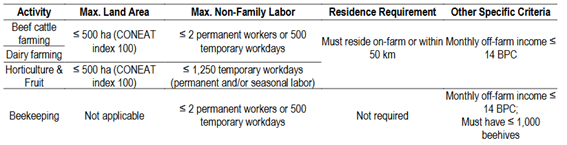
The definition of family farming used in this study follows MGAP Resolution No. 1013/20168, which establishes activity specific eligibility criteria. These include limits on land area, use of non-family labor, off-farm income, and, depending on the sector, residential proximity to the production unit. Table 1 summarizes the criteria applied to the five sectors included in the analysis.
The CONEAT index9, a standardized scale in Uruguay, measures land productivity, especially for livestock and wool production. It ranges from 0 to 250, with a score of 100 indicating the national average. This index is widely used for purposes such as taxation and land valuation.
The study concentrates on five key sectors: beef cattle, dairy, horticulture, fruit, and beekeeping. These sectors encompass the majority of registered family producers, with over 85% of family farming units in Uruguay identifying one of these as their primary activity (see Table 2).
The choice to focus on these sectors is based on their representativeness within the family farming community and the availability of reliable administrative data, which allows for consistent classification across different regions and activities.
2.3 Data Sources and Sectoral Valuation Methods
To estimate production volumes and values, the study integrates administrative records and official statistics for each of the five sectors (Table 3). Only producers actively registered in the Family Farming Registry during a specific year are classified as family farmers. Although some underreporting or lag in registration updates may occur, the registry remains the most robust administrative source for identifying family producers in Uruguay. Registration is voluntary, but incentivized through access to public programs, including tax exemptions and sectoral support. To maintain eligibility, registration must be renewed biennially.
Besides the Family Farming Registry, producers are also required to register in sectoral databases in order to qualify for other benefits. This enhances the coverage and consistency of the data.
It is important to note that sectors such as beef, dairy, and honey are primarily export-oriented, so registration coverage in these areas is expected to be nearly complete11. In contrast, fruit and horticulture are geared toward the domestic market, and may have greater coverage limitations, especially among larger commercial producers. While no recent studies exist to measure registry penetration using census data, it is likely that small and medium-scale producers are well captured due to the incentive structure for registering. Large producers are also required to register, but coverage gaps may persist in some cases.
3. Results
3.1 Family Participation in Beef and Dairy Production
Administrative data from the National Livestock Information System (SNIG) and DICOSE12 indicate that Uruguay's cattle sector comprised approximately 38,000 to 39,000 registered production units from 2017 to 2022. These units cover around 14 million hectares and generate up to USD 2.7 billion annually in beef production value. Within this sector, family producers represented about 30% of the total number of farms. However, despite their share in farm numbers, they accounted for only around 10% of the total beef production value and managed less than 9% of the land dedicated to cattle farming in 2022 (see Table 4).
The number of DICOSE registrations is used as a proxy for identifying production units. It’s important to note that a single farm may have multiple DICOSE numbers. To improve accuracy, an analysis was conducted using the society code variable in SNIG, which serves as a proxy for unique farm enterprises. Aggregating DICOSE numbers by entity yielded similar results to the disaggregated data, reinforcing the robustness of the reported figures.
In dairy, family producers account for a relatively higher share of national production. In 2022, they contributed 20% of the total milk production value (Table 5).
3.2 Family Participation in Beekeeping
Beekeeping is a significant component of family farming in Uruguay. Between the 2017/18 and 2022/23 seasons, over 1,100 of the approximately 2,600 to 2,900 registered beekeepers each year were identified as family farmers. Economically, their contribution to the sector ranged from UYU 216 million to UYU 370 million annually, indicating a meaningful presence in the national honey value chain.
Throughout this period, family beekeepers consistently accounted for between 41% and 46% of all registered producers and contributed a similar share to the total honey production value, as shown in Table 6. These figures highlight the central role that family farming plays in Uruguay's apiculture sector.
However, the actual proportion of family participation may be underestimated. Some beekeepers are registered under different primary activities in the National Registry of Family Farming (RNFH)13, which could lead to underreporting of their involvement in apiculture. This discrepancy occurs because beekeeping is often not the primary activity of the farm. When including family producers for whom beekeeping is a secondary activity -adding approximately 300 additional producers- the total approaches the figures reported in SINATPA data14.
3.3 Family Farming in Fruit and Horticultural Production
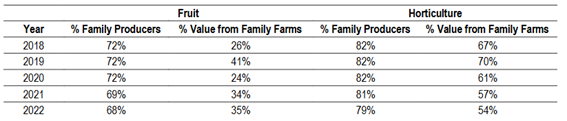
Family farming plays an important contributor in Uruguay’s fruit and horticultural sectors. Between 2018 and 2023, family producers represented approximately 70% of registered fruit farms and about 80% of horticultural farms (see Table 7). However, their contribution to total production value was comparatively lower, reflecting structural differences in farm size, crop specialization, and market orientation.
In the case of fruit production, the estimated contribution of family farms may be overstated. Underreporting is likely for certain crops, such as apples and peaches, mainly because large-scale commercial producers are often absent from the RNFH. This bias is even more evident in citrus fruits, where production is highly concentrated among large producers who are frequently not registered in the system.
In horticulture, similar limitations apply. For instance, potato production (a sector dominated by a small number of large-scale producers not included in the RNFH) is significantly underestimated. Nonetheless, RNFH data align reasonably well with results from the Montevideo Wholesale Market (UAM) for most crops, with potatoes as a notable exception.
Despite these data limitations, the RNFH remains a valuable starting point for estimating family farming’s contribution to fruit and horticultural production. Its utility would be further enhanced through more comprehensive and systematic data collection.
3.4 Cross Sector Summary
Table 8 presents the total value of production (VP) generated by family producers across the five sectors analyzed.
In 2022, family farming accounted for 14% of the total sectoral value, amounting to approximately 22.7 billion pesos. Horticulture, dairy, and beekeeping were the most significant contributors.
Table 9 shows that the contribution of FP to the VP of these five sectors remained relatively stable, fluctuating between 17% and 14% over the period.
4. Discussion and Conclusions
Agrifood value chains in Uruguay account for approximately 11% of national GDP, 80% of goods exports, and generate close to 230,000 jobs (13% of national employment)15)(16) . Their territorial relevance is also strong: 32 of Uruguay’s 44 cities with more than 5,000 inhabitants (excluding Montevideo) are highly specialized in agrifood production17. Within this context, family farming in Uruguay plays a significant, yet often underrecognized, role in Uruguay’s broader agrifood system18. Beyond food supply and rural livelihoods, family farming supports regional development and social cohesion.
Uruguay’s agricultural policies recognize the strategic importance of family farming for sustainable development, environmental conservation, and biodiversity18. The recently launched National Plan for Family Farming (2024-2028), aligned with the UN Decade of Family Farming (2019-2028)19, reaffirms this commitment5. However, implementing these policies effectively hinges on the availability of reliable, disaggregated data to inform decision-making and measure progress.
This study provides the first systematic estimates of the economic contribution of family farming in Uruguay, focusing on beef cattle, dairy, fruit, horticulture, and beekeeping sectors. Results suggest that family producers contributed between 14% and 17% of gross production value from 2018 to 2022.
Findings reveal that family producers are more prevalent in sectors oriented toward domestic markets, such as horticulture and fruit, and in beekeeping. Conversely, their presence is less pronounced in export-driven sectors like beef and dairy, highlighting the sectoral heterogeneity of family farming.
Methodologically, gross production value serves as a practical proxy for economic contribution using available data. Nonetheless, it has limitations: it excludes costs, value added, labor inputs, and income distribution. In some sectors, price data used in the estimations, particularly for fruits and vegetables, are outdated, relying on margins from 2017. Additionally, current registries tend to underrepresent large producers in crops like apples, citrus, and potatoes, which may result in sectoral underestimation and hinder comparative analysis.
This research’s key contribution lies in integrating multiple datasets from the Ministry of Livestock, Agriculture, and Fisheries (MGAP) and applying harmonized criteria to identify family farmers. Despite this, reliance on registry data likely omits unregistered producers, underscoring the need for better coverage. The limited use of recent census data restricts assessment of registry completeness, highlighting a critical area for future improvement.
Enhancing the scope, granularity, and interoperability of public registries is essential for stronger policy formulation and evaluation. Although the Family Farming Registry (RNFH) is the most comprehensive tool currently available, its sectoral effectiveness varies. While livestock, dairy and beekeeping benefit from well-developed systems like SNIG and SINATPA; fruit and horticulture suffer from bigger data limitations like lack of price series, limited coverage of large producers, and fragmented administrative records.
These challenges are not unique to Uruguay; similar issues are prevalent across Latin America, as seen in Brazil, Argentina, and Colombia. This regional trend emphasizes the importance of improving data integration and interoperability to better capture the diverse contributions of family farming.
Looking ahead, the research agenda should advance along several key lines to deepen and refine the understanding of family farming’s economic contribution in Uruguay. First, future studies should incorporate disaggregated analysis to better reflect the diversity within the family farming sector. Segmenting producers by variables such as farm size, gender, age, and region would allow for a more nuanced assessment of their economic roles and challenges. This, in turn, could support the design of more effective public interventions.
Second, there is a need to move beyond gross production value (GPV) and develop a broader set of complementary indicators. These could include measures of net value added, employment generation, labor intensity, productivity, contribution to exports, and even fiscal impacts. Such indicators would provide a more comprehensive view of how family farming contributes to the national economy.
Third, the analytical scope should be expanded to include additional sectors not currently covered by registry-based systems. Sectors such as rainfed agriculture, forestry, and rice are economically significant and may also involve family producers whose contribution remains unquantified due to data limitations.
Fourth, there is a need to improve valuation methods, particularly for crops and vegetables. This includes the development of systematic, up-to-date producer price series that reflect actual farm-gate conditions. Without accurate pricing data, estimates of economic contribution risk being outdated.
Finally, future research should explore the sales and commercialization channels used by family farmers. Many rely on informal or alternative markets, where pricing structures, margins, and buyer relationships differ from those in formal wholesale markets. Understanding these dynamics is essential for accurately valuing production and designing market-oriented support policies.
From a policy perspective, quantifying the economic importance of family farming is crucial for designing targeted support measures and evaluating their impact. The new National Plan presents an opportunity to enhance data systems for evidence-based policymaking. Improved information will help ensure that interventions effectively reach and benefit family farmers, unlocking their full development potential.
In conclusion, family farming remains economically significant in Uruguay. By producing new evidence on its share of total production value, this study takes an important step toward bridging that gap. Ultimately, enhancing the quality and availability of economic data on family farming is critical to accurately quantifying its economic contribution, it is important for developing a more nuanced understanding of its scale and importance, as well as for informing effective policy decisions.
Acknowledgements:
We would like to express our gratitude to Leidy Gorga and Fabian Mila for their valuable comments and suggestions. Any errors or omissions are the responsibility of the authors.
References:
-
1. Graeub BE, Chappell MJ, Wittman H, Ledermann S, Kerr RB, Gemmill-Herren B. The state of family farms in the world. World Dev. 2016;87:1-15. Doi: 10.1016/j.worlddev.2015.05.012.
» https://doi.org/10.1016/j.worlddev.2015.05.012 - 2. Salcedo S, Guzmán L. Agricultura familiar en América Latina y el Caribe: recomendaciones de política. Santiago: FAO; 2014. 497p.
-
3. Dieguez H, Gallego F, Camba Sans G, Staiano L, Baldassini P, Ruggia A, Aguerre V, Paruelo JM. Family farming stands out for its environmental performance in Uruguay’s agricultural sector. Agric Syst. 2025;229:104440. Doi: 10.1016/j.agsy.2025.104440.
» https://doi.org/10.1016/j.agsy.2025.104440 -
4. Ministerio de Ganadería, Agricultura y Pesca, DGDR (UY). Estado de situación de los registros de la agricultura familiar en Uruguay (Internet). Montevideo: MGAP; 2023 (cited 2025 Sep 15). 57p. Available from: Available from: https://www.gub.uy/ministerio-ganaderia-agricultura-pesca/comunicacion/publicaciones/estado-situacion-registros-agricultura-familiar-uruguay
» https://www.gub.uy/ministerio-ganaderia-agricultura-pesca/comunicacion/publicaciones/estado-situacion-registros-agricultura-familiar-uruguay - 5. Ministerio de Ganadería, Agricultura y Pesca (UY). Plan Nacional de Agricultura Familiar. Montevideo: MGAP ; 2024. 90p.
- 6. Tommasino H, Cortelezzi Á, Mondelli M, Bervejillo JE, Silva Carrazzone ME. Tipología de productores agropecuarios: caracterización a partir del Censo Agropecuario 2011. In: Anuario OPYPA. Montevideo: MGAP ; 2014. p. 491-508.
- 7. Ackermann M, Crosa M, Díaz A, Millán J. Estudio de canales y márgenes en la cadena comercial de frutas y hortalizas en Uruguay. Montevideo: MGAP ; 2017. 177p.
-
8. Ministerio de Ganadería, Agricultura y Pesca (UY). Definición del Productor Familiar Agropecuario. Resolución N° 1.013/016 (Internet). 2016 (cited 2025 Sep 15). https://www.gub.uy/ministerio-ganaderia-agricultura-pesca/institucional/normativa/resolucion-n-1013016-mgap-definicion-del-productor-familiar-agropecuario
» https://www.gub.uy/ministerio-ganaderia-agricultura-pesca/institucional/normativa/resolucion-n-1013016-mgap-definicion-del-productor-familiar-agropecuario -
9. CONEAT. Consulta CONEAT (Internet). Montevideo: MGAP ; (cited 2025 Sep 15). Available from: https://www.gub.uy/ministerio-ganaderia-agricultura-pesca/tramites-y-servicios/servicios/consulta-coneat
» https://www.gub.uy/ministerio-ganaderia-agricultura-pesca/tramites-y-servicios/servicios/consulta-coneat -
10. Banco de Previsión Social. Valores actuales (Internet). Montevideo: BPS; (cited 2025 Sep 15). Available from: https://www.bps.gub.uy/bps/valores.jsp?contentid=5478;
» https://www.bps.gub.uy/bps/valores.jsp?contentid=5478; - 11. Aguirre E, Durán V, Hernández E, Branchiccela B. Caracterización y diagnóstico de la cadena apícola en Uruguay. In: Aguirre E, Durán V, Gorga L, Hernández E, Branchiccela B. Caracterización y diagnóstico de las cadenas de carne porcina, carne aviar y apicultura. Montevideo: INIA; 2022. p. 36-55.
-
12. Ministerio de Ganadería, Agricultura y Pesca (UY). Sistema Nacional de Información Ganadera (Internet). Montevideo: MGAP ; (cited 2025 Sep 15). Available from: https://www.snig.gub.uy/principal
» https://www.snig.gub.uy/principal -
13. Ministerio de Ganadería, Agricultura y Pesca, DGDR (UY). Registro de productores familiares agropecuarios (Internet). Montevideo: MGAP ; 2025 (cited 2025 Sep 15). Available from: Available from: https://www.gub.uy/tramites/registro-productores-familiares-agropecuarios
» https://www.gub.uy/tramites/registro-productores-familiares-agropecuarios -
14. Ministerio de Ganadería, Agricultura y Pesca (UY). Sistema Nacional de Trazabilidad de Productos Apícolas (Internet). Montevideo: MGAP ; 2022 (cited 2025 Sep 15). Available from: Available from: https://www.gub.uy/ministerio-ganaderia-agricultura-pesca/politicas-y-gestion/sinatpa
» https://www.gub.uy/ministerio-ganaderia-agricultura-pesca/politicas-y-gestion/sinatpa -
15. Uruguay XXI. Informe sectorial: agronegocios (Internet). Montevideo: Uruguay XXI; 2020 (cited 2025 Sep 15). 79p. Available from: Available from: https://www.uruguayxxi.gub.uy/uploads/informacion/38e9164aa995240bac0a959e37a8c16b438da067.pdf
» https://www.uruguayxxi.gub.uy/uploads/informacion/38e9164aa995240bac0a959e37a8c16b438da067.pdf -
16. Ministerio de Ganadería, Agricultura y Pesca, DIEA (UY). Anuario Estadístico Agropecuario 2023 (Internet). Montevideo: MGAP ; 2023 (cited 2025 Sep 15). 282p. Available from: Available from: https://www.gub.uy/ministerio-ganaderia-agricultura-pesca/comunicacion/publicaciones/anuario-estadistico-agropecuario-2023
» https://www.gub.uy/ministerio-ganaderia-agricultura-pesca/comunicacion/publicaciones/anuario-estadistico-agropecuario-2023 -
17. Barbero MNA, Cortelezzi A. Cadenas agroindustriales y vocación productiva de ciudades intermedias de Uruguay: una aproximación por empleo. Territorios. 2020;(43spe). Doi: 10.12804/revistas.urosario.edu.co/territorios/a.8251.
» https://doi.org/10.12804/revistas.urosario.edu.co/territorios/a.8251 -
18. Ministerio de Ganadería, Agricultura y Pesca, OPYPA (UY). SENDA: Estrategia Nacional para el Desarrollo Agropecuario (Internet). Montevideo: MGAP ; 2024 (cited 2025 Sep 15). 77p. Available from: Available from: https://www.gub.uy/ministerio-ganaderia-agricultura-pesca/estrategia-senda
» https://www.gub.uy/ministerio-ganaderia-agricultura-pesca/estrategia-senda -
19. Food and Agriculture Organization of the United Nations. United Nations Decade of Family Farming (Internet). Rome: FAO; (cited 2025 Sep 15). Available from: https://www.fao.org/family-farming-decade/about/en/
» https://www.fao.org/family-farming-decade/about/en/ - 20. Aguirre E. Evolución reciente de la productividad ganadera en Uruguay (2010-17): metodología y primeros resultados. In: Anuario OPYPA . Montevideo: MGAP ; 2018. p. 457-70.
-
21. Aguirre E. Evolución de la productividad ganadera en Uruguay (2005-2021) (Internet). 2022 (cited 2025 Sep 15). 37p. Available from: Available from: https://www.researchgate.net/publication/368839939_Evolucion_de_la_productividad_ganadera_pastoril_en_Uruguay_2005-2021
» https://www.researchgate.net/publication/368839939_Evolucion_de_la_productividad_ganadera_pastoril_en_Uruguay_2005-2021