Family farming registries in Uruguay and the Mercosur countries
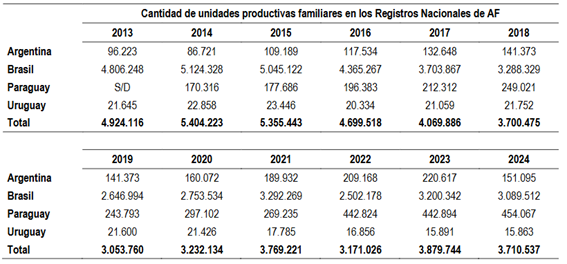
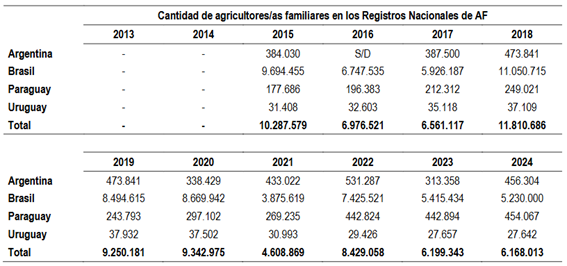
Family farming registries are a type of administrative registry designed to identify the different subjects of family farming with the purpose of implementing public policies and potentially planning various instruments. These administrative registries were created in the Mercosur countries from the discussion within the REAF and consolidated through Resolution GMC 25/07. This standard establishes the common criteria for the recognition and identification of family farmers and, additionally, for the creation of a system of voluntary registers with the objective of accrediting this condition against differentiated public policies for its targeting. These tools that constitute the registries have evolved unevenly in each of these countries based on their management processes and the effective application of specific policies, which, according to FAO, the case of this region is a global reference. The Uruguayan case does not escape this logic. In this work, a comparative analysis of the evolution of the registries in the region linked to different milestones will be carried out, as well as the public policies applied to this sector and the management models used, focusing on the case of the registry of family producers in Uruguay and with references to other cases in the region. There is some evidence that shows that administrative records are consolidated to the extent that there is a volume of public policies that use them and when protocolized information management processes are developed. Finally, a strategic importance of these records was observed in the targeting and effectiveness of public policies implementation.
Keywords:
family farming; administrative registries; differentiated public policy
 Thumbnail