Identification of sheep robust to climate change and variability
Abstract:
Livestock production, in particular sheep farming, faces the challenge of increasing food production in the context of limited resources, with less access to arable land and supplements. In addition, explained by variability and climate change, access to high-quality and quantity pastures and water would be soon restricted. Furthermore, sheep will be more frequently and for longer periods exposed to higher temperatures, to changes in the rainfall pattern and to a scenario of pests and diseases different from the current one. Moreover, considering that sheep have been selected for improved production for a long period of time, it is possible that modern sheep are less robust. There are also society's concerns about livestock farming contribution to methane emissions, animal welfare, food/feed competition, food security and safety, and antiparasitic and antimicrobial resistance. To face this scenario, more efficient, resilient, and adapted animals are needed. The present work aims to review the concepts of robustness, resilience and efficiency, and present studies on these characteristics within breeds and/or breeds that could be considered in the sheep genetic improvement programs for a scenario of climate change and variability.
Keywords:
resilience; robustness; methane; feed efficiency; phenomics
Resumen:
La producción ganadera, en particular la ovina, enfrenta el desafío de aumentar la producción de alimentos en un contexto de recursos limitados, con menor acceso a tierras cultivables y suplementos. Asimismo, explicado por el cambio y la variabilidad climática, se restringiría el acceso al forraje y al agua en términos de cantidad y calidad. Además, los ovinos estarán expuestos con mayor frecuencia y durante períodos más prolongados a temperaturas más elevadas, a cambios en el régimen de precipitaciones y a un escenario de plagas y enfermedades diferente al actual. Además, considerando que los ovinos han sido seleccionados a favor de características productivas durante un largo período de tiempo, es posible que los ovinos modernos sean menos robustos. Paralelamente, tenemos las preocupaciones de la sociedad sobre la contribución de la ganadería a las emisiones de metano, el bienestar animal, la competencia por comida entre humanos y animales, la seguridad alimentaria y la resistencia a los antimicrobianos y antiparasitarios. Para afrontar el escenario descrito se necesitarían animales más eficientes, resilientes y adaptados. El presente trabajo tiene como objetivo revisar los conceptos de robustez, resiliencia y eficiencia y presentar estudios sobre estas características dentro de las razas o razas que podrían ser consideradas en los programas de mejoramiento genético ovino en un escenario de cambio y variabilidad climática.
Palabras clave:
resiliencia; robustez; metano; eficiencia alimenticia; fenómica
Resumo:
A produção pecuária, em particular a ovinocultura, enfrenta o desafio de aumentar a produção alimentar em um contexto de recursos limitados, com menos acesso a terras aráveis e suplementos. E, explicado pelas alterações climáticas e pela variabilidade, o acesso a pastagens e água de elevada qualidade e quantidade seria restringido. Além disso, os ovinos estarão expostos com maior freqüência e por períodos mais longos, a temperaturas mais elevadas, alterações no regime de chuvas e a um cenário diferente do atual de pragas e doenças. Ademais, considerando que os ovinos foram selecionados para características produtivas durante um longo período de tempo, é possível que os ovinos modernos sejam menos robustos. Paralelamente, temos as preocupações da sociedade sobre a contribuição da pecuária para as emissões de metano, o bem-estar animal, a competição por comida entre humanos e animais, a segurança alimentar e a resistência a antimicrobianos e antiparasitários. Para enfrentar o cenário descrito seriam necessários animais mais eficientes, resilientes e adaptados. O presente trabalho tem como objetivo revisar os conceitos de robustez, resiliência e eficiência e apresentar estudos sobre estas características dentro de raças e/ou raças que poderiam ser consideradas nos programas de melhoramento genético de ovinos em um cenário de mudanças e variabilidade climáticas.
Palavras-chave:
resiliência; robustez; metano; eficiência alimentar; fenômica
1. Introduction
Livestock production faces significant global challenges for the coming years, the main of which is to increase food production within the constraints of limited resources. It is actually considered that the area allocated to livestock should not compete with arable land suitable to produce other food for human consumption. In addition, different simulated scenarios of climate change (see 2.3) suggest that native pasture suitable for grazing could be negatively affected in terms of quantity, quality, and variability. Furthermore, access of animals to drinking water could be restricted1)(2) . Although climate change would have direct and indirect effects specific to each region, there is broad consensus that current and future sheep farming would mostly be restricted to marginal production areas3)(4) . Climate change introduces additional vulnerabilities for sheep production: air temperature is increasing, and circannual rainfall patterns are changing in different agroecological regions of the world5. It is expected that sheep will be more frequently and for longer periods exposed to higher temperatures, whitheat stress emerging as a critical threat to the meat and wool production industries5. Both severe and moderate climate change scenarios predict an increase in the number of days per year that sheep will experience thermal stress6. This increased incidence of heat stress could also be accompanied by changes in rainfall pattern1 and increased radiant thermal loads. Consequently, animal physiological, productive, reproductive, behavioral, and well-being changes are expected. Furthermore, the predicted climate conditions are likely to increase the incidence of pests and diseases, posing additional challenges to sheep health2.
Alongside these environmental challenges, a potential antagonism between the selection for high-producing sheep and animal health (physiological and immunological) and behavior patterns has been proposed7. For years, breeding programs have mainly focused on production traits, possibly resulting in less resilient or robust sheep. At the same time, society is increasingly concerned about livestock farming contribution to methane emissions, sheep welfare, the competition with humans for food (e.g. grains), food security, labor and cultural preservation, the possibility of maintaining their activity and farm, gender equity, youth inclusion, chemicals used and its impact on food safety, and antimicrobial resistance3)(4)8)(9) . There is also growing interest in developing production systems with minimal human intervention in both animals and the environment4, which may leave sheep more exposed to environmental challenges such as heat, food or water scarcity, and diseases. In summary, a future is expected where less edible food for humans will be allocated to feeding sheep, there will be a smaller area of arable land for sheep production, and the area allocated will be marginal, with more variable and poorer quality feed. In addition, there will be more environmental disturbances, environmental heterogeneity (less control), a more challenging environment, and a possible greater risk of pests and diseases (regional in nature).
Adaptation to future challenges will require more efficient, resilient, and well adapted animals. And it is even more important to investigate these aspects in specialized systems that have long focused on selection for productivity, due to possible antagonisms between productive traits and those related to animal resilience, adaptation or robustness10. Most sheep production leading countries are encountering the difficulty raised above. This applies to Australia, New Zealand, South Africa, Argentina, Chile, Uruguay, and many others. The case of Uruguay can be used as an interesting study model, with a worldwide outstanding sheep production supported by a comprehensive and modern genetic evaluation system. Sheep production in Uruguay is carried out under grazing conditions on temperate native pastures on the Campos grasslands (see 2.2)11. Most of the wool and meat breeds in this country have genetic improvement programs with positive results given the large number of animals and stud breeders, as well as the genetic progress achieved12, where breeding objectives and selection criteria have mainly focused on production traits (body weight, fleece weight, fiber diameter, rib eye area, among others), health traits (resistance to gastrointestinal nematodes) and reproductive traits (multiple births) (geneticaovina.com.uy). More recently, genetic parameters have been estimated for new reproductive traits (number of lambs, maternal ability)13, feed efficiency traits (feed intake, residual feed intake) and methane emissions9.
This work follows a narrative review methodology with three objectives. Firstly, to synthesize theoretical concepts related to robustness, resilience, and feed efficiency. Secondly, to identify potential traits for selecting more robust sheep, with a focus on their applicability to Uruguay’s sheep production. Finally, to explore new breed options capable of performing well under future climate scenarios in Uruguay. The latter two objectives are based on the hypotheses that certain breeds or specific animals within a breed may outperform others in the face of climate change and increased environmental variability, and that certain key robustness indicators will help identify these superior animals.
2. Methodology
2.1 Review procedure
The search strategy was based on the analysis of published literature retrieved with the following keywords (used individually or in combination): sheep, robustness, resilience, animal welfare, animal health, feed efficiency, climate change, shedding/hairy sheep breeds. The primary search engines were Google Scholar and Timbó. Peer reviewed articles were prioritized in the inclusion criteria, although in specific situations -mostly explained for the novelty of the information- grey literature was included (conference proceedings, postgraduate thesis, book chapters, non-peer reviewed articles, and technical reports).The most relevant journals referenced in this review included: Animal, Journal of Animal Science, Frontiers, Agriculture, Animal Production Science, Animals, Genetics Selection Evolution, Small Ruminant Research, among others. The literature search was conducted primarily during the first half of 2023.
The selection process to identify and screen literature involved reviewing titles, abstracts, and references lists of previous selected articles, followed by a full text screening of relevant papers. This process was conducted by a team of academics with diverse expertise in sheep-related fields, including welfare, health, wool, physiology, breeding, reproduction, biotechnology, immunology, genomics, nutrition, and extensive production systems. As a result of this rigorous process, 296 works were considered, and 110 articles were included in the final version of the manuscript.
The findings described in this review are presented in a conceptual order, organized into main sections. The first section provides a general overview of the theoretical concepts of robustness, resilience, and efficiency. The second section discusses potential traits for identifying more robust sheep within a breed, as well as new breeds that could be introduced in Uruguay.
2.2 Study site
Uruguay has a long history of wool production, with 88% of sheep belonging to wool or dual-purpose (wool and meat) breeds14. Over the last 30 years, these breeds have been selectively bred for productivity, focusing on increasing fleece and body weight while decreasing fiber diameter (geneticaovina.com.uy). In 2023, Uruguay's sheep population stood at 5.927 millions, marking a decline of 5.159 millions since 2006, part of a broader downward trend over the past three decades15)(16) . Fifty eight percent of these sheep are in Tacuarembó, Salto, Paysandú, and Artigas states, primarily within the basaltic region of those states. This region has the lowest pasture production compared with other agroecological regions in Uruguay15 and exhibits a pronounced seasonal growth pattern. Moreover, Tacuarembó, Artigas, and Salto have a lower percentage of improved pastures compared to other states in Uruguay.
According to the Climate Change Knowledge Portal17, Uruguay has four well-defined seasons and is located in the temperate zone, with an average air mean temperature of 17.5 °C, with 12.4 °C in winter and 23.6 °C in summer. The minimum and maximum air temperatures for winter are 7.6 and 17.2 °C, while summer minimum and maximum are 18.1 and 29.3 °C. The average annual rainfall from 1991 to 2020 was 1316 mm, with the lowest seasonal rainfall in winter (279.1 mm), and fall experiencing the highest average (363.6 mm).
2.3 Future climate scenarios for study site
Future climate scenarios for Uruguay were obtained from the Climate Change Knowledge Portal17, with projections based on the sixth phase of the Coupled Model Inter-comparison Projects (CMIP6). Significant changes in climatology are expected in Uruguay to the end of this century, particularly regarding temperature and rainfall. Air temperatures are projected to rise by approximately 1 to 4 °C, depending on the scenario, with the most optimistic scenario being SSP1-2.6 (based on Shared Socioeconomic Pathways and Representative Concentration Pathways RCP 2.6), and the most pessimistic being SSP5-8.5. Furthermore, an increase in the number of hot days (maximum temperatures exceeding 30 °C) is forecasted under both scenarios, with the most pronounced effects during spring, summer, and fall. For example, under the SSP1-2.6, there could be three additional hot days per month in December, January, and February, while the SSP5-8.5 scenario may result in an increase of up to twelve hot days per month during the same period. In parallel, an increase in both the average and variability of precipitation throughout the year is expected, particularly under the SSP5-8.5 scenario. The increased variability is expected to lead to more extreme weather events, including heavy rainfall and longer dry periods.
3. Theoretical concepts
3.1 Robustness
Robustness is the ability of the animal, in the face of environmental restrictions, to continue doing the activities needed to promote its future ability to reproduce. A robust animal combines resilience and adaptation4. Adaptation is defined as the process of adjusting to change within a long-term time horizon, eventually over generations as a result of genetic selection18. Resilience is the animal's ability to be minimally affected by environmental disturbances10. Therefore, robustness goes beyond resilience, since it also integrates characteristics related to adaptability and not only the ability to withstand specific disturbances. Robustness is the combination of multiple interacting mechanisms: survival (ability to avoid culling and death), growth and reproduction. An indicator trait of robustness could be productive longevity, although it has limitations4)(19) . This is the consequence of the animal's ability throughout its life to overcome challenges. However, it is a trait difficult to evaluate due to the variation in different environments, it is very generic (it does not provide much information about the mechanisms that explain it), data is available for each animal at the end of its productive life (generation interval very long) and mostly only in one sex (females).
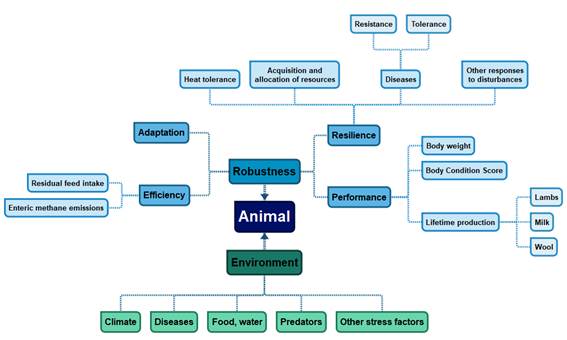
Two types of environmental restrictions have been established4. On the one hand, the severity of the environment (harshness), which is a moderately stable factor and involves nutrition, the production system, and the climate of the region. On the other hand, there would be specific disturbances to this macro environment, in which the intensity and frequency of the disturbance matter (e.g. heat waves, water stress, non-structural forage deficit, and epidemiology of a parasite). These may be more intense and frequent in a scenario of climate change and variability. Therefore, a robust animal (Figure 1) would be one that provides an adequate quantity and quality of product, makes good use of nutritional resources (acquisition, utilization, allocation), matches the environment (such as capacity for thermoregulatory or locomotor abilities), reproduces well and regularly (or according to what is expected by the producer), has a good health status, and shows behavior in accordance with the environment (social interactions, easy care, easy handling, maternal ability).
Different mechanisms are necessary to overcome the two types of challenges mentioned above. For example, confronted with a challenge, there may be changes in the distribution of resources within the animal (for different activities, health, growth, reserves, thermoregulation), or changes in the resource acquisition strategy (grazing time, feed intake, bite rate, selectivity). In the resource allocation theory20, it is assumed that the resource destined for one function cannot be used in another, implying a trade off or antagonism, as an adaptive response of the animal. This means that one option may be to increase the acquisition of resources (grazing time, intake, grazing behavior), and have enough for all activities, and another option may be to alter the allocation. Distribution and acquisition can be altered in the long term by genetic selection. Also, responses can be linked to predictable long-term challenges (pasture production variability within the year, need to generate a homeorhetic physiological response, survival to ensure the species) or unpredictable short-term challenges (negative energy balance and body reserve mobilization, need to generate a homeostatic physiological response, adapt to survive). In short, robustness is the ability to overcome unfavorable environments for a long period of time. Although selecting by associated traits is possible, it is focused on the specific environment where it is conducted, because it is not possible to have an animal that is robust in any environment.
Diagram indicating the main aspects that influence robustness for a particular animal and environment
3.2 Resilience
Resilience, which underpins robustness21, is the animal's ability to respond to environmental perturbations, being a possible indicator of animal well-being22. General resilience can be interpreted as the ability of an animal to be minimally or not affected in its performance by an external disturbance, or to be affected and quickly return to the state it had prior to the disturbance10. Therefore, while producing in a stable and good environment do not require robust or resilience animals, these are valuable characteristics in variable and poor environments. This is the case of outdoor livestock production systems on native pastures in Uruguay, which could benefit from selecting more resilient and robust animals or breeds, as they would be better suited for these environments.
Since resilience is a term commonly associated with diseases, such as gastrointestinal nematode infections, it is important to differentiate disease resilience from general resilience23. In this sense, disease resilience is part of an animal's overall resilience and has been defined as the ability of an animal to maintain a reasonable level of productivity when challenged by a disease24. Resilience to diseases is made up of resistance and tolerance. Resistance is the ability of the host to limit the load of a pathogen25 by restricting its rate of reproduction within the host, blocking the entry of the pathogens or limiting their multiplication once it has entered. Tolerance, on the other hand, is the ability of the infected host to limit the damage done by the pathogen, without necessarily reducing its presence. Tolerance does not help the resilience of the flock, because infectivity persists. From a genetic point of view, the two components of resilience to diseases are negatively correlated; however, cases of favorable or null correlations have also been reported24. This correlation is very difficult and expensive to quantify and can be characterized by studying the animal response to different pathogen presence (reaction norm). Given that correlations between tolerance, resistance and resilience to different disease range from favorable to unfavorable, and the relevance of protecting all animals in the flock, it has been suggested that a potential breeding objective should be to select animals for general resistance, a concept that will be further developed later10.
Due to the complexity of studying resilience to diseases based on the reaction norm, other approaches have been suggested such as the one-dimensional or black box model (less informative) and the two-dimensional model (difficult to analyze). However, as the challenges faced by animals are not recorded or even come from unknown sources, an approach called dynamic resilience study has been proposed, which can be used not only for health challenges, but also for other kind of challenges4)(26) . This approach is supported by the growing amount of automated information increasingly available through the advent of precision livestock farming27. This enables the generation of individual information on a wide range of performance traits, such as body weight, body condition, feed intake, behavior, milk production, bodyweight gain, water consumption, body temperature, and rumen environment. Interestingly, the expected or theoretical production or response of the animal assessed without disturbances is not required19.
Although the best indicator has not been defined yet26, four possible indicators have been proposed for the study of resilience based on the availability of large amounts of information (big-longitudinal data, high-frequency recording). These indicators focus on the deviation of observed production in relation to the expected production of the animal in a certain period, and they all have certain limitations. The high-frequency data approach to resilience measurement is based on the principle that animals are constantly subject to disturbances of unknown origin, resulting in fluctuations of the assessed traits28. The indicators proposed by Berghof and others26 are variance, autocorrelation and skewness of the deviations, and the slope of the response curve, which indicate differential duration and severity of the disturbance. A less resilient animal shows greater variance, positive autocorrelation, negative skewness and steeper slope (indicating a sharper decline in production when faced with disturbance) compared to the population. In contrast, a more resilient animal deviates less from a healthy state or its performance potential or recovers faster from a perturbation29)(30) . Furthermore, recent studies reviewed and analyzed new approaches (hybrid models) that integrate models based on data (data-driven models) and concepts (concept-driven models)31. These new hybrid models are considered promising for resilience characterization of production animals and their potential integration into genetic improvement programs.
Following the previous approach, García-Baccino and others32 recorded changes in the daily intake of sheep facing different challenges, estimated the probability that each day was a challenging day, and included this information in an animal model to evaluate the genetic determinism of resilience. Both the heritability of feed intake changed with the probability of occurrence of a challenging environment. The authors also reported a genetic correlation between the expected progeny difference (EPD) for feed intake in a non-challenging environment and EPD at a given probability of occurrence of an environmental challenge. This genetic correlation was modified by changing the environment. The correlation decreased as the environment became more challenging, indicating that selection for the trait in a non-challenging environment was not useful in a challenging environment, that is, a re-ranking of animals between environments occurs. Finally, by studying the sensitivity to environmental change, they identified animals that were more or less resilient to challenges31. In Uruguay, this approach could be used to study feed intake, behavior, water consumption, and body weight, given that this information is already being recorded in the sheep phenotyping platform at INIA La Magnolia.
3.3 Feed conversion efficiency
Different parameters and traits associated with individual production have been the main selection criteria used over the years in sheep genetic improvement programs, as it has already been reviewed12)(33) . Efficiency in converting feed into product is a determining factor in a genetic improvement program, not only because of the economic benefits for farmers, but also for its environmental advantages (more efficient sheep produce more or the same with fewer resources). Below is a brief overview of some central aspects to consider in a proposal aimed at improving feed efficiency, which can then be integrated with improved resilience.
The selection of sheep that are more efficient in the use of feed is justified, firstly, because feed costs are the most important in sheep production34. Secondly, because body weight in Uruguay has genetically increased, which correlates unfavorably with feed intake and, consequently, with production costs35. Finally, having more efficient animals in the use of feed would reduce the negative impact of animal production on the environment36. Despite the importance of this characteristic, feed intake and feed efficiency have been included since 2022 within a genetic improvement program in a research center for the Australian Merino breed. This is explained by the difficulty in phenotyping these variables37. In this sense, there are different ways to measure feed efficiency, such as residual feed intake (RFI), the relationship between intake and weight gain, residual weight gain, gain index, and residual intake. For biological and statistical attributes, RFI has been deeply studied in the last two decades38)(39) . The RFI is the difference between the observed intake and the expected intake for an animal with a certain body weight and productive performance, which in meat production is defined as weight gain and body composition associated with muscle and fat deposition.
It has been consistently reported that the most efficient animals have a lower dry matter intake, without unfavorable effect on body weight or weight gain, in parallel with a lower methane emission, fewer visits to the feeder, and without changes in wool production or resistance to gastrointestinal nematodes9)(33)36)(40)41)(42)43)(44)45)(46)47)(48) . Additionally, it has been found that rumen, liver, lungs and kidneys of the most efficient animals were smaller, while parts of the small intestine would be larger than less efficient ones47. The differences in organs size were associated with lower intake, better nutrient absorption, lower energy intake and a lower metabolic rate in the most efficient animals, which adds up to greater energy efficiency and a lower protein turnover rate49. Differences in tissue deposition, Thyroxine (T4) and Adrenocorticotropic (ACTH) hormone levels, as well as physical activity, have also been reported between contrasting RFI groups48)(50)51.
4. Genetic improvement programs and breed options
4.1 Selection within a breed
A meta-analysis on genetic parameters in sheep for resilience and efficiency traits focused on milk or meat production52 has been recently published. In relation to resilience, the variables included were linked to resistance to gastrointestinal parasites and foot rot, due to their economic importance. For meat production, they reported heritabilities from 0.07 to 0.50, with high variation across studies. In the case of mastitis (0.07±0.02) and prolificacy (0.09±0.02), authors pointed out that the estimates were very consistent among the studies. Regarding the correlations between variables, the traits linked to the same diseases had medium to high correlations, for example, immunoglobulin concentration and fecal egg count (FEC) (0.40±0.05), or diarrhea and feces consistency (0.94±0.55). Most of the correlations among variables that describe efficiency (includes production) were positive. The exceptions were the correlations between prolificacy and body weight, and body weight with RFI, which were negative but not significant. The estimates for growth and diarrhea scores, and growth and FEC were negative and favorable (-0.33±0.13 and -0.28±0.11, respectively). Finally, the review concludes that the magnitude of genetic correlations (not different from zero or moderate) allows simultaneous advances in resilience, efficiency and productivity by genetic selection, and indicates the need for more studies on resilience traits such as reproduction, survival, and resistance to other diseases.
In a work focused on Australian Merino53, the consequences of incorporating variables of resilience and resistance to diseases within existing selection indices were explored. These authors included body condition and weight change (indicators of energy reserves and nutritional stress), resistance to gastrointestinal parasites and fly strike, and reproduction, as variables of resilience and robustness. Reproduction was considered as an indicator of the general state of the animals and adaptation, under the understanding that reproduction occurs when maintenance requirements are satisfied. The heritability of 0.19 was reported for body condition, which presented a high correlation within year (>0.6). They also reported a high genetic correlation with weight (0.7), fat thickness (0.8), and amount of muscle (0.68), and 0.10 with the number of lambs. The change in body weight or body condition presents heritabilities of 0.02 to 0.11, estimates that are in agreement with another study54, which also reported a high genetic correlation between mobilization and accumulation of body reserves (0.5-0.9). More mobilization and accumulation of body reserves have been associated with better performance and longevity of the sheep52. Heritability for parasite resistance was 0.20 with low to negligible genetic correlations (<0.15) with fat, muscle, and number of lambs. The heritability for fly strike resistance was 0.51 and for wrinkles it was 0.39, presenting low and negative correlations with body weight, body condition, and reproduction (-0.13 to -0.3). Finally, they reported a heritability for the number of lambs weaned per lambed ewe of 0.06, with positive genetic correlation with fat, muscle, body condition, body weight, and changes in body condition and body weight (<0.3). Selection indices in Merino in Australia have focused on fleece weight, body weight, fiber diameter, lamb production, and resistance to gastrointestinal parasites. These authors calculated economic values for body condition, fly strike, and changes in body condition and body weight, and found that selecting animals based on pre-established selection indices would have unfavorable consequences only on one resilience and resistance trait (breech wrinkle, fly strike). Additionally, the integration of resilience and resistance characteristics would not have a detrimental effect on productive traits, with a favorable impact on the economic gain that would increase from 3 to 14%, depending on the selection index used. This study suggests that the importance of resilience and resistance variables may be underestimated, and that more information is necessary to improve these studies.
A recent work13 reports genetic parameters for production and reproduction characteristics, including traits linked to resilience (body condition, number and weight of weaned lambs, and fat thickness) for the Australian Merino breed in Uruguay. These authors found that a selection for finer fiber diameter would not negatively affect sheep reproduction (correlation of -0.03±0.09 between adult fiber diameter and total kilos of lamb weaned in the life of the sheep). However, selection for greater fleece weight would have unfavorable consequences (-0.30±0.08, fleece weight with kilos of lamb weaned), while selection for greater body weight would have favorable consequences in reproduction (0.36±0.08 body weight with kilos of weaned lambs). Another favorable correlation was detected between rib eye area and reproduction (0.49±0.14, with total kilos of weaned lamb). On the other hand, selection for finer fiber diameter would unfavorably affect the level of fattening of the animals (0.31±0.12 between diameter at first fleece and fat thickness). Despite the reported antagonisms, suitable selection index would allow simultaneous improvements in the different groups of characteristics (wool, reproduction).
As previously mentioned, it has been suggested that one alternative to obtain more resilient animals is to select for general resistance to diseases through the characterization of immune competence55. Immunocompetence can be considered as the ability of the animal to produce an appropriate and effective immune response when exposed to a variety of pathogens. It is worth considering that selection for resistance to one disease can have a negatively correlated response in resistance to another disease, given that the resistance mechanisms are specific to the pathogens25. Therefore, the evaluation of an adequate global immune response could contribute in selecting animals that are more resistant to several diseases.
The ability to adapt to a variety of pathogens relies on different immunological mechanisms, including cellular or humoral immunity. Therefore, a genetic selection based on the animal´s ability to develop both types of immune responses would be desirable56)(57) . A protocol used in cattle has recently been adapted and evaluated to assess the immune response in sheep58, mediated by cells or antibodies induced by vaccination59)(60) . The heritability reported for immune response in Merino was 0.49, with negative and favorable correlations with resistance to gastrointestinal parasites, diarrhea score, fly strike, and general fitness of the animal58. It is important to highlight that to develop genetic selection strategies, the immunocompetence of an animal must be evaluated together with other traits that define resilience59, since the animal responds to environmental challenges by displaying a series of defensive reactions that are integrated with each other.
We previously mentioned that in various predicted future scenarios an increase in the number of days that sheep would be under thermal stress is foreseen. An increase of 1 °C in ambient temperature is enough to affect the growth performance and health parameters of most production animals61. Sheep, unlike other domestic species, have managed to adapt to a wide variety of agroecological zones with high temperatures. They maintain their body temperature within a very narrow range (38.3 to 39.9 °C) by balancing heat gain and loss with the environment (homeothermic). When the ambient temperature exceeds the upper limit of its thermoneutral zone, the animal is unable to eliminate the excessive heat load to the outside, causing thermal stress62. In the North of Uruguay, thermal stress during the summer has become a cause of death in sheep (conversation with Mizhael Machado; unreferenced). These precedents support the need for studying sheep resilience to thermal stress in Uruguay. Feed intake decreases with high temperatures and, in parallel, changes occur in metabolic and endocrine processes2)(63) . Some aspects that are modified by heat stress include reductions in meat quality (meat with higher pH, darker color, and lower tenderness). Reproduction is also affected, with lower mating capacity of the rams, alterations in the estrous cycle, increased embryonic mortality, and a decrease in pregnancy rates. The adaptation of animals to heat can be evaluated by morphological, behavioral, physiological, cellular or molecular, endocrine and metabolic aspects2)(63)64. Morphological traits include size and shape of animals, skin type, and coat defined by color and length of hair or wool. At a behavioral level, changes may occur in the duration and time of day when animals spend time eating, ruminating, lying down, standing, drinking water, and seeking shade and shelter. From a physiological point of view, the capacity to release heat through evaporative pathways (sweating rate, respiration rate), body temperature (internal and superficial), and heart rate stands out as traits to be considered. At the molecular level, adaptive responses to heat exposure are driven by increased expression of heat shock proteins (HSPs), which function as intracellular chaperones and prevent protein and cellular damage in animals subjected to heat stress. At the endocrine level, the concentrations of cortisol, prolactin, insulin, triiodothyronine (T3) and thyroxine (T4) could be indicators of adaptation to heat. Finally, tolerance to diseases and droughts and feed efficiency are also indicators of adaptation to the climatic environment.
In Greece, the effect of ambient temperature on milk production in the Chios breed and the genetic determinism of temperature resilience have been studied65)(66) . It was reported that the thresholds in temperature are 10 °C for cold, and 25 °C for hot, below or above a decrease in milk production was observed. The heritability for resilience to heat was 0.20 and for milk production during its life was 0.26, being not significant for resilience to cold and for productive longevity. The genetic correlation between resilience to cold and to heat was high and positive, suggesting that both characteristics are controlled, at least partially, by the same genes. Additionally, the correlation of heat resilience was negative and high with milk production, and positive and high with productive longevity. These results indicate that an animal that is genetically more resilient to heat would produce less milk and have a longer productive life.
In a scenario with limited nutritional resources, selection for high productivity and improved feed efficiency, according to the resource allocation theory, could trigger antagonisms with productive, reproductive and health variables20)(67)68)(69)70. For example, an increase in feed efficiency could be accompanied by a decrease in the energy available for maintenance. Despite this, there is little evidence of negative consequences on reproductive or health traits in sheep. Contrasting lines for feed conversion and parasite resistance were evaluated under parasite challenge and no antagonisms between health and efficiency were detected in this case68. This absence of antagonism between resistance to gastrointestinal parasites and feed conversion efficiency has also been reported in populations from Uruguay44)(45) , both between divergent selection lines and for contrasting groups for resistance to gastrointestinal parasites in the Corriedale breed. Similar work has been carried out in Merino41)(42)43, by comparing health, production, reproduction and methane emissions of contrasting groups for feed efficiency and no antagonisms have been reported found. Recently, genetic parameters have been estimated for feed efficiency, methane emission, and feed intake, including their correlations with weight, resistance to parasites, fat thickness, and rib eye area (conversation with G. Ciappesoni; unreferenced). The heritabilities of feed efficiency, feed intake and methane emission were between 0.34 and 0.41. Feed intake presented a positive correlation with body weight, fat thickness, rib eye area and methane emission. Additionally, feed efficiency was positively genetically correlated with intake and methane emission.
From a commercial point of view, there are new projects where variables such as methane emission, feed conversion efficiency, animal health, animal welfare, reproduction, and production are evaluated. One example is the low input flock of New Zealand71. It is a practical example of public-private work, with strong emphasis on the inclusion of new variables linked to resilience and robustness, in order to reduce resources allocated to a flock, and design more sustainable production systems. For this, genetic selection within a breed was implemented using selection indices. Another example of the inclusion of robustness and resilience information is the GEPEP project in Australia72)(73) , in which tools to identify animals that have high production and lower intake, and maintain good body condition are investigated, which would allow greater production per hectare and reduced use of supplements.
In the Australian and New Zealand sheep sector, the number of genotyped animals participating in genetic evaluations has grown significantly in the last decade74)(75) . The inclusion of genomics in genetic evaluations leads to estimations of genetic value with higher precisions, enables greater selection intensities, and allows reducing the generation interval, which results in a greater selection response32)(76)77. In addition, genomics is useful for evaluating difficult-to-measure traits such as feed efficiency, methane emissions, and adaptability to climate change78. In Uruguay, the Australian Merino breed has genomic predictions for several characteristics of interest, including feed intake, feed efficiency, and methane emission. In addition to their application in genetic evaluations, genomic tools contribute to the identification of genes and genomic regions associated with characteristics of interest (Genome-Wide Association Studies, GWAS). In recent years, candidate genes or regions associated with reproductive characteristics79)(80)81, heat tolerance66, resistance to gastrointestinal nematodes82)(83)84, diarrhea85)(86) , body condition79)(87)88, fly strike85)(89) , foot rot90)(91)92 or mastitis/somatic cells93 have been reported.
4.2 Shedding and hairy sheep
Sheep production is also challenged by a relative increase in shearing costs, and fewer companies/people specialized in this activity, particularly in those regions where sheep population is small. In parallel, farmers that produce sheep with medium to strong wool (>24 µm) have increasing commercialization difficulties due to lower prices and decreasing demand, even going as far as not being sold. In response to this situation, interest and production with hair or shedding breed sheep have grown in various regions of the world. Furthermore, this productive option would allow greater meat production, based on the long breeding season of these breeds, their high fecundity, feed efficiency, production and product quality94. However, the introduction and especially the promotion of new breeds require a thorough evaluation of their performance in the new environment, including crossing with other existing breeds. Performance evaluations of these new breeds should be specific to each region since the results cannot necessarily be extrapolated to other conditions. There is available information generated in several countries and in different conditions. For meat production and quality94, Saint Croix, Dorper, Katahdin, Callipyge, a wool type (Suffolk and Rambouillet) and some of its crosses (St Croix × wool, Callipyge × St Croix, Dorper × St Croix, Dorper × wool) have been evaluated. Adjusted weight gains were similar among groups, except for Dorper × Saint Croix, which was higher than most. In terms of meat flavor, lambs from hair breeds were rated better than animals from wool breeds or their crosses. While in overall acceptability and tenderness lower scores were associated with animals from Callipyge × wool croses. In short, they concluded that the virtue of hair breeds is their meat quality and that they can contribute when used in terminal crossings94. In another study evaluating Barbados Blackbelly, Katahdin and Saint Croix95, growth differences among hair breeds were found linked to the breed adult size. In this case, Katahdin and Saint Croix presented greater weight gain compared to Barbados, as well as differences in the digestion and absorption of N, with similar adjusted feed intake. Additionally, it has been reported that hair breeds are more resistant to gastrointestinal parasites infections than wool breeds. Under moderate challenges, it has been reported that three hair breeds had similar resistance (Dorper, Katahdin, Saint Croix) and all were superior compared to wool breeds. With higher challenges, Saint Croix was the most resistant, while Dorper was similar or inferior to Katahdin96.
Although it is assumed that hair breeds are more tolerant to high radiant thermal loads (challenging environment) than wool breeds, this is not necessarily always the case63. Adaptation to challenging environments and changes in energy metabolism or adult size, for example, is what determines the animal's ability to tolerate heat stress. This was supported by results obtained by Pulido-Rodríguez and others97 when evaluating pure hair breed and its crosses with two Dorper genotypes. Although the mechanisms among groups were different, all groups of breeds adapted to heat stress presented similar tolerance to the heat.
Future climate variability scenarios also foresee that animals may have restrictions in accessing quality water for short periods of time, with consequences on physiological and behavioral characteristics98. Breed differences have been investigated, and a very good adaptation to water consumption restriction in the Saint Croix, Katahdin and Dorper breeds has been identified, suggesting they may play an important role for sheep production in more adverse regions98. In the same line of work, Tadesse and others99 found that the resilience of Saint Croix animals would be greater than Katahdin animals and, finally, Dorper breeds. In terms of heat tolerance, assessed through respiratory rate and body temperature, Saint Croix not only presented the best tolerance, but also the lowest variation within the group. The greatest variation was observed within the Katahdin group.
Vast literature characterizing different hair breeds (Dorper, Katahdin, Pelibuey, Saint Croix, Blackbelly, Santa Inés) in many environments, as pure breeds or crossbreeding, is currently available. For example, the convenience of using the Dorper breed in crosses on Pelibuey when compared with the pure Pelibuey breed and the Katahdin × Pelibuey cross has been indicated, due to its greater growth (although it would have higher intake), being similar carcass traits100. Another example is the comparison of the lactation of Katahdin versus Pelibuey, where it is reported that the performance was similar between breeds, in terms of weaning weight and growth in lactation, despite certain differences in milk production or weight mobilization of sheep101.
A work analyzing the potential use of hair breeds by the sheep industry in the United States was published more than 20 years ago102. Through a review of reproduction, growth, carcass characteristics, health and adaptation performance, it was concluded that hair breeds could collaborate to have an easy-care sheep. Based on the lambs' vigor, disease resistance, no wool, reproduction and growth, the Katahdin and Dorper breeds (50% hair breeds) were identified for consideration in a genetic improvement program. This recommendation was based on their characteristics as hair breeds, but with significant growth rate, adult body weight and carcass characteristics, although their resistance to gastrointestinal parasites was lower than that of pure hair breeds. These two breeds were chosen by INIA Chile (conversation with Raúl Lira; unreferenced) to be included in extensive production systems of the Magallanes region (Southern Patagonia). In 2021, it was reported that the Katahdin and Dorper population was larger than Suffolk, Hampshire, and Dorset breed in USA. Both breeds are found in states with known sheep tradition. An example is Texas, the largest sheep producer in the United States, where the transition from Rambouillet to Dorper has been recorded103. In the case of Katahdin, its participation stands out with 27% of the animals in genetic evaluations in the USA with 77,000 lambs evaluated, from 2015 to 2019.
It is highlighted that breeds such as Katahdin, Dorper and Santa Inés have national genetic evaluations in several countries, including the USA, Australia, New Zealand, South Africa, and Brazil, enabling the possibility of introducing genetics to a new region based on objective information. Although other potential breeds such as Saint Croix, Barbados Blackbelly, Charolais, and Australian White should not be ruled out, it is important to consider the existence of genetic evaluations in their countries of origin, the size of their populations, and their participation in selection programs. This provides a series of guarantees for the development of the breed, the productive expectations, the genealogical control in that country, and, therefore, the possibility of adequate development and characterization of the breed in Uruguay. It should also be considered that traditional hair breeds, although resistant and adapted to challenging environments, may produce less than dual-purpose breeds or breeds selected for reproduction and meat traits.
5. Conclusions
Selecting for robustness would support and contribute to the intensive development of sheep production from an agroecological perspective. In Uruguay, the evaluation of several traits aligned with this concept has begun across several breeds104)(105)106)(107) . This initiative has been underway for some time, particularly in production34)(108)109 and efficiency106 traits, meaning that selection tools for these traits are already available. Genetic parameters for efficiency, production, and some resilience and adaptation traits have been estimated both in Uruguay and internationally13)(46)52)(53)110)(111) , while research is underway to identify genomic regions or genes associated with these traits of interest79)(84) . This provides a context for expanding current phenotyping efforts to include novel traits such as water consumption, immunocompetence, and response to stressors. Additionally, ongoing research in quantitative genetics and genomics, along with the subsequent assessment of the economic and productive feasibility of incorporating these traits into genetic improvement programs19, is essential for enhancing the robustness and sustainability of sheep production in the face of challenging future climate scenarios.
Furthermore, the private sector is seeking objective information regarding hair/shedding sheep breeds and their performance in regions traditionally focused on wool production. In Uruguay, there has been a noticeable increase in the number of animals and breeds imported by the private sector (particularly Dorper, Santa Inés, and Katahdin). In the context of climate change and variability, characterizing these new genetic options, considering production, efficiency, resilience and adaptation traits, would facilitate the identification of the most suitable breeds and animals to incorporate.
Acknowledgements:
This work was carried out within the framework of the GENERA project (ARN_18_0_00) financed by INIA Uruguay.
References:
-
1. Henry BK, Eckard RJ, Beauchemin KA. Adaptation of ruminant livestock production systems to climate changes. Animal. 2018;12(s2):s445-s456. Doi: 10.1017/S1751731118001301.
» https://doi.org/10.1017/S1751731118001301 -
2. Joy A, Dunshea FR, Leury BJ, Clarke IJ, DiGiacomo K, Chauhan SS. Resilience of small ruminants to climate change and increased environmental temperature: a review. Animals (Basel). 2020;10(5):867. Doi: 10.3390/ani10050867.
» https://doi.org/10.3390/ani10050867 -
3. Mottet A, de Haan C, Falcucci A, Tempio G, Opio C, Gerber P. Livestock: on our plates or eating at our table? A new analysis of the feed/food debate. Global Food Sec. 2017;14:1-8. Doi: 10.1016/j.gfs.2017.01.001.
» https://doi.org/10.1016/j.gfs.2017.01.001 -
4. Friggens NC, Blanc F, Berry DP, Puillet L. Deciphering animal robustness: a synthesis to facilitate its use in livestock breeding and management. Animal. 2017;11(12):2237-51. Doi: 10.1017/S175173111700088X.
» https://doi.org/10.1017/S175173111700088X -
5. Pérez RV, Macías U, Avendaño L, Correa-Calderón A, López Baca M, Lara Rivera AL. Impacto del estrés por calor en la producción de ovinos de pelo: revisión. Rev Mex Cienc Pecuarias. 2020;11:205-22. Doi: 10.22319/rmcp.v11i1.4923.
» https://doi.org/10.22319/rmcp.v11i1.4923 -
6. Thornton P, Nelson G, Mayberry D, Herrero M. Increases in extreme heat stress in domesticated livestock species during the twenty-first century. Glob Chang Biol. 2021;27(22):5762-72. Doi: 10.1111/gcb.15825.
» https://doi.org/10.1111/gcb.15825 -
7. Rauw WM, Kanis E, Noordhuizen-Stassen EN, Grommers FJ. Undesirable side effects of selection for high production efficiency in farm animals: a review. Lives Prod Sci. 1998;56:15-33. Doi: 10.1016/S0301-6226(98)00147-X.
» https://doi.org/10.1016/S0301-6226(98)00147-X - 8. WWF. Living Planet Report: 2018 aiming higher. Gland: WWF; 2018. 144p.
- 9. Navajas EA, Ravagnolo O, De Barbieri I, Pravia MI, Aguilar I, Lema MO, Vera B, Peraza P, Marques C, Velazco J, Ciappesoni G. Genetic selection of feed efficiency and methane emissions in sheep and cattle in Uruguay: progress and limitations. In: Veerkamp RF, de Haas Y, editors. Proceedings of 12th World Congress on Genetics Applied to Livestock Production (WCGALP). Technical and species orientated innovations in animal breeding, and contribution of genetics to solving societal challenges. The Netherlands: Wageningen Academic Publishers; 2022. p. 164-7.
-
10. Colditz IG, Hine BC. Resilience in farm animals: biology, management, breeding and implications for animal welfare. Anim Prod Sci. 2016;56:1961-83. Doi: 10.1071/AN15297.
» https://doi.org/10.1071/AN15297 - 11. Abella I, Cardellino RC, Mueller J, Cardellino RA, Benítez D, Lira R. South American sheep and wool industries. In: Cottle D, editor. International sheep and wool handbook. Nottingham: Nottingham University Press; 2010. p. 85-94.
- 12. Ciappesoni G, Gimeno D, Coronel F. Progreso genético logrado en las evaluaciones ovinas del Uruguay. Arch Latinoam Prod Anim. 2014;22:73-80.
-
13. Ramos Z, Garrick DJ, Blair HT, De Barbieri I, Ciappesoni G, Montossi F, Kenyon PR. Genetic and phenotypic relationships between ewe reproductive performance and wool and growth traits in Uruguayan Ultrafine Merino sheep. J Anim Sci. 2023;101:skad071. Doi: 10.1093/jas/skad071.
» https://doi.org/10.1093/jas/skad071 -
14. Ministerio de Ganadería, Agricultura y Pesca, DIEA (UY). Resultados de la encuesta ganadera 2016 (Internet). Montevideo: MGAP; 2018 (cited 2025 Apr 29). 60p. Available from: Available from: https://www.gub.uy/ministerio-ganaderia-agricultura-pesca/datos-y-estadisticas/estadisticas/resultados-encuesta-ganadera-nacional-2016
» https://www.gub.uy/ministerio-ganaderia-agricultura-pesca/datos-y-estadisticas/estadisticas/resultados-encuesta-ganadera-nacional-2016 -
15. Ministerio de Ganadería, Agricultura y Pesca, DIEA (UY). Anuario Estadístico Agropecuario 2024 (Internet). Montevideo: MGAP ; 2024 (cited 2025 Apr 29). Available from: Available from: https://www.gub.uy/ministerio-ganaderia-agricultura-pesca/diea/anuario2024
» https://www.gub.uy/ministerio-ganaderia-agricultura-pesca/diea/anuario2024 -
16. Ministerio de Ganadería, Agricultura y Pesca, DIEA (UY). Anuario Estadístico Agropecuario 2014 (Internet). Montevideo: MGAP ; 2014 (cited 2025 Apr 29). Available from: Available from: http://www.mgap.gub.uy/Dieaanterior/Anuario2014/diea-Anuario%202014-Digital01.pdf
» http://www.mgap.gub.uy/Dieaanterior/Anuario2014/diea-Anuario%202014-Digital01.pdf -
17. World Bank. Climate Change Knowledge Portal (Internet). Washington: World Bank Group; (cited 2025 Apr 29). Available from: https://climateknowledgeportal.worldbank.org/
» https://climateknowledgeportal.worldbank.org/ -
18. Arndt SS, Goerlich VC, van der Staay FJ. A dynamic concept of animal welfare: the role of appetitive and adverse internal and external factors and the animal’s ability to adapt to them. Front Anim Sci. 2022;3:908513. Doi: 10.3389/fanim.2022.908513.
» https://doi.org/10.3389/fanim.2022.908513 - 19. Friggens NC, Ithurbide M, Lenoir G. Getting to grips with resilience: towards large-scale phenotyping of this complex trait. JDS Communications. Forthcoming 2023.
- 20. Douhard F, Rupp R, Gilbert H. Feed efficiency and resource allocation trade-offs: theory, evidence and prospects. In: Veerkamp RF, de Haas Y, editors. Proceedings of 12th World Congress on Genetics Applied to Livestock Production (WCGALP). Technical and species orientated innovations in animal breeding, and contribution of genetics to solving societal challenges . The Netherlands: Wageningen Academic Publishers ; 2022. p. 264-7.
-
21. Friggens NC, Adriaens I, Boré R, Cozzi G, Jurquet J, Kamphuis C, Leiber F, Lora I, Sakowski T, Statham J, De Haas Y. Resilience: reference measures based on longer-term consequences are needed to unlock the potential of precision livestock farming technologies for quantifying this trait. Peer Community J. 2022;2:e38. Doi: 10.24072/pcjournal.136.
» https://doi.org/10.24072/pcjournal.136 -
22. Brito LF, Oliveira HR, McConn BR, Schinckel AP, Arrazola A, Marchant-Forde JN, Johnson JS. Large-scale phenotyping of livestock welfare in commercial production systems: a new frontier in animal breeding. Front Genet. 2020;11:793. Doi: 10.3389/fgene.2020.00793.
» https://doi.org/10.3389/fgene.2020.00793 - 23. Hine BC, Mallard BA, Ingham AB, Colditz IG. Immune competence in livestock. In: Hermesch S, Dominik S, editors. Breeding focus 2014: improving resilience. Armidale: Animal Genetics and Breeding Unit; 2014. p. 49-64.
-
24. Knap PW, Doeschl-Wilson A. Why breed disease-resilient livestock, and how? Genet Sel Evol. 2020;52(1):60. Doi: 10.1186/s12711-020-00580-4.
» https://doi.org/10.1186/s12711-020-00580-4 -
25. Doeschl-Wilson AB, Villanueva B, Kyriazakis I. The first step toward genetic selection for host tolerance to infectious pathogens: obtaining the tolerance phenotype through group estimates. Front Genet . 2012;3:265. Doi: 10.3389/fgene.2012.00265.
» https://doi.org/10.3389/fgene.2012.00265 -
26. Berghof TVL, Poppe M, Mulder HA. Opportunities to improve resilience in animal breeding programs. Front Genet . 2019;9:692. Doi: 10.3389/fgene.2018.00692.
» https://doi.org/10.3389/fgene.2018.00692 - 27. Anand R, Kurmi R, Kumar R. Revolutionizing animal agriculture through precision livestock technology. Agriculture and Food. 2023;5:432-4.
-
28. Poppe M, Veerkamp RF, van Pelt ML, Mulder HA. Exploration of variance, autocorrelation, and skewness of deviations from lactation curves as resilience indicators for breeding. J Dairy Sci. 2020;103(2):1667-84. Doi: 10.3168/jds.2019-17290.
» https://doi.org/10.3168/jds.2019-17290 -
29. Sauvant D, Martin O. Robustesse, rusticité, flexibilité, plasticité (--) les nouveaux critères de qualité des animaux et des systèmes d’élevage: définitions systémique et biologique des différents concepts. INRAE Prod Anim. 2010;23:5-10. Doi: 10.20870/productions-animales.2010.23.1.3280.
» https://doi.org/10.20870/productions-animales.2010.23.1.3280 -
30. Doeschl-Wilson A, Knap PW, Opriessnig T, More SJ. Livestock disease resilience: from individual to herd level. Animal . 2021;15 Suppl 1:100286. Doi: 10.1016/j.animal.2021.100286.
» https://doi.org/10.1016/j.animal.2021.100286 -
31. Taghipoor M, Pastell M, Martin O, Nguyen Ba H, van Milgen J, Doeschl-Wilson A, Loncke C, Friggens NC, Puillet L, Muñoz-Tamayo R. Animal board invited review: quantification of resilience in farm animals. Animal . 2023;17(9):100925. Doi: 10.1016/j.animal.2023.100925.
» https://doi.org/10.1016/j.animal.2023.100925 -
32. Garcia-Baccino CA, Marie-Etancelin C, Tortereau F, Marcon D, Weisbecker JL, Legarra A. Detection of unrecorded environmental challenges in high-frequency recorded traits, and genetic determinism of resilience to challenge, with an application on feed intake in lambs. Genet Sel Evol . 2021;53(1):4. Doi: 10.1186/s12711-020-00595-x.
» https://doi.org/10.1186/s12711-020-00595-x - 33. Ravagnolo O, Aguilar I, Ciappesoni G, Navajas E. Investigación y aplicación de la mejora genética animal para una producción ganadera más sostenible. In: García-Inza G, Paruelo J, Zoppolo R, editors. Aportes científicos y tecnológicos del INIA a las trayectorias agroecológicas. Buenos Aires: Fundación CICCUS; 2023. p. 373-94.
-
34. Lima NLL, Ribeiro CRF, de Sá HCM, Leopoldino Júnior I, Cavalcanti LFL, Santana RAV, Furusho-Garcia IF, Pereira IG. Economic analysis, performance, and feed efficiency in feedlot lambs. R Bras Zootec. 2017;46:821-9. Doi: 10.1590/S1806-92902017001000005.
» https://doi.org/10.1590/S1806-92902017001000005 - 35. Hatcher S, Gardner GE, Gill SD, Lee S, Swan AA, Van Der Werf JHJ. A science-based approach to breeding the future Merino. In: Proceedings of the 9th World Merino Conference. Stellenbosch: South Africa; 2014. p. 1-15.
-
36. Nkrumah JD, Okine EK, Mathison GW, Schmid K, Li C, Basarab JA, Price MA, Wang Z, Moore SS. Relationships of feedlot feed efficiency, performance, and feeding behavior with metabolic rate, methane production, and energy partitioning in beef cattle. J Anim Sci . 2006;84(1):145-53. Doi: 10.2527/2006.841145x.
» https://doi.org/10.2527/2006.841145x -
37. Pravia MI, Navajas EA, Aguilar I, Ravagnolo O. Evaluation of feed efficiency traits in different Hereford populations and their effect on variance component estimation. Anim Prod Sci . 2022;62:1652-60. Doi: 10.1071/AN21420.
» https://doi.org/10.1071/AN21420 -
38. Koch R, Swiger L, Chambers D, Gregory K. Efficiency of feed use in beef cattle. J Anim Sci . 1963;22:486-94. Doi: 10.2527/jas1963.222486x.
» https://doi.org/10.2527/jas1963.222486x -
39. Amarilho-Silveira F, De Barbieri I, Cobuci JA, Balconi C, Ferreira G, Ciappesoni G. Residual feed intake for Australian Merino sheep estimated in less than 42 days of trial. Livest Sci. 2022;258:104889. Doi: 10.1016/j.livsci.2022.104889.
» https://doi.org/10.1016/j.livsci.2022.104889 -
40. Cockrum RR, Stobart RH, Lake SL, Cammack KM. Phenotypic variation in residual feed intake and per-formance traits in rams. Small Rumin Res. 2013;113:313-2. Doi: 10.1016/j.smallrumres.2013.05.001.
» https://doi.org/10.1016/j.smallrumres.2013.05.001 - 41. De Barbieri I, Navajas EA, Giorello D, Velazco JI, Banchero G, Rodríguez B, Rovira F, Ciappesoni G. Association between feed efficiency and methane emissions, performance and health in Merino sheep. In: Book of abstracts of the 71st Annual Meeting of the European Federation of Animal Science. The Netherlands: Wageningen Academic Publishers ; 2020. p. 560.
- 42. De Barbieri I, Ferreira G, Ramos Z, Navajas EA, Ciappesoni G. Consequences of contrasting feed effi-ciency as lamb on later ewe performance. In: Book of abstracts of the 73rd Annual Meeting of the European Federation of Animal Science. The Netherlands: Wageningen Academic Publishers ; 2022. p. 674.
- 43. De Barbieri I, Navajas E, Ramos Z, Velazco J, Ciappesoni G. Explorando la eficiencia de conversión del alimento en ovinos en Uruguay. In: Cueto MI, Maurino J, Giovannini N, Bruno Galarraga MM, editors. Actualización en producción ovina 2022. Paraje Villaverde: INTA EEA Bariloche; 2022. p. 19-25.
-
44. Ferreira GF, Ciappesoni G, Castells D, Navajas EA, Giorello D, Banchero G, De Barbieri I. Feed conversion efficiency in sheep genetically selected for resistance to gastrointestinal nematodes. Anim Prod Sci . 2021;61:754-60. Doi: 10.1071/AN20121.
» https://doi.org/10.1071/AN20121 - 45. Navajas EA, Ciappesoni G, Gimeno D, Velazco JI, De Barbieri I. Association of genetic resistance to internal nematodes and production traits on feed efficiency and methane emissions in Corriedale lambs. In: Veerkamp RF, de Haas Y, editors. Proceedings of 12th World Congress on Genetics Applied to Livestock Production (WCGALP). Technical and species orientated innovations in animal breeding, and contribution of genetics to solving societal challenges . The Netherlands: Wageningen Academic Publishers ; 2022. p. 195-8.
-
46. Paganoni B, Rose G, Macleay C, Jones C, Brown DJ, Kearney G, Ferguson M, Thompson AN. More feed efficient sheep produce less methane and carbon dioxide when eating high-quality pellets. J Anim Sci . 2017;95(9):3839-50. Doi: 10.2527/jas2017.1499.
» https://doi.org/10.2527/jas2017.1499 -
47. Tortereau F, Marie-Etancelin C, Weisbecker JL, Marcon D, Bouvier F, Moreno-Romieux C, François D. Genetic parameters for feed efficiency in Romane rams and responses to single-generation selection. Animal . 2020;14(4):681-7. Doi: 10.1017/S1751731119002544.
» https://doi.org/10.1017/S1751731119002544 -
48. Zhang X, Wang W, Mo F, La Y, Li C, Li F. Association of residual feed intake with growth and slaughtering performance, blood metabolism, and body composition in growing lambs. Sci Rep. 2017;7(1):12681. Doi: 10.1038/s41598-017-13042-7.
» https://doi.org/10.1038/s41598-017-13042-7 -
49. Cantalapiedra-Hijar G, Abo-Ismail M, Carstens GE, Guan LL, Hegarty R, Kenny DA, McGee M, Plastow G, Relling A, Ortigues-Marty I. Biological determinants of between-animal variation in feed efficiency of growing beef cattle. Animal . 2018;12(s2):s321-s335. Doi: 10.1017/S1751731118001489.
» https://doi.org/10.1017/S1751731118001489 -
50. Herd RM, Arthur PF. Physiological basis for residual feed intake. J Anim Sci . 2009;87(14 Suppl):E64-71. Doi: 10.2527/jas.2008-1345.
» https://doi.org/10.2527/jas.2008-1345 -
51. Lines DS, Pitchford WS, Bottema CD, Herd R, Oddy VH. Selection for residual feed intake affects appetite and body composition rather than energetic efficiency. Anim Prod Sci . 2014;58:175-84. Doi: 10.1071/AN13321.
» https://doi.org/10.1071/AN13321 -
52. Mucha S, Tortereau F, Doeschl-Wilson A, Rupp R, Conington J. Meta-analysis of genetic parameters for resilience and efficiency traits in goats and sheep. Animal . 2022;16(3):100456. Doi: 10.1016/j.animal.2022.100456.
» https://doi.org/10.1016/j.animal.2022.100456 - 53. Walkom SF, Brown DJ. Breeding for resilience and resistance in Merino sheep. In: Hermesch S, Dominik S, editors. Breeding focus 2014: improving resilience . Armidale: Animal Genetics and Breeding Unit; 2014. p. 141-56.
-
54. Macé T, González-García E, Pradel J, Parisot S, Carrière F, Douls S, Foulquié D, Hazard D. Genetic analysis of robustness in meat sheep through body weight and body condition score changes over time. J Anim Sci . 2018;96(11):4501-11. Doi: 10.1093/jas/sky318.
» https://doi.org/10.1093/jas/sky318 - 55. Vialoux IM. Genetic parameters of body condition score and effects of BCS and BCS change on ewe performance (doctoral dissertation). Palmerston North (NZ): Massey University; 2020; 191p.
-
56. Thompson-Crispi KA, Hine B, Quinton M, Miglior F, Mallard BA. Association of disease incidence and adaptive immune response in Holstein dairy cows. J Dairy Sci . 2012;95(7):3888-93. Doi: 10.3168/jds.2011-5201.
» https://doi.org/10.3168/jds.2011-5201 -
57. Aleri JW, Hine BC, Pyman MF, Mansell PD, Wales WJ, Mallard B, Fisher AD. Assessing adaptive immune response phenotypes in Australian Holstein-Friesian heifers in a pasture-based production system. J Anim Sci . 2015;93(7):3713-21. Doi: 10.2527/jas.2015-9078.
» https://doi.org/10.2527/jas.2015-9078 -
58. Hine BC, Acton GA, Elks DJ, Niemeyer DDO, Bell AM, Colditz IG, Ingham AB, Smith JL. Targeting improved resilience in Merino sheep: correlations between immune competence and health and fitness traits. Animal . 2022;16(7):100544. Doi: 10.1016/j.animal.2022.100544.
» https://doi.org/10.1016/j.animal.2022.100544 - 59. Mallard BA, Emam M, Paibomesai M, Thompson-Crispi K, Wagter-Lesperance L. Genetic selection of cattle for improved immunity and health. Jpn J Vet Res. 2015;63 Suppl 1:S37-44.
-
60. Hine BC, Bell AM, Niemeyer DDO, Duff CJ, Butcher NM, Dominik S, Ingham AB, Colditz IG. Immune competence traits assessed during the stress of weaning are heritable and favorably genetically correlated with temperament traits in Angus cattle. J Anim Sci . 2019;97(10):4053-65. Doi: 10.1093/jas/skz260.
» https://doi.org/10.1093/jas/skz260 -
61. Zhang M, Dunshea FR, Warner RD, DiGiacomo K, Osei-Amponsah R, Chauhan SS. Impacts of heat stress on meat quality and strategies for amelioration: a review. Int J Biometeorol. 2020;64(9):1613-28. Doi: 10.1007/s00484-020-01929-6.
» https://doi.org/10.1007/s00484-020-01929-6 - 62. Nicolás-López P, Macías-Cruz U, Correa-Calderón A, Mellado-Bosque MA, Díaz-Molina R, Avendaño-Reyes L. Ajustes asociados a la aclimatación y estrés oxidativo en ovinos bajo estrés calórico: una revisión. Inf Tec Econ Agrar. 2021;117:494-512.
-
63. McManus CM, Faria DA, Lucci CM, Louvandini H, Pereira SA, Paiva SR. Heat stress effects on sheep: are hair sheep more heat resistant? Theriogenology. 2020;155:157-67. Doi: 10.1016/j.theriogenology.2020.05.047.
» https://doi.org/10.1016/j.theriogenology.2020.05.047 -
64. Mitchell D, Snelling EP, Hetem RS, Maloney SK, Strauss WM, Fuller A. Revisiting concepts of thermal physiology: predicting responses of mammals to climate change. J Anim Ecol. 2018;87(4):956-73. Doi: 10.1111/1365-2656.12818.
» https://doi.org/10.1111/1365-2656.12818 -
65. Tsartsianidou V, Kapsona VV, Sánchez-Molano E, Basdagianni Z, Carabaño MJ, Chatziplis D, Arsenos G, Triantafyllidis A, Banos G. Understanding the seasonality of performance resilience to climate volatility in Mediterranean dairy sheep. Sci Rep . 2021;11(1):1889. Doi: 10.1038/s41598-021-81461-8.
» https://doi.org/10.1038/s41598-021-81461-8 -
66. Tsartsianidou V, Sánchez-Molano E, Kapsona VV, Basdagianni Z, Chatziplis D, Arsenos G, Triantafyllidis A, Banos G. A comprehensive genome-wide scan detects genomic regions related to local adaptation and climate resilience in Mediterranean domestic sheep. Genet Sel Evol . 2021;53(1):90. Doi: 10.1186/s12711-021-00682-7.
» https://doi.org/10.1186/s12711-021-00682-7 -
67. Douhard F, Douhard M, Gilbert H, Monget P, Gaillard JM, Lemaître JF. How much energetic trade-offs limit selection? Insights from livestock and related laboratory model species. Evol Appl. 2021;14(12):2726-49. Doi: 10.1111/eva.13320.
» https://doi.org/10.1111/eva.13320 -
68. Douhard F, Doeschl-Wilson AB, Corbishley A, Hayward AD, Marcon D, Weisbecker JL, Aguerre S, Bordes L, Jacquiet P, McNeilly TN, Sallé G, Moreno-Romieux C. The cost of host genetic resistance on body condition: evidence from divergently selected sheep. Evol Appl. 2022;15(9):1374-89. Doi: 10.1111/eva.13442.
» https://doi.org/10.1111/eva.13442 -
69. Huber K. Resource allocation mismatch as pathway to disproportionate growth in farm animals - prerequisite for a disturbed health. Animal . 2018;12(3):528-36. Doi: 10.1017/S1751731117002051.
» https://doi.org/10.1017/S1751731117002051 - 70. Rauw WM. Physiological consequences of selection for increased performance. In: 17th Biennial Conference of the Association for the Advancement of Animal Breeding and Genetics 2007. Armidale: AAABG; 2007. p. 240-7.
-
71. Beef + Lamb New Zealand Genetics. Low input sheep progeny test (Internet). Dunedin: Beef + Lamb New Zealand Genetics; 2021 (cited 2025 Apr 29). 34p. Available from: Available from: https://www.blnzgenetics.com/files/1632459786_Low%20Input%20Public%20Report%20-%20Sept2021.pdf
» https://www.blnzgenetics.com/files/1632459786_Low%20Input%20Public%20Report%20-%20Sept2021.pdf - 72. Can we find a better way to compare sheep performance? Beyond the Bale. 2021;86:44-6.
- 73. Can we find a better way to compare sheep performance and profitability on a per hectare basis? Beyond the Bale . 2022;90:44-5.
- 74. Lee M, Newman SA, Dodds K, Nilforooshan M, Auvray B, McIntyre S, Campbell D. Genomic evaluations of sheep in New Zealand. N Z J Anim Sci Prod. 2021;81:106-11.
-
75. Sheep Genetics. Annual outcomes report 2022-23 (Internet). Armidale: Meat & Livestock Australia Limited; 2023 (cited 2025 Apr 29). 11p. Available from: Available from: https://www.sheepgenetics.org.au/globalassets/sheep-genetics/about-us/annual-report-2022-23.pdf
» https://www.sheepgenetics.org.au/globalassets/sheep-genetics/about-us/annual-report-2022-23.pdf -
76. Guinan FL, Wiggans GR, Norman HD, Dürr JW, Cole JB, Van Tassell CP, Misztal I, Lourenco D. Changes in genetic trends in US dairy cattle since the implementation of genomic selection. J Dairy Sci . 2023;106(2):1110-29. Doi: 10.3168/jds.2022-22205.
» https://doi.org/10.3168/jds.2022-22205 -
77. Kaseja K, Mucha S, Smith E, Yates J, Banos G, Conington J. Including genotypic information in genetic evaluations increases the accuracy of sheep breeding values. J Anim Breed Genet. 2023;140(4):462-71. Doi: 10.1111/jbg.12771.
» https://doi.org/10.1111/jbg.12771 - 78. Hayes B, Kemper K, Silva LPE. Breeding Australian cattle for production in the year 2050. In: Proceedings of the 24th Biennial Conference of the Association for the Advancement of Animal Breeding and Genetics. Armidale: AAABG ; 2021. p. 1-5.
-
79. Ramos Z, Garrick DJ, Blair HT, Vera B, Ciappesoni G, Kenyon PR. Genomic regions associated with wool, growth and reproduction traits in Uruguayan Merino sheep. Genes (Basel). 2023;14(1):167. Doi: 10.3390/genes14010167.
» https://doi.org/10.3390/genes14010167 -
80. Wang Y, Niu Z, Zeng Z, Jiang Y, Jiang Y, Ding Y, Tang S, Shi H, Ding X. Using high-density SNP array to reveal selection signatures related to prolificacy in Chinese and Kazakhstan sheep breeds. Animals (Basel) . 2020;10(9):1633. Doi: 10.3390/ani10091633.
» https://doi.org/10.3390/ani10091633 -
81. Zhang Z, Sui Z, Zhang J, Li Q, Zhang Y, Wang C, Li X, Xing F. Identification of signatures of selection for litter size and pubertal initiation in two sheep populations. Animals (Basel) . 2022;12(19):2520. Doi: 10.3390/ani12192520.
» https://doi.org/10.3390/ani12192520 -
82. Benavides MV, Sonstegard TS, Van Tassell C. Genomic regions associated with sheep resistance to gastrointestinal nematodes. Trends Parasitol. 2016;32(6):470-80. Doi: 10.1016/j.pt.2016.03.007.
» https://doi.org/10.1016/j.pt.2016.03.007 -
83. Berton MP, de Oliveira Silva RM, Peripolli E, Stafuzza NB, Martin JF, Álvarez MS, Gavinã BV, Toro MA, Banchero G, Oliveira PS, Eler JP, Baldi F, Ferraz JBS. Genomic regions and pathways associated with gastrointestinal parasites resistance in Santa Inês breed adapted to tropical climate. J Anim Sci Biotechnol. 2017;8:73. Doi: 10.1186/s40104-017-0190-4.
» https://doi.org/10.1186/s40104-017-0190-4 -
84. Carracelas B, Navajas EA, Vera B, Ciappesoni G. Genome-wide association study of parasite resistance to gastrointestinal nematodes in Corriedale sheep. Genes (Basel) . 2022;13(9):1548. Doi: 10.3390/genes13091548.
» https://doi.org/10.3390/genes13091548 - 85. Pickering NK. Genetics of flystrike, dagginess and associated traits in New Zealand dual-purpose sheep (doctoral dissertation). Palmerston North (NZ): Massey University ; 2013. 355p.
-
86. Pickering NK, Auvray B, Dodds KG, McEwan JC. Genomic prediction and genome-wide association study for dagginess and host internal parasite resistance in New Zealand sheep. BMC Genomics. 2015;16:958. Doi: 10.1186/s12864-015-2148-2.
» https://doi.org/10.1186/s12864-015-2148-2 -
87. Macé T, González-García E, Foulquié D, Carrière F, Pradel J, Durand C, Douls S, Allain C, Parisot S, Hazard D. Genome-wide analyses reveal a strong association between LEPR gene variants and body fat reserves in ewes. BMC Genomics . 2022;23(1):412. Doi: 10.1186/s12864-022-08636-z.
» https://doi.org/10.1186/s12864-022-08636-z -
88. Waters DL, Clark SA, Moghaddar N, van der Werf JH. Genomic analysis of the slope of the reaction norm for body weight in Australian sheep. Genet Sel Evol . 2022;54(1):40. Doi: 10.1186/s12711-022-00734-6.
» https://doi.org/10.1186/s12711-022-00734-6 -
89. Bolormaa S, Swan AA, Stothard P, Khansefid M, Moghaddar N, Duijvesteijn N, van der Werf JHJ, Daetwyler HD, MacLeod IM. A conditional multi-trait sequence GWAS discovers pleiotropic candidate genes and variants for sheep wool, skin wrinkle and breech cover traits. Genet Sel Evol . 2021;53(1):58. Doi: 10.1186/s12711-021-00651-0.
» https://doi.org/10.1186/s12711-021-00651-0 -
90. Mucha S, Bunger L, Conington J. Genome-wide association study of footrot in Texel sheep. Genet Sel Evol . 2015;47(1):35. Doi: 10.1186/s12711-015-0119-3.
» https://doi.org/10.1186/s12711-015-0119-3 -
91. Niggeler A, Tetens J, Stäuble A, Steiner A, Drögemüller C. A genome-wide significant association on chromosome 2 for footrot resistance/susceptibility in Swiss White Alpine sheep. Anim Genet. 2017;48(6):712-5. Doi: 10.1111/age.12614.
» https://doi.org/10.1111/age.12614 - 92. Raadsma H, Walkom S, Sharland B, Esquivelzeta-Rabell C, Brown D, Bunter K, Ferguson M. Genetic architecture of resistance to virulent ovine-footrot in a case-control study of New Zealand Merino sheep. In: 11 Proceedings of the World Congress on Genetics Applied to Livestock Production. Auckland: WCGALP; 2018. p. 335.
-
93. Sutera AM, Moscarelli A, Mastrangelo S, Sardina MT, Di Gerlando R, Portolano B, Tolone M. Genome-wide association study identifies new candidate markers for somatic cells score in a local dairy sheep. Front Genet . 2021;12:643531. Doi: 10.3389/fgene.2021.643531.
» https://doi.org/10.3389/fgene.2021.643531 -
94. Bunch TD, Evans RC, Wang S, Brennand CP, Whittier DR, Taylor BJ. Feed efficiency, growth rates, carcass evaluation, cholesterol level and sensory evaluation of lambs of various hair and wool sheep and their crosses. Small Rumin Res . 2004;52:239-45. Doi: 10.1016/j.smallrumres.2003.07.001.
» https://doi.org/10.1016/j.smallrumres.2003.07.001 -
95. Wildeus S, Turner KE, Collins JR. Growth, intake, diet digestibility, and nitrogen use in three hair sheep breeds fed alfalfa hay. Small Rumin Res . 2007;69:221-7. Doi: 10.1016/j.smallrumres.2005.12.016.
» https://doi.org/10.1016/j.smallrumres.2005.12.016 -
96. Burke JM, Miller JE. Relative resistance to gastrointestinal nematode parasites in Dorper, Katahdin, and St. Croix lambs under conditions encountered in the southeastern region of the United States. Small Rumin Res . 2004;54:43-51. Doi: 10.1016/j.smallrumres.2003.10.009.
» https://doi.org/10.1016/j.smallrumres.2003.10.009 -
97. Pulido-Rodríguez LF, Titto CG, Bruni GdeA, Froge GA, Fuloni MF, Payan-Carrera R, Henrique FL, Geraldo ACAPdeM, Pereira AMF. Effect of solar radiation on thermoregulatory responses of Santa Inês sheep and their crosses with wool and hair Dorper sheep. Small Rumin Res . 2021;202:106470. Doi: 10.1016/j.smallrumres.2021.106470.
» https://doi.org/10.1016/j.smallrumres.2021.106470 -
98. Hussein AH, Patra AK, Puchala R, Wilson BK, Goetsch AL. Effects of restricted availability of drinking water on blood characteristics and constituents in Dorper, Katahdin, and St. Croix Sheep from different regions of the USA. Animals (Basel) . 2022;12(22):3167. Doi: 10.3390/ani12223167.
» https://doi.org/10.3390/ani12223167 -
99. Tadesse D, Puchala R, Gipson TA, Goetsch AL. Effects of high heat load conditions on body weight, feed intake, temperature, and respiration of Dorper, Katahdin, and St. Croix sheep. J Appl Anim Res. 2019;47:492-505. Doi: 10.1080/09712119.2019.1674658.
» https://doi.org/10.1080/09712119.2019.1674658 -
100. Macías-Cruz U, Álvarez-Valenzuela FD, Rodríguez-García J, Correa-Calderón A, Torrentera-Olivera NG, Molina-Ramírez L, Avendaño-Reyes L. Crecimiento y características de canal en corderos pelibuey puros y cruzados f1 con razas dorper y katahdin en confinamiento. Arch Med Vet. 2010;42:147-54. Doi: 10.4067/S0301-732X2010000300005.
» https://doi.org/10.4067/S0301-732X2010000300005 -
101. Chay-Canul AJ, Aguilar-Urquizo E, Parra-Bracamonte GM, Piñeiro-Vazquez ÁT, Sanginés-García JR, Magaña-Monforte JG, García-Herrera RA, López-Villalobos N. Ewe and lamb pre-weaning performance of Pelibuey and Katahdin hair sheep breeds under humid tropical conditions. Ital J Anim Sci . 2019;18:850-7. Doi: 10.1080/1828051X.2019.1599305.
» https://doi.org/10.1080/1828051X.2019.1599305 -
102. Notter DR. Potential for hair sheep in the United States. J Anim Sci . 2000;77:1-8. Doi: 10.2527/jas2000.77E-Suppl1h.
» https://doi.org/10.2527/jas2000.77E-Suppl1h -
103. Thorne JW, Murdoch BM, Freking BA, Redden RR, Murphy TW, Taylor JB, Blackburn HD. Evolution of the sheep industry and genetic research in the United States: opportunities for convergence in the twenty-first century. Anim Genet. 2021;52(4):395-408. Doi: 10.1111/age.13067.
» https://doi.org/10.1111/age.13067 - 104. Ciappesoni G, Marques C, Navajas E, Peraza P, Carracelas B, Vera B, De Barbieri I, Salada S, Castells D, Monzalvo C. Breeding for sheep parasite resistance in extensive production systems in Uruguay: from phenotype to genotype. In: Viljoen G, Garcia Podesta M, Boettcher P, editors. International Symposium on Sustainable Animal Production and Health-Current status and way forward. Rome: FAO; 2023. p. 224-36.
-
105. De Barbieri I, Navajas E, Douhard F, Conington J, Ramos Z, Ciappesoni G. PL-8 A review of sheep resilience. Anim Sci Proc. 2023;14:11-2. Doi: 10.1016/j.anscip.2023.01.009.
» https://doi.org/10.1016/j.anscip.2023.01.009 -
106. De Barbieri I, Navajas E, Blumetto O, Marques C, Ciappeosni G. 041 Breeding for feed efficiency and methane emissions in sheep. Anim Sci Proc. 2023;14:572. Doi: 10.1016/j.anscip.2023.04.042.
» https://doi.org/10.1016/j.anscip.2023.04.042 - 107. del Campo M, De Barbieri I, Soares de Lima JM, Lorenze P, Rovira F, De Souza D, Rodríguez L, Abella I, van Lier E. Evaluación de nuevas variables que apuntan a la mejora del bienestar animal y al lo-gro de ovinos más resilientes a condiciones extensivas en la raza Merino Australiano. Arch Latinoam Prod Anim . 2021;29:108-10.
-
108. Ramos Z, Blair HT, De Barbieri I, Ciappesoni G, Montossi F, Kenyon PR. Phenotypic responses to selection for ultrafine wool in Uruguayan yearling lambs. Agriculture. 2021;11:179. Doi: 10.3390/agriculture11020179.
» https://doi.org/10.3390/agriculture11020179 -
109. Ramos Z, Blair HT, De Barbieri I, Ciappesoni G, Montossi F, Kenyon PR. Productivity and reproduc-tive performance of mixed-age ewes across 20 years of selection for ultrafine wool in Uruguay. Agriculture. 2021;11:712. Doi: 10.3390/agriculture11080712.
» https://doi.org/10.3390/agriculture11080712 -
110. Balconi Marques C, Goldberg V, Ciappesoni G. Genetic parameters for production traits, resistance and resilience to Nematode parasites under different worm burden challenges in Corriedale sheep. Vet Parasitol. 2020;287:109272. Doi: 10.1016/j.vetpar.2020.109272.
» https://doi.org/10.1016/j.vetpar.2020.109272 -
111. Jonker A, Hickey SM, Rowe SJ, Janssen PH, Shackell GH, Elmes S, Bain WE, Wing J, Greer GJ, Bryson B, MacLean S, Dodds KG, Pinares-Patiño CS, Young EA, Knowler K, Pickering NK, McEwan JC. Genetic parameters of methane emissions determined using portable accumulation chambers in lambs and ewes grazing pasture and genetic correlations with emissions determined in respiration chambers. J Anim Sci . 2018;96(8):3031-42. Doi: 10.1093/jas/sky187.
» https://doi.org/10.1093/jas/sky187