Multiple knee ligament tear: Magnetic Resonance imaging diagnosis
Abstract
The rupture of the anterior cruciate ligament is common during physical activities; however, when associated with a multiple ligament injury, it represents an uncommon condition. The diagnosis of this injury is commonly delayed or missed. Consequently, the incidence of this injury may in fact be higher than reported. We present a case of a 27-year-old man with complete tear of the anterior cruciate ligament and of the medial collateral ligament and partial tear of the posterior cruciate, lateral collateral and patellar ligaments treated surgically.
Keywords:
Anterior cruciate ligament; Medial collateral ligament; Patellar ligament; Posterior cruciate ligament; Magnetic Resonance Imaging
Resumo
A ruptura do ligamento cruzado anterior é comum durante atividades físicas; entretanto, quando associada a lesão ligamentar múltipla, representa uma condição incomum. O diagnóstico desta lesão é comumente tardio ou esquecido. Consequentemente, a incidência desta lesão pode de facto ser superior à relatada. Apresentamos o caso de um homem de 27 anos com ruptura completa do ligamento cruzado anterior e do ligamento colateral medial e ruptura parcial dos ligamentos cruzado posterior, colateral lateral e patelar tratados cirurgicamente.
Palavras-chave:
Ligamento Cruzado Anterior; Ligamento Colateral Médio do Joelho; Ligamento Patelar; Ligamento Cruzado Posterior; Imageamento por Ressonância Magnética
Resumen
La rotura del ligamento cruzado anterior es común durante las actividades físicas; sin embargo, cuando se asocia con una lesión de múltiples ligamentos, representa una condición poco común. El diagnóstico de esta lesión comúnmente se retrasa o se pasa por alto. En consecuencia, la incidencia de esta lesión puede ser mayor de lo informado. Presentamos el caso de un varón de 27 años con rotura completa del ligamento cruzado anterior y del ligamento colateral medial y rotura parcial de los ligamentos cruzado posterior, colateral lateral y rotuliano tratados quirúrgicamente.
Keywords:
Ligamento Cruzado Anterior; Ligamento Colateral Medial de la Rodilla; Ligamento Rotuliano; Ligamento Cruzado Posterior; Imagen por Resonancia Magnética
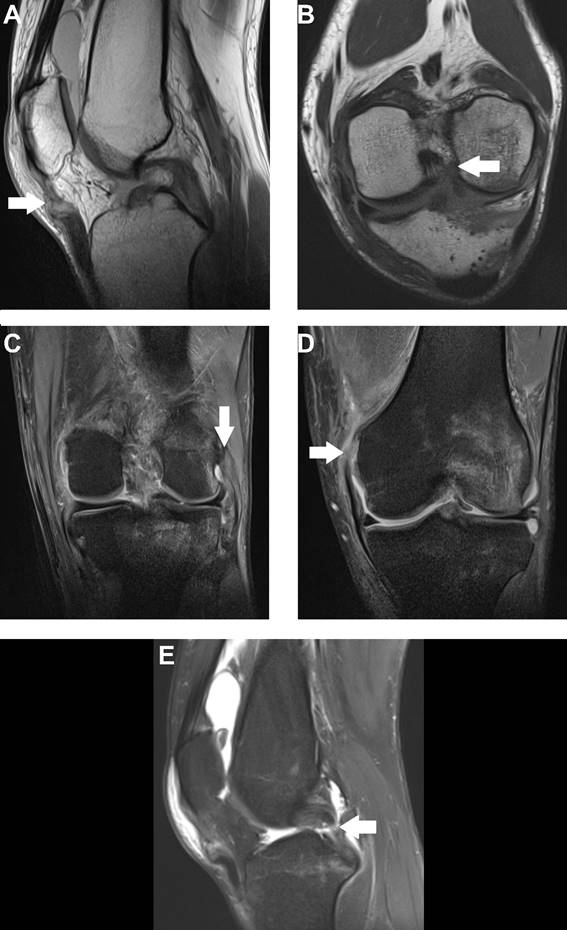
A 27-year-old man experienced a left knee sprain 15 days ago during a football game. Physical examination with knee tests was not performed at the time of trauma due to pain, only joint swelling was detected. Magnetic resonance imaging (MRI) detected a complete rupture of the anterior cruciate ligament and the proximal insertion of the medial collateral ligament, a partial rupture of the posterior cruciate, lateral collateral and patellar ligaments (Figure), and peripheral rupture of the posterior horn of the lateral meniscus. The patient underwent surgery for patellar ligament 50 days after the MRI, followed by 30 sessions of physiotherapy, reporting pain improvement. Seven months later he had another surgery, but, this one, for anterior cruciate ligament correction. Since the second surgery, he is improving the mobility and pain with physiotherapy.
Multi-ligament knee injuries (MLKIs) are complex, involving damage to two or more major knee ligaments affecting less than 0.02% of all orthopedic injuries.1 These injuries often occur with knee dislocations and neurovascular damage, particularly to the popliteal artery and common peroneal nerve.2 MRI is the best imaging tool for detecting MLKIs and related injuries.2 While surgical management is generally preferred over conservative treatment, the evidence supporting this is not strong.3 More research is needed to develop clear, evidence-based guidelines for surgical approaches, including acute, staged, and delayed reconstruction.3
DP sagittal section MRI (A) detecting patellar ligament partial tear (white arrow). T2 oblique section MRI (B) demonstrating anterior cruciate ligament complete tear (white arrow). DP FAT SAT coronal section MRI showing lateral collateral ligament partial tear (C - white arrow) and medial collateral ligament complete tear (D - white arrow). Sagittal T2 FAT SAT section MRI (E) detecting posterior cruciate ligament partial tear (white arrow)
References:
-
1 Pardiwala DN, Subbiah K, Thete R, Jadhav R, Rao N. Multiple ligament knee injuries: Clinical practice guidelines. J Arthrosc Surg Sports Med 2022;3:40-9. doi: 10.25259/JASSM_19_2021
» 10.25259/JASSM_19_2021 -
2 Fortier LM, Stylli JA, Civilette M, Duran NS, Hanukaai S, Wilder H, Sherman WF, Kaye AD. An Evidence-Based Approach to Multi-Ligamentous Knee Injuries. Orthop Rev (Pavia). 2022 May 31;14(4):35825. doi: 10.52965/001c.35825.
» https://doi.org/10.52965/001c.35825. -
3 Samuel LT, Rabin J, Jinnah A, Rosas S, Chao L, Sullivan R, Gwam CU. Management of the multi-ligamentous injured knee: an evidence-based review. Ann Joint 2019;4:21. doi: 10.21037/aoj.2019.02.06
» https://doi.org/10.21037/aoj.2019.02.06