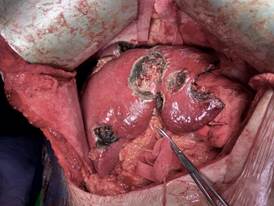
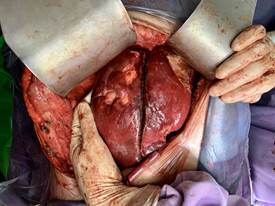
Two-stage hepatectomy for bilobar colorectal liver metastases. Case report.
Half of colorectal cancer patients develop liver metastases during the course of their disease, 80% of which are unresectable.
Resectability is defined not by the extent of the hepatectomy, but by the function of the liver remnant. Therefore, for patients with certain factors, liver remodeling techniques can be performed to increase volume of the remaining liver so that it is sufficient.
Two-stage hepatectomy is performed on colorectal liver metastases which are initially considered unresectable in one stage resection procedures, in which sequential procedures are performed in order to achieve complete resection and preserve a sufficient functioning liver remnant.
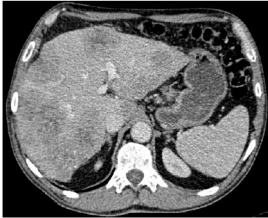
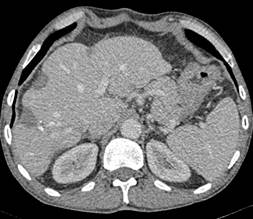
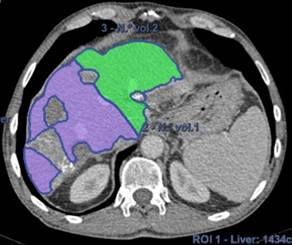
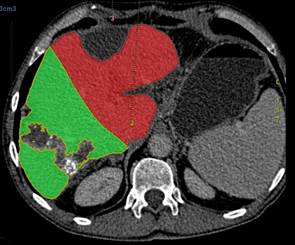
The objective of this paper is to present the case of a patient with unresectable synchronous colorectal liver metastases, in which after conversion chemotherapy, in order to increase the future liver remnant, avoid postoperative liver failure and perform an oncological resection underwent a two-stage hepatectomy, a technique used with low frequency in our setting, highlighting a favorable evolution, with tumor markers in normal values and without imaging evidence of local or systemic relapse.
Keywords:
Two-stage hepatectomy; liver metastases of colorectal origin
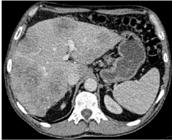 Thumbnail
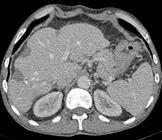 Thumbnail
 Thumbnail
 Thumbnail
 Thumbnail
 Thumbnail