Gluteus minimus tendon tear as a cause of greater trochanteric pain syndrome: a case report
Abstract
Greater trochanteric pain syndrome is frequently related to gluteal tendon pathology. We report a case of a 32-year-old woman with chronic lateral hip pain in whom magnetic resonance imaging revealed a complete gluteus minimus tendon tear associated with gluteus medius tendinopathy. This case emphasizes the role of magnetic resonance imaging in establishing an accurate diagnosis and guiding appropriate treatment.
Keywords:
Greater Trochanteric Pain Syndrome; Gluteus Minimus; Hip Pain; Magnetic Resonance Imaging
Resumen
El síndrome de dolor trocantérico mayor se asocia frecuentemente a lesiones de los tendones glúteos. Se presenta el caso de una mujer de 32 años con dolor lateral crónico de cadera, en quien la resonancia magnética evidenció una rotura completa del tendón del glúteo menor asociada a tendinopatía del glúteo medio. El caso resalta el papel de la resonancia magnética en el diagnóstico preciso y la orientación terapéutica.
Palabras clave:
Cadera; Dolor Musculoesquelético; Lesiones de los Tendones; Imagen por Resonancia Magnética
Resumo
A síndrome da dor trocantérica maior está frequentemente associada a lesões dos tendões glúteos. Relatamos o caso de uma mulher de 32 anos com dor lateral crônica no quadril, em que a ressonância magnética demonstrou rotura completa do tendão do glúteo mínimo associada à tendinopatia do glúteo médio. O caso destaca a importância da ressonância magnética para o diagnóstico preciso e manejo adequado.
Palavras-chave:
Síndrome da Dor Trocantérica Maior; Glúteo Mínimo; Dor no Quadril; Imageamento por Ressonância Magnética
A 32-year-old woman presented with progressive left lateral hip pain and limping for two years, associated with lower-limb edema for 15 months. The pain worsened with walking and significantly limited daily and recreational activities, including running, stair climbing, squatting, and prolonged sitting. Her medical history included bariatric surgery, prior stroke with irregular rehabilitation, and recent cardiac surgery. She was obese, weighing 113 kg (body mass index 40 kg/m²), and reported frequent alcohol consumption. Physical examination revealed localized tenderness over the greater trochanter, with pain-limited hip adduction and internal rotation. Magnetic resonance imaging (MRI) demonstrated a complete tear of the gluteus minimus tendon associated with gluteus medius tendinopathy. Conservative management focused on weight loss and a structured physical therapy program targeting hip abductor strengthening and gait retraining demonstrated progressive improvement over subsequent months.
Lesions of the gluteus medius and minimus tendons share morphological similarities with shoulder abductor injuries1 and commonly present as chronic lateral hip pain. They may be difficult to differentiate clinically from bursitis or snapping hip syndrome.2 MRI is considered the gold standard for diagnosing gluteal tendon pathology, allowing detection of complete and partial tears and associated muscle atrophy.3 Conservative therapy-physical rehabilitation, load modification, and weight reduction-is first-line; surgery is reserved for complete ruptures or refractory pain.4
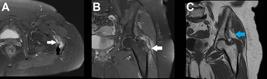
Axial T2 fat-suppressed (A), coronal T2 fat-suppressed (B), and coronal T1-weighted (C) magnetic resonance images showing a complete tear of the left gluteus minimus tendon (white arrow), associated gluteus medius tendinopathy (black arrow), and gluteus minimus muscle atrophy (blue arrow).
References:
-
1 Stanton MC, Maloney MD, Dehaven KE, Giordano BD. Acute traumatic tear of gluteus medius and minimus tendons in a patient without antecedant peritrochanteric hip pain. Geriatr Orthop Surg Rehabil. 2012 Jun;3(2):84-8. doi: 10.1177/2151458512441795.
» https://doi.org/10.1177/2151458512441795 -
2 LaBan MM, Ferris JA, Grant LB. Insertional tears of the gluteus minimus on the greater trochanter. Am J Phys Med Rehabil. 2015 Apr;94(4):e34. doi: 10.1097/PHM.0000000000000251.
» https://doi.org/10.1097/PHM.0000000000000251 -
3 Bajuri MY, Sivasamy P, Simanjuntak GRN, Azemi AF, Azman MI. Posttraumatic Isolated Right Gluteus Minimus Tear: A Case Report. Cureus. 2022 Mar 11;14(3):e23056. doi: 10.7759/cureus.23056.
» https://doi.org/10.7759/cureus.23056 -
4 Godshaw B, Wong M, Ojard C, Williams G, Suri M, Jones D. Acute Traumatic Tear of the Gluteus Medius and Gluteus Minimus in a Marathon Runner. Ochsner J. 2019 Winter;19(4):405-409. doi: 10.31486/toj.18.0090.
» https://doi.org/10.31486/toj.18.0090.