Mechanics and energy during treadmill walking in Healthy Uruguayan Adults: effect of BMI and age.
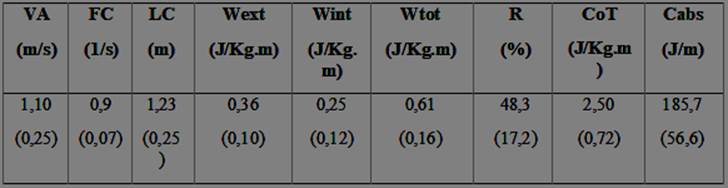
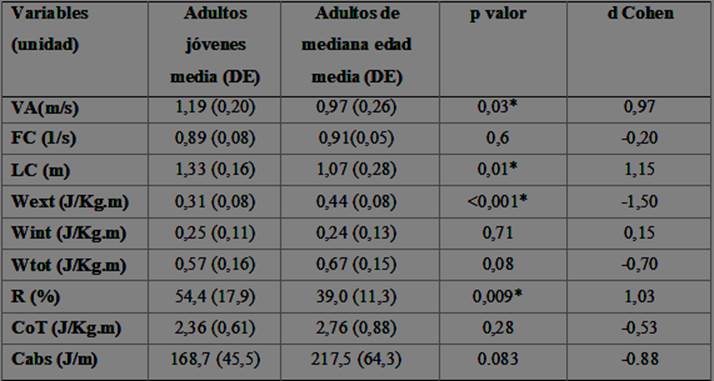
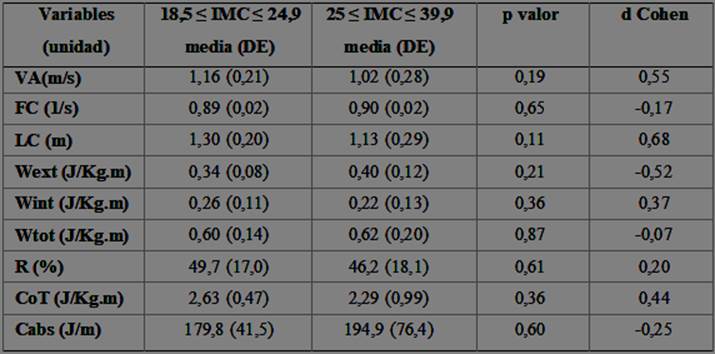
Treadmill gait assessment can be relevant for clinical decision-making. However, demographic factors such as age and BMI may alter result interpretation. Our aim was to obtain spatiotemporal, energetic, and cost of transport variables during self-selected treadmill walking speed for a representative sample of Uruguayan adults (n=28) and to assess if different age ranges and BMI could be factors to consider in clinical tests involving these variables. Seventeen men and eleven women participated (39.3 ± 14.8 years, 75.9 ± 12.5 kg, 1.74 ± 0.09 m, BMI 25.2 ± 4.06). A synchronized 3D motion reconstruction was performed with energy consumption. Reference values were obtained and data were compared using t-tests (p≤0.05), after grouping participants by BMI and age range. Results revealed significant discrepancies in spatiotemporal and energetic measures of Uruguayan adults walking on the treadmill, compared to the literature. Gait differed between young and middle-aged adults in their self-selected speed (p=0.03), stride length (p=0.01), external mechanical work (p<0.001), and mechanical energy recovery (0.009), emphasizing the importance of considering age in clinical evaluations. BMI did not significantly influence these variables. These findings underscore the need to adjust interpretations of treadmill gait clinical tests in middle-aged Uruguayan adults (45 to 65 years).
Keywords:
Biomechanics; Clinical gait analysis; Treadmill; Temporal-distance variables; Mechanical energy; Oxygen cost