Seguimiento de recién nacidos con asfixia perinatal
Abstract
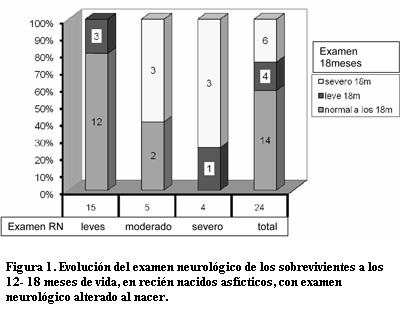
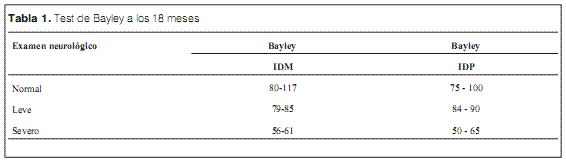
Objective: to study the predictive value of early clinical examination and evolutive profile in the neurodevelopment of term-newborns with perinatal asphyxia. Methods and population: a prospective longitudinal study was made including twenty four newborns who suffered perinatal asphyxia. Follow-up with an interdisciplinary team was performed. Newborns were evaluated and included according to Amiel Tison criteria for neurologic examination into the categories of mild, moderate and severe alterations. At the age of 12 to 18 month they were re-evaluated and classified according to their examination neurologic, and grade of dependency for activities of daily life into normal, or with mild, and severe sequelae. The cognitive evaluation was performed the test Bayley. All of them received physiotherapy as part of their treatment. Results: newborn neurologic examination has proved 62% mild, 21% moderate and 17% severe alterations. Between 12 and 18 months, 58% had normal clinical examination, 17% showed mild and 25% severe sequelae. Results of cognitive evaluation are in agreement with clinical examination. Conclusions: results of early neurological examination, can be an orientative prognostical factor in case of mild sequelae and when a dynamic evolutive profile is present in the perinatal period; showing normal clinical examination at age 12 to 18 months with a 75% predictive value. Newborns with severe alterations at birth and static evolutive profile, still have severe lesions at 18 months, without statistical significance in our sample
ASPHYXIA NEONATORUM; NEUROLOGIC EXAMINATION; FOLLOW-UP STUDIES; INFANT, NEWBORN
 Thumbnail