Guillain-Barré syndrome: Twelve years of experience
Abstract
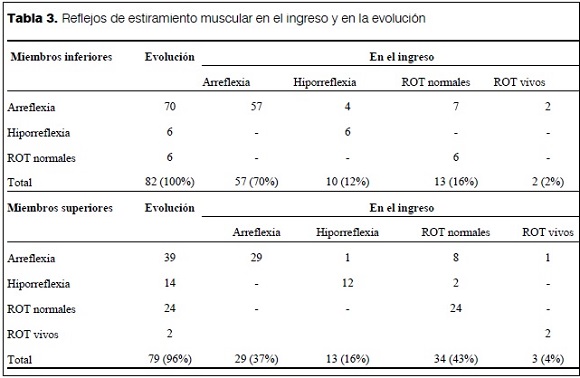
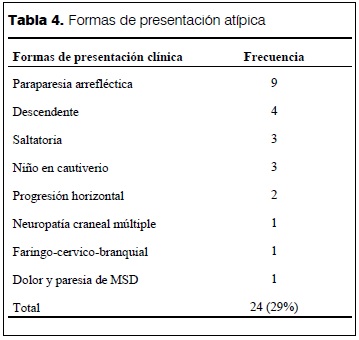
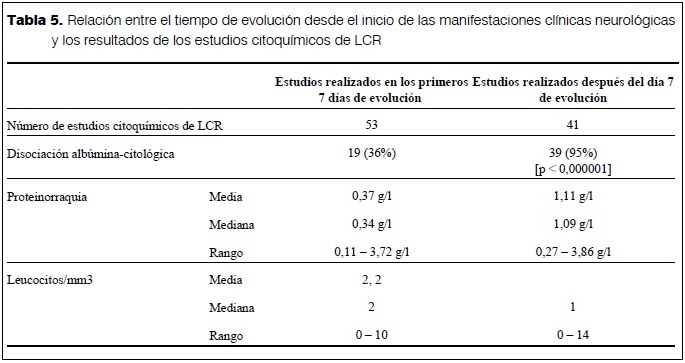
Introduction: early diagnosis and treatment of Guillain-Barré is important to reduce morbimortality of the condition and thus, it is essential to learn about initial clinical presentations and the yield of diagnostic tests. Objectives: to describe the characteristics of patients under 15 years of age who were hospitalized due to Guillain-Barré syndrome at the Pereira Rossell Hospital Center from January 1, 2000 through December 31, 2011. Method: descriptive, retrospective study based on a review of the clinical records. Results: eighty two patients were included, 52 of them were male. Fifty nine patients required to be admitted to the intensive care unit. The most frequent symptom was paresia of the lower limbs (80 patients), followed by pain in the lower limbs (64 patients). Twenty nine percent of our series evidenced clinical presentations that were not typical of Guillain-Barré syndrome. Half of the patients presented disease severity at nadir grade 4 by Hughes. Seventy seven patients underwent a study of the spinal fluid, and this was repeated in 17 patients, what showed albuminocytologic dissociation in 19 out of 53 (36%) of the tests performed in the first seven days of evolution, and in 39 out of 41 (95%) of the tests performed after seven days. Conclusions: we point out the diverse clinical presentations of the Guillain-Barré syndrome and the low sensitivity of the spinal fluid in the first week of evolution
GUILLAIN-BARRE SYNDROME; POLYRADICULONEUROPATHY; ACUTE MOTOR NEUROPATHY