<?xml version="1.0" encoding="ISO-8859-1"?><article xmlns:mml="http://www.w3.org/1998/Math/MathML" xmlns:xlink="http://www.w3.org/1999/xlink" xmlns:xsi="http://www.w3.org/2001/XMLSchema-instance">
<front>
<journal-meta>
<journal-id>2301-1548</journal-id>
<journal-title><![CDATA[Agrociencia (Uruguay)]]></journal-title>
<abbrev-journal-title><![CDATA[Agrociencia Uruguay]]></abbrev-journal-title>
<issn>2301-1548</issn>
<publisher>
<publisher-name><![CDATA[Facultad de Agronomía - Instituto Nacional de Investigación Agropecuaria]]></publisher-name>
</publisher>
</journal-meta>
<article-meta>
<article-id>S2301-15482011000100011</article-id>
<title-group>
<article-title xml:lang="es"><![CDATA[Impacto de las olas de calor en vacas lecheras en Salto (Uruguay)]]></article-title>
<article-title xml:lang="en"><![CDATA[Impact of Heat Waves on Dairy Cows in Salto (Uruguay)]]></article-title>
</title-group>
<contrib-group>
<contrib contrib-type="author">
<name>
<surname><![CDATA[Saravia]]></surname>
<given-names><![CDATA[Celmira]]></given-names>
</name>
<xref ref-type="aff" rid="A01"/>
</contrib>
<contrib contrib-type="author">
<name>
<surname><![CDATA[Astigarraga]]></surname>
<given-names><![CDATA[Laura]]></given-names>
</name>
<xref ref-type="aff" rid="A02"/>
</contrib>
<contrib contrib-type="author">
<name>
<surname><![CDATA[Van Lier]]></surname>
<given-names><![CDATA[Elize]]></given-names>
</name>
<xref ref-type="aff" rid="A02"/>
</contrib>
<contrib contrib-type="author">
<name>
<surname><![CDATA[Bentancur]]></surname>
<given-names><![CDATA[Oscar]]></given-names>
</name>
<xref ref-type="aff" rid="A03"/>
</contrib>
</contrib-group>
<aff id="A01">
<institution><![CDATA[,Estación Experimental de Facultad de Agronomía en Salto Unidad de Sistemas Ambientales ]]></institution>
<addr-line><![CDATA[Salto ]]></addr-line>
<country>Uruguay</country>
</aff>
<aff id="A02">
<institution><![CDATA[,Universidad de la República Facultad de Agronomía Departamento de Producción Animal y Pasturas]]></institution>
<addr-line><![CDATA[Montevideo ]]></addr-line>
</aff>
<aff id="A03">
<institution><![CDATA[,Universidad de la República Estación Experimental Mario A. Cassinoni Departamento de Producción Animal y Pasturas]]></institution>
<addr-line><![CDATA[ ]]></addr-line>
</aff>
<pub-date pub-type="pub">
<day>00</day>
<month>06</month>
<year>2011</year>
</pub-date>
<pub-date pub-type="epub">
<day>00</day>
<month>06</month>
<year>2011</year>
</pub-date>
<volume>15</volume>
<numero>1</numero>
<fpage>93</fpage>
<lpage>102</lpage>
<copyright-statement/>
<copyright-year/>
<self-uri xlink:href="http://www.scielo.edu.uy/scielo.php?script=sci_arttext&amp;pid=S2301-15482011000100011&amp;lng=en&amp;nrm=iso"></self-uri><self-uri xlink:href="http://www.scielo.edu.uy/scielo.php?script=sci_abstract&amp;pid=S2301-15482011000100011&amp;lng=en&amp;nrm=iso"></self-uri><self-uri xlink:href="http://www.scielo.edu.uy/scielo.php?script=sci_pdf&amp;pid=S2301-15482011000100011&amp;lng=en&amp;nrm=iso"></self-uri><abstract abstract-type="short" xml:lang="es"><p><![CDATA[El objetivo de este trabajo fue caracterizar la ocurrencia de condicionantes meteorológicas (CM) estivales de diferente severidad en Salto (Uruguay) y su impacto sobre las respuestas fisiológicas y productivas de vacas lecheras. Se caracterizaron las CM según el índice de temperatura y humedad (ITH) promedio, horas al día con ITH &sup3;72 y las temperaturas mínima y máxima diaria. En los animales, se registró la temperatura rectal (TR) y la frecuencia respiratoria (FR) a las 6:00 y 15:00 horas, también el tiempo dedicado al pastoreo (TP) durante el día. Se identificó una ola de calor severa (OCS), tres olas de calor leve (OCL) y días de no ola de calor (NOC). La FR y la TR de las vacas variaron en función de CM (P<0,0001). Las FR y TR (6:00 y 15:00) fueron mayores en OCS con respecto a OCL y a NOC (P<0,0001). El TP fue menor durante OCS con respecto a OCL y NOC (P<0,0001). La producción de leche, grasa y proteína fueron menores en OCS (P<0,0001) con respecto a OCL y NOC. El recuento de células somáticas fue mayor en OCS que en OCL, pero no que en NOC (P=0,0618). Durante OCS las vacas no lograron mantener la normotermia y tuvieron menor TP, reduciendo la productividad. En OCL las vacas recuperaron la normotermia durante la noche, no reduciendo la productividad en comparación a los días NOC.]]></p></abstract>
<abstract abstract-type="short" xml:lang="en"><p><![CDATA[The aim of this study was to characterise summer meteorological determining factors (MDF) of different severity in Salto (Uruguay) and their impact on the physiological and productive responses of dairy cows. The MDF were characterised according to the mean temperature-humidity index (THI), average hours per day with THI &sup3;72 and minimum and maximum daily temperatures. Rectal temperature (RT) and respiratory frequency (RF) of the cows were taken at 6:00 and 15:00 h, and the time spent grazing (GT) during daytime. One severe heat wave (SHW), three light heat waves (LHW) and days of no heat wave (NHW) were identified. The MDF affected RT and RF of the cows (P<0,0001). The RF and RT (6:00 and 15:00) were higher in SHW compared to LHW and NHW (P<0,0001). Grazing time was less during SHW compared to LHW and NHW (P<0,0001). The production of milk, fat and protein were lower during SHW (P<0,0001) than during LHW and NHW. Somatic cell count was lower during SHW than LHW but not NHW (P=0,0618). During SHW cows did not maintain normothermia and spent less time grazing, reducing productivity. During LHW cows recovered normothermia during the night, with no reduction in productivity compared to NHW.]]></p></abstract>
<kwd-group>
<kwd lng="es"><![CDATA[estrés calórico]]></kwd>
<kwd lng="es"><![CDATA[temperatura rectal]]></kwd>
<kwd lng="es"><![CDATA[frecuencia respiratoria]]></kwd>
<kwd lng="es"><![CDATA[tiempo de pastoreo]]></kwd>
<kwd lng="es"><![CDATA[producción y composición de leche]]></kwd>
<kwd lng="en"><![CDATA[heat stress]]></kwd>
<kwd lng="en"><![CDATA[rectal temperature]]></kwd>
<kwd lng="en"><![CDATA[respiratory frequency]]></kwd>
<kwd lng="en"><![CDATA[grazing time]]></kwd>
<kwd lng="en"><![CDATA[milk production and composition]]></kwd>
</kwd-group>
</article-meta>
</front><body><![CDATA[ <div class="Section1">     <p style="margin-bottom: 0.0001pt;"><font face="Verdana"> <span style="font-size: 10pt;font-weight:700">Impacto de las olas de calor en vacas lecheras en Salto (Uruguay)</span></font></p>      <p style="margin-bottom: 0.0001pt;"><font face="Verdana" size="2"><o:p>&nbsp;</o:p></font></p>      <p style="margin-bottom: 0.0001pt;"><font face="Verdana" size="2"><o:p>&nbsp;</o:p></font></p>      <p style="margin-bottom: 0.0001pt;"><font face="Verdana"> <span style="font-size: 10pt;"><a name="1.."></a>Saravia Celmira</span><a href="#1."><sup><span style="font-size: 10pt;">1</span></sup></a><span style="font-size: 10pt;">, <span class="SpellE"><a name="2.."></a>Astigarraga</span> Laura</span><a href="#2."><sup><span style="font-size: 10pt;">2</span></sup></a><span style="font-size: 10pt;">, Van <span class="SpellE">Lier</span> Elize</span><a href="#2."><sup><span style="font-size: 10pt;">2</span></sup></a><span style="font-size: 10pt;">, <span class="SpellE"><a name="3.."></a>Bentancur</span> Oscar</span><a href="#3."><sup><span style="font-size: 10pt;">3</span></sup></a></font></p>      <p style="margin-bottom: 0.0001pt;"><font face="Verdana" size="2"><o:p>&nbsp;</o:p></font></p>      <p style="margin-bottom: 0.0001pt;"><font face="Verdana" size="2"><o:p>&nbsp;</o:p></font></p>      <p style="margin-bottom: 0.0001pt;"><font face="Verdana"><i><sup> <span style="font-size: 10pt;"><a name="1."></a><a href="#1..">1</a></span></sup><span style="font-size: 10pt;">Unidad de Sistemas Ambientales, Estaci&oacute;n Experimental de Facultad de Agronom&iacute;a en Salto, ruta <st1:metricconverter productid="31 km" w:st="on">31 <span class="SpellE">km</span></st1:metricconverter> 21,5; Salto, Uruguay. </span></i> </font></p>      <p style="margin-bottom: 0.0001pt;"><font face="Verdana"><i><sup> <span style="font-size: 10pt;"><a name="2."></a><a href="#2..">2</a></span></sup><span style="font-size: 10pt;">Departamento de Producci&oacute;n Animal y Pasturas, Facultad de Agronom&iacute;a, Universidad de <st1:personname productid="la Rep&uacute;blica" w:st="on">la Rep&uacute;blica</st1:personname>; Montevideo. </span></i></font></p>      <p style="margin-bottom: 0.0001pt;"><font face="Verdana"><i><sup> <span style="font-size: 10pt;"><a name="3."></a><a href="#3..">3</a></span></sup><span style="font-size: 10pt;">Departamento de Biometr&iacute;a, Estad&iacute;stica y C&oacute;mputo, Estaci&oacute;n Experimental Mario A. <span class="SpellE">Cassinoni</span>, Universidad de <st1:personname productid="la Rep&uacute;blica" w:st="on">la Rep&uacute;blica</st1:personname>; Paysand&uacute;.</span></i></font></p>      ]]></body>
<body><![CDATA[<p style="margin-bottom: 0.0001pt;"><font face="Verdana" size="2"><o:p>&nbsp;</o:p></font></p>      <p style="margin-bottom: 0.0001pt; text-align: center;" align="center"> <font face="Verdana" size="2">Recibido: 18/12/09 Aceptado: 3/3/11</font></p>      <p style="margin-bottom: 0.0001pt;"><font face="Verdana" size="2"><o:p>&nbsp;</o:p></font></p>      <p style="margin-bottom: 0.0001pt;"><font face="Verdana"><b> <span style="font-size: 10pt;">Resumen</span></b></font></p>      <p style="margin-bottom: 0.0001pt;"><font face="Verdana" size="2"><o:p>&nbsp;</o:p></font></p>      <p style="margin-bottom: 0.0001pt;"><font face="Verdana"><i> <span style="font-size: 10pt;">El objetivo de este trabajo fue caracterizar la ocurrencia de condicionantes meteorol&oacute;gicas (CM) estivales de diferente severidad en Salto (Uruguay) y su impacto sobre las respuestas fisiol&oacute;gicas y productivas de vacas lecheras. Se caracterizaron las CM seg&uacute;n el &iacute;ndice de temperatura y humedad (ITH) promedio, horas al d&iacute;a con ITH &ge;72 y las temperaturas m&iacute;nima y m&aacute;xima diaria. En los animales, se registr&oacute; la temperatura rectal (TR) y la frecuencia respiratoria (FR) a las 6:00 y 15:00 horas, tambi&eacute;n el tiempo dedicado al pastoreo (TP) durante el d&iacute;a. Se identific&oacute; una ola de calor severa (OCS), tres olas de calor leve (OCL) y d&iacute;as de no ola de calor (NOC). <st1:personname productid="la FR" w:st="on">La FR</st1:personname> y <st1:personname productid="la TR" w:st="on">la TR</st1:personname> de las vacas variaron en funci&oacute;n de CM (P&lt;0,0001). Las FR<sub> </sub>y TR<sub> </sub>(6:00 y 15:00) fueron mayores en OCS con respecto a OCL y a NOC (P&lt;0,0001). El TP fue menor durante OCS con respecto a OCL y NOC (P&lt;0,0001). La producci&oacute;n de leche, grasa y prote&iacute;na fueron menores en OCS (P&lt;0,0001) con respecto a OCL y NOC. El recuento de c&eacute;lulas som&aacute;ticas fue mayor en OCS que en OCL, pero no que en NOC (P=0,0618). Durante OCS las vacas no lograron mantener la <span class="SpellE">normotermia</span> y tuvieron menor TP, reduciendo la productividad. En OCL las vacas recuperaron la <span class="SpellE">normotermia</span> durante la noche, no reduciendo la productividad en comparaci&oacute;n a los d&iacute;as NOC. </span></i></font></p>      <p style="margin-bottom: 0.0001pt;"><font face="Verdana" size="2"><o:p>&nbsp;</o:p></font></p>      <p style="margin-bottom: 0.0001pt;"><font face="Verdana"><b> <span style="font-size: 10pt;">Palabras clave: </span></b><span style="font-size: 10pt;">ESTR&Eacute;S CAL&Oacute;RICO, TEMPERATURA RECTAL, FRECUENCIA RESPIRATORIA, TIEMPO DE PASTOREO, PRODUCCI&Oacute;N Y COMPOSICI&Oacute;N DE LECHE </span></font></p>      <p style="margin-bottom: 0.0001pt;"><font face="Verdana" size="2"><o:p>&nbsp;</o:p></font></p>      <p style="margin-bottom: 0.0001pt;"><font face="Verdana"><b> <span style="font-size: 10pt;" lang="EN-US">Summary</span></b></font><span style="" lang="EN-US"><o:p></o:p></span></p>      ]]></body>
<body><![CDATA[<p style="margin-bottom: 0.0001pt;"><font face="Verdana" size="2"><span style="" lang="EN-US"><o:p>&nbsp;</o:p></span></font></p>      <p style="margin-bottom: 0.0001pt;"><font face="Verdana"> <span style="font-size: 10pt;" lang="EN-US">Impact of Heat Waves on Dairy Cows in <span class="SpellE">Salto</span> (Uruguay)</span></font><span style="" lang="EN-US"><o:p></o:p></span></p>      <p style="margin-bottom: 0.0001pt;"><font face="Verdana" size="2"><span style="" lang="EN-US"><o:p>&nbsp;</o:p></span></font></p>      <p style="margin-bottom: 0.0001pt;"><font face="Verdana"><i> <span style="font-size: 10pt;" lang="EN-US">The aim of this study was to <span class="SpellE">characterise</span> summer meteorological determining factors (MDF) of different severity in <span class="SpellE">Salto</span> (Uruguay) and their impact on the physiological and productive responses of dairy cows. The MDF were <span class="SpellE">characterised</span> according to the mean temperature-humidity index (THI), average hours per day with THI &ge;72 and minimum and maximum daily temperatures. Rectal temperature (RT) and respiratory frequency (RF) of the cows were taken at 6:00 and 15:00 h, and the time spent grazing (GT) during daytime. One severe heat wave (SHW), three light heat waves (LHW) and days of no heat wave (NHW) were identified. </span></i></font><span style="" lang="EN-US"><o:p></o:p></span></p>      <p style="margin-bottom: 0.0001pt;"><font face="Verdana"><i> <span style="font-size: 10pt;" lang="EN-US">The MDF affected RT and RF of the cows (P&lt;0,0001). The RF and RT (6:00 and 15:00) were higher in SHW compared to LHW and NHW (P&lt;0,0001). Grazing time was less during SHW compared to LHW and NHW (P&lt;0,0001). The production of milk, fat and protein were lower during SHW (P&lt;0,0001) than during LHW and NHW. Somatic cell count was lower during SHW than LHW but not NHW (P=0,0618). During SHW cows did not maintain <span class="SpellE">normothermia</span> and spent less time grazing, reducing productivity. During LHW cows recovered <span class="SpellE">normothermia</span> during the night, with no reduction in productivity compared to NHW.</span></i></font><span style="" lang="EN-US"><o:p></o:p></span></p>      <p style="margin-bottom: 0.0001pt;"><font face="Verdana" size="2"><span style="" lang="EN-US"><o:p>&nbsp;</o:p></span></font></p>      <p style="margin-bottom: 0.0001pt;"><font face="Verdana"><b> <span style="font-size: 10pt;" lang="EN-US">Key words: </span></b> <span style="font-size: 10pt;" lang="EN-US">HEAT STRESS, RECTAL TEMPERATURE, RESPIRATORY FREQUENCY, GRAZING TIME, MILK PRODUCTION AND COMPOSITION</span></font><span style="" lang="EN-US"><o:p></o:p></span></p>      <p style="margin-bottom: 0.0001pt;"><font face="Verdana" size="2"><span style="" lang="EN-US"><o:p>&nbsp;</o:p></span></font></p>      <p style="margin-bottom: 0.0001pt;"><font face="Verdana"><b> <span style="font-size: 10pt;">Introducci&oacute;n</span></b></font></p>      <p style="margin-bottom: 0.0001pt;"><font face="Verdana" size="2"><o:p>&nbsp;</o:p></font></p>      ]]></body>
<body><![CDATA[<p style="margin-bottom: 0.0001pt;"><font size="2" face="Verdana">Durante los meses c&aacute;lidos la acci&oacute;n combinada de alta radiaci&oacute;n solar, temperatura y humedad del aire determina que el ambiente meteorol&oacute;gico se encuentre fuera de la zona de confort t&eacute;rmico de la vaca, reduciendo su productividad. El efecto de este ambiente se verifica directamente a trav&eacute;s de la disminuci&oacute;n de la producci&oacute;n de leche <a name="Hahn1995"></a>(<a href="#12">Hahn, 1995</a>, <a name="1999"></a><a href="#13">1999</a>; <a name="Levaetal.1996"></a><a href="#25">Leva <i>et al</i>., 1996</a>; <a name="Silanikove2000"></a><a href="#39"><span class="SpellE">Silanikove</span>, 2000</a>), cambios en su composici&oacute;n <a name="Bianca1965"></a>(<a href="#4">Bianca, 1965</a>; </font><font size="2"><span class="SpellE"><font face="Verdana"><a name="Sargentetal.1967"></a>Sargent</font></span><font face="Verdana">, </a><a href="#36"><i>et al</i>., 1967</a>) y reducci&oacute;n en la eficiencia reproductiva del rodeo <a name="Ingrahametal.1974"></a>(<a href="#18"><span class="SpellE">Ingraham</span> <i>et al</i>., 1974</a>; </font><span class="SpellE"><font face="Verdana"><a name="Ingrahametal.1976"></a>Ingraham</font></span><font face="Verdana"> </a><a href="#19"><i>et al</i>., 1976</a>; </font><span class="SpellE"><font face="Verdana"><a name="ThatcheryStaples1995"></a>Thatcher</font></span><font face="Verdana"> y <span class="SpellE">Staples</span>, 1995</a>; </font><span class="SpellE"><font face="Verdana"><a name="Flamenbaum1996"></a>Flamenbaum</font></span><font face="Verdana">, 1996</a>; <a name="Jordanetal.2003"></a><a href="#22">Jordan <i>et al.</i>, 2003</a>). Se ha intentado cuantificar las condiciones ambientales y su relaci&oacute;n con la productividad animal a trav&eacute;s de la evoluci&oacute;n de &iacute;ndices <span class="SpellE">biometeorol&oacute;gicos</span>. Un &iacute;ndice <span class="SpellE">biometeorol&oacute;gico</span> muy difundido para caracterizar el ambiente t&eacute;rmico <a name="duPreezetal.1990"></a>(<a href="#7"><span class="SpellE">du</span> <span class="SpellE">Preez</span> <i>et al</i>., 1990</a>; </font><span class="SpellE"><font face="Verdana"><a name="Flamenbaum1994"></a>Flamenbaum</font></span><font face="Verdana">, 1994</a>; </font><span class="SpellE"><font face="Verdana"><a name="Valtortaetal.1998"></a>Valtorta</font></span></font><font size="2" face="Verdana"> </a><a href="#47"><i>et al.</i>, 1998</a>) es el &Iacute;ndice de Temperatura y Humedad (ITH) <a name="Thom1959"></a>(<a href="#42">Thom, 1959</a>), que se ha utilizado como base para sistemas de advertencia <a name="HughJones1994"></a>(<a href="#16">Hugh-Jones, 1994</a>) y para la evaluaci&oacute;n de las consecuencias econ&oacute;micas del estr&eacute;s t&eacute;rmico en ambientes naturales y/o modificados (<a href="#12">Hahn, 1995</a>; <a name="St.Pierreetal.2003"></a><a href="#40"><span class="SpellE">St</span>. Pierre <i>et al</i>., 2003</a>). La zona de confort t&eacute;rmico para vacas lecheras en producci&oacute;n toma valores de ITH entre 35 y 70 y se ha determinado un valor cr&iacute;tico para la producci&oacute;n de leche por estr&eacute;s por calor en vacas <span class="SpellE">Holando</span> de 72 <a name="Johnsonetal.1961"></a>(<a href="#20">Johnson <i>et al.,</i> 1961</a>). </font> </p>      <p style="margin-bottom: 0.0001pt;"><font face="Verdana" size="2"><o:p>&nbsp;</o:p></font></p>      <p style="margin-bottom: 0.0001pt;"><font face="Verdana" size="2">Los animales est&aacute;n adaptados a las condiciones ambientales en las que viven, sin embargo hay ciertas ocasiones en las que sufren estr&eacute;s t&eacute;rmico debido a las variaciones t&eacute;rmicas o bien por una combinaci&oacute;n de factores negativos a los que se someten durante un corto per&iacute;odo de tiempo. Estos per&iacute;odos anormalmente c&aacute;lidos y generalmente h&uacute;medos de tres d&iacute;as consecutivos o m&aacute;s se denominan olas de calor <a name="MinisteriodeDefensa2000"></a>(<a href="#28">Ministerio de Defensa, 2000</a>). Estas son eventos meteorol&oacute;gicos extremos que provocan p&eacute;rdidas econ&oacute;micas en la producci&oacute;n agropecuaria por reducir la productividad de los animales e incluso provocarles la muerte (<a href="#40"><span class="SpellE">St</span>-Pierre <i>et al</i>., 2003</a>). Se han documentado eventos de olas de calor con grandes p&eacute;rdidas econ&oacute;micas en distintas localidades en todo el mundo <a name="NienaberyHahn2007"></a>(<a href="#32"><span class="SpellE">Nienaber</span> y Hahn, 2007</a>).</font></p>      <p style="margin-bottom: 0.0001pt;"><font face="Verdana" size="2"><o:p>&nbsp;</o:p></font></p>      <p style="margin-bottom: 0.0001pt;"><font face="Verdana" size="2">Olas de calor extremas se caracterizan por presentar valores de ITH por encima del umbral de emergencia durante 15 horas o m&aacute;s al d&iacute;a y con una m&iacute;nima oportunidad de recuperaci&oacute;n nocturna, pudiendo provocar la muerte en animales vulnerables como animales de alto nivel de producci&oacute;n, animales nuevos en <span class="SpellE">feedlot</span>, animales pr&oacute;ximos a terminaci&oacute;n, animales no aclimatados o enfermos <a name="Nienaberetal.2003"></a>(<a href="#31"><span class="SpellE">Nienaber</span> <i>et al</i>., 2003</a>). En Uruguay <a name="CruzySaravia2008"></a><span style="color: rgb(51, 51, 255);">Cruz y Saravia</span> (<a href="#6">2008</a>) han realizado una caracterizaci&oacute;n clim&aacute;tica de ITH en el per&iacute;odo estival (promedios hist&oacute;ricos mensuales de la serie 1961-1990 de los meses de diciembre a marzo), encontrando probabilidades mayores al 55% de ocurrencia valores por encima del cr&iacute;tico en el norte del R&iacute;o Negro para el mes de enero. Estas mismas autoras, al caracterizar olas de calor ocurridas en el departamento de Salto (Uruguay), en una serie de cinco a&ntilde;os concluyeron que las olas de calor de mayor duraci&oacute;n ocurren durante los meses de diciembre y enero con un promedio de diez horas con ITH mayores o iguales al umbral de peligro (78) y seis horas en promedio por encima del umbral de emergencia (82), por lo que seg&uacute;n su intensidad y duraci&oacute;n se pueden considerar de fuertes a severas <a name="SaraviayCruz2006"></a>(<a href="#34">Saravia y Cruz, 2006</a>). Sin embargo, en Uruguay, la informaci&oacute;n disponible del impacto del estr&eacute;s cal&oacute;rico sobre animales en producci&oacute;n es escasa. Por ello, el objetivo de este trabajo fue caracterizar la ocurrencia de condicionantes meteorol&oacute;gicas estivales de diferente severidad en Salto y su impacto sobre las respuestas fisiol&oacute;gicas y productivas de vacas lecheras. Este experimento incluy&oacute; tambi&eacute;n la evaluaci&oacute;n del impacto de las diferentes condicionantes meteorol&oacute;gicas sobre dos biotipos lecheros, con o sin acceso voluntario a sombra artificial, pero los resultados de estos dos &uacute;ltimos efectos son reportados en otro trabajo <a name="Saravia2009"></a>(<a href="#35">Saravia, 2009</a>). </font> </p>      <p style="margin-bottom: 0.0001pt;"><font face="Verdana" size="2"><o:p>&nbsp;</o:p></font></p>      <p style="margin-bottom: 0.0001pt;"><font face="Verdana"><b> <span style="font-size: 10pt;">Materiales y m&eacute;todos</span></b></font></p>      <p style="margin-bottom: 0.0001pt;"><font face="Verdana" size="2"><o:p>&nbsp;</o:p></font></p>      <p style="margin-bottom: 0.0001pt;"><font face="Verdana" size="2">El estudio se realiz&oacute; en <st1:personname productid="la Estaci&oacute;n Experimental" w:st="on">la Estaci&oacute;n Experimental</st1:personname> de <st1:personname productid="la Facultad" w:st="on">la Facultad</st1:personname> de Agronom&iacute;a en Salto (EEFAS), Latitud: 31&ordm; 23&acute; S; Longitud: 57&ordm; 57&acute; W, desde el 21 de diciembre de 2005 al 16 de febrero de 2006 (per&iacute;odo experimental 58 d&iacute;as).</font></p>      <p style="margin-bottom: 0.0001pt;"><font face="Verdana" size="2"><o:p>&nbsp;</o:p></font></p>      ]]></body>
<body><![CDATA[<p style="margin-bottom: 0.0001pt;"><font face="Verdana"><b> <span style="font-size: 10pt;">Dise&ntilde;o experimental y determinaciones en los animales </span></b></font></p>      <p style="margin-bottom: 0.0001pt;"><font face="Verdana" size="2"><o:p>&nbsp;</o:p></font></p>      <p style="margin-bottom: 0.0001pt;"><font face="Verdana" size="2">El dise&ntilde;o experimental consisti&oacute; en un arreglo factorial completo donde se evaluaron dos biotipos (<span class="SpellE">Holando</span> y Jersey) y dos ambientes (con y sin acceso voluntario a sombra artificial). Se utilizaron 20 vacas lecheras prim&iacute;paras, 10 <span class="SpellE">Holando</span> y 10 Jersey, de &eacute;poca de parici&oacute;n <span class="SpellE">primavero</span>-estival. Al inicio del per&iacute;odo experimental las vacas ten&iacute;an en promedio (&plusmn; DE) 21 &plusmn; 31 d&iacute;as de paridas, con un peso vivo (&plusmn; DE) de 311 &plusmn; <st1:metricconverter productid="22,6 kg" w:st="on">22,6 <span class="SpellE">kg</span></st1:metricconverter> y 416 &plusmn; <st1:metricconverter productid="46,8 kg" w:st="on">46,8 <span class="SpellE">kg</span></st1:metricconverter>, una condici&oacute;n corporal (&plusmn; DE) de 3,5 &plusmn; 0,4 y de 3,5 &plusmn; 0,5 y una edad promedio (&plusmn; DE) de 27 &plusmn; 3 meses y de 31 &plusmn; 1 meses para las vacas Jersey y para las vacas <span class="SpellE">Holando</span> respectivamente.</font></p>      <p style="margin-bottom: 0.0001pt;"><font face="Verdana" size="2"><o:p>&nbsp;</o:p></font></p>      <p style="margin-bottom: 0.0001pt;"><font face="Verdana" size="2">Durante el per&iacute;odo experimental los animales pastorearon sorgo forrajero (<span class="SpellE"><i>Sorghum</i></span> <i>bicolor </i>L.) en franjas diarias con una asignaci&oacute;n del 6% del peso vivo determinada semanalmente (la disponibilidad se determin&oacute; por el M&eacute;todo de Rendimientos Comparativos de <span class="SpellE">Haydock</span> y Shaw, 1975, un d&iacute;a antes del ingreso a la franja) estimando una utilizaci&oacute;n del 50% de la biomasa ofrecida (biomasa a <st1:metricconverter productid="10 cm" w:st="on">10 cm</st1:metricconverter> del suelo). Los animales fueron suplementados con afrechillo de arroz a raz&oacute;n de un 1,5% del peso vivo ofrecido en dos veces, durante cada orde&ntilde;e (6:30 y 15:30 horas). Una vez por semana, despu&eacute;s del orde&ntilde;e matutino (sin desbaste previo), se determin&oacute; peso vivo en una balanza electr&oacute;nica (<span class="SpellE">True</span> Test de <st1:metricconverter productid="0,5 kg" w:st="on">0,5 <span class="SpellE">kg</span></st1:metricconverter> de precisi&oacute;n). En cada orde&ntilde;e se registr&oacute; la producci&oacute;n individual de leche con medidores MM6 <span class="SpellE">DeLaval</span>. Cinco d&iacute;as a la semana se extrajeron muestras de leche en cada orde&ntilde;e a las cuales se les agreg&oacute; el conservador (2-bromo-2-nitro-1,3 <span class="SpellE">propanediol</span>) y fueron almacenados a <st1:metricconverter productid="-20 &ordm;C" w:st="on">-20 <span class="SpellE">&ordm;C</span></st1:metricconverter> hasta procesamiento por el Laboratorio de Leche (INIA <st1:personname productid="La Estanzuela" w:st="on">La Estanzuela</st1:personname>, Departamento de Colonia). Las determinaciones de los contenidos de lactosa, grasa, prote&iacute;na y s&oacute;lidos no grasos se realizaron seg&uacute;n la t&eacute;cnica establecida en IDF <span class="SpellE">Standart</span> <st1:metricconverter productid="141 A" w:st="on">141 A</st1:metricconverter> (FIL-IDF, 1990). Para la determinaci&oacute;n del recuento de c&eacute;lulas som&aacute;ticas se tomaron dos veces por semana muestras del orde&ntilde;e matutino y vespertino, las cuales fueron conservadas a <st1:metricconverter productid="5 &ordm;C" w:st="on">5 <span class="SpellE">&ordm;C</span></st1:metricconverter> y enviadas al Laboratorio de An&aacute;lisis de leche (Cooperativa Laboratorio Veterinario de Colonia COLAVECO, Nueva Helvecia, Departamento de Colonia), donde fueron analizadas seg&uacute;n la t&eacute;cnica establecida en IDF <span class="SpellE">Standart</span> 148 (FIL-IDF, 1991).</font></p>      <p style="margin-bottom: 0.0001pt;"><font face="Verdana" size="2"><o:p>&nbsp;</o:p></font></p>      <p style="margin-bottom: 0.0001pt;"><font size="2" face="Verdana">Considerando las diferencias en las concentraciones de los componentes (grasa, prote&iacute;na, lactosa) en la leche de los diferentes biotipos, la producci&oacute;n diaria de leche fue corregida por s&oacute;lidos (LCS) en funci&oacute;n de la cantidad de grasa y de s&oacute;lidos no grasos seg&uacute;n la ecuaci&oacute;n propuesta por <span style="color: rgb(51, 51, 255);" class="SpellE"><a name="TyrrellyReid1965"></a>Tyrrell</span><span style="color: rgb(51, 51, 255);"> y Reid</span> (<a href="#44">1965</a>). La producci&oacute;n de leche corregida por s&oacute;lidos y la producci&oacute;n de grasa y prote&iacute;na fueron expresadas por peso metab&oacute;lico (PV<sup>0<span class="GramE">,75</span></sup>) <a name="KleiberyMead1941"></a>(<a href="#23"><span class="SpellE">Kleiber</span> y Mead, 1941</a>; </font><font size="2"><span class="SpellE"> <font face="Verdana"><a name="Gaines1946"></a>Gaines</font></span></font><font size="2" face="Verdana">, 1946</a>). </font> </p>      <p style="margin-bottom: 0.0001pt;"><font face="Verdana" size="2"><o:p>&nbsp;</o:p></font></p>      <p style="margin-bottom: 0.0001pt;"><font face="Verdana" size="2">Tres veces a la semana o todos los d&iacute;as ante pron&oacute;stico de temperaturas elevadas, se realizaron las medidas de temperatura rectal (TR) y frecuencia respiratoria (FR) previo a cada orde&ntilde;e a las 6:00 y 15:00 horas (TR<sub>6:00</sub>, FR<sub>6:00</sub> y TR<sub>15:00</sub>, FR<sub>15:00</sub> respectivamente). La temperatura rectal fue determinada mediante term&oacute;metro de m&aacute;xima de mercurio de <st1:metricconverter productid="0,1 &ordm;C" w:st="on">0,1 <span class="SpellE">&ordm;C</span></st1:metricconverter> de precisi&oacute;n. La frecuencia respiratoria fue determinada por apreciaci&oacute;n visual del movimiento de los flancos durante un minuto, expresada en respiraciones por minuto (<span class="SpellE">r.p.m</span>.).</font></p>      <p style="margin-bottom: 0.0001pt;"><font face="Verdana" size="2"><o:p>&nbsp;</o:p></font></p>      ]]></body>
<body><![CDATA[<p style="margin-bottom: 0.0001pt;"><font face="Verdana" size="2">En los d&iacute;as 14, 19, 23, 30, 38, 44 y 56 del per&iacute;odo experimental se registr&oacute; el tiempo dedicado al pastoreo durante la fase diurna por observaci&oacute;n de los animales cada 15 minutos. La observaci&oacute;n comenz&oacute; al retorno de las vacas a la parcela luego del orde&ntilde;e matutino, entre las 8:00 y las 11:00 (turno 1), luego de 11:00 hasta las 14:00 horas (turno 2), retomando luego del orde&ntilde;e vespertino a las 18:00 hasta las 21:00 (turno 3). </font> </p>      <p style="margin-bottom: 0.0001pt;"><font face="Verdana" size="2"><o:p>&nbsp;</o:p></font></p>      <p style="margin-bottom: 0.0001pt;"><font face="Verdana" size="2">Para el c&aacute;lculo del &Iacute;ndice de Temperatura y Humedad (ITH) (<a href="#42">Thom, 1959</a>) se utilizaron registros horarios de temperatura y humedad del aire de una estaci&oacute;n meteorol&oacute;gica autom&aacute;tica (<span class="SpellE">Watchdog</span> <span class="SpellE">Model</span> 900ET, <span class="SpellE">Spectrum</span> Technologies Inc., <span class="SpellE">Plainfield</span>, IL) ubicada en el Parque <span class="SpellE">Agrometeorol&oacute;gico</span> de <st1:personname productid="la EEFAS" w:st="on">la EEFAS</st1:personname> cercano a la sala de orde&ntilde;o y a <st1:metricconverter productid="2,5 km" w:st="on">2,5 <span class="SpellE">km</span></st1:metricconverter> del lugar de pastoreo. El ITH fue calculado usando la conversi&oacute;n de <span style="color: rgb(51, 51, 255);" class="SpellE"><a name="ValtortayGallardo1996"></a>Valtorta</span><span style="color: rgb(51, 51, 255);"> y Gallardo</span> (<a href="#45">1996</a>)</font></p>      <p style="margin-bottom: 0.0001pt;"><font face="Verdana" size="2"><o:p>&nbsp;</o:p></font></p>      <p style="margin-bottom: 0.0001pt;"><font face="Verdana"><b> <span style="font-size: 10pt;">Caracterizaci&oacute;n de las condicionantes meteorol&oacute;gicas</span></b></font></p>      <p style="margin-bottom: 0.0001pt;"><font face="Verdana" size="2"><o:p>&nbsp;</o:p></font></p>      <p style="margin-bottom: 0.0001pt;"><font face="Verdana" size="2">Se definieron las olas de calor seg&uacute;n los siguientes criterios: si al menos durante tres d&iacute;as consecutivos o m&aacute;s el ITH promedio diario fue mayor a 72 <a name="Valtortaetal.2004"></a>(<a href="#51"><span class="SpellE">Valtorta</span>, <i>et al.,</i> 2004</a>) consider&aacute;ndose que la ola no se interrumpi&oacute; a pesar de que en un d&iacute;a de la serie no se alcanzara este umbral; si al menos durante tres d&iacute;as consecutivos o m&aacute;s el ITH horario fue mayor o igual a 72 durante catorce horas o m&aacute;s <a name="Valtortaetal.2002"></a>(<a href="#50"><span class="SpellE">Valtorta</span>, <i>et al.,</i> 2002</a>); y si al menos durante tres d&iacute;as consecutivos o m&aacute;s la temperatura m&iacute;nima diaria fue mayor o igual a <st1:metricconverter productid="23 &ordm;C" w:st="on">23 <span class="SpellE">&ordm;C</span></st1:metricconverter> y la temperatura m&aacute;xima diaria fue mayor a <st1:metricconverter productid="29 &ordm;C" w:st="on">29 <span class="SpellE">&ordm;C</span></st1:metricconverter> <a name="Rodr&iacute;guezetal.2003"></a>(<a href="#33">Rodr&iacute;guez, <i>et al.,</i> 2003</a>).</font></p>      <p style="margin-bottom: 0.0001pt;"><font face="Verdana" size="2"><o:p>&nbsp;</o:p></font></p>      <p style="margin-bottom: 0.0001pt;"><font face="Verdana" size="2">Se defini&oacute; como ola de calor severa (OCS) si se cumpl&iacute;an simult&aacute;neamente los tres criterios, como ola de calor leve (OCL) si cumpl&iacute;a con al menos uno de ellos y como no ola de calor (NOC) si no se cumpl&iacute;a con ninguno de los criterios enumerados. Esta caracterizaci&oacute;n est&aacute; de acuerdo con las categor&iacute;as definidas en <span style="color: rgb(51, 51, 255);" class="SpellE">Nienaber</span><span style="color: rgb(51, 51, 255);"> </span><i style="color: rgb(51, 51, 255);">et al</i><span style="color: rgb(51, 51, 255);">.</span> (<a href="#31">2003</a>) en funci&oacute;n de la intensidad y duraci&oacute;n del evento y la relaci&oacute;n con respecto al tiempo de recuperaci&oacute;n nocturna considerado para bovinos <span class="SpellE"><i>Bos</i></span> <span class="SpellE"><i>taurus</i></span><i>.</i></font></p>      <p style="margin-bottom: 0.0001pt;"><font face="Verdana" size="2"><o:p>&nbsp;</o:p></font></p>      ]]></body>
<body><![CDATA[<p style="margin-bottom: 0.0001pt;"><font face="Verdana"><b> <span style="font-size: 10pt;">An&aacute;lisis estad&iacute;stico </span></b></font></p>      <p style="margin-bottom: 0.0001pt;"><font face="Verdana" size="2"><o:p>&nbsp;</o:p></font></p>      <p style="margin-bottom: 0.0001pt;"><font face="Verdana" size="2">Los registros de la variable producci&oacute;n de leche (corregida por s&oacute;lidos y peso metab&oacute;lico, expresada en <span class="SpellE">kg</span>/kg<sup>0<span class="GramE">,75</span></sup>), producci&oacute;n de grasa, producci&oacute;n de prote&iacute;na, (en g/kg<sup>0,75</sup>) y las medidas fisiol&oacute;gicas temperatura rectal y frecuencia respiratoria de las 6:00 y las 15:00 horas se analizaron ajustando un modelo lineal general de efectos fijos y de sus interacciones, con medidas repetidas en el tiempo. La estructura de correlaci&oacute;n ajustada fue <span class="SpellE">autorregresiva</span> de orden 1. Se utiliz&oacute; para el an&aacute;lisis el procedimiento <span class="SpellE">Mixed</span> del paquete estad&iacute;stico SAS (SAS <span class="SpellE">Institute</span>, Cary, NC, 2006). Dado que las interacciones no resultaron significativas se presentan solo los resultados referentes al efecto Condicionante Meteorol&oacute;gica.</font></p>      <p style="margin-bottom: 0.0001pt;"><font face="Verdana" size="2"><o:p>&nbsp;</o:p></font></p>      <p style="margin-bottom: 0.0001pt;"><font face="Verdana" size="2">Para el an&aacute;lisis de la producci&oacute;n y de la composici&oacute;n de leche se consideraron dos <span class="SpellE">covariables</span>: el valor medio de las observaciones de la misma obtenidas durante los d&iacute;as 1 al 7 inclusive del experimento (21 al 28 diciembre de 2005); y el n&uacute;mero de d&iacute;as desde la parici&oacute;n de cada vaca al 28 de diciembre de 2005. Las <span class="SpellE">covariables</span> fueron extra&iacute;das del modelo cuando no fueron significativas. Las medias de los efectos significativos fueron comparadas usando el test de Tukey. Se utiliz&oacute; un nivel de significancia cr&iacute;tico de 10%. </font> </p>      <p style="margin-bottom: 0.0001pt;"><font face="Verdana" size="2"><o:p>&nbsp;</o:p></font></p>      <p style="margin-bottom: 0.0001pt;"><font face="Verdana" size="2">Para el an&aacute;lisis de los registros de las medidas fisiol&oacute;gicas, temperatura rectal de las 6:00 y las 15:00 horas y frecuencia respiratoria de las 6:00 y de las 15:00 horas, se utiliz&oacute; el mismo modelo explicado anteriormente sin <span class="SpellE">covariables</span>.</font></p>      <p style="margin-bottom: 0.0001pt;"><font face="Verdana" size="2"><o:p>&nbsp;</o:p></font></p>      <p style="margin-bottom: 0.0001pt;"><font face="Verdana" size="2">El recuento de c&eacute;lulas som&aacute;ticas (1000 <span class="SpellE">cel</span>/ml) se analiz&oacute; ajustando un modelo lineal generalizado de medidas repetidas en el tiempo con el procedimiento GENMOD del paquete estad&iacute;stico SAS (SAS <span class="SpellE">Institute</span>, Cary, NC, 2006). Se asumi&oacute; que dicha variable tiene una distribuci&oacute;n binomial negativa. </font> </p>      <p style="margin-bottom: 0.0001pt;"><font face="Verdana" size="2"><o:p>&nbsp;</o:p></font></p>      ]]></body>
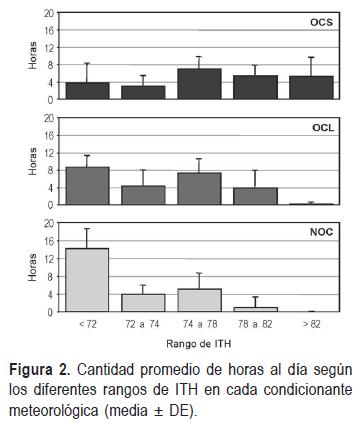
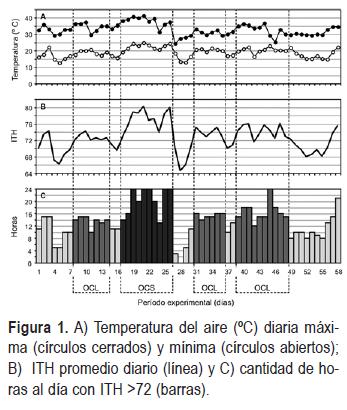
<body><![CDATA[<p style="margin-bottom: 0.0001pt;"><font face="Verdana" size="2">La probabilidad de tiempo dedicado al pastoreo (TP) se analiz&oacute; ajustando un modelo lineal generalizado de medidas repetidas en el tiempo con el procedimiento GLIMMIX del paquete estad&iacute;stico SAS (SAS <span class="SpellE">Institute</span>, Cary, NC, 2006). Se asumi&oacute; que el n&uacute;mero de observaciones de tiempo dedicado al pastoreo en relaci&oacute;n al n&uacute;mero total de observaciones tiene una distribuci&oacute;n binomial. </font> </p>      <p style="margin-bottom: 0.0001pt;"><font face="Verdana" size="2"><o:p>&nbsp;</o:p></font></p>      <p style="margin-bottom: 0.0001pt;"><font face="Verdana"><b> <span style="font-size: 10pt;">Resultados </span></b></font></p>      <p style="margin-bottom: 0.0001pt;"><font face="Verdana" size="2"><o:p>&nbsp;</o:p></font></p>      <p style="margin-bottom: 0.0001pt;"><font face="Verdana"><b> <span style="font-size: 10pt;">Ambiente atmosf&eacute;rico</span></b></font></p>      <p style="margin-bottom: 0.0001pt;"><font face="Verdana" size="2"><o:p>&nbsp;</o:p></font></p>      <p style="margin-bottom: 0.0001pt;"><font face="Verdana" size="2">La temperatura promedio en el per&iacute;odo experimental fue de <st1:metricconverter productid="25,9 &ordm;C" w:st="on">25,9 <span class="SpellE">&ordm;C</span></st1:metricconverter> (&plusmn; 2,7 DE) y la humedad relativa 55% (&plusmn; 14 DE). La temperatura m&aacute;xima promedio fue de <st1:metricconverter productid="32,9 &ordm;C" w:st="on">32,9 <span class="SpellE">&ordm;C</span></st1:metricconverter> con una m&aacute;xima absoluta de <st1:metricconverter productid="41,1 &ordm;C" w:st="on">41,1 <span class="SpellE">&ordm;C</span></st1:metricconverter> ocurrida el 10 de enero. La temperatura m&iacute;nima promedio fue de <st1:metricconverter productid="18,9 &ordm;C" w:st="on">18,9 <span class="SpellE">&ordm;C</span></st1:metricconverter> registr&aacute;ndose la m&iacute;nima absoluta de <st1:metricconverter productid="12,6 &ordm;C" w:st="on">12,6 <span class="SpellE">&ordm;C</span></st1:metricconverter> el 25 de diciembre. El ITH promedio diario durante el experimento fue de 72,6 (&plusmn; 3,47 DE).</font></p>      <p style="margin-bottom: 0.0001pt;"><font face="Verdana" size="2"><o:p>&nbsp;</o:p></font></p>      <p style="margin-bottom: 0.0001pt;"><font face="Verdana" size="2">En la <a href="#f1">Figura 1</a> se presenta la ocurrencia de las tres condicionantes meteorol&oacute;gicas a lo largo del per&iacute;odo experimental. Se identific&oacute; una <b>ola de calor severa</b> (OCS) de una duraci&oacute;n de diez d&iacute;as en total que comprendi&oacute; del 6 al 15 de enero inclusive (d&iacute;as experimentales 17 al 26). <st1:personname productid="La OCS" w:st="on">La OCS</st1:personname> comenz&oacute; con dos d&iacute;as de 14 y 16 horas de ITH &ge;72 (lo que ya permiti&oacute; definir el comienzo de una ola de calor) y temperaturas m&iacute;nimas de 19 y <st1:metricconverter productid="21 &ordm;C" w:st="on">21 <span class="SpellE">&ordm;C</span></st1:metricconverter>, respectivamente. A partir del tercer d&iacute;a comenzaron a sucederse d&iacute;as con 24 horas con ITH &ge;72 y temperaturas m&iacute;nimas superiores a <st1:metricconverter productid="23 &ordm;C" w:st="on">23 <span class="SpellE">&ordm;C</span></st1:metricconverter>. Como condicionante meteorol&oacute;gica <b>ola de calor leve</b> (OCL) se identificaron tres que duraron siete, seis y diez d&iacute;as (<a href="../../../../../img/revistas/agro/v15n1/1a11t1.GIF" target="_blank">Cuadro 1</a>), totalizando 23 d&iacute;as. Los d&iacute;as de OCL se caracterizaron por tener catorce horas o m&aacute;s al d&iacute;a con ITH &gt;72; ITH promedio diario &ge;72 durante casi la totalidad de los d&iacute;as y temperaturas m&aacute;ximas &gt;<st1:metricconverter productid="29 &ordm;C" w:st="on">29 <span class="SpellE">&ordm;C</span></st1:metricconverter> en veintid&oacute;s de los d&iacute;as. Sin embargo, el descenso de la temperatura durante la noche result&oacute; en temperaturas m&iacute;nimas menores a <st1:metricconverter productid="23 &ordm;C" w:st="on">23 <span class="SpellE">&ordm;C</span></st1:metricconverter>, e ITH menores a 72 de <st1:metricconverter productid="6,4 a" w:st="on">6,4 a</st1:metricconverter> 10,4 horas (<a href="#f2">Figura 2</a>). El resto de los d&iacute;as que no cumplieron con los criterios de definici&oacute;n de ola de calor, d&iacute;as de <b>no ola de calor </b>(NOC), fueron el 43% restante de los d&iacute;as del per&iacute;odo experimental (veinticinco d&iacute;as). Los NOC se caracterizaron por tener una temperatura m&aacute;xima promedio de <st1:metricconverter productid="30,9 &ordm;C" w:st="on">30,9 <span class="SpellE">&ordm;C</span></st1:metricconverter>, temperatura m&iacute;nima promedio de <st1:metricconverter productid="16,7 &ordm;C" w:st="on">16,7 <span class="SpellE">&ordm;C</span></st1:metricconverter> e ITH promedio diario de 69,8. Presentaron en promedio 10 horas al d&iacute;a con ITH mayores o iguales a 72, pero con una variaci&oacute;n de <st1:metricconverter productid="0 a" w:st="on">0 a</st1:metricconverter> 21 horas seg&uacute;n el d&iacute;a. Los resultados de las variables meteorol&oacute;gicas temperatura, humedad del aire e ITH durante las condicionantes meteorol&oacute;gicas OCS, OCL y NOC se presentan en el <a href="../../../../../img/revistas/agro/v15n1/1a11t1.GIF" target="_blank">Cuadro 1</a>.</font></p>      <p style="margin-bottom: 0.0001pt;"><font face="Verdana" size="2"><o:p>&nbsp;</o:p></font></p>      ]]></body>
<body><![CDATA[<p style="margin-bottom: 0.0001pt;"><font face="Verdana" size="2"><a name="f1"></a><img id="_x0000_i1025" src="../../../../../img/revistas/agro/v15n1/1a11g1.jpg" name="gr&aacute;ficos1" align="bottom" border="0" height="410" width="347"></font></p>      <p style="margin-bottom: 0.0001pt;"><font face="Verdana" size="2"><o:p>&nbsp;</o:p></font></p>      <p style="margin-bottom: 0.0001pt;"><font face="Verdana" size="2"><a name="f2"></a><img id="_x0000_i1026" src="../../../../../img/revistas/agro/v15n1/1a11g2.jpg" name="gr&aacute;ficos2" align="bottom" border="0" height="426" width="364"></font></p>      <p style="margin-bottom: 0.0001pt;"><font face="Verdana" size="2"><o:p>&nbsp;</o:p></font></p>      <p style="margin-bottom: 0.0001pt;"><font face="Verdana"><b> <span style="font-size: 10pt;">Respuesta animal</span></b></font></p>      <p style="margin-bottom: 0.0001pt;"><font face="Verdana" size="2"><o:p>&nbsp;</o:p></font></p>      <p style="margin-bottom: 0.0001pt;"><font face="Verdana" size="2">Las respuestas fisiol&oacute;gicas (FR, TR) de las vacas variaron en funci&oacute;n de las condicionantes meteorol&oacute;gicas (P&lt;0,0001) (<a href="../../../../../img/revistas/agro/v15n1/1a11t2.GIF" target="_blank">Cuadro 2</a>). Los valores observados de FR y TR tanto a las 6:00 como a las 15:00 fueron mayores en OCS con respecto a OCL y a NOC.</font></p>      <p style="margin-bottom: 0.0001pt;"><font face="Verdana" size="2"><o:p>&nbsp;</o:p></font></p>      <p style="margin-bottom: 0.0001pt;"><font face="Verdana" size="2">El tiempo total dedicado al pastoreo durante el per&iacute;odo de observaci&oacute;n difiri&oacute; significativamente (P&lt;0,0001) seg&uacute;n la condicionante meteorol&oacute;gica siendo menor el tiempo de pastoreo total durante OCS con respecto a OCL, y NOC, mientras que &eacute;ste fue similar entre OCL y NOC. Dentro de cada turno de observaci&oacute;n (turno 1, turno 2 y turno 3) tambi&eacute;n se encontraron diferencias significativas (P&lt;0,0001) seg&uacute;n la condicionante meteorol&oacute;gica. En el turno 1 (de 8:00 a 11:00) se observ&oacute; el menor tiempo dedicado al pastoreo durante OCS en comparaci&oacute;n a OCL y <span class="SpellE">NOC~</span> en el turno 2 (de 11:00 a 14:00) tanto en OCS como OCL se observ&oacute; un menor tiempo dedicado al pastoreo, menor que en NOC y en el turno 3 (de 18:00 a 21:00) el tiempo dedicado al pastoreo fue mayor en OCL con respecto a OCS y NOC (<a href="../../../../../img/revistas/agro/v15n1/1a11t3.GIF" target="_blank">Cuadro 3</a>).</font></p>      <p style="margin-bottom: 0.0001pt;"><font face="Verdana" size="2"><o:p>&nbsp;</o:p></font></p>      ]]></body>
<body><![CDATA[<p style="margin-bottom: 0.0001pt;"><font face="Verdana" size="2">Las condicionantes meteorol&oacute;gicas afectaron significativamente la respuesta productiva de las vacas, tanto en producci&oacute;n de leche que result&oacute; significativamente (P&lt;0,0001) menor en OCS con respecto a las otras dos condicionantes meteorol&oacute;gicas, como as&iacute; tambi&eacute;n en producci&oacute;n de grasa y prote&iacute;na (P&lt;0,0001). El recuento de c&eacute;lulas som&aacute;ticas fue diferente entre condicionantes meteorol&oacute;gicas (P=0,0618) registr&aacute;ndose los mayores valores durante OCS (aunque no difiri&oacute; de NOC) (<a href="../../../../../img/revistas/agro/v15n1/1a11t4.GIF" target="_blank">Cuadro 4</a>).</font></p>      <p style="margin-bottom: 0.0001pt;"><font face="Verdana" size="2"><o:p>&nbsp;</o:p></font></p>      <p style="margin-bottom: 0.0001pt;"><font face="Verdana"><b> <span style="font-size: 10pt;">Discusi&oacute;n</span></b></font></p>      <p style="margin-bottom: 0.0001pt;"><font face="Verdana" size="2"><o:p>&nbsp;</o:p></font></p>      <p style="margin-bottom: 0.0001pt;"><font face="Verdana" size="2">Las condicionantes meteorol&oacute;gicas denominadas para este trabajo olas de calor leves (OCL) y ola de calor severa (OCS) (<a href="#50"><span class="SpellE">Valtorta</span> <i>et al</i>., 2002</a>; <a href="#33">Rodr&iacute;guez <i>et al</i>., 2003</a>; <a href="#31"><span class="SpellE">Nienaber</span> <i>et al.</i>, 2003</a>; <a href="#51"><span class="SpellE">Valtorta,</span></a><span class="SpellE"><a href="#51"><i>et</i></a></span><span class="MsoHyperlink"> <i>al.</i>, 2004</span></font></p>  <span style="font-size: 10pt; font-family: &quot;Verdana&quot;; color: black">) representaron el 57% del tiempo experimental (en total 33 d&iacute;as). OCS se caracteriz&oacute; por elevadas temperaturas m&aacute;ximas (entre 31,1 y 41,1 &ordm; <span class="GramE">C )</span>, lo que determin&oacute; la ocurrencia de niveles de ITH considerados de emergencia (ITH&gt;82) <a name="Informationrelease1970citadopor"></a>(<a href="#17"><span class="SpellE">Information</span> <span class="SpellE">release</span>, 1970, citado por <span class="SpellE">du</span> <span class="SpellE">Preez</span> <i>et al</i>., 1990</a>) durante cinco a nueve horas al d&iacute;a totalizando 22 % de horas con ITH por encima del umbral de peligro 78 (<a href="../../../../../img/revistas/agro/v15n1/1a11t1.GIF" target="_blank">Cuadro 1</a>). El conjunto de estas caracter&iacute;sticas permiti&oacute; definir esta condicionante meteorol&oacute;gica como una ola de calor severa (<a href="#31"><span class="SpellE">Nienaber</span>, <i>et al.</i>, 2003</a>). Los d&iacute;as de ola de calor leve se caracterizaron por presentar condiciones meteorol&oacute;gicas en la fase diurna de elevadas temperaturas y contenidos de humedad del aire que determinaron niveles de ITH considerados de peligro (ITH entre 78 y 82) durante cuatro a ocho horas al d&iacute;a (<a href="#f2">Figura 2</a>) pero el descenso de temperatura durante la noche posibilit&oacute; condiciones de recuperaci&oacute;n nocturna de la <span class="SpellE">normotermia</span> en las vacas (<a href="#31"><span class="SpellE">Nienaber</span> <i>et al.</i>, 2003</a>). Durante NOC, en promedio cinco horas al d&iacute;a el ITH se encontr&oacute; entre 74 y 78, y solo en cuatro de los veinticinco d&iacute;as NOC (un 16% de los d&iacute;as) se registraron valores horarios (de cuatro a ocho horas) superiores a 78, lo que estar&iacute;a indicando que aunque existieron condiciones de altas temperaturas diurnas se dieron por pocas horas al d&iacute;a y solo en algunos de los d&iacute;as, contrastando con las condicionantes meteorol&oacute;gicas olas de calor.</span><font face="Verdana" size="2"> </font>     <p style="margin-bottom: 0.0001pt;"><font face="Verdana" size="2"><o:p>&nbsp;</o:p></font></p>      <p style="margin-bottom: 0.0001pt;"><font face="Verdana" size="2">Las condicionantes meteorol&oacute;gicas tuvieron diferente impacto sobre las respuestas fisiol&oacute;gicas de las vacas. A las horas de alta temperatura del aire (temperatura m&aacute;xima media de todo el per&iacute;odo experimental: <st1:metricconverter productid="32,9 &ordm;C" w:st="on">32,9 <span class="SpellE">&ordm;C</span></st1:metricconverter>) <st1:personname productid="la FR" w:st="on">la FR</st1:personname><sub>15:00</sub> medida en las vacas present&oacute; valores superiores a las 65 <span class="SpellE">r.p.m</span>. tanto en OCS como en OCL, indicando situaciones de estr&eacute;s cal&oacute;rico para vacas en lactaci&oacute;n de medio a alto <a name="ThomasyPearson1986"></a>(<a href="#43">Thomas y <span class="SpellE">Pearson</span>, 1986</a>; <a name="Gaughanetal.1999"></a><a href="#11"><span class="SpellE">Gaughan</span> <i>et al.,</i> 1999</a>). Estos resultados observados en las tres condicionantes meteorol&oacute;gicas est&aacute;n en acuerdo con los resultados encontrados por <a name="Mulleretal.1994"></a><span style="color: rgb(51, 51, 255);">Muller </span><i style="color: rgb(51, 51, 255);">et al.</i> (<a href="#29">1994</a>) en vacas lecheras en d&iacute;as con temperaturas m&aacute;ximas mayores a <st1:metricconverter productid="25 &ordm;C" w:st="on">25 <span class="SpellE">&ordm;C</span></st1:metricconverter> (temperatura cr&iacute;tica m&aacute;xima para vacas <span class="SpellE">Holando</span> en lactaci&oacute;n seg&uacute;n <a name="Bermanetal.1985"></a><a href="#3">Berman <i>et al</i>., 1985</a>). Mientras que en NOC <st1:personname productid="la FR" w:st="on">la FR</st1:personname><sub>15:00</sub> promedi&oacute; 55 <span class="SpellE">r.p.m</span>., valor considerado de estr&eacute;s cal&oacute;rico leve seg&uacute;n <span style="color: rgb(51, 51, 255);">Thomas y </span><span style="color: rgb(51, 51, 255);" class="SpellE">Pearson</span> (<a href="#43">1986</a>). A pesar de estas altas frecuencias respiratorias, las TR<sub>15:00</sub> estuvieron siempre por encima de <st1:metricconverter productid="39,0 &ordm;C" w:st="on">39,0 <span class="SpellE">&ordm;C</span></st1:metricconverter> considerado el l&iacute;mite superior de la <span class="SpellE">normotermia</span> <a name="SeathyMiller1946"></a>(<a href="#37"><span class="SpellE">Seath</span> y Miller, 1946</a>; <a name="Hansenetal.1992"></a><a href="#14">Hansen <i>et al</i>., 1992</a>) registr&aacute;ndose los mayores valores en OCS (<st1:metricconverter productid="39,8 &ordm;C" w:st="on">39,8 <span class="SpellE">&ordm;C</span></st1:metricconverter>) y en OCL (<st1:metricconverter productid="39,6 &ordm;C" w:st="on">39,6 <span class="SpellE">&ordm;C</span></st1:metricconverter>) con respecto a NOC (<st1:metricconverter productid="39,3 &ordm;C" w:st="on">39,3 <span class="SpellE">&ordm;C</span></st1:metricconverter>), lo cual estar&iacute;a indicando las dificultades para mantener la temperatura corporal en las condicionantes m&aacute;s extremas. Seg&uacute;n <a name="MulleryBotha1993"></a><span style="color: rgb(51, 51, 255);">Muller y </span><span style="color: rgb(51, 51, 255);" class="SpellE">Botha</span> (<a href="#29">1993</a>) y en acuerdo con <span style="color: rgb(51, 51, 255);" class="SpellE"><a name="McDowelletal.1953"></a>McDowell</span><span style="color: rgb(51, 51, 255);"> </span><i style="color: rgb(51, 51, 255);">et al</i><span style="color: rgb(51, 51, 255);">.</span> (<a href="#26">1953</a>) y <span style="color: rgb(51, 51, 255);" class="SpellE"><a name="Legatesetal.1991"></a>Legates</span><span style="color: rgb(51, 51, 255);"> </span><i style="color: rgb(51, 51, 255);">et al</i><span style="color: rgb(51, 51, 255);">.</span> (<a href="#24">1991</a>), los bovinos incrementan su frecuencia respiratoria en condiciones c&aacute;lidas, debido a la alta radiaci&oacute;n solar, para reducir su temperatura rectal. Sin embargo, a diferencia de lo ocurrido en OCS, en OCL las temperaturas e ITH diurnos altos son alternados con per&iacute;odos nocturnos (entre las 21:00 y las 6:00 horas) con ITH menores a 72 (ITH promedio de 70,4) y con temperaturas promedio de <st1:metricconverter productid="23,1 &ordm;C" w:st="on">23,1 <span class="SpellE">&ordm;C</span></st1:metricconverter>. Estas condiciones les permiten a las vacas lecheras disipar la carga cal&oacute;rica acumulada durante el per&iacute;odo diurno (<a href="#43">Thomas y <span class="SpellE">Pearson</span>, 1986</a>; <a href="#11"><span class="SpellE">Gaughan</span> <i>et al.,</i> 1999</a>) presentando TR<sub>6:00</sub> similares a NOC (<a href="../../../../../img/revistas/agro/v15n1/1a11t2.GIF" target="_blank">Cuadro 2</a>).</font></p>      <p style="margin-bottom: 0.0001pt;"><font face="Verdana" size="2"><o:p>&nbsp;</o:p></font></p>      <p style="margin-bottom: 0.0001pt;"><font size="2" face="Verdana">El tiempo total dedicado al pastoreo durante el per&iacute;odo de observaci&oacute;n fue menor en OCS (41,1% menor) con respecto a NOC. Esta disminuci&oacute;n se apreci&oacute; desde temprano, en el turno 1, cuando la temperatura del aire era ya de <st1:metricconverter productid="26 &ordm;C" w:st="on">26 <span class="SpellE">&ordm;C</span></st1:metricconverter> a las 8:00, hasta llegar a <st1:metricconverter productid="36,6 &ordm;C" w:st="on">36,6 <span class="SpellE">&ordm;C</span></st1:metricconverter> a las 11:00. Por otro lado, al retorno del orde&ntilde;e de la tarde en OCS, la temperatura del aire tambi&eacute;n permanece elevada, <st1:metricconverter productid="32,2 &ordm;C" w:st="on">32,2 <span class="SpellE">&ordm;C</span></st1:metricconverter> en promedio, lo que podr&iacute;a indicar por qu&eacute; el tiempo dedicado al pastoreo es bajo a&uacute;n en el turno 3 con respecto a NOC (<a href="../../../../../img/revistas/agro/v15n1/1a11t4.GIF" target="_blank">Cuadro 4</a>). Durante la ola de calor severa el an&aacute;lisis del ITH horario, indic&oacute; valores promedio de 76, 81 y 79 para los turnos 1, 2 y 3 respectivamente. En condiciones de pastoreo en verano y en climas c&aacute;lidos, bajo situaciones de estr&eacute;s cal&oacute;rico la actividad de pastoreo durante la noche puede ser un importante aporte al tiempo total dedicado al pastoreo (alrededor del 50% seg&uacute;n </font><font size="2"><span class="SpellE"> <font face="Verdana"><a name="Valtortaetal.2003"></a>Valtorta</font></span></font><font size="2" face="Verdana"> </a><a href="#48"><i>et al</i>. 2003</a>), y prefiriendo los animales pastorear durante las ma&ntilde;anas m&aacute;s frescas y en el atardecer (<a href="#37"><span class="SpellE">Seath</span> y Miller, 1946</a>; <a name="Albright1993"></a><a href="#1">Albright, 1993</a>). En nuestro trabajo no se realizaron observaciones durante la noche, pero por los altos ITH registrados a&uacute;n en la noche en OCS (de una a nueve horas con ITH entre 74 y 78 y hasta una hora con ITH mayor a 82), es probable que la capacidad de recuperar tiempo de pastoreo fuera escasa. En OCL, tambi&eacute;n se observ&oacute; una modificaci&oacute;n del comportamiento en pastoreo como mecanismo de defensa para evitar el per&iacute;odo de mayor calor, pero sin afectar el tiempo total del pastoreo, ya que las vacas dedicaron m&aacute;s tiempo al pastoreo durante el turno 3, cuando la temperatura de aire promedio fue de <st1:metricconverter productid="26,3 &ordm;C" w:st="on">26,3 <span class="SpellE">&ordm;C</span></st1:metricconverter> y el ITH promedio de 73,4.</font></p>      <p style="margin-bottom: 0.0001pt;"><font face="Verdana" size="2"><o:p>&nbsp;</o:p></font></p>      ]]></body>
<body><![CDATA[<p style="margin-bottom: 0.0001pt;"><font face="Verdana" size="2">La severidad de la condicionante meteorol&oacute;gica durante OCS tambi&eacute;n afect&oacute; significativamente la respuesta productiva de las vacas (<a href="../../../../../img/revistas/agro/v15n1/1a11t4.GIF" target="_blank">Cuadro 4</a>). La producci&oacute;n de leche disminuy&oacute; 18,5% en OCS, evidenciando una incapacidad de los animales para disminuir la carga cal&oacute;rica en este per&iacute;odo. Efectos similares encontraron <span class="SpellE"><a name="Valtortaetal.1997"></a><span style="color: rgb(51, 51, 255);">Valtorta</span></span><span style="color: rgb(51, 51, 255);"> </span><i style="color: rgb(51, 51, 255);">et al</i><span style="color: rgb(51, 51, 255);">.</span> (<a href="#49">1997</a>) en vacas despu&eacute;s de estar sometidas a una ola de calor (temperaturas m&aacute;ximas de hasta <st1:metricconverter productid="37,9 &ordm;C" w:st="on">37,9 <span class="SpellE">&ordm;C</span></st1:metricconverter> y m&iacute;nimas <st1:metricconverter productid="20,4 &ordm;C" w:st="on">20,4 <span class="SpellE">&ordm;C</span></st1:metricconverter>), con una reducci&oacute;n de un 12% de la producci&oacute;n hasta 20 d&iacute;as despu&eacute;s de culminada dicha condicionante meteorol&oacute;gica. <a name="JohnsonyVanjonack1976"></a><span style="color: rgb(51, 51, 255);">Johnson y </span><span style="color: rgb(51, 51, 255);" class="SpellE">Vanjonack</span> (<a href="#21">1976</a>) tambi&eacute;n reportan una reducci&oacute;n en la producci&oacute;n de leche asociada a una disminuci&oacute;n del consumo de alimento en vacas lecheras sometidas una temperatura constante de <st1:metricconverter productid="32 &ordm;C" w:st="on">32 <span class="SpellE">&ordm;C</span></st1:metricconverter> y una humedad relativa de 45% reduci&eacute;ndose la respiraci&oacute;n y la evaporaci&oacute;n desde la superficie corporal, con respecto a una situaci&oacute;n de humedad relativa de 20%. En nuestro trabajo durante OCS, la temperatura del aire fue igual o superior a <st1:metricconverter productid="32 &ordm;C" w:st="on">32 <span class="SpellE">&ordm;C</span></st1:metricconverter> m&aacute;s de un tercio del tiempo total de duraci&oacute;n de la condicionante meteorol&oacute;gica, asociado a niveles de humedad promedio de 32%, lo que result&oacute; en un ITH promedio durante esas horas de 82,2 (l&iacute;mite de emergencia). Estas condiciones podr&iacute;an explicar la disminuci&oacute;n del tiempo dedicado al pastoreo y posiblemente al consumo de alimento, aunque esta &uacute;ltima variable no fue medida.</font></p>      <p style="margin-bottom: 0.0001pt;"><font face="Verdana" size="2"><o:p>&nbsp;</o:p></font></p>      <p style="margin-bottom: 0.0001pt;"><font face="Verdana" size="2">La producci&oacute;n de s&oacute;lidos en la leche sigui&oacute; la misma variaci&oacute;n que la producci&oacute;n de leche. Se observ&oacute; una disminuci&oacute;n de la producci&oacute;n de s&oacute;lidos en la leche en OCS, disminuyendo la producci&oacute;n de grasa y prote&iacute;na con respecto a las producciones observadas en OCL y NOC (-17,7% y -18,2% respectivamente). Resultados similares reportan <span style="color: rgb(51, 51, 255);" class="SpellE">Valtorta</span><span style="color: rgb(51, 51, 255);"> </span><i><span style="color: rgb(51, 51, 255);">et al.</span> </i>(<a href="#49">1997</a>) para la producci&oacute;n de prote&iacute;na (-18,7%) durante una ola de calor severa. Estos resultados podr&iacute;an deberse a la alteraci&oacute;n (reducci&oacute;n) durante las altas temperaturas de la s&iacute;ntesis, absorci&oacute;n y movilizaci&oacute;n de los metabolitos (glucosa, &aacute;cidos grasos vol&aacute;tiles, l&iacute;pidos, amino&aacute;cidos) a partir del tracto digestivo, h&iacute;gado y tejido adiposo y su utilizaci&oacute;n por la gl&aacute;ndula mamaria <a name="ArcaroJunioretal.2003"></a>(<a href="#2"><span class="SpellE">Arcaro</span> Junior <i>et al</i>., 2003</a>). Sin embargo, la producci&oacute;n de leche y de s&oacute;lidos fue similar entre OCL y NOC. En nuestro trabajo <st1:personname productid="la TR" w:st="on">la TR</st1:personname><sub>6:00</sub> promedio observada en OCL no difiere de la observada en NOC, explicado seguramente por un mayor n&uacute;mero de horas con condiciones para la recuperaci&oacute;n nocturna de las vacas lecheras del calor acumulado durante el d&iacute;a (entre una y ocho horas con ITH menores a 72 entre las 21:00 y las 6:00 horas en OCL). Estos resultados concuerdan con lo reportado por <span style="color: rgb(51, 51, 255);">Bianca</span> (<a href="#4">1965</a>) que se&ntilde;ala que no observaron diferencias en la producci&oacute;n de vacas lecheras sometidas a elevadas temperaturas diurnas (<st1:metricconverter productid="32 a" w:st="on">32 a</st1:metricconverter> <st1:metricconverter productid="38 &ordm;C" w:st="on">38 <span class="SpellE">&ordm;C</span></st1:metricconverter>) pero mantenidas a temperaturas nocturnas relativamente bajas (menores a <st1:metricconverter productid="24 &ordm;C" w:st="on">24 <span class="SpellE">&ordm;C</span></st1:metricconverter>), indicando que la posibilidad de recuperaci&oacute;n nocturna de la <span class="SpellE">normotermia</span> le permiti&oacute; a los animales afrontar el estr&eacute;s cal&oacute;rico durante el d&iacute;a, minimizando de esta forma los efectos perjudiciales sobre la productividad. </font> </p>      <p style="margin-bottom: 0.0001pt;"><font face="Verdana" size="2"><o:p>&nbsp;</o:p></font></p>      <p style="margin-bottom: 0.0001pt;"><font face="Verdana" size="2">El recuento de c&eacute;lulas som&aacute;ticas fue mayor en OCS con respecto a OCL (aunque OCS no difiri&oacute; estad&iacute;sticamente de NOC). <span style="color: rgb(51, 51, 255);" class="SpellE"><a name="Wegneretal.1974"></a>Wegner</span><span style="color: rgb(51, 51, 255);"> </span><i><span style="color: rgb(51, 51, 255);">et al.</span> </i>(<a href="#52">1974</a>) y <a name="Collieretal.1982"></a><span style="color: rgb(51, 51, 255);">Collier </span><i style="color: rgb(51, 51, 255);">et al</i><span style="color: rgb(51, 51, 255);">.</span> (<a href="#5">1982</a>) sugieren una relaci&oacute;n positiva entre el estr&eacute;s provocado por las altas temperaturas y un alto recuento de c&eacute;lulas som&aacute;ticas. La explicaci&oacute;n del mayor recuento en condiciones de alta temperatura ser&iacute;a que en situaciones de estr&eacute;s (en este caso cal&oacute;rico) disminuye la resistencia a las infecciones, inhibiendo frecuentemente la migraci&oacute;n de leucocitos hacia el sitio de infecci&oacute;n y el desarrollo de la respuesta inflamatoria en respuesta al pat&oacute;geno <a name="Merlot2004"></a>(<a href="#27">Merlot, 2004</a>). La situaci&oacute;n de estr&eacute;s cal&oacute;rico puede aumentar la susceptibilidad a la infecci&oacute;n <span class="SpellE">intramamaria</span> por disminuir la resistencia del hu&eacute;sped y/o incrementar la exposici&oacute;n del mismo a los pat&oacute;genos que se ven favorecidos en su crecimiento y propagaci&oacute;n por el ambiente (c&aacute;lido y h&uacute;medo) que los rodea <a name="SheareryBeede1990"></a>(<a href="#38"><span class="SpellE">Shearer</span> y <span class="SpellE">Beede</span>, 1990</a>). </font> </p>      <p style="margin-bottom: 0.0001pt;"><font face="Verdana" size="2"><o:p>&nbsp;</o:p></font></p>      <p style="margin-bottom: 0.0001pt;"><font face="Verdana"><b> <span style="font-size: 10pt;">Conclusiones</span></b></font></p>      <p style="margin-bottom: 0.0001pt;"><font face="Verdana" size="2"><o:p>&nbsp;</o:p></font></p>      <p style="margin-bottom: 0.0001pt;"><font face="Verdana" size="2">El efecto depresor de condicionantes meteorol&oacute;gicas severas como ola de calor se comprob&oacute; en la productividad, tanto en t&eacute;rminos de producci&oacute;n de leche como de grasa y prote&iacute;na, debido a que las vacas no lograron mantener una temperatura corporal interna en un rango de <span class="SpellE">termoneutralidad</span>, ni a&uacute;n incrementando la frecuencia respiratoria. Dedicaron menos tiempo al pastoreo, lo cual afect&oacute; negativamente la productividad. Sin embargo, cuando las altas temperaturas y humedad diurnas se alternaron con noches de menores ITH como se observ&oacute; durante las olas de calor leve, permitiendo a las vacas recuperar la <span class="SpellE">normotermia</span>, el efecto <span class="SpellE">detrimental</span> del calor no se evidenci&oacute; sobre la producci&oacute;n de leche ni de s&oacute;lidos en comparaci&oacute;n a los d&iacute;as de no ola de calor.</font></p>      <p style="margin-bottom: 0.0001pt;"><font face="Verdana" size="2"><o:p>&nbsp;</o:p></font></p>      ]]></body>
<body><![CDATA[<p style="margin-bottom: 0.0001pt;"><font face="Verdana"><span class="SpellE"><b> <span style="font-size: 10pt;" lang="EN-US">Bibliograf&iacute;a</span></b></span></font><span style="" lang="EN-US"><o:p></o:p></span></p>      <p style="margin-bottom: 0.0001pt;"><font face="Verdana" size="2"><span style="" lang="EN-US"><o:p>&nbsp;</o:p></span></font></p>      <!-- ref --><p style="margin-bottom: 0.0001pt;"><font face="Verdana"><a name="1"> <font size="2"></font></a><a href="#Albright1993"><span class="SpellE"><b> <span style="font-size: 10pt;" lang="EN-US">Albright</span></b></span></a><span style="font-size: 10pt;" lang="EN-US"><a href="#Albright1993"> <b>J.L.</b> 1993</a>. Feeding behavior of dairy cattle. </span><span style="font-size: 10pt;">J. Dairy <span class="SpellE">Sci</span>.; 76: 485-498.    </span></font></p>      <!-- ref --><p style="margin-bottom: 0.0001pt;"><font face="Verdana"><o:p><font size="2">&nbsp;</font></o:p><a name="2"><font size="2"></font></a><a href="#ArcaroJunioretal.2003"><span class="SpellE"><b><span style="font-size: 10pt;">Arcaro</span></b></span></a><span style="font-size: 10pt;"><a href="#ArcaroJunioretal.2003"> <b>Junior I., <span class="SpellE">Arcaro</span> J., Pozzi C., Fagundes H., <span class="SpellE">Matarazzo</span>, S. e de Oliveira C.</b> 2003</a>.<span class="SpellE">Teores</span> plasm&aacute;ticos de <span class="SpellE">horm&ocirc;nios</span>, <span class="SpellE">produ&ccedil;&atilde;o</span> e <span class="SpellE">composi&ccedil;&atilde;o</span> do leite <span class="SpellE">em</span> sala de espera climatizada. Revista <span class="SpellE">Brasileira</span> de <span class="SpellE">Engenharia</span> Agr&iacute;cola e Ambiental; 7(2): 350-354.    </span></font></p>      <!-- ref --><p style="margin-bottom: 0.0001pt;"><font face="Verdana"><o:p><font size="2">&nbsp;</font></o:p><a name="3"><font size="2"></font></a><a href="#Bermanetal.1985"><b><span style="font-size: 10pt;">Berman A., <span class="SpellE">Folman</span> Y., <span class="SpellE">Kaim</span> M., Mamen M., Herz Z., <span class="SpellE">Wolfenson</span> D., <span class="SpellE">Arieli</span> A. <span class="SpellE">and</span> <span class="SpellE">Graber</span> Y. </span></b></a> <span style="font-size: 10pt;"><a href="#Bermanetal.1985">1985</a>. </span> <span style="font-size: 10pt;" lang="EN-US">Upper critical temperatures and forced ventilation effects for high yielding dairy cows in a subtropical climate. J Dairy <span class="SpellE">Sci</span>.; 68: 1488-1495.    </span></font><span style="" lang="EN-US"><o:p></o:p></span></p>      <!-- ref --><p style="margin-bottom: 0.0001pt;"><font face="Verdana"><span style="" lang="EN-US"><o:p> <font size="2">&nbsp;</font></o:p></span><a name="4"><font size="2"></font></a><a href="#Bianca1965"><span class="SpellE"><b><span style="font-size: 10pt;" lang="EN-US">Bianca</span></b></span></a><span style="font-size: 10pt;" lang="EN-US"><a href="#Bianca1965"> <b>W.</b> 1965</a>. Reviews of the progress of dairy science. Section A Physiology. Cattle in a hot environment. J. Dairy Res.; 32: 291-345.    </span></font><span style="" lang="EN-US"><o:p></o:p></span></p>      ]]></body>
<body><![CDATA[<!-- ref --><p style="margin-bottom: 0.0001pt;"><font face="Verdana"><span style="" lang="EN-US"><o:p> <font size="2">&nbsp;</font></o:p></span><a name="5"><font size="2"></font></a><a href="#Collieretal.1982"><b><span style="font-size: 10pt;" lang="EN-US">Collier R. J., <span class="SpellE">Beede</span> D.K., Thatcher W. W., Israel L. A. and Wilcox C. J.</span></b></a><span style="font-size: 10pt;" lang="EN-US"><a href="#Collieretal.1982"> 1982</a>. Influences of environment and its modification on dairy animal health and production. </span><span style="font-size: 10pt;">J. Dairy <span class="SpellE">Sci</span>.; 65: 2213-2227.    </span></font></p>      <!-- ref --><p style="margin-bottom: 0.0001pt;"><font face="Verdana"><o:p><font size="2">&nbsp;</font></o:p><a name="6"><font size="2"></font></a><a href="#CruzySaravia2008"><b><span style="font-size: 10pt;">Cruz G. y Saravia C.</span></b></a><span style="font-size: 10pt;"><a href="#CruzySaravia2008"> 2008</a>. Un &iacute;ndice de temperatura y humedad del aire para regionalizar la producci&oacute;n lechera en Uruguay. </span><span class="SpellE"> <span style="font-size: 10pt;" lang="EN-US">Agrociencia</span></span><span style="font-size: 10pt;" lang="EN-US">; 12(1): 56-60.     </span> </font><span style="" lang="EN-US"><o:p></o:p></span></p>      <!-- ref --><p style="margin-bottom: 0.0001pt;"><font face="Verdana"><span style="" lang="EN-US"><o:p> <font size="2">&nbsp;</font></o:p></span><a name="7"><font size="2"></font></a><a href="#duPreezetal.1990"><b><span style="font-size: 10pt;" lang="EN-US">du <span class="SpellE">Preez</span> J. H., <span class="SpellE">Giesecke</span> W. H. and <span class="SpellE">Hattingh</span> P. J.</span></b></a><span style="font-size: 10pt;" lang="EN-US"><a href="#duPreezetal.1990"> 1990</a>. Heat stress in dairy cattle and other livestock under Southern African conditions: I. Temperature-humidity Index mean values during the four main seasons. </span><span class="SpellE"> <span style="font-size: 10pt;">Onderstepoort</span></span><span style="font-size: 10pt;"> J. Vet. Res.; 57: 77-86.    </span></font></p>      <p style="margin-bottom: 0.0001pt;"><font face="Verdana"><o:p><font size="2">&nbsp;</font></o:p><a name="8"><font size="2"></font></a><a href="#Flamenbaum1994"><span class="SpellE"><b><span style="font-size: 10pt;">Flamenbaum</span></b></span></a><span style="font-size: 10pt;"><a href="#Flamenbaum1994"> <b>I.</b> 1994</a>. Factores que afectan la producci&oacute;n lechera en la zona Norte. Informe de consultor&iacute;a en el &laquo;Segundo Proyecto de desarrollo agropecuario&raquo;. </span> <span style="font-size: 10pt;" lang="EN-US">Montevideo: <span class="SpellE">Comisi&oacute;n</span> Honoraria <span class="SpellE">del</span> Plan <span class="SpellE">Agropecuario</span>. 18 p.</span></font><span style="" lang="EN-US"><o:p></o:p></span></p>      <!-- ref --><p style="margin-bottom: 0.0001pt;"><font face="Verdana"><span style="" lang="EN-US"><o:p> <font size="2">&nbsp;</font></o:p></span><a name="9"><font size="2"></font></a><a href="#Flamenbaum1996"><span class="SpellE"><b><span style="font-size: 10pt;" lang="EN-US">Flamenbaum</span></b></span></a><span style="font-size: 10pt;" lang="EN-US"><a href="#Flamenbaum1996"> <b>I.</b> 1996</a>. Heat stress relief from high producing <span class="SpellE">israeli</span> cows in summer. En International Symposium intensive milk production in Israel under hot climate conditions. Tel-Aviv. pp. 3-9.    </span></font><span style="" lang="EN-US"><o:p></o:p></span></p>      <!-- ref --><p style="margin-bottom: 0.0001pt;"><font face="Verdana"><span style="" lang="EN-US"><o:p> <font size="2">&nbsp;</font></o:p></span><a name="10"><font size="2"></font></a><a href="#Gaines1946"><span class="SpellE"><b><span style="font-size: 10pt;" lang="EN-US">Gaines</span></b></span></a><span style="font-size: 10pt;" lang="EN-US"><a href="#Gaines1946"> <b>E. L.</b> 1946</a>. Live weight versus metabolic body size in dairy cows and goats. J. Dairy <span class="SpellE">Sci</span>.; 29(5): 259-272.    </span></font><span style="" lang="EN-US"><o:p></o:p></span></p>      <!-- ref --><p style="margin-bottom: 0.0001pt;"><font face="Verdana"><span style="" lang="EN-US"><o:p> <font size="2">&nbsp;</font></o:p></span><a name="11"><font size="2"></font></a><a href="#Gaughanetal.1999"><span class="SpellE"><b><span style="font-size: 10pt;" lang="EN-US">Gaughan</span></b></span></a><span style="font-size: 10pt;" lang="EN-US"><a href="#Gaughanetal.1999"> <b>J. B., <span class="SpellE">Mader</span> T. L., Holt S. M., <span class="SpellE">Josey</span> M. J. and Rowan K. J.</b> 1999</a>. Heat tolerance of <span class="SpellE">Boran</span> and <span class="SpellE">Tuli</span> crossbred steers. J. <span class="SpellE">Anim</span>. <span class="SpellE">Sci</span>.; 77(9): 2398-2405.    </span></font><span style="" lang="EN-US"><o:p></o:p></span></p>      <!-- ref --><p style="margin-bottom: 0.0001pt;"><font face="Verdana"><span style="" lang="EN-US"><o:p> <font size="2">&nbsp;</font></o:p></span><a name="12"><font size="2"></font></a><a href="#Hahn1995"><b><span style="font-size: 10pt;" lang="EN-US">Hahn G. L.</span></b></a><span style="font-size: 10pt;" lang="EN-US"><a href="#Hahn1995"> 1995</a>. Environmental management for improved livestock performance, health and well-being. Japanese Journal Livestock Management; 30(3): 113-127.    </span></font><span style="" lang="EN-US"><o:p></o:p></span></p>      <!-- ref --><p style="margin-bottom: 0.0001pt;"><font face="Verdana"><span style="" lang="EN-US"><o:p> <font size="2">&nbsp;</font></o:p></span><a name="13"><font size="2"></font></a><a href="#1999"><b><span style="font-size: 10pt;" lang="EN-US">Hahn L. G.</span></b></a><span style="font-size: 10pt;" lang="EN-US"><a href="#1999"> 1999</a>. Dynamic responses to cattle to thermal heat loads. J. <span class="SpellE">Anim</span>. <span class="SpellE">Sci</span>.; 77(<span class="SpellE">Suppl</span>. 2): 10-20.    </span></font><span style="" lang="EN-US"><o:p></o:p></span></p>      <!-- ref --><p style="margin-bottom: 0.0001pt;"><font face="Verdana"><span style="" lang="EN-US"><o:p> <font size="2">&nbsp;</font></o:p></span><a name="14"><font size="2"></font></a><a href="#Hansenetal.1992"><b><span style="font-size: 10pt;" lang="EN-US">Hansen P. J., Thatcher W.W. and <span class="SpellE">Ealy</span> <span class="SpellE">A.D.</span></span></b></a><span style="font-size: 10pt;" lang="EN-US"><a href="#Hansenetal.1992"> 1992</a>. Methods for reducing effects of heat stress on pregnancy. In Van Horn H.H and Wilcox C. J. (<span class="SpellE">Eds</span>). <i>Large Dairy Herd Management. </i>Champaign: American Dairy Science Association. <span class="SpellE">Pp</span> 116-125.    </span></font><span style="" lang="EN-US"><o:p></o:p></span></p>      <p style="margin-bottom: 0.0001pt;"><font face="Verdana"><span style="" lang="EN-US"><o:p> <font size="2">&nbsp;</font></o:p></span><a name="15"><font size="2"></font></a><span class="SpellE"><b><span style="font-size: 10pt;" lang="EN-US">F</span></b></span><span style="font-size: 10pt;" lang="EN-US"> <b>K. P. and Shaw N. H.</b> 1975, The comparative yield method for estimating dry matter yield of pasture. <span class="SpellE">Aust</span>. J. Exp. <span class="SpellE">Agric</span>. <span class="SpellE">Anim</span>. <span class="SpellE">Husb</span>.; 15 (76): 663-700. </span></font><span style="" lang="EN-US"><o:p></o:p></span></p>      ]]></body>
<body><![CDATA[<!-- ref --><p style="margin-bottom: 0.0001pt;"><font face="Verdana"><span style="" lang="EN-US"><o:p> <font size="2">&nbsp;</font></o:p></span><a name="16"><font size="2"></font></a><a href="#HughJones1994"><b><span style="font-size: 10pt;" lang="EN-US">Hugh-Jones M. E.</span></b></a><span style="font-size: 10pt;" lang="EN-US"><a href="#HughJones1994"> 1994</a>. Livestock: management and decision making. In Handbook of Agricultural Meteorology. <span class="SpellE">Griffiths</span>, J. (Ed.). New York: Oxford University Press. <span class="SpellE">Pp</span> 291-298.    </span></font><span style="" lang="EN-US"><o:p></o:p></span></p>      <!-- ref --><p style="margin-bottom: 0.0001pt;"><font face="Verdana"><span style="" lang="EN-US"><o:p> <font size="2">&nbsp;</font></o:p></span><a name="17"><font size="2"></font></a><a href="#Informationrelease1970citadopor"><b><span style="font-size: 10pt;" lang="EN-US">Information release </span></b></a><span style="font-size: 10pt;" lang="EN-US"><a href="#Informationrelease1970citadopor">1970</a>. Patterns of transit losses. <span class="SpellE">Citado</span> <span class="SpellE">por</span>: du <span class="SpellE">Preez</span> J. H., <span class="SpellE">Hattingh</span> P. J., <span class="SpellE">Giesecke</span> W. H. and <span class="SpellE">Einsenberg</span> B. E. Heat stress in dairy cattle and other livestock under Southern African conditions: III. Monthly Temperature-humidity Index mean values and their significance in the performance of dairy cattle. <span class="SpellE">Onderstepoort</span> J. Vet. Res.; 57: 243-248, 1990.    </span></font><span style="" lang="EN-US"><o:p></o:p></span></p>      <!-- ref --><p style="margin-bottom: 0.0001pt;"><font face="Verdana"><span style="" lang="EN-US"><o:p> <font size="2">&nbsp;</font></o:p></span><a name="18"><font size="2"></font></a><a href="#Ingrahametal.1974"><span class="SpellE"><b><span style="font-size: 10pt;" lang="EN-US">Ingraham</span></b></span></a><span style="font-size: 10pt;" lang="EN-US"><a href="#Ingrahametal.1974"> <b>R. H., Gillette D. D. and Wagner W. D.</b> 1974</a>. Relationship of temperature and humidity to conception rate of Holstein cows in subtropical climate. J. Dairy <span class="SpellE">Sci</span>.; 57: 476-481.    </span></font><span style="" lang="EN-US"><o:p></o:p></span></p>      <!-- ref --><p style="margin-bottom: 0.0001pt;"><font face="Verdana"><span style="" lang="EN-US"><o:p> <font size="2">&nbsp;</font></o:p></span><a name="19"><font size="2"></font></a><a href="#Ingrahametal.1976"><span class="SpellE"><b><span style="font-size: 10pt;" lang="EN-US">Ingraham</span></b></span></a><span style="font-size: 10pt;" lang="EN-US"><a href="#Ingrahametal.1976"> <b>R. H., Stanley R. W. and Wagner W. C.</b> 1976</a>. <b>Relationship of Temperature and Humidity to Conception Rate of Holstein Cows in Hawaii. </b>J. Dairy <span class="SpellE">Sci</span>.; 59: 2086-2090.    </span></font><span style="" lang="EN-US"><o:p></o:p></span></p>      <!-- ref --><p style="margin-bottom: 0.0001pt;"><font face="Verdana"><span style="" lang="EN-US"><o:p> <font size="2">&nbsp;</font></o:p></span><a name="20"><font size="2"></font></a><a href="#Johnsonetal.1961"><b><span style="font-size: 10pt;" lang="EN-US">Johnson H. D., <span class="SpellE">Kibler</span> H. H., <span class="SpellE">Ragsdale</span> A. C., Berry I. L. and <span class="SpellE">Shanklin</span> M. D.</span></b></a><span style="font-size: 10pt;" lang="EN-US"><a href="#Johnsonetal.1961"> 1961</a>. Role of heat tolerance and production level in responses of lactating Holsteins to various temperature-humidity conditions. J. Dairy <span class="SpellE">Sci</span>.; 44: 1191.     </span></font><span style="" lang="EN-US"><o:p></o:p></span></p>      ]]></body>
<body><![CDATA[<!-- ref --><p style="margin-bottom: 0.0001pt;"><font face="Verdana"><span style="" lang="EN-US"><o:p> <font size="2">&nbsp;</font></o:p></span><a name="21"><font size="2"></font></a><a href="#JohnsonyVanjonack1976"><b><span style="font-size: 10pt;" lang="EN-US">Johnson H. D. and <span class="SpellE">Vanjonack</span> W. J.</span></b></a><span style="font-size: 10pt;" lang="EN-US"><a href="#JohnsonyVanjonack1976"> 1976</a>. Effects of environmental and the other <span class="SpellE">stressors</span> on blood hormone patterns in lactating animals. J. Dairy <span class="SpellE">Sci</span>.; 59(9): 1063-1617.    </span></font><span style="" lang="EN-US"><o:p></o:p></span></p>      <!-- ref --><p style="margin-bottom: 0.0001pt;"><font face="Verdana"><span style="" lang="EN-US"><o:p> <font size="2">&nbsp;</font></o:p></span><a name="22"><font size="2"></font></a><a href="#Jordanetal.2003"><b><span style="font-size: 10pt;" lang="EN-US">Jordan E. R.</span></b></a><span style="font-size: 10pt;" lang="EN-US"><a href="#Jordanetal.2003"> 2003</a>. Effects of heat stress in reproduction. </span><span style="font-size: 10pt;" lang="IT">J. Dairy Sci. 86 (E suppl.): E104-E114.    </span></font><span style="" lang="IT"><o:p></o:p></span></p>      <!-- ref --><p style="margin-bottom: 0.0001pt;"><font face="Verdana"><span style="" lang="IT"><o:p> <font size="2">&nbsp;</font></o:p></span><a name="23"><font size="2"></font></a><a href="#KleiberyMead1941"><span class="SpellE"><b><span style="font-size: 10pt;" lang="EN-US">Kleiber</span></b></span></a><span style="font-size: 10pt;" lang="EN-US"><a href="#KleiberyMead1941"> <b>M. and Mead S. W.</b> 1941</a>. Body size and milk production. J. Dairy <span class="SpellE">Sci</span>.; 24: 127-134.    </span></font><span style="" lang="EN-US"><o:p></o:p></span></p>      <!-- ref --><p style="margin-bottom: 0.0001pt;"><font face="Verdana"><span style="" lang="EN-US"><o:p> <font size="2">&nbsp;</font></o:p></span><a name="24"><font size="2"></font></a><a href="#Legatesetal.1991"><b><span style="font-size: 10pt;" lang="EN-US">Legates J. E., Farthing B. R., <span class="SpellE">Casady</span> R. B. and <span class="SpellE">Barrada</span> D. M. S.</span></b></a><span style="font-size: 10pt;" lang="EN-US"><a href="#Legatesetal.1991"> 1991</a>. Body temperature and respiratory rate of lactating dairy cattle under field and chamber conditions. </span><span style="font-size: 10pt;">J. Dairy <span class="SpellE">Sci</span>.; 74: 2491-2500.    </span></font></p>      <!-- ref --><p style="margin-bottom: 0.0001pt;"><font face="Verdana"><o:p><font size="2">&nbsp;</font></o:p><a name="25"><font size="2"></font></a><a href="#Levaetal.1996"><b><span style="font-size: 10pt;">Leva P. E., <span class="SpellE">Valtorta</span> S. y <span class="SpellE">Fornasero</span> L. V.</span></b></a><span style="font-size: 10pt;"><a href="#Levaetal.1996"> 1996</a>. Disminuci&oacute;n de la producci&oacute;n lechera estival: situaci&oacute;n actual y efecto del cambio global. Res&uacute;menes del 20&ordm; Congreso de Producci&oacute;n Animal, AAPA. Argentina. Revista Argentina de Producci&oacute;n Animal Vol. 16(1): 26.     </span></font></p>      ]]></body>
<body><![CDATA[<!-- ref --><p style="margin-bottom: 0.0001pt;"><font face="Verdana"><o:p><font size="2">&nbsp;</font></o:p><a name="26"><font size="2"></font></a><a href="#McDowelletal.1953"><b><span style="font-size: 10pt;" lang="EN-US">McDowell R. E., Lee Douglas H. K. and <span class="SpellE">Fohrman</span> M.H.</span></b></a><span style="font-size: 10pt;" lang="EN-US"><a href="#McDowelletal.1953"> 1953</a>. The Relationship of Surface Area to Heat Tolerance in Jerseys and <span class="SpellE">Sindhi</span>-Jersey (F<sub>1</sub>) Crossbred Cows. J. <span class="SpellE">Anim</span> <span class="SpellE">Sci</span>.; 12: 747-756.    </span></font><span style="" lang="EN-US"><o:p></o:p></span></p>      <p style="margin-bottom: 0.0001pt;"><font face="Verdana"><span style="" lang="EN-US"><o:p> <font size="2">&nbsp;</font></o:p></span><a name="27"><font size="2"></font></a><a href="#Merlot2004"><b><span style="font-size: 10pt;" lang="FR">Merlot E.</span></b></a><span style="font-size: 10pt;" lang="FR"><a href="#Merlot2004"> 2004</a>, Cons&eacute;quences du stress sur la function inmunitaire chez les animaux d&rsquo;elevage. </span> <span style="font-size: 10pt;">INRA <span class="SpellE">Prod</span>. <span class="SpellE">Anim</span>.; 17(4): 255-264.</span></font></p>      <!-- ref --><p style="margin-bottom: 0.0001pt;"><font face="Verdana"><o:p><font size="2">&nbsp;</font></o:p><a name="28"><font size="2"></font></a><a href="#MinisteriodeDefensa2000"><b><span style="font-size: 10pt;">Ministerio de Defensa.</span></b></a><span style="font-size: 10pt;"><a href="#MinisteriodeDefensa2000"> Servicio Meteorol&oacute;gico Nacional. 2000</a>. Ola de calor (En l&iacute;nea). Disponible en: <a href="http://www.smn.gov.ar/?mod=biblioteca&amp;id=78" target="_blank">http://www.smn.gov.ar/?mod=biblioteca&amp;id=78</a>. Consultado: abril 2011.     </span></font></p>      <!-- ref --><p style="margin-bottom: 0.0001pt;"><font face="Verdana"><o:p><font size="2">&nbsp;</font></o:p><a name="29"><font size="2"></font></a><a href="#MulleryBotha1993"><b><span style="font-size: 10pt;" lang="EN-US">Muller C. J. C. and <span class="SpellE">Botha</span> J. A.</span></b></a><span style="font-size: 10pt;" lang="EN-US"><a href="#MulleryBotha1993"> 1993</a>. Effect of summer climatic conditions on different heat tolerance indicators in <span class="SpellE">primiparous</span> Friesian and Jersey cows. S. <span class="SpellE">Afr</span>. J. <span class="SpellE">Anim</span>. <span class="SpellE">Sci</span>.; 23 (3/4): 98-103.    </span></font><span style="" lang="EN-US"><o:p></o:p></span></p>      <!-- ref --><p style="margin-bottom: 0.0001pt;"><font face="Verdana"><span style="" lang="EN-US"><o:p> <font size="2">&nbsp;</font></o:p></span><a name="30"><font size="2"></font></a><a href="#Mulleretal.1994"><b><span style="font-size: 10pt;" lang="EN-US">Muller C. J. C., <span class="SpellE">Botha</span> J. A., <span class="SpellE">Coetzer</span> W. A. and Smith W. A.</span></b></a><span style="font-size: 10pt;" lang="EN-US"><a href="#Mulleretal.1994"> 1994</a>. Effect of shade on various parameters of Friesian cows in a Mediterranean climate in South Africa: 2, Physiological responses. S. <span class="SpellE">Afr</span>. J. <span class="SpellE">Anim</span>. <span class="SpellE">Sci</span>.; 24(2): 56-60.    </span></font><span style="" lang="EN-US"><o:p></o:p></span></p>      <!-- ref --><p style="margin-bottom: 0.0001pt;"><font face="Verdana"><span style="" lang="EN-US"><o:p> <font size="2">&nbsp;</font></o:p></span><a name="31"><font size="2"></font></a><a href="#Nienaberetal.2003"><span class="SpellE"><b><span style="font-size: 10pt;" lang="EN-US">Nienaber</span></b></span></a><span style="font-size: 10pt;" lang="EN-US"><a href="#Nienaberetal.2003"> <b>J. A., Hahn G. L., Brown-<span class="SpellE">Brandl</span> T. M. and <span class="SpellE">Eingenberg</span> R. A.</b> 2003</a>. Heat stress climatic conditions and the physiological responses of cattle. In <span class="SpellE">Janni</span>, K. (Ed.), Fifth International Dairy Housing Proceeding of the Conference. ASAE. <span class="SpellE">Pp</span> 255-262.    </span></font><span style="" lang="EN-US"><o:p></o:p></span></p>      <!-- ref --><p style="margin-bottom: 0.0001pt;"><font face="Verdana"><span style="" lang="EN-US"><o:p> <font size="2">&nbsp;</font></o:p></span><a name="32"><font size="2"></font></a><a href="#NienaberyHahn2007"><span class="SpellE"><b><span style="font-size: 10pt;" lang="EN-US">Nienaber</span></b></span></a><span style="font-size: 10pt;" lang="EN-US"><a href="#NienaberyHahn2007"> <b>J. A. and Hahn G. L.</b> 2007</a>. Livestock production systems management responses to thermal challenges. </span> <span style="font-size: 10pt;">Int. J. <span class="SpellE">Biometeorology</span>; 52: 149-157.    </span></font></p>      <!-- ref --><p style="margin-bottom: 0.0001pt;"><font face="Verdana"><o:p><font size="2">&nbsp;</font></o:p><a name="33"><font size="2"></font></a><a href="#Rodr%EDguezetal.2003"><b><span style="font-size: 10pt;">Rodr&iacute;guez R. O, Herrera M. G. y Blas&oacute;n A. D.</span></b></a><span style="font-size: 10pt;"><a href="#Rodr%EDguezetal.2003"> 2003</a>. Frecuencia, duraci&oacute;n e intensidad de las olas de calor en <st1:personname productid="la Argentina. In" w:st="on">la Argentina. <span style="" lang="IT">In</span></st1:personname><span style="" lang="IT"> SBA/UFSM/UNIFRA (Ed) Anais do Congresso Brasileiro de Agrometeorologia, 13&ordm;, Santa Maria. </span><span class="SpellE">Pp</span> 1087-1088.    </span></font></p>      <!-- ref --><p style="margin-bottom: 0.0001pt;"><font face="Verdana"><a name="34"> <font size="2"></font></a><a href="#SaraviayCruz2006"><b> <span style="font-size: 10pt;">Saravia C. y Cruz G.</span></b></a><span style="font-size: 10pt;"><a href="#SaraviayCruz2006"> 2006</a>. Olas de calor en la cuenca lechera de Salto: evoluci&oacute;n del ITH y comportamiento atmosf&eacute;rico que determinan su ocurrencia. (CD-ROM) In <span class="SpellE">Iran</span> Jos&eacute; Oliveira da Silva (Ed.) <span class="SpellE">Mudan&ccedil;as</span> clim&aacute;ticas: impacto sobre o <span class="SpellE">homem</span>, a planta e o animal. </span><span style="font-size: 10pt;" lang="IT">4&ordm; Congresso Brasileiro de Biometeorologia Ribeir&atilde;o Preto, SP. Brasil.    </span></font><span style="" lang="IT"><o:p></o:p></span></p>      <!-- ref --><p style="margin-bottom: 0.0001pt;"><font face="Verdana"><span style="" lang="IT"><o:p> <font size="2">&nbsp;</font></o:p></span><a name="35"><font size="2"></font></a><a href="#Saravia2009"><b><span style="font-size: 10pt;" lang="IT">Saravia C.</span></b></a><span style="font-size: 10pt;" lang="IT"><a href="#Saravia2009"> 2009</a>. </span> <span style="font-size: 10pt;">Efecto del estr&eacute;s cal&oacute;rico sobre las respuestas fisiol&oacute;gicas y productivas de vacas <span class="SpellE">Holando</span> y Jersey. (Tesis de Maestr&iacute;a) Montevideo: Facultad de Agronom&iacute;a. 140p.    </span></font></p>      <!-- ref --><p style="margin-bottom: 0.0001pt;"><font face="Verdana"><o:p><font size="2">&nbsp;</font></o:p><a name="36"><font size="2"></font></a><a href="#Sargentetal.1967"><span class="SpellE"><b><span style="font-size: 10pt;">Sargent</span></b></span></a><span style="font-size: 10pt;"><a href="#Sargentetal.1967"> <b>F. D., <span class="SpellE">Butcher</span> K. R. <span class="SpellE">and</span> <span class="SpellE">Legates</span> J. E.</b> 1967</a>. </span><span style="font-size: 10pt;" lang="FR">Environmental influences on milk constituents. </span><span style="font-size: 10pt;" lang="EN-US">J. Dairy <span class="SpellE">Sci</span>.; 50(2): 177-184.    </span></font><span style="" lang="EN-US"><o:p></o:p></span></p>      <!-- ref --><p style="margin-bottom: 0.0001pt;"><font face="Verdana"><a name="37"> <font size="2"></font></a><a href="#SeathyMiller1946"><span class="SpellE"><b> <span style="font-size: 10pt;" lang="EN-US">Seath</span></b></span></a><span style="font-size: 10pt;" lang="EN-US"><a href="#SeathyMiller1946"> <b>D. M. and Miller G. D.</b> 1946</a>. Effect of warm weather on grazing performance of milking cows. J. Dairy <span class="SpellE">Sci</span>.; 29: 199-206.    </span></font><span style="" lang="EN-US"><o:p></o:p></span></p>      <!-- ref --><p style="margin-bottom: 0.0001pt;"><font face="Verdana"><span style="" lang="EN-US"><o:p> <font size="2">&nbsp;</font></o:p></span><a name="38"><font size="2"></font></a><a href="#SheareryBeede1990"><span class="SpellE"><b><span style="font-size: 10pt;" lang="EN-US">Shearer</span></b></span></a><span style="font-size: 10pt;" lang="EN-US"><a href="#SheareryBeede1990"> <b>J. K. and <span class="SpellE">Beede</span> D. K.</b> 1990</a>. Effects of high environmental temperature on production, reproduction, and health of dairy cattle. <span class="SpellE">Agri</span>-Practice; 11(5): 6-17.    </span></font><span style="" lang="EN-US"><o:p></o:p></span></p>      <!-- ref --><p style="margin-bottom: 0.0001pt;"><font face="Verdana"><span style="" lang="EN-US"><o:p> <font size="2">&nbsp;</font></o:p></span><a name="39"><font size="2"></font></a><a href="#Silanikove2000"><span class="SpellE"><b><span style="font-size: 10pt;" lang="EN-US">Silanikove</span></b></span></a><span style="font-size: 10pt;" lang="EN-US"><a href="#Silanikove2000"> <b>N.</b> 2000</a>. Effects of heat stress on the welfare of extensively managed domestic. Livestock Production Science; 67: 1-18.    </span></font><span style="" lang="EN-US"><o:p></o:p></span></p>      <!-- ref --><p style="margin-bottom: 0.0001pt;"><font face="Verdana"><span style="" lang="EN-US"><o:p> <font size="2">&nbsp;</font></o:p></span><a name="40"><font size="2"></font></a><a href="#St.Pierreetal.2003"><b><span style="font-size: 10pt;" lang="EN-US">St-Pierre N. R., <span class="SpellE">Cobanov</span> B. and <span class="SpellE">Schnitkey</span> G.</span></b></a><span style="font-size: 10pt;" lang="EN-US"><a href="#St.Pierreetal.2003"> 2003</a>. Economic losses from heat stress by US Livestock Industries. J. Dairy <span class="SpellE">Sci</span>.; 86 (E. <span class="SpellE">suppl</span>.): E52-E77.    </span></font><span style="" lang="EN-US"><o:p></o:p></span></p>      <!-- ref --><p style="margin-bottom: 0.0001pt;"><font face="Verdana"><span style="" lang="EN-US"><o:p> <font size="2">&nbsp;</font></o:p></span><a name="41"><font size="2"></font></a><a href="#ThatcheryStaples1995"><b><span style="font-size: 10pt;" lang="EN-US">Thatcher W.W. and Staples C.R.</span></b></a><span style="font-size: 10pt;" lang="EN-US"><a href="#ThatcheryStaples1995"> 1995</a>. </span><span style="font-size: 10pt;">Efecto del estr&eacute;s cal&oacute;rico y la alimentaci&oacute;n sobre la performance reproductiva: nuevas estrategias para mejorar la eficiencia reproductiva. In XIII Jornadas Uruguayas de Buiatr&iacute;a, Paysand&uacute;. E1-E25.    </span></font></p>      <!-- ref --><p style="margin-bottom: 0.0001pt;"><font face="Verdana"><o:p><font size="2">&nbsp;</font></o:p><a name="42"><font size="2"></font></a><a href="#Thom1959"><b><span style="font-size: 10pt;">Thom <span class="SpellE">E.C</span>.</span></b></a><span style="font-size: 10pt;"><a href="#Thom1959"> 1959</a>. </span> <span style="font-size: 10pt;" lang="EN-US">The discomfort index. <span class="SpellE">Weatherwise</span>; 12: 57-59.    </span></font><span style="" lang="EN-US"><o:p></o:p></span></p>      <!-- ref --><p style="margin-bottom: 0.0001pt;"><font face="Verdana"><span style="" lang="EN-US"><o:p> <font size="2">&nbsp;</font></o:p></span><a name="43"><font size="2"></font></a><a href="#ThomasyPearson1986"><b><span style="font-size: 10pt;" lang="EN-US">Thomas C. K. and Pearson R.A.</span></b></a><span style="font-size: 10pt;" lang="EN-US"><a href="#ThomasyPearson1986"> 1986</a>. Effects of ambient temperature and head cooling on energy expenditure, food intake and heat tolerance of Brahman and Brahman x Friesian cattle working on treadmills. <span class="SpellE">Anim</span>. Prod.; 43: 83-90.    </span></font><span style="" lang="EN-US"><o:p></o:p></span></p>      <p style="margin-bottom: 0.0001pt;"><font face="Verdana"><span style="" lang="EN-US"><o:p> <font size="2">&nbsp;</font></o:p></span><a name="44"><font size="2"></font></a><a href="#TyrrellyReid1965"><span class="SpellE"><b><span style="font-size: 10pt;" lang="EN-US">Tyrrell</span></b></span></a><span style="font-size: 10pt;" lang="EN-US"><a href="#TyrrellyReid1965"> <b>H. F. and Reid J. T.</b> 1965</a>. Prediction of the Energy Value of Cow&rsquo;s Milk. J. Dairy <span class="SpellE">Sci</span>.; 48(9): 1215-1223.</span></font><span style="" lang="EN-US"><o:p></o:p></span></p>      <!-- ref --><p style="margin-bottom: 0.0001pt;"><font face="Verdana"><span style="" lang="EN-US"><o:p> <font size="2">&nbsp;</font></o:p></span><a name="45"><font size="2"></font></a><a href="#ValtortayGallardo1996"><span class="SpellE"><b><span style="font-size: 10pt;">Valtorta</span></b></span></a><span style="font-size: 10pt;"><a href="#ValtortayGallardo1996"> <b>S. E. y Gallardo M. R.</b> 1996</a>. El estr&eacute;s por calor en producci&oacute;n lechera. In Instituto Nacional de Tecnolog&iacute;a Agropecuaria (Ed.) Miscel&aacute;nea; (81): 173-185.    </span></font></p>      <!-- ref --><p style="margin-bottom: 0.0001pt;"><font face="Verdana"><a name="46"> <font size="2"></font></a><a href="#Valtortaetal.1997"><span class="SpellE"><b> <span style="font-size: 10pt;">Valtorta</span></b></span></a><span style="font-size: 10pt;"><a href="#Valtortaetal.1997"> <b>S. E., Leva P. E., Gallardo M., <span class="SpellE">Fornasero</span> <span class="SpellE">L.V</span>., Veles <span class="SpellE">M.A</span>. y Garc&iacute;a M.S.</b> 1997</a>. Producci&oacute;n de leche: respuestas a la alta temperatura. Arch. <span class="SpellE">Latinoam</span>. <span class="SpellE">Prod</span>. <span class="SpellE">Anim</span>.; 5(1): 399-401.    </span></font></p>      ]]></body>
<body><![CDATA[<!-- ref --><p style="margin-bottom: 0.0001pt;"><font face="Verdana"><o:p><font size="2">&nbsp;</font></o:p><a name="47"><font size="2"></font></a><a href="#Valtortaetal.1998"><span class="SpellE"><b><span style="font-size: 10pt;">Valtorta</span></b></span></a><span style="font-size: 10pt;"><a href="#Valtortaetal.1998"> <b>S., Leva P., Castro H., Gallardo M., Maciel M., <span class="SpellE">Guglielmone</span> A. y <span class="SpellE">Anzani</span> O.</b> 1998</a>. Producci&oacute;n de leche en verano. Santa Fe: Universidad Nacional del Litoral. 109 p.    </span></font></p>      <!-- ref --><p style="margin-bottom: 0.0001pt;"><font face="Verdana"><o:p><font size="2">&nbsp;</font></o:p><a name="48"><font size="2"></font></a><a href="#Valtortaetal.2003"><span class="SpellE"><b><span style="font-size: 10pt;">Valtorta</span></b></span></a><span style="font-size: 10pt;"><a href="#Valtortaetal.2003"> <b>S. E., <span class="SpellE">Comer&oacute;n</span> <span class="SpellE">E.A</span>., Romero <span class="SpellE">L.A</span>., <span class="SpellE">Migliore</span> C., Estrada M. de, <span class="SpellE">Aronna</span> M.S. y <span class="SpellE">Quaino</span> <span class="SpellE">O.A</span>.</b> 2003</a>. Comportamiento de vacas <span class="SpellE">Holando</span>, Jersey sus cruzas durante la &eacute;poca estival. 2, Efecto de las variables meteorol&oacute;gicas y el tiempo de pastoreo. Rev. <span class="SpellE">Arg</span>. <span class="SpellE">Prod</span>. <span class="SpellE">Anim</span>.; 23(1): 293-294.    </span></font></p>      <!-- ref --><p style="margin-bottom: 0.0001pt;"><font face="Verdana"><o:p><font size="2">&nbsp;</font></o:p><a name="49"><font size="2"></font></a><a href="#Valtortaetal.1997"><span class="SpellE"><b><span style="font-size: 10pt;">Valtorta</span></b></span></a><span style="font-size: 10pt;"><a href="#Valtortaetal.1997"> <b>S.E., Leva <span class="SpellE">P.E</span>., Gallardo M., <span class="SpellE">Fornasero</span> <span class="SpellE">L.V</span>., Veles <span class="SpellE">M.A</span>. y Garc&iacute;a, M.S. </b>1997</a>. Producci&oacute;n de leche: respuestas a la alta temperatura. Arch. <span class="SpellE">Latinoam</span>. </span><span style="font-size: 10pt;" lang="IT">Prod. Anim.; 5(1): 399-401.    </span></font><span style="" lang="IT"><o:p></o:p></span></p>      <!-- ref --><p style="margin-bottom: 0.0001pt;"><font face="Verdana"><span style="" lang="IT"><o:p> <font size="2">&nbsp;</font></o:p></span><a name="50"><font size="2"></font></a><a href="#Valtortaetal.2002"><b><span style="font-size: 10pt;" lang="IT">Valtorta</span></b></a><span style="font-size: 10pt;" lang="IT"><a href="#Valtortaetal.2002"> <b>S.E., Leva P.E., Gallardo. M.R. and Scarpatti, O.E.</b> 2002</a>. </span> <span style="font-size: 10pt;" lang="EN-US">Milk production responses during heat waves events in Argentina. In: American Meteorological Society (Ed.). Conference on <span class="SpellE">Biometeorology</span> and <span class="SpellE">Aerobiology</span> (15<sup>th)</sup>); International Congress on <span class="SpellE">Biometeorology</span> (16<sup>th</sup>), Kansas City, <span class="SpellE">Mo</span>, Boston. pp. 98-101.    </span></font><span style="" lang="EN-US"><o:p></o:p></span></p>      <!-- ref --><p style="margin-bottom: 0.0001pt;"><font face="Verdana"><span style="" lang="EN-US"><o:p> <font size="2">&nbsp;</font></o:p></span><a name="51"><font size="2"></font></a><a href="#Valtortaetal.2004"><span class="SpellE"><b><span style="font-size: 10pt;">Valtorta</span></b></span></a><span style="font-size: 10pt;"><a href="#Valtortaetal.2004"> <span class="SpellE"><b>S.C</b></span><b>., Gallardo <span class="SpellE">M.R</span>. y Leva <span class="SpellE">P.E</span>.</b> 2004</a>. Olas de calor: impacto sobre la producci&oacute;n lechera en la cuenca central argentina (CD-ROM). In Asociaci&oacute;n Argentina de <span class="SpellE">Agrometeorolog&iacute;a</span> (Ed.). Reuni&oacute;n Argentina, 10ma. <span class="GramE">y</span> Latinoamericana 4ta. <span class="GramE">de</span> <span class="SpellE">Agrometeorolog&iacute;a</span>, Mar del Plata.     </span></font></p>      ]]></body>
<body><![CDATA[<!-- ref --><p style="margin-bottom: 0.0001pt;"><font face="Verdana"><o:p><font size="2">&nbsp;</font></o:p><a name="52"><font size="2"></font></a><a href="#Wegneretal.1974"><span class="SpellE"><b><span style="font-size: 10pt;" lang="EN-US">Wegner</span></b></span></a><span style="font-size: 10pt;" lang="EN-US"><a href="#Wegneretal.1974"> <b>T. N., <span class="SpellE">Schuh</span> <span class="SpellE">J.D.</span>, Nelson F.E. and <span class="SpellE">Stott</span> G.H.</b> 1974</a>. Effect of stress on blood <span class="SpellE">leucocyte</span> and milk somatic cell counts in dairy cows. </span><span style="font-size: 10pt;">J. Dairy <span class="SpellE">Sci</span>.; 59(5): 949-956.    </span></font></p>  </div>       ]]></body><back>
<ref-list>
<ref id="B1">
<nlm-citation citation-type="journal">
<person-group person-group-type="author">
<name>
<surname><![CDATA[Albright]]></surname>
<given-names><![CDATA[J.L.]]></given-names>
</name>
</person-group>
<article-title xml:lang="en"><![CDATA[Feeding behavior of dairy cattle]]></article-title>
<source><![CDATA[J. Dairy Sci]]></source>
<year>1993</year>
<volume>76</volume>
<page-range>485-498</page-range></nlm-citation>
</ref>
<ref id="B2">
<nlm-citation citation-type="journal">
<person-group person-group-type="author">
<name>
<surname><![CDATA[Arcaro Junior]]></surname>
<given-names><![CDATA[I]]></given-names>
</name>
<name>
<surname><![CDATA[Arcaro]]></surname>
<given-names><![CDATA[J]]></given-names>
</name>
<name>
<surname><![CDATA[Pozzi]]></surname>
<given-names><![CDATA[C]]></given-names>
</name>
<name>
<surname><![CDATA[Fagundes]]></surname>
<given-names><![CDATA[H]]></given-names>
</name>
<name>
<surname><![CDATA[Matarazzo]]></surname>
<given-names><![CDATA[S]]></given-names>
</name>
<name>
<surname><![CDATA[de Oliveira]]></surname>
<given-names><![CDATA[C]]></given-names>
</name>
</person-group>
<article-title xml:lang="pt"><![CDATA[Teores plasmáticos de hormônios, produção e composição do leite em sala de espera climatizada]]></article-title>
<source><![CDATA[Revista Brasileira de Engenharia Agrícola e Ambiental]]></source>
<year>2003</year>
<volume>7</volume>
<numero>2</numero>
<issue>2</issue>
<page-range>350-354</page-range></nlm-citation>
</ref>
<ref id="B3">
<nlm-citation citation-type="journal">
<person-group person-group-type="author">
<name>
<surname><![CDATA[Berman]]></surname>
<given-names><![CDATA[A]]></given-names>
</name>
<name>
<surname><![CDATA[Folman]]></surname>
<given-names><![CDATA[Y]]></given-names>
</name>
<name>
<surname><![CDATA[Kaim]]></surname>
<given-names><![CDATA[M]]></given-names>
</name>
<name>
<surname><![CDATA[Mamen]]></surname>
<given-names><![CDATA[M]]></given-names>
</name>
<name>
<surname><![CDATA[Herz]]></surname>
<given-names><![CDATA[Z]]></given-names>
</name>
<name>
<surname><![CDATA[Wolfenson]]></surname>
<given-names><![CDATA[D]]></given-names>
</name>
<name>
<surname><![CDATA[Arieli]]></surname>
<given-names><![CDATA[A.]]></given-names>
</name>
<name>
<surname><![CDATA[Graber]]></surname>
<given-names><![CDATA[Y.]]></given-names>
</name>
</person-group>
<article-title xml:lang="en"><![CDATA[Upper critical temperatures and forced ventilation effects for high yielding dairy cows in a subtropical climate.]]></article-title>
<source><![CDATA[J Dairy Sci]]></source>
<year>1985</year>
<volume>68</volume>
<page-range>1488-1495</page-range></nlm-citation>
</ref>
<ref id="B4">
<nlm-citation citation-type="journal">
<person-group person-group-type="author">
<name>
<surname><![CDATA[Bianca]]></surname>
<given-names><![CDATA[W.]]></given-names>
</name>
</person-group>
<article-title xml:lang="en"><![CDATA[Reviews of the progress of dairy science: Section A Physiology. Cattle in a hot environment]]></article-title>
<source><![CDATA[J. Dairy Res]]></source>
<year>1965</year>
<volume>32</volume>
<page-range>291-345</page-range></nlm-citation>
</ref>
<ref id="B5">
<nlm-citation citation-type="journal">
<person-group person-group-type="author">
<name>
<surname><![CDATA[Collier]]></surname>
<given-names><![CDATA[R. J]]></given-names>
</name>
<name>
<surname><![CDATA[Beede]]></surname>
<given-names><![CDATA[D.K]]></given-names>
</name>
<name>
<surname><![CDATA[Thatcher]]></surname>
<given-names><![CDATA[W. W]]></given-names>
</name>
<name>
<surname><![CDATA[Israel]]></surname>
<given-names><![CDATA[L. A]]></given-names>
</name>
<name>
<surname><![CDATA[Wilcox]]></surname>
<given-names><![CDATA[C. J]]></given-names>
</name>
</person-group>
<article-title xml:lang="en"><![CDATA[Influences of environment and its modification on dairy animal health and production]]></article-title>
<source><![CDATA[J. Dairy Sci]]></source>
<year>1982</year>
<volume>65</volume>
<page-range>2213-2227</page-range></nlm-citation>
</ref>
<ref id="B6">
<nlm-citation citation-type="journal">
<person-group person-group-type="author">
<name>
<surname><![CDATA[Cruz]]></surname>
<given-names><![CDATA[G]]></given-names>
</name>
<name>
<surname><![CDATA[Saravia]]></surname>
<given-names><![CDATA[C]]></given-names>
</name>
</person-group>
<article-title xml:lang="es"><![CDATA[Un índice de temperatura y humedad del aire para regionalizar la producción lechera en Uruguay]]></article-title>
<source><![CDATA[Agrociencia]]></source>
<year>2008</year>
<volume>12</volume>
<numero>1</numero>
<issue>1</issue>
<page-range>56-60</page-range></nlm-citation>
</ref>
<ref id="B7">
<nlm-citation citation-type="journal">
<person-group person-group-type="author">
<name>
<surname><![CDATA[du Preez]]></surname>
<given-names><![CDATA[J. H]]></given-names>
</name>
<name>
<surname><![CDATA[Giesecke]]></surname>
<given-names><![CDATA[W. H.]]></given-names>
</name>
<name>
<surname><![CDATA[Hattingh]]></surname>
<given-names><![CDATA[P. J.]]></given-names>
</name>
</person-group>
<article-title xml:lang="en"><![CDATA[Heat stress in dairy cattle and other livestock under Southern African conditions: I. Temperature-humidity Index mean values during the four main seasons]]></article-title>
<source><![CDATA[Onderstepoort J. Vet. Res]]></source>
<year>1990</year>
<volume>57</volume>
<page-range>77-86</page-range></nlm-citation>
</ref>
<ref id="B8">
<nlm-citation citation-type="book">
<person-group person-group-type="author">
<name>
<surname><![CDATA[Flamenbaum]]></surname>
<given-names><![CDATA[I.]]></given-names>
</name>
</person-group>
<source><![CDATA[Factores que afectan la producción lechera en la zona Norte. Informe de consultoría en el &laquo;Segundo Proyecto de desarrollo agropecuario&raquo]]></source>
<year>1994</year>
<publisher-loc><![CDATA[Montevideo ]]></publisher-loc>
<publisher-name><![CDATA[Comisión Honoraria del Plan Agropecuario]]></publisher-name>
</nlm-citation>
</ref>
<ref id="B9">
<nlm-citation citation-type="confpro">
<person-group person-group-type="author">
<name>
<surname><![CDATA[Flamenbaum]]></surname>
<given-names><![CDATA[I.]]></given-names>
</name>
</person-group>
<article-title xml:lang="en"><![CDATA[Heat stress relief from high producing israeli cows in summer.]]></article-title>
<source><![CDATA[]]></source>
<year>1996</year>
<conf-name><![CDATA[ International Symposium intensive milk production in Israel under hot climate conditions]]></conf-name>
<conf-loc>Tel-Aviv </conf-loc>
</nlm-citation>
</ref>
<ref id="B10">
<nlm-citation citation-type="journal">
<person-group person-group-type="author">
<name>
<surname><![CDATA[Gaines]]></surname>
<given-names><![CDATA[E. L.]]></given-names>
</name>
</person-group>
<article-title xml:lang="en"><![CDATA[Live weight versus metabolic body size in dairy cows and goats.]]></article-title>
<source><![CDATA[J. Dairy Sci.]]></source>
<year>1946</year>
<volume>29</volume>
<numero>5</numero>
<issue>5</issue>
<page-range>259-272</page-range></nlm-citation>
</ref>
<ref id="B11">
<nlm-citation citation-type="journal">
<person-group person-group-type="author">
<name>
<surname><![CDATA[Gaughan]]></surname>
<given-names><![CDATA[J. B]]></given-names>
</name>
<name>
<surname><![CDATA[Mader]]></surname>
<given-names><![CDATA[T. L]]></given-names>
</name>
<name>
<surname><![CDATA[Holt]]></surname>
<given-names><![CDATA[S. M]]></given-names>
</name>
<name>
<surname><![CDATA[Josey]]></surname>
<given-names><![CDATA[M. J]]></given-names>
</name>
<name>
<surname><![CDATA[Rowan]]></surname>
<given-names><![CDATA[K. J.]]></given-names>
</name>
</person-group>
<article-title xml:lang="en"><![CDATA[Heat tolerance of Boran and Tuli crossbred steers]]></article-title>
<source><![CDATA[J. Anim. Sci]]></source>
<year>1999</year>
<volume>77</volume>
<numero>9</numero><numero>2398-2405</numero>
<issue>9</issue><issue>2398-2405</issue>
</nlm-citation>
</ref>
<ref id="B12">
<nlm-citation citation-type="journal">
<person-group person-group-type="author">
<name>
<surname><![CDATA[Hahn]]></surname>
<given-names><![CDATA[G. L.]]></given-names>
</name>
</person-group>
<article-title xml:lang="en"><![CDATA[Environmental management for improved livestock performance, health and well-being]]></article-title>
<source><![CDATA[Japanese Journal Livestock Management]]></source>
<year>1995</year>
<volume>30</volume>
<numero>3</numero>
<issue>3</issue>
<page-range>113-127</page-range></nlm-citation>
</ref>
<ref id="B13">
<nlm-citation citation-type="journal">
<person-group person-group-type="author">
<name>
<surname><![CDATA[Hahn]]></surname>
<given-names><![CDATA[L. G.]]></given-names>
</name>
</person-group>
<article-title xml:lang="en"><![CDATA[Dynamic responses to cattle to thermal heat loads.]]></article-title>
<source><![CDATA[J. Anim. Sci]]></source>
<year>1999</year>
<volume>77</volume>
<numero>Suppl. 2</numero>
<issue>Suppl. 2</issue>
<page-range>10-20</page-range></nlm-citation>
</ref>
<ref id="B14">
<nlm-citation citation-type="book">
<person-group person-group-type="author">
<name>
<surname><![CDATA[Hansen]]></surname>
<given-names><![CDATA[P. J.]]></given-names>
</name>
<name>
<surname><![CDATA[Thatcher]]></surname>
<given-names><![CDATA[W.W.]]></given-names>
</name>
<name>
<surname><![CDATA[Ealy]]></surname>
<given-names><![CDATA[A.D.]]></given-names>
</name>
</person-group>
<article-title xml:lang="en"><![CDATA[Methods for reducing effects of heat stress on pregnancy]]></article-title>
<person-group person-group-type="editor">
<name>
<surname><![CDATA[Van Horn]]></surname>
<given-names><![CDATA[H.H]]></given-names>
</name>
<name>
<surname><![CDATA[Wilcox]]></surname>
<given-names><![CDATA[C. J]]></given-names>
</name>
</person-group>
<source><![CDATA[Large Dairy Herd Management]]></source>
<year>1992</year>
<page-range>116-125</page-range><publisher-loc><![CDATA[Champaign ]]></publisher-loc>
<publisher-name><![CDATA[American Dairy Science Association]]></publisher-name>
</nlm-citation>
</ref>
<ref id="B15">
<nlm-citation citation-type="journal">
<person-group person-group-type="author">
<name>
<surname><![CDATA[Haydock]]></surname>
<given-names><![CDATA[K. P]]></given-names>
</name>
<name>
<surname><![CDATA[Shaw]]></surname>
<given-names><![CDATA[N. H]]></given-names>
</name>
</person-group>
<article-title xml:lang="en"><![CDATA[The comparative yield method for estimating dry matter yield of pasture]]></article-title>
<source><![CDATA[Aust. J. Exp. Agric. Anim. Husb]]></source>
<year>1975</year>
<volume>15</volume>
<numero>76</numero>
<issue>76</issue>
<page-range>663-700</page-range></nlm-citation>
</ref>
<ref id="B16">
<nlm-citation citation-type="book">
<person-group person-group-type="author">
<name>
<surname><![CDATA[Hugh-Jones]]></surname>
<given-names><![CDATA[M. E.]]></given-names>
</name>
</person-group>
<article-title xml:lang="en"><![CDATA[Livestock: management and decision making]]></article-title>
<person-group person-group-type="editor">
<name>
<surname><![CDATA[Griffiths]]></surname>
<given-names><![CDATA[J.]]></given-names>
</name>
</person-group>
<source><![CDATA[Handbook of Agricultural Meteorology]]></source>
<year>1994</year>
<page-range>291-298</page-range><publisher-loc><![CDATA[New York ]]></publisher-loc>
<publisher-name><![CDATA[Oxford University Press]]></publisher-name>
</nlm-citation>
</ref>
<ref id="B17">
<nlm-citation citation-type="journal">
<collab>^dInformation release</collab>
<article-title xml:lang="en"><![CDATA[Patterns of transit losses]]></article-title>
<source><![CDATA[Onderstepoort J. Vet. Res]]></source>
<year>1970</year>
<month>19</month>
<day>90</day>
<volume>57</volume>
<page-range>243-248</page-range></nlm-citation>
</ref>
<ref id="B18">
<nlm-citation citation-type="journal">
<person-group person-group-type="author">
<name>
<surname><![CDATA[Ingraham]]></surname>
<given-names><![CDATA[R. H]]></given-names>
</name>
<name>
<surname><![CDATA[Gillette]]></surname>
<given-names><![CDATA[D. D]]></given-names>
</name>
<name>
<surname><![CDATA[Wagner]]></surname>
<given-names><![CDATA[W. D.]]></given-names>
</name>
</person-group>
<article-title xml:lang="en"><![CDATA[Relationship of temperature and humidity to conception rate of Holstein cows in subtropical climate.]]></article-title>
<source><![CDATA[J. Dairy Sci]]></source>
<year>1974</year>
<volume>57</volume>
<page-range>476-481</page-range></nlm-citation>
</ref>
<ref id="B19">
<nlm-citation citation-type="journal">
<person-group person-group-type="author">
<name>
<surname><![CDATA[Ingraham]]></surname>
<given-names><![CDATA[R. H]]></given-names>
</name>
<name>
<surname><![CDATA[Stanley]]></surname>
<given-names><![CDATA[R. W]]></given-names>
</name>
<name>
<surname><![CDATA[Wagner]]></surname>
<given-names><![CDATA[W. C.]]></given-names>
</name>
</person-group>
<article-title xml:lang="en"><![CDATA[Relationship of Temperature and Humidity to Conception Rate of Holstein Cows in Hawaii]]></article-title>
<source><![CDATA[J. Dairy Sci]]></source>
<year>1976</year>
<volume>59</volume>
<page-range>2086-2090</page-range></nlm-citation>
</ref>
<ref id="B20">
<nlm-citation citation-type="journal">
<person-group person-group-type="author">
<name>
<surname><![CDATA[Johnson]]></surname>
<given-names><![CDATA[H. D]]></given-names>
</name>
<name>
<surname><![CDATA[Kibler]]></surname>
<given-names><![CDATA[H. H]]></given-names>
</name>
<name>
<surname><![CDATA[Ragsdale]]></surname>
<given-names><![CDATA[A. C]]></given-names>
</name>
<name>
<surname><![CDATA[Berry]]></surname>
<given-names><![CDATA[I. L]]></given-names>
</name>
<name>
<surname><![CDATA[Shanklin]]></surname>
<given-names><![CDATA[M. D.]]></given-names>
</name>
</person-group>
<article-title xml:lang="en"><![CDATA[Role of heat tolerance and production level in responses of lactating Holsteins to various temperature-humidity conditions.]]></article-title>
<source><![CDATA[J. Dairy Sci]]></source>
<year>1961</year>
<volume>44</volume>
<page-range>1191</page-range></nlm-citation>
</ref>
<ref id="B21">
<nlm-citation citation-type="journal">
<person-group person-group-type="author">
<name>
<surname><![CDATA[Johnson]]></surname>
<given-names><![CDATA[H. D]]></given-names>
</name>
<name>
<surname><![CDATA[Vanjonack]]></surname>
<given-names><![CDATA[W. J]]></given-names>
</name>
</person-group>
<article-title xml:lang="en"><![CDATA[Effects of environmental and the other stressors on blood hormone patterns in lactating animals.]]></article-title>
<source><![CDATA[J. Dairy Sci]]></source>
<year>1976</year>
<volume>59</volume>
<numero>9</numero>
<issue>9</issue>
<page-range>1063-1617</page-range></nlm-citation>
</ref>
<ref id="B22">
<nlm-citation citation-type="journal">
<person-group person-group-type="author">
<name>
<surname><![CDATA[Jordan]]></surname>
<given-names><![CDATA[E. R]]></given-names>
</name>
</person-group>
<article-title xml:lang="en"><![CDATA[Effects of heat stress in reproduction]]></article-title>
<source><![CDATA[J. Dairy Sci]]></source>
<year>2003</year>
<volume>86</volume>
<numero>^sE</numero>
<issue>^sE</issue>
<supplement>E</supplement>
<page-range>E104-E114</page-range></nlm-citation>
</ref>
<ref id="B23">
<nlm-citation citation-type="journal">
<person-group person-group-type="author">
<name>
<surname><![CDATA[Kleiber]]></surname>
<given-names><![CDATA[M.]]></given-names>
</name>
<name>
<surname><![CDATA[Mead]]></surname>
<given-names><![CDATA[S. W.]]></given-names>
</name>
</person-group>
<article-title xml:lang="en"><![CDATA[Body size and milk production]]></article-title>
<source><![CDATA[J. Dairy Sci]]></source>
<year>1941</year>
<volume>24</volume>
<page-range>127-134</page-range></nlm-citation>
</ref>
<ref id="B24">
<nlm-citation citation-type="journal">
<person-group person-group-type="author">
<name>
<surname><![CDATA[Legates]]></surname>
<given-names><![CDATA[J. E.]]></given-names>
</name>
<name>
<surname><![CDATA[Farthing]]></surname>
<given-names><![CDATA[B. R.]]></given-names>
</name>
<name>
<surname><![CDATA[Casady]]></surname>
<given-names><![CDATA[R. B.]]></given-names>
</name>
<name>
<surname><![CDATA[Barrada]]></surname>
<given-names><![CDATA[D. M. S.]]></given-names>
</name>
</person-group>
<article-title xml:lang="en"><![CDATA[Body temperature and respiratory rate of lactating dairy cattle under field and chamber conditions]]></article-title>
<source><![CDATA[J. Dairy Sci.]]></source>
<year>1991</year>
<volume>74</volume>
<page-range>2491-2500</page-range></nlm-citation>
</ref>
<ref id="B25">
<nlm-citation citation-type="journal">
<person-group person-group-type="author">
<name>
<surname><![CDATA[Leva]]></surname>
<given-names><![CDATA[P. E]]></given-names>
</name>
<name>
<surname><![CDATA[Valtorta]]></surname>
<given-names><![CDATA[S]]></given-names>
</name>
<name>
<surname><![CDATA[Fornasero]]></surname>
<given-names><![CDATA[L. V]]></given-names>
</name>
</person-group>
<article-title xml:lang="es"><![CDATA[Disminución de la producción lechera estival: situación actual y efecto del cambio global. Resúmenes del 20&ordm; Congreso de Producción Animal, AAPA. Argentina]]></article-title>
<source><![CDATA[Revista Argentina de Producción Animal]]></source>
<year>1996</year>
<volume>16</volume>
<numero>1</numero>
<issue>1</issue>
<page-range>26</page-range></nlm-citation>
</ref>
<ref id="B26">
<nlm-citation citation-type="journal">
<person-group person-group-type="author">
<name>
<surname><![CDATA[McDowell]]></surname>
<given-names><![CDATA[R. E.]]></given-names>
</name>
<name>
<surname><![CDATA[Lee Douglas]]></surname>
<given-names><![CDATA[H. K]]></given-names>
</name>
<name>
<surname><![CDATA[Fohrman]]></surname>
<given-names><![CDATA[M.H.]]></given-names>
</name>
</person-group>
<article-title xml:lang="en"><![CDATA[The Relationship of Surface Area to Heat Tolerance in Jerseys and Sindhi-Jersey (F1) Crossbred Cows.]]></article-title>
<source><![CDATA[J. Anim Sci]]></source>
<year>1953</year>
<volume>12</volume>
<page-range>747-756</page-range></nlm-citation>
</ref>
<ref id="B27">
<nlm-citation citation-type="journal">
<person-group person-group-type="author">
<name>
<surname><![CDATA[Merlot]]></surname>
<given-names><![CDATA[E.]]></given-names>
</name>
</person-group>
<article-title xml:lang="fr"><![CDATA[Conséquences du stress sur la function inmunitaire chez les animaux d&rsquo;elevage]]></article-title>
<source><![CDATA[INRA Prod. Anim]]></source>
<year>2004</year>
<volume>17</volume>
<numero>4</numero>
<issue>4</issue>
<page-range>255-264</page-range></nlm-citation>
</ref>
<ref id="B28">
<nlm-citation citation-type="">
<collab>Ministerio de Defensa^dServicio Meteorológico Nacional</collab>
<source><![CDATA[Ola de calor]]></source>
<year>2000</year>
</nlm-citation>
</ref>
<ref id="B29">
<nlm-citation citation-type="journal">
<person-group person-group-type="author">
<name>
<surname><![CDATA[Muller]]></surname>
<given-names><![CDATA[C. J. C]]></given-names>
</name>
<name>
<surname><![CDATA[Botha]]></surname>
<given-names><![CDATA[J. A.]]></given-names>
</name>
</person-group>
<article-title xml:lang="en"><![CDATA[Effect of summer climatic conditions on different heat tolerance indicators in primiparous Friesian and Jersey cows]]></article-title>
<source><![CDATA[S. Afr. J. Anim. Sci]]></source>
<year>1993</year>
<volume>23</volume>
<numero>3/4</numero>
<issue>3/4</issue>
<page-range>98-103</page-range></nlm-citation>
</ref>
<ref id="B30">
<nlm-citation citation-type="journal">
<person-group person-group-type="author">
<name>
<surname><![CDATA[Muller]]></surname>
<given-names><![CDATA[C. J. C]]></given-names>
</name>
<name>
<surname><![CDATA[Botha]]></surname>
<given-names><![CDATA[J. A]]></given-names>
</name>
<name>
<surname><![CDATA[Coetzer]]></surname>
<given-names><![CDATA[W. A]]></given-names>
</name>
<name>
<surname><![CDATA[Smith]]></surname>
<given-names><![CDATA[W. A.]]></given-names>
</name>
</person-group>
<article-title xml:lang="en"><![CDATA[Effect of shade on various parameters of Friesian cows in a Mediterranean climate in South Africa: 2, Physiological responses]]></article-title>
<source><![CDATA[S. Afr. J. Anim. Sci]]></source>
<year>1994</year>
<volume>24</volume>
<numero>2</numero>
<issue>2</issue>
<page-range>56-60.</page-range></nlm-citation>
</ref>
<ref id="B31">
<nlm-citation citation-type="book">
<person-group person-group-type="author">
<name>
<surname><![CDATA[Nienaber]]></surname>
<given-names><![CDATA[J. A]]></given-names>
</name>
<name>
<surname><![CDATA[Hahn]]></surname>
<given-names><![CDATA[G. L]]></given-names>
</name>
<name>
<surname><![CDATA[Brown-Brandl]]></surname>
<given-names><![CDATA[T. M]]></given-names>
</name>
<name>
<surname><![CDATA[Eingenberg]]></surname>
<given-names><![CDATA[R. A]]></given-names>
</name>
</person-group>
<article-title xml:lang="en"><![CDATA[Heat stress climatic conditions and the physiological responses of cattle]]></article-title>
<person-group person-group-type="editor">
<name>
<surname><![CDATA[Janni]]></surname>
<given-names><![CDATA[K.]]></given-names>
</name>
</person-group>
<source><![CDATA[Fifth International Dairy Housing Proceeding of the Conference]]></source>
<year>2003</year>
<page-range>255-262</page-range><publisher-name><![CDATA[ASAE]]></publisher-name>
</nlm-citation>
</ref>
<ref id="B32">
<nlm-citation citation-type="journal">
<person-group person-group-type="author">
<name>
<surname><![CDATA[Nienaber]]></surname>
<given-names><![CDATA[J. A]]></given-names>
</name>
<name>
<surname><![CDATA[Hahn]]></surname>
<given-names><![CDATA[G. L]]></given-names>
</name>
</person-group>
<article-title xml:lang="en"><![CDATA[Livestock production systems management responses to thermal challenges]]></article-title>
<source><![CDATA[Int. J. Biometeorology]]></source>
<year>2007</year>
<volume>52</volume>
<page-range>149-157</page-range></nlm-citation>
</ref>
<ref id="B33">
<nlm-citation citation-type="confpro">
<person-group person-group-type="author">
<name>
<surname><![CDATA[Rodríguez]]></surname>
<given-names><![CDATA[R. O]]></given-names>
</name>
<name>
<surname><![CDATA[Herrera]]></surname>
<given-names><![CDATA[M. G]]></given-names>
</name>
<name>
<surname><![CDATA[Blasón]]></surname>
<given-names><![CDATA[A. D]]></given-names>
</name>
</person-group>
<article-title xml:lang="es"><![CDATA[Frecuencia, duración e intensidad de las olas de calor en la Argentina]]></article-title>
<source><![CDATA[]]></source>
<year>2003</year>
<conf-name><![CDATA[13 Anais do Congresso Brasileiro de Agrometeorologia]]></conf-name>
<conf-loc>Santa Maria </conf-loc>
</nlm-citation>
</ref>
<ref id="B34">
<nlm-citation citation-type="">
<person-group person-group-type="author">
<name>
<surname><![CDATA[Saravia]]></surname>
<given-names><![CDATA[C]]></given-names>
</name>
<name>
<surname><![CDATA[Cruz]]></surname>
<given-names><![CDATA[G]]></given-names>
</name>
</person-group>
<article-title xml:lang="es"><![CDATA[Olas de calor en la cuenca lechera de Salto: evolución del ITH y comportamiento atmosférico que determinan su ocurrencia.]]></article-title>
<person-group person-group-type="editor">
<name>
<surname><![CDATA[Oliveira da Silva]]></surname>
<given-names><![CDATA[Iran José]]></given-names>
</name>
</person-group>
<source><![CDATA[Mudanças climáticas: impacto sobre o homem, a planta e o animal. 4&ordm; Congresso Brasileiro de Biometeorologia Ribeirão Preto]]></source>
<year>2006</year>
<publisher-loc><![CDATA[^eSP SP]]></publisher-loc>
</nlm-citation>
</ref>
<ref id="B35">
<nlm-citation citation-type="book">
<person-group person-group-type="author">
<name>
<surname><![CDATA[Saravia]]></surname>
<given-names><![CDATA[C.]]></given-names>
</name>
</person-group>
<source><![CDATA[Efecto del estrés calórico sobre las respuestas fisiológicas y productivas de vacas Holando y Jersey.]]></source>
<year>2009</year>
<publisher-loc><![CDATA[Montevideo ]]></publisher-loc>
<publisher-name><![CDATA[Facultad de Agronomía]]></publisher-name>
</nlm-citation>
</ref>
<ref id="B36">
<nlm-citation citation-type="journal">
<person-group person-group-type="author">
<name>
<surname><![CDATA[Sargent]]></surname>
<given-names><![CDATA[F. D]]></given-names>
</name>
<name>
<surname><![CDATA[Butcher]]></surname>
<given-names><![CDATA[K. R]]></given-names>
</name>
<name>
<surname><![CDATA[Legates]]></surname>
<given-names><![CDATA[J. E]]></given-names>
</name>
</person-group>
<article-title xml:lang="en"><![CDATA[Environmental influences on milk constituents]]></article-title>
<source><![CDATA[J. Dairy Sci]]></source>
<year>1967</year>
<volume>50</volume>
<numero>2</numero>
<issue>2</issue>
<page-range>177-184</page-range></nlm-citation>
</ref>
<ref id="B37">
<nlm-citation citation-type="journal">
<person-group person-group-type="author">
<name>
<surname><![CDATA[Seath]]></surname>
<given-names><![CDATA[D. M]]></given-names>
</name>
<name>
<surname><![CDATA[Miller]]></surname>
<given-names><![CDATA[G. D]]></given-names>
</name>
</person-group>
<article-title xml:lang="en"><![CDATA[Effect of warm weather on grazing performance of milking cows]]></article-title>
<source><![CDATA[J. Dairy Sci]]></source>
<year>1946</year>
<volume>29</volume>
<page-range>199-206</page-range></nlm-citation>
</ref>
<ref id="B38">
<nlm-citation citation-type="journal">
<person-group person-group-type="author">
<name>
<surname><![CDATA[Shearer]]></surname>
<given-names><![CDATA[J. K]]></given-names>
</name>
<name>
<surname><![CDATA[Beede]]></surname>
<given-names><![CDATA[D. K]]></given-names>
</name>
</person-group>
<article-title xml:lang="en"><![CDATA[Effects of high environmental temperature on production, reproduction, and health of dairy cattle]]></article-title>
<source><![CDATA[Agri-Practice]]></source>
<year>1990</year>
<volume>11</volume>
<numero>5</numero>
<issue>5</issue>
<page-range>6-17</page-range></nlm-citation>
</ref>
<ref id="B39">
<nlm-citation citation-type="journal">
<person-group person-group-type="author">
<name>
<surname><![CDATA[Silanikove]]></surname>
<given-names><![CDATA[N]]></given-names>
</name>
</person-group>
<article-title xml:lang="en"><![CDATA[Effects of heat stress on the welfare of extensively managed domestic]]></article-title>
<source><![CDATA[Livestock Production Science]]></source>
<year>2000</year>
<volume>67</volume>
<page-range>1-18</page-range></nlm-citation>
</ref>
<ref id="B40">
<nlm-citation citation-type="journal">
<person-group person-group-type="author">
<name>
<surname><![CDATA[St-Pierre]]></surname>
<given-names><![CDATA[N. R]]></given-names>
</name>
<name>
<surname><![CDATA[Cobanov]]></surname>
<given-names><![CDATA[B]]></given-names>
</name>
<name>
<surname><![CDATA[Schnitkey]]></surname>
<given-names><![CDATA[G]]></given-names>
</name>
</person-group>
<article-title xml:lang="en"><![CDATA[Economic losses from heat stress by US Livestock Industries]]></article-title>
<source><![CDATA[J. Dairy Sci]]></source>
<year>2003</year>
<volume>86</volume>
<numero>^sE.</numero>
<issue>^sE.</issue>
<supplement>E.</supplement>
<page-range>E52-E77</page-range></nlm-citation>
</ref>
<ref id="B41">
<nlm-citation citation-type="confpro">
<person-group person-group-type="author">
<name>
<surname><![CDATA[Thatcher]]></surname>
<given-names><![CDATA[W.W]]></given-names>
</name>
<name>
<surname><![CDATA[Staples]]></surname>
<given-names><![CDATA[C.R.]]></given-names>
</name>
</person-group>
<article-title xml:lang="es"><![CDATA[Efecto del estrés calórico y la alimentación sobre la performance reproductiva: nuevas estrategias para mejorar la eficiencia reproductiva.]]></article-title>
<source><![CDATA[]]></source>
<year>1995</year>
<conf-name><![CDATA[XIII Jornadas Uruguayas de Buiatría]]></conf-name>
<conf-loc>Paysandú </conf-loc>
</nlm-citation>
</ref>
<ref id="B42">
<nlm-citation citation-type="journal">
<person-group person-group-type="author">
<name>
<surname><![CDATA[Thom]]></surname>
<given-names><![CDATA[E.C.]]></given-names>
</name>
</person-group>
<article-title xml:lang="en"><![CDATA[The discomfort index]]></article-title>
<source><![CDATA[Weatherwise]]></source>
<year>1959</year>
<volume>12</volume>
<page-range>57-59</page-range></nlm-citation>
</ref>
<ref id="B43">
<nlm-citation citation-type="journal">
<person-group person-group-type="author">
<name>
<surname><![CDATA[Thomas]]></surname>
<given-names><![CDATA[C. K.]]></given-names>
</name>
<name>
<surname><![CDATA[Pearson]]></surname>
<given-names><![CDATA[R.A]]></given-names>
</name>
</person-group>
<article-title xml:lang="en"><![CDATA[Effects of ambient temperature and head cooling on energy expenditure, food intake and heat tolerance of Brahman and Brahman x Friesian cattle working on treadmills]]></article-title>
<source><![CDATA[Anim. Prod]]></source>
<year>1986</year>
<volume>43</volume>
<page-range>83-90</page-range></nlm-citation>
</ref>
<ref id="B44">
<nlm-citation citation-type="journal">
<person-group person-group-type="author">
<name>
<surname><![CDATA[Tyrrell]]></surname>
<given-names><![CDATA[H. F]]></given-names>
</name>
<name>
<surname><![CDATA[Reid]]></surname>
<given-names><![CDATA[J. T]]></given-names>
</name>
</person-group>
<article-title xml:lang="en"><![CDATA[Prediction of the Energy Value of Cow&rsquo;s Milk]]></article-title>
<source><![CDATA[J. Dairy Sci]]></source>
<year>1965</year>
<volume>48</volume>
<numero>9</numero>
<issue>9</issue>
<page-range>1215-1223</page-range></nlm-citation>
</ref>
<ref id="B45">
<nlm-citation citation-type="journal">
<person-group person-group-type="author">
<name>
<surname><![CDATA[Valtorta]]></surname>
<given-names><![CDATA[S. E]]></given-names>
</name>
<name>
<surname><![CDATA[Gallardo]]></surname>
<given-names><![CDATA[M. R]]></given-names>
</name>
</person-group>
<article-title xml:lang="es"><![CDATA[El estrés por calor en producción lechera]]></article-title>
<source><![CDATA[Instituto Nacional de Tecnología Agropecuaria (Ed.) Miscelánea]]></source>
<year>1996</year>
<volume>81</volume>
<page-range>173-185</page-range></nlm-citation>
</ref>
<ref id="B46">
<nlm-citation citation-type="journal">
<person-group person-group-type="author">
<name>
<surname><![CDATA[Valtorta]]></surname>
<given-names><![CDATA[S. E]]></given-names>
</name>
<name>
<surname><![CDATA[Leva]]></surname>
<given-names><![CDATA[P. E]]></given-names>
</name>
<name>
<surname><![CDATA[Gallardo]]></surname>
<given-names><![CDATA[M]]></given-names>
</name>
<name>
<surname><![CDATA[Fornasero]]></surname>
<given-names><![CDATA[L.V]]></given-names>
</name>
<name>
<surname><![CDATA[Veles]]></surname>
<given-names><![CDATA[M.A]]></given-names>
</name>
<name>
<surname><![CDATA[García]]></surname>
<given-names><![CDATA[M.S]]></given-names>
</name>
</person-group>
<article-title xml:lang="es"><![CDATA[Producción de leche: respuestas a la alta temperatura]]></article-title>
<source><![CDATA[Arch. Latinoam. Prod. Anim]]></source>
<year>1997</year>
<volume>5</volume>
<numero>1</numero>
<issue>1</issue>
<page-range>399-401</page-range></nlm-citation>
</ref>
<ref id="B47">
<nlm-citation citation-type="book">
<person-group person-group-type="author">
<name>
<surname><![CDATA[Valtorta]]></surname>
<given-names><![CDATA[S]]></given-names>
</name>
<name>
<surname><![CDATA[Leva]]></surname>
<given-names><![CDATA[P]]></given-names>
</name>
<name>
<surname><![CDATA[Castro]]></surname>
<given-names><![CDATA[H]]></given-names>
</name>
<name>
<surname><![CDATA[Gallardo]]></surname>
<given-names><![CDATA[M]]></given-names>
</name>
<name>
<surname><![CDATA[Maciel]]></surname>
<given-names><![CDATA[M]]></given-names>
</name>
<name>
<surname><![CDATA[Guglielmone]]></surname>
<given-names><![CDATA[A]]></given-names>
</name>
<name>
<surname><![CDATA[Anzani]]></surname>
<given-names><![CDATA[O]]></given-names>
</name>
</person-group>
<source><![CDATA[Producción de leche en verano]]></source>
<year>1998</year>
<publisher-loc><![CDATA[Santa Fe ]]></publisher-loc>
<publisher-name><![CDATA[Universidad Nacional del Litoral]]></publisher-name>
</nlm-citation>
</ref>
<ref id="B48">
<nlm-citation citation-type="journal">
<person-group person-group-type="author">
<name>
<surname><![CDATA[Valtorta]]></surname>
<given-names><![CDATA[S. E]]></given-names>
</name>
<name>
<surname><![CDATA[Comerón]]></surname>
<given-names><![CDATA[E.A]]></given-names>
</name>
<name>
<surname><![CDATA[Romero]]></surname>
<given-names><![CDATA[L.A]]></given-names>
</name>
<name>
<surname><![CDATA[Migliore]]></surname>
<given-names><![CDATA[C]]></given-names>
</name>
<name>
<surname><![CDATA[Estrada]]></surname>
<given-names><![CDATA[M. de]]></given-names>
</name>
<name>
<surname><![CDATA[Aronna]]></surname>
<given-names><![CDATA[M.S]]></given-names>
</name>
<name>
<surname><![CDATA[Quaino]]></surname>
<given-names><![CDATA[O.A]]></given-names>
</name>
</person-group>
<article-title xml:lang="es"><![CDATA[Comportamiento de vacas Holando, Jersey sus cruzas durante la época estival. 2, Efecto de las variables meteorológicas y el tiempo de pastoreo]]></article-title>
<source><![CDATA[Rev. Arg. Prod. Anim]]></source>
<year>2003</year>
<volume>23</volume>
<numero>1</numero>
<issue>1</issue>
<page-range>293-294</page-range></nlm-citation>
</ref>
<ref id="B49">
<nlm-citation citation-type="journal">
<person-group person-group-type="author">
<name>
<surname><![CDATA[Valtorta]]></surname>
<given-names><![CDATA[S.E]]></given-names>
</name>
<name>
<surname><![CDATA[Leva]]></surname>
<given-names><![CDATA[P.E]]></given-names>
</name>
<name>
<surname><![CDATA[Gallardo]]></surname>
<given-names><![CDATA[M]]></given-names>
</name>
<name>
<surname><![CDATA[Fornasero]]></surname>
<given-names><![CDATA[L.V]]></given-names>
</name>
<name>
<surname><![CDATA[Veles]]></surname>
<given-names><![CDATA[M.A]]></given-names>
</name>
<name>
<surname><![CDATA[García]]></surname>
<given-names><![CDATA[M.S]]></given-names>
</name>
</person-group>
<article-title xml:lang="es"><![CDATA[Producción de leche: respuestas a la alta temperatura]]></article-title>
<source><![CDATA[Arch. Latinoam. Prod. Anim]]></source>
<year>1997</year>
<volume>5</volume>
<numero>1</numero>
<issue>1</issue>
<page-range>399-401</page-range></nlm-citation>
</ref>
<ref id="B50">
<nlm-citation citation-type="confpro">
<person-group person-group-type="author">
<name>
<surname><![CDATA[Valtorta]]></surname>
<given-names><![CDATA[S.E]]></given-names>
</name>
<name>
<surname><![CDATA[Leva]]></surname>
<given-names><![CDATA[P.E]]></given-names>
</name>
<name>
<surname><![CDATA[Gallardo]]></surname>
<given-names><![CDATA[M.R]]></given-names>
</name>
<name>
<surname><![CDATA[Scarpatti]]></surname>
<given-names><![CDATA[O.E]]></given-names>
</name>
</person-group>
<article-title xml:lang="en"><![CDATA[Milk production responses during heat waves events in Argentina]]></article-title>
<source><![CDATA[]]></source>
<year>2002</year>
<conf-name><![CDATA[15 Conference on Biometeorology and Aerobiology]]></conf-name>
<conf-loc>Kansas CityBoston MoBoston</conf-loc>
</nlm-citation>
</ref>
<ref id="B51">
<nlm-citation citation-type="confpro">
<person-group person-group-type="author">
<name>
<surname><![CDATA[Valtorta]]></surname>
<given-names><![CDATA[S.C]]></given-names>
</name>
<name>
<surname><![CDATA[Gallardo]]></surname>
<given-names><![CDATA[M.R]]></given-names>
</name>
<name>
<surname><![CDATA[Leva]]></surname>
<given-names><![CDATA[P.E]]></given-names>
</name>
</person-group>
<article-title xml:lang="es"><![CDATA[Olas de calor: impacto sobre la producción lechera en la cuenca central argentina (CD-ROM).]]></article-title>
<source><![CDATA[]]></source>
<year>2004</year>
<conf-name><![CDATA[10 Reunión Argentina,]]></conf-name>
<conf-loc>Mar del Plata </conf-loc>
</nlm-citation>
</ref>
<ref id="B52">
<nlm-citation citation-type="journal">
<person-group person-group-type="author">
<name>
<surname><![CDATA[Wegner]]></surname>
<given-names><![CDATA[T. N]]></given-names>
</name>
<name>
<surname><![CDATA[Schuh]]></surname>
<given-names><![CDATA[J.D]]></given-names>
</name>
<name>
<surname><![CDATA[Nelson]]></surname>
<given-names><![CDATA[F.E]]></given-names>
</name>
<name>
<surname><![CDATA[Stott]]></surname>
<given-names><![CDATA[G.H]]></given-names>
</name>
</person-group>
<article-title xml:lang="en"><![CDATA[Effect of stress on blood leucocyte and milk somatic cell counts in dairy cows]]></article-title>
<source><![CDATA[J. Dairy Sci]]></source>
<year>1974</year>
<volume>59</volume>
<numero>5</numero>
<issue>5</issue>
<page-range>949-956</page-range></nlm-citation>
</ref>
</ref-list>
</back>
</article>