<?xml version="1.0" encoding="ISO-8859-1"?><article xmlns:mml="http://www.w3.org/1998/Math/MathML" xmlns:xlink="http://www.w3.org/1999/xlink" xmlns:xsi="http://www.w3.org/2001/XMLSchema-instance">
<front>
<journal-meta>
<journal-id>2301-1548</journal-id>
<journal-title><![CDATA[Agrociencia (Uruguay)]]></journal-title>
<abbrev-journal-title><![CDATA[Agrociencia Uruguay]]></abbrev-journal-title>
<issn>2301-1548</issn>
<publisher>
<publisher-name><![CDATA[Facultad de Agronomía - Instituto Nacional de Investigación Agropecuaria]]></publisher-name>
</publisher>
</journal-meta>
<article-meta>
<article-id>S2301-15482011000100008</article-id>
<title-group>
<article-title xml:lang="es"><![CDATA[Capacidad insecticida de Beauveria bassiana cultivada en hidrocarburos para control de coleópteros en granos almacenados]]></article-title>
<article-title xml:lang="en"><![CDATA[Insecticidal capacity of hydrocarbon-grown Beauveria bassiana to control coleoptera in stored grain]]></article-title>
</title-group>
<contrib-group>
<contrib contrib-type="author">
<name>
<surname><![CDATA[Pedrini]]></surname>
<given-names><![CDATA[Nicolás]]></given-names>
</name>
<xref ref-type="aff" rid="A01"/>
</contrib>
<contrib contrib-type="author">
<name>
<surname><![CDATA[Dal Bello]]></surname>
<given-names><![CDATA[Gustavo M.]]></given-names>
</name>
<xref ref-type="aff" rid="A02"/>
</contrib>
<contrib contrib-type="author">
<name>
<surname><![CDATA[Padín]]></surname>
<given-names><![CDATA[Susana B.]]></given-names>
</name>
<xref ref-type="aff" rid="A03"/>
</contrib>
<contrib contrib-type="author">
<name>
<surname><![CDATA[Juárez]]></surname>
<given-names><![CDATA[M. Patricia]]></given-names>
</name>
<xref ref-type="aff" rid="A01"/>
</contrib>
</contrib-group>
<aff id="A01">
<institution><![CDATA[,UNLP CCT La Plata CONICET Instituto de Investigaciones Bioquímicas de La Plata]]></institution>
<addr-line><![CDATA[La Plata ]]></addr-line>
<country>Argentina</country>
</aff>
<aff id="A02">
<institution><![CDATA[,UNLP Facultad de Ciencias Agrarias y Forestales Comisión de Investigaciones Científicas Provincia de Buenos Aires]]></institution>
<addr-line><![CDATA[La Plata ]]></addr-line>
<country>Argentina</country>
</aff>
<aff id="A03">
<institution><![CDATA[,UNLP Facultad de Ciencias Agrarias y Forestales Comisión de Investigaciones Departamento de Ambiente y Recursos Naturales]]></institution>
<addr-line><![CDATA[La Plata ]]></addr-line>
<country>Argentina</country>
</aff>
<pub-date pub-type="pub">
<day>00</day>
<month>06</month>
<year>2011</year>
</pub-date>
<pub-date pub-type="epub">
<day>00</day>
<month>06</month>
<year>2011</year>
</pub-date>
<volume>15</volume>
<numero>1</numero>
<fpage>64</fpage>
<lpage>69</lpage>
<copyright-statement/>
<copyright-year/>
<self-uri xlink:href="http://www.scielo.edu.uy/scielo.php?script=sci_arttext&amp;pid=S2301-15482011000100008&amp;lng=en&amp;nrm=iso"></self-uri><self-uri xlink:href="http://www.scielo.edu.uy/scielo.php?script=sci_abstract&amp;pid=S2301-15482011000100008&amp;lng=en&amp;nrm=iso"></self-uri><self-uri xlink:href="http://www.scielo.edu.uy/scielo.php?script=sci_pdf&amp;pid=S2301-15482011000100008&amp;lng=en&amp;nrm=iso"></self-uri><abstract abstract-type="short" xml:lang="es"><p><![CDATA[El objetivo de este trabajo fue optimizar la interacción entre los hongos entomopatógenos y la cutícula de coleópteros plaga de granos almacenados. Dos cepas de Beauveria bassiana (Balsamo) Vuillemin (Bb GHA y Bb ARSEF 5500) fueron cultivadas en medios de cultivo conteniendo dos fuentes de carbono diferentes: hidrocarburos análogos a los de insecto o glucosa. Tanto los porcentajes de mortalidad de Acanthoscelides obtectus (gorgojo del poroto) y Rhyzopertha dominica (taladrillo de los granos) como el desarrollo del micelio sobre la cutícula del huésped aumentaron significativamente luego de rociar los insectos con suspensiones de esporas de hongos desarrolladas in vitro en medios de cultivo con hidrocarburos respecto a los crecidos en glucosa. Los resultados demostraron que es posible incrementar la virulencia de los hongos entomopatógenos mediante una modificación nutricional del medio de cultivo.]]></p></abstract>
<abstract abstract-type="short" xml:lang="en"><p><![CDATA[The aim of this study was to optimize the interaction between entomopathogenic fungi and the cuticle of coleopteran pests of stored grains. Two strains of Beauveria bassiana (Balsamo) Vuillemin (Bb GHA y Bb ARSEF 5500) were grown in culture medium containing two different carbon sources, either insect-like hydrocarbons or glucose. Both, mortality percentage of Acanthoscelides obtectus (bean weevil) and Rhyzopertha dominica (lesser grain borer) and micelial growth on the host cuticle increased significantly after spraying the insects with hydrocarbon-grown fungal suspensions compared to glucose-grown. These results showed that increasing entomopathogenic fungal virulence is feasible by changing the nutrient composition of the culture medium]]></p></abstract>
<kwd-group>
<kwd lng="es"><![CDATA[hongos entomopatógenos]]></kwd>
<kwd lng="es"><![CDATA[virulencia]]></kwd>
<kwd lng="es"><![CDATA[insectos plaga]]></kwd>
<kwd lng="es"><![CDATA[cutícula de insectos]]></kwd>
<kwd lng="en"><![CDATA[entomopathogenic fungi]]></kwd>
<kwd lng="en"><![CDATA[virulence]]></kwd>
<kwd lng="en"><![CDATA[insect pest]]></kwd>
<kwd lng="en"><![CDATA[insect cuticle]]></kwd>
</kwd-group>
</article-meta>
</front><body><![CDATA[ <div class="Section1">     <p style="margin-bottom: 0.0001pt;"><font face="Verdana"> <span style="font-size: 13pt;font-weight:700">Capacidad insecticida de <i>Beauveria</i> <i>bassiana</i> cultivada en hidrocarburos para control de cole&oacute;pteros en granos almacenados</span></font></p>       <p style="margin-bottom: 0.0001pt;"><font face="Verdana" size="2"><o:p>&nbsp;</o:p></font></p>       <p style="margin-bottom: 0.0001pt;"><font face="Verdana"> <span style="font-size: 10pt;" lang="IT"><a name="1.."></a>Pedrini Nicol&aacute;s</span><a href="#1."><sup><span style="font-size: 10pt;" lang="IT">1</span></sup></a><span style="font-size: 10pt;" lang="IT">, <a name="2.."></a>Dal Bello Gustavo M.</span><a href="#2."><sup><span style="font-size: 10pt;">2</span></sup></a><span style="font-size: 10pt;">, <a name="3.."></a>Pad&iacute;n Susana B.</span><a href="#3."><sup><span style="font-size: 10pt;">3</span></sup></a><span style="font-size: 10pt;">, Ju&aacute;rez M. Patricia</span><a href="#1."><sup><span style="font-size: 10pt;">1</span></sup></a></font></p>       <p style="margin-bottom: 0.0001pt;"><font face="Verdana" size="2"><o:p>&nbsp;</o:p></font></p>       <p style="margin-bottom: 0.0001pt;"><font face="Verdana"><i><sup> <span style="font-size: 10pt;"><a name="1."></a><a href="#1..">1</a></span></sup><span style="font-size: 10pt;">Instituto de Investigaciones Bioqu&iacute;micas de La Plata (CCT La Plata CONICET-UNLP), calle 60 y 120 (1900) La Plata, Argentina. Correo electr&oacute;nico: </span></i><a href="mailto:mjuarez@isis.unlp.edu.ar"><i> <span style="font-size: 10pt;">mjuarez@isis.unlp.edu.ar</span></i></a></font></p>       <p style="margin-bottom: 0.0001pt;"><font face="Verdana"><i><sup> <span style="font-size: 10pt;"><a name="2."></a><a href="#2..">2</a></span></sup><span style="font-size: 10pt;">Comisi&oacute;n de Investigaciones Cient&iacute;ficas Provincia de Buenos Aires y CIDEFI, Facultad de Ciencias Agrarias y Forestales, UNLP, calle 60 y 119 CC 31 (1900) La Plata, Argentina.</span></i></font></p>       <p style="margin-bottom: 0.0001pt;"><font face="Verdana"><i><sup> <span style="font-size: 10pt;"><a name="3."></a><a href="#3..">3</a></span></sup><span style="font-size: 10pt;">C&aacute;tedra de Terap&eacute;utica Vegetal, Departamento de Ambiente y Recursos Naturales, Facultad de Ciencias Agrarias y Forestales, UNLP, calle 60 y 119 (1900) La Plata, Argentina. </span></i></font></p>       <p style="margin-bottom: 0.0001pt;"><font face="Verdana" size="2"><o:p>&nbsp;</o:p></font></p>       <p style="margin-bottom: 0.0001pt; text-align: center;" align="center"> <font face="Verdana" size="2">Recibido: 21/9/10 Aceptado: 16/2/11</font></p>       ]]></body>
<body><![CDATA[<p style="margin-bottom: 0.0001pt;"><font face="Verdana" size="2"><o:p>&nbsp;</o:p></font></p>       <p style="margin-bottom: 0.0001pt;"><font face="Verdana"><b> <span style="font-size: 10pt;">Resumen</span></b></font></p>       <p style="margin-bottom: 0.0001pt;"><font face="Verdana" size="2"><o:p>&nbsp;</o:p></font></p>       <p style="margin-bottom: 0.0001pt;"><font face="Verdana" size="2">El objetivo de este trabajo fue optimizar la interacci&oacute;n entre los hongos entomopat&oacute;genos y la cut&iacute;cula de cole&oacute;pteros plaga de granos almacenados. Dos cepas de <i>Beauveria</i> <i>bassiana</i> (Balsamo) Vuillemin (Bb GHA y Bb ARSEF 5500) fueron cultivadas en medios de cultivo conteniendo dos fuentes de carbono diferentes: hidrocarburos an&aacute;logos a los de insecto o glucosa. Tanto los porcentajes de mortalidad de <i>Acanthoscelides</i> <i>obtectus</i> (gorgojo del poroto) y <i>Rhyzopertha</i> <i>dominica</i> (taladrillo de los granos) como el desarrollo del micelio sobre la cut&iacute;cula del hu&eacute;sped aumentaron significativamente luego de rociar los insectos con suspensiones de esporas de hongos desarrolladas <i>in vitro</i> en medios de cultivo con hidrocarburos respecto a los crecidos en glucosa. Los resultados demostraron que es posible incrementar la virulencia de los hongos entomopat&oacute;genos mediante una modificaci&oacute;n nutricional del medio de cultivo.</font></p>       <p style="margin-bottom: 0.0001pt;"><font face="Verdana" size="2"><o:p>&nbsp;</o:p></font></p>       <p style="margin-bottom: 0.0001pt;"><font face="Verdana"><b> <span style="font-size: 10pt;">Palabras clave: </span></b><font size="2">hongos entomopat&oacute;genos, virulencia, insectos plaga, cut&iacute;cula de insectos</font></font></p>       <p style="margin-bottom: 0.0001pt;"><font face="Verdana" size="2"><o:p>&nbsp;</o:p></font></p>       <p style="margin-bottom: 0.0001pt;"><font face="Verdana"><b> <span style="font-size: 10pt;" lang="EN-US">Summary</span></b></font><span style="" lang="EN-US"><o:p></o:p></span></p>       <p style="margin-bottom: 0.0001pt;"><font face="Verdana" size="2"><span style="" lang="EN-US"><o:p>&nbsp;</o:p></span></font></p>       <p style="margin-bottom: 0.0001pt;"><font face="Verdana"> <span style="font-size: 10pt;" lang="EN-US">Insecticidal capacity of hydrocarbon-grown <i>Beauveria</i> <i>bassiana</i> to control coleoptera in stored grain</span></font><span style="" lang="EN-US"><o:p></o:p></span></p>       ]]></body>
<body><![CDATA[<p style="margin-bottom: 0.0001pt;"><font face="Verdana" size="2"><span style="" lang="EN-US"><o:p>&nbsp;</o:p></span></font></p>       <p style="margin-bottom: 0.0001pt;"><span style="" lang="EN-US"> <font face="Verdana" size="2">The aim of this study was to optimize the interaction between entomopathogenic fungi and the cuticle of coleopteran pests of stored grains. Two strains of <i>Beauveria</i> <i>bassiana</i> (Balsamo) Vuillemin (Bb GHA y Bb ARSEF 5500) were grown in culture medium containing two different carbon sources, either insect-like hydrocarbons or glucose. Both, mortality percentage of <i>Acanthoscelides</i> <i>obtectus</i> (bean weevil) and <i>Rhyzopertha</i> <i>dominica</i> (lesser grain borer) and micelial growth on the host cuticle increased significantly after spraying the insects with hydrocarbon-grown fungal suspensions compared to glucose-grown. These results showed that increasing entomopathogenic fungal virulence is feasible by changing the nutrient composition of the culture medium</font><o:p></o:p></span></p>       <p style="margin-bottom: 0.0001pt;"><font face="Verdana" size="2"><span style="" lang="EN-US"><o:p>&nbsp;</o:p></span></font></p>       <p style="margin-bottom: 0.0001pt;"><font face="Verdana"><b> <span style="font-size: 10pt;" lang="EN-US">Key words: </span></b></font><span style="" lang="EN-US"> <font face="Verdana" size="2">entomopathogenic fungi, virulence, insect pest, insect cuticle</font><o:p></o:p></span></p>       <p style="margin-bottom: 0.0001pt;"><font face="Verdana" size="2"><span style="" lang="EN-US"><o:p>&nbsp;</o:p></span></font></p>       <p style="margin-bottom: 0.0001pt;"><font face="Verdana"><b> <span style="font-size: 10pt;">Introducci&oacute;n</span></b></font></p>       <p style="margin-bottom: 0.0001pt;"><font face="Verdana" size="2"><o:p>&nbsp;</o:p></font></p>       <p style="margin-bottom: 0.0001pt;"><font face="Verdana" size="2">Debido a las estrictas normas de seguridad impuestas para el uso de insecticidas qu&iacute;micos en los alimentos, su utilizaci&oacute;n para el control de plagas en granos almacenados es muy limitada. Los plaguicidas biol&oacute;gicos resultan ventajosos por no dejar residuos nocivos para el hombre y el medio ambiente y por no generar fen&oacute;menos de resistencia en los insectos <a name="Roberts1989"></a>(<a href="#24">Roberts, 1989</a>; <a name="Lecuona1996"></a><a href="#10">Lecuona, 1996</a>). Entre los bioplaguicidas conocidos, los hongos entomopat&oacute;genos tienen la particularidad de penetrar al hospedante a trav&eacute;s de su cut&iacute;cula, caracter&iacute;stica no com&uacute;n en otros entomopat&oacute;genos. <i>Beauveria bassiana</i>&nbsp; (Balsamo) Vuillemin (Ascomycota: Hypocreales) es uno de los hongos m&aacute;s utilizados y ha sido demostrada su potencial capacidad insecticida sobre diferentes cole&oacute;pteros <a name="Adaneetal.1996"></a>(<a href="#1">Adane <i>et al.</i>, 1996</a>; <a name="Pad&iacute;netal.1997"></a><a href="#15">Pad&iacute;n <i>et al.</i>, 1997</a>,<a name="2002"></a> <a href="#16">2002</a>; <a name="Moinoetal.1998"></a><a href="#13">Moino <i>et al.</i>, 1998</a>; <a name="RiceyCogburn1999"></a><a href="#23">Rice y Cogburn, 1999</a>; <a name="Pedrinietal.2010a"></a><a href="#21">Pedrini <i>et al.</i>, 2010a</a>). La infecci&oacute;n f&uacute;ngica comienza por la germinaci&oacute;n de los conidios sobre la cut&iacute;cula del insecto blanco, la cual cumple una funci&oacute;n dual: sirve de sustrato para la adhesi&oacute;n de los conidios y provee las se&ntilde;ales qu&iacute;micas para la producci&oacute;n de prop&aacute;gulos. La superficie cuticular, esencial para la supervivencia del insecto, est&aacute; cubierta por una delgada capa de l&iacute;pidos cuya principal funci&oacute;n es restringir la p&eacute;rdida de agua, controlar la absorci&oacute;n de sustancias qu&iacute;micas y actuar en procesos de comunicaci&oacute;n qu&iacute;mica <a name="Blomquistetal.1987"></a>(<a href="#4">Blomquist<i>et al.</i>, 1987</a> ; <a name="Ju&aacute;rez1994"></a><a href="#8">Ju&aacute;rez, 1994</a>). La composici&oacute;n y estructura qu&iacute;mica de los l&iacute;pidos cuticulares de una gran variedad de especies de insectos, pertenecientes a diferentes &oacute;rdenes, han sido caracterizadas detalladamente <a name="BlomquistyDillwith1985"></a>(<a href="#3">Blomquist y Dillwith, 1985</a>; <a name="Lockey1988"></a><a href="#12">Lockey, 1988</a>; <a name="NelsonyBlomquist1995"></a><a href="#14">Nelson y Blomquist, 1995</a>). Predominan compuestos de muy larga cadena y escasa reactividad: principalmente hidrocarburos, alcoholes grasos, ceras, glic&eacute;ridos y &aacute;cidos grasos libres, de muy variadas estructuras. La composici&oacute;n de los hidrocarburos cuticulares de los insectos es de gran importancia en la funci&oacute;n de barrera que ejerce la cut&iacute;cula frente a infecciones f&uacute;ngicas <a name="Pedrinietal.2007"></a>(<a href="#19">Pedrini, <i>et al.</i>, 2007</a>). </font> </p>       <p style="margin-bottom: 0.0001pt;"><font face="Verdana" size="2"><o:p>&nbsp;</o:p></font></p>       <p style="margin-bottom: 0.0001pt;"><font face="Verdana" size="2">Para el &eacute;xito de los programas de control microbiano basados en el empleo de hongos entomopat&oacute;genos no basta con la detecci&oacute;n de cepas virulentas, es necesario adem&aacute;s establecer los tratamientos de aplicaci&oacute;n y dise&ntilde;ar formulados que optimicen su eficiencia. En este sentido, es posible incrementar la capacidad insecticida de <i>B. bassiana</i> cultivando el hongo en un medio conteniendo hidrocarburos similares a los cuticulares de los insectos como &uacute;nica fuente de carbono <a name="Crespoetal.2000"></a>(<a href="#5">Crespo <i>et al.</i>, 2000</a>;&nbsp;<a name="2002."></a><a href="#6">2002</a>; <a name="Pedrinietal.2009"></a><a href="#20">Pedrini <i>et al.</i>, 2009</a>).</font></p>       ]]></body>
<body><![CDATA[<p style="margin-bottom: 0.0001pt;"><font face="Verdana" size="2"><o:p>&nbsp;</o:p></font></p>       <p style="margin-bottom: 0.0001pt;"><font face="Verdana" size="2">El objetivo de este trabajo fue incrementar la eficiencia insecticida de <i>B. bassiana</i> mediante la modificaci&oacute;n nutricional del hongo para el control de cole&oacute;pteros plaga de granos almacenados.</font></p>       <p style="margin-bottom: 0.0001pt;"><font face="Verdana" size="2"><o:p>&nbsp;</o:p></font></p>       <p style="margin-bottom: 0.0001pt;"><font face="Verdana"><b> <span style="font-size: 10pt;">Materiales y m&eacute;todos</span></b></font></p>       <p style="margin-bottom: 0.0001pt;"><font face="Verdana" size="2"><o:p>&nbsp;</o:p></font></p>       <p style="margin-bottom: 0.0001pt;"><font face="Verdana"><b> <span style="font-size: 10pt;">Hongos entomopat&oacute;genos</span></b></font></p>       <p style="margin-bottom: 0.0001pt;"><font face="Verdana" size="2"><o:p>&nbsp;</o:p></font></p>       <p style="margin-bottom: 0.0001pt;"><font face="Verdana" size="2">Se utiliz&oacute; <i>B. bassiana</i> cepas GHA, aislada de un formulado comercial (Mycotech, Butte, USA), y ARSEF 5500 (USDA-ARS, Ithaca) <a name="Humber1998"></a>(<a href="#7">Humber, 1998</a>), aislada en 1993 a partir de larvas de <i>Diatraea</i> <i>saccharalis</i> en la localidad de Oliveros (Santa Fe, Argentina). Las mismas fueron mantenidas mediante resiembras peri&oacute;dicas en placas conteniendo Sabouroud dextrosa agar modificado y/o mediante pasajes por el insecto hospedador. Los cultivos f&uacute;ngicos se realizaron en placas de Petri descartables de 9 cm de di&aacute;metro. La composici&oacute;n del medio completo fue: 0,4 g de PO4H2K, 1,4 g de PO<sub>4</sub>HNa<sub>2</sub>, 0,6 g de SO<sub>4</sub>Mg, 1 g ClK, 1,4 g de NO<sub>3</sub>NH<sub>4</sub>, 20 g de glucosa, 10 g de extracto de levadura y 15 g de agar disueltos en 1000 ml de agua destilada. La composici&oacute;n del medio m&iacute;nimo fue similar a la descripta anteriormente pero sin el agregado de glucosa ni de extracto de levadura. Se denomin&oacute; &laquo;CC&raquo; (cultivos control) a los hongos crecidos en medio completo, y &laquo;CHC&raquo; a los hongos crecidos en medio m&iacute;nimo suplementado con un hidrocarburo sint&eacute;tico (de estructura similar a los cuticulares de insecto) como &uacute;nica fuente de carbono. Se emplearon soluciones de <i>n</i>-hexadecano (<i>n</i>-C16) y <i>n</i>-octacosano (<i>n</i>-C28) (Sigma-Aldrich, St. Louis, USA), disueltos en hexano (15% p/v). Estas soluciones (2,5 ml) se esparcieron sobre la superficie del medio de cultivo y posteriormente se evapor&oacute; el solvente. Los cultivos se realizaron a 26 &plusmn; 1&ordm; C durante 14 d&iacute;as.</font></p>       <p style="margin-bottom: 0.0001pt;"><font face="Verdana" size="2"><o:p>&nbsp;</o:p></font></p>       <p style="margin-bottom: 0.0001pt;"><font face="Verdana"><b> <span style="font-size: 10pt;">Insectos</span></b></font></p>       ]]></body>
<body><![CDATA[<p style="margin-bottom: 0.0001pt;"><font face="Verdana" size="2"><o:p>&nbsp;</o:p></font></p>       <p style="margin-bottom: 0.0001pt;"><font face="Verdana" size="2">Se utilizaron como modelo ejemplares adultos (15 d&iacute;as de edad) de <i>Acanthoscelides</i> <i>obtectus</i> Say (gorgojo del poroto) y <i>Rhyzopertha</i> <i>dominica</i> Fabricius (taladrillo de los granos). Los insectos fueron criados y mantenidos durante los ensayos en c&aacute;mara climatizada a 27 &plusmn; 2 &deg;C y 70 &plusmn; 5% HR, con una dieta consistente en granos enteros de poroto (<i>Phaseolus</i> <i>vulgaris</i>) para <i>A. obtectus</i> y de trigo para <i>R. dominica</i>. Los insectos fueron colocados en frascos de vidrio de 250 ml con sus respectivas dietas y tapados con malla met&aacute;lica para permitir el intercambio gaseoso. </font> </p>       <p style="margin-bottom: 0.0001pt;"><font face="Verdana" size="2"><o:p>&nbsp;</o:p></font></p>       <p style="margin-bottom: 0.0001pt;"><font face="Verdana"><b> <span style="font-size: 10pt;">Microscop&iacute;a electr&oacute;nica de barrido</span></b></font></p>       <p style="margin-bottom: 0.0001pt;"><font face="Verdana" size="2"><o:p>&nbsp;</o:p></font></p>       <p style="margin-bottom: 0.0001pt;"><font face="Verdana" size="2">Los conidios de Bb GHA fueron suspendidos en agua destilada est&eacute;ril (ADE) y centrifugados a 1000 rpm durante 10 minutos. El sobrenadante fue descartado y la masa f&uacute;ngica se resuspendi&oacute; en una soluci&oacute;n de ADE y Tween 80 al 0,05% para preparar suspensiones de 1 &times; 10<sup>9</sup> conidios/ml de CC y CHC, que fueron inoculados sobre ejemplares de <i>A. obtectus</i> mediante la t&eacute;cnica de pulverizaci&oacute;n. A las 6 o 24 horas desde el tratamiento, las muestras fueron fijadas 1 hora en formol 0,5% y luego 24 horas en formol 1%. El fijador se reemplaz&oacute; tres veces durante ese per&iacute;odo y finalmente se lav&oacute; varias veces con ADE. La deshidrataci&oacute;n se realiz&oacute; con concentraciones crecientes de etanol absoluto pro an&aacute;lisis (Carlo Erba, Italia): 30, 50, 70, 90 y 100%. Se realizaron tres lavados, de 15-20 minutos cada uno, con cada una de las distintas concentraciones. Las muestras fueron posteriormente procesadas con el m&eacute;todo del punto cr&iacute;tico (Baltec CP 30) y metalizadas con oro paladio en arg&oacute;n en c&aacute;mara de alto vac&iacute;o. Distintos campos de la superficie del insecto se observaron y fotografiaron utilizando el microscopio electr&oacute;nico de barrido JEOL JSM-T100.</font></p>       <p style="margin-bottom: 0.0001pt;"><font face="Verdana" size="2"><o:p>&nbsp;</o:p></font></p>       <p style="margin-bottom: 0.0001pt;"><font face="Verdana"><b> <span style="font-size: 10pt;">Bioensayos</span></b></font></p>       <p style="margin-bottom: 0.0001pt;"><font face="Verdana" size="2"><o:p>&nbsp;</o:p></font></p>       <p style="margin-bottom: 0.0001pt;"><font face="Verdana" size="2">Se pulverizaron ejemplares de <i>A. obtectus</i> y <i>R. dominica </i>con suspensiones acuosas de CC y CHC obtenidas como se describi&oacute; en el &iacute;tem anterior. Las concentraciones ensayadas fueron 4 &times; 10<sup>6</sup> condios/ml (Bb ARSEF 5500) y 8 x 10<sup>7 </sup>conidios/ml (Bb GHA). Para cada tratamiento (CC y CHC), se realizaron cinco repeticiones de 10 insectos cada una. Luego de la inoculaci&oacute;n los insectos se colocaron en frascos de vidrio de 250 ml con sus respectivas dietas y se llevaron a la c&aacute;mara climatizada. El registro de insectos muertos se realiz&oacute; a los 7 y 14 d&iacute;as post tratamiento. Los cad&aacute;veres fueron separados y sumergidos un minuto en etanol 70%, lavados con ADE, secados y mantenidos cinco d&iacute;as en c&aacute;mara h&uacute;meda. Se registraron como infectados los insectos que mostraron el crecimiento de las hifas caracter&iacute;stico de <i>B. bassiana</i>.</font></p>       ]]></body>
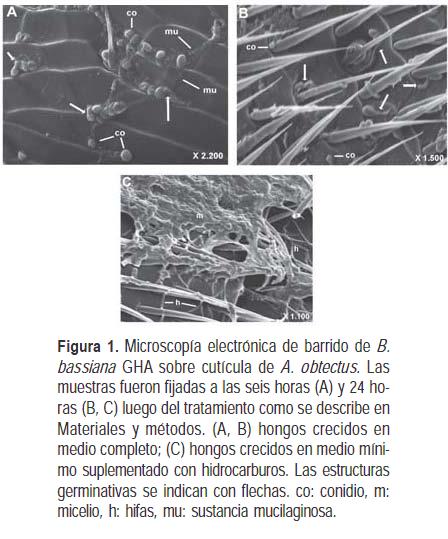
<body><![CDATA[<p style="margin-bottom: 0.0001pt;"><font face="Verdana" size="2"><o:p>&nbsp;</o:p></font></p>       <p style="margin-bottom: 0.0001pt;"><font face="Verdana"><b> <span style="font-size: 10pt;">Resultados</span></b></font></p>       <p style="margin-bottom: 0.0001pt;"><font face="Verdana" size="2"><o:p>&nbsp;</o:p></font></p>       <p style="margin-bottom: 0.0001pt;"><font face="Verdana" size="2">Los an&aacute;lisis de microscop&iacute;a electr&oacute;nica revelaron la presencia de c&uacute;mulos de conidios sobre toda la superficie cuticular de <i>A. obtectus</i>, en particular asociados a pelos, luego de la inoculaci&oacute;n con suspensiones acuosas de Bb GHA. A las seis horas posteriores al tratamiento se observ&oacute; la adhesi&oacute;n de los conidios a la cut&iacute;cula, con una abundante secreci&oacute;n de sustancias mucilaginosas. Se vieron tambi&eacute;n algunos conidios comenzando la etapa de germinaci&oacute;n (<a href="#f1">Figura 1A</a>). A las 24 horas post-inoculaci&oacute;n, la mayor parte de los conidios de CC ya estaban germinados y comenzaban a desarrollar largos tubos germinales (<a href="#f1">Figura 1B</a>). En experimentos similares empleando CHC, a las 24 horas se observ&oacute; una invasi&oacute;n masiva de micelio (<a href="#f1">Figura 1C</a>), a diferencia de las cut&iacute;culas tratadas con CC (<a href="#f1">Figura 1B</a>).</font></p>       <p style="margin-bottom: 0.0001pt;"><font face="Verdana" size="2"><a name="f1"></a><img id="_x0000_i1025" src="../../../../../img/revistas/agro/v15n1/1a08f1.jpg" name="gr&aacute;ficos1" align="bottom" border="0" height="539" width="448"></font></p>       <p style="margin-bottom: 0.0001pt;"><font face="Verdana" size="2">En los bioensayos realizados con las dos cepas f&uacute;ngicas se detectaron importantes diferencias entre CC y CHC. Utilizando Bb GHA sobre <i>A. obtectus</i>, se obtuvo un mayor porcentaje de mortalidad empleando hongos crecidos en <i>n</i>-C28 (67 &plusmn; 3%) respecto a los controles (43 &plusmn; 3%) a los siete d&iacute;as postratamiento, con diferencias significativas seg&uacute;n el test de <i>t</i>-student (<i>p </i>&lt; 0,05). Tambi&eacute;n se obtuvieron diferencias significativas entre ambos tratamientos a los 14 d&iacute;as, cuando la mortalidad alcanz&oacute; el 100% empleando CHC (<a href="../../../../../img/revistas/agro/v15n1/1a08t1.GIF" target="_blank">Cuadro 1</a>). Similares resultados se consiguieron empleando la misma cepa sobre <i>R. dominica</i>, determin&aacute;ndose un mayor porcentaje de mortalidad cuando los insectos se trataron con CHC respecto a los controles (<i>p</i> &lt; 0,05). Los valores alcanzados fueron 69 &plusmn; 16% y 90 &plusmn; 12% para CHC a los 7 y 14 d&iacute;as, respectivamente y 42 &plusmn; 7% para CC, tanto a los siete como a los 14 d&iacute;as (<a href="../../../../../img/revistas/agro/v15n1/1a08t1.GIF" target="_blank">Cuadro 1</a>). Utilizando Bb ARSEF 5500 tambi&eacute;n se obtuvieron diferencias significativas entre ambos tratamientos tanto para <i>A. obtectus</i> <a name="Crespoetal.2002"></a>(<a href="#6">Crespo <i>et al.</i>, 2002</a>) como para <i>R. dominica</i>. En este &uacute;ltimo caso los porcentajes de mortalidad fueron de 6 &plusmn; 4% y 33 &plusmn; 13% (CC), elev&aacute;ndose a 26 &plusmn; 8%&nbsp; y 51 &plusmn; 17% para los CHC a los 7 y 14 d&iacute;as, respectivamente (<i>p </i>&lt; 0,05) (<a href="../../../../../img/revistas/agro/v15n1/1a08t1.GIF" target="_blank">Cuadro 1</a>). Es interesante destacar que en todos los casos ensayados la mortalidad alcanzada a los siete d&iacute;as con hongos crecidos en hidrocarburos (CHC) fue similar a la obtenida con hongos crecidos en medio completo (CC) a los 14 d&iacute;as post-tratamiento.</font></p>       <p style="margin-bottom: 0.0001pt;"><font face="Verdana" size="2"><o:p>&nbsp;</o:p></font></p>       <p style="margin-bottom: 0.0001pt;"><font face="Verdana"><b> <span style="font-size: 10pt;">Discusi&oacute;n</span></b></font></p>       <p style="margin-bottom: 0.0001pt;"><font face="Verdana" size="2"><o:p>&nbsp;</o:p></font></p>       <p style="margin-bottom: 0.0001pt;"><font face="Verdana" size="2">La definici&oacute;n de virulencia m&aacute;s aceptada actualmente en patolog&iacute;a de invertebrados es el grado de patogenicidad de un microorganismo dentro de un grupo o especie <a name="Shapiro-Ilanetal.2005"></a>(<a href="#25">Shapiro-Ilan <i>et al.</i>, 2005</a>). En hongos entomopat&oacute;genos la virulencia puede variar con distintos sustratos nutritivos, presencia de otros microorganismos, factores clim&aacute;ticos, cuando se realiza el pasaje sobre insectos de distinta susceptibilidad al pat&oacute;geno, o cuando se multiplican en medios de cultivo sint&eacute;ticos <a name="LecuonayAlves1996"></a>(<a href="#11">Lecuona y Alves, 1996</a>). La virulencia de hongos entomopat&oacute;genos tambi&eacute;n es frecuentemente relacionada con la rapidez en la germinaci&oacute;n y el crecimiento sobre la cut&iacute;cula de los insectos hospedadores. Un alto porcentaje de germinaci&oacute;n puede ayudar a incrementar la probabilidad de infecci&oacute;n antes que los conidios sean removidos de la cut&iacute;cula <a name="Altreetal.1999"></a>(<a href="#2">Altre <i>et al.</i>, 1999</a>). En el presente trabajo se muestra que a las 24 horas post-infecci&oacute;n se produjo una proliferaci&oacute;n masiva del hongo adaptado a crecer en hidrocarburos sobre la cut&iacute;cula de <i>A. obtectus</i>, mientras que en los cultivos de control s&oacute;lo se observa la adhesi&oacute;n de conidios con escasos tubos germinativos. Este aspecto revela que adem&aacute;s de las ventajas metab&oacute;licas disponibles en los hongos CHC para degradar los hidrocarburos de la cut&iacute;cula del insecto <a name="Ju&aacute;rezetal.2000"></a>(<a href="#9">Ju&aacute;rez <i>et al.</i>, 2000</a>; <a href="#5">Crespo <i>et al.</i>, 2000</a>; <a name="Pedrini2006"></a><a href="#17">Pedrini, 2006</a>), la interacci&oacute;n hongo-cut&iacute;cula se ve favorecida debido a un incremento de la afinidad de los conidios hidrof&oacute;bicos por los componentes cuticulares, disponiendo as&iacute; de una ventaja inicial durante el proceso infectivo. </font> </p>       ]]></body>
<body><![CDATA[<p style="margin-bottom: 0.0001pt;"><font face="Verdana" size="2"><o:p>&nbsp;</o:p></font></p>       <p style="margin-bottom: 0.0001pt;"><font face="Verdana" size="2">Una vez producida la adhesi&oacute;n y germinaci&oacute;n de los conidios, la penetraci&oacute;n a trav&eacute;s de la cut&iacute;cula es la siguiente etapa del ciclo infectivo. La degradaci&oacute;n de los hidrocarburos comienza con una reacci&oacute;n de hidroxilaci&oacute;n catalizada por complejos enzim&aacute;ticos de citocromo P450 monooxigenasas, generando compuestos m&aacute;s hidrof&iacute;licos que son f&aacute;cilmente metabolizables <a name="TanakayFukui1989"></a>(<a href="#26">Tanaka y Fukui, 1989</a>). En <i>B. bassiana</i>, varios genes de P450 fueron clonados y caracterizados, exhibiendo una elevada expresi&oacute;n en hongos adaptados a crecer en hidrocarburos de insecto <a name="Pedrinietal.2010b"></a>(<a href="#22">Pedrini, <i>et al.</i>, 2010b</a>). A continuaci&oacute;n, una serie de enzimas de la v&iacute;a de &beta;-oxidaci&oacute;n metabolizan completamente estos compuestos hidrof&iacute;licos; utiliz&aacute;ndolos para la obtenci&oacute;n de energ&iacute;a e incorpor&aacute;ndolos en constituyentes celulares (<a href="#5">Crespo, <i>et al.</i>, 2000</a>; <a name="Pedrinietal.2006"></a><a href="#18">Pedrini <i>et al.</i>, 2006</a>; <a href="#19">2007</a>).</font></p>       <p style="margin-bottom: 0.0001pt;"><font face="Verdana" size="2"><o:p>&nbsp;</o:p></font></p>       <p style="margin-bottom: 0.0001pt;"><font face="Verdana" size="2">Los resultados de los bioensayos son concordantes con los obtenidos en estudios anteriores en <i>A. obtectus</i> y en <i>Triatoma</i> <i>infestans</i> (Hemiptera: Reduviidae) utilizando cultivos adaptados a crecer en hidrocarburos, permitiendo concluir que mediante esta metodolog&iacute;a es posible aumentar la virulencia favoreciendo las etapas iniciales de la infecci&oacute;n (<a href="#6">Crespo <i>et al.</i>, 2002</a>; <a href="#19">Pedrini <i>et al.</i>, 2007</a>; <a href="#20">2009</a>). Este incremento se evidencia tanto por un aumento en el porcentaje de mortalidad (<a href="#6">Crespo <i>et al.</i>, 2002</a>; este trabajo) como por una disminuci&oacute;n del tiempo letal medio (<a href="#20">Pedrini <i>et al.</i>, 2009</a>). En el presente trabajo, se confirm&oacute; la susceptibilidad de <i>A. obtectus</i> a <i>B. bassiana </i>(<a href="#6">Crespo <i>et al.</i>, 2002</a>), incrementando la mortalidad hasta 60-100%, dependiendo de la cepa, luego de 14 d&iacute;as de su inoculaci&oacute;n con hongos CHC. Asimismo, en <i>R. dominica</i> se detect&oacute; un significativo incremento en este par&aacute;metro en hongos CHC, alcanzando un 90% de mortalidad con la cepa GHA, en tanto que este valor fue &lt;50% empleando hongos CC a las dosis y condiciones ensayadas. En conclusi&oacute;n, el mejoramiento producido luego de la modificaci&oacute;n del medio de cultivo implicar&iacute;a una adaptaci&oacute;n metab&oacute;lica ventajosa para la colonizaci&oacute;n del insecto, pero no la modificaci&oacute;n gen&eacute;tica del microorganismo; de este modo la bioseguridad en relaci&oacute;n al hombre y la fauna ben&eacute;fica no sufrir&iacute;a alteraciones.</font></p>       <p style="margin-bottom: 0.0001pt;"><font face="Verdana" size="2"><o:p>&nbsp;</o:p></font></p>       <p style="margin-bottom: 0.0001pt;"><font face="Verdana"><b> <span style="font-size: 10pt;" lang="EN-US">Bibliograf&iacute;a</span></b></font><span style="" lang="EN-US"><o:p></o:p></span></p>       <p style="margin-bottom: 0.0001pt;"><font face="Verdana" size="2"><span style="" lang="EN-US"><o:p>&nbsp;</o:p></span></font></p>       <!-- ref --><p style="margin-bottom: 0.0001pt;"><font face="Verdana"><a name="1"> <font size="2"></font></a><a href="#Adaneetal.1996"><b> <span style="font-size: 10pt;" lang="EN-US">Adane</span></b></a><span style="font-size: 10pt;" lang="EN-US"><a href="#Adaneetal.1996"> <b>K., Moore D. and Archer S.A.</b> 1996</a>. Preliminary Studies on the Use of <i>Beauveria</i> <i>bassiana</i> to Control <i>Sitophilus</i> <i>zeamais</i> (Coleoptera: Curculionidae) in the Laboratory.Journal of Stored Products Research, 32(2): 105-113.    </span></font></p>       <!-- ref --><p style="margin-bottom: 0.0001pt;"><font face="Verdana"><span style="" lang="EN-US"><o:p> <font size="2">&nbsp;</font></o:p></span><a name="2"><font size="2"></font></a><a href="#Altreetal.1999"><b><span style="font-size: 10pt;" lang="EN-US">Altre</span></b></a><span style="font-size: 10pt;" lang="EN-US"><a href="#Altreetal.1999"> <b>J.A., Vanderberg J.D. and Cantone F.A.</b> 1999</a>. Pathogenicity of <i>Paecilomyces</i> <i>fumosoroseus</i> Isolates to Diamondback moth, <i>Plutella</i> <i>xylostella</i>: Correlation with Spore Size, Germination Speed, and Attachment to Cuticule.Journal of Invertebrate Pathology, 73(3): 332-338.    </span></font><span style="" lang="EN-US"><o:p></o:p></span></p>       <!-- ref --><p style="margin-bottom: 0.0001pt;"><font face="Verdana"><span style="" lang="EN-US"><o:p> <font size="2">&nbsp;</font></o:p></span><a name="3"><font size="2"></font></a><a href="#BlomquistyDillwith1985"><b><span style="font-size: 10pt;" lang="EN-US">Blomquist</span></b></a><span style="font-size: 10pt;" lang="EN-US"><a href="#BlomquistyDillwith1985"> <b>G.J. and Dillwith J.W.</b> 1985</a>. Cuticular Lipids. En: Comprehensive Insect Physiology, Biochemistry and Pharmacology. Kerkut G.A y Gilbert L.I. (Eds.) Oxford : Pergamon Press, pp. 117-154 : v. 3.    </span></font><span style="" lang="EN-US"><o:p></o:p></span></p>       <!-- ref --><p style="margin-bottom: 0.0001pt;"><font face="Verdana"><span style="" lang="EN-US"><o:p> <font size="2">&nbsp;</font></o:p></span><a name="4"><font size="2"></font></a><a href="#Blomquistetal.1987"><b><span style="font-size: 10pt;" lang="FR">Blomquist</span></b></a><span style="font-size: 10pt;" lang="FR"><a href="#Blomquistetal.1987"> <b>G.L., Nelson D.R. and De Renobales M.</b> 1987</a>. </span> <span style="font-size: 10pt;" lang="EN-US">Chemistry, Biochemistry and Physiology of Insect Cuticular Lipids. Archives of Insect Biochemistry and Physiology, 6(4): 227-265.     </span></font><span style="" lang="EN-US"><o:p></o:p></span></p>       <!-- ref --><p style="margin-bottom: 0.0001pt;"><font face="Verdana"><span style="" lang="EN-US"><o:p> <font size="2">&nbsp;</font></o:p></span><a name="5"><font size="2"></font></a><a href="#Crespoetal.2000"><b><span style="font-size: 10pt;" lang="EN-US">Crespo</span></b></a><span style="font-size: 10pt;" lang="EN-US"><a href="#Crespoetal.2000"> <b>R., Ju&aacute;rez M.P. and Cafferata L.F.R.</b> 2000</a>. Biochemical Interaction Between Entomopatogenous Fungi and their Host-like Hydrocarbons. Mycologia 92(3): 528-536.    </span></font><span style="" lang="EN-US"><o:p></o:p></span></p>       <!-- ref --><p style="margin-bottom: 0.0001pt;"><font face="Verdana"><span style="" lang="EN-US"><o:p> <font size="2">&nbsp;</font></o:p></span><a name="6"><font size="2"></font></a><a href="#2002."><b><span style="font-size: 10pt;" lang="EN-US">Crespo R., Ju&aacute;rez M.P., Dal Bello G.M., Pad&iacute;n S.B., Calder&oacute;n Fern&aacute;ndez G.M. and Pedrini, N.</span></b></a><span style="font-size: 10pt;" lang="EN-US"><a href="#2002."> 2002</a>. Increased Mortality of <i>Acanthoscelides</i> <i>obtectus</i> by Alkane-grown <i>Beauveria</i> <i>bassiana</i>. BioControl 47(6): 685-696.    </span></font><span style="" lang="EN-US"><o:p></o:p></span></p>       <!-- ref --><p style="margin-bottom: 0.0001pt;"><font face="Verdana"><span style="" lang="EN-US"><o:p> <font size="2">&nbsp;</font></o:p></span><a name="7"><font size="2"></font></a><a href="#Humber1998"><b><span style="font-size: 10pt;" lang="EN-US">Humber</span></b></a><span style="font-size: 10pt;" lang="EN-US"><a href="#Humber1998"> <b>R.A.</b> 1998</a>. Collection of Entomopathogenic Fungal Cultures. USDA-ARS (Suppl.to the 1992 Catalog), Ithaca, NY, USA.    </span></font><span style="" lang="EN-US"><o:p></o:p></span></p>       <!-- ref --><p style="margin-bottom: 0.0001pt;"><font face="Verdana"><span style="" lang="EN-US"><o:p> <font size="2">&nbsp;</font></o:p></span><a name="8"><font size="2"></font></a><a href="#Ju%E1rez1994"><b><span style="font-size: 10pt;" lang="EN-US">Ju&aacute;rez</span></b></a><span style="font-size: 10pt;" lang="EN-US"><a href="#Ju%E1rez1994"> <b>M.P.</b> 1994</a>. Inhibition of Insect Surface Lipid Synthesis, and Insect Survival. Archives of Insect Biochemistry and Physiology, 25(3): 177-191.    </span></font><span style="" lang="EN-US"><o:p></o:p></span></p>       <!-- ref --><p style="margin-bottom: 0.0001pt;"><font face="Verdana"><span style="" lang="EN-US"><o:p> <font size="2">&nbsp;</font></o:p></span><a name="9"><font size="2"></font></a><a href="#Ju%E1rezetal.2000"><b><span style="font-size: 10pt;" lang="EN-US">Ju&aacute;rez M.P, Crespo R., Calder&oacute;n Fern&aacute;ndez G.M., Lecuona R.E. and Cafferata L.F.R.</span></b></a><span style="font-size: 10pt;" lang="EN-US"><a href="#Ju%E1rezetal.2000"> 2000</a>. Characterization and Carbon Metabolism in Fungi Pathogenic to <i>Triatoma</i> <i>infestans</i>, a Chagas Disease Vector. </span><span style="font-size: 10pt;">Journal of Invertebrate Pathology, 76(3): 198-207.    </span></font></p>       <!-- ref --><p style="margin-bottom: 0.0001pt;"><font face="Verdana"><o:p><font size="2">&nbsp;</font></o:p><a name="10"><font size="2"></font></a><a href="#LecuonayAlves1996"><b><span style="font-size: 10pt;">Lecuona R.E.</span></b></a><span style="font-size: 10pt;"><a href="#LecuonayAlves1996"> 1996</a>. Control microbiano, utop&iacute;a o realidad. En: Microorganismos pat&oacute;genos empleados en el control microbiano de insectos plaga<i>.</i> Lecuona, R.E. (Ed.) Buenos Aires: M. Mas, pp.13-15.    </span></font></p>       <p style="margin-bottom: 0.0001pt;"><font face="Verdana"><o:p><font size="2">&nbsp;</font></o:p><a name="11"><font size="2"></font></a><a href="#LecuonayAlves1996"><b><span style="font-size: 10pt;">Lecuona R.E y Alves S.B.</span></b></a><span style="font-size: 10pt;"><a href="#LecuonayAlves1996"> 1996</a>. Epizootiolog&iacute;a. En: Microorganismos pat&oacute;genos empleados en el control microbiano de insectos plaga<i>. </i>Lecuona, R.E. (Ed.) Buenos Aires : M. Mas, pp. 17-34.</span></font></p>       <!-- ref --><p style="margin-bottom: 0.0001pt;"><font face="Verdana"><o:p><font size="2">&nbsp;</font></o:p><a name="12"><font size="2"></font></a><a href="#Lockey1988"><b><span style="font-size: 10pt;">Lockey</span></b></a><span style="font-size: 10pt;"><a href="#Lockey1988"> <b>K.H.</b> 1988</a>. </span><span style="font-size: 10pt;" lang="EN-US">Lipids of the Insect Cuticle : Origin, Composition and Function. Comparative Biochemistry and Physiology, 89B: 595-645.    </span></font><span style="" lang="EN-US"><o:p></o:p></span></p>       ]]></body>
<body><![CDATA[<!-- ref --><p style="margin-bottom: 0.0001pt;"><font face="Verdana"><span style="" lang="EN-US"><o:p> <font size="2">&nbsp;</font></o:p></span><a name="13"><font size="2"></font></a><a href="#Moinoetal.1998"><b><span style="font-size: 10pt;" lang="EN-US">Moino</span></b></a><span style="font-size: 10pt;" lang="EN-US"><a href="#Moinoetal.1998"> <b>A. Jr., Alves S.B. and Pereira R.M.</b> 1998</a>. Efficacy of <i>Beauveria</i> <i>bassiana</i> (Balsamo) Vuillemin Isolates for Control of Stored-grain Pests. Journal of Applied Entomology 122(1-5): 301-305.    </span></font><span style="" lang="EN-US"><o:p></o:p></span></p>       <!-- ref --><p style="margin-bottom: 0.0001pt;"><font face="Verdana"><a name="14"> <font size="2"></font></a><a href="#NelsonyBlomquist1995"><b> <span style="font-size: 10pt;" lang="EN-US">Nelson D.R. and Blomquist G.J.</span></b></a><span style="font-size: 10pt;" lang="EN-US"><a href="#NelsonyBlomquist1995"> 1995</a>. Insect Waxes. En: Waxes: Chemistry, Molecular Biology and Functions. Hamilton, R.J. (Ed.) Londres : W. W. Christie, The Oily Press, pp. 1-90.    </span></font><span style="" lang="EN-US"><o:p></o:p></span></p>       <!-- ref --><p style="margin-bottom: 0.0001pt;"><font face="Verdana"><span style="" lang="EN-US"><o:p> <font size="2">&nbsp;</font></o:p></span><a name="15"><font size="2"></font></a><a href="#Pad%EDnetal.1997"><b><span style="font-size: 10pt;" lang="EN-US">Pad&iacute;n</span></b></a><span style="font-size: 10pt;" lang="EN-US"><a href="#Pad%EDnetal.1997"> <b>S.B., Dal Bello G.M. and Vasicek A.L.</b> 1997</a>. Pathogenicity of <i>Beauveria</i> <i>bassiana</i> for Adults of <i>Tribolium</i> <i>castaneum</i> (Coleoptera: Tenebrionidae) in Stored Grains. </span><span style="font-size: 10pt;" lang="IT">Entomophaga 42(4): 569-574.    </span></font><span style="" lang="IT"><o:p></o:p></span></p>       <!-- ref --><p style="margin-bottom: 0.0001pt;"><font face="Verdana"><a name="16"> <font size="2"></font></a><a href="#2002"><b> <span style="font-size: 10pt;" lang="IT">Pad&iacute;n</span></b></a><span style="font-size: 10pt;" lang="IT"><a href="#2002"> <b>S.B, Dal Bello G.M. and Fabrizio M.</b> 2002</a>. </span> <span style="font-size: 10pt;" lang="EN-US">Grain Loss Caused by <i>Tribolium</i> <i>castaneum</i>, <i>Sitophilus</i> <i>oryzae</i> and <i>Acanthoscelides</i> <i>obtectus</i> in Stored Durum Wheat and Beans Treated with <i>Beauveria</i> <i>bassiana</i>.Journal of Dtored Products Research, 38(1): 69-74.    </span></font><span style="" lang="EN-US"><o:p></o:p></span></p>       <!-- ref --><p style="margin-bottom: 0.0001pt;"><font face="Verdana"><span style="" lang="EN-US"><o:p> <font size="2">&nbsp;</font></o:p></span><a name="17"><font size="2"></font></a><a href="#Pedrinietal.2006"><b><span style="font-size: 10pt;">Pedrini</span></b></a><span style="font-size: 10pt;"><a href="#Pedrinietal.2006"> <b>N.</b> 2006</a>. Enzimas f&uacute;ngicas involucradas en el catabolismo de hidrocarburos. Su aplicaci&oacute;n a la optimizaci&oacute;n de bioinsecticidas. Tesis Doctoral, Facultad de Ciencias Exactas, Universidad Nacional de La Plata, Argentina.    </span></font></p>       ]]></body>
<body><![CDATA[<!-- ref --><p style="margin-bottom: 0.0001pt;"><font face="Verdana"><o:p><font size="2">&nbsp;</font></o:p><a name="18"><font size="2"></font></a><a href="#Pedrinietal.2006"><b><span style="font-size: 10pt;">Pedrini</span></b></a><span style="font-size: 10pt;"><a href="#Pedrinietal.2006"> <b>N., Crespo R., Ju&aacute;rez M.P. and de Alaniz M.J.T.</b> 2006</a>. </span> <span style="font-size: 10pt;" lang="EN-US">Clues on the Role of <i>Beauveria</i> <i>bassiana </i>catalases in Alkane Degradation Events. Mycologia 98(4): 528-534.    </span></font><span style="" lang="EN-US"><o:p></o:p></span></p>       <!-- ref --><p style="margin-bottom: 0.0001pt;"><font face="Verdana"><span style="" lang="EN-US"><o:p> <font size="2">&nbsp;</font></o:p></span><a name="19"><font size="2"></font></a><a href="#Pedrinietal.2007"><b><span style="font-size: 10pt;" lang="EN-US">Pedrini</span></b></a><span style="font-size: 10pt;" lang="EN-US"><a href="#Pedrinietal.2007"> <b>N., Crespo R. and Ju&aacute;rez M.P.</b> 2007</a>. Biochemistry of Insect Epicuticle Degradation by Entomopathogenic Fungi. Comparative Biochemistry and Physiology, 146C(1-2):124-137.    </span></font><span style="" lang="EN-US"><o:p></o:p></span></p>       <!-- ref --><p style="margin-bottom: 0.0001pt;"><font face="Verdana"><span style="" lang="EN-US"><o:p> <font size="2">&nbsp;</font></o:p></span><a name="20"><font size="2"></font></a><a href="#Pedrinietal.2009"><b><span style="font-size: 10pt;" lang="EN-US">Pedrini</span></b></a><span style="font-size: 10pt;" lang="EN-US"><a href="#Pedrinietal.2009"> <b>N., Mijailovsky S.J., Girotti J.R., Stariolo R., Cardozo R.M., Gentile, A. and Ju&aacute;rez M.P.</b> 2009</a>. Control of Pyrethroid-resistant Chagas Disease Vectors with Entomopathogenic Fungi. PLoS Neglected Tropical Diseases 3(5): e434, </span> <span style="font-size: 10pt;"><a href="http://www.plosntds.org/doi/pntd.0000434" target="_blank"><span style="" lang="EN-US">http://www.plosntds.org/doi/pntd.0000434</span></a></span><span style="font-size: 10pt;" lang="EN-US">, abril 2011.    </span></font><span style="" lang="EN-US"><o:p></o:p></span></p>       <!-- ref --><p style="margin-bottom: 0.0001pt;"><font face="Verdana"><span style="" lang="EN-US"><o:p> <font size="2">&nbsp;</font></o:p></span><a name="21"><font size="2"></font></a><a href="#Pedrinietal.2010a"><b><span style="font-size: 10pt;" lang="EN-US">Pedrini</span></b></a><span style="font-size: 10pt;" lang="EN-US"><a href="#Pedrinietal.2010a"> <b>N., Villaverde M.L., Fuse C.B., Dal Bello G.M. and Ju&aacute;rez M.P.</b> 2010a</a>. <i>Beauveria</i> <i>bassiana</i> Infection Alters Colony Development and Defensive Secretions of the Beetles <i>Tribolium</i> <i>castaneum</i> and <i>Ulomoides</i> <i>dermestoides</i> (Coleoptera: Tenebrionidae). Journal of Economic Entomology, 103(4): 1094-1099.    </span></font><span style="" lang="EN-US"><o:p></o:p></span></p>       <!-- ref --><p style="margin-bottom: 0.0001pt;"><font face="Verdana"><span style="" lang="EN-US"><o:p> <font size="2">&nbsp;</font></o:p></span><a name="22"><font size="2"></font></a><a href="#Pedrinietal.2010b"><b><span style="font-size: 10pt;" lang="EN-US">Pedrini</span></b></a><span style="font-size: 10pt;" lang="EN-US"><a href="#Pedrinietal.2010b"> <b>N., Zhang S., Ju&aacute;rez M.P. and Keyhani N.O.</b> 2010b</a>. Molecular Characterization and Expression Analysis of a Suite of Cytochrome P450 Enzymes Implicated in Insect Hydrocarbon Degradation in the Entomopathogenic Fungus <i>Beauveria</i> <i>bassiana</i>. Microbiology 156(8): 2549-2557.    </span></font><span style="" lang="EN-US"><o:p></o:p></span></p>       ]]></body>
<body><![CDATA[<!-- ref --><p style="margin-bottom: 0.0001pt;"><font face="Verdana"><span style="" lang="EN-US"><o:p> <font size="2">&nbsp;</font></o:p></span><a name="23"><font size="2"></font></a><a href="#RiceyCogburn1999"><b><span style="font-size: 10pt;" lang="EN-US">Rice W.C. and Cogburn R.R.</span></b></a><span style="font-size: 10pt;" lang="EN-US"><a href="#RiceyCogburn1999"> 1999</a>. Activity of the Entomopathogenic Fungus <i>Beauveria</i> <i>bassiana </i>(Deuteromycota: Hyphomycetes) against Three Coleopteran Pests of Stored Grain. Journal of Economic Entomology, 92(3): 691-694.    </span></font><span style="" lang="EN-US"><o:p></o:p></span></p>       <!-- ref --><p style="margin-bottom: 0.0001pt;"><font face="Verdana"><span style="" lang="EN-US"><o:p> <font size="2">&nbsp;</font></o:p></span><a name="24"><font size="2"></font></a><a href="#Roberts1989"><b><span style="font-size: 10pt;" lang="EN-US">Roberts D.W.</span></b></a><span style="font-size: 10pt;" lang="EN-US"><a href="#Roberts1989"> 1989</a>. World Picture of Biological Control of Insects by Fungi. Memorias do Instituto Oswaldo Cruz, 84(S3): 89-100.    </span></font><span style="" lang="EN-US"><o:p></o:p></span></p>       <!-- ref --><p style="margin-bottom: 0.0001pt;"><font face="Verdana"><span style="" lang="EN-US"><o:p> <font size="2">&nbsp;</font></o:p></span><a name="25"><font size="2"></font></a><a href="#Shapiro-Ilanetal.2005"><b><span style="font-size: 10pt;" lang="EN-US">Shapiro-Ilan</span></b></a><span style="font-size: 10pt;" lang="EN-US"><a href="#Shapiro-Ilanetal.2005"> <b>D.I., Fuxa J.R., Lacey J.A., Onstad D.W. and Kaya Y.H.K.</b> 2005</a>. Definitions of Pathogenicity and Virulence in Invertebrate Pathology.Journal of Invertebrate Pathology, 88(1): 1-7.    </span></font><span style="" lang="EN-US"><o:p></o:p></span></p>       <!-- ref --><p style="margin-bottom: 0.0001pt;"><font face="Verdana"><span style="" lang="EN-US"><o:p> <font size="2">&nbsp;</font></o:p></span><a name="26"><font size="2"></font></a><a href="#TanakayFukui1989"><b><span style="font-size: 10pt;" lang="EN-US">Tanaka A. and Fukui S.</span></b></a><span style="font-size: 10pt;" lang="EN-US"><a href="#TanakayFukui1989"> 1989</a>. Metabolism of <i>n</i>-alkanes. En: Tanaka, A., Fukui, S., (Eds.) v. 3. </span><span style="font-size: 10pt;">The Yeast, 2nd ed. Academic Press:New York, pp. 261-287.    </span></font></p>   </div>        ]]></body><back>
<ref-list>
<ref id="B1">
<nlm-citation citation-type="journal">
<person-group person-group-type="author">
<name>
<surname><![CDATA[Adane]]></surname>
<given-names><![CDATA[K]]></given-names>
</name>
<name>
<surname><![CDATA[Moore]]></surname>
<given-names><![CDATA[D]]></given-names>
</name>
<name>
<surname><![CDATA[Archer]]></surname>
<given-names><![CDATA[S.A]]></given-names>
</name>
</person-group>
<article-title xml:lang="en"><![CDATA[Preliminary Studies on the Use of Beauveria bassiana to Control Sitophilus zeamais (Coleoptera: Curculionidae) in the Laboratory]]></article-title>
<source><![CDATA[Journal of Stored Products Research]]></source>
<year>1996</year>
<volume>32</volume>
<numero>2</numero>
<issue>2</issue>
<page-range>105-113</page-range></nlm-citation>
</ref>
<ref id="B2">
<nlm-citation citation-type="journal">
<person-group person-group-type="author">
<name>
<surname><![CDATA[Altre]]></surname>
<given-names><![CDATA[J.A]]></given-names>
</name>
<name>
<surname><![CDATA[Vanderberg]]></surname>
<given-names><![CDATA[J.D]]></given-names>
</name>
<name>
<surname><![CDATA[Cantone]]></surname>
<given-names><![CDATA[F.A]]></given-names>
</name>
</person-group>
<article-title xml:lang="en"><![CDATA[Pathogenicity of Paecilomyces fumosoroseus Isolates to Diamondback moth, Plutella xylostella: Correlation with Spore Size, Germination Speed, and Attachment to Cuticule]]></article-title>
<source><![CDATA[Journal of Invertebrate Pathology]]></source>
<year>1999</year>
<volume>73</volume>
<numero>3</numero>
<issue>3</issue>
<page-range>332-338</page-range></nlm-citation>
</ref>
<ref id="B3">
<nlm-citation citation-type="book">
<person-group person-group-type="author">
<name>
<surname><![CDATA[Blomquist]]></surname>
<given-names><![CDATA[G.J]]></given-names>
</name>
<name>
<surname><![CDATA[Dillwith]]></surname>
<given-names><![CDATA[J.W]]></given-names>
</name>
</person-group>
<article-title xml:lang="en"><![CDATA[Cuticular Lipids]]></article-title>
<person-group person-group-type="editor">
<name>
<surname><![CDATA[Kerkut]]></surname>
<given-names><![CDATA[G.A]]></given-names>
</name>
<name>
<surname><![CDATA[Gilbert]]></surname>
<given-names><![CDATA[L.I]]></given-names>
</name>
</person-group>
<source><![CDATA[Comprehensive Insect Physiology, Biochemistry and Pharmacology]]></source>
<year>1985</year>
<page-range>117-154</page-range><publisher-loc><![CDATA[Oxford ]]></publisher-loc>
<publisher-name><![CDATA[Pergamon Press]]></publisher-name>
</nlm-citation>
</ref>
<ref id="B4">
<nlm-citation citation-type="journal">
<person-group person-group-type="author">
<name>
<surname><![CDATA[Blomquist]]></surname>
<given-names><![CDATA[G.L]]></given-names>
</name>
<name>
<surname><![CDATA[Nelson]]></surname>
<given-names><![CDATA[D.R]]></given-names>
</name>
<name>
<surname><![CDATA[De Renobales]]></surname>
<given-names><![CDATA[M]]></given-names>
</name>
</person-group>
<article-title xml:lang="en"><![CDATA[Chemistry, Biochemistry and Physiology of Insect Cuticular Lipids]]></article-title>
<source><![CDATA[Archives of Insect Biochemistry and Physiology]]></source>
<year>1987</year>
<volume>6</volume>
<numero>4</numero>
<issue>4</issue>
<page-range>227-265</page-range></nlm-citation>
</ref>
<ref id="B5">
<nlm-citation citation-type="journal">
<person-group person-group-type="author">
<name>
<surname><![CDATA[Crespo]]></surname>
<given-names><![CDATA[R]]></given-names>
</name>
<name>
<surname><![CDATA[Juárez]]></surname>
<given-names><![CDATA[M.P]]></given-names>
</name>
<name>
<surname><![CDATA[Cafferata]]></surname>
<given-names><![CDATA[L.F.R]]></given-names>
</name>
</person-group>
<article-title xml:lang="en"><![CDATA[Biochemical Interaction Between Entomopatogenous Fungi and their Host-like Hydrocarbons]]></article-title>
<source><![CDATA[Mycologia]]></source>
<year>2000</year>
<volume>92</volume>
<numero>3</numero>
<issue>3</issue>
<page-range>528-536</page-range></nlm-citation>
</ref>
<ref id="B6">
<nlm-citation citation-type="journal">
<person-group person-group-type="author">
<name>
<surname><![CDATA[Crespo]]></surname>
<given-names><![CDATA[R]]></given-names>
</name>
<name>
<surname><![CDATA[Juárez]]></surname>
<given-names><![CDATA[M.P]]></given-names>
</name>
<name>
<surname><![CDATA[Dal Bello]]></surname>
<given-names><![CDATA[G.M]]></given-names>
</name>
<name>
<surname><![CDATA[Padín]]></surname>
<given-names><![CDATA[S.B]]></given-names>
</name>
<name>
<surname><![CDATA[Calderón Fernández]]></surname>
<given-names><![CDATA[G.M]]></given-names>
</name>
<name>
<surname><![CDATA[Pedrini]]></surname>
<given-names><![CDATA[N]]></given-names>
</name>
</person-group>
<article-title xml:lang="en"><![CDATA[Increased Mortality of Acanthoscelides obtectus by Alkane-grown Beauveria bassiana]]></article-title>
<source><![CDATA[BioControl]]></source>
<year>2002</year>
<volume>47</volume>
<numero>6</numero>
<issue>6</issue>
<page-range>685-696</page-range></nlm-citation>
</ref>
<ref id="B7">
<nlm-citation citation-type="book">
<person-group person-group-type="author">
<name>
<surname><![CDATA[Humber]]></surname>
<given-names><![CDATA[R.A]]></given-names>
</name>
</person-group>
<source><![CDATA[Collection of Entomopathogenic Fungal Cultures]]></source>
<year>1998</year>
<publisher-loc><![CDATA[Ithaca^eNY NY]]></publisher-loc>
<publisher-name><![CDATA[USDA-ARS]]></publisher-name>
</nlm-citation>
</ref>
<ref id="B8">
<nlm-citation citation-type="journal">
<person-group person-group-type="author">
<name>
<surname><![CDATA[Juárez]]></surname>
<given-names><![CDATA[M.P]]></given-names>
</name>
</person-group>
<article-title xml:lang="en"><![CDATA[Inhibition of Insect Surface Lipid Synthesis, and Insect Survival]]></article-title>
<source><![CDATA[Archives of Insect Biochemistry and Physiology]]></source>
<year>1994</year>
<volume>25</volume>
<numero>3</numero>
<issue>3</issue>
<page-range>177-191</page-range></nlm-citation>
</ref>
<ref id="B9">
<nlm-citation citation-type="journal">
<person-group person-group-type="author">
<name>
<surname><![CDATA[Juárez]]></surname>
<given-names><![CDATA[M.P]]></given-names>
</name>
<name>
<surname><![CDATA[Crespo]]></surname>
<given-names><![CDATA[R]]></given-names>
</name>
<name>
<surname><![CDATA[Calderón Fernández]]></surname>
<given-names><![CDATA[G.M]]></given-names>
</name>
<name>
<surname><![CDATA[Lecuona]]></surname>
<given-names><![CDATA[R.E]]></given-names>
</name>
<name>
<surname><![CDATA[Cafferata]]></surname>
<given-names><![CDATA[L.F.R]]></given-names>
</name>
</person-group>
<article-title xml:lang="en"><![CDATA[Characterization and Carbon Metabolism in Fungi Pathogenic to Triatoma infestans, a Chagas Disease Vector.]]></article-title>
<source><![CDATA[Journal of Invertebrate Pathology]]></source>
<year>2000</year>
<volume>76</volume>
<numero>3</numero>
<issue>3</issue>
<page-range>198-207</page-range></nlm-citation>
</ref>
<ref id="B10">
<nlm-citation citation-type="book">
<person-group person-group-type="author">
<name>
<surname><![CDATA[Lecuona]]></surname>
<given-names><![CDATA[R.E]]></given-names>
</name>
</person-group>
<article-title xml:lang="es"><![CDATA[Control microbiano, utopía o realidad]]></article-title>
<person-group person-group-type="editor">
<name>
<surname><![CDATA[Lecuona]]></surname>
<given-names><![CDATA[R.E]]></given-names>
</name>
</person-group>
<source><![CDATA[Microorganismos patógenos empleados en el control microbiano de insectos plaga]]></source>
<year>1996</year>
<page-range>13-15</page-range><publisher-loc><![CDATA[Buenos Aires ]]></publisher-loc>
<publisher-name><![CDATA[M. Mas]]></publisher-name>
</nlm-citation>
</ref>
<ref id="B11">
<nlm-citation citation-type="book">
<person-group person-group-type="author">
<name>
<surname><![CDATA[Lecuona]]></surname>
<given-names><![CDATA[R.E]]></given-names>
</name>
<name>
<surname><![CDATA[Alves]]></surname>
<given-names><![CDATA[S.B]]></given-names>
</name>
</person-group>
<article-title xml:lang="es"><![CDATA[Epizootiología]]></article-title>
<person-group person-group-type="editor">
<name>
<surname><![CDATA[Lecuona]]></surname>
<given-names><![CDATA[R.E]]></given-names>
</name>
</person-group>
<source><![CDATA[Microorganismos patógenos empleados en el control microbiano de insectos plaga]]></source>
<year>1996</year>
<page-range>13-15</page-range><publisher-loc><![CDATA[Buenos Aires ]]></publisher-loc>
<publisher-name><![CDATA[M. Mas]]></publisher-name>
</nlm-citation>
</ref>
<ref id="B12">
<nlm-citation citation-type="journal">
<person-group person-group-type="author">
<name>
<surname><![CDATA[Lockey]]></surname>
<given-names><![CDATA[K.H]]></given-names>
</name>
</person-group>
<article-title xml:lang="en"><![CDATA[Lipids of the Insect Cuticle: Origin, Composition and Function]]></article-title>
<source><![CDATA[Comparative Biochemistry and Physiology]]></source>
<year>1988</year>
<volume>89B</volume>
<page-range>595-645</page-range></nlm-citation>
</ref>
<ref id="B13">
<nlm-citation citation-type="journal">
<person-group person-group-type="author">
<name>
<surname><![CDATA[Moino]]></surname>
<given-names><![CDATA[A]]></given-names>
</name>
<name>
<surname><![CDATA[Alves]]></surname>
<given-names><![CDATA[S.B]]></given-names>
</name>
<name>
<surname><![CDATA[Pereira]]></surname>
<given-names><![CDATA[R.M]]></given-names>
</name>
</person-group>
<article-title xml:lang="en"><![CDATA[Efficacy of Beauveria bassiana (Balsamo) Vuillemin Isolates for Control of Stored-grain Pests]]></article-title>
<source><![CDATA[Journal of Applied Entomology]]></source>
<year>1998</year>
<volume>122</volume>
<numero>1-5</numero>
<issue>1-5</issue>
<page-range>301-305</page-range></nlm-citation>
</ref>
<ref id="B14">
<nlm-citation citation-type="book">
<person-group person-group-type="author">
<name>
<surname><![CDATA[Nelson]]></surname>
<given-names><![CDATA[D.R]]></given-names>
</name>
<name>
<surname><![CDATA[Blomquist]]></surname>
<given-names><![CDATA[G.J.]]></given-names>
</name>
</person-group>
<article-title xml:lang="en"><![CDATA[Insect Waxes]]></article-title>
<person-group person-group-type="editor">
<name>
<surname><![CDATA[Hamilton]]></surname>
<given-names><![CDATA[R.J]]></given-names>
</name>
</person-group>
<source><![CDATA[Waxes: Chemistry, Molecular Biology and Functions]]></source>
<year>1995</year>
<page-range>1-90</page-range><publisher-loc><![CDATA[Londres ]]></publisher-loc>
<publisher-name><![CDATA[W. W. ChristieThe Oily Press]]></publisher-name>
</nlm-citation>
</ref>
<ref id="B15">
<nlm-citation citation-type="journal">
<person-group person-group-type="author">
<name>
<surname><![CDATA[Padín]]></surname>
<given-names><![CDATA[S.B]]></given-names>
</name>
<name>
<surname><![CDATA[Dal Bello]]></surname>
<given-names><![CDATA[G.M]]></given-names>
</name>
<name>
<surname><![CDATA[Vasicek]]></surname>
<given-names><![CDATA[A.L]]></given-names>
</name>
</person-group>
<article-title xml:lang="en"><![CDATA[Pathogenicity of Beauveria bassiana for Adults of Tribolium castaneum (Coleoptera: Tenebrionidae) in Stored Grains]]></article-title>
<source><![CDATA[Entomophaga]]></source>
<year>1997</year>
<volume>42</volume>
<numero>4</numero>
<issue>4</issue>
<page-range>569-574</page-range></nlm-citation>
</ref>
<ref id="B16">
<nlm-citation citation-type="journal">
<person-group person-group-type="author">
<name>
<surname><![CDATA[Padín]]></surname>
<given-names><![CDATA[S.B]]></given-names>
</name>
<name>
<surname><![CDATA[Dal Bello]]></surname>
<given-names><![CDATA[G.M]]></given-names>
</name>
<name>
<surname><![CDATA[Fabrizio]]></surname>
<given-names><![CDATA[M]]></given-names>
</name>
</person-group>
<article-title xml:lang="en"><![CDATA[Grain Loss Caused by Tribolium castaneum, Sitophilus oryzae and Acanthoscelides obtectus in Stored Durum Wheat and Beans Treated with Beauveria bassiana]]></article-title>
<source><![CDATA[Journal of Dtored Products Research]]></source>
<year>2002</year>
<volume>38</volume>
<numero>1</numero>
<issue>1</issue>
<page-range>69-74</page-range></nlm-citation>
</ref>
<ref id="B17">
<nlm-citation citation-type="">
<person-group person-group-type="author">
<name>
<surname><![CDATA[Pedrini]]></surname>
<given-names><![CDATA[N]]></given-names>
</name>
</person-group>
<source><![CDATA[Enzimas fúngicas involucradas en el catabolismo de hidrocarburos: Su aplicación a la optimización de bioinsecticidas]]></source>
<year>2006</year>
</nlm-citation>
</ref>
<ref id="B18">
<nlm-citation citation-type="journal">
<person-group person-group-type="author">
<name>
<surname><![CDATA[Pedrini]]></surname>
<given-names><![CDATA[N]]></given-names>
</name>
<name>
<surname><![CDATA[Crespo]]></surname>
<given-names><![CDATA[R]]></given-names>
</name>
<name>
<surname><![CDATA[Juárez]]></surname>
<given-names><![CDATA[M.P]]></given-names>
</name>
<name>
<surname><![CDATA[de Alaniz]]></surname>
<given-names><![CDATA[M.J.T]]></given-names>
</name>
</person-group>
<article-title xml:lang="en"><![CDATA[Clues on the Role of Beauveria bassiana catalases in Alkane Degradation Events.]]></article-title>
<source><![CDATA[Mycologia]]></source>
<year>2006</year>
<volume>98</volume>
<numero>4</numero>
<issue>4</issue>
<page-range>528-534</page-range></nlm-citation>
</ref>
<ref id="B19">
<nlm-citation citation-type="journal">
<person-group person-group-type="author">
<name>
<surname><![CDATA[Pedrini]]></surname>
<given-names><![CDATA[N]]></given-names>
</name>
<name>
<surname><![CDATA[Crespo]]></surname>
<given-names><![CDATA[R]]></given-names>
</name>
<name>
<surname><![CDATA[Juárez]]></surname>
<given-names><![CDATA[M.P]]></given-names>
</name>
</person-group>
<article-title xml:lang="en"><![CDATA[Biochemistry of Insect Epicuticle Degradation by Entomopathogenic Fungi]]></article-title>
<source><![CDATA[Comparative Biochemistry and Physiology]]></source>
<year>2007</year>
<volume>146C</volume>
<numero>1-2</numero>
<issue>1-2</issue>
<page-range>124-137</page-range></nlm-citation>
</ref>
<ref id="B20">
<nlm-citation citation-type="journal">
<person-group person-group-type="author">
<name>
<surname><![CDATA[Pedrini]]></surname>
<given-names><![CDATA[N]]></given-names>
</name>
<name>
<surname><![CDATA[Mijailovsky]]></surname>
<given-names><![CDATA[S.J]]></given-names>
</name>
<name>
<surname><![CDATA[Girotti]]></surname>
<given-names><![CDATA[J.R]]></given-names>
</name>
<name>
<surname><![CDATA[Stariolo]]></surname>
<given-names><![CDATA[R]]></given-names>
</name>
<name>
<surname><![CDATA[Cardozo]]></surname>
<given-names><![CDATA[R.M]]></given-names>
</name>
<name>
<surname><![CDATA[Gentile]]></surname>
<given-names><![CDATA[A]]></given-names>
</name>
<name>
<surname><![CDATA[Juárez]]></surname>
<given-names><![CDATA[M.P]]></given-names>
</name>
</person-group>
<article-title xml:lang="en"><![CDATA[Control of Pyrethroid-resistant Chagas Disease Vectors with Entomopathogenic Fungi]]></article-title>
<source><![CDATA[PLoS Neglected Tropical Diseases]]></source>
<year>2009</year>
<volume>3</volume>
<numero>5</numero>
<issue>5</issue>
<page-range>e434</page-range></nlm-citation>
</ref>
<ref id="B21">
<nlm-citation citation-type="journal">
<person-group person-group-type="author">
<name>
<surname><![CDATA[Pedrini]]></surname>
<given-names><![CDATA[N]]></given-names>
</name>
<name>
<surname><![CDATA[Villaverde]]></surname>
<given-names><![CDATA[M.L]]></given-names>
</name>
<name>
<surname><![CDATA[Fuse]]></surname>
<given-names><![CDATA[C.B]]></given-names>
</name>
<name>
<surname><![CDATA[Dal Bello]]></surname>
<given-names><![CDATA[G.M]]></given-names>
</name>
<name>
<surname><![CDATA[Juárez]]></surname>
<given-names><![CDATA[M.P]]></given-names>
</name>
</person-group>
<article-title xml:lang="en"><![CDATA[Beauveria bassiana Infection Alters Colony Development and Defensive Secretions of the Beetles Tribolium castaneum and Ulomoides dermestoides (Coleoptera: Tenebrionidae).]]></article-title>
<source><![CDATA[Journal of Economic Entomology]]></source>
<year>2010</year>
<month>a</month>
<volume>103</volume>
<numero>4</numero>
<issue>4</issue>
<page-range>1094-1099</page-range></nlm-citation>
</ref>
<ref id="B22">
<nlm-citation citation-type="journal">
<person-group person-group-type="author">
<name>
<surname><![CDATA[Pedrini]]></surname>
<given-names><![CDATA[N]]></given-names>
</name>
<name>
<surname><![CDATA[Zhang]]></surname>
<given-names><![CDATA[S]]></given-names>
</name>
<name>
<surname><![CDATA[Juárez]]></surname>
<given-names><![CDATA[M.P]]></given-names>
</name>
<name>
<surname><![CDATA[Keyhani]]></surname>
<given-names><![CDATA[N.O]]></given-names>
</name>
</person-group>
<article-title xml:lang="en"><![CDATA[Molecular Characterization and Expression Analysis of a Suite of Cytochrome P450 Enzymes Implicated in Insect Hydrocarbon Degradation in the Entomopathogenic Fungus Beauveria bassiana]]></article-title>
<source><![CDATA[Microbiology]]></source>
<year>2010</year>
<month>b</month>
<volume>156</volume>
<numero>8</numero>
<issue>8</issue>
<page-range>2549-2557</page-range></nlm-citation>
</ref>
<ref id="B23">
<nlm-citation citation-type="journal">
<person-group person-group-type="author">
<name>
<surname><![CDATA[Rice]]></surname>
<given-names><![CDATA[W.C]]></given-names>
</name>
<name>
<surname><![CDATA[Cogburn]]></surname>
<given-names><![CDATA[R.R]]></given-names>
</name>
</person-group>
<article-title xml:lang="en"><![CDATA[Activity of the Entomopathogenic Fungus Beauveria bassiana (Deuteromycota: Hyphomycetes) against Three Coleopteran Pests of Stored Grain.]]></article-title>
<source><![CDATA[Journal of Economic Entomology]]></source>
<year>1999</year>
<volume>92</volume>
<numero>3</numero>
<issue>3</issue>
<page-range>691-694</page-range></nlm-citation>
</ref>
<ref id="B24">
<nlm-citation citation-type="journal">
<person-group person-group-type="author">
<name>
<surname><![CDATA[Roberts]]></surname>
<given-names><![CDATA[D.W.]]></given-names>
</name>
</person-group>
<article-title xml:lang="en"><![CDATA[World Picture of Biological Control of Insects by Fungi]]></article-title>
<source><![CDATA[Memorias do Instituto Oswaldo Cruz]]></source>
<year>1989</year>
<volume>84</volume>
<numero>S3</numero>
<issue>S3</issue>
<page-range>89-100</page-range></nlm-citation>
</ref>
<ref id="B25">
<nlm-citation citation-type="journal">
<person-group person-group-type="author">
<name>
<surname><![CDATA[Shapiro-Ilan]]></surname>
<given-names><![CDATA[D.I]]></given-names>
</name>
<name>
<surname><![CDATA[Fuxa]]></surname>
<given-names><![CDATA[J.R]]></given-names>
</name>
<name>
<surname><![CDATA[Lacey]]></surname>
<given-names><![CDATA[J.A]]></given-names>
</name>
<name>
<surname><![CDATA[Onstad]]></surname>
<given-names><![CDATA[D.W]]></given-names>
</name>
<name>
<surname><![CDATA[Kaya]]></surname>
<given-names><![CDATA[Y.H.K]]></given-names>
</name>
</person-group>
<article-title xml:lang="en"><![CDATA[Definitions of Pathogenicity and Virulence in Invertebrate Pathology]]></article-title>
<source><![CDATA[Journal of Invertebrate Pathology]]></source>
<year>2005</year>
<volume>88</volume>
<numero>1</numero>
<issue>1</issue>
<page-range>1-7</page-range></nlm-citation>
</ref>
<ref id="B26">
<nlm-citation citation-type="book">
<person-group person-group-type="author">
<name>
<surname><![CDATA[Tanaka]]></surname>
<given-names><![CDATA[A]]></given-names>
</name>
<name>
<surname><![CDATA[Fukui]]></surname>
<given-names><![CDATA[S]]></given-names>
</name>
</person-group>
<article-title xml:lang="en"><![CDATA[Metabolism of n-alkanes]]></article-title>
<person-group person-group-type="editor">
<name>
<surname><![CDATA[Tanaka]]></surname>
<given-names><![CDATA[A]]></given-names>
</name>
<name>
<surname><![CDATA[Fukui]]></surname>
<given-names><![CDATA[S]]></given-names>
</name>
</person-group>
<source><![CDATA[]]></source>
<year>1989</year>
<volume>3</volume>
<edition>2</edition>
<page-range>261-287</page-range><publisher-loc><![CDATA[New York ]]></publisher-loc>
<publisher-name><![CDATA[Academic Press]]></publisher-name>
</nlm-citation>
</ref>
</ref-list>
</back>
</article>
