<?xml version="1.0" encoding="ISO-8859-1"?><article xmlns:mml="http://www.w3.org/1998/Math/MathML" xmlns:xlink="http://www.w3.org/1999/xlink" xmlns:xsi="http://www.w3.org/2001/XMLSchema-instance">
<front>
<journal-meta>
<journal-id>2301-1548</journal-id>
<journal-title><![CDATA[Agrociencia (Uruguay)]]></journal-title>
<abbrev-journal-title><![CDATA[Agrociencia Uruguay]]></abbrev-journal-title>
<issn>2301-1548</issn>
<publisher>
<publisher-name><![CDATA[Facultad de Agronomía - Instituto Nacional de Investigación Agropecuaria]]></publisher-name>
</publisher>
</journal-meta>
<article-meta>
<article-id>S2301-15482009000200001</article-id>
<title-group>
<article-title xml:lang="en"><![CDATA[Mass propagation of Vaccinium corymbosum in bioreactors]]></article-title>
<article-title xml:lang="es"><![CDATA[Propagación masal de Vaccinium corymbosum en bioreactores]]></article-title>
</title-group>
<contrib-group>
<contrib contrib-type="author">
<name>
<surname><![CDATA[Ross]]></surname>
<given-names><![CDATA[S.]]></given-names>
</name>
<xref ref-type="aff" rid="A01"/>
</contrib>
<contrib contrib-type="author">
<name>
<surname><![CDATA[Castillo]]></surname>
<given-names><![CDATA[A.]]></given-names>
</name>
<xref ref-type="aff" rid="A02"/>
</contrib>
</contrib-group>
<aff id="A01">
<institution><![CDATA[,Universidad de la República Facultad de Agronomía Depto. de Biología Vegetal]]></institution>
<addr-line><![CDATA[Montevideo ]]></addr-line>
<country>Uruguay</country>
</aff>
<aff id="A02">
<institution><![CDATA[,Instituto Nacional de Investigación Agropecuaria Unidad de Biotecnología ]]></institution>
<addr-line><![CDATA[ ]]></addr-line>
</aff>
<pub-date pub-type="pub">
<day>00</day>
<month>06</month>
<year>2009</year>
</pub-date>
<pub-date pub-type="epub">
<day>00</day>
<month>06</month>
<year>2009</year>
</pub-date>
<volume>13</volume>
<numero>2</numero>
<fpage>1</fpage>
<lpage>8</lpage>
<copyright-statement/>
<copyright-year/>
<self-uri xlink:href="http://www.scielo.edu.uy/scielo.php?script=sci_arttext&amp;pid=S2301-15482009000200001&amp;lng=en&amp;nrm=iso"></self-uri><self-uri xlink:href="http://www.scielo.edu.uy/scielo.php?script=sci_abstract&amp;pid=S2301-15482009000200001&amp;lng=en&amp;nrm=iso"></self-uri><self-uri xlink:href="http://www.scielo.edu.uy/scielo.php?script=sci_pdf&amp;pid=S2301-15482009000200001&amp;lng=en&amp;nrm=iso"></self-uri><abstract abstract-type="short" xml:lang="en"><p><![CDATA[Two kinds of bioreactors were evaluated for in vitro propagation of Vaccinium corymbosum: a temporary immersion system (RITA®) and a permanent immersion reactor. Results were compared with the system currently used of micropropagation in semi-solid medium, used as control for this study. Two varieties, &lsquo;O&rsquo;Neal&rsquo; and &lsquo;Georgia Gem&rsquo;, of the triple hybrid Vaccinium corymbosum, V. ashei and V. darrowii were employed. Explants were cultured in WPM medium (Lloyd and Mc Cown, 1981) containing 0.01mM ascorbic acid, 0.22mM adenine sulphate, 2% sucrose and 20mM 2iP. To minimize hyperhydricity of explants, the effect of ancymidol (0.4, 0.9 and 2.0 &micro;M) as growth retardant and phloroglucinol (0.32mM) as promoter of lignin biosynthesis was tested. The highest multiplication rates were 28 and 24 shoots per bud for the varieties &lsquo;O&rsquo;Neal&rsquo; and &lsquo;Georgia Gem&rsquo; respectively, and were achieved in the permanent immersion system containing phloroglucinol. Light microscopy of the shoots showed a more developed and lignified xylem in the phloroglucinol-derived plants. Shoots obtained from the multiplication system that were 3 or more centimeters long were rooted ex vitro in a mixture of soil, peat and perlite (1:1:1) resulting in 80% rooting. Plants acclimatized well and exhibited normal development in the greenhouse. Abbreviations: IBA &ndash; Indol-3-butyric acid, 2iP &ndash; 6-(g, g-dymethilamino) purine, WPM &ndash; Woody Plant Medium (Lloyd and McCown, 1981).]]></p></abstract>
<abstract abstract-type="short" xml:lang="es"><p><![CDATA[Se evaluaron dos tipos de bioreactores para la propagación in vitro de Vaccinium corymbosum: un reactor de inmersión temporal (RITA®) y un reactor de inmersión permanente. Los resultados fueron comparados con el sistema de micropropagación habitualmente empleado de multiplicación en medio de cultivo semi-sólido, usado como control en este trabajo. Se emplearon dos variedades, &lsquo;O`Neal&rsquo; y &lsquo;Georgia Gem&rsquo;, del triple híbrido Vaccinium corymbosum, V. ashei y V. darrowii. Los explantos fueron cultivados en medio WPM (Lloyd y Mc Cown, 1981) suplementado con ácido ascórbico (0,01 mM), sulfato de adenina (0,22 mM), sacarosa (2%) y 2iP (20&micro;M). Para minimizar la ocurrencia de hiperhidricidad en los explantos se evaluó el efecto del ancymidol (0.4, 0.9 y 2.0 &micro;M ) como retardante del crecimiento y del phloroglucinol (0.32mM) como promotor de la biosíntesis de lignina. Las máximas tasas de multiplicación obtenidas fueron 28 y 24 brotes por yema para las variedades &lsquo;O&rsquo;Neal&rsquo; y &lsquo;Georgia Gem&rsquo; respectivamente, las cuales fueron alcanzadas en el sistema de inmersión permanente con phloroglucinol. Observaciones al microscopio óptico de las plantas obtenidas mostraron una mayor diferenciación de xilema y mayor lignificación de los tejidos en los explantos provenientes del tratamiento con phloroglucinol. Los brotes provenientes del tratamiento de multiplicación que alcanzaron 3 cm o más de altura fueron enraizados ex vitro en una mezcla de tierra, turba y perlita (1:1:1) obteniéndose un 80% de enraizamiento. Las plantas fueron aclimatadas y mostraron un desarrollo normal en invernáculo. Abreviaciones: IBA &ndash; ácido indol 3 butírico, 2iP &ndash; 6-(g, g-dymethilamino) purine, WPM &ndash; Woody Plant Medium (Lloyd y McCown, 1981).]]></p></abstract>
<kwd-group>
<kwd lng="en"><![CDATA[ancymidol]]></kwd>
<kwd lng="en"><![CDATA[blueberry]]></kwd>
<kwd lng="en"><![CDATA[hyperhydricity]]></kwd>
<kwd lng="en"><![CDATA[micropropagation]]></kwd>
<kwd lng="en"><![CDATA[phloroglucinol]]></kwd>
<kwd lng="es"><![CDATA[ancymidol]]></kwd>
<kwd lng="es"><![CDATA[blueberry]]></kwd>
<kwd lng="es"><![CDATA[hiperhidricidad]]></kwd>
<kwd lng="es"><![CDATA[micropropagación]]></kwd>
<kwd lng="es"><![CDATA[phloroglucinol]]></kwd>
</kwd-group>
</article-meta>
</front><body><![CDATA[ <p class="western" style="text-indent: 0cm;" align="left" lang="es-ES"><b> <font style="font-size: 13pt;" face="Verdana"><span lang="en-US">Mass propagation of <i>Vaccinium corymbosum</i> in bioreactors</span></font></b></p>         <p class="western" style="text-indent: 0cm;" align="left" lang="en-US"> <font face="Verdana">    <br>     </font><font face="Verdana" size="2">    <br>     </font>     </p>         <p style="text-indent: 0cm;" lang="es-ES"><font size="2" face="Verdana"><a name="1.."></a>Ross, S.</font><a href="#1."><sup><font size="2" face="Verdana">1</font></sup></a><font size="2" face="Verdana">; <a name="2.."></a>Castillo, A.</font><a href="#2."><sup><font size="2" face="Verdana">2</font></sup></a></p>         <p class="western" style="text-indent: 0cm;" align="left" lang="es-ES"> <font face="Verdana">    <br>     </font>     </p>         <p style="text-indent: 0cm;" lang="es-ES"><i><sup><font face="Verdana"><a name="1."> <font size="2"></font></a><font size="2"><a href="#1..">1</a></font></font></sup><font face="Verdana"><font size="2">Depto. de Biolog&iacute;a Vegetal, Facultad de Agronom&iacute;a-Universidad de la Rep&uacute;blica, Garz&oacute;n 780 Montevideo, Uruguay. (598-2)3553503. Correo electr&oacute;nico: </font> <a href="mailto:sross@fagro.edu.uy"> <font size="2">sross@fagro.edu.uy</font></a></font></i></p>         <p style="text-indent: 0cm;" lang="es-ES"><i><sup><font face="Verdana"><a name="2."> <font size="2"></font></a><font size="2"><a href="#2..">2</a></font></font></sup><font size="2" face="Verdana">Unidad de Biotecnolog&iacute;a, Instituto Nacional de Investigaci&oacute;n Agropecuaria, Las Brujas-Canelones, Uruguay.</font></i></p>         <p class="western" style="text-indent: 0cm;" align="left" lang="es-ES"> <font face="Verdana">    ]]></body>
<body><![CDATA[<br>     </font>     </p>         <p class="western" style="text-indent: 0cm;" align="left" lang="es-ES"> <font face="Verdana">    <br>     </font>     </p>         <p class="western" style="text-indent: 0cm; text-align: center;" lang="es-ES"> <font face="Verdana">Recibido: 16/3/09  Aceptado: 10/11/09</font></p>         <p class="western" style="text-indent: 0cm;" align="left" lang="es-ES"> <font face="Verdana">    <br>     </font>     </p>         <p class="western" style="text-indent: 0cm;" align="left" lang="es-ES"> <font face="Verdana">    <br>     </font>     </p>         <p class="western" style="text-indent: 0cm; line-height: 150%;" align="left" lang="en-US"> <font face="Verdana"><b>Summary</b></font></p>         <p class="western" style="text-indent: 0cm;" align="justify" lang="es-ES"> <font face="Verdana"><span lang="en-US">Two kinds of bioreactors were evaluated for <i>in vitro</i> propagation of <i>Vaccinium corymbosum</i>:<i> </i>a<i> </i>temporary immersion system (RITA&reg;) and a permanent immersion reactor. Results were compared with the system currently used of micropropagation in semi-solid medium, used as control for this study. Two varieties, &lsquo;O&rsquo;Neal&rsquo; and &lsquo;Georgia Gem&rsquo;, of the triple hybrid <i>Vaccinium corymbosum, V. ashei</i> and <i>V. darrowii</i> were employed. Explants were cultured in WPM medium (Lloyd and Mc Cown, 1981) containing 0.01mM ascorbic acid, 0.22mM adenine sulphate, 2% sucrose and 20</span>m<span lang="en-US">M 2iP. To minimize hyperhydricity of explants, the effect of ancymidol (0.4, 0.9 and 2.0 &micro;M) as growth retardant and phloroglucinol (0.32mM) as promoter of lignin biosynthesis was tested. The highest multiplication rates were  28 and 24 shoots per bud for the varieties &lsquo;O&rsquo;Neal&rsquo; and &lsquo;Georgia Gem&rsquo; respectively, and were achieved in the permanent immersion system containing phloroglucinol. Light microscopy of the shoots showed a more developed and lignified xylem in the phloroglucinol-derived plants. Shoots obtained from the multiplication system that were 3 or more centimeters long were rooted <i>ex vitro</i> in a mixture of soil, peat and perlite (1:1:1) resulting in 80% rooting. Plants acclimatized well and exhibited normal development in the greenhouse.</span></font></p>         ]]></body>
<body><![CDATA[<p class="western" style="text-indent: 0cm;" align="justify" lang="es-ES"> <font face="Verdana"><span lang="en-US"><i>Abbreviations</i>: IBA &ndash; Indol-3-butyric acid, 2iP &ndash; 6-(</span>g<span lang="en-US">, </span>g<span lang="en-US">-dymethilamino) purine, WPM &ndash; Woody Plant Medium (Lloyd and McCown, 1981).</span></font></p>         <p class="western" style="text-indent: 0cm;" align="justify" lang="en-US"> <font face="Verdana">     <br>     </font>     </p>         <p class="western" style="text-indent: 0cm;" align="justify" lang="es-ES"> <font face="Verdana"><span lang="en-US"><b>Key words</b>: ancymidol, blueberry, hyperhydricity, micropropagation, phloroglucinol</span></font></p>         <p class="western" style="text-indent: 0cm;" align="left" lang="en-US"> <font face="Verdana">    <br>     </font>     </p>         <p class="western" style="text-indent: 0cm;" align="left" lang="en-US"> <font face="Verdana">    <br>     </font>     </p>         <p class="western" style="text-indent: 0cm;" align="left" lang="en-US"> <font face="Verdana">    <br>     </font>     </p>         ]]></body>
<body><![CDATA[<p class="western" style="text-indent: 0cm; line-height: 150%;" align="left" lang="es-ES"> <font face="Verdana"><b>Resumen</b></font></p>         <p class="western" style="text-indent: 0cm;" align="left" lang="es-ES"> <font face="Verdana">Propagaci&oacute;n masal de <i>Vaccinium corymbosum</i> en bioreactores</font></p>         <p style="text-indent: 0cm;" align="left" lang="es-ES"> <font face="Verdana" size="2">    <br>     </font>     </p>         <p style="text-indent: 0cm;" align="left" lang="es-ES"> <font face="Verdana" size="2">    <br>     </font>     </p>         <p class="western" style="text-indent: 0cm;" align="justify" lang="es-ES"> <font face="Verdana">Se evaluaron dos tipos de bioreactores para la propagaci&oacute;n <i>in vitro</i> de <i>Vaccinium corymbosum</i>: un reactor de inmersi&oacute;n temporal (RITA&reg;) y un reactor de inmersi&oacute;n permanente. Los resultados fueron comparados con el sistema de micropropagaci&oacute;n habitualmente empleado de multiplicaci&oacute;n en medio de cultivo semi-s&oacute;lido, usado como control en este trabajo. Se emplearon dos variedades, &lsquo;O`Neal&rsquo; y &lsquo;Georgia Gem&rsquo;, del triple h&iacute;brido <i>Vaccinium corymbosum, V. ashei</i> y <i>V. darrowii. </i>Los explantos fueron cultivados en medio WPM (Lloyd y Mc Cown, 1981) suplementado con &aacute;cido asc&oacute;rbico (0,01 mM), sulfato de adenina (0,22 mM), sacarosa (2%) y 2iP (20&micro;M). Para minimizar la ocurrencia de hiperhidricidad en los explantos se evalu&oacute; el efecto del ancymidol (0.4, 0.9 y 2.0 &micro;M ) como retardante del crecimiento y del phloroglucinol (0.32mM) como promotor de la bios&iacute;ntesis de lignina. Las m&aacute;ximas tasas de multiplicaci&oacute;n obtenidas fueron 28 y 24 brotes por yema para las variedades &lsquo;O&rsquo;Neal&rsquo; y &lsquo;Georgia Gem&rsquo; respectivamente, las cuales fueron alcanzadas en el sistema de inmersi&oacute;n permanente con phloroglucinol. Observaciones al microscopio &oacute;ptico de las plantas obtenidas mostraron una mayor diferenciaci&oacute;n de xilema y mayor lignificaci&oacute;n de los tejidos en los explantos provenientes del tratamiento con phloroglucinol. Los brotes provenientes del tratamiento de multiplicaci&oacute;n que alcanzaron 3 cm o m&aacute;s de altura fueron enraizados <i>ex vitro</i> en una mezcla de tierra, turba y perlita (1:1:1) obteni&eacute;ndose un 80% de enraizamiento. Las plantas fueron aclimatadas y mostraron un desarrollo normal en invern&aacute;culo.</font></p>         <p class="western" style="text-indent: 0cm;" align="justify" lang="es-ES"> <font face="Verdana"><i>Abreviaciones</i>: IBA &ndash; &aacute;cido indol 3 but&iacute;rico, 2iP &ndash; 6-(g, g-dymethilamino) purine, WPM &ndash; Woody Plant Medium (Lloyd y McCown, 1981).</font></p>         <p class="western" style="text-indent: 0cm;" align="justify" lang="es-ES"> <font face="Verdana">     <br>     </font>     </p>         ]]></body>
<body><![CDATA[<p class="western" style="text-indent: 0cm;" align="justify" lang="es-ES"> <font face="Verdana"><b>Palabras clave</b>: ancymidol, blueberry, hiperhidricidad, micropropagaci&oacute;n, phloroglucinol</font></p>         <p class="western" style="text-indent: 0cm;" align="left" lang="es-ES"> <font face="Verdana">    <br>     </font>     </p>         <p class="western" style="text-indent: 0cm; line-height: 150%;" align="left" lang="en-US"> <font face="Verdana">     <br>     </font>     </p>         <p class="western" style="text-indent: 0cm; line-height: 150%;" align="left" lang="en-US"> <font face="Verdana"><b>Introduction</b></font></p>         <p class="western" lang="es-ES"><font face="Verdana" color="#000000"><span lang="en-US">An increasing interest exists in Uruguay for alternative fruit species, among which the great demand for blueberry (<i>Vaccinium corymbosum</i>) for the establishment of commercial orchards stands out. <i>V. corymbosum</i> is an important fruit crop in many northern latitude countries. Its high anthocyanin content is an excellent source of antioxidants, which are believed to reduce the risk of various human degenerative diseases <a name="Prior2000"></a>(<a href="#14">Prior, 2000</a>). According to United States Food and Drug Administration, blueberries are low in fat, very rich in antioxidants, vitamins C, K and A as well as iron and manganese, and a good source of dietary fiber. They are consumed both as fresh and processed products.</span></font></p>         <p class="western" lang="es-ES"><font face="Verdana" color="#000000"><span lang="en-US">Research carried out by inia (Instituto Nacional de Investigaci&oacute;n Agropecuaria) concludes that Uruguay has adequate soils and climate for the cultivation of this species, with the additional advantage that we can supply fruit to satisfy the high demand from Europe and United States out of season, from October to December. </span></font> </p>         <p class="western" lang="en-US"><font face="Verdana">The main limitation for establishing its culture is the lack of a propagation system which produces disease-free plant material for commercial plantations. Traditionally this species is clonally propagated by rooting cuttings, but this method cannot assure enough identical disease-free plant material <a name="Gonz&aacute;lez2000"></a>(<a href="#7">Gonz&aacute;lez, 2000</a>). Being a relatively new species for cultivation in Uruguay, micropropagation is the best alternative to rapidly satisfy the current demand of plants.</font></p>         <p class="western" lang="en-US"><font face="Verdana">Micropropagation allows the fast clonal propagation of plants free from pathogens, and is routinely used to produce large numbers of fruit, forestry, and ornamental species. Blueberries have been micropropagated for more than twenty years from nodal segments of adult field-grown plants <a name="CohenandElliot1979"></a>(<a href="#2">Cohen and Elliot, 1979</a>; <a name="ZimmermanandBroome1980"></a><a href="#17">Zimmerman and Broome, 1980</a>). However, the extent to which micropropagation can be practiced commercially is limited by the cost of production, due to the intense manipulations required in the different stages of the process <a name="George1993"></a>(<a href="#5">George, 1993</a>).</font></p>         ]]></body>
<body><![CDATA[<p class="western" lang="en-US"><font face="Verdana">Automation of micropropagation in bioreactors has been advanced by several authors as a possible way of reducing costs of micropropagation. Bioreactors provide a sterile environment, designed to strongly promote development and allowing a maximum control of microenvironment conditions <a name="PaekandHahn2002"></a>(<a href="#13">Paek and Hahn, 2002</a>). Bioreactors provide a rapid and efficient plant propagation system for many agricultural and forestry species, utilizing liquid media to avoid intensive manual handling. Bioreactor cultures have several advantages compared with agar-based cultures, with a better contact of the plant tissue with the culture medium, and optimal nutrient and growth regulator supply, as well as aeration and medium circulation, the filtration of the medium and the scaling-up of the cultures <a name="Ziv2005"></a>(<a href="#19">Ziv, 2005</a>). The main disadvantage imposed by the use of liquid medium in bioreactors is the development of hyperhydric plants, which present abnormal morphogenesis such as vitreous leaves, stomata malfunction and hypolignification among others <a name="Ziv1991"></a>(<a href="#18">Ziv, 1991</a>).</font></p>         <p class="western" lang="en-US"><font face="Verdana">The objective of this study was to optimize a bioreactor multiplication system for blueberry to satisfy the actual demand of high quality plant material. Two types of bioreactors were evaluated:  a permanent reactor and a temporary immersion system RITA&reg; <a name="Teisson1996"></a>(<a href="#15">Teisson, 1996</a>).</font></p>         <p class="western" style="text-indent: 0cm; line-height: 150%;" align="left" lang="en-US"> <font face="Verdana">     <br>     </font>     </p>         <p class="western" style="text-indent: 0cm; line-height: 150%;" align="left" lang="en-US"> <font face="Verdana"><b>Materials and methods</b></font></p>         <p class="western" style="text-indent: 0cm; line-height: 150%;" align="left" lang="en-US"> <font face="Verdana"><b>Plant material</b></font></p>         <p class="western" lang="es-ES"><font face="Verdana" color="#000000"><span lang="en-US">Two varieties, &lsquo;O&rsquo;Neal&rsquo; and &lsquo;Georgia Gem&rsquo;, of the triple hybrid <i>Vaccinium corymbosum, V. ashei</i> and <i>V. darrowii</i> were employed in this study. Both varieties show low to medium cold requirements for development, which is an appropriate condition for the temperate climate of Uruguay.</span></font></p>         <p class="western" lang="en-US"><font face="Verdana">The source of explants was axillary shoots, 3-5 cm long, with 3-4 buds each, grown on agar-solidified multiplication medium.</font></p>         <p class="western" style="text-indent: 0cm; line-height: 150%;" align="left" lang="en-US"> <font face="Verdana">     <br>     </font>     </p>         ]]></body>
<body><![CDATA[<p class="western" style="text-indent: 0cm; line-height: 150%;" align="left" lang="en-US"> <font face="Verdana"><b>Multiplication medium</b></font></p>         <p class="western" lang="es-ES"><font face="Verdana" color="#000000"><span lang="en-US">The multiplication medium employed was WPM (Lloyd and McCown, 1981) containing 0.01 mM ascorbic acid, 0.22 mM adenine sulphate, 2 % (w/v) sucrose and 20 </span>m<span lang="en-US">M 2iP, at pH 5.5. The same medium composition but solidified with 0.7 % (w/v) Difco Bacto-agar was used as control treatment in all experiments. </span></font> </p>         <p class="western" lang="en-US"><font face="Verdana">To avoid the occurrence of vitrification two strategies were employed: addition of Ancymidol to the medium in three concentrations: 0.4; 0.9 and 2.0 &micro;M, to evaluate its effect as growth retardant, inhibiting gibberellins biosynthesis <a name="Thakur2006"></a>(<a href="#16">Thakur, 2006</a>); and to prevent the occurrence of vitrification, the effect of adding phloroglucinol (0.32 mM) to the medium as lignin precursor was also evaluated (<a href="#5">George, 1993</a>).</font></p>         <p class="western" style="text-indent: 0cm; line-height: 150%;" align="left" lang="en-US"> <font face="Verdana">     <br>     </font>     </p>         <p class="western" style="text-indent: 0cm; line-height: 150%;" align="left" lang="en-US"> <font face="Verdana"><b>Multiplication system</b></font></p>         <p class="western" lang="en-US"><font face="Verdana">Two kinds of bioreactors were evaluated: a permanent reactor and a temporary immersion system (RITA&reg; <a href="#15">Teisson, 1996</a>).</font></p>         <p class="western" lang="es-ES"><font face="Verdana" color="#000000"><span lang="en-US">The permanent immersion reactor was built with a 2.0 liter Nalgene&reg; vessel with screw lid and two ports to allow filtered air inlet and outlet. Aeration was supplied by a 31 liter Somar compressor at an average of 550 ml.min</span></font><font color="#000000"><sup><font face="Verdana"><span lang="en-US">-1</span></font></sup><font face="Verdana"><span lang="en-US"> for each bioreactor. Two volumes of media (500 and 1000 ml) were evaluated, and 15 explants were placed in each bioreactor.</span></font></font></p>         <p class="western" lang="en-US"><font face="Verdana">RITAs were aerated with an IKAWI pump AP-115, ten explants each, and three volumes of media (200, 250 and 300 ml). The system was programmed for immersions of 1 min. every four hours.</font></p>         <p class="western" lang="es-ES"><font face="Verdana" color="#000000"><span lang="en-US">Cultures were incubated at 20&ordm; C for two months, with a photon flux of 20 </span>m<span lang="en-US">mol.m</span></font><font color="#000000"><sup><font face="Verdana"><span lang="en-US">-2.</span></font></sup><font face="Verdana"><span lang="en-US">s</span></font><sup><font face="Verdana"><span lang="en-US">-1</span></font></sup><font face="Verdana"><span lang="en-US">, 16 h photoperiod.</span></font></font></p>         ]]></body>
<body><![CDATA[<p class="western" lang="en-US"><font face="Verdana">Multiplication treatments are shown in <a href="#t1">Table 1</a>. </font> </p>         <p class="western" style="text-indent: 0cm; line-height: 150%; text-align: center;" lang="en-US"> <font face="Verdana"> <a name="t1"></a></font></p>        <p class="western" style="text-indent: 0cm; line-height: 150%; text-align: center;" lang="en-US"> <font face="Verdana"><img style="width: 510px; height: 393px;" alt="" src="/img/revistas/agro/v13n2/2a01t1.GIF">    <br>     </font>     </p>         <p class="western" style="text-indent: 0cm; line-height: 150%;" align="left" lang="en-US"> <font face="Verdana"><b>Histological analysis</b></font></p>         <p class="western" lang="en-US"><font face="Verdana">Histological differences of solid and liquid media-derived shoots were evaluated by light microscopy in shoots (4 mm diameter or more) stained with Toluidine blue. </font> </p>         <p class="western" style="text-indent: 0cm; line-height: 150%;" align="left" lang="en-US"> <font face="Verdana">     <br>     </font>     </p>         <p class="western" style="text-indent: 0cm; line-height: 150%;" align="left" lang="en-US"> <font face="Verdana"><b>Rooting and transfer to soil</b></font></p>         <p class="western" lang="es-ES"><font face="Verdana" color="#000000"><span lang="en-US">Microshoots (3 cm or longer) were rooted <i>ex vitro</i> in plastic trays with a mixture of soil, peat and perlite (1:1:1 in volume). The trays supply a microenvironment with relative humidity nearly 100%. The effect of a rapid immersion in IBA (500 and 1000 ppm) was evaluated.</span></font></p>         ]]></body>
<body><![CDATA[<p class="western" style="text-indent: 0cm; line-height: 150%;" align="left" lang="en-US"> <font face="Verdana">     <br>     </font>     </p>         <p class="western" style="text-indent: 0cm; line-height: 150%;" align="left" lang="en-US"> <font face="Verdana"><b>Statistical analysis</b></font></p>         <p class="western" lang="en-US"><font face="Verdana">All experiments were performed three times. Each experiment consisted of at least three replicates (reactors).</font></p>         <p class="western" lang="en-US"><font face="Verdana">Multiplication rate (number of micro shoots obtained per bud) and bud size (mm) were measured weekly for two months.</font></p>         <p class="western" lang="en-US"><font face="Verdana">Results of the experiments were analyzed with STATISTICA&reg; using analysis of variance and least significant difference (LSD) means separation.</font></p>         <p class="western" style="text-indent: 0cm; line-height: 150%;" align="left" lang="en-US"> <font face="Verdana">     <br>     </font>     </p>         <p class="western" style="text-indent: 0cm; line-height: 150%;" align="left" lang="en-US"> <font face="Verdana"><b>Results and discussion</b></font></p>         <p class="western" style="text-indent: 0cm; line-height: 150%;" align="left" lang="en-US"> <font face="Verdana"><b>Shoots proliferation</b></font></p>         ]]></body>
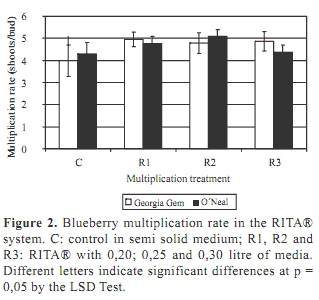
<body><![CDATA[<p class="western" lang="en-US"><font face="Verdana">Shoot proliferation was achieved with both multiplication systems (<a href="#f1">Figure 1</a>). Explants obtained with both culture systems were green, vigorous and apt for rooting. Multiplication rate in all treatments was higher or equal than in the control using semi-solid medium.</font></p>        <p style="text-align: center;" class="western" lang="en-US"> <font face="Verdana"><a name="f1"></a></font></p>        <p style="text-align: center;" class="western" lang="en-US"> <font face="Verdana"><img style="width: 322px; height: 212px;" alt="" src="/img/revistas/agro/v13n2/2a01f1.JPG"></font></p>         <p class="western" lang="es-ES"><font face="Verdana" color="#000000"><span lang="en-US"><a href="#f2">Figure 2</a> shows the multiplication rates obtained with the three volumes of media employed in the RITA&reg; system (200, 250 and 300 ml) and the control. The results presented show that there was no significant effect of media volume (R1, R2 and R3 respectively) on multiplication rate. Moreover, the volumes tested did not differ from the control. This could be due to the frequency and duration of the immersion period used. <a name="Kruegeretal.1991"></a><span style="color: rgb(51, 51, 255);">Krueger </span></span></font> <font face="Verdana" style="color: rgb(51, 51, 255)" color="#000000"><span lang="en-US"><i>et al.</i></span></font><font face="Verdana" color="#000000"><span lang="en-US"> (<a href="#10">1991</a>) demonstrated the importance of immersion frequencies for the proliferation of serviceberry shoots. In this system, the period of immersion is determinant of the capacity of absorption the explants will have, and therefore a key factor in promoting multiplication. Too short or separated periods of immersion may not be enough to achieve the desired effect of enhancing multiplication rate and development of new axillary buds. On the other hand, too frequent immersion periods may result in vitrified shoots. In addition, the optimum immersion time varies depending on genotype <a name="EtienneandBerthouly2002"></a>(<a href="#4">Etienne and Berthouly, 2002</a>). The shoots obtained in our experiment did not show symptoms of vitrification, but the low rates of multiplication achieved with all the volumes tried, justify the need for further evaluation of frequencies and duration of immersion periods.</span></font></p>        <p style="text-align: center;" class="western" lang="es-ES"> <font face="Verdana" color="#000000"><span lang="en-US"><a name="f2"></a></span></font></p>        <p style="text-align: center;" class="western" lang="es-ES"> <font face="Verdana" color="#000000"><span lang="en-US"><img style="width: 319px; height: 300px;" alt="" src="/img/revistas/agro/v13n2/2a01g1.GIF"></span></font></p>         <p class="western" lang="en-US"><font face="Verdana">Permanent immersion bioreactors (BR 1-9) were more adequate for the multiplication of the blueberry varieties used in this study with multiplication rates from 8 to 24 and 10 to 28 microshoots per bud for &lsquo;Georgia Gem&rsquo; and &lsquo;O&rsquo;Neal&rsquo; respectively (<a href="#f3">Figure 3</a>).</font></p>        <p style="text-align: center;" class="western" lang="en-US"> <font face="Verdana"><a name="f3"></a></font></p>        <p style="text-align: center;" class="western" lang="en-US"> <font face="Verdana"><img style="width: 326px; height: 310px;" alt="" src="/img/revistas/agro/v13n2/2a01g2.GIF"></font></p>         <p class="western" lang="en-US"><font face="Verdana">Multiplication rate in the permanent immersion bioreactor was significantly superior to the RITA&reg; system, which didn&rsquo;t show differences with the semi-solid system of multiplication.</font></p>         ]]></body>
<body><![CDATA[<p class="western" lang="en-US"><font face="Verdana">&lsquo;O&rsquo;Neal&rsquo; showed a tendency to higher multiplication rates than &lsquo;Georgia Gem&rsquo; in the permanent bioreactors, although differences were not always significant. This behavior is similar to the one observed on semi-solid medium for this variety (data not shown).</font></p>         <p class="western" lang="en-US"><font face="Verdana">Results presented here show a strong effect of the type of reactor employed on the multiplication rate of both materials. Only in the case of bioreactors without aeration (BR 8 and 9) multiplication rate did not differ significantly from the control. For the bioreactors with aeration (BR 1-7) the lowest multiplication rate doubled that of the control.</font></p>         <p class="western" style="text-indent: 0cm; line-height: 150%;" align="left" lang="en-US"> <font face="Verdana">     <br>     </font>     </p>         <p class="western" style="text-indent: 0cm; line-height: 150%;" align="left" lang="en-US"> <font face="Verdana"><b>Bud length</b></font></p>         <p class="western" lang="es-ES"><font face="Verdana" color="#000000"><span lang="en-US"><a href="#t2">Table 2</a> shows average final length of buds after two months treatment. Buds in the RITA system (R1, R2 and R3) showed better development, achieving sizes of 6 mm for the variety &lsquo;Georgia Gem&rsquo;. However, this was inversely related with the multiplication rate, which was similar to semi-solid medium for the RITA system. Similar results were reported with <i>Allium sativa</i> by <a name="Kimetal.2004"></a><span style="color: rgb(51, 51, 255);">Kim </span> </span></font> <font face="Verdana" style="color: rgb(51, 51, 255)" color="#000000"><span lang="en-US"><i>et al</i></span></font><font face="Verdana" color="#000000"><span lang="en-US"><span style="color: rgb(51, 51, 255);">.</span> (<a href="#9">2004</a>). These authors obtained a higher rate of multiplication and better quality micro-shoots with the permanent immersion system.</span></font></p>         <p class="western" style="text-indent: 0cm; line-height: 150%; text-align: center;" lang="en-US"> <font face="Verdana"> <a name="t2"></a></font></p>        <p class="western" style="text-indent: 0cm; line-height: 150%; text-align: center;" lang="en-US"> <font face="Verdana"><img style="width: 467px; height: 429px;" alt="" src="/img/revistas/agro/v13n2/2a01t2.GIF">    <br>     </font>     </p>         <p class="western" style="text-indent: 0cm; line-height: 150%;" align="left" lang="en-US"> <font face="Verdana"><b>Effect of phloroglucinol to prevent hyperhydricity</b></font></p>         ]]></body>
<body><![CDATA[<p class="western" lang="en-US"><font face="Verdana">The addition of phloroglucinol to the culture media, besides preventing the occurrence of hyperhydric shoots, determined the highest rates of multiplication when working with smaller volumes.</font></p>         <p class="western" lang="en-US"><font face="Verdana"><a href="#f4">Figure 4</a> shows hyperhydric blueberry explants obtained without aeration (BR8). The effect of adding phloroglucinol to the culture medium was markedly significant (less plants developed hyperhydric shoots) when working with a volume of 0.5 litres. <a href="#f5">Figure 5</a> shows a cluster of microshoots obtained with treatment 7, from one initial explant with 4 buds, which provided a multiplication rate of 24 shoots per bud for &lsquo;Georgia Gem&rsquo;.</font></p>        <p style="text-align: center;" class="western" lang="en-US"> <font face="Verdana"><a name="f4"></a></font></p>        <p style="text-align: center;" class="western" lang="en-US"> <font face="Verdana"><img style="width: 262px; height: 358px;" alt="" src="/img/revistas/agro/v13n2/2a01f2.JPG"></font></p>        <p style="text-align: center;" class="western" lang="en-US"></p>        <p style="text-align: center;" class="western" lang="en-US"> <font face="Verdana"><a name="f5"></a></font></p>        <p style="text-align: center;" class="western" lang="en-US"> <font face="Verdana"><img style="width: 314px; height: 235px;" alt="" src="/img/revistas/agro/v13n2/2a01f3.JPG"></font></p>        <p style="text-align: center;" class="western" lang="en-US"></p>        <p style="text-align: center;" class="western" lang="en-US">&nbsp;</p>         <p class="western" lang="en-US"><font face="Verdana">Phloroglucinol is used to prevent hyperhydricity in micropropagation for its effect in lignin biosynthesis providing precursors which normally are poorly or not synthesized at all in hyperhydric tissues. Certain enzymes, particularly p-coumarate:CoA ligase, a key enzyme in lignin synthesis, show significantly less activity in vitrified explants. Adding phloridzin or its precursor phloroglucinol to the culture medium of apple and sunflower shoots prevented the occurrence of hyperhydricity, increasing the activity of enzymes involved in lignin synthesis (<a href="#5">George, 1993</a>). </font> </p>         ]]></body>
<body><![CDATA[<p class="western" lang="en-US"><font face="Verdana">Working with a volume of 1 liter, treatments were not significantly different, though the same tendency was observed. This could be explained by the effect that volume has on aeration, which could be limiting when working with large volumes. Depending on the species, optimal volume media: air relation may vary, and is determinant of oxygen availability for the tissues. In all experiments, although hypoxia is never reached and the explants multiply successfully in 1 liter (reaching multiplication rates of 11 and 15, &lsquo;Georgia Gem&rsquo; and &lsquo;O&rsquo;Neal&rsquo; respectively), smaller volumes clearly result more favorable for this species, allowing a better contact of the explants with the air and therefore a better diffusion of oxygen. In order to confirm the effect of phloroglucinol as lignin precursor, shoots from treatment 7 and the control were studied by light microscopy and compared with semi-solid medium derived shoots. Shoots from treatment 7 (0.32mM phloroglucinol) had more lignified tissues than the control (shown by staining), with a better development of xylem, similar to the shoots from semi-solid medium (<a href="#f6">Figure 6</a>).</font></p>         <p style="text-align: center;" class="western" lang="en-US"> <font face="Verdana"><a name="f6"></a></font></p>        <p style="text-align: center;" class="western" lang="en-US"> <font face="Verdana"><img style="width: 394px; height: 208px;" alt="" src="/img/revistas/agro/v13n2/2a01f4.JPG">    <br>     </font>     </p>         <p class="western" style="text-indent: 0cm; line-height: 150%;" align="left" lang="en-US"> <font face="Verdana">     <br>     </font>     </p>         <p class="western" style="text-indent: 0cm; line-height: 150%;" align="left" lang="en-US"> <font face="Verdana"><b>Effect of Ancymidol</b></font></p>         <p class="western" lang="en-US"><font face="Verdana">Ancymidol is reported in the literature as a growth retardant, and has been used to reduce vitrification and promote shoot clusters <a name="Maki2005"></a>(<a href="#12">Maki, 2005</a>; <a href="#16">Thakur, 2006</a>). This compound inhibits the kaurene oxidation sequence of reactions in the gibberellins biosynthesis pathway. However, in the concentrations tested in our experiments, Ancymidol did not improve or even inhibited multiplication rate (<a href="#f3">Figure 3</a>, BR 2, 3 and 4). Similar results were cited by other authors in Narcissus <a name="ChenandZiv2004"></a>(<a href="#1">Chen and Ziv, 2004</a>), where Ancymidol had a clear effect in promoting vitrification, against what was expected. These results could be explained by the concentrations evaluated, which could be too low to promote cluster formation for this species, considering that endogenous hormones levels differ greatly amongst species.</font></p>         <p class="western" style="text-indent: 0cm; line-height: 150%;" align="left" lang="en-US"> <font face="Verdana">     <br>     </font>     </p>         ]]></body>
<body><![CDATA[<p class="western" style="text-indent: 0cm; line-height: 150%;" align="left" lang="en-US"> <font face="Verdana"><b>Rooting and Acclimatization</b></font></p>         <p class="western" lang="es-ES"><font face="Verdana" color="#000000"><span lang="en-US">Micropropagated shoots formed roots within four weeks in a 1 peat: 1perlite: 1 soil mixture. The highest rooting percentage (80%) was obtained in the control treatment without IBA. Plants were vigorous and showed an intense green colour. Both IBA concentrations tested resulted in very poor (2.46 mM IBA) and no rooting (4.92 mM IBA), as shown in <a href="#f7">Figure7</a>. Moreover, the highest auxin concentration used had a negative effect on the microshoots, which became brown and necrotic. This could be partly explained by the effect of phloroglucinol, which may have a synergic effect with endogenous levels of auxins, therefore the exogenous addition of IBA resulting inhibitory of root differentiation. <i>Ex vitro</i> rooting conditions for &lsquo;Georgia Gem&rsquo; are shown in <a href="#f8">figure 8</a>. Plants acclimatized well and exhibited normal development in the greenhouse. These results show that bioreactor-derived microshoots are apt for <i>ex vitro</i> rooting, thus avoiding the need for <i>in vitro</i> rooting which is more work-consuming.</span></font></p>         <p class="western" style="text-indent: 0cm; line-height: 150%; text-align: center;" lang="en-US"> <font face="Verdana"> <a name="f7"></a></font></p>        <p class="western" style="text-indent: 0cm; line-height: 150%; text-align: center;" lang="en-US"> <font face="Verdana"><img style="width: 328px; height: 283px;" alt="" src="/img/revistas/agro/v13n2/2a01g3.GIF"></font></p>        <p class="western" style="text-indent: 0cm; line-height: 150%; text-align: center;" lang="en-US"></p>        <p class="western" style="text-indent: 0cm; line-height: 150%; text-align: center;" lang="en-US"> <font face="Verdana"><a name="f8"></a></font></p>        <p class="western" style="text-indent: 0cm; line-height: 150%; text-align: center;" lang="en-US"> <font face="Verdana"><img style="width: 325px; height: 219px;" alt="" src="/img/revistas/agro/v13n2/2a01f5.JPG">    <br>     </font>     </p>         <p class="western" style="text-indent: 0cm; line-height: 150%;" align="left" lang="en-US"> <font face="Verdana"><b>Conclusions</b></font></p>         <p class="western" lang="es-ES"><font face="Verdana" color="#000000"><span lang="en-US">This is the first report on the use of permanent immersion bioreactors for the micropropagation of <i>Vaccinium corymbosum.</i></span></font></p>         ]]></body>
<body><![CDATA[<p class="western" lang="es-ES"><font face="Verdana" color="#000000"><span lang="en-US">The results indicate that for clonal propagation <i>in vitro</i> of the blueberry varieties included in this study, the permanent immersion system results in multiplication rates not yet obtained with semi-solid protocols. Plant quality (size, hardiness, survival <i>ex vitro</i>), for the two varieties evaluated was similar or better than for plants grown in semi-solid media. The high multiplication rates achieved resulted in a biomass increase of six-fold in eight weeks, without need for periodic transfer of explants to fresh medium. This represents an effective reduction of costs, where intensive manual handling is the main component. An additional reduction in costs derives from the use of liquid medium, avoiding the use of agar, one of the major components of medium cost. </span></font> </p>         <p class="western" lang="es-ES"><font face="Verdana" color="#000000"><span lang="en-US">Addition of phloroglucinol as precursor in the lignin biosynthesis pathway resulted in effective control of hyperhydricity and best multiplication rate, associated with better quality and high survival percentage of microplants. This system thus has great potential for <i>in vitro</i> production of blueberry plants commercially, to satisfy the current demand of plant material at lower costs.</span></font></p>         <p class="western" style="text-indent: 0cm; line-height: 150%;" align="left" lang="en-US"> <font face="Verdana">     <br>     </font>     </p>         <p class="western" style="text-indent: 0cm; line-height: 150%;" align="left" lang="en-US"> <font face="Verdana"><b>References</b></font></p>         <!-- ref --><p style="margin-left: 0.8cm; text-indent: -0.8cm; font-weight: normal;" lang="es-ES"> <font face="Verdana" size="2"> <a name="1"></a></font><a href="#ChenandZiv2004"><font size="2" face="Verdana"><span lang="en-US"><b>Chen, J.  and Ziv, M.</b></span></font></a><font size="2" face="Verdana"><span lang="en-US"><a href="#ChenandZiv2004"> 2004</a>. Ancymidol-enhanced hyperhydric malformation in relation to gibberellin and oxidative stress in liquid cultured Narcissus leaves. In Vitro Cell Dev. Biol. Plant. 40:613-616.    </span></font></p>         <!-- ref --><p style="margin-left: 0.8cm; text-indent: -0.8cm; font-weight: normal;" lang="es-ES"> <font face="Verdana" size="2"> <a name="2"></a></font><a href="#CohenandElliot1979"> <font size="2" face="Verdana"><span lang="en-US"><b>Cohen, D. and Elliot, D.</b></span></font></a><font size="2" face="Verdana"><span lang="en-US"><a href="#CohenandElliot1979"> 1979</a>. Micropropagation methods for blueberries and tamarillos. </span></font><font style="font-size: 9pt;" size="2"> <font size="2" face="Verdana">Int. Propagators Soc. Comb. Proc. 29, 177-179.    </font></font></p>         <!-- ref --><p style="margin-left: 0.8cm; text-indent: -0.8cm; font-weight: normal;" lang="es-ES"> <font size="2" face="Verdana"><span lang="en-US"><b>Debergh, P.C. and  Zimmerman, R.H.</b> (eds) 1991. Micropropagation: Technology and Application. Kluwer Academic Publishers, The Netherlands.    </span></font></p>         <!-- ref --><p style="margin-left: 0.8cm; text-indent: -0.8cm; font-weight: normal;" lang="es-ES"> <font face="Verdana" size="2"> <a name="4"></a></font><a href="#EtienneandBerthouly2002"> <font size="2" face="Verdana"><span lang="en-US"><b>Etienne, H. and Berthouly, M.</b></span></font></a><font size="2" face="Verdana"><span lang="en-US"><a href="#EtienneandBerthouly2002"> 2002</a>. Temporary immersion systems in plant micropropagation. Plant Cell Tiss. Org. Cult. 69:215-231</span></font><!-- ref --><p style="margin-left: 0.8cm; text-indent: -0.8cm; font-weight: normal;" lang="es-ES"> <font face="Verdana" size="2"> <a name="5"></a></font><a href="#George1993"><font size="2" face="Verdana"><span lang="en-US"><b>George, E.F.</b></span></font></a><font size="2" face="Verdana"><span lang="en-US"><a href="#George1993"> 1993</a>. Plant Propagation by Tissue Culture. Part 1. The Technology. Exegetics Ltd., Edington, England.    </span></font></p>         <!-- ref --><p style="margin-left: 0.8cm; text-indent: -0.8cm; font-weight: normal;" lang="es-ES"> <font size="2" face="Verdana"><span lang="en-US"><b>George, E.F</b>. 1993. Plant Propagation by Tissue Culture. Part 2. In Practice. Exegetics Ltd., Edington, England.    </span></font></p>         <!-- ref --><p style="margin-left: 0.8cm; text-indent: -0.8cm; font-weight: normal;" lang="es-ES"> <font face="Verdana" size="2"> <a name="7"></a></font><a href="#Gonz%E1lez2000"><font size="2" face="Verdana"><span lang="en-US"><b>Gonz&aacute;lez, M.V.</b></span></font></a><font size="2" face="Verdana"><span lang="en-US"><a href="#Gonz%E1lez2000"> 2000</a>. Micropropagation of three berry fruit species using nodal segments from field-grown plants. </span></font><font style="font-size: 9pt;" size="2"> <font size="2" face="Verdana">Ann. Appl. Biol.137:073-078.    </font></font></p>         <!-- ref --><p style="margin-left: 0.8cm; text-indent: -0.8cm; font-weight: normal;" lang="es-ES"> <font size="2" face="Verdana"><b>INIA</b>. 2002. Reuni&oacute;n T&eacute;cnica. El cultivo del Ar&aacute;ndano y otros berries en el Uruguay.    </font></p>         ]]></body>
<body><![CDATA[<!-- ref --><p style="margin-left: 0.8cm; text-indent: -0.8cm; font-weight: normal;" lang="es-ES"> <font face="Verdana" size="2"> <a name="9"></a></font><a href="#Kimetal.2004"><font size="2" face="Verdana"><span lang="en-US"><b>Kim, E.K.; Hahn, E.J.; Murhy, H.N. and Paek, K.Y.</b></span></font></a><font size="2" face="Verdana"><span lang="en-US"><a href="#Kimetal.2004"> 2004</a> Enhanced shoot and bulblet proliferation of garlic (</span></font><font style="font-size: 9pt;" size="2"><font size="2" face="Verdana"><span lang="en-US"><i>Allium sativum</i></span></font><font style="font-size: 9pt;" size="2"><font size="2" face="Verdana"><span lang="en-US"> L.) in bioreactor systems. Journal of Horicultural Science &amp; Biotechnology 79(5) 818-822.    </span></font></font></font></p>         <!-- ref --><p style="margin-left: 0.8cm; text-indent: -0.8cm; font-weight: normal;" lang="es-ES"> <font face="Verdana" size="2"> <a name="10"></a></font><a href="#Kruegeretal.1991"> <font size="2" face="Verdana"><span lang="en-US"><b>Krueger, S.; Robacker, C. and Simonton, W.</b></span></font></a><font size="2" face="Verdana"><span lang="en-US"><a href="#Kruegeretal.1991"> 1991</a>. Culture of Amelanchier x grandiflora in a programmable micropropagation apparatus. Plant Cell Tiss. Org. Cult. 27:219-226.    </span></font></p>         <!-- ref --><p style="margin-left: 0.8cm; text-indent: -0.8cm; font-weight: normal;" lang="es-ES"> <font size="2" face="Verdana"><span lang="en-US"><b>Levin, R. and Tanny, G.</b> 2004. Bioreactors as a low cost option for tissue culture. In: Low cost options for tissue culture technology in developing countries. Vienna, International Atomic Energy Agency/FAO.    </span></font></p>         <!-- ref --><p style="margin-left: 0.8cm; text-indent: -0.8cm; font-weight: normal;" lang="es-ES"> <font face="Verdana" size="2"> <a name="12"></a></font><a href="#Maki2005"><font size="2" face="Verdana"><span lang="en-US"><b>Maki, S.L.; Delgado, M. and Adelberg, W.</b></span></font></a><font size="2" face="Verdana"><span lang="en-US"><a href="#Maki2005"> 2005</a>. Time course study of Ancymidol for micropropagation of Hosta in a liquid culture system. Hort Science 40(3):764-766.    </span></font></p>         <!-- ref --><p style="margin-left: 0.8cm; text-indent: -0.8cm; font-weight: normal;" lang="es-ES"> <font face="Verdana" size="2"> <a name="13"></a></font><a href="#PaekandHahn2002"> <font size="2" face="Verdana"><span lang="en-US"><b>Paek, K. and Hahn, E.</b></span></font></a><font size="2" face="Verdana"><span lang="en-US"><a href="#PaekandHahn2002"> 2002</a>. Application of bioreactor system for scale up production of horticultural and medicinal plants. In: 1</span></font><font style="font-size: 9pt;" size="2"><sup><font size="2" face="Verdana"><span lang="en-US">st</span></font></sup><font style="font-size: 9pt;" size="2"><font size="2" face="Verdana"><span lang="en-US"> Int. Symp. &laquo;Liquid systems for in vitro Mass Propagation of Plants&raquo;. &Aring;s, Norway. pp.15-16.    </span></font></font></font></p>         ]]></body>
<body><![CDATA[<!-- ref --><p style="margin-left: 0.8cm; text-indent: -0.8cm; font-weight: normal;" lang="es-ES"> <font face="Verdana" size="2"> <a name="14"></a></font><a href="#Prior2000"><font size="2" face="Verdana"><span lang="en-US"><b>Prior, R.L. and Cao, G.</b></span></font></a><font size="2" face="Verdana"><span lang="en-US"><a href="#Prior2000"> 2000</a>. Antioxidant phytochemicals in fruits and vegetables: diet and health implications. HortScience 35:588-592.    </span></font></p>         <!-- ref --><p style="margin-left: 0.8cm; text-indent: -0.8cm; font-weight: normal;" lang="es-ES"> <font face="Verdana" size="2"> <a name="15"></a></font><a href="#Teisson1996"><font size="2" face="Verdana"><span lang="en-US"><b>Teisson, C.; Alvard, D.; Berthouly, B.; C&ocirc;te, F.; Escalant, J.V.; Etienne, H. and Lartaud, M.</b></span></font></a><font size="2" face="Verdana"><span lang="en-US"><a href="#Teisson1996"> 1996</a>. Simple apparatus to perform plant tissue culture by temporary immersion. In: Proc. Int. Sym. Plant Production in Closed Ecosystems. Acta Hor. 440:521-526.    </span></font></p>         <!-- ref --><p style="margin-left: 0.8cm; text-indent: -0.8cm; font-weight: normal;" lang="es-ES"> <font face="Verdana" size="2"> <a name="16"></a></font><a href="#Thakur2006"><font size="2" face="Verdana"><span lang="en-US"><b>Thakur, R.; Sood, A.; Nagar, P.K.; Pandey, S.; Sobti, R.C.; Ahuja, P.S.</b></span></font></a><font size="2" face="Verdana"><span lang="en-US"><a href="#Thakur2006"> 2006</a>. Regulation of growth of </span></font><font style="font-size: 9pt;" size="2"> <font size="2" face="Verdana"><span lang="en-US"><i>Lilium</i></span></font><font style="font-size: 9pt;" size="2"><font size="2" face="Verdana"><span lang="en-US"> plantlets in liquid medium by application of paclobutrazol or ancymidol, for its amenability in a bioreactor system: growth parameters. Plant Cell Rep 25:382-391.    </span></font></font></font></p>         <!-- ref --><p style="margin-left: 0.8cm; text-indent: -0.8cm; font-weight: normal;" lang="es-ES"> <font face="Verdana" size="2"> <a name="17"></a></font><a href="#ZimmermanandBroome1980"> <font size="2" face="Verdana"><span lang="en-US"><b>Zimmerman, R.H. and Broome, O.C.</b></span></font></a><font size="2" face="Verdana"><span lang="en-US"><a href="#ZimmermanandBroome1980"> 1980</a>. Blueberry micropropagation. USDA-SEA Agric. Res. Results ARRNE. 11, 44-47.    </span></font></p>         <!-- ref --><p style="margin-left: 0.8cm; text-indent: -0.8cm; font-weight: normal;" lang="es-ES"> <font face="Verdana" size="2"><a name="18"></a> </font><a href="#Ziv1991"><font size="2" face="Verdana"><span lang="en-US"><b>Ziv, M.</b></span></font></a><font size="2" face="Verdana"><span lang="en-US"><a href="#Ziv1991"> 1991</a>. Quality of micropropagated plants: vitrification. In vitro Cell Dev. Biol. 27:64-69.    </span></font></p>         ]]></body>
<body><![CDATA[<!-- ref --><p style="margin-left: 0.8cm; text-indent: -0.8cm; font-weight: normal;" lang="es-ES"> <font face="Verdana" size="2"> <a name="19"></a></font><a href="#Ziv2005"><font size="2" face="Verdana"><span lang="en-US"><b>Ziv, M.</b></span></font></a><font size="2" face="Verdana"><span lang="en-US"><a href="#Ziv2005"> 2005</a> Simple bioreactors for mass propagation of plants. Plant Cell Tiss. Org. Cult. 81:277-285.    </span></font></p>         <p class="western" style="text-indent: 0cm;" align="left" lang="en-US"> <font face="Verdana">    <br>     </font>     </p>          ]]></body><back>
<ref-list>
<ref id="B1">
<nlm-citation citation-type="journal">
<person-group person-group-type="author">
<name>
<surname><![CDATA[Chen]]></surname>
<given-names><![CDATA[J.]]></given-names>
</name>
<name>
<surname><![CDATA[Ziv]]></surname>
<given-names><![CDATA[M.]]></given-names>
</name>
</person-group>
<article-title xml:lang="en"><![CDATA[Ancymidol-enhanced hyperhydric malformation in relation to gibberellin and oxidative stress in liquid cultured Narcissus leaves.]]></article-title>
<source><![CDATA[In Vitro Cell Dev. Biol. Plant.]]></source>
<year>2004</year>
<volume>40</volume>
<page-range>613-616</page-range></nlm-citation>
</ref>
<ref id="B2">
<nlm-citation citation-type="journal">
<person-group person-group-type="author">
<name>
<surname><![CDATA[Cohen]]></surname>
<given-names><![CDATA[D.]]></given-names>
</name>
<name>
<surname><![CDATA[Elliot]]></surname>
<given-names><![CDATA[D.]]></given-names>
</name>
</person-group>
<article-title xml:lang="en"><![CDATA[Micropropagation methods for blueberries and tamarillos]]></article-title>
<source><![CDATA[Int. Propagators Soc. Comb. Proc.]]></source>
<year>1979</year>
<volume>29</volume>
<page-range>177-179</page-range></nlm-citation>
</ref>
<ref id="B3">
<nlm-citation citation-type="book">
<person-group person-group-type="author">
<name>
<surname><![CDATA[Debergh]]></surname>
<given-names><![CDATA[P.C.]]></given-names>
</name>
<name>
<surname><![CDATA[Zimmerman]]></surname>
<given-names><![CDATA[R.H.]]></given-names>
</name>
</person-group>
<source><![CDATA[Micropropagation: Technology and Application]]></source>
<year>1991</year>
<publisher-name><![CDATA[Kluwer Academic Publishers]]></publisher-name>
</nlm-citation>
</ref>
<ref id="B4">
<nlm-citation citation-type="journal">
<person-group person-group-type="author">
<name>
<surname><![CDATA[Etienne]]></surname>
<given-names><![CDATA[H.]]></given-names>
</name>
<name>
<surname><![CDATA[Berthouly]]></surname>
<given-names><![CDATA[M.]]></given-names>
</name>
</person-group>
<article-title xml:lang="en"><![CDATA[Temporary immersion systems in plant micropropagation]]></article-title>
<source><![CDATA[Plant Cell Tiss. Org. Cult.]]></source>
<year>2002</year>
<volume>69</volume>
<page-range>215-231</page-range></nlm-citation>
</ref>
<ref id="B5">
<nlm-citation citation-type="book">
<person-group person-group-type="author">
<name>
<surname><![CDATA[George]]></surname>
<given-names><![CDATA[E.F.]]></given-names>
</name>
</person-group>
<source><![CDATA[Plant Propagation by Tissue Culture: Part 1. The Technology]]></source>
<year>1993</year>
<publisher-loc><![CDATA[Edington ]]></publisher-loc>
<publisher-name><![CDATA[Exegetics]]></publisher-name>
</nlm-citation>
</ref>
<ref id="B6">
<nlm-citation citation-type="book">
<person-group person-group-type="author">
<name>
<surname><![CDATA[George]]></surname>
<given-names><![CDATA[E.F.]]></given-names>
</name>
</person-group>
<source><![CDATA[Plant Propagation by Tissue Culture: Part 2. In Practice]]></source>
<year>1993</year>
<publisher-loc><![CDATA[Edington ]]></publisher-loc>
<publisher-name><![CDATA[Exegetics]]></publisher-name>
</nlm-citation>
</ref>
<ref id="B7">
<nlm-citation citation-type="journal">
<person-group person-group-type="author">
<name>
<surname><![CDATA[González]]></surname>
<given-names><![CDATA[M.V.]]></given-names>
</name>
</person-group>
<article-title xml:lang="en"><![CDATA[Micropropagation of three berry fruit species using nodal segments from field-grown plants]]></article-title>
<source><![CDATA[Ann. Appl. Biol.]]></source>
<year>2000</year>
<volume>137</volume>
<page-range>073-078</page-range></nlm-citation>
</ref>
<ref id="B8">
<nlm-citation citation-type="">
<collab>inia</collab>
<source><![CDATA[Reunión Técnica: El cultivo del Arándano y otros berries en el Uruguay]]></source>
<year>2002</year>
</nlm-citation>
</ref>
<ref id="B9">
<nlm-citation citation-type="journal">
<person-group person-group-type="author">
<name>
<surname><![CDATA[Kim]]></surname>
<given-names><![CDATA[E.K.]]></given-names>
</name>
<name>
<surname><![CDATA[Hahn]]></surname>
<given-names><![CDATA[E.J.]]></given-names>
</name>
<name>
<surname><![CDATA[Murhy]]></surname>
<given-names><![CDATA[H.N.]]></given-names>
</name>
<name>
<surname><![CDATA[Paek]]></surname>
<given-names><![CDATA[K.Y.]]></given-names>
</name>
</person-group>
<article-title xml:lang="en"><![CDATA[Enhanced shoot and bulblet proliferation of garlic (Allium sativum L.) in bioreactor systems]]></article-title>
<source><![CDATA[Journal of Horicultural Science & Biotechnology]]></source>
<year>2004</year>
<volume>79</volume>
<numero>5</numero>
<issue>5</issue>
<page-range>818-822</page-range></nlm-citation>
</ref>
<ref id="B10">
<nlm-citation citation-type="journal">
<person-group person-group-type="author">
<name>
<surname><![CDATA[Krueger]]></surname>
<given-names><![CDATA[S.]]></given-names>
</name>
<name>
<surname><![CDATA[Robacker]]></surname>
<given-names><![CDATA[C.]]></given-names>
</name>
<name>
<surname><![CDATA[Simonton]]></surname>
<given-names><![CDATA[W.]]></given-names>
</name>
</person-group>
<article-title xml:lang="en"><![CDATA[Culture of Amelanchier x grandiflora in a programmable micropropagation apparatus]]></article-title>
<source><![CDATA[Plant Cell Tiss. Org. Cult]]></source>
<year>1991</year>
<volume>27</volume>
<page-range>219-226</page-range></nlm-citation>
</ref>
<ref id="B11">
<nlm-citation citation-type="book">
<person-group person-group-type="author">
<name>
<surname><![CDATA[Levin]]></surname>
<given-names><![CDATA[R.]]></given-names>
</name>
<name>
<surname><![CDATA[Tanny]]></surname>
<given-names><![CDATA[G.]]></given-names>
</name>
</person-group>
<article-title xml:lang="en"><![CDATA[Bioreactors as a low cost option for tissue culture]]></article-title>
<source><![CDATA[Low cost options for tissue culture technology in developing countries]]></source>
<year>2004</year>
<publisher-loc><![CDATA[Vienna ]]></publisher-loc>
<publisher-name><![CDATA[International Atomic Energy Agency/FAO]]></publisher-name>
</nlm-citation>
</ref>
<ref id="B12">
<nlm-citation citation-type="journal">
<person-group person-group-type="author">
<name>
<surname><![CDATA[Maki]]></surname>
<given-names><![CDATA[S.L.]]></given-names>
</name>
<name>
<surname><![CDATA[Delgado]]></surname>
<given-names><![CDATA[M.]]></given-names>
</name>
<name>
<surname><![CDATA[Adelberg]]></surname>
<given-names><![CDATA[W.]]></given-names>
</name>
</person-group>
<article-title xml:lang="en"><![CDATA[Time course study of Ancymidol for micropropagation of Hosta in a liquid culture system]]></article-title>
<source><![CDATA[Hort Science]]></source>
<year>2005</year>
<volume>40</volume>
<numero>3</numero>
<issue>3</issue>
<page-range>764-766</page-range></nlm-citation>
</ref>
<ref id="B13">
<nlm-citation citation-type="confpro">
<person-group person-group-type="author">
<name>
<surname><![CDATA[Paek]]></surname>
<given-names><![CDATA[K.]]></given-names>
</name>
<name>
<surname><![CDATA[Hahn]]></surname>
<given-names><![CDATA[E.]]></given-names>
</name>
</person-group>
<article-title xml:lang="en"><![CDATA[Application of bioreactor system for scale up production of horticultural and medicinal plants]]></article-title>
<source><![CDATA[]]></source>
<year>2002</year>
<conf-name><![CDATA[1 Int. Symp. &laquo;Liquid systems for in vitro Mass Propagation of Plants&raquo;.]]></conf-name>
<conf-loc>Ås </conf-loc>
<page-range>15-16</page-range></nlm-citation>
</ref>
<ref id="B14">
<nlm-citation citation-type="journal">
<person-group person-group-type="author">
<name>
<surname><![CDATA[Prior]]></surname>
<given-names><![CDATA[R.L.]]></given-names>
</name>
<name>
<surname><![CDATA[Cao]]></surname>
<given-names><![CDATA[G.]]></given-names>
</name>
</person-group>
<article-title xml:lang="en"><![CDATA[Antioxidant phytochemicals in fruits and vegetables: diet and health implications]]></article-title>
<source><![CDATA[HortScience]]></source>
<year>2000</year>
<volume>35</volume>
<page-range>588-592</page-range></nlm-citation>
</ref>
<ref id="B15">
<nlm-citation citation-type="journal">
<person-group person-group-type="author">
<name>
<surname><![CDATA[Teisson]]></surname>
<given-names><![CDATA[C.]]></given-names>
</name>
<name>
<surname><![CDATA[Alvard]]></surname>
<given-names><![CDATA[D.]]></given-names>
</name>
<name>
<surname><![CDATA[Berthouly]]></surname>
<given-names><![CDATA[B.]]></given-names>
</name>
<name>
<surname><![CDATA[Côte]]></surname>
<given-names><![CDATA[F.]]></given-names>
</name>
<name>
<surname><![CDATA[Escalant]]></surname>
<given-names><![CDATA[J.V.]]></given-names>
</name>
<name>
<surname><![CDATA[Etienne]]></surname>
<given-names><![CDATA[H.]]></given-names>
</name>
<name>
<surname><![CDATA[Lartaud]]></surname>
<given-names><![CDATA[M.]]></given-names>
</name>
</person-group>
<article-title xml:lang="en"><![CDATA[Simple apparatus to perform plant tissue culture by temporary immersion]]></article-title>
<source><![CDATA[Acta Hor.]]></source>
<year>1996</year>
<volume>440</volume>
<page-range>521-526</page-range></nlm-citation>
</ref>
<ref id="B16">
<nlm-citation citation-type="journal">
<person-group person-group-type="author">
<name>
<surname><![CDATA[Thakur]]></surname>
<given-names><![CDATA[R.]]></given-names>
</name>
<name>
<surname><![CDATA[Sood]]></surname>
<given-names><![CDATA[A.]]></given-names>
</name>
<name>
<surname><![CDATA[Nagar]]></surname>
<given-names><![CDATA[P.K.]]></given-names>
</name>
<name>
<surname><![CDATA[Pandey]]></surname>
<given-names><![CDATA[S.]]></given-names>
</name>
<name>
<surname><![CDATA[Sobti]]></surname>
<given-names><![CDATA[R.C.]]></given-names>
</name>
<name>
<surname><![CDATA[Ahuja]]></surname>
<given-names><![CDATA[P.S.]]></given-names>
</name>
</person-group>
<article-title xml:lang="en"><![CDATA[Regulation of growth of Lilium plantlets in liquid medium by application of paclobutrazol or ancymidol, for its amenability in a bioreactor system: growth parameters]]></article-title>
<source><![CDATA[Plant Cell Rep]]></source>
<year>2006</year>
<volume>25</volume>
<page-range>382-391</page-range></nlm-citation>
</ref>
<ref id="B17">
<nlm-citation citation-type="journal">
<person-group person-group-type="author">
<name>
<surname><![CDATA[Zimmerman]]></surname>
<given-names><![CDATA[R.H.]]></given-names>
</name>
<name>
<surname><![CDATA[Broome]]></surname>
<given-names><![CDATA[O.C.]]></given-names>
</name>
</person-group>
<article-title xml:lang="en"><![CDATA[Blueberry micropropagation]]></article-title>
<source><![CDATA[USDA-SEA Agric. Res. Results ARRNE]]></source>
<year>1980</year>
<volume>11</volume>
<page-range>44-47</page-range></nlm-citation>
</ref>
<ref id="B18">
<nlm-citation citation-type="journal">
<person-group person-group-type="author">
<name>
<surname><![CDATA[Ziv]]></surname>
<given-names><![CDATA[M.]]></given-names>
</name>
</person-group>
<article-title xml:lang="en"><![CDATA[Quality of micropropagated plants: vitrification]]></article-title>
<source><![CDATA[In vitro Cell Dev. Biol.]]></source>
<year>1991</year>
<volume>27</volume>
<page-range>64-69</page-range></nlm-citation>
</ref>
<ref id="B19">
<nlm-citation citation-type="journal">
<person-group person-group-type="author">
<name>
<surname><![CDATA[Ziv]]></surname>
<given-names><![CDATA[M]]></given-names>
</name>
</person-group>
<article-title xml:lang="en"><![CDATA[Simple bioreactors for mass propagation of plants]]></article-title>
<source><![CDATA[Plant Cell Tiss. Org. Cult.]]></source>
<year>2005</year>
<volume>81</volume>
<page-range>277-285</page-range></nlm-citation>
</ref>
</ref-list>
</back>
</article>