<?xml version="1.0" encoding="ISO-8859-1"?><article xmlns:mml="http://www.w3.org/1998/Math/MathML" xmlns:xlink="http://www.w3.org/1999/xlink" xmlns:xsi="http://www.w3.org/2001/XMLSchema-instance">
<front>
<journal-meta>
<journal-id>2079-312X</journal-id>
<journal-title><![CDATA[Lingüística]]></journal-title>
<abbrev-journal-title><![CDATA[Lingüística]]></abbrev-journal-title>
<issn>2079-312X</issn>
<publisher>
<publisher-name><![CDATA[Asociación de Lingüística y Filología de América Latina]]></publisher-name>
</publisher>
</journal-meta>
<article-meta>
<article-id>S2079-312X2015000100006</article-id>
<title-group>
<article-title xml:lang="es"><![CDATA[ACERCAMIENTO AL ANÁLISIS PAUSOLÓGICO DEL PROCESO DE PRODUCCIÓN ESCRITA MEDIANTE LA TÉCNICA KEYSTROKE LOGGING]]></article-title>
<article-title xml:lang="en"><![CDATA[AN APPROACH TO PAUSES ANALYSIS OF WRITING PROCESS THROUGH KEYSTROKE LOGGING TECHNIQUE]]></article-title>
</title-group>
<contrib-group>
<contrib contrib-type="author">
<name>
<surname><![CDATA[Aguirre]]></surname>
<given-names><![CDATA[Luis Alejandro]]></given-names>
</name>
<xref ref-type="aff" rid="A01"/>
</contrib>
</contrib-group>
<aff id="A01">
<institution><![CDATA[,Universidad Nacional de Cuyo  ]]></institution>
<addr-line><![CDATA[ ]]></addr-line>
</aff>
<pub-date pub-type="pub">
<day>00</day>
<month>00</month>
<year>2015</year>
</pub-date>
<pub-date pub-type="epub">
<day>00</day>
<month>00</month>
<year>2015</year>
</pub-date>
<volume>31</volume>
<numero>1</numero>
<fpage>81</fpage>
<lpage>91</lpage>
<copyright-statement/>
<copyright-year/>
<self-uri xlink:href="http://www.scielo.edu.uy/scielo.php?script=sci_arttext&amp;pid=S2079-312X2015000100006&amp;lng=en&amp;nrm=iso"></self-uri><self-uri xlink:href="http://www.scielo.edu.uy/scielo.php?script=sci_abstract&amp;pid=S2079-312X2015000100006&amp;lng=en&amp;nrm=iso"></self-uri><self-uri xlink:href="http://www.scielo.edu.uy/scielo.php?script=sci_pdf&amp;pid=S2079-312X2015000100006&amp;lng=en&amp;nrm=iso"></self-uri><abstract abstract-type="short" xml:lang="es"><p><![CDATA[El objetivo principal de este artículo es examinar algunos aspectos de las pausas del proceso de composición. Para ello, solicitamos a 30 alumnos de primer año de ingeniería (Universidad Nacional de Cuyo) que redactaran en computadora un resumen a partir de la proyección de un video. Registramos el proceso de producción textual mediante un keylogger. Se consideró la distribución temporal del proceso (duración, tiempo invertido en la escritura y en la realización de pausas, distribución de las pausas y valor de las mismas) y la calidad del texto final (evaluación holística). Los resultados sugieren que los alumnos dedican escaso tiempo a la revisión global final del texto, aun cuando el tiempo total de pausa es elevado. Además, activan recursivamente los procesos a lo largo del tiempo de escritura, lo cual se correlaciona con la calidad del producto textual]]></p></abstract>
<abstract abstract-type="short" xml:lang="en"><p><![CDATA[The aim of this article is to evaluate some aspects of pausing in writing process. To achieve the above mentioned aim we asked write a summary starting from a video projection. This study involved 30 students of National University of Cuyo. Writing process of each student was recorded with a keylogger. We took into account temporary distribution of process (duration, time wasted in typing and pausing, distribution and value of pauses) and final text quality (holistic assessment). Results showed that freshmen dedicate scarce time to final textual reviewing and revising, still when total time of pausing is quite high. Besides, they activate processes recursively through full writing process, which is correlated to text quality]]></p></abstract>
<kwd-group>
<kwd lng="es"><![CDATA[proceso de escritura]]></kwd>
<kwd lng="es"><![CDATA[pausa]]></kwd>
<kwd lng="es"><![CDATA[keystroke logging]]></kwd>
<kwd lng="es"><![CDATA[revisión]]></kwd>
<kwd lng="es"><![CDATA[calidad textual]]></kwd>
<kwd lng="en"><![CDATA[writing process]]></kwd>
<kwd lng="en"><![CDATA[pausing]]></kwd>
<kwd lng="en"><![CDATA[keystroke logging]]></kwd>
<kwd lng="en"><![CDATA[revision]]></kwd>
<kwd lng="en"><![CDATA[text quality]]></kwd>
</kwd-group>
</article-meta>
</front><body><![CDATA[ <div class="WordSection1">      <p style="background: white none repeat scroll 0% 50%; -moz-background-clip: initial; -moz-background-origin: initial; -moz-background-inline-policy: initial; text-align: left; text-indent: 0cm; line-height: normal;" align="left"> <span style="font-size: 10pt; font-family: &quot;Verdana&quot;; color: black" lang="ES">Ling&uuml;&iacute;stica</span><span style="font-size: 12pt; font-family: &quot;Verdana&quot;,&quot;sans-serif&quot;; color: black;" lang="ES-UY"><o:p></o:p></span></p>          <p style="background: white none repeat scroll 0% 50%; -moz-background-clip: initial; -moz-background-origin: initial; -moz-background-inline-policy: initial; text-align: left; text-indent: 0cm; line-height: normal;" align="left"> <span style="font-size: 10pt; font-family: &quot;Verdana&quot;; color: black" lang="ES">Vol. 31</span><span style="font-size: 10pt; font-family: &quot;Verdana&quot;; color: black" lang="ES-AR">-1</span><span style="font-size: 10pt; font-family: &quot;Verdana&quot;; color: black" lang="ES">,&nbsp;</span><span style="font-size: 10pt; font-family: &quot;Verdana&quot;; color: black" lang="ES-AR">junio</span><span style="font-size: 10pt; font-family: &quot;Verdana&quot;; color: black" lang="ES">&nbsp;201</span><span style="font-size: 10pt; font-family: &quot;Verdana&quot;; color: black" lang="ES-AR">5</span><span style="font-size: 10pt; font-family: &quot;Verdana&quot;; color: black" lang="ES">:&nbsp;81-91</span><span style="font-size: 12pt; font-family: &quot;Verdana&quot;,&quot;sans-serif&quot;; color: black;" lang="ES-UY"><o:p></o:p></span></p>          <p style="background: white none repeat scroll 0% 50%; -moz-background-clip: initial; -moz-background-origin: initial; -moz-background-inline-policy: initial; text-align: left; text-indent: 0cm; line-height: normal;" align="left"> <span style="font-size: 10pt; font-family: &quot;Verdana&quot;; color: black" lang="ES">ISSN 2079-312X en l&iacute;nea</span><span style="font-size: 12pt; font-family: &quot;Verdana&quot;,&quot;sans-serif&quot;; color: black;" lang="ES-UY"><o:p></o:p></span></p>          <p style="background: white none repeat scroll 0% 50%; -moz-background-clip: initial; -moz-background-origin: initial; -moz-background-inline-policy: initial; text-align: left; text-indent: 0cm; line-height: normal;" align="left"> <span style="font-size: 10pt; font-family: &quot;Verdana&quot;; color: black" lang="ES">ISSN 1132-0214 impresa</span><span style="font-size: 12pt; font-family: &quot;Verdana&quot;,&quot;sans-serif&quot;; color: black;" lang="ES-UY"><o:p></o:p></span></p>          <p style="text-align: left; text-indent: 0cm; line-height: normal;" align="left"><b style=""> <span style="font-size: 10pt; font-family: &quot;Verdana&quot;;" lang="ES-AR"><o:p>&nbsp;</o:p></span></b></p>          <p style="text-indent: 0cm; line-height: normal;"><b style=""> <span style="font-size: 10pt; font-family: &quot;Verdana&quot;;" lang="ES-AR"><o:p>&nbsp;</o:p></span></b></p>          <p style="text-align: center; text-indent: 0cm; line-height: normal;" align="center"><b style=""> <font face="Verdana" size="4"><span lang="ES-AR">ACERCAMIENTO AL AN&Aacute;LISIS PAUSOL&Oacute;GICO DEL PROCESO DE PRODUCCI&Oacute;N ESCRITA MEDIANTE LA T&Eacute;CNICA KEYSTROKE LOGGING</span></font><span style="font-size: 10pt; font-family: &quot;Verdana&quot;;" lang="ES-AR"><o:p>&nbsp;</o:p></span></b></p>          <p style="text-align: center; text-indent: 0cm; line-height: normal;" align="center"> <font face="Verdana">AN APPROACH TO PAUSES ANALYSIS OF WRITING PROCESS THROUGH KEYSTROKE LOGGING TECHNIQUE</font><o:p></o:p></p>          <p style="text-align: center; text-indent: 0cm; line-height: normal;" align="center"> <span style="font-size: 10pt; font-family: &quot;Verdana&quot;;"><o:p>&nbsp;</o:p></span></p>          ]]></body>
<body><![CDATA[<p style="text-align: center; text-indent: 0cm; line-height: normal;" align="center"> <span style="font-size: 10pt; font-family: &quot;Verdana&quot;;"><o:p>&nbsp;</o:p></span></p>          <p style="text-align: right; text-indent: 35.45pt; line-height: normal;" align="right"> <font face="Verdana"><span style="font-size: 10pt; " lang="ES-AR">Luis Alejandro Aguirre</span></font><o:p></o:p></p>          <p style="text-align: right; text-indent: 35.45pt; line-height: normal;" align="right"> <font face="Verdana"><span style="font-size: 10pt; " lang="ES-AR">Universidad Nacional de Cuyo - Conicet</span></font><o:p></o:p></p>          <p style="text-align: right; text-indent: 35.45pt; line-height: normal;" align="right"><span lang="ES-AR"><a href="mailto:luisaleaguirre@yahoo.com"> <span style="font-family: &quot;Verdana&quot;;"><font size="2">luisaleaguirre@yahoo.com</font></span></a></span><span style="font-size: 12pt; font-family: &quot;Times New Roman&quot;,&quot;serif&quot;;" lang="ES-AR"><o:p></o:p></span></p>          <p style="text-indent: 0cm; line-height: normal;"><b style=""> <span style="font-size: 10pt; font-family: &quot;Verdana&quot;;" lang="ES-AR"><o:p>&nbsp;</o:p></span></b></p>          <p style="text-indent: 0cm; line-height: normal;"><b style=""> <span style="font-size: 10pt; font-family: &quot;Verdana&quot;;" lang="ES-AR"><o:p>&nbsp;</o:p></span></b></p>          <p style="text-indent: 0cm; line-height: normal; text-align: justify;"> <span style="font-size: 10pt; font-family: &quot;Verdana&quot;;" lang="ES-AR">El objetivo principal de este art&iacute;culo es examinar algunos aspectos de las pausas del proceso de composici&oacute;n. Para ello, solicitamos a 30 alumnos de primer a&ntilde;o de ingenier&iacute;a (Universidad Nacional de Cuyo) que redactaran en computadora un resumen a partir de la proyecci&oacute;n de un video. Registramos el proceso de producci&oacute;n textual mediante un <span class="SpellE"><i style="">keylogger</i></span>. Se consider&oacute;</span><span style="font-size: 10pt; font-family: &quot;Verdana&quot;; letter-spacing: -0.1pt" lang="ES-TRAD"> la distribuci&oacute;n temporal del proceso (duraci&oacute;n, tiempo invertido en la escritura y en la realizaci&oacute;n de pausas, distribuci&oacute;n de las pausas y valor de las mismas) y la calidad del texto final (evaluaci&oacute;n hol&iacute;stica).</span><span style="font-size: 10pt; font-family: &quot;Verdana&quot;;" lang="ES-TRAD"> </span> <font face="Verdana"> <span style="font-size: 10pt; letter-spacing: -0.1pt" lang="ES-TRAD">Los resultados sugieren que los alumnos dedican escaso tiempo a la revisi&oacute;n global final del texto, aun cuando el tiempo total de pausa es elevado. Adem&aacute;s, activan recursivamente los procesos a lo largo del tiempo de escritura, lo cual se correlaciona con la calidad del producto textual.</span></font><o:p></o:p></p>     <div style="text-align: justify;">     </div>     <p style="text-indent: 35.45pt; line-height: normal; text-align: justify;"> <span style="font-size: 10pt; font-family: &quot;Verdana&quot;; letter-spacing: -0.1pt" lang="ES-TRAD"><o:p>&nbsp;</o:p></span></p>     <div style="text-align: justify;">     </div>     ]]></body>
<body><![CDATA[<p style="margin-right: -5.65pt; text-indent: 0cm; line-height: normal; text-align: justify;"><b style=""> <span style="font-size: 10pt; font-family: &quot;Verdana&quot;;" lang="ES-AR">Palabras clave:</span></b><font face="Verdana"><span style="font-size: 10pt; " lang="ES-AR"> proceso de escritura, pausa, <span class="SpellE"><i style="">keystroke</i></span><i style=""> <span class="SpellE">logging</span></i>, revisi&oacute;n, calidad textual.</span></font><o:p></o:p></p>     <div style="text-align: justify;">     </div>     <p style="text-indent: 0cm; line-height: normal; text-align: justify;"><b style=""> <span style="font-size: 10pt; font-family: &quot;Verdana&quot;; letter-spacing: -0.1pt" lang="ES-UY"><o:p>&nbsp;</o:p></span></b></p>     <div style="text-align: justify;">     </div>     <p style="text-indent: 0cm; line-height: normal; text-align: justify;"><b style=""> <span style="font-size: 10pt; font-family: &quot;Verdana&quot;; letter-spacing: -0.1pt">Keywords:</span></b><font face="Verdana"><span style="font-size: 10pt; letter-spacing: -0.1pt"> writing process, pausing, keystroke logging, revision, <span class="GramE">text</span> quality.</span></font><o:p></o:p></p>     <div style="text-align: justify;">     </div>     <p style="text-indent: 35.45pt; line-height: normal; text-align: justify;"> <span style="font-size: 10pt; font-family: &quot;Verdana&quot;; letter-spacing: -0.1pt"><o:p>&nbsp;</o:p></span></p>     <div style="text-align: justify;">     </div>     <p style="text-indent: 0cm; line-height: normal; text-align: justify;"> <font face="Verdana"><span style="font-size: 10pt; letter-spacing: -0.1pt">The aim of this article is to evaluate some aspects of pausing in <span class="GramE">writing<span style="">&nbsp; </span>process</span>. To achieve the above mentioned aim we asked write a summary starting from a video projection. This study involved 30 students of National University of <span class="SpellE">Cuyo</span>. Writing process of each student was recorded with a <span class="SpellE">keylogger</span>. We took into account temporary distribution of process (duration, time wasted in typing and pausing, distribution and value of pauses) and final text quality (holistic assessment). Results showed that freshmen dedicate scarce time to final textual reviewing and revising, still when total time of pausing is quite high. Besides, they activate processes recursively through full writing process, which is correlated to text quality.</span></font><o:p></o:p></p>     <div style="text-align: justify;">     </div>     ]]></body>
<body><![CDATA[<p style="text-indent: 35.45pt; line-height: normal; text-align: justify;"><b style=""> <span style="font-size: 10pt; font-family: &quot;Verdana&quot;; letter-spacing: -0.1pt"><o:p>&nbsp;</o:p></span></b></p>     <div style="text-align: justify;">     </div>     <p style="text-indent: 35.45pt; line-height: normal; text-align: justify;"><b style=""> <span style="font-size: 10pt; font-family: &quot;Verdana&quot;; letter-spacing: -0.1pt"><o:p>&nbsp;</o:p></span></b></p>     <div style="text-align: justify;">     </div>     <p style="text-indent: 0cm; line-height: normal; text-align: justify;"> <font face="Verdana"><span style="font-size: 10pt; " lang="ES-UY">(Recibido: 31/1/13; Aceptado: 23/4/13)</span></font><o:p></o:p></p>     <div style="text-align: justify;">     </div>     <p style="text-indent: 35.45pt; line-height: normal; text-align: justify;"> <span style="font-size: 10pt; font-family: &quot;Verdana&quot;; letter-spacing: -0.1pt" lang="ES-UY"><o:p>&nbsp;</o:p></span></p>     <div style="text-align: justify;">     </div>     <p style="text-indent: 0cm; line-height: normal; text-align: justify;"> <span style="font-size: 10pt; font-family: &quot;Verdana&quot;; letter-spacing: -0.1pt" lang="ES-UY"><o:p>&nbsp;</o:p></span></p>     <div style="text-align: justify;">     </div>     ]]></body>
<body><![CDATA[<p style="text-indent: 0cm; line-height: normal; text-align: justify;"><b style=""> <font face="Verdana"> <span style="font-size: 10pt; letter-spacing: -0.1pt" lang="ES-TRAD">0. INTRODUCCI&Oacute;N</span></font><o:p></o:p></b></p>     <div style="text-align: justify;">     </div>     <p style="text-indent: 0cm; line-height: normal; text-align: justify;"><b style=""> <span style="font-size: 10pt; font-family: &quot;Verdana&quot;; letter-spacing: -0.1pt" lang="ES-TRAD"><o:p>&nbsp;</o:p></span></b></p>     <div style="text-align: justify;">     </div>     <p style="text-indent: 1cm; line-height: normal; text-align: justify;"> <font face="Verdana"><span style="font-size: 10pt; " lang="ES-AR">El estudio de las pausas en la escritura es fundamental para conocer los procesos activados, su duraci&oacute;n y el costo cognitivo de los mismos. Existen variadas t&eacute;cnicas para estudiar los aspectos temporales del proceso de escritura: protocolos<span style="">&nbsp; </span>de pensamiento en voz alta concurrentes con la tarea de escritura, la doble y la triple tarea, el empleo de videograbaciones, el registro del proceso mediante programas computacionales, el registro de los movimientos oculares y de la actividad cerebral. En las &uacute;ltimas d&eacute;cadas la diversificaci&oacute;n de las t&eacute;cnicas de investigaci&oacute;n, en buena medida debido a los avances tecnol&oacute;gicos, ha ido de la mano de un cambio de perspectiva en los estudios, lo que ha dado lugar a mayor cantidad de an&aacute;lisis experimentales. El cambio de perspectiva ha sido permitido gracias al paso del an&aacute;lisis del producto textual al estudio del proceso de composici&oacute;n. No se trata de un cambio menor, puesto que supone una elecci&oacute;n te&oacute;rico-metodol&oacute;gica en la cual se ponen en juego variados factores. La investigaci&oacute;n del proceso supone la inclusi&oacute;n <span class="GramE">de la</span> variable <i style="">tiempo</i>, pero no solamente como una variable m&aacute;s entre otras, sino como una variable esencial alrededor de la cual se estructuran las actividades de escritura. Esto es, el tiempo entendido en el sentido de <i style="">tiempo real</i>, contabilizado en unidades de medici&oacute;n temporal (milisegundos, segundos, minutos, etc.). La adopci&oacute;n de tal perspectiva llev&oacute; al dise&ntilde;o de instrumentos para obtener datos del proceso en una l&iacute;nea temporal y para codificarlos de acuerdo con las actividades cognitivas realizadas. En ese contexto surgen las t&eacute;cnicas computacionales para el estudio del proceso de composici&oacute;n, tal como la que empleamos en este estudio. Esas t&eacute;cnicas permiten un acercamiento <span class="SpellE">microanal&iacute;tico</span> al estudio de las pausas realizadas durante la redacci&oacute;n de un texto.</span></font><o:p></o:p></p>     <div style="text-align: justify;">     </div>     <p style="text-indent: 1cm; line-height: normal; text-align: justify;"> <span style="font-size: 10pt; font-family: &quot;Verdana&quot;;" lang="ES-AR">El an&aacute;lisis de las pausas en la escritura puede constituirse en un indicador de las demandas cognitivas impuestas por la tarea, pero puede resultar una forma algo inespec&iacute;fica para determinar qu&eacute; proceso cognitivo est&aacute; realizando el sujeto. Una pausa larga, por ejemplo, podr&iacute;a reflejar tanto una instancia de planificaci&oacute;n como de revisi&oacute;n interna. Para aclarar tales aspectos es necesario recurrir a la voz y conciencia del sujeto, que puede aportar, de manera m&aacute;s directa</span><a style="" href="#_ftn1" name="_ftnref1" title=""><span style="font-size: 10pt; line-height: 150%; font-family: &quot;Verdana&quot;;" lang="ES-AR">[1]</span></a><font face="Verdana"><span style="font-size: 10pt; " lang="ES-AR">, abundantes datos acerca de los procesos realizados durante determinada pausa temporal.</span></font><o:p></o:p></p>     <div style="text-align: justify;">     </div>     <p style="text-indent: 1cm; line-height: normal; text-align: justify;"> <font face="Verdana"><span style="font-size: 10pt; " lang="ES-AR">Una manera indirecta e <span class="SpellE">inobtrusiva</span> de obtener los valores de las pausas y su ubicaci&oacute;n temporal es mediante el empleo de programas inform&aacute;ticos para la observaci&oacute;n on-line del proceso de escritura. Estos programas registran, mientras el sujeto escribe en su procesador de textos, la secuencia de acciones (<span class="SpellE"><i style="">events</i></span>) del teclado y del <i style="">mouse</i> en una l&iacute;nea temporal en la que se ofrecen detalles acerca de las pausas entre tales acciones. Mediante el an&aacute;lisis de los valores de tales pausas, su ubicaci&oacute;n temporal en el proceso (inicio-medio-fin), el nivel ling&uuml;&iacute;stico afectado, el proceso cognitivo asociado a la pausa, entre otras variables, se puede obtener una imagen detallada del desarrollo del proceso. Claro est&aacute; que una imagen m&aacute;s completa debe contemplar, adem&aacute;s, verbalizaciones del sujeto respecto de su propio proceso de escritura (protocolos verbales concurrentes con la tarea o diferidos).</span></font><o:p></o:p></p>     <div style="text-align: justify;">     </div>     ]]></body>
<body><![CDATA[<p style="text-indent: 1cm; line-height: normal; text-align: justify;"> <span style="font-size: 10pt; font-family: &quot;Verdana&quot;;" lang="ES-AR">El objeto de este art&iacute;culo es realizar una aproximaci&oacute;n al an&aacute;lisis de las pausas en la escritura mediante el empleo de la t&eacute;cnica <span class="SpellE"><i style="">keystroke</i></span><i style=""> <span class="SpellE">logging</span></i>, que se basa en la realizaci&oacute;n de un registro en tiempo real del proceso de escritura en computadora. Mediante la aplicaci&oacute;n de la t&eacute;cnica mencionada es posible obtener una importante cantidad de datos, que luego deben ser filtrados en funci&oacute;n de la finalidad del estudio. En primer lugar, presentaremos algunas nociones te&oacute;ricas sobre las cuales se asienta nuestro estudio. Luego, precisaremos la metodolog&iacute;a empleada. Posteriormente, examinaremos los datos obtenidos sobre la </span> <span style="font-size: 10pt; font-family: &quot;Verdana&quot;; letter-spacing: -0.1pt" lang="ES-TRAD">distribuci&oacute;n temporal del proceso en cuanto a su duraci&oacute;n total (discriminando el tiempo de <span class="SpellE">tipeo</span></span><a style="" href="#_ftn2" name="_ftnref2" title=""><span style="font-size: 10pt; line-height: 150%; font-family: &quot;Verdana&quot;;" lang="ES-AR">[2]</span></a><span style="font-size: 10pt; font-family: &quot;Verdana&quot;; letter-spacing: -0.1pt" lang="ES-TRAD"> del tiempo de pausa) y en relaci&oacute;n con la distribuci&oacute;n de las pausas y su valor. Tendremos en cuenta, adem&aacute;s, la calidad del texto final mediante una evaluaci&oacute;n hol&iacute;stica del mismo. Finalmente, concluiremos con una generalizaci&oacute;n de los resultados, sus alcances y limitaciones, destacando, adem&aacute;s,</span><font face="Verdana"><span style="font-size: 10pt; " lang="ES-AR"> algunas potencialidades y restricciones que posee la t&eacute;cnica <span class="SpellE"><i style="">keystroke</i></span><i style=""> <span class="SpellE">logging</span></i> aplicada de manera aislada.</span></font><o:p></o:p></p>     <div style="text-align: justify;">     </div>     <p style="text-indent: 1cm; line-height: normal; text-align: justify;"><b style=""> <span style="font-size: 10pt; font-family: &quot;Verdana&quot;;" lang="ES-AR"><o:p>&nbsp;</o:p></span></b></p>     <div style="text-align: justify;">     </div>     <p style="text-indent: 1cm; line-height: normal; text-align: justify;"><b style=""> <span style="font-size: 10pt; font-family: &quot;Verdana&quot;;" lang="ES-AR"><o:p>&nbsp;</o:p></span></b></p>     <div style="text-align: justify;">     </div>     <p style="text-indent: 0cm; line-height: normal; text-align: justify;"><b style=""> <font face="Verdana"><span style="font-size: 10pt; " lang="ES-AR">1. MARCO TE&Oacute;RICO</span></font><o:p></o:p></b></p>     <div style="text-align: justify;">     </div>     <p style="text-indent: 0cm; line-height: normal; text-align: justify;"> <span style="font-size: 10pt; font-family: &quot;Verdana&quot;;" lang="ES-AR"><o:p>&nbsp;</o:p></span></p>     <div style="text-align: justify;">     </div>     ]]></body>
<body><![CDATA[<p style="text-indent: 1cm; line-height: normal; text-align: justify;"> <font face="Verdana"><span style="font-size: 10pt; " lang="ES-AR">E<span style="">n el &aacute;mbito del estudio de la escritura mediante herramientas computacionales, hemos de entender por p</span>ausa el espacio temporal comprendido entre dos acciones (<span class="SpellE"><i>events</i></span>) del teclado o del <i style="">mouse</i> <a name="-Spelman_Miller_2000"></a><a href="#Spelman_Miller">(v&eacute;ase <span class="SpellE">Spelman</span> Miller 2000)</a>. Los estudios sobre las pausas mediante programas inform&aacute;ticos se remontan a los '90. <a name="-Levy_1996"></a><a href="#Levy">Levy <i style="">et al.</i> (1996)</a> y <a href="#Spelman_Miller"> Miller (2000)</a> constituyen ejemplos de estudios sobre la ubicaci&oacute;n de las pausas en diferentes unidades ling&uuml;&iacute;sticas: car&aacute;cter, palabra, constituyentes intermedios, cl&aacute;usula, oraci&oacute;n y p&aacute;rrafo. <a href="#Levy"><span class="SpellE">Spelman</span>Levy</a> <a href="#Levy"><span style="font-style: italic;">et al</span> (1996: 152)</a> realizaron un an&aacute;lisis de la ubicaci&oacute;n de las pausas con el programa <span class="SpellE">EventLog</span>. Tuvieron en cuenta si las pausas se localizaban en el interior de las palabras, en el interior de una oraci&oacute;n, en el interior de un p&aacute;rrafo y pausas generales entre p&aacute;rrafos. <a href="#Spelman_Miller"><span class="SpellE">Spelman</span> Miller (2000)</a> examin&oacute; sobre qu&eacute; unidades se ubicaban las pausas: caracteres, palabras, constituyentes intermedios, cl&aacute;usulas y oraciones. <a name="-Van_Waes_2003"></a><a href="#Van_Waes_2003">Van <span class="SpellE">Waes</span> <i style="">et al.</i> (2003)</a>, por su parte, establecieron una clasificaci&oacute;n de los aspectos a tener en cuenta en el estudio computacional de las pausas en la escritura. Esta taxonom&iacute;a resulta m&aacute;s integral que las dem&aacute;s <a name="-Abdel_Latif_2008"></a><a href="#Abdel_Latif">(<span class="SpellE">Abdel</span> <span class="SpellE">Latif</span></a> <a href="#Abdel_Latif">2008: 39)</a>. En ella se distinguen siete aspectos: 1) promedio de tiempo de pausas y promedio de tiempo de escritura activa, 2) n&uacute;mero de palabras en el texto final, 3) duraci&oacute;n de las pausas, 4) cantidad de pausas, 5) tipo de pausa (pausas de formulaci&oacute;n y pausas de revisi&oacute;n), 6) ubicaci&oacute;n ling&uuml;&iacute;stica de las pausas (caracteres, palabras, cl&aacute;usulas y oraciones) y 7) ubicaci&oacute;n temporal de las pausas (inicio-medio-fin).</span></font><o:p></o:p></p>     <div style="text-align: justify;">     </div>     <p style="text-indent: 1cm; line-height: normal; text-align: justify;"> <font face="Verdana"><span style="font-size: 10pt; " lang="ES-AR">En los estudios sobre el proceso de composici&oacute;n se destaca la importancia que posee definir con exactitud el umbral de pausa (<a name="-Alamargot_2007"></a><a href="#Alamargot_2007"><span class="SpellE">Alamargot</span> <i style="">et al</i>. 2007</a>, <a name="-Alves_2007"></a><a href="#Alves">Alves <i style="">et al</i>. 2007</a>, <a name="-Grabowski_2008"></a><a href="#Grabowski"><span class="SpellE">Grabowski</span> 2008</a>, <a name="-Olive_2009"></a><a href="#Olive_2009">Olive <i style="">et al.</i> 2009</a>, <a name="-Olive_2010"></a><a href="#Olive_2010">Olive 2010</a>). El valor (o umbral) de pausa puede calcularse mediante la velocidad de <span class="SpellE">tipeo</span> de los sujetos (<span class="SpellE"><i style="">wpm</i></span><i style="">, <span class="SpellE">words</span> per minute</i>) o mediante el promedio del valor de las pausas ocurridas entre los caracteres <span class="SpellE">tipeados</span> (<span class="SpellE"><i style="">interkey</i></span><i style=""> pause</i>) <a href="#Alves">(Alves <i style="">et al</i>. 2007)</a>. Este c&aacute;lculo es considerado en la mayor&iacute;a de los estudios como una medida confiable, aunque su validez haya sido discutida por <a href="#Grabowski"><span class="SpellE">Grabowski</span> (2008)</a>, quien propone el c&aacute;lculo de la habilidad de <span class="SpellE">tipeo</span> en lugar de la velocidad de <span class="SpellE">tipeo</span>. Sostiene el investigador que la habilidad de <span class="SpellE">tipeo</span> permite considerar distintas variables no contempladas en la velocidad de <span class="SpellE">tipeo</span>, tales como la habilidad de empleo de las teclas para subir y bajar el texto mientras se lo lee, el empleo de la tecla <span class="SpellE"><i style="">shift</i></span>, entre otras <a href="#Grabowski">(<span class="SpellE">Grabowski</span> 2008)</a>. Estas variables har&iacute;an que el c&aacute;lculo del valor de pausa fuera m&aacute;s preciso, aunque claro est&aacute; que ser&iacute;a tambi&eacute;n m&aacute;s complejo.</span></font><o:p></o:p></p>     <div style="text-align: justify;">     </div>     <p style="text-indent: 1cm; line-height: normal; text-align: justify;"> <font face="Verdana"><span style="font-size: 10pt; " lang="ES-AR">Obtenido mediante uno u otro procedimiento, el valor de pausa es una noci&oacute;n fundamental, puesto que por encima del mismo se supone que se activan los procesos de composici&oacute;n sustantivos y por debajo los procesos considerados autom&aacute;ticos. Debemos hacer la salvedad de que aun los procesos que parecieran ser completamente autom&aacute;ticos, requieren de recursos de la memoria de trabajo para funcionar. Ciertamente tales recursos son m&iacute;nimos o casi despreciables, lo cual hace que el costo cognitivo sea muy bajo y en consecuencia el tiempo de pausa quede por debajo del umbral que se haya determinado. Ello es lo que ocurre, por ejemplo, con la ejecuci&oacute;n motora en la escritura manual en sujetos que ya han adquirido tal habilidad <a name="-Olive_2002"></a><a href="#Olive_2002">(Olive <i style="">et al.</i> 2002)</a>. </span> </font> <o:p></o:p></p>     <div style="text-align: justify;">     </div>     <p style="text-indent: 1cm; line-height: normal; text-align: justify;"> <font face="Verdana"><span style="font-size: 10pt; " lang="ES-AR">Estudios previos de escritura a mano y en computadora han empleado umbrales de pausa que oscilan entre 130 ms y 5 s (<a href="#Olive_2009">Olive <i style="">et al.</i> 2009: 6</a>, <a href="#Olive_2010">Olive 2010: 3)</a>. <a href="#Alamargot_2007"><span class="SpellE">Alamargot</span> <i style="">et al</i>. (2007)</a> sostiene que con umbrales menores de 250 ms puede registrase activaci&oacute;n de procesos sustantivos. Debemos decir, no obstante, que no hay un valor de pausa absoluto, puesto que es relativo a la velocidad de <span class="SpellE">tipeo</span> (o habilidad de <span class="SpellE">tipeo</span>) de quien escribe. Para los que <span class="SpellE">tipean</span> velozmente se tendr&aacute; que considerar valores de pausa m&aacute;s peque&ntilde;os que para los que <span class="SpellE">tipean</span> m&aacute;s lento. En general, cuando no se realizan mediciones previas de la velocidad o habilidad de <span class="SpellE">tipeo</span>, los estudios de escritura en computadora optan por valores de pausa que rondan los 2 segundos. En an&aacute;lisis de grupos de sujetos puede trabajarse con promedios grupales, a menos que se hallen significativas diferencias interindividuales.</span></font><o:p></o:p></p>     <div style="text-align: justify;">     </div>     <p style="text-indent: 1cm; line-height: normal; text-align: justify;"> <span style="font-size: 10pt; font-family: &quot;Verdana&quot;;" lang="ES-AR">La consideraci&oacute;n del tiempo en la escritura es fundamental y no solamente para el estudio de las pausas. El tiempo real en el que se desarrolla el proceso de escritura constituye una condici&oacute;n fundamental para estudiar la escritura <a name="-Rijlaarsdam_1996"></a><a href="#Rijlaarsdam_1996">(<span class="SpellE">Rijlaarsdam</span> <i style="">et al.</i> 1996)</a>. <span class="SpellE">Rijlaarsdam</span> y van den <span class="SpellE">Bergh</span> insist&iacute;an en los '90 en la relevancia de indagar en la organizaci&oacute;n temporal del proceso de escritura, puesto que el tiempo constituye "<span class="SpellE">an</span> <span class="SpellE">important</span> variable in <span class="SpellE">writing</span> <span class="SpellE">process</span> <span class="SpellE">research</span>, <span class="SpellE">because</span> time in <span class="SpellE">inherent</span> in <span class="SpellE">the</span> concept of <span class="SpellE">process</span>" <a href="#Rijlaarsdam_1996">(<span class="SpellE">Rijlaarsdam</span> <i style="">et al.</i> 1996: 112)</a>. La propuesta de an&aacute;lisis de los procesos y su distribuci&oacute;n en funci&oacute;n del tiempo, de van den <span class="SpellE">Bergh</span>, <span class="SpellE">Rijlaarsdam</span> y sus colaboradores, ha dado lugar a un modelo probabil&iacute;stico de la orquestaci&oacute;n de los procesos de escritura y su relaci&oacute;n con la calidad textual <a name="-Breetvelt_1994"></a><a href="#Breetvelt">(<span class="SpellE">Breetvelt</span> <i style="">et al.</i> 1994</a>, <a name="-van_den_Bergh_1993"></a><a href="#van_den_Bergh_1993">van den <span class="SpellE">Bergh</span> <i style="">et al.</i> 1993</a>, <a href="#Rijlaarsdam_1996"><span class="SpellE">Rijlaarsdam</span> <i style="">et al.</i> 1996</a>, <a name="-Rijlaarsdam_2006"></a><a href="#Rijlaarsdam_2006">2006</a>, <a name="-van_Weijen_2008"></a><a href="#van_Weijen_2008">van <span class="SpellE">Weijen</span> 2008</a>). Seg&uacute;n han demostrado estos investigadores, la distribuci&oacute;n de los procesos en el tiempo de composici&oacute;n</span><a style="" href="#_ftn3" name="_ftnref3" title=""><span style="font-size: 10pt; line-height: 150%; font-family: &quot;Verdana&quot;;" lang="ES-AR">[3]</span></a><font face="Verdana"><span style="font-size: 10pt; " lang="ES-AR"> afecta la calidad del producto escrito. De acuerdo con tales investigaciones, se espera obtener un texto de mayor calidad cuando la activaci&oacute;n de los procesos relacionados con la revisi&oacute;n se intensifica hacia el final del proceso y/o cuando los procesos se activan con mayor recursividad.</span></font><o:p></o:p></p>     <div style="text-align: justify;">     </div>     ]]></body>
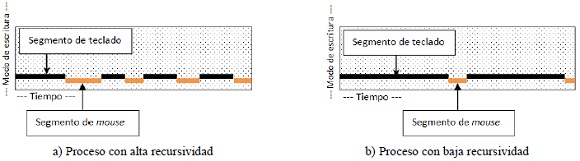
<body><![CDATA[<p style="text-indent: 1cm; line-height: normal; text-align: justify;"> <span style="font-size: 10pt; font-family: &quot;Verdana&quot;;" lang="ES-AR">En sus estudios, <a href="#Rijlaarsdam_1996"><span class="SpellE">Rijlaarsdam</span> <i style="">et al.</i> (1996)</a> dividen el tiempo de escritura en tres momentos (inicio, medio y fin) y llaman <i style="">episodio</i> (<span class="SpellE"><i style="">episode</i></span>) a cada una de las porciones temporales. En nuestro estudio realizaremos la divisi&oacute;n del proceso en tres porciones de tiempo iguales, pero no utilizaremos el t&eacute;rmino <i style="">episodio</i>, que en los estudios de composici&oacute;n es fuertemente polis&eacute;mico</span><a style="" href="#_ftn4" name="_ftnref4" title=""><span style="font-size: 10pt; line-height: 150%; font-family: &quot;Verdana&quot;;" lang="ES-AR">[4]</span></a><font face="Verdana"><span style="font-size: 10pt; " lang="ES-AR">. En consonancia con la t&eacute;cnica de investigaci&oacute;n empleada (<span class="SpellE"><i style="">keystroke</i></span><i style=""> <span class="SpellE">logging</span></i>), optamos por la voz <i style="">intervalo</i> en lugar de <i style="">episodio</i>. En esta l&iacute;nea, <a name="-van_Waes_2009"></a><a href="#van_Waes_2009">van <span class="SpellE">Waes</span> <i style="">et al.</i> (2009)</a>, al especificar los t&eacute;rminos t&eacute;cnicos empleados en <span class="SpellE">Inputlog</span>, conceptualizan el intervalo como cada espacio temporal igual en que el proceso de la escritura se puede dividir. Al analizar el registro de un proceso de composici&oacute;n, el analista puede dividir el proceso en tres o m&aacute;s intervalos cuya duraci&oacute;n ser&aacute; similar y depender&aacute; de la duraci&oacute;n total del proceso. Asimismo, se&ntilde;alan los autores, es posible realizar la divisi&oacute;n atendiendo a los periodos, que constituyen una determinada duraci&oacute;n temporal. Si la divisi&oacute;n se realiza por periodos, ha de fijarse la duraci&oacute;n (en segundos) del periodo, cuya cantidad depender&aacute; de la duraci&oacute;n total del proceso. Estas dos maneras de dividir el proceso para su estudio ofrecen muchas posibilidades y se encuentran entre las funcionalidades del programa <span class="SpellE">Inputlog</span> <a href="#van_Waes_2009">(van <span class="SpellE">Waes</span> <i style="">et al.</i> 2009)</a>.</span></font><o:p></o:p></p>     <div style="text-align: justify;">     </div>     <p style="text-indent: 1cm; line-height: normal; text-align: justify;"> <font face="Verdana"><span style="font-size: 10pt; " lang="ES-AR">Los intervalos temporales del proceso de escritura permiten examinar qu&eacute; procesos predominan en cada momento. <a name="-Piolat_2001"></a><a href="#Piolat_2001"><span class="SpellE">Piolat</span> <i style="">et al.</i> (2001)</a> <span class="GramE">se&ntilde;alan</span> (teniendo en cuenta los procesos de escritura determinados por <a name="-Kellogg_1996"></a><a href="#Kellogg">Kellogg (1996)</a>) que mientras los procesos de planificaci&oacute;n y traducci&oacute;n de ideas decrecen a medida que avanza el tiempo en una sesi&oacute;n de escritura, los procesos de evaluaci&oacute;n, revisi&oacute;n y ejecuci&oacute;n motora se incrementan: "<span class="SpellE">Planning</span> and <span class="SpellE">translating</span> <span class="SpellE">decreased</span> <span class="SpellE">across</span> <span class="SpellE">the</span> <span class="SpellE">first</span>, <span class="SpellE">second</span>, and <span class="SpellE">third</span> <span class="SpellE">phases</span> of <span class="SpellE">writing</span>, <span class="SpellE">whereas</span> <span class="SpellE">evaluation</span>, <span class="SpellE">revision</span>, and <span class="SpellE">execution</span> <span class="SpellE">increased</span> <span class="SpellE">slightly</span>" <a href="#Piolat_2001">(<span class="SpellE">Piolat</span> <i style="">et al.</i> 2001: 80)</a>. Afirman estos investigadores que se trata de un patr&oacute;n que se ha encontrado mediante la investigaci&oacute;n con diversas t&eacute;cnicas, como la triple tarea, el protocolo verbal concurrente en voz alta o el empleo de videograbaciones.</span></font><o:p></o:p></p>     <div style="text-align: justify;">     </div>     <p style="text-indent: 1cm; line-height: normal; text-align: justify;"> <font face="Verdana"><span style="font-size: 10pt; " lang="ES-AR">Si establecemos relaciones entre el momento de activaci&oacute;n de los procesos y las pausas, podemos decir que durante el primer intervalo (inicio) es habitual encontrar m&aacute;s pausas que durante el intervalo siguiente, debido a que se invierte tiempo en la planificaci&oacute;n del texto (metas, construcci&oacute;n de redes de objetivos locales y globales, construcci&oacute;n de la <span class="SpellE">macroestructura</span> o tema del texto, consideraci&oacute;n de esquemas textuales, en este caso del resumen). Con respecto al segundo intervalo, es el habitualmente empleado para la <span class="SpellE">textualizaci&oacute;n</span> o puesta en texto. En este periodo se <span class="SpellE">tipea</span> la mayor proporci&oacute;n de los caracteres del texto, por lo tanto las pausas son m&aacute;s escasas que en los otros intervalos y generalmente relacionadas con la habilidad de <span class="SpellE">tipeo</span> del sujeto. Finalmente, en el tercer intervalo se espera que se produzca la mayor cantidad de pausas, puesto que en &eacute;l se produce una fuerte actividad cognitiva de control del texto, vehiculizada por la revisi&oacute;n del texto escrito y su ajuste a las constricciones comunicativas especificadas en la consigna y a patrones de calidad textual. Esta actividad exige tiempo de relectura de fragmentos textuales e incluso del texto completo, valoraci&oacute;n de la calidad y correcci&oacute;n de los desajustes percibidos.</span></font><o:p></o:p></p>     <div style="text-align: justify;">     </div>     <p style="text-indent: 1cm; line-height: normal; text-align: justify;"> <span style="font-size: 10pt; font-family: &quot;Verdana&quot;;" lang="ES-AR">Entre los aspectos temporales del estudio de la escritura ligados a las pausas se encuentra tambi&eacute;n la recursividad del proceso de composici&oacute;n. El grado de recursividad puede estimarse computacionalmente atendiendo a los segmentos de escritura continuada usando un mismo modo o medio de escritura (teclado o <i style="">mouse</i>). Esto es, una vez definido el valor de pausa, el uso del teclado durante un lapso temporal sin pausa constituir&aacute; un segmento</span><a style="" href="#_ftn5" name="_ftnref5" title=""><span style="font-size: 10pt; line-height: 150%; font-family: &quot;Verdana&quot;;" lang="ES-AR">[5]</span></a><font face="Verdana"><span style="font-size: 10pt; " lang="ES-AR">. Cuando se interrumpe el uso del teclado o del <i style="">mouse</i> y/o se produce una pausa igual o superior al umbral de pausa definido, el segmento se divide. Ello supone la activaci&oacute;n moment&aacute;nea de un proceso distinto al de la <span class="SpellE">textualizaci&oacute;n</span> o mayor dificultad en el mantenimiento del proceso activado, por lo que el proceso en ese momento se torna recursivo. Mientras m&aacute;s interrupciones se presenten, mayor ser&aacute; la recursividad. Estas interrupciones y cambios son contabilizados por un programa inform&aacute;tico (en nuestro caso <span class="SpellE">Inputlog</span> nos aporta tales datos). En la siguiente figura (Figura 1) representamos gr&aacute;ficamente el modo de estimaci&oacute;n de la recursividad del proceso de escritura:</span></font><o:p></o:p></p>     <div style="text-align: justify;">     </div>     <p style="text-indent: 1cm; line-height: normal; text-align: justify;"><span style="font-size: 12pt; font-family: &quot;Times New Roman&quot;,&quot;serif&quot;;" lang="ES-AR"><o:p></o:p></span> <span style="font-size: 10pt; font-family: Verdana" lang="ES-AR">&nbsp;&nbsp;&nbsp;&nbsp;&nbsp;&nbsp;&nbsp;&nbsp;&nbsp;&nbsp;&nbsp;&nbsp;&nbsp;&nbsp;&nbsp;&nbsp;&nbsp;&nbsp;&nbsp;&nbsp;&nbsp;&nbsp;&nbsp;&nbsp;&nbsp;&nbsp;&nbsp;&nbsp;&nbsp;&nbsp;&nbsp;&nbsp;&nbsp;&nbsp;&nbsp;&nbsp;&nbsp;&nbsp;&nbsp;&nbsp;&nbsp;&nbsp;&nbsp;&nbsp;&nbsp;&nbsp;&nbsp;&nbsp;&nbsp;&nbsp;&nbsp;&nbsp;&nbsp;&nbsp;</span></p>     <div style="text-align: justify;">   </div>     ]]></body>
<body><![CDATA[<p style="text-indent: 35.45pt; line-height: normal; text-align: justify;"></p>     <div style="text-align: justify;">   </div>     <p style="text-indent: 35.45pt; line-height: normal; text-align: justify;"> <font face="Verdana" size="2"><img style="width: 580px; height: 161px;" alt="" src="/img/revistas/ling/v31n1/1a06f1.jpg"></font><span style="font-size: 10pt; font-family: &quot;Times New Roman&quot;,&quot;serif&quot;;" lang="ES-AR"><o:p></o:p></span></p>     <div style="text-align: justify;">     </div>     <p style="text-indent: 35.45pt; line-height: normal; text-align: justify;"> <span style="font-size: 10pt; font-family: &quot;Verdana&quot;;" lang="ES-AR"><o:p>&nbsp;</o:p></span></p>     <div style="text-align: justify;">     </div>     <p style="text-indent: 0cm; line-height: normal; text-align: justify;"><b style=""> <font face="Verdana"><span style="font-size: 10pt; " lang="ES-AR">Fig. 1 (a y b). Representaci&oacute;n gr&aacute;fica de la estimaci&oacute;n del &iacute;ndice de recursividad.</span></font><o:p></o:p></b></p>     <div style="text-align: justify;">     </div>     <p style="text-indent: 1cm; line-height: normal; text-align: justify;"> <span style="font-size: 10pt; font-family: &quot;Verdana&quot;;" lang="ES-AR"><o:p>&nbsp;</o:p></span></p>     <div style="text-align: justify;">     </div>     ]]></body>
<body><![CDATA[<p style="text-indent: 1cm; line-height: normal; text-align: justify;"> <font face="Verdana"><span style="font-size: 10pt; " lang="ES-AR">Hay que hacer la salvedad de que la estimaci&oacute;n de la recursividad de la manera descripta supone un escritor ideal que se dedica &uacute;nicamente a la tarea de escritura, no se distrae, no se cansa e invierte cualquier tiempo de pausa y ejecuci&oacute;n (en teclado y <i style="">mouse</i>) &uacute;nicamente en actividades cognitivas relacionadas con la tarea. Sabemos que en realidad no es as&iacute;, por lo que se debe tomar con mucha cautela el valor de la recursividad obtenida del modo referido. Por otra parte, subyace la idea de que durante la <span class="SpellE">textualizaci&oacute;n</span> no se activa paralelamente otro proceso, lo cual no es necesariamente cierto desde que se ha demostrado que los escritores pueden activar varios procesos de escritura de manera simult&aacute;nea <a href="#Olive_2002">(Olive <i style="">et al.</i> 2002)</a>. Nos encontramos aqu&iacute; frente a una limitaci&oacute;n no menor de la t&eacute;cnica utilizada para examinar el proceso de escritura, objeto complejo y multiforme.</span></font><o:p></o:p></p>     <div style="text-align: justify;">     </div>     <p style="text-indent: 1cm; line-height: normal; text-align: justify;"> <span style="font-size: 10pt; font-family: &quot;Verdana&quot;; letter-spacing: -0.1pt" lang="ES-TRAD"><o:p>&nbsp;</o:p></span></p>     <div style="text-align: justify;">     </div>     <p style="text-indent: 1cm; line-height: normal; text-align: justify;"> <span style="font-size: 10pt; font-family: &quot;Verdana&quot;; letter-spacing: -0.1pt" lang="ES-TRAD"><o:p>&nbsp;</o:p></span></p>     <div style="text-align: justify;">     </div>     <p style="text-indent: 0cm; line-height: normal; text-align: justify;"><b style=""> <font face="Verdana"> <span style="font-size: 10pt; letter-spacing: -0.1pt" lang="ES-TRAD">2. METODOLOG&Iacute;A</span></font><o:p></o:p></b></p>     <div style="text-align: justify;">     </div>     <p style="text-indent: 0cm; line-height: normal; text-align: justify;"> <span style="font-size: 10pt; font-family: &quot;Verdana&quot;;" lang="ES-AR"><o:p>&nbsp;</o:p></span></p>     <div style="text-align: justify;">     </div>     ]]></body>
<body><![CDATA[<p style="text-indent: 1cm; line-height: normal; text-align: justify;"> <span style="font-size: 10pt; font-family: &quot;Verdana&quot;;" lang="ES-AR">Participaron del estudio 30 alumnos de primer a&ntilde;o (n=30; 28 varones y 2 mujeres) de Ingenier&iacute;a de Petr&oacute;leos y Civil (Facultad de Ingenier&iacute;a, Universidad Nacional de Cuyo, Mendoza, Argentina). La edad media de los alumnos fue de 18 a&ntilde;os (</span><span style="font-size: 10pt; font-family: &quot;Verdana&quot;; color: black" lang="ES-AR">x=18; </span> <span style="font-size: 10pt; font-family: &quot;Verdana&quot;;" lang="ES-AR">SD=1). Estos estudiantes hab&iacute;an seguido un curso de escritura de informes t&eacute;cnicos. Entre las secciones estudiadas, se abord&oacute; expl&iacute;citamente el resumen como parte integrante del informe. El experimento consisti&oacute; en la escritura, en computadora, de un resumen a partir de la proyecci&oacute;n de un video, </span> <font face="Verdana"><span style="font-size: 10pt; " lang="ES-AR">en aproximadamente 30 minutos. La audiencia prevista fue un ingeniero docente de primer a&ntilde;o de la carrera que evaluar&iacute;a los textos.</span></font><o:p></o:p></p>     <div style="text-align: justify;">     </div>     <p style="text-indent: 1cm; line-height: normal; text-align: justify;"> <span style="font-size: 10pt; font-family: &quot;Verdana&quot;;" lang="ES-AR">Para el registro del proceso se emple&oacute; </span><span class="SpellE"> <span style="font-size: 10pt; font-family: &quot;Verdana&quot;;" lang="ES-AR">Inputlog</span></span><font face="Verdana"><span style="font-size: 10pt; " lang="ES-AR"> 4.0 <a name="-van_Waes_2006"></a><a href="#van_Waes_2006">(van <span class="SpellE">Waes</span> <i style="">et al.</i> 2006)</a>, un programa que trabaja oculto mientras el escritor redacta en el procesador de textos. El valor de pausa que se adopt&oacute; fue de 500 milisegundos, puesto que tal valor super&oacute; el valor promedio grupal de pausa en interior de palabras <a href="#Alves">(Alves <i style="">et al.</i> 2007)</a>.</span></font><o:p></o:p></p>     <div style="text-align: justify;">     </div>     <p style="text-indent: 35.45pt; line-height: normal; text-align: justify;"> <span style="font-size: 10pt; font-family: &quot;Verdana&quot;;" lang="ES-AR"><o:p>&nbsp;</o:p></span></p>     <div style="text-align: justify;">     </div>     <p style="text-indent: 35.45pt; line-height: normal; text-align: justify;"> <span style="font-size: 10pt; font-family: &quot;Verdana&quot;;" lang="ES-AR"><o:p>&nbsp;</o:p></span></p>     <div style="text-align: justify;">     </div>     <p style="text-indent: 0cm; line-height: normal; text-align: justify;"><b style=""> <font face="Verdana"><span style="font-size: 10pt; " lang="ES-AR">3. RESULTADOS</span></font><o:p></o:p></b></p>     <div style="text-align: justify;">     </div>     ]]></body>
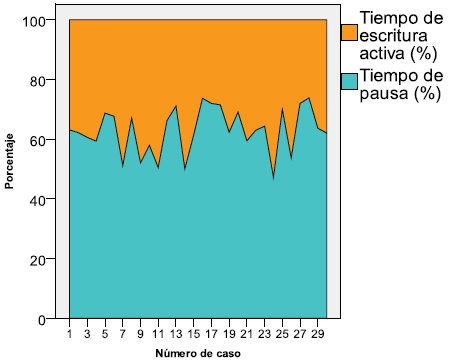
<body><![CDATA[<p style="text-indent: 0cm; line-height: normal; text-align: justify;"> <span style="font-size: 10pt; font-family: &quot;Verdana&quot;;" lang="ES-AR"><o:p>&nbsp;</o:p></span></p>     <div style="text-align: justify;">     </div>     <p style="text-indent: 1cm; line-height: normal; text-align: justify;"> <font face="Verdana"><span style="font-size: 10pt; " lang="ES-AR">En promedio, los alumnos tardaron <span style="color: black;">1660,45 </span>segundos (SD=<span style="color: black;">440,21</span>) en resolver la tarea de escritura, o sea, 27,67 minutos. Para la mayor&iacute;a de los alumnos, el tiempo empleado en las pausas fue notablemente superior al tiempo de <span class="SpellE">textualizaci&oacute;n</span>: <span style="color: black;">62,84% </span>(x=<span style="color: black;">1660,45 </span>s; SD=<span style="color: black;">440,21</span>) del tiempo se emple&oacute; en pausas frente al <span style="color: black;">37,16% (x=1039,20 </span>s; SD=<span style="color: black;">284,88) del tiempo usado para <span class="SpellE">textualizar</span>.</span> En algunos casos, la proporci&oacute;n de pausa igual&oacute; a la de <span class="SpellE">textualizaci&oacute;n</span>: alumno 8 (<span class="SpellE">Text</span>.: 48,96%; Pausa: 51,03%), 10 (<span class="SpellE">Text</span>.: 48,01%; Pausa: 51,99%) y 12 (<span class="SpellE">Text</span>.: 49,56%; Pausa: 50,43%). La excepci&oacute;n la constituyen dos alumnos, para quienes el tiempo de <span class="SpellE">textualizaci&oacute;n</span> fue levemente superior al de pausa: alumno 15 (<span class="SpellE">Text</span>.: 50,06%; Pausa: 49,94%) y alumno 25 (<span class="SpellE">Text</span>.: 52,95%; Pausa: 47,05%). Estos alumnos no presentaron diferencias notables en los dem&aacute;s indicadores del estudio. En la figura 2 pueden apreciarse las diferencias interindividuales del tiempo empleado en la escritura activa (o <span class="SpellE">tipeo</span> del texto) y en las pausas.</span></font><o:p></o:p></p>     <div style="text-align: justify;">     </div>     <p style="text-indent: 0cm; line-height: normal; text-align: justify;"> <span style="font-size: 10pt; font-family: &quot;Verdana&quot;;" lang="ES-AR"><o:p>&nbsp;</o:p></span></p>     <div style="text-align: justify;">     </div>     <p style="text-indent: 0cm; line-height: normal; text-align: justify;"><span style="font-size: 12pt; font-family: &quot;Times New Roman&quot;,&quot;serif&quot;;" lang="ES-AR"><o:p></o:p></span> <font face="Verdana" size="2"><img style="width: 450px; height: 361px;" alt="" src="/img/revistas/ling/v31n1/1a06f2.jpg"></font></p>     <div style="text-align: justify;">     </div>     <p style="text-indent: 0cm; line-height: normal; text-align: justify;"> <span style="font-size: 10pt; font-family: &quot;Verdana&quot;;" lang="ES-AR"><o:p>&nbsp;</o:p></span></p>     <div style="text-align: justify;">     </div>     ]]></body>
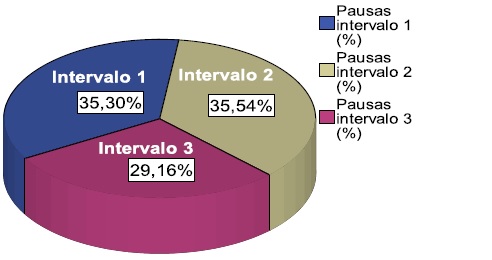
<body><![CDATA[<p style="text-indent: 0cm; line-height: normal; text-align: justify;"><b style=""> <font face="Verdana"><span style="font-size: 10pt; " lang="ES-AR">Fig. 2. Tiempo de pausa y de escritura activa.</span></font><o:p></o:p></b></p>     <div style="text-align: justify;">     </div>     <p style="text-indent: 35.45pt; line-height: normal; text-align: justify;"> <span style="font-size: 10pt; font-family: &quot;Verdana&quot;;" lang="ES-AR"><o:p>&nbsp;</o:p></span></p>     <div style="text-align: justify;">     </div>     <p style="text-indent: 1cm; line-height: normal; text-align: justify;"> <font face="Verdana"><span style="font-size: 10pt; " lang="ES-AR">En el an&aacute;lisis que realizamos, el tiempo del proceso fue dividido en tres intervalos temporales de igual duraci&oacute;n. Se contabiliz&oacute; la totalidad de las pausas halladas en todo el proceso (x=536,4; SD=<span style="color: black;">176,49</span>) y por intervalo. Durante el primer intervalo temporal tuvo lugar el 35,30% (x=<span style="color: black;">186,53; SD=59,73</span>) del total de pausas, durante el segundo intervalo el 35,54% (x=<span style="color: black;">191,83; SD=72,05</span>) y en el tercero el 29,16% (x=<span style="color: black;">158,00; SD=56,26</span>). En la figura 3 se aprecia la distribuci&oacute;n de las pausas en el grupo estudiado de acuerdo con cada intervalo.</span></font><o:p></o:p></p>     <div style="text-align: justify;">     </div>     <p style="text-indent: 35.45pt; line-height: normal; text-align: justify;"> <span style="font-size: 10pt; font-family: &quot;Verdana&quot;;" lang="ES-AR"><o:p>&nbsp;</o:p></span></p>     <div style="text-align: justify;">     </div>     <p style="text-indent: 0cm; line-height: normal; text-align: justify;"><span style="font-size: 12pt; font-family: &quot;Times New Roman&quot;,&quot;serif&quot;;" lang="ES-AR"><o:p></o:p></span> <font face="Verdana" size="2"><img style="width: 492px; height: 260px;" alt="" src="/img/revistas/ling/v31n1/1a06g1.jpg"></font></p>     <div style="text-align: justify;">     </div>     ]]></body>
<body><![CDATA[<p style="text-indent: 0cm; line-height: normal; text-align: justify;"><b style=""> <font face="Verdana"><span style="font-size: 10pt; " lang="ES-AR">Fig. 3. Porcentaje de pausas en cada intervalo.</span></font><o:p></o:p></b></p>     <div style="text-align: justify;">     </div>     <p style="text-indent: 35.45pt; line-height: normal; text-align: justify;"> <span style="font-size: 10pt; font-family: &quot;Verdana&quot;;" lang="ES-AR"><o:p>&nbsp;</o:p></span></p>     <div style="text-align: justify;">     </div>     <p style="text-indent: 1cm; line-height: normal; text-align: justify;"> <font face="Verdana"><span style="font-size: 10pt; " lang="ES-AR">La media de la cantidad de pausas del intervalo 2 es superior a la de los dem&aacute;s intervalos y en este intervalo se encuentra la mayor dispersi&oacute;n de los valores. El tercer intervalo, llamativamente, es el que presenta la media m&aacute;s baja en cuanto a cantidad de pausas (x=<span style="color: black;">158,00; SD=56,26</span>) y menor porcentaje de pausas (29,16%). Estos resultados indican que el grupo ha pausado muy poco en el final del proceso de escritura, o sea, en el intervalo 3. </span></font> <o:p></o:p></p>     <div style="text-align: justify;">     </div>     <p style="text-indent: 1cm; line-height: normal; text-align: justify;"> <font face="Verdana"><span style="font-size: 10pt; " lang="ES-AR">Si dividimos el proceso de escritura en tres partes temporales iguales, obtendremos un intervalo 1 (inicio del proceso), un intervalo 2 (medio del proceso) y un intervalo 3 (final del proceso). Teniendo en cuenta las investigaciones acerca de la orquestaci&oacute;n de los procesos de escritura (<a href="#Breetvelt"><span class="SpellE">Breetvelt</span> <i style="">et al.</i> 1994</a>, <a href="#van_den_Bergh_1993">van den <span class="SpellE">Bergh</span> <i style="">et al.</i> 1993</a>, <a href="#Rijlaarsdam_1996"><span class="SpellE">Rijlaarsdam </span><i style="">et al.</i> 1996</a> , <a href="#Rijlaarsdam_2006">2006</a>, <a href="#Piolat_2001"><span class="SpellE">Piolat</span> <i style="">et al.</i> 2001</a>, <a href="#van_Weijen_2008">van <span class="SpellE">Weijen</span> 2008</a>), le podr&iacute;amos asignar a cada intervalo la preponderancia de un proceso: planificaci&oacute;n al intervalo 1, <span class="SpellE">textualizaci&oacute;n</span> al 2 y revisi&oacute;n al 3. Como la planificaci&oacute;n y la revisi&oacute;n demandan m&aacute;s esfuerzo y tiempo que la <span class="SpellE">textualizaci&oacute;n</span>, es de esperar que los intervalos 1 y 3 sean los que presenten m&aacute;s cantidad de pausas. No obstante, no es ello lo que ocurre en el grupo de alumnos estudiado, puesto que estos intervalos no tienen m&aacute;s cantidad de pausas, por lo cual consideramos que la planificaci&oacute;n y la revisi&oacute;n global han sido procesos muy escasamente activados. Habr&iacute;a que hacer una salvedad con respecto a la planificaci&oacute;n, puesto que en nuestro estudio la tarea impuesta exigi&oacute; un tiempo previo de planificaci&oacute;n del texto mientras los alumnos tomaban nota del video observado. Este hecho puede haber determinado la escasez de tiempo de pausa destinado a la planificaci&oacute;n en el primer intervalo.</span></font><o:p></o:p></p>     <div style="text-align: justify;">     </div>     <p style="text-indent: 1cm; line-height: normal; text-align: justify;"> <font face="Verdana"><span style="font-size: 10pt; " lang="ES-AR">El hecho de que los dos primeros intervalos presenten una cantidad media de pausas bastante similar entre s&iacute; y el tercero menos pausas, nos lleva a pensar en un proceso de escritura con escasa revisi&oacute;n o con una revisi&oacute;n principalmente superficial dilatada a lo largo del proceso. De haber una revisi&oacute;n intensa y global, ser&iacute;a de esperar una mayor cantidad de pausas en el tercer intervalo, puesto que al final del proceso se realizan lecturas cr&iacute;ticas profundas globales y parciales del texto que requieren de tiempo. </span></font> <o:p></o:p></p>     <div style="text-align: justify;">     </div>     ]]></body>
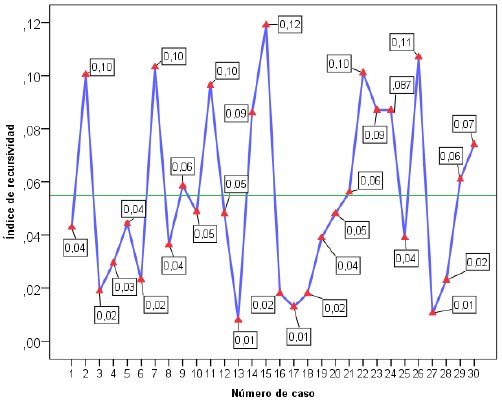
<body><![CDATA[<p style="text-indent: 1cm; line-height: normal; text-align: justify;"> <font face="Verdana"><span style="font-size: 10pt; " lang="ES-AR">Un indicio respecto de la magnitud de la activaci&oacute;n de procesos sustantivos (planificaci&oacute;n y revisi&oacute;n) a lo largo de la producci&oacute;n textual lo aporta la estimaci&oacute;n de la recursividad. Mientras m&aacute;s se acerque el &iacute;ndice a uno, m&aacute;s lineal ser&aacute; el proceso y predominar&aacute; la activaci&oacute;n de la <span class="SpellE">textualizaci&oacute;n</span>. Un &iacute;ndice de recursividad m&aacute;s cercano a cero, por el contrario, ser&aacute; una pista de que los procesos de escritura han ido activ&aacute;ndose con frecuencia alternadamente.</span></font><o:p></o:p></p>     <div style="text-align: justify;">     </div>     <p style="text-indent: 1cm; line-height: normal; text-align: justify;"> <font face="Verdana"><span style="font-size: 10pt; " lang="ES-AR">En el grupo de alumnos del estudio el &iacute;ndice de recursividad medio fue de 0,0548 (SD=0,0334), lo cual indicar&iacute;a que los alumnos activaron en varias oportunidades diferentes procesos de escritura. No obstante, hubo entre los alumnos de la muestra una variabilidad importante respecto de la recursividad del proceso. Tales diferencias se aprecian en la figura 4.</span></font><o:p></o:p></p>     <div style="text-align: justify;">     </div>     <p style="text-indent: 1cm; line-height: normal; text-align: justify;"> <span style="font-size: 10pt; font-family: &quot;Verdana&quot;;" lang="ES-AR"><o:p>&nbsp;</o:p></span></p>     <div style="text-align: justify;">     </div>     <p style="text-indent: 0cm; line-height: normal; text-align: justify;"><span style="font-size: 12pt; font-family: &quot;Times New Roman&quot;,&quot;serif&quot;;" lang="ES-AR"><o:p></o:p></span> <font face="Verdana" size="2"><img style="width: 502px; height: 400px;" alt="" src="/img/revistas/ling/v31n1/v1a06f4.jpg"></font></p>     <div style="text-align: justify;">     </div>     <p style="text-indent: 0cm; line-height: normal; text-align: justify;"><b style=""> <font face="Verdana"><span style="font-size: 10pt; " lang="ES-AR">Fig. 4. Grado de recursividad estimado.</span></font><o:p></o:p></b></p>     <div style="text-align: justify;">     </div>     ]]></body>
<body><![CDATA[<p style="text-indent: 35.45pt; line-height: normal; text-align: justify;"> <span style="font-size: 10pt; font-family: &quot;Verdana&quot;;" lang="ES-AR"><o:p>&nbsp;</o:p></span></p>     <div style="text-align: justify;">     </div>     <p style="text-indent: 1cm; line-height: normal; text-align: justify;"> <font face="Verdana"><span style="font-size: 10pt; " lang="ES-AR">Este alto grado de recursividad se relaciona con la calidad de los textos de los alumnos. En nuestro estudio, sujetos expertos discutieron y acordaron una calificaci&oacute;n global para cada texto en la escala 1-10. La calificaci&oacute;n media del grupo fue de 7,0667 (SD=1,79), con un m&iacute;nimo de 4 y un m&aacute;ximo de 10. La media puede considerarse bastante alta, si tenemos en cuenta algunas caracter&iacute;sticas del proceso, como la escasa revisi&oacute;n global a nivel profundo durante el &uacute;ltimo intervalo temporal. Al analizar la relaci&oacute;n entre las variables, solamente encontramos correlaci&oacute;n de nivel medio entre la calidad del producto textual y el grado de recursividad.</span></font><o:p></o:p></p>     <div style="text-align: justify;">     </div>     <p style="text-indent: 35.45pt; line-height: normal; text-align: justify;"><b style=""> <span style="font-size: 10pt; font-family: &quot;Verdana&quot;;" lang="ES-AR"><o:p>&nbsp;</o:p></span></b></p>     <div style="text-align: justify;">     </div>     <p style="text-indent: 0cm; line-height: normal; text-align: justify;"><b style=""> <span style="font-size: 10pt; font-family: &quot;Verdana&quot;;" lang="ES-AR"><o:p>&nbsp;</o:p></span></b></p>     <div style="text-align: justify;">     </div>     <p style="text-indent: 0cm; line-height: normal; text-align: justify;"><b style=""> <font face="Verdana"><span style="font-size: 10pt; " lang="ES-AR">4. CONSIDERACIONES FINALES</span></font><o:p></o:p></b></p>     <div style="text-align: justify;">     </div>     ]]></body>
<body><![CDATA[<p style="text-indent: 0cm; line-height: normal; text-align: justify;"> <span style="font-size: 10pt; font-family: &quot;Verdana&quot;;" lang="ES-AR"><o:p>&nbsp;</o:p></span></p>     <div style="text-align: justify;">     </div>     <p style="text-indent: 1cm; line-height: normal; text-align: justify;"> <font face="Verdana"><span style="font-size: 10pt; " lang="ES-AR">Los estudios internacionales indican que los escritores invierten al menos la mitad del tiempo de composici&oacute;n en la realizaci&oacute;n de pausas (<a href="#Alves">Alves <i style="">et al.</i> 2007</a>,<a href="#Olive_2009"> Olive <i style="">et al.</i> 2009</a>). En nuestra investigaci&oacute;n, los estudiantes de Ingenier&iacute;a Civil y de Petr&oacute;leos pausan <span style="color: black;">62,84% </span>del tiempo empleado en la producci&oacute;n del texto, por lo cual se encuentran dentro de lo se&ntilde;alado internacionalmente.</span></font><o:p></o:p></p>     <div style="text-align: justify;">     </div>     <p style="text-indent: 1cm; line-height: normal; text-align: justify;"> <font face="Verdana"><span style="font-size: 10pt; " lang="ES-AR">&iquest;A qu&eacute; se debe que estos estudiantes pausen durante buena parte del tiempo de escritura? Podr&iacute;a aventurarse que la tarea de escritura propuesta en el estudio haya sido altamente demandante de recursos cognitivos, lo cual puede haber exigido realizar gran cantidad de pausas o pausas de mayor extensi&oacute;n para activar procesos de escritura sustantivos. Otra posibilidad es que la habilidad de lectura cr&iacute;tica de los estudiantes no est&eacute; suficientemente desarrollada, y debido a ello hayan demorado en la estimaci&oacute;n de la calidad de los textos que produc&iacute;an. O bien que los alumnos no cuenten con conocimientos suficientes sobre los criterios para evaluar la calidad de un texto. No obstante, si tal fuera el caso, se encontrar&iacute;an m&aacute;s pausas en el tercer intervalo. Una tercera respuesta ser&iacute;a que caracter&iacute;sticas individuales relacionadas con aspectos motivacionales, con h&aacute;bitos de escritura o con circunstancias particulares hayan influido en la realizaci&oacute;n de pausas, aspectos no medidos en el estudio.</span></font><o:p></o:p></p>     <div style="text-align: justify;">     </div>     <p style="text-indent: 1cm; line-height: normal; text-align: justify;"> <font face="Verdana"><span style="font-size: 10pt; " lang="ES-AR">El hecho de que se encuentren pocas pausas en el tercer intervalo, nos dice que la revisi&oacute;n del texto escrito ha sido muy escasa, a menos a nivel global y profundo. El tipo de revisi&oacute;n predominante es superficial, a lo largo de los tres intervalos: correcci&oacute;n de caracteres err&oacute;neos, sustituci&oacute;n a nivel l&eacute;xico, cambios &ldquo;cosm&eacute;ticos&rdquo; como el estilo y el tama&ntilde;o de los caracteres, el subrayado, la cursiva, etc. </span></font> <o:p></o:p></p>     <div style="text-align: justify;">     </div>     <p style="text-indent: 1cm; line-height: normal; text-align: justify;"> <font face="Verdana"><span style="font-size: 10pt; " lang="ES-AR">A pesar de que durante el proceso de escritura no se ha realizado una revisi&oacute;n profunda a nivel global, los textos poseen una calidad relativamente alta, seg&uacute;n las mediciones subjetivas y hol&iacute;sticas realizadas. Ello lo podemos atribuir al alto grado de recursividad del proceso, con el cual se correlaciona la calidad textual (<a href="#Rijlaarsdam_1996"><span class="SpellE">Rijslaarsdam</span> <i style="">et al.</i> 1996</a>, <a href="#Rijlaarsdam_2006">2006</a>, <a href="#van_den_Bergh_1993">van den <span class="SpellE">Bergh</span> <i style="">et al</i>. 1993</a>, <a href="#Breetvelt"><span class="SpellE">Breetvelt</span> <i style="">et al.</i> 1994</a>).</span></font><o:p></o:p></p>     <div style="text-align: justify;">     </div>     ]]></body>
<body><![CDATA[<p style="text-indent: 1cm; line-height: normal; text-align: justify;"> <font face="Verdana"><span style="font-size: 10pt; " lang="ES-AR">Con respecto a las limitaciones del estudio, diremos que si bien las herramientas computacionales aportan una gran cantidad de datos, la interpretaci&oacute;n de los mismos se ve bastante limitada si no se dispone, adem&aacute;s, de la visi&oacute;n del escritor en primera persona. As&iacute;, por ejemplo, la variaci&oacute;n interindividual en lo que respecta a la recursividad, merece un estudio pormenorizado con la aplicaci&oacute;n conjunta de t&eacute;cnicas computacionales y t&eacute;cnicas que aporten datos cualitativos, tales como los protocolos de pensamiento en voz alta. Adem&aacute;s, para un estudio m&aacute;s completo, ser&iacute;a necesario controlar otros aspectos, como el tiempo empleado en la lectura del texto que se est&aacute; escribiendo, la consigna y las anotaciones. A pesar de tales limitaciones metodol&oacute;gicas, consideramos que los programas inform&aacute;ticos, como el aplicado en nuestro caso al an&aacute;lisis <span class="SpellE">pausol&oacute;gico</span> de la composici&oacute;n, constituyen un instrumento muy valioso para investigar el proceso de escritura a nivel <span class="SpellE">microanal&iacute;tico</span>.</span></font><o:p></o:p></p>     <div style="text-align: justify;">     </div>     <p style="text-indent: 35.45pt; line-height: normal; text-align: justify;"><b style=""> <span style="font-size: 10pt; font-family: &quot;Verdana&quot;; letter-spacing: -0.1pt" lang="ES-TRAD"><o:p>&nbsp;</o:p></span></b></p>     <div style="text-align: justify;">     </div>     <p style="text-indent: 35.45pt; line-height: normal; text-align: justify;"><b style=""> <span style="font-size: 10pt; font-family: &quot;Verdana&quot;; letter-spacing: -0.1pt" lang="ES-TRAD"><o:p>&nbsp;</o:p></span></b></p>     <div style="text-align: justify;">     </div>     <p style="margin-left: 35.45pt; text-indent: -35.45pt; line-height: normal; text-align: justify;"><b style=""> <span style="font-size: 10pt; "><font face="Verdana">REFERENCIAS BIBLIOGR&Aacute;FICAS</font></span><o:p></o:p></b></p>     <div style="text-align: justify;">     </div>     <p style="margin-left: 35.45pt; text-indent: -35.45pt; line-height: normal; text-align: justify;"><b style=""> <span style="font-size: 10pt; font-family: &quot;Verdana&quot;;"><o:p>&nbsp;</o:p></span></b></p>     <div style="text-align: justify;">     </div>     ]]></body>
<body><![CDATA[<!-- ref --><p style="margin-left: 1cm; text-indent: -1cm; line-height: normal; text-align: justify;"> <span style="font-size: 10pt; "><a name="Abdel_Latif"><font face="Verdana"> </font></a><font face="Verdana"><a href="#-Abdel_Latif_2008">Abdel <span class="SpellE">Latif</span>, Muhammad. 2008</a>. <span style="">A State-of-the-Art Review of the Real-Time Computer-Aided Study of the Writing Process, </span><i>IJES</i>, 8 (1): 29-50.    </font></span><o:p></o:p></p>     <div style="text-align: justify;">     </div>     <!-- ref --><p style="margin-left: 1cm; text-indent: -1cm; line-height: normal; text-align: justify;"><span class="SpellE"><span class="GramE"> <span style="font-size: 10pt; font-family: &quot;Verdana&quot;;"><a name="Alamargot_2001"></a><a href="#-Alamargot_2001">Alamargot</a></span></span></span><a href="#-Alamargot_2001"><span class="GramE"><span style="font-size: 10pt; font-family: &quot;Verdana&quot;;">, Denis y Lucile <span class="SpellE">Chanquoy</span>.</span></span></a><span style="font-size: 10pt; "><a href="#-Alamargot_2001"><font face="Verdana"> 2001</font></a><font face="Verdana">. <span class="GramE"><i>Through</i></span><i> the models of writing, </i>Dordrecht, <span class="SpellE">Kluwer</span> Academic Publishers.    </font></span><o:p></o:p></p>     <div style="text-align: justify;">     </div>     <!-- ref --><p style="margin-left: 1cm; text-indent: -1cm; line-height: normal; text-align: justify;"><span class="SpellE"><span class="GramE"> <span style="font-size: 10pt; font-family: &quot;Verdana&quot;;"><a name="Alamargot_2007"></a><a href="#-Alamargot_2007">Alamargot</a></span></span></span><a href="#-Alamargot_2007"><span class="GramE"><span style="font-size: 10pt; font-family: &quot;Verdana&quot;;">, Denis; Christophe <span class="SpellE">Dansac</span>; David <span class="SpellE">Chesnet</span> y Michel <span class="SpellE">Fayol</span>.</span></span></a><span style="font-size: 10pt; "><a href="#-Alamargot_2007"><font face="Verdana"> 2007</font></a><font face="Verdana">. Parallel processing before and after pauses: A combined analysis of <span class="SpellE">graphomotor</span> and eye movements during procedural text production, en M. Torrance, L. van <span class="SpellE">Waes</span> y D. Galbraith (eds.), <i style="">Writing and Cognition: Research and Applications</i>, Amsterdam, Elsevier: 13-29.    </font></span><o:p></o:p></p>     <div style="text-align: justify;">     </div>     <p style="margin-left: 1cm; text-indent: -1cm; line-height: normal; text-align: justify;"> <span style="font-size: 10pt; font-family: &quot;Verdana&quot;;" lang="PT-BR"><a name="Alves"></a><a href="#-Alves_2007">Alves, Rui; S&atilde;o Lu&iacute;s Castro y Liliana de Sousa. </a></span><span style="font-size: 10pt; "><a href="#-Alves_2007"> <font face="Verdana">2007</font></a><font face="Verdana">. Influence of typing skill on pause-execution cycles in written composition, en M. Torrance, L. van <span class="SpellE">Waes</span> y D. Galbraith (eds.), <i style="">Writing and Cognition: Research and Applications</i>, Amsterdam, Elsevier: 55-65.</font></span><o:p></o:p></p>     ]]></body>
<body><![CDATA[<div style="text-align: justify;">     </div>     <!-- ref --><p style="margin-left: 1cm; text-indent: -1cm; line-height: normal; text-align: justify;"><span class="SpellE"><span class="GramE"> <span style="font-size: 10pt; font-family: &quot;Verdana&quot;;"><a name="Breetvelt"></a><a href="#-Breetvelt_1994">Breetvelt</a></span></span></span><a href="#-Breetvelt_1994"><span class="GramE"><span style="font-size: 10pt; font-family: &quot;Verdana&quot;;">, Iris; <span class="SpellE">Huub</span> Van den Bergh y <span class="SpellE">Gert</span> <span class="SpellE">Rijlaarsdam</span>.</span></span></a><span style="font-size: 10pt; "><a href="#-Breetvelt_1994"><font face="Verdana"> 1994</font></a><font face="Verdana">. Relations between writing processes and text quality: When and how<span class="GramE">?,</span> <i style="">Cognition and Instruction,</i> 12 (2): 103-123.    </font></span><o:p></o:p></p>     <div style="text-align: justify;">     </div>     <!-- ref --><p style="margin-left: 1cm; text-indent: -1cm; line-height: normal; text-align: justify;"><span class="GramE"> <span style="font-size: 10pt; font-family: &quot;Verdana&quot;;"><a name="Chenoweth_2001"></a><a href="#-Chenoweth_2001">Chenoweth, Ann y John Hayes.</a></span></span><span style="font-size: 10pt; "><a href="#-Chenoweth_2001"><font face="Verdana"> 2001</font></a><font face="Verdana">. Fluency in writing: Generating text in L1 and L2, <i style="">Written Communication</i>, 18: 80-98.    </font></span><o:p></o:p></p>     <div style="text-align: justify;">     </div>     <!-- ref --><p style="margin-left: 1cm; text-indent: -1cm; line-height: normal; text-align: justify;"><span class="GramE"> <span style="font-size: 10pt; font-family: &quot;Verdana&quot;;"><a name="Chenoweth_2003"></a><a href="#-Chenoweth_2003">Chenoweth, Ann</a></span><a href="#-Chenoweth_2003"><span style="font-size: 10pt; font-family: &quot;Verdana&quot;;"> y John Hayes.</span></a></span><span style="font-size: 10pt; "><a href="#-Chenoweth_2003"><font face="Verdana"> 2003</font></a><font face="Verdana">. The inner voice in writing, <i style="">Written Communication</i>, 20: 99-118.    </font></span><o:p></o:p></p>     <div style="text-align: justify;">     </div>     ]]></body>
<body><![CDATA[<!-- ref --><p style="margin-left: 1cm; text-indent: -1cm; line-height: normal; text-align: justify;"><span class="GramE"> <span style="font-size: 10pt; font-family: &quot;Verdana&quot;;"><a name="Ericsson"></a><a href="#-Ericsson_1993">Ericsson, K. Anders y Herbert Simon.</a></span></span><span style="font-size: 10pt; "><a href="#-Ericsson_1993"><font face="Verdana"> 1993</font></a><font face="Verdana">. <i style="">Protocol analysis: Verbal reports as data,</i> Cambridge, MA, Bradford books/MIT Press.    </font></span><o:p></o:p></p>     <div style="text-align: justify;">     </div>     <p style="margin-left: 1cm; text-indent: -1cm; line-height: normal; text-align: justify;"> <span style="font-size: 10pt; "><a name="Grabowski"><font face="Verdana"></font></a> <font face="Verdana"><a href="#-Grabowski_2008">Grabowski, Joachim. 2008</a>. The internal structure of university students&rsquo; keyboard skills, <i style="">Journal of Writing Research,</i> 1 (1): 27-52.</font></span><o:p></o:p></p>     <div style="text-align: justify;">     </div>     <!-- ref --><p style="margin-left: 1cm; text-indent: -1cm; line-height: normal; text-align: justify;"><span class="GramE"> <span style="font-size: 10pt; font-family: &quot;Verdana&quot;;"><a name="Hayes"></a><a href="#-Hayes_2006">Hayes, John y Ann Chenoweth.</a></span></span><span style="font-size: 10pt; "><a href="#-Hayes_2006"><font face="Verdana"> 2006</font></a><font face="Verdana">. Is working memory involved in the transcribing and editing of texts<span class="GramE">?,</span> <i style="">Written Communication</i>, 23 (2): 135-149.    </font></span><o:p></o:p></p>     <div style="text-align: justify;">     </div>     <!-- ref --><p style="margin-left: 1cm; text-indent: -1cm; line-height: normal; text-align: justify;"><span class="SpellE"> <span style="font-size: 10pt; font-family: &quot;Verdana&quot;;" lang="ES-AR"><a name="Janssen"></a><a href="#-Janssen_1996">Janssen</a></span></span><a href="#-Janssen_1996"><span style="font-size: 10pt; font-family: &quot;Verdana&quot;;" lang="ES-AR">, <span class="SpellE">Dani&euml;l</span>, <span class="SpellE">Luuk</span> Van <span class="SpellE">Waes</span> y <span class="SpellE">Huub</span> van den <span class="SpellE">Bergh</span>. </span></a> <span style="font-size: 10pt; "><a href="#-Janssen_1996"><font face="Verdana">1996</font></a><font face="Verdana">. Effects of thinking aloud on writing processes, en M. Levy y S. <span class="SpellE">Ransdell</span> (eds.), <span class="GramE"><i style="">The</i></span><i style=""> science of writing: theories, methods, individual differences, and applications</i>, Mahwah, NJ, Lawrence Erlbaum Associates: 233-250.    </font></span><o:p></o:p></p>     ]]></body>
<body><![CDATA[<div style="text-align: justify;">     </div>     <!-- ref --><p style="margin-left: 1cm; text-indent: -1cm; line-height: normal; text-align: justify;"> <span style="font-size: 10pt; "><a name="Kellogg"><font face="Verdana"></font></a> <font face="Verdana"><a href="#-Kellogg_1996">Kellogg, Ronald. 1996</a>. A model of working memory in writing, en M. Levy y S. <span class="SpellE">Ransdell</span> (eds.), <i style="">The Science of writing: Theories, methods, individual differences and applications</i>, Mahwah, NJ, Lawrence Erlbaum Associates: 57-72.    </font></span><o:p></o:p></p>     <div style="text-align: justify;">     </div>     <!-- ref --><p style="margin-left: 1cm; text-indent: -1cm; line-height: normal; text-align: justify;"> <span style="font-size: 10pt; font-family: &quot;Verdana&quot;;" lang="ES-AR"><a name="Levy"></a><a href="#-Levy_1996">Levy, Michael y Sarah <span class="SpellE">Ransdell</span>. </a></span><span style="font-size: 10pt; "><a href="#-Levy_1996"> <font face="Verdana">1996</font></a><font face="Verdana">. Writing signatures, en M. Levy y S. <span class="SpellE">Ransdell</span> (eds.), <i style="">The Science of writing: Theories, methods, individual differences and applications</i>, Mahwah, NJ, Lawrence Erlbaum Associates: 149-161.    </font></span><o:p></o:p></p>     <div style="text-align: justify;">     </div>     <!-- ref --><p style="margin-left: 1cm; text-indent: -1cm; line-height: normal; text-align: justify;"> <span style="font-size: 10pt; " lang="ES-AR"><a name="Moliner"> <font face="Verdana"></font></a><font face="Verdana"><a href="#-Moliner_2008">Moliner, Mar&iacute;a. 2008</a>. <i style="">Diccionario de uso del espa&ntilde;ol</i>, 3&ordf; ed., Madrid, Gredos.    </font></span><o:p></o:p></p>     <div style="text-align: justify;">     </div>     ]]></body>
<body><![CDATA[<!-- ref --><p style="margin-left: 1cm; text-indent: -1cm; line-height: normal; text-align: justify;"><span class="GramE"> <span style="font-size: 10pt; font-family: &quot;Verdana&quot;;"><a name="Olive_2002"></a><a href="#-Olive_2002">Olive, Thierry y Ronald Kellogg.</a></span></span><span style="font-size: 10pt; "><a href="#-Olive_2002"><font face="Verdana"> 2002</font></a><font face="Verdana">. Concurrent activation of high- and low-level production processes in written composition, <i style="">Memory &amp; Cognition</i>, 30 (4): 594-600.    </font></span><o:p></o:p></p>     <div style="text-align: justify;">     </div>     <p style="margin-left: 1cm; text-indent: -1cm; line-height: normal; text-align: justify;"> <span style="font-size: 10pt; " lang="FR"><a name="Olive_2003"> <font face="Verdana"></font></a><font face="Verdana"><a href="#-Olive_2003">Olive, Thierry y Annie <span class="SpellE">Piolat</span>. 2003</a>. Activation des processus r&eacute;dactionnels et qualit&eacute; des textes, <i style="">Le Langage et l&rsquo;Homme</i>, XXXVIII (2): 191-206.</font></span><o:p></o:p></p>     <div style="text-align: justify;">     </div>     <!-- ref --><p style="margin-left: 1cm; text-indent: -1cm; line-height: normal; text-align: justify;"> <span style="font-size: 10pt; font-family: &quot;Verdana&quot;;" lang="FR"><a name="Olive_2009"></a><a href="#-Olive_2009">Olive, Thierry; <span class="SpellE">Rui</span> Alves y S&atilde;o <span class="SpellE">Lu&iacute;s</span> Castro. 2009</a>. </span><font face="Verdana"><span style="font-size: 10pt; ">Cognitive processes in writing during pause and execution periods, <span class="SpellE"><i style="">Eur</i></span><i style=""> J <span class="SpellE">Cogn</span> <span class="SpellE">Psychol</span></i>, 21 (5): 758-785.    </span></font><o:p></o:p></p>     <div style="text-align: justify;">     </div>     <!-- ref --><p style="margin-left: 1cm; text-indent: -1cm; line-height: normal; text-align: justify;"> <span style="font-size: 10pt; "><a name="Olive_2010"><font face="Verdana"> </font></a><font face="Verdana"><a href="#-Olive_2010">Olive, Thierry. 2010</a>. Methods, tools and techniques for the on-line study of the writing process, en N. <span class="SpellE">Mertens</span> (ed.), <i style="">Writing: Processes, Tools and Techniques,</i> New York, Nova Publishers: 1-18.    </font></span><o:p></o:p></p>     ]]></body>
<body><![CDATA[<div style="text-align: justify;">     </div>     <!-- ref --><p style="margin-left: 1cm; text-indent: -1cm; line-height: normal; text-align: justify;"><span class="SpellE"><span class="GramE"> <span style="font-size: 10pt; font-family: &quot;Verdana&quot;;"><a name="Piolat_2001"></a><a href="#-Piolat_2001">Piolat</a></span></span></span><a href="#-Piolat_2001"><span class="GramE"><span style="font-size: 10pt; font-family: &quot;Verdana&quot;;">, Annie; Ronald Kellogg y <span class="SpellE">Fernand</span> <span class="SpellE">Farioli</span>.</span></span></a><span style="font-size: 10pt; "><a href="#-Piolat_2001"><font face="Verdana"> 2001</font></a><font face="Verdana">. The triple task technique for studying writing processes: on which task is attention focused<span class="GramE">?,</span> <i style="">Current Psychology Letters</i>, 4: 67-83.    </font></span><o:p></o:p></p>     <div style="text-align: justify;">     </div>     <!-- ref --><p style="margin-left: 1cm; text-indent: -1cm; line-height: normal; text-align: justify;"><span class="SpellE"> <span style="font-size: 10pt; font-family: &quot;Verdana&quot;;" lang="ES-AR"><a name="Rijlaarsdam_1996"></a><a href="#-Rijlaarsdam_1996">Rijlaarsdam</a></span></span><a href="#-Rijlaarsdam_1996"><span style="font-size: 10pt; font-family: &quot;Verdana&quot;;" lang="ES-AR">, <span class="SpellE">Gert</span> y <span class="SpellE">Huub</span> van den <span class="SpellE">Bergh</span>. </span></a> <span style="font-size: 10pt; "><a href="#-Rijlaarsdam_1996"> <font face="Verdana">1996</font></a><font face="Verdana">. The Dynamics of Composing - An Agenda for Research into an Interactive Compensatory Model of Writing: Many Questions, Some Answers, en M. Levy y S. <span class="SpellE">Ransdell</span> (eds.), <span class="GramE"><i style="">The</i></span><i style=""> science of writing: theories, methods, individual differences, and applications</i>, Mahwah, NJ, Lawrence Erlbaum Associates: 107-125.    </font></span><o:p></o:p></p>     <div style="text-align: justify;">     </div>     <!-- ref --><p style="margin-left: 1cm; text-indent: -1cm; line-height: normal; text-align: justify;"><span class="SpellE"> <span style="font-size: 10pt; font-family: &quot;Verdana&quot;;" lang="ES-AR"><a name="Rijlaarsdam_2006"></a><a href="#-Rijlaarsdam_2006">Rijlaarsdam</a></span></span><a href="#-Rijlaarsdam_2006"><span style="font-size: 10pt; font-family: &quot;Verdana&quot;;" lang="ES-AR">, <span class="SpellE">Gert</span> y <span class="SpellE">Huub</span> van den <span class="SpellE">Bergh</span>. </span></a> <span style="font-size: 10pt; "><a href="#-Rijlaarsdam_2006"> <font face="Verdana">2006</font></a><font face="Verdana">. Writing process theory: a functional dynamic approach, en Ch. MacArthur, S. Graham y J. Fitzgerald (eds.), <span class="GramE"><i style="">The</i></span><i style=""> handbook of writing research</i>, New York, Guilford Publications: 41-53.    </font></span><o:p></o:p></p>     <div style="text-align: justify;">     </div>     ]]></body>
<body><![CDATA[<!-- ref --><p style="margin-left: 1cm; text-indent: -1cm; line-height: normal; text-align: justify;"><span class="SpellE"> <span style="font-size: 10pt; font-family: &quot;Verdana&quot;;"><a name="Spelman_Miller"></a><a href="#-Spelman_Miller_2000">Spelman</a></span></span><span style="font-size: 10pt; "><a href="#-Spelman_Miller_2000"><font face="Verdana"> Miller, <span class="SpellE">Kristyan</span>. 2000</font></a><font face="Verdana">. Academic writers on-line: investigating pausing in the production of text, <i style="">Language Teaching Research</i>, 4 (2): 123-148.    </font></span><o:p></o:p></p>     <div style="text-align: justify;">     </div>     <!-- ref --><p style="margin-left: 1cm; text-indent: -1cm; line-height: normal; text-align: justify;"><span class="GramE"> <span style="font-size: 10pt; font-family: &quot;Verdana&quot;;"><a name="van_den_Bergh_1993"></a><a href="#-van_den_Bergh_1993">van</a></span></span><span style="font-size: 10pt; "><a href="#-van_den_Bergh_1993"><font face="Verdana"> den Bergh, <span class="SpellE">Huub</span>; <span class="SpellE">Gert</span> <span class="SpellE">Rijlaarsdam</span> e Iris <span class="SpellE">Breetvelt</span>. 1993</font></a><font face="Verdana">. Revision process and text quality: An empirical study, en G. <span class="SpellE">Eigler</span> y Th. <span class="SpellE">Jechle</span> (eds.), <span class="GramE"><i style="">Writing</i></span><i style="">. Current Trends in European Research</i>, Freiburg, <span class="SpellE">HochschulVerlag</span>: 133-147.    </font></span><o:p></o:p></p>     <div style="text-align: justify;">     </div>     <!-- ref --><p style="margin-left: 1cm; text-indent: -1cm; line-height: normal; text-align: justify;"><span class="GramE"> <span style="font-size: 10pt; font-family: &quot;Verdana&quot;;"><a name="van_Someren"></a><a href="#-van_Someren_1994">van</a></span></span><span style="font-size: 10pt; "><a href="#-van_Someren_1994"><font face="Verdana"> <span class="SpellE">Someren</span>, Maarten; Yvonne Barnard y <span class="SpellE">Jacobijn</span> Sandberg. 1994</font></a><font face="Verdana">. <i style="">The think aloud method. <span class="GramE">A practical guide to <span class="SpellE">modelling</span> cognitive processes,<span style="font-style: normal;"> London, Academic Press.    </span></span></i></font></span><o:p></o:p></p>     <div style="text-align: justify;">     </div>     <!-- ref --><p style="margin-left: 1cm; text-indent: -1cm; line-height: normal; text-align: justify;"><span class="GramE"> <span style="font-size: 10pt; font-family: &quot;Verdana&quot;;" lang="ES-AR"><a name="van_Waes_2006"></a><a href="#-van_Waes_2006">van</a></span></span><a href="#-van_Waes_2006"><span style="font-size: 10pt; font-family: &quot;Verdana&quot;;" lang="ES-AR"> <span class="SpellE">Waes</span>, <span class="SpellE">Luuk</span> y <span class="SpellE">Mari&euml;lle</span> <span class="SpellE">Leijten</span>. </span></a> <span style="font-size: 10pt; "><a href="#-van_Waes_2006"><font face="Verdana">2006</font></a><font face="Verdana">. Logging writing processes with <span class="SpellE">Inputlog</span>, en L. van <span class="SpellE">Waes</span>, M. <span class="SpellE">Leijten</span> y C. <span class="SpellE">Neuwirth</span> (eds.), <i style="">Writing and digital media</i>, Oxford, Elsevier: 158-166.    </font></span><o:p></o:p></p>     <div style="text-align: justify;">     </div>     <!-- ref --><p style="margin-left: 1cm; text-indent: -1cm; line-height: normal; text-align: justify;"> <span style="font-size: 10pt; "><a name="Van_Waes_2003"><font face="Verdana"> </font></a><font face="Verdana"><a href="#-Van_Waes_2003">Van <span class="SpellE">Waes</span>, <span class="SpellE">Luuk</span> y Peter Jan <span class="SpellE">Schellens</span>. 2003</a>. Writing profiles: The effect of the writing mode on pausing and revision patterns of experienced writers, <i style="">Journal of Pragmatics</i>, 35 (6): 829-853.    </font></span><o:p></o:p></p>     <div style="text-align: justify;">     </div>     <!-- ref --><p style="margin-left: 1cm; text-indent: -1cm; line-height: normal; text-align: justify;"><span class="GramE"> <span style="font-size: 10pt; font-family: &quot;Verdana&quot;;" lang="ES-AR"><a name="van_Waes_2009"></a><a href="#-van_Waes_2009">van</a></span></span><a href="#-van_Waes_2009"><span style="font-size: 10pt; font-family: &quot;Verdana&quot;;" lang="ES-AR"> <span class="SpellE">Waes</span>, <span class="SpellE">Luuk</span>; <span class="SpellE">Mari&euml;lle</span> <span class="SpellE">Leijten</span> y Daphne van <span class="SpellE">Weijen</span>. </span></a> <span style="font-size: 10pt; "><a href="#-van_Waes_2009"><font face="Verdana">2009</font></a><font face="Verdana">. Keystroke logging in writing research: Observing writing processes with <span class="SpellE">Inputlog</span>, <span class="SpellE"><i style="">gfl</i></span><i style="">-journal</i>, 2-3: 40-64.    </font></span><o:p></o:p></p>     <div style="text-align: justify;">     </div>     <!-- ref --><p style="margin-left: 1cm; text-indent: -1cm; line-height: normal; text-align: justify;"><span class="GramE"> <span style="font-size: 10pt; font-family: &quot;Verdana&quot;;"><a name="van_Weijen_2008"></a><a href="#-van_Weijen_2008">van</a></span></span><span style="font-size: 10pt; "><a href="#-van_Weijen_2008"><font face="Verdana"> <span class="SpellE">Weijen</span>, Daphne. 2008</font></a><font face="Verdana">. <i style="">Writing processes, text quality, and task effects. <span class="GramE">Empirical studies in first and second language writing<span style="font-style: normal;">, Utrecht, LOT.    </span></span></i></font></span><o:p></o:p></p>     ]]></body>
<body><![CDATA[<div style="text-align: justify;">     </div>     <p style="margin-left: 1cm; text-indent: -1cm; line-height: normal; text-align: justify;"> <span style="font-size: 10pt; font-family: &quot;Verdana&quot;;"><o:p>&nbsp;</o:p></span></p>     <div style="text-align: justify;">     </div>     <p style="margin-left: 1cm; text-indent: -1cm; line-height: normal; text-align: justify;"> <span style="font-size: 10pt; font-family: &quot;Verdana&quot;;"><o:p>&nbsp;</o:p></span></p>     <div style="text-align: justify;">     </div>     <p style="margin-left: 1cm; text-indent: -1cm; line-height: normal; text-align: justify;"> <span style="font-size: 10pt; font-family: &quot;Verdana&quot;;"><o:p>&nbsp;</o:p></span></p>     <div style="text-align: justify;">     </div> </div>     <div style="text-align: justify;">     </div>     <div style="">     <div style="text-align: justify;"><font face="Verdana" size="2"><br clear="all">        </font>      </div> <hr style="margin-left: 0px; margin-right: 0px;" size="1" width="33%">     ]]></body>
<body><![CDATA[<div style="text-align: justify;">  </div>     <div style="text-align: justify;" id="ftn1">     <p style="text-indent: 0cm; line-height: normal;"><font face="Verdana" size="2"><a style="" href="#_ftnref1" name="_ftn1" title="">[1]</a><span lang="ES-AR"> Coincidimos con <a name="-Janssen_1996"></a><a href="#Janssen"><span class="SpellE">Janssen</span> <i style="">et al.</i> (1996: 234)</a> en que los protocolos (ya sean concurrentes con la tarea o diferidos) aportan datos m&aacute;s directos que otras t&eacute;cnicas que analizan el proceso o el producto textual. No obstante, y como contrapartida, si los protocolos no se dise&ntilde;an cuidadosamente son susceptibles de aportar datos subjetivos (impredecibles y dispersos), pueden interferir en la tarea de escritura <a href="#Janssen">(<span class="SpellE">Janssen</span> <i style="">et al.</i> 1996)</a> y sus datos se restringen a lo que es accesible a la conciencia del sujeto y por lo tanto nada dicen sobre los procesos automatizados <a href="#Olive_2010">(Olive 2010)</a>.</span></font></p>      </div>     <div style="text-align: justify;">     </div>     <div style="text-align: justify;" id="ftn2">      <p style="text-indent: 0cm; line-height: normal;"><font face="Verdana" size="2"><a style="" href="#_ftnref2" name="_ftn2" title="">[2]</a><span lang="ES-AR"> Si bien en el diccionario de la Real Academia Espa&ntilde;ola no se registra <span class="SpellE"><i style="">tipeo</i></span> ni <span class="SpellE"><i style="">tipear</i></span>, s&iacute; figuran estas voces en la &uacute;ltima edici&oacute;n del diccionario de<a name="-Moliner_2008"></a><a href="#Moliner"> Mar&iacute;a Moliner (2008)</a>, lo cual nos autoriza a emplearlas. En este trabajo entendemos por <span class="SpellE"><i style="">tipeo</i></span> la actividad motora de ingresar caracteres por medio de un teclado, lo cual deja marcas visibles sobre la pantalla de la computadora. Se trata de la traducci&oacute;n de <span class="SpellE"><i style="">typing</i></span>. En el an&aacute;lisis realizado mediante el programa <span class="SpellE">Inputlog</span> el <span class="SpellE">tipeo</span> se menciona tambi&eacute;n como <i style="">escritura activa</i>.</span></font></p>      </div>     <div style="text-align: justify;">     </div>     <div style="text-align: justify;" id="ftn3">      <p style="text-indent: 0cm; line-height: normal;"><font face="Verdana"><a style="" href="#_ftnref3" name="_ftn3" title=""> <font size="2">[3]</font></a></font><font size="2"><span lang="ES-AR"><font face="Verdana"> La distribuci&oacute;n de los procesos en el tiempo de composici&oacute;n es conocida como <i style="">orquestaci&oacute;n de los procesos de composici&oacute;n</i> (<a name="-Alamargot_2001"></a><a href="#Alamargot_2001">Alamargot</a></font></span></font><font face="Verdana"><font size="2"><a href="#Alamargot_2001"> <i style="">et al.</i> 2001</a>, <a name="-Olive_2003"></a><a href="#Olive_2003">Olive <i style="">et al.</i> 2003</a>) y comporta uno de los aspectos del estudio de la din&aacute;mica de la composici&oacute;n junto con las demandas cognitivas de cada proceso: "<span class="SpellE">The</span> <span class="SpellE">dynamics</span> of <span class="SpellE">writing</span> <span class="SpellE">refers</span> <span class="SpellE">both</span> <span class="SpellE">to</span> <span class="SpellE">the</span> temporal <span class="SpellE">organization</span> of <span class="SpellE">these</span> <span class="SpellE">processes</span> <span class="SpellE">during</span> a <span class="SpellE">writing</span> <span class="SpellE">session</span> and <span class="SpellE">to</span> <span class="SpellE">their</span> <span class="SpellE">cognitive</span> <span class="SpellE">demands</span> (...) <span style="">To state it simply, researchers study "when " a process is activated and its "cost"." </span></font><span lang="ES-AR"><font size="2"><a href="#Piolat_2001">(<span class="SpellE">Piolat</span> <i style="">et al.</i> 2001: 68)</a>.</font></span></font></p>      </div>     <div style="text-align: justify;">     </div>     ]]></body>
<body><![CDATA[<div style="text-align: justify;" id="ftn4">      <p style="text-indent: 0cm; line-height: normal;"><font face="Verdana" size="2"><a style="" href="#_ftnref4" name="_ftn4" title="">[4]</a><span lang="ES-AR"> Por ejemplo, en las investigaciones que emplean como t&eacute;cnica el protocolo de pensamiento en voz alta (<span class="SpellE"><i style="">think</i></span><i style=""> <span class="SpellE">aloud</span></i>) se denomina usualmente <i style="">episodio</i> a la secuencia de segmentos del protocolo en la cual se verifica la presencia de alguna categor&iacute;a definida en el modelo (<a name="-Ericsson_1993"></a><a href="#Ericsson">Ericsson <i style="">et al.</i> 1993</a>, <a name="-van_Someren_1994"></a><a href="#van_Someren">van <span class="SpellE">Someren</span> <i style="">et al.</i> 1994</a>). El <i style="">segmento</i>, por su parte, corresponde a cada una de las porciones en que el texto del protocolo ha sido dividido.</span></font></p>      </div>     <div style="text-align: justify;">     </div>     <div style="" id="ftn5">     <div style="text-align: justify;">  </div>     <p style="text-indent: 0cm; line-height: normal; text-align: justify;"> <font face="Verdana"><a style="" href="#_ftnref5" name="_ftn5" title=""> <font size="2">[5]</font></a><font size="2"> </font></font><font size="2"> <span lang="ES-AR"> <font face="Verdana">Estos segmentos reciben el nombre de <span class="SpellE"><i style="">bursts</i></span> en los estudios sobre los procesos de <span class="SpellE">textualizaci&oacute;n</span> realizados por <span class="SpellE">Chenoweth</span> y Hayes (<a name="-Chenoweth_2001"></a><a href="#Chenoweth_2001">Chenoweth</a></font></span></font><font size="2" face="Verdana"><a href="#Chenoweth_2001"> <i style="">et al.</i> 2001</a>, <a name="-Chenoweth_2003"></a><a href="#Chenoweth_2003">2003</a>, <a name="-Hayes_2006"></a><a href="#Hayes">Hayes <i style="">et al.</i> 2006</a>).</font></p>      </div>      </div>           ]]></body><back>
<ref-list>
<ref id="B1">
<nlm-citation citation-type="journal">
<person-group person-group-type="author">
<name>
<surname><![CDATA[Abdel Latif]]></surname>
<given-names><![CDATA[Muhammad]]></given-names>
</name>
</person-group>
<article-title xml:lang="en"><![CDATA[A State-of-the-Art Review of the Real-Time Computer-Aided Study of the Writing Process]]></article-title>
<source><![CDATA[IJES]]></source>
<year>2008</year>
<volume>8</volume>
<numero>1</numero>
<issue>1</issue>
<page-range>29-50</page-range></nlm-citation>
</ref>
<ref id="B2">
<nlm-citation citation-type="book">
<person-group person-group-type="author">
<name>
<surname><![CDATA[Alamargot]]></surname>
<given-names><![CDATA[Denis]]></given-names>
</name>
<name>
<surname><![CDATA[Chanquoy]]></surname>
<given-names><![CDATA[Lucile]]></given-names>
</name>
</person-group>
<source><![CDATA[Through the models of writing]]></source>
<year>2001</year>
<publisher-loc><![CDATA[Dordrecht ]]></publisher-loc>
<publisher-name><![CDATA[Kluwer Academic Publishers]]></publisher-name>
</nlm-citation>
</ref>
<ref id="B3">
<nlm-citation citation-type="book">
<person-group person-group-type="author">
<name>
<surname><![CDATA[Alamargot]]></surname>
<given-names><![CDATA[Denis]]></given-names>
</name>
<name>
<surname><![CDATA[Dansac]]></surname>
<given-names><![CDATA[Christophe]]></given-names>
</name>
<name>
<surname><![CDATA[Chesnet]]></surname>
<given-names><![CDATA[David]]></given-names>
</name>
<name>
<surname><![CDATA[Fayol]]></surname>
<given-names><![CDATA[Michel]]></given-names>
</name>
</person-group>
<article-title xml:lang="en"><![CDATA[Parallel processing before and after pauses: A combined analysis of graphomotor and eye movements during procedural text production]]></article-title>
<person-group person-group-type="editor">
<name>
<surname><![CDATA[Torrance]]></surname>
<given-names><![CDATA[M]]></given-names>
</name>
<name>
<surname><![CDATA[van Waes]]></surname>
<given-names><![CDATA[L]]></given-names>
</name>
<name>
<surname><![CDATA[Galbraith]]></surname>
<given-names><![CDATA[D]]></given-names>
</name>
</person-group>
<source><![CDATA[Writing and Cognition: Research and Applications]]></source>
<year>2007</year>
<page-range>13-29</page-range><publisher-loc><![CDATA[Amsterdam ]]></publisher-loc>
<publisher-name><![CDATA[Elsevier]]></publisher-name>
</nlm-citation>
</ref>
<ref id="B4">
<nlm-citation citation-type="book">
<person-group person-group-type="author">
<name>
<surname><![CDATA[Alves]]></surname>
<given-names><![CDATA[Rui]]></given-names>
</name>
<name>
<surname><![CDATA[Castro]]></surname>
<given-names><![CDATA[Sao Luís]]></given-names>
</name>
<name>
<surname><![CDATA[de Sousa]]></surname>
<given-names><![CDATA[Liliana]]></given-names>
</name>
</person-group>
<article-title xml:lang="en"><![CDATA[Influence of typing skill on pause-execution cycles in written composition]]></article-title>
<person-group person-group-type="editor">
<name>
<surname><![CDATA[Torrance]]></surname>
<given-names><![CDATA[M]]></given-names>
</name>
<name>
<surname><![CDATA[van Waes]]></surname>
<given-names><![CDATA[L]]></given-names>
</name>
<name>
<surname><![CDATA[Galbraith]]></surname>
<given-names><![CDATA[D]]></given-names>
</name>
</person-group>
<source><![CDATA[Writing and Cognition: Research and Applications]]></source>
<year>2007</year>
<page-range>55-65</page-range><publisher-loc><![CDATA[Amsterdam ]]></publisher-loc>
<publisher-name><![CDATA[Elsevier]]></publisher-name>
</nlm-citation>
</ref>
<ref id="B5">
<nlm-citation citation-type="journal">
<person-group person-group-type="author">
<name>
<surname><![CDATA[Breetvelt]]></surname>
<given-names><![CDATA[Iris]]></given-names>
</name>
<name>
<surname><![CDATA[Van den Bergh]]></surname>
<given-names><![CDATA[Huub]]></given-names>
</name>
<name>
<surname><![CDATA[Rijlaarsdam]]></surname>
<given-names><![CDATA[Gert]]></given-names>
</name>
</person-group>
<article-title xml:lang="en"><![CDATA[Relations between writing processes and text quality: When and how?]]></article-title>
<source><![CDATA[Cognition and Instruction]]></source>
<year>1994</year>
<volume>12</volume>
<numero>2</numero>
<issue>2</issue>
<page-range>103-123</page-range></nlm-citation>
</ref>
<ref id="B6">
<nlm-citation citation-type="journal">
<person-group person-group-type="author">
<name>
<surname><![CDATA[Chenoweth]]></surname>
<given-names><![CDATA[Ann]]></given-names>
</name>
<name>
<surname><![CDATA[Hayes]]></surname>
<given-names><![CDATA[John]]></given-names>
</name>
</person-group>
<article-title xml:lang="en"><![CDATA[Fluency in writing: Generating text in L1 and L2]]></article-title>
<source><![CDATA[Written Communication]]></source>
<year>2001</year>
<volume>18</volume>
<page-range>80-98</page-range></nlm-citation>
</ref>
<ref id="B7">
<nlm-citation citation-type="journal">
<person-group person-group-type="author">
<name>
<surname><![CDATA[Chenoweth]]></surname>
<given-names><![CDATA[Ann]]></given-names>
</name>
<name>
<surname><![CDATA[Hayes]]></surname>
<given-names><![CDATA[John]]></given-names>
</name>
</person-group>
<article-title xml:lang="en"><![CDATA[The inner voice in writing]]></article-title>
<source><![CDATA[Written Communication]]></source>
<year>2003</year>
<volume>20</volume>
<page-range>99-118</page-range></nlm-citation>
</ref>
<ref id="B8">
<nlm-citation citation-type="book">
<person-group person-group-type="author">
<name>
<surname><![CDATA[Ericsson]]></surname>
<given-names><![CDATA[K Anders]]></given-names>
</name>
<name>
<surname><![CDATA[Simon]]></surname>
<given-names><![CDATA[Herbert]]></given-names>
</name>
</person-group>
<source><![CDATA[Protocol analysis: Verbal reports as data]]></source>
<year>1993</year>
<publisher-loc><![CDATA[Cambridge ]]></publisher-loc>
<publisher-name><![CDATA[Bradford booksMIT Press]]></publisher-name>
</nlm-citation>
</ref>
<ref id="B9">
<nlm-citation citation-type="journal">
<person-group person-group-type="author">
<name>
<surname><![CDATA[Grabowski]]></surname>
<given-names><![CDATA[Joachim]]></given-names>
</name>
</person-group>
<article-title xml:lang="en"><![CDATA[The internal structure of university students’s keyboard skills]]></article-title>
<source><![CDATA[Journal of Writing Research]]></source>
<year>2008</year>
<volume>1</volume>
<numero>1</numero>
<issue>1</issue>
<page-range>27-52</page-range></nlm-citation>
</ref>
<ref id="B10">
<nlm-citation citation-type="journal">
<person-group person-group-type="author">
<name>
<surname><![CDATA[Hayes]]></surname>
<given-names><![CDATA[John]]></given-names>
</name>
<name>
<surname><![CDATA[Chenoweth]]></surname>
<given-names><![CDATA[Ann]]></given-names>
</name>
</person-group>
<article-title xml:lang="en"><![CDATA[Is working memory involved in the transcribing and editing of texts?]]></article-title>
<source><![CDATA[Written Communication]]></source>
<year>2006</year>
<volume>23</volume>
<numero>2</numero>
<issue>2</issue>
<page-range>135-149</page-range></nlm-citation>
</ref>
<ref id="B11">
<nlm-citation citation-type="book">
<person-group person-group-type="author">
<name>
<surname><![CDATA[Janssen]]></surname>
<given-names><![CDATA[Daniël]]></given-names>
</name>
<name>
<surname><![CDATA[Van Waes]]></surname>
<given-names><![CDATA[Luuk]]></given-names>
</name>
<name>
<surname><![CDATA[van den Bergh]]></surname>
<given-names><![CDATA[Huub]]></given-names>
</name>
</person-group>
<article-title xml:lang="en"><![CDATA[Effects of thinking aloud on writing processes]]></article-title>
<person-group person-group-type="editor">
<name>
<surname><![CDATA[Levy]]></surname>
<given-names><![CDATA[M]]></given-names>
</name>
<name>
<surname><![CDATA[Ransdell]]></surname>
<given-names><![CDATA[S]]></given-names>
</name>
</person-group>
<source><![CDATA[The science of writing: theories, methods, individual differences, and applications]]></source>
<year>1996</year>
<page-range>233-250</page-range><publisher-loc><![CDATA[Mahwah ]]></publisher-loc>
<publisher-name><![CDATA[Lawrence Erlbaum Associates]]></publisher-name>
</nlm-citation>
</ref>
<ref id="B12">
<nlm-citation citation-type="book">
<person-group person-group-type="author">
<name>
<surname><![CDATA[Kellogg]]></surname>
<given-names><![CDATA[Ronald]]></given-names>
</name>
</person-group>
<article-title xml:lang="en"><![CDATA[A model of working memory in writing]]></article-title>
<person-group person-group-type="editor">
<name>
<surname><![CDATA[Levy]]></surname>
<given-names><![CDATA[M]]></given-names>
</name>
<name>
<surname><![CDATA[Ransdell]]></surname>
<given-names><![CDATA[S]]></given-names>
</name>
</person-group>
<source><![CDATA[The Science of writing: Theories, methods, individual differences and applications]]></source>
<year>1996</year>
<page-range>57-72</page-range><publisher-loc><![CDATA[Mahwah ]]></publisher-loc>
<publisher-name><![CDATA[Lawrence Erlbaum Associates]]></publisher-name>
</nlm-citation>
</ref>
<ref id="B13">
<nlm-citation citation-type="book">
<person-group person-group-type="author">
<name>
<surname><![CDATA[Levy]]></surname>
<given-names><![CDATA[Michael]]></given-names>
</name>
<name>
<surname><![CDATA[Ransdell]]></surname>
<given-names><![CDATA[Sarah]]></given-names>
</name>
</person-group>
<article-title xml:lang="en"><![CDATA[Writing signatures]]></article-title>
<person-group person-group-type="editor">
<name>
<surname><![CDATA[Levy]]></surname>
<given-names><![CDATA[M]]></given-names>
</name>
<name>
<surname><![CDATA[Ransdell]]></surname>
<given-names><![CDATA[S]]></given-names>
</name>
</person-group>
<source><![CDATA[The Science of writing: Theories, methods, individual differences and applications]]></source>
<year>1996</year>
<page-range>149-161</page-range><publisher-loc><![CDATA[Mahwah ]]></publisher-loc>
<publisher-name><![CDATA[Lawrence Erlbaum Associates]]></publisher-name>
</nlm-citation>
</ref>
<ref id="B14">
<nlm-citation citation-type="book">
<person-group person-group-type="author">
<name>
<surname><![CDATA[Moliner]]></surname>
<given-names><![CDATA[María]]></given-names>
</name>
</person-group>
<source><![CDATA[Diccionario de uso del español]]></source>
<year>2008</year>
<edition>3ed</edition>
<publisher-loc><![CDATA[Madrid ]]></publisher-loc>
<publisher-name><![CDATA[Gredos]]></publisher-name>
</nlm-citation>
</ref>
<ref id="B15">
<nlm-citation citation-type="journal">
<person-group person-group-type="author">
<name>
<surname><![CDATA[Olive]]></surname>
<given-names><![CDATA[Thierry]]></given-names>
</name>
<name>
<surname><![CDATA[Kellogg]]></surname>
<given-names><![CDATA[Ronald]]></given-names>
</name>
</person-group>
<article-title xml:lang="en"><![CDATA[Concurrent activation of high- and low-level production processes in written composition]]></article-title>
<source><![CDATA[Memory & Cognition]]></source>
<year>2002</year>
<volume>30</volume>
<numero>4</numero>
<issue>4</issue>
<page-range>594-600</page-range></nlm-citation>
</ref>
<ref id="B16">
<nlm-citation citation-type="journal">
<person-group person-group-type="author">
<name>
<surname><![CDATA[Olive]]></surname>
<given-names><![CDATA[Thierry]]></given-names>
</name>
<name>
<surname><![CDATA[Piolat]]></surname>
<given-names><![CDATA[Annie]]></given-names>
</name>
</person-group>
<article-title xml:lang="fr"><![CDATA[Activation des processus rédactionnels et qualité des textes]]></article-title>
<source><![CDATA[Le Langage et l’Homme]]></source>
<year>2003</year>
<volume>XXXVIII</volume>
<numero>2</numero>
<issue>2</issue>
<page-range>191-206</page-range></nlm-citation>
</ref>
<ref id="B17">
<nlm-citation citation-type="journal">
<person-group person-group-type="author">
<name>
<surname><![CDATA[Olive]]></surname>
<given-names><![CDATA[Thierry]]></given-names>
</name>
<name>
<surname><![CDATA[Alves]]></surname>
<given-names><![CDATA[Rui]]></given-names>
</name>
<name>
<surname><![CDATA[Castro]]></surname>
<given-names><![CDATA[São Luís]]></given-names>
</name>
</person-group>
<article-title xml:lang="en"><![CDATA[Cognitive processes in writing during pause and execution periods]]></article-title>
<source><![CDATA[Eur J Cogn Psychol]]></source>
<year>2009</year>
<volume>21</volume>
<numero>5</numero>
<issue>5</issue>
<page-range>758-785</page-range></nlm-citation>
</ref>
<ref id="B18">
<nlm-citation citation-type="book">
<person-group person-group-type="author">
<name>
<surname><![CDATA[Olive]]></surname>
<given-names><![CDATA[Thierry]]></given-names>
</name>
</person-group>
<article-title xml:lang="en"><![CDATA[Methods, tools and techniques for the on-line study of the writing process]]></article-title>
<person-group person-group-type="editor">
<name>
<surname><![CDATA[Mertens]]></surname>
<given-names><![CDATA[N]]></given-names>
</name>
</person-group>
<source><![CDATA[Writing: Processes, Tools and Techniques]]></source>
<year>2010</year>
<page-range>1-18</page-range><publisher-loc><![CDATA[New York ]]></publisher-loc>
<publisher-name><![CDATA[Nova Publishers]]></publisher-name>
</nlm-citation>
</ref>
<ref id="B19">
<nlm-citation citation-type="journal">
<person-group person-group-type="author">
<name>
<surname><![CDATA[Piolat]]></surname>
<given-names><![CDATA[Annie]]></given-names>
</name>
<name>
<surname><![CDATA[Kellogg]]></surname>
<given-names><![CDATA[Ronald]]></given-names>
</name>
<name>
<surname><![CDATA[Farioli]]></surname>
<given-names><![CDATA[Fernand]]></given-names>
</name>
</person-group>
<article-title xml:lang="en"><![CDATA[The triple task technique for studying writing processes: on which task is attention focused?]]></article-title>
<source><![CDATA[Current Psychology Letters]]></source>
<year>2001</year>
<volume>4</volume>
<page-range>67-83</page-range></nlm-citation>
</ref>
<ref id="B20">
<nlm-citation citation-type="book">
<person-group person-group-type="author">
<name>
<surname><![CDATA[Rijlaarsdam]]></surname>
<given-names><![CDATA[Gert]]></given-names>
</name>
<name>
<surname><![CDATA[van den Bergh]]></surname>
<given-names><![CDATA[Huub]]></given-names>
</name>
</person-group>
<article-title xml:lang="en"><![CDATA[The Dynamics of Composing - An Agenda for Research into an Interactive Compensatory Model of Writing: Many Questions, Some Answers]]></article-title>
<person-group person-group-type="editor">
<name>
<surname><![CDATA[Levy]]></surname>
<given-names><![CDATA[M]]></given-names>
</name>
<name>
<surname><![CDATA[Ransdell]]></surname>
<given-names><![CDATA[S]]></given-names>
</name>
</person-group>
<source><![CDATA[The science of writing: theories, methods, individual differences, and applications]]></source>
<year>1996</year>
<page-range>107-125</page-range><publisher-loc><![CDATA[Mahwah ]]></publisher-loc>
<publisher-name><![CDATA[Lawrence Erlbaum Associates]]></publisher-name>
</nlm-citation>
</ref>
<ref id="B21">
<nlm-citation citation-type="book">
<person-group person-group-type="author">
<name>
<surname><![CDATA[Rijlaarsdam]]></surname>
<given-names><![CDATA[Gert]]></given-names>
</name>
<name>
<surname><![CDATA[van den Bergh]]></surname>
<given-names><![CDATA[Huub]]></given-names>
</name>
</person-group>
<article-title xml:lang="en"><![CDATA[Writing process theory: a functional dynamic approach]]></article-title>
<person-group person-group-type="editor">
<name>
<surname><![CDATA[MacArthur]]></surname>
<given-names><![CDATA[Ch]]></given-names>
</name>
<name>
<surname><![CDATA[Graham]]></surname>
<given-names><![CDATA[S]]></given-names>
</name>
<name>
<surname><![CDATA[Fitzgerald]]></surname>
<given-names><![CDATA[J]]></given-names>
</name>
</person-group>
<source><![CDATA[The handbook of writing research]]></source>
<year>2006</year>
<page-range>41-53</page-range><publisher-loc><![CDATA[New York ]]></publisher-loc>
<publisher-name><![CDATA[Guilford Publications]]></publisher-name>
</nlm-citation>
</ref>
<ref id="B22">
<nlm-citation citation-type="journal">
<person-group person-group-type="author">
<name>
<surname><![CDATA[Spelman Miller]]></surname>
<given-names><![CDATA[Kristyan]]></given-names>
</name>
</person-group>
<article-title xml:lang="en"><![CDATA[Academic writers on-line: investigating pausing in the production of text]]></article-title>
<source><![CDATA[Language Teaching Research]]></source>
<year>2000</year>
<volume>4</volume>
<numero>2</numero>
<issue>2</issue>
<page-range>123-148</page-range></nlm-citation>
</ref>
<ref id="B23">
<nlm-citation citation-type="book">
<person-group person-group-type="author">
<name>
<surname><![CDATA[van den Bergh]]></surname>
<given-names><![CDATA[Huub]]></given-names>
</name>
<name>
<surname><![CDATA[Rijlaarsdam]]></surname>
<given-names><![CDATA[Gert]]></given-names>
</name>
<name>
<surname><![CDATA[Breetvelt]]></surname>
<given-names><![CDATA[Iris]]></given-names>
</name>
</person-group>
<article-title xml:lang="en"><![CDATA[Revision process and text quality: An empirical study]]></article-title>
<person-group person-group-type="editor">
<name>
<surname><![CDATA[Eigler]]></surname>
<given-names><![CDATA[G]]></given-names>
</name>
<name>
<surname><![CDATA[Jechle]]></surname>
<given-names><![CDATA[Th]]></given-names>
</name>
</person-group>
<source><![CDATA[Writing. Current Trends in European Research]]></source>
<year>1993</year>
<page-range>133-147</page-range><publisher-loc><![CDATA[Freiburg ]]></publisher-loc>
<publisher-name><![CDATA[HochschulVerlag]]></publisher-name>
</nlm-citation>
</ref>
<ref id="B24">
<nlm-citation citation-type="book">
<person-group person-group-type="author">
<name>
<surname><![CDATA[van Someren]]></surname>
<given-names><![CDATA[Maarten]]></given-names>
</name>
<name>
<surname><![CDATA[Barnard]]></surname>
<given-names><![CDATA[Yvonne]]></given-names>
</name>
<name>
<surname><![CDATA[Sandberg]]></surname>
<given-names><![CDATA[Jacobijn]]></given-names>
</name>
</person-group>
<source><![CDATA[The think aloud method: A practical guide to modelling cognitive processes]]></source>
<year>1994</year>
<publisher-loc><![CDATA[London ]]></publisher-loc>
<publisher-name><![CDATA[Academic Press]]></publisher-name>
</nlm-citation>
</ref>
<ref id="B25">
<nlm-citation citation-type="book">
<person-group person-group-type="author">
<name>
<surname><![CDATA[van Waes]]></surname>
<given-names><![CDATA[Luuk]]></given-names>
</name>
<name>
<surname><![CDATA[Leijten]]></surname>
<given-names><![CDATA[Mariëlle]]></given-names>
</name>
</person-group>
<article-title xml:lang="en"><![CDATA[Logging writing processes with Inputlog]]></article-title>
<person-group person-group-type="editor">
<name>
<surname><![CDATA[van Waes]]></surname>
<given-names><![CDATA[L]]></given-names>
</name>
<name>
<surname><![CDATA[Leijten]]></surname>
<given-names><![CDATA[M]]></given-names>
</name>
<name>
<surname><![CDATA[Neuwirth]]></surname>
<given-names><![CDATA[C]]></given-names>
</name>
</person-group>
<source><![CDATA[Writing and digital media]]></source>
<year>2006</year>
<page-range>158-166</page-range><publisher-loc><![CDATA[Oxford ]]></publisher-loc>
<publisher-name><![CDATA[Elsevier]]></publisher-name>
</nlm-citation>
</ref>
<ref id="B26">
<nlm-citation citation-type="journal">
<person-group person-group-type="author">
<name>
<surname><![CDATA[Van Waes]]></surname>
<given-names><![CDATA[Luuk]]></given-names>
</name>
<name>
<surname><![CDATA[Schellens]]></surname>
<given-names><![CDATA[Peter Jan]]></given-names>
</name>
</person-group>
<article-title xml:lang="en"><![CDATA[Writing profiles: The effect of the writing mode on pausing and revision patterns of experienced writers]]></article-title>
<source><![CDATA[Journal of Pragmatics]]></source>
<year>2003</year>
<volume>35</volume>
<numero>6</numero>
<issue>6</issue>
<page-range>829-853</page-range></nlm-citation>
</ref>
<ref id="B27">
<nlm-citation citation-type="journal">
<person-group person-group-type="author">
<name>
<surname><![CDATA[van Waes]]></surname>
<given-names><![CDATA[Luuk]]></given-names>
</name>
<name>
<surname><![CDATA[Leijten]]></surname>
<given-names><![CDATA[Mariëlle]]></given-names>
</name>
<name>
<surname><![CDATA[van Weijen]]></surname>
<given-names><![CDATA[Daphne]]></given-names>
</name>
</person-group>
<article-title xml:lang="en"><![CDATA[Keystroke logging in writing research: Observing writing processes with Inputlog]]></article-title>
<source><![CDATA[gfl-journal]]></source>
<year>2009</year>
<volume>2-3</volume>
<page-range>40-64</page-range></nlm-citation>
</ref>
<ref id="B28">
<nlm-citation citation-type="book">
<person-group person-group-type="author">
<name>
<surname><![CDATA[van Weijen]]></surname>
<given-names><![CDATA[Daphne]]></given-names>
</name>
</person-group>
<source><![CDATA[Writing processes, text quality, and task effects. Empirical studies in first and second language writing]]></source>
<year>2008</year>
<publisher-loc><![CDATA[Utrecht ]]></publisher-loc>
<publisher-name><![CDATA[LOT]]></publisher-name>
</nlm-citation>
</ref>
</ref-list>
</back>
</article>