<?xml version="1.0" encoding="ISO-8859-1"?><article xmlns:mml="http://www.w3.org/1998/Math/MathML" xmlns:xlink="http://www.w3.org/1999/xlink" xmlns:xsi="http://www.w3.org/2001/XMLSchema-instance">
<front>
<journal-meta>
<journal-id>1688-4809</journal-id>
<journal-title><![CDATA[Veterinaria (Montevideo)]]></journal-title>
<abbrev-journal-title><![CDATA[Veterinaria (Montev.)]]></abbrev-journal-title>
<issn>1688-4809</issn>
<publisher>
<publisher-name><![CDATA[Sociedad de Medicina Veterinaria del Uruguay]]></publisher-name>
</publisher>
</journal-meta>
<article-meta>
<article-id>S1688-48092016000400002</article-id>
<title-group>
<article-title xml:lang="es"><![CDATA[Eficacia clínica antiparasitaria contra Ancylostoma caninum y Trichuris sp de una formulación de liberación modificada en base a Ricobendazole para administración oral en perros]]></article-title>
<article-title xml:lang="en"><![CDATA[Antiparasitic efficacy of a Ricobendazole controlled release formulation against Ancylostoma caninum and Trichuris sp intended for oral administration in dogs]]></article-title>
</title-group>
<contrib-group>
<contrib contrib-type="author">
<name>
<surname><![CDATA[Dib]]></surname>
<given-names><![CDATA[A]]></given-names>
</name>
<xref ref-type="aff" rid="A01"/>
</contrib>
<contrib contrib-type="author">
<name>
<surname><![CDATA[Paredes]]></surname>
<given-names><![CDATA[A]]></given-names>
</name>
<xref ref-type="aff" rid="A02"/>
</contrib>
<contrib contrib-type="author">
<name>
<surname><![CDATA[Aldrovandi]]></surname>
<given-names><![CDATA[A]]></given-names>
</name>
<xref ref-type="aff" rid="A03"/>
</contrib>
<contrib contrib-type="author">
<name>
<surname><![CDATA[Allemandi]]></surname>
<given-names><![CDATA[A]]></given-names>
</name>
<xref ref-type="aff" rid="A02"/>
</contrib>
<contrib contrib-type="author">
<name>
<surname><![CDATA[Lanusse]]></surname>
<given-names><![CDATA[C]]></given-names>
</name>
<xref ref-type="aff" rid="A04"/>
</contrib>
<contrib contrib-type="author">
<name>
<surname><![CDATA[Palma]]></surname>
<given-names><![CDATA[S]]></given-names>
</name>
<xref ref-type="aff" rid="A02"/>
</contrib>
<contrib contrib-type="author">
<name>
<surname><![CDATA[Sánchez]]></surname>
<given-names><![CDATA[S]]></given-names>
</name>
<xref ref-type="aff" rid="A04"/>
</contrib>
</contrib-group>
<aff id="A01">
<institution><![CDATA[,Universidad de la República Facultad de Veterinaria Área Farmacología]]></institution>
<addr-line><![CDATA[ ]]></addr-line>
<country>Uruguay</country>
</aff>
<aff id="A02">
<institution><![CDATA[,Universidad Nacional de Córdoba Facultad de Ciencias Químicas Departamento de Farmacia]]></institution>
<addr-line><![CDATA[Córdoba ]]></addr-line>
<country>Argentina</country>
</aff>
<aff id="A03">
<institution><![CDATA[,UdelaR Facultad de Veterinaria Instituto de Ciencias y Tecnología de los Alimentos]]></institution>
<addr-line><![CDATA[ ]]></addr-line>
</aff>
<aff id="A04">
<institution><![CDATA[,CIVETA-UNCPBA Facultad de Medicina Veterinaria Laboratorio de Farmacología]]></institution>
<addr-line><![CDATA[Tandil ]]></addr-line>
<country>Argentina</country>
</aff>
<pub-date pub-type="pub">
<day>16</day>
<month>12</month>
<year>2016</year>
</pub-date>
<pub-date pub-type="epub">
<day>16</day>
<month>12</month>
<year>2016</year>
</pub-date>
<volume>52</volume>
<numero>204</numero>
<fpage>2</fpage>
<lpage>2</lpage>
<copyright-statement/>
<copyright-year/>
<self-uri xlink:href="http://www.scielo.edu.uy/scielo.php?script=sci_arttext&amp;pid=S1688-48092016000400002&amp;lng=en&amp;nrm=iso"></self-uri><self-uri xlink:href="http://www.scielo.edu.uy/scielo.php?script=sci_abstract&amp;pid=S1688-48092016000400002&amp;lng=en&amp;nrm=iso"></self-uri><self-uri xlink:href="http://www.scielo.edu.uy/scielo.php?script=sci_pdf&amp;pid=S1688-48092016000400002&amp;lng=en&amp;nrm=iso"></self-uri><abstract abstract-type="short" xml:lang="es"><p><![CDATA[Resumen El objetivo de este trabajo, fue evaluar la eficacia clínica antiparasitaria en perros de dos diferentes dosis (20 mg/kg y 10 mg/kg), de una formulación experimental de liberación modificada (LM) en base a Ricobendazole (RBZ) formulada en una matriz lipídica con Alcohol Cetílico y compararla con la eficacia clínica de una formulación experimental de RBZ (20 mg/kg) de liberación inmediata (LI) y una formulación comercial de Albendazole (ABZ) LI (25 mg/kg) (3 dosis sid consecutivas). Se trabajó con perros (n=30) naturalmente parasitados con Ancylostoma caninum y Trichuris sp agrupados aleatoriamente en 5 grupos (n = 6). Los datos estadísticos se analizaron mediante un test t (p<0,05) y un test Kruskall-Wallis - Test posthoc: Mann-Whitney (p<0,05). Se observó que la aparición del máximo efecto antiparasitario de la formulación RBZ LM, fue al día 2 post administración, en contraste con el de RBZ LI y ABZ LI. La reducción del conteo de huevos observados contra las especies parásitas luego de la administración de la dosis de 10 m/kg de RBZ LM, estarían relacionados con la potencia del principio activo y su mínima dosis efectiva. Serían necesarios estudios farmacocinéticos a la dosis de 10 mg/kg para determinar la biodisponibilidad de RBZ por vía oral en perros a dicha dosis. No se observaron reacciones adversas o toxicidad en los animales, luego de la administración de los diferentes tratamientos farmacológicos]]></p></abstract>
<abstract abstract-type="short" xml:lang="en"><p><![CDATA[Summary The aim of this work was to evaluate the clinical oral efficacy in dogs of two different single doses (20 mg/kg and 10 mg/kg) of a controlled release (CR) Ricobendazole (RBZ) based formulation formulated within a lipid matrix of Cetyl Alcohol and compare it with those of one single dose RBZ immediate release (IR) formulation (20 mg/kg) and one Albendazole (ABZ) IR formulation (25 mg/kg) (3 consecutive doses q/24 h). Thirty naturally parasitised dogs with Ancylostoma caninum and Trichuris sp were randomly allocated to five groups (n=6). A pair-sample t- Test (p<0.05) and a Kruskall-Wallis - Test posthoc: Mann-Whitney (p<0.05) were performed. The potency and the minimum effective dose of RBZ could be related to the high clinical efficacy observed against the gastrointestinal parasite species after the administration of 10 mg/kg. More pharmakinetics assays in order to determine the bioavailabity of RBZ in dogs after the administration of the mentioned dose would be required. No adverse reactions or toxicity were observed in the animals after the administration of the different treatments]]></p></abstract>
<kwd-group>
<kwd lng="es"><![CDATA[Caninos]]></kwd>
<kwd lng="es"><![CDATA[benzimidazoles]]></kwd>
<kwd lng="es"><![CDATA[sistemas de liberación modificada]]></kwd>
<kwd lng="en"><![CDATA[canines]]></kwd>
<kwd lng="en"><![CDATA[benzimidazoles]]></kwd>
<kwd lng="en"><![CDATA[modified release systems]]></kwd>
</kwd-group>
</article-meta>
</front><body><![CDATA[ <div class="WordSection1">      <p class="MsoNormal" style="text-align: center; line-height: 200%;" align="center"><b style=""><span style="font-size: 14pt; line-height: 200%; font-family: &quot;Verdana&quot;,&quot;sans-serif&quot;;">Eficacia cl&iacute;nica antiparasitaria contra <i style="">Ancylostoma caninum</i> y <i style="">Trichuris</i> sp de una formulaci&oacute;n de liberaci&oacute;n modificada en base a Ricobendazole para administraci&oacute;n oral en perros<o:p></o:p></span></b></p>         <p class="MsoNormal" style="text-align: justify; line-height: 200%;"><b style=""><span style="font-size: 10pt; line-height: 200%; font-family: &quot;Verdana&quot;,&quot;sans-serif&quot;;"><o:p>&nbsp;</o:p></span></b></p>         <p class="MsoNormal" style="text-align: center; line-height: 200%;" align="center"><b style=""><span style="font-size: 14pt; line-height: 200%; font-family: &quot;Verdana&quot;,&quot;sans-serif&quot;;" lang="EN-US">Antiparasitic efficacy of a Ricobendazole controlled release formulation against <i style="">Ancylostoma caninum</i> and <i style="">Trichuris</i> sp intended for oral administration in dogs<o:p></o:p></span></b></p>         <p class="MsoNormal" style="text-align: justify; line-height: 200%;"><b style=""><span style="font-size: 10pt; line-height: 200%; font-family: &quot;Verdana&quot;,&quot;sans-serif&quot;;" lang="EN-US"><o:p>&nbsp;</o:p></span></b></p>         <p class="MsoNormal" style="text-align: center; line-height: 200%;" align="center"><span style="font-size: 10pt; line-height: 200%; font-family: &quot;Verdana&quot;,&quot;sans-serif&quot;;">Dib A<sup><a href="#1">1</a><a name="-1"></a><a href="#1a">*</a><a name="-1a"></a></sup>, Paredes A<a href="#2"><sup>2</sup></a><sup><a name="-2"></a></sup>, Aldrovandi A<a href="#3"><sup>3</sup></a><a name="-3"></a>, Allemandi A<a href="#2"><sup>2</sup></a>, Lanusse C<a href="#4"><sup>4</sup></a><sup><a name="-4"></a></sup>, Palma S<a href="#2"><sup>2</sup></a>. S&aacute;nchez Bruni S<a href="#4"><sup>4</sup></a>.<o:p></o:p></span></p>         <p class="MsoNormal" style="text-align: justify; line-height: 200%;"><span style="font-size: 10pt; line-height: 200%; font-family: &quot;Verdana&quot;,&quot;sans-serif&quot;;"><o:p>&nbsp;</o:p></span></p>         <p class="MsoNormal" style="text-align: justify; line-height: 150%;"><a href="#-1"><sup><span style="font-size: 10pt; line-height: 150%; font-family: &quot;Verdana&quot;,&quot;sans-serif&quot;;">1</span></sup></a><sup><a name="1"></a></sup><span style="font-size: 10pt; line-height: 150%; font-family: &quot;Verdana&quot;,&quot;sans-serif&quot;;"> &Aacute;rea Farmacolog&iacute;a. Facultad de Veterinaria, Universidad de la Rep&uacute;blica, Uruguay<o:p></o:p></span></p>         <p class="MsoNormal" style="text-align: justify; line-height: 150%;"><a href="#-2"><sup><span style="font-size: 10pt; line-height: 150%; font-family: &quot;Verdana&quot;,&quot;sans-serif&quot;;">2</span></sup></a><span style="font-size: 10pt; line-height: 150%; font-family: &quot;Verdana&quot;,&quot;sans-serif&quot;;"><a name="2"></a> Departamento de Farmacia, Facultad de Ciencias Qu&iacute;micas, UNITEFA, Universidad Nacional de C&oacute;rdoba, C&oacute;rdoba, Rep&uacute;blica Argentina.<o:p></o:p></span></p>         <p class="MsoNormal" style="text-align: justify; line-height: 150%;"><a href="#-3"><sup><span style="font-size: 10pt; line-height: 150%; font-family: &quot;Verdana&quot;,&quot;sans-serif&quot;;">3</span></sup></a><sup><a name="3"></a></sup><span style="font-size: 10pt; line-height: 150%; font-family: &quot;Verdana&quot;,&quot;sans-serif&quot;;"> Instituto de Ciencias y Tecnolog&iacute;a de los Alimentos, Facultad de Veterinaria, UdelaR.<o:p></o:p></span></p>         ]]></body>
<body><![CDATA[<p class="MsoNormal" style="text-align: justify; line-height: 150%;"><a href="#-4"><sup><span style="font-size: 10pt; line-height: 150%; font-family: &quot;Verdana&quot;,&quot;sans-serif&quot;;">4</span></sup></a><sup><a name="4"></a></sup><span style="font-size: 10pt; line-height: 150%; font-family: &quot;Verdana&quot;,&quot;sans-serif&quot;;"> Laboratorio de Farmacolog&iacute;a, Facultad de Medicina Veterinaria, CIVETA-UNCPBA, Tandil, Rep&uacute;blica Argentina.<o:p></o:p></span></p>         <p class="MsoNormal" style="text-align: justify; line-height: 150%;"><span style="font-size: 10pt; line-height: 150%; font-family: &quot;Verdana&quot;,&quot;sans-serif&quot;;"><a href="#-1a">*</a><a name="1a"></a>Autor para correspondencia: aliciadib2014@gmail.com<o:p></o:p></span></p>         <p class="MsoNormal" style="text-align: justify; line-height: 200%;"><span style="font-size: 10pt; line-height: 200%; font-family: &quot;Verdana&quot;,&quot;sans-serif&quot;; color: red;"><o:p>&nbsp;</o:p></span></p>         <p class="MsoNormal" style=""><span style="font-size: 10pt; font-family: &quot;Verdana&quot;,&quot;sans-serif&quot;; color: red;">Recibido: 11/5/2016 <span style="">&nbsp;&nbsp;&nbsp;&nbsp;&nbsp;&nbsp;&nbsp;&nbsp;&nbsp;&nbsp;&nbsp;&nbsp;&nbsp;&nbsp;&nbsp;&nbsp;&nbsp;&nbsp; </span>Aceptado: 12/7/2016</span><span style="font-size: 10pt; font-family: &quot;Verdana&quot;,&quot;sans-serif&quot;; color: red;"><o:p></o:p></span></p>         <p class="MsoNormal" style="text-align: justify; line-height: 200%;"><span style="font-size: 10pt; line-height: 200%; font-family: &quot;Verdana&quot;,&quot;sans-serif&quot;; color: red;"><o:p>&nbsp;</o:p></span></p>         <p class="MsoNormal" style="background: white none repeat scroll 0% 50%; -moz-background-clip: initial; -moz-background-origin: initial; -moz-background-inline-policy: initial; text-align: justify; line-height: 200%;"><b style=""><span style="font-size: 14pt; line-height: 200%; font-family: &quot;Verdana&quot;,&quot;sans-serif&quot;;">Resumen<o:p></o:p></span></b></p>         <p class="MsoNormal" style="text-align: justify; line-height: 200%;"><span style="font-size: 10pt; line-height: 200%; font-family: &quot;Verdana&quot;,&quot;sans-serif&quot;;">El objetivo de este trabajo, fue evaluar la eficacia cl&iacute;nica antiparasitaria en perros de dos diferentes dosis (20 mg/kg y 10 mg/kg), de una formulaci&oacute;n experimental de liberaci&oacute;n modificada (LM) en base a Ricobendazole (RBZ) formulada en una matriz lip&iacute;dica con Alcohol Cet&iacute;lico y compararla con la eficacia cl&iacute;nica de una formulaci&oacute;n experimental de RBZ (20 mg/kg) de liberaci&oacute;n inmediata (LI) y una formulaci&oacute;n comercial de Albendazole (ABZ) LI (25 mg/kg) (3 dosis sid consecutivas). Se trabaj&oacute; con perros (n=30) naturalmente parasitados con <i style="">Ancylostoma caninum</i> y <i style="">Trichuris</i> sp agrupados aleatoriamente en 5 grupos (n = 6). Los datos estad&iacute;sticos se analizaron mediante un test t (p&lt;0,05) y un test Kruskall-Wallis &ndash; Test posthoc: Mann-Whitney (p&lt;0,05). Se observ&oacute; que la aparici&oacute;n del m&aacute;ximo efecto antiparasitario de la formulaci&oacute;n RBZ LM, fue al d&iacute;a 2 post administraci&oacute;n, en contraste con el de RBZ LI y ABZ LI. La reducci&oacute;n del conteo de huevos observados contra las especies par&aacute;sitas luego de la administraci&oacute;n de la dosis de 10 m/kg de RBZ LM, estar&iacute;an relacionados con la potencia del principio activo y su m&iacute;nima dosis efectiva. Ser&iacute;an necesarios estudios farmacocin&eacute;ticos a la dosis de 10 mg/kg para determinar la biodisponibilidad de RBZ por v&iacute;a oral en perros a dicha dosis. No se observaron reacciones adversas o toxicidad en los animales, luego de la administraci&oacute;n de los diferentes tratamientos farmacol&oacute;gicos.<o:p></o:p></span></p>         <p class="MsoNormal" style="background: white none repeat scroll 0% 50%; -moz-background-clip: initial; -moz-background-origin: initial; -moz-background-inline-policy: initial; text-align: justify; line-height: 200%;"><span style="font-size: 10pt; line-height: 200%; font-family: &quot;Verdana&quot;,&quot;sans-serif&quot;;"><o:p>&nbsp;</o:p></span></p>         <p class="MsoNormal" style="background: white none repeat scroll 0% 50%; -moz-background-clip: initial; -moz-background-origin: initial; -moz-background-inline-policy: initial; text-align: justify; line-height: 200%;"><b style=""><span style="font-size: 10pt; line-height: 200%; font-family: &quot;Verdana&quot;,&quot;sans-serif&quot;;">Palabras clave:</span></b><span style="font-size: 10pt; line-height: 200%; font-family: &quot;Verdana&quot;,&quot;sans-serif&quot;;"> Caninos, benzimidazoles, sistemas de liberaci&oacute;n modificada<o:p></o:p></span></p>         <p class="MsoNormal" style="background: white none repeat scroll 0% 50%; -moz-background-clip: initial; -moz-background-origin: initial; -moz-background-inline-policy: initial; text-align: justify; line-height: 200%;"><b style=""><span style="font-size: 10pt; line-height: 200%; font-family: &quot;Verdana&quot;,&quot;sans-serif&quot;; color: red;"><o:p>&nbsp;</o:p></span></b></p>         ]]></body>
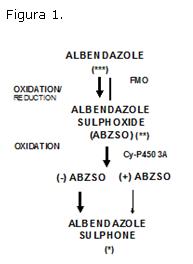
<body><![CDATA[<p class="MsoNormal" style="background: white none repeat scroll 0% 50%; -moz-background-clip: initial; -moz-background-origin: initial; -moz-background-inline-policy: initial; text-align: justify; line-height: 200%;"><b style=""><span style="font-family: &quot;Verdana&quot;,&quot;sans-serif&quot;;" lang="EN-US">Summary<o:p></o:p></span></b></p>         <p class="MsoNormal" style="text-align: justify; line-height: 200%;"><span style="font-size: 10pt; line-height: 200%; font-family: &quot;Verdana&quot;,&quot;sans-serif&quot;;" lang="EN-US">The aim of this work was to evaluate the clinical oral efficacy in dogs of two different single doses (20 mg/kg and 10 mg/kg) of a controlled release (CR) Ricobendazole (RBZ) based formulation formulated within a lipid matrix of Cetyl Alcohol and compare it with those of one single dose RBZ immediate release (IR) formulation (20 mg/kg) and one Albendazole (ABZ) IR formulation (25 mg/kg) (3 consecutive doses q/24 h). Thirty naturally parasitised dogs with <i style="">Ancylostoma caninum </i>and <i style="">Trichuris</i> sp were randomly allocated to five groups (n=6). A pair-sample t- Test (<i style="">p&lt;0.05</i>) and a </span><span style="font-size: 10pt; line-height: 200%; font-family: &quot;Verdana&quot;,&quot;sans-serif&quot;;" lang="EN-US">Kruskall-Wallis - Test posthoc: Mann-Whitney</span><span style="font-size: 10pt; line-height: 200%; font-family: &quot;Verdana&quot;,&quot;sans-serif&quot;;" lang="EN-US"> (<i style="">p&lt;0.05</i>) were performed. The potency and the <em><span style="background: white none repeat scroll 0% 50%; -moz-background-clip: initial; -moz-background-origin: initial; -moz-background-inline-policy: initial; font-family: &quot;Verdana&quot;,&quot;sans-serif&quot;; font-style: normal;">minimum effective dose of RBZ could be related to the high clinical efficacy observed against the gastrointestinal parasite species after the administration of 10 mg/kg. More pharmakinetics assays in order to determine the bioavailabity of RBZ in dogs after the administration of the mentioned dose would be required. No adverse reactions or toxicity were observed in the animals after the administration of the different treatments.<o:p></o:p></span></em></span></p>         <p class="MsoNormal" style="text-align: justify; line-height: 200%;"><span style="font-size: 10pt; line-height: 200%; font-family: &quot;Verdana&quot;,&quot;sans-serif&quot;;" lang="EN-US"><o:p>&nbsp;</o:p></span></p>         <p class="MsoNormal" style="text-align: justify; line-height: 200%;"><b style=""><span style="font-size: 10pt; line-height: 200%; font-family: &quot;Verdana&quot;,&quot;sans-serif&quot;;" lang="EN-US">Keywords:</span></b><span style="font-size: 10pt; line-height: 200%; font-family: &quot;Verdana&quot;,&quot;sans-serif&quot;;" lang="EN-US"> canines, benzimidazoles, modified release systems<o:p></o:p></span></p>         <p class="MsoNormal" style="text-align: justify; line-height: 200%;"><span style="font-size: 10pt; line-height: 200%; font-family: &quot;Verdana&quot;,&quot;sans-serif&quot;; color: red;" lang="EN-US"><o:p>&nbsp;</o:p></span></p>         <p class="MsoNormal" style="text-align: justify; line-height: 200%;"><b style=""><span style="font-size: 14pt; line-height: 200%; font-family: &quot;Verdana&quot;,&quot;sans-serif&quot;;">Introducci&oacute;n<o:p></o:p></span></b></p>         <p class="MsoNormal" style="text-align: justify; line-height: 200%;"><span style="font-size: 10pt; line-height: 200%; font-family: &quot;Verdana&quot;,&quot;sans-serif&quot;;">El tratamiento y el control de los par&aacute;sitos internos en peque&ntilde;os animales, es muy importante dado que afectan su normal desarrollo y crecimiento, pueden producir diarreas severas y disturbios metab&oacute;licos (<a name="-Diez_1999"></a><a href="#Diez_1999">Diez</a>, 1999; <a name="-Soulsby_1987"></a><a href="#Soulsby_1987">Soulsby</a>, 1987). <i style="">Ancylostoma caninum</i> y <i style="">Trichuris</i> sp. son las especies par&aacute;sitas m&aacute;s importantes de nematodes gastrointestinales (GI) del perro adulto en nuestro pa&iacute;s. <o:p></o:p></span></p>         <p class="MsoNormal" style="text-align: justify; line-height: 200%;"><span style="font-size: 10pt; line-height: 200%; font-family: &quot;Verdana&quot;,&quot;sans-serif&quot;;">En la actualidad, son muchas las presentaciones farmacol&oacute;gicas presentes en el mercado veterinario para el combate de estos helmintos par&aacute;sitos. Los benzimidazoles (BZD), son f&aacute;rmacos que han sido incluidos en formulaciones que se usan en todas las especies dom&eacute;sticas, tanto de producci&oacute;n como en animales de compa&ntilde;&iacute;a (<a name="-Campbell_1990"></a><a href="#Campbell_1990">Campbell</a>, 1990). Albendazole (ABZ), es un BZD metil-carbamato efectivo contra especies par&aacute;sitas de nematodes pat&oacute;genos GI y pulmonares, cestodes y trematodes como <i style="">Fasciola hep&aacute;tica</i> (<a href="#Campbell_1990">Campbell</a>, 1990; <a name="-McKellar_1990"></a><a href="#McKellar_1990">McKellar</a>, 1990). En rumiantes, el ABZ es efectivo para el control de formas maduras y larvarias de diferentes especies de nematodes GI de los g&eacute;neros <i style="">Haemonchus, Trichostrongylus, Ostertagia, Cooperia, Nematodirus, Bunostomun, Oesophagostum, Neoascaris, Chabertia, Strongyloides y Trichuris</i>. Adem&aacute;s, nematodes pulmonares del g&eacute;nero <i style="">Dictyocaulus</i> y cestodes como <i style="">Moniezia</i>. En caninos, es indicado para especies del g&eacute;nero <i style="">Toxocara, Ancylostoma, Uncinaria, Stongyloides </i>y <i style="">Trichuris</i> y cestodes como <i style="">Dipylidium y Taenia</i> sp. (<a href="#Campbell_1990">Campbell</a>, 1990). Se ha demostrado la eficacia de ABZ y su metabolito activo sulf&oacute;xido (ABZSO), contra el protozoo <i style="">Giardia duodenalis</i> en humanos (<a name="-Oxberry_y_col_2000"></a><a href="#Oxberry_y_col_2000">Oxberry</a> y col., 2000), as&iacute; como su actividad ovicida contra <i style="">Ascaris summ </i>en la especie suina (<a name="-Belo_y_col_1999"></a><a href="#Belo_y_col_1999">Belo</a> y col., 1999).<o:p></o:p></span></p>         <p class="MsoNormal" style="text-align: justify; line-height: 200%;"><span style="font-size: 10pt; line-height: 200%; font-family: &quot;Verdana&quot;,&quot;sans-serif&quot;;">El metabolito activo ABZSO tambi&eacute;n conocido como Ricobendazole (RBZ), se forma mediante un proceso de oxidaci&oacute;n mediado por la enzima flavin monooxigenasa hep&aacute;tica (<a href="#fig_1">Fig 1</a>). Se encuentra disponible en el mercado veterinario de algunos pa&iacute;ses de Sudam&eacute;rica, excepto Uruguay, como preparados farmac&eacute;uticos en forma de comprimidos ranurados de liberaci&oacute;n inmediata (LI) para administraci&oacute;n oral en dosis &uacute;nica (20 mg/kg) en perros.</span></p>     <p class="MsoNormal" style="text-align: justify; line-height: 200%;"><img style="width: 193px; height: 264px;" alt="" src="/img/revistas/vet/v52n204/n204a02f1.JPG"><a name="fig_1"></a></p>     ]]></body>
<body><![CDATA[<p class="MsoNormal" style="text-align: justify; line-height: 200%;"><span style="font-size: 10pt; line-height: 200%; font-family: &quot;Verdana&quot;,&quot;sans-serif&quot;;"> <o:p></o:p></span></p>         <p class="MsoNormal" style="text-align: justify; line-height: 200%;"><span style="font-size: 10pt; line-height: 200%; font-family: &quot;Verdana&quot;,&quot;sans-serif&quot;;">En los sistemas LI, la liberaci&oacute;n de la sustancia activa no est&aacute; deliberadamente modificada por un dise&ntilde;o de formulaci&oacute;n particular ni por un m&eacute;todo de fabricaci&oacute;n especial. La velocidad de disoluci&oacute;n del principio activo depende de sus propiedades intr&iacute;nsecas y existe siempre un control reducido en la liberaci&oacute;n del principio activo (<a name="-Veiga_y_col_2001"></a><a href="#Veiga_y_col_2001">Veiga</a> y col., 2001). La concentraci&oacute;n que alcanza el sitio de acci&oacute;n, no siempre es igual, lo cual puede redundar en cambios constantes e impredecibles y muchas veces derivar en concentraciones sub o supra terap&eacute;uticas en el sitio de acci&oacute;n (<a name="-Verma_y_Garg_2001"></a><a href="#Verma_y_Garg_2001">Verma</a> y Garg, 2001). La baja solubilidad acuosa de los BZD, puede limitar su absorci&oacute;n durante el tr&aacute;nsito GI, lo cual es particularmente importante en perros, dado su corto tracto GI (<a name="-Garc&iacute;a_Sacrist&aacute;n_y_col_1995"></a><a href="#Garc%EDa_Sacrist%E1n_y_col_1995">Garc&iacute;a</a> Sacrist&aacute;n y col., 1995), comparado al de otras especies dom&eacute;sticas, como por ejemplo rumiantes y equinos (<a name="-Mc_Kellar_y_col_1993"></a><a href="#Mc_Kellar_y_col_1993">Mc</a> Kellar y col., 1993) e incluso al de los seres humanos (<a name="-Ganong_1995"></a><a href="#Ganong_1995">Ganong</a>, 1995). En caninos, un sistema LI en base a BZD, puede pasar a trav&eacute;s del duodeno, que es la porci&oacute;n intestinal con m&aacute;s capacidad de absorci&oacute;n, antes de que pueda producirse la completa disoluci&oacute;n y liberaci&oacute;n del f&aacute;rmaco, afectando por ende su biodisponibilidad. Los sistemas LM, son capaces de mantener y liberar una cantidad de principio activo, en forma predecible y medible durante un per&iacute;odo prolongado de tiempo (<a name="-Choi_y_col_2002"></a><a href="#Choi_y_col_2002">Choi</a> y col., 2002).<o:p></o:p></span></p>         <p class="MsoNormal" style="text-align: justify; line-height: 200%;"><span style="font-size: 10pt; line-height: 200%; font-family: &quot;Verdana&quot;,&quot;sans-serif&quot;;">Se forman cuando un pol&iacute;mero u otro sistema matricial se combina con una f&aacute;rmaco u otro agente farmacol&oacute;gicamente activo, formando una formulaci&oacute;n de la cual el principio activo, se libera en forma predise&ntilde;ada. La base racional de estos sistemas, es la optimizaci&oacute;n de las propiedades biofarmac&eacute;uticas, farmacocin&eacute;ticas y farmacodin&aacute;micas de un f&aacute;rmaco, as&iacute; como el de proveer un control terap&eacute;utico seguro (<a name="-Srikanth_y_Col_2013"></a><a href="#Srikanth_y_Col_2013">Srikanth</a> y col., 2013).<o:p></o:p></span></p>         <p class="MsoNormal" style="text-align: justify; line-height: 200%;"><span style="font-size: 10pt; line-height: 200%; font-family: &quot;Verdana&quot;,&quot;sans-serif&quot;;">En los sistemas LM, la tasa de liberaci&oacute;n del f&aacute;rmaco est&aacute; principalmente controlada por las propiedades f&iacute;sico-qu&iacute;micas del pol&iacute;mero (<a name="-Hjorth_y_Karlsen_2002"></a><a href="#Hjorth_y_Karlsen_2002">Hjorth</a> y Karlsen, 2002; <a name="-Ju&aacute;rez_y_Villafuerte_2011"></a><a href="#Ju%E1rez_y_Villafuerte_2011">Ju&aacute;rez</a> y Villafuerte, 2011), pero adem&aacute;s otros factores como el pH del medio, en el cual se produce la liberaci&oacute;n del principio activo, debe ser tomado en cuenta (<a name="-S&aacute;ez_2004"></a><a href="#S%E1ez_2004">S&aacute;ez</a>, 2004). Por ejemplo, con excipientes formadores de matrices hidrof&iacute;licas, es posible modificar el ambiente de disoluci&oacute;n del f&aacute;rmaco para controlar la velocidad de liberaci&oacute;n, creando un micro-pH en la matriz (<a name="-Costa_y_col_2004"></a><a href="#Costa_y_col_2004">Costa</a> y col, 2004). Por tanto, estos sistemas polim&eacute;ricos, pueden favorecer la liberaci&oacute;n prolongada del f&aacute;rmaco, independientemente de la velocidad de pasaje por el tracto GI. Los materiales usados para el dise&ntilde;o y desarrollo de sistemas LM, pueden ser hidrof&iacute;licos, como por ejemplo la Hidroxipropil metil celulosa y el &Aacute;cido Alg&iacute;nico o lipof&iacute;licos como el Alcohol Cet&iacute;lico y los Gelucires&reg;. <a name="-Dib_y_col_2015"></a><a href="#Dib_y_col_2015">Dib</a> y col. (2015) evaluaron el comportamiento farmacot&eacute;cnico (<i style="">in vitro</i>) y farmacocin&eacute;tico (<i style="">in vivo</i>) de diferentes formulaciones LM, en las cuales se utilizaron los materiales formadores de matriz antes mencionados. <o:p></o:p></span></p>         <p class="MsoNormal" style="text-align: justify; line-height: 200%;"><span style="font-size: 10pt; line-height: 200%; font-family: &quot;Verdana&quot;,&quot;sans-serif&quot;;">El Alcohol Cet&iacute;lico, es ampliamente utilizado en preparaciones farmac&eacute;uticas s&oacute;lidas como comprimidos, formas semis&oacute;lidas, como cremas y ung&uuml;entos y formas l&iacute;quidas como emulsiones y lociones. Alcohol Cet&iacute;lico, es una mezcla s&oacute;lida alif&aacute;tica de alcoholes que comprenden principalmente 1-hexadecanol (C<sub>16</sub>H<sub>30</sub>O) (<a name="-Rowe_y_col_2009"></a><a href="#Rowe_y_col_2009">Rowe</a> y col., 2009). <o:p></o:p></span></p>         <p class="MsoNormal" style="text-align: justify; line-height: 200%;"><span style="font-size: 10pt; line-height: 200%; font-family: &quot;Verdana&quot;,&quot;sans-serif&quot;;">La hip&oacute;tesis de trabajo fue que la formulaci&oacute;n de RBZ LM podr&iacute;a mejorar las propiedades biofarmac&eacute;uticas y optimizar su eficacia antiparasitaria. <o:p></o:p></span></p>         <p class="MsoNormal" style="text-align: justify; line-height: 200%;"><span style="font-size: 10pt; line-height: 200%; font-family: &quot;Verdana&quot;,&quot;sans-serif&quot;;">El objetivo de este trabajo, fue evaluar la eficacia cl&iacute;nica antiparasitaria de dos diferentes dosis (20 mg/kg y 10 mg/kg), de una formulaci&oacute;n en base a RBZ LM, formulada en una matriz lip&iacute;dica con Alcohol Cet&iacute;lico, administradas en dosis &uacute;nica por v&iacute;a oral en perros y comparar dicha eficacia con la de una formulaci&oacute;n en dosis &uacute;nica de RBZ LI (20 mg/kg) y una formulaci&oacute;n de ABZ LI (25 mg/kg) en 3 dosis consecutivas, (sid). <o:p></o:p></span></p>         <p class="MsoNormal" style="text-align: justify; line-height: 200%;"><span style="font-size: 10pt; line-height: 200%; font-family: &quot;Verdana&quot;,&quot;sans-serif&quot;;"><o:p>&nbsp;</o:p></span></p>         <p class="MsoNormal" style="text-align: justify; line-height: 200%;"><b style=""><span style="font-size: 14pt; line-height: 200%; font-family: &quot;Verdana&quot;,&quot;sans-serif&quot;;">Materiales y m&eacute;todos<o:p></o:p></span></b></p>         <p class="MsoNormal" style="text-align: justify; line-height: 200%;"><span style="font-size: 10pt; line-height: 200%; font-family: &quot;Verdana&quot;,&quot;sans-serif&quot;;">Este estudio fue llevado a cabo de acuerdo a la normativa de la Asociaci&oacute;n Mundial para el Avance de la Parasitolog&iacute;a Veterinaria (WAAVP) (<a name="-Jacobs_y_col_1994"></a><a href="#Jacobs_y_col_1994">Jacobs</a> y col., 1994). El protocolo de investigaci&oacute;n se realiz&oacute; siguiendo las normativas y con la aprobaci&oacute;n de la Comisi&oacute;n Honoraria de Experimentaci&oacute;n Animal (CHEA), de la Universidad de la Rep&uacute;blica. <i style=""><o:p></o:p></i></span></p>         ]]></body>
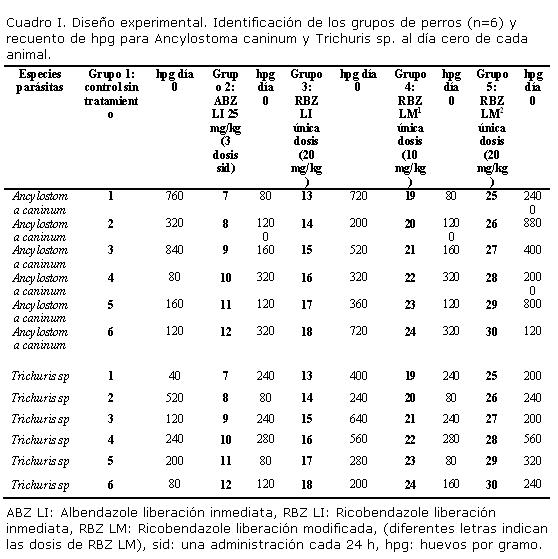
<body><![CDATA[<p class="MsoNormal" style="text-align: justify; line-height: 200%;"><i style=""><span style="font-size: 10pt; line-height: 200%; font-family: &quot;Verdana&quot;,&quot;sans-serif&quot;;">Animales<o:p></o:p></span></i></p>         <p class="MsoNormal" style="text-align: justify; line-height: 200%;"><span style="font-size: 10pt; line-height: 200%; font-family: &quot;Verdana&quot;,&quot;sans-serif&quot;;">Se trabaj&oacute; con perros (n=30) naturalmente parasitados con <i style="">Ancylostoma caninum</i> y <i style="">Trichuris</i> sp. procedentes de un refugio canino del Departamento de Canelones, Uruguay. Los animales, estaban alojados en caniles individuales con piso de cemento y techo de lata, cada canil ten&iacute;a adem&aacute;s una superficie a cielo abierto. Todos los animales estaban quir&uacute;rgicamente esterilizados. Los perros (18 machos y 12 hembras), eran de raza cruza y sus edades estaban comprendidas entre 2 y 10 a&ntilde;os y sus pesos promedios fueron de 25 &plusmn; 5,5 kg. Todos los animales ten&iacute;an acceso libre al agua y eran alimentados con comida de tipo balanceada.<o:p></o:p></span></p>         <p class="MsoNormal" style="text-align: justify; line-height: 200%;"><span style="font-size: 10pt; line-height: 200%; font-family: &quot;Verdana&quot;,&quot;sans-serif&quot;;">Se recogi&oacute; materia fecal de cada perro, desde el piso de su canil, el mismo d&iacute;a de la emisi&oacute;n y se analiz&oacute; con un m&eacute;todo tradicional de flotaci&oacute;n (<a name="-Willis_1921"></a><a href="#Willis_1921">Willis</a>, 1921) y se verific&oacute; la morfolog&iacute;a de los huevos (<!-- big --><a name="-Boch_y_Supperer_1992"></a><!-- /big --><a href="#Boch_y_Supperer_1992">Boch</a> y Supperer, 1992; <a name="-Thienpont_y_col_1979"></a><a href="#Thienpont_y_col_1979">Thienpont</a> y col., 1979). <o:p></o:p></span></p>         <p class="MsoNormal" style="text-align: justify; line-height: 200%;"><i style=""><span style="font-size: 10pt; line-height: 200%; font-family: &quot;Verdana&quot;,&quot;sans-serif&quot;;">Grupo experimentales<o:p></o:p></span></i></p>         <p class="MsoNormal" style="text-align: justify; line-height: 200%;"><span style="font-size: 10pt; line-height: 200%; font-family: &quot;Verdana&quot;,&quot;sans-serif&quot;;">Los animales fueron distribuidos en forma aleatoria en 5 grupos (n = 6 cada uno). Los grupos fueron identificados de la siguiente manera: Grupo 1: control sin tratamiento, Grupo 2: ABZ LI, Grupo 3: RBZ LI, Grupo 4: RBZ LM<sup>1</sup>, Grupo 5: RBZ LM<sup>2</sup>. El valor de huevos por gramo (hpg) de materia fecal al d&iacute;a 0 (pre- tratamiento) en todos los perros, fue de un promedio de 537 para <i style="">Ancylostoma caninum</i> (rango entre 2400 y 80 hpg) y de un promedio de 246 hpg para <i style="">Trichuris</i> sp. (rango entre 640 y 40 hpg). El <a href="#tab_1">Cuadro I</a> muestra el dise&ntilde;o experimental y los valores de hpg al d&iacute;a 0 de todos los animales incluidos en el ensayo. </span></p>         <p class="MsoNormal" style="text-align: justify; line-height: 200%;"><o:p>&nbsp;</o:p></p>     <p class="MsoNormal" style="text-align: justify; line-height: 200%;"><o:p><img style="width: 558px; height: 559px;" alt="" src="/img/revistas/vet/v52n204/n204a02t1.JPG"><a name="tab_1"></a></o:p></p>          <p class="MsoNormal" style="text-align: justify; line-height: 200%;"><o:p></o:p></p>         <p class="MsoNormal" style="text-align: justify; line-height: 200%;"><i style=""><span style="font-size: 10pt; line-height: 200%; font-family: &quot;Verdana&quot;,&quot;sans-serif&quot;;">Formulaciones farmacol&oacute;gicas administradas <o:p></o:p></span></i></p>         <p class="MsoNormal" style="text-align: justify; line-height: 200%;"><span style="font-size: 10pt; line-height: 200%; font-family: &quot;Verdana&quot;,&quot;sans-serif&quot;;">Las formulaciones en forma de comprimidos ranurados administradas por v&iacute;a oral a los animales fueron: una formulaci&oacute;n experimental en base a RBZ LM con una matriz lip&iacute;dica de Alcohol Cet&iacute;lico, una formulaci&oacute;n experimental en base a RBZ LI y una formulaci&oacute;n comercial en base a ABZ LI (Prazibek&reg;, Vetcross). <o:p></o:p></span></p>         ]]></body>
<body><![CDATA[<p class="MsoNormal" style="text-align: justify; line-height: 200%;"><span style="font-size: 10pt; line-height: 200%; font-family: &quot;Verdana&quot;,&quot;sans-serif&quot;;">El dise&ntilde;o, formulaci&oacute;n y evaluaci&oacute;n farmacot&eacute;cnica de todas las formulaciones experimentales en base a RBZ usadas en este trabajo, se hizo en el Departamento de Farmacia de la Facultad de Ciencias Qu&iacute;micas, UNITEFA, Universidad Nacional de C&oacute;rdoba, Argentina (<a href="#Dib_y_col_2015">Dib</a> y col., 2015). <span style="color: red;"><o:p></o:p></span></span></p>         <p class="MsoNormal" style="text-align: justify; line-height: 200%;"><i style=""><span style="font-size: 10pt; line-height: 200%; font-family: &quot;Verdana&quot;,&quot;sans-serif&quot;;">Administraci&oacute;n de las formulaciones y toma de muestras fecales post-administraci&oacute;n<o:p></o:p></span></i></p>         <p class="MsoNormal" style="text-align: justify; line-height: 200%;"><span style="font-size: 10pt; line-height: 200%; font-family: &quot;Verdana&quot;,&quot;sans-serif&quot;;">Los perros positivos incluidos en este trabajo, fueron sometidos a un ayuno de 12 horas previo a la administraci&oacute;n de los tratamientos farmacol&oacute;gicos. <o:p></o:p></span></p>         <p class="MsoNormal" style="text-align: justify; line-height: 200%;"><span style="font-size: 10pt; line-height: 200%; font-family: &quot;Verdana&quot;,&quot;sans-serif&quot;;">Se tom&oacute; materia fecal de cada perro, el mismo d&iacute;a de su emisi&oacute;n desde el piso de su canil a los d&iacute;as 1, 2, 3, 7, 14 y 30, post- administraci&oacute;n de la &uacute;ltima dosis de cada formulaci&oacute;n. La toma de muestras se hizo en forma manual, con la protecci&oacute;n de guantes descartables, se utiliz&oacute; un guante diferente para cada animal. Cada muestra fecal, se guard&oacute; en heladera (4&deg;C), en frascos debidamente rotulados hasta su an&aacute;lisis parasitol&oacute;gico. <o:p></o:p></span></p>         <p class="MsoNormal" style="text-align: justify; line-height: 200%;"><span style="font-size: 10pt; line-height: 200%; font-family: &quot;Verdana&quot;,&quot;sans-serif&quot;;">Se utiliz&oacute; una t&eacute;cnica de flotaci&oacute;n de Willis (<a href="#Willis_1921">Willis</a>, 1921) y una t&eacute;cnica McMaster (<a href="#-Thienpont_y_col_1979">Thienpont</a>, 1979). El an&aacute;lisis de todas las muestras fecales, se realiz&oacute; en el Departamento de Parasitolog&iacute;a de la Facultad de Veterinaria, Universidad de la Rep&uacute;blica.<o:p></o:p></span></p>         <p class="MsoNormal" style="text-align: justify; line-height: 200%;"><i style=""><span style="font-size: 10pt; line-height: 200%; font-family: &quot;Verdana&quot;,&quot;sans-serif&quot;;">Bioqu&iacute;mica sangu&iacute;nea y hematol&oacute;gica<o:p></o:p></span></i></p>         <p class="MsoNormal" style="text-align: justify; line-height: 200%;"><span style="font-size: 10pt; line-height: 200%; font-family: &quot;Verdana&quot;,&quot;sans-serif&quot;;">Se evalu&oacute; actividad enzim&aacute;tica (alanino amino transferasa ALT, aspartato aminotransferasa, AST y fosfatasa alcalina, ALP), a las 24 horas previas y a las 48 horas posteriores a la administraci&oacute;n de la &uacute;ltima dosis de cada formulaci&oacute;n farmacol&oacute;gica. Para ello, se recolectaron muestras sangu&iacute;neas (5 ml), de la vena cef&aacute;lica antebraquial de cada perro utilizando mariposa y jeringa 18G. La sangre extra&iacute;da, se introdujo inmediatamente en tubos est&eacute;riles BD Vacutainer&reg; identificados para tal fin y se almacen&oacute; en heladera (4&deg;C), hasta su posterior an&aacute;lisis. El mismo, se realiz&oacute; dentro de las 24 h posteriores a la extracci&oacute;n, en el Laboratorio de An&aacute;lisis Cl&iacute;nicos de la Facultad de Veterinaria, UdelaR. Se utiliz&oacute; un equipo <i style="">CB 350i Wiener Lab group </i>Italia, mediante el m&eacute;todo de acuerdo a la Federaci&oacute;n Internacional de Qu&iacute;mica Cl&iacute;nica (IFCC).<o:p></o:p></span></p>         <p class="MsoNormal" style="text-align: justify; line-height: 200%;"><i style=""><span style="font-size: 10pt; line-height: 200%; font-family: &quot;Verdana&quot;,&quot;sans-serif&quot;;">Eficacia cl&iacute;nica parasitol&oacute;gica<o:p></o:p></span></i></p>         <p class="MsoNormal" style="text-align: justify; line-height: 200%;"><span style="font-size: 10pt; line-height: 200%; font-family: &quot;Verdana&quot;,&quot;sans-serif&quot;;">El test de reducci&oacute;n de conteo de huevos (TRCH), de cada especie de par&aacute;sito en cada perro, fue determinado por la siguiente f&oacute;rmula:</span><span style="font-family: &quot;Verdana&quot;,&quot;sans-serif&quot;;"><o:p></o:p></span></p>         <p class="MsoNormal"><o:p>&nbsp;</o:p></p>      ]]></body>
<body><![CDATA[<p class="MsoNormal"><o:p><img style="width: 533px; height: 72px;" alt="" src="/img/revistas/vet/v52n204/n204a02z1.JPG"></o:p></p>         <p class="MsoNormal"><o:p>&nbsp;</o:p></p>         <p class="MsoNormal" style="text-align: justify; line-height: 200%;"><span style="font-size: 10pt; line-height: 200%; font-family: &quot;Verdana&quot;,&quot;sans-serif&quot;;">Los animales fueron rutinariamente observados por personal experimentado, durante varias horas post- tratamiento, para reportar la aparici&oacute;n de posibles reacciones adversas.<o:p></o:p></span></p>         <p class="MsoNormal" style="text-align: justify;"><i style=""><span style="font-size: 10pt; font-family: &quot;Verdana&quot;,&quot;sans-serif&quot;;">An&aacute;lisis estad&iacute;stico<o:p></o:p></span></i></p>            <p class="MsoNormal" style="text-align: justify; line-height: 200%;"><span style="font-size: 10pt; line-height: 200%; font-family: &quot;Verdana&quot;,&quot;sans-serif&quot;;">Se utiliz&oacute; el test t (p&lt;0,05), para muestras pareadas para evaluar la eficacia cl&iacute;nica de RBZ LM en dos dosis diferentes (10 mg/kg y 20 mg/kg), dado que se midieron los valores de hpg y TRCH de cada grupo de perros a diferentes tiempos, compar&aacute;ndolos con los respectivos valores de hpg al d&iacute;a 0. <o:p></o:p></span></p>         <p class="MsoNormal" style="text-align: justify; line-height: 200%;"><span style="font-size: 10pt; line-height: 200%; font-family: &quot;Verdana&quot;,&quot;sans-serif&quot;;">Se us&oacute; el test de Kruskal-Wallis &ndash; Test posthoc: Mann-Whitney (p&lt; 0,05), para comparar las eficacias cl&iacute;nicas entre las diferentes formulaciones utilizadas, ya que los diferentes grupos de perros, que fueron seleccionados aleatoriamente, presentaron contajes muy dispares mostrando alta heterogeneidad. <o:p></o:p></span></p>         <p class="MsoNormal" style="text-align: justify; line-height: 200%;"><span style="font-size: 10pt; line-height: 200%; font-family: &quot;Verdana&quot;,&quot;sans-serif&quot;;">Se utiliz&oacute; el test t (p&lt;0,05) para muestras pareadas para evaluar la significancia estad&iacute;stica entre los valores de la bioqu&iacute;mica sangu&iacute;nea previo y post administraci&oacute;n para cada animal. <o:p></o:p></span></p>         <p class="MsoNormal" style="text-align: justify; line-height: 200%;"><span style="font-size: 10pt; line-height: 200%; font-family: &quot;Verdana&quot;,&quot;sans-serif&quot;;">Todos los datos estad&iacute;sticos, se examinaron utilizando el software gratuito Past 3.07 (<a name="-Hammer_y_col_2001"></a><a href="#Hammer_y_col_2001">Hammer</a> y col., 2001).<o:p></o:p></span></p>         <p class="MsoNormal" style="text-align: justify; line-height: 200%;"><b style=""><span style="font-size: 10pt; line-height: 200%; font-family: &quot;Verdana&quot;,&quot;sans-serif&quot;;"><o:p>&nbsp;</o:p></span></b></p>         <p class="MsoNormal" style="text-align: justify; line-height: 200%;"><b style=""><span style="font-size: 14pt; line-height: 200%; font-family: &quot;Verdana&quot;,&quot;sans-serif&quot;;">Resultados<o:p></o:p></span></b></p>         ]]></body>
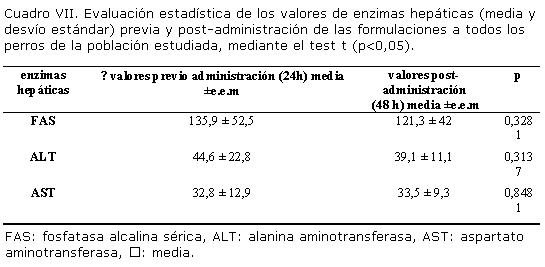
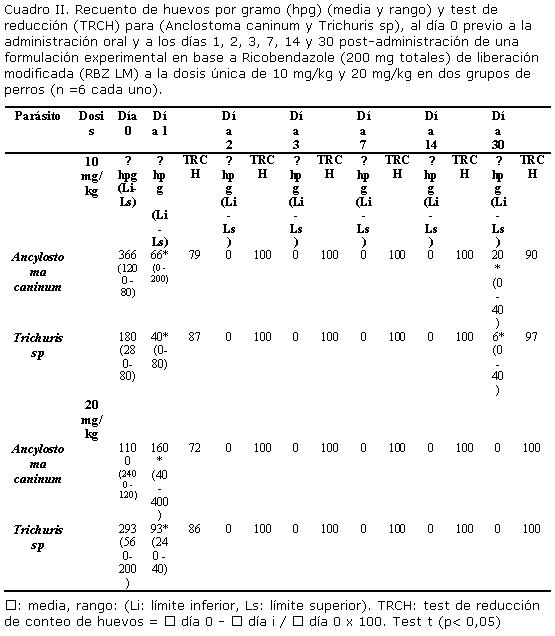
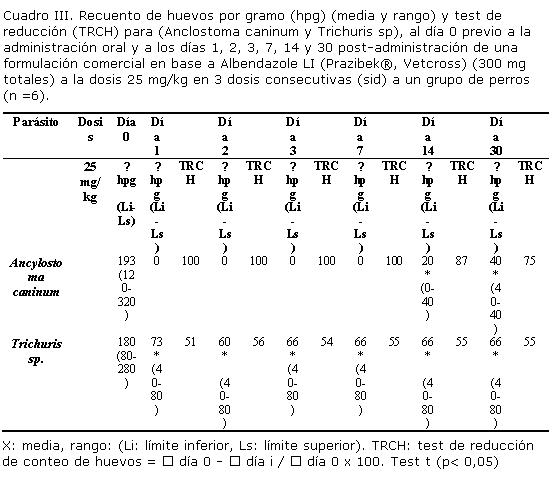
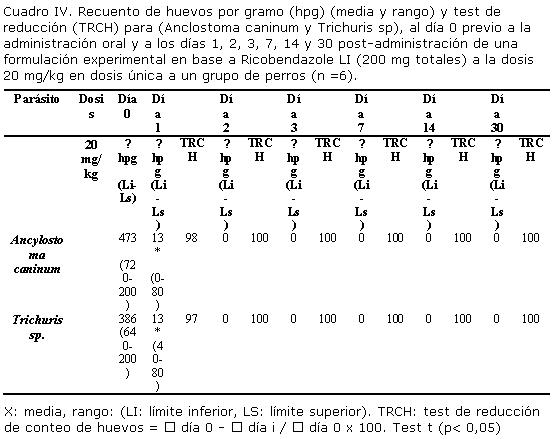
<body><![CDATA[<p class="MsoNormal" style="text-align: justify; line-height: 200%;"><span style="font-size: 10pt; line-height: 200%; font-family: &quot;Verdana&quot;,&quot;sans-serif&quot;;">Los animales no presentaron signos de toxicidad a las dosis utilizadas, la constituci&oacute;n de los comprimidos demostr&oacute; ser f&aacute;cilmente fraccionable para administrar dichas dosis. Ning&uacute;n animal present&oacute; dificultades para ingerir los comprimidos ni tampoco se produjo regurgitaci&oacute;n. <o:p></o:p></span></p>         <p class="MsoNormal" style="text-align: justify; line-height: 200%;"><span style="font-size: 10pt; line-height: 200%; font-family: &quot;Verdana&quot;,&quot;sans-serif&quot;;">Los cuadros <a href="#tab_2">II</a>, <a href="#tab_3">III</a> y <a href="#tab_4">IV</a>, muestran los recuentos de hpg (media y rango) y TRCH para <i style="">Ancylostoma caninum</i> y <i style="">Trichuris</i> sp. al d&iacute;a cero previo a la administraci&oacute;n y a los d&iacute;as 1, 2, 3, 7 y 30 post-administraci&oacute;n de las diferentes formulaciones, a los distintos grupos de perros de la poblaci&oacute;n de estudio, as&iacute; como su significancia estad&iacute;stica (l&iacute;mites de confianza del 95%), mediante el test t (p&lt; 0,05).<o:p></o:p></span></p>             <p class="MsoNormal" style="text-align: justify; line-height: 200%;"><o:p></o:p></p>     <p class="MsoNormal" style="text-align: justify; line-height: 200%;"><o:p><img style="width: 555px; height: 636px;" alt="" src="/img/revistas/vet/v52n204/n204a02t2.JPG"><a name="tab_2"></a></o:p></p>         <p class="MsoNormal" style="text-align: justify; line-height: 200%;"><o:p>&nbsp;</o:p></p>         <p class="MsoNormal" style="text-align: justify; line-height: 200%;"><o:p>&nbsp;<img style="width: 554px; height: 477px;" alt="" src="/img/revistas/vet/v52n204/n204a02t3.JPG"><a name="tab_3"></a></o:p></p>         <p class="MsoNormal" style="text-align: justify; line-height: 200%;"><o:p>&nbsp;</o:p></p>     <p class="MsoNormal" style="text-align: justify; line-height: 200%;"><o:p><img style="width: 553px; height: 439px;" alt="" src="/img/revistas/vet/v52n204/n204a02t4.JPG"><a name="tab_4"></a></o:p></p>         <p class="MsoNormal" style="text-align: justify; line-height: 200%;"><o:p>&nbsp;</o:p></p>         <p class="MsoNormal" style="text-align: justify; line-height: 200%;"><span style="font-size: 10pt; line-height: 200%; font-family: &quot;Verdana&quot;,&quot;sans-serif&quot;;">Los recuentos de hpg, fueron negativos al d&iacute;a 2 post tratamiento para las formulaciones en base a RBZ LM (10 mg/kg y 20 mg/kg). Sin embargo, se observ&oacute; una TRCH de 90% y 97% para <i style="">Ancylostoma caninum</i> y <i style="">Trichuris</i> sp. respectivamente al d&iacute;a 30 post administraci&oacute;n de la formulaci&oacute;n en base a RBZ LM administrada a 10 mg/kg (<a href="#tab_2">Cuadro II</a>).<o:p></o:p></span></p>         ]]></body>
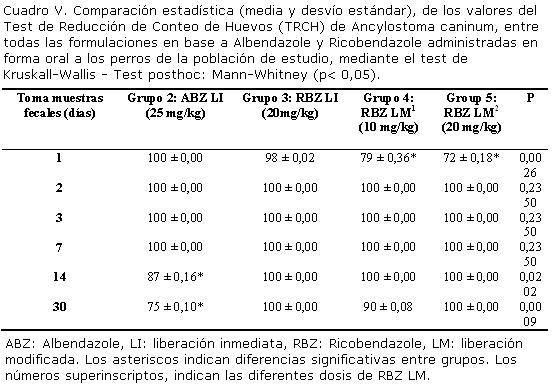
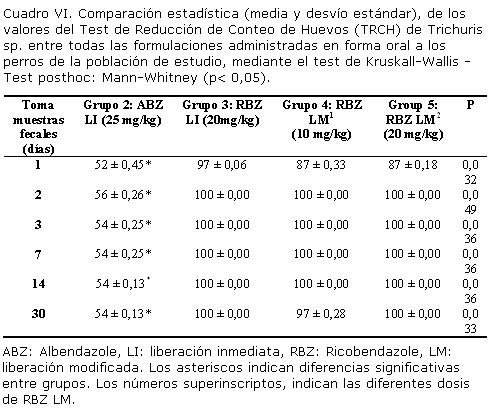
<body><![CDATA[<p class="MsoNormal" style="text-align: justify; line-height: 200%;"><span style="font-size: 10pt; line-height: 200%; font-family: &quot;Verdana&quot;,&quot;sans-serif&quot;;">En referencia a la formulaci&oacute;n comercial de ABZ, se observ&oacute; una eficacia antiparasitaria del 100% para <i style="">Ancylostoma caninum</i> desde el d&iacute;a 1 hasta el d&iacute;a 7 post-administraci&oacute;n, sin embargo a los d&iacute;as 14 y 30 la eficacia antiparasitaria, disminuy&oacute; a 87% y 75% respectivamente. El TRCH para <i style="">Trichuris</i> sp, no super&oacute; el 56% durante todo el ensayo experimental (<a href="#tab_3">Cuadro III</a>). <o:p></o:p></span></p>         <p class="MsoNormal" style="text-align: justify; line-height: 200%;"><span style="font-size: 10pt; line-height: 200%; font-family: &quot;Verdana&quot;,&quot;sans-serif&quot;;">La formulaci&oacute;n RBZ LI (20 mg/kg), demostr&oacute; una efectividad del 100% al primer d&iacute;a post-administraci&oacute;n, la cual se mantuvo durante todo el ensayo (<a href="#tab_4">Cuadro IV</a>).<o:p></o:p></span></p>         <p class="MsoNormal" style="text-align: justify; line-height: 200%;"><span style="font-size: 10pt; line-height: 200%; font-family: &quot;Verdana&quot;,&quot;sans-serif&quot;;">Los Cuadros <a href="#tab_5">V</a> y <a href="#tab_6">VI</a>, comparan los TRCH de las diferentes formulaciones administradas a los perros participantes en el ensayo, contra <i style="">Ancylostoma caninun</i> y <i style="">Trichuris</i> sp. respectivamente, as&iacute; como su significancia estad&iacute;stica (p&lt;0,05). <o:p></o:p></span></p>         <p class="MsoNormal" style="text-align: justify; line-height: 200%;"><o:p>&nbsp;</o:p></p>         <p class="MsoNormal" style="text-align: justify; line-height: 200%;"><o:p>&nbsp;<img style="width: 552px; height: 390px;" alt="" src="/img/revistas/vet/v52n204/n204a02t5.JPG"><a name="tab_5"></a></o:p></p>         <p class="MsoNormal" style="text-align: justify; line-height: 200%;"><o:p>&nbsp;</o:p></p>     <p class="MsoNormal" style="text-align: justify; line-height: 200%;"><o:p><img style="width: 491px; height: 413px;" alt="" src="/img/revistas/vet/v52n204/n204a02t6.JPG"><a name="tab_6"></a></o:p></p>         <p class="MsoNormal" style="text-align: justify; line-height: 200%;"><o:p>&nbsp;</o:p></p>         <p class="MsoNormal" style="text-align: justify; line-height: 200%;"><span style="font-size: 10pt; line-height: 200%; font-family: &quot;Verdana&quot;,&quot;sans-serif&quot;;">El <a href="#tab_7">Cuadro VII</a> muestra la comparaci&oacute;n estad&iacute;stica mediante el test t (p&lt;0,05), entre la media de los valores de enzimas hep&aacute;ticas (FAS, ALT y AST), medidos en todos los perros de la poblaci&oacute;n, a las 24 horas pre-administraci&oacute;n y a las 48 horas post administraci&oacute;n de todas las formulaciones farmac&eacute;uticas. No se observaron diferencias estad&iacute;sticas en los tiempos estudiados. <o:p></o:p></span></p>         <p class="MsoBodyText" style="text-align: left; line-height: 200%;" align="left"><b style=""><span style="color: windowtext;"><o:p>&nbsp;</o:p></span></b></p>     ]]></body>
<body><![CDATA[<p class="MsoBodyText" style="text-align: left; line-height: 200%;" align="left"><b style=""><span style="color: windowtext;"><o:p><img style="width: 545px; height: 267px;" alt="" src="/img/revistas/vet/v52n204/n204a02t7.JPG"><a name="tab_7"></a></o:p></span></b></p>         <p class="MsoBodyText" style="text-align: left; line-height: 200%;" align="left"><span style="color: windowtext;"><o:p>&nbsp;</o:p></span></p>         <p class="MsoNormal" style="text-align: justify; line-height: 200%;"><b style=""><span style="font-size: 14pt; line-height: 200%; font-family: &quot;Verdana&quot;,&quot;sans-serif&quot;;">Discusi&oacute;n<o:p></o:p></span></b></p>         <p class="MsoNormal" style="text-align: justify; line-height: 200%;"><span style="font-size: 10pt; line-height: 200%; font-family: &quot;Verdana&quot;,&quot;sans-serif&quot;;">Los tiempos de aparici&oacute;n de los efectos farmacol&oacute;gicos, pueden variar seg&uacute;n la v&iacute;a de administraci&oacute;n utilizada y las caracter&iacute;sticas f&iacute;sico-qu&iacute;micas y biofarmac&eacute;uticas del f&aacute;rmaco. Entre el tiempo que transcurre desde la administraci&oacute;n y la aparici&oacute;n de los efectos farmacol&oacute;gicos, el principio activo debe atravesar diferentes barreras biol&oacute;gicas. Este pasaje, va a depender no solamente de las propiedades f&iacute;sico-qu&iacute;micas de la mol&eacute;cula administrada, sino tambi&eacute;n de la naturaleza de dichas barreras (<a name="-S&aacute;nchez_Bruni_y_col_2006"></a><a href="#S%E1nchez_Bruni_y_col_2006">S&aacute;nchez</a> Bruni y col., 2006). La baja solubilidad de los BZD, puede limitar la liberaci&oacute;n, la absorci&oacute;n y por ende la biodisponibilidad del f&aacute;rmaco administrado durante su tr&aacute;nsito por el GI (<a href="#McKellar_1990">McKellar</a> y col., 1990; <a href="#Mc_Kellar_y_col_1993">Mc</a> Kellar y col., 1993). Una dosis terap&eacute;utica convencional de ABZ por v&iacute;a oral (25 mg kg cada 24hs) durante 3 a 5 d&iacute;as (<a href="#Campbell_1990">Campbell</a>, 1990), ha sido indicada en perros para alcanzar concentraciones plasm&aacute;ticas estables de la droga, debido a su baja solubilidad (0,01 mg/ml) (<a name="-Galia_y_col_1999"></a><a href="#Galia_y_col_1999">Galia</a> y col., 1999) y al corto tr&aacute;nsito GI de esta especie, a diferencia del de las especies rumiantes. En estas especies los BZD se administran en &uacute;nica dosis por v&iacute;a oral, sufren un efecto reservorio a nivel ruminal, un atrapamiento i&oacute;nico en el abomaso y un pasaje lento del principio activo al intestino, donde se producir&aacute; su absorci&oacute;n (<a name="-Lanusse_y_Pritchard_1993"></a><a href="#Lanusse_y_Pritchard_1993">Lanusse</a> y Pritchard, 1993).<o:p></o:p></span></p>         <p class="MsoNormal" style="text-align: justify; line-height: 200%;"><span style="font-size: 10pt; line-height: 200%; font-family: &quot;Verdana&quot;,&quot;sans-serif&quot;;"><a name="-Hollenwegger_y_col_1987"></a><a href="#Hollenwegger_y_col_1987">Hollenwegger</a> y col. (1987), evaluaron la eficacia antiparasitaria de una formulaci&oacute;n comercial de ABZ contra nematodes GI en perros, administrada por v&iacute;a oral en tres diferentes dosis (10, 20 y 30 mg/kg). En ese trabajo, se obtuvieron recuentos negativos de huevos de <i style="">Ancylostoma caninum</i> y <i style="">Trichuris</i> sp. a la dosis de 30 mg/kg. Sin embargo, en dicho trabajo, el producto se utiliz&oacute; en forma extra-r&oacute;tulo, ya que su presentaci&oacute;n era en forma de suspensi&oacute;n para toma oral, indicada para la especie ovina. <o:p></o:p></span></p>         <p class="MsoNormal" style="text-align: justify; line-height: 200%;"><span style="font-size: 10pt; line-height: 200%; font-family: &quot;Verdana&quot;,&quot;sans-serif&quot;;">La solubilidad del RBZ es mayor (0,062 mg/ml) (<a name="-Wu_y_col_2005"></a><a href="#Wu_y_col_2005">Wu</a> y col., 2005), que la de ABZ. Esta mol&eacute;cula se encuentra formulada en productos comerciales LI para perros, en forma de comprimidos de administraci&oacute;n oral en &uacute;nica dosis (20 mg/kg), que contienen 200 mg totales de RBZ por cada comprimido. La indicaci&oacute;n terap&eacute;utica del laboratorio de referencia (AFFORD S.A., Argentina), es de administrar un comprimido cada 10 kgs de peso vivo, como se indica en su producto APTOMAX&reg;, el cual est&aacute; registrado en el Servicio Nacional de Sanidad y Calidad Agroalimentaria (<a name="-SENASA"></a><a href="#SENASA">SENASA</a>) de la Rep&uacute;blica Argentina, con el n&uacute;mero 04-133 (<a href="#SENASA">senasa</a>.gov.ar). <a name="-Saumell_y_col_2006"></a><a href="#Saumell_y_col_2006">Saumell</a> y col. (2006), evaluaron la eficacia cl&iacute;nica parasitol&oacute;gica de dicho producto comercial en perros, administr&aacute;ndolo a la dosis indicada de 20 mg/kg. En ese trabajo, se obtuvo un recuento negativo de huevos de <i style="">Ancylostoma caninun</i> y <i style="">Trichuris</i> sp. al d&iacute;a 4 post-dosificaci&oacute;n. <o:p></o:p></span></p>         <p class="MsoNormal" style="text-align: justify; line-height: 200%;"><span style="font-size: 10pt; line-height: 200%; font-family: &quot;Verdana&quot;,&quot;sans-serif&quot;;">En el presente trabajo, se evalu&oacute; la eficacia cl&iacute;nica de una formulaci&oacute;n experimental en base a RBZ LM, formulada en una matriz lip&iacute;dica con Alcohol Cet&iacute;lico, dado que la hip&oacute;tesis, afirmaba que la modulaci&oacute;n de la liberaci&oacute;n del principio activo RBZ por parte de dicha matriz, optimizar&iacute;a su eficacia antiparasitaria y sus propiedades biofarmac&eacute;uticas.<o:p></o:p></span></p>         <p class="MsoNormal" style="text-align: justify; line-height: 200%;"><span style="font-size: 10pt; line-height: 200%; font-family: &quot;Verdana&quot;,&quot;sans-serif&quot;;">La formulaci&oacute;n experimental en base a RBZ LM con Alcohol Cet&iacute;lico utilizada en este estudio, fue la que exhibi&oacute; el mejor perfil farmacocin&eacute;tico como liberaci&oacute;n modificada <i style="">in vivo,</i> cuando fue comparada con otras formulaciones experimentales en base a RBZ LM testadas por <a href="#Dib_y_col_2015">Dib</a> y col. (2015). En ese trabajo, se demostr&oacute; que el tiempo de aparici&oacute;n del pico plasm&aacute;tico (Tmax) de la formulaci&oacute;n en base a RBZ LM con Alcohol Cet&iacute;lico, fue mayor que el de otras formulaciones experimentales en base a RBZ LM y RBZ LI. <o:p></o:p></span></p>         <p class="MsoNormal" style="text-align: justify; line-height: 200%;"><span style="font-size: 10pt; line-height: 200%; font-family: &quot;Verdana&quot;,&quot;sans-serif&quot;;">En el presente estudio, se evidenci&oacute; que ambas dosis (10 mg/kg y 20 mg/kg) de la formulaci&oacute;n RBZ LM con Alcohol Cet&iacute;lico, alcanzaron un TRCH del 100% contra <i style="">Ancylostoma caninum </i>y del 96% contra <i style="">Trichuris</i> sp. al d&iacute;a 2 post- administraci&oacute;n, mientras que la formulaci&oacute;n en base a RBZ LI, obtuvo un TRCH cercano al 100% contra ambos par&aacute;sitos GI al d&iacute;a 1 post-administraci&oacute;n. <o:p></o:p></span></p>         <p class="MsoNormal" style="text-align: justify; line-height: 200%;"><span style="font-size: 10pt; line-height: 200%; font-family: &quot;Verdana&quot;,&quot;sans-serif&quot;;">Este resultado, sugiri&oacute; que la matriz lip&iacute;dica con Alcohol Cet&iacute;lico de la formulaci&oacute;n experimental en base a RBZ LM, pudo demorar la aparici&oacute;n de la m&aacute;xima eficacia cl&iacute;nica antiparasitaria observada, tanto luego de la administraci&oacute;n de la dosis completa convencional (20 mg/kg), como luego de la administraci&oacute;n de la mitad (10 mg/kg) de dicha dosis, lo cual no se consider&oacute; una desventaja desde el punto de vista cl&iacute;nico. Se sugiri&oacute; la existencia de un paralelismo entre el tiempo de aparici&oacute;n de la m&aacute;xima eficacia cl&iacute;nica de esta formulaci&oacute;n experimental con su perfil farmacocin&eacute;tico (Tmax) observado <i style="">in vivo </i>por <a href="#Dib_y_col_2015">Dib</a> y col., (2015). <o:p></o:p></span></p>         ]]></body>
<body><![CDATA[<p class="MsoNormal" style="text-align: justify; line-height: 200%;"><span style="font-size: 10pt; line-height: 200%; font-family: &quot;Verdana&quot;,&quot;sans-serif&quot;;">Los autores consideraron interesante observar, que la elevada eficacia cl&iacute;nica antiparasitaria observada luego de la administraci&oacute;n de la dosis de 10 mg/kg de la formulaci&oacute;n experimental con Alcohol Cet&iacute;lico, podr&iacute;a estar relacionada con la potencia del principio activo, dado que aunque la cantidad de f&aacute;rmaco que lleg&oacute; a los par&aacute;sitos fue menor, igualmente se obtuvo una elevada eficacia antiparasitaria. Esto supuso que la mol&eacute;cula RBZ, podr&iacute;a tener una dosis efectiva m&iacute;nima m&aacute;s baja que la dosis convencional. Sin embargo, esto deber&aacute; ser confirmado mediante la evaluaci&oacute;n farmacocin&eacute;tica correspondiente con dicha dosis. <o:p></o:p></span></p>         <p class="MsoNormal" style="text-align: justify; line-height: 200%;"><span style="font-size: 10pt; line-height: 200%; font-family: &quot;Verdana&quot;,&quot;sans-serif&quot;;">Es preciso destacar que <a name="-Dib_y_col_2010"></a><a href="#Dib_y_col_2010">Dib</a> y col., (2010), demostraron que una &uacute;nica dosis oral convencional (20 mg/kg), de la misma formulaci&oacute;n experimental en base a RBZ LI que se us&oacute; en el presente trabajo, alcanz&oacute; un 500% de m&aacute;s alta biodisponibilidad plasm&aacute;tica, que una dosis convencional (25 mg/kg), de una formulaci&oacute;n experimental en base a ABZ LI administrada tambi&eacute;n en &uacute;nica dosis. Por tanto, cabe considerar que la administraci&oacute;n de la mitad de la dosis convencional de RBZ, podr&iacute;a mejorar el margen de seguridad para esta mol&eacute;cula, basado en su comportamiento farmacocin&eacute;tico. <o:p></o:p></span></p>         <p class="MsoNormal" style="text-align: justify; line-height: 200%;"><span style="font-size: 10pt; line-height: 200%; font-family: &quot;Verdana&quot;,&quot;sans-serif&quot;;">Los perros utilizados en el presente trabajo, no presentaron signos de toxicidad a las dosis administradas de las formulaciones experimentales en base a RBZ o de la formulaci&oacute;n comercial en base a ABZ. Tampoco se encontr&oacute; diferencia significativa en los valores de enzimas hep&aacute;ticas de los perros de la poblaci&oacute;n de estudio, luego del an&aacute;lisis de los resultados bioqu&iacute;micos, previa y post-administraci&oacute;n de las formulaciones (<a href="#tab_7">Cuadro VII</a>). El inter&eacute;s de realizar este estudio bioqu&iacute;mico, fue dado por la extensa metabolizaci&oacute;n en segundo pasaje hep&aacute;tico, que sufre la mol&eacute;cula RBZ hacia su metabolito inactivo sulfona (<a href="#fig_1">Figura 1</a>). </span></p>         <p class="MsoNormal" style="text-align: justify; line-height: 200%;"><span style="font-size: 10pt; line-height: 200%; font-family: &quot;Verdana&quot;,&quot;sans-serif&quot;;">Secuencia metab&oacute;lica propuesta para ABZ y sus metabolitos. Los procesos de oxidaci&oacute;n son mediados por la enzima flavin-monoxigenasa (FMO) y citocromo- P450 (CY-P450 3A). Paso enantiom&eacute;rico del metabolito activo sulf&oacute;xido (ABZSO) o Ricobendazole (RBZ): los enantiomeros (-) y (+) en caninos fueron demostrados por <a name="-Delatour_y_col_1990"></a><a href="#Delatour_y_col_1990">Delatour</a> y col., (1990). La potencia antihelm&iacute;ntica de la droga madre y metabolitos est&aacute;n representados como: (*) muy pobre o sin actividad, (**) buena actividad y (***) muy buena actividad. Adaptado de <a href="#S%E1nchez_Bruni_y_col_2006">S&aacute;nchez</a> Bruni y col., (2006).<o:p></o:p></span></p>         <p class="MsoNormal" style="text-align: justify; line-height: 200%;"><span style="font-size: 10pt; line-height: 200%; font-family: &quot;Verdana&quot;,&quot;sans-serif&quot;;">Se ha estudiado que los medicamentos, pueden presentar reacciones adversas o t&oacute;xicas inesperadas, por lo que la farmacovigilancia continuada es necesaria una vez que los productos se registran para su venta (<a name="Batalha_1997"></a><a href="#-Batalha_1997">Batalha</a>, 1997). No se encontraron a la fecha del presente ensayo, trabajos cient&iacute;ficos que hubieran estudiado la toxicidad aguda de RBZ en animales de experimentaci&oacute;n o reportes de notificaciones adversas o t&oacute;xicas de perros tratados con esta mol&eacute;cula. Sin embargo, los trabajos publicados sobre toxicidad aguda y valores de dosis letal 50 (DL50), del f&aacute;rmaco madre ABZ en animales de experimentaci&oacute;n, indican que la DL50 de ABZ en ratas por v&iacute;a oral, oscila entre 1.320 a 2.400 mg/kg <span style="background: white none repeat scroll 0% 50%; -moz-background-clip: initial; -moz-background-origin: initial; -moz-background-inline-policy: initial;">(<a name="-Dayan_2003"></a><a href="#Dayan_2003">Dayan</a><span class="author">, 2003).</span></span> <a name="-Stokol_y_col_1997"></a><a href="#Stokol_y_col_1997">Stokol</a> y col., (1997), indicaron que una dosis de <span style="background: white none repeat scroll 0% 50%; -moz-background-clip: initial; -moz-background-origin: initial; -moz-background-inline-policy: initial;">30 a 40&nbsp;mg/kg de ABZ durante 4 a 90 d&iacute;as en perros, caus&oacute; anemia reversible, leucopenia y p&eacute;rdida de peso. Tambi&eacute;n, observaron</span> que un perro desarroll&oacute; toxicidad de la m&eacute;dula &oacute;sea, luego de la administraci&oacute;n de ABZ (25 mg/kg, c/24 hs) durante 5 d&iacute;as, seguido por la administraci&oacute;n de 50 mg/kg <i style="">per os</i> cada 12 hs durante 5 d&iacute;as. Los resultados observados por <a href="#Stokol_y_col_1997">Stoko</a>l y col., (1997), permiten evidenciar que las reacciones adversas que se detallaron en los animales de ese estudio, pudieron ser debidas a que los perros recibieron durante varios d&iacute;as, dosis superiores a la dosis terap&eacute;utica convencional.<o:p></o:p></span></p>         <p class="MsoNormal" style="text-align: justify; line-height: 200%;"><span style="font-size: 10pt; line-height: 200%; font-family: &quot;Verdana&quot;,&quot;sans-serif&quot;;">La eficacia parasitol&oacute;gica de la formulaci&oacute;n comercial en base a ABZ LI fue del 100% al d&iacute;a 1 contra <i style="">Ancylostoma caninum, </i>la cual se mantuvo hasta el d&iacute;a 7, sin embargo se observ&oacute; un recuento del 87%, al d&iacute;a 14 post administraci&oacute;n de la &uacute;ltima dosis, lo cual sugiri&oacute; una reinfestaci&oacute;n con esta especie de nematode en los perros que recibieron este tratamiento. Se observ&oacute; una actividad moderada (TRCH: 56%) contra <i style="">Trichuris</i> sp. durante todo el ensayo, como estudiado por <a href="#Campbell_1990">Campbell</a>, (1990). <b style=""><o:p></o:p></b></span></p>         <p class="MsoNormal" style="text-align: justify; line-height: 200%;"><b style=""><span style="color: red;"><o:p>&nbsp;</o:p></span></b></p>         <p class="MsoNormal" style="text-align: justify; line-height: 200%;"><b style=""><span style="font-size: 14pt; line-height: 200%; font-family: &quot;Verdana&quot;,&quot;sans-serif&quot;;">Conclusiones<o:p></o:p></span></b></p>         <p class="MsoNormal" style="text-align: justify; line-height: 200%;"><span style="font-size: 10pt; line-height: 200%; font-family: &quot;Verdana&quot;,&quot;sans-serif&quot;;">Los TRCH observados contra <i style="">Ancylostoma caninum</i> y <i style="">Trichuris</i> sp. luego de la administraci&oacute;n de la mitad de la dosis convencional (10 m/kg), de RBZ LM, redundar&iacute;a en una mejora del margen de seguridad de la mol&eacute;cula RBZ. Sin embargo, har&iacute;an falta evaluaciones farmacocin&eacute;ticas de la mol&eacute;cula <i style="">in vivo</i> en perros tratados con esa dosis.<o:p></o:p></span></p>         <p class="MsoNormal" style="text-align: justify; line-height: 200%;"><span style="font-size: 10pt; line-height: 200%; font-family: &quot;Verdana&quot;,&quot;sans-serif&quot;;">Ser&iacute;an necesarios realizar ensayos donde se eval&uacute;en los niveles de toxicidad aguda de RBZ en animales de experimentaci&oacute;n, administrado por v&iacute;a oral u otras v&iacute;as de administraci&oacute;n. <o:p></o:p></span></p>         ]]></body>
<body><![CDATA[<p class="MsoNormal" style="text-align: justify; line-height: 200%;"><span style="font-size: 10pt; line-height: 200%; font-family: &quot;Verdana&quot;,&quot;sans-serif&quot;;"><o:p>&nbsp;</o:p></span></p>         <p class="MsoNormal" style="text-align: justify; line-height: 200%;"><b style=""><span style="font-size: 14pt; line-height: 200%; font-family: &quot;Verdana&quot;,&quot;sans-serif&quot;;">Bibliograf&iacute;a </span></b><span style="font-size: 14pt; line-height: 200%; font-family: &quot;Verdana&quot;,&quot;sans-serif&quot;;"><o:p></o:p></span></p>         <!-- ref --><p class="MsoListParagraphCxSpFirst" style="margin-left: 34pt; text-align: justify; text-indent: -19.8pt; line-height: 200%;"><span style="font-size: 10pt; line-height: 200%; font-family: &quot;Verdana&quot;,&quot;sans-serif&quot;;" lang="PT-BR"><span style="">1.<span style="font-family: &quot;Times New Roman&quot;; font-style: normal; font-variant: normal; font-weight: normal; font-size: 7pt; line-height: normal; font-size-adjust: none; font-stretch: normal;">&nbsp;&nbsp;&nbsp;&nbsp;&nbsp;</span></span></span><span style="font-size: 10pt; line-height: 200%; font-family: &quot;Verdana&quot;,&quot;sans-serif&quot;;" lang="PT-BR"><a name="-Batalha_1997"></a><a href="#Batalha_1997">Batalha</a> A. (1997). Veterinary pharmacovigilance in the EU. Proceedings 2nd International Symposium on Veterinary Pharmacovigilance, 29-30. BGVV, Berlin.    <o:p></o:p></span></p>         <!-- ref --><p class="MsoListParagraphCxSpMiddle" style="margin-left: 34pt; text-align: justify; text-indent: -19.8pt; line-height: 200%;"><span style="font-size: 10pt; line-height: 200%; font-family: &quot;Verdana&quot;,&quot;sans-serif&quot;;"><span style="">2.<span style="font-family: &quot;Times New Roman&quot;; font-style: normal; font-variant: normal; font-weight: normal; font-size: 7pt; line-height: normal; font-size-adjust: none; font-stretch: normal;">&nbsp;&nbsp;&nbsp;&nbsp;&nbsp;</span></span></span><span style="font-size: 10pt; line-height: 200%; font-family: &quot;Verdana&quot;,&quot;sans-serif&quot;;" lang="PT-BR"><a name="Belo_y_col_1999"></a><a href="#-Belo_y_col_1999">Belo</a> M, Castagnoli K, Gomes R, Costa A, Nascimento A, Morais D. (1999). </span><span style="font-size: 10pt; line-height: 200%; font-family: &quot;Verdana&quot;,&quot;sans-serif&quot;;" lang="EN-GB">Assay on the efficacy of an albendazole sulphoxide, praziquantel and pyrantel pamoate association for helminth parasite control in cats. </span><span style="font-size: 10pt; line-height: 200%; font-family: &quot;Verdana&quot;,&quot;sans-serif&quot;;">ARS Vet Sup 45-49.    <b style=""><o:p></o:p></b></span></p>         <!-- ref --><p class="MsoListParagraphCxSpMiddle" style="margin-left: 34pt; text-align: justify; text-indent: -19.8pt; line-height: 200%;"><span style="font-size: 10pt; line-height: 200%; font-family: &quot;Verdana&quot;,&quot;sans-serif&quot;;"><span style="">3.<span style="font-family: &quot;Times New Roman&quot;; font-style: normal; font-variant: normal; font-weight: normal; font-size: 7pt; line-height: normal; font-size-adjust: none; font-stretch: normal;">&nbsp;&nbsp;&nbsp;&nbsp;&nbsp;<a name="Boch_y_Supperer_1992"></a></span></span></span><span style="font-size: 10pt; line-height: 200%; font-family: &quot;Verdana&quot;,&quot;sans-serif&quot;;"><a href="#-Boch_y_Supperer_1992">Boch</a> J, Supperer R. (1982). Parasitolog&iacute;a en Medicina Veterinaria. Buenos Aires, Argentina, Ed. Hemisferio Sur 627 p.    <o:p></o:p></span></p>         <!-- ref --><p class="MsoListParagraphCxSpMiddle" style="margin-left: 34pt; text-align: justify; text-indent: -19.8pt; line-height: 200%;"><span style="font-size: 10pt; line-height: 200%; font-family: &quot;Verdana&quot;,&quot;sans-serif&quot;;" lang="EN-US"><span style="">4.<span style="font-family: &quot;Times New Roman&quot;; font-style: normal; font-variant: normal; font-weight: normal; font-size: 7pt; line-height: normal; font-size-adjust: none; font-stretch: normal;">&nbsp;&nbsp;&nbsp;&nbsp;&nbsp;</span></span></span><span style="font-size: 10pt; line-height: 200%; font-family: &quot;Verdana&quot;,&quot;sans-serif&quot;;" lang="EN-US"><a name="Campbell_1990"></a><a href="#-Campbell_1990">Campbell</a> W. (1990). Benzimidazoles: veterinary uses. Parasitol Today 6:130-133.    <o:p></o:p></span></p>         ]]></body>
<body><![CDATA[<!-- ref --><p class="MsoListParagraphCxSpMiddle" style="margin-left: 34pt; text-align: justify; text-indent: -19.8pt; line-height: 200%;"><span style="font-size: 10pt; line-height: 200%; font-family: &quot;Verdana&quot;,&quot;sans-serif&quot;; color: rgb(34, 34, 34);"><span style="">5.<span style="font-family: &quot;Times New Roman&quot;; font-style: normal; font-variant: normal; font-weight: normal; font-size: 7pt; line-height: normal; font-size-adjust: none; font-stretch: normal;">&nbsp;&nbsp;&nbsp;&nbsp;&nbsp;</span></span></span><span style="background: white none repeat scroll 0% 50%; -moz-background-clip: initial; -moz-background-origin: initial; -moz-background-inline-policy: initial; font-size: 10pt; line-height: 200%; font-family: &quot;Verdana&quot;,&quot;sans-serif&quot;; color: rgb(34, 34, 34);" lang="EN-US"><a name="Choi_y_col_2002"></a><a href="#-Choi_y_col_2002">Choi</a> B, Park H, Hwang S, Park B. (2002). Preparation of alginate beads for floating drug delivery system: effects of CO<sub>2</sub> gas-forming agents. </span><span style="background: white none repeat scroll 0% 50%; -moz-background-clip: initial; -moz-background-origin: initial; -moz-background-inline-policy: initial; font-size: 10pt; line-height: 200%; font-family: &quot;Verdana&quot;,&quot;sans-serif&quot;; color: rgb(34, 34, 34);">International Journal of Pharmaceutics 239:</span><span style="background: white none repeat scroll 0% 50%; -moz-background-clip: initial; -moz-background-origin: initial; -moz-background-inline-policy: initial; font-size: 10pt; line-height: 200%; font-family: &quot;Verdana&quot;,&quot;sans-serif&quot;; color: rgb(34, 34, 34);">81-91.    <o:p></o:p></span></p>         <!-- ref --><p class="MsoListParagraphCxSpMiddle" style="margin-left: 34pt; text-align: justify; text-indent: -19.8pt; line-height: 200%;"><span style="font-size: 10pt; line-height: 200%; font-family: &quot;Verdana&quot;,&quot;sans-serif&quot;;"><span style="">6.<span style="font-family: &quot;Times New Roman&quot;; font-style: normal; font-variant: normal; font-weight: normal; font-size: 7pt; line-height: normal; font-size-adjust: none; font-stretch: normal;">&nbsp;&nbsp;&nbsp;&nbsp;&nbsp;</span></span></span><span style="background: white none repeat scroll 0% 50%; -moz-background-clip: initial; -moz-background-origin: initial; -moz-background-inline-policy: initial; font-size: 10pt; line-height: 200%; font-family: &quot;Verdana&quot;,&quot;sans-serif&quot;; color: rgb(34, 34, 34);"><a name="Costa_y_col_2004"></a><a href="#-Costa_y_col_2004">Costa</a> E, Arancibia A, A&iuml;ache JM. (2004). Sistemas Matriciales. Acta Farm Bonaerense 23:259-265.    </span><span style="font-size: 10pt; line-height: 200%; font-family: &quot;Verdana&quot;,&quot;sans-serif&quot;;"><o:p></o:p></span></p>         <p class="MsoListParagraphCxSpMiddle" style="margin-left: 34pt; text-align: justify; text-indent: -19.8pt; line-height: 200%;"><span style="font-size: 10pt; line-height: 200%; font-family: &quot;Verdana&quot;,&quot;sans-serif&quot;;"><span style="">7.<span style="font-family: &quot;Times New Roman&quot;; font-style: normal; font-variant: normal; font-weight: normal; font-size: 7pt; line-height: normal; font-size-adjust: none; font-stretch: normal;">&nbsp;&nbsp;&nbsp;&nbsp;&nbsp;</span></span></span><span class="author"><span style="background: white none repeat scroll 0% 50%; -moz-background-clip: initial; -moz-background-origin: initial; -moz-background-inline-policy: initial; font-size: 10pt; line-height: 200%; font-family: &quot;Verdana&quot;,&quot;sans-serif&quot;; color: black;" lang="EN-US"><a name="Dayan_2003"></a><a href="#-Dayan_2003">Dayan</a> AD. (2003). </span></span><span class="articletitle"><span style="background: white none repeat scroll 0% 50%; -moz-background-clip: initial; -moz-background-origin: initial; -moz-background-inline-policy: initial; font-size: 10pt; line-height: 200%; font-family: &quot;Verdana&quot;,&quot;sans-serif&quot;; color: black;" lang="EN-US">Albendazole, mebendazole and praziquantel. Review of non-clinical toxicity and pharmacokinetics</span></span><span style="background: white none repeat scroll 0% 50%; -moz-background-clip: initial; -moz-background-origin: initial; -moz-background-inline-policy: initial; font-size: 10pt; line-height: 200%; font-family: &quot;Verdana&quot;,&quot;sans-serif&quot;; color: black;" lang="EN-US">. </span><span class="journaltitle"><span style="background: white none repeat scroll 0% 50%; -moz-background-clip: initial; -moz-background-origin: initial; -moz-background-inline-policy: initial; font-size: 10pt; line-height: 200%; font-family: &quot;Verdana&quot;,&quot;sans-serif&quot;; color: black;">Acta Trop</span></span><span style="background: white none repeat scroll 0% 50%; -moz-background-clip: initial; -moz-background-origin: initial; -moz-background-inline-policy: initial; font-size: 10pt; line-height: 200%; font-family: &quot;Verdana&quot;,&quot;sans-serif&quot;; color: black;"> <span class="vol"><span style="">86</span></span>:<span class="pagefirst">141</span>&ndash;<span class="pagelast">159</span></span><span style="font-size: 10pt; line-height: 200%; font-family: &quot;Verdana&quot;,&quot;sans-serif&quot;;">.<o:p></o:p></span></p>         <p class="MsoListParagraphCxSpMiddle" style="margin-left: 34pt; text-align: justify; text-indent: -19.8pt; line-height: 200%;"><span class="author"><span style="font-size: 10pt; line-height: 200%; font-family: &quot;Verdana&quot;,&quot;sans-serif&quot;; color: black;"><span style="">8.<span style="font-family: &quot;Times New Roman&quot;; font-style: normal; font-variant: normal; font-weight: normal; font-size: 7pt; line-height: normal; font-size-adjust: none; font-stretch: normal;">&nbsp;&nbsp;&nbsp;&nbsp;&nbsp;<a name="Delatour_y_col_1990"></a></span></span></span></span><span class="author"><span style="background: white none repeat scroll 0% 50%; -moz-background-clip: initial; -moz-background-origin: initial; -moz-background-inline-policy: initial; font-size: 10pt; line-height: 200%; font-family: &quot;Verdana&quot;,&quot;sans-serif&quot;; color: black;" lang="EN-US"><a href="#-Delatour_y_col_1990">Delatour</a> P, Benoit E, Garnier F, Besse S. (1990). Chirality of the sulphoxide of fenbendazole and albendazole in sheep. </span></span><span class="author"><span style="background: white none repeat scroll 0% 50%; -moz-background-clip: initial; -moz-background-origin: initial; -moz-background-inline-policy: initial; font-size: 10pt; line-height: 200%; font-family: &quot;Verdana&quot;,&quot;sans-serif&quot;; color: black;">J Vet Pharmacol Therap 13:361&ndash;366.<o:p></o:p></span></span></p>         <!-- ref --><p class="MsoListParagraphCxSpMiddle" style="margin-left: 34pt; text-align: justify; text-indent: -19.8pt; line-height: 200%;"><span style="font-size: 10pt; line-height: 200%; font-family: &quot;Verdana&quot;,&quot;sans-serif&quot;;"><span style="">9.<span style="font-family: &quot;Times New Roman&quot;; font-style: normal; font-variant: normal; font-weight: normal; font-size: 7pt; line-height: normal; font-size-adjust: none; font-stretch: normal;">&nbsp;&nbsp;&nbsp;&nbsp;&nbsp;</span></span></span><span style="font-size: 10pt; line-height: 200%; font-family: &quot;Verdana&quot;,&quot;sans-serif&quot;;"><a name="Dib_y_col_2015"></a><a href="#-Dib_y_col_2015">Dib</a> A, Paredes A, Eli&oacute;pulos N, Far&iacute;as C, Su&aacute;rez G, </span><span style="font-size: 10pt; line-height: 200%; font-family: &quot;Verdana&quot;,&quot;sans-serif&quot;;">Allemandi D, Lanusse C,</span><span style="font-size: 10pt; line-height: 200%; font-family: &quot;Verdana&quot;,&quot;sans-serif&quot;;"> </span><span style="font-size: 10pt; line-height: 200%; font-family: &quot;Verdana&quot;,&quot;sans-serif&quot;;">S&aacute;nchez Bruni S</span><span style="font-size: 10pt; line-height: 200%; font-family: &quot;Verdana&quot;,&quot;sans-serif&quot;;">. (2015). </span><span style="font-size: 10pt; line-height: 200%; font-family: &quot;Verdana&quot;,&quot;sans-serif&quot;;" lang="EN-US">Pharmacokinetic Assessment of Novel Controlled Release Formulations of Ricobendazole Intended for Oral Administration in Dogs. </span><span style="font-size: 10pt; line-height: 200%; font-family: &quot;Verdana&quot;,&quot;sans-serif&quot;;">Clinical &amp; Experimental Pharmacology 5- 6. Doi: 10/4172/2161-1459.1000198.    <o:p></o:p></span></p>         <!-- ref --><p class="MsoListParagraphCxSpMiddle" style="margin-left: 34pt; text-align: justify; text-indent: -19.8pt; line-height: 200%;"><span style="font-size: 10pt; line-height: 200%; font-family: &quot;Verdana&quot;,&quot;sans-serif&quot;;"><span style="">10.<span style="font-family: &quot;Times New Roman&quot;; font-style: normal; font-variant: normal; font-weight: normal; font-size: 7pt; line-height: normal; font-size-adjust: none; font-stretch: normal;">&nbsp;&nbsp;</span></span></span><span style="font-size: 10pt; line-height: 200%; font-family: &quot;Verdana&quot;,&quot;sans-serif&quot;;" lang="ES-AR"><a name="Dib_y_col_2010"></a><a href="#-Dib_y_col_2010">Dib</a> A, Su&aacute;rez G, Far&iacute;as G, Cabrera P, Castro S, Allemandi D, Moreno L, Lanusse C, Sanchez Bruni S. (2010). </span><span style="font-size: 10pt; line-height: 200%; font-family: &quot;Verdana&quot;,&quot;sans-serif&quot;;" lang="EN-GB">Albendazole sulphoxide kinetic disposition after treatment with different formulations in dogs. </span><span style="font-size: 10pt; line-height: 200%; font-family: &quot;Verdana&quot;,&quot;sans-serif&quot;;">J Vet Pharmacol Therap 34:136-141.    <o:p></o:p></span></p>         ]]></body>
<body><![CDATA[<!-- ref --><p class="MsoListParagraphCxSpMiddle" style="margin-left: 34pt; text-align: justify; text-indent: -19.8pt; line-height: 200%;"><span style="font-size: 10pt; line-height: 200%; font-family: &quot;Verdana&quot;,&quot;sans-serif&quot;;" lang="EN-US"><span style="">11.<span style="font-family: &quot;Times New Roman&quot;; font-style: normal; font-variant: normal; font-weight: normal; font-size: 7pt; line-height: normal; font-size-adjust: none; font-stretch: normal;">&nbsp;&nbsp;</span></span></span><a href="#-Diez_1999"><span style="font-size: 10pt; line-height: 200%; font-family: &quot;Verdana&quot;,&quot;sans-serif&quot;;"></span></a><a name="Diez_1999"></a><font size="-1"><a style="font-family: Verdana;" href="#-Diez_1999">D<span style="font-size: 10pt; line-height: 200%;" lang="PT-BR">&#943;</span></a></font><span style="font-size: 10pt; line-height: 200%; font-family: &quot;Verdana&quot;,&quot;sans-serif&quot;;"><font size="-1"><a style="font-family: Verdana;" href="#-Diez_1999">ez</a></font> P, D</span><span style="font-size: 10pt; line-height: 200%; font-family: &quot;Verdana&quot;,&quot;sans-serif&quot;;" lang="PT-BR">&#943;</span><span style="font-size: 10pt; line-height: 200%; font-family: &quot;Verdana&quot;,&quot;sans-serif&quot;;">ez N, Morrondo M. (1999). Nematodosis: Toxocariosis, Toxascariosis, Ancilostomatidosis, Tricuriosis, Estrongiloidosis, Espirocercosis y Ollulanosis. En: Cordero del Campillo M, Rojo F. Parasitolog&iacute;a Veterinaria. Madrid, Ed. </span><span style="font-size: 10pt; line-height: 200%; font-family: &quot;Verdana&quot;,&quot;sans-serif&quot;;" lang="EN-US">Mc Graw Hill. Interamericana pp. 615-651.    <o:p></o:p></span></p>         <p class="MsoListParagraphCxSpMiddle" style="margin-left: 34pt; text-align: justify; text-indent: -19.8pt; line-height: 200%;"><span style="font-size: 10pt; line-height: 200%; font-family: &quot;Verdana&quot;,&quot;sans-serif&quot;;"><span style="">12.<span style="font-family: &quot;Times New Roman&quot;; font-style: normal; font-variant: normal; font-weight: normal; font-size: 7pt; line-height: normal; font-size-adjust: none; font-stretch: normal;">&nbsp;&nbsp;</span></span></span><span style="font-size: 10pt; line-height: 200%; font-family: &quot;Verdana&quot;,&quot;sans-serif&quot;;" lang="EN-US"><a name="Galia_y_col_1999"></a><a href="#-Galia_y_col_1999">Galia</a> E, Horton J, Dressman J. (1999)<span style="color: black;">. Albendazole Generics &ndash; a comparative in vitro study. </span></span><span style="font-size: 10pt; line-height: 200%; font-family: &quot;Verdana&quot;,&quot;sans-serif&quot;;">Pharm Res 16: 1871-1875.<o:p></o:p></span></p>         <!-- ref --><p class="MsoListParagraphCxSpMiddle" style="margin-left: 34pt; text-align: justify; text-indent: -19.8pt; line-height: 200%;"><span style="font-size: 10pt; line-height: 200%; font-family: &quot;Verdana&quot;,&quot;sans-serif&quot;;" lang="EN-US"><span style="">13.<span style="font-family: &quot;Times New Roman&quot;; font-style: normal; font-variant: normal; font-weight: normal; font-size: 7pt; line-height: normal; font-size-adjust: none; font-stretch: normal;">&nbsp;&nbsp;</span></span></span><span style="font-size: 10pt; line-height: 200%; font-family: &quot;Verdana&quot;,&quot;sans-serif&quot;;"><a name="Ganong_1995"></a><a href="#-Ganong_1995">Ganong</a> W. (1995). Digesti&oacute;n y Absorci&oacute;n. En: <span style="">Fisiolog&iacute;a M&eacute;dica</span>. 20a ed. M&eacute;xico, Ed. Panamericana pp. 535-568.    </span><span style="font-size: 10pt; line-height: 200%; font-family: &quot;Verdana&quot;,&quot;sans-serif&quot;;" lang="EN-US"><o:p></o:p></span></p>         <p class="MsoListParagraphCxSpMiddle" style="margin-left: 34pt; text-align: justify; text-indent: -19.8pt; line-height: 200%;"><span style="font-size: 10pt; line-height: 200%; font-family: &quot;Verdana&quot;,&quot;sans-serif&quot;;" lang="EN-US"><span style="">14.<span style="font-family: &quot;Times New Roman&quot;; font-style: normal; font-variant: normal; font-weight: normal; font-size: 7pt; line-height: normal; font-size-adjust: none; font-stretch: normal;">&nbsp;&nbsp;</span></span></span><span style="font-size: 10pt; line-height: 200%; font-family: &quot;Verdana&quot;,&quot;sans-serif&quot;;"><a name="Garc&iacute;a_Sacrist&aacute;n_y_col_1995"></a><a href="#-Garc%EDa_Sacrist%E1n_y_col_1995">Garc&iacute;a</a> Sacrist&aacute;n A, Castej&oacute;n F, de la Cruz L, Gonzalez J, Murillo M, Salido G. (1995). Transportes de los alimentos en el tracto digestivo. En: Fisiolog&iacute;a Veterinaria. </span><span style="font-size: 10pt; line-height: 200%; font-family: &quot;Verdana&quot;,&quot;sans-serif&quot;;" lang="EN-US">M&eacute;xico, ed. </span><span style="background: white none repeat scroll 0% 50%; -moz-background-clip: initial; -moz-background-origin: initial; -moz-background-inline-policy: initial; font-size: 10pt; line-height: 200%; font-family: &quot;Verdana&quot;,&quot;sans-serif&quot;;">Interamericana &ndash; Mc Graw Hill</span><span style="font-size: 10pt; line-height: 200%; font-family: &quot;Verdana&quot;,&quot;sans-serif&quot;;" lang="EN-US"> pp. 528-568.<o:p></o:p></span></p>         <!-- ref --><p class="MsoListParagraphCxSpMiddle" style="margin-left: 34pt; text-align: justify; text-indent: -19.8pt; line-height: 200%;"><span style="font-size: 10pt; line-height: 200%; font-family: &quot;Verdana&quot;,&quot;sans-serif&quot;;"><span style="">15.<span style="font-family: &quot;Times New Roman&quot;; font-style: normal; font-variant: normal; font-weight: normal; font-size: 7pt; line-height: normal; font-size-adjust: none; font-stretch: normal;">&nbsp;&nbsp;</span></span></span><span style="font-size: 10pt; line-height: 200%; font-family: &quot;Verdana&quot;,&quot;sans-serif&quot;;"><a name="Hammer_y_col_2001"></a><a href="#-Hammer_y_col_2001">Hammer</a> O, Harper D, Ryan P. (2001). </span><span style="font-size: 10pt; line-height: 200%; font-family: &quot;Verdana&quot;,&quot;sans-serif&quot;;" lang="EN-US">Past: Paleontological Statistics software package for education and data analysis. </span><span style="font-size: 10pt; line-height: 200%; font-family: &quot;Verdana&quot;,&quot;sans-serif&quot;;">Paleontolog&iacute;a Electr&oacute;nica 4: 9.    <o:p></o:p></span></p>         <p class="MsoListParagraphCxSpMiddle" style="margin-left: 34pt; text-align: justify; text-indent: -19.8pt; line-height: 200%;"><span style="font-size: 10pt; line-height: 200%; font-family: &quot;Verdana&quot;,&quot;sans-serif&quot;;" lang="EN-US"><span style="">16.<span style="font-family: &quot;Times New Roman&quot;; font-style: normal; font-variant: normal; font-weight: normal; font-size: 7pt; line-height: normal; font-size-adjust: none; font-stretch: normal;">&nbsp;&nbsp;</span></span></span><span style="font-size: 10pt; line-height: 200%; font-family: &quot;Verdana&quot;,&quot;sans-serif&quot;;" lang="EN-US"><a name="Hjorth_y_Karlsen_2002"></a><a href="#-Hjorth_y_Karlsen_2002">Hjorth</a> H, Karlsen J. (2002). Alginate in Drug Delivery Systems. Drug Development and </span><span style="font-size: 10pt; line-height: 200%; font-family: &quot;Verdana&quot;,&quot;sans-serif&quot;;" lang="EN-US">Industrial Pharmacy <span style="background: white none repeat scroll 0% 50%; -moz-background-clip: initial; -moz-background-origin: initial; -moz-background-inline-policy: initial;">28:621&ndash;630.</span><o:p></o:p></span></p>         <!-- ref --><p class="MsoListParagraphCxSpMiddle" style="margin-left: 34pt; text-align: justify; text-indent: -19.8pt; line-height: 200%;"><span style="font-size: 10pt; line-height: 200%; font-family: &quot;Verdana&quot;,&quot;sans-serif&quot;;"><span style="">17.<span style="font-family: &quot;Times New Roman&quot;; font-style: normal; font-variant: normal; font-weight: normal; font-size: 7pt; line-height: normal; font-size-adjust: none; font-stretch: normal;">&nbsp;&nbsp;</span></span></span><span style="font-size: 10pt; line-height: 200%; font-family: &quot;Verdana&quot;,&quot;sans-serif&quot;;"><a name="Hollenwegger_y_col_1987"></a><a href="#-Hollenwegger_y_col_1987">Holenwegger</a> J, Waserman A, P&eacute;rez R, Mato B. (1987). Estudio de la eficacia nematocida de Albendazol en los caninos. Veterinaria Argentina 4:165-167.    <o:p></o:p></span></p>         <p class="MsoListParagraphCxSpMiddle" style="margin-left: 34pt; text-align: justify; text-indent: -19.8pt; line-height: 200%;"><span style="font-size: 10pt; line-height: 200%; font-family: &quot;Verdana&quot;,&quot;sans-serif&quot;;"><span style="">18.<span style="font-family: &quot;Times New Roman&quot;; font-style: normal; font-variant: normal; font-weight: normal; font-size: 7pt; line-height: normal; font-size-adjust: none; font-stretch: normal;">&nbsp;&nbsp;</span></span></span><span style="font-size: 10pt; line-height: 200%; font-family: &quot;Verdana&quot;,&quot;sans-serif&quot;;" lang="EN-US"><a name="Jacobs_y_col_1994"></a><a href="#-Jacobs_y_col_1994">Jacobs</a> D, Arakawab A, Courtney C, Gemmeld M, McCalle J, Myers G, Vanoarujsg O. (1994). World Association for the Advancement of Veterinary Parasitology (W.A.A.V.P.) guidelines for evaluating the efficacy of anthelmintics for dogs and cats&rsquo;. </span><span style="font-size: 10pt; line-height: 200%; font-family: &quot;Verdana&quot;,&quot;sans-serif&quot;;">Vet Parasitol 52:179-202. <o:p></o:p></span></p>         <!-- ref --><p class="MsoListParagraphCxSpMiddle" style="margin: 0cm 2.25pt 0.0001pt 34pt; text-align: justify; text-indent: -19.8pt; line-height: 200%;"><span style="font-size: 10pt; line-height: 200%; font-family: &quot;Verdana&quot;,&quot;sans-serif&quot;;" lang="EN-US"><span style="">19.<span style="font-family: &quot;Times New Roman&quot;; font-style: normal; font-variant: normal; font-weight: normal; font-size: 7pt; line-height: normal; font-size-adjust: none; font-stretch: normal;">&nbsp;&nbsp;</span></span></span><span style="background: white none repeat scroll 0% 50%; -moz-background-clip: initial; -moz-background-origin: initial; -moz-background-inline-policy: initial; font-size: 10pt; line-height: 200%; font-family: &quot;Verdana&quot;,&quot;sans-serif&quot;;" lang="EN-US"><a name="Ju&aacute;rez_y_Villafuerte_2011"></a><a href="#-Ju%E1rez_y_Villafuerte_2011">Ju&aacute;rez</a> D, VillaFuerte L. (2011). Gelucire 39/01 as excipient for gastroretentive metronidazole sustained delivery. <span style="">Int J Pharm Pharm Sci 3:</span>86-91.    <o:p></o:p></span></p>         <!-- ref --><p class="MsoListParagraphCxSpMiddle" style="margin-left: 34pt; text-align: justify; text-indent: -19.8pt; line-height: 200%;"><span style="font-size: 10pt; line-height: 200%; font-family: &quot;Verdana&quot;,&quot;sans-serif&quot;; color: rgb(48, 48, 48);"><span style="">20.<span style="font-family: &quot;Times New Roman&quot;; font-style: normal; font-variant: normal; font-weight: normal; font-size: 7pt; line-height: normal; font-size-adjust: none; font-stretch: normal;">&nbsp;&nbsp;</span></span></span><span style="font-size: 10pt; line-height: 200%; font-family: &quot;Verdana&quot;,&quot;sans-serif&quot;;" lang="EN-US"><a name="Lanusse_y_Pritchard_1993"></a><a href="#-Lanusse_y_Pritchard_1993">Lanusse</a> C, Prichard R. (1993). Cinical Pharmacokinetics and metabolism of benzimidazole anthelmintics in ruminants. </span><span style="font-size: 10pt; line-height: 200%; font-family: &quot;Verdana&quot;,&quot;sans-serif&quot;;" lang="ES-UY">Drug Metabol Rev. 25:235-279.    </span><span style="background: white none repeat scroll 0% 50%; -moz-background-clip: initial; -moz-background-origin: initial; -moz-background-inline-policy: initial; font-size: 10pt; line-height: 200%; font-family: &quot;Verdana&quot;,&quot;sans-serif&quot;; color: rgb(48, 48, 48);"><o:p></o:p></span></p>         <p class="MsoListParagraphCxSpMiddle" style="margin-left: 34pt; text-align: justify; text-indent: -19.8pt; line-height: 200%;"><span style="font-size: 10pt; line-height: 200%; font-family: &quot;Verdana&quot;,&quot;sans-serif&quot;;" lang="EN-US"><span style="">21.<span style="font-family: &quot;Times New Roman&quot;; font-style: normal; font-variant: normal; font-weight: normal; font-size: 7pt; line-height: normal; font-size-adjust: none; font-stretch: normal;">&nbsp;&nbsp;</span></span></span><span style="background: white none repeat scroll 0% 50%; -moz-background-clip: initial; -moz-background-origin: initial; -moz-background-inline-policy: initial; font-size: 10pt; line-height: 200%; font-family: &quot;Verdana&quot;,&quot;sans-serif&quot;; color: rgb(48, 48, 48);" lang="EN-US">Lumsden JH, Mullen K, McSherry BJ. (1979). Canine hematology and biochemistry reference values.<span class="apple-converted-space">&nbsp;</span><span style="">Canadian Journal of Comparative Medicine<i> </i>43</span>:125&ndash;131.</span><span style="font-size: 10pt; line-height: 200%; font-family: &quot;Verdana&quot;,&quot;sans-serif&quot;;" lang="EN-US"><o:p></o:p></span></p>         <!-- ref --><p class="MsoListParagraphCxSpMiddle" style="margin-left: 34pt; text-align: justify; text-indent: -19.8pt; line-height: 200%;"><span style="font-size: 10pt; line-height: 200%; font-family: &quot;Verdana&quot;,&quot;sans-serif&quot;;"><span style="">22.<span style="font-family: &quot;Times New Roman&quot;; font-style: normal; font-variant: normal; font-weight: normal; font-size: 7pt; line-height: normal; font-size-adjust: none; font-stretch: normal;">&nbsp;&nbsp;<a name="Mc_Kellar_y_col_1993"></a></span></span></span><span style="font-size: 10pt; line-height: 200%; font-family: &quot;Verdana&quot;,&quot;sans-serif&quot;;"><a href="#-Mc_Kellar_y_col_1993">McKellar</a> Q, Galgraith E, Baxter P. (1993). </span><span style="font-size: 10pt; line-height: 200%; font-family: &quot;Verdana&quot;,&quot;sans-serif&quot;;" lang="EN-US">Oral absorption and bioavailability of fenbendazole in the dog and the effects of concurrent ingestion on food. </span><span style="font-size: 10pt; line-height: 200%; font-family: &quot;Verdana&quot;,&quot;sans-serif&quot;;">J Vet Pharmacol Therap 13:223-227.    <o:p></o:p></span></p>         <!-- ref --><p class="MsoListParagraphCxSpMiddle" style="margin-left: 34pt; text-align: justify; text-indent: -19.8pt; line-height: 200%;"><span style="font-size: 10pt; line-height: 200%; font-family: &quot;Verdana&quot;,&quot;sans-serif&quot;;"><span style="">23.<span style="font-family: &quot;Times New Roman&quot;; font-style: normal; font-variant: normal; font-weight: normal; font-size: 7pt; line-height: normal; font-size-adjust: none; font-stretch: normal;">&nbsp;&nbsp;</span></span></span><span style="font-size: 10pt; line-height: 200%; font-family: &quot;Verdana&quot;,&quot;sans-serif&quot;;" lang="EN-US"><a name="McKellar_1990"></a><a href="#-McKellar_1990">McKellar</a> Q, Harrison P, Galbraith E, Inglis I. (1990). Pharmacokinetics of fenbendazole in dogs. </span><span style="font-size: 10pt; line-height: 200%; font-family: &quot;Verdana&quot;,&quot;sans-serif&quot;;">J Vet Pharmacol Therap 13:386-392.    <o:p></o:p></span></p>         <!-- ref --><p class="MsoListParagraphCxSpMiddle" style="margin-left: 34pt; text-align: justify; text-indent: -19.8pt; line-height: 200%;"><span style="font-size: 10pt; line-height: 200%; font-family: &quot;Verdana&quot;,&quot;sans-serif&quot;;" lang="EN-GB"><span style="">24.<span style="font-family: &quot;Times New Roman&quot;; font-style: normal; font-variant: normal; font-weight: normal; font-size: 7pt; line-height: normal; font-size-adjust: none; font-stretch: normal;">&nbsp;&nbsp;</span></span></span><span style="font-size: 10pt; line-height: 200%; font-family: &quot;Verdana&quot;,&quot;sans-serif&quot;;" lang="EN-US"><a name="Oxberry_y_col_2000"></a><a href="#-Oxberry_y_col_2000">Oxberry</a> M, Reynoldson J, Thompson R. (2000). The binding and distribution of albendazole and its principal metabolites in <span style="">Giardia duodenalis</span>. </span><span style="font-size: 10pt; line-height: 200%; font-family: &quot;Verdana&quot;,&quot;sans-serif&quot;;" lang="EN-GB">J Vet Pharmacol Therap 23:113-120.    <o:p></o:p></span></p>         <!-- ref --><p class="MsoListParagraphCxSpMiddle" style="margin-left: 34pt; text-align: justify; text-indent: -19.8pt; line-height: 200%;"><span style="font-size: 10pt; line-height: 200%; font-family: &quot;Verdana&quot;,&quot;sans-serif&quot;;" lang="EN-GB"><span style="">25.<span style="font-family: &quot;Times New Roman&quot;; font-style: normal; font-variant: normal; font-weight: normal; font-size: 7pt; line-height: normal; font-size-adjust: none; font-stretch: normal;">&nbsp;&nbsp;</span></span></span><span style="font-size: 10pt; line-height: 200%; font-family: &quot;Verdana&quot;,&quot;sans-serif&quot;;" lang="EN-US"><a name="Rowe_y_col_2009"></a><a href="#-Rowe_y_col_2009">Rowe</a> R, Sheskey P, Quinn M. (2009). Cetyl Alcohol. En: Handbook of Pharmaceutical Excipients. 6a. ed. London UK, Ed. Pharmaceutical Press pp.155-156.    </span><span style="font-size: 10pt; line-height: 200%; font-family: &quot;Verdana&quot;,&quot;sans-serif&quot;;" lang="EN-GB"><o:p></o:p></span></p>         <!-- ref --><p class="MsoListParagraphCxSpMiddle" style="margin-left: 34pt; text-align: justify; text-indent: -19.8pt; line-height: 200%;"><span style="font-size: 10pt; line-height: 200%; font-family: &quot;Verdana&quot;,&quot;sans-serif&quot;;"><span style="">26.<span style="font-family: &quot;Times New Roman&quot;; font-style: normal; font-variant: normal; font-weight: normal; font-size: 7pt; line-height: normal; font-size-adjust: none; font-stretch: normal;">&nbsp;&nbsp;</span></span></span><span style="font-size: 10pt; line-height: 200%; font-family: &quot;Verdana&quot;,&quot;sans-serif&quot;;" lang="PT-BR"><a name="S&aacute;ez_2004"></a><a href="#-S%E1ez_2004">S&aacute;ez</a> V, Hern&aacute;ez E, Sanz L, Katime I. (2004). </span><span style="font-size: 10pt; line-height: 200%; font-family: &quot;Verdana&quot;,&quot;sans-serif&quot;;">Liberaci&oacute;n controlada de f&aacute;rmacos. Micropart&iacute;culas. Revista Iberoamericana de Pol&iacute;meros 5:87-101.    <o:p></o:p></span></p>         <!-- ref --><p class="MsoListParagraphCxSpMiddle" style="margin-left: 34pt; text-align: justify; text-indent: -19.8pt; line-height: 200%;"><span style="font-size: 10pt; line-height: 200%; font-family: &quot;Verdana&quot;,&quot;sans-serif&quot;;" lang="EN-US"><span style="">27.<span style="font-family: &quot;Times New Roman&quot;; font-style: normal; font-variant: normal; font-weight: normal; font-size: 7pt; line-height: normal; font-size-adjust: none; font-stretch: normal;">&nbsp;&nbsp;</span></span></span><span style="font-size: 10pt; line-height: 200%; font-family: &quot;Verdana&quot;,&quot;sans-serif&quot;;" lang="EN-US"><a name="S&aacute;nchez_Bruni_y_col_2006"></a><a href="#-S%E1nchez_Bruni_y_col_2006">S&aacute;nchez</a> Bruni S, Jones D, McKellar Q. (2006). Pharmacological approaches towards rationalizing the use of endoparasitic drugs in small animals. J Vet Pharmacol Therap 29:443-457.    <o:p></o:p></span></p>         <!-- ref --><p class="MsoListParagraphCxSpMiddle" style="margin: 0cm 2.25pt 0.0001pt 34pt; text-align: justify; text-indent: -19.8pt; line-height: 200%;"><span style="font-size: 10pt; line-height: 200%; font-family: &quot;Verdana&quot;,&quot;sans-serif&quot;;"><span style="">28.<span style="font-family: &quot;Times New Roman&quot;; font-style: normal; font-variant: normal; font-weight: normal; font-size: 7pt; line-height: normal; font-size-adjust: none; font-stretch: normal;">&nbsp;&nbsp;</span></span></span><span style="font-size: 10pt; line-height: 200%; font-family: &quot;Verdana&quot;,&quot;sans-serif&quot;;" lang="IT"><a name="Saumell_y_col_2006"></a><a href="#-Saumell_y_col_2006">Saumell</a> C, Fuse L, Monfrinotti A, Iglesias L, Steffan P, Fiel C. (2006). </span><span style="font-size: 10pt; line-height: 200%; font-family: &quot;Verdana&quot;,&quot;sans-serif&quot;;">Evaluaci&oacute;n de Ricobendazole v&iacute;a oral en caninos. Rev Med Vet 87:160-165.    <o:p></o:p></span></p>         <!-- ref --><p class="MsoListParagraphCxSpMiddle" style="margin-left: 34pt; text-align: justify; text-indent: -19.8pt; line-height: 200%;"><span style="font-size: 10pt; line-height: 200%; font-family: &quot;Verdana&quot;,&quot;sans-serif&quot;;"><span style="">29.<span style="font-family: &quot;Times New Roman&quot;; font-style: normal; font-variant: normal; font-weight: normal; font-size: 7pt; line-height: normal; font-size-adjust: none; font-stretch: normal;">&nbsp;&nbsp;</span></span></span><a href="#-SENASA"><span style="background: white none repeat scroll 0% 50%; -moz-background-clip: initial; -moz-background-origin: initial; -moz-background-inline-policy: initial; font-size: 10pt; line-height: 200%; font-family: &quot;Verdana&quot;,&quot;sans-serif&quot;;"><a name="SENASA"></a>senasa</span></a><span style="background: white none repeat scroll 0% 50%; -moz-background-clip: initial; -moz-background-origin: initial; -moz-background-inline-policy: initial; font-size: 10pt; line-height: 200%; font-family: &quot;Verdana&quot;,&quot;sans-serif&quot;;">.gov.ar/Archivos/File/File831-productos.xls. Fecha de consulta: 25 de julio de 2016<o:p></o:p></span><!-- ref --><p class="MsoListParagraphCxSpMiddle" style="margin-left: 34pt; text-align: justify; text-indent: -19.8pt; line-height: 200%;"><span style="font-size: 10pt; line-height: 200%; font-family: &quot;Verdana&quot;,&quot;sans-serif&quot;;"><span style="">30.<span style="font-family: &quot;Times New Roman&quot;; font-style: normal; font-variant: normal; font-weight: normal; font-size: 7pt; line-height: normal; font-size-adjust: none; font-stretch: normal;">&nbsp;&nbsp;</span></span></span><span style="font-size: 10pt; line-height: 200%; font-family: &quot;Verdana&quot;,&quot;sans-serif&quot;;"><a name="Soulsby_1987"></a><a href="#-Soulsby_1987">Soulsby</a> E. (1987). Parasitolog&iacute;a y Enfermedades Parasitarias. 7a. ed. M&eacute;xico, Ed. Interamericana 823 p.    <o:p></o:p></span></p>         <!-- ref --><p class="MsoListParagraphCxSpMiddle" style="margin-left: 34pt; text-align: justify; text-indent: -19.8pt; line-height: 200%;"><span style="font-size: 10pt; line-height: 200%; font-family: &quot;Verdana&quot;,&quot;sans-serif&quot;;"><span style="">31.<span style="font-family: &quot;Times New Roman&quot;; font-style: normal; font-variant: normal; font-weight: normal; font-size: 7pt; line-height: normal; font-size-adjust: none; font-stretch: normal;">&nbsp;&nbsp;</span></span></span><span style="font-size: 10pt; line-height: 200%; font-family: &quot;Verdana&quot;,&quot;sans-serif&quot;;" lang="EN-US"><a name="Srikanth_y_Col_2013"></a><a href="#-Srikanth_y_Col_2013">Srikanth</a> P, Narayana R, Wasim Raja S, Brito Raj S. (2013). A review on oral controlled drug delivery. </span><span style="font-size: 10pt; line-height: 200%; font-family: &quot;Verdana&quot;,&quot;sans-serif&quot;;">Advanced Pharmaceutics 3:51-58.    </span><span style="font-size: 10pt; line-height: 200%; font-family: &quot;Verdana&quot;,&quot;sans-serif&quot;;"><o:p></o:p></span></p>         <!-- ref --><p class="MsoListParagraphCxSpMiddle" style="margin-left: 34pt; text-align: justify; text-indent: -19.8pt; line-height: 200%;"><span style="font-size: 10pt; line-height: 200%; font-family: &quot;Verdana&quot;,&quot;sans-serif&quot;;" lang="EN-US"><span style="">32.<span style="font-family: &quot;Times New Roman&quot;; font-style: normal; font-variant: normal; font-weight: normal; font-size: 7pt; line-height: normal; font-size-adjust: none; font-stretch: normal;">&nbsp;&nbsp;<a name="Stokol_y_col_1997"></a></span></span></span><span style="font-size: 10pt; line-height: 200%; font-family: &quot;Verdana&quot;,&quot;sans-serif&quot;;" lang="EN-US"><a href="#-Stokol_y_col_1997">Stokol</a> T, Randolph F, Nachbar S, Rodi C, Barr S. (1997). Development of bone </span><span style="font-size: 10pt; line-height: 200%; font-family: &quot;Verdana&quot;,&quot;sans-serif&quot;;" lang="EN-GB">marrow toxicosis after albendazole administration in a dog and cat. Am Vet Med Assoc 210</span><span style="font-size: 10pt; line-height: 200%; font-family: &quot;Verdana&quot;,&quot;sans-serif&quot;;">:1753-1756.    </span><span style="font-size: 10pt; line-height: 200%; font-family: &quot;Verdana&quot;,&quot;sans-serif&quot;;" lang="EN-US"><o:p></o:p></span></p>         <!-- ref --><p class="MsoListParagraphCxSpMiddle" style="margin-left: 34pt; text-align: justify; text-indent: -19.8pt; line-height: 200%;"><span style="font-size: 10pt; line-height: 200%; font-family: &quot;Verdana&quot;,&quot;sans-serif&quot;;" lang="EN-US"><span style="">33.<span style="font-family: &quot;Times New Roman&quot;; font-style: normal; font-variant: normal; font-weight: normal; font-size: 7pt; line-height: normal; font-size-adjust: none; font-stretch: normal;">&nbsp;&nbsp;</span></span></span><span style="font-size: 10pt; line-height: 200%; font-family: &quot;Verdana&quot;,&quot;sans-serif&quot;;" lang="EN-US"><a name="Thienpont_y_col_1979"></a><a href="#-Thienpont_y_col_1979">Thienpont</a> D, Rochette F, Vanparijs O. (1979). </span><span style="font-size: 10pt; line-height: 200%; font-family: &quot;Verdana&quot;,&quot;sans-serif&quot;;">Diagn&oacute;stico de las helmintiasis por medio del examen coprol&oacute;gico. </span><span style="font-size: 10pt; line-height: 200%; font-family: &quot;Verdana&quot;,&quot;sans-serif&quot;;" lang="EN-US">Beerse, B&eacute;lgica, </span><span style="font-size: 10pt; line-height: 200%; font-family: &quot;Verdana&quot;,&quot;sans-serif&quot;;">Ed</span><span style="font-size: 10pt; line-height: 200%; font-family: &quot;Verdana&quot;,&quot;sans-serif&quot;;" lang="EN-US">. Janssen Research Foundation 187 pp.    <o:p></o:p></span></p>         ]]></body>
<body><![CDATA[<!-- ref --><p class="MsoListParagraphCxSpLast" style="margin-left: 34pt; text-align: justify; text-indent: -19.8pt; line-height: 200%;"><span style="font-size: 10pt; line-height: 200%; font-family: &quot;Verdana&quot;,&quot;sans-serif&quot;;"><span style="">34.<span style="font-family: &quot;Times New Roman&quot;; font-style: normal; font-variant: normal; font-weight: normal; font-size: 7pt; line-height: normal; font-size-adjust: none; font-stretch: normal;">&nbsp;&nbsp;</span></span></span><span style="font-size: 10pt; line-height: 200%; font-family: &quot;Verdana&quot;,&quot;sans-serif&quot;;"><a name="Veiga_y_col_2001"></a><a href="#-Veiga_y_col_2001">Veiga</a> D, Gil E, Torrado J. (2001). Aspectos fundamentales de los sistemas farmac&eacute;uticos. Preformulaci&oacute;n. En: Vila Jato JL. Tecnolog&iacute;a farmac&eacute;utica. Madrid, Ed. Universidad Complutense de Madrid pp. 27-73.    <o:p></o:p></span></p>         <!-- ref --><p class="MsoBodyText" style="margin-left: 34pt; text-indent: -19.8pt; line-height: 200%;"><span style="font-size: 10pt; line-height: 200%; font-family: &quot;Verdana&quot;,&quot;sans-serif&quot;; color: windowtext;"><span style="">35.<span style="font-family: &quot;Times New Roman&quot;; font-style: normal; font-variant: normal; font-weight: normal; font-size: 7pt; line-height: normal; font-size-adjust: none; font-stretch: normal;">&nbsp;&nbsp;</span></span></span><span style="background: white none repeat scroll 0% 50%; -moz-background-clip: initial; -moz-background-origin: initial; -moz-background-inline-policy: initial; font-size: 10pt; line-height: 200%; font-family: &quot;Verdana&quot;,&quot;sans-serif&quot;; color: windowtext;" lang="EN-US"><a name="Verma_y_Garg_2001"></a><a href="#-Verma_y_Garg_2001">Verma</a> R, Garg S. (2001). Current status of Drug Delivery Technologies and Future Directions. </span><span style="background: white none repeat scroll 0% 50%; -moz-background-clip: initial; -moz-background-origin: initial; -moz-background-inline-policy: initial; font-size: 10pt; line-height: 200%; font-family: &quot;Verdana&quot;,&quot;sans-serif&quot;; color: windowtext;">Pharmaceutical Technology on-line 25:1-4.    <o:p></o:p></span></p>         <!-- ref --><p class="MsoBodyText" style="margin-left: 34pt; text-indent: -19.8pt; line-height: 200%;"><span style="font-size: 10pt; line-height: 200%; font-family: &quot;Verdana&quot;,&quot;sans-serif&quot;; color: windowtext;" lang="EN-GB"><span style="">36.<span style="font-family: &quot;Times New Roman&quot;; font-style: normal; font-variant: normal; font-weight: normal; font-size: 7pt; line-height: normal; font-size-adjust: none; font-stretch: normal;">&nbsp;&nbsp;<a name="Willis_1921"></a></span></span></span><span style="background: white none repeat scroll 0% 50%; -moz-background-clip: initial; -moz-background-origin: initial; -moz-background-inline-policy: initial; font-size: 10pt; line-height: 200%; font-family: &quot;Verdana&quot;,&quot;sans-serif&quot;; color: windowtext;" lang="EN-US"><a href="#-Willis_1921">Willis</a> HH. (1921). A simple levitation method for the detection of hookworm ova.<span class="apple-converted-space">&nbsp;</span><span style="">Med J Aust 2</span>:375-376.    </span><span style="font-size: 10pt; line-height: 200%; font-family: &quot;Verdana&quot;,&quot;sans-serif&quot;; color: windowtext;" lang="EN-GB"><o:p></o:p></span></p>         <!-- ref --><p class="MsoBodyText" style="margin-left: 34pt; text-indent: -19.8pt; line-height: 200%;"><span style="font-size: 10pt; line-height: 200%; font-family: &quot;Verdana&quot;,&quot;sans-serif&quot;; color: windowtext;"><span style="">37.<span style="font-family: &quot;Times New Roman&quot;; font-style: normal; font-variant: normal; font-weight: normal; font-size: 7pt; line-height: normal; font-size-adjust: none; font-stretch: normal;">&nbsp;&nbsp;</span></span></span><span style="font-size: 10pt; line-height: 200%; font-family: &quot;Verdana&quot;,&quot;sans-serif&quot;; color: windowtext;" lang="EN-GB"><a name="Wu_y_col_2005"></a><a href="#-Wu_y_col_2005">Wu</a> Z, Razzak M, Tucker I, Medlicott N. (2005). </span><span style="font-size: 10pt; line-height: 200%; font-family: &quot;Verdana&quot;,&quot;sans-serif&quot;; color: windowtext;" lang="EN-US">Physicochemical Characterization of Ricobendazole: Solubility, Lipophilicity, and ionization characteristics. </span><span style="font-size: 10pt; line-height: 200%; font-family: &quot;Verdana&quot;,&quot;sans-serif&quot;; color: windowtext;">Int J Pharm<i> </i>Sci 94:983-993.    <o:p></o:p></span></p>         <p class="MsoNormal"><span style="font-size: 10pt; font-family: &quot;Verdana&quot;,&quot;sans-serif&quot;;"><o:p>&nbsp;</o:p></span></p>     </div>          ]]></body><back>
<ref-list>
<ref id="B1">
<nlm-citation citation-type="">
<person-group person-group-type="author">
<name>
<surname><![CDATA[Batalha]]></surname>
<given-names><![CDATA[A]]></given-names>
</name>
</person-group>
<article-title xml:lang="en"><![CDATA[Veterinary pharmacovigilance in the EU]]></article-title>
<source><![CDATA[Proceedings 2nd International Symposium on Veterinary Pharmacovigilance]]></source>
<year>1997</year>
<page-range>29-30</page-range></nlm-citation>
</ref>
<ref id="B2">
<nlm-citation citation-type="journal">
<person-group person-group-type="author">
<name>
<surname><![CDATA[Belo]]></surname>
<given-names><![CDATA[M]]></given-names>
</name>
<name>
<surname><![CDATA[Castagnoli]]></surname>
<given-names><![CDATA[K]]></given-names>
</name>
<name>
<surname><![CDATA[Gomes]]></surname>
<given-names><![CDATA[R]]></given-names>
</name>
<name>
<surname><![CDATA[Costa]]></surname>
<given-names><![CDATA[A]]></given-names>
</name>
<name>
<surname><![CDATA[Nascimento]]></surname>
<given-names><![CDATA[A]]></given-names>
</name>
<name>
<surname><![CDATA[Morais]]></surname>
<given-names><![CDATA[D]]></given-names>
</name>
</person-group>
<article-title xml:lang="en"><![CDATA[Assay on the efficacy of an albendazole sulphoxide, praziquantel and pyrantel pamoate association for helminth parasite control in cats]]></article-title>
<source><![CDATA[ARS Vet Sup]]></source>
<year>1999</year>
<page-range>45-49</page-range></nlm-citation>
</ref>
<ref id="B3">
<nlm-citation citation-type="book">
<person-group person-group-type="author">
<name>
<surname><![CDATA[Boch]]></surname>
<given-names><![CDATA[J]]></given-names>
</name>
<name>
<surname><![CDATA[Supperer]]></surname>
<given-names><![CDATA[R]]></given-names>
</name>
</person-group>
<source><![CDATA[Parasitología en Medicina Veterinaria]]></source>
<year>1982</year>
<page-range>627</page-range><publisher-loc><![CDATA[Buenos Aires ]]></publisher-loc>
<publisher-name><![CDATA[Ed. Hemisferio Sur]]></publisher-name>
</nlm-citation>
</ref>
<ref id="B4">
<nlm-citation citation-type="journal">
<person-group person-group-type="author">
<name>
<surname><![CDATA[Campbell]]></surname>
<given-names><![CDATA[W]]></given-names>
</name>
</person-group>
<article-title xml:lang="en"><![CDATA[Benzimidazoles: veterinary uses]]></article-title>
<source><![CDATA[Parasitol Today]]></source>
<year>1990</year>
<volume>6</volume>
<page-range>130-133</page-range></nlm-citation>
</ref>
<ref id="B5">
<nlm-citation citation-type="journal">
<person-group person-group-type="author">
<name>
<surname><![CDATA[Choi]]></surname>
<given-names><![CDATA[B]]></given-names>
</name>
<name>
<surname><![CDATA[Park]]></surname>
<given-names><![CDATA[H]]></given-names>
</name>
<name>
<surname><![CDATA[Hwang]]></surname>
<given-names><![CDATA[S]]></given-names>
</name>
<name>
<surname><![CDATA[Park]]></surname>
<given-names><![CDATA[B]]></given-names>
</name>
</person-group>
<article-title xml:lang="en"><![CDATA[Preparation of alginate beads for floating drug delivery system: effects of CO2 gas-forming agents]]></article-title>
<source><![CDATA[International Journal of Pharmaceutics]]></source>
<year>2002</year>
<volume>239</volume>
<page-range>81-91</page-range></nlm-citation>
</ref>
<ref id="B6">
<nlm-citation citation-type="journal">
<person-group person-group-type="author">
<name>
<surname><![CDATA[Costa]]></surname>
<given-names><![CDATA[E]]></given-names>
</name>
<name>
<surname><![CDATA[Arancibia]]></surname>
<given-names><![CDATA[A]]></given-names>
</name>
<name>
<surname><![CDATA[Aïache]]></surname>
<given-names><![CDATA[JM]]></given-names>
</name>
</person-group>
<article-title xml:lang="es"><![CDATA[Sistemas Matriciales]]></article-title>
<source><![CDATA[Acta Farm Bonaerense]]></source>
<year>2004</year>
<volume>23</volume>
<page-range>259-265</page-range></nlm-citation>
</ref>
<ref id="B7">
<nlm-citation citation-type="journal">
<person-group person-group-type="author">
<name>
<surname><![CDATA[Dayan]]></surname>
<given-names><![CDATA[AD]]></given-names>
</name>
</person-group>
<article-title xml:lang="en"><![CDATA[Albendazole, mebendazole and praziquantel: Review of non-clinical toxicity and pharmacokinetics]]></article-title>
<source><![CDATA[Acta Trop]]></source>
<year>2003</year>
<volume>86</volume>
<page-range>141-159</page-range></nlm-citation>
</ref>
<ref id="B8">
<nlm-citation citation-type="journal">
<person-group person-group-type="author">
<name>
<surname><![CDATA[Delatour]]></surname>
<given-names><![CDATA[P]]></given-names>
</name>
<name>
<surname><![CDATA[Benoit]]></surname>
<given-names><![CDATA[E]]></given-names>
</name>
<name>
<surname><![CDATA[Garnier]]></surname>
<given-names><![CDATA[F]]></given-names>
</name>
<name>
<surname><![CDATA[Besse]]></surname>
<given-names><![CDATA[S]]></given-names>
</name>
</person-group>
<article-title xml:lang="en"><![CDATA[Chirality of the sulphoxide of fenbendazole and albendazole in sheep]]></article-title>
<source><![CDATA[J Vet Pharmacol Therap]]></source>
<year>1990</year>
<volume>13</volume>
<page-range>361-366</page-range></nlm-citation>
</ref>
<ref id="B9">
<nlm-citation citation-type="book">
<person-group person-group-type="author">
<name>
<surname><![CDATA[Dib]]></surname>
<given-names><![CDATA[A]]></given-names>
</name>
<name>
<surname><![CDATA[Paredes]]></surname>
<given-names><![CDATA[A]]></given-names>
</name>
<name>
<surname><![CDATA[Eliópulos]]></surname>
<given-names><![CDATA[N]]></given-names>
</name>
<name>
<surname><![CDATA[Farías]]></surname>
<given-names><![CDATA[C]]></given-names>
</name>
<name>
<surname><![CDATA[Suárez]]></surname>
<given-names><![CDATA[G]]></given-names>
</name>
<name>
<surname><![CDATA[Allemandi]]></surname>
<given-names><![CDATA[D]]></given-names>
</name>
<name>
<surname><![CDATA[Lanusse]]></surname>
<given-names><![CDATA[C]]></given-names>
</name>
<name>
<surname><![CDATA[Sánchez]]></surname>
<given-names><![CDATA[S]]></given-names>
</name>
</person-group>
<source><![CDATA[Pharmacokinetic Assessment of Novel Controlled Release Formulations of Ricobendazole Intended for Oral Administration in Dogs]]></source>
<year>2015</year>
<page-range>5- 6</page-range><publisher-name><![CDATA[Clinical & Experimental Pharmacology]]></publisher-name>
</nlm-citation>
</ref>
<ref id="B10">
<nlm-citation citation-type="journal">
<person-group person-group-type="author">
<name>
<surname><![CDATA[Dib]]></surname>
<given-names><![CDATA[A]]></given-names>
</name>
<name>
<surname><![CDATA[Suárez]]></surname>
<given-names><![CDATA[G]]></given-names>
</name>
<name>
<surname><![CDATA[Farías]]></surname>
<given-names><![CDATA[G]]></given-names>
</name>
<name>
<surname><![CDATA[Cabrera]]></surname>
<given-names><![CDATA[P]]></given-names>
</name>
<name>
<surname><![CDATA[Castro]]></surname>
<given-names><![CDATA[S]]></given-names>
</name>
<name>
<surname><![CDATA[Allemandi]]></surname>
<given-names><![CDATA[D]]></given-names>
</name>
<name>
<surname><![CDATA[Moreno]]></surname>
<given-names><![CDATA[L]]></given-names>
</name>
<name>
<surname><![CDATA[Lanusse]]></surname>
<given-names><![CDATA[C]]></given-names>
</name>
<name>
<surname><![CDATA[Sanchez]]></surname>
<given-names><![CDATA[S]]></given-names>
</name>
</person-group>
<article-title xml:lang="en"><![CDATA[Albendazole sulphoxide kinetic disposition after treatment with different formulations in dogs]]></article-title>
<source><![CDATA[J Vet Pharmacol Therap]]></source>
<year>2010</year>
<volume>34</volume>
<page-range>136-141</page-range></nlm-citation>
</ref>
<ref id="B11">
<nlm-citation citation-type="book">
<person-group person-group-type="author">
<name>
<surname><![CDATA[D&#943;ez]]></surname>
<given-names><![CDATA[P]]></given-names>
</name>
<name>
<surname><![CDATA[D&#943;ez]]></surname>
<given-names><![CDATA[N]]></given-names>
</name>
<name>
<surname><![CDATA[Morrondo]]></surname>
<given-names><![CDATA[M]]></given-names>
</name>
</person-group>
<article-title xml:lang="es"><![CDATA[Nematodosis: Toxocariosis, Toxascariosis, Ancilostomatidosis, Tricuriosis, Estrongiloidosis, Espirocercosis y Ollulanosis]]></article-title>
<person-group person-group-type="editor">
<name>
<surname><![CDATA[Cordero del Campillo]]></surname>
<given-names><![CDATA[M]]></given-names>
</name>
<name>
<surname><![CDATA[Rojo]]></surname>
<given-names><![CDATA[F]]></given-names>
</name>
</person-group>
<source><![CDATA[Parasitología Veterinaria]]></source>
<year>1999</year>
<page-range>615-651</page-range><publisher-loc><![CDATA[Madrid ]]></publisher-loc>
<publisher-name><![CDATA[Ed. Mc Graw Hill. Interamericana]]></publisher-name>
</nlm-citation>
</ref>
<ref id="B12">
<nlm-citation citation-type="journal">
<person-group person-group-type="author">
<name>
<surname><![CDATA[Galia]]></surname>
<given-names><![CDATA[E]]></given-names>
</name>
<name>
<surname><![CDATA[Horton]]></surname>
<given-names><![CDATA[J]]></given-names>
</name>
<name>
<surname><![CDATA[Dressman]]></surname>
<given-names><![CDATA[J]]></given-names>
</name>
</person-group>
<article-title xml:lang="en"><![CDATA[Albendazole Generics - a comparative in vitro study]]></article-title>
<source><![CDATA[Pharm Res]]></source>
<year>1999</year>
<volume>16</volume>
<page-range>1871-1875</page-range></nlm-citation>
</ref>
<ref id="B13">
<nlm-citation citation-type="book">
<person-group person-group-type="author">
<name>
<surname><![CDATA[Ganong]]></surname>
<given-names><![CDATA[W]]></given-names>
</name>
</person-group>
<article-title xml:lang="es"><![CDATA[Digestión y Absorción]]></article-title>
<source><![CDATA[Fisiología Médica]]></source>
<year>1995</year>
<edition>20</edition>
<page-range>535-568</page-range><publisher-name><![CDATA[Ed. Panamericana]]></publisher-name>
</nlm-citation>
</ref>
<ref id="B14">
<nlm-citation citation-type="book">
<person-group person-group-type="author">
<name>
<surname><![CDATA[García]]></surname>
<given-names><![CDATA[A]]></given-names>
</name>
<name>
<surname><![CDATA[Castejón]]></surname>
<given-names><![CDATA[F]]></given-names>
</name>
<name>
<surname><![CDATA[de la Cruz]]></surname>
<given-names><![CDATA[L]]></given-names>
</name>
<name>
<surname><![CDATA[Gonzalez]]></surname>
<given-names><![CDATA[J]]></given-names>
</name>
<name>
<surname><![CDATA[Murillo]]></surname>
<given-names><![CDATA[M]]></given-names>
</name>
<name>
<surname><![CDATA[Salido]]></surname>
<given-names><![CDATA[G]]></given-names>
</name>
</person-group>
<article-title xml:lang="es"><![CDATA[Transportes de los alimentos en el tracto digestivo]]></article-title>
<source><![CDATA[Fisiología Veterinaria]]></source>
<year>1995</year>
<page-range>528-568</page-range><publisher-name><![CDATA[ed. Interamericana - Mc Graw Hill]]></publisher-name>
</nlm-citation>
</ref>
<ref id="B15">
<nlm-citation citation-type="journal">
<person-group person-group-type="author">
<name>
<surname><![CDATA[Hammer]]></surname>
<given-names><![CDATA[O]]></given-names>
</name>
<name>
<surname><![CDATA[Harper]]></surname>
<given-names><![CDATA[D]]></given-names>
</name>
<name>
<surname><![CDATA[Ryan]]></surname>
<given-names><![CDATA[P]]></given-names>
</name>
</person-group>
<article-title xml:lang="en"><![CDATA[Past: Paleontological Statistics software package for education and data analysis]]></article-title>
<source><![CDATA[Paleontología Electrónica]]></source>
<year>2001</year>
<volume>4</volume>
<page-range>9</page-range></nlm-citation>
</ref>
<ref id="B16">
<nlm-citation citation-type="journal">
<person-group person-group-type="author">
<name>
<surname><![CDATA[Hjorth]]></surname>
<given-names><![CDATA[H]]></given-names>
</name>
<name>
<surname><![CDATA[Karlsen]]></surname>
<given-names><![CDATA[J]]></given-names>
</name>
</person-group>
<article-title xml:lang="en"><![CDATA[Alginate in Drug Delivery Systems]]></article-title>
<source><![CDATA[Drug Development and Industrial Pharmacy]]></source>
<year>2002</year>
<volume>28</volume>
<page-range>621-630</page-range></nlm-citation>
</ref>
<ref id="B17">
<nlm-citation citation-type="journal">
<person-group person-group-type="author">
<name>
<surname><![CDATA[Holenwegger]]></surname>
<given-names><![CDATA[J]]></given-names>
</name>
<name>
<surname><![CDATA[Waserman]]></surname>
<given-names><![CDATA[A]]></given-names>
</name>
<name>
<surname><![CDATA[Pérez]]></surname>
<given-names><![CDATA[R]]></given-names>
</name>
<name>
<surname><![CDATA[Mato]]></surname>
<given-names><![CDATA[B]]></given-names>
</name>
</person-group>
<article-title xml:lang="es"><![CDATA[Estudio de la eficacia nematocida de Albendazol en los caninos]]></article-title>
<source><![CDATA[Veterinaria Argentina]]></source>
<year>1987</year>
<volume>4</volume>
<page-range>165-167</page-range></nlm-citation>
</ref>
<ref id="B18">
<nlm-citation citation-type="journal">
<person-group person-group-type="author">
<name>
<surname><![CDATA[Jacobs]]></surname>
<given-names><![CDATA[D]]></given-names>
</name>
<name>
<surname><![CDATA[Arakawab]]></surname>
<given-names><![CDATA[A]]></given-names>
</name>
<name>
<surname><![CDATA[Courtney]]></surname>
<given-names><![CDATA[C]]></given-names>
</name>
<name>
<surname><![CDATA[Gemmeld]]></surname>
<given-names><![CDATA[M]]></given-names>
</name>
<name>
<surname><![CDATA[McCalle]]></surname>
<given-names><![CDATA[J]]></given-names>
</name>
<name>
<surname><![CDATA[Myers]]></surname>
<given-names><![CDATA[G]]></given-names>
</name>
<name>
<surname><![CDATA[Vanoarujsg]]></surname>
<given-names><![CDATA[O]]></given-names>
</name>
</person-group>
<article-title xml:lang="en"><![CDATA[World Association for the Advancement of Veterinary Parasitology (W.A.A.V.P.) guidelines for evaluating the efficacy of anthelmintics for dogs and cats’]]></article-title>
<source><![CDATA[Vet Parasitol]]></source>
<year>1994</year>
<volume>52</volume>
<page-range>179-202</page-range></nlm-citation>
</ref>
<ref id="B19">
<nlm-citation citation-type="journal">
<person-group person-group-type="author">
<name>
<surname><![CDATA[Juárez]]></surname>
<given-names><![CDATA[D]]></given-names>
</name>
<name>
<surname><![CDATA[VillaFuerte]]></surname>
<given-names><![CDATA[L]]></given-names>
</name>
</person-group>
<article-title xml:lang="en"><![CDATA[Gelucire 39/01 as excipient for gastroretentive metronidazole sustained delivery]]></article-title>
<source><![CDATA[Int J Pharm Pharm Sci]]></source>
<year>2011</year>
<volume>3</volume>
<page-range>86-91</page-range></nlm-citation>
</ref>
<ref id="B20">
<nlm-citation citation-type="journal">
<person-group person-group-type="author">
<name>
<surname><![CDATA[Lanusse]]></surname>
<given-names><![CDATA[C]]></given-names>
</name>
<name>
<surname><![CDATA[Prichard]]></surname>
<given-names><![CDATA[R]]></given-names>
</name>
</person-group>
<article-title xml:lang="en"><![CDATA[Cinical Pharmacokinetics and metabolism of benzimidazole anthelmintics in ruminants]]></article-title>
<source><![CDATA[Drug Metabol Rev]]></source>
<year>1993</year>
<volume>25</volume>
<page-range>235-279</page-range></nlm-citation>
</ref>
<ref id="B21">
<nlm-citation citation-type="journal">
<person-group person-group-type="author">
<name>
<surname><![CDATA[Lumsden]]></surname>
<given-names><![CDATA[JH]]></given-names>
</name>
<name>
<surname><![CDATA[Mullen]]></surname>
<given-names><![CDATA[K]]></given-names>
</name>
<name>
<surname><![CDATA[McSherry]]></surname>
<given-names><![CDATA[BJ]]></given-names>
</name>
</person-group>
<article-title xml:lang="en"><![CDATA[Canine hematology and biochemistry reference values]]></article-title>
<source><![CDATA[Canadian Journal of Comparative Medicine]]></source>
<year>1979</year>
<volume>43</volume>
<page-range>125-131</page-range></nlm-citation>
</ref>
<ref id="B22">
<nlm-citation citation-type="journal">
<person-group person-group-type="author">
<name>
<surname><![CDATA[McKellar]]></surname>
<given-names><![CDATA[Q]]></given-names>
</name>
<name>
<surname><![CDATA[Galgraith]]></surname>
<given-names><![CDATA[E]]></given-names>
</name>
<name>
<surname><![CDATA[Baxter]]></surname>
<given-names><![CDATA[P]]></given-names>
</name>
</person-group>
<article-title xml:lang="en"><![CDATA[Oral absorption and bioavailability of fenbendazole in the dog and the effects of concurrent ingestion on food]]></article-title>
<source><![CDATA[J Vet Pharmacol Therap]]></source>
<year>1993</year>
<volume>13</volume>
<page-range>223-227</page-range></nlm-citation>
</ref>
<ref id="B23">
<nlm-citation citation-type="journal">
<person-group person-group-type="author">
<name>
<surname><![CDATA[McKellar]]></surname>
<given-names><![CDATA[Q]]></given-names>
</name>
<name>
<surname><![CDATA[Harrison]]></surname>
<given-names><![CDATA[P]]></given-names>
</name>
<name>
<surname><![CDATA[Galbraith]]></surname>
<given-names><![CDATA[E]]></given-names>
</name>
<name>
<surname><![CDATA[Inglis]]></surname>
<given-names><![CDATA[I]]></given-names>
</name>
</person-group>
<article-title xml:lang="en"><![CDATA[Pharmacokinetics of fenbendazole in dogs]]></article-title>
<source><![CDATA[J Vet Pharmacol Therap]]></source>
<year>1990</year>
<volume>13</volume>
<page-range>386-392</page-range></nlm-citation>
</ref>
<ref id="B24">
<nlm-citation citation-type="journal">
<person-group person-group-type="author">
<name>
<surname><![CDATA[Oxberry]]></surname>
<given-names><![CDATA[M]]></given-names>
</name>
<name>
<surname><![CDATA[Reynoldson]]></surname>
<given-names><![CDATA[J]]></given-names>
</name>
<name>
<surname><![CDATA[Thompson]]></surname>
<given-names><![CDATA[R]]></given-names>
</name>
</person-group>
<article-title xml:lang="en"><![CDATA[The binding and distribution of albendazole and its principal metabolites in Giardia duodenalis]]></article-title>
<source><![CDATA[J Vet Pharmacol Therap]]></source>
<year>2000</year>
<volume>23</volume>
<page-range>113-120</page-range></nlm-citation>
</ref>
<ref id="B25">
<nlm-citation citation-type="book">
<person-group person-group-type="author">
<name>
<surname><![CDATA[Rowe]]></surname>
<given-names><![CDATA[R]]></given-names>
</name>
<name>
<surname><![CDATA[Sheskey]]></surname>
<given-names><![CDATA[P]]></given-names>
</name>
<name>
<surname><![CDATA[Quinn]]></surname>
<given-names><![CDATA[M]]></given-names>
</name>
</person-group>
<article-title xml:lang="en"><![CDATA[Cetyl Alcohol]]></article-title>
<source><![CDATA[Handbook of Pharmaceutical Excipients]]></source>
<year>2009</year>
<edition>6</edition>
<page-range>155-156</page-range><publisher-loc><![CDATA[London ]]></publisher-loc>
<publisher-name><![CDATA[Ed. Pharmaceutical Press]]></publisher-name>
</nlm-citation>
</ref>
<ref id="B26">
<nlm-citation citation-type="journal">
<person-group person-group-type="author">
<name>
<surname><![CDATA[Sáez]]></surname>
<given-names><![CDATA[V]]></given-names>
</name>
<name>
<surname><![CDATA[Hernáez]]></surname>
<given-names><![CDATA[E]]></given-names>
</name>
<name>
<surname><![CDATA[Sanz]]></surname>
<given-names><![CDATA[L]]></given-names>
</name>
<name>
<surname><![CDATA[Katime]]></surname>
<given-names><![CDATA[I]]></given-names>
</name>
</person-group>
<article-title xml:lang="es"><![CDATA[Liberación controlada de fármacos: Micropartículas]]></article-title>
<source><![CDATA[Revista Iberoamericana de Polímeros]]></source>
<year>2004</year>
<volume>5</volume>
<page-range>87-101</page-range></nlm-citation>
</ref>
<ref id="B27">
<nlm-citation citation-type="journal">
<person-group person-group-type="author">
<name>
<surname><![CDATA[Sánchez]]></surname>
<given-names><![CDATA[S]]></given-names>
</name>
<name>
<surname><![CDATA[Jones]]></surname>
<given-names><![CDATA[D]]></given-names>
</name>
<name>
<surname><![CDATA[McKellar]]></surname>
<given-names><![CDATA[Q]]></given-names>
</name>
</person-group>
<article-title xml:lang="en"><![CDATA[Pharmacological approaches towards rationalizing the use of endoparasitic drugs in small animals]]></article-title>
<source><![CDATA[J Vet Pharmacol Therap]]></source>
<year>2006</year>
<volume>29</volume>
<page-range>443-457</page-range></nlm-citation>
</ref>
<ref id="B28">
<nlm-citation citation-type="journal">
<person-group person-group-type="author">
<name>
<surname><![CDATA[Saumell]]></surname>
<given-names><![CDATA[C]]></given-names>
</name>
<name>
<surname><![CDATA[Fuse]]></surname>
<given-names><![CDATA[L]]></given-names>
</name>
<name>
<surname><![CDATA[Monfrinotti]]></surname>
<given-names><![CDATA[A]]></given-names>
</name>
<name>
<surname><![CDATA[Iglesias]]></surname>
<given-names><![CDATA[L]]></given-names>
</name>
<name>
<surname><![CDATA[Steffan]]></surname>
<given-names><![CDATA[P]]></given-names>
</name>
<name>
<surname><![CDATA[Fiel]]></surname>
<given-names><![CDATA[C]]></given-names>
</name>
</person-group>
<article-title xml:lang="es"><![CDATA[Evaluación de Ricobendazole vía oral en caninos]]></article-title>
<source><![CDATA[Rev Med Vet]]></source>
<year>2006</year>
<volume>87</volume>
<page-range>160-165</page-range></nlm-citation>
</ref>
<ref id="B29">
<nlm-citation citation-type="">
<source><![CDATA[]]></source>
<year></year>
</nlm-citation>
</ref>
<ref id="B30">
<nlm-citation citation-type="book">
<person-group person-group-type="author">
<name>
<surname><![CDATA[Soulsby]]></surname>
<given-names><![CDATA[E]]></given-names>
</name>
</person-group>
<source><![CDATA[Parasitología y Enfermedades Parasitarias]]></source>
<year>1987</year>
<edition>7</edition>
<page-range>823</page-range><publisher-name><![CDATA[Ed. Interamericana]]></publisher-name>
</nlm-citation>
</ref>
<ref id="B31">
<nlm-citation citation-type="journal">
<person-group person-group-type="author">
<name>
<surname><![CDATA[Srikanth]]></surname>
<given-names><![CDATA[P]]></given-names>
</name>
<name>
<surname><![CDATA[Narayana]]></surname>
<given-names><![CDATA[R]]></given-names>
</name>
<name>
<surname><![CDATA[Wasim]]></surname>
<given-names><![CDATA[S]]></given-names>
</name>
<name>
<surname><![CDATA[Brito]]></surname>
<given-names><![CDATA[S]]></given-names>
</name>
</person-group>
<article-title xml:lang="en"><![CDATA[A review on oral controlled drug delivery]]></article-title>
<source><![CDATA[Advanced Pharmaceutics]]></source>
<year>2013</year>
<volume>3</volume>
<page-range>51-58</page-range></nlm-citation>
</ref>
<ref id="B32">
<nlm-citation citation-type="journal">
<person-group person-group-type="author">
<name>
<surname><![CDATA[Stokol]]></surname>
<given-names><![CDATA[T]]></given-names>
</name>
<name>
<surname><![CDATA[Randolph]]></surname>
<given-names><![CDATA[F]]></given-names>
</name>
<name>
<surname><![CDATA[Nachbar]]></surname>
<given-names><![CDATA[S]]></given-names>
</name>
<name>
<surname><![CDATA[Rodi]]></surname>
<given-names><![CDATA[C]]></given-names>
</name>
<name>
<surname><![CDATA[Barr]]></surname>
<given-names><![CDATA[S]]></given-names>
</name>
</person-group>
<article-title xml:lang="en"><![CDATA[Development of bone marrow toxicosis after albendazole administration in a dog and cat]]></article-title>
<source><![CDATA[Am Vet Med Assoc]]></source>
<year>1997</year>
<volume>210</volume>
<page-range>1753-1756</page-range></nlm-citation>
</ref>
<ref id="B33">
<nlm-citation citation-type="book">
<person-group person-group-type="author">
<name>
<surname><![CDATA[Thienpont]]></surname>
<given-names><![CDATA[D]]></given-names>
</name>
<name>
<surname><![CDATA[Rochette]]></surname>
<given-names><![CDATA[F]]></given-names>
</name>
<name>
<surname><![CDATA[Vanparijs]]></surname>
<given-names><![CDATA[O]]></given-names>
</name>
</person-group>
<source><![CDATA[Diagnóstico de las helmintiasis por medio del examen coprológico]]></source>
<year>1979</year>
<page-range>187</page-range><publisher-loc><![CDATA[Beerse ]]></publisher-loc>
<publisher-name><![CDATA[Ed. Janssen Research Foundation]]></publisher-name>
</nlm-citation>
</ref>
<ref id="B34">
<nlm-citation citation-type="book">
<person-group person-group-type="author">
<name>
<surname><![CDATA[Veiga]]></surname>
<given-names><![CDATA[D]]></given-names>
</name>
<name>
<surname><![CDATA[Gil]]></surname>
<given-names><![CDATA[E]]></given-names>
</name>
<name>
<surname><![CDATA[Torrado]]></surname>
<given-names><![CDATA[J]]></given-names>
</name>
</person-group>
<article-title xml:lang="es"><![CDATA[Aspectos fundamentales de los sistemas farmacéuticos: Preformulación]]></article-title>
<person-group person-group-type="editor">
<name>
<surname><![CDATA[Vila]]></surname>
<given-names><![CDATA[JL]]></given-names>
</name>
</person-group>
<source><![CDATA[Tecnología farmacéutica]]></source>
<year>2001</year>
<page-range>27-73</page-range><publisher-loc><![CDATA[Madrid ]]></publisher-loc>
<publisher-name><![CDATA[Ed. Universidad Complutense de Madrid]]></publisher-name>
</nlm-citation>
</ref>
<ref id="B35">
<nlm-citation citation-type="journal">
<person-group person-group-type="author">
<name>
<surname><![CDATA[Verma]]></surname>
<given-names><![CDATA[R]]></given-names>
</name>
<name>
<surname><![CDATA[Garg]]></surname>
<given-names><![CDATA[S]]></given-names>
</name>
</person-group>
<article-title xml:lang="en"><![CDATA[Current status of Drug Delivery Technologies and Future Directions]]></article-title>
<source><![CDATA[Pharmaceutical Technology on-line]]></source>
<year>2001</year>
<volume>25</volume>
<page-range>1-4</page-range></nlm-citation>
</ref>
<ref id="B36">
<nlm-citation citation-type="journal">
<person-group person-group-type="author">
<name>
<surname><![CDATA[Willis]]></surname>
<given-names><![CDATA[HH]]></given-names>
</name>
</person-group>
<article-title xml:lang="en"><![CDATA[A simple levitation method for the detection of hookworm ova]]></article-title>
<source><![CDATA[Med J Aust]]></source>
<year>1921</year>
<volume>2</volume>
<page-range>375-376</page-range></nlm-citation>
</ref>
<ref id="B37">
<nlm-citation citation-type="journal">
<person-group person-group-type="author">
<name>
<surname><![CDATA[Wu]]></surname>
<given-names><![CDATA[Z]]></given-names>
</name>
<name>
<surname><![CDATA[Razzak]]></surname>
<given-names><![CDATA[M]]></given-names>
</name>
<name>
<surname><![CDATA[Tucker]]></surname>
<given-names><![CDATA[I]]></given-names>
</name>
<name>
<surname><![CDATA[Medlicott]]></surname>
<given-names><![CDATA[N]]></given-names>
</name>
</person-group>
<article-title xml:lang="en"><![CDATA[Physicochemical Characterization of Ricobendazole: Solubility, Lipophilicity, and ionization characteristics]]></article-title>
<source><![CDATA[Int J Pharm Sci]]></source>
<year>2005</year>
<volume>94</volume>
<page-range>983-993</page-range></nlm-citation>
</ref>
</ref-list>
</back>
</article>