<?xml version="1.0" encoding="ISO-8859-1"?><article xmlns:mml="http://www.w3.org/1998/Math/MathML" xmlns:xlink="http://www.w3.org/1999/xlink" xmlns:xsi="http://www.w3.org/2001/XMLSchema-instance">
<front>
<journal-meta>
<journal-id>1688-4809</journal-id>
<journal-title><![CDATA[Veterinaria (Montevideo)]]></journal-title>
<abbrev-journal-title><![CDATA[Veterinaria (Montev.)]]></abbrev-journal-title>
<issn>1688-4809</issn>
<publisher>
<publisher-name><![CDATA[Sociedad de Medicina Veterinaria del Uruguay]]></publisher-name>
</publisher>
</journal-meta>
<article-meta>
<article-id>S1688-48092016000400001</article-id>
<title-group>
<article-title xml:lang="es"><![CDATA[Estudio de la consulta neurológica felina en el Hospital de Facultad de Veterinaria durante el periodo enero 2009 a diciembre 2014]]></article-title>
<article-title xml:lang="en"><![CDATA[Study of feline neurological consultation in the Hospital of the Faculty of Veterinary during the period January 2009 to December 2014]]></article-title>
</title-group>
<contrib-group>
<contrib contrib-type="author">
<name>
<surname><![CDATA[Benítez]]></surname>
<given-names><![CDATA[C]]></given-names>
</name>
<xref ref-type="aff" rid="A01"/>
</contrib>
<contrib contrib-type="author">
<name>
<surname><![CDATA[Olivera]]></surname>
<given-names><![CDATA[J]]></given-names>
</name>
<xref ref-type="aff" rid="A01"/>
</contrib>
<contrib contrib-type="author">
<name>
<surname><![CDATA[Delucchi]]></surname>
<given-names><![CDATA[L]]></given-names>
</name>
<xref ref-type="aff" rid="A01"/>
</contrib>
</contrib-group>
<aff id="A01">
<institution><![CDATA[,UdelaR Facultad de Veterinaria Unidad de Neurología]]></institution>
<addr-line><![CDATA[ ]]></addr-line>
</aff>
<pub-date pub-type="pub">
<day>16</day>
<month>12</month>
<year>2016</year>
</pub-date>
<pub-date pub-type="epub">
<day>16</day>
<month>12</month>
<year>2016</year>
</pub-date>
<volume>52</volume>
<numero>204</numero>
<fpage>1</fpage>
<lpage>1</lpage>
<copyright-statement/>
<copyright-year/>
<self-uri xlink:href="http://www.scielo.edu.uy/scielo.php?script=sci_arttext&amp;pid=S1688-48092016000400001&amp;lng=en&amp;nrm=iso"></self-uri><self-uri xlink:href="http://www.scielo.edu.uy/scielo.php?script=sci_abstract&amp;pid=S1688-48092016000400001&amp;lng=en&amp;nrm=iso"></self-uri><self-uri xlink:href="http://www.scielo.edu.uy/scielo.php?script=sci_pdf&amp;pid=S1688-48092016000400001&amp;lng=en&amp;nrm=iso"></self-uri><abstract abstract-type="short" xml:lang="es"><p><![CDATA[Resumen Se realizó un estudio retrospectivo de los pacientes felinos que concurrieron a la consulta neurológica en el Hospital de Pequeños Animales de la Facultad de Veterinaria (UdelaR) entre enero de 2009 a diciembre de 2014. Fueron analizadas un total de 53 fichas clínicas y se recolectaron datos que permitieron realizar una clasificación por sexo, raza, edad, causa etiológica y localización de la lesión. Los resultados obtenidos nos demostraron que los pacientes felinos que concurren a nuestra consulta neurológica son, en su mayoría machos (64,2%), cruza (86,7%), de categoría adulto, de 13 meses a 7 años de edad (39,6%), el motivo de su consulta es traumática (35,9%) y la localización de la lesión es en la médula espinal (51%). Al no existir reportes sobre epidemiología en neurología felina en nuestro país, consideramos de utilidad todas aquellas investigaciones que puedan colaborar en la práctica de la clínica diaria]]></p></abstract>
<abstract abstract-type="short" xml:lang="en"><p><![CDATA[Summary We performed a retrospective study in the felines patients that attended to neurology clinic of Veterinary College UdelaR between January 2009 and December 2014. We studied a total of 53 clinical records and we grouped the cases according to sex, breed, age, etiological cause and lesion localization The results obtained show that most of our patients are males (64,2%), mixed breed (86,7%), adult category, from 13 months to 7 years old (39,6%), trauma was the most common reason for consultation (35,9%) and the lesion localization was in the spinal cord (51%). As there are no reports on feline neurological epidemiology in our country, we consider useful all researches that can contribute in the daily clinical practice]]></p></abstract>
<kwd-group>
<kwd lng="es"><![CDATA[Médula espinal]]></kwd>
<kwd lng="es"><![CDATA[Traumático]]></kwd>
<kwd lng="es"><![CDATA[Casuística]]></kwd>
<kwd lng="es"><![CDATA[Toxoplasma gondii]]></kwd>
<kwd lng="es"><![CDATA[Uruguay]]></kwd>
<kwd lng="en"><![CDATA[Spinal cord]]></kwd>
<kwd lng="en"><![CDATA[Traumatic]]></kwd>
<kwd lng="en"><![CDATA[Casuistics]]></kwd>
<kwd lng="en"><![CDATA[Toxoplasma gondii]]></kwd>
<kwd lng="en"><![CDATA[Uruguay]]></kwd>
</kwd-group>
</article-meta>
</front><body><![CDATA[ <div class="WordSection1">      <p class="Cuerpo" style="margin-bottom: 0.0001pt; text-align: center; line-height: 200%;" align="center"><span class="Ninguno"><b style=""><span style="font-size: 14pt; line-height: 200%; font-family: &quot;Verdana&quot;,&quot;sans-serif&quot;; color: windowtext;" lang="ES-TRAD">Estudio de la consulta neurol&oacute;gica felina en el Hospital de Facultad de Veterinaria durante el periodo enero 2009 a diciembre 2014<o:p></o:p></span></b></span></p>         <p class="Cuerpo" style="margin-bottom: 0.0001pt; text-align: center; line-height: 200%;" align="center"><span class="Ninguno"><b style=""><span style="font-size: 10pt; line-height: 200%; font-family: &quot;Verdana&quot;,&quot;sans-serif&quot;; color: windowtext;" lang="ES-TRAD"><o:p>&nbsp;</o:p></span></b></span></p>         <p class="Cuerpo" style="margin-bottom: 0.0001pt; text-align: center; line-height: 200%;" align="center"><span class="Ninguno"><b style=""><span style="font-size: 14pt; line-height: 200%; font-family: &quot;Verdana&quot;,&quot;sans-serif&quot;; color: windowtext;" lang="EN-US">Study of feline neurological consultation in the Hospital of the Faculty of Veterinary during the period January 2009 to December 2014<o:p></o:p></span></b></span></p>         <p class="Cuerpo" style="margin-bottom: 0.0001pt; text-align: center; line-height: 200%;" align="center"><span class="Ninguno"><b style=""><span style="font-size: 10pt; line-height: 200%; font-family: &quot;Verdana&quot;,&quot;sans-serif&quot;; color: windowtext;" lang="EN-US"><o:p>&nbsp;</o:p></span></b></span></p>         <p class="Cuerpo" style="margin-bottom: 0.0001pt; text-align: center; line-height: 200%;" align="center"><span class="Ninguno"><span style="font-size: 10pt; line-height: 200%; font-family: &quot;Verdana&quot;,&quot;sans-serif&quot;; color: windowtext;" lang="ES-TRAD">Ben&iacute;tez C <sup><a style="color: rgb(38, 77, 195);" href="#1">1</a><a name="-1"></a><a style="color: rgb(38, 77, 195);" href="#1a">*</a><a name="-1a"></a></sup>, Olivera J<a style="color: rgb(38, 77, 195);" href="#1"><sup>1</sup></a>, Delucchi L<a style="color: rgb(38, 77, 195);" href="#1"><sup>1</sup></a>.<o:p></o:p></span></span></p>         <p class="Cuerpo" style="margin-bottom: 0.0001pt; text-align: center; line-height: 200%;" align="center"><span class="Ninguno"><span style="font-size: 10pt; line-height: 200%; font-family: &quot;Verdana&quot;,&quot;sans-serif&quot;; color: windowtext;" lang="ES-TRAD"><o:p>&nbsp;</o:p></span></span></p>         <p class="Cuerpo" style="margin-bottom: 0.0001pt; line-height: 150%;"><span class="Ninguno"><span style="font-size: 10pt; line-height: 150%; font-family: &quot;Verdana&quot;,&quot;sans-serif&quot;; color: windowtext;" lang="ES-TRAD"><a style="color: rgb(38, 77, 195);" href="#-1">1</a><a name="1"></a> Departamento de Patolog&iacute;a y Cl&iacute;nica de Peque&ntilde;os Animales. Unidad de Neurolog&iacute;a. Facultad de Veterinaria. (UdelaR)</span></span><span class="Ninguno"><span style="font-size: 10pt; line-height: 150%; font-family: &quot;Verdana&quot;,&quot;sans-serif&quot;; color: windowtext;" lang="ES-TRAD"><o:p></o:p></span></span></p>         <p class="Cuerpo" style="margin-bottom: 0.0001pt; line-height: 150%;"><span class="Ninguno"><span style="font-size: 10pt; line-height: 150%; font-family: &quot;Verdana&quot;,&quot;sans-serif&quot;; color: windowtext;" lang="ES-TRAD"><a style="color: rgb(38, 77, 195);" href="#-1a">*</a><a name="1a"></a>Autor para correspondencia: carolina_benitez85@hotmail.com</span></span><span class="Ninguno"><span style="font-size: 10pt; line-height: 150%; font-family: &quot;Verdana&quot;,&quot;sans-serif&quot;; color: windowtext;" lang="ES-TRAD"><o:p></o:p></span></span></p>         <p class="Cuerpo" style="margin-bottom: 0.0001pt; line-height: 200%;"><span style="font-size: 10pt; line-height: 200%; font-family: &quot;Verdana&quot;,&quot;sans-serif&quot;;" lang="ES-TRAD"><o:p>&nbsp;</o:p></span></p>         ]]></body>
<body><![CDATA[<p class="MsoNormal" style="border: medium none ;"><span class="Ninguno"><span style="font-size: 10pt; font-family: &quot;Verdana&quot;,&quot;sans-serif&quot;; color: red;" lang="ES-TRAD">Recibido: 6/6/2016<span style="">&nbsp;&nbsp;&nbsp;&nbsp;&nbsp;&nbsp;&nbsp;&nbsp;&nbsp;&nbsp;&nbsp;&nbsp;&nbsp;&nbsp;&nbsp;&nbsp;&nbsp;&nbsp;&nbsp;&nbsp;&nbsp;&nbsp; </span>Aceptado: 4/7/2016</span></span><span style="font-size: 10pt; font-family: &quot;Verdana&quot;,&quot;sans-serif&quot;; color: red;"><o:p></o:p></span></p>         <p class="Cuerpo" style="margin-bottom: 0.0001pt; line-height: 200%;"><span style="font-size: 10pt; line-height: 200%; font-family: &quot;Verdana&quot;,&quot;sans-serif&quot;;" lang="ES-TRAD"><o:p>&nbsp;</o:p></span></p>         <p class="Cuerpo" style="margin-bottom: 0.0001pt; text-align: justify; line-height: 200%;"><span class="Ninguno"><b style=""><span style="font-size: 14pt; line-height: 200%; font-family: &quot;Verdana&quot;,&quot;sans-serif&quot;;" lang="ES-TRAD">Resumen</span></b></span><span class="Ninguno"><b style=""><span style="font-size: 14pt; line-height: 200%; font-family: &quot;Verdana&quot;,&quot;sans-serif&quot;;" lang="ES-TRAD"><o:p></o:p></span></b></span></p>         <p class="Cuerpo" style="margin-bottom: 0.0001pt; text-align: justify; line-height: 200%;"><span class="Ninguno"><span style="font-size: 10pt; line-height: 200%; font-family: &quot;Verdana&quot;,&quot;sans-serif&quot;;" lang="ES-TRAD">Se realiz&oacute; un estudio retrospectivo de los pacientes felinos que concurrieron a la consulta neurol&oacute;gica en el Hospital de Peque&ntilde;os Animales de la Facultad de Veterinaria (UdelaR) entre enero de 2009 a diciembre de 2014. Fueron analizadas un total de 53 fichas cl&iacute;nicas y se recolectaron datos que permitieron realizar una clasificaci&oacute;n por sexo, raza, edad, causa etiol&oacute;gica y localizaci&oacute;n de la lesi&oacute;n. Los resultados obtenidos nos demostraron que los pacientes felinos que concurren a nuestra consulta neurol&oacute;gica son, en su mayor&iacute;a machos (64,2%), cruza (86,7%), de categor&iacute;a adulto, de 13 meses a 7 a&ntilde;os de edad (39,6%), el motivo de su consulta es traum&aacute;tica (35,9%) y la localizaci&oacute;n de la lesi&oacute;n es en la m&eacute;dula espinal (51%). Al no existir reportes sobre epidemiolog&iacute;a en neurolog&iacute;a felina en nuestro pa&iacute;s, consideramos de utilidad todas aquellas investigaciones que puedan colaborar en la pr&aacute;ctica de la cl&iacute;nica diaria.<o:p></o:p></span></span></p>         <p class="Cuerpo" style="margin-bottom: 0.0001pt; text-align: justify; line-height: 200%;"><span class="Ninguno"><span style="font-size: 10pt; line-height: 200%; font-family: &quot;Verdana&quot;,&quot;sans-serif&quot;;" lang="ES-TRAD"><o:p>&nbsp;</o:p></span></span></p>         <p class="Cuerpo" style="margin-bottom: 0.0001pt; text-align: justify; line-height: 200%;"><span class="Ninguno"><b style=""><span style="font-size: 10pt; line-height: 200%; font-family: &quot;Verdana&quot;,&quot;sans-serif&quot;;" lang="ES-TRAD">Palabras claves:</span></b></span><span class="Ninguno"><span style="font-size: 10pt; line-height: 200%; font-family: &quot;Verdana&quot;,&quot;sans-serif&quot;;" lang="ES-TRAD"> M&eacute;dula espinal, Traum&aacute;tico, Casu&iacute;stica, Toxoplasma gondii, Uruguay.</span></span><span class="Ninguno"><span style="font-size: 10pt; line-height: 200%; font-family: &quot;Verdana&quot;,&quot;sans-serif&quot;;" lang="ES-TRAD"><o:p></o:p></span></span></p>         <p class="Cuerpo" style="margin-bottom: 0.0001pt; text-align: justify; line-height: 200%;"><span style="font-size: 10pt; line-height: 200%; font-family: &quot;Verdana&quot;,&quot;sans-serif&quot;;" lang="ES-TRAD"><o:p>&nbsp;</o:p></span></p>         <p class="Cuerpo" style="margin-bottom: 0.0001pt; text-align: justify; line-height: 200%;"><span class="Ninguno"><b style=""><span style="font-size: 12pt; line-height: 200%; font-family: &quot;Verdana&quot;,&quot;sans-serif&quot;;" lang="SV">Summary</span></b></span><span class="Ninguno"><b style=""><span style="font-size: 12pt; line-height: 200%; font-family: &quot;Verdana&quot;,&quot;sans-serif&quot;;" lang="EN-US"><o:p></o:p></span></b></span></p>         <p class="Cuerpo" style="margin-bottom: 0.0001pt; text-align: justify; line-height: 200%;"><span class="Ninguno"><span style="font-size: 10pt; line-height: 200%; font-family: &quot;Verdana&quot;,&quot;sans-serif&quot;;" lang="EN-US">We performed a retrospective study in the felines patients that attended to neurology clinic of Veterinary College UdelaR between January 2009 and December 2014. We studied a total of 53 clinical records and we grouped the cases according to sex, breed, age, etiological cause and lesion localization The results obtained show that most of our patients are males (64,2%), mixed breed (86,7%), adult category, from 13 months to 7 years old (39,6%), trauma was the most common reason for consultation (35,9%) and the lesion localization was in the spinal cord (51%). As there are no reports on feline neurological epidemiology in our country, we consider useful all researches that can contribute in the daily clinical practice.<o:p></o:p></span></span></p>         <p class="Cuerpo" style="margin-bottom: 0.0001pt; text-align: justify; line-height: 200%;"><span class="Ninguno"><span style="font-size: 10pt; line-height: 200%; font-family: &quot;Verdana&quot;,&quot;sans-serif&quot;;" lang="EN-US"><o:p>&nbsp;</o:p></span></span></p>         ]]></body>
<body><![CDATA[<p class="Cuerpo" style="margin-bottom: 0.0001pt; text-align: justify; line-height: 200%;"><span class="Ninguno"><b style=""><span style="font-size: 10pt; line-height: 200%; font-family: &quot;Verdana&quot;,&quot;sans-serif&quot;;" lang="EN-US">Keywords:</span></b></span><span class="Ninguno"><span style="font-size: 10pt; line-height: 200%; font-family: &quot;Verdana&quot;,&quot;sans-serif&quot;;" lang="EN-US"> Spinal cord, Traumatic, Casuistics, Toxoplasma gondii, Uruguay.</span></span><span class="Ninguno"><span style="font-size: 10pt; line-height: 200%; font-family: &quot;Verdana&quot;,&quot;sans-serif&quot;;" lang="EN-US"><o:p></o:p></span></span></p>         <p class="Cuerpo" style="margin-bottom: 0.0001pt; text-align: justify; line-height: 200%;"><span style="font-size: 10pt; line-height: 200%; font-family: &quot;Verdana&quot;,&quot;sans-serif&quot;;" lang="EN-US"><o:p>&nbsp;</o:p></span></p>         <p class="Cuerpo" style="margin-bottom: 0.0001pt; text-align: justify; line-height: 200%;"><span class="Ninguno"><b style=""><span style="font-size: 14pt; line-height: 200%; font-family: &quot;Verdana&quot;,&quot;sans-serif&quot;;" lang="ES-TRAD">Introducci&oacute;n</span></b></span><span class="Ninguno"><b style=""><span style="font-size: 14pt; line-height: 200%; font-family: &quot;Verdana&quot;,&quot;sans-serif&quot;;" lang="ES-TRAD"><o:p></o:p></span></b></span></p>         <p class="Cuerpo" style="margin-bottom: 0.0001pt; text-align: justify; line-height: 200%;"><span class="Ninguno"><span style="font-size: 10pt; line-height: 200%; font-family: &quot;Verdana&quot;,&quot;sans-serif&quot;;" lang="ES-TRAD">La medicina felina se encuentra en un continuo crecimiento y est&aacute; ocupando un importante lugar en la Medicina Veterinaria a nivel mundial. Cada vez m&aacute;s m&eacute;dicos veterinarios se especializan, y los pacientes felinos reciben un mejor cuidado por parte de sus due&ntilde;os. Con el crecimiento de la urbanizaci&oacute;n, la poblaci&oacute;n de felinos en los hogares ha aumentado y consigo han aumentado los cuidados y consultas veterinarias en esta especie.</span></span><span class="Ninguno"><span style="font-size: 10pt; line-height: 200%; font-family: &quot;Verdana&quot;,&quot;sans-serif&quot;;" lang="ES-TRAD"><o:p></o:p></span></span></p>         <p class="Cuerpo" style="margin-bottom: 0.0001pt; text-align: justify; line-height: 200%;"><span class="Ninguno"><span style="font-size: 10pt; line-height: 200%; font-family: &quot;Verdana&quot;,&quot;sans-serif&quot;;" lang="ES-TRAD">Sin perjuicio de las circunstancias antes referidas, las consultas felinas son notoriamente menores en comparaci&oacute;n con las caninas; seg&uacute;n <a name="-Aguero_2006"></a><a style="color: rgb(38, 77, 195);" href="#Aguero_2006">Ag&uuml;ero</a> (2006) las primeras representan un 19,1% mientras que las segundas corresponden al restante 80,9%. En lo que respecta a la consulta de medicina felina general, de acuerdo con <a name="-Valenzuela_2010"></a><a style="color: rgb(38, 77, 195);" href="#Valenzuela_2010">Valenzuela</a> (2010) los animales mayores a 8 a&ntilde;os de edad son los m&aacute;s afectados (29,49%). Seg&uacute;n sexo, la distribuci&oacute;n fue bastante similar, el 51,13% correspondi&oacute; a machos y un 48,87% a las hembras. Los felinos dom&eacute;sticos de pelo corto fueron los m&aacute;s afectados con un 52,96%. El sistema m&aacute;s afectado fue el gastrointestinal con un 24,17%.</span></span><span class="Ninguno"><span style="font-size: 10pt; line-height: 200%; font-family: &quot;Verdana&quot;,&quot;sans-serif&quot;;" lang="ES-TRAD"><o:p></o:p></span></span></p>         <p class="Cuerpo" style="margin-bottom: 0.0001pt; text-align: justify; line-height: 200%;"><span class="Ninguno"><span style="font-size: 10pt; line-height: 200%; font-family: &quot;Verdana&quot;,&quot;sans-serif&quot;;" lang="ES-TRAD">En cuanto a la neurolog&iacute;a veterinaria se podr&iacute;a decir que tambi&eacute;n es un &aacute;rea en crecimiento. Y respecto a la neurolog&iacute;a felina podr&iacute;amos decir que es un t&oacute;pico el cual reci&eacute;n est&aacute; comenzando a desarrollarse. Para <a style="color: rgb(38, 77, 195);" href="#Aguero_2006">Ag&uuml;ero</a> (2006), las consultas neurol&oacute;gicas felinas representan apenas un 2,1% del total de consultas, y seg&uacute;n <a style="color: rgb(38, 77, 195);" href="#Valenzuela_2010">Valenzuela</a> (2010), dichas consultas corresponden a menos del 1% en relaci&oacute;n a la consulta felina general. </span></span><span class="Ninguno"><span style="font-size: 10pt; line-height: 200%; font-family: &quot;Verdana&quot;,&quot;sans-serif&quot;; color: windowtext;" lang="ES-TRAD"><a name="-Whale_2014"></a><a style="color: rgb(38, 77, 195);" href="#Whale_2014">Whale</a> (2014), realiz&oacute; una caracterizaci&oacute;n cl&iacute;nica de la epilepsia de causa desconocida en felinos, de un total de 81 pacientes con diagn&oacute;stico de epilepsia, obtuvo resultados que muestran que un 47% fue por causa de una lesi&oacute;n estructural, 31% fue debido a etiolog&iacute;a t&oacute;xica o metab&oacute;lica y 22% fue por causa desconocida. <a name="-Marioni_Henry_2004"></a><a style="color: rgb(38, 77, 195);" href="#Marioni_Henry_2004">Marioni</a>-Henry (2004), afirma que, en lo que refiere a la prevalencia de enfermedades de la m&eacute;dula espinal, un 64% se debe a causas infecciosas o inflamatorias y la peritonitis infecciosa felina es la causa m&aacute;s frecuente dentro de esta categor&iacute;a. Las patolog&iacute;as fueron, en su mayor&iacute;a, de curso cr&oacute;nico (m&aacute;s de 30 d&iacute;as de duraci&oacute;n del cuadro cl&iacute;nico). La localizaci&oacute;n, dentro de la m&eacute;dula espinal, m&aacute;s frecuente fue en columna lumbosacra y los pacientes afectados ten&iacute;an menos de 2 a&ntilde;os de edad en su mayor&iacute;a.</span></span><span class="Ninguno"><span style="font-size: 10pt; line-height: 200%; font-family: &quot;Verdana&quot;,&quot;sans-serif&quot;; color: windowtext;" lang="ES-TRAD"><o:p></o:p></span></span></p>         <p class="Cuerpo" style="margin-bottom: 0.0001pt; text-align: justify; line-height: 200%;"><span class="Ninguno"><span style="font-size: 10pt; line-height: 200%; font-family: &quot;Verdana&quot;,&quot;sans-serif&quot;;" lang="ES-TRAD">El examen neurol&oacute;gico en felinos presenta un desaf&iacute;o para el cl&iacute;nico debido a las dificultades que </span></span><span class="Ninguno"><span style="font-size: 10pt; line-height: 200%; font-family: &quot;Verdana&quot;,&quot;sans-serif&quot;;" lang="ES-TRAD">&eacute;</span></span><span class="Ninguno"><span style="font-size: 10pt; line-height: 200%; font-family: &quot;Verdana&quot;,&quot;sans-serif&quot;;" lang="ES-TRAD">ste implica, principalmente por falta de colaboraci&oacute;n del paciente. Adem&aacute;s, dicho examen, puede resultar alterado debido a </span></span><span class="Ninguno"><span style="font-size: 10pt; line-height: 200%; font-family: &quot;Verdana&quot;,&quot;sans-serif&quot;;" lang="ES-TRAD">una gran descarga</span></span><span class="Ninguno"><span style="font-size: 10pt; line-height: 200%; font-family: &quot;Verdana&quot;,&quot;sans-serif&quot;;" lang="ES-TRAD"> simp&aacute;tica y a la respuesta fisiol&oacute;gica que presenta esta especie (<a name="-Little_2014"></a><a style="color: rgb(38, 77, 195);" href="#Little_2014">Little</a>, 2014). Por lo tanto una anamnesis detallada y una buena observaci&oacute;n del paciente ser&aacute;n de gran ayuda cuando el examen neurol&oacute;gico completo no sea posible.</span></span><span class="Ninguno"><span style="font-size: 10pt; line-height: 200%; font-family: &quot;Verdana&quot;,&quot;sans-serif&quot;;" lang="ES-TRAD"><o:p></o:p></span></span></p>         <p class="Cuerpo" style="margin-bottom: 0.0001pt; text-align: justify; line-height: 200%;"><span class="Ninguno"><span style="font-size: 10pt; line-height: 200%; font-family: &quot;Verdana&quot;,&quot;sans-serif&quot;;" lang="ES-TRAD">A nivel mundial, regional y nacional hay escasas investigaciones publicadas sobre epidemiolog&iacute;a en medicina felina, y se podr&iacute;a decir que son inexistentes aquellas sobre epidemiolog&iacute;a en neurolog&iacute;a de dicha especie. Por lo tanto consideramos que este tipo de trabajo representa un importante aporte para la cl&iacute;nica m&eacute;dica. </span></span><span class="Ninguno"><span style="font-size: 10pt; line-height: 200%; font-family: &quot;Verdana&quot;,&quot;sans-serif&quot;;" lang="ES-TRAD"><o:p></o:p></span></span></p>         <p class="Cuerpo" style="margin-bottom: 0.0001pt; text-align: justify; line-height: 200%;"><span class="Ninguno"><span style="font-size: 10pt; line-height: 200%; font-family: &quot;Verdana&quot;,&quot;sans-serif&quot;;" lang="ES-TRAD">El objetivo del presente trabajo fue realizar un estudio descriptivo retrospectivo de la consulta felina en la Unidad de Neurolog&iacute;a del Departamento de Patolog&iacute;a y Cl&iacute;nica de Peque&ntilde;os Animales de la Facultad de Veterinaria (UdelaR) entre enero de 2009 y diciembre de 2014.</span></span><span class="Ninguno"><span style="font-size: 10pt; line-height: 200%; font-family: &quot;Verdana&quot;,&quot;sans-serif&quot;;" lang="ES-TRAD"><o:p></o:p></span></span></p>         <p class="Cuerpo" style="margin-bottom: 0.0001pt; text-align: justify; line-height: 200%;"><span style="font-size: 10pt; line-height: 200%; font-family: &quot;Verdana&quot;,&quot;sans-serif&quot;;" lang="ES-TRAD"><o:p>&nbsp;</o:p></span></p>         ]]></body>
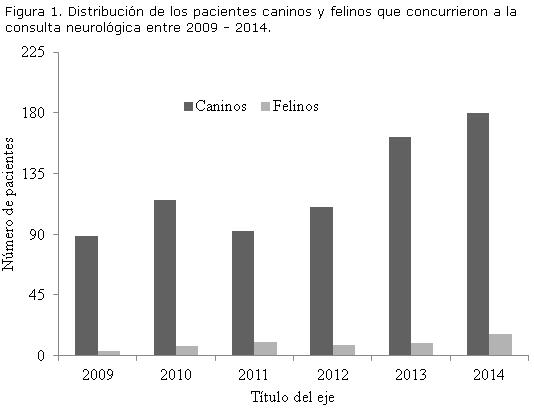
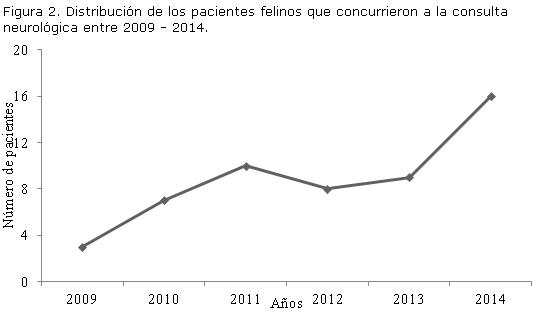
<body><![CDATA[<p class="Cuerpo" style="margin-bottom: 0.0001pt; text-align: justify; line-height: 200%;"><span class="Ninguno"><b style=""><span style="font-size: 14pt; line-height: 200%; font-family: &quot;Verdana&quot;,&quot;sans-serif&quot;;" lang="ES-TRAD">Materiales y m&eacute;todos</span></b></span><span class="Ninguno"><b style=""><span style="font-size: 14pt; line-height: 200%; font-family: &quot;Verdana&quot;,&quot;sans-serif&quot;;" lang="ES-TRAD"><o:p></o:p></span></b></span></p>         <p class="Cuerpo" style="margin-bottom: 0.0001pt; text-align: justify; line-height: 200%;"><span class="Ninguno"><span style="font-size: 10pt; line-height: 200%; font-family: &quot;Verdana&quot;,&quot;sans-serif&quot;;" lang="ES-TRAD">Para la realizaci&oacute;n de este trabajo fueron analizadas todas las fichas cl&iacute;nicas de los felinos que concurrieron a la consulta neurol&oacute;gica dentro del per&iacute;odo de tiempo enero de 2009 y diciembre de 2014. Se tomaron registro de las siguientes variables: sexo, raza, edad, causa etiol&oacute;gica y localizaci&oacute;n de la lesi&oacute;n que los afectaba.</span></span><span class="Ninguno"><span style="font-size: 10pt; line-height: 200%; font-family: &quot;Verdana&quot;,&quot;sans-serif&quot;;" lang="ES-TRAD"><o:p></o:p></span></span></p>         <p class="Cuerpo" style="margin-bottom: 0.0001pt; text-align: justify; line-height: 200%;"><span class="Ninguno"><span style="font-size: 10pt; line-height: 200%; font-family: &quot;Verdana&quot;,&quot;sans-serif&quot;;" lang="ES-TRAD">Tambi&eacute;n se registraron la cantidad total de pacientes que concurrieron, incluyendo caninos y felinos, a la consulta neurol&oacute;gica y el n&uacute;mero total de pacientes de ambas especies, que concurrieron a consulta general del Hospital de Peque&ntilde;os Animales de la Facultad de Veterinaria (UdelaR). </span></span><span class="Ninguno"><s><span style="font-size: 10pt; line-height: 200%; font-family: &quot;Verdana&quot;,&quot;sans-serif&quot;; color: red;" lang="ES-TRAD"><o:p></o:p></span></s></span></p>         <p class="Cuerpo" style="margin-bottom: 0.0001pt; text-align: justify; line-height: 200%;"><span class="Ninguno"><span style="font-size: 10pt; line-height: 200%; font-family: &quot;Verdana&quot;,&quot;sans-serif&quot;;" lang="ES-TRAD">Para la variable edad se determinaron cuatro categor&iacute;as: sin datos (cuando los propietarios no pudieron suministrar este dato), cachorros (comprende pacientes entre 0 a 12 meses de edad), adultos (de 13 meses a 7 a&ntilde;os de edad) y gerontes (mayor a 7 a&ntilde;os de edad).</span></span><span class="Ninguno"><span style="font-size: 10pt; line-height: 200%; font-family: &quot;Verdana&quot;,&quot;sans-serif&quot;;" lang="ES-TRAD"><o:p></o:p></span></span></p>         <p class="Cuerpo" style="margin-bottom: 0.0001pt; text-align: justify; line-height: 200%;"><span class="Ninguno"><span style="font-size: 10pt; line-height: 200%; font-family: &quot;Verdana&quot;,&quot;sans-serif&quot;;" lang="ES-TRAD">En cuanto a la variable causa etiol&oacute;gica, se realiz&oacute; la clasificaci&oacute;n utilizando el sistema DAMNVIT y aquellas patolog&iacute;as que no estaban contempladas en este sistema fueron clasificadas como otros, vestibular, s&iacute;ndromes convulsivos y ceguera central. La clasificaci&oacute;n DAMNVIT es un m&eacute;todo que nos permite clasificar la etiolog&iacute;a de las patolog&iacute;as neurol&oacute;gicas seg&uacute;n su origen. Cada letra corresponde a una causa etiol&oacute;gica, siendo D (degenerativo), A (anomal&iacute;a cong&eacute;nita), M (metab&oacute;lico), N (neoplasia, nutricional), V (vascular), I (inflamatorio, infeccioso), T (t&oacute;xico, traum&aacute;tico).</span></span><span class="Ninguno"><span style="font-size: 10pt; line-height: 200%; font-family: &quot;Verdana&quot;,&quot;sans-serif&quot;;" lang="ES-TRAD"><o:p></o:p></span></span></p>         <p class="Cuerpo" style="margin-bottom: 0.0001pt; text-align: justify; line-height: 200%;"><span class="Ninguno"><span style="font-size: 10pt; line-height: 200%; font-family: &quot;Verdana&quot;,&quot;sans-serif&quot;;" lang="ES-TRAD">Para la variable localizaci&oacute;n de la lesi&oacute;n, se clasificaron en seis categor&iacute;as: enc&eacute;falo, m&eacute;dula, enc&eacute;falo/m&eacute;dula, vestibular, s&iacute;ndromes convulsivos y sistema nervioso perif&eacute;rico.</span></span><span class="Ninguno"><span style="font-size: 10pt; line-height: 200%; font-family: &quot;Verdana&quot;,&quot;sans-serif&quot;;" lang="ES-TRAD"><o:p></o:p></span></span></p>         <p class="Cuerpo" style="margin-bottom: 0.0001pt; text-align: justify; line-height: 200%;"><span style="font-size: 10pt; line-height: 200%; font-family: &quot;Verdana&quot;,&quot;sans-serif&quot;;" lang="ES-TRAD"><o:p>&nbsp;</o:p></span></p>         <p class="Cuerpo" style="margin-bottom: 0.0001pt; text-align: justify; line-height: 200%;"><span class="Ninguno"><b style=""><span style="font-size: 14pt; line-height: 200%; font-family: &quot;Verdana&quot;,&quot;sans-serif&quot;;" lang="ES-TRAD">Resultados</span></b></span><span class="Ninguno"><span style="font-size: 14pt; line-height: 200%; font-family: &quot;Verdana&quot;,&quot;sans-serif&quot;;" lang="ES-TRAD"><o:p></o:p></span></span></p>         <p class="Cuerpo" style="margin-bottom: 0.0001pt; text-align: justify; line-height: 200%;"><span class="Ninguno"><span style="font-size: 10pt; line-height: 200%; font-family: &quot;Verdana&quot;,&quot;sans-serif&quot;;" lang="ES-TRAD">Entre el a&ntilde;o 2009 a 2014 fueron atendidos en la consulta especializada de Neurolog&iacute;a del Hospital 53 felinos. Estos pacientes representaron un 6,6% de la consulta neurol&oacute;gica, el restante 93,4% correspondieron a caninos (<a style="color: rgb(38, 77, 195);" href="#fig_1">Figuras 1</a> y <a style="color: rgb(38, 77, 195);" href="#fig_2">2</a>).<o:p></o:p></span></span></p>         <p class="Cuerpo" style="margin-bottom: 0.0001pt; text-align: justify; line-height: 200%;"><span class="Ninguno"><span style="font-size: 10pt; line-height: 200%; font-family: &quot;Verdana&quot;,&quot;sans-serif&quot;;" lang="ES-TRAD"><o:p>&nbsp;</o:p></span></span></p>         ]]></body>
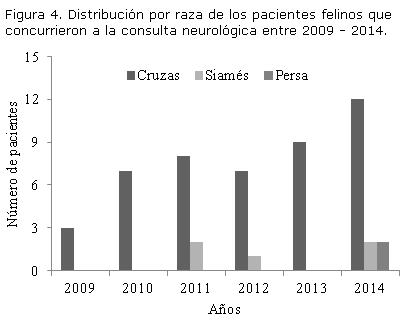
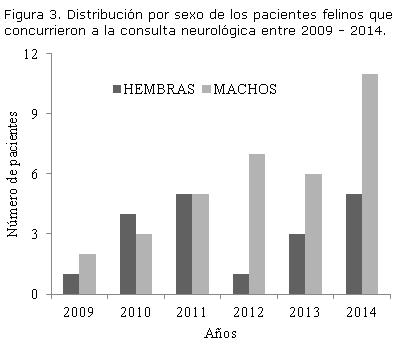
<body><![CDATA[<p class="Cuerpo" style="margin-bottom: 0.0001pt; text-align: justify; line-height: 200%;"><span class="Ninguno"><span style="font-size: 10pt; line-height: 200%; font-family: &quot;Verdana&quot;,&quot;sans-serif&quot;;" lang="ES-TRAD"><o:p>&nbsp;<img style="width: 534px; height: 412px;" alt="" src="/img/revistas/vet/v52n204/n204a01f1.JPG"><a name="fig_1"></a></o:p></span></span></p>         <p class="Cuerpo" style="margin-bottom: 0.0001pt; text-align: justify; line-height: 200%;"><span style="font-size: 10pt; line-height: 200%; font-family: &quot;Verdana&quot;,&quot;sans-serif&quot;;" lang="ES-TRAD"><o:p>&nbsp;</o:p></span></p>      <p class="Cuerpo" style="margin-bottom: 0.0001pt; text-align: justify; line-height: 200%;"><span style="font-size: 10pt; line-height: 200%; font-family: &quot;Verdana&quot;,&quot;sans-serif&quot;;" lang="ES-TRAD"><o:p><img style="width: 536px; height: 328px;" alt="" src="/img/revistas/vet/v52n204/n204a01f2.JPG"><a name="fig_2"></a></o:p></span></p>         <p class="Cuerpo" style="margin-bottom: 0.0001pt; text-align: justify; line-height: 200%;"><span style="font-size: 10pt; line-height: 200%; font-family: &quot;Verdana&quot;,&quot;sans-serif&quot;;" lang="ES-TRAD"><o:p>&nbsp;</o:p></span></p>         <p class="Cuerpo" style="margin-bottom: 0.0001pt; text-align: justify; line-height: 200%;"><span class="Ninguno"><span style="font-size: 10pt; line-height: 200%; font-family: &quot;Verdana&quot;,&quot;sans-serif&quot;;" lang="ES-TRAD">De estos 53 pacientes, 19 fueron hembras (35,8%) y 34 machos (64,2%) (<a style="color: rgb(38, 77, 195);" href="#fig_3">Figura 3</a>).<o:p></o:p></span></span></p>         <p class="Cuerpo" style="margin-bottom: 0.0001pt; text-align: justify; line-height: 200%;"><span class="Ninguno"><span style="font-size: 10pt; line-height: 200%; font-family: &quot;Verdana&quot;,&quot;sans-serif&quot;;" lang="ES-TRAD"><o:p>&nbsp;</o:p></span></span></p>      <p class="Cuerpo" style="margin-bottom: 0.0001pt; text-align: justify; line-height: 200%;"><span class="Ninguno"><span style="font-size: 10pt; line-height: 200%; font-family: &quot;Verdana&quot;,&quot;sans-serif&quot;;" lang="ES-TRAD"><o:p><img style="width: 404px; height: 345px;" alt="" src="/img/revistas/vet/v52n204/n204a01f3.JPG"><a name="fig_3"></a></o:p></span></span></p>         <p class="Cuerpo" style="margin-bottom: 0.0001pt; text-align: justify; line-height: 200%;"><span style="font-size: 10pt; line-height: 200%; font-family: &quot;Verdana&quot;,&quot;sans-serif&quot;;" lang="ES-TRAD"><o:p>&nbsp;</o:p></span></p>         <p class="Cuerpo" style="margin-bottom: 0.0001pt; text-align: justify; line-height: 200%;"><span class="Ninguno"><span style="font-size: 10pt; line-height: 200%; font-family: &quot;Verdana&quot;,&quot;sans-serif&quot;;" lang="ES-TRAD">En el periodo de tiempo estudiado se encontr&oacute; que la mayor&iacute;a de animales fue de raza cruza con 46 pacientes (86,7%), 5 de la raza Siam&eacute;s (9,4%) y 2 pacientes de la raza Persa (3,7%) (<a style="color: rgb(38, 77, 195);" href="#fig_4">Figura 4</a>).<o:p></o:p></span></span></p>         <p class="Cuerpo" style="margin-bottom: 0.0001pt; text-align: justify; line-height: 200%;"><span class="Ninguno"><span style="font-size: 10pt; line-height: 200%; font-family: &quot;Verdana&quot;,&quot;sans-serif&quot;;" lang="ES-TRAD"><o:p>&nbsp;</o:p></span></span></p>      ]]></body>
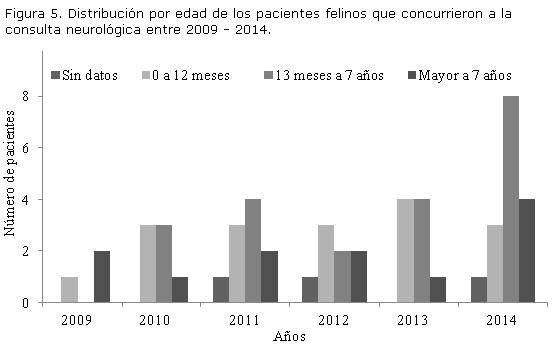
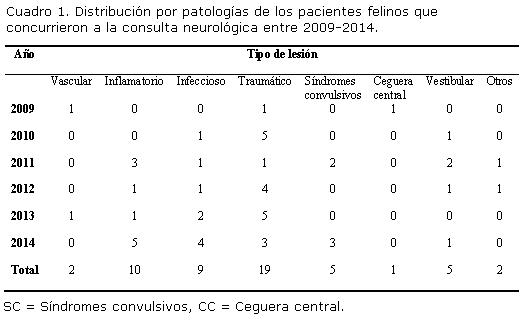
<body><![CDATA[<p class="Cuerpo" style="margin-bottom: 0.0001pt; text-align: justify; line-height: 200%;"><span class="Ninguno"><span style="font-size: 10pt; line-height: 200%; font-family: &quot;Verdana&quot;,&quot;sans-serif&quot;;" lang="ES-TRAD"><o:p><img style="width: 406px; height: 320px;" alt="" src="/img/revistas/vet/v52n204/n204a01f4.JPG"><a name="fig_4"></a></o:p></span></span></p>         <p class="Cuerpo" style="margin-bottom: 0.0001pt; text-align: justify; line-height: 200%;"><span style="font-size: 10pt; line-height: 200%; font-family: &quot;Verdana&quot;,&quot;sans-serif&quot;;" lang="ES-TRAD"><o:p>&nbsp;</o:p></span></p>         <p class="Cuerpo" style="margin-bottom: 0.0001pt; text-align: justify; line-height: 200%;"><span class="Ninguno"><span style="font-size: 10pt; line-height: 200%; font-family: &quot;Verdana&quot;,&quot;sans-serif&quot;;" lang="ES-TRAD">En cuanto a la edad, hubieron 3 animales sin datos acerca de su edad (5,7%), 17 pacientes ten&iacute;an entre 0 a 12 meses de edad (32,1%), 21 pacientes entre 13 meses a 7 a&ntilde;os (39,6%) y 12 pacientes eran mayores a 7 a&ntilde;os (22,6%) (<a style="color: rgb(38, 77, 195);" href="#fig_5">Figura 5</a>).</span></span><span class="Ninguno"><span style="font-size: 10pt; line-height: 200%; font-family: &quot;Verdana&quot;,&quot;sans-serif&quot;;" lang="ES-TRAD"><o:p></o:p></span></span></p>         <p class="Cuerpo" style="margin-bottom: 0.0001pt; text-align: justify; line-height: 200%;"><span style="font-size: 12pt; line-height: 200%; font-family: &quot;Times New Roman&quot;,&quot;serif&quot;;" lang="ES-TRAD"><o:p>&nbsp;</o:p></span></p>      <p class="Cuerpo" style="margin-bottom: 0.0001pt; text-align: justify; line-height: 200%;"><span style="font-size: 12pt; line-height: 200%; font-family: &quot;Times New Roman&quot;,&quot;serif&quot;;" lang="ES-TRAD"><o:p><img style="width: 555px; height: 348px;" alt="" src="/img/revistas/vet/v52n204/n204a01f5.JPG"><a name="fig_5"></a></o:p></span></p>         <p class="Cuerpo" style="margin-bottom: 0.0001pt; text-align: justify; line-height: 200%;"><span style="font-size: 12pt; line-height: 200%; font-family: &quot;Times New Roman&quot;,&quot;serif&quot;;" lang="ES-TRAD"><o:p>&nbsp;</o:p></span></p>         <p class="Cuerpo" style="margin-bottom: 0.0001pt; text-align: justify; line-height: 200%;"><span class="Ninguno"><span style="font-size: 10pt; line-height: 200%; font-family: &quot;Verdana&quot;,&quot;sans-serif&quot;;" lang="ES-TRAD">Para la variable causa etiol&oacute;gica se registraron 19 felinos con traumatismos (35,9%), 10 pacientes con patolog&iacute;as inflamatorias (18,9%), 9 con enfermedad de etiolog&iacute;a infecciosa (17%) y 2 felinos con enfermedad vascular (3,7%). Las siguientes categor&iacute;as fueron clasificadas aparte, por no estar contempladas dentro del DAMNVIT. Se registraron 2 casos que fueron clasificados en la categor&iacute;a otros (3,8%), los cuales correspondieron a un trastorno obsesivo compulsivo y a un hiperparatiroidismo nutricional secundario. Los s&iacute;ndromes convulsivos fueron clasificados en una categor&iacute;a que lleva su nombre, aqu&iacute; se registraron 5 casos (9,4%). Los cuadros vestibulares tambi&eacute;n fueron clasificados en una categor&iacute;a separada, 5 felinos presentaron este cuadro (9,4%). Por &uacute;ltimo, fue registrado un caso de ceguera central, que tambi&eacute;n se clasific&oacute; en otra categor&iacute;a que lleva su nombre (1,9%) (<a style="color: rgb(38, 77, 195);" href="#tab_1">Cuadro 1</a>).</span></span><span style="font-size: 10pt; line-height: 200%; font-family: &quot;Verdana&quot;,&quot;sans-serif&quot;;" lang="ES-TRAD"><o:p></o:p></span></p>         <p class="Cuerpo" style="margin-bottom: 0.0001pt; text-align: justify; line-height: 200%;"><span class="Ninguno"><span style="font-size: 10pt; line-height: 200%; font-family: &quot;Verdana&quot;,&quot;sans-serif&quot;;" lang="ES-TRAD"><o:p>&nbsp;</o:p></span></span></p>      <p class="Cuerpo" style="margin-bottom: 0.0001pt; text-align: justify; line-height: 200%;"><span class="Ninguno"><span style="font-size: 10pt; line-height: 200%; font-family: &quot;Verdana&quot;,&quot;sans-serif&quot;;" lang="ES-TRAD"><o:p><img style="width: 524px; height: 321px;" alt="" src="/img/revistas/vet/v52n204/n204a01t1.JPG"><a name="tab_1"></a></o:p></span></span></p>         <p class="Cuerpo" style="margin-bottom: 0.0001pt; text-align: justify; line-height: 200%;"><span class="Ninguno"><span style="font-size: 10pt; line-height: 200%; font-family: &quot;Verdana&quot;,&quot;sans-serif&quot;;" lang="ES-TRAD"><o:p>&nbsp;</o:p></span></span></p>         ]]></body>
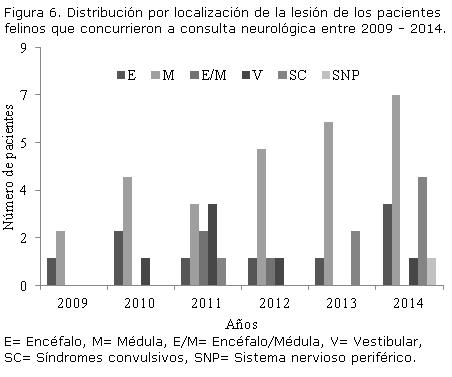
<body><![CDATA[<p class="Cuerpo" style="margin-bottom: 0.0001pt; text-align: justify; line-height: 200%;"><span class="Ninguno"><span style="font-size: 10pt; line-height: 200%; font-family: &quot;Verdana&quot;,&quot;sans-serif&quot;;" lang="ES-TRAD">Dentro de los casos infecciosos es importante destacar que de un total de 9 pacientes, 5 padec&iacute;an toxoplasmosis (<i>Toxoplasma gondii</i>), 2 pacientes estaban afectados por VIF (Virus de la Inmunodeficiencia Felina) y los restantes 2 eran seropositivos a PIF (Peritonitis Infecciosa Felina).</span></span><span class="Ninguno"><span style="font-size: 10pt; line-height: 200%; font-family: &quot;Verdana&quot;,&quot;sans-serif&quot;;" lang="ES-TRAD"><o:p></o:p></span></span></p>         <p class="Cuerpo" style="margin-bottom: 0.0001pt; text-align: justify; line-height: 200%;"><span class="Ninguno"><span style="font-size: 10pt; line-height: 200%; font-family: &quot;Verdana&quot;,&quot;sans-serif&quot;;" lang="ES-TRAD">La variable localizaci&oacute;n de la lesi&oacute;n tuvo la siguiente distribuci&oacute;n: 9 pacientes tuvieron el enc&eacute;falo afectado (17%), en 27 casos la lesi&oacute;n se localiz&oacute; en la m&eacute;dula (51%), 3 felinos tuvieron afecci&oacute;n de enc&eacute;falo y m&eacute;dula (5,6%), hubieron 6 pacientes con afecci&oacute;n del sistema vestibular (11,3%), 7 animales presentaron s&iacute;ndromes convulsivos (13,2%) y solo 1 paciente tuvo afecci&oacute;n de su sistema nervioso perif&eacute;rico (1,9%) (<a style="color: rgb(38, 77, 195);" href="#fig_6">Figura 6</a>).</span></span><span class="Ninguno"><span style="font-size: 10pt; line-height: 200%; font-family: &quot;Verdana&quot;,&quot;sans-serif&quot;;" lang="ES-TRAD"><o:p></o:p></span></span></p>         <p class="Cuerpo" style="margin-bottom: 0.0001pt; text-align: justify; line-height: 200%;"><span class="Ninguno"><span style="font-size: 12pt; line-height: 200%; font-family: &quot;Times New Roman&quot;,&quot;serif&quot;;" lang="ES-TRAD"><o:p>&nbsp;</o:p></span></span></p>      <p class="Cuerpo" style="margin-bottom: 0.0001pt; text-align: justify; line-height: 200%;"><span class="Ninguno"><span style="font-size: 12pt; line-height: 200%; font-family: &quot;Times New Roman&quot;,&quot;serif&quot;;" lang="ES-TRAD"><o:p><img style="width: 452px; height: 377px;" alt="" src="/img/revistas/vet/v52n204/n204a01f6.JPG"><a name="fig_6"></a></o:p></span></span></p>         <p class="Cuerpo" style="margin-bottom: 0.0001pt; text-align: justify; line-height: 200%;"><span class="Ninguno"><span style="font-size: 12pt; line-height: 200%; font-family: &quot;Times New Roman&quot;,&quot;serif&quot;;" lang="ES-TRAD"><o:p>&nbsp;</o:p></span></span></p>         <p class="Cuerpo" style="margin-bottom: 0.0001pt; text-align: justify; line-height: 200%;"><span class="Ninguno"><b style=""><span style="font-size: 14pt; line-height: 200%; font-family: &quot;Verdana&quot;,&quot;sans-serif&quot;;" lang="ES-TRAD">Discusi&oacute;n</span></b></span><span class="Ninguno"><b style=""><span style="font-size: 14pt; line-height: 200%; font-family: &quot;Verdana&quot;,&quot;sans-serif&quot;;" lang="ES-TRAD"><o:p></o:p></span></b></span></p>         <p class="Cuerpo" style="margin-bottom: 0.0001pt; text-align: justify; line-height: 200%;"><span class="Ninguno"><span style="font-size: 10pt; line-height: 200%; font-family: &quot;Verdana&quot;,&quot;sans-serif&quot;; color: windowtext;" lang="ES-TRAD">En cuanto a los datos bibliogr&aacute;ficos, son escasos los trabajos realizados sobre casu&iacute;stica de felinos y en cuanto a neurolog&iacute;a felina s&oacute;lo se encontraron disponibles en la bibliograf&iacute;a consultada algunos art&iacute;culos que hacen referencia a enfermedades concretas del sistema nervioso. <o:p></o:p></span></span></p>         <p class="Cuerpo" style="margin-bottom: 0.0001pt; text-align: justify; line-height: 200%;"><span class="Ninguno"><span style="font-size: 10pt; line-height: 200%; font-family: &quot;Verdana&quot;,&quot;sans-serif&quot;;" lang="ES-TRAD">De nuestro estudio, se desprende que la consulta neurol&oacute;gica en el Hospital de Peque&ntilde;os Animales de la Facultad de Veterinaria, entre enero de 2009 y diciembre de 2014 representa un 7,6% del total de los animales atendidos. Dentro de la consulta neurol&oacute;gica, durante dicho per&iacute;odo, fueron atendidos 53 felinos, que representan un 6,6% y el restante 93,6% corresponde a caninos. Seg&uacute;n <a name="-Issakowickz_2010"></a><a style="color: rgb(38, 77, 195);" href="#Issakowickz_2010">Issakowickz</a> (2010) en el periodo 2006 a 2008 fueron atendidos un total de 81 pacientes felinos, sin especificar consultas especializadas. Seg&uacute;n <a style="color: rgb(38, 77, 195);" href="#Aguero_2006">Ag&uuml;ero</a> (2006) entre julio de 2000 y junio de 2001, tuvieron en consulta general 480 pacientes felinos, los cuales representaron un 19,1% de las consultas; el restante 80,9% correspondi&oacute; a consultas caninas. En este caso, al igual que en el anterior los datos corresponden a consulta general, sin especificar consultas especializadas. Como podemos ver nuestros datos coinciden con los dem&aacute;s autores en cuanto a que la consulta felina significa un peque&ntilde;o n&uacute;mero en comparaci&oacute;n con las consultas caninas. </span></span><span class="Ninguno"><span style="font-size: 10pt; line-height: 200%; font-family: &quot;Verdana&quot;,&quot;sans-serif&quot;;" lang="ES-TRAD"><o:p></o:p></span></span></p>         <p class="Cuerpo" style="margin-bottom: 0.0001pt; text-align: justify; line-height: 200%;"><span class="Ninguno"><span style="font-size: 10pt; line-height: 200%; font-family: &quot;Verdana&quot;,&quot;sans-serif&quot;;" lang="ES-TRAD">Dentro de la consulta especializada de neurolog&iacute;a nuestros datos nos informan que hay mayor&iacute;a de pacientes machos, con 34 animales que corresponden al 64,1% y 19 hembras con el 35,9%. Para <a style="color: rgb(38, 77, 195);" href="#Issakowickz_2010">Issakowicz</a> (2010) los resultados son a la inversa, tiene mayor&iacute;a de hembras afectadas con el 55,6% y los machos representaron el 44,4%. Sin embargo para <a style="color: rgb(38, 77, 195);" href="#Aguero_2006">Ag&uuml;ero</a> (2006) los datos coinciden con los nuestros, ya que obtuvo un 50,4% de machos, un 48,3% de hembras y un 1,3% de pacientes de los cuales no se ten&iacute;an datos. <a style="color: rgb(38, 77, 195);" href="#Valenzuela_2010">Valenzuela</a> (2010) tambi&eacute;n tuvo mayor&iacute;a de machos con el 51,13% y las hembras correspondieron al 48,87%. Como podemos apreciar nuestros datos coinciden con la mayor&iacute;a de los autores consultados, siendo los machos los m&aacute;s afectados en la consulta </span></span><span class="Ninguno"><span style="font-size: 10pt; line-height: 200%; font-family: &quot;Verdana&quot;,&quot;sans-serif&quot;; color: windowtext;" lang="ES-TRAD">felina. Cabe destacar que, nuestros datos corresponden a consulta neurol&oacute;gica felina y los autores citados anteriormente se refieren a la consulta felina en general, sin especificar ninguna especialidad m&eacute;dica.</span></span><span class="Ninguno"><span style="font-size: 10pt; line-height: 200%; font-family: &quot;Verdana&quot;,&quot;sans-serif&quot;; color: windowtext;" lang="ES-TRAD"><o:p></o:p></span></span></p>         <p class="Cuerpo" style="margin-bottom: 0.0001pt; text-align: justify; line-height: 200%;"><span class="Ninguno"><span style="font-size: 10pt; line-height: 200%; font-family: &quot;Verdana&quot;,&quot;sans-serif&quot;;" lang="ES-TRAD">En cuanto a los rangos etarios, nosotros obtuvimos mayor afecci&oacute;n de animales de categor&iacute;a adulta (13 meses a 7 a&ntilde;os de edad), que corresponden al 39,6%, con 21 pacientes. El segundo lugar lo ocupa la categor&iacute;a de los cachorros (0 a 12 meses de edad) con un 32 %, 17 pacientes. Luego est&aacute;n los animales gerontes, mayores a 7 a&ntilde;os, 12 pacientes que representan el 22,6%. Y en &uacute;ltimo lugar lo ocupan los pacientes sin datos que son 3 felinos y representan el 5,6%. <a style="color: rgb(38, 77, 195);" href="#Issakowickz_2010">Issakowicz</a> (2010), no especifica edad de los animales afectados y como dato general nos informa que los pacientes incluidos en su estudio ten&iacute;an entre 1 mes a 12 a&ntilde;os de edad. Por el contrario <a style="color: rgb(38, 77, 195);" href="#Aguero_2006">Ag&uuml;ero</a> (2006) realiza un an&aacute;lisis m&aacute;s detallado en cuanto a las edades de los animales afectados. Para su estudio divide en 5 categor&iacute;as. La mayor&iacute;a de los animales afectados son menores a 12 meses con 218 animales (45,4%). El segundo lugar lo ocupan los animales adultos, entre 1 a 5 a&ntilde;os de edad con 165 pacientes (34,4%). <a style="color: rgb(38, 77, 195);" href="#Valenzuela_2010">Valenzuela</a> (2010) tiene como rango de edad m&aacute;s afectado a los mayores a 8 a&ntilde;os con el 29,49%. Esta &uacute;ltima autora no brinda m&aacute;s datos sobre el resto de los animales afectados. En esta variable no hay acuerdo entre los diferentes autores consultados, ya que cada uno tiene una categor&iacute;a diferente como la m&aacute;s afectada. Solo <a style="color: rgb(38, 77, 195);" href="#Aguero_2006">Ag&uuml;ero</a> coincide con nosotros, afirmando que los m&aacute;s afectados son los animales adultos. Diferimos en cuanto a las edades comprendidas en la categor&iacute;a adultos. En nuestro trabajo tomamos como adultos entre 13 meses a 7 a&ntilde;os de edad y para dicha autora los adultos estaban comprendidos entre 1 a 5 a&ntilde;os de edad.</span></span><span class="Ninguno"><span style="font-size: 10pt; line-height: 200%; font-family: &quot;Verdana&quot;,&quot;sans-serif&quot;;" lang="ES-TRAD"><o:p></o:p></span></span></p>         ]]></body>
<body><![CDATA[<p class="Cuerpo" style="margin-bottom: 0.0001pt; text-align: justify; line-height: 200%;"><span class="Ninguno"><span style="font-size: 10pt; line-height: 200%; font-family: &quot;Verdana&quot;,&quot;sans-serif&quot;;" lang="ES-TRAD">En cuanto a las razas afectadas nosotros obtuvimos mayor&iacute;a de animales cruzas, 46 animales afectados que representan el 86,7% del total de animales. El segundo lugar lo ocupa la raza Siam&eacute;s y en tercer lugar, s&oacute;lo con 2 representantes tenemos a la raza Persa. Para <a style="color: rgb(38, 77, 195);" href="#Issakowickz_2010">Issakowicz</a> (2010) los felinos cruza tambi&eacute;n fueron mayor&iacute;a con el 75% y un 25% de animales de raza, pero no especifica cuales razas fueron afectadas. Para <a style="color: rgb(38, 77, 195);" href="#Valenzuela_2010">Valenzuela</a> (2010) hay una gran mayor&iacute;a de felinos dom&eacute;sticos de pelo corto con 52,96%, en segundo lugar los dom&eacute;sticos de pelo largo (24,78%), luego los Persas con el 14%, Siam&eacute;s con 4,61% y en &uacute;ltimo lugar otras razas con el 3,65%. <a style="color: rgb(38, 77, 195);" href="#Aguero_2006">Ag&uuml;ero</a> (2006) tiene mayor&iacute;a de dom&eacute;sticos de pelo corto (74,1%), mestizos (12,7%), Siam&eacute;s (7,2%), dom&eacute;stico de pelo largo (5,3%) y por &uacute;ltimo los Persa (0,6%). En cuanto a esta variable hay amplio consenso que los m&aacute;s afectados son los felinos cruzas (enti&eacute;ndase que los dom&eacute;sticos de pelo largo y corto son tambi&eacute;n individuos </span></span><span class="Ninguno"><span style="font-size: 10pt; line-height: 200%; font-family: &quot;Verdana&quot;,&quot;sans-serif&quot;; color: windowtext;" lang="ES-TRAD">cruza). La media de edad para <a style="color: rgb(38, 77, 195);" href="#Whale_2014">Whale</a> (2014) fue de 3,8 a&ntilde;os de edad para el inicio de epilepsia de causa desconocida. Y seg&uacute;n <a style="color: rgb(38, 77, 195);" href="#Marioni_Henry_2004">Marioni</a>-Henry (2004) la mayor&iacute;a de los animales afectados por enfermedades de la m&eacute;dula espinal eran menores a 2 a&ntilde;os de edad.</span></span><span class="Ninguno"><span style="font-size: 10pt; line-height: 200%; font-family: &quot;Verdana&quot;,&quot;sans-serif&quot;; color: windowtext;" lang="ES-TRAD"><o:p></o:p></span></span></p>         <p class="Cuerpo" style="margin-bottom: 0.0001pt; text-align: justify; line-height: 200%;"><span class="Ninguno"><span style="font-size: 10pt; line-height: 200%; font-family: &quot;Verdana&quot;,&quot;sans-serif&quot;;" lang="ES-TRAD">De acuerdo a nuestro estudio, en la mayor&iacute;a de los animales afectados, el motivo de consulta fue de etiolog&iacute;a traumatol&oacute;gica, 19 casos (35,8%). Como segunda causa etiol&oacute;gica m&aacute;s frecuente tenemos los casos de origen inflamatorio con 10 pacientes, 18,8%. Y el tercer lugar lo ocupan los casos infecciosos con 9 felinos que representan el 16,9%. Dentro de los casos infecciosos tenemos 5 positivos serol&oacute;gicamente a <i>Toxoplasma gondii</i>, 2 pacientes positivos al virus de la inmunodeficiencia de felina (VIF) y 2 positivos a peritonitis infecciosa felina (PIF). Para <a style="color: rgb(38, 77, 195);" href="#Issakowickz_2010">Issakowickz</a> (2010), la mayor&iacute;a de las consultas correspondieron a causas renales (19,8%) y el segundo lugar lo compartieron las consultas dermatol&oacute;gicas y oncol&oacute;gicas con el 13,6%. Para <a style="color: rgb(38, 77, 195);" href="#Valenzuela_2010">Valenzuela</a> (2010), la mayor&iacute;a de las consultas correspondieron a trastornos gastrointestinales (24,17%) y en segundo lugar a las consultas dermatol&oacute;gicas con el 17,04%. Las consultas neurol&oacute;gicas para esta autora correspondieron al 1,04% y dentro de ellas la mayor&iacute;a correspondi&oacute; a traumas e intoxicaciones. Para <a style="color: rgb(38, 77, 195);" href="#Aguero_2006">Ag&uuml;ero</a> (2006) la mayor&iacute;a fueron por causas traumatol&oacute;gicas (15,8%) y las consultas </span></span><span class="Ninguno"><span style="font-size: 10pt; line-height: 200%; font-family: &quot;Verdana&quot;,&quot;sans-serif&quot;; color: windowtext;" lang="ES-TRAD">neurol&oacute;gicas tuvieron un 2,1%. Seg&uacute;n <a style="color: rgb(38, 77, 195);" href="#Marioni_Henry_2004">Marioni</a>-Henry (2004) la etiolog&iacute;a m&aacute;s frecuente para enfermedades de la m&eacute;dula espinal es la causa inflamatoria/infecciosa, y dentro de esta categor&iacute;a la mayor&iacute;a de los casos se deben al virus de la peritonitis infecciosa felina. Para esta variable existe mayor complicaci&oacute;n para </span></span><span class="Ninguno"><span style="font-size: 10pt; line-height: 200%; font-family: &quot;Verdana&quot;,&quot;sans-serif&quot;;" lang="ES-TRAD">poder comparar con los dem&aacute;s autores, ya que ellos se refieren a la consulta en general y no a la consulta neurol&oacute;gica. Pero s&iacute; podemos comparar nuestros resultados con <a style="color: rgb(38, 77, 195);" href="#Valenzuela_2010">Valenzuela</a> (2010). Coincidimos con esta autora en cuanto a que la mayor&iacute;a de las consultas neurol&oacute;gicas son por causas traum&aacute;ticas, no coincidiendo con ella en cuanto a que tambi&eacute;n tiene amplia mayor&iacute;a de consultas neurol&oacute;gicas de causa toxicol&oacute;gica. Nosotros, en el periodo de tiempo analizado no encontramos ninguna consulta de causa t&oacute;xica, pero esto podr&iacute;a explicarse debido a que estos pacientes no llegan a nuestra consulta y son atendidos en medicina general.</span></span><span class="Ninguno"><span style="font-size: 10pt; line-height: 200%; font-family: &quot;Verdana&quot;,&quot;sans-serif&quot;;" lang="ES-TRAD"><o:p></o:p></span></span></p>         <p class="Cuerpo" style="margin-bottom: 0.0001pt; text-align: justify; line-height: 200%;"><span style="font-size: 10pt; line-height: 200%; font-family: &quot;Verdana&quot;,&quot;sans-serif&quot;;" lang="ES-TRAD"><o:p>&nbsp;</o:p></span></p>         <p class="Cuerpo" style="margin-bottom: 0.0001pt; text-align: justify; line-height: 200%;"><span class="Ninguno"><b style=""><span style="font-size: 14pt; line-height: 200%; font-family: &quot;Verdana&quot;,&quot;sans-serif&quot;;" lang="ES-TRAD">Conclusi&oacute;n</span></b></span><span class="Ninguno"><b style=""><span style="font-size: 14pt; line-height: 200%; font-family: &quot;Verdana&quot;,&quot;sans-serif&quot;;" lang="ES-TRAD"><o:p></o:p></span></b></span></p>         <p class="Cuerpo" style="margin-bottom: 0.0001pt; text-align: justify; line-height: 200%;"><span class="Ninguno"><span style="font-size: 10pt; line-height: 200%; font-family: &quot;Verdana&quot;,&quot;sans-serif&quot;;" lang="ES-TRAD">En el presente trabajo podemos concluir que la consulta neurol&oacute;gica felina se encuentra en continuo crecimiento. De todas formas, representa un n&uacute;mero muy peque&ntilde;o en comparaci&oacute;n con la consulta canina.</span></span><span class="Ninguno"><span style="font-size: 10pt; line-height: 200%; font-family: &quot;Verdana&quot;,&quot;sans-serif&quot;;" lang="ES-TRAD"><o:p></o:p></span></span></p>         <p class="Cuerpo" style="margin-bottom: 0.0001pt; text-align: justify; line-height: 200%;"><span class="Ninguno"><span style="font-size: 10pt; line-height: 200%; font-family: &quot;Verdana&quot;,&quot;sans-serif&quot;;" lang="ES-TRAD">En cuanto al sexo la mayor&iacute;a de nuestros pacientes fueron machos, los animales cruza predominaron en nuestra consulta y los m&aacute;s afectados fueron los adultos, 13 meses a 7 a&ntilde;os de edad. La mayor&iacute;a de las consultas fueron por causas traum&aacute;ticas y la m&eacute;dula espinal fue la localizaci&oacute;n m&aacute;s afectada. Estas dos &uacute;ltimas variables est&aacute;n relacionadas, ya que la mayor&iacute;a de las consultas fueron debidas a traumatismos medulares. </span></span><span class="Ninguno"><span style="font-size: 10pt; line-height: 200%; font-family: &quot;Verdana&quot;,&quot;sans-serif&quot;; color: red;" lang="ES-TRAD"><o:p></o:p></span></span></p>         <p class="Cuerpo" style="margin-bottom: 0.0001pt; text-align: justify; line-height: 200%;"><span style="font-size: 10pt; line-height: 200%; font-family: &quot;Verdana&quot;,&quot;sans-serif&quot;;" lang="ES-TRAD"><o:p>&nbsp;</o:p></span></p>         <p class="Cuerpo" style="margin-bottom: 0.0001pt; text-align: justify; line-height: 200%;"><span class="Ninguno"><b style=""><span style="font-size: 14pt; line-height: 200%; font-family: &quot;Verdana&quot;,&quot;sans-serif&quot;;" lang="ES-TRAD">Bibliograf&iacute;a</span></b></span><span class="Ninguno"><b style=""><span style="font-size: 14pt; line-height: 200%; font-family: &quot;Verdana&quot;,&quot;sans-serif&quot;;" lang="ES-TRAD"><o:p></o:p></span></b></span></p>         <!-- ref --><p class="Cuerpo" style="margin: 0cm 0cm 0.0001pt 34pt; text-align: justify; text-indent: -19.8pt; line-height: 200%;"><span class="Ninguno"><span style="font-size: 10pt; line-height: 200%; font-family: &quot;Verdana&quot;,&quot;sans-serif&quot;; color: windowtext;" lang="ES-TRAD"><span style="">1.<span style="font-family: &quot;Times New Roman&quot;; font-style: normal; font-variant: normal; font-weight: normal; font-size: 7pt; line-height: normal; font-size-adjust: none; font-stretch: normal;">&nbsp;&nbsp;&nbsp;&nbsp;&nbsp;</span></span></span></span><span class="Ninguno"><span style="font-size: 10pt; line-height: 200%; font-family: &quot;Verdana&quot;,&quot;sans-serif&quot;;" lang="ES-TRAD"><a name="Aguero_2006"></a><a style="color: rgb(38, 77, 195);" href="#-Aguero_2006">Ag&uuml;ero</a> L. (2006). Estudio epidemiol&oacute;gico retrospectivo de las principales patolog&iacute;as en caninos y felinos y de variables administrativas. Hospital Cl&iacute;nico Veterinario, Universidad de Chile. Disponible </span></span><span class="Ninguno"><span style="font-size: 10pt; line-height: 200%; font-family: &quot;Verdana&quot;,&quot;sans-serif&quot;; color: windowtext;" lang="ES-TRAD">en: <a style="color: rgb(38, 77, 195);" href="http://repositorio.uchile.cl/handle/2250/130981">repositorio.uchile.cl/handle/2250/130981</a>. Fecha de consulta: 20/12/2015.    </span></span><span class="Ninguno"><span style="font-size: 10pt; line-height: 200%; font-family: &quot;Verdana&quot;,&quot;sans-serif&quot;; color: windowtext;" lang="ES-TRAD"><o:p></o:p></span></span></p>         ]]></body>
<body><![CDATA[<!-- ref --><p class="Cuerpo" style="margin: 0cm 0cm 0.0001pt 34pt; text-align: justify; text-indent: -19.8pt; line-height: 200%;"><span class="Ninguno"><span style="font-size: 10pt; line-height: 200%; font-family: &quot;Verdana&quot;,&quot;sans-serif&quot;;" lang="ES-TRAD"><span style="">2.<span style="font-family: &quot;Times New Roman&quot;; font-style: normal; font-variant: normal; font-weight: normal; font-size: 7pt; line-height: normal; font-size-adjust: none; font-stretch: normal;">&nbsp;&nbsp;&nbsp;&nbsp;&nbsp;<a name="Issakowickz_2010"></a></span></span></span></span><span class="Ninguno"><span style="font-size: 10pt; line-height: 200%; font-family: &quot;Verdana&quot;,&quot;sans-serif&quot;; color: windowtext;" lang="ES-TRAD"><a style="color: rgb(38, 77, 195);" href="#-Issakowickz_2010">Issakowicz</a> J. (2010). Casu&iacute;stica dos atendimentos de felinos na cl&iacute;nica escola veterin&aacute;ria (CEVET) DA Unicentro no trienio 2006 - 2008. Disponible en:</span></span><span style="font-size: 10pt; line-height: 200%; font-family: &quot;Verdana&quot;,&quot;sans-serif&quot;; color: windowtext;" lang="ES-TRAD"> </span><font style="color: rgb(38, 77, 195);" size="-1"><a style="font-family: Verdana;" href="http://faef.revista.inf.br/imagens_arquivos/arquivos_destaque/5cYaezbDgMJqoCN_2013-6-25-11-55-42.pdf">http://faef.revista.inf.br/imagens_arquivos/arquivos_destaque/5cYaezbDgMJqoCN_2013-6-25-11-55-42.pdf</a></font><span class="Ninguno"><span style="font-size: 10pt; line-height: 200%; font-family: &quot;Verdana&quot;,&quot;sans-serif&quot;; color: windowtext;" lang="ES-TRAD">. Fecha de consulta</span></span><span class="Ninguno"><span style="font-size: 10pt; line-height: 200%; font-family: &quot;Verdana&quot;,&quot;sans-serif&quot;;" lang="ES-TRAD">: 20/12/2015.    </span></span><span class="Ninguno"><span style="font-size: 10pt; line-height: 200%; font-family: &quot;Verdana&quot;,&quot;sans-serif&quot;;" lang="ES-TRAD"><o:p></o:p></span></span></p>         <!-- ref --><p class="Cuerpo" style="margin: 0cm 0cm 0.0001pt 34pt; text-align: justify; text-indent: -19.8pt; line-height: 200%;"><span class="Ninguno"><span style="font-size: 10pt; line-height: 200%; font-family: &quot;Verdana&quot;,&quot;sans-serif&quot;; color: black;" lang="ES-TRAD"><span style="">3.<span style="font-family: &quot;Times New Roman&quot;; font-style: normal; font-variant: normal; font-weight: normal; font-size: 7pt; line-height: normal; font-size-adjust: none; font-stretch: normal;">&nbsp;&nbsp;&nbsp;&nbsp;&nbsp;</span></span></span></span><span class="Ninguno"><span style="font-size: 10pt; line-height: 200%; font-family: &quot;Verdana&quot;,&quot;sans-serif&quot;; color: black;" lang="ES-TRAD"><a name="Little_2014"></a><a style="color: rgb(38, 77, 195);" href="#-Little_2014">Little</a> S. (2014). El Gato. Medicina cl&iacute;nica y tratamiento. M&eacute;xico, Editorial Inter-M&eacute;dica 1676p.    </span></span><span class="Ninguno"><span style="font-size: 10pt; line-height: 200%; font-family: &quot;Verdana&quot;,&quot;sans-serif&quot;; color: black;" lang="ES-TRAD"><o:p></o:p></span></span></p>         <!-- ref --><p class="Cuerpo" style="margin: 0cm 0cm 0.0001pt 34pt; text-align: justify; text-indent: -19.8pt; line-height: 200%;"><span class="Ninguno"><span style="font-size: 10pt; line-height: 200%; font-family: &quot;Verdana&quot;,&quot;sans-serif&quot;; color: black;" lang="ES-UY"><span style="">4.<span style="font-family: &quot;Times New Roman&quot;; font-style: normal; font-variant: normal; font-weight: normal; font-size: 7pt; line-height: normal; font-size-adjust: none; font-stretch: normal;">&nbsp;&nbsp;&nbsp;&nbsp;&nbsp;</span></span></span></span><span class="Ninguno"><span style="font-size: 10pt; line-height: 200%; font-family: &quot;Verdana&quot;,&quot;sans-serif&quot;; color: black;" lang="EN-US"><a name="Marioni_Henry_2004"></a><a style="color: rgb(38, 77, 195);" href="#-Marioni_Henry_2004">Marioni</a>-Henry K. (2004). Prevalence of diseases of the spinal cord of cats. </span></span><span class="Ninguno"><span style="font-size: 10pt; line-height: 200%; font-family: &quot;Verdana&quot;,&quot;sans-serif&quot;; color: black;" lang="ES-UY">J Vet Intern Med 18:851</span></span><span class="Ninguno"><span style="font-size: 10pt; line-height: 200%; font-family: &quot;Verdana&quot;,&quot;sans-serif&quot;; color: black;" lang="ES-UY">-</span></span><span class="Ninguno"><span style="font-size: 10pt; line-height: 200%; font-family: &quot;Verdana&quot;,&quot;sans-serif&quot;; color: black;" lang="ES-UY">858.    </span></span><span class="Ninguno"><span style="font-size: 10pt; line-height: 200%; font-family: &quot;Verdana&quot;,&quot;sans-serif&quot;; color: black;" lang="ES-UY"><o:p></o:p></span></span></p>         <!-- ref --><p class="Cuerpo" style="margin: 0cm 0cm 0.0001pt 34pt; text-align: justify; text-indent: -19.8pt; line-height: 200%;"><span class="Ninguno"><span style="font-size: 10pt; line-height: 200%; font-family: &quot;Verdana&quot;,&quot;sans-serif&quot;; color: windowtext;" lang="EN-US"><span style="">5.<span style="font-family: &quot;Times New Roman&quot;; font-style: normal; font-variant: normal; font-weight: normal; font-size: 7pt; line-height: normal; font-size-adjust: none; font-stretch: normal;">&nbsp;&nbsp;&nbsp;&nbsp;&nbsp;</span></span></span></span><span class="Ninguno"><span style="font-size: 10pt; line-height: 200%; font-family: &quot;Verdana&quot;,&quot;sans-serif&quot;;" lang="ES-TRAD"><a name="Valenzuela_2010"></a><a style="color: rgb(38, 77, 195);" href="#-Valenzuela_2010">Valenzuela</a> M. (2010). Diagn&oacute;sticos cl&iacute;nicos de 1056 felinos: Periodo 2005 a 2007. Disponible </span></span><span class="Ninguno"><span style="font-size: 10pt; line-height: 200%; font-family: &quot;Verdana&quot;,&quot;sans-serif&quot;; color: windowtext;" lang="ES-TRAD">en:<a style="color: rgb(38, 77, 195);" href="http://www.rhv.cl/index.php?option=com_content&amp;view=category&amp;id=2&amp;layout=blog&amp;Itemid=8">http://www.rhv.cl/index.php?option=com_content&amp;view=category&amp;id=2&amp;layout=blog&amp;Itemid=8</a>. </span></span><span class="Ninguno"><span style="font-size: 10pt; line-height: 200%; font-family: &quot;Verdana&quot;,&quot;sans-serif&quot;; color: windowtext;" lang="EN-US">Fecha de consulta: 20/12/2015.    <o:p></o:p></span></span></p>         <!-- ref --><p class="Cuerpo" style="margin: 0cm 0cm 0.0001pt 34pt; text-align: justify; text-indent: -19.8pt; line-height: 200%;"><span class="Ninguno"><span style="font-size: 10pt; line-height: 200%; font-family: &quot;Verdana&quot;,&quot;sans-serif&quot;;" lang="EN-US"><span style="">6.<span style="font-family: &quot;Times New Roman&quot;; font-style: normal; font-variant: normal; font-weight: normal; font-size: 7pt; line-height: normal; font-size-adjust: none; font-stretch: normal;">&nbsp;&nbsp;&nbsp;&nbsp;&nbsp;</span></span></span></span><span class="Ninguno"><span style="font-size: 10pt; line-height: 200%; font-family: &quot;Verdana&quot;,&quot;sans-serif&quot;; color: windowtext;" lang="EN-US"><a name="Whale_2014"></a><a style="color: rgb(38, 77, 195);" href="#-Whale_2014">Wahle</a> A. (2014</span></span><span class="Ninguno"><span style="font-size: 10pt; line-height: 200%; font-family: &quot;Verdana&quot;,&quot;sans-serif&quot;;" lang="EN-US">). Clinical characterization of epilepsy of unknown cause in cats. J Vet Intern Med 28:182-188.    </span></span><span class="Ninguno"><span style="font-size: 10pt; line-height: 200%; font-family: &quot;Verdana&quot;,&quot;sans-serif&quot;;" lang="EN-US"><o:p></o:p></span></span></p>         ]]></body>
<body><![CDATA[<p class="Cuerpo" style="margin-bottom: 0.0001pt; text-align: justify; line-height: 200%;"><span style="font-size: 10pt; line-height: 200%; font-family: &quot;Verdana&quot;,&quot;sans-serif&quot;;" lang="EN-US"><o:p>&nbsp;</o:p></span></p>     </div>          ]]></body><back>
<ref-list>
<ref id="B1">
<nlm-citation citation-type="book">
<person-group person-group-type="author">
<name>
<surname><![CDATA[Agüero]]></surname>
<given-names><![CDATA[L]]></given-names>
</name>
</person-group>
<source><![CDATA[Estudio epidemiológico retrospectivo de las principales patologías en caninos y felinos y de variables administrativas]]></source>
<year>2006</year>
<publisher-name><![CDATA[Hospital Clínico Veterinario, Universidad de Chile]]></publisher-name>
</nlm-citation>
</ref>
<ref id="B2">
<nlm-citation citation-type="">
<person-group person-group-type="author">
<name>
<surname><![CDATA[Issakowicz]]></surname>
<given-names><![CDATA[J]]></given-names>
</name>
</person-group>
<source><![CDATA[Casuística dos atendimentos de felinos na clínica escola veterinária (CEVET) DA Unicentro no trienio 2006 - 2008]]></source>
<year>2010</year>
</nlm-citation>
</ref>
<ref id="B3">
<nlm-citation citation-type="book">
<person-group person-group-type="author">
<name>
<surname><![CDATA[Little]]></surname>
<given-names><![CDATA[S]]></given-names>
</name>
</person-group>
<article-title xml:lang="es"><![CDATA[El Gato]]></article-title>
<source><![CDATA[Medicina clínica y tratamiento]]></source>
<year>2014</year>
<page-range>1676</page-range><publisher-name><![CDATA[Editorial Inter-Médica]]></publisher-name>
</nlm-citation>
</ref>
<ref id="B4">
<nlm-citation citation-type="journal">
<person-group person-group-type="author">
<name>
<surname><![CDATA[Marioni]]></surname>
<given-names><![CDATA[K]]></given-names>
</name>
</person-group>
<article-title xml:lang="en"><![CDATA[Prevalence of diseases of the spinal cord of cats]]></article-title>
<source><![CDATA[J Vet Intern Med]]></source>
<year>2004</year>
<volume>18</volume>
<page-range>851-858</page-range></nlm-citation>
</ref>
<ref id="B5">
<nlm-citation citation-type="">
<person-group person-group-type="author">
<name>
<surname><![CDATA[Valenzuela]]></surname>
<given-names><![CDATA[M]]></given-names>
</name>
</person-group>
<source><![CDATA[Diagnósticos clínicos de 1056 felinos: Periodo 2005 a 2007]]></source>
<year>2010</year>
</nlm-citation>
</ref>
<ref id="B6">
<nlm-citation citation-type="journal">
<person-group person-group-type="author">
<name>
<surname><![CDATA[Wahle]]></surname>
<given-names><![CDATA[A]]></given-names>
</name>
</person-group>
<article-title xml:lang="en"><![CDATA[Clinical characterization of epilepsy of unknown cause in cats]]></article-title>
<source><![CDATA[J Vet Intern Med]]></source>
<year>2014</year>
<volume>28</volume>
<page-range>182-188</page-range></nlm-citation>
</ref>
</ref-list>
</back>
</article>