<?xml version="1.0" encoding="ISO-8859-1"?><article xmlns:mml="http://www.w3.org/1998/Math/MathML" xmlns:xlink="http://www.w3.org/1999/xlink" xmlns:xsi="http://www.w3.org/2001/XMLSchema-instance">
<front>
<journal-meta>
<journal-id>1688-4809</journal-id>
<journal-title><![CDATA[Veterinaria (Montevideo)]]></journal-title>
<abbrev-journal-title><![CDATA[Veterinaria (Montev.)]]></abbrev-journal-title>
<issn>1688-4809</issn>
<publisher>
<publisher-name><![CDATA[Sociedad de Medicina Veterinaria del Uruguay]]></publisher-name>
</publisher>
</journal-meta>
<article-meta>
<article-id>S1688-48092015000400002</article-id>
<title-group>
<article-title xml:lang="es"><![CDATA[MSUD (Maple Syrup Urine Disease) en terneros Polled Hereford y cruzas Polled Hereford x Shorthorn en Uruguay]]></article-title>
<article-title xml:lang="en"><![CDATA[MSUD (Maple Syrup Urine Disease) in Polled Hereford and Polled Hereford x Shorthorn crosses in calves in Uruguay]]></article-title>
</title-group>
<contrib-group>
<contrib contrib-type="author">
<name>
<surname><![CDATA[Dutra]]></surname>
<given-names><![CDATA[F]]></given-names>
</name>
<xref ref-type="aff" rid="A01"/>
</contrib>
<contrib contrib-type="author">
<name>
<surname><![CDATA[Romero]]></surname>
<given-names><![CDATA[A]]></given-names>
</name>
<xref ref-type="aff" rid="A01"/>
</contrib>
<contrib contrib-type="author">
<name>
<surname><![CDATA[Quinteros]]></surname>
<given-names><![CDATA[C]]></given-names>
</name>
<xref ref-type="aff" rid="A01"/>
</contrib>
<contrib contrib-type="author">
<name>
<surname><![CDATA[Kelly]]></surname>
<given-names><![CDATA[L]]></given-names>
</name>
<xref ref-type="aff" rid="A02"/>
</contrib>
</contrib-group>
<aff id="A01">
<institution><![CDATA[,DILAVE Laboratorio Regional Este ]]></institution>
<addr-line><![CDATA[Treinta y Tres ]]></addr-line>
<country>Uruguay</country>
</aff>
<aff id="A02">
<institution><![CDATA[,INIA  ]]></institution>
<addr-line><![CDATA[Canelones ]]></addr-line>
<country>Uruguay</country>
</aff>
<pub-date pub-type="pub">
<day>15</day>
<month>12</month>
<year>2015</year>
</pub-date>
<pub-date pub-type="epub">
<day>15</day>
<month>12</month>
<year>2015</year>
</pub-date>
<volume>51</volume>
<numero>200</numero>
<fpage>2</fpage>
<lpage>2</lpage>
<copyright-statement/>
<copyright-year/>
<self-uri xlink:href="http://www.scielo.edu.uy/scielo.php?script=sci_arttext&amp;pid=S1688-48092015000400002&amp;lng=en&amp;nrm=iso"></self-uri><self-uri xlink:href="http://www.scielo.edu.uy/scielo.php?script=sci_abstract&amp;pid=S1688-48092015000400002&amp;lng=en&amp;nrm=iso"></self-uri><self-uri xlink:href="http://www.scielo.edu.uy/scielo.php?script=sci_pdf&amp;pid=S1688-48092015000400002&amp;lng=en&amp;nrm=iso"></self-uri><abstract abstract-type="short" xml:lang="es"><p><![CDATA[Resumen Se reporta el primer diagnóstico de MSUD (Maple Syrup Urine Disease) o Enfermedad de la orina con Olor a Jarabe de Arce en terneros Polled Hereford (PH) y cruzas Polled Hereford x Shorthorn (PH x SH) en Uruguay. La enfermedad se diagnosticó en 3 rodeos de cría comercial en la región Este de Uruguay, el primero en agosto de 2004 en terneros PH (3 casos, 2,3%), el segundo en setiembre de 2006 en PH (5 casos, 4,1%) y el tercero en agosto de 2008 en terneros cruza PH x SH (7 casos, 3,8%). Todos los predios adquirían los toros y el semen Polled Hereford de cabañas nacionales. Los terneros afectados eran normales al nacimiento pero luego de mamar calostro desarrollaban un cuadro nervioso severo con hiperestesia, decúbito, convulsiones, lomo arqueado, opistótonos y muerte en los primeros días de vida. No había lesiones macroscópicas. Histológicamente, se observó edema severo de mielina con status spongiosus a lo largo del neuroeje, principalmente en el cerebelo, sustancia blanca subcortical, mesencéfalo y formación reticular del bulbo, y menos en la médula espinal. No no se encontraron signos de desmielinización ni de degeneración o pérdida de neuronas. Un toro y 5 (35,7%) vacas testadas del predio 2, y 1 toro, el ternero afectado y 2 (28.5%) vacas del predio 3 eran portadores de la mutación MSUD 248C&#8594;T. El MSUD es una enfermedad hereditaria presente en la raza Polled Hereford en Uruguay y su diagnóstico diferencial debe siempre considerarse en cuadros nerviosos perinatales en esta raza.]]></p></abstract>
<abstract abstract-type="short" xml:lang="en"><p><![CDATA[Summary Maple Syrup Urine Disease (MSUD) was diagnosed in Polled Hereford and Polled Hereford x Shorthorn calves from three commercial herds in the East Region of Uruguay. Three calves (2.3%) were affected in a purebred Polled Hereford herd in August 2004, 5 (4.1%) in a purebred polled Hereford cows in September 2006, and 7 (3.8%) in a Polled Hereford x Shorthorn herd in August 2008. All three herds were bred with Uruguayan Polled Hereford bulls. Affected calves were normal at birth but after weaning developed a severe neurologic condition characterized clinically by extensor spasms, depression, opisthotonos and inability to stand, dying within 3-5 days of birth. The principal histopathologic change in 3 affected calves was diffuse, severe, status spongiosus throughout the white matter of the cerebellum, cerebrum, mesencephalus and medulla oblongata, and less so in spinal cord. Spongiosis was due to edema of myelin sheaths. Myelin deficits or neuronal death were not found. Blood samples from 1 bull and 5 cows (37.5%) from herd 2, and 1 bull, 2 cows (28.5%) and the affected calf from herd 3, were identified as carriers for the MSUD 248C&#8594;T mutation. The mutation seems to be widespread in Polled Hereford herds in Uruguay.]]></p></abstract>
<kwd-group>
<kwd lng="es"><![CDATA[Bovino]]></kwd>
<kwd lng="es"><![CDATA[MSUD]]></kwd>
<kwd lng="es"><![CDATA[Maple Syrup Urine Disease]]></kwd>
<kwd lng="es"><![CDATA[Edema Neuroaxial]]></kwd>
<kwd lng="es"><![CDATA[Status spongiosus]]></kwd>
<kwd lng="en"><![CDATA[Maple Syrup Urine Disease]]></kwd>
<kwd lng="en"><![CDATA[Bovine]]></kwd>
<kwd lng="en"><![CDATA[Polle Hereford]]></kwd>
<kwd lng="en"><![CDATA[Shorthorn]]></kwd>
<kwd lng="en"><![CDATA[status spongiosus]]></kwd>
</kwd-group>
</article-meta>
</front><body><![CDATA[ <div class="WordSection1">  <h1 style="margin: 0cm 0cm 0.0001pt; text-align: center; line-height: 200%; page-break-after: auto;" align="center"><span style="font-size: 14pt; line-height: 200%; font-family: &quot;Verdana&quot;,&quot;sans-serif&quot;;" lang="EN-US">MSUD (Maple Syrup Urine Disease) en <span class="SpellE">terneros</span> Polled Hereford y <span class="SpellE">cruzas</span> Polled Hereford x Shorthorn en Uruguay<o:p></o:p></span></h1>         <p class="MsoNormal" style="text-align: center; line-height: 200%;" align="center"><span style="font-size: 10pt; line-height: 200%; font-family: &quot;Verdana&quot;,&quot;sans-serif&quot;;" lang="IT"><o:p>&nbsp;</o:p></span></p>         <p class="MsoNormal" style="text-align: center; line-height: 200%;" align="center"><b><span style="font-family: &quot;Verdana&quot;,&quot;sans-serif&quot;;" lang="IT">MSUD (Maple Syrup Urine Disease) in Polled Hereford and Polled Hereford x Shorthorn crosses in calves in Uruguay<o:p></o:p></span></b></p>         <p class="MsoNormal" style="text-align: center; line-height: 200%;" align="center"><b><span style="font-size: 10pt; line-height: 200%; font-family: &quot;Verdana&quot;,&quot;sans-serif&quot;;" lang="IT"><o:p>&nbsp;</o:p></span></b></p>         <p class="MsoNormal" style="text-align: center; line-height: 200%;" align="center"><span style="font-size: 10pt; line-height: 200%; font-family: &quot;Verdana&quot;,&quot;sans-serif&quot;;" lang="IT">Dutra F<sup><a href="#1">1</a><a name="-1"></a><a href="#1a">*</a></sup><a name="-1a"></a>, Romero A<a href="#1"><sup>1</sup></a>, Quinteros C,<a href="#1"><sup>1</sup></a> Kelly L<sup><a href="#2">2</a><a name="-2"></a>.<o:p></o:p></sup></span></p>         <p class="MsoNormal" style="text-align: center; line-height: 200%;" align="center"><span style="font-size: 10pt; line-height: 200%; font-family: &quot;Verdana&quot;,&quot;sans-serif&quot;;" lang="IT"><o:p>&nbsp;</o:p></span></p>         <p class="MsoNormal" style="text-align: justify; line-height: 150%;"><span style="font-family: &quot;Verdana&quot;,&quot;sans-serif&quot;;"><a href="#-1"><sup><span style="font-size: 10pt; line-height: 150%;" lang="IT">1</span></sup></a></span><a name="1"></a><span style="font-size: 10pt; line-height: 150%; font-family: &quot;Verdana&quot;,&quot;sans-serif&quot;;" lang="IT">DILAVE Miguel C Rubino, Laboratorio Regional Este, Avelino Miranda 2045, Treinta y Tres, Uruguay.<o:p></o:p></span></p>         <p class="MsoNormal" style="text-align: justify; line-height: 150%;"><span style="font-family: &quot;Verdana&quot;,&quot;sans-serif&quot;;"><a href="#-2"><sup><span style="font-size: 10pt; line-height: 150%;" lang="ES-UY">2</span></sup></a></span><a name="2"></a><span style="font-size: 10pt; line-height: 150%; font-family: &quot;Verdana&quot;,&quot;sans-serif&quot;;" lang="ES-UY">INIA Las Brujas, Ruta <st1:metricconverter productid="48, Km" w:st="on">48, Km</st1:metricconverter> 10, Canelones. Uruguay.<o:p></o:p></span></p>         <p class="MsoNormal" style="text-align: justify; line-height: 150%;"><span style="font-family: &quot;Verdana&quot;,&quot;sans-serif&quot;;"><a href="#-1a"><sup><span style="font-size: 10pt; line-height: 150%;" lang="ES-UY">*</span></sup></a></span><a name="1a"></a><span style="font-size: 10pt; line-height: 150%; font-family: &quot;Verdana&quot;,&quot;sans-serif&quot;;" lang="ES-UY">Autor para correspondencia: </span><span style="font-size: 10pt; line-height: 150%; font-family: &quot;Verdana&quot;,&quot;sans-serif&quot;;"><a href="mailto:fdutra@mgap.gub.uy"><span style="" lang="ES-UY">fdutra@mgap.gub.uy</span></a></span><span class="MsoHyperlink"><o:p></o:p></span></p>         <p class="MsoNormal" style="text-align: justify; line-height: 200%;"><o:p>&nbsp;</o:p></p>         ]]></body>
<body><![CDATA[<p class="MsoNormal" style="text-align: justify; line-height: 200%;"><span style="font-size: 10pt; line-height: 200%; font-family: &quot;Verdana&quot;,&quot;sans-serif&quot;; color: red;" lang="ES-UY">Recibido: 21/12/2014&nbsp;&nbsp;&nbsp;&nbsp;&nbsp;&nbsp;&nbsp;&nbsp;&nbsp;&nbsp;&nbsp;&nbsp;&nbsp;&nbsp;&nbsp;&nbsp;&nbsp;&nbsp; Aceptado: 15/5/2015<o:p></o:p></span></p>         <p class="MsoNormal" style="text-align: justify; line-height: 200%;"><b><span style="font-size: 10pt; line-height: 200%; font-family: &quot;Verdana&quot;,&quot;sans-serif&quot;;"><o:p>&nbsp;</o:p></span></b></p>         <p class="MsoNormal" style="text-align: justify; line-height: 200%;"><b><span style="font-size: 14pt; line-height: 200%; font-family: &quot;Verdana&quot;,&quot;sans-serif&quot;;">Resumen</span></b><span style="font-size: 14pt; line-height: 200%; font-family: &quot;Verdana&quot;,&quot;sans-serif&quot;;"><o:p></o:p></span></p>         <p class="MsoNormal" style="text-align: justify; line-height: 200%;"><span style="font-size: 10pt; line-height: 200%; font-family: &quot;Verdana&quot;,&quot;sans-serif&quot;;">Se reporta el primer diagn&oacute;stico de MSUD (Maple <span class="SpellE">Syrup</span> <span class="SpellE">Urine</span> <span class="SpellE">Disease</span>) o Enfermedad de la orina con Olor a Jarabe de Arce en terneros Polled Hereford (PH) y cruzas Polled Hereford x Shorthorn (PH x SH) en Uruguay. La enfermedad se diagnostic&oacute; en 3 rodeos de cr&iacute;a comercial en la regi&oacute;n Este de Uruguay, el primero en agosto de 2004 en terneros PH (3 casos, 2,3%), el segundo en setiembre de 2006 en PH (5 casos, 4,1%) y el tercero en agosto de 2008 en terneros cruza PH x SH (7 casos, 3,8%). Todos los predios adquir&iacute;an los toros y el semen Polled Hereford de caba&ntilde;as nacionales. Los terneros afectados eran normales al nacimiento pero luego de mamar calostro desarrollaban un cuadro nervioso severo con hiperestesia, dec&uacute;bito, convulsiones, lomo arqueado, opist&oacute;tonos y muerte en los primeros d&iacute;as de vida. No hab&iacute;a lesiones macrosc&oacute;picas. Histol&oacute;gicamente, se observ&oacute; edema severo de mielina con <i>status <span class="SpellE">spongiosus</span></i> a lo largo del <span class="SpellE">neuroeje</span>, principalmente en el cerebelo</span><span style="font-size: 10pt; line-height: 200%; font-family: &quot;Verdana&quot;,&quot;sans-serif&quot;;" lang="ES-UY">, sustancia blanca </span><span style="font-size: 10pt; line-height: 200%; font-family: &quot;Verdana&quot;,&quot;sans-serif&quot;;">sub</span><span style="font-size: 10pt; line-height: 200%; font-family: &quot;Verdana&quot;,&quot;sans-serif&quot;;" lang="ES-UY">cortical, </span><span style="font-size: 10pt; line-height: 200%; font-family: &quot;Verdana&quot;,&quot;sans-serif&quot;;">mesenc&eacute;falo </span><span style="font-size: 10pt; line-height: 200%; font-family: &quot;Verdana&quot;,&quot;sans-serif&quot;;" lang="ES-UY">y formaci&oacute;n reticular</span><span style="font-size: 10pt; line-height: 200%; font-family: &quot;Verdana&quot;,&quot;sans-serif&quot;;"> del bulbo, y menos en la m&eacute;dula espinal. </span><span style="font-size: 10pt; line-height: 200%; font-family: &quot;Verdana&quot;,&quot;sans-serif&quot;;" lang="ES-UY">No </span><span style="font-size: 10pt; line-height: 200%; font-family: &quot;Verdana&quot;,&quot;sans-serif&quot;;">no se encontraron signos de</span><span style="font-size: 10pt; line-height: 200%; font-family: &quot;Verdana&quot;,&quot;sans-serif&quot;;" lang="ES-UY"> desmielinizaci&oacute;n ni de degeneraci&oacute;n o p&eacute;rdida de neuronas.<i> </i></span><span style="font-size: 10pt; line-height: 200%; font-family: &quot;Verdana&quot;,&quot;sans-serif&quot;;">Un toro y 5 (35,7%) vacas testadas del predio 2, y </span><span style="font-size: 10pt; line-height: 200%; font-family: &quot;Verdana&quot;,&quot;sans-serif&quot;;" lang="ES-TRAD">1 toro, el ternero afectado y 2 (28.5%) vacas del predio 3 eran portadores de la mutaci&oacute;n MSUD </span><span style="font-size: 10pt; line-height: 200%; font-family: &quot;Verdana&quot;,&quot;sans-serif&quot;;">248</span><span style="font-size: 10pt; line-height: 200%; font-family: &quot;Verdana&quot;,&quot;sans-serif&quot;;" lang="ES-UY">C</span><span style="font-size: 10pt; line-height: 200%;" lang="ES-UY">&rarr;</span><span style="font-size: 10pt; line-height: 200%; font-family: &quot;Verdana&quot;,&quot;sans-serif&quot;;" lang="ES-UY">T. </span><span style="font-size: 10pt; line-height: 200%; font-family: &quot;Verdana&quot;,&quot;sans-serif&quot;;">El MSUD es una enfermedad hereditaria presente en la raza Polled Hereford en Uruguay y su diagn&oacute;stico diferencial debe siempre considerarse en cuadros nerviosos perinatales en esta raza.<o:p></o:p></span></p>         <p class="MsoNormal" style="text-align: justify; line-height: 200%;"><span style="font-size: 10pt; line-height: 200%; font-family: &quot;Verdana&quot;,&quot;sans-serif&quot;;"><o:p>&nbsp;</o:p></span></p>         <p class="MsoNormal" style="text-align: justify; line-height: 200%;"><span class="SpellE"><b><span style="font-size: 10pt; line-height: 200%; font-family: &quot;Verdana&quot;,&quot;sans-serif&quot;;" lang="EN-US">Palabras</span></b></span><b><span style="font-size: 10pt; line-height: 200%; font-family: &quot;Verdana&quot;,&quot;sans-serif&quot;;" lang="EN-US"> clave:</span></b><span style="font-size: 10pt; line-height: 200%; font-family: &quot;Verdana&quot;,&quot;sans-serif&quot;;" lang="EN-US"> <span class="SpellE">Bovino</span>, MSUD, Maple Syrup Urine Disease, Edema <span class="SpellE">Neuroaxial</span>, <i>Status <span class="SpellE">spongiosus</span></i>, <o:p></o:p></span></p>         <p class="MsoNormal" style="text-align: justify; line-height: 200%;"><span style="font-size: 10pt; line-height: 200%; font-family: &quot;Verdana&quot;,&quot;sans-serif&quot;;" lang="EN-US"><o:p>&nbsp;</o:p></span></p>         <p class="MsoNormal" style="text-align: justify; line-height: 200%;"><b><span style="font-family: &quot;Verdana&quot;,&quot;sans-serif&quot;;" lang="EN-US">Summary</span></b><span style="font-family: &quot;Verdana&quot;,&quot;sans-serif&quot;;" lang="EN-US"><o:p></o:p></span></p>         <p class="MsoNormal" style="text-align: justify; line-height: 200%;"><span style="font-size: 10pt; line-height: 200%; font-family: &quot;Verdana&quot;,&quot;sans-serif&quot;;" lang="EN-US">Maple Syrup Urine Disease (MSUD) was diagnosed in Polled Hereford and Polled Hereford x Shorthorn calves from three commercial herds in the East Region of Uruguay. Three calves (2.3%) were affected in a purebred Polled Hereford herd in August 2004, 5 (4.1%) in a purebred polled Hereford cows in September 2006, and 7 (3.8%) in a Polled Hereford x Shorthorn herd in August 2008. All three herds were bred with Uruguayan Polled Hereford bulls. Affected calves were normal at birth but after weaning developed a severe neurologic condition characterized clinically by extensor spasms, depression, <span class="SpellE">opisthotonos</span> and inability to stand, dying within 3-5 days of birth. The principal histopathologic change in 3 affected calves was diffuse, severe, <i>status spongiosus</i> throughout the white matter of the cerebellum, cerebrum, <span class="SpellE">mesencephalus</span> and medulla oblongata, and less so in spinal cord. <span class="SpellE">Spongiosis</span> was due to edema of myelin sheaths. Myelin deficits or neuronal death were not found. Blood samples from 1 bull and 5 cows (37.5%) from herd 2, and 1 bull, 2 cows (28.5%) and the affected calf from herd 3, were identified as carriers for the MSUD 248C</span><span style="font-size: 10pt; line-height: 200%;" lang="EN-US">&rarr;</span><span style="font-size: 10pt; line-height: 200%; font-family: &quot;Verdana&quot;,&quot;sans-serif&quot;;" lang="EN-US">T mutation. The mutation seems to be widespread in Polled Hereford herds in Uruguay.<o:p></o:p></span></p>         <p class="MsoNormal" style="text-align: justify; line-height: 200%;"><span style="font-size: 10pt; line-height: 200%; font-family: &quot;Verdana&quot;,&quot;sans-serif&quot;;" lang="EN-US"><o:p>&nbsp;</o:p></span></p>         ]]></body>
<body><![CDATA[<p class="MsoNormal" style="text-align: justify; line-height: 200%;"><b><span style="font-size: 10pt; line-height: 200%; font-family: &quot;Verdana&quot;,&quot;sans-serif&quot;;" lang="EN-US">Keywords:</span></b><span style="font-size: 10pt; line-height: 200%; font-family: &quot;Verdana&quot;,&quot;sans-serif&quot;;" lang="EN-US"> Maple Syrup Urine Disease, Bovine, <span class="SpellE">Polle</span> Hereford, Shorthorn, <i>status <span class="SpellE">spongiosus</span><o:p></o:p></i></span></p>         <p class="MsoNormal" style="text-align: justify; line-height: 200%;"><span style="font-size: 10pt; line-height: 200%; font-family: &quot;Verdana&quot;,&quot;sans-serif&quot;;" lang="EN-US"><o:p>&nbsp;</o:p></span></p>         <p class="MsoNormal" style="text-align: justify; line-height: 200%;"><b><span style="font-size: 14pt; line-height: 200%; font-family: &quot;Verdana&quot;,&quot;sans-serif&quot;;">Introducci&oacute;n<o:p></o:p></span></b></p>         <p class="MsoNormal" style="text-align: justify; line-height: 200%;"><span style="font-size: 10pt; line-height: 200%; font-family: &quot;Verdana&quot;,&quot;sans-serif&quot;;" lang="ES-UY">Maple <span class="SpellE">Syrup</span> <span class="SpellE">Urine</span> <span class="SpellE">Disease</span> o Enfermedad de la orina con Olor a Jarabe de Arce (MSUD) (<a name="-OMIA"></a><a href="#OMIA">OMIA</a> 000627), es una de las enfermedades hereditarias m&aacute;s significativas e importantes del bovino. Ocurre en terneros de raza Polled Hereford (PH), Hereford <span style="background-attachment: scroll;"><span style="background: white none repeat scroll 0% 50%; -moz-background-clip: initial; -moz-background-origin: initial; -moz-background-inline-policy: initial;">(HER),</span></span> Polled Shorthorn (PS) y sus cruzas, y se ha reportado en Australia, Nueva Zelanda Estados Unidos, Reino Unido y Canad&aacute; (<a name="-Cordy_y_col_1969"></a><a href="#Cordy_y_col_1969"><span class="SpellE">Cordy</span></a> y col., 1969; <a name="-Davis_y_col_1975"></a><a href="#Davis_y_col_1975">Davis</a> y col., 1975; <a name="-Baird_y_col_1987"></a><a href="#Baird_y_col_1987"><span class="SpellE">Baird</span></a> y col., 1987; </span><a name="-Harper_y_col_1989"></a><span style="font-size: 10pt; line-height: 200%; font-family: &quot;Verdana&quot;,&quot;sans-serif&quot;;"><a href="#Harper_y_col_1989">Harper</a> y col., 1989</span><span style="font-size: 10pt; line-height: 200%; font-family: &quot;Verdana&quot;,&quot;sans-serif&quot;;" lang="ES-UY">). Existe tambi&eacute;n un reporte en terneros Hereford en la provincia de Chubut, Argentina (<a name="-Gonz&aacute;lez_y_col_1997"></a><a href="#Gonz%E1lez_y_col_1997">Gonz&aacute;lez</a> y col., 1997). Originalmente el MSUD estaba incluido </span><span style="font-size: 10pt; line-height: 200%; font-family: &quot;Verdana&quot;,&quot;sans-serif&quot;;">dentro del s&iacute;ndrome Edema <span class="SpellE">Neuroaxial</span> Hereditario que comprend&iacute;a tambi&eacute;n a la <span class="SpellE">Mioclonia</span> Cong&eacute;nita Hereditaria (ICM) (</span><span style="font-size: 10pt; line-height: 200%; font-family: &quot;Verdana&quot;,&quot;sans-serif&quot;;" lang="ES-UY"><a href="#OMIA">OMIA</a> 000689</span><span style="font-size: 10pt; line-height: 200%; font-family: &quot;Verdana&quot;,&quot;sans-serif&quot;;">) (<a name="-Healy_y_col_1985"></a><a href="#Healy_y_col_1985"><span class="SpellE">Healy</span></a> y col., 1985; <a name="-Gundlach_1990"></a><a href="#Gundlach_1990">Gundlach</a>, 1990). Ambas enfermedades son cl&iacute;nicamente muy similares y pueden presentarse simult&aacute;neamente en el mismo rodeo por lo que su diagn&oacute;stico diferencial muy dif&iacute;cil (<a href="#Harper_y_col_1989"><span class="SpellE">Harper</span></a>, 1989; <a name="-Healy_y_col_2002"></a><a href="#Healy_y_col_2002">Healy</a> y col., 2002). </span><span style="font-size: 10pt; line-height: 200%; font-family: &quot;Verdana&quot;,&quot;sans-serif&quot;;" lang="ES-UY">Estudios poblacionales en toros HER y PH de Australia muestran que ambas enfermedades mantienen una prevalencia de heterocigotos de 3% a&uacute;n despu&eacute;s de a&ntilde;os de introducir pruebas de ADN/PCR como m&eacute;todo de control en caba&ntilde;as (<a name="-Healy_1996"></a><a href="#Healy_1996"><span class="SpellE">Healy</span></a>, 1996; </span><span style="font-size: 10pt; line-height: 200%; font-family: &quot;Verdana&quot;,&quot;sans-serif&quot;;"><a href="#Healy_y_col_2002"><span class="SpellE">Healy</span></a> y col., 2002</span><span style="font-size: 10pt; line-height: 200%; font-family: &quot;Verdana&quot;,&quot;sans-serif&quot;;" lang="ES-UY">). </span><span style="font-size: 10pt; line-height: 200%; font-family: &quot;Verdana&quot;,&quot;sans-serif&quot;;"><o:p></o:p></span></p>         <p class="MsoNormal" style="text-align: justify; line-height: 200%;"><span style="font-size: 10pt; line-height: 200%; font-family: &quot;Verdana&quot;,&quot;sans-serif&quot;;">El MSUD es una enfermedad autos&oacute;mica recesiva causada por una mutaci&oacute;n en </span><span style="font-size: 10pt; line-height: 200%; font-family: &quot;Verdana&quot;,&quot;sans-serif&quot;;" lang="ES-UY">uno de los genes que codifica para el complejo enzim&aacute;tico </span><span style="font-size: 10pt; line-height: 200%; font-family: &quot;Verdana&quot;,&quot;sans-serif&quot;;">a-</span><span class="SpellE"><span style="font-size: 10pt; line-height: 200%; font-family: &quot;Verdana&quot;,&quot;sans-serif&quot;;" lang="ES-UY">ceto&aacute;cido</span></span><span style="font-size: 10pt; line-height: 200%; font-family: &quot;Verdana&quot;,&quot;sans-serif&quot;;" lang="ES-UY"> deshidrogenasa E1 (BCKDC, por sus siglas en ingl&eacute;s) (<a name="-Chuang_y_col_2006"></a><a href="#Chuang_y_col_2006">Chuang</a> y col., 2006)</span><span style="font-size: 10pt; line-height: 200%; font-family: &quot;Verdana&quot;,&quot;sans-serif&quot;;">. En la raza PH su base molecular es una mutaci&oacute;n sin sentido (MSUD 248C</span><span style="font-size: 10pt; line-height: 200%;">&rarr;</span><span style="font-size: 10pt; line-height: 200%; font-family: &quot;Verdana&quot;,&quot;sans-serif&quot;;">T) en </span><span style="font-size: 10pt; line-height: 200%; font-family: &quot;Verdana&quot;,&quot;sans-serif&quot;;" lang="ES-UY">uno de los genes de BCKDC (<a name="-Zhang_y_col_1990"></a><a href="#Zhang_y_col_1990">Zhang</a> y col., 1990), </span><span style="font-size: 10pt; line-height: 200%; font-family: &quot;Verdana&quot;,&quot;sans-serif&quot;;">en tanto que en PS la mutaci&oacute;n es una transici&oacute;n C</span><span style="font-size: 10pt; line-height: 200%;">&rarr;</span><span style="font-size: 10pt; line-height: 200%; font-family: &quot;Verdana&quot;,&quot;sans-serif&quot;;">T en el nucle&oacute;tido 1380 (MSUD 1380C</span><span style="font-size: 10pt; line-height: 200%;">&rarr;</span><span style="font-size: 10pt; line-height: 200%; font-family: &quot;Verdana&quot;,&quot;sans-serif&quot;;">T) del mismo gen (</span><a name="-Dennis_y_Healy_1999"></a><span style="font-size: 10pt; line-height: 200%; font-family: &quot;Verdana&quot;,&quot;sans-serif&quot;;" lang="ES-UY"><a href="#Dennis_y_Healy_1999">Dennis</a> y <span class="SpellE">Healy</span>, 1999). Los terneros cruza PH x PS son heterocigotos compuestos al tener ambas mutaciones, lo que ilustra</span><span style="font-size: 10pt; line-height: 200%; font-family: &quot;Verdana&quot;,&quot;sans-serif&quot;;"> la heterogeneidad molecular del MSUD en el bovino (</span><span style="font-size: 10pt; line-height: 200%; font-family: &quot;Verdana&quot;,&quot;sans-serif&quot;;" lang="ES-UY"><a href="#Dennis_y_Healy_1999">Dennis</a> y <span class="SpellE">Healy</span>, 1999). El defecto gen&eacute;tico del MSUD es un error innato del metabolismo cl&aacute;sico, en el que el defecto de la enzima BCKDC bloquea el catabolismo de los amino&aacute;cidos ramificados leucina, isoleucina y valina y de sus respectivos alfa-<span class="SpellE">ceto&aacute;cidos</span> derivados </span><span style="font-size: 10pt; line-height: 200%; font-family: &quot;Verdana&quot;,&quot;sans-serif&quot;;">(a-<span class="SpellE">cetoisocaproico</span>, a-<span class="SpellE">ceto</span>-b-<span class="SpellE">metilval&eacute;rico</span> y a-<span class="SpellE">cetoisoval&eacute;rico</span></span><span style="font-size: 10pt; line-height: 200%; font-family: &quot;Verdana&quot;,&quot;sans-serif&quot;;" lang="ES-UY">, respectivamente), los que aumentan en sangre y tejidos causando, -especialmente la leucina-, las lesiones caracter&iacute;sticas de <i>status spongiosus</i> en el sistema nervioso central y el fuerte olor a az&uacute;car quemada en la orina que le da el nombre a la enfermedad (<a href="#Chuang_y_col_2006">Chuang</a> y col., 2006). </span><span style="font-size: 10pt; line-height: 200%; font-family: &quot;Verdana&quot;,&quot;sans-serif&quot;;"><o:p></o:p></span></p>         <p class="MsoNormal" style="text-align: justify; line-height: 200%;"><span style="font-size: 10pt; line-height: 200%; font-family: &quot;Verdana&quot;,&quot;sans-serif&quot;;" lang="ES-UY">El MSUD en terneros Polled Hereford es an&aacute;logo al tipo cl&aacute;sico de MSUD infantil (<a name="-Harper_y_col_1990"></a><a href="#Harper_y_col_1990">Harper</a> y col., 1990). En humanos, el embarazo y el per&iacute;odo neonatal inmediato aparecen sin incidentes, debido a que el nivel de amino&aacute;cidos ramificados y sus ceto&aacute;cidos es regulado por la placenta y la circulaci&oacute;n materna (<a name="-Volpe_2001"></a><a href="#Volpe_2001">Volpe</a></span><span style="font-size: 10pt; line-height: 200%; font-family: &quot;Verdana&quot;,&quot;sans-serif&quot;;">, 2001; <a href="#Chuang_y_col_2006"><span class="SpellE">Chuang</span></a> y col., 2006). En los terneros la historia es similar, los animales son normales al nacimiento pero con el consumo y la absorci&oacute;n de calostro y leche altos en amino&aacute;cidos ramificados, los metabolitos t&oacute;xicos se acumulan r&aacute;pidamente en cantidades excesivas en sangre, orina y tejidos, causando un cuadro cl&iacute;nico nervioso severo caracterizado por depresi&oacute;n, rigidez, convulsiones intermitentes, opist&oacute;tonos y muerte (<a href="#Cordy_y_col_1969"><span class="SpellE">Cordy</span></a> y col., 1969; <a href="#Harper_y_col_1989">Harper</a> y col., 1989, <a href="#Harper_y_col_1990">1990</a>). Sin embargo, la regulaci&oacute;n de las concentraciones de amino&aacute;cidos y ceto&aacute;cidos por la placenta es menos eficiente en el bovino que en humanos, por lo que puede existir muerte fetal y partos prematuros y encontrarse niveles elevados de amino&aacute;cidos ramificados en neonatos antes de mamar (<a href="#Healy_y_col_1985"><span class="SpellE">Healy</span></a> y col., 1985; <a href="#Harper_y_col_1990">Harper</a> y col., 1990). El MSUD en bovinos acorta significativamente el largo de gestaci&oacute;n por lo que los casos generalmente se observan al comienzo del per&iacute;odo parici&oacute;n (<a href="#Healy_y_col_1985"><span class="SpellE">Healy</span></a> y col., 1985; <a href="#Baird_y_col_1987">Baird</a> y col., 1987).</span><span style="font-size: 10pt; line-height: 200%; font-family: &quot;Verdana&quot;,&quot;sans-serif&quot;;"> </span><span style="font-size: 10pt; line-height: 200%; font-family: &quot;Verdana&quot;,&quot;sans-serif&quot;;">El diagn&oacute;stico de la enfermedad se realiza por las lesiones neurol&oacute;gicas caracter&iacute;sticas y se confirma por la t&eacute;cnica de PCR-RFLP (<a href="#Healy_y_col_2002"><span class="SpellE">Healy</span></a> y col., 2002). Tambi&eacute;n se puede realizar mediante determinaci&oacute;n de los niveles de amino&aacute;cidos y alfa-ceto&aacute;cidos ramificados en sangre (<a name="-Heldta_y_col_2005"></a><a href="#Heldta_y_col_2005"><span class="SpellE">Heldta</span></a> y col., 2005; <a href="#Chuang_y_col_2006">Chuang</a> y col., 2006; </span><span style="font-size: 10pt; line-height: 200%; font-family: &quot;Verdana&quot;,&quot;sans-serif&quot;;" lang="ES-UY"><a href="#Gonz%E1lez_y_col_1997">Gonz&aacute;lez</a> y col., 1997) </span><span style="font-size: 10pt; line-height: 200%; font-family: &quot;Verdana&quot;,&quot;sans-serif&quot;;">pero esto es costoso y poco pr&aacute;ctico en condiciones de campo.</span><span style="font-size: 10pt; line-height: 200%; font-family: &quot;Verdana&quot;,&quot;sans-serif&quot;;" lang="ES-UY"><o:p></o:p></span></p>         <p class="MsoNormal" style="text-align: justify; line-height: 200%;"><span style="font-size: 10pt; line-height: 200%; font-family: &quot;Verdana&quot;,&quot;sans-serif&quot;;">En el presente trabajo se reporta el primer diagn&oacute;stico de MSUD en terneros de raza Polled Hereford y cruza Polled Hereford x Shorthorn en Uruguay.<o:p></o:p></span></p>         <p class="MsoNormal" style="text-align: justify; line-height: 200%;"><span style="font-size: 10pt; line-height: 200%; font-family: &quot;Verdana&quot;,&quot;sans-serif&quot;;"><o:p>&nbsp;</o:p></span></p>         <p class="MsoNormal" style="text-align: justify; line-height: 200%;"><b><span style="font-size: 14pt; line-height: 200%; font-family: &quot;Verdana&quot;,&quot;sans-serif&quot;;">Materiales y M&eacute;todos<o:p></o:p></span></b></p>         <p class="MsoNormal" style="text-align: justify; line-height: 200%;"><span style="font-size: 10pt; line-height: 200%; font-family: &quot;Verdana&quot;,&quot;sans-serif&quot;;">Los diagn&oacute;sticos patol&oacute;gicos se realizaron en el Laboratorio Regional Este, DILAVE Miguel C Rubino, Treinta y Tres, Uruguay. Entre el 2004 y 2008 se investigaron 3 terneros neonatos con cuadro nervioso remitidos al laboratorio para diagn&oacute;stico (2 vivos y 1 muertos). Los animales proven&iacute;an de 3 predios ganaderos de cr&iacute;a, de tipo comercial, de la zona Este de Uruguay. Los terneros se revisaron cl&iacute;nicamente en el predio o en el laboratorio y luego fueron humanamente sacrificados. <s><o:p></o:p></s></span></p>         ]]></body>
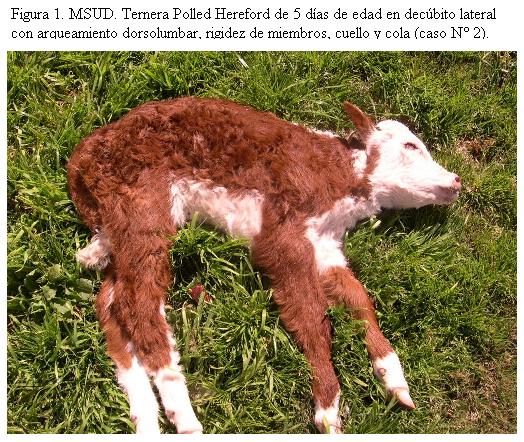
<body><![CDATA[<p class="MsoNormal" style="text-align: justify; line-height: 200%;"><span style="font-size: 10pt; line-height: 200%; font-family: &quot;Verdana&quot;,&quot;sans-serif&quot;;">Se realiz&oacute; </span><span style="font-size: 10pt; line-height: 200%; font-family: &quot;Verdana&quot;,&quot;sans-serif&quot;;" lang="ES-UY">un examen post-mortem completo en todos los casos. El enc&eacute;falo se extrajo entero junto a muestras de m&eacute;dula espinal cervical y <span class="SpellE">toracolumbar</span>, se fij&oacute; </span><span style="font-size: 10pt; line-height: 200%; font-family: &quot;Verdana&quot;,&quot;sans-serif&quot;;">en formol bufferado al 10% durante por lo menos10 d&iacute;as, y se cort&oacute; transversalmente en forma seriada en l&aacute;minas de <st1:metricconverter productid="0.5 cm" w:st="on">0.5 cm</st1:metricconverter> de espesor. Muestras de &oacute;rganos y de diferentes regiones del sistema nervioso central (corteza cerebral, n&uacute;cleos de la base, t&aacute;lamo, hipocampo, mesenc&eacute;falo, cerebelo, m&eacute;dula oblonga, obex y m&eacute;dula espinal) se incluyeron en parafina, se cortaron a 6-7 &micro;m y se colorearon con la t&eacute;cnica de Hematoxilina y Eosina (H&amp;E) y de Cresil Violeta (t&eacute;cnica de <span class="SpellE">Vogt</span>). El grado de espongiosis (vacuolizaci&oacute;n) del sistema nervioso central se evalu&oacute; seg&uacute;n la siguiente escala: sin vacuolas: -; escasas vacuolas: +; espongiosis moderada: ++; <span class="SpellE">espongiosis</span> severa: +++; <i>status <span class="SpellE">spongiosus</span></i>: ++++<i>.</i><o:p></o:p></span></p>         <p class="MsoNormal" style="text-align: justify; line-height: 200%;"><span style="font-size: 10pt; line-height: 200%; font-family: &quot;Verdana&quot;,&quot;sans-serif&quot;;">Para confirmar el origen gen&eacute;tico de la enfermedad, muestras de sangre con EDTA-K del predio 2, incluyendo 2 toros y 14 vacas del rodeo que hab&iacute;an perdido los terneros en el per&iacute;odo perinatal con signos nerviosos aparentes, incluyendo la madre del ternero enfermo, se testaron por PCR-RFLP para detectar la mutaci&oacute;n de ICM y MSUD 248C</span><span style="font-size: 10pt; line-height: 200%;">&rarr;</span><span style="font-size: 10pt; line-height: 200%; font-family: &quot;Verdana&quot;,&quot;sans-serif&quot;;">T en la Unidad de Biotecnolog&iacute;a de INIA Las Brujas. En el predio 3, se testaron con la misma t&eacute;cnica el ternero afectado, los 2 toros y 7 de las vacas sospechosas. Brevemente, la extracci&oacute;n de leucocitos se realiz&oacute; siguiendo normas y protocolos establecidos del Banco de ADN de la Unidad de Biotecnolog&iacute;a INIA Las Brujas, en tanto que el ADN se extrajo utilizando el kit comercial <span class="SpellE">DNAzol</span>&reg; <span class="SpellE">Reagent</span> (GIBCO <span class="SpellE">Life</span> Technologies) seg&uacute;n protocolo de fabricante y se evalu&oacute; en gel de agarosa al 0.8%. Para el ICM se amplific&oacute; un segmento de DNA de 273pb, usando los cebadores: F: 5&acute;CTCCATGGGGAGGATTCTGTATA 3&acute; y el R: 5&acute;GCAAGTGGGTTT AGTTCGTATAC 3&acute;, en los que se crea un cambio de la secuencia (<span class="SpellE">mismatch</span>) para crear el corte de la enzima <span class="SpellE"><i>Acc</i>I</span> permitiendo detectar la mutaci&oacute;n que sustituye T por G. En este caso se reconoce el alelo normal (CC) de 232pb y el mutante de 252pb (AA) seg&uacute;n la t&eacute;cnica de <a href="#Healy_y_col_2002"><span class="SpellE">Healy</span></a> y col. (2002). Para separar las bandas se corri&oacute; en un gel al 3%. En el caso de la mutaci&oacute;n del MSUD 248C</span><span style="font-size: 10pt; line-height: 200%;">&rarr;</span><span style="font-size: 10pt; line-height: 200%; font-family: &quot;Verdana&quot;,&quot;sans-serif&quot;;">T se amplific&oacute; con los cebadores F: 5&acute;CAGCACCCGCCCAGGTGG 3&acute;y el R: 5&acute;GCTTGTCTATGAACTCGGCTG 3&acute;, dando un amplificado de 94pb. La mutaci&oacute;n del ex&oacute;n 2 es reconocida por la enzima <span class="SpellE"><i>Bgl</i></span> I, produciendo un fragmento normal de 79pb y uno mutante de 94 que se observa en un gel de agarosa al 4% (<a href="#Dennis_y_Healy_1999">Dennis</a> y <span class="SpellE">Healy</span>, 1999).<o:p></o:p></span></p>         <p class="MsoNormal" style="text-align: justify; line-height: 200%;"><b><span style="font-size: 10pt; line-height: 200%; font-family: &quot;Verdana&quot;,&quot;sans-serif&quot;;"><o:p>&nbsp;</o:p></span></b></p>         <p class="MsoNormal" style="text-align: justify; line-height: 200%;"><b><span style="font-size: 14pt; line-height: 200%; font-family: &quot;Verdana&quot;,&quot;sans-serif&quot;;">Resultados</span></b><span style="font-size: 14pt; line-height: 200%; font-family: &quot;Verdana&quot;,&quot;sans-serif&quot;;"><o:p></o:p></span></p>         <p class="MsoNormal" style="text-align: justify; line-height: 200%;"><i><span style="font-size: 10pt; line-height: 200%; font-family: &quot;Verdana&quot;,&quot;sans-serif&quot;;">Cl&iacute;nica y epidemiolog&iacute;a<o:p></o:p></span></i></p>         <p class="MsoNormal" style="text-align: justify; line-height: 200%;"><span style="font-size: 10pt; line-height: 200%; font-family: &quot;Verdana&quot;,&quot;sans-serif&quot;;">El primer foco ocurri&oacute; en agosto de 2004 en la 6&ordf; seccional policial del departamento de Treinta y Tres. En un rodeo de 130 vacas Polled Hereford de buena gen&eacute;tica, se registraron 3 (2,3%) muertes de terneros con cuadro nervioso pocos d&iacute;as despu&eacute;s de haber nacido. Las vacas hab&iacute;an sido servidas con toros Polled Hereford comprados el a&ntilde;o anterior en 2 caba&ntilde;as nacionales. Un ternero macho, Polled Hereford, de 3-5 d&iacute;as de edad (Caso N&ordm; 1) presentaba convulsiones y opist&oacute;tonos, muriendo en 24 horas. El animal se remiti&oacute; al laboratorio para diagn&oacute;stico ya que en el predio exist&iacute;an casos similares casi todos los a&ntilde;os y ese a&ntilde;o ya se hab&iacute;an presentado 3 terneros afectados. No se observaron casos similares en las vacas Angus o cruzas del establecimiento.<o:p></o:p></span></p>         <p class="MsoNormal" style="text-align: justify; line-height: 200%;"><span style="font-size: 10pt; line-height: 200%; font-family: &quot;Verdana&quot;,&quot;sans-serif&quot;;">El segundo foco se diagnostic&oacute; en octubre y noviembre de 2006 en un plantel Polled Hereford de la 10&ordf; secci&oacute;n del departamento de Lavalleja. Se afectaron en total 5 (4,1%) terneros de 120 vacas y vaquillonas inseminadas con un toro de pedigr&iacute; adquirido el a&ntilde;o anterior y luego repasadas con toros Polled Hereford. Los terneros eran normales al nacimiento pero dentro de los primeros 5 d&iacute;as de vida se los encontraba en dec&uacute;bito lateral con rigidez y convulsiones intermitentes, estado en el que permanec&iacute;an durante 2-3 d&iacute;as hasta la muerte. Casos espor&aacute;dicos similares hab&iacute;an sido observados en el rodeo en los a&ntilde;os anteriores. Un ternero vivo, hembra, Polled Hereford, de 5 d&iacute;as de edad (caso 2) remitida viva al laboratorio para diagn&oacute;stico, presentaba hiperestesia, temblores, arqueamiento <span class="SpellE">dorsolumbar</span>, nistagmo, trismo y rigidez muscular generalizada incluyendo la cola (<a href="#fig_1">Figura 1</a>).<o:p></o:p></span></p>         <p class="MsoNormal" style="text-align: justify; line-height: 200%;"><span style="font-family: &quot;Verdana&quot;,&quot;sans-serif&quot;;" lang="ES-UY"><o:p>&nbsp;</o:p></span></p>         <p class="MsoNormal" style="text-align: justify; line-height: 200%;"><span style="font-family: &quot;Verdana&quot;,&quot;sans-serif&quot;;"><img style="border: 0px solid ;" alt="" id="_x0000_i1030" src="/img/revistas/vet/v51n200/200a02f1.JPG"></span><a name="fig_1"></a><span style="font-family: &quot;Verdana&quot;,&quot;sans-serif&quot;;" lang="ES-UY"><o:p></o:p></span></p>         <p class="MsoNormal" style="text-align: justify; line-height: 200%;"><span style="font-family: &quot;Verdana&quot;,&quot;sans-serif&quot;;" lang="ES-UY"><o:p>&nbsp;</o:p></span></p>         ]]></body>
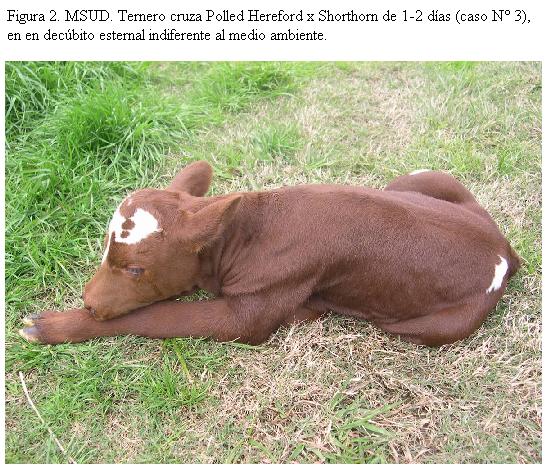
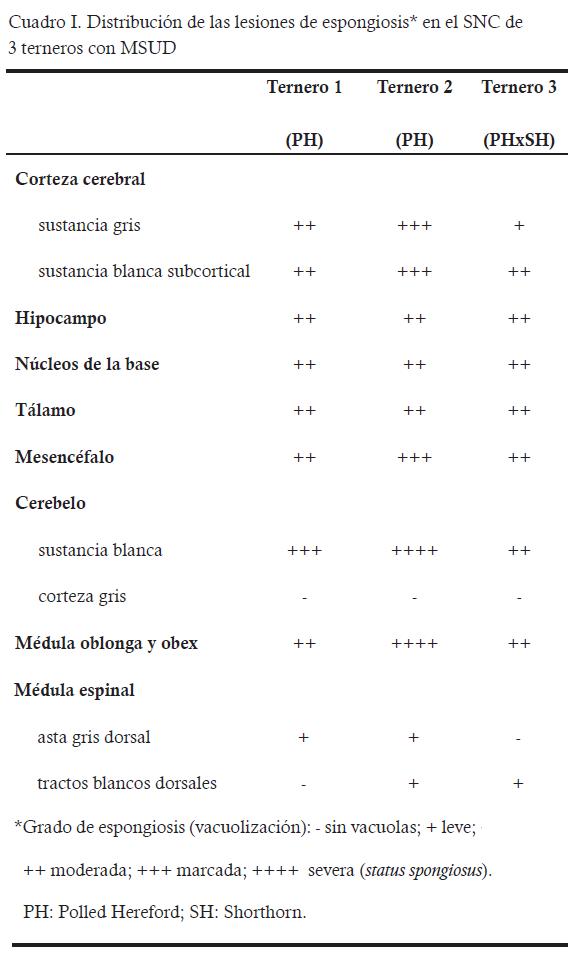
<body><![CDATA[<p class="MsoNormal" style="text-align: justify; line-height: 200%;"><span style="font-size: 10pt; line-height: 200%; font-family: &quot;Verdana&quot;,&quot;sans-serif&quot;;">El tercer foco se diagnostic&oacute; en un establecimiento ganadero en la 8&ordf; secci&oacute;n del departamento de Lavalleja. En un rodeo de 180 vacas Polled Shorthorn en cruzamiento absorbente con PH se registr&oacute; la muerte con cuadro nervioso de unos 20 terneros neonatos en los 3 a&ntilde;os siguientes a la compra de 2 toros PH de una caba&ntilde;a de la zona. En agosto &ndash; setiembre de 2008 aparecieron 7 (3.8%) terneros afectados de los cuales se remiti&oacute; uno vivo para diagn&oacute;stico. Era un macho de 1-2 d&iacute;as de edad cruza PH x SH que permanec&iacute;a en dec&uacute;bito esternal o lateral, indiferente al medio ambiente, aunque presentaba cierta hipersensibilidad sonora y t&aacute;ctil (<a href="#fig_2">Figura 2</a>).<o:p></o:p></span></p>         <p class="MsoNormal" style="text-align: justify; line-height: 200%;"><span style="font-family: &quot;Verdana&quot;,&quot;sans-serif&quot;;"><o:p>&nbsp;</o:p></span></p>         <p class="MsoNormal" style="text-align: justify; line-height: 200%;"><span style="font-family: &quot;Verdana&quot;,&quot;sans-serif&quot;;"><img style="border: 0px solid ;" alt="" id="_x0000_i1029" src="/img/revistas/vet/v51n200/200a02f2.JPG"></span><a name="fig_2"></a><span style="font-family: &quot;Verdana&quot;,&quot;sans-serif&quot;;"><o:p></o:p></span></p>         <p class="MsoNormal" style="text-align: justify; line-height: 200%;"><span style="font-family: &quot;Verdana&quot;,&quot;sans-serif&quot;;" lang="ES-UY"><o:p>&nbsp;</o:p></span></p>         <p class="MsoNormal" style="text-align: justify; line-height: 200%;"><span style="font-size: 10pt; line-height: 200%; font-family: &quot;Verdana&quot;,&quot;sans-serif&quot;;">Cuando se lo pon&iacute;a de pie, el ternero aumentaba la base de sustentaci&oacute;n, manten&iacute;a la cabeza baja, se tambaleaba, y se ca&iacute;a por incoordinaci&oacute;n y par&aacute;lisis de miembros. No se observaron casos en un rodeo Normando puro del mismo establecimiento, por lo que se sospech&oacute; de una enfermedad ligada a la raza con los toros como sospechosos.<o:p></o:p></span></p>         <p class="MsoNormal" style="text-align: justify; line-height: 200%;"><i><span style="font-size: 10pt; line-height: 200%; font-family: &quot;Verdana&quot;,&quot;sans-serif&quot;;">Hallazgos patol&oacute;gicos<o:p></o:p></span></i></p>         <p class="MsoNormal" style="text-align: justify; line-height: 200%;"><span style="font-size: 10pt; line-height: 200%; font-family: &quot;Verdana&quot;,&quot;sans-serif&quot;;">A la necropsia, en los 3 animales hab&iacute;an grados variables de deshidrataci&oacute;n, restos de leche en el abomaso o intestino y ausencia parcial de las reservas grasas perirrenales, indicando muerte en el periodo neonatal tard&iacute;o (&gt; 72 h). El ternero N&ordm; 3 era prematuro, peque&ntilde;o y delgado, de solo <st1:metricconverter productid="67 cm" w:st="on">67 cm</st1:metricconverter> de largo isquio-frontal, y su orina era &aacute;cida con un pH 5, leve proteinuria y un ligero olor dulce, muy diferente al fuerte olor amoniacal normal. No se realiz&oacute; la olfacci&oacute;n en la orina de los otros casos. En todos los animales hab&iacute;a un aumento moderado en la cantidad de l&iacute;quido cefaloraqu&iacute;deo al abrir el cr&aacute;neo, y en el caso 2 se observ&oacute; dilataci&oacute;n moderada de los ventr&iacute;culos laterales. No se observaron otras lesiones macrosc&oacute;picas.<o:p></o:p></span></p>         <p class="MsoNormal" style="text-align: justify; line-height: 200%;"><span style="font-size: 10pt; line-height: 200%; font-family: &quot;Verdana&quot;,&quot;sans-serif&quot;;">A la histopatolog&iacute;a, los 3 animales presentaban una vacuolizaci&oacute;n marcada de la sustancia blanca y parte de la sustancia gris a lo largo del <span class="SpellE">neuroeje</span> (<a href="#tab_1">Cuadro I</a>).</span><span style="font-family: &quot;Verdana&quot;,&quot;sans-serif&quot;;"> <o:p></o:p></span></p>         <p class="MsoNormal" style="text-align: justify; line-height: 200%;"><span style="font-family: &quot;Verdana&quot;,&quot;sans-serif&quot;;"><o:p>&nbsp;</o:p></span></p>         <p class="MsoNormal" style="text-align: justify; line-height: 200%;"><span style="font-family: &quot;Verdana&quot;,&quot;sans-serif&quot;;"><img style="border: 0px solid ;" alt="" id="_x0000_i1028" src="/img/revistas/vet/v51n200/200a02t1.JPG"></span><a name="tab_1"></a><span style="font-family: &quot;Verdana&quot;,&quot;sans-serif&quot;;"><o:p></o:p></span></p>         ]]></body>
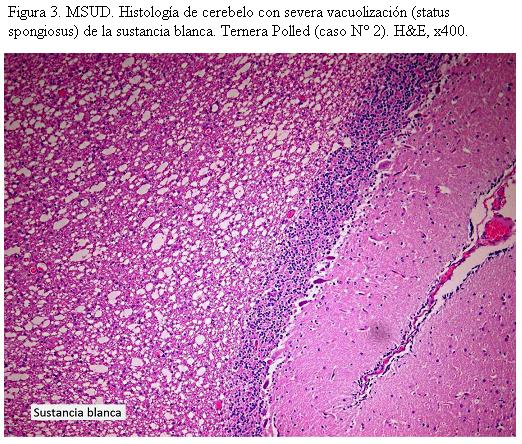
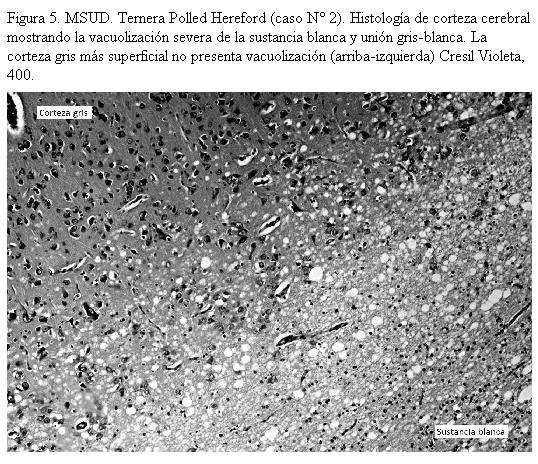
<body><![CDATA[<p class="MsoNormal" style="text-align: justify; line-height: 200%;"><span style="font-family: &quot;Verdana&quot;,&quot;sans-serif&quot;;"><o:p>&nbsp;</o:p></span></p>         <p class="MsoNormal" style="text-align: justify; line-height: 200%;"><span style="font-size: 10pt; line-height: 200%; font-family: &quot;Verdana&quot;,&quot;sans-serif&quot;;">En el cerebelo, la espongiosis era difusa y severa (<i>status spongiosus</i>) y se restring&iacute;a a la sustancia blanca (<a href="#fig_3">Figura 3</a>). <o:p></o:p></span></p>         <p class="MsoNormal" style="text-align: justify; line-height: 200%;"><span style="font-family: &quot;Verdana&quot;,&quot;sans-serif&quot;;" lang="ES-UY"><o:p>&nbsp;</o:p></span></p>         <p class="MsoNormal" style="text-align: justify; line-height: 200%;"><span style="font-family: &quot;Verdana&quot;,&quot;sans-serif&quot;;"><img style="border: 0px solid ;" alt="" id="_x0000_i1027" src="/img/revistas/vet/v51n200/200a02f3.JPG"></span><a name="fig_3"></a><span style="font-family: &quot;Verdana&quot;,&quot;sans-serif&quot;;" lang="ES-UY"><o:p></o:p></span></p>         <p class="MsoNormal" style="line-height: 200%;"><span style="font-family: &quot;Verdana&quot;,&quot;sans-serif&quot;;" lang="ES-UY"><o:p>&nbsp;</o:p></span></p>         <p class="MsoNormal" style="line-height: 200%;"><span style="font-size: 10pt; line-height: 200%; font-family: &quot;Verdana&quot;,&quot;sans-serif&quot;;">Las vacuolas eran grandes (20-150 &micro;m), &oacute;pticamente vac&iacute;as, y ten&iacute;an una forma alargada con el eje mayor paralelo a los axones. La coloraci&oacute;n de cresil violeta mostr&oacute; que la espongiosis se localizaba en los espacios periaxonales en concordancia con un edema de mielina (<a href="#fig_4">Figura 4</a>).<o:p></o:p></span></p>         <p class="MsoNormal" style="line-height: 200%;"><span style="font-family: &quot;Verdana&quot;,&quot;sans-serif&quot;;" lang="ES-UY"><o:p>&nbsp;</o:p></span></p>         <p class="MsoNormal" style="line-height: 200%;"><span style="font-family: &quot;Verdana&quot;,&quot;sans-serif&quot;;"><img style="border: 0px solid ;" alt="" id="_x0000_i1026" src="/img/revistas/vet/v51n200/200a02f4.JPG"></span><a name="fig_4"></a><span style="font-family: &quot;Verdana&quot;,&quot;sans-serif&quot;;" lang="ES-UY"><o:p></o:p></span></p>         <p class="MsoNormal" style="line-height: 200%;"><span style="font-family: &quot;Verdana&quot;,&quot;sans-serif&quot;;" lang="ES-UY"><o:p>&nbsp;</o:p></span></p>         <p class="MsoNormal" style="line-height: 200%;"><span style="font-size: 10pt; line-height: 200%; font-family: &quot;Verdana&quot;,&quot;sans-serif&quot;;">En el cerebro, adem&aacute;s de la sustancia blanca subcortical, la espongiosis se extend&iacute;a a la uni&oacute;n corteza gris &ndash; sustancia blanca y la capa profunda de la corteza gris (<a href="#fig_5">Figura 5</a>).<o:p></o:p></span></p>         ]]></body>
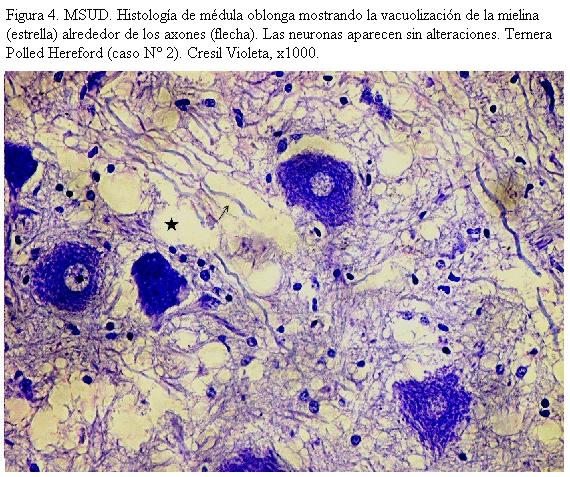
<body><![CDATA[<p class="MsoNormal" style="line-height: 200%;"><span style="font-family: &quot;Verdana&quot;,&quot;sans-serif&quot;;" lang="ES-UY"><o:p>&nbsp;</o:p></span></p>         <p class="MsoNormal" style="line-height: 200%;"><span style="font-family: &quot;Verdana&quot;,&quot;sans-serif&quot;;"><img style="border: 0px solid ;" alt="" id="_x0000_i1025" src="/img/revistas/vet/v51n200/200a02f5.JPG"></span><a name="fig_5"></a><span style="font-family: &quot;Verdana&quot;,&quot;sans-serif&quot;;" lang="ES-UY"><o:p></o:p></span></p>         <p class="MsoNormal" style="line-height: 200%;"><span style="font-family: &quot;Verdana&quot;,&quot;sans-serif&quot;;" lang="ES-UY"><o:p>&nbsp;</o:p></span></p>         <p class="MsoNormal" style="text-align: justify; line-height: 200%;"><span style="font-size: 10pt; line-height: 200%; font-family: &quot;Verdana&quot;,&quot;sans-serif&quot;;">Las lesiones eran moderadas en el hipocampo, n&uacute;cleos de la base y t&aacute;lamo, y muy marcadas en el mesenc&eacute;falo, </span><span style="font-size: 10pt; line-height: 200%; font-family: &quot;Verdana&quot;,&quot;sans-serif&quot;;" lang="ES-UY">formaci&oacute;n reticular</span><span style="font-size: 10pt; line-height: 200%; font-family: &quot;Verdana&quot;,&quot;sans-serif&quot;;"> de la m&eacute;dula oblonga y obex, donde afectaba parcialmente los diferentes n&uacute;cleos grises, especialmente el oculomotor en el mesenc&eacute;falo y n&uacute;cleos grises dorsales en la m&eacute;dula oblonga. En la m&eacute;dula espinal las lesiones eran m&aacute;s discretas y se restring&iacute;an a la uni&oacute;n gris &ndash; blanca de las astas dorsales. En el ternero N&ordm; 2, en la capa molecular del cerebelo hab&iacute;a numerosos esferoides dendr&iacute;ticos indicativos de exitotoxicidad. En ninguno de los animales </span><span style="font-size: 10pt; line-height: 200%; font-family: &quot;Verdana&quot;,&quot;sans-serif&quot;;" lang="ES-UY">hab&iacute;a espongiosis neuronal, edema de astrocitos u oligodendrocitos, edema perivascular, p&eacute;rdida de mielina o alteraciones en las neuronas</span><span style="font-size: 10pt; line-height: 200%; font-family: &quot;Verdana&quot;,&quot;sans-serif&quot;;">. El resto de los &oacute;rganos examinados no presentaban alteraciones de significaci&oacute;n.<o:p></o:p></span></p>         <p class="MsoNormal" style="text-align: justify; line-height: 200%;"><i><span style="font-size: 10pt; line-height: 200%; font-family: &quot;Verdana&quot;,&quot;sans-serif&quot;;">Diagn&oacute;stico molecular<o:p></o:p></span></i></p>         <p class="MsoNormal" style="text-align: justify; line-height: 200%;"><span style="font-size: 10pt; line-height: 200%; font-family: &quot;Verdana&quot;,&quot;sans-serif&quot;;">Uno de los toros y 5 de las 14 (35,7%) vacas testadas en el predio 2 </span><span style="font-size: 10pt; line-height: 200%; font-family: &quot;Verdana&quot;,&quot;sans-serif&quot;;" lang="ES-TRAD">se identificaron como portadoras de la mutaci&oacute;n MSUD </span><span style="font-size: 10pt; line-height: 200%; font-family: &quot;Verdana&quot;,&quot;sans-serif&quot;;">248</span><span style="font-size: 10pt; line-height: 200%; font-family: &quot;Verdana&quot;,&quot;sans-serif&quot;;" lang="ES-UY">C</span><span style="font-size: 10pt; line-height: 200%;" lang="ES-UY">&rarr;</span><span style="font-size: 10pt; line-height: 200%; font-family: &quot;Verdana&quot;,&quot;sans-serif&quot;;" lang="ES-UY">T</span><span style="font-size: 10pt; line-height: 200%; font-family: &quot;Verdana&quot;,&quot;sans-serif&quot;;" lang="ES-TRAD">. En el predio N&ordm; 3, el ternero cruza PH x SH afectado, 1 de los 2 toros PH y 2 de las 7 (28,5%) madres analizadas fueron heterocigotos positivos a MSUD </span><span style="font-size: 10pt; line-height: 200%; font-family: &quot;Verdana&quot;,&quot;sans-serif&quot;;">248</span><span style="font-size: 10pt; line-height: 200%; font-family: &quot;Verdana&quot;,&quot;sans-serif&quot;;" lang="ES-UY">C</span><span style="font-size: 10pt; line-height: 200%;" lang="ES-UY">&rarr;</span><span style="font-size: 10pt; line-height: 200%; font-family: &quot;Verdana&quot;,&quot;sans-serif&quot;;" lang="ES-UY">T</span><span style="font-size: 10pt; line-height: 200%; font-family: &quot;Verdana&quot;,&quot;sans-serif&quot;;" lang="ES-TRAD">. No se realiz&oacute; la prueba para el alelo MSUD </span><span style="font-size: 10pt; line-height: 200%; font-family: &quot;Verdana&quot;,&quot;sans-serif&quot;;">1380</span><span style="font-size: 10pt; line-height: 200%; font-family: &quot;Verdana&quot;,&quot;sans-serif&quot;;" lang="ES-UY">C</span><span style="font-size: 10pt; line-height: 200%;" lang="ES-UY">&rarr;</span><span style="font-size: 10pt; line-height: 200%; font-family: &quot;Verdana&quot;,&quot;sans-serif&quot;;" lang="ES-UY">T. </span><span style="font-size: 10pt; line-height: 200%; font-family: &quot;Verdana&quot;,&quot;sans-serif&quot;;" lang="ES-TRAD">Ninguno de los animales testados en el predio 2 fue positivo para ICM.<o:p></o:p></span></p>         <p class="MsoNormal" style="text-align: justify; line-height: 200%;"><span style="font-size: 10pt; line-height: 200%; font-family: &quot;Verdana&quot;,&quot;sans-serif&quot;;"><o:p>&nbsp;</o:p></span></p>         <p class="MsoNormal" style="text-align: justify; line-height: 200%;"><b><span style="font-size: 14pt; line-height: 200%; font-family: &quot;Verdana&quot;,&quot;sans-serif&quot;;">Discusi&oacute;n</span></b><span style="font-size: 14pt; line-height: 200%; font-family: &quot;Verdana&quot;,&quot;sans-serif&quot;;"><o:p></o:p></span></p>         <p class="MsoNormal" style="text-align: justify; line-height: 200%;"><span style="font-size: 10pt; line-height: 200%; font-family: &quot;Verdana&quot;,&quot;sans-serif&quot;;">El presente trabajo demuestra por primera vez en Uruguay la existencia de la aminoacidopat&iacute;a hereditaria conocida como Maple <span class="SpellE">Syrup</span> <span class="SpellE">Urine</span> <span class="SpellE">Disease</span> (MSUD), o enfermedad de la orina con olor a Jarabe de Arce, en terneros PH y cruzas PH x SH. El diagn&oacute;stico se realiz&oacute; por el cuadro cl&iacute;nico y neuropatol&oacute;gico caracter&iacute;stico y se confirm&oacute; por t&eacute;cnicas de gen&eacute;tica molecular.<o:p></o:p></span></p>         <p class="MsoNormal" style="text-align: justify; line-height: 200%;"><span style="font-size: 10pt; line-height: 200%; font-family: &quot;Verdana&quot;,&quot;sans-serif&quot;;">La     ]]></body>
<body><![CDATA[mutaci&oacute;n MSUD 248C</span><span style="font-size: 10pt; line-height: 200%;">&rarr;</span><span style="font-size: 10pt; line-height: 200%; font-family: &quot;Verdana&quot;,&quot;sans-serif&quot;;">T     es la m&aacute;s difundida en el Hereford mocho y astado en pa&iacute;ses d&oacute;nde la enfermedad     ha sido diagnosticada (<a href="#Healy_1996"><span class="SpellE">Healy</span></a>,     1996; <a href="#Healy_y_col_2002"><span class="SpellE">Healy</span></a> y col.,     2002; <a name="-Windsor_2011"></a><a href="#Windsor_2011">Windsor</a>, 2011).     Los casos </span><span style="font-size: 10pt; line-height: 200%; font-family: &quot;Verdana&quot;,&quot;sans-serif&quot;;" lang="ES-UY">del presente     estudio </span><span style="font-size: 10pt; line-height: 200%; font-family: &quot;Verdana&quot;,&quot;sans-serif&quot;;">aparecieron     en forma de brotes en predios criadores de tipo comercial </span><span style="font-size: 10pt; line-height: 200%; font-family: &quot;Verdana&quot;,&quot;sans-serif&quot;;" lang="ES-UY">(</span><span style="font-size: 10pt; line-height: 200%; font-family: &quot;Verdana&quot;,&quot;sans-serif&quot;;">2.3%, 4.1% y 3.8% en predios 1-3,     respectivamente</span><span style="font-size: 10pt; line-height: 200%; font-family: &quot;Verdana&quot;,&quot;sans-serif&quot;;" lang="ES-UY">)</span><span style="font-size: 10pt; line-height: 200%; font-family: &quot;Verdana&quot;,&quot;sans-serif&quot;;">,     los predios ten&iacute;an antecedentes de casos similares en a&ntilde;os anteriores, y el semen     ]]></body>
<body><![CDATA[y los toros utilizados eran todos de origen nacional, sugiriendo que el gen     MSUD 248</span><span style="font-size: 10pt; line-height: 200%; font-family: &quot;Verdana&quot;,&quot;sans-serif&quot;;" lang="ES-UY">C</span><span style="font-size: 10pt; line-height: 200%;" lang="ES-UY">&rarr;</span><span style="font-size: 10pt; line-height: 200%; font-family: &quot;Verdana&quot;,&quot;sans-serif&quot;;" lang="ES-UY">T </span><span style="font-size: 10pt; line-height: 200%; font-family: &quot;Verdana&quot;,&quot;sans-serif&quot;;">ha </span><span style="font-size: 10pt; line-height: 200%; font-family: &quot;Verdana&quot;,&quot;sans-serif&quot;;" lang="ES-UY">traspasado </span><span style="font-size: 10pt; line-height: 200%; font-family: &quot;Verdana&quot;,&quot;sans-serif&quot;;">los planteles de pedigr&iacute; y     se ha generalizado en la cr&iacute;a comercial. En el predio N&ordm; 3, -que practicaba un     cruzamiento absorbente del Shorthorn-, el ternero PH x SH afectado result&oacute;     heterocigoto para el alelo MSUD 248</span><span style="font-size: 10pt; line-height: 200%; font-family: &quot;Verdana&quot;,&quot;sans-serif&quot;;" lang="ES-UY">C</span><span style="font-size: 10pt; line-height: 200%;" lang="ES-UY">&rarr;</span><span style="font-size: 10pt; line-height: 200%; font-family: &quot;Verdana&quot;,&quot;sans-serif&quot;;" lang="ES-UY">T.     </span><span style="font-size: 10pt; line-height: 200%; font-family: &quot;Verdana&quot;,&quot;sans-serif&quot;;">En     la raza Shorthorn, la mutaci&oacute;n causante del MSUD es una transici&oacute;n C</span><span style="font-size: 10pt; line-height: 200%;">&rarr;</span><span style="font-size: 10pt; line-height: 200%; font-family: &quot;Verdana&quot;,&quot;sans-serif&quot;;">T en el nucle&oacute;tido     1380 del mismo gen, habi&eacute;ndose demostrado que los terneros enfermos PH x SH son     siempre heterocigotos compuestos, es decir poseedores de ambos alelos mutantes     MSUD 248 y 1380 (<a href="#Dennis_y_Healy_1999">Dennis</a> y <span class="SpellE">Healy</span>, 1999). As&iacute;, si bien en el presente trabajo no se     ]]></body>
<body><![CDATA[realiz&oacute; PCR-RFLP para el alelo 1380, es previsible que esta mutaci&oacute;n est&eacute;     presente en el Shorthorn nacional. Caracter&iacute;sticamente, en los tres predios la     enfermedad se hizo manifiesta luego de la compra de nuevos toros (presuntamente     heterocigotos), indicando que en el rodeo ya hab&iacute;a una alta proporci&oacute;n de vacas     portadoras del gen mutante. </span><span style="font-size: 10pt; line-height: 200%; font-family: &quot;Verdana&quot;,&quot;sans-serif&quot;;" lang="ES-UY">Seg&uacute;n     <a href="#Cordy_y_col_1969"><span class="SpellE">Cordy</span></a> y col. (1969),     un gen recesivo letal como el MSUD debe alcanzar una frecuencia g&eacute;nica de 20% o     m&aacute;s en un rodeo o en una l&iacute;nea gen&eacute;tica determinada antes de que la enfermedad     llame la atenci&oacute;n de genetistas o pat&oacute;logos, y con m&aacute;s de 20% los casos     cl&iacute;nicos aparecen en niveles alarmantes. </span><span style="font-size: 10pt; line-height: 200%; font-family: &quot;Verdana&quot;,&quot;sans-serif&quot;;">A</span><span style="font-size: 10pt; line-height: 200%; font-family: &quot;Verdana&quot;,&quot;sans-serif&quot;;" lang="ES-UY"> este respecto, en el presente estudio la prevalencia     ]]></body>
<body><![CDATA[de portadores heterocigotos MSUD 248</span><span style="font-size: 10pt; line-height: 200%; font-family: &quot;Verdana&quot;,&quot;sans-serif&quot;;">C</span><span style="font-size: 10pt; line-height: 200%;">&rarr;</span><span style="font-size: 10pt; line-height: 200%; font-family: &quot;Verdana&quot;,&quot;sans-serif&quot;;">T </span><span style="font-size: 10pt; line-height: 200%; font-family: &quot;Verdana&quot;,&quot;sans-serif&quot;;" lang="ES-UY">estimada seg&uacute;n la Ley de Hardy-Weinberg en base a la     incidencia al parto de terneros afectados (<a name="-Nicholas_2010"></a><a href="#Nicholas_2010">Nicholas</a>, 2010), fue de 25.7%, 32.3% y 31.3% en los     predios 1-3, respectivamente, en tanto que la proporci&oacute;n de vacas portadoras     detectadas por </span><span style="font-size: 10pt; line-height: 200%; font-family: &quot;Verdana&quot;,&quot;sans-serif&quot;;">PCR-RFLP en los predios 2 y 3 fue de 35.7%     y 28.5%. </span><span style="font-size: 10pt; line-height: 200%; font-family: &quot;Verdana&quot;,&quot;sans-serif&quot;;" lang="ES-UY">La incidencia real     de la enfermedad podr&iacute;a ser incluso mayor, ya que la prevalencia observada al     nacimiento no incluye la mortalidad embrionaria y los fetos que no llegan a     t&eacute;rmino y que pueden ser parte de las p&eacute;rdidas causadas por el MSUD (<a href="#Healy_y_col_1985"><span class="SpellE">Healy</span></a> y col., 1985; <a href="#Baird_y_col_1987"><span class="SpellE">Baird</span></a> y col., 1987). </span><span style="font-size: 10pt; line-height: 200%; font-family: &quot;Verdana&quot;,&quot;sans-serif&quot;;">Si     bien estos datos son de predios problemas y los grupos muestreados eran     peque&ntilde;os y no son una gu&iacute;a precisa de la incidencia de la enfermedad, los     ]]></body>
<body><![CDATA[resultados revelan que la mutaci&oacute;n puede estar difundida en el Hereford     nacional o algunas de sus l&iacute;neas. </span><span style="font-size: 10pt; line-height: 200%; font-family: &quot;Verdana&quot;,&quot;sans-serif&quot;;" lang="ES-UY"><o:p></o:p></span></p>     <p class="MsoNormal" style="text-align: justify; line-height: 200%;"><span style="font-size: 10pt; line-height: 200%; font-family: &quot;Verdana&quot;,&quot;sans-serif&quot;;">La     sintomatolog&iacute;a cl&iacute;nica nerviosa de rigidez y opist&oacute;tonos que presentaban los     animales reci&eacute;n nacidos era bastante similar al t&eacute;tanos neonatal (<a name="-Stober_2005"></a><a href="#Stober_2005">Stober</a>, 2005), pero las lesiones histopatol&oacute;gicas     encontradas en el sistema nervioso central y la ausencia de onfalitis, <span class="SpellE">miasis</span> o heridas descartaron dicha patolog&iacute;a. Adem&aacute;s, el     periodo de incubaci&oacute;n m&iacute;nimo del <span class="SpellE"><i>Clostridium</i></span><i>     <span class="SpellE">tetani</span></i> es de 10-14 d&iacute;as (<a href="#Stober_2005"><span class="SpellE">Stober</span></a>, 2005) mientras que los casos de MSUD siempre     ocurren entre 1-10 d&iacute;as de nacidos (<a href="#Cordy_y_col_1969"><span class="SpellE">Cordy</span></a> y col. 1969; <a href="#Harper_y_col_1989"><span class="SpellE">Harper</span></a> y col., 1989), por lo que dichas enfermedades     raramente o nunca se superponen. Tambi&eacute;n se desestimaron por histopatolog&iacute;a del     ]]></body>
<body><![CDATA[SNC, la <span class="SpellE">leptomeningitis</span> bacteriana y la encefalopat&iacute;a     <span class="SpellE">hip&oacute;xico</span>-isqu&eacute;mica a consecuencia de asfixia fetal     por partos dificultosos o dist&oacute;cicos. Histol&oacute;gicamente, l</span><span style="font-size: 10pt; line-height: 200%; font-family: &quot;Verdana&quot;,&quot;sans-serif&quot;;" lang="ES-UY">as lesiones </span><span style="font-size: 10pt; line-height: 200%; font-family: &quot;Verdana&quot;,&quot;sans-serif&quot;;">neurol&oacute;gicas en los 3     casos estudiados </span><span style="font-size: 10pt; line-height: 200%; font-family: &quot;Verdana&quot;,&quot;sans-serif&quot;;" lang="ES-UY">eran     indistinguibles de</span><span style="font-size: 10pt; line-height: 200%; font-family: &quot;Verdana&quot;,&quot;sans-serif&quot;;">l </span><span style="font-size: 10pt; line-height: 200%; font-family: &quot;Verdana&quot;,&quot;sans-serif&quot;;" lang="ES-UY">MSUD</span><span style="font-size: 10pt; line-height: 200%; font-family: &quot;Verdana&quot;,&quot;sans-serif&quot;;"> tal y como ha sido descripto en terneros (<a href="#Cordy_y_col_1969"><span class="SpellE">Cordy</span></a> y col., 1969; <a href="#Harper_y_col_1989"><span class="SpellE">Harper</span></a> y col., 1986, <a href="#Harper_y_col_1990">1990</a>) y en ni&ntilde;os neonatos con la forma cl&aacute;sica (<a href="#Volpe_2001"><span class="SpellE">Volpe</span></a>, 2001</span><span style="font-size: 10pt; line-height: 200%; font-family: &quot;Verdana&quot;,&quot;sans-serif&quot;;" lang="ES-UY">). La lesi&oacute;n principal </span><span style="font-size: 10pt; line-height: 200%; font-family: &quot;Verdana&quot;,&quot;sans-serif&quot;;">era</span><span style="font-size: 10pt; line-height: 200%; font-family: &quot;Verdana&quot;,&quot;sans-serif&quot;;" lang="ES-UY"> el </span><i><span style="font-size: 10pt; line-height: 200%; font-family: &quot;Verdana&quot;,&quot;sans-serif&quot;;">status spongiosus</span></i><span style="font-size: 10pt; line-height: 200%; font-family: &quot;Verdana&quot;,&quot;sans-serif&quot;;">     de la sustancia </span><span style="font-size: 10pt; line-height: 200%; font-family: &quot;Verdana&quot;,&quot;sans-serif&quot;;" lang="ES-UY">blanca y, en     menor medida, </span><span style="font-size: 10pt; line-height: 200%; font-family: &quot;Verdana&quot;,&quot;sans-serif&quot;;">de </span><span style="font-size: 10pt; line-height: 200%; font-family: &quot;Verdana&quot;,&quot;sans-serif&quot;;" lang="ES-UY">la     </span><span style="font-size: 10pt; line-height: 200%; font-family: &quot;Verdana&quot;,&quot;sans-serif&quot;;">uni&oacute;n     gris-blanca a lo largo del neuroeje tal y como se han descripto en el MSUD (<a href="#Harper_y_col_1989"><span class="SpellE">Harper</span></a> y col., 1986, <a href="#Harper_y_col_1990">1990</a>). Las lesiones </span><span style="font-size: 10pt; line-height: 200%; font-family: &quot;Verdana&quot;,&quot;sans-serif&quot;;" lang="ES-UY">eran </span><span style="font-size: 10pt; line-height: 200%; font-family: &quot;Verdana&quot;,&quot;sans-serif&quot;;">severas</span><span style="font-size: 10pt; line-height: 200%; font-family: &quot;Verdana&quot;,&quot;sans-serif&quot;;" lang="ES-UY">, difusas </span><span style="font-size: 10pt; line-height: 200%; font-family: &quot;Verdana&quot;,&quot;sans-serif&quot;;">y </span><span style="font-size: 10pt; line-height: 200%; font-family: &quot;Verdana&quot;,&quot;sans-serif&quot;;" lang="ES-UY">de simetr&iacute;a bilateral</span><span style="font-size: 10pt; line-height: 200%; font-family: &quot;Verdana&quot;,&quot;sans-serif&quot;;">, y las m&aacute;s </span><span style="font-size: 10pt; line-height: 200%; font-family: &quot;Verdana&quot;,&quot;sans-serif&quot;;" lang="ES-UY">graves se </span><span style="font-size: 10pt; line-height: 200%; font-family: &quot;Verdana&quot;,&quot;sans-serif&quot;;">localizaban en el cerebelo</span><span style="font-size: 10pt; line-height: 200%; font-family: &quot;Verdana&quot;,&quot;sans-serif&quot;;" lang="ES-UY">, la sustancia blanca </span><span style="font-size: 10pt; line-height: 200%; font-family: &quot;Verdana&quot;,&quot;sans-serif&quot;;">sub</span><span style="font-size: 10pt; line-height: 200%; font-family: &quot;Verdana&quot;,&quot;sans-serif&quot;;" lang="ES-UY">cortical, </span><span style="font-size: 10pt; line-height: 200%; font-family: &quot;Verdana&quot;,&quot;sans-serif&quot;;">el mesenc&eacute;falo </span><span style="font-size: 10pt; line-height: 200%; font-family: &quot;Verdana&quot;,&quot;sans-serif&quot;;" lang="ES-UY">y la formaci&oacute;n reticular</span><span style="font-size: 10pt; line-height: 200%; font-family: &quot;Verdana&quot;,&quot;sans-serif&quot;;"> del bulbo, siendo     mucho m&aacute;s modestas en la m&eacute;dula espinal. </span><span style="font-size: 10pt; line-height: 200%; font-family: &quot;Verdana&quot;,&quot;sans-serif&quot;;" lang="ES-UY">No </span><span style="font-size: 10pt; line-height: 200%; font-family: &quot;Verdana&quot;,&quot;sans-serif&quot;;">hab&iacute;a signos de</span><span style="font-size: 10pt; line-height: 200%; font-family: &quot;Verdana&quot;,&quot;sans-serif&quot;;" lang="ES-UY"> desmielinizaci&oacute;n ni de degeneraci&oacute;n o p&eacute;rdida de     ]]></body>
<body><![CDATA[neuronas. La espongiosis, degeneraci&oacute;n esponjosa o <i>status spongiosus </i>es,     por definici&oacute;n, un diagn&oacute;stico neuropatol&oacute;gico caracterizado microsc&oacute;picamente     por la apariencia micro-vacuolar o esponjosa, con aspecto de colador del tejido     nervioso, sin alteraci&oacute;n o p&eacute;rdida de c&eacute;lulas neuronales </span><span style="font-size: 10pt; line-height: 200%; font-family: &quot;Verdana&quot;,&quot;sans-serif&quot;;">(<a name="-Hooper_1975"></a><a href="#Hooper_1975">Hooper</a>, 1975; <a name="-Cho_y_Leipold_1977"></a><a href="#Cho_y_Leipold_1977">Cho</a> y <span class="SpellE">Leipold</span>, 1977</span><span style="font-size: 10pt; line-height: 200%; font-family: &quot;Verdana&quot;,&quot;sans-serif&quot;;" lang="ES-UY">)</span><span style="font-size: 10pt; line-height: 200%; font-family: &quot;Verdana&quot;,&quot;sans-serif&quot;;">. </span><span style="font-size: 10pt; line-height: 200%; font-family: &quot;Verdana&quot;,&quot;sans-serif&quot;;" lang="ES-UY">Para el diagn&oacute;stico diferencial de <i>status     spongiosus</i> es vital determinar si la vacuolizaci&oacute;n es debida edema     intramiel&iacute;nico, vacuolizaci&oacute;n de astrocitos u oligodendrocitos, o a la     vacuolizaci&oacute;n del neuropilo</span><span style="font-size: 10pt; line-height: 200%; font-family: &quot;Verdana&quot;,&quot;sans-serif&quot;;"> (<a href="#Cho_y_Leipold_1977"><span class="SpellE">Cho</span></a> y <span class="SpellE">Leipold</span>, 1977).</span><span style="font-size: 10pt; line-height: 200%; font-family: &quot;Verdana&quot;,&quot;sans-serif&quot;;" lang="ES-UY"> Lesiones de <i>status spongiosus</i> con edema de     mielina pr&aacute;cticamente indistinguibles del MSUD, -y que se suponen son tambi&eacute;n     condiciones heredadas-, se han reportado en terneros neonatos de raza Wagyu, (<a name="-Kato_y_col_2005"></a><a href="#Kato_y_col_2005"><span class="SpellE">Kato</span></a>     y col., 2005) y <span class="SpellE">Gelbvieh</span> (<a name="-O&rsquo;Toole_y_col_2005"></a><a href="#O%92Toole_y_col_2005"><span class="SpellE">O&rsquo;Toole</span></a></span><span style="font-size: 10pt; line-height: 200%; font-family: &quot;Verdana&quot;,&quot;sans-serif&quot;;"> y     ]]></body>
<body><![CDATA[col., 2005), aunque la causa no pudo ser determinada. La enfermedad de Canavan,     que causa una degeneraci&oacute;n esponjosa severa de la sustancia blanca en ni&ntilde;os     debido a una deficiencia de la enzima aspartatoacilasa, se ha sospechado pero     no ha podido ser confirmada en terneros Hereford de Nueva Zelanda (<a href="#O%92Toole_y_col_2005"><span class="SpellE">O&rsquo;Toole</span></a> y col.,     2005). La encefalopat&iacute;a hep&aacute;tica causa espongiosis cerebral por edema     intramiel&iacute;nico (<a href="#Cho_y_Leipold_1977"><span class="SpellE">Cho</span></a>     y <span class="SpellE">Leipold</span>, 1977), pero las lesiones nunca son tan     severas como en el MSUD y en los terneros del presente estudio no hab&iacute;a     lesiones hep&aacute;ticas. Otra patolog&iacute;a autos&oacute;mica recesiva a considerar en el     diagn&oacute;stico diferencial es la Citrulinemia </span><span style="font-size: 10pt; line-height: 200%; font-family: &quot;Verdana&quot;,&quot;sans-serif&quot;;" lang="ES-UY">(OMIA 000194-9913)</span><span style="font-size: 10pt; line-height: 200%; font-family: &quot;Verdana&quot;,&quot;sans-serif&quot;;">, pero esta enfermedad     ]]></body>
<body><![CDATA[solo se ha diagnosticado en terneros Holando hasta el momento, y adem&aacute;s     histol&oacute;gicamente el edema y los cambios espongiformes en el SNC son m&aacute;s     modestos que el MSUD, afectan preferentemente las capas profundas de la corteza     gris cerebral, y se caracterizan por expansi&oacute;n de los espacios <span class="SpellE">perivasculares</span> y <span class="SpellE">perineuronales</span> y     por edema intracelular de astrocitos antes que por edema de mielina (<a name="-Harper_y_col_1988"></a><a href="#Harper_y_col_1988">Harper</a> y col., 1988). Otra enfermedad hereditaria     muy similar al MSUD en terneros HER y PH desde el punto de vista cl&iacute;nico y     epidemiol&oacute;gico, es la Mioclonia Cong&eacute;nita Hereditaria o ICM (</span><span style="font-size: 10pt; line-height: 200%; font-family: &quot;Verdana&quot;,&quot;sans-serif&quot;;" lang="ES-UY"><a href="#OMIA">OMIA</a> 000689</span><span style="font-size: 10pt; line-height: 200%; font-family: &quot;Verdana&quot;,&quot;sans-serif&quot;;">).     Ambas enfermedades son pr&aacute;cticamente <span class="GramE">indistinguible</span> ya     que muchos animales son portadores para ambas mutaciones y las enfermedades     pueden ocurrir simult&aacute;neamente en el mismo rodeo (<a href="#Gundlach_1990"><span class="SpellE">Gundlach</span></a>, 1990; </span><a name="-Pierce_y_col_2001"></a><span style="font-size: 10pt; line-height: 200%; font-family: &quot;Verdana&quot;,&quot;sans-serif&quot;;" lang="ES-UY"><a href="#Pierce_y_col_2001">Pierce</a> y col., 2001; </span><span style="font-size: 10pt; line-height: 200%; font-family: &quot;Verdana&quot;,&quot;sans-serif&quot;;"><a href="#Healy_y_col_2002"><span class="SpellE">Healy</span></a> y col., 2002). La     ]]></body>
<body><![CDATA[ICM es debida a una mutaci&oacute;n en el gen que codifica para la subunidad alfa-1     del receptor de la glicina, estricnina-sensitivo, GLRA1, con la p&eacute;rdida de la     acci&oacute;n inhibitoria de este <span class="SpellE">neurotrasmisor</span> en la     m&eacute;dula espinal (<a href="#Gundlach_1990"><span class="SpellE">Gundlach</span></a>,     1990; </span><span style="font-size: 10pt; line-height: 200%; font-family: &quot;Verdana&quot;,&quot;sans-serif&quot;;" lang="ES-UY"><a href="#Pierce_y_col_2001">Pierce</a> y col., 2001)</span><span style="font-size: 10pt; line-height: 200%; font-family: &quot;Verdana&quot;,&quot;sans-serif&quot;;">.     A diferencia del MSUD, los terneros con ICM nacen con signos cl&iacute;nicos nerviosos     o incluso muestran sintomatolog&iacute;a en la fase fetal, pero en condiciones de     campo no siempre es posible determinar si los animales caminaron y mamaron el     primer d&iacute;a de vida (<a href="#Gundlach_1990"><span class="SpellE">Gundlach</span></a>,     1990). La enfermedad se descart&oacute; por PCR y por la ausencia de espongiosis en el     ]]></body>
<body><![CDATA[SNC.<o:p></o:p></span></p>     <p class="MsoNormal" style="text-align: justify; line-height: 200%;"><span style="font-size: 10pt; line-height: 200%; font-family: &quot;Verdana&quot;,&quot;sans-serif&quot;;">En los &uacute;ltimos a&ntilde;os la biolog&iacute;a molecular ha permitido el desarrollo de pruebas de laboratorio econ&oacute;micos, r&aacute;pidos y mucho m&aacute;s sensibles y eficientes basados en PCR que han facilitado el diagn&oacute;stico y control de las enfermedades hereditarias del ganado (<a href="#Windsor_2011">Windsor</a> y col., 2011). Actualmente, varios pa&iacute;ses cuentan con programas para identificar portadores de caracteres indeseables y tambi&eacute;n para aumentar el conocimiento cl&iacute;nico y patol&oacute;gico de las enfermedades gen&eacute;ticas (<a href="#Healy_1996"><span class="SpellE">Healy</span></a>, 1996; <a href="#Windsor_2011">Windsor</a> y col., 2011). En Uruguay, con sistemas de producci&oacute;n comercial dominados por razas puras, con el uso extendido de tecnolog&iacute;as de la reproducci&oacute;n de &uacute;ltima generaci&oacute;n en caba&ntilde;as, con </span><span style="font-size: 10pt; line-height: 200%; font-family: &quot;Verdana&quot;,&quot;sans-serif&quot;;" lang="ES-UY">programas de evaluaci&oacute;n gen&eacute;tica poblacional </span><span style="font-size: 10pt; line-height: 200%; font-family: &quot;Verdana&quot;,&quot;sans-serif&quot;;">avanzados y con una de las poblaciones HER y PH m&aacute;s grande y selectas del mundo, el riesgo de difusi&oacute;n de defectos recesivos es real, como lo demuestra el hecho de que varias enfermedades hereditarias se han reconocido en los &uacute;ltimos a&ntilde;os (<a name="-Dutra_2012"></a><a href="#Dutra_2012">Dutra</a>, 2012; <a name="-Kelly_y_col_2012"></a><a href="#Kelly_y_col_2012">Kelly</a> y col., 2012). La falta de diagn&oacute;stico e investigaci&oacute;n es la principal causa de difusi&oacute;n de estas enfermedades en el rodeo nacional. </span><span style="font-size: 10pt; line-height: 200%; font-family: &quot;Verdana&quot;,&quot;sans-serif&quot;;" lang="ES-UY">En consecuencia, es pertinente advertir a la sociedad de criadores sobre la conveniencia de establecer un programa de cribado dirigido al germoplasma de &eacute;lite para reducir la posibilidad de difusi&oacute;n de los genes delet&eacute;reos, adem&aacute;s de fomentar entre veterinarios la utilizaci&oacute;n de las pruebas de PCR para confirmar los diagn&oacute;sticos y ayudar a los criadores en la selecci&oacute;n de los toros y vaquillonas de reemplazo para su uso en un reba&ntilde;o afectado. </span><span style="font-size: 10pt; line-height: 200%; font-family: &quot;Verdana&quot;,&quot;sans-serif&quot;;">A largo plazo, solo un aumento de los cruzamientos en la producci&oacute;n de carne comercial reducir&aacute; la importancia de los genes defectuosos (<a href="#Healy_1996"><span class="SpellE">Healy</span></a>, 1996). <o:p></o:p></span></p>         <p class="MsoNormal" style="text-align: justify; line-height: 200%;"><span style="font-size: 10pt; line-height: 200%; font-family: &quot;Verdana&quot;,&quot;sans-serif&quot;;">En conclusi&oacute;n, el MSUD es una patolog&iacute;a hereditaria que est&aacute; presente en el ganado Hereford, Polled Hereford y Shorthorn de nuestro pa&iacute;s. La enfermedad es gen&eacute;ticamente heterog&eacute;nea y est&aacute; causada por las mutaciones MSUD 248C</span><span style="font-size: 10pt; line-height: 200%;">&rarr;</span><span style="font-size: 10pt; line-height: 200%; font-family: &quot;Verdana&quot;,&quot;sans-serif&quot;;">T en el Polled Hereford y MSUD 1380C</span><span style="font-size: 10pt; line-height: 200%;">&rarr;</span><span style="font-size: 10pt; line-height: 200%; font-family: &quot;Verdana&quot;,&quot;sans-serif&quot;;">T en el Polled Shorthon. Ambas mutaciones est&aacute;n probablemente est&aacute; muy difundida en nuestro pa&iacute;s. Es necesario advertir a los criadores y veterinarios, reportar y remitir todo tipo de anomal&iacute;as cong&eacute;nitas, equipar los laboratorios de diagn&oacute;stico y desarrollar l&iacute;neas de investigaci&oacute;n para mejor la prevalencia y difusi&oacute;n de los genes delet&eacute;reos involucrados.<o:p></o:p></span></p>         <p class="MsoNormal" style="text-align: justify; line-height: 200%;"><b><span style="font-size: 10pt; line-height: 200%; font-family: &quot;Verdana&quot;,&quot;sans-serif&quot;;"><o:p>&nbsp;</o:p></span></b></p>         <p class="MsoNormal" style="text-align: justify; line-height: 200%;"><b><span style="font-size: 14pt; line-height: 200%; font-family: &quot;Verdana&quot;,&quot;sans-serif&quot;;">Agradecimientos</span></b><span style="font-size: 14pt; line-height: 200%; font-family: &quot;Verdana&quot;,&quot;sans-serif&quot;;"><o:p></o:p></span></p>         <p class="MsoNormal" style="text-align: justify; line-height: 200%;"><span style="font-size: 10pt; line-height: 200%; font-family: &quot;Verdana&quot;,&quot;sans-serif&quot;;">Al los colegas Dres. Miguel <span class="SpellE">Lussich</span>, <span class="SpellE">Ruben</span> <span class="SpellE">Ara&uacute;jo</span> y Miguel D&iacute;az por el env&iacute;o de los casos y la remisi&oacute;n de muestras de sangre para la obtenci&oacute;n de ADN y el diagn&oacute;stico de laboratorio. Al personal de laboratorio de DILAVE Treinta y Tres e INIA Las Brujas por la colaboraci&oacute;n en las pruebas de laboratorio.<o:p></o:p></span></p>         <p class="MsoNormal" style="text-align: justify; line-height: 200%;"><span style="font-size: 10pt; line-height: 200%; font-family: &quot;Verdana&quot;,&quot;sans-serif&quot;;"><o:p>&nbsp;</o:p></span></p>         <p class="MsoNormal" style="text-align: justify; line-height: 200%;"><span class="SpellE"><b><span style="font-size: 14pt; line-height: 200%; font-family: &quot;Verdana&quot;,&quot;sans-serif&quot;;" lang="EN-US">Referencias</span></b></span><b><span style="font-size: 14pt; line-height: 200%; font-family: &quot;Verdana&quot;,&quot;sans-serif&quot;;" lang="EN-US"><o:p></o:p></span></b></p>         <!-- ref --><p class="MsoNormal" style="text-align: justify; line-height: 200%;"><a name="Baird_y_col_1987"></a><span style="font-size: 10pt; line-height: 200%; font-family: &quot;Verdana&quot;,&quot;sans-serif&quot;;" lang="EN-US">1. <a href="#-Baird_y_col_1987">Baird</a> JD, <span class="SpellE">Wojcinski</span> ZW, Wise AP, <span class="SpellE">Godkin</span>, MA. <span class="GramE">(1987). Maple syrup urine disease in five Hereford calves in Ontario.</span> Can Vet J 28:505-511.    <o:p></o:p></span></p>         ]]></body>
<body><![CDATA[<!-- ref --><p class="MsoNormal" style="text-align: justify; line-height: 200%;"><a name="Cho_y_Leipold_1977"></a><span style="font-size: 10pt; line-height: 200%; font-family: &quot;Verdana&quot;,&quot;sans-serif&quot;;" lang="EN-US">2. <a href="#-Cho_y_Leipold_1977">Cho</a> DY, <span class="SpellE">Leipold</span> HW. <span class="GramE">(1977). Experimental spongy degeneration in calves.</span> <span class="SpellE"><span class="GramE">Acta</span></span><span class="GramE"> Neuropath (<span class="SpellE">Berl</span>.)</span> 39:115-127.    <o:p></o:p></span></p>         <!-- ref --><p class="MsoNormal" style="text-align: justify; line-height: 200%;"><a name="Chuang_y_col_2006"></a><span style="font-size: 10pt; line-height: 200%; font-family: &quot;Verdana&quot;,&quot;sans-serif&quot;;" lang="EN-US">3. <a href="#-Chuang_y_col_2006">Chuang</a> DT, Chuang JL, Wynn RM. (2006). <span class="GramE">Lessons from genetic disorders of branched-chain amino acid metabolism.</span> J <span class="SpellE">Nutr</span> 136(1 <span class="SpellE">Suppl</span>) 24:3S-9S.    <o:p></o:p></span></p>         <!-- ref --><p class="MsoNormal" style="text-align: justify; line-height: 200%;"><a name="Cordy_y_col_1969"></a><span style="font-size: 10pt; line-height: 200%; font-family: &quot;Verdana&quot;,&quot;sans-serif&quot;;" lang="EN-US">4. </span><span style="font-size: 10pt; line-height: 200%; font-family: &quot;Verdana&quot;,&quot;sans-serif&quot;;"><a href="#-Cordy_y_col_1969"><span class="SpellE"><span style="" lang="EN-US">Cordy</span></span></a></span><span style="font-size: 10pt; line-height: 200%; font-family: &quot;Verdana&quot;,&quot;sans-serif&quot;;" lang="EN-US"> DR, Richards WPC, Stormont C. (1969). Hereditary <span class="SpellE">neuraxial</span> <span class="SpellE">oedema</span> in Hereford calves. <span class="SpellE">Pathol</span> Vet 6:487-501.    <o:p></o:p></span></p>         <!-- ref --><p class="MsoNormal" style="text-align: justify; line-height: 200%;"><a name="Davis_y_col_1975"></a><span style="font-size: 10pt; line-height: 200%; font-family: &quot;Verdana&quot;,&quot;sans-serif&quot;;" lang="EN-US">5. <a href="#-Davis_y_col_1975">Davis</a> GB, Thompson EJ, Kyle R.J. (1975). <span class="GramE">Letter.</span> <span class="GramE">Hereditary <span class="SpellE">neuraxial</span> <span class="SpellE">oedema</span> of calves.</span> N Z Vet J. 23:181<o:p></o:p></span><!-- ref --><p class="MsoNormal" style="text-align: justify; line-height: 200%;"><a name="Dennis_y_Healy_1999"></a><span style="font-size: 10pt; line-height: 200%; font-family: &quot;Verdana&quot;,&quot;sans-serif&quot;;" lang="EN-US">6. <a href="#-Dennis_y_Healy_1999">Dennis</a> JA, Healy PJ. (1999). Definition of the mutation responsible for Maple Syrup Urine Disease in Poll Shorthorns and genotyping Poll Shorthorns and Poll Herefords for Maple Syrup Urine Disease alleles. </span><span style="font-size: 10pt; line-height: 200%; font-family: &quot;Verdana&quot;,&quot;sans-serif&quot;;">Res <span class="SpellE">Vet</span> <span class="SpellE">Sci</span> 67:1-6.    <o:p></o:p></span></p>         <!-- ref --><p class="MsoNormal" style="text-align: justify; line-height: 200%;"><a name="Dutra_2012"></a><span style="font-size: 10pt; line-height: 200%; font-family: &quot;Verdana&quot;,&quot;sans-serif&quot;;">7. <a href="#-Dutra_2012"><span class="SpellE">Dutra</span></a></span><span style="font-size: 10pt; line-height: 200%; font-family: &quot;Verdana&quot;,&quot;sans-serif&quot;;" lang="ES-UY"><a href="#-Dutra_2012"> F</a>. (2012). Algunas enfermedades hereditarias de los bovinos en Uruguay: &iquest;Qu&eacute; nos ense&ntilde;an la <span class="SpellE">Osteopetrosis</span>, el MSUD, la Cardiomiopat&iacute;a de pelo crespo y la <span class="SpellE">Epidermolisis</span> bullosa? VI Jornada de Agrobiotecnolog&iacute;a INIA Unidad de Biotecnolog&iacute;a INIA Serie Actividades de Difusi&oacute;n N&ordm; 698, 20 de Octubre de 2012, pp. 13-14.    <o:p></o:p></span></p>         <!-- ref --><p class="MsoNormal" style="text-align: justify; line-height: 200%;"><a name="Gonz&aacute;lez_y_col_1997"></a><span style="font-size: 10pt; line-height: 200%; font-family: &quot;Verdana&quot;,&quot;sans-serif&quot;;" lang="ES-UY">8. </span><span style="font-size: 10pt; line-height: 200%; font-family: &quot;Verdana&quot;,&quot;sans-serif&quot;;"><a href="#-Gonz%E1lez_y_col_1997">Gonz&aacute;lez</a> N, <span class="SpellE">Uzal</span> FA, Videla N, <span class="SpellE">Pierangelini</span> DM, <span class="SpellE">Chamoles</span> N, Lager I, Jeffrey M, <span class="SpellE">Belak</span> K. (1997). Enfermedad de la orina con olor a jarabe de arce (<span class="SpellE">Leucinosis</span>) en terneros en Argentina. <span style="background-attachment: scroll;"></span><span class="SpellE"><span style="background: white none repeat scroll 0% 50%; -moz-background-clip: initial; -moz-background-origin: initial; -moz-background-inline-policy: initial; font-size: 10pt; line-height: 200%; font-family: &quot;Verdana&quot;,&quot;sans-serif&quot;;" lang="EN-US">Revista</span></span><span style="background: white none repeat scroll 0% 50%; -moz-background-clip: initial; -moz-background-origin: initial; -moz-background-inline-policy: initial; font-size: 10pt; line-height: 200%; font-family: &quot;Verdana&quot;,&quot;sans-serif&quot;;" lang="EN-US"> de <span class="SpellE">Medicina</span> <span class="SpellE">Veterinaria</span> (Buenos Aires)<span class="apple-converted-space"><span style="color: rgb(61, 76, 82);">&nbsp;</span></span></span></span><span style="font-size: 10pt; line-height: 200%; font-family: &quot;Verdana&quot;,&quot;sans-serif&quot;;" lang="EN-US">78:243-248.    <o:p></o:p></span></p>         <!-- ref --><p class="MsoNormal" style="text-align: justify; line-height: 200%;"><a name="Gundlach_1990"></a><span style="font-size: 10pt; line-height: 200%; font-family: &quot;Verdana&quot;,&quot;sans-serif&quot;;" lang="EN-US">9. </span><span style="font-size: 10pt; line-height: 200%; font-family: &quot;Verdana&quot;,&quot;sans-serif&quot;;"><a href="#-Gundlach_1990"><span class="SpellE"><span style="" lang="EN-US">Gundlac</span></span><span style="" lang="EN-US">h</span></a></span><span style="font-size: 10pt; line-height: 200%; font-family: &quot;Verdana&quot;,&quot;sans-serif&quot;;" lang="EN-US"> AL. (1990). Disorder of the inhibitory glycine receptor: inherited myoclonus in Poll Hereford calves. The FASEB J. 4:2761-2766.    <o:p></o:p></span></p>         <!-- ref --><p class="MsoNormal" style="text-align: justify; line-height: 200%;"><span style="font-size: 10pt; line-height: 200%; font-family: &quot;Verdana&quot;,&quot;sans-serif&quot;;" lang="EN-US">10. <span class="SpellE">Gundlach</span> AL. (1990). Disorder of the inhibitory glycine receptor: inherited myoclonus in Poll Hereford calves. The FASEB J 4:2761-2766.    <o:p></o:p></span></p>         <!-- ref --><p class="MsoNormal" style="text-align: justify; line-height: 200%;"><a name="Harper_y_col_1989"></a><span style="font-size: 10pt; line-height: 200%; font-family: &quot;Verdana&quot;,&quot;sans-serif&quot;;" lang="EN-US">11. <a href="#-Harper_y_col_1989">Harper</a> PA, Dennis JA, Healy PJ, Brown GK. (1989). Maple syrup urine disease in calves: a clinical, pathological and biochemical study. <span class="SpellE">Aust</span> Vet J 66:46-49.    <o:p></o:p></span></p>         <p class="MsoNormal" style="text-align: justify; line-height: 200%;"><a name="Harper_y_col_1990"></a><span style="font-size: 10pt; line-height: 200%; font-family: &quot;Verdana&quot;,&quot;sans-serif&quot;;" lang="EN-US">12. <a href="#-Harper_y_col_1990">Harper</a> PA, Healy PJ, Dennis JA. <span class="GramE">(1990). Maple syrup urine disease (branched chain <span class="SpellE">ketoaciduria</span>).</span> <span class="GramE">Am J <span class="SpellE">Pathol</span>.</span> 136:1445&ndash;1447.<o:p></o:p></span></p>         ]]></body>
<body><![CDATA[<!-- ref --><p class="MsoNormal" style="text-align: justify; line-height: 200%;"><span style="font-size: 10pt; line-height: 200%; font-family: &quot;Verdana&quot;,&quot;sans-serif&quot;;" lang="EN-US">13. Harper PAW, Healy PJ, Dennis JA. <span class="GramE">(1986). Ultrastructural findings in Maple Syrup Urine Disease in Poll Hereford calves.</span> <span class="SpellE">Acta</span> <span class="SpellE">Neuropathol</span> (<span class="SpellE">Berl</span>) 71:316-320.    <o:p></o:p></span></p>         <!-- ref --><p class="MsoNormal" style="text-align: justify; line-height: 200%;"><a name="Harper_y_col_1988"></a><span style="font-size: 10pt; line-height: 200%; font-family: &quot;Verdana&quot;,&quot;sans-serif&quot;;" lang="EN-US">14. <a href="#-Harper_y_col_1988">Harper</a> PAW, Healy PJ, Dennis JA, Martin AB. (1988). <span class="GramE">Ultrastructural findings in <span class="SpellE">Citrullinaemia</span> in Holstein-Friesian calves.</span> <span class="SpellE">Acta</span> <span class="SpellE">Neuropathol</span> 76:306-310.    <o:p></o:p></span></p>         <!-- ref --><p class="MsoNormal" style="text-align: justify; line-height: 200%;"><a name="Healy_1996"></a><span style="font-size: 10pt; line-height: 200%; font-family: &quot;Verdana&quot;,&quot;sans-serif&quot;;" lang="EN-US">15. <a href="#-Healy_1996">Healy</a> PJ. (1996). <span class="GramE">Testing</span> for undesirable traits in cattle: an Australian perspective. J <span class="SpellE">Anim</span> <span class="SpellE">Sci</span> 74:917-922.    <o:p></o:p></span></p>         <!-- ref --><p class="MsoNormal" style="text-align: justify; line-height: 200%;"><a name="Healy_y_col_2002"></a><span class="GramE"><span style="font-size: 10pt; line-height: 200%; font-family: &quot;Verdana&quot;,&quot;sans-serif&quot;;" lang="EN-US">16. <a href="#-Healy_y_col_2002">Healy</a> PJ, Dennis JA, Windsor PA, Pierce KD, Schofield PA.</span></span><span style="font-size: 10pt; line-height: 200%; font-family: &quot;Verdana&quot;,&quot;sans-serif&quot;;" lang="EN-US"> <span class="GramE">(2002). Genotyping cattle for Inherited Congenital Myoclonus and Maple Syrup Urine Disease.</span> <span class="SpellE">Aust</span> Vet J 80:695-697.    <o:p></o:p></span></p>         <!-- ref --><p class="MsoNormal" style="text-align: justify; line-height: 200%;"><a name="Healy_y_col_1985"></a><span class="GramE"><span style="font-size: 10pt; line-height: 200%; font-family: &quot;Verdana&quot;,&quot;sans-serif&quot;;" lang="EN-US">17. <a href="#-Healy_y_col_1985">Healy</a> PJ, Harper PAW, Bowler JK.</span></span><span style="font-size: 10pt; line-height: 200%; font-family: &quot;Verdana&quot;,&quot;sans-serif&quot;;" lang="EN-US"> <span class="GramE">(1985). Prenatal occurrence and mode of inheritance of <span class="SpellE">Neuraxial</span> <span class="SpellE">Oedema</span> in Poll Hereford calves.</span> Res Vet Sci 38: 96-98.    <o:p></o:p></span></p>         ]]></body>
<body><![CDATA[<p class="MsoNormal" style="text-align: justify; line-height: 200%;"><a name="Heldta_y_col_2005"></a><span style="font-size: 10pt; line-height: 200%; font-family: &quot;Verdana&quot;,&quot;sans-serif&quot;;" lang="EN-US">18. </span><span style="font-size: 10pt; line-height: 200%; font-family: &quot;Verdana&quot;,&quot;sans-serif&quot;;"><a href="#-Heldta_y_col_2005"><span class="SpellE"><span style="" lang="EN-US">Heldta</span></span></a></span><span style="font-size: 10pt; line-height: 200%; font-family: &quot;Verdana&quot;,&quot;sans-serif&quot;;" lang="EN-US"> K, <span class="SpellE">Schwahna</span> B, Marquardt I, <span class="SpellE">Grotzkea</span> M, <span class="SpellE">Wendela</span> U. (2005). Diagnosis of MSUD by newborn screening allows early intervention without extraneous detoxification (2005). Mol Genet and <span class="SpellE">Metab</span> 84:313&ndash;316.<o:p></o:p></span></p>         <!-- ref --><p class="MsoNormal" style="text-align: justify; line-height: 200%;"><a name="Hooper_1975"></a><span style="font-size: 10pt; line-height: 200%; font-family: &quot;Verdana&quot;,&quot;sans-serif&quot;;" lang="EN-US">19. <a href="#-Hooper_1975">Hooper</a> PT. (1975). <span class="GramE">Spongy degeneration in the central nervous system of domestic animals.</span> Part I: Morphology. <span class="SpellE"><span class="GramE">Acta</span></span><span class="GramE"> Neuropath (<span class="SpellE">Berl</span>.)</span> 31:325-334.    <o:p></o:p></span></p>         <!-- ref --><p class="MsoNormal" style="text-align: justify; line-height: 200%;"><a name="Kato_y_col_2005"></a><span style="font-size: 10pt; line-height: 200%; font-family: &quot;Verdana&quot;,&quot;sans-serif&quot;;" lang="EN-US">20. </span><span style="font-size: 10pt; line-height: 200%; font-family: &quot;Verdana&quot;,&quot;sans-serif&quot;;" lang="IT"><a href="#-Kato_y_col_2005">Kato</a> K, Uchida K, Murakami T, Tateyama S. (2005). A neurological disease with spongy degeneration in a newborn Japanese black calf. J Vet Med Sci. 67:1067-1070.    <o:p></o:p></span></p>         <p class="MsoNormal" style="text-align: justify; line-height: 200%;"><a name="Kelly_y_col_2012"></a><span style="font-size: 10pt; line-height: 200%; font-family: &quot;Verdana&quot;,&quot;sans-serif&quot;;" lang="IT">21. <a href="#-Kelly_y_col_2012">Kelly</a> L, Dutra F, Llamb&iacute; S, Rivero R, Moraes J, Trenchi G, D&rsquo;Agosto S, Peraza P, Ravagnolo O, Dalla Rizza M. (2012). </span><span style="font-size: 10pt; line-height: 200%; font-family: &quot;Verdana&quot;,&quot;sans-serif&quot;;">Diagn&oacute;stico molecular de enfermedades hereditarias bovinas en el Uruguay. Veterinaria (Montevideo) 48:3-11.<o:p></o:p></span></p>         <!-- ref --><p class="MsoNormal" style="text-align: justify; line-height: 200%;"><a name="Nicholas_2010"></a><span style="font-size: 10pt; line-height: 200%; font-family: &quot;Verdana&quot;,&quot;sans-serif&quot;;" lang="IT">22. <a href="#-Nicholas_2010">Nicholas</a> FW. (2010). Singles genes in populations. En: Introduction to Veterinary Genetics. F.W. Nicholas, 3rd. ed. 2010, Blackwell Publishing Ltd., Iowa, EE.UU., pp. 121-138.    <o:p></o:p></span></p>         <p class="MsoNormal" style="text-align: justify; line-height: 200%;"><a name="O&rsquo;Toole_y_col_2005"></a><span style="font-size: 10pt; line-height: 200%; font-family: &quot;Verdana&quot;,&quot;sans-serif&quot;;" lang="IT">23. </span><span style="font-size: 10pt; line-height: 200%; font-family: &quot;Verdana&quot;,&quot;sans-serif&quot;;" lang="EN-US"><a href="#-O%92Toole_y_col_2005"><span class="GramE">O&rsquo;Toole</span></a><span class="GramE"> D, Montgomery DL, Steadman L, O&rsquo;Rourke B, Russell W, Dennis J. (2005).</span> Status spongiosus of white matter in newborn <span class="SpellE">Gelbvieh</span>-cross calves. J Vet <span class="SpellE">Diagn</span> Invest 17:546&ndash;553.<o:p></o:p></span></p>         <!-- ref --><p class="MsoNormal" style="text-align: justify; line-height: 200%;"><a name="OMIA"></a><span style="font-size: 10pt; line-height: 200%; font-family: &quot;Verdana&quot;,&quot;sans-serif&quot;;" lang="EN-US">24. <a href="#-OMIA">Online</a> <span class="SpellE">Mendelian</span> Inheritance in Animals (OMIA). <span class="SpellE"><span class="GramE">Reprogen</span></span><span class="GramE">; Faculty of Veterinary Science; University of Sydney.</span> MIA Number: 1202/000627 (Maple Syrup Urine Disease). World Wide Web URL: </span><span style="font-size: 10pt; line-height: 200%; font-family: &quot;Verdana&quot;,&quot;sans-serif&quot;;"><a href="http://www.omia.angis.org.au"><span style="" lang="EN-US">http://omia.angis.org.au/</span></a></span><span style="font-size: 10pt;     line-height: 200%; font-family: &quot;Verdana&quot;,&quot;sans-serif&quot;;" lang="EN-US"><o:p></o:p></span></p>         <!-- ref --><p class="MsoNormal" style="text-align: justify; line-height: 200%;"><span style="font-size: 10pt; line-height: 200%; font-family: &quot;Verdana&quot;,&quot;sans-serif&quot;;" lang="EN-US">25. <a href="#-OMIA">Online</a> <span class="SpellE">Mendelian</span> Inheritance in Animals (OMIA). <span class="SpellE"><span class="GramE">Reprogen</span></span><span class="GramE">; Faculty of Veterinary Science; University of Sydney.</span> MIA Number: 1290/000689 (Congenital Myoclonus). World Wide Web URL: </span><span style="font-size: 10pt; line-height: 200%; font-family: &quot;Verdana&quot;,&quot;sans-serif&quot;;"><a href="http://www.omia.angis.org.au"><span style="" lang="EN-US">http://omia.angis.org.au</span></a></span><span style="font-size: 10pt;     line-height: 200%; font-family: &quot;Verdana&quot;,&quot;sans-serif&quot;;" lang="EN-US"><o:p></o:p></span></p>         <!-- ref --><p class="MsoNormal" style="text-align: justify; line-height: 200%;"><a name="Pierce_y_col_2001"></a><span style="font-size: 10pt; line-height: 200%; font-family: &quot;Verdana&quot;,&quot;sans-serif&quot;;" lang="EN-US">26. <a href="#-Pierce_y_col_2001">Pierce</a> KD, <span class="SpellE">Handford</span> CA, Morris R, <span class="SpellE">Vafa</span> B, Dennis JA, Healy PJ, Schofield PR. (2001). A nonsense mutation in the alpha1 subunit of the inhibitory glycine receptor associated with Bovine Myoclonus. </span><span style="font-size: 10pt; line-height: 200%; font-family: &quot;Verdana&quot;,&quot;sans-serif&quot;;">Mol <span class="SpellE">Cell</span> <span class="SpellE">Neurosci</span>. 17:354-363.    <o:p></o:p></span></p>         <!-- ref --><p class="MsoNormal" style="text-align: justify; line-height: 200%;"><a name="Stober_2005"></a><span style="font-size: 10pt; line-height: 200%; font-family: &quot;Verdana&quot;,&quot;sans-serif&quot;;">27. <a href="#-Stober_2005"><span class="SpellE">Stober</span></a></span><span style="font-size: 10pt; line-height: 200%; font-family: &quot;Verdana&quot;,&quot;sans-serif&quot;;" lang="ES-UY"> M. (2005). Enfermedades infecciosas de los &oacute;rganos del sistema nerviosos central. En: <span class="SpellE">Dirksen</span> G, <span class="SpellE">Grunder</span> HS, <span class="SpellE">Stober</span> M., 4a edici&oacute;n, Medicina interna y cirug&iacute;a del bovino, Volumen 2, Buenos Aires, Inter-Medica, pp. 967- 970.    <o:p></o:p></span></p>         <!-- ref --><p class="MsoNormal" style="text-align: justify; line-height: 200%;"><a name="Volpe_2001"></a><span style="font-size: 10pt; line-height: 200%; font-family: &quot;Verdana&quot;,&quot;sans-serif&quot;;" lang="EN-US">28. <a href="#-Volpe_2001">Volpe</a> JJ. <span class="GramE">(2001). <span class="SpellE">Hyperammonemia</span> and other disorders of amino acid metabolism.</span> En: Neurology of the Newborn. <span class="GramE">Volpe JJ; editor.</span> 4th ed. Saunders; Philadelphia; 2001; pp. 547-573.    <o:p></o:p></span></p>         <!-- ref --><p class="MsoNormal" style="text-align: justify; line-height: 200%;"><a name="Windsor_2011"></a><span style="font-size: 10pt; line-height: 200%; font-family: &quot;Verdana&quot;,&quot;sans-serif&quot;;" lang="EN-US">29. <a href="#-Windsor_2011">Windsor</a> P, <span class="SpellE">Kessell</span> A, Finnie J. (2011). <span class="GramE">Neurological diseases of ruminant livestock in Australia.</span> V: congenital <span class="SpellE">neurogenetic</span> disorders of cattle. <span class="SpellE">Aust</span> Vet J 89:394-401.    <o:p></o:p></span></p>         <p class="MsoNormal" style="text-align: justify; line-height: 200%;"><a name="Zhang_y_col_1990"></a><span style="font-size: 10pt; line-height: 200%; font-family: &quot;Verdana&quot;,&quot;sans-serif&quot;;" lang="EN-US">30. <a href="#-Zhang_y_col_1990">Zhang</a> B, Healy PJ, Zhao Y, <span class="SpellE">Crabb</span> DW, Harris RA. (1990). Premature translation termination of the pre-E1 alpha subunit of the branched chain alpha-<span class="SpellE">ketoacid</span> <span class="SpellE">dehydrogenase</span> as a cause of Maple Syrup Urine Disease in Polled Hereford calves. J <span class="SpellE">Biol</span> <span class="SpellE">Chem</span> 265: 2425&ndash;2427. <o:p></o:p></span></p>     </div>          ]]></body><back>
<ref-list>
<ref id="B1">
<nlm-citation citation-type="journal">
<person-group person-group-type="author">
<name>
<surname><![CDATA[Baird]]></surname>
<given-names><![CDATA[JD]]></given-names>
</name>
<name>
<surname><![CDATA[Wojcinski]]></surname>
<given-names><![CDATA[ZW]]></given-names>
</name>
<name>
<surname><![CDATA[Wise]]></surname>
<given-names><![CDATA[AP]]></given-names>
</name>
<name>
<surname><![CDATA[Godkin]]></surname>
<given-names><![CDATA[MA]]></given-names>
</name>
</person-group>
<article-title xml:lang="en"><![CDATA[Maple syrup urine disease in five Hereford calves in Ontario]]></article-title>
<source><![CDATA[Can Vet J]]></source>
<year>1987</year>
<volume>28</volume>
<page-range>505-511</page-range></nlm-citation>
</ref>
<ref id="B2">
<nlm-citation citation-type="journal">
<person-group person-group-type="author">
<name>
<surname><![CDATA[Cho]]></surname>
<given-names><![CDATA[DY]]></given-names>
</name>
<name>
<surname><![CDATA[Leipold]]></surname>
<given-names><![CDATA[HW]]></given-names>
</name>
</person-group>
<article-title xml:lang="en"><![CDATA[Experimental spongy degeneration in calves]]></article-title>
<source><![CDATA[Acta Neuropath]]></source>
<year>1977</year>
<volume>39</volume>
<page-range>115-127</page-range></nlm-citation>
</ref>
<ref id="B3">
<nlm-citation citation-type="journal">
<person-group person-group-type="author">
<name>
<surname><![CDATA[Chuang]]></surname>
<given-names><![CDATA[DT]]></given-names>
</name>
<name>
<surname><![CDATA[Chuang]]></surname>
<given-names><![CDATA[JL]]></given-names>
</name>
<name>
<surname><![CDATA[Wynn]]></surname>
<given-names><![CDATA[RM]]></given-names>
</name>
</person-group>
<article-title xml:lang="en"><![CDATA[Lessons from genetic disorders of branched-chain amino acid metabolism]]></article-title>
<source><![CDATA[J Nutr]]></source>
<year>2006</year>
<volume>24</volume>
<numero>^s1</numero>
<issue>^s1</issue>
<supplement>1</supplement>
<page-range>3S-9S</page-range></nlm-citation>
</ref>
<ref id="B4">
<nlm-citation citation-type="journal">
<person-group person-group-type="author">
<name>
<surname><![CDATA[Cordy]]></surname>
<given-names><![CDATA[DR]]></given-names>
</name>
<name>
<surname><![CDATA[Richards]]></surname>
<given-names><![CDATA[WPC]]></given-names>
</name>
<name>
<surname><![CDATA[Stormont]]></surname>
<given-names><![CDATA[C]]></given-names>
</name>
</person-group>
<article-title xml:lang="en"><![CDATA[Hereditary neuraxial oedema in Hereford calves]]></article-title>
<source><![CDATA[Pathol Vet]]></source>
<year>1969</year>
<volume>6</volume>
<page-range>487-501</page-range></nlm-citation>
</ref>
<ref id="B5">
<nlm-citation citation-type="journal">
<person-group person-group-type="author">
<name>
<surname><![CDATA[Davis]]></surname>
<given-names><![CDATA[GB]]></given-names>
</name>
<name>
<surname><![CDATA[Thompson]]></surname>
<given-names><![CDATA[EJ]]></given-names>
</name>
<name>
<surname><![CDATA[Kyle]]></surname>
<given-names><![CDATA[RJ]]></given-names>
</name>
</person-group>
<article-title xml:lang="en"><![CDATA[Letter: Hereditary neuraxial oedema of calves]]></article-title>
<source><![CDATA[N Z Vet J]]></source>
<year>1975</year>
<volume>23</volume>
<page-range>181</page-range></nlm-citation>
</ref>
<ref id="B6">
<nlm-citation citation-type="journal">
<person-group person-group-type="author">
<name>
<surname><![CDATA[Dennis]]></surname>
<given-names><![CDATA[JA]]></given-names>
</name>
<name>
<surname><![CDATA[Healy]]></surname>
<given-names><![CDATA[PJ]]></given-names>
</name>
</person-group>
<article-title xml:lang="en"><![CDATA[Definition of the mutation responsible for Maple Syrup Urine Disease in Poll Shorthorns and genotyping Poll Shorthorns and Poll Herefords for Maple Syrup Urine Disease alleles]]></article-title>
<source><![CDATA[Res Vet Sci]]></source>
<year>1999</year>
<volume>67</volume>
<page-range>1-6</page-range></nlm-citation>
</ref>
<ref id="B7">
<nlm-citation citation-type="confpro">
<person-group person-group-type="author">
<name>
<surname><![CDATA[Dutra]]></surname>
<given-names><![CDATA[F]]></given-names>
</name>
</person-group>
<source><![CDATA[Algunas enfermedades hereditarias de los bovinos en Uruguay: ¿Qué nos enseñan la Osteopetrosis, el MSUD, la Cardiomiopatía de pelo crespo y la Epidermolisis bullosa?]]></source>
<year>2012</year>
<month>20</month>
<day> d</day>
<conf-name><![CDATA[VI Jornada de Agrobiotecnología INIA]]></conf-name>
<conf-loc> </conf-loc>
<page-range>13-14</page-range><publisher-name><![CDATA[Unidad de Biotecnología INIA]]></publisher-name>
</nlm-citation>
</ref>
<ref id="B8">
<nlm-citation citation-type="journal">
<person-group person-group-type="author">
<name>
<surname><![CDATA[González]]></surname>
<given-names><![CDATA[N]]></given-names>
</name>
<name>
<surname><![CDATA[Uzal]]></surname>
<given-names><![CDATA[FA]]></given-names>
</name>
<name>
<surname><![CDATA[Videla]]></surname>
<given-names><![CDATA[N]]></given-names>
</name>
<name>
<surname><![CDATA[Pierangelini]]></surname>
<given-names><![CDATA[DM]]></given-names>
</name>
<name>
<surname><![CDATA[Chamoles]]></surname>
<given-names><![CDATA[N]]></given-names>
</name>
<name>
<surname><![CDATA[Lager]]></surname>
<given-names><![CDATA[I]]></given-names>
</name>
<name>
<surname><![CDATA[Jeffrey]]></surname>
<given-names><![CDATA[M]]></given-names>
</name>
<name>
<surname><![CDATA[Belak]]></surname>
<given-names><![CDATA[K]]></given-names>
</name>
</person-group>
<article-title xml:lang="es"><![CDATA[Enfermedad de la orina con olor a jarabe de arce (Leucinosis) en terneros en Argentina]]></article-title>
<source><![CDATA[Revista de Medicina Veterinaria]]></source>
<year>1997</year>
<volume>78</volume>
<page-range>243-248</page-range><publisher-loc><![CDATA[Buenos Aires ]]></publisher-loc>
</nlm-citation>
</ref>
<ref id="B9">
<nlm-citation citation-type="journal">
<person-group person-group-type="author">
<name>
<surname><![CDATA[Gundlach]]></surname>
<given-names><![CDATA[AL]]></given-names>
</name>
</person-group>
<article-title xml:lang="en"><![CDATA[Disorder of the inhibitory glycine receptor: inherited myoclonus in Poll Hereford calves]]></article-title>
<source><![CDATA[The FASEB J]]></source>
<year>1990</year>
<volume>4</volume>
<page-range>2761-2766</page-range></nlm-citation>
</ref>
<ref id="B10">
<nlm-citation citation-type="journal">
<person-group person-group-type="author">
<name>
<surname><![CDATA[Gundlach]]></surname>
<given-names><![CDATA[AL]]></given-names>
</name>
</person-group>
<article-title xml:lang="en"><![CDATA[Disorder of the inhibitory glycine receptor: inherited myoclonus in Poll Hereford calves]]></article-title>
<source><![CDATA[The FASEB J]]></source>
<year>1990</year>
<volume>4</volume>
<page-range>2761-2766</page-range></nlm-citation>
</ref>
<ref id="B11">
<nlm-citation citation-type="journal">
<person-group person-group-type="author">
<name>
<surname><![CDATA[Harper]]></surname>
<given-names><![CDATA[PA]]></given-names>
</name>
<name>
<surname><![CDATA[Dennis]]></surname>
<given-names><![CDATA[JA]]></given-names>
</name>
<name>
<surname><![CDATA[Healy]]></surname>
<given-names><![CDATA[PJ]]></given-names>
</name>
<name>
<surname><![CDATA[Brown]]></surname>
<given-names><![CDATA[GK]]></given-names>
</name>
</person-group>
<article-title xml:lang="en"><![CDATA[Maple syrup urine disease in calves: a clinical, pathological and biochemical study]]></article-title>
<source><![CDATA[Aust Vet J]]></source>
<year>1989</year>
<volume>66</volume>
<page-range>46-49</page-range></nlm-citation>
</ref>
<ref id="B12">
<nlm-citation citation-type="journal">
<person-group person-group-type="author">
<name>
<surname><![CDATA[Harper]]></surname>
<given-names><![CDATA[PA]]></given-names>
</name>
<name>
<surname><![CDATA[Healy]]></surname>
<given-names><![CDATA[PJ]]></given-names>
</name>
<name>
<surname><![CDATA[Dennis]]></surname>
<given-names><![CDATA[JA]]></given-names>
</name>
</person-group>
<article-title xml:lang="en"><![CDATA[Maple syrup urine disease (branched chain ketoaciduria)]]></article-title>
<source><![CDATA[Am J Pathol]]></source>
<year>1990</year>
<volume>136</volume>
<page-range>1445-1447</page-range></nlm-citation>
</ref>
<ref id="B13">
<nlm-citation citation-type="journal">
<person-group person-group-type="author">
<name>
<surname><![CDATA[Harper]]></surname>
<given-names><![CDATA[PAW]]></given-names>
</name>
<name>
<surname><![CDATA[Healy]]></surname>
<given-names><![CDATA[PJ]]></given-names>
</name>
<name>
<surname><![CDATA[Dennis]]></surname>
<given-names><![CDATA[JA]]></given-names>
</name>
</person-group>
<article-title xml:lang="en"><![CDATA[Ultrastructural findings in Maple Syrup Urine Disease in Poll Hereford calves]]></article-title>
<source><![CDATA[Acta Neuropathol]]></source>
<year>1986</year>
<volume>71</volume>
<page-range>316-320</page-range></nlm-citation>
</ref>
<ref id="B14">
<nlm-citation citation-type="journal">
<person-group person-group-type="author">
<name>
<surname><![CDATA[Harper]]></surname>
<given-names><![CDATA[PAW]]></given-names>
</name>
<name>
<surname><![CDATA[Healy]]></surname>
<given-names><![CDATA[PJ]]></given-names>
</name>
<name>
<surname><![CDATA[Dennis]]></surname>
<given-names><![CDATA[JA]]></given-names>
</name>
<name>
<surname><![CDATA[Martin]]></surname>
<given-names><![CDATA[AB]]></given-names>
</name>
</person-group>
<article-title xml:lang="en"><![CDATA[Ultrastructural findings in Citrullinaemia in Holstein-Friesian calves]]></article-title>
<source><![CDATA[Acta Neuropathol]]></source>
<year>1988</year>
<volume>76</volume>
<page-range>306-310</page-range></nlm-citation>
</ref>
<ref id="B15">
<nlm-citation citation-type="journal">
<person-group person-group-type="author">
<name>
<surname><![CDATA[Healy]]></surname>
<given-names><![CDATA[PJ]]></given-names>
</name>
</person-group>
<article-title xml:lang="en"><![CDATA[Testing for undesirable traits in cattle: an Australian perspective]]></article-title>
<source><![CDATA[J Anim Sci]]></source>
<year>1996</year>
<volume>74</volume>
<page-range>917-922</page-range></nlm-citation>
</ref>
<ref id="B16">
<nlm-citation citation-type="journal">
<person-group person-group-type="author">
<name>
<surname><![CDATA[Healy]]></surname>
<given-names><![CDATA[PJ]]></given-names>
</name>
<name>
<surname><![CDATA[Dennis]]></surname>
<given-names><![CDATA[JA]]></given-names>
</name>
<name>
<surname><![CDATA[Windsor]]></surname>
<given-names><![CDATA[PA]]></given-names>
</name>
<name>
<surname><![CDATA[Pierce]]></surname>
<given-names><![CDATA[KD]]></given-names>
</name>
<name>
<surname><![CDATA[Schofield]]></surname>
<given-names><![CDATA[PA]]></given-names>
</name>
</person-group>
<article-title xml:lang="en"><![CDATA[Genotyping cattle for Inherited Congenital Myoclonus and Maple Syrup Urine Disease]]></article-title>
<source><![CDATA[Aust Vet J]]></source>
<year>2002</year>
<volume>80</volume>
<page-range>695-697</page-range></nlm-citation>
</ref>
<ref id="B17">
<nlm-citation citation-type="journal">
<person-group person-group-type="author">
<name>
<surname><![CDATA[Healy]]></surname>
<given-names><![CDATA[PJ]]></given-names>
</name>
<name>
<surname><![CDATA[Harper]]></surname>
<given-names><![CDATA[PAW]]></given-names>
</name>
<name>
<surname><![CDATA[Bowler]]></surname>
<given-names><![CDATA[JK]]></given-names>
</name>
</person-group>
<article-title xml:lang="en"><![CDATA[Prenatal occurrence and mode of inheritance of Neuraxial Oedema in Poll Hereford calves]]></article-title>
<source><![CDATA[Res Vet Sci]]></source>
<year>1985</year>
<volume>38</volume>
<page-range>96-98</page-range></nlm-citation>
</ref>
<ref id="B18">
<nlm-citation citation-type="journal">
<person-group person-group-type="author">
<name>
<surname><![CDATA[Heldta]]></surname>
<given-names><![CDATA[K]]></given-names>
</name>
<name>
<surname><![CDATA[Schwahna]]></surname>
<given-names><![CDATA[B]]></given-names>
</name>
<name>
<surname><![CDATA[Marquardt]]></surname>
<given-names><![CDATA[I]]></given-names>
</name>
<name>
<surname><![CDATA[Grotzkea]]></surname>
<given-names><![CDATA[M]]></given-names>
</name>
<name>
<surname><![CDATA[Wendela]]></surname>
<given-names><![CDATA[U]]></given-names>
</name>
</person-group>
<article-title xml:lang="en"><![CDATA[Diagnosis of MSUD by newborn screening allows early intervention without extraneous detoxification]]></article-title>
<source><![CDATA[Mol Genet and Metab]]></source>
<year>2005</year>
<volume>84</volume>
<page-range>313-316</page-range></nlm-citation>
</ref>
<ref id="B19">
<nlm-citation citation-type="journal">
<person-group person-group-type="author">
<name>
<surname><![CDATA[Hooper]]></surname>
<given-names><![CDATA[PT]]></given-names>
</name>
</person-group>
<article-title xml:lang="en"><![CDATA[Spongy degeneration in the central nervous system of domestic animals: Part I: Morphology]]></article-title>
<source><![CDATA[Acta Neuropath]]></source>
<year>1975</year>
<volume>31</volume>
<page-range>325-334</page-range></nlm-citation>
</ref>
<ref id="B20">
<nlm-citation citation-type="journal">
<person-group person-group-type="author">
<name>
<surname><![CDATA[Kato]]></surname>
<given-names><![CDATA[K]]></given-names>
</name>
<name>
<surname><![CDATA[Uchida]]></surname>
<given-names><![CDATA[K]]></given-names>
</name>
<name>
<surname><![CDATA[Murakami]]></surname>
<given-names><![CDATA[T]]></given-names>
</name>
<name>
<surname><![CDATA[Tateyama]]></surname>
<given-names><![CDATA[S]]></given-names>
</name>
</person-group>
<article-title xml:lang="en"><![CDATA[A neurological disease with spongy degeneration in a newborn Japanese black calf]]></article-title>
<source><![CDATA[J Vet Med Sci]]></source>
<year>2005</year>
<volume>67</volume>
<page-range>1067-1070</page-range></nlm-citation>
</ref>
<ref id="B21">
<nlm-citation citation-type="journal">
<person-group person-group-type="author">
<name>
<surname><![CDATA[Kelly]]></surname>
<given-names><![CDATA[L]]></given-names>
</name>
<name>
<surname><![CDATA[Dutra]]></surname>
<given-names><![CDATA[F]]></given-names>
</name>
<name>
<surname><![CDATA[Llambí]]></surname>
<given-names><![CDATA[S]]></given-names>
</name>
<name>
<surname><![CDATA[Rivero]]></surname>
<given-names><![CDATA[R]]></given-names>
</name>
<name>
<surname><![CDATA[Moraes]]></surname>
<given-names><![CDATA[J]]></given-names>
</name>
<name>
<surname><![CDATA[Trenchi]]></surname>
<given-names><![CDATA[G]]></given-names>
</name>
<name>
<surname><![CDATA[D’Agosto]]></surname>
<given-names><![CDATA[S]]></given-names>
</name>
<name>
<surname><![CDATA[Peraza]]></surname>
<given-names><![CDATA[P]]></given-names>
</name>
<name>
<surname><![CDATA[Ravagnolo]]></surname>
<given-names><![CDATA[O]]></given-names>
</name>
<name>
<surname><![CDATA[Dalla Rizza]]></surname>
<given-names><![CDATA[M]]></given-names>
</name>
</person-group>
<article-title xml:lang="es"><![CDATA[Diagnóstico molecular de enfermedades hereditarias bovinas en el Uruguay]]></article-title>
<source><![CDATA[Veterinaria (Montevideo)]]></source>
<year>2012</year>
<volume>48</volume>
<page-range>3-11</page-range></nlm-citation>
</ref>
<ref id="B22">
<nlm-citation citation-type="book">
<person-group person-group-type="author">
<name>
<surname><![CDATA[Nicholas]]></surname>
<given-names><![CDATA[FW]]></given-names>
</name>
</person-group>
<article-title xml:lang="en"><![CDATA[Singles genes in populations]]></article-title>
<person-group person-group-type="editor">
<name>
<surname><![CDATA[Nicholas]]></surname>
<given-names><![CDATA[FW]]></given-names>
</name>
</person-group>
<source><![CDATA[Introduction to Veterinary Genetics]]></source>
<year>2010</year>
<edition>3</edition>
<page-range>121-138</page-range><publisher-loc><![CDATA[Iowa ]]></publisher-loc>
<publisher-name><![CDATA[Blackwell Publishing Ltd]]></publisher-name>
</nlm-citation>
</ref>
<ref id="B23">
<nlm-citation citation-type="journal">
<person-group person-group-type="author">
<name>
<surname><![CDATA[O’Toole]]></surname>
<given-names><![CDATA[D]]></given-names>
</name>
<name>
<surname><![CDATA[Montgomery]]></surname>
<given-names><![CDATA[DL]]></given-names>
</name>
<name>
<surname><![CDATA[Steadman]]></surname>
<given-names><![CDATA[L]]></given-names>
</name>
<name>
<surname><![CDATA[O’Rourke]]></surname>
<given-names><![CDATA[B]]></given-names>
</name>
<name>
<surname><![CDATA[Russell]]></surname>
<given-names><![CDATA[W]]></given-names>
</name>
<name>
<surname><![CDATA[Dennis]]></surname>
<given-names><![CDATA[J]]></given-names>
</name>
</person-group>
<article-title xml:lang="en"><![CDATA[Status spongiosus of white matter in newborn Gelbvieh-cross calves]]></article-title>
<source><![CDATA[J Vet Diagn Invest]]></source>
<year>2005</year>
<volume>17</volume>
<page-range>546-553</page-range></nlm-citation>
</ref>
<ref id="B24">
<nlm-citation citation-type="book">
<collab>Online Mendelian Inheritance in Animals</collab>
<source><![CDATA[]]></source>
<year></year>
<publisher-loc><![CDATA[Sydney ]]></publisher-loc>
<publisher-name><![CDATA[Faculty of Veterinary Science]]></publisher-name>
</nlm-citation>
</ref>
<ref id="B25">
<nlm-citation citation-type="book">
<collab>Online Mendelian Inheritance in Animals</collab>
<source><![CDATA[]]></source>
<year></year>
<publisher-loc><![CDATA[Sydney ]]></publisher-loc>
<publisher-name><![CDATA[Faculty of Veterinary Science]]></publisher-name>
</nlm-citation>
</ref>
<ref id="B26">
<nlm-citation citation-type="journal">
<person-group person-group-type="author">
<name>
<surname><![CDATA[Pierce]]></surname>
<given-names><![CDATA[KD]]></given-names>
</name>
<name>
<surname><![CDATA[Handford]]></surname>
<given-names><![CDATA[CA]]></given-names>
</name>
<name>
<surname><![CDATA[Morris]]></surname>
<given-names><![CDATA[R]]></given-names>
</name>
<name>
<surname><![CDATA[Vafa]]></surname>
<given-names><![CDATA[B]]></given-names>
</name>
<name>
<surname><![CDATA[Dennis]]></surname>
<given-names><![CDATA[JA]]></given-names>
</name>
<name>
<surname><![CDATA[Healy]]></surname>
<given-names><![CDATA[PJ]]></given-names>
</name>
<name>
<surname><![CDATA[Schofield]]></surname>
<given-names><![CDATA[PR]]></given-names>
</name>
</person-group>
<article-title xml:lang="en"><![CDATA[A nonsense mutation in the alpha1 subunit of the inhibitory glycine receptor associated with Bovine Myoclonus]]></article-title>
<source><![CDATA[Mol Cell Neurosci]]></source>
<year>2001</year>
<volume>17</volume>
<page-range>354-363</page-range></nlm-citation>
</ref>
<ref id="B27">
<nlm-citation citation-type="book">
<person-group person-group-type="author">
<name>
<surname><![CDATA[Stober]]></surname>
<given-names><![CDATA[M]]></given-names>
</name>
</person-group>
<article-title xml:lang="es"><![CDATA[Enfermedades infecciosas de los órganos del sistema nerviosos central]]></article-title>
<person-group person-group-type="editor">
<name>
<surname><![CDATA[Dirksen]]></surname>
<given-names><![CDATA[G]]></given-names>
</name>
<name>
<surname><![CDATA[Grunder]]></surname>
<given-names><![CDATA[HS]]></given-names>
</name>
<name>
<surname><![CDATA[Stober]]></surname>
<given-names><![CDATA[M]]></given-names>
</name>
</person-group>
<source><![CDATA[Medicina interna y cirugía del bovino]]></source>
<year>2005</year>
<volume>2</volume>
<edition>4</edition>
<page-range>967- 970</page-range><publisher-loc><![CDATA[Buenos Aires ]]></publisher-loc>
<publisher-name><![CDATA[Inter-Medica]]></publisher-name>
</nlm-citation>
</ref>
<ref id="B28">
<nlm-citation citation-type="">
<person-group person-group-type="author">
<name>
<surname><![CDATA[Volpe]]></surname>
<given-names><![CDATA[JJ]]></given-names>
</name>
</person-group>
<article-title xml:lang="en"><![CDATA[Hyperammonemia and other disorders of amino acid metabolism]]></article-title>
<person-group person-group-type="editor">
<name>
<surname><![CDATA[Volpe]]></surname>
<given-names><![CDATA[JJ]]></given-names>
</name>
</person-group>
<source><![CDATA[Neurology of the Newborn]]></source>
<year>2001</year>
<edition>4</edition>
<page-range>547-573</page-range><publisher-loc><![CDATA[Philadelphia ]]></publisher-loc>
</nlm-citation>
</ref>
<ref id="B29">
<nlm-citation citation-type="journal">
<person-group person-group-type="author">
<name>
<surname><![CDATA[Windsor]]></surname>
<given-names><![CDATA[P]]></given-names>
</name>
<name>
<surname><![CDATA[Kessell]]></surname>
<given-names><![CDATA[A]]></given-names>
</name>
<name>
<surname><![CDATA[Finnie]]></surname>
<given-names><![CDATA[J]]></given-names>
</name>
</person-group>
<article-title xml:lang="en"><![CDATA[Neurological diseases of ruminant livestock in Australia: V: congenital neurogenetic disorders of cattle]]></article-title>
<source><![CDATA[Aust Vet J]]></source>
<year>2011</year>
<volume>89</volume>
<page-range>394-401</page-range></nlm-citation>
</ref>
<ref id="B30">
<nlm-citation citation-type="journal">
<person-group person-group-type="author">
<name>
<surname><![CDATA[Zhang]]></surname>
<given-names><![CDATA[B]]></given-names>
</name>
<name>
<surname><![CDATA[Healy]]></surname>
<given-names><![CDATA[PJ]]></given-names>
</name>
<name>
<surname><![CDATA[Zhao]]></surname>
<given-names><![CDATA[Y]]></given-names>
</name>
<name>
<surname><![CDATA[Crabb]]></surname>
<given-names><![CDATA[DW]]></given-names>
</name>
<name>
<surname><![CDATA[Harris]]></surname>
<given-names><![CDATA[RA]]></given-names>
</name>
</person-group>
<article-title xml:lang="en"><![CDATA[Premature translation termination of the pre-E1 alpha subunit of the branched chain alpha-ketoacid dehydrogenase as a cause of Maple Syrup Urine Disease in Polled Hereford calves]]></article-title>
<source><![CDATA[J Biol Chem]]></source>
<year>1990</year>
<volume>265</volume>
<page-range>2425-2427</page-range></nlm-citation>
</ref>
</ref-list>
</back>
</article>