<?xml version="1.0" encoding="ISO-8859-1"?><article xmlns:mml="http://www.w3.org/1998/Math/MathML" xmlns:xlink="http://www.w3.org/1999/xlink" xmlns:xsi="http://www.w3.org/2001/XMLSchema-instance">
<front>
<journal-meta>
<journal-id>1688-4809</journal-id>
<journal-title><![CDATA[Veterinaria (Montevideo)]]></journal-title>
<abbrev-journal-title><![CDATA[Veterinaria (Montev.)]]></abbrev-journal-title>
<issn>1688-4809</issn>
<publisher>
<publisher-name><![CDATA[Sociedad de Medicina Veterinaria del Uruguay]]></publisher-name>
</publisher>
</journal-meta>
<article-meta>
<article-id>S1688-48092015000100003</article-id>
<title-group>
<article-title xml:lang="es"><![CDATA[Comparación de diferentes formulaciones de estradiol y de progesterona en un protocolo de sincronización de celos en vacas Holando en lactancia en un sistema pastoril; perfiles hormonales y respuesta ovárica]]></article-title>
<article-title xml:lang="en"><![CDATA[Comparison of different estradiol and progesterone formulations in an estrus synchronization protocol in lactating Holstein cows in a pasture-based system; hormonal profiles and ovarian response]]></article-title>
</title-group>
<contrib-group>
<contrib contrib-type="author">
<name>
<surname><![CDATA[Martínez-Barbitta]]></surname>
<given-names><![CDATA[M]]></given-names>
</name>
<xref ref-type="aff" rid="A01"/>
</contrib>
<contrib contrib-type="author">
<name>
<surname><![CDATA[González-Guasque]]></surname>
<given-names><![CDATA[W]]></given-names>
</name>
<xref ref-type="aff" rid="A02"/>
</contrib>
<contrib contrib-type="author">
<name>
<surname><![CDATA[Martínez-Piña]]></surname>
<given-names><![CDATA[M]]></given-names>
</name>
<xref ref-type="aff" rid="A02"/>
</contrib>
<contrib contrib-type="author">
<name>
<surname><![CDATA[Cavestany]]></surname>
<given-names><![CDATA[D]]></given-names>
</name>
<xref ref-type="aff" rid="A03"/>
</contrib>
</contrib-group>
<aff id="A01">
<institution><![CDATA[,Universidad de la República Facultad de Veterinaria Programa de Posgrados]]></institution>
<addr-line><![CDATA[Montevideo ]]></addr-line>
<country>Uruguay</country>
</aff>
<aff id="A02">
<institution><![CDATA[,Ejercicio liberal  ]]></institution>
<addr-line><![CDATA[ ]]></addr-line>
<country>Uruguay</country>
</aff>
<aff id="A03">
<institution><![CDATA[,Universidad de la República Facultad de Veterinaria Departamento de Reproducción]]></institution>
<addr-line><![CDATA[Montevideo ]]></addr-line>
<country>Uruguay</country>
</aff>
<pub-date pub-type="pub">
<day>04</day>
<month>05</month>
<year>2015</year>
</pub-date>
<pub-date pub-type="epub">
<day>04</day>
<month>05</month>
<year>2015</year>
</pub-date>
<volume>51</volume>
<numero>197</numero>
<fpage>3</fpage>
<lpage>3</lpage>
<copyright-statement/>
<copyright-year/>
<self-uri xlink:href="http://www.scielo.edu.uy/scielo.php?script=sci_arttext&amp;pid=S1688-48092015000100003&amp;lng=en&amp;nrm=iso"></self-uri><self-uri xlink:href="http://www.scielo.edu.uy/scielo.php?script=sci_abstract&amp;pid=S1688-48092015000100003&amp;lng=en&amp;nrm=iso"></self-uri><self-uri xlink:href="http://www.scielo.edu.uy/scielo.php?script=sci_pdf&amp;pid=S1688-48092015000100003&amp;lng=en&amp;nrm=iso"></self-uri><abstract abstract-type="short" xml:lang="es"><p><![CDATA[Resumen El objetivo fue evaluar tres formulaciones de estradiol (E2) [5 mg de 17&#946; (E17), 1 mg de benzoato (EB) y 1 mg de cipionato (ECP)] y dos presentaciones de la progesterona (P4) - dispositivo intravaginal (DIV) con 558 mg de P4 y 200 mg de P4 parenteral (MAD-4) - en un protocolo de sincronización de la ovulación. Se seleccionaron 30 vacas Holando en ordeñe que fueron presincronizadas con una combinación de GnRH y prostaglandina (PG) administradas con siete días de intervalo y que manifestaron celo en el mismo día; a los 10 días de éste se formaron 6 grupos (n=5 c/u): 1) DIV + EB: día 0: DIV + EB; Día 8: PG y retiro del DIV; Día 9: EB. 2) DIV + E17: día 0: DIV + E17; Día 8: PG y retiro del DIV; Día 9: E17. 3) DIV + ECP: día 0: DIV + ECP; Día 8: PG y retiro del DIV + ECP. 4) MAD-4 + EB: día 0: MAD-4 + EB; Día 8: PG; Día 9: EB. 5) MAD-4 + E17: día 0: MAD-4 + E17; Día 8: PG; Día 9: E17. 6) MAD-4 + ECP: día 0: MAD-4 + ECP; Día 8: PG + ECP. La respuesta fue evaluada por los niveles plasmáticos de E2, P4 y ecografía ovárica. Las concentraciones máximas de P4 se registraron una hora después del tratamiento (7,3±0,7 ng/mL DIV y 16,1±0,7 ng/mL MAD-4; P<0,0001); seis horas más tarde se redujeron a 5,7±0,7 ng/mL DIV y 11,2±0,7 ng/mL MAD-4 respectivamente (P<0.0001). Las concentraciones de E2 alcanzaron un máximo 4 horas después del tratamiento para grupos E17 y EB y 28 h después del tratamiento para grupos de ECP. Las concentraciones máximas fueron E17: 641,5±11,5 pg/mL, EB: 166,5±11,5 pg/mL y ECP: 45,6±10,9 pg/mL (P<0,0001). E2 volvió a los niveles iniciales 40 horas más tarde en grupos E17 y EB y 80 horas en grupos de ECP. Los diámetros foliculares en el día 8, fueron 14,9±1,4 y 14,4±1,3 mm para las vacas EB y E17 y 10,9±1,4 para los animales ECP (P<0,05). La ovulación ocurrió más temprano en los grupos EB y el porcentaje de vacas ovulando fue 88,9% en E17, 66,7% en EB y 30,0% en ECP (P<0,05).]]></p></abstract>
<abstract abstract-type="short" xml:lang="en"><p><![CDATA[Abstract The objective was to evaluate three estradiol (E2) formulations [5 mg of 17&#946; (E17), 1 mg of benzoate (EB) and 1 mg of cypionate (ECP)] and two presentations of progesterone (P4) - intravaginal device (DIV) with 558 mg of P4 200 mg of P4 parenteral (MAD-4) - in an ovulation synchronization protocol. Thirty lactating Holstein cows were presynchronized with a combination of GnRH and Prostaglandin (PG) given seven days apart and responding with a standing heat on the same day were selected; 10 days 6 groups were formed (n=5 each): 1) DIV+EB: Day 0: DIV + EB; Day 8: PG and DIV withdraw; Day 9: EB. 2) DIV+E17: Day 0: DIV + E17; Day 8: PG and DIV withdraw; Day 9: E17. 3) DIV+ECP: Day 0: DIV + ECP; Day 8: PG, DIV withdraw + ECP. 4) MAD-4+EB: Day 0: MAD-4 + EB; Day 8: PG; Day 9: EB. 5) MAD-4 + E17: Day 0: MAD-4 + E17; Day 8: PG; Day 9: E17. 6) MAD-4 + ECP: Day 0: MAD-4 + ECP; Day 8: PG + ECP. The response was evaluated by plasma levels of E2 and P4 and ovarian ultrasonography. The maximum average P4 concentrations were reached one hour after the treatment (7.3±0.7 ng/mL DIV and 16.1±0.7 ng/mL MAD-4; P<0.0001); six hours later were reduced to 11.2±0.7 ng/mL DIV and 5.7±0.7 ng/mL MAD-4 respectively (P<0.0001). E2 concentrations reached a maximum 4 hours after treatment for E17 and EB groups and 28 h after treatment for ECP groups. Maximum average concentrations were E17: 641.5±11.5 pg/mL, EB: 166.5±11.5 pg/mL and ECP: 45.6±10.9 pg/mL (P<0.0001). E2 returned to baseline levels 40 hours later in E17 and EB groups and 80 hours in ECP groups. The average follicular diameters at the Day 8 were 14.9±1.4 and 14.4±1.3 mm for the EB and E17 cows and 10.9±1.4 for the ECP animals (P<0.05). Ovulation occurred earlier in E17 and was 88.9% in EB, 66.7% in E17 and 30.0% to ECP (P<0.05).]]></p></abstract>
<kwd-group>
<kwd lng="es"><![CDATA[vacas lecheras]]></kwd>
<kwd lng="es"><![CDATA[sincronización de celo]]></kwd>
<kwd lng="es"><![CDATA[ovulación]]></kwd>
<kwd lng="es"><![CDATA[estradiol]]></kwd>
<kwd lng="es"><![CDATA[progesterona]]></kwd>
<kwd lng="en"><![CDATA[dairy cows]]></kwd>
<kwd lng="en"><![CDATA[estrus synchronization]]></kwd>
<kwd lng="en"><![CDATA[ovulation]]></kwd>
<kwd lng="en"><![CDATA[estradiol]]></kwd>
<kwd lng="en"><![CDATA[progesterone]]></kwd>
</kwd-group>
</article-meta>
</front><body><![CDATA[ <div class="WordSection1">      <p class="MsoNormal" style="text-align: center; line-height: 200%;" align="center"><b><span style="font-size: 14pt; line-height: 200%; font-family: &quot;Verdana&quot;,&quot;sans-serif&quot;;">Comparaci&oacute;n de diferentes formulaciones de estradiol y de progesterona en un protocolo de sincronizaci&oacute;n de celos en vacas Holando en lactancia en un sistema pastoril; perfiles hormonales y respuesta ov&aacute;rica</span></b><span style="font-size: 14pt; line-height: 200%; font-family: &quot;Verdana&quot;,&quot;sans-serif&quot;;"><o:p></o:p></span></p>        <p class="MsoNormal" style="text-align: center; line-height: 200%;" align="center"><b><span style="font-size: 10pt; line-height: 200%; font-family: &quot;Verdana&quot;,&quot;sans-serif&quot;;">&nbsp;</span></b><span style="font-size: 10pt; line-height: 200%; font-family: &quot;Verdana&quot;,&quot;sans-serif&quot;;"><o:p></o:p></span></p>        <p class="MsoNormal" style="text-align: center; line-height: 200%;" align="center"><b><span style="font-family: &quot;Verdana&quot;,&quot;sans-serif&quot;;" lang="EN-US">Comparison of different estradiol and progesterone formulations in an estrus synchronization protocol in lactating Holstein cows in a pasture-based system; hormonal profiles and ovarian response<o:p></o:p></span></b></p>        <p class="MsoNormal" style="text-align: justify; line-height: 200%;"><span style="font-size: 10pt; line-height: 200%; font-family: &quot;Verdana&quot;,&quot;sans-serif&quot;;" lang="EN-US"><o:p>&nbsp;</o:p></span></p>        <p class="MsoNormal" style="text-align: center; line-height: 200%;" align="center"><span style="font-size: 10pt; line-height: 200%; font-family: &quot;Verdana&quot;,&quot;sans-serif&quot;;" lang="ES-TRAD">Mart&iacute;nez-Barbitta M<a name="-a"></a><sup><a href="#a">a</a></sup>, </span><span style="font-size: 10pt; line-height: 200%; font-family: &quot;Verdana&quot;,&quot;sans-serif&quot;;">Gonz&aacute;lez-Guasque W<a name="-b"></a><sup><a href="#b">b</a></sup>, Mart&iacute;nez-Pi&ntilde;a M</span><a href="#b"><sup><span style="font-size: 10pt; line-height: 200%; font-family: &quot;Verdana&quot;,&quot;sans-serif&quot;;">b</span></sup></a><span style="font-size: 10pt; line-height: 200%; font-family: &quot;Verdana&quot;,&quot;sans-serif&quot;;">, Cavestany D<a name="-c"></a><a href="#c">c</a></span><a name="-c_"></a><a href="#c_">*</a></p>        <p class="MsoNormal" style="text-align: center; line-height: 200%; font-family: Verdana;" align="center"><font size="-1"><span style="font-size: 10pt; line-height: 200%;"><o:p>&nbsp;</o:p></span></font></p>        <p class="MsoFootnoteText" style="line-height: 150%; font-family: Verdana;"><font size="-1"><a name="a"></a><sup><a href="#-a">a</a></sup> Doctor. en Ciencias Veterinarias (DCV), Programa de Posgrados, Facultad de Veterinaria, Universidad de la Rep&uacute;blica, Montevideo, Uruguay<o:p></o:p></font></p>        <p class="MsoFootnoteText" style="line-height: 150%; font-family: Verdana;"><font size="-1"><a name="b"></a><sup><a href="#-b">b</a></sup> DCV, Ejercicio liberal, Uruguay<o:p></o:p></font></p>        <p class="MsoFootnoteText" style="line-height: 150%; font-family: Verdana;"><font size="-1"><a name="c"></a><sup><a href="#-c">c</a></sup> Doctor en Veterinaria (DV), MSc., PhD.&nbsp;Departamento de Reproducci&oacute;n, Facultad de Veterinaria, Universidad de la Rep&uacute;blica, Montevideo, Uruguay<o:p></o:p></font></p>        ]]></body>
<body><![CDATA[<p class="MsoFootnoteText" style="line-height: 150%; font-family: Verdana;"><font size="-1"><a name="c_"></a><sup><a href="#-c_">*</a></sup>Autor para correspondencia: Facultad de Veterinaria, Universidad de la Rep&uacute;blica, Lasplaces 1620, 11700 Montevideo, Uruguay. E-mail: <a href="mailto:daniel.cavestany@gmail.com">daniel.cavestany@gmail.com</a><o:p></o:p></font></p>        <p class="MsoFootnoteText" style="line-height: 200%; font-family: Verdana;"><font size="-1"><o:p>&nbsp;</o:p></font></p>        <p class="MsoNormal" style="text-align: justify; line-height: 200%;"><span style="font-size: 10pt; line-height: 200%; font-family: &quot;Verdana&quot;,&quot;sans-serif&quot;; color: red;">Recibido: 6/5/2014&nbsp;&nbsp;&nbsp;&nbsp;&nbsp;&nbsp;&nbsp;&nbsp;&nbsp;&nbsp;&nbsp;&nbsp;&nbsp;&nbsp;&nbsp;&nbsp;&nbsp;&nbsp;&nbsp;&nbsp;&nbsp; &nbsp;&nbsp;&nbsp;&nbsp;&nbsp;&nbsp;&nbsp;&nbsp; Aceptado: 28/7/2014<o:p></o:p></span></p>        <p class="MsoNormal" style="text-align: justify; line-height: 200%;"><b><span style="font-size: 10pt; line-height: 200%; font-family: &quot;Verdana&quot;,&quot;sans-serif&quot;; color: red;"><o:p>&nbsp;</o:p></span></b></p>        <p class="MsoNormal" style="line-height: 200%;"><b><span style="font-size: 14pt; line-height: 200%; font-family: &quot;Verdana&quot;,&quot;sans-serif&quot;;">Resumen<o:p></o:p></span></b></p>        <p class="MsoNormal" style="text-align: justify; line-height: 200%;"><span style="font-size: 10pt; line-height: 200%; font-family: &quot;Verdana&quot;,&quot;sans-serif&quot;;">El objetivo fue evaluar tres formulaciones de estradiol (E<sub>2</sub>) [5 mg de 17&beta; (E17), 1 mg de benzoato (EB) y 1 mg de cipionato (ECP)] y dos presentaciones de la progesterona (P<sub>4</sub>) - dispositivo intravaginal (DIV) con 558 mg de P<sub>4 </sub>y 200 mg de P<sub>4</sub> parenteral (MAD-4) - en un protocolo de sincronizaci&oacute;n de la ovulaci&oacute;n. Se seleccionaron 30 vacas Holando en orde&ntilde;e que fueron presincronizadas con una combinaci&oacute;n de GnRH y prostaglandina (PG) administradas con siete d&iacute;as de intervalo y que manifestaron celo en el mismo d&iacute;a; a los 10 d&iacute;as de &eacute;ste se formaron 6 grupos (n=5 c/u): 1) <u>DIV + EB</u>: d&iacute;a 0: DIV + EB; D&iacute;a 8: PG y retiro del DIV; D&iacute;a 9: EB. 2) <u>DIV + E17</u>: d&iacute;a 0: DIV + E17; D&iacute;a 8: PG y retiro del DIV; D&iacute;a 9: E17. 3) <u>DIV + ECP</u>: d&iacute;a 0: DIV + ECP; D&iacute;a 8: PG y retiro del DIV + ECP. 4) <u>MAD-4 + EB</u>: d&iacute;a 0: MAD-4 + EB; D&iacute;a 8: PG; D&iacute;a 9: EB. 5) <u>MAD-4 + E17</u>: d&iacute;a 0: MAD-4 + E17; D&iacute;a 8: PG; D&iacute;a 9: E17. 6) <u>MAD-4 + ECP</u>: d&iacute;a 0: MAD-4 + ECP; D&iacute;a 8: PG + ECP. La respuesta fue evaluada por los niveles plasm&aacute;ticos de E<sub>2</sub>, P<sub>4</sub> y ecograf&iacute;a ov&aacute;rica. Las concentraciones m&aacute;ximas de P<sub>4</sub> se registraron una hora despu&eacute;s del tratamiento (7,3&plusmn;0,7 ng/mL DIV y 16,1&plusmn;0,7 ng/mL MAD-4; P&lt;0,0001); seis horas m&aacute;s tarde se redujeron a 5,7&plusmn;0,7 ng/mL DIV y 11,2&plusmn;0,7 ng/mL MAD-4 respectivamente (P&lt;0.0001). Las concentraciones de E<sub>2</sub> alcanzaron un m&aacute;ximo 4 horas despu&eacute;s del tratamiento para grupos E17 y EB y 28 h despu&eacute;s del tratamiento para grupos de ECP. Las concentraciones m&aacute;ximas fueron E17: 641,5&plusmn;11,5 pg/mL, EB: 166,5&plusmn;11,5 pg/mL y ECP: 45,6&plusmn;10,9 pg/mL (P&lt;0,0001). E<sub>2</sub> volvi&oacute; a los niveles iniciales 40 horas m&aacute;s tarde en grupos E17 y EB y 80 horas en grupos de ECP. Los di&aacute;metros foliculares en el d&iacute;a 8, fueron 14,9&plusmn;1,4 y 14,4&plusmn;1,3 mm para las vacas EB y E17 y 10,9&plusmn;1,4 para los animales ECP (P&lt;0,05). La ovulaci&oacute;n ocurri&oacute; m&aacute;s temprano en los grupos EB y el porcentaje de vacas ovulando fue 88,9% en E17, 66,7% en EB y 30,0% en ECP (P&lt;0,05).<o:p></o:p></span></p>        <p class="MsoNormal" style="line-height: 200%;"><span style="font-size: 10pt; line-height: 200%; font-family: &quot;Verdana&quot;,&quot;sans-serif&quot;;">&nbsp;<o:p></o:p></span></p>        <p class="MsoNormal" style="line-height: 200%;"><b><span style="font-size: 10pt; line-height: 200%; font-family: &quot;Verdana&quot;,&quot;sans-serif&quot;;">Palabras clave: </span></b><span style="font-size: 10pt; line-height: 200%; font-family: &quot;Verdana&quot;,&quot;sans-serif&quot;;">vacas lecheras, sincronizaci&oacute;n de celo, ovulaci&oacute;n, estradiol, progesterona<o:p></o:p></span></p>        <p class="MsoNormal" style="line-height: 200%;"><span style="font-size: 10pt; line-height: 200%; font-family: &quot;Verdana&quot;,&quot;sans-serif&quot;;">&nbsp;<b><o:p></o:p></b></span></p>        <p class="MsoNormal" style="line-height: 200%;"><b><span style="font-size: 14pt; line-height: 200%; font-family: &quot;Verdana&quot;,&quot;sans-serif&quot;;" lang="EN-US">Abstract<o:p></o:p></span></b></p>        ]]></body>
<body><![CDATA[<p class="MsoNormal" style="text-align: justify; line-height: 200%;"><span style="font-size: 10pt; line-height: 200%; font-family: &quot;Verdana&quot;,&quot;sans-serif&quot;;" lang="EN-US">The objective was to evaluate three estradiol (E<sub>2</sub>) formulations [5 mg of 17&beta; (E17), 1 mg of benzoate (EB) and 1 mg of cypionate (ECP)] and two presentations of progesterone (P<sub>4</sub>) - intravaginal device (DIV) with 558 mg of P<sub>4</sub> 200 mg of P<sub>4</sub> parenteral (MAD-4) - in an ovulation synchronization protocol. Thirty lactating Holstein cows were presynchronized with a combination of GnRH and Prostaglandin (PG) given seven days apart and responding with a standing heat on the same day were selected; 10 days 6 groups were formed (n=5 each): 1) <u>DIV+EB</u>: Day 0: DIV + EB; Day 8: PG and DIV withdraw; Day 9: EB. 2) <u>DIV+E17</u>: Day 0: DIV + E17; Day 8: PG and DIV withdraw; Day 9: E17. 3) <u>DIV+ECP</u>: Day 0: DIV + ECP; Day 8: PG, DIV withdraw + ECP. 4) <u>MAD-4+EB</u>: Day 0: MAD-4 + EB; Day 8: PG; Day 9: EB. 5) <u>MAD-4 + E17</u>: Day 0: MAD-4 + E17; Day 8: PG; Day 9: E17. 6) <u>MAD-4 + ECP</u>: Day 0: MAD-4 + ECP; Day 8: PG + ECP. The response was evaluated by plasma levels of E<sub>2</sub> and P<sub>4</sub> and ovarian ultrasonography. The maximum average P<sub>4</sub> concentrations were reached one hour after the treatment (7.3&plusmn;0.7 ng/mL DIV and 16.1&plusmn;0.7 ng/mL MAD-4; P&lt;0.0001); six hours later were reduced to 11.2&plusmn;0.7 ng/mL DIV and 5.7&plusmn;0.7 ng/mL MAD-4 respectively (P&lt;0.0001). E<sub>2</sub> concentrations reached a maximum 4 hours after treatment for E17 and EB groups and 28 h after treatment for ECP groups. Maximum average concentrations were E17: 641.5&plusmn;11.5 pg/mL, EB: 166.5&plusmn;11.5 pg/mL and ECP: 45.6&plusmn;10.9 pg/mL (P&lt;0.0001). E<sub>2</sub> returned to baseline levels 40 hours later in E17 and EB groups and 80 hours in ECP groups. The average follicular diameters at the Day 8 were 14.9&plusmn;1.4 and 14.4&plusmn;1.3 mm for the EB and E17 cows and 10.9&plusmn;1.4 for the ECP animals (P&lt;0.05). Ovulation occurred earlier in E17 and was 88.9% in EB, 66.7% in E17 and 30.0% to ECP (P&lt;0.05).<o:p></o:p></span></p>        <p class="MsoNormal" style="text-align: justify; line-height: 200%;"><span style="font-size: 10pt; line-height: 200%; font-family: &quot;Verdana&quot;,&quot;sans-serif&quot;;" lang="EN-US"><o:p>&nbsp;</o:p></span></p>        <p class="MsoNormal" style="line-height: 200%;"><b><span style="font-size: 10pt; line-height: 200%; font-family: &quot;Verdana&quot;,&quot;sans-serif&quot;;" lang="EN-US">Keywords: </span></b><span style="font-size: 10pt; line-height: 200%; font-family: &quot;Verdana&quot;,&quot;sans-serif&quot;;" lang="EN-US">dairy cows, estrus synchronization, ovulation, estradiol, progesterone<o:p></o:p></span></p>        <p class="MsoNormal" style="line-height: 200%;"><span style="font-size: 10pt; line-height: 200%; font-family: &quot;Verdana&quot;,&quot;sans-serif&quot;;" lang="EN-US"><o:p>&nbsp;</o:p></span></p>        <p class="MsoNormal" style="text-align: justify; line-height: 200%;"><b><span style="font-size: 14pt; line-height: 200%; font-family: &quot;Verdana&quot;,&quot;sans-serif&quot;;">Introducci&oacute;n<o:p></o:p></span></b></p>        <p class="MsoNormal" style="text-align: justify; line-height: 200%;"><span style="font-size: 10pt; line-height: 200%; font-family: &quot;Verdana&quot;,&quot;sans-serif&quot;;">La disminuci&oacute;n en la eficiencia reproductiva en vacas Holando de alta producci&oacute;n es un problema ampliamente reconocido y entre las razones se mencionan cambios hormonales que afectan la endocrinolog&iacute;a reproductiva tales como reducci&oacute;n en niveles de insulina e IGF-I, que comprometen la funci&oacute;n ov&aacute;rica (<a name="-Macmillan_2010"></a><a href="#Macmillan_2010">Macmillan</a>, 2010). En estos animales un aumento del metabolismo que incluye un incremento en la funci&oacute;n hep&aacute;tica induce una degradaci&oacute;n m&aacute;s r&aacute;pida del estradiol que resulta en una reducci&oacute;n en la intensidad del celo (<a name="-Lopez_y_col_2004"></a><a href="#Lopez_y_col_2004">L&oacute;pez</a> y col. 2004, <a name="-Wiltbank_y_col_2006"></a><a href="#Wiltbank_y_col_2006">Wiltbank</a> y col., 2006), lo que dificulta su detecci&oacute;n. Es por eso que desde que se demostr&oacute; que la ovulaci&oacute;n se pod&iacute;a programar manipulando hormonalmente el eje hip&oacute;fiso-gonadal (<a name="-Pursley_y_col_1995"></a><a href="#Pursley_y_col_1995">Pursley</a> y col., 1995) una gran cantidad de protocolos que incluyen inseminaci&oacute;n artificial a tiempo fijo (FTIA) han sido desarrollados en los cuales el control de la din&aacute;mica folicular y la ovulaci&oacute;n han representado un avance fundamental en el desarrollo de tratamientos de sincronizaci&oacute;n de celos y de ovulaci&oacute;n (<a name="-Lucy_y_col_2001"></a><a href="#Lucy_y_col_2001">Lucy</a> y col., 2001). <o:p></o:p></span></p>        <p class="MsoNormal" style="text-align: justify; line-height: 200%;"><span style="font-size: 10pt; line-height: 200%; font-family: &quot;Verdana&quot;,&quot;sans-serif&quot;;">Los primeros protocolos dise&ntilde;ados para sincronizar las ondas foliculares se basaban en el uso de GnRH (</span><a href="#Pursley_y_col_1995"><span style="font-size: 10pt; line-height: 200%; font-family: &quot;Verdana&quot;,&quot;sans-serif&quot;;">Pursley</span></a><span style="font-size: 10pt; line-height: 200%; font-family: &quot;Verdana&quot;,&quot;sans-serif&quot;;"> y col., 1995), el cual fue posteriormente sustituido por Estradiol (<a name="-Colazo_y_col_2003"></a><a href="#Colazo_y_col_2003">Colazo</a> y col., 2003). Estos protocolos estimulan un celo natural cuando los estr&oacute;genos se aplican luego de la regresi&oacute;n luteal inducida por Prostaglandinas (PG) (<a name="-Vynckier_y_col_1990"></a><a href="#Vynckier_y_col_1990">Vynckier</a> y col., 1990). Existe una amplia gama de preparados a base de estr&oacute;genos naturales o en sales sint&eacute;ticas; &eacute;stas poseen absorci&oacute;n retardada desde el lugar de inyecci&oacute;n y el estradiol 17&beta; (E<sub>2</sub>) activo es liberado despu&eacute;s de la hidr&oacute;lisis. Cu&aacute;nto m&aacute;s larga es la cadena del &eacute;ster m&aacute;s baja es su solubilidad y m&aacute;s demora la absorci&oacute;n de la dosis completa. Por consiguiente, la vida media de las sales difiere acorde a su estructura (<a name="-Souza_y_col_2005"></a><a href="#Souza_y_col_2005">Souza</a> y col., 2005); es as&iacute; que el benzoato de estradiol (EB) tiene una vida media m&aacute;s corta que el cipionato de estradiol (ECP) (<a name="-Bo_y_col_2000"></a><a href="#Bo_y_col_2000">Bo</a> y col., 2000). <o:p></o:p></span></p>        <p class="MsoNormal" style="text-align: justify; line-height: 200%;"><span style="font-size: 10pt; line-height: 200%; font-family: &quot;Verdana&quot;,&quot;sans-serif&quot;;">En muchos protocolos de sincronizaci&oacute;n se emplea progesterona (P<sub>4</sub>) en forma de dispositivos intravaginales (DIV) con la finalidad de mantener ex&oacute;genamente los niveles sangu&iacute;neos controlados y estables de esta hormona durante un tiempo determinados hasta su extracci&oacute;n (<a name="-Colazo_y_col_2002"></a><a href="#Colazo_y_col_2002">Colazo</a> y col., 2002; <a name="-Martinez_y_col_2005"></a><a href="#Martinez_y_col_2005">Mart&iacute;nez</a> y col., 2005) lo que ha resultado en una mejora en la fertilidad, tanto en vacas c&iacute;clicas como en anestro (<a name="-Murugavel_y_col_2003"></a><a href="#Murugavel_y_col_2003">Murugavel</a> y col., 2003; <a name="-Stevenson_y_col_2006"></a><a href="#Stevenson_y_col_2006">Stevenson</a> y col., 2006; <a name="-Chebel_y_col_2010"></a><a href="#Chebel_y_col_2010">Chebel</a> y col., 2010). Sin embargo, el problema de la contaminaci&oacute;n ambiental ocasionada por el deshecho de dispositivos de silicona con la mayor parte de la P<sub>4</sub> luego de su utilizaci&oacute;n ha llevado al desarrollo de nuevas presentaciones de progesterona natural inyectable (<a name="-Cavestany_y_col_2008"></a><a href="#Cavestany_y_col_2008">Cavestany</a> y col., 2008). <o:p></o:p></span></p>        <p class="MsoNormal" style="margin: 6pt 0cm; text-align: justify; line-height: 200%;"><span style="font-size: 10pt; line-height: 200%; font-family: &quot;Verdana&quot;,&quot;sans-serif&quot;;">Se han evaluado varias sales de estradiol administradas al inicio de los tratamientos juntamente con dispositivos de progesterona, al d&iacute;a de la retirada de &eacute;stos o al d&iacute;a siguiente, con resultados variables (<a name="-Burke_y_col_2003"></a><a href="#Burke_y_col_2003">Burke</a> y col., 2003; </span><a href="#Souza_y_col_2005"><span style="font-size: 10pt; line-height: 200%; font-family: &quot;Verdana&quot;,&quot;sans-serif&quot;;">Souza</span></a><span style="font-size: 10pt; line-height: 200%; font-family: &quot;Verdana&quot;,&quot;sans-serif&quot;;"> y col., 2005). Sin embargo, no se han estudiado las correlaciones entre los niveles plasm&aacute;ticos obtenidos con las diferentes drogas con el comportamiento reproductivo obtenido en los animales. Asimismo no se han presentado reportes que combinen diferentes sales de estradiol con diferentes formulaciones de progesterona. Por lo tanto, el objetivo del presente trabajo fue evaluar el efecto de la de dos presentaciones de progesterona y tres formulaciones de estradiol sobre los perfiles plasm&aacute;ticos hormonales de E<sub>2</sub> y P<sub>4</sub>, el desarrollo folicular y la ocurrencia de celos y ovulaciones en vacas lecheras presincronizadas con una combinaci&oacute;n de GnRH y PG.&nbsp; <o:p></o:p></span></p>        <p class="MsoNormal" style="text-align: justify; line-height: 200%;"><span style="font-size: 10pt; line-height: 200%; font-family: &quot;Verdana&quot;,&quot;sans-serif&quot;;"><o:p>&nbsp;</o:p></span></p>        ]]></body>
<body><![CDATA[<p class="MsoNormal" style="line-height: 200%;"><b><span style="font-size: 14pt; line-height: 200%; font-family: &quot;Verdana&quot;,&quot;sans-serif&quot;;">Materiales y m&eacute;todos<o:p></o:p></span></b></p>        <p class="MsoNormal" style="margin: 6pt 0cm; text-align: justify; line-height: 200%;"><i><span style="font-size: 10pt; line-height: 200%; font-family: &quot;Verdana&quot;,&quot;sans-serif&quot;;">Animales y tratamientos<o:p></o:p></span></i></p>        <p class="MsoNormal" style="text-align: justify; line-height: 200%;"><span style="font-size: 10pt; line-height: 200%; font-family: &quot;Verdana&quot;,&quot;sans-serif&quot;;">Los procedimientos con animales fueron previamente aprobados por la Comisi&oacute;n de &Eacute;tica en Uso de Animales (<strong><span style="font-family: &quot;Verdana&quot;,&quot;sans-serif&quot;; font-weight: normal;">CEUA</span></strong>) de la Universidad de la Rep&uacute;blica, Montevideo, Uruguay. El experimento se realiz&oacute; en la Unidad de Lecher&iacute;a del Instituto Nacional de Investigaci&oacute;n Agropecuaria (INIA) (La Estanzuela, Colonia, Uruguay). De 280 animales en orde&ntilde;e se seleccionaron 54 vacas mult&iacute;paras, vac&iacute;as y ciclando, en lactancia tard&iacute;a (224&plusmn;64 d&iacute;as), de condici&oacute;n corporal de 2,5&plusmn;0,3 (escala de <st1:metricconverter productid="1 a" w:st="on">1  a</st1:metricconverter> 5, <a name="-Edmonson_y_col_1989"></a><a href="#Edmonson_y_col_1989">Edmonson</a> y col., 1989), con una producci&oacute;n diaria de leche de 12,5&plusmn;2,4 L. La alimentaci&oacute;n consisti&oacute; en pastoreo de mezcla de gram&iacute;neas y leguminosas complementada con silo de ma&iacute;z (12 kg/MF/vaca/d&iacute;a) y <st1:metricconverter productid="2 kg" w:st="on">2 kg</st1:metricconverter> de concentrado comercial (19% PC y 1,7 Mcal/kg NEL) administrado en el momento de cada orde&ntilde;e.<o:p></o:p></span></p>        <p class="MsoNormal" style="margin-bottom: 6pt; text-align: justify; line-height: 200%;"><span style="font-size: 10pt; line-height: 200%; font-family: &quot;Verdana&quot;,&quot;sans-serif&quot;;">Diez d&iacute;as antes del comienzo de los tratamientos las vacas se presincronizaron con GnRH (0,25 mg de Gonadorelina; Fertagyl, MSD Salud Animal, Sinervia, Montevideo, Uruguay)<span class="MsoFootnoteReference"> </span>y, siete d&iacute;as m&aacute;s tarde, con 150 mcg de un an&aacute;logo de PG (Prostaglandina, Laboratorio R&iacute;o de Janeiro, Santa Fe, Argentina). Se colocaron parches para ayudar a la detecci&oacute;n de celo (Estrotect, Gensur, Uruguay) y se realiz&oacute; detecci&oacute;n visual de celo durante media hora tres veces por d&iacute;a. Se seleccionaron 30 vacas que mostraron celo en un mismo d&iacute;a (48 horas luego de la administraci&oacute;n de PG). El dise&ntilde;o experimental consisti&oacute; en una combinaci&oacute;n de las tres formulaciones de E<sub>2</sub> y dos de P<sub>4</sub>. Para el tratamiento los animales se distribuyeron en 6 grupos equilibrados en base a DPP, CC y producci&oacute;n de leche (n=5 cada uno) y se utilizaron dispositivos intravaginales (DIV) de 558 mg de P<sub>4</sub> natural (Cronipres M-24, Laboratorio Biog&eacute;nesis-Bag&oacute;, Montevideo, Uruguay) o 200 mg de P<sub>4</sub> natural inyectable (MAD-4, Laboratorio R&iacute;o de Janeiro, Santa Fe, Argentina). Se utilizaron adem&aacute;s tres formulaciones de estradiol: 1 mg de benzoato de estradiol (EB, Estradiol 10 Benzoato, Laboratorio R&iacute;o de Janeiro, Santa Fe, Argentina), 5 mg de estradiol 17&beta; (E17, Estradiol 17&beta; Laboratorio R&iacute;o de Janeiro, Santa Fe, Argentina) o 1 mg de cipionato de estradiol (ECP, ECP Estradiol, Laboratorios K&ouml;nig, Montevideo, Uruguay) todos administrados v&iacute;a intramuscular en el D&iacute;a 0. La PG fue 150 &mu;g de d-cloprostenol (PG; Prostaglandina, Laboratorio R&iacute;o de Janeiro, Santa Fe, Argentina), por v&iacute;a intramuscular. Los grupos experimentales quedaron formados de la siguiente manera:<o:p></o:p></span></p>    <ol style="margin-top: 0cm;" start="1" type="1">    <li class="MsoNormal" style="text-align: justify; line-height: 200%;"><u><span style="font-size: 10pt; line-height: 200%; font-family: &quot;Verdana&quot;,&quot;sans-serif&quot;;">DIV+EB (n=5)</span></u><span style="font-size: 10pt; line-height: 200%; font-family: &quot;Verdana&quot;,&quot;sans-serif&quot;;">:      D&iacute;a 0: DIV + EB; D&iacute;a 8: PG y retiro del DIV; D&iacute;a 9: EB. <o:p></o:p></span></li>    <li class="MsoNormal" style="text-align: justify; line-height: 200%;"><u><span style="font-size: 10pt; line-height: 200%; font-family: &quot;Verdana&quot;,&quot;sans-serif&quot;;">DIV+E17 (n=5)</span></u><span style="font-size: 10pt; line-height: 200%; font-family: &quot;Verdana&quot;,&quot;sans-serif&quot;;">:      D&iacute;a 0: DIV + E17; D&iacute;a 8: PG y retiro del DIV; D&iacute;a 9: E17. <o:p></o:p></span></li>    <li class="MsoNormal" style="text-align: justify; line-height: 200%;"><u><span style="font-size: 10pt; line-height: 200%; font-family: &quot;Verdana&quot;,&quot;sans-serif&quot;;">DIV+ECP (n=5)</span></u><span style="font-size: 10pt; line-height: 200%; font-family: &quot;Verdana&quot;,&quot;sans-serif&quot;;">:      D&iacute;a 0: DIV + ECP; D&iacute;a 8: PG + retiro del DIV + ECP. <o:p></o:p></span></li>    <li class="MsoNormal" style="text-align: justify; line-height: 200%;"><u><span style="font-size: 10pt; line-height: 200%; font-family: &quot;Verdana&quot;,&quot;sans-serif&quot;;">MAD-4+EB (n=5)</span></u><span style="font-size: 10pt; line-height: 200%; font-family: &quot;Verdana&quot;,&quot;sans-serif&quot;;">:      D&iacute;a 0: MAD-4 + EB; D&iacute;a 8: PG; D&iacute;a 9: EB.<o:p></o:p></span></li>    <li class="MsoNormal" style="text-align: justify; line-height: 200%;"><u><span style="font-size: 10pt; line-height: 200%; font-family: &quot;Verdana&quot;,&quot;sans-serif&quot;;">MAD-4 + E17 (n=5)</span></u><span style="font-size: 10pt; line-height: 200%; font-family: &quot;Verdana&quot;,&quot;sans-serif&quot;;">:      D&iacute;a 0: MAD-4 + E17; D&iacute;a 8: PG; D&iacute;a 9 E17. <o:p></o:p></span></li>    <li class="MsoNormal" style="margin-bottom: 6pt; text-align: justify; line-height: 200%;"><u><span style="font-size: 10pt; line-height: 200%; font-family: &quot;Verdana&quot;,&quot;sans-serif&quot;;">MAD-4      + ECP (n=5)</span></u><span style="font-size: 10pt; line-height: 200%; font-family: &quot;Verdana&quot;,&quot;sans-serif&quot;;">: D&iacute;a 0: MAD-4 + ECP; D&iacute;a 8: PG + ECP.      <o:p></o:p></span></li>       </ol>        <p class="MsoNormal" style="text-align: justify; line-height: 200%;"><span style="font-size: 10pt; line-height: 200%; font-family: &quot;Verdana&quot;,&quot;sans-serif&quot;;">Se obtuvo sangre por punci&oacute;n yugular en tubos heparinizados al inicio del tratamiento de sincronizaci&oacute;n, hora 0 y a las horas 1, 6, 24, 48, 96, 144, 192, 196, 199 y 202 posteriores para determinar niveles plasm&aacute;ticos de P<sub>4</sub> (a la hora 192 se retiraron los DIV). Se realizaron sangrados adicionales cada 4 horas para determinar niveles plasm&aacute;ticos de E<sub>2</sub>, desde el momento previo a la administraci&oacute;n de los tratamientos hasta 68 horas para el E17 y EB y hasta 92 horas para ECP. La sangre fue centrifugada dentro de las dos horas de obtenida y el plasma separado y conservado a <st1:metricconverter productid="-20 &#65466;C" w:st="on">-20 &ordm;C</st1:metricconverter> hasta su an&aacute;lisis.<o:p></o:p></span></p>        <p class="MsoNormal" style="margin: 6pt 0cm; text-align: justify; line-height: 200%;"><i><span style="font-size: 10pt; line-height: 200%; font-family: &quot;Verdana&quot;,&quot;sans-serif&quot;;">Determinaciones hormonales<o:p></o:p></span></i></p>        <p class="MsoNormal" style="text-align: justify; line-height: 200%;"><span style="font-size: 10pt; line-height: 200%; font-family: &quot;Verdana&quot;,&quot;sans-serif&quot;;">Las determinaciones hormonales se realizaron en el Laboratorio de T&eacute;cnicas Nucleares de la Facultad de Veterinaria. La progesterona se analiz&oacute; por RIA en fase s&oacute;lida (</span><sup><span style="font-size: 10pt; line-height: 200%; font-family: &quot;Verdana&quot;,&quot;sans-serif&quot;;" lang="ES-UY">125</span></sup><span style="font-size: 10pt; line-height: 200%; font-family: &quot;Verdana&quot;,&quot;sans-serif&quot;;" lang="ES-UY">I Progesterona CAC,</span><span style="font-size: 10pt; line-height: 200%; font-family: &quot;Verdana&quot;,&quot;sans-serif&quot;;"> Siemens SA, Montevideo, Uruguay). La sensibilidad del ensayo fue de 0,02 ng/mL y los coeficientes de variaci&oacute;n intraensayo para controles bajo (0,8 ng/mL), medio (8,0 ng/mL) y alto (15 ng/mL) fueron de 7,6%, 10,3% y 5,9%, respectivamente. La variaci&oacute;n interensayo fue de 9,3%, 11,8% y 6,3% para los mismos controles. Para la determinaci&oacute;n de estradiol se emple&oacute; RIA en fase l&iacute;quida (</span><sup><span style="font-size: 10pt; line-height: 200%; font-family: &quot;Verdana&quot;,&quot;sans-serif&quot;;" lang="IT">125</span></sup><span style="font-size: 10pt; line-height: 200%; font-family: &quot;Verdana&quot;,&quot;sans-serif&quot;;" lang="IT">I Estradiol DA,<b> </b></span><span style="font-size: 10pt; line-height: 200%; font-family: &quot;Verdana&quot;,&quot;sans-serif&quot;;">Siemens SA, Montevideo, Uruguay) de acuerdo al m&eacute;todo descripto por <a name="-Meikle_y_col_2001"></a><a href="#Meikle_y_col_2001">Meikle</a> y col., (2001). La sensibilidad del ensayo fue de 1,4 pg/mL. Los coeficientes de variaci&oacute;n interensayo fueron de 25,5%, 20,3% y 21,6% e intraensayo de 16,4%, 15,7% y 16,7% para controles bajos (7,8 pg/mL), medios (62,5 pg/mL) y altos (250 pg/mL), respectivamente.<o:p></o:p></span></p>        <p class="MsoNormal" style="margin: 6pt 0cm; text-align: justify; line-height: 200%;"><i><span style="font-size: 10pt; line-height: 200%; font-family: &quot;Verdana&quot;,&quot;sans-serif&quot;;">Ultrasonograf&iacute;a<o:p></o:p></span></i></p>        <p class="MsoNormal" style="text-align: justify; line-height: 200%;"><span style="font-size: 10pt; line-height: 200%; font-family: &quot;Verdana&quot;,&quot;sans-serif&quot;;">Desde el comienzo de los tratamientos de sincronizaci&oacute;n se realiz&oacute; diariamente ultrasonograf&iacute;a ov&aacute;rica por v&iacute;a transrectal (Aloka SSD-500, Tokio, Jap&oacute;n)<span class="MsoFootnoteReference"> </span><span class="MsoFootnoteReference"><span style="vertical-align: baseline;">utilizando</span> </span>un transductor de 5 MHz para determinaci&oacute;n del crecimiento folicular y presencia de cuerpo l&uacute;teo. A partir del D9 se realiz&oacute; ecograf&iacute;a cada 4 horas para determinar el di&aacute;metro folicular m&aacute;ximo y el momento de la ovulaci&oacute;n. <o:p></o:p></span></p>        ]]></body>
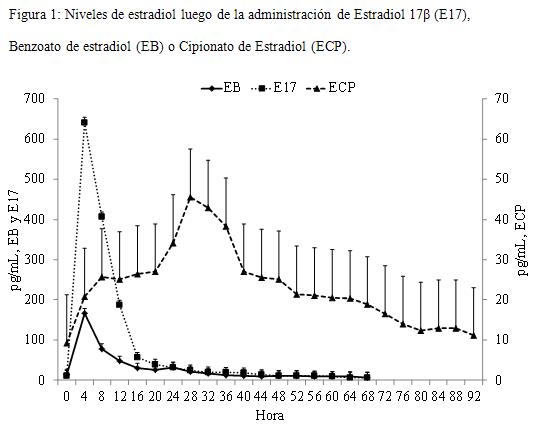
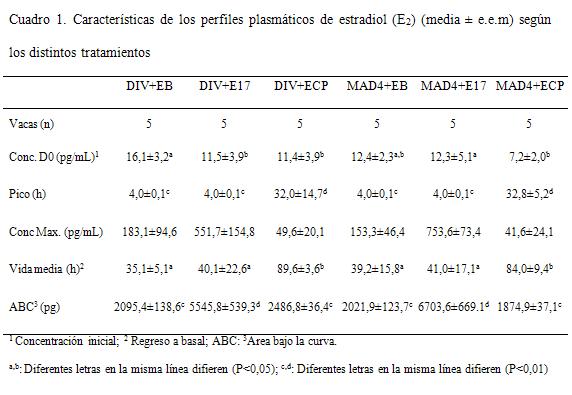
<body><![CDATA[<p class="MsoNormal" style="margin: 6pt 0cm; text-align: justify; line-height: 200%;"><i><span style="font-size: 10pt; line-height: 200%; font-family: &quot;Verdana&quot;,&quot;sans-serif&quot;;">Detecci&oacute;n de celo<o:p></o:p></span></i></p>        <p class="MsoNormal" style="text-align: justify; line-height: 200%;"><span style="font-size: 10pt; line-height: 200%; font-family: &quot;Verdana&quot;,&quot;sans-serif&quot;;">Desde el D7 y durante 15 minutos cada 4 horas se realiz&oacute; detecci&oacute;n visual de celo. Asimismo se volvieron a colocar dispositivos de ayuda de detecci&oacute;n de celos (Estrotect, Gensur SRL, Uruguay). <o:p></o:p></span></p>        <p class="MsoNormal" style="margin: 6pt 0cm; text-align: justify; line-height: 200%;"><i><span style="font-size: 10pt; line-height: 200%; font-family: &quot;Verdana&quot;,&quot;sans-serif&quot;;">An&aacute;lisis estad&iacute;stico<o:p></o:p></span></i></p>        <p class="MsoNormal" style="text-align: justify; line-height: 200%;"><span style="font-size: 10pt; line-height: 200%; font-family: &quot;Verdana&quot;,&quot;sans-serif&quot;;">Para el an&aacute;lisis de variables continuas con m&aacute;s de una medici&oacute;n durante el transcurso del experimento (concentraciones hormonales y crecimiento folicular) se utiliz&oacute; un modelo mixto: PROC MIXED del SAS (<a name="-Littell_y_col_1998"></a><a href="#Littell_y_col_1998">Littell</a> y col., 1998), que incluy&oacute; como efectos fijos: tratamiento, d&iacute;a e interacciones. La estructura de covarianza utilizada fue AR (1) y las medidas repetidas se realizaron sobre la unidad vaca anidada dentro de tratamiento por d&iacute;a. La ocurrencia de la ovulaci&oacute;n se analiz&oacute; por el PROC GENMOD de SAS (SAS Institute Inc., Cary NC, USA). El &aacute;rea bajo la curva, como medida global de los perfiles de liberaci&oacute;n plasm&aacute;tica de las formulaciones evaluadas, se calcul&oacute; por el m&eacute;todo de trapezoides (<a name="-Matthews_y_col_1990"></a><a href="#Matthews_y_col_1990">Matthews</a> y col., 1990). Se determin&oacute; el nivel de significancia en 5%.<o:p></o:p></span></p>        <p class="MsoNormal" style="text-align: justify; line-height: 200%;"><span style="font-size: 10pt; line-height: 200%; font-family: &quot;Verdana&quot;,&quot;sans-serif&quot;;"><o:p>&nbsp;</o:p></span></p>        <p class="MsoNormal" style="line-height: 200%;"><b><span style="font-size: 14pt; line-height: 200%; font-family: &quot;Verdana&quot;,&quot;sans-serif&quot;;">Resultados<o:p></o:p></span></b></p>        <p class="MsoNormal" style="margin: 6pt 0cm; text-align: justify; line-height: 200%;"><i><span style="font-size: 10pt; line-height: 200%; font-family: &quot;Verdana&quot;,&quot;sans-serif&quot;;">Estradiol<o:p></o:p></span></i></p>        <p class="MsoNormal" style="text-align: justify; line-height: 200%;"><span style="font-size: 10pt; line-height: 200%; font-family: &quot;Verdana&quot;,&quot;sans-serif&quot;;">La concentraci&oacute;n de E<sub>2</sub> a <span class="hps">la segunda dosis (D9 en E17 y EB, D8 en ECP) </span>fue en promedio de 11,6&plusmn;6,6, similar para todos los grupos (P&gt;0,1)<span class="hps">. El pico de E<sub>2</sub> se detect&oacute; a las 4 horas luego del tratamiento para los grupos E17 y EB y a las 32 horas para los grupos ECP (P&lt;0,0001). Los valores m&aacute;ximos en la concentraci&oacute;n tambi&eacute;n fueron distintos para las tres formulaciones de E<sub>2</sub> ya que se registraron valores promedio de 652,6&plusmn;66,1 pg/mL para los grupos E17, 169,8&plusmn;72,3 pg/mL para EB y para los grupos ECP de 45,6&plusmn;22,6 pg/mL (P&lt;0,001). Luego del pico las concentraciones en los grupos E17 regresaron a los valores iniciales a las 16 horas manteni&eacute;ndose as&iacute; hasta el final del per&iacute;odo. En los grupos ECP el pico fue menos pronunciado y las concentraciones descendieron 8 horas despu&eacute;s (</span></span><a href="#tab_1"><span style="font-size: 10pt; line-height: 200%; font-family: &quot;Verdana&quot;,&quot;sans-serif&quot;;">Cuadro 1</span></a><span class="hps"><span style="font-size: 10pt; line-height: 200%; font-family: &quot;Verdana&quot;,&quot;sans-serif&quot;;"> y </span></span><a href="#graf_1"><span style="font-size: 10pt; line-height: 200%; font-family: &quot;Verdana&quot;,&quot;sans-serif&quot;;">Figura 1</span></a><span class="hps"><span style="font-size: 10pt; line-height: 200%; font-family: &quot;Verdana&quot;,&quot;sans-serif&quot;;">). </span><o:p></o:p></span></p>        <p class="MsoNormal" style="text-align: justify; line-height: 200%;"><span class="hps"><span style="font-size: 10pt; line-height: 200%; font-family: &quot;Verdana&quot;,&quot;sans-serif&quot;;"><o:p>&nbsp;</o:p></span></span></p>        <p class="MsoNormal" style="text-align: justify; line-height: 200%;"><a name="tab_1"></a><span style="font-size: 10pt; line-height: 200%; font-family: &quot;Verdana&quot;,&quot;sans-serif&quot;;"><img style="border: 0px solid ;" alt="" id="_x0000_i1029" src="/img/revistas/vet/v51n197/197a03t1.JPG"></span><span class="hps"><span style="font-size: 10pt; line-height: 200%; font-family: &quot;Verdana&quot;,&quot;sans-serif&quot;;"><o:p></o:p></span></span></p>        ]]></body>
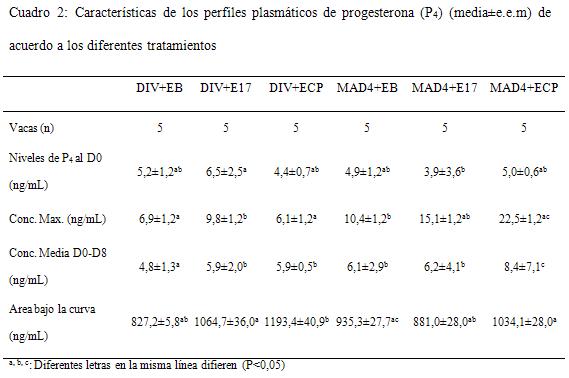
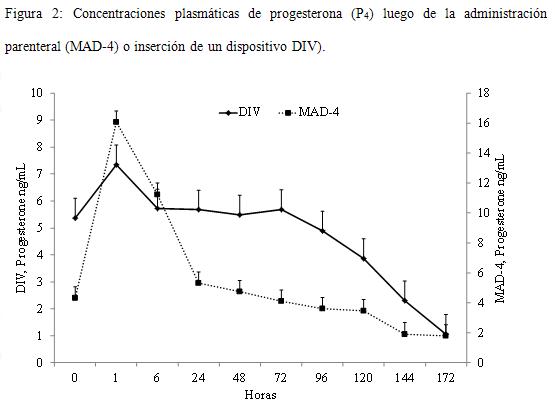
<body><![CDATA[<p class="MsoNormal" style="text-align: justify; line-height: 200%;"><span class="hps"><span style="font-size: 10pt; line-height: 200%; font-family: &quot;Verdana&quot;,&quot;sans-serif&quot;;"><o:p>&nbsp;</o:p></span></span></p>        <p class="MsoNormal" style="text-align: justify; line-height: 200%;"><a name="graf_1"></a><span style="font-size: 10pt; line-height: 200%; font-family: &quot;Verdana&quot;,&quot;sans-serif&quot;;"><img style="border: 0px solid ;" alt="" id="_x0000_i1028" src="/img/revistas/vet/v51n197/197a03g1.JPG"></span></p>        <p class="MsoNormal" style="text-align: justify; line-height: 200%;"><span style="font-size: 10pt; line-height: 200%; font-family: &quot;Verdana&quot;,&quot;sans-serif&quot;;"><o:p>&nbsp;</o:p></span></p>        <p class="MsoNormal" style="margin: 6pt 0cm; text-align: justify; line-height: 200%;"><i><span style="font-size: 10pt; line-height: 200%; font-family: &quot;Verdana&quot;,&quot;sans-serif&quot;;">Progesterona<o:p></o:p></span></i></p>        <p class="MsoNormal" style="text-align: justify; line-height: 200%;"><span style="font-size: 10pt; line-height: 200%; font-family: &quot;Verdana&quot;,&quot;sans-serif&quot;;">Las caracter&iacute;sticas de los perfiles plasm&aacute;ticos de P<sub>4</sub> entre los d&iacute;as 0 y 8 se presentan en el </span><a href="#tab_2"><span style="font-size: 10pt; line-height: 200%; font-family: &quot;Verdana&quot;,&quot;sans-serif&quot;;">Cuadro 2</span></a><span style="font-size: 10pt; line-height: 200%; font-family: &quot;Verdana&quot;,&quot;sans-serif&quot;;"> y la </span><a href="#graf_2"><span style="font-size: 10pt; line-height: 200%; font-family: &quot;Verdana&quot;,&quot;sans-serif&quot;;">Figura 2</span></a><span style="font-size: 10pt; line-height: 200%; font-family: &quot;Verdana&quot;,&quot;sans-serif&quot;;">. Los niveles plasm&aacute;ticos al comienzo del tratamiento fueron <span class="hps">de 4,4&plusmn;0,3</span> <span class="hps">y</span> <span class="hps">5,2&plusmn;0,3</span> ng<span class="hps">/mL</span> <span class="hps">para</span> <span class="hps">DIV</span> <span class="hps">y</span> <span class="hps">MAD-4</span> respectivamente <span class="hpsatn">(</span><span class="hps">P&gt;0,1</span>). Las concentraciones m&aacute;ximas <span class="hps">se</span> <span class="hps">detectaron</span> <span class="hps">una hora</span> despu&eacute;s del tratamiento en los grupos con progesterona inyectable y seis <span class="hps">horas despu&eacute;s en los grupos con DIV. El valor de P<sub>4</sub> al pico fue de </span>7,3<span class="hps">&plusmn;0,7</span> <span class="hps">para</span> <span class="hps">DIV</span> <span class="hps">y</span> <span class="hps">16,1&plusmn;0,7</span> <span class="hps">para</span> <span class="hps">MAD</span><span class="atn">-</span>4, (<span class="hps">P</span><span class="hpsatn">&lt;</span>0,0001) y seis horas m&aacute;s tarde se redujeron a 5,7&plusmn;0,7 y 11,2&plusmn;0,7 ng/mL para DIV y MAD-4 respectivamente (P&lt;0,0001), posteriormente manteni&eacute;ndose en niveles similares hasta D8. Los niveles plasm&aacute;ticos de P<sub>4</sub> descendieron hasta niveles basales m&aacute;s r&aacute;pidamente en las vacas tratadas con MAD-4 que con DIV, con un promedio entre grupos de 164,4&plusmn;56,4 h para MAD-4 y 178,3&plusmn;46,4 h para DIV.<o:p></o:p></span></p>        <p class="MsoNormal" style="text-align: justify; line-height: 200%;"><span style="font-size: 10pt; line-height: 200%; font-family: &quot;Verdana&quot;,&quot;sans-serif&quot;;"><o:p>&nbsp;</o:p></span></p>        <p class="MsoNormal" style="text-align: justify; line-height: 200%;"><a name="tab_2"></a><span style="font-size: 10pt; line-height: 200%; font-family: &quot;Verdana&quot;,&quot;sans-serif&quot;;"><img style="border: 0px solid ;" alt="" id="_x0000_i1027" src="/img/revistas/vet/v51n197/197a03t2.JPG"></span><span style="font-size: 10pt; line-height: 200%; font-family: &quot;Verdana&quot;,&quot;sans-serif&quot;;"><o:p></o:p></span></p>        <p class="MsoNormal" style="text-align: justify; line-height: 200%;"><span style="font-size: 10pt; line-height: 200%; font-family: &quot;Verdana&quot;,&quot;sans-serif&quot;;"><o:p>&nbsp;</o:p></span></p>        <p class="MsoNormal" style="text-align: justify; line-height: 200%;"><a name="graf_2"></a><span style="font-size: 10pt; line-height: 200%; font-family: &quot;Verdana&quot;,&quot;sans-serif&quot;;">&nbsp;</span><span style="font-size: 10pt; line-height: 200%; font-family: &quot;Verdana&quot;,&quot;sans-serif&quot;;"><img style="border: 0px solid ;" alt="" id="_x0000_i1026" src="/img/revistas/vet/v51n197/197a03g2.JPG"></span></p>        <p class="MsoNormal" style="text-align: justify; line-height: 200%;"><span style="font-size: 10pt; line-height: 200%; font-family: &quot;Verdana&quot;,&quot;sans-serif&quot;;"><o:p>&nbsp;</o:p></span></p>        ]]></body>
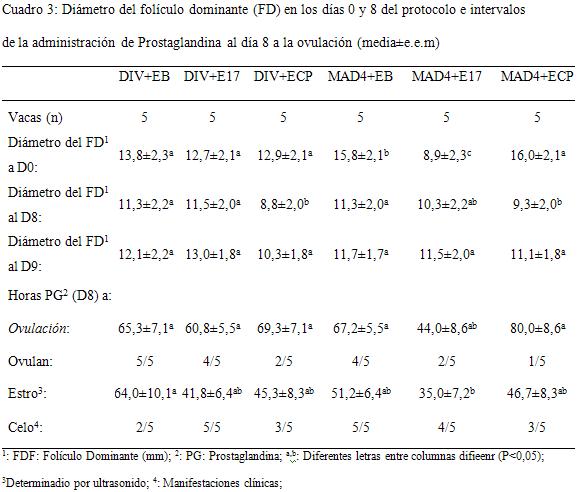
<body><![CDATA[<p class="MsoNormal" style="margin: 6pt 0cm; text-align: justify; line-height: 200%;"><i><span style="font-size: 10pt; line-height: 200%; font-family: &quot;Verdana&quot;,&quot;sans-serif&quot;;">Desarrollo folicular, ovulaci&oacute;n y manifestaci&oacute;n estral<o:p></o:p></span></i></p>        <p class="MsoNormal" style="text-align: justify; line-height: 200%;"><span style="font-size: 10pt; line-height: 200%; font-family: &quot;Verdana&quot;,&quot;sans-serif&quot;;">Las caracter&iacute;sticas de crecimiento folicular, celo y ovulaci&oacute;n se presentan en el </span><a href="#tab_3"><span style="font-size: 10pt; line-height: 200%; font-family: &quot;Verdana&quot;,&quot;sans-serif&quot;;">Cuadro 3</span></a><span style="font-size: 10pt; line-height: 200%; font-family: &quot;Verdana&quot;,&quot;sans-serif&quot;;">. E<span class="hps">l di&aacute;metro folicular al inicio de los tratamientos de P<sub>4</sub> fue de 14,9&plusmn;1,4 mm y 14,4&plusmn;1,3 mm para EB y E17, y de 10,9&plusmn;1,4 para los animales ECP (P&lt;0,05). El di&aacute;metro folicular al momento del tratamiento con PG (D8) fue en promedio de 10,4&plusmn;0,9 mm sin diferencias entre grupos y para el D9 (tratamientos E17 y EB) fue de 12,8&plusmn;1,5 mm, 11,0&plusmn;1,4 mm y 10,7 para EB, E17 y ECP respectivamente (P&gt;0,1). </span></span><span class="hps"><o:p></o:p></span></p>        <p class="MsoNormal" style="text-align: justify; line-height: 200%;"><span class="hps"><span style="font-size: 10pt; line-height: 200%; font-family: &quot;Verdana&quot;,&quot;sans-serif&quot;;"><o:p>&nbsp;</o:p></span></span></p>        <p class="MsoNormal" style="text-align: justify; line-height: 200%;"><a name="tab_3"></a><span style="font-size: 10pt; line-height: 200%; font-family: &quot;Verdana&quot;,&quot;sans-serif&quot;;"><img style="border: 0px solid ;" alt="" id="_x0000_i1025" src="/img/revistas/vet/v51n197/197a03t3.JPG"></span></p>        <p class="MsoNormal" style="text-align: justify; line-height: 200%;"><span style="font-size: 10pt; line-height: 200%; font-family: &quot;Verdana&quot;,&quot;sans-serif&quot;;"><o:p>&nbsp;</o:p></span></p>        <p class="MsoNormal" style="text-align: justify; line-height: 200%;"><span class="hps"><span style="font-size: 10pt; line-height: 200%; font-family: &quot;Verdana&quot;,&quot;sans-serif&quot;;">La lute&oacute;lisis se determin&oacute; por la ca&iacute;da de P<sub>4</sub> a los niveles previos a la administraci&oacute;n o colocaci&oacute;n de los dispositivos y ocurri&oacute; en el 77,8% de las vacas del grupo EB (7/9), en el 33,3% de las del grupo E17 (3/9) y en el 20% de las del ECP (2/10) (P &gt; 0,1).</span><o:p></o:p></span></p>        <p class="MsoNormal" style="text-align: justify; line-height: 200%;"><span class="hps"><span style="font-size: 10pt; line-height: 200%; font-family: &quot;Verdana&quot;,&quot;sans-serif&quot;;">La ovulaci&oacute;n (desaparici&oacute;n del fol&iacute;culo dominante a la ecograf&iacute;a) se detect&oacute; en el 9/10 de las vacas EB, 6/10 de las E17 y 3/10 de las ECP (P&lt;0,05) y se produjo a las 60 horas despu&eacute;s del tratamiento con PG, siendo de 63&plusmn;3,7 h, 52&plusmn;4,2 h y 66,6&plusmn;6,0 h para las vacas en los grupos EB, E17 y ECP respectivamente (P&gt;0,05). El tama&ntilde;o del fol&iacute;culo dominante al momento de la PG fue significativamente m&aacute;s grande (P&lt;0,05) en aquellos animales que ovularon, 10,8&plusmn;2,3 mm vs. 8,8&plusmn;2,5 en los animales en los que no desapareci&oacute; el FD.<o:p></o:p></span></span></p>        <p class="MsoNormal" style="text-align: justify; line-height: 200%;"><span class="hps"><span style="font-size: 10pt; line-height: 200%; font-family: &quot;Verdana&quot;,&quot;sans-serif&quot;;">El comportamiento estral se manifest&oacute; en el 70% de las vacas del grupo EB, el 100% de las del E17 y el 60% de las vacas del ECP (P&gt;0,1). <o:p></o:p></span></span></p>        <p class="MsoNormal" style="line-height: 200%;"><span style="color: red;"><o:p>&nbsp;</o:p></span></p>        <p class="MsoNormal" style="line-height: 200%;"><b><span style="font-size: 14pt; line-height: 200%; font-family: &quot;Verdana&quot;,&quot;sans-serif&quot;;">Discusi&oacute;n<o:p></o:p></span></b></p>        ]]></body>
<body><![CDATA[<p class="MsoNormal" style="text-align: justify; line-height: 200%;"><span style="font-size: 10pt; line-height: 200%; font-family: &quot;Verdana&quot;,&quot;sans-serif&quot;;">La adici&oacute;n de E<sub>2</sub> en tratamientos de inducci&oacute;n de ovulaci&oacute;n produce un aumento r&aacute;pido de la circulaci&oacute;n de E17 con lo que se inhibe de la liberaci&oacute;n prematura de PG y por lo tanto la expectativa del mantenimiento normal en la vida del cuerpo l&uacute;teo en protocolos IATF (<a name="-Mann_y_Lamming_2000"></a><a href="#Mann_y_Lamming_2000">Mann</a> y Lamming, 2000). En protocolos Ovsynch modificados la adici&oacute;n de 0,5 o 1 mg de E17 8 h antes de la GnRH produce un aumento de esteroides circulante similar al natural, superior a las vacas control (</span><a href="#Vynckier_y_col_1990"><span style="font-size: 10pt; line-height: 200%; font-family: &quot;Verdana&quot;,&quot;sans-serif&quot;;">Vynckier</span></a><span style="font-size: 10pt; line-height: 200%; font-family: &quot;Verdana&quot;,&quot;sans-serif&quot;;"> y col., 1990; <a name="-Sartori_y_col_2002"></a><a href="#Sartori_y_col_2002">Sartori</a> y col., 2002; <a name="-Wolfenson_y_col_2004"></a><a href="#Wolfenson_y_col_2004">Wolfenson</a> y col., 2004). Con estos supra niveles de concentraci&oacute;n de E17 se puede esperar que se produzca mayor motilidad uterina y del oviducto (<a name="-Hawk_1975"></a><a href="#Hawk_1975">Hawk</a> 1975), aumento del flujo sangu&iacute;neo uterino (<a name="-Krzymowski_y_col_2004"></a><a href="#Krzymowski_y_col_2004">Krzymowski</a> y col., 2004) y aumento de la inmunidad local por mayor fagocitosis (<a name="-Frank_y_col_1983"></a><a href="#Frank_y_col_1983">Frank</a> y col., 1983). Estos cambios podr&iacute;an mejorar el ambiente uterino y podr&iacute;an resultar en efectos positivos sobre la fertilidad. <o:p></o:p></span></p>        <p class="MsoNormal" style="text-align: justify; line-height: 200%;"><span style="font-size: 10pt; line-height: 200%; font-family: &quot;Verdana&quot;,&quot;sans-serif&quot;;">La     respuesta a las diferentes formulaciones de estradiol vari&oacute; de acuerdo a las     mismas. En las vacas tratadas con EB y E17 se registr&oacute; un pico plasm&aacute;tico de E<sub>2</sub>     a las 4 horas del tratamiento, mientras que en las tratadas con ECP el mismo se     observ&oacute; a las 32 horas. El pico de E<sub>2</sub> en respuesta al tratamiento     con E17 fue cuatro veces m&aacute;s grande que con EB, mientras que el pico luego de     ECP fue sensiblemente menor. Esta dis&iacute;mil liberaci&oacute;n plasm&aacute;tica din&aacute;mica se     aprecia claramente en el &aacute;rea bajo la curva (ABC) donde asimismo se constata la     relaci&oacute;n entre dosis administrada y niveles globales encontrados (la dosis de     ]]></body>
<body><![CDATA[E17 es 5 veces superior a EB y ECP), donde la correcta elecci&oacute;n en la     frecuencia y posici&oacute;n de los sangrados, permiti&oacute; diferenciar claramente los     distintos perfiles de liberaci&oacute;n plasm&aacute;tica del estradiol. Las diferencias en     los perfiles sangu&iacute;neos de estradiol luego de tratamientos con diferentes     estr&oacute;genos son consistentes con resultados previos (</span><a href="#Vynckier_y_col_1990"><span style="font-size: 10pt; line-height: 200%; font-family: &quot;Verdana&quot;,&quot;sans-serif&quot;;">Vynckier</span></a><span style="font-size: 10pt; line-height: 200%; font-family: &quot;Verdana&quot;,&quot;sans-serif&quot;;"> y col., 1990; </span><a href="#Bo_y_col_2000"><span style="font-size: 10pt; line-height: 200%; font-family: &quot;Verdana&quot;,&quot;sans-serif&quot;;">Bo</span></a><span style="font-size: 10pt; line-height: 200%; font-family: &quot;Verdana&quot;,&quot;sans-serif&quot;;"> y col., 2000; <a name="-Haughian_y_col_2002"></a><a href="#Haughian_y_col_2002">Haughian</a> y     col., 2002; </span><a href="#Burke_y_col_2003"><span style="font-size: 10pt; line-height: 200%; font-family: &quot;Verdana&quot;,&quot;sans-serif&quot;;">Burke</span></a><span style="font-size: 10pt; line-height: 200%; font-family: &quot;Verdana&quot;,&quot;sans-serif&quot;;"> y     col., 2003; </span><a href="#Martinez_y_col_2005"><span style="font-size: 10pt; line-height: 200%; font-family: &quot;Verdana&quot;,&quot;sans-serif&quot;;">Mart&iacute;nez</span></a><span style="font-size: 10pt; line-height: 200%; font-family: &quot;Verdana&quot;,&quot;sans-serif&quot;;"> y     col., 2005). </span><a href="#Souza_y_col_2005"><span style="font-size: 10pt; line-height: 200%; font-family: &quot;Verdana&quot;,&quot;sans-serif&quot;;">Souza</span></a><span style="font-size: 10pt; line-height: 200%; font-family: &quot;Verdana&quot;,&quot;sans-serif&quot;;"> y     col. (2005) reportan valores m&aacute;s bajos pero utilizaron animales de m&aacute;s del     doble de producci&oacute;n de leche que en este trabajo. Estos autores tambi&eacute;n     ]]></body>
<body><![CDATA[reportan diferencias en los niveles de esteroides seg&uacute;n la presencia o no de     fol&iacute;culos dominantes, eliminando su producci&oacute;n natural de estradiol. La     diferencia con el presente trabajo podr&iacute;a deberse a la influencia de la secreci&oacute;n     end&oacute;gena, ya que se utilizaron vacas ciclando que generar&iacute;a mayores picos en     las concentraciones de esta hormona as&iacute; como mantenimiento de los niveles por     m&aacute;s tiempo. Muy diferente fue el comportamiento de ECP donde el pico fue de 45     pg/mL a las 32 horas, llegando a niveles basales reci&eacute;n entre las <st1:metricconverter productid="84 a" w:st="on">84 a</st1:metricconverter> 90 h, con valores     pr&aacute;cticamente constantes hasta ese punto. Contrariamente, </span><a href="#Souza_y_col_2005"><span style="font-size: 10pt; line-height: 200%; font-family: &quot;Verdana&quot;,&quot;sans-serif&quot;;">Souza</span></a><span style="font-size: 10pt; line-height: 200%; font-family: &quot;Verdana&quot;,&quot;sans-serif&quot;;"> y col. (2005)     utilizando la misma dosis pero efectuando la ablaci&oacute;n de fol&iacute;culo mayores de 5     mm dirigida por ecograf&iacute;a no encontraron variaciones significativas desde los     ]]></body>
<body><![CDATA[valores de base. <a name="-Lammoglia_y_col_1998"></a><a href="#Lammoglia_y_col_1998">Lammoglia</a> y col. (1998) evaluaron las dosis de     EB para inducir estro y ovulaci&oacute;n en vacas en anestro en protocolos con P<sub>4</sub>     y PG. Con 1 mg de EB obtuvieron el pico de concentraci&oacute;n a las 11 h en vacas     que volvieron a valores basales a las 28 h. </span><a href="#Martinez_y_col_2005"><span style="font-size: 10pt; line-height: 200%; font-family: &quot;Verdana&quot;,&quot;sans-serif&quot;;">Mart&iacute;nez</span></a><span style="font-size: 10pt; line-height: 200%; font-family: &quot;Verdana&quot;,&quot;sans-serif&quot;; color: black;"> y col.     (2005) encontraron concentraciones de estradiol en plasma con pico m&aacute;ximo 6 h     despu&eacute;s del tratamiento con E17 que disminuyeron gradualmente a niveles basales     a las 36 h. Tambi&eacute;n se ha informado que las concentraciones de estradiol     aumentaron dr&aacute;sticamente a las 2 horas (</span><a href="#Bo_y_col_2000"><span style="font-size: 10pt; line-height: 200%; font-family: &quot;Verdana&quot;,&quot;sans-serif&quot;;">Bo</span></a><span style="font-size: 10pt; line-height: 200%; font-family: &quot;Verdana&quot;,&quot;sans-serif&quot;; color: black;"> y col., 2000) y 6 horas (<a name="-Bo_y_col_1994"></a><a href="#Bo_y_col_1994">Bo</a> y col., 1994) despu&eacute;s del tratamiento con E17. </span><a href="#Vynckier_y_col_1990"><span style="font-size: 10pt; line-height: 200%; font-family: &quot;Verdana&quot;,&quot;sans-serif&quot;;">Vynckier</span></a><span style="font-size: 10pt; line-height: 200%; font-family: &quot;Verdana&quot;,&quot;sans-serif&quot;; color: black;"> y col.     (1990) encontraron concentraciones de estradiol en plasma durante el estro     inducido con PG en valores de 14 pg/mL (rango de <st1:metricconverter productid="11 a" w:st="on">11 a</st1:metricconverter> 28 pg/mL), similares a     ]]></body>
<body><![CDATA[los encontrados en este trabajo luego de una inyecci&oacute;n de 1 mg de EB. </span><span style="font-size: 10pt; line-height: 200%; font-family: &quot;Verdana&quot;,&quot;sans-serif&quot;;">En     el estudio de </span><a href="#Souza_y_col_2005"><span style="font-size: 10pt; line-height: 200%; font-family: &quot;Verdana&quot;,&quot;sans-serif&quot;;">Souza</span></a><span style="font-size: 10pt; line-height: 200%; font-family: &quot;Verdana&quot;,&quot;sans-serif&quot;;"> y     col., (2005), el tratamiento con 1 mg de EB elev&oacute; las concentraciones     circulantes de E17 a unos 10 pg/mL, relaci&oacute;n mantenida con dosis menores. Por     el contrario, </span><a href="#Vynckier_y_col_1990"><span style="font-size: 10pt; line-height: 200%; font-family: &quot;Verdana&quot;,&quot;sans-serif&quot;;">Vynckier</span></a><span style="font-size: 10pt; line-height: 200%; font-family: &quot;Verdana&quot;,&quot;sans-serif&quot;;"> y     col (1990) reportaron un aumento de <st1:metricconverter productid="2 a" w:st="on">2      a</st1:metricconverter> 175 pg/mL despu&eacute;s del tratamiento en vacas con 10 mg     de EB o una elevaci&oacute;n de aproximadamente 17 pg/mL por cada mg de EB. </span><a href="#Martinez_y_col_2005"><span style="font-size: 10pt; line-height: 200%; font-family: &quot;Verdana&quot;,&quot;sans-serif&quot;;">Mart&iacute;nez</span></a><span style="font-size: 10pt; line-height: 200%; font-family: &quot;Verdana&quot;,&quot;sans-serif&quot;;"> y col (2005)     reportaron una elevaci&oacute;n de aproximadamente 100 pg/mL despu&eacute;s de 5 mg de EB o     de 20 pg/mL para cada mg de EB en vacas ovariectomizadas, es decir en ausencia     ]]></body>
<body><![CDATA[de estradiol end&oacute;geno. Se debe considerar diferencias a causa de la disminuci&oacute;n     de las concentraciones circulantes de E17 en algunos estudios (</span><a href="#Souza_y_col_2005"><span style="font-size: 10pt; line-height: 200%; font-family: &quot;Verdana&quot;,&quot;sans-serif&quot;;">Souza</span></a><span style="font-size: 10pt; line-height: 200%; font-family: &quot;Verdana&quot;,&quot;sans-serif&quot;;"> y col 2005) debido     al mayor metabolismo de los esteroides en vacas lecheras de alta producci&oacute;n (<a name="-Sangsritavong_y_col_2002"></a><a href="#Sangsritavong_y_col_2002">Sangsritavong</a>     y col 2002). Para evitar este efecto y sus posibles interferencias, nuestro     dise&ntilde;o experimental utiliz&oacute; animales en lactancias tard&iacute;as, donde los animales     en promedio presentaban s&oacute;lo el 46% de su producci&oacute;n m&aacute;xima diaria de la     lactancia. <o:p></o:p></span></p>     <p class="MsoNormal" style="text-align: justify; line-height: 200%;"><span style="font-size: 10pt; line-height: 200%; font-family: &quot;Verdana&quot;,&quot;sans-serif&quot;;">Los animales del presente ensayo fueron seleccionados tomando el criterio de inclusi&oacute;n seg&uacute;n ciclicidad reproductiva lo que se constat&oacute; hormonalmente con posterioridad y fueron presincronizados de modo que al empezar el protocolo se encontraran en fase luteal, con lo que los niveles de P<sub>4</sub> fueron superiores a 3 ng/mL. Luego del tratamiento se registr&oacute; un aumento en los niveles plasm&aacute;ticos de P<sub>4</sub> el cual fue mayor luego de la administraci&oacute;n de MAD-4, que adem&aacute;s present&oacute; el pico de concentraci&oacute;n antes que los dispositivos intravaginales. A partir de dicho momento los niveles de P<sub>4</sub> cayeron m&aacute;s dr&aacute;sticamente en vacas tratadas con MAD-4 que con DIV; considerando que ambos productos contienen P<sub>4</sub> natural, es muy posible que la v&iacute;a parenteral no logre mantener niveles plasm&aacute;ticos elevados por m&aacute;s de 24 h aunque esto tambi&eacute;n deber&iacute;a ser evaluado tratando animales en anestro o en fase folicular, de manera de evitar interferencia con P<sub>4</sub> end&oacute;gena de CL en vacas ciclando. <a name="-Rogan_y_col_2007"></a><a href="#Rogan_y_col_2007">Rogan</a> y col. (2007) dise&ntilde;aron un experimento con el fin de caracterizar perfiles de liberaci&oacute;n de P<sub>4 </sub>plasm&aacute;tica de distintos dispositivos intravaginales con cantidades variables de hormona. Emplearon vacas lactantes ciclando, presincronizadas con PG. Encontraron gran equivalencia entre los picos de concentraci&oacute;n (ng/mL) entre grupos (Cue-Mate: 5,0&plusmn;1,1; DIB: 3,9&plusmn;0,6; CIDR-<st1:metricconverter productid="1,9 g" w:st="on">1,9 g</st1:metricconverter>: 4,6&plusmn;0,6; CIDR-<st1:metricconverter productid="1,38 g" w:st="on">1,38 g</st1:metricconverter> 3,7&plusmn;0,4; P=0,51). Estos valores son similares a los valores m&aacute;ximos en el presente ensayo con el DIV pero muy diferentes a <span class="hps">los obtenidos luego con</span> <span class="hps">MAD</span><span class="atn">-</span>4. Burke y col. (1999) registraron niveles de progesterona de 10 ng/mL a las 2 h despu&eacute;s de la inserci&oacute;n del CIDR que se mantuvo elevado durante 2-3 d&iacute;as. De modo similar </span><a href="#Mann_y_col_2000"><span style="font-size: 10pt; line-height: 200%; font-family: &quot;Verdana&quot;,&quot;sans-serif&quot;;">Mann</span></a><span style="font-size: 10pt; line-height: 200%; font-family: &quot;Verdana&quot;,&quot;sans-serif&quot;;"> y col. (2000) obtuvieron niveles de 10,3&plusmn;0,8 ng/mL como media con estos dispositivos. </span><a href="#Martinez_y_col_2005"><span style="font-size: 10pt; line-height: 200%; font-family: &quot;Verdana&quot;,&quot;sans-serif&quot;;">Mart&iacute;nez</span></a><span style="font-size: 10pt; line-height: 200%; font-family: &quot;Verdana&quot;,&quot;sans-serif&quot;;"> y col. (2005) obtuvo niveles similares a una fase luteal media (5-7 ng/mL) 24 horas despu&eacute;s de la inserci&oacute;n del dispositivo vacas ovariectomizadas, disminuyendo a 2-3 ng/mL a los 2-3 d&iacute;as manteniendo esos niveles hasta su retiro el d&iacute;a 7. La dosis experimental ensayada para MAD-4 de 200 mg mostr&oacute; niveles sangu&iacute;neos, aunque din&aacute;micamente distintos en muchos momentos de la determinaci&oacute;n sangu&iacute;nea, equiparables a los obtenidos con los dispositivos y su ABC tomando todos los grupos fue similar globalmente y poco variable.<o:p></o:p></span></p>        <p class="MsoNormal" style="text-align: justify; line-height: 200%;"><span class="hps"><span style="font-size: 10pt; line-height: 200%; font-family: &quot;Verdana&quot;,&quot;sans-serif&quot;;">Los porcentajes de vacas que registraron luteolisis son </span></span><span style="font-size: 10pt; line-height: 200%; font-family: &quot;Verdana&quot;,&quot;sans-serif&quot;;">coincidentes con aquellos encontrados por <a name="-Callejas_y_col_2008"></a><a href="#Callejas_y_col_2008">Callejas</a> y col. (2008) con EB donde con 2 mg encontr&oacute; 73,7% de regresi&oacute;n del CL y con 5 mg 85,6% y expresan la necesidad de inclusi&oacute;n de PG en protocolos con esteroides. M&aacute;s dram&aacute;ticas fueron los hallazgos en los casos de E17 y ECP no superando en ninguno de estos casos porcentajes de regresi&oacute;n del CL del 35%. <o:p></o:p></span></p>        <p class="MsoNormal" style="text-align: justify; line-height: 200%;"><span style="font-size: 10pt; line-height: 200%; font-family: &quot;Verdana&quot;,&quot;sans-serif&quot;;">Se ha descrito la importancia de una concentraci&oacute;n m&iacute;nima circulante de E<sub>2</sub> para la causar expresi&oacute;n del estro (</span><a href="#Lammoglia_y_col_1998"><span style="font-size: 10pt; line-height: 200%; font-family: &quot;Verdana&quot;,&quot;sans-serif&quot;;">Lammoglia</span></a><span style="font-size: 10pt; line-height: 200%; font-family: &quot;Verdana&quot;,&quot;sans-serif&quot;;"> y col., 1998). <a name="-Lyimo_y_col_2000"></a><a href="#Lyimo_y_col_2000">Lyimo</a> y col. (2000) reportan una alta correlaci&oacute;n entre los niveles s&eacute;ricos de E<sub>2</sub> y la conducta estral en vacas Holando en lactancia. La adici&oacute;n de esteroides en protocolos de sincronizaci&oacute;n colabora en la expresividad conductual y es claramente diferencial acorde a los perfiles de liberaci&oacute;n de las formulaciones. En nuestro ensayo encontramos gran diferencia en las demostraciones conductuales con un 100% de animales con expresi&oacute;n de para E17, mientras que esta cifra desciende a 70% y 60% en EB y ECP, respectivamente, que coincide asimismo con los niveles m&aacute;ximos plasm&aacute;ticos obtenidos y tambi&eacute;n se corresponden con el tiempo para alcanzar la m&aacute;xima concentraci&oacute;n sangu&iacute;nea, as&iacute; en promedio las vacas E17 ya a las 4 h alcanzan su mayor concentraci&oacute;n sangu&iacute;nea de E<sub>2</sub> con valores cercanos a 650 pg/mL y en su totalidad demuestran celo, mientras que las vacas EB y ECP logran el cenit plasm&aacute;tico a las 32 h con valores promedio de 170 y 45 pg/mL respectivamente que se relativiza en su menor expresi&oacute;n estral. En todos los casos los niveles de P<sub>4</sub> al momento de la segunda dosis de E<sub>2</sub> se hallaba por debajo de 1 ng/mL, luego de la remoci&oacute;n de los dispositivos a las 192 h (en los grupos correspondientes) y la aplicaci&oacute;n de PG, siendo valorados promedio y no disimiles entre grupos de 1,4&plusmn;0,7 ng/mL entre la remoci&oacute;n y la hora 202. </span><a href="#Lammoglia_y_col_1998"><span style="font-size: 10pt; line-height: 200%; font-family: &quot;Verdana&quot;,&quot;sans-serif&quot;;">Lammoglia</span></a><span style="font-size: 10pt; line-height: 200%; font-family: &quot;Verdana&quot;,&quot;sans-serif&quot;;"> y col. (1998) demostraron que las dosis que resultaron en celo inducido transitoriamente superaron los rangos fisiol&oacute;gicos lo que se relaciona directamente con los niveles plasm&aacute;ticos, tal cual se vio en los resultados de este ensayo. </span><a href="#Souza_y_col_2005"><span style="font-size: 10pt; line-height: 200%; font-family: &quot;Verdana&quot;,&quot;sans-serif&quot;;">Souza</span></a><span style="font-size: 10pt; line-height: 200%; font-family: &quot;Verdana&quot;,&quot;sans-serif&quot;;"> y col. (2005) mostraron que con dosis de 0,5 mg (EB, ECP y E17) el comportamiento estral no se manifestaba, excepto con E17, mientras que con 1 mg la respuesta conductual con montas e hiperactividad se presentaba entre las 12 y 36 horas en una proporci&oacute;n alta de los animales tratados, particularmente en aquellos tratados con E17 y EB. <span class="hps">En la ocurrencia de la ovulaci&oacute;n tambi&eacute;n se encontraron diferencias importantes entre los esteroides evaluados con diferencias significativas entre el EB con 89% de ovulaci&oacute;n, frente a 67% y 30% para E17 y ECP respectivamente. Existe una relaci&oacute;n de tendencia entre las horas al pico de concentraci&oacute;n plasm&aacute;tica y los niveles encontrados con el momento de la ovulaci&oacute;n, siendo anterior en E17, seguido de EB y finalmente ECP. </span></span><span class="hps"><o:p></o:p></span></p>        ]]></body>
<body><![CDATA[<p class="MsoNormal" style="text-align: justify; line-height: 200%;"><a name="-Cutaia_y_col_2003"></a><span style="font-size: 10pt; line-height: 200%; font-family: &quot;Verdana&quot;,&quot;sans-serif&quot;;"><a href="#Cutaia_y_col_2003">Cutaia</a><span class="hps"> y col. (2003) trabajando en vacas de carne con EB encontraron porcentajes de ovulaci&oacute;n similares aplicando ECP tanto al momento de retirar el DIV como 24 h despu&eacute;s y por los antecedentes encontrados con esta sal se procedi&oacute; a administrar al mismo momento que la PG en vez de hacerlo al d&iacute;a siguiente como se efectu&oacute; con EB y E17. <o:p></o:p></span></span></p>        <p class="MsoNormal" style="text-align: justify; line-height: 200%;"><span class="hps"><span style="font-size: 10pt; line-height: 200%; font-family: &quot;Verdana&quot;,&quot;sans-serif&quot;;">El primer tratamiento con ECP podr&iacute;a no ser efectivo en sincronizar de la nueva onda folicular ya que al momento del segundo tratamiento con ECP la maduraci&oacute;n del fol&iacute;culo ser&iacute;a variable o no completa y por lo tanto con escasa la respuesta ovulatoria (</span></span><a href="#Bo_y_col_2000"><span style="font-size: 10pt; line-height: 200%; font-family: &quot;Verdana&quot;,&quot;sans-serif&quot;;">Bo</span></a><span class="hps"><span style="font-size: 10pt; line-height: 200%; font-family: &quot;Verdana&quot;,&quot;sans-serif&quot;;"> y col, 2000). Las concentraciones plasm&aacute;ticas por mayor tiempo en los animales ECP podr&iacute;an haber suprimido la liberaci&oacute;n end&oacute;gena de FSH por intervalos m&aacute;s prolongados (</span></span><a href="#Colazo_y_col_2003"><span style="font-size: 10pt; line-height: 200%; font-family: &quot;Verdana&quot;,&quot;sans-serif&quot;;">Colazo</span></a><span class="hps"><span style="font-size: 10pt; line-height: 200%; font-family: &quot;Verdana&quot;,&quot;sans-serif&quot;;"> y col., 2003) y de forma m&aacute;s variable en comparaci&oacute;n con E17 y EB que conducir&iacute;a a una aparici&oacute;n tard&iacute;a de la onda folicular al inicio del tratamiento y menor tasa ovulatoria a la inducci&oacute;n con estradiol.</span></span><span style="" lang="ES-UY"><o:p></o:p></span></p>        <p class="MsoNormal" style="text-align: justify; line-height: 200%;"><span class="hps"><o:p>&nbsp;</o:p></span></p>        <p class="MsoNormal" style="background: white none repeat scroll 0% 50%; -moz-background-clip: initial; -moz-background-origin: initial; -moz-background-inline-policy: initial; line-height: 200%;"><b><span style="font-size: 14pt; line-height: 200%; font-family: &quot;Verdana&quot;,&quot;sans-serif&quot;;">Conclusiones</span></b><b><span style="font-size: 14pt; line-height: 200%;"><o:p></o:p></span></b></p>        <p class="MsoNormal" style="background: white none repeat scroll 0% 50%; -moz-background-clip: initial; -moz-background-origin: initial; -moz-background-inline-policy: initial; text-align: justify; line-height: 200%;"><span style="font-size: 10pt; line-height: 200%; font-family: &quot;Verdana&quot;,&quot;sans-serif&quot;;">Los resultados obtenidos sugieren que, en las condiciones de este ensayo, el E17 ser&iacute;a el compuesto que genera mejor respuesta conductual al estro, mientras que el EB ser&iacute;a ligeramente m&aacute;s efectivo en promover la ovulaci&oacute;n y ambos mejores que el ECP. Hay que tener presente que &eacute;stos resultados pueden tener relaci&oacute;n con las formulaciones de E<sub>2</sub> administradas al inicio del protocolo. En cuanto a la P<sub>4</sub>, los dispositivos intravaginales generan respuestas m&aacute;s moderadas, estables y prolongadas que la P<sub>4</sub> inyectable. M&aacute;s investigaci&oacute;n con estos productos en diferentes condiciones es necesaria para determinar estos efectos.<o:p></o:p></span></p>        <p class="MsoNormal" style="background: white none repeat scroll 0% 50%; -moz-background-clip: initial; -moz-background-origin: initial; -moz-background-inline-policy: initial; text-align: justify; line-height: 200%;"><span style="font-size: 10pt; line-height: 200%; font-family: &quot;Verdana&quot;,&quot;sans-serif&quot;;"><o:p>&nbsp;</o:p></span></p>        <p class="MsoNormal" style="background: white none repeat scroll 0% 50%; -moz-background-clip: initial; -moz-background-origin: initial; -moz-background-inline-policy: initial; text-align: justify; line-height: 200%;"><b><span style="font-size: 14pt; line-height: 200%; font-family: &quot;Verdana&quot;,&quot;sans-serif&quot;;">Referencias<span style="color: red;"><o:p></o:p></span></span></b></p>        <p class="MsoNormal" style="line-height: 200%;"><a name="Bo_y_col_1994"></a><span style="font-size: 10pt; line-height: 200%; font-family: &quot;Verdana&quot;,&quot;sans-serif&quot;;">1. <a href="#-Bo_y_col_1994">Bo</a> GA, Adams GP, Pierson RA, Tribulo HE, Caccia M, Mapletoft RJ. </span><span style="font-size: 10pt; line-height: 200%; font-family: &quot;Verdana&quot;,&quot;sans-serif&quot;;" lang="EN-US">(1994). Follicular wave dynamics after estradiol-17</span><span style="font-size: 10pt; line-height: 200%; font-family: &quot;Verdana&quot;,&quot;sans-serif&quot;;">&beta;</span><span style="font-size: 10pt; line-height: 200%; font-family: &quot;Verdana&quot;,&quot;sans-serif&quot;;" lang="EN-US"> treatment of heifers with or without a progestogen implant. Theriogenology 41:1555-1569.<o:p></o:p></span></p>        <!-- ref --><p class="MsoNormal" style="line-height: 200%;"><a name="Bo_y_col_2000"></a><span style="font-size: 10pt; line-height: 200%; font-family: &quot;Verdana&quot;,&quot;sans-serif&quot;;" lang="EN-US">2. </span><a href="#-Bo_y_col_2000"><span style="font-size: 10pt; line-height: 200%; font-family: &quot;Verdana&quot;,&quot;sans-serif&quot;;" lang="EN-US">Bo</span></a><span style="font-size: 10pt; line-height: 200%; font-family: &quot;Verdana&quot;,&quot;sans-serif&quot;;" lang="EN-US"> GA, Bergfelt DR, Brogliatti GM, Pierson PA, Adams GP, Mapletoft RJ. (2000). Local versus systemic effects of exogenous estradiol-17 beta on ovarian follicular dynamics in heifers with progestogen implants. Anim Reprod Sci 31:141-157<o:p></o:p></span><!-- ref --><p class="MsoNormal" style="line-height: 200%;"><a name="Burke_y_col_2003"></a><span style="font-size: 10pt; line-height: 200%; font-family: &quot;Verdana&quot;,&quot;sans-serif&quot;;" lang="EN-US">3. </span><a href="#-Burke_y_col_2003"><span style="font-size: 10pt; line-height: 200%; font-family: &quot;Verdana&quot;,&quot;sans-serif&quot;;" lang="EN-US">Burke</span></a><span style="font-size: 10pt; line-height: 200%; font-family: &quot;Verdana&quot;,&quot;sans-serif&quot;;" lang="EN-US"> CR, Mussard ML, Gasser CL, Grum DE, Day ML. (2003). Estradiol benzoate delays new follicular wave emergence in a dose-dependent manner after ablation of the dominant ovarian follicle in cattle. </span><span style="font-size: 10pt; line-height: 200%; font-family: &quot;Verdana&quot;,&quot;sans-serif&quot;;">Theriogenology 60:647-658.    <o:p></o:p></span></p>        <!-- ref --><p class="MsoNormal" style="line-height: 200%;"><a name="Callejas_y_col_2008"></a><span style="font-size: 10pt; line-height: 200%; font-family: &quot;Verdana&quot;,&quot;sans-serif&quot;;">4. </span><a href="#-Callejas_y_col_2008"><span style="font-size: 10pt; line-height: 200%; font-family: &quot;Verdana&quot;,&quot;sans-serif&quot;;">Callejas</span></a><span style="font-size: 10pt; line-height: 200%; font-family: &quot;Verdana&quot;,&quot;sans-serif&quot;;"> S, Echevarria S, Zapiola A. (2008). Uso de benzoato de estradiol y un dispositivo intravaginal con progesterona en vacas cola de parici&oacute;n con servicio natural. Rev Arg Prod Anim 28 (Supl. 1):149-150.    <o:p></o:p></span></p>        <!-- ref --><p class="MsoNormal" style="line-height: 200%;"><a name="Cavestany_y_col_2008"></a><span style="font-size: 10pt; line-height: 200%; font-family: &quot;Verdana&quot;,&quot;sans-serif&quot;;">5. </span><a href="#-Cavestany_y_col_2008"><span style="font-size: 10pt; line-height: 200%; font-family: &quot;Verdana&quot;,&quot;sans-serif&quot;;">Cavestany</span></a><span style="font-size: 10pt; line-height: 200%; font-family: &quot;Verdana&quot;,&quot;sans-serif&quot;;"> D, Fern&aacute;ndez D, Salazar E, Sanchez A, Leyton L, Crespi D. (2008). Determinaci&oacute;n de niveles de progesterona en sangre luego de la administraci&oacute;n parenteral de progesterona en vacas Holstein ovariectomizadas. XXXVI Jornadas Uruguayas de Buiatr&iacute;a, Paysand&uacute;, Uruguay.    <o:p></o:p></span></p>        <!-- ref --><p class="MsoNormal" style="line-height: 200%;"><a name="Chebel_y_col_2010"></a><span style="font-size: 10pt; line-height: 200%; font-family: &quot;Verdana&quot;,&quot;sans-serif&quot;;">6. </span><a href="#-Chebel_y_col_2010"><span style="font-size: 10pt; line-height: 200%; font-family: &quot;Verdana&quot;,&quot;sans-serif&quot;;">Chebel</span></a><span style="font-size: 10pt; line-height: 200%; font-family: &quot;Verdana&quot;,&quot;sans-serif&quot;;"> RC, Al-Hassan MJ, Fricke PM, Santos JE, Lima JR, Martel CA, Stevenson JS, Garc&iacute;a R, Ax RL. </span><span style="font-size: 10pt; line-height: 200%; font-family: &quot;Verdana&quot;,&quot;sans-serif&quot;;" lang="EN-US">(2010). Supplementation of progesterone via controlled internal drug release inserts during ovulation synchronization protocols in lactating dairy cows. J Dairy Sci 93:922-931.    <o:p></o:p></span></p>        <!-- ref --><p class="MsoNormal" style="line-height: 200%;"><a name="Colazo_y_col_2002"></a><span style="font-size: 10pt; line-height: 200%; font-family: &quot;Verdana&quot;,&quot;sans-serif&quot;;" lang="EN-US">7. </span><a href="#-Colazo_y_col_2002"><span style="font-size: 10pt; line-height: 200%; font-family: &quot;Verdana&quot;,&quot;sans-serif&quot;;" lang="EN-US">Colazo</span></a><span style="font-size: 10pt; line-height: 200%; font-family: &quot;Verdana&quot;,&quot;sans-serif&quot;;" lang="EN-US"> MG, Mart&iacute;nez MF, Whittaker PR, Kastelic JP, Mapletoft RJ. (2002). Estradiol cypionate (ECP) in CIDR-B-based programs for fixed time AI in beef heifers. Theriogenology 57:371 abstr.    <o:p></o:p></span></p>        <p class="MsoNormal" style="line-height: 200%;"><a name="Colazo_y_col_2003"></a><span style="font-size: 10pt; line-height: 200%; font-family: &quot;Verdana&quot;,&quot;sans-serif&quot;;" lang="EN-US">8. </span><a href="#-Colazo_y_col_2003"><span style="font-size: 10pt; line-height: 200%; font-family: &quot;Verdana&quot;,&quot;sans-serif&quot;;" lang="EN-US">Colazo</span></a><span style="font-size: 10pt; line-height: 200%; font-family: &quot;Verdana&quot;,&quot;sans-serif&quot;;" lang="EN-US"> MG, Kastelic JP, Mapletoft RJ. (2003). Effects of estradiol cypionate (ECP) on ovarian follicular dynamics, synchrony of ovulation, and fertility in CIDR-based, fixed-time AI programs in beef heifers. </span><span style="font-size: 10pt; line-height: 200%; font-family: &quot;Verdana&quot;,&quot;sans-serif&quot;;" lang="ES-CL">Theriogenology 60:855&ndash;865.&nbsp;</span><span style="font-size: 10pt; line-height: 200%; font-family: &quot;Verdana&quot;,&quot;sans-serif&quot;;"><o:p></o:p></span></p>        ]]></body>
<body><![CDATA[<!-- ref --><p class="MsoNormal" style="line-height: 200%;"><a name="Cutaia_y_col_2003"></a><span style="font-size: 10pt; line-height: 200%; font-family: &quot;Verdana&quot;,&quot;sans-serif&quot;;">9. </span><a href="#-Cutaia"><span style="font-size: 10pt; line-height: 200%; font-family: &quot;Verdana&quot;,&quot;sans-serif&quot;;">Cutaia</span></a><span style="font-size: 10pt; line-height: 200%; font-family: &quot;Verdana&quot;,&quot;sans-serif&quot;;" lang="ES-UY"> L, Chesta P, Moreno D, B&oacute; GA. (2003). Efecto del momento de la aplicaci&oacute;n de benzoato de estradiol sobre la sincron&iacute;a, el tiempo de ovulaci&oacute;n y los porcentajes de pre&ntilde;ez en vacas tratadas con un dispositivo DIB y PGF. </span><span style="font-size: 10pt; line-height: 200%; font-family: &quot;Verdana&quot;,&quot;sans-serif&quot;;" lang="EN-US">V Simposio Int Reprod Anim. C&oacute;rdoba. Argentina. Abstr. 386<o:p></o:p></span><!-- ref --><p class="MsoNormal" style="line-height: 200%;"><a name="Edmonson_y_col_1989"></a><span style="font-size: 10pt; line-height: 200%; font-family: &quot;Verdana&quot;,&quot;sans-serif&quot;;" lang="EN-US">10. </span><a href="#-Edmonson_y_col_1989"><span style="font-size: 10pt; line-height: 200%; font-family: &quot;Verdana&quot;,&quot;sans-serif&quot;;" lang="EN-US">Edmonson</span></a><span style="font-size: 10pt; line-height: 200%; font-family: &quot;Verdana&quot;,&quot;sans-serif&quot;;" lang="EN-US"> AJ, Lean IJ, Weaver LD, Farver T, Webster G. (1989). A body condition scoring chart for Holstein dairy cows. J Dairy Sci 72:68-78.    <o:p></o:p></span></p>        <!-- ref --><p class="MsoNormal" style="line-height: 200%;"><a name="Frank_y_col_1983"></a><span style="font-size: 10pt; line-height: 200%; font-family: &quot;Verdana&quot;,&quot;sans-serif&quot;;" lang="EN-US">11. </span><a href="#-Frank_y_col_1983"><span style="font-size: 10pt; line-height: 200%; font-family: &quot;Verdana&quot;,&quot;sans-serif&quot;;" lang="EN-US">Frank</span></a><span style="font-size: 10pt; line-height: 200%; font-family: &quot;Verdana&quot;,&quot;sans-serif&quot;;" lang="EN-US"> T, Anderson KL, Smith AR, Whitmore HL, Gustafsson BK. (1983). Phagocytosis in the uterus: a review. Theriogenology 20:103-111.    <o:p></o:p></span></p>        <!-- ref --><p class="MsoNormal" style="line-height: 200%;"><a name="Haughian_y_col_2002"></a><span style="font-size: 10pt; line-height: 200%; font-family: &quot;Verdana&quot;,&quot;sans-serif&quot;;" lang="EN-US">12. </span><a href="#-Haughian_y_col_2002"><span style="font-size: 10pt; line-height: 200%; font-family: &quot;Verdana&quot;,&quot;sans-serif&quot;;" lang="EN-US">Haughian</span></a><span style="font-size: 10pt; line-height: 200%; font-family: &quot;Verdana&quot;,&quot;sans-serif&quot;;" lang="EN-US"> JM, Sartori R, Guenther JN, Gumen A, Wiltbank MC. (2002). Extending the postpartum anovulatory period in dairy cattle with estradiol cypionate. J Dairy Sci 85:3238-3249.    <o:p></o:p></span></p>        <!-- ref --><p class="MsoNormal" style="line-height: 200%;"><a name="Hawk_1975"></a><span style="font-size: 10pt; line-height: 200%; font-family: &quot;Verdana&quot;,&quot;sans-serif&quot;;" lang="EN-US">13. </span><a href="#-Hawk_1975"><span style="font-size: 10pt; line-height: 200%; font-family: &quot;Verdana&quot;,&quot;sans-serif&quot;;" lang="EN-US">Hawk</span></a><span style="font-size: 10pt; line-height: 200%; font-family: &quot;Verdana&quot;,&quot;sans-serif&quot;;" lang="EN-US"> HW. (1975). Hormonal control of changes in the direction of uterine contractions in the estrous ewe. Biol Reprod 12:423-430.    <o:p></o:p></span></p>        <!-- ref --><p class="MsoNormal" style="line-height: 200%;"><a name="Krzymowski_y_col_2004"></a><span style="font-size: 10pt; line-height: 200%; font-family: &quot;Verdana&quot;,&quot;sans-serif&quot;;" lang="EN-US">14. </span><a href="#-Krzymowski_y_col_2004"><span style="font-size: 10pt; line-height: 200%; font-family: &quot;Verdana&quot;,&quot;sans-serif&quot;;" lang="EN-US">Krzymowski</span></a><span style="font-size: 10pt; line-height: 200%; font-family: &quot;Verdana&quot;,&quot;sans-serif&quot;;" lang="EN-US"> T, Stefanczyk-Krzymowska S. (2004). The oestrous cycle and early pregnancy - a new concept of local endocrine regulation. Vet J:168, 285-296.    <o:p></o:p></span></p>        <p class="MsoNormal" style="line-height: 200%;"><a name="Lammoglia_y_col_1998"></a><span style="font-size: 10pt; line-height: 200%; font-family: &quot;Verdana&quot;,&quot;sans-serif&quot;;" lang="EN-US">15. </span><a href="#-Lammoglia_y_col_1998"><span style="font-size: 10pt; line-height: 200%; font-family: &quot;Verdana&quot;,&quot;sans-serif&quot;;" lang="EN-US">Lammoglia</span></a><span style="font-size: 10pt; line-height: 200%; font-family: &quot;Verdana&quot;,&quot;sans-serif&quot;;" lang="EN-US"> MA, Short RE, Bellows SE, Bellows RA, MacNeil MD, Hafs HD. (1998). Induced and synchronized estrus in cattle: dose titration of estradiol benzoate in peripubertal heifers and postpartum cows after treatment with an intravaginal progesteronereleasing insert and prostaglandin F2</span><span style="font-size: 10pt; line-height: 200%; font-family: &quot;Verdana&quot;,&quot;sans-serif&quot;;">&alpha;</span><span style="font-size: 10pt; line-height: 200%; font-family: &quot;Verdana&quot;,&quot;sans-serif&quot;;" lang="EN-US">. J Anim Sci 76:1662-1670.<o:p></o:p></span></p>        <!-- ref --><p class="MsoNormal" style="line-height: 200%;"><a name="Littell_y_col_1998"></a><span style="font-size: 10pt; line-height: 200%; font-family: &quot;Verdana&quot;,&quot;sans-serif&quot;;" lang="EN-US">16. </span><a href="#-Littell_y_col_1998"><span style="font-size: 10pt; line-height: 200%; font-family: &quot;Verdana&quot;,&quot;sans-serif&quot;;" lang="EN-US">Littell</span></a><span style="font-size: 10pt; line-height: 200%; font-family: &quot;Verdana&quot;,&quot;sans-serif&quot;;" lang="EN-US"> RC, Henry PR, Ammermann CB. (1998). Statistical analysis of repeated measures data using SAS procedures. J Anim Sci 76:1216:1231.    <o:p></o:p></span></p>        <!-- ref --><p class="MsoNormal" style="line-height: 200%;"><a name="Lopez_y_col_2004"></a><span style="font-size: 10pt; line-height: 200%; font-family: &quot;Verdana&quot;,&quot;sans-serif&quot;;" lang="EN-US">17. </span><a href="#-Lopez_y_col_2004"><span style="font-size: 10pt; line-height: 200%; font-family: &quot;Verdana&quot;,&quot;sans-serif&quot;;" lang="EN-US">Lopez</span></a><span style="font-size: 10pt; line-height: 200%; font-family: &quot;Verdana&quot;,&quot;sans-serif&quot;;" lang="EN-US"> H, Satter LD, Wiltbank MC. (2004). Relationship between level of milk production and estrous behavior of lactating dairy cows. Anim Reprod Sci 81:209-223.    <o:p></o:p></span></p>        <!-- ref --><p class="MsoNormal" style="line-height: 200%;"><a name="Lucy_y_col_2001"></a><span style="font-size: 10pt; line-height: 200%; font-family: &quot;Verdana&quot;,&quot;sans-serif&quot;;" lang="EN-US">18. </span><a href="#-Lucy_y_col_2001"><span style="font-size: 10pt; line-height: 200%; font-family: &quot;Verdana&quot;,&quot;sans-serif&quot;;" lang="EN-US">Lucy</span></a><span style="font-size: 10pt; line-height: 200%; font-family: &quot;Verdana&quot;,&quot;sans-serif&quot;;" lang="EN-US"> MC. (2001). Reproductive loss in high-producing dairy cattle: where will it end? J Dairy Sci 84:1277-1293.    <o:p></o:p></span></p>        <!-- ref --><p class="MsoNormal" style="line-height: 200%;"><a name="Lyimo_y_col_2000"></a><span style="font-size: 10pt; line-height: 200%; font-family: &quot;Verdana&quot;,&quot;sans-serif&quot;;" lang="EN-US">19. </span><a href="#-Lyimo_y_col_2000"><span style="font-size: 10pt; line-height: 200%; font-family: &quot;Verdana&quot;,&quot;sans-serif&quot;;" lang="EN-US">Lyimo</span></a><span style="font-size: 10pt; line-height: 200%; font-family: &quot;Verdana&quot;,&quot;sans-serif&quot;;" lang="EN-US"> ZC, Nielen M, Ouweltjes W, Kruip TAM, van Eerdenburg FJCM. (2000). Relationships among estradiol, cortisol and intensity of estrous behavior in dairy cattle. Theriogenology 53:1783-1795.    <o:p></o:p></span></p>        ]]></body>
<body><![CDATA[<!-- ref --><p class="MsoNormal" style="line-height: 200%;"><a name="Macmillan_2010"></a><span style="font-size: 10pt; line-height: 200%; font-family: &quot;Verdana&quot;,&quot;sans-serif&quot;;" lang="EN-US">20. </span><a href="#-Macmillan_2010"><span style="font-size: 10pt; line-height: 200%; font-family: &quot;Verdana&quot;,&quot;sans-serif&quot;;" lang="EN-US">Macmillan</span></a><span style="font-size: 10pt; line-height: 200%; font-family: &quot;Verdana&quot;,&quot;sans-serif&quot;;" lang="EN-US"> KL. (2010). Recent advances in the synchronization of estrus and ovulation in dairy cows. J Reprod Dev 56:S42-S47.    <o:p></o:p></span></p>        <!-- ref --><p class="MsoNormal" style="line-height: 200%;"><a name="Mann_y_Lamming_2000"></a><span style="font-size: 10pt; line-height: 200%; font-family: &quot;Verdana&quot;,&quot;sans-serif&quot;;" lang="EN-US">21. </span><a href="#-Mann_y_Lamming_2000"><span style="font-size: 10pt; line-height: 200%; font-family: &quot;Verdana&quot;,&quot;sans-serif&quot;;" lang="EN-US">Mann</span></a><span style="font-size: 10pt; line-height: 200%; font-family: &quot;Verdana&quot;,&quot;sans-serif&quot;;" lang="EN-US"> GE, Lamming GE. (2000). The role of suboptimal preovulatory oestradiol secretion in the aetiology of premature luteolysis during the short oestrous cycle in the cow. Anim Reprod Sci 64:171- 180.    <o:p></o:p></span></p>        <!-- ref --><p class="MsoNormal" style="line-height: 200%;"><a name="Martinez_y_col_2005"></a><span style="font-size: 10pt; line-height: 200%; font-family: &quot;Verdana&quot;,&quot;sans-serif&quot;;" lang="EN-US">22. </span><a href="#-Martinez_y_col_2005"><span style="font-size: 10pt; line-height: 200%; font-family: &quot;Verdana&quot;,&quot;sans-serif&quot;;" lang="EN-US">Martinez</span></a><span style="font-size: 10pt; line-height: 200%; font-family: &quot;Verdana&quot;,&quot;sans-serif&quot;;" lang="EN-US"> MF, Kastelic JP, Bo GA, Caccia M, Mapletoft RJ. (2005). Effects of oestradiol and some of its esters on gonadotrophin release and ovarian follicular dynamics in CIDR-treated beef cattle. Anim Reprod Sci 86:37-52.    <o:p></o:p></span></p>        <!-- ref --><p class="MsoNormal" style="line-height: 200%;"><a name="Matthews_y_col_1990"></a><span style="font-size: 10pt; line-height: 200%; font-family: &quot;Verdana&quot;,&quot;sans-serif&quot;;" lang="EN-US">23. </span><a href="#-Matthews_y_col_1990"><span style="font-size: 10pt; line-height: 200%; font-family: &quot;Verdana&quot;,&quot;sans-serif&quot;;" lang="EN-US">Mattews</span></a><span style="font-size: 10pt; line-height: 200%; font-family: &quot;Verdana&quot;,&quot;sans-serif&quot;;" lang="EN-US"> JN, Altman DG, Campbell NJ, Royston P. (1990). <span style="color: black;">Analysis of serial measurements in medical research. BMJ 27;300:230-235.    </span><o:p></o:p></span></p>        <p class="MsoNormal" style="line-height: 200%;"><a name="Meikle_y_col_2001"></a><span style="font-size: 10pt; line-height: 200%; font-family: &quot;Verdana&quot;,&quot;sans-serif&quot;;" lang="EN-US">24. </span><a href="#-Meikle_y_col_2001"><span style="font-size: 10pt; line-height: 200%; font-family: &quot;Verdana&quot;,&quot;sans-serif&quot;;" lang="EN-US">Meikle</span></a><span style="font-size: 10pt; line-height: 200%; font-family: &quot;Verdana&quot;,&quot;sans-serif&quot;;" lang="EN-US"> A, Sahlin L, Ferraris A, Masironi B, Blanc JE, Rodr&iacute;guez-Irazoqui M, Rodr&iacute;guez-Pi&ntilde;&oacute;n M, Kindahl H, Forsberg M. (2001). Endometrial mRNA expression of oestrogen receptor </span><span style="font-size: 10pt; line-height: 200%; font-family: &quot;Verdana&quot;,&quot;sans-serif&quot;;">&alpha;</span><span style="font-size: 10pt; line-height: 200%; font-family: &quot;Verdana&quot;,&quot;sans-serif&quot;;" lang="EN-US">, progesterone receptor and insulin-like growth factor-I (IGF-I) throughout the bovine oestrous cycle. Anim Reprod Sci 68:45&ndash;56.<o:p></o:p></span></p>        <!-- ref --><p class="MsoNormal" style="line-height: 200%;"><a name="Murugavel_y_col_2005"></a><span style="font-size: 10pt; line-height: 200%; font-family: &quot;Verdana&quot;,&quot;sans-serif&quot;;" lang="EN-US">25. </span><a href="#-Murugavel_y_col_2005"><span style="font-size: 10pt; line-height: 200%; font-family: &quot;Verdana&quot;,&quot;sans-serif&quot;;" lang="EN-US">Murugavel</span></a><span style="font-size: 10pt; line-height: 200%; font-family: &quot;Verdana&quot;,&quot;sans-serif&quot;;" lang="EN-US"> K, Y&aacute;ntiz JL, Santolaria P, L&oacute;pez-B&eacute;jar M, L&oacute;pez-Gatius F. (2003). Luteal activity at the onset of a timed insemination protocol affects reproductive outcome in early postpartum dairy cows. Theriogenology 60:583-593.    <o:p></o:p></span></p>        <!-- ref --><p class="MsoNormal" style="line-height: 200%;"><a name="Pursley_y_col_1995"></a><span style="font-size: 10pt; line-height: 200%; font-family: &quot;Verdana&quot;,&quot;sans-serif&quot;;" lang="EN-US">26. </span><span style="font-size: 10pt; line-height: 200%; font-family: &quot;Verdana&quot;,&quot;sans-serif&quot;;"><a href="#-Pursley_y_col_1995"><span style="" lang="EN-US">Pursley</span></a></span><span style="font-size: 10pt; line-height: 200%; font-family: &quot;Verdana&quot;,&quot;sans-serif&quot;;" lang="EN-US"> JR, Mee MO, Wiltbank MC. (1995). Synchronization of ovulation in dairy cows using PGF 2 Alfa and GnRH. Theriogenology 44:915-923.    <o:p></o:p></span></p>        <!-- ref --><p class="MsoNormal" style="line-height: 200%;"><a name="Rogan_y_col_2007"></a><span style="font-size: 10pt; line-height: 200%; font-family: &quot;Verdana&quot;,&quot;sans-serif&quot;;" lang="EN-US">27. </span><a href="#-Rogan_y_col_2007"><span style="font-size: 10pt; line-height: 200%; font-family: &quot;Verdana&quot;,&quot;sans-serif&quot;;" lang="EN-US">Rogan</span></a><span style="font-size: 10pt; line-height: 200%; font-family: &quot;Verdana&quot;,&quot;sans-serif&quot;;" lang="EN-US"> D, Martinez MF, B&oacute; GA, Chesta P, Feresin F, Mapletoft RJ. (2007). Progesterone release patterns from Cue-Mate in comparison to other intravaginal progesterone-releasing devices in lactating dairy cows. Reprod Fert Dev 19:126-127.    <o:p></o:p></span></p>        <p class="MsoNormal" style="line-height: 200%;"><a name="Sangsritavong_y_col_2002"></a><span style="font-size: 10pt; line-height: 200%; font-family: &quot;Verdana&quot;,&quot;sans-serif&quot;;" lang="EN-US">28. </span><a href="#-Sangsritavong_y_col_2002"><span style="font-size: 10pt; line-height: 200%; font-family: &quot;Verdana&quot;,&quot;sans-serif&quot;;" lang="EN-US">Sangsritavong</span></a><span style="font-size: 10pt; line-height: 200%; font-family: &quot;Verdana&quot;,&quot;sans-serif&quot;;" lang="EN-US"> S, Combs DK, Sartori R, Wiltbank MC. (2002). High feed intake increases blood flow and metabolism of progesterone and estradiol-17</span><span style="font-size: 10pt; line-height: 200%; font-family: &quot;Verdana&quot;,&quot;sans-serif&quot;;">&beta;</span><span style="font-size: 10pt; line-height: 200%; font-family: &quot;Verdana&quot;,&quot;sans-serif&quot;;" lang="EN-US"> in dairy cattle. J Dairy Sci 85:2831-2842.<o:p></o:p></span></p>        <!-- ref --><p class="MsoNormal" style="line-height: 200%;"><a name="Sartori_y_col_2002"></a><span style="font-size: 10pt; line-height: 200%; font-family: &quot;Verdana&quot;,&quot;sans-serif&quot;;" lang="EN-US">29. </span><a href="#-Sartori_y_col_2002"><span style="font-size: 10pt; line-height: 200%; font-family: &quot;Verdana&quot;,&quot;sans-serif&quot;;" lang="EN-US">Sartori</span></a><span style="font-size: 10pt; line-height: 200%; font-family: &quot;Verdana&quot;,&quot;sans-serif&quot;;" lang="EN-US"> R, Rosa GJ, Wiltbank MC. (2002). Ovarian structures and circulating steroids in heifers and lactating cows in summer and lactating cows and dry cows in winter. J Dairy Sci 85:2813-2822.    <o:p></o:p></span></p>        <p class="MsoNormal" style="line-height: 200%;"><a name="Souza_y_col_2005"></a><span style="font-size: 10pt; line-height: 200%; font-family: &quot;Verdana&quot;,&quot;sans-serif&quot;;">30. </span><a href="#-Souza_y_col_2005"><span style="font-size: 10pt; line-height: 200%; font-family: &quot;Verdana&quot;,&quot;sans-serif&quot;;">Souza</span></a><span style="font-size: 10pt; line-height: 200%; font-family: &quot;Verdana&quot;,&quot;sans-serif&quot;;"> AH, Cunha AP, Caraviello, Wiltbank MC. </span><span style="font-size: 10pt; line-height: 200%; font-family: &quot;Verdana&quot;,&quot;sans-serif&quot;;" lang="EN-US">(2005). Profiles of circulating estradiol-17</span><span style="font-size: 10pt; line-height: 200%; font-family: &quot;Verdana&quot;,&quot;sans-serif&quot;;">&beta;</span><span style="font-size: 10pt; line-height: 200%; font-family: &quot;Verdana&quot;,&quot;sans-serif&quot;;" lang="EN-US"> after different estrogen treatments in lactating dairy cows. Anim Reprod Sci 2-4:224-232.<o:p></o:p></span></p>        <!-- ref --><p class="MsoNormal" style="line-height: 200%;"><a name="Stevenson_y_col_2006"></a><span style="font-size: 10pt; line-height: 200%; font-family: &quot;Verdana&quot;,&quot;sans-serif&quot;;" lang="EN-US">31. </span><a href="#-Stevenson_y_col_2006"><span style="font-size: 10pt; line-height: 200%; font-family: &quot;Verdana&quot;,&quot;sans-serif&quot;;" lang="EN-US">Stevenson</span></a><span style="font-size: 10pt; line-height: 200%; font-family: &quot;Verdana&quot;,&quot;sans-serif&quot;;" lang="EN-US"> JS, Pursley JR, Garverick HA, Fricke PM, Kesler DJ, Ottobre JS, Wiltbank MC. (2006). Treatment of cycling and noncycling lactating dairy cows with progesterone during Ovsynch. J Dairy Sci 89:2567-2578.    <o:p></o:p></span></p>        <p class="MsoNormal" style="line-height: 200%;"><a name="Vynckier_y_col_1990"></a><span style="font-size: 10pt; line-height: 200%; font-family: &quot;Verdana&quot;,&quot;sans-serif&quot;;" lang="EN-US">32. </span><a href="#-Vynckier_y_col_1990"><span style="font-size: 10pt; line-height: 200%; font-family: &quot;Verdana&quot;,&quot;sans-serif&quot;;" lang="EN-US">Vynckier</span></a><span style="font-size: 10pt; line-height: 200%; font-family: &quot;Verdana&quot;,&quot;sans-serif&quot;;" lang="EN-US"> L, Debackere M, de Kruif A, Coryn M. (1990). Plasma estradiol-17</span><span style="font-size: 10pt; line-height: 200%; font-family: &quot;Verdana&quot;,&quot;sans-serif&quot;;">&beta;</span><span style="font-size: 10pt; line-height: 200%; font-family: &quot;Verdana&quot;,&quot;sans-serif&quot;;" lang="EN-US"> concentrations in the cow during induced estrus and after injection of estradiol- 17</span><span style="font-size: 10pt; line-height: 200%; font-family: &quot;Verdana&quot;,&quot;sans-serif&quot;;">&beta;</span><span style="font-size: 10pt; line-height: 200%; font-family: &quot;Verdana&quot;,&quot;sans-serif&quot;;" lang="EN-US"> benzoate and estradiol-17</span><span style="font-size: 10pt; line-height: 200%; font-family: &quot;Verdana&quot;,&quot;sans-serif&quot;;">&beta;</span><span style="font-size: 10pt; line-height: 200%; font-family: &quot;Verdana&quot;,&quot;sans-serif&quot;;" lang="EN-US"> cyprionate-a preliminary study. &nbsp;J Vet Pharmacol Ther 13:36-42.<o:p></o:p></span></p>        <!-- ref --><p class="MsoNormal" style="line-height: 200%;"><a name="Wiltbank_y_col_2006"></a><span style="font-size: 10pt; line-height: 200%; font-family: &quot;Verdana&quot;,&quot;sans-serif&quot;;" lang="EN-US">33. </span><a href="#-Wiltbank_y_col_2006"><span style="font-size: 10pt; line-height: 200%; font-family: &quot;Verdana&quot;,&quot;sans-serif&quot;;" lang="EN-US">Wiltbank</span></a><span style="font-size: 10pt; line-height: 200%; font-family: &quot;Verdana&quot;,&quot;sans-serif&quot;;" lang="EN-US"> MC, Lopez H, Sartori R, Sangsritavong S, Gumen A. (2006). Changes in reproductive physiology of lactating dairy cows due to elevated steroid metabolism. Theriogenology 65:17-29.    <o:p></o:p></span></p>        <!-- ref --><p class="MsoNormal" style="line-height: 200%;"><a name="Wolfenson_y_col_2004"></a><span style="font-size: 10pt; line-height: 200%; font-family: &quot;Verdana&quot;,&quot;sans-serif&quot;;" lang="EN-US">34. </span><a href="#-Wolfenson_y_col_2004"><span style="font-size: 10pt; line-height: 200%; font-family: &quot;Verdana&quot;,&quot;sans-serif&quot;;" lang="EN-US">Wolfenson</span></a><span style="font-size: 10pt; line-height: 200%; font-family: &quot;Verdana&quot;,&quot;sans-serif&quot;;" lang="EN-US"> D, Inbar G, Roth Z, Kaim M, Bloch A, Braw-Tal R. (2004). Follicular dynamics and concentrations of steroids and gonadotropins in lactating cows and nulliparous heifers. </span><span style="font-size: 10pt; line-height: 200%; font-family: &quot;Verdana&quot;,&quot;sans-serif&quot;;" lang="ES-CL">Theriogenology 62:1042-1055.    </span><span style="font-size: 10pt; line-height: 200%; font-family: &quot;Verdana&quot;,&quot;sans-serif&quot;;"><o:p></o:p></span></p>        <p class="MsoNormal" style="text-align: center; line-height: 200%;" align="center"><span style="font-size: 10pt; line-height: 200%; font-family: &quot;Verdana&quot;,&quot;sans-serif&quot;;"><o:p>&nbsp;</o:p></span></p>        <p class="MsoNormal" style="text-align: justify; line-height: 200%;"><span style="font-size: 10pt; line-height: 200%; font-family: &quot;Verdana&quot;,&quot;sans-serif&quot;;"><o:p>&nbsp;</o:p></span></p>    </div>         ]]></body><back>
<ref-list>
<ref id="B1">
<nlm-citation citation-type="journal">
<person-group person-group-type="author">
<name>
<surname><![CDATA[Bo]]></surname>
<given-names><![CDATA[GA]]></given-names>
</name>
<name>
<surname><![CDATA[Adams]]></surname>
<given-names><![CDATA[GP]]></given-names>
</name>
<name>
<surname><![CDATA[Pierson]]></surname>
<given-names><![CDATA[RA]]></given-names>
</name>
<name>
<surname><![CDATA[Tribulo]]></surname>
<given-names><![CDATA[HE]]></given-names>
</name>
<name>
<surname><![CDATA[Caccia]]></surname>
<given-names><![CDATA[M]]></given-names>
</name>
<name>
<surname><![CDATA[Mapletoft]]></surname>
<given-names><![CDATA[RJ]]></given-names>
</name>
</person-group>
<article-title xml:lang="en"><![CDATA[Follicular wave dynamics after estradiol-17&#946; treatment of heifers with or without a progestogen implant]]></article-title>
<source><![CDATA[Theriogenology]]></source>
<year>1994</year>
<volume>41</volume>
<page-range>1555-1569</page-range></nlm-citation>
</ref>
<ref id="B2">
<nlm-citation citation-type="journal">
<person-group person-group-type="author">
<name>
<surname><![CDATA[Bo]]></surname>
<given-names><![CDATA[GA]]></given-names>
</name>
<name>
<surname><![CDATA[Bergfelt]]></surname>
<given-names><![CDATA[DR]]></given-names>
</name>
<name>
<surname><![CDATA[Brogliatti]]></surname>
<given-names><![CDATA[GM]]></given-names>
</name>
<name>
<surname><![CDATA[Pierson]]></surname>
<given-names><![CDATA[PA]]></given-names>
</name>
<name>
<surname><![CDATA[Adams]]></surname>
<given-names><![CDATA[GP]]></given-names>
</name>
<name>
<surname><![CDATA[Mapletoft]]></surname>
<given-names><![CDATA[RJ]]></given-names>
</name>
</person-group>
<article-title xml:lang="en"><![CDATA[Local versus systemic effects of exogenous estradiol-17 beta on ovarian follicular dynamics in heifers with progestogen implants]]></article-title>
<source><![CDATA[Anim Reprod Sci]]></source>
<year>2000</year>
<volume>31</volume>
<page-range>141-157</page-range></nlm-citation>
</ref>
<ref id="B3">
<nlm-citation citation-type="journal">
<person-group person-group-type="author">
<name>
<surname><![CDATA[Burke]]></surname>
<given-names><![CDATA[CR]]></given-names>
</name>
<name>
<surname><![CDATA[Mussard]]></surname>
<given-names><![CDATA[ML]]></given-names>
</name>
<name>
<surname><![CDATA[Gasser]]></surname>
<given-names><![CDATA[CL]]></given-names>
</name>
<name>
<surname><![CDATA[Grum]]></surname>
<given-names><![CDATA[DE]]></given-names>
</name>
<name>
<surname><![CDATA[Day]]></surname>
<given-names><![CDATA[ML]]></given-names>
</name>
</person-group>
<article-title xml:lang="en"><![CDATA[Estradiol benzoate delays new follicular wave emergence in a dose-dependent manner after ablation of the dominant ovarian follicle in cattle]]></article-title>
<source><![CDATA[Theriogenology]]></source>
<year>2003</year>
<volume>60</volume>
<page-range>647-658</page-range></nlm-citation>
</ref>
<ref id="B4">
<nlm-citation citation-type="journal">
<person-group person-group-type="author">
<name>
<surname><![CDATA[Callejas]]></surname>
<given-names><![CDATA[S]]></given-names>
</name>
<name>
<surname><![CDATA[Echevarria]]></surname>
<given-names><![CDATA[S]]></given-names>
</name>
<name>
<surname><![CDATA[Zapiola]]></surname>
<given-names><![CDATA[A]]></given-names>
</name>
</person-group>
<article-title xml:lang="es"><![CDATA[Uso de benzoato de estradiol y un dispositivo intravaginal con progesterona en vacas cola de parición con servicio natural]]></article-title>
<source><![CDATA[Rev Arg Prod Anim]]></source>
<year>2008</year>
<volume>28</volume>
<numero>^s1</numero>
<issue>^s1</issue>
<supplement>1</supplement>
<page-range>149-150</page-range></nlm-citation>
</ref>
<ref id="B5">
<nlm-citation citation-type="confpro">
<person-group person-group-type="author">
<name>
<surname><![CDATA[Cavestany]]></surname>
<given-names><![CDATA[D]]></given-names>
</name>
<name>
<surname><![CDATA[Fernández]]></surname>
<given-names><![CDATA[D]]></given-names>
</name>
<name>
<surname><![CDATA[Salazar]]></surname>
<given-names><![CDATA[E]]></given-names>
</name>
<name>
<surname><![CDATA[Sanchez]]></surname>
<given-names><![CDATA[A]]></given-names>
</name>
<name>
<surname><![CDATA[Leyton]]></surname>
<given-names><![CDATA[L]]></given-names>
</name>
<name>
<surname><![CDATA[Crespi]]></surname>
<given-names><![CDATA[D]]></given-names>
</name>
</person-group>
<source><![CDATA[Determinación de niveles de progesterona en sangre luego de la administración parenteral de progesterona en vacas Holstein ovariectomizadas]]></source>
<year>2008</year>
<conf-name><![CDATA[XXXVI Jornadas Uruguayas de Buiatría]]></conf-name>
<conf-loc>Paysandú Paysandú</conf-loc>
</nlm-citation>
</ref>
<ref id="B6">
<nlm-citation citation-type="journal">
<person-group person-group-type="author">
<name>
<surname><![CDATA[Chebel]]></surname>
<given-names><![CDATA[RC]]></given-names>
</name>
<name>
<surname><![CDATA[Al-Hassan]]></surname>
<given-names><![CDATA[MJ]]></given-names>
</name>
<name>
<surname><![CDATA[Fricke]]></surname>
<given-names><![CDATA[PM]]></given-names>
</name>
<name>
<surname><![CDATA[Santos]]></surname>
<given-names><![CDATA[JE]]></given-names>
</name>
<name>
<surname><![CDATA[Lima]]></surname>
<given-names><![CDATA[JR]]></given-names>
</name>
<name>
<surname><![CDATA[Martel]]></surname>
<given-names><![CDATA[CA]]></given-names>
</name>
<name>
<surname><![CDATA[Stevenson]]></surname>
<given-names><![CDATA[JS]]></given-names>
</name>
<name>
<surname><![CDATA[García]]></surname>
<given-names><![CDATA[R]]></given-names>
</name>
<name>
<surname><![CDATA[Ax]]></surname>
<given-names><![CDATA[RL]]></given-names>
</name>
</person-group>
<article-title xml:lang="en"><![CDATA[Supplementation of progesterone via controlled internal drug release inserts during ovulation synchronization protocols in lactating dairy cows]]></article-title>
<source><![CDATA[J Dairy Sci]]></source>
<year>2010</year>
<volume>93</volume>
<page-range>922-931</page-range></nlm-citation>
</ref>
<ref id="B7">
<nlm-citation citation-type="journal">
<person-group person-group-type="author">
<name>
<surname><![CDATA[Colazo]]></surname>
<given-names><![CDATA[MG]]></given-names>
</name>
<name>
<surname><![CDATA[Martínez]]></surname>
<given-names><![CDATA[MF]]></given-names>
</name>
<name>
<surname><![CDATA[Whittaker]]></surname>
<given-names><![CDATA[PR]]></given-names>
</name>
<name>
<surname><![CDATA[Kastelic]]></surname>
<given-names><![CDATA[JP]]></given-names>
</name>
<name>
<surname><![CDATA[Mapletoft]]></surname>
<given-names><![CDATA[RJ]]></given-names>
</name>
</person-group>
<article-title xml:lang="en"><![CDATA[Estradiol cypionate (ECP) in CIDR-B-based programs for fixed time AI in beef heifers]]></article-title>
<source><![CDATA[Theriogenology]]></source>
<year>2002</year>
<volume>57</volume>
<page-range>371</page-range></nlm-citation>
</ref>
<ref id="B8">
<nlm-citation citation-type="journal">
<person-group person-group-type="author">
<name>
<surname><![CDATA[Colazo]]></surname>
<given-names><![CDATA[MG]]></given-names>
</name>
<name>
<surname><![CDATA[Kastelic]]></surname>
<given-names><![CDATA[JP]]></given-names>
</name>
<name>
<surname><![CDATA[Mapletoft]]></surname>
<given-names><![CDATA[RJ]]></given-names>
</name>
</person-group>
<article-title xml:lang="en"><![CDATA[Effects of estradiol cypionate (ECP) on ovarian follicular dynamics, synchrony of ovulation, and fertility in CIDR-based, fixed-time AI programs in beef heifers]]></article-title>
<source><![CDATA[Theriogenology]]></source>
<year>2003</year>
<volume>60</volume>
<page-range>855-865</page-range></nlm-citation>
</ref>
<ref id="B9">
<nlm-citation citation-type="confpro">
<person-group person-group-type="author">
<name>
<surname><![CDATA[Cutaia]]></surname>
<given-names><![CDATA[L]]></given-names>
</name>
<name>
<surname><![CDATA[Chesta]]></surname>
<given-names><![CDATA[P]]></given-names>
</name>
<name>
<surname><![CDATA[Moreno]]></surname>
<given-names><![CDATA[D]]></given-names>
</name>
<name>
<surname><![CDATA[Bó]]></surname>
<given-names><![CDATA[GA]]></given-names>
</name>
</person-group>
<source><![CDATA[Efecto del momento de la aplicación de benzoato de estradiol sobre la sincronía, el tiempo de ovulación y los porcentajes de preñez en vacas tratadas con un dispositivo DIB y PGF]]></source>
<year>2003</year>
<conf-name><![CDATA[ V Simposio Int Reprod Anim]]></conf-name>
<conf-loc>Córdoba Córdoba</conf-loc>
</nlm-citation>
</ref>
<ref id="B10">
<nlm-citation citation-type="journal">
<person-group person-group-type="author">
<name>
<surname><![CDATA[Edmonson]]></surname>
<given-names><![CDATA[AJ]]></given-names>
</name>
<name>
<surname><![CDATA[Lean]]></surname>
<given-names><![CDATA[IJ]]></given-names>
</name>
<name>
<surname><![CDATA[Weaver]]></surname>
<given-names><![CDATA[LD]]></given-names>
</name>
<name>
<surname><![CDATA[Farver]]></surname>
<given-names><![CDATA[T]]></given-names>
</name>
<name>
<surname><![CDATA[Webster]]></surname>
<given-names><![CDATA[G]]></given-names>
</name>
</person-group>
<article-title xml:lang="en"><![CDATA[A body condition scoring chart for Holstein dairy cows]]></article-title>
<source><![CDATA[J Dairy Sci]]></source>
<year>1989</year>
<volume>72</volume>
<page-range>68-78</page-range></nlm-citation>
</ref>
<ref id="B11">
<nlm-citation citation-type="journal">
<person-group person-group-type="author">
<name>
<surname><![CDATA[Frank]]></surname>
<given-names><![CDATA[T]]></given-names>
</name>
<name>
<surname><![CDATA[Anderson]]></surname>
<given-names><![CDATA[KL]]></given-names>
</name>
<name>
<surname><![CDATA[Smith]]></surname>
<given-names><![CDATA[AR]]></given-names>
</name>
<name>
<surname><![CDATA[Whitmore]]></surname>
<given-names><![CDATA[HL]]></given-names>
</name>
<name>
<surname><![CDATA[Gustafsson]]></surname>
<given-names><![CDATA[BK]]></given-names>
</name>
</person-group>
<article-title xml:lang="en"><![CDATA[Phagocytosis in the uterus: a review]]></article-title>
<source><![CDATA[Theriogenology]]></source>
<year>1983</year>
<volume>20</volume>
<page-range>103-111</page-range></nlm-citation>
</ref>
<ref id="B12">
<nlm-citation citation-type="journal">
<person-group person-group-type="author">
<name>
<surname><![CDATA[Haughian]]></surname>
<given-names><![CDATA[JM]]></given-names>
</name>
<name>
<surname><![CDATA[Sartori]]></surname>
<given-names><![CDATA[R]]></given-names>
</name>
<name>
<surname><![CDATA[Guenther]]></surname>
<given-names><![CDATA[JN]]></given-names>
</name>
<name>
<surname><![CDATA[Gumen]]></surname>
<given-names><![CDATA[A]]></given-names>
</name>
<name>
<surname><![CDATA[Wiltbank]]></surname>
<given-names><![CDATA[MC]]></given-names>
</name>
</person-group>
<article-title xml:lang="en"><![CDATA[Extending the postpartum anovulatory period in dairy cattle with estradiol cypionate]]></article-title>
<source><![CDATA[J Dairy Sci]]></source>
<year>2002</year>
<volume>85</volume>
<page-range>3238-3249</page-range></nlm-citation>
</ref>
<ref id="B13">
<nlm-citation citation-type="journal">
<person-group person-group-type="author">
<name>
<surname><![CDATA[Hawk]]></surname>
<given-names><![CDATA[HW]]></given-names>
</name>
</person-group>
<article-title xml:lang="en"><![CDATA[Hormonal control of changes in the direction of uterine contractions in the estrous ewe]]></article-title>
<source><![CDATA[Biol Reprod]]></source>
<year>1975</year>
<volume>12</volume>
<page-range>423-430</page-range></nlm-citation>
</ref>
<ref id="B14">
<nlm-citation citation-type="journal">
<person-group person-group-type="author">
<name>
<surname><![CDATA[Krzymowski]]></surname>
<given-names><![CDATA[T]]></given-names>
</name>
<name>
<surname><![CDATA[Stefanczyk-Krzymowska]]></surname>
<given-names><![CDATA[S]]></given-names>
</name>
</person-group>
<article-title xml:lang="en"><![CDATA[The oestrous cycle and early pregnancy: a new concept of local endocrine regulation]]></article-title>
<source><![CDATA[Vet J]]></source>
<year>2004</year>
<volume>168</volume>
<page-range>285-296</page-range></nlm-citation>
</ref>
<ref id="B15">
<nlm-citation citation-type="journal">
<person-group person-group-type="author">
<name>
<surname><![CDATA[Lammoglia]]></surname>
<given-names><![CDATA[MA]]></given-names>
</name>
<name>
<surname><![CDATA[Short]]></surname>
<given-names><![CDATA[RE]]></given-names>
</name>
<name>
<surname><![CDATA[Bellows]]></surname>
<given-names><![CDATA[SE]]></given-names>
</name>
<name>
<surname><![CDATA[Bellows]]></surname>
<given-names><![CDATA[RA]]></given-names>
</name>
<name>
<surname><![CDATA[MacNeil]]></surname>
<given-names><![CDATA[MD]]></given-names>
</name>
<name>
<surname><![CDATA[Hafs]]></surname>
<given-names><![CDATA[HD]]></given-names>
</name>
</person-group>
<article-title xml:lang="en"><![CDATA[Induced and synchronized estrus in cattle: dose titration of estradiol benzoate in peripubertal heifers and postpartum cows after treatment with an intravaginal progesteronereleasing insert and prostaglandin F2&#945;]]></article-title>
<source><![CDATA[J Anim Sci]]></source>
<year>1998</year>
<volume>76</volume>
<page-range>1662-1670</page-range></nlm-citation>
</ref>
<ref id="B16">
<nlm-citation citation-type="journal">
<person-group person-group-type="author">
<name>
<surname><![CDATA[Littell]]></surname>
<given-names><![CDATA[RC]]></given-names>
</name>
<name>
<surname><![CDATA[Henry]]></surname>
<given-names><![CDATA[PR]]></given-names>
</name>
<name>
<surname><![CDATA[Ammermann]]></surname>
<given-names><![CDATA[CB]]></given-names>
</name>
</person-group>
<article-title xml:lang="en"><![CDATA[Statistical analysis of repeated measures data using SAS procedures]]></article-title>
<source><![CDATA[J Anim Sci]]></source>
<year>1998</year>
<volume>76</volume>
<page-range>1216:1231</page-range></nlm-citation>
</ref>
<ref id="B17">
<nlm-citation citation-type="journal">
<person-group person-group-type="author">
<name>
<surname><![CDATA[Lopez]]></surname>
<given-names><![CDATA[H]]></given-names>
</name>
<name>
<surname><![CDATA[Satter]]></surname>
<given-names><![CDATA[LD]]></given-names>
</name>
<name>
<surname><![CDATA[Wiltbank]]></surname>
<given-names><![CDATA[MC]]></given-names>
</name>
</person-group>
<article-title xml:lang="en"><![CDATA[Relationship between level of milk production and estrous behavior of lactating dairy cows]]></article-title>
<source><![CDATA[Anim Reprod Sci]]></source>
<year>2004</year>
<volume>81</volume>
<page-range>209-223</page-range></nlm-citation>
</ref>
<ref id="B18">
<nlm-citation citation-type="journal">
<person-group person-group-type="author">
<name>
<surname><![CDATA[Lucy]]></surname>
<given-names><![CDATA[MC]]></given-names>
</name>
</person-group>
<article-title xml:lang="en"><![CDATA[Reproductive loss in high-producing dairy cattle: where will it end?]]></article-title>
<source><![CDATA[J Dairy Sci]]></source>
<year>2001</year>
<volume>84</volume>
<page-range>1277-1293</page-range></nlm-citation>
</ref>
<ref id="B19">
<nlm-citation citation-type="journal">
<person-group person-group-type="author">
<name>
<surname><![CDATA[Lyimo]]></surname>
<given-names><![CDATA[ZC]]></given-names>
</name>
<name>
<surname><![CDATA[Nielen]]></surname>
<given-names><![CDATA[M]]></given-names>
</name>
<name>
<surname><![CDATA[Ouweltjes]]></surname>
<given-names><![CDATA[W]]></given-names>
</name>
<name>
<surname><![CDATA[Kruip]]></surname>
<given-names><![CDATA[TAM]]></given-names>
</name>
<name>
<surname><![CDATA[van Eerdenburg]]></surname>
<given-names><![CDATA[FJCM]]></given-names>
</name>
</person-group>
<article-title xml:lang="en"><![CDATA[Relationships among estradiol, cortisol and intensity of estrous behavior in dairy cattle]]></article-title>
<source><![CDATA[Theriogenology]]></source>
<year>2000</year>
<volume>53</volume>
<page-range>1783-1795</page-range></nlm-citation>
</ref>
<ref id="B20">
<nlm-citation citation-type="journal">
<person-group person-group-type="author">
<name>
<surname><![CDATA[Macmillan]]></surname>
<given-names><![CDATA[KL]]></given-names>
</name>
</person-group>
<article-title xml:lang="en"><![CDATA[Recent advances in the synchronization of estrus and ovulation in dairy cows]]></article-title>
<source><![CDATA[J Reprod Dev]]></source>
<year>2010</year>
<volume>56</volume>
<page-range>S42-S47</page-range></nlm-citation>
</ref>
<ref id="B21">
<nlm-citation citation-type="journal">
<person-group person-group-type="author">
<name>
<surname><![CDATA[Mann]]></surname>
<given-names><![CDATA[GE]]></given-names>
</name>
<name>
<surname><![CDATA[Lamming]]></surname>
<given-names><![CDATA[GE]]></given-names>
</name>
</person-group>
<article-title xml:lang="en"><![CDATA[The role of suboptimal preovulatory oestradiol secretion in the aetiology of premature luteolysis during the short oestrous cycle in the cow]]></article-title>
<source><![CDATA[Anim Reprod Sci]]></source>
<year>2000</year>
<volume>64</volume>
<page-range>171- 180</page-range></nlm-citation>
</ref>
<ref id="B22">
<nlm-citation citation-type="journal">
<person-group person-group-type="author">
<name>
<surname><![CDATA[Martinez]]></surname>
<given-names><![CDATA[MF]]></given-names>
</name>
<name>
<surname><![CDATA[Kastelic]]></surname>
<given-names><![CDATA[JP]]></given-names>
</name>
<name>
<surname><![CDATA[Bo]]></surname>
<given-names><![CDATA[GA]]></given-names>
</name>
<name>
<surname><![CDATA[Caccia]]></surname>
<given-names><![CDATA[M]]></given-names>
</name>
<name>
<surname><![CDATA[Mapletoft]]></surname>
<given-names><![CDATA[RJ]]></given-names>
</name>
</person-group>
<article-title xml:lang="en"><![CDATA[Effects of oestradiol and some of its esters on gonadotrophin release and ovarian follicular dynamics in CIDR-treated beef cattle]]></article-title>
<source><![CDATA[Anim Reprod Sci]]></source>
<year>2005</year>
<volume>86</volume>
<page-range>37-52</page-range></nlm-citation>
</ref>
<ref id="B23">
<nlm-citation citation-type="journal">
<person-group person-group-type="author">
<name>
<surname><![CDATA[Mattews]]></surname>
<given-names><![CDATA[JN]]></given-names>
</name>
<name>
<surname><![CDATA[Altman]]></surname>
<given-names><![CDATA[DG]]></given-names>
</name>
<name>
<surname><![CDATA[Campbell]]></surname>
<given-names><![CDATA[NJ]]></given-names>
</name>
<name>
<surname><![CDATA[Royston]]></surname>
<given-names><![CDATA[P]]></given-names>
</name>
</person-group>
<article-title xml:lang="en"><![CDATA[Analysis of serial measurements in medical research]]></article-title>
<source><![CDATA[BMJ]]></source>
<year>1990</year>
<volume>27</volume>
<page-range>230-235</page-range></nlm-citation>
</ref>
<ref id="B24">
<nlm-citation citation-type="journal">
<person-group person-group-type="author">
<name>
<surname><![CDATA[Meikle]]></surname>
<given-names><![CDATA[A]]></given-names>
</name>
<name>
<surname><![CDATA[Sahlin]]></surname>
<given-names><![CDATA[L]]></given-names>
</name>
<name>
<surname><![CDATA[Ferraris]]></surname>
<given-names><![CDATA[A]]></given-names>
</name>
<name>
<surname><![CDATA[Masironi]]></surname>
<given-names><![CDATA[B]]></given-names>
</name>
<name>
<surname><![CDATA[Blanc]]></surname>
<given-names><![CDATA[JE]]></given-names>
</name>
<name>
<surname><![CDATA[Rodríguez]]></surname>
<given-names><![CDATA[M]]></given-names>
</name>
<name>
<surname><![CDATA[Rodríguez]]></surname>
<given-names><![CDATA[M]]></given-names>
</name>
<name>
<surname><![CDATA[Kindahl]]></surname>
<given-names><![CDATA[H]]></given-names>
</name>
<name>
<surname><![CDATA[Forsberg]]></surname>
<given-names><![CDATA[M]]></given-names>
</name>
</person-group>
<article-title xml:lang="en"><![CDATA[Endometrial mRNA expression of oestrogen receptor &#945;, progesterone receptor and insulin-like growth factor-I (IGF-I) throughout the bovine oestrous cycle]]></article-title>
<source><![CDATA[Anim Reprod Sci]]></source>
<year>2001</year>
<volume>68</volume>
<page-range>45-56</page-range></nlm-citation>
</ref>
<ref id="B25">
<nlm-citation citation-type="journal">
<person-group person-group-type="author">
<name>
<surname><![CDATA[Murugavel]]></surname>
<given-names><![CDATA[K]]></given-names>
</name>
<name>
<surname><![CDATA[Yántiz]]></surname>
<given-names><![CDATA[JL]]></given-names>
</name>
<name>
<surname><![CDATA[Santolaria]]></surname>
<given-names><![CDATA[P]]></given-names>
</name>
<name>
<surname><![CDATA[López]]></surname>
<given-names><![CDATA[M]]></given-names>
</name>
<name>
<surname><![CDATA[López]]></surname>
<given-names><![CDATA[F]]></given-names>
</name>
</person-group>
<article-title xml:lang="en"><![CDATA[Luteal activity at the onset of a timed insemination protocol affects reproductive outcome in early postpartum dairy cows]]></article-title>
<source><![CDATA[Theriogenology]]></source>
<year>2003</year>
<volume>60</volume>
<page-range>583-593</page-range></nlm-citation>
</ref>
<ref id="B26">
<nlm-citation citation-type="journal">
<person-group person-group-type="author">
<name>
<surname><![CDATA[Pursley]]></surname>
<given-names><![CDATA[JR]]></given-names>
</name>
<name>
<surname><![CDATA[Mee]]></surname>
<given-names><![CDATA[MO]]></given-names>
</name>
<name>
<surname><![CDATA[Wiltbank]]></surname>
<given-names><![CDATA[MC]]></given-names>
</name>
</person-group>
<article-title xml:lang="en"><![CDATA[Synchronization of ovulation in dairy cows using PGF 2 Alfa and GnRH]]></article-title>
<source><![CDATA[Theriogenology]]></source>
<year>1995</year>
<volume>44</volume>
<page-range>915-923</page-range></nlm-citation>
</ref>
<ref id="B27">
<nlm-citation citation-type="journal">
<person-group person-group-type="author">
<name>
<surname><![CDATA[Rogan]]></surname>
<given-names><![CDATA[D]]></given-names>
</name>
<name>
<surname><![CDATA[Martinez]]></surname>
<given-names><![CDATA[MF]]></given-names>
</name>
<name>
<surname><![CDATA[Bó]]></surname>
<given-names><![CDATA[GA]]></given-names>
</name>
<name>
<surname><![CDATA[Chesta]]></surname>
<given-names><![CDATA[P]]></given-names>
</name>
<name>
<surname><![CDATA[Feresin]]></surname>
<given-names><![CDATA[F]]></given-names>
</name>
<name>
<surname><![CDATA[Mapletoft]]></surname>
<given-names><![CDATA[RJ]]></given-names>
</name>
</person-group>
<article-title xml:lang="en"><![CDATA[Progesterone release patterns from Cue-Mate in comparison to other intravaginal progesterone-releasing devices in lactating dairy cows]]></article-title>
<source><![CDATA[Reprod Fert Dev]]></source>
<year>2007</year>
<volume>19</volume>
<page-range>126-127</page-range></nlm-citation>
</ref>
<ref id="B28">
<nlm-citation citation-type="journal">
<person-group person-group-type="author">
<name>
<surname><![CDATA[Sangsritavong]]></surname>
<given-names><![CDATA[S]]></given-names>
</name>
<name>
<surname><![CDATA[Combs]]></surname>
<given-names><![CDATA[DK]]></given-names>
</name>
<name>
<surname><![CDATA[Sartori]]></surname>
<given-names><![CDATA[R]]></given-names>
</name>
<name>
<surname><![CDATA[Wiltbank]]></surname>
<given-names><![CDATA[MC]]></given-names>
</name>
</person-group>
<article-title xml:lang="en"><![CDATA[High feed intake increases blood flow and metabolism of progesterone and estradiol-17&#946; in dairy cattle]]></article-title>
<source><![CDATA[J Dairy Sci]]></source>
<year>2002</year>
<volume>85</volume>
<page-range>2831-2842</page-range></nlm-citation>
</ref>
<ref id="B29">
<nlm-citation citation-type="journal">
<person-group person-group-type="author">
<name>
<surname><![CDATA[Sartori]]></surname>
<given-names><![CDATA[R]]></given-names>
</name>
<name>
<surname><![CDATA[Rosa]]></surname>
<given-names><![CDATA[GJ]]></given-names>
</name>
<name>
<surname><![CDATA[Wiltbank]]></surname>
<given-names><![CDATA[MC]]></given-names>
</name>
</person-group>
<article-title xml:lang="en"><![CDATA[Ovarian structures and circulating steroids in heifers and lactating cows in summer and lactating cows and dry cows in winter]]></article-title>
<source><![CDATA[J Dairy Sci]]></source>
<year>2002</year>
<volume>85</volume>
<page-range>2813-2822</page-range></nlm-citation>
</ref>
<ref id="B30">
<nlm-citation citation-type="journal">
<person-group person-group-type="author">
<name>
<surname><![CDATA[Souza]]></surname>
<given-names><![CDATA[AH]]></given-names>
</name>
<name>
<surname><![CDATA[Cunha]]></surname>
<given-names><![CDATA[AP]]></given-names>
</name>
<name>
<surname><![CDATA[Caraviello]]></surname>
</name>
<name>
<surname><![CDATA[Wiltbank]]></surname>
<given-names><![CDATA[MC]]></given-names>
</name>
</person-group>
<article-title xml:lang="en"><![CDATA[Profiles of circulating estradiol-17&#946; after different estrogen treatments in lactating dairy cows]]></article-title>
<source><![CDATA[Anim Reprod Sci]]></source>
<year>2005</year>
<volume>2</volume>
<page-range>224-232</page-range></nlm-citation>
</ref>
<ref id="B31">
<nlm-citation citation-type="journal">
<person-group person-group-type="author">
<name>
<surname><![CDATA[Stevenson]]></surname>
<given-names><![CDATA[JS]]></given-names>
</name>
<name>
<surname><![CDATA[Pursley]]></surname>
<given-names><![CDATA[JR]]></given-names>
</name>
<name>
<surname><![CDATA[Garverick]]></surname>
<given-names><![CDATA[HA]]></given-names>
</name>
<name>
<surname><![CDATA[Fricke]]></surname>
<given-names><![CDATA[PM]]></given-names>
</name>
<name>
<surname><![CDATA[Kesler]]></surname>
<given-names><![CDATA[DJ]]></given-names>
</name>
<name>
<surname><![CDATA[Ottobre]]></surname>
<given-names><![CDATA[JS]]></given-names>
</name>
<name>
<surname><![CDATA[Wiltbank]]></surname>
<given-names><![CDATA[MC]]></given-names>
</name>
</person-group>
<article-title xml:lang="en"><![CDATA[Treatment of cycling and noncycling lactating dairy cows with progesterone during Ovsynch]]></article-title>
<source><![CDATA[J Dairy Sci]]></source>
<year>2006</year>
<volume>89</volume>
<page-range>2567-2578</page-range></nlm-citation>
</ref>
<ref id="B32">
<nlm-citation citation-type="journal">
<person-group person-group-type="author">
<name>
<surname><![CDATA[Vynckier]]></surname>
<given-names><![CDATA[L]]></given-names>
</name>
<name>
<surname><![CDATA[Debackere]]></surname>
<given-names><![CDATA[M]]></given-names>
</name>
<name>
<surname><![CDATA[de Kruif]]></surname>
<given-names><![CDATA[A]]></given-names>
</name>
<name>
<surname><![CDATA[Coryn]]></surname>
<given-names><![CDATA[M]]></given-names>
</name>
</person-group>
<article-title xml:lang="en"><![CDATA[Plasma estradiol-17&#946; concentrations in the cow during induced estrus and after injection of estradiol- 17&#946; benzoate and estradiol-17&#946; cyprionate-a preliminary study]]></article-title>
<source><![CDATA[J Vet Pharmacol Ther]]></source>
<year>1990</year>
<volume>13</volume>
<page-range>36-42</page-range></nlm-citation>
</ref>
<ref id="B33">
<nlm-citation citation-type="journal">
<person-group person-group-type="author">
<name>
<surname><![CDATA[Wiltbank]]></surname>
<given-names><![CDATA[MC]]></given-names>
</name>
<name>
<surname><![CDATA[Lopez]]></surname>
<given-names><![CDATA[H]]></given-names>
</name>
<name>
<surname><![CDATA[Sartori]]></surname>
<given-names><![CDATA[R]]></given-names>
</name>
<name>
<surname><![CDATA[Sangsritavong]]></surname>
<given-names><![CDATA[S]]></given-names>
</name>
<name>
<surname><![CDATA[Gumen]]></surname>
<given-names><![CDATA[A]]></given-names>
</name>
</person-group>
<article-title xml:lang="en"><![CDATA[Changes in reproductive physiology of lactating dairy cows due to elevated steroid metabolism]]></article-title>
<source><![CDATA[Theriogenology]]></source>
<year>2006</year>
<volume>65</volume>
<page-range>17-29</page-range></nlm-citation>
</ref>
<ref id="B34">
<nlm-citation citation-type="journal">
<person-group person-group-type="author">
<name>
<surname><![CDATA[Wolfenson]]></surname>
<given-names><![CDATA[D]]></given-names>
</name>
<name>
<surname><![CDATA[Inbar]]></surname>
<given-names><![CDATA[G]]></given-names>
</name>
<name>
<surname><![CDATA[Roth]]></surname>
<given-names><![CDATA[Z]]></given-names>
</name>
<name>
<surname><![CDATA[Kaim]]></surname>
<given-names><![CDATA[M]]></given-names>
</name>
<name>
<surname><![CDATA[Bloch]]></surname>
<given-names><![CDATA[A]]></given-names>
</name>
<name>
<surname><![CDATA[Braw-Tal]]></surname>
<given-names><![CDATA[R]]></given-names>
</name>
</person-group>
<article-title xml:lang="en"><![CDATA[Follicular dynamics and concentrations of steroids and gonadotropins in lactating cows and nulliparous heifers]]></article-title>
<source><![CDATA[Theriogenology]]></source>
<year>2004</year>
<volume>62</volume>
<page-range>1042-1055</page-range></nlm-citation>
</ref>
</ref-list>
</back>
</article>