<?xml version="1.0" encoding="ISO-8859-1"?><article xmlns:mml="http://www.w3.org/1998/Math/MathML" xmlns:xlink="http://www.w3.org/1999/xlink" xmlns:xsi="http://www.w3.org/2001/XMLSchema-instance">
<front>
<journal-meta>
<journal-id>1688-4221</journal-id>
<journal-title><![CDATA[Ciencias Psicológicas]]></journal-title>
<abbrev-journal-title><![CDATA[Cienc. Psicol.]]></abbrev-journal-title>
<issn>1688-4221</issn>
<publisher>
<publisher-name><![CDATA[Universidad Católica del Uruguay.]]></publisher-name>
</publisher>
</journal-meta>
<article-meta>
<article-id>S1688-42212012000200002</article-id>
<title-group>
<article-title xml:lang="es"><![CDATA[Entre pobreza y violencia: ¿cómo afectan los estresores diarios y la violencia a adolescentes en zonas de guerra?]]></article-title>
<article-title xml:lang="en"><![CDATA[Between poverty and violence: how do daily stressors and exposure to violence affect Adolescents living in a war zone?]]></article-title>
</title-group>
<contrib-group>
<contrib contrib-type="author">
<name>
<surname><![CDATA[Mels]]></surname>
<given-names><![CDATA[Cindy]]></given-names>
</name>
</contrib>
</contrib-group>
<aff id="A01">
<institution><![CDATA[,Universidad Católica del Uruguay  ]]></institution>
<addr-line><![CDATA[ ]]></addr-line>
<country>Uruguay</country>
</aff>
<pub-date pub-type="pub">
<day>00</day>
<month>11</month>
<year>2012</year>
</pub-date>
<pub-date pub-type="epub">
<day>00</day>
<month>11</month>
<year>2012</year>
</pub-date>
<volume>6</volume>
<numero>2</numero>
<fpage>111</fpage>
<lpage>122</lpage>
<copyright-statement/>
<copyright-year/>
<self-uri xlink:href="http://www.scielo.edu.uy/scielo.php?script=sci_arttext&amp;pid=S1688-42212012000200002&amp;lng=en&amp;nrm=iso"></self-uri><self-uri xlink:href="http://www.scielo.edu.uy/scielo.php?script=sci_abstract&amp;pid=S1688-42212012000200002&amp;lng=en&amp;nrm=iso"></self-uri><self-uri xlink:href="http://www.scielo.edu.uy/scielo.php?script=sci_pdf&amp;pid=S1688-42212012000200002&amp;lng=en&amp;nrm=iso"></self-uri><abstract abstract-type="short" xml:lang="es"><p><![CDATA[Se ha establecido científicamente que la violencia sufrida en situaciones de guerra afecta negativamente al funcionamiento psicológico de las víctimas, no obstante, se supone que es el conjunto de varios factores de riesgo y factores protectores los que determinan las reacciones concretas. Este artículo se enfocará en dos factores de riesgo -la exposición a eventos violentos y los estresores diarios- y su relación con conductas internalizadas (depresión y ansiedad) en adolescentes viviendo en una zona de guerra. A través de un muestreo por conglomerados comprendiendo 13 colegios en 4 zonas seleccionadas en Ituri, una provincia en el noreste de la República Democrática del Congo, se encuestan 991 alumnos (13 a 21 años) por medio de cuestionarios de auto-informe, revelando datos sobre las variables sexo, edad, exposición a la violencia, estresores diarios, conductas internalizadas y externalizadas. Se encontró que los adolescentes varones resultaron más expuestos a la violencia que las adolescentes mujeres. La exposición a eventos violentos también se diferenció según la edad, en ambos sexos. A su vez, los adolescentes mayores, tanto varones como mujeres, reportaron más estresores diarios que sus pares de menor edad. Un efecto de interacción entre la exposición a la violencia y estresores diarios predijo comportamientos internalizados a medida que ambas variables se acumulaban. Además, las adolescentes mujeres, mostraron más conductas internalizadas bajo la acumulación de estresores diarios que los adolescentes varones. Concluimos que los estresores diarios están asociados con mayores niveles de conductas internalizadas, sobre todo en adolescentes mujeres, y que la exposición a la violencia aumenta el efecto. A pesar de la violencia sufrida, la reducción de estresores diarios en la vida de adolescentes afectados por la guerra, podría promover su resiliencia y minimizar en cierta medida los síntomas psicológicos causados por el estrés acumulado durante la guerra.]]></p></abstract>
<abstract abstract-type="short" xml:lang="en"><p><![CDATA[The negative effects of the violence suffered in situations of armed conflict on psychological functioning are well established. Nonetheless, it is considered that concrete psychological reactions result for the interaction of various risk and protective factors. This article focuses on two risk factors - the exposure to violent events and daily stressors - and their relationship with internalizing conducts (depression and anxiety) in adolescents living in a war zone. Through a clustered sample comprising 13 secondary schools in 4 selected zones in Ituri, a province in the northeast of the Democratic Republic of Congo, we gathered data in 991 pupils (13 to 21 years). By means of self-informed questionnaires we collected data on the variables sex, age, exposure to violence, daily stressors, internalizing and externalizing behaviors. We found boys and older adolescents to be most exposed to violence. Older adolescents reported more daily stressors compared to their younger peers, yet there was no difference by age. An interaction effect between exposure to violence and daily stressors predicted internalizing behaviors. Moreover, girls reported more internalizing problems than boys when daily stressors accumulated. We conclude that daily stressors are associated with higher symptom levels of internalizing behavior problems, particularly in girls, while the exposure to violence increases the effect. Despite violence suffered, the reduction of daily stressors in the life of adolescents affected by war could promote resilience and minimize to a certain extent the psychological symptoms caused by the stress accumulated by war.]]></p></abstract>
<kwd-group>
<kwd lng="es"><![CDATA[depresión]]></kwd>
<kwd lng="es"><![CDATA[ansiedad]]></kwd>
<kwd lng="es"><![CDATA[adolescencia]]></kwd>
<kwd lng="es"><![CDATA[resiliencia]]></kwd>
<kwd lng="es"><![CDATA[República Democratica del Congo]]></kwd>
<kwd lng="en"><![CDATA[depression]]></kwd>
<kwd lng="en"><![CDATA[anxiety]]></kwd>
<kwd lng="en"><![CDATA[adolescence]]></kwd>
<kwd lng="en"><![CDATA[resilience]]></kwd>
<kwd lng="en"><![CDATA[Democratic Republic of Congo]]></kwd>
</kwd-group>
</article-meta>
</front><body><![CDATA[ <div style="width: 840px;" class="Section1">     <p class="western" style="margin: 5pt 134.25pt 0.0001pt 27pt; text-align: justify; line-height: 120%; width: 840px;"><b><span style="font-size: 16pt; line-height: 120%; font-family: Arial;" lang="ES-UY">Entre pobreza y violencia: &iquest;c&oacute;mo afectan los estresores diarios y la violencia a adolescentes en zonas de guerra?</span></b><span style="font-size: 16pt; line-height: 120%; font-family: Arial;" lang="ES-UY"><o:p></o:p></span></p>      <p class="western" style="margin: 5pt 134.25pt 0.0001pt 27pt; text-align: justify; line-height: 120%;"><span style="font-size: 16pt; line-height: 120%; font-family: Arial;" lang="ES-UY"><o:p>&nbsp;</o:p></span></p>      <p class="western" style="margin: 5pt 134.25pt 0.0001pt 27pt; text-align: justify; line-height: 120%; width: 840px;"><b><span style="font-size: 16pt; line-height: 120%; font-family: Arial;" lang="EN-US">Between poverty and violence: how do daily stressors and exposure to violence affect Adolescents living in a war zone?</span></b><span style="font-size: 16pt; line-height: 120%; font-family: Arial;" lang="EN-US"><o:p></o:p></span></p>      <p class="western" style="margin: 5pt 134.25pt 0.0001pt 27pt; text-align: justify; line-height: 120%;"><span style="font-size: 16pt; line-height: 120%; font-family: Arial;" lang="EN-US"><o:p>&nbsp;</o:p></span></p>      <p class="western" style="margin: 5pt 134.25pt 0.0001pt 27pt; text-align: justify; line-height: 120%;"><b><i><span style="font-size: 12pt; line-height: 120%; font-family: Arial;" lang="ES-UY">Cindy Mels</span></i></b><span style="font-size: 12pt; line-height: 120%; font-family: Arial;" lang="ES-UY"><o:p></o:p></span></p>      <p class="western" style="margin: 5pt 134.25pt 9.9pt 27pt; text-align: justify;"><i><span style="font-size: 12pt; line-height: 115%; font-family: Arial;" lang="ES-UY">Universidad Cat&oacute;lica del Uruguay, Uruguay</span></i><span style="font-size: 12pt; line-height: 115%; font-family: Arial;" lang="ES-UY"><o:p></o:p></span></p>      <p style="margin: 5pt 134.25pt 0.0001pt 27pt; text-align: justify; line-height: 120%; width: 840px;"><b><i><span style="font-family: Arial;" lang="ES-UY">Resumen: </span></i></b><span style="font-family: Arial;" lang="ES-UY">Se ha establecido cient&iacute;ficamente que la violencia sufrida en situaciones de guerra afecta negativamente al funcionamiento psicol&oacute;gico de las v&iacute;ctimas, no obstante, se supone que es el conjunto de varios factores de riesgo y factores protectores los que determinan las reacciones concretas. Este art&iacute;culo se enfocar&aacute; en dos factores de riesgo &ndash;la exposici&oacute;n a eventos violentos y los estresores diarios&ndash; y su relaci&oacute;n con conductas internalizadas (depresi&oacute;n y ansiedad) en adolescentes viviendo en una zona de guerra. A trav&eacute;s de un muestreo por conglomerados comprendiendo 13 colegios en 4 zonas seleccionadas en Ituri, una provincia en el noreste de la Rep&uacute;blica Democr&aacute;tica del Congo, se encuestan 991 alumnos (13 a 21 a&ntilde;os) por medio de cuestionarios de auto-informe, revelando datos sobre las variables sexo, edad, exposici&oacute;n a la violencia, estresores diarios, conductas internalizadas y externalizadas. Se encontr&oacute; que los adolescentes varones resultaron m&aacute;s expuestos a la violencia que las adolescentes mujeres. La exposici&oacute;n a eventos violentos tambi&eacute;n se diferenci&oacute; seg&uacute;n la edad, en ambos sexos. A su vez, los adolescentes mayores, tanto varones como mujeres, reportaron m&aacute;s estresores diarios que sus pares de menor edad. Un efecto de interacci&oacute;n entre la exposici&oacute;n a la violencia y estresores diarios predijo comportamientos internalizados a medida que ambas variables se acumulaban. Adem&aacute;s, las adolescentes mujeres, mostraron m&aacute;s conductas internalizadas bajo la acumulaci&oacute;n de estresores diarios que los adolescentes varones. Concluimos que los estresores diarios est&aacute;n asociados con mayores niveles de conductas internalizadas, sobre todo en adolescentes mujeres, y que la exposici&oacute;n a la violencia aumenta el efecto. A pesar de la violencia sufrida, la reducci&oacute;n de estresores diarios en la vida de adolescentes afectados por la guerra, podr&iacute;a promover su resiliencia y minimizar en cierta medida los s&iacute;ntomas psicol&oacute;gicos causados por el estr&eacute;s acumulado durante la guerra.<o:p></o:p></span></p>      <p style="margin: 5pt 134.25pt 0.0001pt 27pt; text-align: justify; line-height: 120%;"><span style="font-family: Arial;" lang="ES-UY"><o:p>&nbsp;</o:p></span></p>      <p style="margin: 5pt 134.25pt 0.0001pt 27pt; text-align: justify; line-height: 120%;"><b><i><span style="font-family: Arial;" lang="ES-UY">Palabras clave: </span></i></b><i><span style="font-family: Arial;" lang="ES-UY">depresi&oacute;n; ansiedad; adolescencia; resiliencia; Rep&uacute;blica Democratica del Congo.</span></i><span style="font-family: Arial;" lang="ES-UY"><o:p></o:p></span></p>      ]]></body>
<body><![CDATA[<p style="margin: 5pt 134.25pt 0.0001pt 27pt; text-align: justify; line-height: 120%;"><span style="font-family: Arial;" lang="ES-UY"><o:p>&nbsp;</o:p></span></p>      <p style="margin: 5pt 134.25pt 0.0001pt 27pt; text-align: justify; line-height: 120%; width: 836px;"><b><i><span style="font-family: Arial;" lang="EN-US">Abstract: </span></i></b><span style="font-family: Arial;" lang="EN-US">The negative effects of the violence suffered in situations of armed conflict on psychological functioning are well established. Nonetheless, it is considered that concrete psychological reactions result for the interaction of various risk and protective factors. This article focuses on two risk factors &ndash; the exposure to violent events and daily stressors &ndash; and their relationship with internalizing conducts (depression and anxiety) in adolescents living in a war zone.</span><span style="font-family: Arial;" lang="EN-GB"><o:p></o:p></span></p>      <p style="margin: 5pt 134.25pt 0.0001pt 27pt; text-align: justify; line-height: 120%; width: 841px;"><span style="font-family: Arial;" lang="EN-US">Through a clustered sample comprising 13 secondary schools in 4 selected zones in <span class="SpellE">Ituri</span>, a province in the northeast of the Democratic Republic of Congo, we gathered data in 991 pupils (13 to 21 years). By means of self-informed questionnaires we collected data on the variables sex, age, <span class="GramE">exposure</span> to violence, daily stressors, internalizing and externalizing behaviors. <o:p></o:p></span></p>      <p style="margin: 5pt 134.25pt 0.0001pt 27pt; text-align: justify; line-height: 120%; width: 841px;"><span style="font-family: Arial;" lang="EN-US">We found boys and older adolescents to be most exposed to violence. Older adolescents reported more daily stressors compared to their younger peers, yet there was no difference by age. An interaction effect between exposure to violence and daily stressors predicted internalizing behaviors. Moreover, girls reported more internalizing problems than boys when daily stressors accumulated.<o:p></o:p></span></p>      <p style="margin: 5pt 134.25pt 0.0001pt 27pt; text-align: justify; line-height: 120%; width: 845px;"><span style="font-family: Arial;" lang="EN-US">We conclude that daily stressors are associated with higher symptom levels of internalizing behavior problems, particularly in girls, while the exposure to violence increases the effect. Despite violence suffered, the reduction of daily stressors in the life of adolescents affected by war could promote resilience and minimize to a certain extent the psychological symptoms caused by the stress accumulated by war.<o:p></o:p></span></p>      <p style="margin: 5pt 134.25pt 0.0001pt 27pt; text-align: justify; line-height: 120%;"><span style="font-family: Arial;" lang="EN-US"><o:p>&nbsp;</o:p></span></p>      <p class="western" style="margin: 5pt 134.25pt 9.9pt 27pt; text-align: justify;"><b><i><span style="font-size: 12pt; line-height: 115%; font-family: Arial;" lang="EN-US">Keywords: </span></i></b><i><span style="font-size: 12pt; line-height: 115%; font-family: Arial;" lang="EN-US">depression; anxiety; adolescence; resilience; Democratic </span></i><st1:place><st1:placetype><i><span style="font-size: 12pt; line-height: 115%; font-family: Arial;" lang="EN-US">Republic</span></i></st1:placetype><i><span style="font-size: 12pt; line-height: 115%; font-family: Arial;" lang="EN-US"> of </span></i><st1:placename><i><span style="font-size: 12pt; line-height: 115%; font-family: Arial;" lang="EN-US">Congo</span></i></st1:placename></st1:place><i><span style="font-size: 12pt; line-height: 115%; font-family: Arial;" lang="EN-US">.</span></i><span style="font-size: 12pt; line-height: 115%; font-family: Arial;" lang="EN-GB"><o:p></o:p></span></p>      <p class="western" style="margin: 5pt 134.25pt 0.0001pt 27pt; text-align: justify; line-height: 120%;"><i><span style="font-size: 12pt; line-height: 120%; font-family: Arial;" lang="EN-GB"><o:p>&nbsp;</o:p></span></i></p>      <p class="western" style="margin: 5pt 134.25pt 0.0001pt 27pt; text-align: justify; line-height: 120%;"><i><span style="font-size: 12pt; line-height: 120%; font-family: Arial;" lang="ES-UY">Correspondencia: Prof. Cindy Mels. Departamento de Psicolog&iacute;a del Desarrollo y la Educaci&oacute;n, Universidad Cat&oacute;lica del Uruguay</span></i><span style="font-size: 12pt; line-height: 120%; font-family: Arial;" lang="ES-UY"><o:p></o:p></span></p>      <p class="western" style="margin: 5pt 134.25pt 9.9pt 27pt; text-align: justify;"><i><span style="font-size: 12pt; line-height: 115%; font-family: Arial;" lang="ES-UY">Correo Electr&oacute;nico: </span></i><u><span style="font-size: 12pt; line-height: 115%; font-family: Arial; color: blue;" lang="ES-UY"><a href="mailto:cimels@ucu.edu.uy"><i>cimels@ucu.edu.uy</i></a></span></u><span style="font-size: 12pt; line-height: 115%; font-family: Arial;" lang="ES-UY"><o:p></o:p></span></p>      ]]></body>
<body><![CDATA[<p style="margin: 5pt 134.25pt 0.0001pt 27pt; text-align: justify; line-height: 120%;"><i><span style="font-family: Arial;" lang="ES-UY"><o:p>&nbsp;</o:p></span></i></p>      <p style="margin: 5pt 134.25pt 0.0001pt 27pt; text-align: justify; line-height: 120%;"><i><span style="font-size: 10pt; line-height: 120%; font-family: Arial;" lang="ES-UY">Recibido: 02/2012</span></i><span style="font-size: 10pt; line-height: 120%; font-family: Arial;" lang="ES-UY"><o:p></o:p></span></p>      <p style="margin: 5pt 134.25pt 0.0001pt 27pt; text-align: justify; line-height: 120%;"><i><span style="font-size: 10pt; line-height: 120%; font-family: Arial;" lang="ES-UY">Revisado: 07/2012</span></i><span style="font-size: 10pt; line-height: 120%; font-family: Arial;" lang="ES-UY"><o:p></o:p></span></p>      <p class="western" style="margin: 5pt 134.25pt 9.9pt 27pt; text-align: justify; line-height: 150%;"><i><span style="font-size: 10pt; line-height: 150%; font-family: Arial;" lang="ES-UY">Aceptado: 08/2012</span></i><span style="font-size: 10pt; line-height: 150%; font-family: Arial;" lang="ES-UY"><o:p></o:p></span></p>      <p class="western" style="margin: 5pt 134.25pt 12pt 27pt; text-align: justify;"><span style="font-size: 12pt; line-height: 115%; font-family: Arial;" lang="ES-UY"><o:p>&nbsp;</o:p></span></p>      <p class="western" style="margin: 5pt 134.25pt 0.0001pt 27pt; text-align: justify; line-height: 150%;"><b><span style="font-size: 12pt; line-height: 150%; font-family: Arial;" lang="ES-UY">Introducci&oacute;n</span></b><span style="font-size: 12pt; line-height: 150%; font-family: Arial;" lang="ES-UY"><o:p></o:p></span></p>      <p class="western" style="margin: 5pt 134.25pt 0.0001pt 27pt; text-align: justify; line-height: 150%;"><span style="font-size: 12pt; line-height: 150%; font-family: Arial;" lang="ES-UY"><o:p>&nbsp;</o:p></span></p>      <p class="western" style="margin: 5pt 134.25pt 0.0001pt 27pt; text-align: justify; line-height: 150%; width: 840px;"><span style="font-size: 12pt; line-height: 150%; font-family: Arial;" lang="ES-UY">Es un hecho establecido que la exposici&oacute;n a la violencia se asocia con impedimentos en el desarrollo y la presencia de varios s&iacute;ntomas cl&iacute;nicos, tanto en adultos como en ni&ntilde;os/as y adolescentes de ambos sexos <a name="Lopez-Soleretal.2008"></a>(<a href="#Lopez">Lopez-Soler et al.</a>, 2008; <a name="Murthy2007"></a><a href="#Murthy">Murthy</a>, 2007; <a name="Panter-Brick2010"></a><a href="#Panter">Panter-Brick</a>, 2010). Desde una mirada psicobiol&oacute;gica, se ven afectadas estructuras neurol&oacute;gicas que son responsables de la regulaci&oacute;n de las reacciones frente al estr&eacute;s, lo que se asocia con la aparici&oacute;n de un trastorno espec&iacute;fico llamado <i>Trastorno Estr&eacute;s Postraum&aacute;tico</i> (TEPT) (<a href="#Lopez">Lopez-Soler et al.</a>, 2008). Aunque es una categor&iacute;a diagn&oacute;stica muy controvertida por su conceptualizaci&oacute;n ambigua y etnoc&eacute;ntrica, es la que se ha investigado m&aacute;s en varias poblaciones afectadas por eventos violentos, tales como torturas, ataques personales o terroristas, secuestros, abuso, etc <a name="Lynch2003"></a>(<a href="#Lynch">Lynch</a>, 2003). El ser testigo o v&iacute;ctima de violencia tambi&eacute;n se ha vinculado con problemas de conducta de tipo internalizada &ndash;tales como depresi&oacute;n, ansiedad y baja autoestima&ndash; y con conductas externalizadas como conductas antisociales, agresi&oacute;n y consumo de drogas, a menudo acompa&ntilde;adas de problemas interpersonales y un bajo rendimiento escolar (<a href="#Lynch">Lynch</a>, 2003; <a href="#Panter">Panter-Brick</a>, 2010;<a name="Williams2007"></a> <a href="#Williams">Williams</a>, 2007).<o:p></o:p></span></p>      <p class="western" style="margin: 5pt 134.25pt 0.0001pt 27pt; text-align: justify; line-height: 150%;"><span style="font-size: 12pt; line-height: 150%; font-family: Arial;" lang="ES-UY"><o:p>&nbsp;</o:p></span></p>      <p class="western" style="margin: 5pt 134.25pt 0.0001pt 27pt; text-align: justify; line-height: 150%; width: 838px;"><span style="font-size: 12pt; line-height: 150%; font-family: Arial;" lang="ES-UY">&Eacute;ste art&iacute;culo se enfocar&aacute; en un tipo particular de violencia sufrido por millones de ni&ntilde;os/as y adolescentes a trav&eacute;s del mundo: la guerra. Aunque no hay datos concluyentes sobre cu&aacute;ntos ni&ntilde;os/as est&aacute;n afectados actualmente por la guerra, podemos construir un marco a partir del conocimiento con que hoy en d&iacute;a se cuenta: en este momento hay 24 conflictos armados activos, casi todos en pa&iacute;ses en desarrollo, donde el 50% de la poblaci&oacute;n est&aacute; constituida por menores de edad (<a href="#Murthy">Murthy</a>, 2007; <a name="ProjectPloughshares2012"></a><a href="#Project">Project Ploughshares</a>, 2012). <o:p></o:p></span></p>      ]]></body>
<body><![CDATA[<p class="western" style="margin: 5pt 134.25pt 0.0001pt 27pt; text-align: justify; line-height: 150%;"><span style="font-size: 12pt; line-height: 150%; font-family: Arial;" lang="ES-UY"><o:p>&nbsp;</o:p></span></p>      <p class="western" style="margin: 5pt 134.25pt 0.0001pt 27pt; text-align: justify; line-height: 150%; width: 844px;"><span style="font-size: 12pt; line-height: 150%; font-family: Arial;" lang="ES-UY">Los eventos violentos frecuentemente sufridos por ni&ntilde;os/as y adolescentes en situaciones de guerra conciernen principalmente a: separaci&oacute;n de los padres, ver cuerpos muertos o mutilados, ser testigo de tiroteos, de asesinatos, ser v&iacute;ctima o testigo de violaciones, secuestro (en el caso de ni&ntilde;os soldados), entre otros <a name="BarenbaumRuchkinSchwab-Stone2004"></a>(<a href="#Barenbaum">Barenbaum, Ruchkin &amp; Schwab-Stone</a>, 2004; <a href="#Derluyn04">Derluyn, Broekaert, Schuyten &amp; De Temmerman</a>, 2004; <a name="MelsDerluynBroekaertRosseel2009"></a><a href="#Mels1">Mels, Derluyn, Broekaert &amp; Rosseel</a>, 2009).<o:p></o:p></span></p>      <p class="western" style="margin: 5pt 134.25pt 0.0001pt 27pt; text-align: justify; line-height: 150%;"><span style="font-size: 12pt; line-height: 150%; font-family: Arial;" lang="ES-UY"><o:p>&nbsp;</o:p></span></p>      <p class="western" style="margin: 5pt 134.25pt 0.0001pt 27pt; text-align: justify; line-height: 150%;"><span style="font-size: 12pt; line-height: 150%; font-family: Arial;" lang="ES-UY"><o:p>&nbsp;</o:p></span></p>      <p class="western" style="margin: 5pt 134.25pt 0.0001pt 27pt; text-align: justify; line-height: 150%;"><b><span style="font-size: 12pt; line-height: 150%; font-family: Arial;" lang="ES-UY">1. La violencia de la guerra, susconsecuencias psicol&oacute;gicas y factores propiciadores</span></b><span style="font-size: 12pt; line-height: 150%; font-family: Arial;" lang="ES-UY"><o:p></o:p></span></p>      <p class="western" style="margin: 5pt 134.25pt 0.0001pt 27pt; text-align: justify; line-height: 150%;"><span style="font-size: 12pt; line-height: 150%; font-family: Arial;" lang="ES-UY"><o:p>&nbsp;</o:p></span></p>      <p class="western" style="margin: 5pt 134.25pt 0.0001pt 27pt; text-align: justify; line-height: 150%; width: 839px;"><span style="font-size: 12pt; line-height: 150%; font-family: Arial;" lang="ES-UY">La prevalencia de TEPT encontrada en poblaciones de ni&ntilde;os/as y adolescentes afectados por la guerra, ha tenido valores con amplia variaci&oacute;n, del 22% y el 90%, a trav&eacute;s de varias investigaciones <a name="Amone-P&rsquo;OlakGarnefskiKraaij2007"></a>(<a href="#Amone">Amone-P&rsquo;Olak, Garnefski &amp; Kraaij</a>, 2007; <a href="#Barenbaum">Barenbaum et al.</a>, 2004; <a name="DerluynBroekaertSchuytenDe"></a><a href="#Derluyn04">Derluyn, Broekaert, Schuyten &amp; De Temmerman</a>, 2004; Entholt &amp; Yule, 2006). Aunque menos indagada, la prevalencia reportada de depresi&oacute;n ha sido informada en el 4% al 47% y entre el 11% y 57% para s&iacute;ntomas cl&iacute;nicos de ansiedad (<a href="#Barenbaum">Barenbaum et al.</a>, 2004; <a name="EhntholtYule2006"></a><a href="#Ehntholt">Ehntholt &amp; Yule</a>, 2006). <o:p></o:p></span></p>      <p class="western" style="margin: 5pt 134.25pt 0.0001pt 27pt; text-align: justify; line-height: 150%;"><span style="font-size: 12pt; line-height: 150%; font-family: Arial;" lang="ES-UY"><o:p>&nbsp;</o:p></span></p>      <p class="western" style="margin: 5pt 134.25pt 0.0001pt 27pt; text-align: justify; line-height: 150%; width: 840px;"><span style="font-size: 12pt; line-height: 150%; font-family: Arial;" lang="ES-UY">Est&aacute; claro que varios factores &ndash;entre ellos las caracter&iacute;sticas propias de cada conflicto armado&ndash; influyen en el impacto que tiene la guerra en el funcionamiento psicol&oacute;gico de los afectados. Entre los factores m&aacute;s estudiados, se encuentran el tipo, la severidad y la cantidad de eventos violentos experimentados (<a href="#Barenbaum">Barenbaum et al.</a>, 2004; <a name="MacksoudAber1996"></a><a href="#Macksoud">Macksoud &amp; Aber</a>, 1996). En cuanto a &eacute;sto, la existencia de una relaci&oacute;n positiva entre el n&uacute;mero de experiencias violentas prolongadas en el tiempo y la cantidad y severidad de s&iacute;ntomas reportados, ha sido establecida a trav&eacute;s de varios escenarios y poblaciones <a name="DerluynMelsBroekaert2009"></a>(<a href="#Derluyn09">Derluyn, Mels &amp; Broekaert</a>, 2009; <a href="#Ehntholt">Ehntholt &amp; Yule</a>, 2006; <a href="#Murthy">Murthy</a>, 2007; <a name="PorterHaslam2005"></a><a href="#Porter">Porter &amp; Haslam</a>, 2005). <o:p></o:p></span></p>      <p class="western" style="margin: 5pt 134.25pt 0.0001pt 27pt; text-align: justify; line-height: 150%;"><span style="font-size: 12pt; line-height: 150%; font-family: Arial;" lang="ES-UY"><o:p>&nbsp;</o:p></span></p>      ]]></body>
<body><![CDATA[<p class="western" style="margin: 5pt 134.25pt 0.0001pt 27pt; text-align: justify; line-height: 150%; width: 841px;"><span style="font-size: 12pt; line-height: 150%; font-family: Arial;" lang="ES-UY">A su vez, ciertas caracter&iacute;sticas individuales han sido asociadas con determinadas consecuencias psicol&oacute;gicas, m&aacute;s all&aacute; de la cantidad de eventos violentos sufridos. Los datos sobre el papel del sexo han mostrado sistem&aacute;ticamente, que las adolescentes mujeres tienden a presentar m&aacute;s sintomatolog&iacute;a que los adolescentes varones, sobre todo en lo que concierne a los s&iacute;ntomas vinculados a TEPT y conductas internalizadas (<a href="#Barenbaum">Barenbaum et al.</a>, 2004; <a href="#Panter">Panter-Brick</a>, 2010). En lo que concierne al papel de la edad, los datos han resultado menos consistentes (<a href="#Porter">Porter &amp; Haslam</a>, 2005; <a href="#Williams">Williams</a>, 2007). No obstante, en su revisi&oacute;n de la literatura emp&iacute;rica <a href="#Murthy">Murthy</a> (2007) concluye que los adolescentes est&aacute;n en mayor riesgo que los ni&ntilde;os m&aacute;s peque&ntilde;os para desarrollar problemas psicol&oacute;gicos al ser expuestos a la guerra, teniendo mayor participaci&oacute;n fuera del hogar y mejores habilidades cognitivas para darse cuenta de ciertos eventos y sus consecuencias.<o:p></o:p></span></p>      <p class="western" style="margin: 5pt 134.25pt 0.0001pt 27pt; text-align: justify; line-height: 150%;"><span style="font-size: 12pt; line-height: 150%; font-family: Arial;" lang="ES-UY"><o:p>&nbsp;</o:p></span></p>      <p class="western" style="margin: 5pt 134.25pt 0.0001pt 27pt; text-align: justify; line-height: 150%; width: 843px;"><span style="font-size: 12pt; line-height: 150%; font-family: Arial;" lang="ES-UY">Mientras que muchos ni&ntilde;os/as y adolescentes sufren s&iacute;ntomas de desajuste psicol&oacute;gico debido a la guerra, muchos de ellos se recuperan de manera natural o logran seguir funcionando socialmente y acad&eacute;micamente bien, a pesar de la presencia de algunos s&iacute;ntomas (<a href="#Ehntholt">Ehntholt &amp; Yule</a>, 2006; <a name="JonesKafetsios2002"></a><a href="#Jones">Jones &amp; Kafetsios</a>, 2002; <a href="#Williams">Williams</a>, 2007). No obstante, varios estudios longitudinales han demostrado que en ciertos ni&ntilde;os/as y adolescentes, los s&iacute;ntomas contin&uacute;an afectando negativamente su funcionamiento y relaciones interpersonales (<a href="#Barenbaum">Barenbaum et al.</a>, 2004; <a name="SharonLevavBrodskyShemehKohn"></a><a href="#Sharon">Sharon, Levav, Brodsky, Shemeh &amp; Kohn</a>, 2009).<o:p></o:p></span></p>      <p class="western" style="margin: 5pt 134.25pt 0.0001pt 27pt; text-align: justify; line-height: 150%;"><span style="font-size: 12pt; line-height: 150%; font-family: Arial;" lang="ES-UY"><o:p>&nbsp;</o:p></span></p>      <p class="western" style="margin: 5pt 134.25pt 0.0001pt 27pt; text-align: justify; line-height: 150%;"><span style="font-size: 12pt; line-height: 150%; font-family: Arial;" lang="ES-UY"><o:p>&nbsp;</o:p></span></p>      <p class="western" style="margin: 5pt 134.25pt 0.0001pt 27pt; text-align: justify; line-height: 150%;"><b><span style="font-size: 12pt; line-height: 150%; font-family: Arial;" lang="ES-UY">2. Las consecuencias de la guerra en la vida diaria y su impactopsicol&oacute;gico</span></b><span style="font-size: 12pt; line-height: 150%; font-family: Arial;" lang="ES-UY"><o:p></o:p></span></p>      <p class="western" style="margin: 5pt 134.25pt 0.0001pt 27pt; text-align: justify; line-height: 150%;"><span style="font-size: 12pt; line-height: 150%; font-family: Arial;" lang="ES-UY"><o:p>&nbsp;</o:p></span></p>      <p class="western" style="margin: 5pt 134.25pt 0.0001pt 27pt; text-align: justify; line-height: 150%; width: 842px;"><span style="font-size: 12pt; line-height: 150%; font-family: Arial;" lang="ES-UY">Tomando en cuenta la gran diversidad individual, constatada con respecto al funcionamiento psicol&oacute;gico en ni&ntilde;os/as y adolescentes afectados por la guerra, recientemente se ha empezado a mostrar m&aacute;s inter&eacute;s en la b&uacute;squeda de factores contextuales en la vida de las v&iacute;ctimas que favorecen u obstaculizan reacciones resilientes <a name="BetancourtKahn2008"></a>(<a href="#Betancourt">Betancourt &amp; Kahn</a>, 2008). Desde una perspectiva socio-ecol&oacute;gica <a name="Bronfenbrenner1979"></a>(<a href="#Bronfenbrenner">Bronfenbrenner</a>, 1979) la violencia experimentada a nivel de la comunidad, sus consecuencias para la vida cotidiana &ndash;en el hogar, la escuela o el barrio&ndash; as&iacute; como tambi&eacute;n, los recursos o factores de riesgo presentes en la comunidad, en la familia o en el individuo, interact&uacute;an y van determinando el funcionamiento y bienestar del mismo (<a href="#Betancourt">Betancourt &amp; Kahn</a>, 2008; <a href="#Kienzler">Kienzler</a>, 2008).<o:p></o:p></span></p>      <p class="western" style="margin: 5pt 134.25pt 0.0001pt 27pt; text-align: justify; line-height: 150%;"><span style="font-size: 12pt; line-height: 150%; font-family: Arial;" lang="ES-UY"><o:p>&nbsp;</o:p></span></p>      <p class="western" style="margin: 5pt 134.25pt 0.0001pt 27pt; text-align: justify; line-height: 150%; width: 844px;"><span style="font-size: 12pt; line-height: 150%; font-family: Arial;" lang="ES-UY">En el marco del modelo de <a href="#Bronfenbrenner">Bronfenbrenner</a> (1979), es necesario ir m&aacute;s all&aacute; del simple estudio de los efectos directos de la violencia sobre el funcionamiento psicol&oacute;gico del individuo, para poder comprender c&oacute;mo la guerra afecta la salud mental de una poblaci&oacute;n <a name="Kienzler2008"></a>(<a href="#Kienzler">Kienzler</a>, 2008;<a href="#Williams">Williams</a>, 2007). La guerra afecta tambi&eacute;n las condiciones diarias en las cuales se desarrollan los seres humanos &ndash;t&iacute;picamente caracterizadas por penuria econ&oacute;mica, ruptura familiar, exclusi&oacute;n social, inestabilidad e inseguridad&ndash; causando aflicciones adicionales y simult&aacute;neamente socavando las estrategias y recursos disponibles para afrontar los problemas y el estr&eacute;s (<a href="#Betancourt">Betancourt &amp; Kahn</a>, 2008; <a name="MillerRasmussen2010"></a><a href="#Miller3">Miller &amp; Rasmussen</a>, 2010).<o:p></o:p></span></p>      ]]></body>
<body><![CDATA[<p class="western" style="margin: 5pt 134.25pt 0.0001pt 27pt; text-align: justify; line-height: 150%;"><span style="font-size: 12pt; line-height: 150%; font-family: Arial;" lang="ES-UY"><o:p>&nbsp;</o:p></span></p>      <p class="western" style="margin: 5pt 134.25pt 0.0001pt 27pt; text-align: justify; line-height: 150%; width: 845px;"><span style="line-height: 150%; font-family: Arial; font-size: 12pt;" lang="ES-UY">El reconocimiento se&ntilde;alado precedentemente, dio paso al estudio de los efectos de los estresores diarios en situaciones afectadas por un conflicto armado, conceptualizados como las molestias asociadas con la penuria econ&oacute;mica, la inseguridad y la exclusi&oacute;n social, por ejemplo: el estar excluido de la familia por un embarazo extramatrimonial, o el estar excluido de la sociedad por ser ex ni&ntilde;o soldado (<a href="#Miller3">Miller &amp; Rasmussen</a>, 2010). Previamente, este tipo de estresores ha sido asociado con la incidencia de depresi&oacute;n en ni&ntilde;os/as y adultos refugiados viviendo en Europa y los Estados Unidos <a name="EllisMacDonaldLincolnCabral"></a>(<a href="#Ellis">Ellis, MacDonald, Lincoln &amp; Cabral</a>, 2008; <a name="HeptinstallSethnaTaylor2004"></a><a href="#Heptinstall">Heptinstall, Sethna &amp; Taylor</a>, 2004; <a name="Milleretal.2002"></a><a href="#Miller1">Miller et al.</a>, 2002). Aunque el estudio de estresores diarios en zonas de guerra en curso es muy reciente y se ha enfocado casi solamente en poblaciones adultas, en su revisi&oacute;n de la literatura <a href="#Miller3">Miller &amp; Rasmussen</a> (2010) concluyen que hay evidencias para el valor agregado de esta variable. Encontraron que, en comparaci&oacute;n con el modelo simple y directo de la relaci&oacute;n &ldquo;experiencias violentas &rarr; desajuste psicol&oacute;gico&rdquo;, al agregar la variable &ldquo;estresores diarios&rdquo; (constituyendo as&iacute; un modelo con doble causalidad) mejora significativamente el valor explicativo del modelo y sistem&aacute;ticamente debilita la relaci&oacute;n directa entre violencia experimentada y salud mental</span><span style="font-size: 12pt; line-height: 150%; font-family: Arial;" lang="ES-UY">. <o:p></o:p></span></p>      <p class="western" style="margin: 5pt 134.25pt 0.0001pt 27pt; text-align: justify; line-height: 150%;"><span style="font-size: 12pt; line-height: 150%; font-family: Arial;" lang="ES-UY"><o:p>&nbsp;</o:p></span></p>      <p style="margin: 5pt 134.25pt 0.0001pt 27pt; text-align: justify; line-height: 150%; width: 844px;"><span class="western" style="font-family: Arial; color: rgb(0, 0, 0);" lang="ES-UY">En nuestro estudio sobre el impacto psicol&oacute;gico del desplazamiento forzado en adolescentes -chicas y varones- afectados por la guerra en la Rep&uacute;blica Democr&aacute;tica del Congo, se encontr&oacute; que el nivel elevado de s&iacute;ntomas del TEPT en adolescentes desplazados, frente a adolescentes no desplazados, se explicaba por sus elevados niveles de estresores diarios experimentados, incluso cuando eran controlados por eventos violentos <a name="MelsDerluynBroekaertRosseel"></a>(<a href="#Mels2">Mels, Derluyn, Broekaert &amp; Rosseel</a>, 2010a). No obstante, comparando los resultados de estas dos variables &ndash;estresores diarios y la exposici&oacute;n a eventos violentos&ndash; en datos recogidos en v&iacute;ctimas de guerra, se ha propuesto la hip&oacute;tesis de que ambas variables afectan por la v&iacute;a de trayectorias diferentes, a los s&iacute;ntomas del TEPT y a los s&iacute;ntomas internalizantes (<a href="#Heptinstall">Heptinstall, Sethna &amp; Taylor</a>, 2004; <a href="#Miller1">Miller et al.</a>, 2002; <a href="#Miller3">Miller &amp; Rasmussen</a>, 2010). Consecuentemente, nos interesa investigar c&oacute;mo, la exposici&oacute;n a la violencia y los estresores diarios afectan a las conductas internalizadas, reportadas en la muestra de adolescentes afectados por la guerra en la Rep&uacute;blica Democr&aacute;tica del Congo. Por lo tanto, los objetivos concretos de este estudio son los siguientes:</span><span style="font-family: Arial;" lang="ES-UY">&nbsp;<o:p></o:p></span></p>      <p style="margin: 5pt 134.25pt 0.0001pt 27pt; text-align: justify; line-height: 150%;"><span style="font-family: Arial;" lang="ES-UY"><o:p>&nbsp;</o:p></span></p>      <p class="western" style="margin: 5pt 134.25pt 0.0001pt 27pt; text-align: justify; line-height: 150%; width: 849px;"><span style="font-family: Arial;" lang="ES-UY">1) conocer la prevalencia de s&iacute;ntomas internalizantes y externalizantes en adolescentes viviendo en este contexto espec&iacute;fico y <o:p></o:p></span></p>      <p style="margin: 5pt 134.25pt 0.0001pt 27pt; text-align: justify; line-height: 150%; width: 843px;"><span style="font-family: Arial;" lang="ES-UY"><span class="western">2) explorar cu&aacute;les de los factores de inter&eacute;s (sexo, edad, exposici&oacute;n violenta y estresores diarios) predicen los s&iacute;ntomas internalizantes y de qu&eacute; manera. Con esto, esperamos contribuir al conocimiento sobre el tema y brindar informaci&oacute;n que pueda ser &uacute;til en las intervenciones, para fomentar conductas resilientes.</span> <o:p></o:p></span></p>      <p class="western" style="margin: 5pt 134.25pt 0.0001pt 27pt; text-align: justify; line-height: 150%;"><span style="font-size: 12pt; line-height: 150%; font-family: Arial;" lang="ES-UY"><o:p>&nbsp;</o:p></span></p>      <p class="western" style="margin: 5pt 134.25pt 0.0001pt 27pt; text-align: justify; line-height: 150%; width: 842px;"><span style="font-size: 12pt; line-height: 150%; font-family: Arial;" lang="ES-UY">Bas&aacute;ndonos en la escasa literatura sobre estresores diarios y eventos violentos en adultos, residiendo en zonas de guerra y ni&ntilde;os/as y adolescentes refugiados asentados en el Oeste, proponemos las hip&oacute;tesis siguientes:<o:p></o:p></span></p>      <p class="western" style="margin: 5pt 134.25pt 0.0001pt 27pt; text-align: justify; line-height: 150%;"><span style="font-size: 12pt; line-height: 150%; font-family: Arial;" lang="ES-UY"><o:p>&nbsp;</o:p></span></p>      ]]></body>
<body><![CDATA[<p class="western" style="margin: 5pt 134.25pt 0.0001pt 27pt; text-align: justify; line-height: 150%; width: 845px;"><span style="font-size: 12pt; line-height: 150%; font-family: Arial;" lang="ES-UY">- La exposici&oacute;n a la violencia y a los estresores diarios, var&iacute;an seg&uacute;n sexo y edad: los adolescentes varones estar&aacute;n m&aacute;s expuestos que las adolescentes mujeres; y a su vez ambos -en el grupo de mayor edad- estar&aacute;n m&aacute;s expuestos que los integrantes del grupo de menor edad.<o:p></o:p></span></p>      <p class="western" style="margin: 5pt 134.25pt 0.0001pt 27pt; text-align: justify; line-height: 150%;"><span style="font-size: 12pt; line-height: 150%; font-family: Arial;" lang="ES-UY"><o:p>&nbsp;</o:p></span></p>      <p class="western" style="margin: 5pt 134.25pt 0.0001pt 27pt; text-align: justify; line-height: 150%; width: 843px;"><span style="font-size: 12pt; line-height: 150%; font-family: Arial;" lang="ES-UY">- Los puntajes para conductas internalizadas, se asocian positivamente con las siguientes variables: mayor edad, sexo femenino, exposici&oacute;n a la violencia y estresores diarios.<o:p></o:p></span></p>      <p class="western" style="margin: 5pt 134.25pt 0.0001pt 27pt; text-align: justify; line-height: 150%;"><span style="font-size: 12pt; line-height: 150%; font-family: Arial;" lang="ES-UY"><o:p>&nbsp;</o:p></span></p>      <p class="western" style="margin: 5pt 134.25pt 0.0001pt 27pt; text-align: justify; line-height: 150%; width: 921px;"><span style="font-size: 12pt; line-height: 150%; font-family: Arial;" lang="ES-UY">- En los puntajes de las conductas internalizadas, los estresores diarios tienen mayor efecto que la exposici&oacute;n a la violencia.<o:p></o:p></span></p>      <p class="western" style="margin: 5pt 134.25pt 0.0001pt 27pt; text-align: justify; line-height: 150%;"><span style="font-size: 12pt; line-height: 150%; font-family: Arial;" lang="ES-UY"><o:p>&nbsp;</o:p></span></p>      <p class="western" style="margin: 5pt 134.25pt 0.0001pt 27pt; text-align: justify; line-height: 150%;"><span style="font-size: 12pt; line-height: 150%; font-family: Arial;" lang="ES-UY"><o:p>&nbsp;</o:p></span></p>      <p class="western" style="margin: 5pt 134.25pt 0.0001pt 27pt; text-align: justify; line-height: 150%;"><b><span style="font-size: 12pt; line-height: 150%; font-family: Arial;" lang="ES-UY">3. M&eacute;todo</span></b><span style="font-size: 12pt; line-height: 150%; font-family: Arial;" lang="ES-UY"><o:p></o:p></span></p>      <p class="western" style="margin: 5pt 134.25pt 0.0001pt 27pt; text-align: justify; line-height: 150%;"><span style="font-size: 12pt; line-height: 150%; font-family: Arial;" lang="ES-UY"><o:p>&nbsp;</o:p></span></p>      <p class="western" style="margin: 5pt 134.25pt 0.0001pt 27pt; text-align: justify; line-height: 150%;"><b><i><span style="font-size: 12pt; line-height: 150%; font-family: Arial;" lang="ES-UY">3.1. Escenario de investigaci&oacute;n</span></i></b><span style="font-size: 12pt; line-height: 150%; font-family: Arial;" lang="ES-UY"><o:p></o:p></span></p>      ]]></body>
<body><![CDATA[<p class="western" style="margin: 5pt 134.25pt 0.0001pt 27pt; text-align: justify; line-height: 150%;"><span style="font-size: 12pt; line-height: 150%; font-family: Arial;" lang="ES-UY"><o:p>&nbsp;</o:p></span></p>      <p style="margin: 5pt 134.25pt 0.0001pt 27pt; text-align: justify; line-height: 150%; width: 840px;"><span style="font-family: Arial;" lang="ES-UY">Desde el a&ntilde;o 1996 la Rep&uacute;blica Democr&aacute;tica del Congo (RDC) ha sido el escenario de un conflicto complejo, involucrando a varios actores locales, nacionales e internacionales <a name="VlassenrootRaeymaekers2004"></a>(<a href="#Vlassenroot">Vlassenroot &amp; Raeymaekers</a>, 2004). A pesar de un acuerdo de paz obtenido en 2003 y la consiguiente organizaci&oacute;n de elecciones democr&aacute;ticas, el este del pa&iacute;s ha seguido estando muy inestable y violento, inform&aacute;ndose de varios focos de violencia inter&eacute;tnica y ocupaciones extranjeras <a name="Auteserre2009"></a>(<a href="#Autesserre"><span style="color: rgb(51, 51, 255);">Auteserre</span>, 2009</a>, <a name="MelsDerluynBroekaertVlassenroot"></a><a href="#Mels4">Mels, Derluyn, Broekaert &amp; Vlassenroot</a>, 2012). El <a name="InternationalRescueCommitteeIRC"></a><a href="#International">International Rescue Committee</a> (IRC, 2008) estim&oacute; que la guerra hab&iacute;a causado 5.4 millones de muertos directos e indirectos, entre agosto 1998 y abril 2007. Hasta el d&iacute;a de hoy las Naciones Unidas est&aacute;n presentes en la RDC para imponer el orden, cabe destacar que hay una gran cantidad de tropas uruguayas en su misi&oacute;n de paz <a name="UnitedNations2012"></a>(<a href="#United">United Nations</a>, 2012).<o:p></o:p></span></p>      <p style="margin: 5pt 134.25pt 0.0001pt 27pt; text-align: justify; line-height: 150%;"><span style="font-family: Arial;" lang="ES-UY"><o:p>&nbsp;</o:p></span></p>      <p style="margin: 5pt 134.25pt 0.0001pt 27pt; text-align: justify; line-height: 150%; width: 840px;"><span style="font-family: Arial;" lang="ES-UY">En este estudio nos enfocamos en Ituri, una provincia en el noreste de la RDC, severamente afectada por la guerra &eacute;tnica que tuvo su cl&iacute;max entre 1999 y 2006, incentivando el despliegue de la misi&oacute;n de paz de las Naciones Unidas, por lo extremo de las atrocidades reportadas y sus repercusiones para el resto del pa&iacute;s (<a href="#Mels4">Mels et al.</a>, 2012). Durante el conflicto en Ituri la poblaci&oacute;n civil fue el blanco de masacres, mutilaciones, violaciones, torturas, asaltos e incendios, causando unos 60.000 muertos y 500.000 refugiados <a name="HumanRightsWatch2003"></a>(<a href="#Human">Human Rights Watch</a>, 2003).<o:p></o:p></span></p>      <p class="western" style="margin: 5pt 134.25pt 0.0001pt 27pt; text-align: justify; line-height: 150%;"><span style="font-size: 12pt; line-height: 150%; font-family: Arial;" lang="ES-UY"><o:p>&nbsp;</o:p></span></p>      <p class="western" style="margin: 5pt 134.25pt 0.0001pt 27pt; text-align: justify; line-height: 150%;"><b><i><span style="font-size: 12pt; line-height: 150%; font-family: Arial;" lang="ES-UY">3.2. Instrumentos</span></i></b><span style="font-size: 12pt; line-height: 150%; font-family: Arial;" lang="ES-UY"><o:p></o:p></span></p>      <p class="western" style="margin: 5pt 134.25pt 0.0001pt 27pt; text-align: justify; line-height: 150%;"><span style="font-size: 12pt; line-height: 150%; font-family: Arial;" lang="ES-UY"><o:p>&nbsp;</o:p></span></p>      <p class="western" style="margin: 5pt 134.25pt 9.9pt 27pt; text-align: justify; line-height: 150%; width: 838px;"><span style="font-size: 12pt; line-height: 150%; font-family: Arial;" lang="ES-UY">Aunque el estudio de poblaciones afectadas por la guerra ya tiene algunos a&ntilde;os de historia, en la &uacute;ltima d&eacute;cada se develaron varios problemas metodol&oacute;gicos que limitan los hallazgos logrados. Entre los desaf&iacute;os m&aacute;s profundos se encuentran los temas de validez transcultural y la relevancia contextual <a name="Barenbaumetal.2004"></a>(<a href="#Barenbaum">Barenbaum et al.</a>, 2004; <a name="Hollifieldetal.2002"></a><a href="#Hollifield">Hollifield et al.</a>, 2002; <a href="#Panter">Panter-Brick</a>, 2010). Se ha encontrado que la conceptualizaci&oacute;n de varios trastornos psicol&oacute;gicos &ndash;como el estr&eacute;s postraum&aacute;tico, la depresi&oacute;n, la ansiedad y los trastornos de conducta&ndash; no se puede considerar como v&aacute;lida universalmente a trav&eacute;s de varias culturas <a name="BrackenGillerSummerfield1995"></a>(<a href="#Bracken">Bracken, Giller &amp; Summerfield</a>, 1995; <a name="PatelFlisherNikapotaMalhotra"></a><a href="#Patel">Patel, Flisher, Nikapota &amp; Malhotra</a>, 2008). En consecuencia, va surgiendo un cierto consenso que no se puede evaluar la salud mental en poblaciones no-occidentales, sin tomar en cuenta expresiones locales de malestar psicol&oacute;gico (<a href="#Barenbaum">Barenbaum et al.</a>, 2004; <a href="#Kienzler">Kienzler</a>, 2008; <a name="Pateletal.2008"></a><a href="#Patel">Patel et al.</a>, 2008). En consecuencia, la adaptaci&oacute;n de instrumentos para la evaluaci&oacute;n de s&iacute;ntomas psicol&oacute;gicos (tipo screening) para uso en otras culturas, tiene que ir m&aacute;s lejos que la mera traducci&oacute;n de los cuestionarios, incluyendo tambi&eacute;n una investigaci&oacute;n de la validez y relevancia de los conceptos subyacentes para la poblaci&oacute;n a investigar. Adem&aacute;s, hay que verificar la viabilidad de los procedimientos de investigaci&oacute;n usados com&uacute;nmente, sobre todo cuando se trata de poblaciones de bajos recursos, evitando as&iacute; problemas pr&aacute;cticos que pueden afectar la fiabilidad de la encuesta. No obstante, el desarrollo o la adaptaci&oacute;n transcultural y la validaci&oacute;n de instrumentos de investigaci&oacute;n constituyen procesos costosos que adem&aacute;s consumen mucho tiempo, casi imposibles de llevar a cabo bajo los desaf&iacute;os caracter&iacute;sticos de situaciones de guerra: peligros para la seguridad y el acceso limitado a la poblaci&oacute;n &ndash;lo cual complica un muestreo representativo&ndash; y la falta de recursos (tal como la escasez de profesionales y la ausencia de instrumentos diagn&oacute;sticos) <a name="BassRyderLammersMukabaBolton"></a>(<a href="#Bass">Bass, Ryder, Lammers, Mukaba &amp; Bolton</a>, 2008; <a href="#Patel">Patel et al.</a>, 2008).<o:p></o:p></span></p>      <p class="western" style="margin: 5pt 134.25pt 0.0001pt 27pt; text-align: justify; line-height: 150%; width: 838px;"><span style="font-size: 12pt; line-height: 150%; font-family: Arial;" lang="ES-UY">Tomando en cuenta estas dificultades, desarrollamos una metodolog&iacute;a para la adaptaci&oacute;n transcultural de instrumentos tipo screening, descrito con detalle en <a name="Melsetal.2010b"></a><a href="#Mels3">Mels et al.</a> (2010b). Combinamos: (1) una investigaci&oacute;n cualitativa dirigida a un an&aacute;lisis de la relevancia cultural de los &iacute;tems y conceptos subyacentes a trav&eacute;s de grupos de discusi&oacute;n, con informantes locales, a la vez que se proporcionaron alternativas, con (2) el estudio cuantitativo psicom&eacute;trico, incluyendo un an&aacute;lisis factorial y de correlaciones para confirmar relaciones te&oacute;ricas. Aplicamos este procedimiento &ndash;entre otros&ndash; en el instrumento siguiente que corresponde a las variables dependientes del estudio.<o:p></o:p></span></p>      <p class="western" style="margin: 5pt 134.25pt 0.0001pt 27pt; text-align: justify; line-height: 150%;"><span style="font-size: 12pt; line-height: 150%; font-family: Arial;" lang="ES-UY"><o:p>&nbsp;</o:p></span></p>      ]]></body>
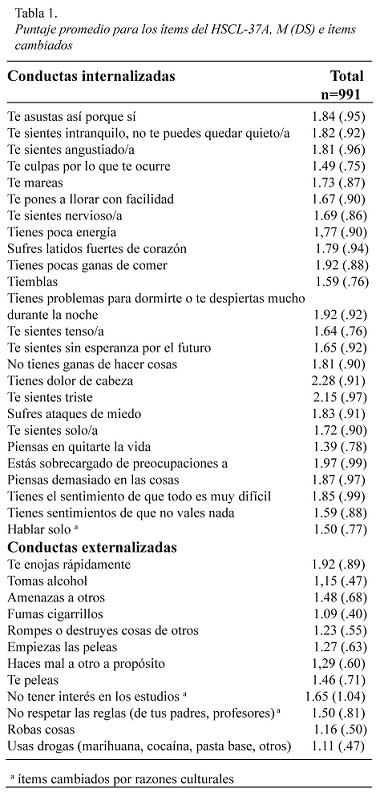
<body><![CDATA[<p class="western" style="margin: 5pt 134.25pt 0.0001pt 27pt; text-align: justify; line-height: 150%; width: 835px;"><span style="font-size: 12pt; line-height: 150%; font-family: Arial;" lang="ES-UY">El <i>Hopkins Symptoms Checklist 37 for Adolescents</i> -HSCL-37A; Lista de S&iacute;ntomas de Hopkins - versi&oacute;n 37 para Adolescentes- <a name="BeanDerluynEurelings-Bontekoe"></a>(<a href="#Bean">Bean, Derluyn, Eurelings-Bontekoe, Broekaert &amp; Spinhoven</a>, 2007); es una escala que mide s&iacute;ntomas basados en los criterios del DSM-IV: depresi&oacute;n (15 &iacute;tems), ansiedad (10 &iacute;tems) y perturbaciones en comportamientos externalizados (12 &iacute;tems). Este instrumento es una modificaci&oacute;n multicultural del HSCL-25 <a name="DerogatisLipmanRikelsUlenhoth"></a>(<a href="#Derogatis">Derogatis, Lipman, Rikels, Ulenhoth &amp; Colvi</a>, 1974), adaptada a la vida adolescente. Treinta y siete &iacute;tems eval&uacute;an la severidad de los s&iacute;ntomas en una escala Likert de 1 hasta 4 (nunca = 1; a veces = 2; seguido = 3; siempre = 4). La escala est&aacute; disponible en 19 idiomas, con valores adecuados de validez de constructo, contenido y criterio y una estructura bifactorial (internalizaci&oacute;n &ndash; externalizaci&oacute;n), obtenidos en una muestra de adolescentes inmigrantes y aut&oacute;ctonos holandeses y flamencos <a name="Beanetal.2007"></a>(<a href="#Bean">Bean et al.</a>, 2007). <o:p></o:p></span></p>      <p class="western" style="margin: 5pt 134.25pt 0.0001pt 27pt; text-align: justify; line-height: 150%;"><span style="font-size: 12pt; line-height: 150%; font-family: Arial;" lang="ES-UY"><o:p>&nbsp;</o:p></span></p>      <p class="western" style="margin: 5pt 134.25pt 0.0001pt 27pt; text-align: justify; line-height: 120%; width: 837px;"><span style="font-size: 12pt; line-height: 120%; font-family: Arial;" lang="ES-UY">Para el estudio, en la versi&oacute;n congolesa del cuestionario, se cambiaron cuatro &iacute;tems con poca relevancia local por &iacute;tems m&aacute;s apropiados a la cultura, seg&uacute;n informantes claves (<a href="#Mels3">Mels et al.</a>, 2010b), indicado en la <a name="t1"></a><a href="/img/revistas/cp/v6n2/2a02t1.jpg">tabla 1</a>.<o:p></o:p></span></p>      <p class="western" style="margin: 5pt 134.25pt 0.0001pt 27pt; text-align: justify; line-height: 150%; width: 836px;"><span style="font-size: 12pt; line-height: 150%; font-family: Arial;" lang="ES-UY"><o:p>&nbsp;&nbsp;</o:p>    <br>  No obstante, la evaluaci&oacute;n de los valores de fiabilidad interna de las sub-escalas mostr&oacute; una fiabilidad buena para la sub-escala de internalizaci&oacute;n (.89 para la escala francesa y .91 para la escala swahili), pero discutible para la sub-escala de externalizaci&oacute;n (.76 para la escala francesa y .60 para la escala swahili). <o:p></o:p></span></p>      <p class="western" style="margin: 5pt 134.25pt 0.0001pt 27pt; text-align: justify; line-height: 150%; width: 839px;"><span style="font-size: 12pt; line-height: 150%; font-family: Arial;" lang="ES-UY">Por esta raz&oacute;n, en este art&iacute;culo, nos enfocaremos, solamente en el an&aacute;lisis de covarianza de la sub-escala de conductas internalizadas.<o:p></o:p></span></p>      <p class="western" style="margin: 5pt 134.25pt 0.0001pt 27pt; text-align: justify; line-height: 150%;"><span style="font-size: 12pt; line-height: 150%; font-family: Arial;" lang="ES-UY"><o:p>&nbsp;</o:p></span></p>      <p class="western" style="margin: 5pt 134.25pt 0.0001pt 27pt; text-align: justify; line-height: 150%; width: 838px;"><span style="font-size: 12pt; line-height: 150%; font-family: Arial;" lang="ES-UY">Para investigar las variables independientes, desarrollamos &ndash;igualmente bas&aacute;ndonos en el estudio cualitativo descrito en <a href="#Mels3">Mels et al.</a> (2010b)&ndash; una escala socio-demogr&aacute;fica y los dos cuestionarios siguientes:<o:p></o:p></span></p>      <p class="western" style="margin: 5pt 134.25pt 0.0001pt 27pt; text-align: justify; line-height: 150%;"><span style="font-size: 12pt; line-height: 150%; font-family: Arial;" lang="ES-UY"><o:p>&nbsp;</o:p></span></p>      <p class="western" style="margin: 5pt 134.25pt 0.0001pt 27pt; text-align: justify; line-height: 150%; width: 836px;"><span style="font-size: 12pt; line-height: 150%; font-family: Arial;" lang="ES-UY">El <i>Adolescent Complex Emergency Exposure Scale</i> (Escala Adolescente de Exposici&oacute;n en Emergencias Complejas) (<a href="#Mels1">Mels et al.</a>, 2009). Se trata de una lista de 13 eventos impactantes y potencialmente traum&aacute;ticos, vinculados espec&iacute;ficamente a la guerra (como la separaci&oacute;n de la familia, la muerte de familiares o amigos, ser testigo de asesinato, experimentar ataques armados, etc.). Para cada uno de los eventos en la lista, el participante debe indicar si lo experiment&oacute; o no (respuesta cerrada: si/no). La suma total de todos los &iacute;tems lleva a un valor para eventos impactantes acumulados, o sea: exposici&oacute;n a la violencia. <o:p></o:p></span></p>      ]]></body>
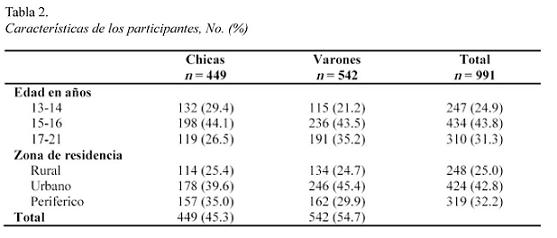
<body><![CDATA[<p class="western" style="margin: 5pt 134.25pt 0.0001pt 27pt; text-align: justify; line-height: 150%;"><span style="font-size: 12pt; line-height: 150%; font-family: Arial;" lang="ES-UY"><o:p>&nbsp;</o:p></span></p>      <p class="western" style="margin: 5pt 134.25pt 0.0001pt 27pt; text-align: justify; line-height: 150%; width: 837px;"><span style="font-size: 12pt; line-height: 150%; font-family: Arial;" lang="ES-UY">El <i>Adolescent Complex Emergency Daily Stressors Scale</i> (Escala Adolescente de Estresores Diarios en Emergencias Complejas) (<a href="#Mels2">Mels et al.</a> 2010a), eval&uacute;a 13 dificultades sufridas en el &uacute;ltimo mes (por ejemplo: insuficiencia de comida, cuidados m&eacute;dicos, etc.) y cinco condiciones estresantes conocidas por impactar negativamente en la vida diaria (por ejemplo, rechazo de la familia, matrimonio forzado, etc.). Se indica la respuesta cerrada marcando si o no. La suma de todas las dificultades reportadas opera como indicador para los estresores diarios sufridos.<o:p></o:p></span></p>      <p class="western" style="margin: 5pt 134.25pt 0.0001pt 27pt; text-align: justify; line-height: 150%;"><span style="font-size: 12pt; line-height: 150%; font-family: Arial;" lang="ES-UY"><o:p>&nbsp;</o:p></span></p>      <p class="western" style="margin: 5pt 134.25pt 0.0001pt 27pt; text-align: justify; line-height: 150%;"><b><i><span style="font-size: 12pt; line-height: 150%; font-family: Arial;" lang="ES-UY">3.3. Participantes</span></i></b><span style="font-size: 12pt; line-height: 150%; font-family: Arial;" lang="ES-UY"><o:p></o:p></span></p>      <p class="western" style="margin: 5pt 134.25pt 0.0001pt 27pt; text-align: justify; line-height: 150%;"><span style="font-size: 12pt; line-height: 150%; font-family: Arial;" lang="ES-UY"><o:p>&nbsp;</o:p></span></p>      <p class="western" style="margin: 5pt 134.25pt 0.0001pt 27pt; text-align: justify; line-height: 150%; width: 836px;"><span style="font-size: 12pt; line-height: 150%; font-family: Arial;" lang="ES-UY">Entre noviembre 2007 y febrero 2008 se realiz&oacute; una encuesta en 13 colegios secundarios a trav&eacute;s de cuatro zonas seleccionadas de la provincia (Bunia, Rwampara, Nyankunde y Rethy). Se seleccionaron las zonas seg&uacute;n los criterios siguientes: accesibilidad f&iacute;sica y ofrecer un m&iacute;nimo de seguridad para llevar a cabo la encuesta, representatividad de a&eacute;reas rurales, perif&eacute;ricas y urbanas (o sea la variable zona de residencia). Participaron 1051 alumnos entre 13 y 21 a&ntilde;os, asistiendo entre el primer y cuarto a&ntilde;o (a causa de la guerra se suspendieron las clases, por lo que el sistema escolar tiene una dispersi&oacute;n muy amplia de edades por a&ntilde;os escolares). Ninguno de los alumnos se neg&oacute; a la participaci&oacute;n. No obstante, los datos recogidos de 60 participantes resultaron deficientes para el testeo de las hip&oacute;tesis, reduciendo el tama&ntilde;o de la muestra a 991. Las caracter&iacute;sticas de la muestra y su distribuci&oacute;n seg&uacute;n sexo, grupo de edad y zona de residencia se presentan en la&nbsp;<a href="#t2">Tabla 2</a>.</span></p>      <p class="western" style="margin: 5pt 134.25pt 0.0001pt 27pt; text-align: justify; line-height: 150%;"><span style="font-size: 12pt; line-height: 150%; font-family: Arial;" lang="ES-UY"> <o:p></o:p></span></p>      <p class="western" style="margin: 5pt 134.25pt 0.0001pt 27pt; text-align: justify; line-height: 150%;"><span style="font-size: 12pt; line-height: 150%; font-family: Arial;" lang="ES-UY"><o:p>&nbsp;<a name="t2"></a><img style="width: 557px; height: 238px;" alt="" src="/img/revistas/cp/v6n2/2a02t2.jpg"></o:p></span></p>      <p class="western" style="margin: 5pt 134.25pt 0.0001pt 27pt; text-align: justify; line-height: 120%;"><span style="font-size: 12pt; line-height: 120%; font-family: Arial;" lang="ES-UY"><o:p>&nbsp;</o:p></span></p>      <p class="western" style="margin: 5pt 134.25pt 0.0001pt 27pt; text-align: justify; line-height: 120%;"><b><i><span style="font-size: 12pt; line-height: 120%; font-family: Arial;" lang="ES-UY">3.4. Procedimiento</span></i></b><span style="font-size: 12pt; line-height: 120%; font-family: Arial;" lang="ES-UY"><o:p></o:p></span></p>      ]]></body>
<body><![CDATA[<p class="western" style="margin: 5pt 134.25pt 0.0001pt 27pt; text-align: justify; line-height: 120%;"><span style="font-size: 12pt; line-height: 120%; font-family: Arial;" lang="ES-UY"><o:p>&nbsp;</o:p></span></p>      <p class="western" style="margin: 5pt 134.25pt 0.0001pt 27pt; text-align: justify; line-height: 150%; width: 837px;"><span style="font-size: 12pt; line-height: 150%; font-family: Arial;" lang="ES-UY">La encuesta consisti&oacute; en la administraci&oacute;n en clase de los cuestionarios auto-informados referidos, junto con la explicaci&oacute;n del estudio y la obtenci&oacute;n de su consentimiento informado en forma escrita. Por las altas tasas de analfabetismo esperadas entre los padres, result&oacute; imposible conseguir su consentimiento escrito para la participaci&oacute;n de sus hijos en la investigaci&oacute;n.<o:p></o:p></span></p>      <p class="western" style="margin: 5pt 134.25pt 0.0001pt 27pt; text-align: justify; line-height: 150%;"><span style="font-size: 12pt; line-height: 150%; font-family: Arial;" lang="ES-UY"><o:p>&nbsp;</o:p></span></p>      <p class="western" style="margin: 5pt 134.25pt 0.0001pt 27pt; text-align: justify; line-height: 150%; width: 840px;"><span style="font-size: 12pt; line-height: 150%; font-family: Arial;" lang="ES-UY">Se ofreci&oacute; la elecci&oacute;n entre una bater&iacute;a en Franc&eacute;s o Swahili para dejar a los alumnos la posibilidad de elegir el idioma con el cual se sintieran m&aacute;s c&oacute;modos. Se les proporcion&oacute; informaci&oacute;n y datos de contacto de servicios psicosociales a los participantes, para poder cumplir con necesidades psicol&oacute;gicas que pudieran surgir en algunos alumnos durante su participaci&oacute;n. Los investigadores (la autora extranjera y un asistente congol&eacute;s) estuvieron presentes para responder las preguntas o dudas que surgieran durante la administraci&oacute;n.<o:p></o:p></span></p>      <p class="western" style="margin: 5pt 134.25pt 0.0001pt 27pt; text-align: justify; line-height: 150%;"><span style="font-size: 12pt; line-height: 150%; font-family: Arial;" lang="ES-UY"><o:p>&nbsp;</o:p></span></p>      <p class="western" style="margin: 5pt 134.25pt 0.0001pt 27pt; text-align: justify; line-height: 150%; width: 838px;"><span style="font-size: 12pt; line-height: 150%; font-family: Arial;" lang="ES-UY">Como en aquel momento no hab&iacute;a una instancia activa en la RDC que autorizace la investigaci&oacute;n, se busc&oacute; y obtuvo la aprobaci&oacute;n del Comit&eacute; de &Eacute;tica de la Facultad de Psicolog&iacute;a y Ciencias Pedag&oacute;gicas de la Universidad de Gante en B&eacute;lgica, donde la autora estaba como becaria doctoral en el momento de la investigaci&oacute;n. <o:p></o:p></span></p>      <p class="western" style="margin: 5pt 134.25pt 0.0001pt 27pt; text-align: justify; line-height: 150%;"><span style="font-size: 12pt; line-height: 150%; font-family: Arial;" lang="ES-UY"><o:p>&nbsp;</o:p></span></p>      <p class="western" style="margin: 5pt 134.25pt 0.0001pt 27pt; text-align: justify; line-height: 150%;"><span style="font-size: 12pt; line-height: 150%; font-family: Arial;" lang="ES-UY"><o:p>&nbsp;</o:p></span></p>      <p class="western" style="margin: 5pt 134.25pt 0.0001pt 27pt; text-align: justify; line-height: 150%;"><b><span style="font-size: 12pt; line-height: 150%; font-family: Arial;" lang="ES-UY">4. An&aacute;lisis estad&iacute;sticos</span></b><span style="font-size: 12pt; line-height: 150%; font-family: Arial;" lang="ES-UY"><o:p></o:p></span></p>      <p class="western" style="margin: 5pt 134.25pt 0.0001pt 27pt; text-align: justify; line-height: 150%;"><span style="font-size: 12pt; line-height: 150%; font-family: Arial;" lang="ES-UY"><o:p>&nbsp;</o:p></span></p>      ]]></body>
<body><![CDATA[<p class="western" style="margin: 5pt 134.25pt 0.0001pt 27pt; text-align: justify; line-height: 150%; width: 837px;"><span style="font-size: 12pt; line-height: 150%; font-family: Arial;" lang="ES-UY">Se utilizaron estad&iacute;sticos descriptivos para rese&ntilde;ar las caracter&iacute;sticas de la muestra seg&uacute;n sexo, promedios de la exposici&oacute;n violenta, estresores diarios y conductas internalizadas y externalizadas -seg&uacute;n sexo grupo de edad y zona de residencia-. Las diferencias para los promedios por grupos de edad y sexo, fueron comprobados con one-way ANOVA (con Games-Howell, post-hoc tests) y t-test respectivamente. Se us&oacute; ANCOVA para investigar como las variables sexo, edad, estresores diarios y exposici&oacute;n violenta, mediaban en los puntajes de conductas interiorizadas. El modelo testeado contuvo todos los efectos directos y efectos de interacci&oacute;n con las variables estresores diarios y exposici&oacute;n violenta, con el objetivo de investigar sus efectos potencialmente acumulativos. Tambi&eacute;n estaban incluidos los efectos directos e indirectos de la variable zona de residencia.<o:p></o:p></span></p>      <p class="western" style="margin: 5pt 134.25pt 0.0001pt 27pt; text-align: justify; line-height: 150%;"><span style="font-size: 12pt; line-height: 150%; font-family: Arial;" lang="ES-UY"><o:p>&nbsp;</o:p></span></p>      <p class="western" style="margin: 5pt 134.25pt 0.0001pt 27pt; text-align: justify; line-height: 150%; width: 838px;"><span style="font-size: 12pt; line-height: 150%; font-family: Arial;" lang="ES-UY">En un estudio previo (<a href="#Mels1">Mels et al.</a>, 2009), &eacute;sta variable se mostr&oacute; como moderador relevante en la prevalencia de los s&iacute;ntomas del TEPT. Los test de Levene confirmaron la equivalencia de varianzas entre los grupos evaluados. Los datos fueron analizados con SPSS 15.0 Statistical Software (SPSS Inc., 2006). <o:p></o:p></span></p>      <p class="western" style="margin: 5pt 134.25pt 0.0001pt 27pt; text-align: justify; line-height: 150%;"><span style="font-size: 12pt; line-height: 150%; font-family: Arial;" lang="ES-UY"><o:p>&nbsp;</o:p></span></p>      <p class="western" style="margin: 5pt 134.25pt 0.0001pt 27pt; text-align: justify; line-height: 150%;"><span style="font-size: 12pt; line-height: 150%; font-family: Arial;" lang="ES-UY"><o:p>&nbsp;</o:p></span></p>      <p class="western" style="margin: 5pt 134.25pt 0.0001pt 27pt; text-align: justify; line-height: 150%; width: 836px;"><span style="font-size: 12pt; line-height: 150%; font-family: Arial;" lang="ES-UY">El nivel de significaci&oacute;n para las comparaciones entre promedios por grupos fue de a <i>p</i> &le; .001. Para la interpretaci&oacute;n del modelo ANCOVA aplicamos <i>p &lt; </i>.05 como umbral para estudio de significaci&oacute;n. Se us&oacute; la eta parcial al cuadrado <i>(&eta;&sup2;</i>) como una aproximaci&oacute;n del efecto del tama&ntilde;o (efect size).<o:p></o:p></span></p>      <p class="western" style="margin: 5pt 134.25pt 0.0001pt 27pt; text-align: justify; line-height: 150%;"><span style="font-size: 12pt; line-height: 150%; font-family: Arial;" lang="ES-UY"><o:p>&nbsp;</o:p></span></p>      <p class="western" style="margin: 5pt 134.25pt 0.0001pt 27pt; text-align: justify; line-height: 150%;"><span style="font-size: 12pt; line-height: 150%; font-family: Arial;" lang="ES-UY"><o:p>&nbsp;</o:p></span></p>      <p class="western" style="margin: 5pt 134.25pt 0.0001pt 27pt; text-align: justify; line-height: 150%;"><b><span style="font-size: 12pt; line-height: 150%; font-family: Arial;" lang="ES-UY">5. Resultados</span></b><span style="font-size: 12pt; line-height: 150%; font-family: Arial;" lang="ES-UY"><o:p></o:p></span></p>      <p class="western" style="margin: 5pt 134.25pt 0.0001pt 27pt; text-align: justify; line-height: 150%;"><span style="font-size: 12pt; line-height: 150%; font-family: Arial;" lang="ES-UY"><o:p>&nbsp;</o:p></span></p>      ]]></body>
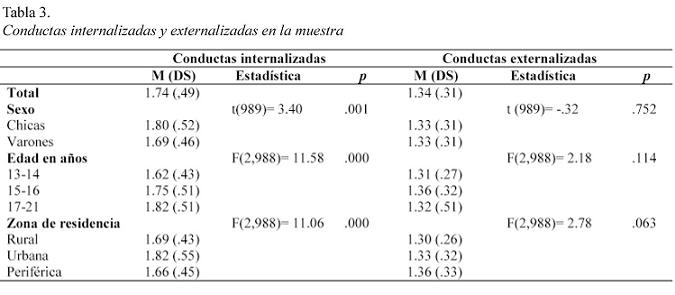
<body><![CDATA[<p class="western" style="margin: 5pt 134.25pt 0.0001pt 27pt; text-align: justify; line-height: 150%;"><b><i><span style="font-size: 12pt; line-height: 150%; font-family: Arial;" lang="ES-UY">5.1. Conductas internalizadas y externalizadas</span></i></b><span style="font-size: 12pt; line-height: 150%; font-family: Arial;" lang="ES-UY"><o:p></o:p></span></p>      <p class="western" style="margin: 5pt 134.25pt 0.0001pt 27pt; text-align: justify; line-height: 150%;"><span style="font-size: 12pt; line-height: 150%; font-family: Arial;" lang="ES-UY"><o:p>&nbsp;</o:p></span></p>      <p class="western" style="margin: 5pt 134.25pt 0.0001pt 27pt; text-align: justify; line-height: 150%; width: 837px;"><span style="font-size: 12pt; line-height: 150%; font-family: Arial;" lang="ES-UY">La <a href="#t1">tabla 1</a> presenta los &iacute;tems del HSCL-37A seg&uacute;n las sub-escalas internalizaci&oacute;n &ndash; externalizaci&oacute;n y los puntajes promedios en la muestra (promedio en una escala Likert de 1 a 4). Con respecto a las conductas internalizadas reportadas, llaman la atenci&oacute;n los altos puntajes para los &iacute;tems &ldquo;tener dolor de cabeza&rdquo; y &ldquo;sentirse triste&rdquo;. Desde el tercer hasta quinto lugar de s&iacute;ntomas m&aacute;s frecuentemente reportados encontramos los &iacute;tems &ldquo;estar sobrecargado de preocupaciones&rdquo;, &ldquo;tener problemas para dormirse o despertarse durante la noche&rdquo;, y &ldquo;tener pocas ganas de comer&rdquo;. Los cinco s&iacute;ntomas con mayores puntajes en promedio se encuentran entre los criterios para el diagn&oacute;stico de depresi&oacute;n. <o:p></o:p></span></p>      <p class="western" style="margin: 5pt 134.25pt 0.0001pt 27pt; text-align: justify; line-height: 150%;"><span style="font-size: 12pt; line-height: 150%; font-family: Arial;" lang="ES-UY"><o:p>&nbsp;</o:p></span></p>      <p class="western" style="margin: 5pt 134.25pt 0.0001pt 27pt; text-align: justify; line-height: 150%; width: 838px;"><span style="font-size: 12pt; line-height: 150%; font-family: Arial;" lang="ES-UY">En comparaci&oacute;n, los &iacute;tems de la sub-escala externalizaci&oacute;n tienen promedios menores. Un solo &iacute;tem llama la atenci&oacute;n por su promedio alto: &ldquo;enojarse r&aacute;pidamente&rdquo;.<o:p></o:p></span></p>      <p class="western" style="margin: 5pt 134.25pt 0.0001pt 27pt; text-align: justify; line-height: 150%;"><span style="font-size: 12pt; line-height: 150%; font-family: Arial;" lang="ES-UY"><o:p>&nbsp;</o:p></span></p>      <p class="western" style="margin: 5pt 134.25pt 0.0001pt 27pt; text-align: justify; line-height: 150%; width: 839px;"><span style="font-size: 12pt; line-height: 150%; font-family: Arial;" lang="ES-UY">La <a href="/img/revistas/cp/v6n2/2a02t3.jpg">tabla 3</a> (p&aacute;gina siguiente) muestra los promedios de las sub-escalas del HSCL-37A, y compara los promedios seg&uacute;n grupo de edad, sexo y zona de residencia. No encontramos diferencias entre los grupos en conductas externalizadas. En lo que concierne a las conductas interiorizadas, se encontraron diferencias significativas entre los grupos: las ni&ntilde;as reportaron m&aacute;s conductas internalizadas que los varones, y los adolescentes mayores, en general reportaron m&aacute;s s&iacute;ntomas que los adolescentes m&aacute;s j&oacute;venes. <o:p></o:p></span></p>      <p class="western" style="margin: 5pt 134.25pt 0.0001pt 27pt; text-align: justify; line-height: 150%;"><span style="font-size: 12pt; line-height: 150%; font-family: Arial;" lang="ES-UY"><o:p>&nbsp;&nbsp;</o:p></span></p>      <p class="western" style="margin: 5pt 134.25pt 0.0001pt 27pt; text-align: justify; line-height: 150%;"><b><i><span style="font-size: 12pt; line-height: 150%; font-family: Arial;" lang="ES-UY">5.2. Exposici&oacute;n a la violencia y estresores diarios</span></i></b><span style="font-size: 12pt; line-height: 150%; font-family: Arial;" lang="ES-UY"><o:p></o:p></span></p>      <p class="western" style="margin: 5pt 134.25pt 0.0001pt 27pt; text-align: justify; line-height: 150%;"><span style="font-size: 12pt; line-height: 150%; font-family: Arial;" lang="ES-UY"><o:p>&nbsp;</o:p></span></p>      ]]></body>
<body><![CDATA[<p class="western" style="margin: 5pt 134.25pt 9.9pt 27pt; text-align: justify; line-height: 150%; width: 838px;"><span style="font-size: 12pt; line-height: 150%; font-family: Arial;" lang="ES-UY">Las medias de las variables exposici&oacute;n a la violencia y estresores diarios, seg&uacute;n sexo ygrupo de edad, est&aacute;n presentadas en la <a href="/img/revistas/cp/v6n2/2a02t4.jpg">tabla 4</a>. Los datos muestran que no hab&iacute;a diferencias en los estresores diarios experimentados seg&uacute;n sexo. S&iacute; variaron significativamente seg&uacute;n edad: los adolescentes mayores -de ambos sexos- reportaron m&aacute;s estresores diarios que sus pares de menor edad.<o:p></o:p></span></p>  <span style="font-size: 12pt; line-height: 150%; font-family: Arial;" lang="ES-UY"><o:p>&nbsp;</o:p></span><span style="font-size: 12pt; line-height: 150%; font-family: Arial;" lang="ES-UY"><o:p></o:p></span>     <p class="western" style="margin: 5pt 134.25pt 0.0001pt 27pt; text-align: justify; line-height: 150%; width: 839px;"><span style="font-size: 12pt; line-height: 150%; font-family: Arial;" lang="ES-UY">Con respecto a la exposici&oacute;n a la violencia, encontramos diferencias significativas seg&uacute;n edad y seg&uacute;n sexo: los adolescentes varones resultaron m&aacute;s expuestos que las chicas, tambi&eacute;n los adolescentes (varones y mujeres) de mayor edad reportaron m&aacute;s eventos violentos experimentados, que los de menor edad -de ambos sexos-.<o:p></o:p></span></p>      <p class="western" style="margin: 5pt 134.25pt 0.0001pt 27pt; text-align: justify; line-height: 150%;"><span style="font-size: 12pt; line-height: 150%; font-family: Arial;" lang="ES-UY"><o:p>&nbsp;</o:p></span></p>      <p class="western" style="margin: 5pt 134.25pt 0.0001pt 27pt; text-align: justify; line-height: 150%;"><b><i><span style="font-size: 12pt; line-height: 150%; font-family: Arial;" lang="ES-UY">5.3. Predictores de conductas internalizadas</span></i></b><span style="font-size: 12pt; line-height: 150%; font-family: Arial;" lang="ES-UY"><o:p></o:p></span></p>      <p class="western" style="margin: 5pt 134.25pt 0.0001pt 27pt; text-align: justify; line-height: 150%;"><span style="font-size: 12pt; line-height: 150%; font-family: Arial;" lang="ES-UY"><o:p>&nbsp;</o:p></span></p>      <p class="western" style="margin: 5pt 134.25pt 0.0001pt 27pt; text-align: justify; line-height: 150%; width: 838px;"><span style="font-size: 12pt; line-height: 150%; font-family: Arial;" lang="ES-UY">El modelo comprobado explic&oacute; el 41% de la varianza en la variable independiente (R&sup2;= .411). Se encontraron peque&ntilde;os efectos en relaci&oacute;n con la zona de residencia (<i>F </i>(2,990) = 3.643, <i>p</i>= .027, &eta;&sup2;= .007) y estresores diarios (<i>F </i>(2,972)= 6.425, <i>p</i>= .011, &eta;&sup2;= .007), que no obstante deben ser matizados a la luz de los efectos de interacci&oacute;n comprendidos en estas variables.<o:p></o:p></span></p>      <p class="western" style="margin: 5pt 134.25pt 0.0001pt 27pt; text-align: justify; line-height: 150%;"><span style="font-size: 12pt; line-height: 150%; font-family: Arial;" lang="ES-UY"><o:p>&nbsp;</o:p></span></p>      <p class="western" style="margin: 5pt 134.25pt 0.0001pt 27pt; text-align: justify; line-height: 150%; width: 836px;"><span style="font-size: 12pt; line-height: 150%; font-family: Arial;" lang="ES-UY">El efecto con mayor valor &eta;&sup2; en el modelo, fue el efecto de interacci&oacute;n entre exposici&oacute;n violenta y estresores diarios (<i>F </i>(1,972)= 6.425, <i>p</i>= .000, &eta;&sup2;= .027) indicando comportamientos internalizados elevados a medida que ambas variables acumulaban<i> </i>(<i>B</i> = .006, <i>SE</i> = .001,<i> t</i> = 4.916, <i>p</i> = .000).<o:p></o:p></span></p>      <p class="western" style="margin: 5pt 134.25pt 0.0001pt 27pt; text-align: justify; line-height: 150%;"><span style="font-size: 12pt; line-height: 150%; font-family: Arial;" lang="ES-UY"><o:p>&nbsp;</o:p></span></p>      <p class="western" style="margin: 5pt 134.25pt 0.0001pt 27pt; text-align: justify; line-height: 150%; width: 849px;"><span style="font-size: 12pt; line-height: 150%; font-family: Arial;" lang="ES-UY">Tambi&eacute;n se constataron efectos de interacci&oacute;n peque&ntilde;os entre sexo y estresores diarios (<i>F </i>(1,972)= 7.808, <i>p </i>= .005, &eta;&sup2;= .008) y entre zona de residencia y exposici&oacute;n a la violencia (<i>F </i>(1,972)= 5.421, <i>p</i>= .005, &eta;&sup2;= .011): las chicas tienen m&aacute;s conductas internalizadas que los adolescentes varones bajo la acumulaci&oacute;n de estresores diarios (<i>B</i> = .021, <i>SE</i> = .008,<i> t</i> = 2.794, <i>p</i> = .005). En a&eacute;reas perif&eacute;ricas la acumulaci&oacute;n de eventos violentos afecta m&aacute;s negativamente a las conductas internalizadas que en otras a&eacute;reas (<i>B</i> = .036, <i>SE</i> = .014, <i>t</i> = 2.577, <i>p</i> = .010).<o:p></o:p></span></p>      ]]></body>
<body><![CDATA[<p class="western" style="margin: 5pt 134.25pt 0.0001pt 27pt; text-align: justify; line-height: 150%;"><span style="font-size: 12pt; line-height: 150%; font-family: Arial;" lang="ES-UY"><o:p>&nbsp;</o:p></span></p>      <p class="western" style="margin: 5pt 134.25pt 0.0001pt 27pt; text-align: justify; line-height: 150%;"><span style="font-size: 12pt; line-height: 150%; font-family: Arial;" lang="ES-UY"><o:p>&nbsp;</o:p></span></p>      <p class="western" style="margin: 5pt 134.25pt 0.0001pt 27pt; text-align: justify; line-height: 120%;"><b><span style="font-size: 12pt; line-height: 120%; font-family: Arial;" lang="ES-UY">6. Discusi&oacute;n y conclusiones</span></b><span style="font-size: 12pt; line-height: 120%; font-family: Arial;" lang="ES-UY"><o:p></o:p></span></p>      <p class="western" style="margin: 5pt 134.25pt 0.0001pt 27pt; text-align: justify; line-height: 120%;"><span style="font-size: 12pt; line-height: 120%; font-family: Arial;" lang="ES-UY"><o:p>&nbsp;</o:p></span></p>      <p class="western" style="margin: 5pt 134.25pt 0.0001pt 27pt; text-align: justify; line-height: 150%; width: 837px;"><span style="font-size: 12pt; line-height: 150%; font-family: Arial;" lang="ES-UY">Mientras que algunos/as adolescentes desarrollan reacciones psicopatol&oacute;gicas duraderas, el desajuste psicol&oacute;gico en j&oacute;venes afectados por la guerra est&aacute; cada vez m&aacute;s reconocido como una reacci&oacute;n aguda, pero temporal, frente a eventos extremadamente estresantes. Generalmente esta reacci&oacute;n inicial est&aacute; seguida por una fase de recuperaci&oacute;n en la cual, ni&ntilde;os/as y adolescentes resilientes vuelven a patrones de emociones y comportamientos normales, con el paso del tiempo (<a href="#Williams">Williams</a>, 2007). Tomando en cuenta estas diferencias observadas, es importante desarrollar un mejor entendimiento sobre el impacto de varios factores de riesgo y factores protectores (tales como la edad, sexo, la cantidad de experiencias violentas sufridas y estresores diarios) y c&oacute;mo interact&uacute;an entre ellos. Estos conocimientos nos ayudar&aacute;n a fomentar la estimulaci&oacute;n de la resiliencia y la prevenci&oacute;n de problemas psicol&oacute;gicos duraderos en ni&ntilde;os/as y adolescentes en varias situaciones amenazadas por la violencia (<a href="#Betancourt">Betancourt &amp; Kahn</a>, 2008; <a href="#Williams">Williams</a>, 2007).<o:p></o:p></span></p>      <p class="western" style="margin: 5pt 134.25pt 0.0001pt 27pt; text-align: justify; line-height: 150%;"><span style="font-size: 12pt; line-height: 150%; font-family: Arial;" lang="ES-UY"><o:p>&nbsp;</o:p></span></p>      <p class="western" style="margin: 5pt 134.25pt 0.0001pt 27pt; text-align: justify; line-height: 150%; width: 835px;"><span style="font-size: 12pt; line-height: 150%; font-family: Arial;" lang="ES-UY">Este estudio, en particular se enfoc&oacute; en la exploraci&oacute;n de dos factores de riesgo asociados con la vida en zonas de guerra &ndash;la exposici&oacute;n a eventos violentos y los estresores diarios (las consecuencias cotidianas de la pobreza y la exclusi&oacute;n social)&ndash; y sus relaciones directas e indirectas con conductas internalizadas.<o:p></o:p></span></p>      <p class="western" style="margin: 5pt 134.25pt 0.0001pt 27pt; text-align: justify; line-height: 150%;"><span style="font-size: 12pt; line-height: 150%; font-family: Arial;" lang="ES-UY"><o:p>&nbsp;</o:p></span></p>      <p class="western" style="margin: 5pt 134.25pt 0.0001pt 27pt; text-align: justify; line-height: 150%; width: 833px;"><span style="font-size: 12pt; line-height: 150%; font-family: Arial;" lang="ES-UY">Confirmando estudios anteriores, en esta investigaci&oacute;n, los adolescentes varones reportaron haber experimentado un mayor n&uacute;mero de eventos violentos que las adolescentes mujeres; y a su vez ambos reportaron una mayor exposici&oacute;n en comparaci&oacute;n con los/las adolescentes de menor edad (<a href="#Barenbaum">Barenbaum et al.</a>, 2004; <a href="#Macksoud">Macksoud &amp; Aber</a>, 1996; <a href="#Mels1">Mels et al.</a>, 2009; <a href="#Murthy">Murthy</a>, 2007). Se ha atribuido este resultado a la mayor independencia en la sociedad y el menor grado de protecci&oacute;n por parte de los padres hacia los hijos/as adolescentes mayores por un lado y a los hijos varones frente a las hijas mujeres de menor edad, por otro (<a href="#Murthy">Murthy</a>, 2007; <a href="#Porter">Porter &amp; Haslam</a>, 2005). Si bien, respecto a los estresores diarios, tambi&eacute;n se podr&iacute;a atribuir que la menor protecci&oacute;n por parte de los padres hacia los adolescentes varones, llevar&aacute; a encontrar diferentes niveles de estresores diarios sufridos por &eacute;stos en comparaci&oacute;n con las chicas, los datos no confirmaron esta hip&oacute;tesis ya que ambos presentaron niveles de estresores diarios semejantes. Se podr&iacute;a suponer entonces, que en un pa&iacute;s tan indigente y tan aquejado por las tensiones &eacute;tnicas como la Rep&uacute;blica Democr&aacute;tica del Congo, la pobreza y la exclusi&oacute;n social son tan generalizadas que afectaran a todos, independientemente de su posici&oacute;n participativa en la sociedad.<o:p></o:p></span></p>      <p class="western" style="margin: 5pt 134.25pt 0.0001pt 27pt; text-align: justify; line-height: 150%;"><span style="font-size: 12pt; line-height: 150%; font-family: Arial;" lang="ES-UY"><o:p>&nbsp;</o:p></span></p>      ]]></body>
<body><![CDATA[<p class="western" style="margin: 5pt 134.25pt 0.0001pt 27pt; text-align: justify; line-height: 150%; width: 832px;"><span style="font-size: 12pt; line-height: 150%; font-family: Arial;" lang="ES-UY">Aunque este estudio no ten&iacute;a el objetivo de comparar los puntajes obtenidos en la muestra congolesa con otras poblaciones no afectadas por la guerra, podemos concluir que las medias obtenidas en la sub-escala de comportamientos internalizados del HSCL-37A son altas. En estudios previos en Europa y Estados Unidos, se ha establecido el valor 1.75 como umbral indicativo para la significancia cl&iacute;nica de la sintomatolog&iacute;a <a name="Derogatisetal.1974"></a>(<a href="#Derogatis">Derogatis et al.</a>, 1974; <a href="#Hollifield">Hollifield et al.</a>, 2002). Aunque las poblaciones refiridas, ni los umbrales extra&iacute;dos de ellas son comparables con la poblaci&oacute;n investigada, en este estudio llama la atenci&oacute;n que el promedio total de nuestra muestra (1.74) casi llega a este puntaje. No obstante es dudoso que, en esta muestra, los s&iacute;ntomas tengan implicaciones cl&iacute;nicas comparables con aquellas encontradas en zonas desarrolladas y pac&iacute;ficas <a name="Brackenetal.1995"></a>(<a href="#Bracken">Bracken et al.</a>, 1995; <a href="#Jones">Jones &amp; Kafetsios</a>, 2002; <a href="#Miller3">Miller&amp; Rasmussen, 2010</a>).<o:p></o:p></span></p>      <p class="western" style="margin: 5pt 134.25pt 0.0001pt 27pt; text-align: justify; line-height: 150%;"><span style="font-size: 12pt; line-height: 150%; font-family: Arial;" lang="ES-UY"><o:p>&nbsp;</o:p></span></p>      <p class="western" style="margin: 5pt 134.25pt 0.0001pt 27pt; text-align: justify; line-height: 150%; width: 832px;"><span style="font-size: 12pt; line-height: 150%; font-family: Arial;" lang="ES-UY">De acuerdo con nuestra hip&oacute;tesis, los puntajes para problemas de conductas internalizadas se asocian positivamente con el sexo femenino, la exposici&oacute;n a la violencia y estresores diarios. No obstante estos efectos constatados exigen cierta explicaci&oacute;n: las adolescentes mujeres son m&aacute;s vulnerables que los adolescentes varones, tienen mayor presencia de s&iacute;ntomas internalizantes, pero solamente aquellas con mayores &iacute;ndices de estresores diarios sufridos. Este dato puede indicar que la resiliencia de las chicas, se ve negativamente afectada debido a los mayores niveles de estr&eacute;s diario, conclusi&oacute;n &eacute;sta, similar a la alcanzada por <a name="Milleretal.2008"></a><a href="#Miller2">Miller et al.</a> (2008) en su estudio con mujeres afganas. <o:p></o:p></span></p>      <p class="western" style="margin: 5pt 134.25pt 0.0001pt 27pt; text-align: justify; line-height: 150%;"><span style="font-size: 12pt; line-height: 150%; font-family: Arial;" lang="ES-UY"><o:p>&nbsp;</o:p></span></p>      <p class="western" style="margin: 5pt 134.25pt 9.9pt 27pt; text-align: justify; line-height: 150%; width: 832px;"><span style="font-size: 12pt; line-height: 150%; font-family: Arial;" lang="ES-UY">En lo que concierne a los efectos respectivos de la exposici&oacute;n a la violencia y estresores diarios en los puntajes de conductas internalizadas, podemos concluir que &ndash;como se ha planteado&ndash; se encontr&oacute; mayor influencia de estresores diarios, aunque este efecto no puede estar completamente separado del impacto delos eventos violentos sufridos. Aunque haya un efecto directo negativo, peque&ntilde;o, de estresores diarios en el reporte de s&iacute;ntomas internalizantes, la mayor parte de la varianza fue explicada por el efecto indirecto de estresores diarios, en interacci&oacute;n con la exposici&oacute;n a eventos violentos. Esto implica que, la acumulaci&oacute;n de estresores diarios tiene mayor efecto negativo para la salud mental, cuando est&aacute; acompa&ntilde;ado por mayores niveles de exposici&oacute;n a eventos violentos. En otras palabras: mientras que mayores niveles de estresores diarios est&aacute;n asociados con mayores niveles de conductas internalizadas, sobre todo en adolescentes mujeres, la exposici&oacute;n a la violencia es facilitador en este proceso, aumentando el efecto negativo de los estresores diarios en el ajuste psicol&oacute;gico.<o:p></o:p></span></p>      <p class="western" style="margin: 5pt 134.25pt 0.0001pt 27pt; text-align: justify; line-height: 150%;"><span style="font-size: 12pt; line-height: 150%; font-family: Arial;" lang="ES-UY"><o:p>&nbsp;</o:p></span></p>      <p class="western" style="margin: 5pt 134.25pt 0.0001pt 27pt; text-align: justify; line-height: 150%; width: 839px;"><span style="font-size: 12pt; line-height: 150%; font-family: Arial;" lang="ES-UY">Este resultado corresponde con las conclusiones de <a href="#Miller1">Miller et al.</a> (2002) en su estudio de refugiados bosnios adultos: mientras que la exposici&oacute;n a eventos violentos result&oacute; altamente predictiva para la aparici&oacute;n de s&iacute;ntomas de TEPT, la sintomatolog&iacute;a depresiva se vio principalmente afectada por estresores diarios. No obstante, en los casos m&aacute;s graves, la exposici&oacute;n a eventos violentos tambi&eacute;n explican los s&iacute;ntomas de depresi&oacute;n. Este proceso se ve reflejado en las altas tasas de depresi&oacute;n &ndash;entre otros s&iacute;ntomas internalizantes&ndash; constatadas a trav&eacute;s de varias poblaciones afectadas por la guerra (<a href="#Barenbaum">Barenbaum et al.</a>, 2004; <a href="#Ehntholt">Ehntholt &amp; Yule</a>, 2006; <a href="#Lynch">Lynch</a>, 2003; <a href="#Murthy">Murthy</a>, 2007). Vale plantear la cuesti&oacute;n de, en qu&eacute; medida, se puede seguir concibiendo la violencia cr&oacute;nica como un evento extraordinario (uno de los criterios usados en el diagnostico de TEPT) en situaciones que ha tomado m&aacute;s un car&aacute;cter de una molestia diaria, y lo que esta implica para la sintomatolog&iacute;a (<a href="#Kienzler">Kienzler</a>, 2008; <a href="#Miller3">Miller &amp; Rasmussen</a>, 2010). <o:p></o:p></span></p>      <p class="western" style="margin: 5pt 134.25pt 0.0001pt 27pt; text-align: justify; line-height: 150%;"><span style="font-size: 12pt; line-height: 150%; font-family: Arial;" lang="ES-UY"><o:p>&nbsp;</o:p></span></p>      <p class="western" style="margin: 5pt 134.25pt 0.0001pt 27pt; text-align: justify; line-height: 150%; width: 840px;"><span style="font-size: 12pt; line-height: 150%; font-family: Arial;" lang="ES-UY">Mientras que en este trabajo se encontraron diferencias significativas en conductas internalizadas seg&uacute;n edad, el an&aacute;lisis de covarianza no dio evidencia de una mayor vulnerabilidad para el desarrollo de s&iacute;ntomas en ciertas edades. Frecuentemente se han constatado diferencias en niveles de ajuste psicol&oacute;gicos seg&uacute;n edad, no obstante con conclusiones muy inconsistentes (<a href="#Barenbaum">Barenbaum et al.</a>, 2004; <a href="#Porter">Porter &amp; Haslam</a>, 2005). M&aacute;s que una mayor vulnerabilidad directa para el desarrollo de s&iacute;ntomas en adolescentes mayores, parece ser m&aacute;s probable que se trate de una mayor vulnerabilidad por verse expuestos tanto a estresores diarios, como a eventos violentos. La consecuencia l&oacute;gica es entonces el mayor desajuste psicol&oacute;gico en estos adolescentes, lo cual no significa que sean menos resilientes bajo niveles de estr&eacute;s comparables (<a href="#Williams">Williams</a>, 2007).<o:p></o:p></span></p>      <p class="western" style="margin: 5pt 134.25pt 0.0001pt 27pt; text-align: justify; line-height: 150%;"><span style="font-size: 12pt; line-height: 150%; font-family: Arial;" lang="ES-UY"><o:p>&nbsp;</o:p></span></p>      ]]></body>
<body><![CDATA[<p class="western" style="margin: 5pt 134.25pt 0.0001pt 27pt; text-align: justify; line-height: 150%;"><b><i><span style="font-size: 12pt; line-height: 150%; font-family: Arial;" lang="ES-UY">6.1. Limitaciones del estudio e implicaciones futuras</span></i></b><span style="font-size: 12pt; line-height: 150%; font-family: Arial;" lang="ES-UY"><o:p></o:p></span></p>      <p class="western" style="margin: 5pt 134.25pt 0.0001pt 27pt; text-align: justify; line-height: 150%;"><span style="font-size: 12pt; line-height: 150%; font-family: Arial;" lang="ES-UY"><o:p>&nbsp;</o:p></span></p>      <p class="western" style="margin: 5pt 134.25pt 0.0001pt 27pt; text-align: justify; line-height: 150%; width: 840px;"><span style="font-size: 12pt; line-height: 150%; font-family: Arial;" lang="ES-UY">Primero, se destacan las condiciones extraordinarias en las cuales se llev&oacute; a cabo este estudio, limitando el rango de opciones presentes para su dise&ntilde;o. Cuestiones de infraestructuras empobrecidas (para la comunicaci&oacute;n y el transporte), inseguridad y riesgos para la salud (restringiendo el acceso a ciertas areas con presencia de rebeldes y casos confirmados de c&oacute;lera) complicaron la obtenci&oacute;n de una muestra aleatoria. Asimismo, las condiciones nos dirigieron hacia un dise&ntilde;o transversal con el uso de solamente una fuente &ndash;los/las adolescentes&ndash; para evaluar sus conductas. En segundo lugar, para garantizar un cierto nivel de alfabetismo necesario para el buen entendimiento de los cuestionarios, optamos por una encuesta en liceos, lo cual limita la generalizabilidad de la muestra a todos los j&oacute;venes en la regi&oacute;n. Por &uacute;ltimo, a pesar de la importancia sobre la adaptaci&oacute;n y validaci&oacute;n transcultural de los instrumentos de investigaci&oacute;n usados (<a href="#Mels3">Mels et al.</a>, 2010b); no se pueden excluir completamente los &ldquo;errores&rdquo; transculturales en este tipo de investigaci&oacute;n (<a href="#Bracken">Bracken et al.</a>, 1995). <o:p></o:p></span></p>      <p class="western" style="margin: 5pt 134.25pt 0.0001pt 27pt; text-align: justify; line-height: 150%;"><span style="font-size: 12pt; line-height: 150%; font-family: Arial;" lang="ES-UY"><o:p>&nbsp;</o:p></span></p>      <p class="western" style="margin: 5pt 134.25pt 0.0001pt 27pt; text-align: justify; line-height: 150%; width: 840px;"><span style="font-size: 12pt; line-height: 150%; font-family: Arial;" lang="ES-UY">No obstante estas limitaciones, creemos que este estudio contribuye al estado del arte sobre este tema, proporcionando datos recogidos en una poblaci&oacute;n muy poco investigada: los ni&ntilde;os/as y adolescentes viviendo en una zona de guerra (<a href="#Barenbaum">Barenbaum et al.</a>, 2004; <a href="#Porter">Porter &amp; Haslam</a>, 2005). Adem&aacute;s, las poblaciones africanas est&aacute;n sistem&aacute;ticamente menos representadas en cualquier campo de estudio en psicolog&iacute;a (<a href="#Patel">Patel et al.</a>, 2008; <a href="#Porter">Porter &amp; Haslam</a>, 2005). En un momento de gran desconfianza hacia los modelos tradicionales, generalmente usados en investigaciones sobre la relaci&oacute;n entre el estar expuesto a actos violentos y reacciones psicopatol&oacute;gicas, este estudio colabora en el entendimiento sobre factores de riesgo y sus interacciones mutuas, y c&oacute;mo afectan en s&iacute;ntomas internalizantes y en las reacciones resilientes.<o:p></o:p></span></p>      <p class="western" style="margin: 5pt 134.25pt 0.0001pt 27pt; text-align: justify; line-height: 150%;"><span style="font-size: 12pt; line-height: 150%; font-family: Arial;" lang="ES-UY"><o:p>&nbsp;</o:p></span></p>      <p class="western" style="margin: 5pt 134.25pt 0.0001pt 27pt; text-align: justify; line-height: 150%; width: 837px;"><span style="font-size: 12pt; line-height: 150%; font-family: Arial;" lang="ES-UY">La confirmaci&oacute;n del papel fundamental que juegan los estresores diarios en el ajuste psicol&oacute;gico de ni&ntilde;os/as y adolescentes, que se desarrollan en situaciones afectadas por conflictos armados, tiene algunas implicaciones importantes para la intervenci&oacute;n psicol&oacute;gica en dichas condiciones. Mientras que los eventos violentos sufridos durante la guerra son irreversibles en la fase de post-conflicto, la idea de que una reducci&oacute;n de estresores diarios puede promover la resiliencia y minimizar &ndash;en cierta medida&ndash; los s&iacute;ntomas psicol&oacute;gicos causados por el estr&eacute;s acumulado durante la guerra, ofrece un punto de partida efectivo para procesos de recuperaci&oacute;n (<a href="#Miller3">Miller &amp; Rasmussen</a>, 2010). Esto implica que la mejora de las circunstancias socio-econ&oacute;micas de los hogares y comunidades en las cuales estos j&oacute;venes se encuentran, beneficiar&aacute; su desarrollo sano y adaptaci&oacute;n psicologica.<o:p></o:p></span></p>      <p class="western" style="margin: 5pt 134.25pt 0.0001pt 27pt; text-align: justify; line-height: 150%;"><span style="font-size: 12pt; line-height: 150%; font-family: Arial;" lang="ES-UY"><o:p>&nbsp;</o:p></span></p>      <p class="western" style="margin: 5pt 134.25pt 0.0001pt 27pt; text-align: justify; line-height: 150%; width: 839px;"><span style="font-size: 12pt; line-height: 150%; font-family: Arial;" lang="ES-UY">Junto con el debate sobre la utilidad y validez de investigaciones enfocadas en el mero estudio de los efectos directos de la violencia sufrida y los s&iacute;ntomas psicopatol&oacute;gicos (principalmente el TEPT), en los &uacute;ltimos a&ntilde;os se ha desplegado simult&aacute;neamente un cuestionamiento sobre la utilidad del modelo terap&eacute;utico cl&aacute;sico en poblaciones afectadas por conflictos armados (<a href="#Mels4">Mels et al.</a>, 2012). Este abordaje ha demostrado ser inefectivo por cuestiones pr&aacute;cticas (tal como, la falta de recursos y profesionales en estas zonas generalmente poco desarrolladas) y su validez transcultural muy limitada (<a href="#Bracken">Bracken et al.</a>, 1996; Patel et al., 2006), impulsando un modelo de intervenci&oacute;n psicosocial como alternativa (<a href="#Miller3">Miller &amp; Rasmussen</a>, 2010; <a href="#Panter">Panter-Brick</a>, 2010; <a href="#Williams">Williams</a>, 2007). Este modelo propone la importancia de un abordaje amplio de problemas psicol&oacute;gicos, tomando en cuenta los aspectos concretos y sociales de la situaci&oacute;n diaria que da forma al desarrollo humano. Nuestro estudio confirma el potencial de este tipo de intervenciones en zonas de guerra y da paso a futuras investigaciones, evaluando su aplicabilidad en otros contextos afectados por la pobreza y la violencia comunitaria.<o:p></o:p></span></p>      <p class="western" style="margin: 5pt 134.25pt 0.0001pt 27pt; text-align: justify; line-height: 150%;"><span style="font-size: 12pt; line-height: 150%; font-family: Arial;" lang="ES-UY"><o:p>&nbsp;</o:p></span></p>      ]]></body>
<body><![CDATA[<p class="western" style="margin: 5pt 134.25pt 0.0001pt 27pt; text-align: justify; line-height: 120%;"><span style="font-size: 12pt; line-height: 120%; font-family: Arial;" lang="ES-UY"><o:p>&nbsp;</o:p></span></p>      <p class="western" style="margin: 5pt 134.25pt 0.0001pt 27pt; text-align: justify; line-height: 120%;"><b><span style="font-size: 12pt; line-height: 120%; font-family: Arial;" lang="EN-US">7. <span class="SpellE">Referencias</span></span></b><span style="font-size: 12pt; line-height: 120%; font-family: Arial;" lang="EN-US"><o:p></o:p></span></p>      <p class="western" style="margin: 5pt 134.25pt 0.0001pt 27pt; text-align: justify; line-height: 120%;"><span style="font-size: 12pt; line-height: 120%; font-family: Arial;" lang="EN-US"><o:p>&nbsp;</o:p></span></p>      <p class="western" style="margin: 5pt 134.25pt 0.0001pt 27pt; text-align: justify; line-height: 150%; width: 838px;"><span class="SpellE"><span class="GramE"><span style="font-size: 12pt; line-height: 150%; font-family: Arial;" lang="EN-US"><a name="Amone"></a><a href="#Amone-P%92OlakGarnefskiKraaij2007">Amone-P&rsquo;Olak</a></span></span></span><span class="GramE"><span style="font-size: 12pt; line-height: 150%; font-family: Arial;" lang="EN-US"><a href="#Amone-P%92OlakGarnefskiKraaij2007">, K., <span class="SpellE">Garnefski</span>, N., &amp; <span class="SpellE">Kraaij</span>, V. (2007</a>).</span></span><span style="font-size: 12pt; line-height: 150%; font-family: Arial;" lang="EN-US"> Adolescents caught between fires: cognitive emotion regulation in response to war experiences in </span><st1:place><span style="font-size: 12pt; line-height: 150%; font-family: Arial;" lang="EN-US">Northern Uganda</span></st1:place><span style="font-size: 12pt; line-height: 150%; font-family: Arial;" lang="EN-US">. <i>Journal of Adolescence, 30</i> (4), 655-669.</span><span style="font-size: 12pt; line-height: 150%; font-family: Arial;" lang="EN-GB"><o:p></o:p></span></p>      <!-- ref --><p class="western" style="margin: 5pt 134.25pt 0.0001pt 27pt; text-align: justify; line-height: 150%; width: 840px;"><span class="SpellE"><span class="GramE"><span style="font-size: 12pt; line-height: 150%; font-family: Arial;" lang="EN-US"><a name="Autesserre"></a><a href="#Auteserre2009">Autesserre</a></span></span></span><span class="GramE"><span style="font-size: 12pt; line-height: 150%; font-family: Arial;" lang="EN-US"><a href="#Auteserre2009">, S. (2009</a>).</span></span><span style="font-size: 12pt; line-height: 150%; font-family: Arial;" lang="EN-US"> Hobbes and the </span><st1:country-region><st1:place><span style="font-size: 12pt; line-height: 150%; font-family: Arial;" lang="EN-US">Congo</span></st1:place></st1:country-region><span style="font-size: 12pt; line-height: 150%; font-family: Arial;" lang="EN-US">: frames, local violence, and international intervention. <i>International Organization, 63</i> (2), 249-280.    </span><span style="font-size: 12pt; line-height: 150%; font-family: Arial;" lang="EN-GB"><o:p></o:p></span></p>      <!-- ref --><p class="western" style="margin: 5pt 134.25pt 0.0001pt 27pt; text-align: justify; line-height: 150%; width: 838px;"><span class="SpellE"><span class="GramE"><span style="font-size: 12pt; line-height: 150%; font-family: Arial;" lang="EN-US"><a name="Barenbaum"></a><a href="#BarenbaumRuchkinSchwab-Stone2004">Barenbaum</a></span></span></span><span class="GramE"><span style="font-size: 12pt; line-height: 150%; font-family: Arial;" lang="EN-US"><a href="#BarenbaumRuchkinSchwab-Stone2004">, J., <span class="SpellE">Ruchkin</span>, V., &amp; Schwab-Stone, M. (2004</a>).</span></span><span style="font-size: 12pt; line-height: 150%; font-family: Arial;" lang="EN-US"> The psychosocial aspects of children exposed to war: practice and policy initiatives. <i>Journal of Child Psychology &amp; Psychiatry</i>,<i> 45 </i>(1), 41-62.    </span><span style="font-size: 12pt; line-height: 150%; font-family: Arial;" lang="EN-GB"><o:p></o:p></span></p>      <!-- ref --><p class="western" style="margin: 5pt 134.25pt 0.0001pt 27pt; text-align: justify; line-height: 150%; width: 835px;"><span style="font-size: 12pt; line-height: 150%; font-family: Arial;" lang="EN-US"><a name="Bass"></a><a href="#BassRyderLammersMukabaBolton">Bass, J. K., Ryder, R. W., <span class="SpellE">Lammers</span>, M. C., <span class="SpellE">Mukaba</span>, T. N., &amp; Bolton, P. A. (2008</a>). Postpartum depression in </span><st1:city><st1:place><span style="font-size: 12pt; line-height: 150%; font-family: Arial;" lang="EN-US">Kinshasa</span></st1:place></st1:city><span style="font-size: 12pt; line-height: 150%; font-family: Arial;" lang="EN-US">, Democratic Republic of Congo: Validation of a concept using a mixed- methods cross-cultural approach.<i> Tropical Medicine and International Health, 13</i>, 1534-1542.    </span><span style="font-size: 12pt; line-height: 150%; font-family: Arial;" lang="EN-GB"><o:p></o:p></span></p>      ]]></body>
<body><![CDATA[<!-- ref --><p class="western" style="margin: 5pt 134.25pt 0.0001pt 27pt; text-align: justify; line-height: 150%; width: 835px;"><span class="GramE"><span style="font-size: 12pt; line-height: 150%; font-family: Arial;" lang="EN-US"><a name="Bean"></a><a href="#BeanDerluynEurelings-Bontekoe">Bean, T., <span class="SpellE">Derluyn</span>, </a></span></span><a href="#BeanDerluynEurelings-Bontekoe"><st1:place><span class="GramE"><span style="font-size: 12pt; line-height: 150%; font-family: Arial;" lang="EN-US">I.</span></span></st1:place></a><span class="GramE"><span style="font-size: 12pt; line-height: 150%; font-family: Arial;" lang="EN-US"><a href="#BeanDerluynEurelings-Bontekoe">, <span class="SpellE">Eurelings-Bontekoe</span>, E., <span class="SpellE">Broekaert</span>, E., &amp; <span class="SpellE">Spinhoven</span>, P. (2007</a>).</span></span><span style="font-size: 12pt; line-height: 150%; font-family: Arial;" lang="EN-US"> <span class="GramE">Validation of the multiple language versions of the Hopkins Symptom Checklist-37 for Refugee Adolescents.</span> <i>Adolescence, 42</i>, 51-71.    </span><span style="font-size: 12pt; line-height: 150%; font-family: Arial;" lang="EN-GB"><o:p></o:p></span></p>      <!-- ref --><p class="western" style="margin: 5pt 134.25pt 0.0001pt 27pt; text-align: justify; line-height: 150%; width: 840px;"><span class="GramE"><span style="font-size: 12pt; line-height: 150%; font-family: Arial;" lang="EN-US"><a name="Betancourt"></a><a href="#BetancourtKahn2008">Betancourt, T., &amp; Khan, K. (2008</a>).</span></span><span style="font-size: 12pt; line-height: 150%; font-family: Arial;" lang="EN-US"> The mental health of children affected by armed conflict: protective processes and pathways to resilience. <i>International Review of Psychiatry, 20</i> (3), 317-328.     </span><span style="font-size: 12pt; line-height: 150%; font-family: Arial;" lang="EN-GB"><o:p></o:p></span></p>      <!-- ref --><p class="western" style="margin: 5pt 134.25pt 0.0001pt 27pt; text-align: justify; line-height: 150%; width: 833px;"><span class="GramE"><span style="font-size: 12pt; line-height: 150%; font-family: Arial;" lang="EN-US"><a name="Bracken"></a><a href="#Brackenetal.1995">Bracken, P., <span class="SpellE">Giller</span>, J., &amp; Summerfield, D. (1995</a>).</span></span><span style="font-size: 12pt; line-height: 150%; font-family: Arial;" lang="EN-US"> Psychological responses to war and atrocity: the limitations of current concepts. <i>Social Science &amp; Medicine, 40</i>, 1073-1082.    </span><span style="font-size: 12pt; line-height: 150%; font-family: Arial;" lang="EN-GB"><o:p></o:p></span></p>      <!-- ref --><p class="western" style="margin: 5pt 134.25pt 0.0001pt 27pt; text-align: justify; line-height: 150%; width: 912px;"><span class="SpellE"><span style="font-size: 12pt; line-height: 150%; font-family: Arial;" lang="EN-US"><a name="Bronfenbrenner"></a><a href="#Bronfenbrenner1979">Bronfenbrenner</a></span></span><span style="font-size: 12pt; line-height: 150%; font-family: Arial;" lang="EN-US"><a href="#Bronfenbrenner1979">, U. (1979</a>). <span class="GramE"><i>The ecology of human development</i>.</span> </span><st1:city><st1:place><span style="font-size: 12pt; line-height: 150%; font-family: Arial;" lang="EN-US">Cambridge</span></st1:place></st1:city><span style="font-size: 12pt; line-height: 150%; font-family: Arial;" lang="EN-US">: </span><st1:place><st1:placename><span style="font-size: 12pt; line-height: 150%; font-family: Arial;" lang="EN-US">Harvard</span></st1:placename><span style="font-size: 12pt; line-height: 150%; font-family: Arial;" lang="EN-US"> </span><st1:placetype><span style="font-size: 12pt; line-height: 150%; font-family: Arial;" lang="EN-US">University</span></st1:placetype></st1:place><span style="font-size: 12pt; line-height: 150%; font-family: Arial;" lang="EN-US"> Press.     </span><span style="font-size: 12pt; line-height: 150%; font-family: Arial;" lang="EN-GB"><o:p></o:p></span></p>      <!-- ref --><p class="western" style="margin: 5pt 134.25pt 0.0001pt 27pt; text-align: justify; line-height: 150%; width: 833px;"><span class="SpellE"><span class="GramE"><span style="font-size: 12pt; line-height: 150%; font-family: Arial;" lang="EN-US"><a name="Derluyn04"></a><a href="#DerluynBroekaertSchuytenDe">Derluyn</a></span></span></span><a href="#DerluynBroekaertSchuytenDe"><span class="GramE"><span style="font-size: 12pt; line-height: 150%; font-family: Arial;" lang="EN-US">, </span></span><st1:place><span class="GramE"><span style="font-size: 12pt; line-height: 150%; font-family: Arial;" lang="EN-US">I.</span></span></st1:place></a><span class="GramE"><span style="font-size: 12pt; line-height: 150%; font-family: Arial;" lang="EN-US"><a href="#DerluynBroekaertSchuytenDe">, <span class="SpellE">Broekaert</span>, E., <span class="SpellE">Schuyten</span>, G., &amp; De <span class="SpellE">Temmerman</span>, E. (2004</a>).</span></span><span style="font-size: 12pt; line-height: 150%; font-family: Arial;" lang="EN-US"> <span class="GramE">Post-traumatic stress in former Ugandan child soldiers.</span> <i>Lancet</i>, <i>363 </i>(5), 861-863.    </span><span style="font-size: 12pt; line-height: 150%; font-family: Arial;" lang="EN-GB"><o:p></o:p></span></p>      ]]></body>
<body><![CDATA[<!-- ref --><p class="western" style="margin: 5pt 134.25pt 0.0001pt 27pt; text-align: justify; line-height: 150%; width: 839px;"><span class="SpellE"><span class="GramE"><span style="font-size: 12pt; line-height: 150%; font-family: Arial;" lang="EN-US"><a name="Derluyn09"></a><a href="#DerluynMelsBroekaert2009">Derluyn</a></span></span></span><a href="#DerluynMelsBroekaert2009"><span class="GramE"><span style="font-size: 12pt; line-height: 150%; font-family: Arial;" lang="EN-US">, </span></span><st1:place><span class="GramE"><span style="font-size: 12pt; line-height: 150%; font-family: Arial;" lang="EN-US">I.</span></span></st1:place></a><span class="GramE"><span style="font-size: 12pt; line-height: 150%; font-family: Arial;" lang="EN-US"><a href="#DerluynMelsBroekaert2009">, <span class="SpellE">Mels</span>, C., &amp; <span class="SpellE">Broekaert</span>, E. (2009</a>).</span></span><span style="font-size: 12pt; line-height: 150%; font-family: Arial;" lang="EN-US"> <span class="GramE">Mental health problems in separated refugee adolescents.</span> <i>Journal of Adolescent Health, 44 </i>(3), 292-297.    </span><span style="font-size: 12pt; line-height: 150%; font-family: Arial;" lang="EN-GB"><o:p></o:p></span></p>      <!-- ref --><p class="western" style="margin: 5pt 134.25pt 0.0001pt 27pt; text-align: justify; line-height: 150%; width: 835px;"><span class="SpellE"><span class="GramE"><span style="font-size: 12pt; line-height: 150%; font-family: Arial;" lang="EN-US"><a name="Derogatis"></a><a href="#DerogatisLipmanRikelsUlenhoth">Derogatis</a></span></span></span><span class="GramE"><span style="font-size: 12pt; line-height: 150%; font-family: Arial;" lang="EN-US"><a href="#DerogatisLipmanRikelsUlenhoth">, L., <span class="SpellE">Lipman</span>, R., <span class="SpellE">Rikels</span>, K., <span class="SpellE">Ulenhoth</span>, E., &amp; <span class="SpellE">Colvi</span>, L. (1974</a>).</span></span><span style="font-size: 12pt; line-height: 150%; font-family: Arial;" lang="EN-US"> The </span><st1:city><st1:place><span style="font-size: 12pt; line-height: 150%; font-family: Arial;" lang="EN-US">Hopkins</span></st1:place></st1:city><span style="font-size: 12pt; line-height: 150%; font-family: Arial;" lang="EN-US"> Symptom Checklist (HSCL): a self-report symptom inventory. <span class="SpellE"><i>Behavioural</i></span><i> Science, 19</i>, 1-15.    </span><span style="font-size: 12pt; line-height: 150%; font-family: Arial;" lang="EN-GB"><o:p></o:p></span></p>      <!-- ref --><p class="western" style="margin: 5pt 134.25pt 0.0001pt 27pt; text-align: justify; line-height: 150%; width: 838px;"><span class="SpellE"><span class="GramE"><span style="font-size: 12pt; line-height: 150%; font-family: Arial;" lang="EN-US"><a name="Ehntholt"></a><a href="#EhntholtYule2006">Ehntholt</a></span></span></span><span class="GramE"><span style="font-size: 12pt; line-height: 150%; font-family: Arial;" lang="EN-US"><a href="#EhntholtYule2006"> K., &amp; Yule, W. (2006</a>).</span></span><span style="font-size: 12pt; line-height: 150%; font-family: Arial;" lang="EN-US"> Practitioner review: assessment and treatment of refugee children and adolescents who have experienced war-related trauma. <i>Journal of Child Psychology &amp; Psychiatry, 47 </i>(12), 1197-1210.    </span><span style="font-size: 12pt; line-height: 150%; font-family: Arial;" lang="EN-GB"><o:p></o:p></span></p>      <!-- ref --><p class="western" style="margin: 5pt 134.25pt 0.0001pt 27pt; text-align: justify; line-height: 150%; width: 841px;"><span class="GramE"><span style="font-size: 12pt; line-height: 150%; font-family: Arial;" lang="EN-US"><a name="Ellis"></a><a href="#EllisMacDonaldLincolnCabral">Ellis, H., MacDonald, H., Lincoln, A., &amp; Cabral, H. (2008</a>).</span></span><span style="font-size: 12pt; line-height: 150%; font-family: Arial;" lang="EN-US"> Mental health of Somali adolescent refugees: the role of trauma, stress and perceived discrimination. <i>Journal of Consulting &amp; Clinical Psychology</i>, <i>76 </i>(2), 184-193.    </span><span style="font-size: 12pt; line-height: 150%; font-family: Arial;" lang="EN-GB"><o:p></o:p></span></p>      <p class="western" style="margin: 5pt 134.25pt 0.0001pt 27pt; text-align: justify; line-height: 150%; width: 837px;"><span class="SpellE"><span class="GramE"><span style="font-size: 12pt; line-height: 150%; font-family: Arial;" lang="EN-US"><a name="Heptinstall"></a><a href="#HeptinstallSethnaTaylor2004">Heptinstall</a></span></span></span><span class="GramE"><span style="font-size: 12pt; line-height: 150%; font-family: Arial;" lang="EN-US"><a href="#HeptinstallSethnaTaylor2004">, E., <span class="SpellE">Sethna</span>, V., &amp; Taylor, E. (2004</a>).</span></span><span style="font-size: 12pt; line-height: 150%; font-family: Arial;" lang="EN-US"> <span class="GramE">PTSD and depression in refugee children &ndash; Associations with pre-migration trauma and post-migration stress.</span> <i>European Child &amp; Adolescent Psychiatry, 13 </i>(6), 373-380.</span><span style="font-size: 12pt; line-height: 150%; font-family: Arial;" lang="EN-GB"><o:p></o:p></span></p>      <!-- ref --><p class="western" style="margin: 5pt 134.25pt 0.0001pt 27pt; text-align: justify; line-height: 150%; width: 838px;"><span class="SpellE"><span style="font-size: 12pt; line-height: 150%; font-family: Arial;" lang="EN-US"><a name="Hollifield"></a><a href="#Hollifieldetal.2002">Hollifield</a></span></span><a href="#Hollifieldetal.2002"><span style="font-size: 12pt; line-height: 150%; font-family: Arial;" lang="EN-US">, M., Warner, T., <span class="SpellE">Lian</span>, N., </span><st1:place><span style="font-size: 12pt; line-height: 150%; font-family: Arial;" lang="EN-US">Krakow</span></st1:place></a><span style="font-size: 12pt; line-height: 150%; font-family: Arial;" lang="EN-US"><a href="#Hollifieldetal.2002">, B., Jenkins, J., <span class="SpellE">Kesler</span>, J.<span class="GramE">,...</span>Stevenson,J.(2002)</a>. <span class="GramE">Measuring trauma and health status in refugees.</span> <span class="GramE">A critical review.</span> <i>Journal of the American Medical Association, 288</i>, 611-621.    </span><span style="font-size: 12pt; line-height: 150%; font-family: Arial;" lang="EN-GB"><o:p></o:p></span></p>      <!-- ref --><p class="western" style="margin: 5pt 134.25pt 0.0001pt 27pt; text-align: justify; line-height: 150%; width: 837px;"><span class="GramE"><span style="font-size: 12pt; line-height: 150%; font-family: Arial;" lang="EN-US"><a name="Human"></a><a href="#HumanRightsWatch2003">Human Rights Watch (2003</a>).</span></span><span style="font-size: 12pt; line-height: 150%; font-family: Arial;" lang="EN-US"> <span class="GramE"><i>Covered in blood.</i></span><i> Ethnically targeted violence in Northern DRC</i>. </span><st1:state><st1:place><span style="font-size: 12pt; line-height: 150%; font-family: Arial;" lang="EN-US">New York</span></st1:place></st1:state><span style="font-size: 12pt; line-height: 150%; font-family: Arial;" lang="EN-US">: HRW Publications. <span class="SpellE">Recuperado</span> de <a href="http://www.hrw.org/en/reports/%202003/07/07/covered-blood-0">http://www.hrw.org/en/reports/ 2003/07/07/covered-blood-0</a></span><span style="font-size: 12pt;     line-height: 150%; font-family: Arial;" lang="EN-GB"><o:p></o:p></span></p>      <!-- ref --><p class="western" style="margin: 5pt 134.25pt 0.0001pt 27pt; text-align: justify; line-height: 150%; width: 834px;"><span class="GramE"><span style="font-size: 12pt; line-height: 150%; font-family: Arial;" lang="EN-US"><a name="International"></a><a href="#InternationalRescueCommitteeIRC">International Rescue Committee (2008</a>)<i>.</i></span></span><i><span style="font-size: 12pt; line-height: 150%; font-family: Arial;" lang="EN-US"> Mortality in the Democratic Republic in </span></i><st1:country-region><st1:place><i><span style="font-size: 12pt; line-height: 150%; font-family: Arial;" lang="EN-US">Congo</span></i></st1:place></st1:country-region><i><span style="font-size: 12pt; line-height: 150%; font-family: Arial;" lang="EN-US">: an ongoing crisis.</span></i><span style="font-size: 12pt; line-height: 150%; font-family: Arial;" lang="EN-US"> </span><st1:state><st1:place><span style="font-size: 12pt; line-height: 150%; font-family: Arial;" lang="EN-US">New York</span></st1:place></st1:state><span style="font-size: 12pt; line-height: 150%; font-family: Arial;" lang="EN-US">: International Rescue Committee.     </span><span style="font-size: 12pt; line-height: 150%; font-family: Arial;" lang="EN-GB"><o:p></o:p></span></p>      <!-- ref --><p class="western" style="margin: 5pt 134.25pt 0.0001pt 27pt; text-align: justify; line-height: 150%; width: 841px;"><span class="GramE"><span style="font-size: 12pt; line-height: 150%; font-family: Arial;" lang="EN-US"><a name="Jones"></a><a href="#JonesKafetsios2002">Jones, L., &amp; <span class="SpellE">Kafetsios</span>, K. (2002</a>).</span></span><span style="font-size: 12pt; line-height: 150%; font-family: Arial;" lang="EN-US"> <span class="GramE">Assessing adolescent mental health in war-affected societies: the significance of symptoms.</span> <i>Child Abuse &amp; Neglect, 26 </i>(10), 1059-1080.    </span><span style="font-size: 12pt; line-height: 150%; font-family: Arial;" lang="EN-GB"><o:p></o:p></span></p>      <!-- ref --><p class="western" style="margin: 5pt 134.25pt 0.0001pt 27pt; text-align: justify; line-height: 150%; width: 844px;"><span class="SpellE"><span style="font-size: 12pt; line-height: 150%; font-family: Arial;" lang="EN-US"><a name="Kienzler"></a><a href="#Kienzler2008">Kienzler</a></span></span><span style="font-size: 12pt; line-height: 150%; font-family: Arial;" lang="EN-US"><a href="#Kienzler2008">, H. (2008</a>). Debating war-trauma and post-traumatic stress disorder (PTSD) in an interdisciplinary arena. </span><i><span style="font-size: 12pt; line-height: 150%; font-family: Arial;" lang="ES-UY">Social Science &amp; Medicine</span></i><span style="font-size: 12pt; line-height: 150%; font-family: Arial;" lang="ES-UY">, <i>67</i>, 218-227.     <o:p></o:p></span></p>      <!-- ref --><p class="western" style="margin: 5pt 134.25pt 0.0001pt 27pt; text-align: justify; line-height: 150%; width: 835px;"><span style="font-size: 12pt; line-height: 150%; font-family: Arial;" lang="ES-UY"><a name="Lopez"></a><a href="#Lopez-Soleretal.2008">L&oacute;pez-Soler, C., Castro, M., Alc&aacute;ntara, M., Fern&aacute;ndez, V., Prieto, M., Puerto, J. C., Daset, L. R. (2008</a>). Consecuencias del maltrato grave intrafamiliar en la infancia: conceptualizaci&oacute;n u diagnostico de las reacciones postraum&aacute;ticas complejas. </span><span class="SpellE"><i><span style="font-size: 12pt; line-height: 150%; font-family: Arial;" lang="EN-US">Ciencias</span></i></span><i><span style="font-size: 12pt; line-height: 150%; font-family: Arial;" lang="EN-US"> <span class="SpellE">Psicol&oacute;gicas</span>, 2</span></i><span style="font-size: 12pt; line-height: 150%; font-family: Arial;" lang="EN-US"> (2), 103-118.    </span><span style="font-size: 12pt; line-height: 150%; font-family: Arial;" lang="EN-GB"><o:p></o:p></span></p>      <p class="western" style="margin: 5pt 134.25pt 0.0001pt 27pt; text-align: justify; line-height: 150%; width: 832px;"><span style="font-size: 12pt; line-height: 150%; font-family: Arial;" lang="EN-US"><a name="Lynch"></a><a href="#Lynch2003">Lynch, M. (2003</a>). <span class="GramE">Consequences of children&rsquo;s exposure to community violence.</span> <i>Clinical Child and Family Psychology Review, 6 </i>(4), 265-274.</span><span style="font-size: 12pt; line-height: 150%; font-family: Arial;" lang="EN-GB"><o:p></o:p></span></p>      <!-- ref --><p class="western" style="margin: 5pt 134.25pt 0.0001pt 27pt; text-align: justify; line-height: 150%; width: 838px;"><span class="SpellE"><span class="GramE"><span style="font-size: 12pt; line-height: 150%; font-family: Arial;" lang="EN-US"><a name="Macksoud"></a><a href="#MacksoudAber1996">Macksoud</a></span></span></span><span class="GramE"><span style="font-size: 12pt; line-height: 150%; font-family: Arial;" lang="EN-US"><a href="#MacksoudAber1996">, M., &amp; <span class="SpellE">Aber</span>, J. (1996</a>).</span></span><span style="font-size: 12pt; line-height: 150%; font-family: Arial;" lang="EN-US"> <span class="GramE">The war experiences and psychosocial development of children in </span></span><st1:country-region><st1:place><span class="GramE"><span style="font-size: 12pt; line-height: 150%; font-family: Arial;" lang="EN-US">Lebanon</span></span></st1:place></st1:country-region><span class="GramE"><span style="font-size: 12pt; line-height: 150%; font-family: Arial;" lang="EN-US">.</span></span><span style="font-size: 12pt; line-height: 150%; font-family: Arial;" lang="EN-US"> <i>Child Development, 67 </i>(1), 70-88.    </span><span style="font-size: 12pt; line-height: 150%; font-family: Arial;" lang="EN-GB"><o:p></o:p></span></p>      <!-- ref --><p class="western" style="margin: 5pt 134.25pt 0.0001pt 27pt; text-align: justify; line-height: 150%; width: 831px;"><span class="SpellE"><span class="GramE"><span style="font-size: 12pt; line-height: 150%; font-family: Arial;" lang="EN-US"><a name="Mels1"></a><a href="#MelsDerluynBroekaertRosseel2009">Mels</a></span></span></span><a href="#MelsDerluynBroekaertRosseel2009"><span class="GramE"><span style="font-size: 12pt; line-height: 150%; font-family: Arial;" lang="EN-US">, C., <span class="SpellE">Derluyn</span>, </span></span><st1:place><span class="GramE"><span style="font-size: 12pt; line-height: 150%; font-family: Arial;" lang="EN-US">I.</span></span></st1:place></a><span class="GramE"><span style="font-size: 12pt; line-height: 150%; font-family: Arial;" lang="EN-US"><a href="#MelsDerluynBroekaertRosseel2009">, <span class="SpellE">Broekaert</span>, E., &amp; <span class="SpellE">Rosseel</span>, Y. (2009</a>).</span></span><span style="font-size: 12pt; line-height: 150%; font-family: Arial;" lang="EN-US"> <span class="GramE">Screening for traumatic exposure and post-traumatic stress symptoms adolescents in war-affected Eastern Democratic Republic of Congo.</span> <i>Archives of Pediatrics &amp; Adolescent Medicine, 163</i>, 525-530.    </span><span style="font-size: 12pt; line-height: 150%; font-family: Arial;" lang="EN-GB"><o:p></o:p></span></p>      <!-- ref --><p class="western" style="margin: 5pt 134.25pt 0.0001pt 27pt; text-align: justify; line-height: 150%; width: 839px;"><span class="SpellE"><span style="font-size: 12pt; line-height: 150%; font-family: Arial;" lang="EN-US"><a name="Mels2"></a><a href="#MelsDerluynBroekaertRosseel">Mels</a></span></span><a href="#MelsDerluynBroekaertRosseel"><span style="font-size: 12pt; line-height: 150%; font-family: Arial;" lang="EN-US">, C., <span class="SpellE">Derluyn</span>, </span><st1:place><span style="font-size: 12pt; line-height: 150%; font-family: Arial;" lang="EN-US">I.</span></st1:place></a><span style="font-size: 12pt; line-height: 150%; font-family: Arial;" lang="EN-US"><a href="#MelsDerluynBroekaertRosseel">, <span class="SpellE">Broekaert</span>, E., &amp; <span class="SpellE">Rosseel</span>, Y. (2010a</a>). <span class="GramE">The psychological impact of forced displacement and related risk factors on Eastern Congolese adolescents affected by war.</span> <i>Child Psychology &amp; Psychiatry, 51 </i>(10), 1096-1104.    </span><span style="font-size: 12pt; line-height: 150%; font-family: Arial;" lang="EN-GB"><o:p></o:p></span></p>      <!-- ref --><p class="western" style="margin: 5pt 134.25pt 0.0001pt 27pt; text-align: justify; line-height: 150%; width: 840px;"><span class="SpellE"><span style="font-size: 12pt; line-height: 150%; font-family: Arial;" lang="EN-US"><a name="Mels3"></a><a href="#Melsetal.2010b">Mels</a></span></span><a href="#Melsetal.2010b"><span style="font-size: 12pt; line-height: 150%; font-family: Arial;" lang="EN-US">, C., <span class="SpellE">Derluyn</span>, </span><st1:place><span style="font-size: 12pt; line-height: 150%; font-family: Arial;" lang="EN-US">I.</span></st1:place></a><span style="font-size: 12pt; line-height: 150%; font-family: Arial;" lang="EN-US"><a href="#Melsetal.2010b">, <span class="SpellE">Broekaert</span>, E., &amp; <span class="SpellE">Rosseel</span>, Y. (2010b</a>). Community-based cross-cultural adaptation of mental health measures in emergency settings: validating the IES-R and HSCL-37A in Eastern Democratic Republic of Congo. <i>Social Psychiatry &amp; Psychiatric Epidemiology</i>,<i> 45</i> (9), 899-910.    </span><span style="font-size: 12pt; line-height: 150%; font-family: Arial;" lang="EN-GB"><o:p></o:p></span></p>      ]]></body>
<body><![CDATA[<!-- ref --><p class="western" style="margin: 5pt 134.25pt 0.0001pt 27pt; text-align: justify; line-height: 150%; width: 839px;"><span class="SpellE"><span class="GramE"><span style="font-size: 12pt; line-height: 150%; font-family: Arial;" lang="EN-US"><a name="Mels4"></a><a href="#MelsDerluynBroekaertVlassenroot">Mels</a></span></span></span><a href="#MelsDerluynBroekaertVlassenroot"><span class="GramE"><span style="font-size: 12pt; line-height: 150%; font-family: Arial;" lang="EN-US">, C., <span class="SpellE">Derluyn</span>, </span></span><st1:place><span class="GramE"><span style="font-size: 12pt; line-height: 150%; font-family: Arial;" lang="EN-US">I.</span></span></st1:place></a><span class="GramE"><span style="font-size: 12pt; line-height: 150%; font-family: Arial;" lang="EN-US"><a href="#MelsDerluynBroekaertVlassenroot">, <span class="SpellE">Broekaert</span>, E., &amp; <span class="SpellE">Vlassenroot</span>, K. (2012</a>).</span></span><span style="font-size: 12pt; line-height: 150%; font-family: Arial;" lang="EN-US"> <span class="GramE">Exploring the context for adolescent mental heath and <span class="SpellE">spychosocial</span> assistance in the Eastern Democratic Republic of Congo.</span> In </span><st1:place><span style="font-size: 12pt; line-height: 150%; font-family: Arial;" lang="EN-US">I.</span></st1:place><span style="font-size: 12pt; line-height: 150%; font-family: Arial;" lang="EN-US"> <span class="SpellE">Derluyn</span>, C. <span class="SpellE">Mels</span>, </span><st1:place><span style="font-size: 12pt; line-height: 150%; font-family: Arial;" lang="EN-US">S. <span class="SpellE">Parmentier</span></span></st1:place><span style="font-size: 12pt; line-height: 150%; font-family: Arial;" lang="EN-US">, </span><st1:place><span style="font-size: 12pt; line-height: 150%; font-family: Arial;" lang="EN-US">W. <span class="SpellE">Vandenhole</span></span></st1:place><span style="font-size: 12pt; line-height: 150%; font-family: Arial;" lang="EN-US">, <i>Re-Member. <span class="GramE">Rehabilitation, Reintegration and Reconciliation of War-affected Children<span style="font-style: normal;">.</span></span></i> <span class="GramE"><i>Volume 11 of the Series on Transitional Justice.</i></span> Cambridge/Antwerp/Portland: <span class="SpellE">Intersentia</span>.    </span><span style="font-size: 12pt; line-height: 150%; font-family: Arial;" lang="EN-GB"><o:p></o:p></span></p>      <!-- ref --><p class="western" style="margin: 5pt 134.25pt 0.0001pt 27pt; text-align: justify; line-height: 150%; width: 837px;"><span style="font-size: 12pt; line-height: 150%; font-family: Arial;" lang="EN-US"><a name="Miller1"></a><a href="#Milleretal.2002">Miller, K., <span class="SpellE">Weine</span>, S., <span class="SpellE">Ramic</span>, A., <span class="SpellE">Brkic</span>, N., <span class="SpellE">Djuric</span> <span class="SpellE">Bjedic</span>, Z., <span class="SpellE">Smajkic</span>, A.<span class="GramE">,...</span> </a></span><a href="#Milleretal.2002"><st1:city><st1:place><span style="font-size: 12pt; line-height: 150%; font-family: Arial;" lang="EN-US">Worthington</span></st1:place></st1:city></a><span style="font-size: 12pt; line-height: 150%; font-family: Arial;" lang="EN-US"><a href="#Milleretal.2002">, G. (2002</a>). <span class="GramE">The relative contribution of war experiences and exile-related stressors to levels of psychological distress among Bosnian refugees.</span> <i>Journal of Traumatic Stress, 15</i> (5), 377-387.    </span><span style="font-size: 12pt; line-height: 150%; font-family: Arial;" lang="EN-GB"><o:p></o:p></span></p>      <!-- ref --><p class="western" style="margin: 5pt 134.25pt 0.0001pt 27pt; text-align: justify; line-height: 150%; width: 839px;"><span class="GramE"><span style="font-size: 12pt; line-height: 150%; font-family: Arial;" lang="EN-US"><a name="Miller2"></a><a href="#Milleretal.2008">Miller, K., <span class="SpellE">Omidian</span>, P., Rasmussen, A., <span class="SpellE">Yaqubi</span>, A., &amp; <span class="SpellE">Daudzai</span>, H. (2008</a>).</span></span><span style="font-size: 12pt; line-height: 150%; font-family: Arial;" lang="EN-US"> <span class="GramE">Daily stressors, war experiences, and mental health in </span></span><st1:country-region><st1:place><span class="GramE"><span style="font-size: 12pt; line-height: 150%; font-family: Arial;" lang="EN-US">Afghanistan</span></span></st1:place></st1:country-region><span class="GramE"><span style="font-size: 12pt; line-height: 150%; font-family: Arial;" lang="EN-US">.</span></span><span style="font-size: 12pt; line-height: 150%; font-family: Arial;" lang="EN-US"> <span class="SpellE"><i>Transcultural</i></span><i> Psychiatry, 45 </i>(4), 611-638.    </span><span style="font-size: 12pt; line-height: 150%; font-family: Arial;" lang="EN-GB"><o:p></o:p></span></p>      <!-- ref --><p class="western" style="margin: 5pt 134.25pt 0.0001pt 27pt; text-align: justify; line-height: 150%; width: 836px;"><span class="GramE"><span style="font-size: 12pt; line-height: 150%; font-family: Arial;" lang="EN-US"><a name="Miller3"></a><a href="#MillerRasmussen2010">Miller, K., &amp; Rasmussen, A. (2010</a>).</span></span><span style="font-size: 12pt; line-height: 150%; font-family: Arial;" lang="EN-US"> War exposure, daily stressors; and mental health in conflict and post-conflict settings: bridging the divide between trauma-<span class="SpellE">focussed</span> and psychosocial frameworks. <i>Social Science &amp; Medicine, 70</i>, 7-16.    </span><span style="font-size: 12pt; line-height: 150%; font-family: Arial;" lang="EN-GB"><o:p></o:p></span></p>      <p class="western" style="margin: 5pt 134.25pt 0.0001pt 27pt; text-align: justify; line-height: 150%; width: 837px;"><span style="font-size: 12pt; line-height: 150%; font-family: Arial;" lang="EN-US"><a name="Murthy"></a><a href="#Murthy2007">Murthy, R. (2007</a>). <span class="GramE">Mass violence and mental health &ndash; Recent epidemiological findings.</span> <i>International Review of Psychiatry, 19 </i>(3), 183-192.</span><span style="font-size: 12pt; line-height: 150%; font-family: Arial;" lang="EN-GB"><o:p></o:p></span></p>      <!-- ref --><p class="western" style="margin: 5pt 134.25pt 0.0001pt 27pt; text-align: justify; line-height: 150%; width: 838px;"><span class="SpellE"><span class="GramE"><span style="font-size: 12pt; line-height: 150%; font-family: Arial;" lang="EN-US"><a name="Panter"></a><a href="#Panter-Brick2010">Panter</a></span></span></span><span class="GramE"><span style="font-size: 12pt; line-height: 150%; font-family: Arial;" lang="EN-US"><a href="#Panter-Brick2010">-Brick, C. (2010</a>).</span></span><span style="font-size: 12pt; line-height: 150%; font-family: Arial;" lang="EN-US"> Conflict, violence, and health: setting a new interdisciplinary agenda. <i>Social Science &amp; Medicine, 70</i>, 1-6.    </span><span style="font-size: 12pt; line-height: 150%; font-family: Arial;" lang="EN-GB"><o:p></o:p></span></p>      <!-- ref --><p class="western" style="margin: 5pt 134.25pt 0.0001pt 27pt; text-align: justify; line-height: 150%; width: 837px;"><span style="font-size: 12pt; line-height: 150%; font-family: Arial;" lang="EN-US"><a name="Patel"></a><a href="#Pateletal.2008">Patel, V., <span class="SpellE">Flisher</span>, A., <span class="SpellE">Nikapota</span>, A., &amp; <span class="SpellE">Malhotra</span>, S. (2008</a>). Promoting child and <span class="GramE">adolescents</span> mental health in low and middle income countries. <i>Journal of Child Psychology &amp; Psychiatry, 49</i>, 313-334.    </span><span style="font-size: 12pt; line-height: 150%; font-family: Arial;" lang="EN-GB"><o:p></o:p></span></p>      <!-- ref --><p class="western" style="margin: 5pt 134.25pt 0.0001pt 27pt; text-align: justify; line-height: 150%; width: 839px;"><span class="GramE"><span style="font-size: 12pt; line-height: 150%; font-family: Arial;" lang="EN-US"><a name="Porter"></a><a href="#PorterHaslam2005">Porter, M., &amp; <span class="SpellE">Haslam</span>, N. (2005</a>).</span></span><span style="font-size: 12pt; line-height: 150%; font-family: Arial;" lang="EN-US"> <span class="SpellE">Predisplacement</span> and <span class="SpellE">postdisplacement</span> factors associated with mental health of refugees and internally displaced persons. <i>Journal of the American Medical Association, 249</i>, 602-612.    </span><span style="font-size: 12pt; line-height: 150%; font-family: Arial;" lang="EN-GB"><o:p></o:p></span></p>      <!-- ref --><p class="western" style="margin: 5pt 134.25pt 0.0001pt 27pt; text-align: justify; line-height: 150%; width: 839px;"><span class="GramE"><span style="font-size: 12pt; line-height: 150%; font-family: Arial;" lang="EN-US"><a name="Project"></a><a href="#ProjectPloughshares2012">Project Ploughshares (2012</a>).</span></span><span style="font-size: 12pt; line-height: 150%; font-family: Arial;" lang="EN-US"> <span class="GramE"><i>Armed Conflicts Report 2011</i>.</span> Project Ploughshares: </span><st1:place><st1:city><span style="font-size: 12pt; line-height: 150%; font-family: Arial;" lang="EN-US">Waterloo</span></st1:city><span style="font-size: 12pt; line-height: 150%; font-family: Arial;" lang="EN-US"> </span><st1:state><span style="font-size: 12pt; line-height: 150%; font-family: Arial;" lang="EN-US">Ontario</span></st1:state><span style="font-size: 12pt; line-height: 150%; font-family: Arial;" lang="EN-US"> </span><st1:country-region><span style="font-size: 12pt; line-height: 150%; font-family: Arial;" lang="EN-US">Canada</span></st1:country-region></st1:place><span style="font-size: 12pt; line-height: 150%; font-family: Arial;" lang="EN-US">. </span><span style="font-size: 12pt; line-height: 150%; font-family: Arial;" lang="ES-UY">Recuperado de <a href="http://www.ploughshares.ca/content/2011-armed-conflicts-report">http://www.ploughshares.ca/content/2011-armed-conflicts-report</a><o:p></o:p></span><!-- ref --><p class="western" style="margin: 5pt 134.25pt 0.0001pt 27pt; text-align: justify; line-height: 150%; width: 840px;"><st1:city><st1:place><span class="GramE"><span style="font-size: 12pt; line-height: 150%; font-family: Arial;" lang="EN-GB"><a name="Sharon"></a><a href="#SharonLevavBrodskyShemehKohn">Sharon</a></span></span></st1:place></st1:city><a href="#SharonLevavBrodskyShemehKohn"><span class="GramE"><span style="font-size: 12pt; line-height: 150%; font-family: Arial;" lang="EN-GB">, A., <span class="SpellE">Levav</span>, </span></span><st1:place><span class="GramE"><span style="font-size: 12pt; line-height: 150%; font-family: Arial;" lang="EN-GB">I.</span></span></st1:place></a><span class="GramE"><span style="font-size: 12pt; line-height: 150%; font-family: Arial;" lang="EN-GB"><a href="#SharonLevavBrodskyShemehKohn">, Brodsky, J., <span class="SpellE">Shemeh</span>, A.A., &amp; Kohn, R. (2009</a>).</span></span><span style="font-size: 12pt; line-height: 150%; font-family: Arial;" lang="EN-GB"> </span><span class="GramE"><span style="font-size: 12pt; line-height: 150%; font-family: Arial;" lang="EN-US">Psychiatric disorders and other health dimensions among Holocaust survivors 6 decades later.</span></span><span style="font-size: 12pt; line-height: 150%; font-family: Arial;" lang="EN-US"> <i>The British Journal of Psychiatry, 195</i>, 331-335.    </span><span style="font-size: 12pt; line-height: 150%; font-family: Arial;" lang="EN-GB"><o:p></o:p></span></p>      <!-- ref --><p class="western" style="margin: 5pt 134.25pt 0.0001pt 27pt; text-align: justify; line-height: 150%; width: 836px;"><span class="GramE"><span style="font-size: 12pt; line-height: 150%; font-family: Arial;" lang="EN-US"><a name="United"></a><a href="#UnitedNations2012">United Nations (2012</a>).</span></span><span style="font-size: 12pt; line-height: 150%; font-family: Arial;" lang="EN-US"> <span class="GramE"><i>MONUSCO facts and figures.</i></span> </span><span style="font-size: 12pt; line-height: 150%; font-family: Arial;" lang="ES-UY">Recuperado de <a href="http://www.un.org/en/peacekeeping/missions/monusco/facts.shtml">http://www.un.org/en/peacekeeping/missions/monusco/facts.shtml</a><o:p></o:p></span><!-- ref --><p class="western" style="margin: 5pt 134.25pt 0.0001pt 27pt; text-align: justify; line-height: 150%; width: 846px;"><span class="SpellE"><span class="GramE"><span style="font-size: 12pt; line-height: 150%; font-family: Arial;" lang="EN-US"><a name="Vlassenroot"></a><a href="#VlassenrootRaeymaekers2004">Vlassenroot</a></span></span></span><span class="GramE"><span style="font-size: 12pt; line-height: 150%; font-family: Arial;" lang="EN-US"><a href="#VlassenrootRaeymaekers2004">, K., &amp; <span class="SpellE">Raeymaekers</span>, T. (2004</a>).</span></span><span style="font-size: 12pt; line-height: 150%; font-family: Arial;" lang="EN-US"> The politics of rebellion and intervention in <span class="SpellE">Ituri</span>: The emergence of a new political complex? <i>African Affairs,</i> <i>103 </i>(412), 385-412.    </span><span style="font-size: 12pt; line-height: 150%; font-family: Arial;" lang="EN-GB"><o:p></o:p></span></p>      <!-- ref --><p class="western" style="margin: 5pt 134.25pt 0.0001pt 27pt; text-align: justify; line-height: 150%; width: 839px;"><span style="font-size: 12pt; line-height: 150%; font-family: Arial;" lang="EN-US"><a name="Williams"></a><a href="#Williams2007">Williams, R. (2007</a>). <span class="GramE">The psychosocial consequences for children of mass violence, terrorism and disasters<i>.</i></span><i> </i></span><i><span style="font-size: 12pt; line-height: 150%; font-family: Arial;" lang="ES-UY">International Review of Psychiatry, 19 </span></i><span style="font-size: 12pt; line-height: 150%; font-family: Arial;" lang="ES-UY">(3), 263-277.    <o:p></o:p></span></p>      <p class="western" style="margin: 5pt 134.25pt 0.0001pt 27pt; text-align: justify; line-height: 150%; width: 824px;"><span style="font-size: 12pt; line-height: 150%; font-family: Arial;" lang="ES-UY"><o:p>&nbsp;</o:p></span></p>      <p style="margin: 5pt 134.25pt 0.0001pt 27pt; text-align: justify; line-height: 120%; width: 834px;"><span style="font-size: 10pt; line-height: 120%; font-family: Arial;" lang="ES-UY">Para citar este art&iacute;culo: <o:p></o:p></span></p>      <p style="margin: 5pt 134.25pt 0.0001pt 27pt; text-align: justify; line-height: 120%; width: 840px;"><span style="font-size: 10pt; line-height: 120%; font-family: Arial;" lang="ES-UY">Mels, C. (2012). Entre pobreza y violencia: &iquest;c&oacute;mo afectan los estresores diarios y la violencia a adolescentes en zonas de guerra? <i>Ciencias Psicol&oacute;gicas VI </i>(2):<i> </i>111-122.<o:p></o:p></span></p>      <p class="western" style="margin: 5pt 134.25pt 0.0001pt 27pt; text-align: justify; line-height: 150%; width: 846px;"><span style="font-size: 10pt; line-height: 150%; font-family: Arial;" lang="ES-UY"><o:p>&nbsp;</o:p></span></p>      <p class="western" style="margin: 5pt 134.25pt 0.0001pt 27pt; text-align: justify; line-height: 150%;"><span style="font-size: 12pt; line-height: 150%; font-family: Arial;" lang="ES-UY"><o:p>&nbsp;</o:p></span></p>      <p class="western" style="margin: 5pt 134.25pt 12pt 27pt; text-align: justify; line-height: 150%;"><span style="font-size: 12pt; line-height: 150%; font-family: Arial;" lang="ES-UY"><o:p>&nbsp;</o:p></span></p>  </div>       ]]></body><back>
<ref-list>
<ref id="B1">
<nlm-citation citation-type="journal">
<person-group person-group-type="author">
<name>
<surname><![CDATA[Amone-P&rsquo;Olak]]></surname>
<given-names><![CDATA[K.]]></given-names>
</name>
<name>
<surname><![CDATA[Garnefski]]></surname>
<given-names><![CDATA[N.]]></given-names>
</name>
<name>
<surname><![CDATA[Kraaij]]></surname>
</name>
</person-group>
<article-title xml:lang="en"><![CDATA[Adolescents caught between fires: cognitive emotion regulation in response to war experiences in Northern Uganda]]></article-title>
<source><![CDATA[Journal of Adolescence]]></source>
<year>2007</year>
<volume>30</volume>
<numero>4</numero>
<issue>4</issue>
<page-range>655-669</page-range></nlm-citation>
</ref>
<ref id="B2">
<nlm-citation citation-type="journal">
<person-group person-group-type="author">
<name>
<surname><![CDATA[Autesserre]]></surname>
<given-names><![CDATA[S.]]></given-names>
</name>
</person-group>
<article-title xml:lang="en"><![CDATA[Hobbes and the Congo: frames, local violence, and international intervention]]></article-title>
<source><![CDATA[International Organization]]></source>
<year>2009</year>
<volume>63</volume>
<numero>2</numero>
<issue>2</issue>
<page-range>249-280</page-range></nlm-citation>
</ref>
<ref id="B3">
<nlm-citation citation-type="journal">
<person-group person-group-type="author">
<name>
<surname><![CDATA[Barenbaum]]></surname>
<given-names><![CDATA[J.]]></given-names>
</name>
<name>
<surname><![CDATA[Ruchkin]]></surname>
<given-names><![CDATA[V.]]></given-names>
</name>
<name>
<surname><![CDATA[Schwab-Stone]]></surname>
<given-names><![CDATA[M.]]></given-names>
</name>
</person-group>
<article-title xml:lang="en"><![CDATA[The psychosocial aspects of children exposed to war: practice and policy initiatives]]></article-title>
<source><![CDATA[Journal of Child Psychology & Psychiatry]]></source>
<year>2004</year>
<volume>45</volume>
<numero>1</numero>
<issue>1</issue>
<page-range>41-62</page-range></nlm-citation>
</ref>
<ref id="B4">
<nlm-citation citation-type="journal">
<person-group person-group-type="author">
<name>
<surname><![CDATA[Bass]]></surname>
<given-names><![CDATA[J. K.]]></given-names>
</name>
<name>
<surname><![CDATA[Ryder]]></surname>
<given-names><![CDATA[R. W.]]></given-names>
</name>
<name>
<surname><![CDATA[Lammers]]></surname>
<given-names><![CDATA[M. C.]]></given-names>
</name>
<name>
<surname><![CDATA[Mukaba]]></surname>
<given-names><![CDATA[T. N.]]></given-names>
</name>
<name>
<surname><![CDATA[Bolton]]></surname>
<given-names><![CDATA[P. A.]]></given-names>
</name>
</person-group>
<article-title xml:lang="en"><![CDATA[Postpartum depression in Kinshasa, Democratic Republic of Congo: Validation of a concept using a mixed- methods cross-cultural approach]]></article-title>
<source><![CDATA[Tropical Medicine and International Health]]></source>
<year>2008</year>
<volume>13</volume>
<page-range>1534-1542</page-range></nlm-citation>
</ref>
<ref id="B5">
<nlm-citation citation-type="journal">
<person-group person-group-type="author">
<name>
<surname><![CDATA[Bean]]></surname>
<given-names><![CDATA[T.]]></given-names>
</name>
<name>
<surname><![CDATA[Derluyn]]></surname>
<given-names><![CDATA[I.]]></given-names>
</name>
<name>
<surname><![CDATA[Eurelings-Bontekoe]]></surname>
<given-names><![CDATA[E.]]></given-names>
</name>
<name>
<surname><![CDATA[Broekaert]]></surname>
<given-names><![CDATA[E.]]></given-names>
</name>
<name>
<surname><![CDATA[Spinhoven]]></surname>
<given-names><![CDATA[P.]]></given-names>
</name>
</person-group>
<article-title xml:lang="en"><![CDATA[Validation of the multiple language versions of the Hopkins Symptom Checklist-37 for Refugee Adolescents]]></article-title>
<source><![CDATA[Adolescence]]></source>
<year>2007</year>
<volume>42</volume>
<page-range>51-71</page-range></nlm-citation>
</ref>
<ref id="B6">
<nlm-citation citation-type="journal">
<person-group person-group-type="author">
<name>
<surname><![CDATA[Betancourt]]></surname>
<given-names><![CDATA[T.]]></given-names>
</name>
<name>
<surname><![CDATA[Khan]]></surname>
<given-names><![CDATA[K.]]></given-names>
</name>
</person-group>
<article-title xml:lang="en"><![CDATA[The mental health of children affected by armed conflict: protective processes and pathways to resilience]]></article-title>
<source><![CDATA[International Review of Psychiatry]]></source>
<year>2008</year>
<volume>20</volume>
<numero>3</numero>
<issue>3</issue>
<page-range>317-328</page-range></nlm-citation>
</ref>
<ref id="B7">
<nlm-citation citation-type="journal">
<person-group person-group-type="author">
<name>
<surname><![CDATA[Bracken]]></surname>
<given-names><![CDATA[P.]]></given-names>
</name>
<name>
<surname><![CDATA[Giller]]></surname>
<given-names><![CDATA[J.]]></given-names>
</name>
<name>
<surname><![CDATA[Summerfield]]></surname>
<given-names><![CDATA[D.]]></given-names>
</name>
</person-group>
<article-title xml:lang="en"><![CDATA[Psychological responses to war and atrocity: the limitations of current concepts]]></article-title>
<source><![CDATA[Social Science & Medicine]]></source>
<year>1995</year>
<volume>40</volume>
<page-range>1073-1082</page-range></nlm-citation>
</ref>
<ref id="B8">
<nlm-citation citation-type="book">
<person-group person-group-type="author">
<name>
<surname><![CDATA[Bronfenbrenner]]></surname>
<given-names><![CDATA[U.]]></given-names>
</name>
</person-group>
<source><![CDATA[The ecology of human development]]></source>
<year>1979</year>
<publisher-loc><![CDATA[Cambridge ]]></publisher-loc>
<publisher-name><![CDATA[Harvard University Press]]></publisher-name>
</nlm-citation>
</ref>
<ref id="B9">
<nlm-citation citation-type="journal">
<person-group person-group-type="author">
<name>
<surname><![CDATA[Derluyn]]></surname>
<given-names><![CDATA[I.]]></given-names>
</name>
<name>
<surname><![CDATA[Broekaert]]></surname>
<given-names><![CDATA[E.]]></given-names>
</name>
<name>
<surname><![CDATA[Schuyten]]></surname>
<given-names><![CDATA[G.]]></given-names>
</name>
<name>
<surname><![CDATA[De Temmerman]]></surname>
<given-names><![CDATA[E.]]></given-names>
</name>
</person-group>
<article-title xml:lang="en"><![CDATA[Post-traumatic stress in former Ugandan child soldiers]]></article-title>
<source><![CDATA[Lancet]]></source>
<year>2004</year>
<volume>363</volume>
<numero>5</numero>
<issue>5</issue>
<page-range>861-863</page-range></nlm-citation>
</ref>
<ref id="B10">
<nlm-citation citation-type="journal">
<person-group person-group-type="author">
<name>
<surname><![CDATA[Derluyn]]></surname>
<given-names><![CDATA[I.]]></given-names>
</name>
<name>
<surname><![CDATA[Mels]]></surname>
<given-names><![CDATA[C.]]></given-names>
</name>
<name>
<surname><![CDATA[Broekaert]]></surname>
<given-names><![CDATA[E.]]></given-names>
</name>
</person-group>
<article-title xml:lang="en"><![CDATA[Mental health problems in separated refugee adolescents]]></article-title>
<source><![CDATA[Journal of Adolescent Health]]></source>
<year></year>
<volume>44</volume>
<numero>3</numero>
<issue>3</issue>
<page-range>292-297</page-range></nlm-citation>
</ref>
<ref id="B11">
<nlm-citation citation-type="journal">
<person-group person-group-type="author">
<name>
<surname><![CDATA[Derogatis]]></surname>
<given-names><![CDATA[L.]]></given-names>
</name>
<name>
<surname><![CDATA[Lipman]]></surname>
<given-names><![CDATA[R.]]></given-names>
</name>
<name>
<surname><![CDATA[Rikels]]></surname>
<given-names><![CDATA[K.]]></given-names>
</name>
<name>
<surname><![CDATA[Ulenhoth]]></surname>
<given-names><![CDATA[E.]]></given-names>
</name>
<name>
<surname><![CDATA[Colvi]]></surname>
<given-names><![CDATA[L.]]></given-names>
</name>
</person-group>
<article-title xml:lang="en"><![CDATA[The Hopkins Symptom Checklist (HSCL): a self-report symptom inventory]]></article-title>
<source><![CDATA[Behavioural Science]]></source>
<year>1974</year>
<volume>19</volume>
<page-range>1-15</page-range></nlm-citation>
</ref>
<ref id="B12">
<nlm-citation citation-type="journal">
<person-group person-group-type="author">
<name>
<surname><![CDATA[Ehntholt]]></surname>
<given-names><![CDATA[K.]]></given-names>
</name>
<name>
<surname><![CDATA[Yule]]></surname>
<given-names><![CDATA[W.]]></given-names>
</name>
</person-group>
<article-title xml:lang="en"><![CDATA[Practitioner review: assessment and treatment of refugee children and adolescents who have experienced war-related trauma]]></article-title>
<source><![CDATA[Journal of Child Psychology & Psychiatry]]></source>
<year>2006</year>
<volume>47</volume>
<numero>12</numero>
<issue>12</issue>
<page-range>1197-1210</page-range></nlm-citation>
</ref>
<ref id="B13">
<nlm-citation citation-type="journal">
<person-group person-group-type="author">
<name>
<surname><![CDATA[Ellis]]></surname>
<given-names><![CDATA[H.]]></given-names>
</name>
<name>
<surname><![CDATA[MacDonald]]></surname>
<given-names><![CDATA[H.]]></given-names>
</name>
<name>
<surname><![CDATA[Lincoln]]></surname>
<given-names><![CDATA[A.]]></given-names>
</name>
<name>
<surname><![CDATA[Cabral]]></surname>
<given-names><![CDATA[H.]]></given-names>
</name>
</person-group>
<article-title xml:lang="en"><![CDATA[Mental health of Somali adolescent refugees: the role of trauma, stress and perceived discrimination]]></article-title>
<source><![CDATA[Journal of Consulting & Clinical Psychology]]></source>
<year>2008</year>
<volume>76</volume>
<numero>2</numero>
<issue>2</issue>
<page-range>184-193</page-range></nlm-citation>
</ref>
<ref id="B14">
<nlm-citation citation-type="journal">
<person-group person-group-type="author">
<name>
<surname><![CDATA[Heptinstall]]></surname>
<given-names><![CDATA[E.]]></given-names>
</name>
<name>
<surname><![CDATA[Sethna]]></surname>
<given-names><![CDATA[V.]]></given-names>
</name>
<name>
<surname><![CDATA[Taylor]]></surname>
<given-names><![CDATA[E.]]></given-names>
</name>
</person-group>
<article-title xml:lang="en"><![CDATA[PTSD and depression in refugee children: Associations with pre-migration trauma and post-migration stress]]></article-title>
<source><![CDATA[European Child & Adolescent Psychiatry]]></source>
<year>2004</year>
<volume>13</volume>
<numero>6</numero>
<issue>6</issue>
<page-range>373-380</page-range></nlm-citation>
</ref>
<ref id="B15">
<nlm-citation citation-type="journal">
<person-group person-group-type="author">
<name>
<surname><![CDATA[Hollifield]]></surname>
<given-names><![CDATA[M.]]></given-names>
</name>
<name>
<surname><![CDATA[Warner]]></surname>
<given-names><![CDATA[T.]]></given-names>
</name>
<name>
<surname><![CDATA[Lian]]></surname>
<given-names><![CDATA[N.]]></given-names>
</name>
<name>
<surname><![CDATA[Krakow]]></surname>
<given-names><![CDATA[B.]]></given-names>
</name>
<name>
<surname><![CDATA[Jenkins]]></surname>
<given-names><![CDATA[J.]]></given-names>
</name>
<name>
<surname><![CDATA[Kesler]]></surname>
<given-names><![CDATA[J.]]></given-names>
</name>
<name>
<surname><![CDATA[Stevenson]]></surname>
<given-names><![CDATA[J.]]></given-names>
</name>
</person-group>
<article-title xml:lang="en"><![CDATA[Measuring trauma and health status in refugees: A critical review]]></article-title>
<source><![CDATA[Journal of the American Medical Association]]></source>
<year>2002</year>
<volume>288</volume>
<page-range>611-621</page-range></nlm-citation>
</ref>
<ref id="B16">
<nlm-citation citation-type="book">
<collab>Human Rights Watch</collab>
<source><![CDATA[Covered in blood: Ethnically targeted violence in Northern DRC.]]></source>
<year>2003</year>
<publisher-loc><![CDATA[New York ]]></publisher-loc>
<publisher-name><![CDATA[HRW Publications]]></publisher-name>
</nlm-citation>
</ref>
<ref id="B17">
<nlm-citation citation-type="">
<collab>International Rescue Committee</collab>
<source><![CDATA[Mortality in the Democratic Republic in Congo: an ongoing crisis. New York: International Rescue Committee]]></source>
<year>2008</year>
</nlm-citation>
</ref>
<ref id="B18">
<nlm-citation citation-type="journal">
<person-group person-group-type="author">
<name>
<surname><![CDATA[Jones]]></surname>
<given-names><![CDATA[L.]]></given-names>
</name>
<name>
<surname><![CDATA[Kafetsios]]></surname>
<given-names><![CDATA[K.]]></given-names>
</name>
</person-group>
<source><![CDATA[Child Abuse & NeglectAssessing adolescent mental health in war-affected societies: the significance of symptoms]]></source>
<year>2002</year>
<volume>26</volume>
<numero>10</numero>
<issue>10</issue>
<page-range>1059-1080</page-range></nlm-citation>
</ref>
<ref id="B19">
<nlm-citation citation-type="journal">
<person-group person-group-type="author">
<name>
<surname><![CDATA[Kienzler]]></surname>
<given-names><![CDATA[H.]]></given-names>
</name>
</person-group>
<article-title xml:lang="en"><![CDATA[Debating war-trauma and post-traumatic stress disorder (PTSD) in an interdisciplinary arena]]></article-title>
<source><![CDATA[Social Science & Medicine]]></source>
<year>2008</year>
<volume>67</volume>
<page-range>218-227</page-range></nlm-citation>
</ref>
<ref id="B20">
<nlm-citation citation-type="journal">
<person-group person-group-type="author">
<name>
<surname><![CDATA[López-Soler]]></surname>
<given-names><![CDATA[C.]]></given-names>
</name>
<name>
<surname><![CDATA[Castro]]></surname>
<given-names><![CDATA[M.]]></given-names>
</name>
<name>
<surname><![CDATA[Alcántara]]></surname>
<given-names><![CDATA[M.]]></given-names>
</name>
<name>
<surname><![CDATA[Fernández]]></surname>
<given-names><![CDATA[V.]]></given-names>
</name>
<name>
<surname><![CDATA[Prieto]]></surname>
<given-names><![CDATA[M.]]></given-names>
</name>
<name>
<surname><![CDATA[Puerto]]></surname>
<given-names><![CDATA[J. C.]]></given-names>
</name>
<name>
<surname><![CDATA[Daset]]></surname>
<given-names><![CDATA[L. R.]]></given-names>
</name>
</person-group>
<article-title xml:lang="es"><![CDATA[Consecuencias del maltrato grave intrafamiliar en la infancia: conceptualización u diagnostico de las reacciones postraumáticas complejas]]></article-title>
<source><![CDATA[Ciencias Psicológicas]]></source>
<year>2008</year>
<volume>2</volume>
<numero>2</numero>
<issue>2</issue>
<page-range>103-118</page-range></nlm-citation>
</ref>
<ref id="B21">
<nlm-citation citation-type="journal">
<person-group person-group-type="author">
<name>
<surname><![CDATA[Lynch]]></surname>
<given-names><![CDATA[M.]]></given-names>
</name>
</person-group>
<article-title xml:lang="en"><![CDATA[Consequences of children&rsquo;s exposure to community violence]]></article-title>
<source><![CDATA[Clinical Child and Family Psychology Review]]></source>
<year>2003</year>
<volume>6</volume>
<numero>4</numero>
<issue>4</issue>
<page-range>265-274</page-range></nlm-citation>
</ref>
<ref id="B22">
<nlm-citation citation-type="journal">
<person-group person-group-type="author">
<name>
<surname><![CDATA[Macksoud]]></surname>
<given-names><![CDATA[M.]]></given-names>
</name>
<name>
<surname><![CDATA[Aber]]></surname>
<given-names><![CDATA[J.]]></given-names>
</name>
</person-group>
<article-title xml:lang="en"><![CDATA[The war experiences and psychosocial development of children in Lebanon]]></article-title>
<source><![CDATA[Child Development]]></source>
<year>1996</year>
<volume>67</volume>
<numero>1</numero>
<issue>1</issue>
<page-range>70-88</page-range></nlm-citation>
</ref>
<ref id="B23">
<nlm-citation citation-type="journal">
<person-group person-group-type="author">
<name>
<surname><![CDATA[Mels]]></surname>
<given-names><![CDATA[C.]]></given-names>
</name>
<name>
<surname><![CDATA[Derluyn]]></surname>
<given-names><![CDATA[I.]]></given-names>
</name>
<name>
<surname><![CDATA[Broekaert]]></surname>
<given-names><![CDATA[E.]]></given-names>
</name>
<name>
<surname><![CDATA[Rosseel]]></surname>
<given-names><![CDATA[Y.]]></given-names>
</name>
</person-group>
<article-title xml:lang="en"><![CDATA[Screening for traumatic exposure and post-traumatic stress symptoms adolescents in war-affected Eastern Democratic Republic of Congo]]></article-title>
<source><![CDATA[Archives of Pediatrics & Adolescent Medicine]]></source>
<year>2009</year>
<volume>163</volume>
<page-range>525-530</page-range></nlm-citation>
</ref>
<ref id="B24">
<nlm-citation citation-type="journal">
<person-group person-group-type="author">
<name>
<surname><![CDATA[Mels]]></surname>
<given-names><![CDATA[C.]]></given-names>
</name>
<name>
<surname><![CDATA[Derluyn]]></surname>
<given-names><![CDATA[I.]]></given-names>
</name>
<name>
<surname><![CDATA[Broekaert]]></surname>
<given-names><![CDATA[E.]]></given-names>
</name>
<name>
<surname><![CDATA[Rosseel]]></surname>
<given-names><![CDATA[Y.]]></given-names>
</name>
</person-group>
<article-title xml:lang="en"><![CDATA[The psychological impact of forced displacement and related risk factors on Eastern Congolese adolescents affected by war]]></article-title>
<source><![CDATA[Child Psychology & Psychiatry]]></source>
<year>2010</year>
<volume>51</volume>
<numero>10</numero>
<issue>10</issue>
<page-range>1096-1104</page-range></nlm-citation>
</ref>
<ref id="B25">
<nlm-citation citation-type="journal">
<person-group person-group-type="author">
<name>
<surname><![CDATA[Mels]]></surname>
<given-names><![CDATA[C.]]></given-names>
</name>
<name>
<surname><![CDATA[Derluyn]]></surname>
<given-names><![CDATA[I.]]></given-names>
</name>
<name>
<surname><![CDATA[Broekaert]]></surname>
<given-names><![CDATA[E.]]></given-names>
</name>
<name>
<surname><![CDATA[Rosseel]]></surname>
<given-names><![CDATA[Y.]]></given-names>
</name>
</person-group>
<article-title xml:lang="en"><![CDATA[Community-based cross-cultural adaptation of mental health measures in emergency settings: validating the IES-R and HSCL-37A in Eastern Democratic Republic of Congo]]></article-title>
<source><![CDATA[Social Psychiatry & Psychiatric Epidemiology]]></source>
<year>2010</year>
<volume>45</volume>
<numero>9</numero>
<issue>9</issue>
<page-range>899-910</page-range></nlm-citation>
</ref>
<ref id="B26">
<nlm-citation citation-type="book">
<person-group person-group-type="author">
<name>
<surname><![CDATA[Mels]]></surname>
<given-names><![CDATA[C.]]></given-names>
</name>
<name>
<surname><![CDATA[Derluyn]]></surname>
<given-names><![CDATA[I.]]></given-names>
</name>
<name>
<surname><![CDATA[Broekaert]]></surname>
<given-names><![CDATA[E.]]></given-names>
</name>
<name>
<surname><![CDATA[Vlassenroot]]></surname>
<given-names><![CDATA[K.]]></given-names>
</name>
</person-group>
<article-title xml:lang="en"><![CDATA[Exploring the context for adolescent mental heath and spychosocial assistance in the Eastern Democratic Republic of Congo]]></article-title>
<person-group person-group-type="editor">
<name>
<surname><![CDATA[Derluyn]]></surname>
<given-names><![CDATA[I.]]></given-names>
</name>
<name>
<surname><![CDATA[Mels]]></surname>
<given-names><![CDATA[C.]]></given-names>
</name>
<name>
<surname><![CDATA[Parmentier]]></surname>
<given-names><![CDATA[S.]]></given-names>
</name>
<name>
<surname><![CDATA[Vandenhole]]></surname>
<given-names><![CDATA[W.]]></given-names>
</name>
</person-group>
<source><![CDATA[Re-Member: Rehabilitation, Reintegration and Reconciliation of War-affected Children]]></source>
<year>2012</year>
<volume>Volume 11</volume>
<publisher-loc><![CDATA[Cambridge/Antwerp/Portland ]]></publisher-loc>
<publisher-name><![CDATA[Intersentia]]></publisher-name>
</nlm-citation>
</ref>
<ref id="B27">
<nlm-citation citation-type="journal">
<person-group person-group-type="author">
<name>
<surname><![CDATA[Miller]]></surname>
<given-names><![CDATA[K.]]></given-names>
</name>
<name>
<surname><![CDATA[Weine]]></surname>
<given-names><![CDATA[S.]]></given-names>
</name>
<name>
<surname><![CDATA[Ramic]]></surname>
<given-names><![CDATA[A.]]></given-names>
</name>
<name>
<surname><![CDATA[Brkic]]></surname>
<given-names><![CDATA[N.]]></given-names>
</name>
<name>
<surname><![CDATA[Djuric Bjedic]]></surname>
<given-names><![CDATA[Z.]]></given-names>
</name>
<name>
<surname><![CDATA[Smajkic]]></surname>
<given-names><![CDATA[A.]]></given-names>
</name>
<name>
<surname><![CDATA[Worthington]]></surname>
<given-names><![CDATA[G.]]></given-names>
</name>
</person-group>
<article-title xml:lang="en"><![CDATA[The relative contribution of war experiences and exile-related stressors to levels of psychological distress among Bosnian refugees]]></article-title>
<source><![CDATA[Journal of Traumatic Stress]]></source>
<year>2002</year>
<volume>15</volume>
<numero>5</numero>
<issue>5</issue>
<page-range>377-387</page-range></nlm-citation>
</ref>
<ref id="B28">
<nlm-citation citation-type="journal">
<person-group person-group-type="author">
<name>
<surname><![CDATA[Miller]]></surname>
<given-names><![CDATA[K.]]></given-names>
</name>
<name>
<surname><![CDATA[Omidian]]></surname>
<given-names><![CDATA[P.]]></given-names>
</name>
<name>
<surname><![CDATA[Rasmussen]]></surname>
<given-names><![CDATA[A.]]></given-names>
</name>
<name>
<surname><![CDATA[Yaqubi]]></surname>
<given-names><![CDATA[A.]]></given-names>
</name>
<name>
<surname><![CDATA[Daudzai]]></surname>
<given-names><![CDATA[H.]]></given-names>
</name>
</person-group>
<article-title xml:lang="en"><![CDATA[Daily stressors, war experiences, and mental health in Afghanistan]]></article-title>
<source><![CDATA[Transcultural Psychiatry]]></source>
<year>2008</year>
<volume>45</volume>
<numero>4</numero>
<issue>4</issue>
<page-range>611-638</page-range></nlm-citation>
</ref>
<ref id="B29">
<nlm-citation citation-type="journal">
<person-group person-group-type="author">
<name>
<surname><![CDATA[Miller]]></surname>
<given-names><![CDATA[K.]]></given-names>
</name>
<name>
<surname><![CDATA[Rasmussen]]></surname>
<given-names><![CDATA[A.]]></given-names>
</name>
</person-group>
<article-title xml:lang="en"><![CDATA[War exposure, daily stressors; and mental health in conflict and post-conflict settings: bridging the divide between trauma-focussed and psychosocial frameworks]]></article-title>
<source><![CDATA[Social Science & Medicine]]></source>
<year>2010</year>
<volume>70</volume>
<page-range>7-16</page-range></nlm-citation>
</ref>
<ref id="B30">
<nlm-citation citation-type="journal">
<person-group person-group-type="author">
<name>
<surname><![CDATA[Murthy]]></surname>
<given-names><![CDATA[R.]]></given-names>
</name>
</person-group>
<article-title xml:lang="en"><![CDATA[Mass violence and mental health - Recent epidemiological findings]]></article-title>
<source><![CDATA[International Review of Psychiatry]]></source>
<year>2007</year>
<volume>19</volume>
<numero>3</numero>
<issue>3</issue>
<page-range>183-192</page-range></nlm-citation>
</ref>
<ref id="B31">
<nlm-citation citation-type="journal">
<person-group person-group-type="author">
<name>
<surname><![CDATA[Panter-Brick,]]></surname>
<given-names><![CDATA[C.]]></given-names>
</name>
</person-group>
<article-title xml:lang="en"><![CDATA[Conflict, violence, and health: setting a new interdisciplinary agenda]]></article-title>
<source><![CDATA[Social Science & Medicine]]></source>
<year>2010</year>
<volume>70</volume>
<page-range>1-6</page-range></nlm-citation>
</ref>
<ref id="B32">
<nlm-citation citation-type="journal">
<person-group person-group-type="author">
<name>
<surname><![CDATA[Patel]]></surname>
<given-names><![CDATA[V.]]></given-names>
</name>
<name>
<surname><![CDATA[Flisher]]></surname>
<given-names><![CDATA[A.]]></given-names>
</name>
<name>
<surname><![CDATA[Nikapota]]></surname>
<given-names><![CDATA[A.]]></given-names>
</name>
<name>
<surname><![CDATA[Malhotra]]></surname>
<given-names><![CDATA[S.]]></given-names>
</name>
</person-group>
<article-title xml:lang="en"><![CDATA[Promoting child and adolescents mental health in low and middle income countries]]></article-title>
<source><![CDATA[Journal of Child Psychology & Psychiatry]]></source>
<year>2008</year>
<volume>49</volume>
<page-range>313-334</page-range></nlm-citation>
</ref>
<ref id="B33">
<nlm-citation citation-type="journal">
<person-group person-group-type="author">
<name>
<surname><![CDATA[Porter]]></surname>
<given-names><![CDATA[M.]]></given-names>
</name>
<name>
<surname><![CDATA[Haslam]]></surname>
<given-names><![CDATA[N.]]></given-names>
</name>
</person-group>
<article-title xml:lang="en"><![CDATA[Predisplacement and postdisplacement factors associated with mental health of refugees and internally displaced persons]]></article-title>
<source><![CDATA[Journal of the American Medical Association]]></source>
<year>2005</year>
<volume>249</volume>
<page-range>602-612</page-range></nlm-citation>
</ref>
<ref id="B34">
<nlm-citation citation-type="book">
<collab>Project Ploughshares</collab>
<source><![CDATA[Armed Conflicts Report 2011]]></source>
<year>2012</year>
<publisher-loc><![CDATA[Waterloo^eOntario Ontario]]></publisher-loc>
<publisher-name><![CDATA[Project Ploughshares]]></publisher-name>
</nlm-citation>
</ref>
<ref id="B35">
<nlm-citation citation-type="journal">
<person-group person-group-type="author">
<name>
<surname><![CDATA[Sharon]]></surname>
<given-names><![CDATA[A.]]></given-names>
</name>
<name>
<surname><![CDATA[Levav]]></surname>
<given-names><![CDATA[I.]]></given-names>
</name>
<name>
<surname><![CDATA[Brodsky]]></surname>
<given-names><![CDATA[J.]]></given-names>
</name>
<name>
<surname><![CDATA[Shemeh]]></surname>
<given-names><![CDATA[A.A.]]></given-names>
</name>
<name>
<surname><![CDATA[Kohn]]></surname>
<given-names><![CDATA[R.]]></given-names>
</name>
</person-group>
<article-title xml:lang="en"><![CDATA[Psychiatric disorders and other health dimensions among Holocaust survivors 6 decades later]]></article-title>
<source><![CDATA[The British Journal of Psychiatry]]></source>
<year>2009</year>
<volume>195</volume>
<page-range>331-335</page-range></nlm-citation>
</ref>
<ref id="B36">
<nlm-citation citation-type="">
<collab>United Nation</collab>
<source><![CDATA[MONUSCO facts and figures]]></source>
<year>2012</year>
</nlm-citation>
</ref>
<ref id="B37">
<nlm-citation citation-type="journal">
<person-group person-group-type="author">
<name>
<surname><![CDATA[Vlassenroot]]></surname>
<given-names><![CDATA[K.]]></given-names>
</name>
<name>
<surname><![CDATA[Raeymaekers]]></surname>
<given-names><![CDATA[T.]]></given-names>
</name>
</person-group>
<article-title xml:lang="en"><![CDATA[The politics of rebellion and intervention in Ituri: The emergence of a new political complex?]]></article-title>
<source><![CDATA[African Affairs]]></source>
<year>2004</year>
<volume>103</volume>
<numero>412</numero>
<issue>412</issue>
<page-range>385-412</page-range></nlm-citation>
</ref>
<ref id="B38">
<nlm-citation citation-type="journal">
<person-group person-group-type="author">
<name>
<surname><![CDATA[Williams]]></surname>
<given-names><![CDATA[R.]]></given-names>
</name>
</person-group>
<article-title xml:lang="en"><![CDATA[The psychosocial consequences for children of mass violence, terrorism and disasters]]></article-title>
<source><![CDATA[International Review of Psychiatry]]></source>
<year>2007</year>
<volume>19</volume>
<numero>3</numero>
<issue>3</issue>
<page-range>263-277</page-range></nlm-citation>
</ref>
</ref-list>
</back>
</article>