<?xml version="1.0" encoding="ISO-8859-1"?><article xmlns:mml="http://www.w3.org/1998/Math/MathML" xmlns:xlink="http://www.w3.org/1999/xlink" xmlns:xsi="http://www.w3.org/2001/XMLSchema-instance">
<front>
<journal-meta>
<journal-id>1688-4221</journal-id>
<journal-title><![CDATA[Ciencias Psicológicas]]></journal-title>
<abbrev-journal-title><![CDATA[Cienc. Psicol.]]></abbrev-journal-title>
<issn>1688-4221</issn>
<publisher>
<publisher-name><![CDATA[Universidad Católica del Uruguay.]]></publisher-name>
</publisher>
</journal-meta>
<article-meta>
<article-id>S1688-42212011000200002</article-id>
<title-group>
<article-title xml:lang="es"><![CDATA[TEORÍAS IMPLÍCITAS DEL LIDERAZGO MASCULINO Y FEMENINO SEGÚN ÁMBITO DE DESEMPEÑO]]></article-title>
<article-title xml:lang="en"><![CDATA[IMPLICIT LEADERSHIP THEORIES ABOUT MASCULINE AND FEMININE LEADERSHIP ACCORDING WORK CONTEXT]]></article-title>
</title-group>
<contrib-group>
<contrib contrib-type="author">
<name>
<surname><![CDATA[Lupano Perugini]]></surname>
<given-names><![CDATA[María Laura]]></given-names>
</name>
<xref ref-type="aff" rid="A01"/>
</contrib>
<contrib contrib-type="author">
<name>
<surname><![CDATA[Castro Solano]]></surname>
<given-names><![CDATA[Alejandro]]></given-names>
</name>
<xref ref-type="aff" rid="A02"/>
</contrib>
</contrib-group>
<aff id="A01">
<institution><![CDATA[,Universidad de Palermo Consejo Nacional de Investigaciones Científicas y Técnicas ]]></institution>
<addr-line><![CDATA[ ]]></addr-line>
<country>Argentina</country>
</aff>
<aff id="A02">
<institution><![CDATA[,Universidad de Palermo Consejo Nacional de Investigaciones Científicas y Técnicas ]]></institution>
<addr-line><![CDATA[ ]]></addr-line>
<country>Argentina</country>
</aff>
<pub-date pub-type="pub">
<day>00</day>
<month>11</month>
<year>2011</year>
</pub-date>
<pub-date pub-type="epub">
<day>00</day>
<month>11</month>
<year>2011</year>
</pub-date>
<volume>5</volume>
<numero>2</numero>
<fpage>139</fpage>
<lpage>150</lpage>
<copyright-statement/>
<copyright-year/>
<self-uri xlink:href="http://www.scielo.edu.uy/scielo.php?script=sci_arttext&amp;pid=S1688-42212011000200002&amp;lng=en&amp;nrm=iso"></self-uri><self-uri xlink:href="http://www.scielo.edu.uy/scielo.php?script=sci_abstract&amp;pid=S1688-42212011000200002&amp;lng=en&amp;nrm=iso"></self-uri><self-uri xlink:href="http://www.scielo.edu.uy/scielo.php?script=sci_pdf&amp;pid=S1688-42212011000200002&amp;lng=en&amp;nrm=iso"></self-uri><abstract abstract-type="short" xml:lang="es"><p><![CDATA[Se intentó analizar si existen diferencias en las Teorías Implícitas del Liderazgo (TILs) acerca del liderazgo masculino y femenino según ámbito de desempeño (empresarial, académico y político). Además se buscaron diferencias según ámbito y según sexo de quien responde, para el caso de las TILs acerca del liderazgo femenino. Participaron 441 sujetos (50,3% varones; 49,7% mujeres). Se diseñó un instrumento ad-hoc que solicitaba caracterizar a un/una líder efectivo/a de acuerdo al ámbito. Los resultados muestran que no existen diferencias en las TILs acerca del liderazgo masculino y femenino según ámbito, pero si existen diferencias por ámbitos tomando las TILs en conjunto. Además se hallaron diferencias en las TILs acerca del liderazgo femenino según ámbito y según sexo de quien responde]]></p></abstract>
<abstract abstract-type="short" xml:lang="en"><p><![CDATA[Research was conducted to find if exist differences in implicit leadership theories (ILTs) about masculine and feminine leadership according work context (enterprise, academic and political). Besides, we look for differences in feminine ILTs according work context, and sex of the participant. Participate 441 adults (50,3% male; 49,7% female). The data collection was realized by a survey designed ad-hoc, in which the participants were requested to describe a male/ female leader according work context. The obtained results do not evidence differences in masculine and feminine ILTs according work context, but show differences in ILTs considered globally. Besides we found differences in feminine ILTs according work context, and sex of the participant]]></p></abstract>
<kwd-group>
<kwd lng="es"><![CDATA[liderazgo]]></kwd>
<kwd lng="es"><![CDATA[teorías implícitas]]></kwd>
<kwd lng="es"><![CDATA[género]]></kwd>
<kwd lng="es"><![CDATA[ámbito]]></kwd>
<kwd lng="en"><![CDATA[leadership]]></kwd>
<kwd lng="en"><![CDATA[implicit theories]]></kwd>
<kwd lng="en"><![CDATA[gender]]></kwd>
<kwd lng="en"><![CDATA[context]]></kwd>
</kwd-group>
</article-meta>
</front><body><![CDATA[ <div class="Section1">     <p class="western"  style="margin: 5pt 36pt 0.0001pt 0cm; text-align: center; line-height: 120%;"  align="center"><b><span  style="font-size: 14pt; line-height: 120%; font-family: Arial;"  lang="ES-UY">TEOR&Iacute;AS IMPL&Iacute;CITAS DEL LIDERAZGO MASCULINO Y FEMENINO SEG&Uacute;N</span></b><span  style="font-size: 14pt; line-height: 120%; font-family: Arial;"  lang="ES-UY"><o:p></o:p></span></p>     <p class="western"  style="margin: 5pt 36pt 0.0001pt 0cm; text-align: center; line-height: 120%;"  align="center"><b><span  style="font-size: 14pt; line-height: 120%; font-family: Arial;"  lang="EN-US">&Aacute;MBITO DE DESEMPE&Ntilde;O</span></b><span  style="font-size: 14pt; line-height: 120%; font-family: Arial;"  lang="EN-US"><o:p></o:p></span></p>     <p class="western"  style="margin: 5pt 36pt 0.0001pt 0cm; text-align: center; line-height: 120%;"  align="center"><span  style="font-size: 14pt; line-height: 120%; font-family: Arial;"  lang="EN-US"><o:p>&nbsp;</o:p></span></p>     <p class="western"  style="margin: 5pt 36pt 0.0001pt 0cm; text-align: center; line-height: 120%;"  align="center"><b><span  style="font-size: 14pt; line-height: 120%; font-family: Arial;"  lang="EN-US">IMPLICIT LEADERSHIP THEORIES ABOUT MASCULINE AND FEMININE LEADERSHIP ACCORDING WORK CONTEXT</span></b><span  style="font-size: 14pt; line-height: 120%; font-family: Arial;"  lang="EN-US"><o:p></o:p></span></p>     <p class="western"  style="margin: 5pt 36pt 0.0001pt 0cm; text-align: justify; line-height: 120%;"><span  style="font-size: 12pt; line-height: 120%; font-family: Arial;"  lang="EN-US"><o:p>&nbsp;</o:p></span></p>     <p class="western"  style="margin: 5pt 36pt 0.0001pt 0cm; text-align: justify; line-height: 120%;"><span  style="font-size: 12pt; line-height: 120%; font-family: Arial;"  lang="EN-US"><o:p>&nbsp;</o:p></span></p>     <p class="western"  style="margin: 5pt 36pt 0.0001pt 0cm; text-align: center; line-height: 120%;"  align="center"><b><span  style="font-size: 12pt; line-height: 120%; font-family: Arial;"  lang="ES-UY">Mar&iacute;a Laura Lupano Perugini</span></b><span  style="font-size: 12pt; line-height: 120%; font-family: Arial;"  lang="ES-UY"><o:p></o:p></span></p>     <p class="western"  style="margin: 5pt 36pt 0.0001pt 0cm; text-align: center; line-height: 120%;"  align="center"><span  style="font-size: 12pt; line-height: 120%; font-family: Arial;"  lang="ES-UY">Consejo Nacional de Investigaciones Cient&iacute;ficas y T&eacute;cnicas, Argentina<o:p></o:p></span></p>     <p class="western"  style="margin: 5pt 36pt 0.0001pt 0cm; text-align: center; line-height: 120%;"  align="center"><span  style="font-size: 12pt; line-height: 120%; font-family: Arial;"  lang="ES-UY">Universidad de Palermo, Argentina<o:p></o:p></span></p>     ]]></body>
<body><![CDATA[<p class="western"  style="margin: 5pt 36pt 0.0001pt 0cm; text-align: center; line-height: 120%;"  align="center"><span  style="font-size: 12pt; line-height: 120%; font-family: Arial;"  lang="ES-UY"><o:p>&nbsp;</o:p></span></p>     <p class="western"  style="margin: 5pt 36pt 0.0001pt 0cm; text-align: center; line-height: 120%;"  align="center"><b><span  style="font-size: 12pt; line-height: 120%; font-family: Arial;"  lang="ES-UY">Alejandro Castro Solano</span></b><span  style="font-size: 12pt; line-height: 120%; font-family: Arial;"  lang="ES-UY"><o:p></o:p></span></p>     <p class="western"  style="margin: 5pt 36pt 0.0001pt 0cm; text-align: center; line-height: 120%;"  align="center"><span  style="font-size: 12pt; line-height: 120%; font-family: Arial;"  lang="ES-UY">Consejo Nacional de Investigaciones Cient&iacute;ficas y T&eacute;cnicas, Argentina<o:p></o:p></span></p>     <p class="western"  style="margin: 5pt 36pt 0.0001pt 0cm; text-align: center; line-height: 120%;"  align="center"><span  style="font-size: 12pt; line-height: 120%; font-family: Arial;"  lang="ES-UY">Universidad de Palermo, Argentina<o:p></o:p></span></p>     <p class="western"  style="margin: 5pt 36pt 12pt 0cm; text-align: justify;"><span  style="font-size: 12pt; line-height: 115%; font-family: Arial;"  lang="ES-UY"><o:p>&nbsp;</o:p></span></p>     <p class="western"  style="margin: 5pt 36pt 12pt 0cm; text-align: justify;"><span  style="font-size: 12pt; line-height: 115%; font-family: Arial;"  lang="ES-UY"><o:p>&nbsp;</o:p></span></p>     <p class="western"  style="margin: 5pt 36pt 0.0001pt 18pt; text-align: justify; line-height: 120%;"><b><span  style="font-size: 12pt; line-height: 120%; font-family: Arial;"  lang="ES-UY">Resumen:</span></b><span  style="font-size: 12pt; line-height: 120%; font-family: Arial;"  lang="ES-UY"> Se intent&oacute; analizar si existen diferencias en las Teor&iacute;as Impl&iacute;citas del Liderazgo (TILs) acerca del liderazgo masculino y femenino seg&uacute;n &aacute;mbito de desempe&ntilde;o (empresarial, acad&eacute;mico y pol&iacute;tico). Adem&aacute;s se buscaron diferencias seg&uacute;n &aacute;mbito y seg&uacute;n sexo de quien responde, para el caso de las TILs acerca del liderazgo femenino. Participaron 441 sujetos (50,3% varones; 49,7% mujeres). Se dise&ntilde;&oacute; un instrumento ad-hoc que solicitaba caracterizar a un/una l&iacute;der efectivo/a de acuerdo al &aacute;mbito. Los resultados muestran que no existen diferencias en las TILs acerca del liderazgo masculino y femenino seg&uacute;n &aacute;mbito, pero si existen diferencias por &aacute;mbitos tomando las TILs en conjunto. Adem&aacute;s se hallaron diferencias en las TILs acerca del liderazgo femenino seg&uacute;n &aacute;mbito y seg&uacute;n sexo de quien responde.<o:p></o:p></span></p>     <p class="western"  style="margin: 5pt 36pt 0.0001pt 18pt; text-align: justify; line-height: 120%;"><b><span  style="font-size: 12pt; line-height: 120%; font-family: Arial;"  lang="ES-UY">Palabras clave:</span></b><span  style="font-size: 12pt; line-height: 120%; font-family: Arial;"  lang="ES-UY"> liderazgo, teor&iacute;as impl&iacute;citas, g&eacute;nero, &aacute;mbito.<o:p></o:p></span></p>     <p class="western"  style="margin: 5pt 36pt 0.0001pt 18pt; text-align: justify; line-height: 120%;"><span  style="font-size: 12pt; line-height: 120%; font-family: Arial;"  lang="ES-UY"><o:p>&nbsp;</o:p></span></p>     <p class="western"  style="margin: 5pt 36pt 0.0001pt 18pt; text-align: justify; line-height: 120%;"><b><span  style="font-size: 12pt; line-height: 120%; font-family: Arial;"  lang="EN-US">Abstract:</span></b><span  style="font-size: 12pt; line-height: 120%; font-family: Arial;"  lang="EN-US"> Research was conducted to find if exist differences in implicit leadership theories (ILTs) about masculine and feminine leadership according work context (enterprise, academic and political). Besides, we look for differences in feminine ILTs according work context, and sex of the participant. Participate 441 adults (50,3% male; 49,7% female). The data collection was realized by a survey designed ad-hoc, in which the participants were requested to describe a male/ female leader according work context. The obtained results do not evidence differences in masculine and feminine ILTs according work context, but show differences in ILTs considered globally. Besides we found differences in feminine ILTs according work context, and sex of the participant.</span><span  style="font-size: 12pt; line-height: 120%; font-family: Arial;"  lang="EN-GB"><o:p></o:p></span></p>     ]]></body>
<body><![CDATA[<p class="western"  style="margin: 5pt 36pt 0.0001pt 18pt; text-align: justify; line-height: 120%;"><b><span  style="font-size: 12pt; line-height: 120%; font-family: Arial;"  lang="EN-US">Keywords: </span></b><span  style="font-size: 12pt; line-height: 120%; font-family: Arial;"  lang="EN-US">leadership, implicit theories, gender, context.</span><span  style="font-size: 12pt; line-height: 120%; font-family: Arial;"  lang="EN-GB"><o:p></o:p></span></p>     <p class="western"  style="margin: 5pt 36pt 12pt 18pt; text-align: justify;"><span  style="font-size: 12pt; line-height: 115%; font-family: Arial;"  lang="EN-US"><o:p>&nbsp;</o:p></span></p>     <p class="western"  style="margin: 5pt 36pt 0.0001pt 18pt; text-align: justify; line-height: 120%;"><span  style="font-size: 10pt; line-height: 120%; font-family: Arial;"  lang="ES-UY">Correspondencia: Mar&iacute;a Laura Lupano. Facultad de Ciencias Sociales. Universidad de Palermo. Buenos Aires. Argentina. Correo Electr&oacute;nico: </span><u><span  style="font-size: 10pt; line-height: 120%; font-family: Arial; color: blue;"  lang="ES-UY"><a href="mailto:mllupano@psi.uba.ar">mllupano@psi.uba.ar</a></span></u><span  style="font-size: 10pt; line-height: 120%; font-family: Arial;"  lang="ES-UY">, </span><u><span  style="font-size: 10pt; line-height: 120%; font-family: Arial; color: blue;"  lang="ES-UY"><a href="mailto:mllupano@hotmail.com">mllupano@hotmail.com</a></span></u><span  style="font-size: 10pt; line-height: 120%; font-family: Arial;"  lang="ES-UY"><o:p></o:p></span></p>     <p class="western"  style="margin: 5pt 36pt 0.0001pt 18pt; text-align: justify; line-height: 120%;"><span  style="font-size: 12pt; line-height: 120%; font-family: Arial;"  lang="ES-UY"><o:p>&nbsp;</o:p></span></p>     <p class="western"  style="margin: 5pt 36pt 0.0001pt 18pt; text-align: justify; line-height: 150%;"><span  style="font-size: 10pt; line-height: 150%; font-family: Arial;"  lang="ES-UY">Recibido: 07/2011<o:p></o:p></span></p>     <p  style="margin: 5pt 36pt 0.0001pt 18pt; text-align: justify; line-height: 120%;"><span  style="font-size: 10pt; line-height: 120%; font-family: Arial;"  lang="ES-UY">Revisado: 09/2011<o:p></o:p></span></p>     <p class="western"  style="margin: 5pt 36pt 0.0001pt 18pt; text-align: justify; line-height: 150%;"><span  style="font-size: 10pt; line-height: 150%; font-family: Arial;"  lang="ES-UY">Aceptado: 10/2011<o:p></o:p></span></p>     <p class="western"  style="margin: 5pt 36pt 12pt 18pt; text-align: justify;"><span  style="font-size: 12pt; line-height: 115%; font-family: Arial;"  lang="ES-UY"><o:p>&nbsp;</o:p></span></p>     <p class="western"  style="margin: 5pt 36pt 0.0001pt 18pt; text-align: center; line-height: 120%;"  align="center"><b><span  style="font-size: 12pt; line-height: 120%; font-family: Arial;"  lang="ES-UY">1. MUJERES Y LIDERAZGO</span></b><span  style="font-size: 12pt; line-height: 120%; font-family: Arial;"  lang="ES-UY"><o:p></o:p></span></p>     <p class="western"  style="margin: 5pt 36pt 0.0001pt 18pt; text-align: justify; line-height: 150%;"><span  style="font-size: 12pt; line-height: 150%; font-family: Arial;"  lang="ES-UY"><o:p>&nbsp;</o:p></span></p>     ]]></body>
<body><![CDATA[<p class="western"  style="margin: 5pt 36pt 0.0001pt 18pt; text-align: justify; text-indent: 14.2pt; line-height: 150%;"><span  style="font-size: 12pt; line-height: 150%; font-family: Arial;"  lang="ES-UY">Hombres y mujeres difieren en el acceso a puestos de liderazgo. Esto se refleja en el hecho de que una de las desigualdades m&aacute;s llamativas presentes en la mayor&iacute;a de las sociedades occidentales es la menor presencia de mujeres en puestos de direcci&oacute;n en distintos &aacute;mbitos y organizaciones (<a href="#Cuadrado1">Cuadrado</a>, 2004). La diferencia a favor de los hombres en dicho acceso se la ha explicado a trav&eacute;s de la met&aacute;fora del Techo de Cristal (<a href="#Federal">Federal Glass Ceiling Commission</a>, 1995; <a href="#Morrison">Morrison, White &amp; Van Velsor</a>, 1987) que intenta mostrar que existen barreras invisibles, pero efectivas, que permiten a las mujeres avanzar solo hasta un determinado nivel en la escala jer&aacute;rquica de las organizaciones. <a href="#Eagly4">Eagly y Carli</a> (2007) sostienen que esta situaci&oacute;n ha empezado a cambiar y que las mujeres presentan mayor acceso. Pi&eacute;nsese, por ejemplo, en los cargos pol&iacute;ticos presidenciales ocupados por mujeres en los &uacute;ltimos tiempos. Estas autoras proponen el concepto de laberinto como nueva met&aacute;fora en reemplazo de la ya mencionada, destacando que, en la actualidad, a las mujeres no les est&aacute; bloqueado el acceso a los puestos m&aacute;s altos, pero s&iacute; deben sortear diferentes obst&aacute;culos y recorrer dificultosos caminos para poder llegar a ellos. <o:p></o:p></span></p>     <p class="western"  style="margin: 5pt 36pt 0.0001pt 18pt; text-align: justify; text-indent: 14.2pt; line-height: 150%;"><span  style="font-size: 12pt; line-height: 150%; font-family: Arial;"  lang="ES-UY"><o:p>&nbsp;</o:p></span></p>     <p class="western"  style="margin: 5pt 36pt 0.0001pt 18pt; text-align: justify; text-indent: 14.2pt; line-height: 150%;"><span  style="font-size: 12pt; line-height: 150%; font-family: Arial;"  lang="ES-UY">Tradicionalmente se ha asociado al liderazgo con el g&eacute;nero masculino. Los cargos directivos suelen ser caracterizados con propiedades generalmente atribuidas a los hombres como competitividad, control, autoridad u orientaci&oacute;n hacia la tarea &ndash; rasgos instrumentales/ ag&eacute;nticos-. Estas consideraciones hacen que caracter&iacute;sticas propiamente femeninas como la orientaci&oacute;n y preocupaci&oacute;n por los otros &ndash; rasgos expresivos/ comunales- no sean consideradas esperables para los puestos de liderazgo, fomentando sesgos contra las mujeres en selecci&oacute;n, promoci&oacute;n y ocupaci&oacute;n de puestos directivos (<a href="#Cheung">Cheung &amp; Halpern</a>, 2010; <a  href="#Cuadrado1">Cuadrado</a>, 2004; <a href="#Eagly1">Eagly</a> 1987). <o:p></o:p></span></p>     <p class="western"  style="margin: 5pt 36pt 0.0001pt 18pt; text-align: justify; text-indent: 14.2pt; line-height: 150%;"><span  style="font-size: 12pt; line-height: 150%; font-family: Arial;"  lang="ES-UY"><o:p>&nbsp;</o:p></span></p>     <p class="western"  style="margin: 5pt 36pt 0.0001pt 18pt; text-align: justify; text-indent: 14.2pt; line-height: 150%;"><span  style="font-size: 12pt; line-height: 150%; font-family: Arial;"  lang="ES-UY">En esta l&iacute;nea, la Teor&iacute;a de congruencia del rol hacia las mujeres l&iacute;deres, propuesta por <a  href="#Eagly3">Eagly y Karau</a> (2002), defiende que el prejuicio hacia las mujeres l&iacute;deres es una de las causas de las dificultades que presentan las mujeres para acceder a puestos de liderazgo. El prejuicio proceder&iacute;a de la incongruencia entre las caracter&iacute;sticas femeninas y los requisitos del rol de l&iacute;der. El constructo clave de la Teor&iacute;a es el de roles de g&eacute;nero, es decir, aquellas creencias compartidas acerca de los atributos de hombres y mujeres (<a  href="#Morales">Morales &amp; Cuadrado</a>, 2004). Los roles incluyen dos tipos de expectativas o normas: descriptivas &ndash;expectativas compartidas sobre lo que los miembros de un grupo realmente hacen- y prescriptivas - expectativas compartidas sobre lo que los miembros de un grupo idealmente deber&iacute;an hacer. En t&eacute;rminos generales, las personas tienden a creer que para desempe&ntilde;arse efectivamente en puestos de liderazgo es necesario desplegar cualidades masculinas, principalmente en roles definidos de modo m&aacute;s ag&eacute;ntico (e.g. roles militares). Dicha percepci&oacute;n ha presionado a muchas mujeres a adoptar caracter&iacute;sticas similares a los hombres. Sin embargo, cuando algunas mujeres llegan a ser consideradas igual de competentes que sus pares varones, las personas tienden a considerar que violan las normas esperadas socialmente (o prescriptivas) y reaccionan negativamente frente a ellas (<a href="#Butler">Butler &amp; Geis</a>, 1990). Por ende, las mujeres l&iacute;deres pueden llegar a ser evaluadas negativamente por dos razones: ya sea porque no despliegan las caracter&iacute;sticas que suelen relacionarse con el liderazgo efectivo o porque, en el caso de que las desplieguen, son consideradas poco femeninas. De ambas formas existe incongruencia entre el rol de liderazgo y el rol social. En consecuencia se ven obligadas a combinar atributos asociados al estereotipo masculino (asertividad, competencia, control) con cualidades femeninas, con el fin de lograr no ser rechazadas principalmente por sus pares varones.<o:p></o:p></span></p>     <p class="western"  style="margin: 5pt 36pt 0.0001pt 18pt; text-align: justify; line-height: 150%;"><span  style="font-size: 12pt; line-height: 150%; font-family: Arial;"  lang="ES-UY"><o:p>&nbsp;</o:p></span></p>     <p class="western"  style="margin: 5pt 36pt 0.0001pt 18pt; text-align: justify; line-height: 150%;"><span  style="font-size: 12pt; line-height: 150%; font-family: Arial;"  lang="ES-UY"><o:p>&nbsp;</o:p></span></p>     <p class="western"  style="margin: 5pt 36pt 0.0001pt 18pt; text-align: center; line-height: 150%;"  align="center"><b><span  style="font-size: 12pt; line-height: 150%; font-family: Arial;"  lang="ES-UY">2. TEOR&Iacute;AS IMPL&Iacute;CITAS ACERCA DEL LIDERAZGO</span></b><span  style="font-size: 12pt; line-height: 150%; font-family: Arial;"  lang="ES-UY"><o:p></o:p></span></p>     <p class="western"  style="margin: 5pt 36pt 0.0001pt 18pt; text-align: justify; line-height: 150%;"><span  style="font-size: 12pt; line-height: 150%; font-family: Arial;"  lang="ES-UY"><o:p>&nbsp;</o:p></span></p>     <p class="western"  style="margin: 5pt 36pt 0.0001pt 18pt; text-align: justify; text-indent: 14.2pt; line-height: 150%;"><span  style="font-size: 12pt; line-height: 150%; font-family: Arial;"  lang="ES-UY">El estudio de las caracter&iacute;sticas esperadas para el correcto ejercicio del liderazgo es uno de los objetivos del Modelo denominado Procesamiento de la Informaci&oacute;n (<a href="#Lord">Lord, Foti &amp; De Vader</a>, 1984) que constituye un enfoque muy desarrollado en el abordaje de esta tem&aacute;tica. Dicho modelo sostiene que, tanto l&iacute;deres como subordinados, poseen un gui&oacute;n o estereotipo sobre cu&aacute;les son las conductas esperadas de una persona para ser considerada l&iacute;der (<a  href="#Wofford">Wofford, Godwin &amp; Wittington</a>, 1998). Se sugiere que los miembros de un grupo de trabajo desarrollan, a trav&eacute;s de experiencias pasadas con l&iacute;deres, una serie de teor&iacute;as impl&iacute;citas acerca del liderazgo (TILs). &Eacute;stas consisten en un conjunto de presunciones acerca de atributos y habilidades que caracterizan a un l&iacute;der ideal. Las TILs presuponen una serie de estructuras cognitivas o esquemas que especifican un repertorio de caracter&iacute;sticas que los seguidores esperan de sus l&iacute;deres. <a href="#Lord">Lord</a> et al. (1984) argumentan que las diferentes percepciones que los seguidores sostienen acerca de sus superiores, conforman una serie de categor&iacute;as cognitivas jerarquizadas, cada una de las cuales est&aacute; representada por una serie de prototipos. Se encuentran condensadas en la memoria de los seguidores y se activan cuando interact&uacute;an con personas que ocupan una posici&oacute;n de liderazgo (<a href="#Kenney">Kenney, Schartz-Kenney &amp; Blascovich</a>, 1996). &Eacute;stos esquemas proveen una estructura cognitiva que permite comprender los comportamientos de los superiores. Entonces, la esencia del liderazgo reside m&aacute;s en el seguidor que en las caracter&iacute;sticas individuales del propio l&iacute;der. As&iacute;, un l&iacute;der ser&aacute; considerado como tal si las caracter&iacute;sticas o conductas que de &eacute;l perciben sus seguidores coinciden con los prototipos internalizados por ellos. Estos prototipos son altamente idiosincr&aacute;sicos, por lo cual es esperable encontrar diferentes prototipos de l&iacute;deres en diferentes grupos sociales y poblaciones.<o:p></o:p></span></p>     ]]></body>
<body><![CDATA[<p class="western"  style="margin: 5pt 36pt 0.0001pt 18pt; text-align: justify; text-indent: 14.2pt; line-height: 150%;"><span  style="font-size: 12pt; line-height: 150%; font-family: Arial;"  lang="ES-UY"><o:p>&nbsp;</o:p></span></p>     <p class="western"  style="margin: 5pt 36pt 0.0001pt 18pt; text-align: justify; text-indent: 14.2pt; line-height: 150%;"><span  style="font-size: 12pt; line-height: 150%; font-family: Arial;"  lang="ES-UY">En estudios previos sobre teor&iacute;as impl&iacute;citas acerca del liderazgo masculino y femenino (<a href="#Lupano2">Lupano Perugini &amp; Castro Solano</a>, 2008<a href="#Lupano2">a</a>,<a  href="#Lupano3">b</a>) se identificaron Prototipos masculinos y femeninos de liderazgo sostenidos por l&iacute;deres y seguidores. Se encontr&oacute;, adem&aacute;s, que a los prototipos masculinos se los relaciona con caracter&iacute;sticas como la capacidad de conducci&oacute;n y el logro de resultados obtenidos. En cambio, los prototipos femeninos eran asociados con atributos como la protecci&oacute;n y la consecuci&oacute;n de beneficios sociales, caracter&iacute;sticas que se corresponden con rasgos t&iacute;picamente asociados al g&eacute;nero femenino. Sin embargo, los participantes de dichos estudios consideraron que las l&iacute;deres mujeres tambi&eacute;n despliegan caracter&iacute;sticas como la firmeza y la habilidad para superar obst&aacute;culos, las cuales son asociadas por lo general al g&eacute;nero masculino. Dichos resultados dan cuenta de la necesidad de combinar atributos de ambos g&eacute;neros para consolidar un liderazgo femenino efectivo. Tambi&eacute;n se han hallado diferencias en los esquemas perceptuales de l&iacute;deres y seguidores. Pudo observarse, que para ambos prototipos, los seguidores hacen mayor &eacute;nfasis en aquellas caracter&iacute;sticas que se encuentran relacionadas con su posici&oacute;n, por ejemplo consideran que un l&iacute;der efectivo debe tener en cuenta a los subalternos. En relaci&oacute;n con las caracter&iacute;sticas de los prototipos femeninos fueron los seguidores quienes consideraron que las l&iacute;deres mujeres deben combinar ambas caracter&iacute;sticas (comunales y ag&eacute;nticas), lo que da cuenta de procesos de categorizaci&oacute;n distintos en ambos tipos de participantes (l&iacute;deres/seguidores).<o:p></o:p></span></p>     <p class="western"  style="margin: 5pt 36pt 0.0001pt 18pt; text-align: justify; text-indent: 14.2pt; line-height: 150%;"><span  style="font-size: 12pt; line-height: 150%; font-family: Arial;"  lang="ES-UY"><o:p>&nbsp;</o:p></span></p>     <p class="western"  style="margin: 5pt 36pt 0.0001pt 18pt; text-align: justify; text-indent: 14.2pt; line-height: 150%;"><span  style="font-size: 12pt; line-height: 150%; font-family: Arial;"  lang="ES-UY">Como ya se mencion&oacute;, estos Prototipos son idiosincr&aacute;sicos, investigaciones previas verificaron que la cultura organizacional influye sobre las TILs tanto de l&iacute;deres y seguidores, resultando dif&iacute;cil la generalizaci&oacute;n a diferentes contextos organizacionales (<a href="#Castro1">Castro Solano</a>, 2006; <a href="#Castro3">Castro Solano &amp; Lupano Perugini</a>, 2005; <a href="#Castro2">Castro Solano &amp; Nader</a>, 2004; <a href="#House1">House</a> et. al, 1999). En relaci&oacute;n con lo antedicho, se analizaron prototipos de liderazgo masculinos y femeninos en poblaci&oacute;n militar, intentando dar cuenta de las caracter&iacute;sticas t&iacute;picas que resultan deseables en ese contexto particular (<a href="#Lupano4">Lupano Perugini, Castro Solano &amp; Casullo</a>, 2008). En continuidad con dichas investigaciones, en este estudio, se intenta verificar si existen diferencias en las TILs de acuerdo al &aacute;mbito de desempe&ntilde;o del l&iacute;der var&oacute;n o mujer, en particular en los &aacute;mbitos empresariales, educacionales y pol&iacute;ticos.<o:p></o:p></span></p>     <p class="western"  style="margin: 5pt 36pt 0.0001pt 18pt; text-align: justify; text-indent: 14.2pt; line-height: 150%;"><span  style="font-size: 12pt; line-height: 150%; font-family: Arial;"  lang="ES-UY"><o:p>&nbsp;</o:p></span></p>     <p class="western"  style="margin: 5pt 36pt 0.0001pt 18pt; text-align: justify; line-height: 150%;"><span  style="font-size: 12pt; line-height: 150%; font-family: Arial;"  lang="ES-UY"><o:p>&nbsp;</o:p></span></p>     <p class="western"  style="margin: 5pt 36pt 0.0001pt 18pt; text-align: center; line-height: 150%;"  align="center"><b><span  style="font-size: 12pt; line-height: 150%; font-family: Arial;"  lang="ES-UY">3. LIDERAZGO, G&Eacute;NERO Y CONTEXTO</span></b><span  style="font-size: 12pt; line-height: 150%; font-family: Arial;"  lang="ES-UY"><o:p></o:p></span></p>     <p class="western"  style="margin: 5pt 36pt 0.0001pt 18pt; text-align: justify; text-indent: 14.2pt; line-height: 150%;"><span  style="font-size: 12pt; line-height: 150%; font-family: Arial;"  lang="ES-UY"><o:p>&nbsp;</o:p></span></p>     <p class="western"  style="margin: 5pt 36pt 0.0001pt 18pt; text-align: justify; text-indent: 14.2pt; line-height: 150%;"><span  style="font-size: 12pt; line-height: 150%; font-family: Arial;"  lang="ES-UY">Muchos autores sostienen que ciertas variables organizacionales tienen efecto en la manera de ejercer liderazgo. Estas variables son fundamentalmente la ocupaci&oacute;n de un rol congruente con el g&eacute;nero (trabajar en organizaciones t&iacute;picamente femeninas para las mujeres y t&iacute;picamente masculinas para los hombres) y el predominio num&eacute;rico de hombres y mujeres en roles directivos (<a href="#Eagly2">Eagly &amp; Jonson</a>, 1990; <a href="#Rosener">Rosener</a>, 1990; <a href="#Gardiner">Gardiner &amp; Tiggerman</a>, 1999, <a href="#Van">Van Engen, Van der Leeden &amp; Willemsen</a>, 2001; <a href="#Cuadrado2">Cuadrado, Navas &amp; Molero</a>, 2004, <a  href="#Cuadrado3">2006</a>). <a href="#Cuadrado2">Cuadrado, Navas y Molero</a> (2004) mostraron que las mujeres l&iacute;deres consideran que desempe&ntilde;an con mayor frecuencia un estilo de liderazgo democr&aacute;tico u orientado a las relaciones (considerado t&iacute;picamente femenino, en contraposici&oacute;n a un estilo autoritario u orientado a la tarea considerado t&iacute;picamente masculino) en organizaciones cuya actividad es t&iacute;picamente femenina (e.g. organizaciones dedicadas a la salud o la educaci&oacute;n, y empresas con rubros relacionados con la mujer, como ser la moda o la est&eacute;tica) que en las t&iacute;picamente masculinas (e.g. entidades bancarias y empresas con rubros vinculados a los hombres, como la construcci&oacute;n o la producci&oacute;n automotriz). Cabe destacar que en &aacute;mbitos empresariales son pocas las mujeres que llegan a puestos directivos altos, en Argentina las CEO mujeres llegan apenas al 2% del total (<a href="#Calvo">Calvo</a>, 2006; <a  href="#Casas">Casas</a> 2010). Como ya ha sido demostrado por otras investigaciones (<a href="#Druskat">Druskat</a>, 1994; <a  href="#Eagly2">Eagly &amp; Jonson</a>, 1990; <a href="#Rosener">Rosener</a>, 1990; <a  href="#Gardiner">Gardiner &amp; Tiggerman</a>, 1999, <a href="#Van">Van Engen, Van der Leeden &amp; Willemsen</a>, 2001), el tipo de actividad no es determinante por s&iacute; misma del estilo de liderazgo a ser ejercido sino en combinaci&oacute;n con otras variables. Por ello, cuando se combinan los dos criterios de g&eacute;nero (tipo de actividad y dominaci&oacute;n num&eacute;rica de hombres y mujeres en puestos directivos), se observa que la congruencia entre el sexo del l&iacute;der (mujer), el tipo de organizaci&oacute;n (femenina) y el predominio num&eacute;rico en puestos directivos (mujeres) produce una mayor utilizaci&oacute;n de estilos de liderazgo congruentes con el estereotipo femenino (e.g. democr&aacute;tico). <a  href="#Ridgeway">Ridgeway</a> (2001) sostiene, en relaci&oacute;n con lo planteado, que los comportamientos de hombres y mujeres var&iacute;an en virtud del tipo de cultura organizacional, del tipo de tareas a desarrollar y de la composici&oacute;n sexual del plantel de empleados. <o:p></o:p></span></p>     <p class="western"  style="margin: 5pt 36pt 0.0001pt 18pt; text-align: justify; text-indent: 14.2pt; line-height: 150%;"><span  style="font-size: 12pt; line-height: 150%; font-family: Arial;"  lang="ES-UY"><o:p>&nbsp;</o:p></span></p>     ]]></body>
<body><![CDATA[<p class="western"  style="margin: 5pt 36pt 0.0001pt 18pt; text-align: justify; text-indent: 14.2pt; line-height: 150%;"><span  style="font-size: 12pt; line-height: 150%; font-family: Arial;"  lang="ES-UY">Espec&iacute;ficamente en relaci&oacute;n al &aacute;mbito educacional, si bien hay un mayor n&uacute;mero de mujeres en cargos directivos en comparaci&oacute;n con otros &aacute;mbitos, resulta inferior al que corresponder&iacute;a en proporci&oacute;n a su presencia en esta profesi&oacute;n. Ocupan mayoritariamente puestos de direcci&oacute;n en nivel inicial y primario. Parece ser que a mayor nivel educativo, menor proporci&oacute;n de mujeres en puestos directivos. Adem&aacute;s, parece existir mayor credibilidad por parte del profesorado y alumnado hacia los directivos hombres (<a href="#Diez">Diez Gutierrez, Terr&oacute;n Ba&ntilde;uelos, Valle Fl&oacute;rez &amp; Centeno Su&aacute;rez</a>, 2002). <o:p></o:p></span></p>     <p class="western"  style="margin: 5pt 36pt 0.0001pt 18pt; text-align: justify; text-indent: 14.2pt; line-height: 150%;"><span  style="font-size: 12pt; line-height: 150%; font-family: Arial;"  lang="ES-UY"><o:p>&nbsp;</o:p></span></p>     <p class="western"  style="margin: 5pt 36pt 0.0001pt 18pt; text-align: justify; text-indent: 14.2pt; line-height: 150%;"><span  style="font-size: 12pt; line-height: 150%; font-family: Arial;"  lang="ES-UY">En las organizaciones universitarias, en los &uacute;ltimos a&ntilde;os, las mujeres han incrementado notablemente la matr&iacute;cula y el plantel docente, pero no los cargos directivos (<a href="#Glazer">Glazer-Raymo</a>, 1999; <a href="#Ropers">Ropers-Huilman</a>, 2003). <a href="#Sanchez">S&aacute;nchez Moreno y L&oacute;pez Y&aacute;&ntilde;ez</a> (2008) realizaron un trabajo acerca de mujeres que se desempe&ntilde;an en cargos de gesti&oacute;n universitaria atinente a indagar datos acerca del perfil profesional de las mismas, roles desempe&ntilde;ados, estilos de liderazgo, problemas y necesidades formativas percibidas por ellas. Dentro de los resultados obtenidos se destaca la percepci&oacute;n, por parte de las l&iacute;deres, de la adopci&oacute;n de un estilo de liderazgo flexible, que se adapta al contexto y a la situaci&oacute;n, y fuertemente orientado al grupo y su bienestar, que combina tanto aspectos sociales como t&eacute;cnicos del ejercicio de los cargos de gesti&oacute;n. Al ser consultadas por las caracter&iacute;sticas que consideran deben ser valoradas para el correcto desempe&ntilde;o del puesto, privilegiaron la responsabilidad, la capacidad de planificaci&oacute;n y organizaci&oacute;n, capacidad de resoluci&oacute;n de conflictos y sentido &eacute;tico. Los seguidores tambi&eacute;n se&ntilde;alaron la responsabilidad como la caracter&iacute;stica m&aacute;s valorada, pero destacaron que percib&iacute;an en sus directivas poca capacidad de gesti&oacute;n econ&oacute;mica.<o:p></o:p></span></p>     <p class="western"  style="margin: 5pt 36pt 0.0001pt 18pt; text-align: justify; text-indent: 14.2pt; line-height: 150%;"><span  style="font-size: 12pt; line-height: 150%; font-family: Arial;"  lang="ES-UY"><o:p>&nbsp;</o:p></span></p>     <p class="western"  style="margin: 5pt 36pt 0.0001pt 18pt; text-align: justify; text-indent: 14.2pt; line-height: 150%;"><span  style="font-size: 12pt; line-height: 150%; font-family: Arial;"  lang="ES-UY">Por &uacute;ltimo, en relaci&oacute;n al &aacute;mbito pol&iacute;tico, cada vez son m&aacute;s las mujeres que presentan sus candidaturas. Distintos estudios muestran que las mujeres que ocupan cargos pol&iacute;ticos gozan de una creciente aceptaci&oacute;n por parte del electorado (<a  href="#Carroll">Carroll</a>, 1985; <a href="#Darcy">Darcy, Welch &amp; Clark</a>, 1987). <a  href="#Benze">Benze y Declerq</a> (1985) sintetizaron las caracter&iacute;sticas que suelen preferir los electores: mujeres fuertes pero no agresivas, que muestran perfil profesional y que no son demasiado atractivas f&iacute;sicamente. No existe acuerdo acerca de si difieren de los hombres respecto de su estilo de liderar. <a  href="#Genovese">Genovese</a> (1993) estudi&oacute; varias l&iacute;deres pol&iacute;ticas y se&ntilde;al&oacute; que no existen diferentes estilos, sino situaciones diferentes que requieren de la adaptaci&oacute;n de los propios estilos. <a href="#Uriarte">Uriarte y Ruiz</a> (1999) sostienen que las pol&iacute;ticas son m&aacute;s dialogantes, menos autoritarias y tienen mayor capacidad de integrar a los subordinados. <a href="#Benze">Benze y Declerq</a> (1985) realizaron un an&aacute;lisis de contenido de spots electorales y concluyeron que en ellos los hombres tienden a enfatizar la dureza, mientras que las mujeres usualmente acent&uacute;an su capacidad de compasi&oacute;n.<o:p></o:p></span></p>     <p class="western"  style="margin: 5pt 36pt 0.0001pt 18pt; text-align: justify; text-indent: 14.2pt; line-height: 150%;"><span  style="font-size: 12pt; line-height: 150%; font-family: Arial;"  lang="ES-UY"><o:p>&nbsp;</o:p></span></p>     <p class="western"  style="margin: 5pt 36pt 0.0001pt 18pt; text-align: justify; text-indent: 14.2pt; line-height: 150%;"><span  style="font-size: 12pt; line-height: 150%; font-family: Arial;"  lang="ES-UY">En Argentina, <a href="#DAdamo">D'Adamo, Garc&iacute;a Beaudoux, Ferrari y Slavinsky</a> (2008) realizaron un estudio tendiente a explorar las percepciones que predominan en la opini&oacute;n p&uacute;blica acerca del liderazgo femenino, espec&iacute;ficamente, de las mujeres que presentan candidaturas pol&iacute;ticas. Los resultados mostraron que la mayor&iacute;a considera que no hay diferencias en cuanto a estilos de liderazgo entre hombres y mujeres, que ellas se preocupan m&aacute;s por las cuestiones sociales y que presentan mayores dificultades y son m&aacute;s criticadas ya que existen prejuicios negativos hacia ellas. Por &uacute;ltimo consideran que existen atributos que favorecen a las mujeres en campa&ntilde;a: demostrar inteligencia (para negociar), paciencia, firmeza, decisi&oacute;n y saber explotar sus cualidades f&iacute;sicas y femeninas en cuanto a capacidad de empat&iacute;a y comprensi&oacute;n.<o:p></o:p></span></p>     <p class="western"  style="margin: 5pt 36pt 0.0001pt 18pt; text-align: justify; text-indent: 14.2pt; line-height: 150%;"><span  style="font-size: 12pt; line-height: 150%; font-family: Arial;"  lang="ES-UY"><o:p>&nbsp;</o:p></span></p>     <p class="western"  style="margin: 5pt 36pt 0.0001pt 18pt; text-align: justify; text-indent: 14.2pt; line-height: 150%;"><span  style="font-size: 12pt; line-height: 150%; font-family: Arial;"  lang="ES-UY">En funci&oacute;n de lo previamente mencionado, el presente estudio tiene los siguientes objetivos:<o:p></o:p></span></p>     <p class="western"  style="margin: 5pt 36pt 0.0001pt 18pt; text-align: justify; text-indent: 14.2pt; line-height: 150%;"><span  style="font-size: 12pt; line-height: 150%; font-family: Arial;"  lang="ES-UY">1. Verificar si existen diferencias significativas en las teor&iacute;as impl&iacute;citas acerca del liderazgo masculino y femenino seg&uacute;n &aacute;mbito de desempe&ntilde;o (empresarial, acad&eacute;mico y pol&iacute;tico), en poblaci&oacute;n argentina.<o:p></o:p></span></p>     ]]></body>
<body><![CDATA[<p class="western"  style="margin: 5pt 36pt 0.0001pt 18pt; text-align: justify; text-indent: 14.2pt; line-height: 150%;"><span  style="font-size: 12pt; line-height: 150%; font-family: Arial;"  lang="ES-UY"><o:p>&nbsp;</o:p></span></p>     <p class="western"  style="margin: 5pt 36pt 0.0001pt 18pt; text-align: justify; text-indent: 14.2pt; line-height: 150%;"><span  style="font-size: 12pt; line-height: 150%; font-family: Arial;"  lang="ES-UY">2. Analizar, diferencias seg&uacute;n &aacute;mbito de desempe&ntilde;o (empresarial, acad&eacute;mico y pol&iacute;tico) y, adem&aacute;s, seg&uacute;n sexo de quien responde, para el caso de las teor&iacute;as impl&iacute;citas acerca del liderazgo femenino, en poblaci&oacute;n argentina.<o:p></o:p></span></p>     <p class="western"  style="margin: 5pt 36pt 0.0001pt 18pt; text-align: justify; line-height: 150%;"><span  style="font-size: 12pt; line-height: 150%; font-family: Arial;"  lang="ES-UY"><o:p>&nbsp;</o:p></span></p>     <p class="western"  style="margin: 5pt 36pt 0.0001pt 18pt; text-align: justify; line-height: 150%;"><span  style="font-size: 12pt; line-height: 150%; font-family: Arial;"  lang="ES-UY"><o:p>&nbsp;</o:p></span></p>     <p class="western"  style="margin: 5pt 36pt 0.0001pt 18pt; text-align: center; line-height: 150%;"  align="center"><b><span  style="font-size: 12pt; line-height: 150%; font-family: Arial;"  lang="ES-UY">4. M&eacute;todo</span></b><span  style="font-size: 12pt; line-height: 150%; font-family: Arial;"  lang="ES-UY"><o:p></o:p></span></p>     <p class="western"  style="margin: 5pt 36pt 0.0001pt 18pt; text-align: justify; line-height: 150%;"><b><span  style="font-size: 12pt; line-height: 150%; font-family: Arial;"  lang="ES-UY">4.1. Participantes </span></b><span  style="font-size: 12pt; line-height: 150%; font-family: Arial;"  lang="ES-UY"><o:p></o:p></span></p>     <p class="western"  style="margin: 5pt 36pt 0.0001pt 18pt; text-align: justify; text-indent: 14.2pt; line-height: 150%;"><span  style="font-size: 12pt; line-height: 150%; font-family: Arial;"  lang="ES-UY">Participaron de forma voluntaria 441 sujetos adultos, 222 varones (50,3%) y 219 mujeres (49,7%) que ten&iacute;an en promedio 32,38 a&ntilde;os (DE = 10,14). Si bien la selecci&oacute;n no se realiz&oacute; al azar, se convoc&oacute; a gran cantidad de pasantes de la Universidad sede del trabajo para que recolectaran los datos de la manera m&aacute;s aleatoria m&aacute;s posible. <o:p></o:p></span></p>     <p class="western"  style="margin: 5pt 36pt 0.0001pt 18pt; text-align: justify; text-indent: 14.2pt; line-height: 150%;"><span  style="font-size: 12pt; line-height: 150%; font-family: Arial;"  lang="ES-UY"><o:p>&nbsp;</o:p></span></p>     <p class="western"  style="margin: 5pt 36pt 0.0001pt 18pt; text-align: justify; text-indent: 14.2pt; line-height: 150%;"><span  style="font-size: 12pt; line-height: 150%; font-family: Arial;"  lang="ES-UY">En relaci&oacute;n a la ocupaci&oacute;n laboral se definieron cinco grupos. El 16,1% eran funcionarios, directivos y/o profesionales -se trataba de la categor&iacute;a ocupacional m&aacute;s alta- (n = 71). El 10,7% eran jefes de nivel intermedio (n = 46). El 54,9% (n = 242) trabajaba como comerciantes, empleados calificados, docentes, entre otros. El 16,6% (n = 73) trabajaba como cuentapropistas, trabajadores de servicios, choferes, empleados no calificados, entre otros. El 2% restante se dedicaba a actividades no incluidas en las categor&iacute;as precedentes (n = 9). Los participantes refirieron que se desempe&ntilde;aban principalmente en grandes empresas o multinacionales (41%, n = 181), en medianas empresas el 31,3% (n = 138) y en peque&ntilde;as empresas el 25,2% (n = 111). El 2,5% (n = 11) no refiri&oacute; datos.<o:p></o:p></span></p>     <p class="western"  style="margin: 5pt 36pt 0.0001pt 18pt; text-align: justify; text-indent: 14.2pt; line-height: 150%;"><span  style="font-size: 12pt; line-height: 150%; font-family: Arial;"  lang="ES-UY"><o:p>&nbsp;</o:p></span></p>     ]]></body>
<body><![CDATA[<p class="western"  style="margin: 5pt 36pt 0.0001pt 18pt; text-align: justify; text-indent: 14.2pt; line-height: 150%;"><span  style="font-size: 12pt; line-height: 150%; font-family: Arial;"  lang="ES-UY">Con respecto al nivel educativo, la mayor&iacute;a (70,2%) estaba cursando o pose&iacute;a estudios universitarios o superiores (n = 308). El 13,6% (n = 60) refer&iacute;a estar cursando o haber finalizado estudios terciarios; y el 16,6% restante presentaba un nivel de estudios menor &ndash;principalmente secundario completo- (n = 73).<o:p></o:p></span></p>     <p class="western"  style="margin: 5pt 36pt 0.0001pt 18pt; text-align: justify; text-indent: 14.2pt; line-height: 150%;"><span  style="font-size: 12pt; line-height: 150%; font-family: Arial;"  lang="ES-UY"><o:p>&nbsp;</o:p></span></p>     <p class="western"  style="margin: 5pt 36pt 0.0001pt 18pt; text-align: justify; text-indent: 14.2pt; line-height: 150%;"><span  style="font-size: 12pt; line-height: 150%; font-family: Arial;"  lang="ES-UY">La mayor parte de los participantes (85,4%; n = 377) resid&iacute;an en la ciudad de Buenos Aires y el conurbano bonaerense (Argentina). El resto (11,6%) se distribu&iacute;a en provincias del interior, y solo una persona resid&iacute;a temporalmente en el exterior. Se decidi&oacute; dejar a la persona extranjera ya que reside de forma alternada en Argentina y en el exterior y esta particularidad es cada vez mas frecuente en las grandes urbes como Buenos Aires. Lo mismo suced&iacute;a con las personas que ten&iacute;an lugar de residencia en el interior del pa&iacute;s. El 2,7% (n = 12) no refiri&oacute; lugar de residencia.<o:p></o:p></span></p>     <p class="western"  style="margin: 5pt 36pt 0.0001pt 18pt; text-align: justify; text-indent: 14.2pt; line-height: 150%;"><span  style="font-size: 12pt; line-height: 150%; font-family: Arial;"  lang="ES-UY"><o:p>&nbsp;</o:p></span></p>     <p class="western"  style="margin: 5pt 36pt 0.0001pt 18pt; line-height: 150%;"><b><span  style="font-size: 12pt; line-height: 150%; font-family: Arial;"  lang="ES-UY">4.2. Instrumentos</span></b><span  style="font-size: 12pt; line-height: 150%; font-family: Arial;"  lang="ES-UY"><o:p></o:p></span></p>     <p class="western"  style="margin: 5pt 36pt 0.0001pt 18pt; text-align: justify; text-indent: 14.2pt; line-height: 150%;"><span  style="font-size: 12pt; line-height: 150%; font-family: Arial;"  lang="ES-UY">Listado de Atributos de liderazgo seg&uacute;n &aacute;mbito de desempe&ntilde;o (Formas Mujer- Var&oacute;n)<o:p></o:p></span></p>     <p class="western"  style="margin: 5pt 36pt 0.0001pt 18pt; text-align: justify; text-indent: 14.2pt; line-height: 150%;"><span  style="font-size: 12pt; line-height: 150%; font-family: Arial;"  lang="ES-UY"><o:p>&nbsp;</o:p></span></p>     <p class="western"  style="margin: 5pt 36pt 0.0001pt 18pt; text-align: justify; text-indent: 14.2pt; line-height: 150%;"><span  style="font-size: 12pt; line-height: 150%; font-family: Arial;"  lang="ES-UY">En un estudio anterior (<a href="#Lupano2">Lupano Perugini &amp; Castro Solano</a>, 2008a) se identificaron Prototipos masculinos y femeninos de liderazgo efectivo a partir de la administraci&oacute;n de un protocolo cualitativo dise&ntilde;ado ad- hoc que constaba de los siguientes elementos:<o:p></o:p></span></p>     <p class="western"  style="margin: 5pt 36pt 0.0001pt 18pt; text-align: justify; text-indent: 14.2pt; line-height: 150%;"><span  style="font-size: 12pt; line-height: 150%; font-family: Arial;"  lang="ES-UY"><o:p>&nbsp;</o:p></span></p>     <p class="western"  style="margin: 5pt 36pt 0.0001pt 18pt; text-align: justify; text-indent: 14.2pt; line-height: 150%;"><span  style="font-size: 12pt; line-height: 150%; font-family: Arial;"  lang="ES-UY">1. Nombre del l&iacute;der. Se solicitaba a los participantes que nombren a una persona percibida por ellos como l&iacute;der efectivo. En primer lugar se les ped&iacute;a que nombren a un l&iacute;der var&oacute;n y, luego, a una l&iacute;der mujer; <o:p></o:p></span></p>     ]]></body>
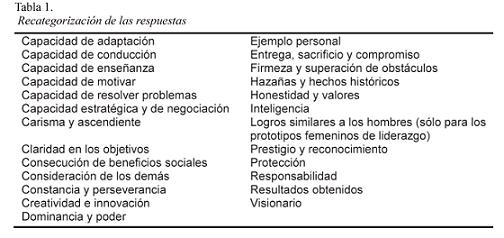
<body><![CDATA[<p class="western"  style="margin: 5pt 36pt 0.0001pt 18pt; text-align: justify; text-indent: 14.2pt; line-height: 150%;"><span  style="font-size: 12pt; line-height: 150%; font-family: Arial;"  lang="ES-UY"><o:p>&nbsp;</o:p></span></p>     <p class="western"  style="margin: 5pt 36pt 0.0001pt 18pt; text-align: justify; text-indent: 14.2pt; line-height: 150%;"><span  style="font-size: 12pt; line-height: 150%; font-family: Arial;"  lang="ES-UY">2. Justificaci&oacute;n. En una pregunta abierta se ped&iacute;a a las personas que describieran con sus palabras, las razones o caracter&iacute;sticas por las cuales consideraban como l&iacute;der al sujeto (var&oacute;n y mujer) nombrado anteriormente. <o:p></o:p></span></p>     <p class="western"  style="margin: 5pt 36pt 0.0001pt 18pt; text-align: justify; text-indent: 14.2pt; line-height: 150%;"><span  style="font-size: 12pt; line-height: 150%; font-family: Arial;"  lang="ES-UY"><o:p>&nbsp;</o:p></span></p>     <p class="western"  style="margin: 5pt 36pt 0.0001pt 18pt; text-align: justify; text-indent: 14.2pt; line-height: 150%;"><span  style="font-size: 12pt; line-height: 150%; font-family: Arial;"  lang="ES-UY">En dicho estudio se gener&oacute; un listado de categor&iacute;as de tipos de l&iacute;der (e.g. l&iacute;der pol&iacute;tico, militar, religioso, etc) y nombres (e.g. Per&oacute;n, Madre Teresa de Calcuta) que constituyen ejemplares de l&iacute;deres efectivos hombres y mujeres. En esa misma investigaci&oacute;n se analizaron las caracter&iacute;sticas que abarcaban dichos prototipos. Para realizar dicho an&aacute;lisis se trabaj&oacute; sobre la segunda parte del instrumento de recolecci&oacute;n de datos (Solicitud de justificaci&oacute;n de la elecci&oacute;n realizada en la primera parte). Se realiz&oacute; un an&aacute;lisis de contenido de las respuestas dadas para l&iacute;deres varones y mujeres, generando veinticinco categor&iacute;as (exclusivas y excluyentes) de caracter&iacute;sticas, de acuerdo a los atributos que eran mencionados con mayor frecuencia.<o:p></o:p></span></p>     <p class="western"  style="margin: 5pt 36pt 0.0001pt 18pt; text-align: justify; text-indent: 14.2pt; line-height: 150%;"><span  style="font-size: 12pt; line-height: 150%; font-family: Arial;"  lang="ES-UY"><o:p>&nbsp;</o:p></span></p>     <p class="western"  style="margin: 5pt 36pt 0.0001pt 18pt; text-align: justify; text-indent: 14.2pt; line-height: 150%;"><span  style="font-size: 12pt; line-height: 150%; font-family: Arial;"  lang="ES-UY">Posteriormente se procedi&oacute; a recategorizar las respuestas asignando la categor&iacute;a que mayormente representara a la respuesta dada por el sujeto. Las categor&iacute;as generadas, se presentan en la <a href="#t1">Tabla 1</a>. <o:p></o:p></span></p>     <p class="western"  style="margin: 5pt 36pt 0.0001pt 18pt; text-align: justify; text-indent: 14.2pt; line-height: 150%;"><span  style="font-size: 12pt; line-height: 150%; font-family: Arial;"  lang="ES-UY"><o:p>&nbsp;</o:p></span></p>     <p class="western"  style="margin: 5pt 36pt 0.0001pt 18pt; text-align: justify; text-indent: 14.2pt; line-height: 150%;"><a  name="t1"></a><span  style="font-size: 12pt; line-height: 150%; font-family: Arial;"  lang="ES-UY"><img id="_x0000_i1025"  src="../../../../../img/revistas/cp/v5n2/2a02t1.jpg"  style="border-style: solid; border-width: 0px; height: 193px; width: 408px;"  name="1 Imagen" border="0" height="32" width="32"><o:p></o:p></span></p>     <p class="western"  style="margin: 5pt 36pt 0.0001pt 18pt; text-align: justify; text-indent: 14.2pt; line-height: 150%;"><span  style="font-size: 12pt; line-height: 150%; font-family: Arial;"  lang="ES-UY"><o:p>&nbsp;</o:p></span></p>     <p class="western"  style="margin: 5pt 36pt 0.0001pt 18pt; text-align: justify; text-indent: 14.2pt; line-height: 150%;"><span  style="font-size: 12pt; line-height: 150%; font-family: Arial;"  lang="ES-UY">Para la presente investigaci&oacute;n se tomaron 23 de las caracter&iacute;sticas listadas (se elimin&oacute; &ldquo;Logros similares a los hombres&rdquo; ya que es una categor&iacute;a exclusiva del liderazgo femenino, y &ldquo;Haza&ntilde;as y hechos hist&oacute;ricos&rdquo; porque resultaba no aplicable a los prop&oacute;sitos de indagaci&oacute;n de este estudio).<o:p></o:p></span></p>     ]]></body>
<body><![CDATA[<p class="western"  style="margin: 5pt 36pt 0.0001pt 18pt; text-align: justify; text-indent: 14.2pt; line-height: 150%;"><span  style="font-size: 12pt; line-height: 150%; font-family: Arial;"  lang="ES-UY"><o:p>&nbsp;</o:p></span></p>     <p class="western"  style="margin: 5pt 36pt 0.0001pt 18pt; text-align: justify; text-indent: 14.2pt; line-height: 150%;"><span  style="font-size: 12pt; line-height: 150%; font-family: Arial;"  lang="ES-UY">Se dise&ntilde;aron seis protocolos. Tres de ellos solicitaban al participante que pensara en una mujer que ocupara un puesto jer&aacute;rquico y que marcara en una escala de 1 a 7 el grado en el que cree que debe predominar cada una de las 23 caracter&iacute;sticas listadas para ser considerada una l&iacute;der efectiva. Se le ped&iacute;a que esa elecci&oacute;n la hiciera pensando en tres &aacute;mbitos de desempe&ntilde;o: un protocolo indagaba sobre el desempe&ntilde;o en el &aacute;mbito empresarial, otro en el &aacute;mbito pol&iacute;tico y el &uacute;ltimo en el &aacute;mbito acad&eacute;mico. Los otros tres protocolos presentaban la misma consigna pero se le ped&iacute;a al participante que pensara en un l&iacute;der hombre. Para la recolecci&oacute;n de datos se pidi&oacute; a la mitad de los participantes que contestaran a los tres protocolos que indagaban sobre la l&iacute;der mujer (Forma Mujer) y, a la otra mitad, sobre el l&iacute;der hombre (Forma Hombre).<o:p></o:p></span></p>     <p class="western"  style="margin: 5pt 36pt 0.0001pt 18pt; text-align: justify; text-indent: 14.2pt; line-height: 150%;"><span  style="font-size: 12pt; line-height: 150%; font-family: Arial;"  lang="ES-UY"><o:p>&nbsp;</o:p></span></p>     <p class="western"  style="margin: 5pt 36pt 0.0001pt 18pt; text-align: justify; text-indent: 14.2pt; line-height: 150%;"><span  style="font-size: 12pt; line-height: 150%; font-family: Arial;"  lang="ES-UY"><o:p>&nbsp;</o:p></span></p>     <p class="western"  style="margin: 5pt 36pt 0.0001pt 18pt; text-align: center; line-height: 150%;"  align="center"><b><span  style="font-size: 12pt; line-height: 150%; font-family: Arial;"  lang="ES-UY">5. Procedimiento</span></b><span  style="font-size: 12pt; line-height: 150%; font-family: Arial;"  lang="ES-UY"><o:p></o:p></span></p>     <p class="western"  style="margin: 5pt 36pt 0.0001pt 18pt; text-align: justify; text-indent: 14.2pt; line-height: 150%;"><span  style="font-size: 12pt; line-height: 150%; font-family: Arial;"  lang="ES-UY">Los instrumentos formaban parte de una bater&iacute;a de pruebas m&aacute;s amplia que se administr&oacute; con el prop&oacute;sito de obtener informaci&oacute;n acerca de teor&iacute;as impl&iacute;citas, creencias y actitudes acerca del liderazgo femenino y masculino. Las otras pruebas administradas fueron: CEALM -Escala de creencias estereotipadas acerca de mujeres l&iacute;deres - (Moore, Grunberg &amp; Greenberg, 2003); ACT- ML - Escala de actitudes hacia las mujeres l&iacute;deres - (<a href="#Lupano1">Lupano Perugini &amp; Castro Solano</a>, 2010).<o:p></o:p></span></p>     <p class="western"  style="margin: 5pt 36pt 0.0001pt 18pt; text-align: justify; text-indent: 14.2pt; line-height: 150%;"><span  style="font-size: 12pt; line-height: 150%; font-family: Arial;"  lang="ES-UY"><o:p>&nbsp;</o:p></span></p>     <p class="western"  style="margin: 5pt 36pt 0.0001pt 18pt; text-align: justify; text-indent: 14.2pt; line-height: 150%;"><span  style="font-size: 12pt; line-height: 150%; font-family: Arial;"  lang="ES-UY">Las tareas de supervisi&oacute;n de recolecci&oacute;n y entrada de datos estuvieron a cargo de un becario. El an&aacute;lisis de los datos se efectu&oacute; con el procesador SPSS versi&oacute;n 13.0. <o:p></o:p></span></p>     <p class="western"  style="margin: 5pt 36pt 0.0001pt 18pt; text-align: justify; text-indent: 14.2pt; line-height: 150%;"><span  style="font-size: 12pt; line-height: 150%; font-family: Arial;"  lang="ES-UY"><o:p>&nbsp;</o:p></span></p>     <p class="western"  style="margin: 5pt 36pt 0.0001pt 18pt; text-align: center; line-height: 150%;"  align="center"><b><span  style="font-size: 12pt; line-height: 150%; font-family: Arial;"  lang="ES-UY">6. Resultados</span></b><span  style="font-size: 12pt; line-height: 150%; font-family: Arial;"  lang="ES-UY"><o:p></o:p></span></p>     ]]></body>
<body><![CDATA[<p class="western"  style="margin: 5pt 36pt 0.0001pt 18pt; text-align: justify; text-indent: 14.2pt; line-height: 150%;"><span  style="font-size: 12pt; line-height: 150%; font-family: Arial;"  lang="ES-UY">Analizando los objetivos planteados, los resultados en cada caso son:<o:p></o:p></span></p>     <p class="western"  style="margin: 5pt 36pt 0.0001pt 18pt; text-align: justify; text-indent: 14.2pt; line-height: 150%;"><b><span  style="font-size: 12pt; line-height: 150%; font-family: Arial;"  lang="ES-UY">Diferencias en las teor&iacute;as impl&iacute;citas acerca del liderazgo masculino y femenino seg&uacute;n &aacute;mbito de desempe&ntilde;o (empresarial, acad&eacute;mico y pol&iacute;tico).</span></b><span  style="font-size: 12pt; line-height: 150%; font-family: Arial;"  lang="ES-UY"><o:p></o:p></span></p>     <p class="western"  style="margin: 5pt 36pt 0.0001pt 18pt; text-align: justify; text-indent: 14.2pt; line-height: 150%;"><span  style="font-size: 12pt; line-height: 150%; font-family: Arial;"  lang="ES-UY"><o:p>&nbsp;</o:p></span></p>     <p class="western"  style="margin: 5pt 36pt 0.0001pt 18pt; text-align: justify; text-indent: 14.2pt; line-height: 150%;"><span  style="font-size: 12pt; line-height: 150%; font-family: Arial;"  lang="ES-UY">A fin de responder al primer objetivo que se propone verificar la existencia de diferencias estad&iacute;sticamente significativas en las teor&iacute;as impl&iacute;citas acerca del liderazgo masculino y femenino seg&uacute;n &aacute;mbito de desempe&ntilde;o (empresarial, acad&eacute;mico y pol&iacute;tico), se llev&oacute; a cabo un an&aacute;lisis multivariado de la varianza (MANOVA) con un dise&ntilde;o 2 (Forma TILs = Forma Mujer o Forma Hombre) x 3 (&Aacute;mbito = empresarial, acad&eacute;mico y pol&iacute;tico).<o:p></o:p></span></p>     <p class="western"  style="margin: 5pt 36pt 0.0001pt 18pt; text-align: justify; text-indent: 14.2pt; line-height: 150%;"><span  style="font-size: 12pt; line-height: 150%; font-family: Arial;"  lang="ES-UY"><o:p>&nbsp;</o:p></span></p>     <p class="western"  style="margin: 5pt 36pt 0.0001pt 18pt; text-align: justify; text-indent: 14.2pt; line-height: 150%;"><span  style="font-size: 12pt; line-height: 150%; font-family: Arial;"  lang="ES-UY">En cuanto a la influencia del &Aacute;mbito, el an&aacute;lisis realizado arroj&oacute; diferencias estad&iacute;sticamente significativas entre los vectores de medias de las TILs para los diferentes contextos (&lambda; = 0.40, F (46, 2590) = 32.39, p &lt; 0.001, &eta; = 0.36). Por lo tanto el contraste de las medias arroja diferencias en la mayor&iacute;a de las TILs. Siguiendo las indicaciones de <a href="#Cohen">Cohen</a> (1991) para la interpretaci&oacute;n del tama&ntilde;o del efecto del contraste multivariado implementado podemos considerar la magnitud de estas diferencias como amplia. <o:p></o:p></span></p>     <p class="western"  style="margin: 5pt 36pt 0.0001pt 18pt; text-align: justify; text-indent: 14.2pt; line-height: 150%;"><span  style="font-size: 12pt; line-height: 150%; font-family: Arial;"  lang="ES-UY">El an&aacute;lisis no arroj&oacute; diferencias estad&iacute;sticamente significativas entre los vectores de medias de las TILs teniendo en cuenta la Forma (&lambda; = 0.97, F (23, 1295) = 1.25, p &gt; 0.05, &eta; = 0.02). Por lo tanto puede afirmarse que las TILs se mantienen estables y no se ven afectadas por la variable Forma, es decir que no difieren seg&uacute;n refieran al liderazgo masculino o femenino.<o:p></o:p></span></p>     <p class="western"  style="margin: 5pt 36pt 0.0001pt 18pt; text-align: justify; text-indent: 14.2pt; line-height: 150%;"><span  style="font-size: 12pt; line-height: 150%; font-family: Arial;"  lang="ES-UY"><o:p>&nbsp;</o:p></span></p>     <p class="western"  style="margin: 5pt 36pt 0.0001pt 18pt; text-align: justify; text-indent: 14.2pt; line-height: 150%;"><span  style="font-size: 12pt; line-height: 150%; font-family: Arial;"  lang="ES-UY">No se observ&oacute; interacci&oacute;n entre el &Aacute;mbito y la Forma (&lambda; = 0.97, F (46, 2590) = 0.64, p &gt; 0.05, &eta; = 0.01). Por lo tanto no existen diferencias en las TILs considerando la Forma (TILs acerca del liderazgo masculino o femenino) y el &Aacute;mbito (empresarial, acad&eacute;mico y pol&iacute;tico) tomados en forma conjunta.<o:p></o:p></span></p>     <p class="western"  style="margin: 5pt 36pt 0.0001pt 18pt; text-align: justify; text-indent: 14.2pt; line-height: 150%;"><span  style="font-size: 12pt; line-height: 150%; font-family: Arial;"  lang="ES-UY"><o:p>&nbsp;</o:p></span></p>     ]]></body>
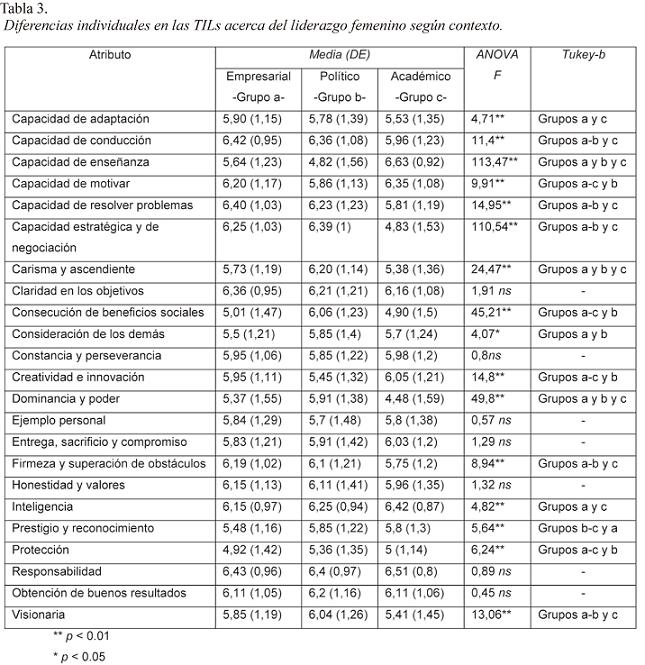
<body><![CDATA[<p class="western"  style="margin: 5pt 36pt 0.0001pt 18pt; text-align: justify; text-indent: 14.2pt; line-height: 150%;"><span  style="font-size: 12pt; line-height: 150%; font-family: Arial;"  lang="ES-UY">A fin de examinar las diferencias individuales en las TILs seg&uacute;n contexto se realizaron contrastes univariados registr&aacute;ndose diferencias en la mayor&iacute;a de ellas tal como se muestra en la <a href="../../../../../img/revistas/cp/v5n2/2a02t2.jpg">Tabla 2</a>.<o:p></o:p></span></p>     <p class="western"  style="margin: 5pt 36pt 0.0001pt 18pt; text-align: justify; text-indent: 14.2pt; line-height: 150%;"><span  style="font-size: 12pt; line-height: 150%; font-family: Arial;"  lang="ES-UY"><o:p>&nbsp;</o:p></span></p>     <p class="western"  style="margin: 5pt 36pt 0.0001pt 18pt; text-align: justify; text-indent: 14.2pt; line-height: 150%;"><span  style="font-size: 12pt; line-height: 150%; font-family: Arial;"  lang="ES-UY"><o:p>&nbsp;</o:p></span></p>     <p class="western"  style="margin: 5pt 36pt 0.0001pt 18pt; text-align: justify; text-indent: 14.2pt; line-height: 150%;"><span  style="font-size: 12pt; line-height: 150%; font-family: Arial;"  lang="ES-UY">Puede observarse en la Tabla 2 que determinadas caracter&iacute;sticas resultan m&aacute;s relevantes para los &aacute;mbitos empresariales y pol&iacute;ticos que para los acad&eacute;micos, como ser: capacidad de adaptaci&oacute;n, de conducci&oacute;n, de resolver problemas, estrat&eacute;gica y de negociaci&oacute;n, firmeza y superaci&oacute;n de obst&aacute;culos y ser visionario. En cambio, en el acad&eacute;mico, se destacan las cualidades de capacidad de ense&ntilde;anza, inteligencia y de entrega, sacrificio y compromiso (comparado especialmente con el &aacute;mbito empresarial). En la empresa parece ser menos influyente el prestigio y reconocimiento (comparando con los otros &aacute;mbitos). En la pol&iacute;tica resulta relevante el carisma y ascendiente, la protecci&oacute;n, la consideraci&oacute;n de los dem&aacute;s, la consecuci&oacute;n de beneficios sociales, y la dominancia y poder. En cambio parece ser menos importante la capacidad de motivar y la creatividad e innovaci&oacute;n (comparando con los otros &aacute;mbitos).<o:p></o:p></span></p>     <p class="western"  style="margin: 5pt 36pt 0.0001pt 18pt; text-align: justify; text-indent: 14.2pt; line-height: 150%;"><span  style="font-size: 12pt; line-height: 150%; font-family: Arial;"  lang="ES-UY"><o:p>&nbsp;</o:p></span></p>     <p class="western"  style="margin: 5pt 36pt 0.0001pt 18pt; text-align: justify; text-indent: 14.2pt; line-height: 150%;"><b><span  style="font-size: 12pt; line-height: 150%; font-family: Arial;"  lang="ES-UY">Diferencias seg&uacute;n &aacute;mbito de desempe&ntilde;o (empresarial, acad&eacute;mico y pol&iacute;tico) y, sexo de quien responde, para el caso de las teor&iacute;as impl&iacute;citas acerca del liderazgo femenino.</span></b><span  style="font-size: 12pt; line-height: 150%; font-family: Arial;"  lang="ES-UY"><o:p></o:p></span></p>     <p class="western"  style="margin: 5pt 36pt 0.0001pt 18pt; text-align: justify; text-indent: 14.2pt; line-height: 150%;"><span  style="font-size: 12pt; line-height: 150%; font-family: Arial;"  lang="ES-UY"><o:p>&nbsp;</o:p></span></p>     <p class="western"  style="margin: 5pt 36pt 0.0001pt 18pt; text-align: justify; text-indent: 14.2pt; line-height: 150%;"><span  style="font-size: 12pt; line-height: 150%; font-family: Arial;"  lang="ES-UY">A fin de responder al segundo objetivo que se propone verificar la existencia de diferencias seg&uacute;n &aacute;mbito de desempe&ntilde;o (empresarial, acad&eacute;mico y pol&iacute;tico) y, adem&aacute;s, seg&uacute;n sexo de quien responde, para el caso de las teor&iacute;as impl&iacute;citas acerca del liderazgo femenino, se llev&oacute; a cabo un an&aacute;lisis multivariado de la varianza (MANOVA) con un dise&ntilde;o 2 (Sexo = mujer o var&oacute;n) x 3 (&Aacute;mbito = empresarial, acad&eacute;mico y pol&iacute;tico).<o:p></o:p></span></p>     <p class="western"  style="margin: 5pt 36pt 0.0001pt 18pt; text-align: justify; text-indent: 14.2pt; line-height: 150%;"><span  style="font-size: 12pt; line-height: 150%; font-family: Arial;"  lang="ES-UY"><o:p>&nbsp;</o:p></span></p>     <p class="western"  style="margin: 5pt 36pt 0.0001pt 18pt; text-align: justify; text-indent: 14.2pt; line-height: 150%;"><span  style="font-size: 12pt; line-height: 150%; font-family: Arial;"  lang="ES-UY">En cuanto a la influencia del &Aacute;mbito, el an&aacute;lisis realizado arroj&oacute; diferencias estad&iacute;sticamente significativas entre los vectores de medias de las TILs para los diferentes contextos (&lambda; = 0.39, F (46, 1264) = 16,54, p &lt; 0.001, &eta; = 0.37). Por lo tanto el contraste de las medias arroja diferencias en la mayor&iacute;a de las TILs. Siguiendo las indicaciones de <a href="#Cohen">Cohen</a> (1991) para la interpretaci&oacute;n del tama&ntilde;o del efecto del contraste multivariado implementado podemos considerar la magnitud de estas diferencias como amplia. <o:p></o:p></span></p>     ]]></body>
<body><![CDATA[<p class="western"  style="margin: 5pt 36pt 0.0001pt 18pt; text-align: justify; text-indent: 14.2pt; line-height: 150%;"><span  style="font-size: 12pt; line-height: 150%; font-family: Arial;"  lang="ES-UY"><o:p>&nbsp;</o:p></span></p>     <p class="western"  style="margin: 5pt 36pt 0.0001pt 18pt; text-align: justify; text-indent: 14.2pt; line-height: 150%;"><span  style="font-size: 12pt; line-height: 150%; font-family: Arial;"  lang="ES-UY">El an&aacute;lisis, tambi&eacute;n arroj&oacute; diferencias estad&iacute;sticamente significativas entre los vectores de medias de las TILs teniendo en cuenta el sexo de quien responde (&lambda; = 0.93, F (23, 632) = 1.98, p &gt; 0.05, &eta; = 0.06). Por lo tanto puede afirmarse que las TILs difieren seg&uacute;n el perceptor sea una mujer o un hombre, aunque las diferencias son consideradas peque&ntilde;as.<o:p></o:p></span></p>     <p class="western"  style="margin: 5pt 36pt 0.0001pt 18pt; text-align: justify; text-indent: 14.2pt; line-height: 150%;"><span  style="font-size: 12pt; line-height: 150%; font-family: Arial;"  lang="ES-UY"><o:p>&nbsp;</o:p></span></p>     <p class="western"  style="margin: 5pt 36pt 0.0001pt 18pt; text-align: justify; text-indent: 14.2pt; line-height: 150%;"><span  style="font-size: 12pt; line-height: 150%; font-family: Arial;"  lang="ES-UY">No se observ&oacute; interacci&oacute;n entre el &Aacute;mbito y el Sexo (&lambda; = 0.92, F (46, 1264) = 1.02, p &gt; 0.05, &eta; = 0.03). Por lo tanto no existen diferencias en las TILs considerando el &Aacute;mbito (empresarial, acad&eacute;mico y pol&iacute;tico) y el sexo del perceptor, tomados en forma conjunta.<o:p></o:p></span></p>     <p class="western"  style="margin: 5pt 36pt 0.0001pt 18pt; text-align: justify; text-indent: 14.2pt; line-height: 150%;"><span  style="font-size: 12pt; line-height: 150%; font-family: Arial;"  lang="ES-UY"><o:p>&nbsp;</o:p></span></p>     <p class="western"  style="margin: 5pt 36pt 0.0001pt 18pt; text-align: justify; text-indent: 14.2pt; line-height: 150%;"><span  style="font-size: 12pt; line-height: 150%; font-family: Arial;"  lang="ES-UY">A fin de examinar las diferencias individuales en las TILs acerca del liderazgo femenino seg&uacute;n contexto se realizaron contrastes univariados registr&aacute;ndose diferencias en la mayor&iacute;a de ellas tal como se muestra en la <a  href="../../../../../img/revistas/cp/v5n2/2a02t3.jpg">Tabla 3</a>.<o:p></o:p></span></p>     <p class="western"  style="margin: 5pt 36pt 0.0001pt 18pt; text-align: justify; text-indent: 14.2pt; line-height: 150%;"><span  style="font-size: 12pt; line-height: 150%; font-family: Arial;"  lang="ES-UY"><o:p>&nbsp;</o:p></span></p>     <p class="western"  style="margin: 5pt 36pt 0.0001pt 18pt; text-align: justify; text-indent: 14.2pt; line-height: 150%;"><span  style="font-size: 12pt; line-height: 150%; font-family: Arial;"  lang="ES-UY"><o:p>&nbsp;</o:p></span></p>     <p class="western"  style="margin: 5pt 36pt 0.0001pt 18pt; text-align: justify; text-indent: 14.2pt; line-height: 150%;"><span  style="font-size: 12pt; line-height: 150%; font-family: Arial;"  lang="ES-UY"><o:p>&nbsp;</o:p></span></p>     <p class="western"  style="margin: 5pt 36pt 0.0001pt 18pt; text-align: justify; text-indent: 14.2pt; line-height: 150%;"><span  style="font-size: 12pt; line-height: 150%; font-family: Arial;"  lang="ES-UY">En virtud de que los an&aacute;lisis realizados para el cumplimiento del Objetivo 1 arrojaron que no existen diferencias en las TILs seg&uacute;n la Forma (Forma Mujer o Forma Hombre), las diferencias halladas en las TILs acerca del liderazgo femenino son muy similares a las halladas tomando las TILs en conjunto (Forma Mujer y Forma Hombre). Por lo tanto, se hall&oacute; que determinadas caracter&iacute;sticas resultan m&aacute;s relevantes para los &aacute;mbitos empresariales y pol&iacute;ticos que para los acad&eacute;micos, como por ejemplo: capacidad de adaptaci&oacute;n, de conducci&oacute;n, de resolver problemas, estrat&eacute;gica y de negociaci&oacute;n, firmeza y superaci&oacute;n de obst&aacute;culos y ser visionaria. En el acad&eacute;mico, en cambio, tambi&eacute;n se destacaron las cualidades de capacidad de ense&ntilde;anza e inteligencia. En la empresa tambi&eacute;n result&oacute; ser menos influyente el prestigio y reconocimiento (comparando con los otros &aacute;mbitos). Por &uacute;ltimo, en la pol&iacute;tica tambi&eacute;n result&oacute; relevante el carisma y ascendiente, la consideraci&oacute;n de los dem&aacute;s, protecci&oacute;n, la consecuci&oacute;n de beneficios sociales, y la dominancia y poder. En cambio pareci&oacute; ser menos importante la capacidad de motivar y la creatividad e innovaci&oacute;n (comparando con los otros &aacute;mbitos).<o:p></o:p></span></p>     ]]></body>
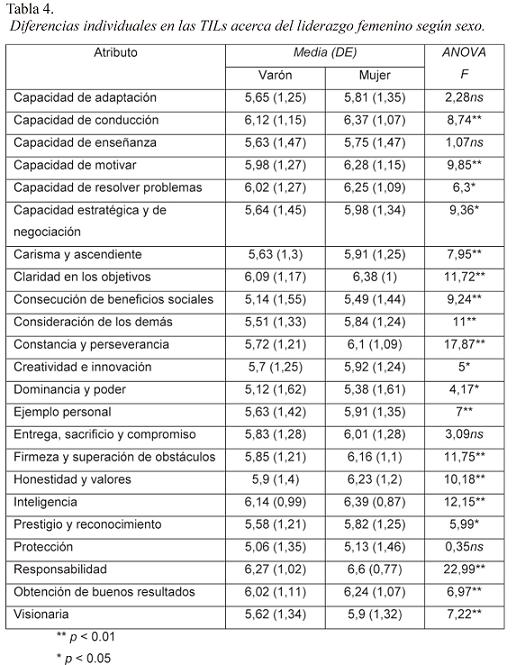
<body><![CDATA[<p class="western"  style="margin: 5pt 36pt 0.0001pt 18pt; text-align: justify; text-indent: 14.2pt; line-height: 150%;"><span  style="font-size: 12pt; line-height: 150%; font-family: Arial;"  lang="ES-UY"><o:p>&nbsp;</o:p></span></p>     <p class="western"  style="margin: 5pt 36pt 0.0001pt 18pt; text-align: justify; text-indent: 14.2pt; line-height: 150%;"><span  style="font-size: 12pt; line-height: 150%; font-family: Arial;"  lang="ES-UY">Por &uacute;ltimo, con la finalidad de examinar las diferencias individuales en las TILs acerca del liderazgo femenino seg&uacute;n sexo, se realizaron contrastes univariados registr&aacute;ndose diferencias en la mayor&iacute;a de ellas tal como se muestra en la <a  href="../../../../../img/revistas/cp/v5n2/2a02t4.jpg">Tabla 4</a>.<o:p></o:p></span></p>     <p class="western"  style="margin: 5pt 36pt 0.0001pt 18pt; text-align: justify; text-indent: 14.2pt; line-height: 150%;"><span  style="font-size: 12pt; line-height: 150%; font-family: Arial;"  lang="ES-UY"><o:p>&nbsp;</o:p></span></p>     <p class="western"  style="margin: 5pt 36pt 0.0001pt 18pt; text-align: justify; text-indent: 14.2pt; line-height: 150%;"><span  style="font-size: 12pt; line-height: 150%; font-family: Arial;"  lang="ES-UY"><o:p>&nbsp;</o:p></span></p>     <p class="western"  style="margin: 5pt 36pt 0.0001pt 18pt; text-align: justify; text-indent: 14.2pt; line-height: 150%;"><span  style="font-size: 12pt; line-height: 150%; font-family: Arial;"  lang="ES-UY">&nbsp;<o:p></o:p></span></p>     <p class="western"  style="margin: 5pt 36pt 0.0001pt 18pt; text-align: justify; text-indent: 14.2pt; line-height: 150%;"><span  style="font-size: 12pt; line-height: 150%; font-family: Arial;"  lang="ES-UY">Los resultados exhibidos en la Tabla 4 muestran que todas las diferencias estad&iacute;sticamente significativas fueron halladas a favor de las mujeres. Es decir que las participantes de esta investigaci&oacute;n consideran que las mujeres l&iacute;deres muestran, en mayor medida que los hombres, casi todos los atributos listados. Llama la atenci&oacute;n que no se hallaron diferencias en aquellos atributos que son t&iacute;picamente femeninos como por ejemplo la protecci&oacute;n, la entrega, sacrificio y compromiso. <o:p></o:p></span></p>     <p class="western"  style="margin: 5pt 36pt 0.0001pt 18pt; text-align: justify; line-height: 150%;"><span  style="font-size: 12pt; line-height: 150%; font-family: Arial;"  lang="ES-UY"><o:p>&nbsp;</o:p></span></p>     <p class="western"  style="margin: 5pt 36pt 0.0001pt 18pt; text-align: center; line-height: 150%;"  align="center"><b><span  style="font-size: 12pt; line-height: 150%; font-family: Arial;"  lang="ES-UY">7. Discusi&oacute;n</span></b><span  style="font-size: 12pt; line-height: 150%; font-family: Arial;"  lang="ES-UY"><o:p></o:p></span></p>     <p class="western"  style="margin: 5pt 36pt 0.0001pt 18pt; text-align: justify; text-indent: 14.2pt; line-height: 150%;"><span  style="font-size: 12pt; line-height: 150%; font-family: Arial;"  lang="ES-UY">Este trabajo presentaba el inter&eacute;s de se&ntilde;alar la importancia del contexto en el ejercicio del liderazgo. Qued&oacute; demostrado que el &aacute;mbito de desempe&ntilde;o determina diferencias significativas en las teor&iacute;as impl&iacute;citas acerca del liderazgo. Sin embargo, los resultados mostraron que no existen diferencias seg&uacute;n el &aacute;mbito de desempe&ntilde;o en cuanto a Prototipos masculinos o femeninos de liderazgo.<o:p></o:p></span></p>     <p class="western"  style="margin: 5pt 36pt 0.0001pt 18pt; text-align: justify; text-indent: 14.2pt; line-height: 150%;"><span  style="font-size: 12pt; line-height: 150%; font-family: Arial;"  lang="ES-UY"><o:p>&nbsp;</o:p></span></p>     ]]></body>
<body><![CDATA[<p class="western"  style="margin: 5pt 36pt 0.0001pt 18pt; text-align: justify; text-indent: 14.2pt; line-height: 150%;"><span  style="font-size: 12pt; line-height: 150%; font-family: Arial;"  lang="ES-UY">Por lo tanto, en relaci&oacute;n con los resultados previos obtenidos (<a href="#Lupano2">Lupano Perugini &amp; Castro Solano</a>, 2008a), puede decirse que existen diferencias entre Prototipos de liderazgo masculinos y femeninos pero, que si se los analiza m&aacute;s espec&iacute;ficamente seg&uacute;n &aacute;mbito de desempe&ntilde;o (empresarial, acad&eacute;mico y pol&iacute;tico), no se hallan discrepancias. Es decir que puede afirmarse que el contexto y la cultura organizacional influyen sobre las TILs de l&iacute;deres y seguidores (<a href="#Castro1">Castro Solano</a>, 2006; <a  href="#House1">House</a> et. al, 1999), pero a nivel general, sin tener en cuenta el sexo del l&iacute;der.<o:p></o:p></span></p>     <p class="western"  style="margin: 5pt 36pt 0.0001pt 18pt; text-align: justify; text-indent: 14.2pt; line-height: 150%;"><span  style="font-size: 12pt; line-height: 150%; font-family: Arial;"  lang="ES-UY"><o:p>&nbsp;</o:p></span></p>     <p class="western"  style="margin: 5pt 36pt 0.0001pt 18pt; text-align: justify; text-indent: 14.2pt; line-height: 150%;"><span  style="font-size: 12pt; line-height: 150%; font-family: Arial;"  lang="ES-UY">Es probable que los l&iacute;deres pongan en pr&aacute;ctica diferentes conductas y estrategias en funci&oacute;n del contexto en el que les toca desempe&ntilde;arse, por lo tanto un estilo de liderazgo puede ser m&aacute;s adaptativo en un contexto que en otro (<a href="#Castro2">Castro Solano &amp; Nader</a>, 2004). Adem&aacute;s, puede afirmarse que la cultura organizacional en donde est&aacute;n insertos tanto seguidores como l&iacute;deres modera e influye sobre la percepci&oacute;n de aquel que tiene que caracterizar a un l&iacute;der efectivo (<a href="#House2">House, Javidan &amp; Dorfman</a>, 2001). <o:p></o:p></span></p>     <p class="western"  style="margin: 5pt 36pt 0.0001pt 18pt; text-align: justify; text-indent: 14.2pt; line-height: 150%;"><span  style="font-size: 12pt; line-height: 150%; font-family: Arial;"  lang="ES-UY"><o:p>&nbsp;</o:p></span></p>     <p class="western"  style="margin: 5pt 36pt 0.0001pt 18pt; text-align: justify; text-indent: 14.2pt; line-height: 150%;"><span  style="font-size: 12pt; line-height: 150%; font-family: Arial;"  lang="ES-UY">En el caso particular de los resultados hallados en la presente investigaci&oacute;n, se encontr&oacute; que las caracter&iacute;sticas que son asignadas a l&iacute;deres efectivos, var&iacute;an seg&uacute;n el lugar d&oacute;nde este se desempe&ntilde;e. Para el caso del &aacute;mbito acad&eacute;mico resultaron poco relevantes atributos relacionados con la capacidad estrat&eacute;gica de negociaci&oacute;n, de resolver problemas o tener visi&oacute;n de futuro. Estas caracter&iacute;sticas resultan mayormente deseables para los &aacute;mbitos pol&iacute;ticos y empresariales. En el entorno educativo, las cualidades que son elegidas para describir a un l&iacute;der eficaz son las relacionadas con el conocimiento, como ser la inteligencia y, tambi&eacute;n, tener la capacidad de transmitir o ense&ntilde;ar. En la pol&iacute;tica se destacan todas aquellas caracter&iacute;sticas que est&aacute;n relacionadas con el bienestar general de la poblaci&oacute;n, como ser la consecuci&oacute;n de beneficios sociales y la consideraci&oacute;n de los dem&aacute;s. Tambi&eacute;n en este &aacute;mbito resulta muy importante la capacidad del l&iacute;der de poder influir sobre otros, por ello de destacan el carisma, la dominancia y el poder del l&iacute;der. Seguramente estos atributos sean valorados en virtud de que en este &aacute;mbito el l&iacute;der debe lograr tener injerencia sobre grandes grupos, siendo menos importante, por ejemplo, la creatividad del dirigente, atributo mucho m&aacute;s valorado en la educaci&oacute;n.<o:p></o:p></span></p>     <p class="western"  style="margin: 5pt 36pt 0.0001pt 18pt; text-align: justify; text-indent: 14.2pt; line-height: 150%;"><span  style="font-size: 12pt; line-height: 150%; font-family: Arial;"  lang="ES-UY"><o:p>&nbsp;</o:p></span></p>     <p class="western"  style="margin: 5pt 36pt 0.0001pt 18pt; text-align: justify; text-indent: 14.2pt; line-height: 150%;"><span  style="font-size: 12pt; line-height: 150%; font-family: Arial;"  lang="ES-UY">El presente trabajo intentaba tambi&eacute;n verificar diferencias seg&uacute;n &aacute;mbito de desempe&ntilde;o y seg&uacute;n sexo de quien responde, para el caso de las teor&iacute;as impl&iacute;citas acerca del liderazgo femenino. Las diferencias halladas para las TILs acerca del liderazgo femenino resultaron ser casi las mismas que para las TILs tomadas en conjunto, ya que no fueron verificadas diferencias seg&uacute;n forma (l&iacute;der var&oacute;n o mujer), tal como se expuso previamente. <o:p></o:p></span></p>     <p class="western"  style="margin: 5pt 36pt 0.0001pt 18pt; text-align: justify; text-indent: 14.2pt; line-height: 150%;"><span  style="font-size: 12pt; line-height: 150%; font-family: Arial;"  lang="ES-UY"><o:p>&nbsp;</o:p></span></p>     <p class="western"  style="margin: 5pt 36pt 0.0001pt 18pt; text-align: justify; text-indent: 14.2pt; line-height: 150%;"><span  style="font-size: 12pt; line-height: 150%; font-family: Arial;"  lang="ES-UY">Se puede ver que el atributo responsabilidad que result&oacute; ser ampliamente valorado en investigaciones previas relacionadas al &aacute;mbito acad&eacute;mico (<a href="#Sanchez">S&aacute;nchez Moreno &amp; L&oacute;pez Y&aacute;&ntilde;ez</a>, 2008), en el presente trabajo no fue una caracter&iacute;stica que generara diferencias entre los &aacute;mbitos, sino que parece ser significativa para todos ellos. En esta investigaci&oacute;n, se destacaron los factores vinculados al conocimiento y a su transmisi&oacute;n y no tanto a las habilidades de gesti&oacute;n (e.g. capacidad de planificaci&oacute;n y organizaci&oacute;n) como en la investigaci&oacute;n citada. En cambio, en la pol&iacute;tica y la empresa, esas capacidades resultaron m&aacute;s deseadas. Para los participantes de esta investigaci&oacute;n, hombres y mujeres no diferir&iacute;an en sus atributos a la hora de liderar -tal como sostiene <a  href="#Genovese">Genovese</a>, 1993-, sino que ambos requerir&iacute;an de cualidades de ascendencia y preocupaci&oacute;n por las causas sociales.<o:p></o:p></span></p>     <p class="western"  style="margin: 5pt 36pt 0.0001pt 18pt; text-align: justify; text-indent: 14.2pt; line-height: 150%;"><span  style="font-size: 12pt; line-height: 150%; font-family: Arial;"  lang="ES-UY"><o:p>&nbsp;</o:p></span></p>     ]]></body>
<body><![CDATA[<p class="western"  style="margin: 5pt 36pt 0.0001pt 18pt; text-align: justify; text-indent: 14.2pt; line-height: 150%;"><span  style="font-size: 12pt; line-height: 150%; font-family: Arial;"  lang="ES-UY">Result&oacute; relevante en este estudio las diferencias halladas seg&uacute;n sexo de quien responde dando cuenta de procesos de categorizaci&oacute;n distintos entre hombres y mujeres. Estas &uacute;ltimas, al ser consultadas por las caracter&iacute;sticas de Prototipos de l&iacute;deres mujeres, asumieron que las l&iacute;deres presentan, en mayor medida, casi todas las caracter&iacute;sticas presentadas. Llam&oacute; la atenci&oacute;n que no se hallaran diferencias en aquellos atributos que son t&iacute;picamente femeninos como por ser la protecci&oacute;n, la entrega, sacrificio y compromiso. Estos resultados indican, como sostienen <a href="#Cuadrado2">Cuadrado, Navas y Molero</a> (2004), que con independencia del sexo del l&iacute;der y del tipo de organizaci&oacute;n, el sexo del evaluador tambi&eacute;n puede tener importancia en ciertas ocasiones.<o:p></o:p></span></p>     <p class="western"  style="margin: 5pt 36pt 0.0001pt 18pt; text-align: justify; text-indent: 14.2pt; line-height: 150%;"><span  style="font-size: 12pt; line-height: 150%; font-family: Arial;"  lang="ES-UY"><o:p>&nbsp;</o:p></span></p>     <p class="western"  style="margin: 5pt 36pt 0.0001pt 18pt; text-align: justify; text-indent: 14.2pt; line-height: 150%;"><span  style="font-size: 12pt; line-height: 150%; font-family: Arial;"  lang="ES-UY">Puede considerarse entonces que, si no existen diferencias en las TILs acerca del liderazgo masculino y femenino seg&uacute;n &aacute;mbito de desempe&ntilde;o, las diferencias entre hombres y mujeres en el acceso a los puestos directivos siga siendo resultado de la existencia de prejuicios. <a href="#DAdamo">D&rsquo;Adamo, Garc&iacute;a Beaudoux, Ferrari y Slavinsky</a> (2008), en su investigaci&oacute;n sobre liderazgo femenino en pol&iacute;tica, encontraron que casi el 60% de los participantes consideraron que entre los votantes existen prejuicios negativos hacia las candidatas mujeres. Muchos contextos organizacionales, especialmente los empresariales, pueden promover, fomentar o permitir determinados estilos de liderazgo o caracter&iacute;sticas que pueden perjudicar a las mujeres l&iacute;deres (<a href="#Cuadrado2">Cuadrado, Navas &amp; Molero</a>, 2004). Es decir, determinados &aacute;mbitos privilegian el poseer cualidades t&iacute;picamente masculinas (como la capacidad estrat&eacute;gica o la dominancia, previamente mencionadas) lo cual favorece el acceso de los hombres a los puestos m&aacute;s altos por no presentar incongruencia entre su rol de l&iacute;der y su rol social, tal como propone la Teor&iacute;a de la congruencia de rol previamente descripta (<a href="#Eagly3">Eagly &amp; Karau</a>, 2002). <o:p></o:p></span></p>     <p class="western"  style="margin: 5pt 36pt 0.0001pt 18pt; text-align: justify; text-indent: 14.2pt; line-height: 150%;"><span  style="font-size: 12pt; line-height: 150%; font-family: Arial;"  lang="ES-UY"><o:p>&nbsp;</o:p></span></p>     <p class="western"  style="margin: 5pt 36pt 0.0001pt 18pt; text-align: justify; text-indent: 14.2pt; line-height: 150%;"><span  style="font-size: 12pt; line-height: 150%; font-family: Arial;"  lang="ES-UY">Futuras investigaciones deber&aacute;n dar cuenta de si existen diferencias en TILs acerca del liderazgo femenino seg&uacute;n el tipo de actividad desarrollada, principalmente en las empresas, ya que trabajos previos (e.g. <a href="#Van">Van Engen, Van der Leeden &amp; Willemsen</a>, 2001; <a href="#Cuadrado2">Cuadrado, Navas &amp; Molero</a>, 2004) mostraron que las mujeres suelen desarrollar un estilo de liderazgo m&aacute;s congruente con el estereotipo femenino cuando se desempe&ntilde;an en empresas con rubros t&iacute;picamente femeninos (e.g. empresas de belleza o dedicadas a la educaci&oacute;n).<o:p></o:p></span></p>     <p class="western"  style="margin: 5pt 36pt 0.0001pt 18pt; text-align: justify; text-indent: 14.2pt; line-height: 150%;"><span  style="font-size: 12pt; line-height: 150%; font-family: Arial;"  lang="ES-UY"><o:p>&nbsp;</o:p></span></p>     <p class="western"  style="margin: 5pt 36pt 0.0001pt 18pt; text-align: justify; text-indent: 14.2pt; line-height: 150%;"><span  style="font-size: 12pt; line-height: 150%; font-family: Arial;"  lang="ES-UY">Tambi&eacute;n deber&iacute;an profundizarse las investigaciones acerca del liderazgo femenino en pol&iacute;tica ya que se evidencia que las caracter&iacute;sticas que suelen ser percibidas en ese &aacute;mbito son una combinatoria de atributos t&iacute;picamente masculinos (e.g. dominancia) y femeninos (e.g. protecci&oacute;n), lo cual resulta congruente con los Prototipos femeninos de liderazgo efectivo (e.g. <a href="#Eagly3">Eagly &amp; Karau</a>, 2002; <a href="#Lupano2">Lupano Perugini &amp; Castro Solano</a>, 2008a). Esto quiz&aacute;s explique la creciente aceptaci&oacute;n, por parte del electorado de candidatas mujeres (<a href="#Carroll">Carroll</a>, 1985; <a href="#Darcy">Darcy, Welch &amp; Clark</a>, 1987; <a href="#DAdamo">D&rsquo;Adamo, Garc&iacute;a Beaudoux, Ferrari &amp; Slavinsky</a>, 2008; <a href="#Eagly4">Eagly &amp; Carli</a>, 2007). Algunos cambios actuales en las organizaciones, como por ejemplo la preferencia de estilos m&aacute;s democr&aacute;ticos de liderazgo pueden favorecer a las mujeres (<a href="#Eagly3">Eagly &amp; Karau</a>, 2002), aunque debe tenerse en cuenta que muchas veces las cualidades t&iacute;picamente femeninas o comunales (como la orientaci&oacute;n hacia otros) pueden ser vistas como ventajas y desventajas simult&aacute;neamente. <a href="#DAdamo">D&rsquo;Adamo, Garc&iacute;a Beaudoux, Ferrari y Slavinsky</a> (2008), hallaron que, por un lado se destaca en las mujeres candidatas sus habilidades interpersonales y de empat&iacute;a, aunque tambi&eacute;n se las ve como d&eacute;biles o pasivas, en comparaci&oacute;n con los hombres. Deber&iacute;a profundizarse el an&aacute;lisis de estas cuestiones referentes a los fen&oacute;menos de percepci&oacute;n del liderazgo femenino.<o:p></o:p></span></p>     <p class="western"  style="margin: 5pt 36pt 0.0001pt 18pt; text-align: justify; line-height: 150%;"><span  style="font-size: 12pt; line-height: 150%; font-family: Arial;"  lang="ES-UY"><o:p>&nbsp;</o:p></span></p>     <p class="western"  style="margin: 5pt 36pt 0.0001pt 18pt; text-align: center; line-height: 120%;"  align="center"><b><span  style="font-size: 12pt; line-height: 120%; font-family: Arial;"  lang="ES-UY">8. Referencias</span></b><span  style="font-size: 12pt; line-height: 120%; font-family: Arial;"  lang="ES-UY"><o:p></o:p></span></p>     <!-- ref --><p class="western"  style="margin: 14.2pt 36pt 0.0001pt 27pt; text-align: justify; text-indent: -21.25pt; line-height: 150%;"><a  name="Benze"></a><span  style="font-size: 12pt; line-height: 150%; font-family: Arial;"  lang="EN-GB">Benze, J. J. &amp; Declerq, E. R. (1985). </span><span  style="font-size: 12pt; line-height: 150%; font-family: Arial;"  lang="EN-US">Content of television spot and female candidates. Journalism Quarterly, 62, 278-283.    </span><span  style="font-size: 12pt; line-height: 150%; font-family: Arial;"  lang="EN-GB"><o:p></o:p></span></p>     <!-- ref --><p class="western"  style="margin: 5pt 36pt 0.0001pt 27pt; text-align: justify; text-indent: -21.25pt; line-height: 150%;"><a  name="Butler"></a><st1:place w:st="on"><st1:city w:st="on"><span  style="font-size: 12pt; line-height: 150%; font-family: Arial;"  lang="EN-US">Butler</span></st1:city></st1:place><span  style="font-size: 12pt; line-height: 150%; font-family: Arial;"  lang="EN-US">, D &amp; Geis, F. L. (1990). Nonverbal affect responses to male and female leaders: Implications for leadership evaluations. </span><span  style="font-size: 12pt; line-height: 150%; font-family: Arial;">Journal of Personality and Social Psychology, 58, 48-59.    <o:p></o:p></span></p>     <!-- ref --><p class="western"  style="margin: 5pt 36pt 0.0001pt 27pt; text-align: justify; text-indent: -21.25pt; line-height: 150%;"><a  name="Calvo"></a><span  style="font-size: 12pt; line-height: 150%; font-family: Arial;">Calvo, P. (2006, 20 de agosto). </span><span  style="font-size: 12pt; line-height: 150%; font-family: Arial;"  lang="ES-UY">Ellas avanzan, pero faltan 30 a&ntilde;os para la igualdad. Clar&iacute;n, pp. 32-34.    <o:p></o:p></span></p>     <!-- ref --><p class="western"  style="margin: 5pt 36pt 0.0001pt 27pt; text-align: justify; text-indent: -21.25pt; line-height: 150%;"><a  name="Casas"></a><span  style="font-size: 12pt; line-height: 150%; font-family: Arial;"  lang="ES-UY">Casas, X. (2010). Hay m&aacute;s jefas pero pocas llegan a ser CEO. Recuperado el 21 de marzo de 2011 <a  href="http://www.iae.edu.ar/iaehoy/Documents/NG_20100308_Cronista_Debeljuh_MujeresLideres.pdf">http://www.iae.edu.ar/iaehoy/Documents/NG_20100308_Cronista_Debeljuh_MujeresLideres.pdf</a><o:p></o:p></span><!-- ref --><p class="western"  style="margin: 5pt 36pt 0.0001pt 27pt; text-align: justify; text-indent: -21.25pt; line-height: 150%;"><a  name="Castro1"></a><span  style="font-size: 12pt; line-height: 150%; font-family: Arial;"  lang="ES-UY">Castro Solano, A. (2006). Teor&iacute;as impl&iacute;citas del liderazgo, contexto y capacidad de conducci&oacute;n. Anales de psicolog&iacute;a, 22 (1), 89-97.     <o:p></o:p></span></p>     <!-- ref --><p class="western"  style="margin: 5pt 36pt 0.0001pt 27pt; text-align: justify; text-indent: -21.25pt; line-height: 150%;"><a  name="Castro2"></a><span  style="font-size: 12pt; line-height: 150%; font-family: Arial;"  lang="ES-UY">Castro Solano, A. &amp; Nader, M. (2004). Estilos de liderazgo, contexto y cultura organizacional percibida. Un estudio comparativo en poblaci&oacute;n civil y militar. Bolet&iacute;n de Psicolog&iacute;a, 82, 45-63.    <o:p></o:p></span></p>     ]]></body>
<body><![CDATA[<!-- ref --><p class="western"  style="margin: 5pt 36pt 0.0001pt 27pt; text-align: justify; text-indent: -21.25pt; line-height: 150%;"><a  name="Castro3"></a><span  style="font-size: 12pt; line-height: 150%; font-family: Arial;"  lang="ES-UY">Castro Solano, A. &amp; Lupano Perugini, M.L. (2005). Diferencias individuales en las teor&iacute;as impl&iacute;citas del liderazgo y la cultura organizacional percibida. </span><span  style="font-size: 12pt; line-height: 150%; font-family: Arial;"  lang="EN-US">Bolet&iacute;n de Psicolog&iacute;a, 85, 89-109.    </span><span  style="font-size: 12pt; line-height: 150%; font-family: Arial;"  lang="EN-GB"><o:p></o:p></span></p>     <!-- ref --><p class="western"  style="margin: 5pt 36pt 0.0001pt 27pt; text-align: justify; text-indent: -21.25pt; line-height: 150%;"><a  name="Carroll"></a><span  style="font-size: 12pt; line-height: 150%; font-family: Arial;"  lang="EN-US">Carroll, S. J. (1985). Women as Candidate in American Politics. <st1:city w:st="on"><st1:place w:st="on">Bloomington</st1:place></st1:city>: <st1:place w:st="on"><st1:placename w:st="on">Indiana</st1:placename> <st1:placetype  w:st="on">University</st1:placetype></st1:place> Press.    </span><span  style="font-size: 12pt; line-height: 150%; font-family: Arial;"  lang="EN-GB"><o:p></o:p></span></p>     <!-- ref --><p class="western"  style="margin: 5pt 36pt 0.0001pt 27pt; text-align: justify; text-indent: -21.25pt; line-height: 150%;"><a  name="Cheung"></a><span  style="font-size: 12pt; line-height: 150%; font-family: Arial;"  lang="EN-US">Cheung, F. &amp; Halpern, D. (2010). Women at the top. Powerful leaders define success as work + family in a culture of gender. American Psychologist, 65 (3), 182-193.    </span><span  style="font-size: 12pt; line-height: 150%; font-family: Arial;"  lang="EN-GB"><o:p></o:p></span></p>     <!-- ref --><p class="western"  style="margin: 5pt 36pt 0.0001pt 27pt; text-align: justify; text-indent: -21.25pt; line-height: 150%;"><a  name="Cohen"></a><span  style="font-size: 12pt; line-height: 150%; font-family: Arial;"  lang="EN-US">Cohen, J. (1991). Statistical Power Analysis for the Behavioral Sciences. </span><span  style="font-size: 12pt; line-height: 150%; font-family: Arial;"  lang="ES-UY">New Jersey: Hillsdale Lawrence Erlbaum Assoc.    <o:p></o:p></span></p>     <!-- ref --><p class="western"  style="margin: 5pt 36pt 0.0001pt 27pt; text-align: justify; text-indent: -21.25pt; line-height: 150%;"><a  name="Cuadrado1"></a><span  style="font-size: 12pt; line-height: 150%; font-family: Arial;"  lang="ES-UY">Cuadrado, I. (2004). Valores y rasgos estereot&iacute;picos de g&eacute;nero de mujeres l&iacute;deres. Psicothema, 16 (2), 270- 275.    <o:p></o:p></span></p>     ]]></body>
<body><![CDATA[<!-- ref --><p class="western"  style="margin: 5pt 36pt 0.0001pt 27pt; text-align: justify; text-indent: -21.25pt; line-height: 150%;"><a  name="Cuadrado2"></a><span  style="font-size: 12pt; line-height: 150%; font-family: Arial;"  lang="ES-UY">Cuadrado, I. Navas, M. &amp; Molero, F. (2004). El acceso de las mujeres a puestos directivos: g&eacute;nero, contexto organizacional y estilos de liderazgo. Rev. de Psicol. Gral. y Aplic., 57 (2), 181-192.    <o:p></o:p></span></p>     <!-- ref --><p class="western"  style="margin: 5pt 36pt 0.0001pt 27pt; text-align: justify; text-indent: -21.25pt; line-height: 150%;"><a  name="Cuadrado3"></a><span  style="font-size: 12pt; line-height: 150%; font-family: Arial;"  lang="ES-UY">Cuadrado, I. Navas, M. &amp; Molero, F. (2006). Mujeres y Liderazgo. Claves Psicosociales del Techo de Cristal. Madrid: Sanz y Torres.    <o:p></o:p></span></p>     <p class="western"  style="margin: 5pt 36pt 0.0001pt 27pt; text-align: justify; text-indent: -21.25pt; line-height: 150%;"><a  name="DAdamo"></a><span  style="font-size: 12pt; line-height: 150%; font-family: Arial;"  lang="ES-UY">D&rsquo;Adamo, O., Garc&iacute;a Beaudoux, V., Ferrari, G. &amp; Slavinsky, G. (2008). Mujeres candidatas: percepci&oacute;n p&uacute;blica del liderazgo femenino. Revista de Psicolog&iacute;a Social, 23 (1), 91-104.<o:p></o:p></span></p>     <!-- ref --><p class="western"  style="margin: 5pt 36pt 0.0001pt 27pt; text-align: justify; text-indent: -21.25pt; line-height: 150%;"><a  name="Darcy"></a><span  style="font-size: 12pt; line-height: 150%; font-family: Arial;"  lang="EN-US">Darcy, R.; Welch, S. &amp; Clark, J. (1987). Women, electronics, and representation. Nueva York: Longmans.    </span><span  style="font-size: 12pt; line-height: 150%; font-family: Arial;"  lang="EN-GB"><o:p></o:p></span></p>     <!-- ref --><p class="western"  style="margin: 5pt 36pt 0.0001pt 27pt; text-align: justify; text-indent: -21.25pt; line-height: 150%;"><a  name="Diez"></a><span  style="font-size: 12pt; line-height: 150%; font-family: Arial;"  lang="ES-UY">Diez Gutierrez, E.J.; Terr&oacute;n Ba&ntilde;uelos, E.; Valle Fl&oacute;rez, R.E. &amp; Centeno Su&aacute;rez, B. (2002). Las mujeres y el poder en las organizaciones educativas. Revista Complutense de educaci&oacute;n, 13 (2), 485-513.    <o:p></o:p></span></p>     <!-- ref --><p class="western"  style="margin: 5pt 36pt 0.0001pt 27pt; text-align: justify; text-indent: -21.25pt; line-height: 150%;"><a  name="Druskat"></a><span  style="font-size: 12pt; line-height: 150%; font-family: Arial;"  lang="EN-US">Druskat, V.U (1994). Gender and leadership style: transformational and transactional leadership in the Roman Catholic Church. Leadership Quarterly, 5 (2), 99-119.    </span><span  style="font-size: 12pt; line-height: 150%; font-family: Arial;"  lang="EN-GB"><o:p></o:p></span></p>     <!-- ref --><p class="western"  style="margin: 5pt 36pt 0.0001pt 27pt; text-align: justify; text-indent: -21.25pt; line-height: 150%;"><a  name="Eagly1"></a><span  style="font-size: 12pt; line-height: 150%; font-family: Arial;"  lang="EN-US">Eagly, A. H. (1987). Sex differences in social behaviour: A social- role interpretation. <st1:place w:st="on"><st1:city w:st="on">Hillsdale</st1:city>, <st1:state w:st="on">NJ</st1:state></st1:place>: <st1:city w:st="on"><st1:place  w:st="on">Lawrence</st1:place></st1:city> Erbaum.     <o:p></o:p></span></p>     <!-- ref --><p class="western"  style="margin: 5pt 36pt 0.0001pt 27pt; text-align: justify; text-indent: -21.25pt; line-height: 150%;"><a  name="Eagly2"></a><span  style="font-size: 12pt; line-height: 150%; font-family: Arial;"  lang="EN-US">Eagly, A. H., &amp; Johonson, B. T. (1990). Gender and leadership style: A meta-analysis. Psychological Bulletin, 108, 233-256.    </span><span  style="font-size: 12pt; line-height: 150%; font-family: Arial;"  lang="EN-GB"><o:p></o:p></span></p>     <!-- ref --><p class="western"  style="margin: 5pt 36pt 0.0001pt 27pt; text-align: justify; text-indent: -21.25pt; line-height: 150%;"><a  name="Eagly3"></a><span  style="font-size: 12pt; line-height: 150%; font-family: Arial;"  lang="EN-US">Eagly, A. H. &amp; Karau, S. J., (2002). Role congruity theory of prejudice toward female leaders. Psychological Review, 109, 573- 598.     </span><span  style="font-size: 12pt; line-height: 150%; font-family: Arial;"  lang="EN-GB"><o:p></o:p></span></p>     <!-- ref --><p class="western"  style="margin: 5pt 36pt 0.0001pt 27pt; text-align: justify; text-indent: -21.25pt; line-height: 150%;"><a  name="Eagly4"></a><span  style="font-size: 12pt; line-height: 150%; font-family: Arial;"  lang="EN-US">Eagly, A. H.&amp; Carli L. (2007). Trough the labyrinth. The truth about how women become leaders. <st1:city w:st="on"><st1:place w:st="on">Boston</st1:place></st1:city>: <st1:place w:st="on"><st1:placename w:st="on">Harvard</st1:placename> <st1:placename  w:st="on">Business</st1:placename> <st1:placetype w:st="on">School</st1:placetype></st1:place> Press.    </span><span  style="font-size: 12pt; line-height: 150%; font-family: Arial;"  lang="EN-GB"><o:p></o:p></span></p>     <!-- ref --><p class="western"  style="margin: 5pt 36pt 0.0001pt 27pt; text-align: justify; text-indent: -21.25pt; line-height: 150%;"><a  name="Federal"></a><span  style="font-size: 12pt; line-height: 150%; font-family: Arial;"  lang="EN-US">Federal Glass Ceiling Commission. (1995). Good for business: Making full use of the nation&acute;s human capital: The environment scan: A fact finding report of the Federal Glass Ceiling Commission. <st1:place w:st="on"><st1:city  w:st="on">Washington</st1:city>, <st1:state w:st="on">DC</st1:state></st1:place>: <st1:country-region w:st="on"><st1:place w:st="on">U.S.</st1:place></st1:country-region> Government Printing Office.    </span><span  style="font-size: 12pt; line-height: 150%; font-family: Arial;"  lang="EN-GB"><o:p></o:p></span></p>     <!-- ref --><p class="western"  style="margin: 5pt 36pt 0.0001pt 27pt; text-align: justify; text-indent: -21.25pt; line-height: 150%;"><a  name="Gardiner"></a><span  style="font-size: 12pt; line-height: 150%; font-family: Arial;"  lang="EN-US">Gardiner, M. &amp; Tiggerman, M. (1999). Gender differences in leadership style, job stress, and mental health in male and female dominated industries. Journal of Occupational and Organizational Psychology, 72, 801- 816.    </span><span  style="font-size: 12pt; line-height: 150%; font-family: Arial;"  lang="EN-GB"><o:p></o:p></span></p>     <!-- ref --><p class="western"  style="margin: 5pt 36pt 0.0001pt 27pt; text-align: justify; text-indent: -21.25pt; line-height: 150%;"><a  name="Genovese"></a><span  style="font-size: 12pt; line-height: 150%; font-family: Arial;"  lang="EN-US">Genovese, M. (1993). Women as national leaders. <st1:place  w:st="on"><st1:placename w:st="on">Newbury</st1:placename> <st1:placetype  w:st="on">Park</st1:placetype></st1:place>: Sage.    </span><span  style="font-size: 12pt; line-height: 150%; font-family: Arial;"  lang="EN-GB"><o:p></o:p></span></p>     <!-- ref --><p class="western"  style="margin: 5pt 36pt 0.0001pt 27pt; text-align: justify; text-indent: -21.25pt; line-height: 150%;"><a  name="Glazer"></a><span  style="font-size: 12pt; line-height: 150%; font-family: Arial;"  lang="EN-US">Glazer-Raymo, J. (1999). Shattering the myths. Women in academe. <st1:city w:st="on"><st1:place w:st="on">Baltimore</st1:place></st1:city>: The <st1:place w:st="on"><st1:placename w:st="on">Johns</st1:placename> <st1:placename w:st="on">Hopkins</st1:placename> <st1:placetype  w:st="on">University</st1:placetype></st1:place> Press.    </span><span  style="font-size: 12pt; line-height: 150%; font-family: Arial;"  lang="EN-GB"><o:p></o:p></span></p>     <p class="western"  style="margin: 5pt 36pt 0.0001pt 27pt; text-align: justify; text-indent: -21.25pt; line-height: 150%;"><a  name="House1"></a><span  style="font-size: 12pt; line-height: 150%; font-family: Arial;">House, R. J., Hanges, P. J, Ruiz &ndash;Quintanilla, S. A., Dorfan, P. W., Javidan, M., Dickson, M. et al (1999). </span><span  style="font-size: 12pt; line-height: 150%; font-family: Arial;"  lang="EN-US">Cultural influences on leadership and organisations: Project GLOBE. En W. H. Mobley (Ed.), Advances in global leadership (Vol. 1, pp. 171-233). <st1:place w:st="on"><st1:city w:st="on">Stamford</st1:city>, <st1:state w:st="on">CT</st1:state></st1:place>: JAI Press. </span><span  style="font-size: 12pt; line-height: 150%; font-family: Arial;"  lang="EN-GB"><o:p></o:p></span></p>     <!-- ref --><p class="western"  style="margin: 5pt 36pt 0.0001pt 27pt; text-align: justify; text-indent: -21.25pt; line-height: 150%;"><a  name="House2"></a><span  style="font-size: 12pt; line-height: 150%; font-family: Arial;"  lang="EN-US">House, R.J., Javidan, M. &amp; Dorfman, P.W. (2001). Project GLOBE: An introduction. Applied Psychology: An introduction, 50 (4), 489-505.    </span><span  style="font-size: 12pt; line-height: 150%; font-family: Arial;"  lang="EN-GB"><o:p></o:p></span></p>     ]]></body>
<body><![CDATA[<p class="western"  style="margin: 5pt 36pt 0.0001pt 27pt; text-align: justify; text-indent: -21.25pt; line-height: 150%;"><a  name="Kenney"></a><span  style="font-size: 12pt; line-height: 150%; font-family: Arial;"  lang="EN-US">Kenney, R. A., Schwartz-Kenney, B. M. &amp; Blascovich, J. (1996). Implicit Leadership Theories: Defining leaders described as worthy of influence. Personality and Social Psychology Bulletin, 22, 1128 &ndash; 1142. </span><span  style="font-size: 12pt; line-height: 150%; font-family: Arial;"  lang="EN-GB"><o:p></o:p></span></p>     <!-- ref --><p class="western"  style="margin: 5pt 36pt 0.0001pt 27pt; text-align: justify; text-indent: -21.25pt; line-height: 150%;"><a  name="Lord"></a><span  style="font-size: 12pt; line-height: 150%; font-family: Arial;">Lord, R., Foti, R. &amp; De Vader, C. (1984). </span><span  style="font-size: 12pt; line-height: 150%; font-family: Arial;"  lang="EN-US">A test of leadership categorization theory: Internal structure, information processing and leadership perceptions. Organizational behaviour and Human Performance, 34, 343-378.    </span><span  style="font-size: 12pt; line-height: 150%; font-family: Arial;"  lang="EN-GB"><o:p></o:p></span></p>     <!-- ref --><p class="western"  style="margin: 5pt 36pt 0.0001pt 27pt; text-align: justify; text-indent: -21.25pt; line-height: 150%;"><a  name="Lupano1"></a><span  style="font-size: 12pt; line-height: 150%; font-family: Arial;"  lang="EN-US">Lupano Perugini, M.L. &amp; Castro Solano, A. (2010). </span><span  style="font-size: 12pt; line-height: 150%; font-family: Arial;"  lang="ES-UY">Actitudes desfavorables hacia mujeres l&iacute;deres. Un instrumento para su evaluaci&oacute;n. Manuscrito enviado para su evaluaci&oacute;n.    <o:p></o:p></span></p>     <!-- ref --><p class="western"  style="margin: 5pt 36pt 0.0001pt 27pt; text-align: justify; text-indent: -21.25pt; line-height: 150%;"><a  name="Lupano2"></a><span  style="font-size: 12pt; line-height: 150%; font-family: Arial;"  lang="ES-UY">Lupano Perugini, M.L. &amp; Castro Solano A., (2008a). Liderazgo y g&eacute;nero. Identificaci&oacute;n de Prototipos de liderazgo efectivo. Perspectivas en Psicolog&iacute;a, 5 (1), 69-77.    <o:p></o:p></span></p>     <!-- ref --><p class="western"  style="margin: 5pt 36pt 0.0001pt 27pt; text-align: justify; text-indent: -21.25pt; line-height: 150%;"><a  name="Lupano3"></a><span  style="font-size: 12pt; line-height: 150%; font-family: Arial;"  lang="ES-UY">Lupano Perugini, M.L. &amp; Castro Solano A., (2008b). Prototipos de l&iacute;deres varones y mujeres. Un an&aacute;lisis comparativo seg&uacute;n sexo y puesto ocupado. Acta Psiqui&aacute;trica y Psicol&oacute;gica de Am&eacute;rica Latina, 54 (3), 160-170.     <o:p></o:p></span></p>     <!-- ref --><p class="western"  style="margin: 5pt 36pt 0.0001pt 27pt; text-align: justify; text-indent: -21.25pt; line-height: 150%;"><a  name="Lupano4"></a><span  style="font-size: 12pt; line-height: 150%; font-family: Arial;"  lang="ES-UY">Lupano Perugini, M. L., Castro Solano, A. &amp; Casullo M.M. (2008). Prototipos de liderazgo masculino y femenino en poblaci&oacute;n militar. Revista de Psicolog&iacute;a (PUCP), 25 (2), 195-218.     <o:p></o:p></span></p>     <!-- ref --><p class="western"  style="margin: 5pt 36pt 0.0001pt 27pt; text-align: justify; text-indent: -21.25pt; line-height: 150%;"><a  name="Morales"></a><span  style="font-size: 12pt; line-height: 150%; font-family: Arial;"  lang="ES-UY">Morales, J. F. &amp; Cuadrado, I. (2004). Introducci&oacute;n: Teor&iacute;a de congruencia de rol del prejuicio hacia l&iacute;deres femeninos. Rev. de Psicol. Gral. y Aplic., 57 (2), 135- 146.     <o:p></o:p></span></p>     <!-- ref --><p class="western"  style="margin: 5pt 36pt 0.0001pt 27pt; text-align: justify; text-indent: -21.25pt; line-height: 150%;"><a  name="Morrison"></a><span  style="font-size: 12pt; line-height: 150%; font-family: Arial;"  lang="ES-UY">Morrison, A. M., White, R.P, &amp; Van Velsor, E. (1987). </span><span  style="font-size: 12pt; line-height: 150%; font-family: Arial;"  lang="EN-US">Breaking the glass ceiling: Can women reach the top of America&acute;s largest corporations? <st1:place w:st="on"><st1:city  w:st="on">Reading</st1:city>, <st1:state w:st="on">MA</st1:state></st1:place>: Addison- Wesley.    </span><span  style="font-size: 12pt; line-height: 150%; font-family: Arial;"  lang="EN-GB"><o:p></o:p></span></p>     <!-- ref --><p class="western"  style="margin: 5pt 36pt 0.0001pt 27pt; text-align: justify; text-indent: -21.25pt; line-height: 150%;"><a  name="Sanchez"></a><span  style="font-size: 12pt; line-height: 150%; font-family: Arial;">S&aacute;nchez Moreno, M &amp; L&oacute;pez Y&aacute;&ntilde;ez, J. (2008). </span><span  style="font-size: 12pt; line-height: 150%; font-family: Arial;"  lang="ES-UY">Poder y liderazgo de mujeres responsables de Instituciones Universitarias. </span><span  style="font-size: 12pt; line-height: 150%; font-family: Arial;"  lang="EN-US">Revista Espa&ntilde;ola de Pedagog&iacute;a, LXVI (240), 345-364.    </span><span  style="font-size: 12pt; line-height: 150%; font-family: Arial;"  lang="EN-GB"><o:p></o:p></span></p>     <!-- ref --><p class="western"  style="margin: 5pt 36pt 0.0001pt 27pt; text-align: justify; text-indent: -21.25pt; line-height: 150%;"><a  name="Ridgeway"></a><span  style="font-size: 12pt; line-height: 150%; font-family: Arial;"  lang="EN-US">Ridgeway, C. (2001). Gender, status and leadership. Journal of Social Issues, 57, 637- 655.    </span><span  style="font-size: 12pt; line-height: 150%; font-family: Arial;"  lang="EN-GB"><o:p></o:p></span></p>     <!-- ref --><p class="western"  style="margin: 5pt 36pt 0.0001pt 27pt; text-align: justify; text-indent: -21.25pt; line-height: 150%;"><a  name="Rosener"></a><span  style="font-size: 12pt; line-height: 150%; font-family: Arial;"  lang="EN-US">Rosener, J. B. (1990). Ways women leads. Harvard Business Review, 68, 119-125.    </span><span  style="font-size: 12pt; line-height: 150%; font-family: Arial;"  lang="EN-GB"><o:p></o:p></span></p>     <!-- ref --><p class="western"  style="margin: 5pt 36pt 0.0001pt 27pt; text-align: justify; text-indent: -21.25pt; line-height: 150%;"><a  name="Ropers"></a><span  style="font-size: 12pt; line-height: 150%; font-family: Arial;"  lang="EN-US">Ropers-Huilman, B. (2003). Gendered features in higher education. Critical perspective for change. <st1:state w:st="on"><st1:place  w:st="on">New York</st1:place></st1:state>: <st1:place w:st="on"><st1:placetype  w:st="on">State</st1:placetype> <st1:placetype w:st="on">University</st1:placetype></st1:place> of NY Press.    </span><span  style="font-size: 12pt; line-height: 150%; font-family: Arial;"  lang="EN-GB"><o:p></o:p></span></p>     <!-- ref --><p class="western"  style="margin: 5pt 36pt 0.0001pt 27pt; text-align: justify; text-indent: -21.25pt; line-height: 150%;"><a  name="Uriarte"></a><span  style="font-size: 12pt; line-height: 150%; font-family: Arial;"  lang="ES-UY">Uriarte, E. &amp; Ruiz, C. (1999). Mujeres y hombres en las elites pol&iacute;ticas espa&ntilde;olas: &iquest;Diferencias o similitudes? REIS, 88, 207-232 <o:p></o:p></span><!-- ref --><p class="western"  style="margin: 5pt 36pt 0.0001pt 27pt; text-align: justify; text-indent: -21.25pt; line-height: 150%;"><a  name="Van"></a><span  style="font-size: 12pt; line-height: 150%; font-family: Arial;"  lang="ES-UY">Van Engen, M. L.; Van der Leeden R. &amp; Willemsen, T.M. (2001). </span><span  style="font-size: 12pt; line-height: 150%; font-family: Arial;"  lang="EN-US">Gender, context and leadership styles: A field study. Journal of Occupational and Organizational Psychology, 74, 581-598.     </span><span  style="font-size: 12pt; line-height: 150%; font-family: Arial;"  lang="EN-GB"><o:p></o:p></span></p>     <!-- ref --><p class="western"  style="margin: 5pt 36pt 0.0001pt 27pt; text-align: justify; text-indent: -21.25pt; line-height: 150%;"><a  name="Wofford"></a><span  style="font-size: 12pt; line-height: 150%; font-family: Arial;"  lang="EN-US">Wofford, J., Godwin, V., &amp; Wittington, J. (1998). A field study of a cognitive approach to understanding transformational and transaccional leadership. </span><span  style="font-size: 12pt; line-height: 150%; font-family: Arial;"  lang="ES-UY">Leadership Quaterly. 9(1), 55-84<o:p></o:p></span><p class="western"  style="margin: 5pt 36pt 0.0001pt 18pt; text-align: justify; text-indent: -21.25pt; line-height: 150%;"><span  style="font-size: 12pt; line-height: 150%; font-family: Arial;"  lang="ES-UY"><o:p>&nbsp;</o:p></span></p>     <p  style="margin: 5pt 36pt 0.0001pt 9pt; text-align: justify; line-height: 120%;"><span  style="font-size: 10pt; line-height: 120%; font-family: Arial;"  lang="ES-UY">Para citar este art&iacute;culo: <o:p></o:p></span></p>     <p class="western"  style="margin: 5pt 36pt 0.0001pt 9pt; text-align: justify; line-height: 150%;"><span  style="font-size: 10pt; line-height: 150%; font-family: Arial;"  lang="ES-UY">Lupano Perugino, M. L. &amp; Castro Solano, A. (2011). Teor&iacute;as impl&iacute;citas del liderazgo masculino y femenino seg&uacute;n &aacute;mbito de desempe&ntilde;o. <o:p></o:p></span></p>     ]]></body>
<body><![CDATA[<p class="western"  style="margin: 5pt 36pt 0.0001pt 9pt; text-align: justify; line-height: 150%;"><span  style="font-size: 10pt; line-height: 150%; font-family: Arial;"  lang="ES-UY">Ciencias Psicol&oacute;gicas V (2): 139-150.<o:p></o:p></span></p>     <p class="western"  style="margin: 5pt 36pt 0.0001pt 18pt; text-align: justify; line-height: 150%;"><span  style="font-size: 12pt; line-height: 150%; font-family: Arial;"  lang="ES-UY"><o:p>&nbsp;</o:p></span></p>     <p class="western"  style="margin: 5pt 36pt 0.0001pt 18pt; text-align: justify; line-height: 150%;"><span  style="font-size: 12pt; line-height: 150%; font-family: Arial;"  lang="ES-UY"><o:p>&nbsp;</o:p></span></p>     <p class="western"  style="margin: 5pt 36pt 0.0001pt 18pt; text-align: justify; line-height: 150%;"><span  style="font-size: 12pt; line-height: 150%; font-family: Arial;"  lang="ES-UY"><o:p>&nbsp;</o:p></span></p>     <p class="western"  style="margin: 5pt 36pt 0.0001pt 18pt; text-align: justify; line-height: 150%;"><span  style="font-size: 12pt; line-height: 150%; font-family: Arial;"  lang="ES-UY"><o:p>&nbsp;</o:p></span></p> </div>      ]]></body><back>
<ref-list>
<ref id="B1">
<nlm-citation citation-type="journal">
<person-group person-group-type="author">
<name>
<surname><![CDATA[Benze]]></surname>
<given-names><![CDATA[J. J.]]></given-names>
</name>
<name>
<surname><![CDATA[Declerq]]></surname>
<given-names><![CDATA[E. R.]]></given-names>
</name>
</person-group>
<article-title xml:lang="en"><![CDATA[Content of television spot and female candidates]]></article-title>
<source><![CDATA[Journalism Quarterly]]></source>
<year>1985</year>
<volume>62</volume>
<page-range>278-283</page-range></nlm-citation>
</ref>
<ref id="B2">
<nlm-citation citation-type="journal">
<person-group person-group-type="author">
<name>
<surname><![CDATA[Butler]]></surname>
<given-names><![CDATA[D.]]></given-names>
</name>
<name>
<surname><![CDATA[Geis]]></surname>
<given-names><![CDATA[F. L.]]></given-names>
</name>
</person-group>
<article-title xml:lang="en"><![CDATA[Nonverbal affect responses to male and female leaders: Implications for leadership evaluations]]></article-title>
<source><![CDATA[Journal of Personality and Social Psychology]]></source>
<year>1990</year>
<volume>58</volume>
<page-range>48-59</page-range></nlm-citation>
</ref>
<ref id="B3">
<nlm-citation citation-type="">
<person-group person-group-type="author">
<name>
<surname><![CDATA[Calvo]]></surname>
<given-names><![CDATA[P.]]></given-names>
</name>
</person-group>
<source><![CDATA[Ellas avanzan, pero faltan 30 años para la igualdad]]></source>
<year>2006</year>
<month>, </month>
<day>20</day>
<page-range>32-34</page-range></nlm-citation>
</ref>
<ref id="B4">
<nlm-citation citation-type="">
<person-group person-group-type="author">
<name>
<surname><![CDATA[Casas]]></surname>
<given-names><![CDATA[X]]></given-names>
</name>
</person-group>
<source><![CDATA[Hay más jefas pero pocas llegan a ser CEO]]></source>
<year>2010</year>
</nlm-citation>
</ref>
<ref id="B5">
<nlm-citation citation-type="journal">
<person-group person-group-type="author">
<name>
<surname><![CDATA[Castro Solano]]></surname>
<given-names><![CDATA[A.]]></given-names>
</name>
</person-group>
<article-title xml:lang="es"><![CDATA[Teorías implícitas del liderazgo, contexto y capacidad de conducción]]></article-title>
<source><![CDATA[Anales de psicología]]></source>
<year>2006</year>
<volume>22</volume>
<numero>1</numero>
<issue>1</issue>
<page-range>89-97</page-range></nlm-citation>
</ref>
<ref id="B6">
<nlm-citation citation-type="journal">
<person-group person-group-type="author">
<name>
<surname><![CDATA[Castro Solano]]></surname>
<given-names><![CDATA[A.]]></given-names>
</name>
<name>
<surname><![CDATA[Nader]]></surname>
<given-names><![CDATA[M.]]></given-names>
</name>
</person-group>
<article-title xml:lang="es"><![CDATA[Estilos de liderazgo, contexto y cultura organizacional percibida: Un estudio comparativo en población civil y militar]]></article-title>
<source><![CDATA[Boletín de Psicología]]></source>
<year>2004</year>
<volume>82</volume>
<page-range>45-63</page-range></nlm-citation>
</ref>
<ref id="B7">
<nlm-citation citation-type="journal">
<person-group person-group-type="author">
<name>
<surname><![CDATA[Castro Solano]]></surname>
<given-names><![CDATA[A.]]></given-names>
</name>
<name>
<surname><![CDATA[Lupano Perugini]]></surname>
<given-names><![CDATA[M.L.]]></given-names>
</name>
</person-group>
<article-title xml:lang="es"><![CDATA[Diferencias individuales en las teorías implícitas del liderazgo y la cultura organizacional percibida]]></article-title>
<source><![CDATA[Boletín de Psicología]]></source>
<year>2005</year>
<volume>85</volume>
<page-range>89-109</page-range></nlm-citation>
</ref>
<ref id="B8">
<nlm-citation citation-type="book">
<person-group person-group-type="author">
<name>
<surname><![CDATA[Carroll]]></surname>
<given-names><![CDATA[S. J.]]></given-names>
</name>
</person-group>
<source><![CDATA[Women as Candidate in American Politics]]></source>
<year>1985</year>
<publisher-loc><![CDATA[Bloomington ]]></publisher-loc>
<publisher-name><![CDATA[Indiana University Press]]></publisher-name>
</nlm-citation>
</ref>
<ref id="B9">
<nlm-citation citation-type="journal">
<person-group person-group-type="author">
<name>
<surname><![CDATA[Cheung]]></surname>
<given-names><![CDATA[F.]]></given-names>
</name>
<name>
<surname><![CDATA[Halpern]]></surname>
<given-names><![CDATA[D.]]></given-names>
</name>
</person-group>
<article-title xml:lang="en"><![CDATA[Women at the top: Powerful leaders define success as work + family in a culture of gender]]></article-title>
<source><![CDATA[American Psychologist]]></source>
<year>2010</year>
<volume>65</volume>
<numero>3</numero>
<issue>3</issue>
<page-range>182-193</page-range></nlm-citation>
</ref>
<ref id="B10">
<nlm-citation citation-type="book">
<person-group person-group-type="author">
<name>
<surname><![CDATA[Cohen]]></surname>
<given-names><![CDATA[J.]]></given-names>
</name>
</person-group>
<source><![CDATA[Statistical Power Analysis for the Behavioral Sciences]]></source>
<year>1991</year>
<publisher-loc><![CDATA[New Jersey ]]></publisher-loc>
<publisher-name><![CDATA[Hillsdale Lawrence Erlbaum Assoc]]></publisher-name>
</nlm-citation>
</ref>
<ref id="B11">
<nlm-citation citation-type="journal">
<person-group person-group-type="author">
<name>
<surname><![CDATA[Cuadrado]]></surname>
<given-names><![CDATA[I.]]></given-names>
</name>
</person-group>
<article-title xml:lang="es"><![CDATA[Valores y rasgos estereotípicos de género de mujeres líderes]]></article-title>
<source><![CDATA[Psicothema]]></source>
<year>2004</year>
<volume>16</volume>
<numero>2</numero>
<issue>2</issue>
<page-range>270- 275</page-range></nlm-citation>
</ref>
<ref id="B12">
<nlm-citation citation-type="journal">
<person-group person-group-type="author">
<name>
<surname><![CDATA[Cuadrado]]></surname>
<given-names><![CDATA[I]]></given-names>
</name>
<name>
<surname><![CDATA[Navas]]></surname>
<given-names><![CDATA[M]]></given-names>
</name>
<name>
<surname><![CDATA[Molero]]></surname>
<given-names><![CDATA[F]]></given-names>
</name>
</person-group>
<article-title xml:lang="es"><![CDATA[El acceso de las mujeres a puestos directivos: género, contexto organizacional y estilos de liderazgo]]></article-title>
<source><![CDATA[Rev. de Psicol. Gral. y Aplic]]></source>
<year>2004</year>
<volume>57</volume>
<numero>2</numero>
<issue>2</issue>
<page-range>181-192</page-range></nlm-citation>
</ref>
<ref id="B13">
<nlm-citation citation-type="book">
<person-group person-group-type="author">
<name>
<surname><![CDATA[Cuadrado]]></surname>
<given-names><![CDATA[I]]></given-names>
</name>
<name>
<surname><![CDATA[Navas]]></surname>
<given-names><![CDATA[M]]></given-names>
</name>
<name>
<surname><![CDATA[Molero]]></surname>
<given-names><![CDATA[F]]></given-names>
</name>
</person-group>
<source><![CDATA[Mujeres y Liderazgo: Claves Psicosociales del Techo de Cristal]]></source>
<year>2006</year>
<publisher-loc><![CDATA[Madrid ]]></publisher-loc>
<publisher-name><![CDATA[Sanz y Torres]]></publisher-name>
</nlm-citation>
</ref>
<ref id="B14">
<nlm-citation citation-type="journal">
<person-group person-group-type="author">
<name>
<surname><![CDATA[D&rsquo;Adamo]]></surname>
<given-names><![CDATA[O]]></given-names>
</name>
<name>
<surname><![CDATA[García Beaudoux]]></surname>
<given-names><![CDATA[V]]></given-names>
</name>
<name>
<surname><![CDATA[Ferrari]]></surname>
<given-names><![CDATA[G]]></given-names>
</name>
<name>
<surname><![CDATA[Slavinsky]]></surname>
<given-names><![CDATA[G]]></given-names>
</name>
</person-group>
<article-title xml:lang="es"><![CDATA[Mujeres candidatas: percepción pública del liderazgo femenino]]></article-title>
<source><![CDATA[Revista de Psicología Social]]></source>
<year>2008</year>
<volume>23</volume>
<numero>1</numero>
<issue>1</issue>
<page-range>91-104</page-range></nlm-citation>
</ref>
<ref id="B15">
<nlm-citation citation-type="book">
<person-group person-group-type="author">
<name>
<surname><![CDATA[Darcy]]></surname>
<given-names><![CDATA[R.]]></given-names>
</name>
<name>
<surname><![CDATA[Welch]]></surname>
<given-names><![CDATA[S]]></given-names>
</name>
<name>
<surname><![CDATA[Clark]]></surname>
<given-names><![CDATA[J]]></given-names>
</name>
</person-group>
<source><![CDATA[Women, electronics, and representation]]></source>
<year>1987</year>
<publisher-loc><![CDATA[Nueva York ]]></publisher-loc>
<publisher-name><![CDATA[Longmans]]></publisher-name>
</nlm-citation>
</ref>
<ref id="B16">
<nlm-citation citation-type="journal">
<person-group person-group-type="author">
<name>
<surname><![CDATA[Diez Gutierrez]]></surname>
<given-names><![CDATA[E.J.]]></given-names>
</name>
<name>
<surname><![CDATA[Terrón Bañuelos]]></surname>
<given-names><![CDATA[E]]></given-names>
</name>
<name>
<surname><![CDATA[Valle Flórez]]></surname>
<given-names><![CDATA[R.E.]]></given-names>
</name>
<name>
<surname><![CDATA[Centeno Suárez]]></surname>
<given-names><![CDATA[B]]></given-names>
</name>
</person-group>
<article-title xml:lang="es"><![CDATA[Las mujeres y el poder en las organizaciones educativas]]></article-title>
<source><![CDATA[Revista Complutense de educación]]></source>
<year>2002</year>
<volume>13</volume>
<numero>2</numero>
<issue>2</issue>
<page-range>485-513</page-range></nlm-citation>
</ref>
<ref id="B17">
<nlm-citation citation-type="journal">
<person-group person-group-type="author">
<name>
<surname><![CDATA[Druskat]]></surname>
<given-names><![CDATA[V.U]]></given-names>
</name>
</person-group>
<article-title xml:lang="en"><![CDATA[Gender and leadership style: transformational and transactional leadership in the Roman Catholic Church]]></article-title>
<source><![CDATA[Leadership Quarterly]]></source>
<year>1994</year>
<volume>5</volume>
<numero>2</numero>
<issue>2</issue>
<page-range>99-119</page-range></nlm-citation>
</ref>
<ref id="B18">
<nlm-citation citation-type="book">
<person-group person-group-type="author">
<name>
<surname><![CDATA[Eagly]]></surname>
<given-names><![CDATA[A. H.]]></given-names>
</name>
</person-group>
<source><![CDATA[Sex differences in social behaviour: A social- role interpretation]]></source>
<year>1987</year>
<publisher-loc><![CDATA[Hillsdale ]]></publisher-loc>
<publisher-name><![CDATA[Lawrence Erbaum]]></publisher-name>
</nlm-citation>
</ref>
<ref id="B19">
<nlm-citation citation-type="journal">
<person-group person-group-type="author">
<name>
<surname><![CDATA[Eagly]]></surname>
<given-names><![CDATA[A. H.]]></given-names>
</name>
<name>
<surname><![CDATA[Johonson]]></surname>
<given-names><![CDATA[B. T.]]></given-names>
</name>
</person-group>
<article-title xml:lang="en"><![CDATA[Gender and leadership style: A meta-analysis]]></article-title>
<source><![CDATA[Psychological Bulletin]]></source>
<year>1990</year>
<volume>108</volume>
<page-range>233-256</page-range></nlm-citation>
</ref>
<ref id="B20">
<nlm-citation citation-type="journal">
<person-group person-group-type="author">
<name>
<surname><![CDATA[Eagly]]></surname>
<given-names><![CDATA[A. H]]></given-names>
</name>
<name>
<surname><![CDATA[Karau]]></surname>
<given-names><![CDATA[S. J.]]></given-names>
</name>
</person-group>
<article-title xml:lang="en"><![CDATA[Role congruity theory of prejudice toward female leaders]]></article-title>
<source><![CDATA[Psychological Review]]></source>
<year>2002</year>
<volume>109</volume>
<page-range>573- 598</page-range></nlm-citation>
</ref>
<ref id="B21">
<nlm-citation citation-type="book">
<person-group person-group-type="author">
<name>
<surname><![CDATA[Eagly]]></surname>
<given-names><![CDATA[A. H.]]></given-names>
</name>
<name>
<surname><![CDATA[Carli]]></surname>
<given-names><![CDATA[L.]]></given-names>
</name>
</person-group>
<source><![CDATA[Trough the labyrinth: The truth about how women become leaders]]></source>
<year>2007</year>
<publisher-loc><![CDATA[Boston ]]></publisher-loc>
<publisher-name><![CDATA[Harvard Business School Press]]></publisher-name>
</nlm-citation>
</ref>
<ref id="B22">
<nlm-citation citation-type="book">
<collab>Federal Glass Ceiling Commission</collab>
<source><![CDATA[Good for business: Making full use of the nation´s human capital: The environment scan: A fact finding report of the Federal Glass Ceiling Commission]]></source>
<year>1995</year>
<publisher-loc><![CDATA[Washington, DC ]]></publisher-loc>
<publisher-name><![CDATA[Government Printing Office]]></publisher-name>
</nlm-citation>
</ref>
<ref id="B23">
<nlm-citation citation-type="journal">
<person-group person-group-type="author">
<name>
<surname><![CDATA[Gardiner]]></surname>
<given-names><![CDATA[M]]></given-names>
</name>
<name>
<surname><![CDATA[Tiggerman]]></surname>
<given-names><![CDATA[M]]></given-names>
</name>
</person-group>
<article-title xml:lang="en"><![CDATA[Gender differences in leadership style, job stress, and mental health in male and female dominated industries]]></article-title>
<source><![CDATA[Journal of Occupational and Organizational Psychology]]></source>
<year>1999</year>
<volume>72</volume>
<page-range>801- 816</page-range></nlm-citation>
</ref>
<ref id="B24">
<nlm-citation citation-type="book">
<person-group person-group-type="author">
<name>
<surname><![CDATA[Genovese]]></surname>
<given-names><![CDATA[M]]></given-names>
</name>
</person-group>
<source><![CDATA[Women as national leaders]]></source>
<year>1993</year>
<publisher-loc><![CDATA[Newbury Park ]]></publisher-loc>
<publisher-name><![CDATA[Sage]]></publisher-name>
</nlm-citation>
</ref>
<ref id="B25">
<nlm-citation citation-type="book">
<person-group person-group-type="author">
<name>
<surname><![CDATA[Glazer-Raymo]]></surname>
<given-names><![CDATA[J]]></given-names>
</name>
</person-group>
<source><![CDATA[Shattering the myths: Women in academe]]></source>
<year>1999</year>
<publisher-loc><![CDATA[Baltimore ]]></publisher-loc>
<publisher-name><![CDATA[The Johns Hopkins University Press]]></publisher-name>
</nlm-citation>
</ref>
<ref id="B26">
<nlm-citation citation-type="book">
<person-group person-group-type="author">
<name>
<surname><![CDATA[House]]></surname>
<given-names><![CDATA[R. J.]]></given-names>
</name>
<name>
<surname><![CDATA[Hanges]]></surname>
<given-names><![CDATA[P. J]]></given-names>
</name>
<name>
<surname><![CDATA[Ruiz -Quintanilla]]></surname>
<given-names><![CDATA[S. A.]]></given-names>
</name>
<name>
<surname><![CDATA[Dorfan]]></surname>
<given-names><![CDATA[P. W]]></given-names>
</name>
<name>
<surname><![CDATA[Javidan]]></surname>
<given-names><![CDATA[M]]></given-names>
</name>
<name>
<surname><![CDATA[Dickson]]></surname>
<given-names><![CDATA[M]]></given-names>
</name>
</person-group>
<article-title xml:lang="en"><![CDATA[Cultural influences on leadership and organisations: Project GLOBE]]></article-title>
<person-group person-group-type="editor">
<name>
<surname><![CDATA[Mobley]]></surname>
<given-names><![CDATA[W. H.]]></given-names>
</name>
</person-group>
<source><![CDATA[Advances in global leadership]]></source>
<year>1999</year>
<volume>1</volume>
<page-range>171-233</page-range><publisher-loc><![CDATA[Stamford, CT ]]></publisher-loc>
<publisher-name><![CDATA[JAI Press]]></publisher-name>
</nlm-citation>
</ref>
<ref id="B27">
<nlm-citation citation-type="journal">
<person-group person-group-type="author">
<name>
<surname><![CDATA[House]]></surname>
<given-names><![CDATA[R.J]]></given-names>
</name>
<name>
<surname><![CDATA[Javidan]]></surname>
<given-names><![CDATA[M]]></given-names>
</name>
<name>
<surname><![CDATA[Dorfman]]></surname>
<given-names><![CDATA[P.W.]]></given-names>
</name>
</person-group>
<article-title xml:lang="en"><![CDATA[Project GLOBE]]></article-title>
<source><![CDATA[Applied Psychology]]></source>
<year>2001</year>
<volume>50</volume>
<numero>4</numero>
<issue>4</issue>
<page-range>489-505</page-range></nlm-citation>
</ref>
<ref id="B28">
<nlm-citation citation-type="journal">
<person-group person-group-type="author">
<name>
<surname><![CDATA[Kenney]]></surname>
<given-names><![CDATA[R. A.]]></given-names>
</name>
<name>
<surname><![CDATA[Schwartz-Kenney]]></surname>
<given-names><![CDATA[B. M.]]></given-names>
</name>
<name>
<surname><![CDATA[Blascovich]]></surname>
<given-names><![CDATA[J]]></given-names>
</name>
</person-group>
<article-title xml:lang="en"><![CDATA[Implicit Leadership Theories: Defining leaders described as worthy of influence]]></article-title>
<source><![CDATA[Personality and Social Psychology Bulletin]]></source>
<year>1996</year>
<volume>22</volume>
<page-range>1128 - 1142</page-range></nlm-citation>
</ref>
<ref id="B29">
<nlm-citation citation-type="journal">
<person-group person-group-type="author">
<name>
<surname><![CDATA[Lord]]></surname>
<given-names><![CDATA[R]]></given-names>
</name>
<name>
<surname><![CDATA[Foti]]></surname>
<given-names><![CDATA[R]]></given-names>
</name>
<name>
<surname><![CDATA[De Vader]]></surname>
<given-names><![CDATA[C]]></given-names>
</name>
</person-group>
<article-title xml:lang="en"><![CDATA[A test of leadership categorization theory: Internal structure, information processing and leadership perceptions]]></article-title>
<source><![CDATA[Organizational behaviour and Human Performance]]></source>
<year>1984</year>
<volume>34</volume>
<page-range>343-378</page-range></nlm-citation>
</ref>
<ref id="B30">
<nlm-citation citation-type="">
<person-group person-group-type="author">
<name>
<surname><![CDATA[Lupano Perugini]]></surname>
<given-names><![CDATA[M.L.]]></given-names>
</name>
<name>
<surname><![CDATA[Castro Solano]]></surname>
<given-names><![CDATA[A]]></given-names>
</name>
</person-group>
<source><![CDATA[Actitudes desfavorables hacia mujeres líderes: Un instrumento para su evaluación]]></source>
<year>2010</year>
</nlm-citation>
</ref>
<ref id="B31">
<nlm-citation citation-type="journal">
<person-group person-group-type="author">
<name>
<surname><![CDATA[Lupano Perugini]]></surname>
<given-names><![CDATA[M.L]]></given-names>
</name>
<name>
<surname><![CDATA[Castro Solano]]></surname>
<given-names><![CDATA[A]]></given-names>
</name>
</person-group>
<article-title xml:lang="es"><![CDATA[Liderazgo y género: Identificación de Prototipos de liderazgo efectivo]]></article-title>
<source><![CDATA[Perspectivas en Psicología]]></source>
<year>2008</year>
<volume>5</volume>
<numero>1</numero>
<issue>1</issue>
<page-range>69-77</page-range></nlm-citation>
</ref>
<ref id="B32">
<nlm-citation citation-type="journal">
<person-group person-group-type="author">
<name>
<surname><![CDATA[Lupano Perugini]]></surname>
<given-names><![CDATA[M.L]]></given-names>
</name>
<name>
<surname><![CDATA[Castro Solano]]></surname>
<given-names><![CDATA[A]]></given-names>
</name>
</person-group>
<article-title xml:lang="es"><![CDATA[Prototipos de líderes varones y mujeres: Un análisis comparativo según sexo y puesto ocupado]]></article-title>
<source><![CDATA[Acta Psiquiátrica y Psicológica de América Latina]]></source>
<year>2008</year>
<volume>54</volume>
<numero>3</numero>
<issue>3</issue>
<page-range>160-170</page-range></nlm-citation>
</ref>
<ref id="B33">
<nlm-citation citation-type="journal">
<person-group person-group-type="author">
<name>
<surname><![CDATA[Lupano Perugini]]></surname>
<given-names><![CDATA[M. L]]></given-names>
</name>
<name>
<surname><![CDATA[Castro Solano]]></surname>
<given-names><![CDATA[A]]></given-names>
</name>
<name>
<surname><![CDATA[Casullo]]></surname>
<given-names><![CDATA[M.M]]></given-names>
</name>
</person-group>
<article-title xml:lang="es"><![CDATA[Prototipos de liderazgo masculino y femenino en población militar]]></article-title>
<source><![CDATA[Revista de Psicología]]></source>
<year>2008</year>
<volume>25</volume>
<numero>2</numero>
<issue>2</issue>
<page-range>195-218</page-range></nlm-citation>
</ref>
<ref id="B34">
<nlm-citation citation-type="journal">
<person-group person-group-type="author">
<name>
<surname><![CDATA[Morales]]></surname>
<given-names><![CDATA[J. F]]></given-names>
</name>
<name>
<surname><![CDATA[Cuadrado]]></surname>
<given-names><![CDATA[I]]></given-names>
</name>
</person-group>
<article-title xml:lang="es"><![CDATA[Introducción: Teoría de congruencia de rol del prejuicio hacia líderes femeninos]]></article-title>
<source><![CDATA[Rev. de Psicol. Gral. y Aplic.]]></source>
<year>2004</year>
<volume>57</volume>
<numero>2</numero>
<issue>2</issue>
<page-range>135- 146</page-range></nlm-citation>
</ref>
<ref id="B35">
<nlm-citation citation-type="book">
<person-group person-group-type="author">
<name>
<surname><![CDATA[Morrison]]></surname>
<given-names><![CDATA[A. M.]]></given-names>
</name>
<name>
<surname><![CDATA[White]]></surname>
<given-names><![CDATA[R.P]]></given-names>
</name>
<name>
<surname><![CDATA[Van Velsor]]></surname>
<given-names><![CDATA[E]]></given-names>
</name>
</person-group>
<source><![CDATA[Breaking the glass ceiling: Can women reach the top of America´s largest corporations?]]></source>
<year>1987</year>
<publisher-loc><![CDATA[Reading^eMA MA]]></publisher-loc>
<publisher-name><![CDATA[Addison- Wesley]]></publisher-name>
</nlm-citation>
</ref>
<ref id="B36">
<nlm-citation citation-type="journal">
<person-group person-group-type="author">
<name>
<surname><![CDATA[Sánchez Moreno]]></surname>
<given-names><![CDATA[M]]></given-names>
</name>
<name>
<surname><![CDATA[López Yáñez]]></surname>
<given-names><![CDATA[J]]></given-names>
</name>
</person-group>
<article-title xml:lang="es"><![CDATA[Poder y liderazgo de mujeres responsables de Instituciones Universitarias]]></article-title>
<source><![CDATA[Revista Española de Pedagogía]]></source>
<year>2008</year>
<volume>LXVI</volume>
<numero>240</numero>
<issue>240</issue>
<page-range>345-364</page-range></nlm-citation>
</ref>
<ref id="B37">
<nlm-citation citation-type="journal">
<person-group person-group-type="author">
<name>
<surname><![CDATA[Ridgeway]]></surname>
<given-names><![CDATA[C]]></given-names>
</name>
</person-group>
<source><![CDATA[Journal of Social IssuesGender, status and leadership]]></source>
<year>2001</year>
<volume>57</volume>
<page-range>637- 655</page-range></nlm-citation>
</ref>
<ref id="B38">
<nlm-citation citation-type="journal">
<person-group person-group-type="author">
<name>
<surname><![CDATA[Rosener]]></surname>
<given-names><![CDATA[J. B]]></given-names>
</name>
</person-group>
<article-title xml:lang="en"><![CDATA[Ways women leads]]></article-title>
<source><![CDATA[Harvard Business Review]]></source>
<year>1990</year>
<volume>68</volume>
<page-range>119-125</page-range></nlm-citation>
</ref>
<ref id="B39">
<nlm-citation citation-type="book">
<person-group person-group-type="author">
<name>
<surname><![CDATA[Ropers-Huilman]]></surname>
<given-names><![CDATA[B]]></given-names>
</name>
</person-group>
<source><![CDATA[Gendered features in higher education: Critical perspective for change]]></source>
<year>2003</year>
<publisher-loc><![CDATA[New York ]]></publisher-loc>
<publisher-name><![CDATA[State University of NY Press]]></publisher-name>
</nlm-citation>
</ref>
<ref id="B40">
<nlm-citation citation-type="journal">
<person-group person-group-type="author">
<name>
<surname><![CDATA[Uriarte]]></surname>
<given-names><![CDATA[E]]></given-names>
</name>
<name>
<surname><![CDATA[Ruiz]]></surname>
<given-names><![CDATA[C]]></given-names>
</name>
</person-group>
<article-title xml:lang="es"><![CDATA[Mujeres y hombres en las elites políticas españolas: ¿Diferencias o similitudes?]]></article-title>
<source><![CDATA[REIS]]></source>
<year>1999</year>
<volume>88</volume>
<page-range>207-232</page-range></nlm-citation>
</ref>
<ref id="B41">
<nlm-citation citation-type="journal">
<person-group person-group-type="author">
<name>
<surname><![CDATA[Van Engen]]></surname>
<given-names><![CDATA[M. L]]></given-names>
</name>
<name>
<surname><![CDATA[Van der Leeden]]></surname>
<given-names><![CDATA[R]]></given-names>
</name>
<name>
<surname><![CDATA[Willemsen]]></surname>
<given-names><![CDATA[T.M]]></given-names>
</name>
</person-group>
<article-title xml:lang="en"><![CDATA[Gender, context and leadership styles: A field study]]></article-title>
<source><![CDATA[Journal of Occupational and Organizational Psychology]]></source>
<year>2001</year>
<volume>74</volume>
<page-range>581-598</page-range></nlm-citation>
</ref>
<ref id="B42">
<nlm-citation citation-type="journal">
<person-group person-group-type="author">
<name>
<surname><![CDATA[Wofford]]></surname>
<given-names><![CDATA[J]]></given-names>
</name>
<name>
<surname><![CDATA[Godwin]]></surname>
<given-names><![CDATA[V]]></given-names>
</name>
<name>
<surname><![CDATA[Wittington]]></surname>
<given-names><![CDATA[J]]></given-names>
</name>
</person-group>
<article-title xml:lang="en"><![CDATA[A field study of a cognitive approach to understanding transformational and transaccional leadership]]></article-title>
<source><![CDATA[Leadership Quaterly]]></source>
<year>1998</year>
<volume>9</volume>
<numero>1</numero>
<issue>1</issue>
<page-range>55-84</page-range></nlm-citation>
</ref>
</ref-list>
</back>
</article>