<?xml version="1.0" encoding="ISO-8859-1"?><article xmlns:mml="http://www.w3.org/1998/Math/MathML" xmlns:xlink="http://www.w3.org/1999/xlink" xmlns:xsi="http://www.w3.org/2001/XMLSchema-instance">
<front>
<journal-meta>
<journal-id>1688-4221</journal-id>
<journal-title><![CDATA[Ciencias Psicológicas]]></journal-title>
<abbrev-journal-title><![CDATA[Cienc. Psicol.]]></abbrev-journal-title>
<issn>1688-4221</issn>
<publisher>
<publisher-name><![CDATA[Universidad Católica del Uruguay.]]></publisher-name>
</publisher>
</journal-meta>
<article-meta>
<article-id>S1688-42212009000100008</article-id>
<title-group>
<article-title xml:lang="es"><![CDATA[El uso del modelo farmacológico basado en la administración experimental de MK-801, para la revisión y re-definición del sistema límbico en el contexto de la anátomo-patología]]></article-title>
<article-title xml:lang="en"><![CDATA[The use of the pharmacological model based on the experimental administration of MK-801, for the revision and redefinition of the limbic system into the anatomical and pathological context]]></article-title>
</title-group>
<contrib-group>
<contrib contrib-type="author">
<name>
<surname><![CDATA[Bueno]]></surname>
<given-names><![CDATA[Adrián Marcelo]]></given-names>
</name>
<xref ref-type="aff" rid="A01"/>
</contrib>
<contrib contrib-type="author">
<name>
<surname><![CDATA[de Olmos]]></surname>
<given-names><![CDATA[Soledad]]></given-names>
</name>
<xref ref-type="aff" rid="A02"/>
</contrib>
</contrib-group>
<aff id="A01">
<institution><![CDATA[,Universidad Nacional de Córdoba Universidad Católica de Córdoba Inst. de Inv. Médica Mercedes y Martín Ferreyra, INIMEC-CONICET]]></institution>
<addr-line><![CDATA[Córdoba ]]></addr-line>
<country>Argentina</country>
</aff>
<aff id="A02">
<institution><![CDATA[,Inst. de Inv. Médica Mercedes y Martín Ferreyra INIMEC-CONICET Córdoba ]]></institution>
<addr-line><![CDATA[ ]]></addr-line>
<country>Argentina</country>
</aff>
<pub-date pub-type="pub">
<day>00</day>
<month>05</month>
<year>2009</year>
</pub-date>
<pub-date pub-type="epub">
<day>00</day>
<month>05</month>
<year>2009</year>
</pub-date>
<volume>3</volume>
<numero>1</numero>
<fpage>83</fpage>
<lpage>90</lpage>
<copyright-statement/>
<copyright-year/>
<self-uri xlink:href="http://www.scielo.edu.uy/scielo.php?script=sci_arttext&amp;pid=S1688-42212009000100008&amp;lng=en&amp;nrm=iso"></self-uri><self-uri xlink:href="http://www.scielo.edu.uy/scielo.php?script=sci_abstract&amp;pid=S1688-42212009000100008&amp;lng=en&amp;nrm=iso"></self-uri><self-uri xlink:href="http://www.scielo.edu.uy/scielo.php?script=sci_pdf&amp;pid=S1688-42212009000100008&amp;lng=en&amp;nrm=iso"></self-uri><abstract abstract-type="short" xml:lang="es"><p><![CDATA[El efecto neurotóxico inducido en el sistema límbico de ratas por el tratamiento agudo con MK-801, afecta a todas las áreas del lóbulo límbico, como la corteza olfatoria, la amígdala baso-lateral, el sistema hipocampal, la corteza del cíngulo y regiones específicas de la corteza frontal e insular (allo-corticales y meso-corticales). En contraste, los núcleos sub-corticales habitualmente incluidos en el sistema límbico, como la amígdala extendida, el sistema estriado-palidal ventral, el área septal, el tálamo y el hipotálamo, no evidencian muerte neuronal. Los resultados anátomo-patológicos sugieren que las áreas del lóbulo límbico comparten características comunes, y soporta la idea de una unidad funcional que es diferente, dentro del sistema límbico, de otras regiones &ldquo;límbicas&rdquo; sub-corticales. Esto apoya la consideración de un lóbulo límbico compuesto estrictamente por áreas allo-corticales y meso-corticales del telencéfalo e implica la necesidad de re-definir el clásico y amplio concepto de &ldquo;sistema límbico&rdquo;]]></p></abstract>
<abstract abstract-type="short" xml:lang="en"><p><![CDATA[The neuro-toxic effect induced in the rat limbic system after acute MK-801-treatment, affects all the limbic lobe areas, such as olfactory cortex, basolateral amygdala, hippocampal system, cingulate cortex and specific frontal and insular cortical region (allo-cortical and meso-cortical areas). In contrast, the sub-cortical nucleus usually included into the limbic system, such as the extended amygdala, the estriato-pallidal-ventral system, septal area, thalamus and hippothalamus, do not evidentiate neural death. Anatomo-pathological results suggest that the limbic lobe areas share common characteristics, and support the idea of a different functional unit, which differs from other sub-cortical &ldquo;limbic&rdquo; regions. This supports the idea of a limbic lobe formed only by thelencephalic allo-cortical and meso-cortical areas and implies the need to redefine the classic and broad concept of &ldquo;limbic system&rdquo;]]></p></abstract>
<kwd-group>
<kwd lng="es"><![CDATA[MK-801]]></kwd>
<kwd lng="es"><![CDATA[Muerte neuronal]]></kwd>
<kwd lng="es"><![CDATA[Sistema Límbico]]></kwd>
<kwd lng="es"><![CDATA[Modelo de Neuropatología]]></kwd>
<kwd lng="en"><![CDATA[MK-801]]></kwd>
<kwd lng="en"><![CDATA[Neuronal death]]></kwd>
<kwd lng="en"><![CDATA[Limbic System]]></kwd>
<kwd lng="en"><![CDATA[Neuropathologic model]]></kwd>
</kwd-group>
</article-meta>
</front><body><![CDATA[ <div class="Section1">      <p style="margin: 5pt 134.25pt 0.0001pt 27pt; text-align: center; line-height: 120%;" align="center"><b><span style="font-size: 16pt; line-height: 120%; font-family: Arial;" lang="ES-UY">EL USO DEL MODELO FARMACOL&Oacute;GICO BASADO EN LA ADMINISTRACI&Oacute;N EXPERIMENTAL DE<o:p></o:p></span></b></p>         <p style="margin: 5pt 134.25pt 0.0001pt 27pt; text-align: center; line-height: 120%;" align="center"><b><span style="font-size: 16pt; line-height: 120%; font-family: Arial;" lang="ES-UY"><span style="">&nbsp;</span>MK-801, PARA LA REVISI&Oacute;N Y RE-DEFINICI&Oacute;N DEL SISTEMA L&Iacute;MBICO EN EL CONTEXTO DE LA AN&Aacute;TOMO-PATOLOG&Iacute;A</span></b><span style="font-size: 16pt; line-height: 120%; font-family: Arial;" lang="ES-UY"><o:p></o:p></span></p>         <p style="margin: 5pt 134.25pt 0.0001pt 27pt; text-align: center; line-height: 120%;" align="center"><span style="font-size: 16pt; line-height: 120%; font-family: Arial;" lang="ES-UY"><o:p>&nbsp;</o:p></span></p>         <p style="margin: 5pt 134.25pt 0.0001pt 27pt; text-align: center; line-height: 120%;" align="center"><b><span style="font-size: 16pt; line-height: 120%; font-family: Arial;" lang="EN-US">THE USE OF THE PHARMACOLOGICAL MODEL BASED ON THE EXPERIMENTAL ADMINISTRATION OF MK-801, FOR THE REVISION AND REDEFINITION OF THE LIMBIC SYSTEM INTO THE ANATOMICAL AND PATHOLOGICAL CONTEXT</span></b><span style="font-size: 16pt; line-height: 120%; font-family: Arial;" lang="EN-US"><o:p></o:p></span></p>         <p style="margin: 5pt 134.25pt 0.0001pt 27pt; text-align: center; line-height: 120%;" align="center"><span style="font-family: Arial;" lang="EN-US"><o:p>&nbsp;</o:p></span></p>         <p style="margin: 5pt 134.25pt 0.0001pt 27pt; text-align: center; line-height: 120%;" align="center"><b><span style="font-family: Arial;" lang="ES-UY">Adri&aacute;n Marcelo Bueno</span></b><span style="font-family: Arial;" lang="ES-UY"><o:p></o:p></span></p>         <p style="margin: 5pt 134.25pt 0.0001pt 27pt; text-align: center; line-height: 120%;" align="center"><span style="font-family: Arial;" lang="ES-UY">Universidad Nacional de C&oacute;rdoba, Argentina<o:p></o:p></span></p>         <p style="margin: 5pt 134.25pt 0.0001pt 27pt; text-align: center; line-height: 120%;" align="center"><span style="font-family: Arial;" lang="ES-UY">Universidad Cat&oacute;lica de C&oacute;rdoba, Argentina<o:p></o:p></span></p>         <p style="margin: 5pt 134.25pt 0.0001pt 27pt; text-align: center; line-height: 120%;" align="center"><span style="font-family: Arial;" lang="ES-UY">Inst. de Inv. M&eacute;dica Mercedes y Mart&iacute;n Ferreyra, INIMEC-CONICET ,C&oacute;rdoba, Argentina<o:p></o:p></span></p>         ]]></body>
<body><![CDATA[<p style="margin: 5.65pt 134.25pt 0.0001pt 27pt; text-align: center; line-height: 120%;" align="center"><b><span style="font-family: Arial;" lang="ES-UY"><o:p>&nbsp;</o:p></span></b></p>         <p style="margin: 5.65pt 134.25pt 0.0001pt 27pt; text-align: center; line-height: 120%;" align="center"><b><span style="font-family: Arial;" lang="ES-UY">Soledad de Olmos</span></b><span style="font-family: Arial;" lang="ES-UY"><o:p></o:p></span></p>         <p style="margin: 5pt 134.25pt 0.0001pt 27pt; text-align: center; line-height: 120%;" align="center"><span style="font-family: Arial;" lang="ES-UY">Inst. de Inv. M&eacute;dica Mercedes y Mart&iacute;n Ferreyra, INIMEC-CONICET C&oacute;rdoba, Argentina<o:p></o:p></span></p>         <p style="margin: 5pt 134.25pt 0.0001pt 27pt; text-align: justify; line-height: 120%;"><span style="font-family: Arial;" lang="ES-UY"><o:p>&nbsp;</o:p></span></p>         <p style="margin: 5pt 134.25pt 0.0001pt 27pt; text-align: justify; line-height: 120%;"><span style="font-family: Arial;" lang="ES-UY"><o:p>&nbsp;</o:p></span></p>         <p style="margin: 5pt 134.25pt 0.0001pt 27pt; text-align: justify; line-height: 120%;"><b><span style="font-family: Arial;" lang="ES-UY">Resumen: </span></b><span style="font-family: Arial;" lang="ES-UY">El efecto neurot&oacute;xico inducido en el sistema l&iacute;mbico de ratas por el tratamiento agudo con MK-801, afecta a todas las &aacute;reas del l&oacute;bulo l&iacute;mbico, como la corteza olfatoria, la am&iacute;gdala baso-lateral, el sistema hipocampal, la corteza del c&iacute;ngulo y regiones espec&iacute;ficas de la corteza frontal e insular (allo-corticales y meso-corticales). En contraste, los n&uacute;cleos sub-corticales habitualmente incluidos en el sistema l&iacute;mbico, como la am&iacute;gdala extendida, el sistema estriado-palidal ventral, el &aacute;rea septal, el t&aacute;lamo y el hipot&aacute;lamo, no evidencian muerte neuronal. Los resultados an&aacute;tomo-patol&oacute;gicos sugieren que las &aacute;reas del l&oacute;bulo l&iacute;mbico comparten caracter&iacute;sticas comunes, y soporta la idea de una unidad funcional que es diferente, dentro del sistema l&iacute;mbico, de otras regiones &ldquo;l&iacute;mbicas&rdquo; sub-corticales. Esto apoya la consideraci&oacute;n de un l&oacute;bulo l&iacute;mbico compuesto estrictamente por &aacute;reas allo-corticales y meso-corticales del telenc&eacute;falo e implica la necesidad de re-definir el cl&aacute;sico y amplio concepto de &ldquo;sistema l&iacute;mbico&rdquo;.<o:p></o:p></span></p>         <p style="margin: 5pt 134.25pt 0.0001pt 27pt; text-align: justify; line-height: 120%;"><b><span style="font-family: Arial;" lang="ES-UY">Palabras clave:</span></b><span style="font-family: Arial;" lang="ES-UY"> MK-801, Muerte neuronal, Sistema L&iacute;mbico, Modelo de Neuropatolog&iacute;a.<o:p></o:p></span></p>         <p style="margin: 5pt 134.25pt 0.0001pt 27pt; text-align: justify; line-height: 120%;"><span style="font-family: Arial;" lang="ES-UY"><o:p>&nbsp;</o:p></span></p>         <p style="margin: 5pt 134.25pt 0.0001pt 27pt; text-align: justify; line-height: 120%;"><b><span style="font-family: Arial;" lang="EN-US">Abstract: </span></b><span style="font-family: Arial;" lang="EN-US">The <span class="SpellE">neuro</span>-toxic effect induced in the rat limbic system after acute MK-801-treatment, affects all the limbic lobe areas, such as olfactory cortex, <span class="SpellE">basolateral</span> <span class="SpellE">amygdala</span>, <span class="SpellE">hippocampal</span> system, <span class="SpellE">cingulate</span> cortex and specific frontal and insular cortical region (<span class="SpellE">allo</span>-cortical and <span class="SpellE">meso</span>-cortical areas). In contrast, the sub-cortical nucleus usually included into the limbic system, such as the extended <span class="SpellE">amygdala</span>, the <span class="SpellE">estriato-pallidal-ventral</span> system, <span class="SpellE">septal</span> area, thalamus and <span class="SpellE">hippothalamus</span>, do not <span class="SpellE">evidentiate</span> neural death. <span class="SpellE">Anatomo</span>-pathological results suggest that the limbic lobe areas share common characteristics, and support the idea of a different functional unit, which differs from other sub-cortical &ldquo;limbic&rdquo; regions. This supports the idea of a limbic lobe formed only by <span class="SpellE">thelencephalic</span> <span class="SpellE">allo</span>-cortical and <span class="SpellE">meso</span>-cortical areas and implies the need to redefine the classic and broad concept of &ldquo;limbic system&rdquo;.</span><span style="font-family: Arial;" lang="EN-GB"><o:p></o:p></span></p>         <p class="western" style="margin: 5pt 134.25pt 9.9pt 27pt; text-align: justify;"><b><span style="font-size: 12pt; line-height: 115%; font-family: Arial;" lang="EN-US">Keywords:</span></b><span style="font-size: 12pt; line-height: 115%; font-family: Arial;" lang="EN-US"> MK-801, Neuronal death, Limbic System, <span class="SpellE">Neuropathologic</span> model.</span><span style="font-size: 12pt; line-height: 115%; font-family: Arial;" lang="EN-GB"><o:p></o:p></span></p>         ]]></body>
<body><![CDATA[<p style="margin: 2.85pt 134.25pt 0.0001pt 27pt; text-align: justify; line-height: 120%;"><span style="font-family: Arial;" lang="EN-GB"><o:p>&nbsp;</o:p></span></p>         <p style="margin: 2.85pt 134.25pt 0.0001pt 27pt; text-align: justify; line-height: 120%;"><span style="font-size: 11pt; line-height: 120%; font-family: Arial;" lang="ES-UY">Correspondencia: Adr&iacute;an Bueno. C&aacute;tedra de Neurobiolog&iacute;a, Carrera de Psicolog&iacute;a, Universidad Cat&oacute;lica de C&oacute;rdoba, Argentina Correo electr&oacute;nico:adrianmarcelobueno@yahoo.com.ar . Laboratorio de Psicolog&iacute;a, Facultad de Psicolog&iacute;a, Universidad Nacional de C&oacute;rdoba.Instituto de Investigaci&oacute;n M&eacute;dica Mercedes y Mart&iacute;n Ferreyra, INIMEC-CONICET, C&oacute;rdoba, Argentina. Correo electr&oacute;nico:.<a href="mailto:unco%20immf@immfr.edu">unco</a></span><a href="mailto:unco%20immf@immfr.edu"><span style="font-size: 11pt; line-height: 120%; font-family: Arial;" lang="ES-UY"> immf@immfr.edu</span></a><span style="font-size: 11pt; line-height: 120%; font-family: Arial;" lang="ES-UY"><o:p></o:p></span></p>         <p class="western" style="margin: 5pt 134.25pt 12pt 27pt; text-align: justify;"><span style="font-size: 12pt; line-height: 115%; font-family: Arial;"><o:p>&nbsp;</o:p></span></p>         <p class="western" style="margin: 5pt 134.25pt 12pt 27pt; text-align: justify;"><span style="font-size: 12pt; line-height: 115%; font-family: Arial;"><o:p>&nbsp;</o:p></span></p>         <p class="western" style="margin: 5pt 134.25pt 0.0001pt 27pt; text-align: center; line-height: 150%;" align="center"><b><span style="font-size: 12pt; line-height: 150%; font-family: Arial;" lang="ES-UY">INTRODUCCI&Oacute;N</span></b><span style="font-size: 12pt; line-height: 150%; font-family: Arial;" lang="ES-UY"><o:p></o:p></span></p>         <p class="western" style="margin: 5pt 134.25pt 0.0001pt 27pt; text-align: justify; line-height: 150%;"><span style="font-size: 12pt; line-height: 150%; font-family: Arial;" lang="ES-UY"><o:p>&nbsp;</o:p></span></p>         <p class="western" style="margin: 5pt 134.25pt 0.0001pt 27pt; text-align: justify; line-height: 150%;"><span style="font-size: 12pt; line-height: 150%; font-family: Arial;" lang="ES-UY">El MK-801 o dizocilpina maleato es un psicof&aacute;rmaco que act&uacute;a como &ldquo;antagonista no-competitivo de los receptores NMDA glutamat&eacute;rgicos&rdquo; (<a name="Kemp1987."></a><a href="#Kemp">Kemp, Foster y Wong</a>, 1987). <o:p></o:p></span></p>         <p class="western" style="margin: 5pt 134.25pt 0.0001pt 27pt; text-align: justify; line-height: 150%;"><span style="font-size: 12pt; line-height: 150%; font-family: Arial;" lang="ES-UY"><o:p>&nbsp;</o:p></span></p>         <p class="western" style="margin: 5pt 134.25pt 0.0001pt 27pt; text-align: justify; line-height: 150%;"><span style="font-size: 12pt; line-height: 150%; font-family: Arial;" lang="ES-UY">De hecho, este tipo de f&aacute;rmacos bloquea los canales de calcio ubicados en los receptores NMDA, una vez que estos han sido abiertos por la acci&oacute;n del glutamato en su sitio espec&iacute;fico. <o:p></o:p></span></p>         <p class="western" style="margin: 5pt 134.25pt 0.0001pt 27pt; text-align: justify; line-height: 150%;"><span style="font-size: 12pt; line-height: 150%; font-family: Arial;" lang="ES-UY"><o:p>&nbsp;</o:p></span></p>         ]]></body>
<body><![CDATA[<p class="western" style="margin: 5pt 134.25pt 0.0001pt 27pt; text-align: justify; line-height: 150%;"><span style="font-size: 12pt; line-height: 150%; font-family: Arial;" lang="ES-UY">Como consecuencia, entra menos calcio a la neurona y disminuye la excitabilidad glutamat&eacute;rgica. La fenciclidina (PCP), conocida vulgarmente como &ldquo;polvo de &aacute;ngel&rdquo;, y la ketamina (KTA), habitualmente usada como anest&eacute;sico, son drogas de abuso (<a name="A.P.A1995."></a><a href="#A.P.A.">A.P.A.</a>, 1995) que tienen una acci&oacute;n an&aacute;loga a la del MK-801. <o:p></o:p></span></p>         <p class="western" style="margin: 5pt 134.25pt 0.0001pt 27pt; text-align: justify; line-height: 150%;"><span style="font-size: 12pt; line-height: 150%; font-family: Arial;" lang="ES-UY"><o:p>&nbsp;</o:p></span></p>         <p class="western" style="margin: 5pt 134.25pt 0.0001pt 27pt; text-align: justify; line-height: 150%;"><span style="font-size: 12pt; line-height: 150%; font-family: Arial;" lang="ES-UY">De hecho, el inter&eacute;s por estudiar estos psicof&aacute;rmacos est&aacute; dado, en parte, por su relaci&oacute;n con los procesos de adicci&oacute;n a drogas.<o:p></o:p></span></p>         <p class="western" style="margin: 5pt 134.25pt 0.0001pt 27pt; text-align: justify; line-height: 150%;"><span style="font-size: 12pt; line-height: 150%; font-family: Arial;" lang="ES-UY"><o:p>&nbsp;</o:p></span></p>         <p class="western" style="margin: 5pt 134.25pt 0.0001pt 27pt; text-align: justify; line-height: 150%;"><span style="font-size: 12pt; line-height: 150%; font-family: Arial;" lang="ES-UY">Adem&aacute;s, el uso m&eacute;dico-cl&iacute;nico que se hace de ellos (como anest&eacute;sicos o como anticonvulsivantes), y la manifestaci&oacute;n de estados disociativos y psic&oacute;ticos que induce su consumo en sujetos humanos, le ha dado cada vez mayor relevancia en el contexto de la neurolog&iacute;a y la psiquiatr&iacute;a (<a name="Lahti1995."></a><a href="#Lahti">Lahti, Holcomb, Medoff y Tamminga</a>, 1995). <o:p></o:p></span></p>         <p class="western" style="margin: 5pt 134.25pt 0.0001pt 27pt; text-align: justify; line-height: 150%;"><span style="font-size: 12pt; line-height: 150%; font-family: Arial;" lang="ES-UY"><o:p>&nbsp;</o:p></span></p>         <p class="western" style="margin: 5pt 134.25pt 0.0001pt 27pt; text-align: justify; line-height: 150%;"><span style="font-size: 12pt; line-height: 150%; font-family: Arial;" lang="ES-UY">En efecto, los &ldquo;antagonistas NMDA&rdquo; est&aacute;n siendo usados para modelar psicopatolog&iacute;as en el &aacute;mbito de la psicobiolog&iacute;a experimental, y representa, desde hace dos d&eacute;cadas, el modelo experimental de esquizofrenia que goza de mayor consenso (p.e. <a name="Carlsson1990."></a><a href="#Carlsson">Carlsson y Carlsson</a>, 1990; <a name="Olney1999."></a><a href="#Olney2">Olney, Newcomer y Farber</a>, 1999). En este marco, la evaluaci&oacute;n de los efectos del MK-801 o sus an&aacute;logos en el sistema nervioso de animales experimentales, pone en evidencia que, en general, el impacto farmacol&oacute;gico afecta a las mismas estructuras cerebrales que muestran alteraciones anat&oacute;micas y morfol&oacute;gicas en sujetos con esquizofrenia (<a name="Ellison1995."></a><a href="#Ellison">Ellison</a>, 1995). Y en este sentido, las estructuras del sistema l&iacute;mbico son las regiones encef&aacute;licas que resultan de mayor inter&eacute;s morfol&oacute;gico y funcional (p.e. <a name="Tamminga2000."></a><a href="#Tamminga">Tamminga, Vogel, Gao, Laht&iacute; y Holcomb</a>, 2000). <o:p></o:p></span></p>         <p class="western" style="margin: 5pt 134.25pt 0.0001pt 27pt; text-align: justify; line-height: 150%;"><span style="font-size: 12pt; line-height: 150%; font-family: Arial;" lang="ES-UY"><o:p>&nbsp;</o:p></span></p>         <p class="western" style="margin: 5pt 134.25pt 0.0001pt 27pt; text-align: justify; line-height: 150%;"><span style="font-size: 12pt; line-height: 150%; font-family: Arial;" lang="ES-UY">Ahora bien, en los estudios experimentales en los que se ha evaluado el efecto t&oacute;xico del MK-801, PCP o KTA, los conceptos estructurales relacionados al sistema l&iacute;mbico han sido tratados en t&eacute;rminos generales, y en el grueso de ellos se ha acotado el an&aacute;lisis s&oacute;lo a la corteza retroesplenial del c&iacute;ngulo posterior, seguramente por ser el &aacute;rea m&aacute;s afectada (p.e. <a name="Fix1996."></a><a href="#Fix">Fix, Ross, Stitzel y Switzer</a>, 1996). En gran cantidad de reportes no se han considerado, en detalle, los l&iacute;mites entre las diversas estructuras, lo que ha llevado a algunas confusiones (por ej. <a href="#Ellison">Ellison</a> [1995] en la Fig. 1 reporta lesi&oacute;n en el septum ventral, cuando es en la taenia tecta olfatoria). <o:p></o:p></span></p>         <p class="western" style="margin: 5pt 134.25pt 0.0001pt 27pt; text-align: justify; line-height: 150%;"><span style="font-size: 12pt; line-height: 150%; font-family: Arial;" lang="ES-UY"><o:p>&nbsp;</o:p></span></p>         ]]></body>
<body><![CDATA[<p class="western" style="margin: 5pt 134.25pt 0.0001pt 27pt; text-align: justify; line-height: 150%;"><span style="font-size: 12pt; line-height: 150%; font-family: Arial;" lang="ES-UY">Aun dentro de la muy estudiada corteza retroesplenial, los autores no definen sus sub-divisiones intra-estructurales, siendo evidente que ambas responden diferentes al impacto t&oacute;xico del MK-801 (ver Bueno, de Olmos, Heimer y de Olmos, 2003a [Fig. 8]). Adem&aacute;s, los avances en el marco de la neuroanatom&iacute;a propiciaron la revisi&oacute;n y modificaci&oacute;n de conceptos cl&aacute;sicos, lo cual ha sucedido muy particularmente dentro del sistema l&iacute;mbico, en donde se han evidenciado nuevas sub-estructuras y sub-sistemas (ver p.e. <a name="Heimer1997."></a><a href="#Heimer1">Heimer, Harlan, Alheid, Garc&iacute;a y de Olmos</a>, 1997).<o:p></o:p></span></p>         <p class="western" style="margin: 5pt 134.25pt 0.0001pt 27pt; text-align: justify; line-height: 150%;"><span style="font-size: 12pt; line-height: 150%; font-family: Arial;" lang="ES-UY"><o:p>&nbsp;</o:p></span></p>         <p class="western" style="margin: 5pt 134.25pt 0.0001pt 27pt; text-align: justify; line-height: 150%;"><span style="font-size: 12pt; line-height: 150%; font-family: Arial;" lang="ES-UY">Consecuentemente, las consideraciones funcionales y comportamentales relacionadas a las alteraciones morfol&oacute;gicas inducidas por &ldquo;antagonistas NMDA&rdquo; han sido sobre-simplificadas, limitando el alcance te&oacute;rico de este modelo. As&iacute; mismo, se hacen m&aacute;s groseras a&uacute;n las ya gruesas comparaciones entre los datos experimentales y lo observado en los casos cl&iacute;nicos que se pretenden modelar (para el caso, de esquizofrenia). Por todo ello, cobra relevancia realizar un an&aacute;lisis de las alteraciones estructurales que aparecen tras el tratamiento con MK-801, siguiendo en detalle a las m&aacute;s recientes parcelaciones neuro-anat&oacute;micas, y poniendo el foco de atenci&oacute;n dentro del sistema l&iacute;mbico, dada su importancia morfo-funcional en el marco de la an&aacute;tomo-patolog&iacute;a.<o:p></o:p></span></p>         <p class="western" style="margin: 5pt 134.25pt 0.0001pt 27pt; text-align: justify; line-height: 150%;"><span style="font-size: 12pt; line-height: 150%; font-family: Arial;" lang="ES-UY"><o:p>&nbsp;</o:p></span></p>         <p class="western" style="margin: 5pt 134.25pt 0.0001pt 27pt; text-align: justify; line-height: 150%;"><span style="font-size: 12pt; line-height: 150%; font-family: Arial;" lang="ES-UY"><o:p>&nbsp;</o:p></span></p>         <p class="western" style="margin: 5pt 134.25pt 0.0001pt 27pt; text-align: center; line-height: 150%;" align="center"><b><span style="font-size: 12pt; line-height: 150%; font-family: Arial;" lang="ES-UY">OBJETIVOS</span></b><span style="font-size: 12pt; line-height: 150%; font-family: Arial;" lang="ES-UY"><o:p></o:p></span></p>         <p class="western" style="margin: 5pt 134.25pt 0.0001pt 27pt; text-align: justify; line-height: 150%;"><span style="font-size: 12pt; line-height: 150%; font-family: Arial;" lang="ES-UY"><o:p>&nbsp;</o:p></span></p>         <p class="western" style="margin: 5pt 134.25pt 0.0001pt 27pt; text-align: justify; line-height: 150%;"><span style="font-size: 12pt; line-height: 150%; font-family: Arial;" lang="ES-UY">Este trabajo tiene dos objetivos, a saber:<o:p></o:p></span></p>         <p class="western" style="margin: 5pt 134.25pt 0.0001pt 27pt; text-align: justify; line-height: 150%;"><span style="font-size: 12pt; line-height: 150%; font-family: Arial;" lang="ES-UY">a) Evaluar experimentalmente el efecto t&oacute;xico del MK-801 en estructuras del sistema l&iacute;mbico de la rata. <o:p></o:p></span></p>         <p class="western" style="margin: 5pt 134.25pt 0.0001pt 27pt; text-align: justify; line-height: 150%;"><span style="font-size: 12pt; line-height: 150%; font-family: Arial;" lang="ES-UY">b) Revisar el concepto de sistema l&iacute;mbico a la luz de las m&aacute;s recientes consideraciones, y re-definirlo en t&eacute;rminos an&aacute;tomo-patol&oacute;gicos m&aacute;s precisos.<o:p></o:p></span></p>         ]]></body>
<body><![CDATA[<p class="western" style="margin: 5pt 134.25pt 0.0001pt 27pt; text-align: justify; line-height: 150%;"><span style="font-size: 12pt; line-height: 150%; font-family: Arial;" lang="ES-UY"><o:p>&nbsp;</o:p></span></p>         <p class="western" style="margin: 5pt 134.25pt 0.0001pt 27pt; text-align: justify; line-height: 150%;"><span style="font-size: 12pt; line-height: 150%; font-family: Arial;" lang="ES-UY"><o:p>&nbsp;</o:p></span></p>         <p class="western" style="margin: 5pt 134.25pt 0.0001pt 27pt; text-align: center; line-height: 150%;" align="center"><b><span style="font-size: 12pt; line-height: 150%; font-family: Arial;" lang="ES-UY">MATERIALES Y METODOS</span></b><span style="font-size: 12pt; line-height: 150%; font-family: Arial;" lang="ES-UY"><o:p></o:p></span></p>         <p class="western" style="margin: 5pt 134.25pt 0.0001pt 27pt; text-align: justify; line-height: 150%;"><span style="font-size: 12pt; line-height: 150%; font-family: Arial;" lang="ES-UY"><o:p>&nbsp;</o:p></span></p>         <p class="western" style="margin: 5pt 134.25pt 0.0001pt 27pt; text-align: justify; line-height: 150%;"><span style="font-size: 12pt; line-height: 150%; font-family: Arial;" lang="ES-UY">Para la realizaci&oacute;n del trabajo experimental, se han usado ratas hembras adultas (68 +/- 8 d&iacute;as de edad), de la cepa Sprague Dawley, las cuales fueron inyectadas con una dosis &uacute;nica (i.p.) de MK-801 (10 mg/kg) [N=6] o de soluci&oacute;n fisiol&oacute;gica (ClNa, 2 ml/kg) [N=6]. Todas las ratas fueron sacrificadas 3 d&iacute;as despu&eacute;s de la inyecci&oacute;n por perfusi&oacute;n trans-cardiaca. Todos estos par&aacute;metros fueron ajustados en funci&oacute;n de experiencias previas (p.e. Wozniak et al. 1998). El material histol&oacute;gico fue procesado siguiendo estrictamente el protocolo de la t&eacute;cnica Amino-Cupro-Arg&eacute;ntica (A-Cu-Ag), procedimiento aplicado para te&ntilde;ir, de negro, neuronas que evidencian un estado degenerativo como consecuencia de una injuria (<a name="deOlmos1994."></a><a href="#deOlmos1">de Olmos, Beltramino y de Olmos</a>, 1994). Variados microscopios binoculares fueron el soporte para la evaluaci&oacute;n histol&oacute;gica del tejido. Las ilustraciones del material se obtuvieron con t&eacute;cnicas digitales, capturando la imagen con una c&aacute;mara (Leaf Lumina) montada sobre un microscopio de luz (Zeizz Axioskop), y utilizando como soporte un programa espec&iacute;fico de an&aacute;lisis de imagen (Adobe Photoshop). <o:p></o:p></span></p>         <p class="western" style="margin: 5pt 134.25pt 0.0001pt 27pt; text-align: justify; line-height: 150%;"><span style="font-size: 12pt; line-height: 150%; font-family: Arial;" lang="ES-UY"><o:p>&nbsp;</o:p></span></p>         <p class="western" style="margin: 5pt 134.25pt 0.0001pt 27pt; text-align: justify; line-height: 150%;"><span style="font-size: 12pt; line-height: 150%; font-family: Arial;" lang="ES-UY"><o:p>&nbsp;</o:p></span></p>         <p class="western" style="margin: 5pt 134.25pt 0.0001pt 27pt; text-align: center; line-height: 150%;" align="center"><b><span style="font-size: 12pt; line-height: 150%; font-family: Arial;" lang="ES-UY">PARCELACION ANAT&Oacute;MICA Y NOMENCLATURA DEL SISTEMA LIMBICO</span></b><span style="font-size: 12pt; line-height: 150%; font-family: Arial;" lang="ES-UY"><o:p></o:p></span></p>         <p class="western" style="margin: 5pt 134.25pt 0.0001pt 27pt; text-align: justify; line-height: 150%;"><span style="font-size: 12pt; line-height: 150%; font-family: Arial;" lang="ES-UY"><o:p>&nbsp;</o:p></span></p>         <p class="western" style="margin: 5pt 134.25pt 0.0001pt 27pt; text-align: justify; line-height: 150%;"><span style="font-size: 12pt; line-height: 150%; font-family: Arial;" lang="ES-UY">Si bien los vestigios nominales, morfol&oacute;gicos y funcionales del concepto de &ldquo;Sistema L&iacute;mbico&rdquo; se pueden encontrar en la obra de <a name="Broca1878."></a><a href="#Broca">Broca</a> (1878), tal denominaci&oacute;n fue incluida en la literatura cient&iacute;fica por <a name="McLean1952."></a><a href="#McLean1">McLean</a> (1952), ampliando el circuito neuroanat&oacute;mico y funcional que a&ntilde;os antes hab&iacute;a sido propuesto por <a name="Papez1937."></a><a href="#Papez">Papez</a> (1937) como la base de los procesos emocionales (ver discusi&oacute;n). <o:p></o:p></span></p>         ]]></body>
<body><![CDATA[<p class="western" style="margin: 5pt 134.25pt 0.0001pt 27pt; text-align: justify; line-height: 150%;"><span style="font-size: 12pt; line-height: 150%; font-family: Arial;" lang="ES-UY"><o:p>&nbsp;</o:p></span></p>         <p class="western" style="margin: 5pt 134.25pt 0.0001pt 27pt; text-align: justify; line-height: 150%;"><span style="font-size: 12pt; line-height: 150%; font-family: Arial;" lang="ES-UY">Siguiendo este criterio, el sistema l&iacute;mbico definido por McLean integra a una larga lista de estructuras cerebrales que incluyen al sistema olfatorio completo, la am&iacute;gdala, la formaci&oacute;n hipocampal, la corteza del c&iacute;ngulo, el l&oacute;bulo de la &iacute;nsula, la corteza frontal orbital y medial, los n&uacute;cleos del &aacute;rea septal, la regi&oacute;n ventral de los ganglios basales, y sub-n&uacute;cleos espec&iacute;ficos del t&aacute;lamo y del hipot&aacute;lamo. M&aacute;s tarde, <a name="McLean1970."></a><a href="#McLean2">McLean</a> (1970) lo llamar&iacute;a &ldquo;cerebro mam&iacute;fero&rdquo; en el contexto de su concepci&oacute;n del cerebro trino. <o:p></o:p></span></p>         <p class="western" style="margin: 5pt 134.25pt 0.0001pt 27pt; text-align: justify; line-height: 150%;"><span style="font-size: 12pt; line-height: 150%; font-family: Arial;" lang="ES-UY"><o:p>&nbsp;</o:p></span></p>         <p class="western" style="margin: 5pt 134.25pt 0.0001pt 27pt; text-align: justify; line-height: 150%;"><span style="font-size: 12pt; line-height: 150%; font-family: Arial;" lang="ES-UY">Como puede notarse, el sistema l&iacute;mbico as&iacute; concebido es anat&oacute;mica, morfol&oacute;gica, funcional y filogen&eacute;ticamente un territorio muy amplio y heterog&eacute;neo, lo cual ha suscitado controversias al momento de definir con precisi&oacute;n sus l&iacute;mites (para una revisi&oacute;n ver <a name="Lautin2002."></a><a href="#Lautin">Lautin</a>, 2002). <o:p></o:p></span></p>         <p class="western" style="margin: 5pt 134.25pt 0.0001pt 27pt; text-align: justify; line-height: 150%;"><span style="font-size: 12pt; line-height: 150%; font-family: Arial;" lang="ES-UY"><o:p>&nbsp;</o:p></span></p>         <p class="western" style="margin: 5pt 134.25pt 0.0001pt 27pt; text-align: justify; line-height: 150%;"><span style="font-size: 12pt; line-height: 150%; font-family: Arial;" lang="ES-UY">De acuerdo con <a name="Gloor1997."></a><a href="#Gloor">Gloor</a> (1997), queda claro que la definici&oacute;n de sistema l&iacute;mbico depende del o los criterios que priorice cada autor, lo cual es un tema que ser&aacute; discutido oportunamente en este trabajo. <o:p></o:p></span></p>         <p class="western" style="margin: 5pt 134.25pt 0.0001pt 27pt; text-align: justify; line-height: 150%;"><span style="font-size: 12pt; line-height: 150%; font-family: Arial;" lang="ES-UY"><o:p>&nbsp;</o:p></span></p>         <p class="western" style="margin: 5pt 134.25pt 0.0001pt 27pt; text-align: justify; line-height: 150%;"><span style="font-size: 12pt; line-height: 150%; font-family: Arial;" lang="ES-UY">De todas maneras, en este trabajo se parte de la definici&oacute;n de <a href="#McLean1">McLean</a> (1952), por ser la m&aacute;s amplia, y tambi&eacute;n la m&aacute;s cl&aacute;sica. La evaluaci&oacute;n histol&oacute;gica de las estructuras l&iacute;mbicas, se realiz&oacute; siguiendo la parcelaci&oacute;n y la nomenclatura de la &uacute;ltima edici&oacute;n del cl&aacute;sico &ldquo;Atlas Estereot&aacute;xico de la rata&rdquo; de <a name="Paxinos2006."></a><a href="#Paxinos">Paxinos y Watson</a> (2006). Con esta parcelaci&oacute;n se definieron los l&iacute;mites y la denominaci&oacute;n de las regiones anat&oacute;micas correspondientes al sistema l&iacute;mbico de la rata, todas las cuales corresponden a las estructuras evaluadas en este trabajo.<o:p></o:p></span></p>         <p class="western" style="margin: 5pt 134.25pt 0.0001pt 27pt; text-align: justify; line-height: 150%;"><span style="font-size: 12pt; line-height: 150%; font-family: Arial;" lang="ES-UY"><o:p>&nbsp;</o:p></span></p>         <p class="western" style="margin: 5.65pt 134.25pt 0.0001pt 27pt; text-align: center; line-height: 150%;" align="center"><b><span style="font-size: 12pt; line-height: 150%; font-family: Arial;" lang="ES-UY">RESULTADOS</span></b><span style="font-size: 12pt; line-height: 150%; font-family: Arial;" lang="ES-UY"><o:p></o:p></span></p>         ]]></body>
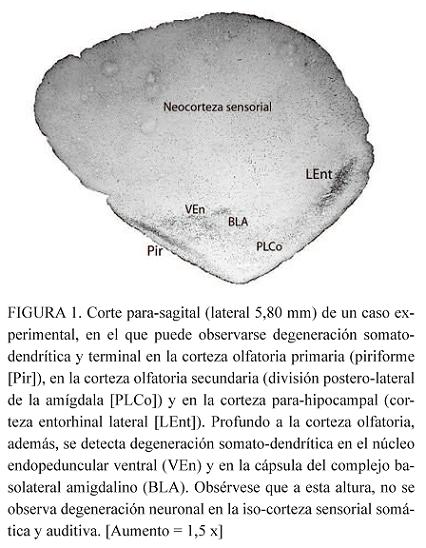
<body><![CDATA[<p class="western" style="margin: 5pt 134.25pt 0.0001pt 27pt; text-align: justify; line-height: 150%;"><span style="font-size: 12pt; line-height: 150%; font-family: Arial;" lang="ES-UY"><o:p>&nbsp;</o:p></span></p>         <p class="western" style="margin: 2.85pt 134.25pt 0.0001pt 27pt; text-align: justify; line-height: 150%;"><span style="font-size: 12pt; line-height: 150%; font-family: Arial;" lang="ES-UY">En todo el manto de la corteza olfatoria, el efecto t&oacute;xico del MK-801 afecta espec&iacute;ficamente a neuronas piramidales localizadas en la capa III, cuyas terminales nerviosas pueden verse densamente te&ntilde;idas en la capa Ib, como un reguero continuo y paralelo a la superficie (<a href="#f1">Fig. 1</a>). <o:p></o:p></span></p>         <p class="western" style="margin: 2.85pt 134.25pt 0.0001pt 27pt; text-align: justify; line-height: 150%;"><span style="font-size: 12pt; line-height: 150%; font-family: Arial;" lang="ES-UY"><o:p>&nbsp;</o:p></span></p>         <p class="western" style="margin: 2.85pt 134.25pt 0.0001pt 27pt; text-align: justify; line-height: 150%;"><span style="font-size: 12pt; line-height: 150%; font-family: Arial;" lang="ES-UY">Profunda a la corteza olfatoria, se observa degeneraci&oacute;n neuronal som&aacute;tica y dendr&iacute;tica circunscripta a la c&aacute;psula superficial del complejo baso-lateral amigdalino (<a href="#f1">Fig. 1</a>). <o:p></o:p></span></p>         <p class="western" style="margin: 5pt 134.25pt 0.0001pt 27pt; text-align: justify; line-height: 150%;"><span style="font-size: 12pt; line-height: 150%; font-family: Arial;" lang="ES-UY"><o:p>&nbsp;</o:p></span></p>         <p class="western" style="margin: 5pt 134.25pt 0.0001pt 27pt; text-align: justify; line-height: 150%;"><span style="font-size: 12pt; line-height: 150%; font-family: Arial;" lang="ES-UY"><o:p>&nbsp;</o:p></span></p>         <p class="western" style="margin: 5pt 134.25pt 0.0001pt 27pt; text-align: justify; line-height: 150%;"><a name="f1"></a><img id="_x0000_i1025" src="../../../../../img/revistas/cp/v3n1/1a08f1.jpg" style="height: 548px; width: 426px;" border="0" height="32" width="32"><span style="font-size: 12pt; line-height: 150%; font-family: Arial;" lang="ES-UY"><o:p></o:p></span></p>         <p class="western" style="margin: 17pt 134.25pt 0.0001pt 27pt; text-align: justify; line-height: 150%;"><span style="font-size: 12pt; line-height: 150%; font-family: Arial;" lang="ES-UY"><o:p>&nbsp;</o:p></span></p>         <p class="western" style="margin: 17pt 134.25pt 0.0001pt 27pt; text-align: justify; line-height: 150%;"><span style="font-size: 12pt; line-height: 150%; font-family: Arial;" lang="ES-UY">Toda la corteza parahipocampal evidencia, al menos, terminales nerviosas en estado degenerativo en la capa superficial, siendo la corteza entorhinal lateral la subdivisi&oacute;n con mayor densidad de degeneraci&oacute;n somato-dendr&iacute;tca (<a href="#f1">Fig. 1</a>).<o:p></o:p></span></p>         <p class="western" style="margin: 5pt 134.25pt 0.0001pt 27pt; text-align: justify; line-height: 150%;"><span style="font-size: 12pt; line-height: 150%; font-family: Arial;" lang="ES-UY"><o:p>&nbsp;</o:p></span></p>         ]]></body>
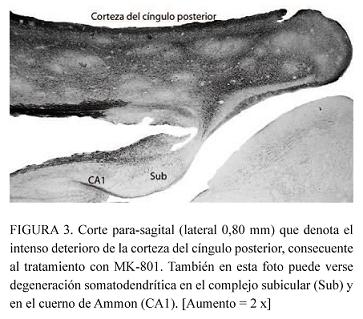
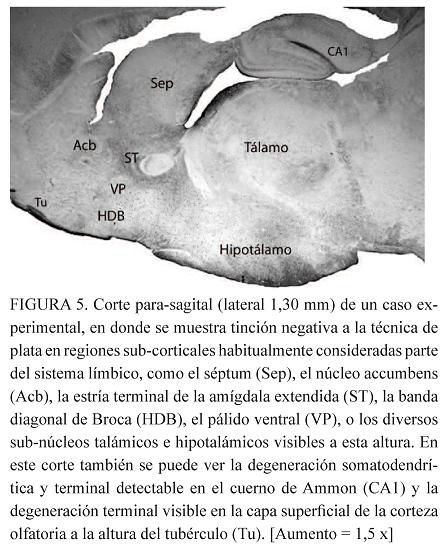
<body><![CDATA[<p class="western" style="margin: 5pt 134.25pt 0.0001pt 27pt; text-align: justify; line-height: 150%;"><span style="font-size: 12pt; line-height: 150%; font-family: Arial;" lang="ES-UY">Similar a la corteza olfatoria, se observa tinci&oacute;n de neuronas piramidales en la capa III, aunque en esta regi&oacute;n se detectan neuronas estrelladas en la capa II.<o:p></o:p></span></p>         <p class="western" style="margin: 5pt 134.25pt 0.0001pt 27pt; text-align: justify; line-height: 150%;"><span style="font-size: 12pt; line-height: 150%; font-family: Arial;" lang="ES-UY"><o:p>&nbsp;</o:p></span></p>         <p class="western" style="margin: 5pt 134.25pt 0.0001pt 27pt; text-align: justify; line-height: 150%;"><span style="font-size: 12pt; line-height: 150%; font-family: Arial;" lang="ES-UY">Dentro del hipocampo proper se visualiza una densa degeneraci&oacute;n de c&eacute;lulas granulares en el giro dentado (<a href="#f2">Fig. 2</a>), la cual es concomitante con una tinci&oacute;n de terminales nerviosas que se muestran compactas en diversas capas, tanto del giro dentado como del cuerno de Ammon (ver tambi&eacute;n <a href="#f5">Fig. 5</a>). Pueden observarse, adem&aacute;s, c&eacute;lulas piramidales localizadas en el &aacute;rea CA1 y en el complejo subicular (ver <a href="#f3">Figs. 3</a> y <a href="#f5">5</a>).<o:p></o:p></span></p>         <p class="western" style="margin: 5pt 134.25pt 0.0001pt 27pt; text-align: justify; line-height: 150%;"><span style="font-size: 12pt; line-height: 150%; font-family: Arial;" lang="ES-UY"><o:p>&nbsp;</o:p></span></p>         <p class="western" style="margin: 5pt 134.25pt 0.0001pt 27pt; text-align: justify; line-height: 150%;"><span style="font-size: 12pt; line-height: 150%; font-family: Arial;" lang="ES-UY">La corteza retroesplenial del c&iacute;ngulo posterior (RSC) es, sin duda, la regi&oacute;n encef&aacute;lica que evidencia mayor densidad de muerte neuronal despu&eacute;s del tratamiento con MK-801 (<a href="#f3">Fig. 3</a>). <o:p></o:p></span></p>         <p class="western" style="margin: 5pt 134.25pt 0.0001pt 27pt; text-align: justify; line-height: 150%;"><span style="font-size: 12pt; line-height: 150%; font-family: Arial;" lang="ES-UY"><o:p>&nbsp;</o:p></span></p>         <p class="western" style="margin: 5pt 134.25pt 0.0001pt 27pt; text-align: justify; line-height: 150%;"><span style="font-size: 12pt; line-height: 150%; font-family: Arial;" lang="ES-UY">Gran cantidad de somas de neuronas piramidales aparecen te&ntilde;idos en las capas intermedias y semi-profundas sobre un denso trasfondo de dendritas, terminales y axones en estado degenerativo. La capa superficial de la RSC evidencia una muy densa degeneraci&oacute;n terminal.<o:p></o:p></span></p>         <p class="western" style="margin: 5pt 134.25pt 0.0001pt 27pt; text-align: justify; line-height: 150%;"><span style="font-size: 12pt; line-height: 150%; font-family: Arial;" lang="ES-UY"><o:p>&nbsp;</o:p></span></p>         <p class="western" style="margin: 5pt 134.25pt 0.0001pt 27pt; text-align: justify; line-height: 150%;"><span style="font-size: 12pt; line-height: 150%; font-family: Arial;" lang="ES-UY">Si bien se observa este patr&oacute;n degenerativo como un continuo en toda la corteza del c&iacute;ngulo, la densidad disminuye progresivamente hacia delante, de modo que el c&iacute;ngulo anterior muestra menos degeneraci&oacute;n somato-dendr&iacute;tica mientras m&aacute;s adelante se lo analiza.</span></p>         <p class="western" style="margin: 5pt 134.25pt 0.0001pt 27pt; text-align: justify; line-height: 150%;"><span style="font-size: 12pt; line-height: 150%; font-family: Arial;" lang="ES-UY"><o:p>&nbsp;</o:p></span></p>         ]]></body>
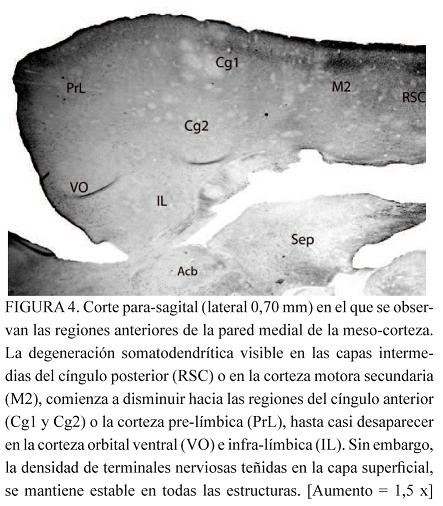
<body><![CDATA[<p class="western" style="margin: 5pt 134.25pt 0.0001pt 27pt; text-align: justify; line-height: 150%;"><span style="font-size: 12pt; line-height: 150%; font-family: Arial;" lang="ES-UY"><o:p>&nbsp;</o:p></span></p>         <p class="western" style="margin: 5pt 134.25pt 0.0001pt 27pt; text-align: justify; line-height: 150%;"><a name="f2"></a><img id="_x0000_i1026" src="../../../../../img/revistas/cp/v3n1/1a08f2.jpg" style="height: 527px; width: 411px;" border="0" height="32" width="32"><span style="font-size: 12pt; line-height: 150%; font-family: Arial;" lang="ES-UY"><o:p></o:p></span></p>         <p class="western" style="margin: 5pt 134.25pt 0.0001pt 27pt; text-align: justify; line-height: 150%;"><span style="font-size: 12pt; line-height: 150%; font-family: Arial;" lang="ES-UY"><o:p>&nbsp;</o:p></span></p>         <p class="western" style="margin: 5pt 134.25pt 0.0001pt 27pt; text-align: justify; line-height: 150%;"><span style="font-size: 12pt; line-height: 150%; font-family: Arial;" lang="ES-UY"><o:p>&nbsp;</o:p></span></p>         <p class="western" style="margin: 5pt 134.25pt 0.0001pt 27pt; text-align: justify; line-height: 150%;"><a name="f3"></a><img id="_x0000_i1027" src="../../../../../img/revistas/cp/v3n1/1a08f3.jpg" style="height: 319px; width: 363px;" border="0" height="32" width="32"><span style="font-size: 12pt; line-height: 150%; font-family: Arial;" lang="ES-UY"><o:p></o:p></span></p>         <p class="western" style="margin: 5pt 134.25pt 0.0001pt 27pt; text-align: justify; line-height: 150%;"><span style="font-size: 12pt; line-height: 150%; font-family: Arial;" lang="ES-UY"><o:p>&nbsp;</o:p></span></p>         <p class="western" style="margin: 5pt 134.25pt 0.0001pt 27pt; text-align: justify; line-height: 150%;"><span style="font-size: 12pt; line-height: 150%; font-family: Arial;" lang="ES-UY"><o:p>&nbsp;</o:p></span></p>         <p class="western" style="margin: 14.2pt 134.25pt 0.0001pt 27pt; text-align: justify; line-height: 150%;"><span style="font-size: 12pt; line-height: 150%; font-family: Arial;" lang="ES-UY">M&aacute;s a&uacute;n, al observar la pared medial del l&oacute;bulo frontal por adelante del c&iacute;ngulo anterior, se detectan terminales nerviosas en la capa superficial, pero con escasa o nula degeneraci&oacute;n somato-dendr&iacute;tica (<a href="#f4">Fig. 4</a>).<o:p></o:p></span></p>         <p class="western" style="margin: 5pt 134.25pt 0.0001pt 27pt; text-align: justify; line-height: 150%;"><span style="font-size: 12pt; line-height: 150%; font-family: Arial;" lang="ES-UY"><o:p>&nbsp;</o:p></span></p>         <p class="western" style="margin: 5pt 134.25pt 0.0001pt 27pt; text-align: justify; line-height: 150%;"><span style="font-size: 12pt; line-height: 150%; font-family: Arial;" lang="ES-UY">El resto de las estructuras encef&aacute;licas consideradas parte del sistema l&iacute;mbico, como los n&uacute;cleos y sub-n&uacute;cleos de la am&iacute;gdala extendida, del sistema estriado-palidal ventral, del &aacute;rea septal, del t&aacute;lamo y del hipot&aacute;lamo, no evidencian muerte neuronal en ninguno de los casos experimentales (<a href="#f5">Fig. 5</a>; ver tambi&eacute;n <a href="#f4">Fig. 4</a>).</span></p>         ]]></body>
<body><![CDATA[<p class="western" style="margin: 5pt 134.25pt 0.0001pt 27pt; text-align: justify; line-height: 150%;"><span style="font-size: 12pt; line-height: 150%; font-family: Arial;" lang="ES-UY"><o:p>&nbsp;</o:p></span></p>         <p class="western" style="margin: 5pt 134.25pt 0.0001pt 27pt; text-align: justify; line-height: 150%;"><span style="font-size: 12pt; line-height: 150%; font-family: Arial;" lang="ES-UY"><o:p>&nbsp;</o:p></span></p>         <p class="western" style="margin: 2.85pt 134.25pt 0.0001pt 27pt; text-align: justify; line-height: 150%;"><a name="f4"></a><img id="_x0000_i1028" src="../../../../../img/revistas/cp/v3n1/1a08f4.jpg" style="height: 506px; width: 443px;" border="0" height="32" width="32"><span style="font-size: 12pt; line-height: 150%; font-family: Arial;" lang="ES-UY"><o:p></o:p></span></p>         <p class="western" style="margin: 5pt 134.25pt 0.0001pt 27pt; text-align: justify; line-height: 150%;"><span style="font-size: 12pt; line-height: 150%; font-family: Arial;" lang="ES-UY"><o:p>&nbsp;</o:p></span></p>         <p class="western" style="margin: 5pt 134.25pt 0.0001pt 27pt; text-align: justify; line-height: 150%;"><span style="font-size: 12pt; line-height: 150%; font-family: Arial;" lang="ES-UY"><o:p>&nbsp;</o:p></span></p>         <p class="western" style="margin: 5pt 134.25pt 0.0001pt 27pt; text-align: justify; line-height: 150%;"><a name="f5"></a><img id="_x0000_i1029" src="../../../../../img/revistas/cp/v3n1/1a08f5.jpg" style="height: 555px; width: 445px;" border="0" height="32" width="32"><span style="font-size: 12pt; line-height: 150%; font-family: Arial;" lang="ES-UY"><o:p></o:p></span></p>         <p class="western" style="margin: 5pt 134.25pt 0.0001pt 27pt; text-align: justify; line-height: 150%;"><span style="font-size: 12pt; line-height: 150%; font-family: Arial;" lang="ES-UY"><o:p>&nbsp;</o:p></span></p>         <p class="western" style="margin: 5pt 134.25pt 0.0001pt 27pt; text-align: justify; line-height: 150%;"><span style="font-size: 12pt; line-height: 150%; font-family: Arial;" lang="ES-UY"><o:p>&nbsp;</o:p></span></p>         <p style="margin: 5pt 134.25pt 0.0001pt 27pt; text-align: justify; line-height: 150%;"><b><span style="font-family: Arial;" lang="ES-UY">DISCUSI&Oacute;N</span></b><span style="font-family: Arial;" lang="ES-UY"><o:p></o:p></span></p>         <p style="margin: 2.85pt 134.25pt 0.0001pt 27pt; text-align: justify; line-height: 150%;"><span style="font-family: Arial;" lang="ES-UY"><o:p>&nbsp;</o:p></span></p>         ]]></body>
<body><![CDATA[<p style="margin: 2.85pt 134.25pt 0.0001pt 27pt; text-align: justify; line-height: 150%;"><span style="font-family: Arial;" lang="ES-UY">Los datos obtenidos en esta investigaci&oacute;n son, en t&eacute;rminos generales, consistentes con los reportados en trabajos similares en los que se han usado otras t&eacute;cnicas de evaluaci&oacute;n, se han administrado f&aacute;rmacos an&aacute;logos al MK-801, o se han manipulado combinadamente otras variables, como: edad, sexo, sobrevida, especie, cepa y/o dosis (<a name="Olney1989."></a><a href="#Olney1">Olney, Labruyere y Price</a>, 1989; <a name="Farber1995."></a><a href="#Farber">Farber et al</a>. 1995; <a href="#Fix">Fix, et al</a>. 1996; <a name="Horv&aacute;th1997."></a><a href="#Horvath">Horv&aacute;th, Czopf y Buzs&aacute;ki</a>, 1997; <a name="Hur1999."></a><a href="#Hur">Hur, Son, Shin, Kang y Kim</a>, 1999). <o:p></o:p></span></p>         <p style="margin: 5pt 134.25pt 0.0001pt 27pt; text-align: justify; line-height: 150%;"><span style="font-family: Arial;" lang="ES-UY"><o:p>&nbsp;</o:p></span></p>         <p style="margin: 5pt 134.25pt 0.0001pt 27pt; text-align: justify; line-height: 150%;"><span style="font-family: Arial;" lang="ES-UY">Sin embargo, y como ya se aclarara en la introducci&oacute;n, el an&aacute;lisis anat&oacute;mico realizado en tales investigaciones fue general y poco preciso, o circunscripto a las &aacute;reas de m&aacute;s alto impacto t&oacute;xico. El presente trabajo, por el contrario, aporta un an&aacute;lisis con gran detalle en la evaluaci&oacute;n neuroanat&oacute;mica y atendiendo a las m&aacute;s recientes definiciones morfo-funcionales. Adem&aacute;s, la gran sensibilidad de la t&eacute;cnica A-Cu-Ag para te&ntilde;ir particularmente las terminales nerviosas en estado degenerativo (p.e. <a name="Switzer2000."></a><a href="#Switzer">Switzer</a>, 2000), ha permitido involucrar en el proceso patol&oacute;gico inducido por MK-801, a &aacute;reas espec&iacute;ficas de la meso-corteza cuya exclusi&oacute;n hubiera interferido en la interpretaci&oacute;n y discusi&oacute;n de los resultados. <o:p></o:p></span></p>         <p style="margin: 5pt 134.25pt 0.0001pt 27pt; text-align: justify; line-height: 150%;"><span style="font-family: Arial;" lang="ES-UY"><o:p>&nbsp;</o:p></span></p>         <p style="margin: 5pt 134.25pt 0.0001pt 27pt; text-align: justify; line-height: 150%;"><span style="font-family: Arial;" lang="ES-UY">Ahora bien, para revisar el concepto de &ldquo;sistema l&iacute;mbico&rdquo;, es preciso comenzar por la idea original de <a name="Paul1878."></a><a href="#Broca">Paul Broca</a> (1878), quien, trabajando con peque&ntilde;os roedores, defini&oacute; como &ldquo;gran l&oacute;bulo l&iacute;mbico&rdquo; a un grupo de estructuras corticales de la pared medial de los hemisferios cerebrales, dispuestas en forma de anillo alrededor del t&aacute;lamo y del cuerpo calloso. Dentro de &eacute;l, el autor incluy&oacute; a las cortezas piriforme, amigdalina y para-hipocampal, al hipocampo proper, a la corteza del c&iacute;ngulo y a las regiones postero-mediales de la corteza frontal. Inicialmente, Broca atribuy&oacute; a su l&oacute;bulo l&iacute;mbico una funci&oacute;n netamente olfatoria, motivo por el que cl&aacute;sicamente se le ha asignado la denominaci&oacute;n de &ldquo;rinenc&eacute;falo&rdquo; o &ldquo;cerebro olfatorio&rdquo;. A la luz del conocimiento actual, este concepto ser&iacute;a m&aacute;s preciso si se lo limitara s&oacute;lo a las estructuras antero-ventrales del anillo (<a href="#Lautin">Lautin</a>, 2002; Shipley et al. 2004). <o:p></o:p></span></p>         <p style="margin: 5pt 134.25pt 0.0001pt 27pt; text-align: justify; line-height: 150%;"><span style="font-family: Arial;" lang="ES-UY"><o:p>&nbsp;</o:p></span></p>         <p style="margin: 5pt 134.25pt 0.0001pt 27pt; text-align: justify; line-height: 150%;"><span style="font-family: Arial;" lang="ES-UY">A&ntilde;os despu&eacute;s, <a name="Yakovlev1948."></a><a href="#Yakovlev1">Yakovlev</a> (1948) realiz&oacute; el que se considera el primer an&aacute;lisis basado en el desarrollo filogen&eacute;tico y en la cito-arquitectura del enc&eacute;falo. El autor dividi&oacute; a la corteza en endopalio, mesopalio y ectopalio. <o:p></o:p></span></p>         <p style="margin: 5pt 134.25pt 0.0001pt 27pt; text-align: justify; line-height: 150%;"><span style="font-family: Arial;" lang="ES-UY"><o:p>&nbsp;</o:p></span></p>         <p style="margin: 5pt 134.25pt 0.0001pt 27pt; text-align: justify; line-height: 150%;"><span style="font-family: Arial;" lang="ES-UY">En el &ldquo;endopalio&rdquo; incluy&oacute; a estructuras de 3 capas, como la corteza olfatoria y el hipocampo proper, m&aacute;s el &ldquo;rudimento hipocampal&rdquo; que conecta a ambas regiones. En el &ldquo;mesopalio&rdquo; el autor incluy&oacute; a las cortezas para-hipocampal, del c&iacute;ngulo, frontal medial y orbital, al l&oacute;bulo de la &iacute;nsula y a las regiones temporales adyacentes. Estas &aacute;reas del mesopalio tienen el com&uacute;n denominador de tener un grado de estratificaci&oacute;n intermedio entre el endopalio y el ectopalio (en general, de 5 capas). El &ldquo;ectopalio&rdquo;, en fin, representa la sub-divisi&oacute;n de m&aacute;s reciente desarrollo, en la que el autor incluy&oacute; a todas las &aacute;reas corticales con 6 capas celulares bien diferenciadas. La definici&oacute;n de Yakovlev, en este contexto, implica que el endopalio y el mesopalio, juntos, conforman una regi&oacute;n homologable al l&oacute;bulo l&iacute;mbico de Broca, con una ligera ampliaci&oacute;n de sus l&iacute;mites hacia regiones fronto-t&eacute;mporo-insulares.<o:p></o:p></span></p>         <p style="margin: 5pt 134.25pt 0.0001pt 27pt; text-align: justify; line-height: 150%;"><span style="font-family: Arial;" lang="ES-UY"><o:p>&nbsp;</o:p></span></p>         ]]></body>
<body><![CDATA[<p style="margin: 5pt 134.25pt 0.0001pt 27pt; text-align: justify; line-height: 150%;"><span style="font-family: Arial;" lang="ES-UY">Estas tres sub-regiones de Yakovlev son respectivamente equivalentes a la allo-corteza, la meso-corteza y la iso-corteza (ver <a href="#Gloor">Gloor</a>, 1997; <a name="Palomero2004."></a><a href="#Palomero">Palomero-Gallagher y Zilles</a>, 2004). Recientes estudios citoarquitect&oacute;nicos han ajustado a&uacute;n m&aacute;s los l&iacute;mites entre estas sub-divisiones en &aacute;reas espec&iacute;ficas, como las cortezas pre-frontal medial, orbito-frontal y t&eacute;mporo-insular, adem&aacute;s de incluir al complejo baso-lateral amigdalino (BLA) como un &aacute;rea &ldquo;pseudo-cortical&rdquo;, diferenci&aacute;ndolo de las estructuras sub-corticales de la am&iacute;gdala (<a name="Heimer2006."></a><a href="#Heimer2">Heimer y Van Hoesen</a>, 2006; ver tambi&eacute;n <a name="Mega1997."></a><a href="#Mega">Mega, Cummings, Salloway y Malloy</a>, 1997; <a name="deOlmos2004."></a><a href="#deOlmos2">de Olmos, Beltramino y Alheid</a>, 2004). <o:p></o:p></span></p>         <p style="margin: 5pt 134.25pt 0.0001pt 27pt; text-align: justify; line-height: 150%;"><span style="font-family: Arial;" lang="ES-UY"><o:p>&nbsp;</o:p></span></p>         <p style="margin: 5pt 134.25pt 0.0001pt 27pt; text-align: justify; line-height: 150%;"><span style="font-family: Arial;" lang="ES-UY">Dada la caracter&iacute;stica anat&oacute;mica del l&oacute;bulo l&iacute;mbico as&iacute; definido, en la literatura general se lo denomina tambi&eacute;n &ldquo;corteza l&iacute;mbica&rdquo; (p.e. <a name="Vogt2004."></a><a href="#Vogt">Vogt, Vogt y Farber</a>, 2004), lo cual lo discrimina claramente de las estructuras sub-corticales incluidas dentro del concepto cl&aacute;sico de sistema l&iacute;mbico. <o:p></o:p></span></p>         <p style="margin: 5pt 134.25pt 0.0001pt 27pt; text-align: justify; line-height: 150%;"><span style="font-family: Arial;" lang="ES-UY"><o:p>&nbsp;</o:p></span></p>         <p style="margin: 5pt 134.25pt 0.0001pt 27pt; text-align: justify; line-height: 150%;"><span style="font-family: Arial;" lang="ES-UY">Cabe destacar que muchas de las estructuras sub-corticales incluidas por McLean en el sistema l&iacute;mbico tambi&eacute;n han sido re-conceptualizadas, particularmente en el telenc&eacute;falo a partir de la reciente re-definici&oacute;n anat&oacute;mica de la &ldquo;sustancia innominada&rdquo; (&ldquo;regi&oacute;n sin nombre&rdquo;), como fuera tempranamente denominada esta compleja zona encef&aacute;lica (<a name="Reil1809."></a><a href="#Reil">Reil</a>, 1809; <a name="Reichert1859."></a><a href="#Reichert">Reichert</a>, 1859). Y ha sido tal re-definici&oacute;n de la sustancia innominada lo que principalmente hizo surgir nuevos conceptos an&aacute;tomo-funcionales dentro del sistema l&iacute;mbico (para una revisi&oacute;n ver <a href="#Heimer1">Heimer et al</a>. 1997). <o:p></o:p></span></p>         <p style="margin: 5pt 134.25pt 0.0001pt 27pt; text-align: justify; line-height: 150%;"><span style="font-family: Arial;" lang="ES-UY"><o:p>&nbsp;</o:p></span></p>         <p style="margin: 5pt 134.25pt 0.0001pt 27pt; text-align: justify; line-height: 150%;"><span style="font-family: Arial;" lang="ES-UY">Uno de ellos, la &ldquo;am&iacute;gdala extendida&rdquo;, est&aacute; compuesta por los cl&aacute;sicos sub-n&uacute;cleos central y medial de la am&iacute;gdala, y por la extensi&oacute;n que, en forma de arco continuo, incluye a la estr&iacute;a terminal, al n&uacute;cleo del lecho de la estr&iacute;a terminal, y a sub-regiones espec&iacute;ficas de la sustancia innominada (<a href="#deOlmos2">de Olmos et al.</a> 2004; ver tambi&eacute;n <a href="#Heimer1">Heimer et al</a>. 1997). Otra concepci&oacute;n es el del &ldquo;sistema estriado-palidal ventral&rdquo;, formado por los cl&aacute;sicos sub-n&uacute;cleos del estriado ventral, el n&uacute;cleo accumbens, el fondus striati y determinados territorios de la sustancia innominada, re-definidos como p&aacute;lido ventral (PV). Otras estructuras que tambi&eacute;n fueron incluidas originalmente dentro de la sustancia innominada, como el n&uacute;cleo basal de Meynert y el n&uacute;cleo de la banda diagonal de Broca, son actualmente consideradas, junto al Septum propiamente dicho, parte integral del &ldquo;&aacute;rea septal&rdquo; (ver tambi&eacute;n <a name="Risold2004."></a><a href="#Risold">Risold</a>, 2004). <o:p></o:p></span></p>         <p style="margin: 5pt 134.25pt 0.0001pt 27pt; text-align: justify; line-height: 150%;"><span style="font-family: Arial;" lang="ES-UY"><o:p>&nbsp;</o:p></span></p>         <p style="margin: 5pt 134.25pt 0.0001pt 27pt; text-align: justify; line-height: 150%;"><span style="font-family: Arial;" lang="ES-UY">Estas &ldquo;nuevas&rdquo; regiones cerebrales distinguidas: la am&iacute;gdala extendida, el sistema estriado-palidal ventral y el &aacute;rea septal, por la caracter&iacute;stica morfol&oacute;gica y la disposici&oacute;n espacial, representan n&uacute;cleos y circuitos sub-corticales, y se los ha clasificado dentro del &ldquo;telenc&eacute;falo basal anterior&rdquo;, al cual se le atribuye la funci&oacute;n &ldquo;efectora&rdquo; en los comportamientos emocionales (<a href="#Heimer2">Heimer y van Hoesen</a>, 2006). Si se sigue el criterio de incluir dentro del sistema l&iacute;mbico s&oacute;lo a estructuras telencef&aacute;licas (p.e. <a href="#Gloor">Gloor</a>, 1997), las regiones hasta aqu&iacute; definidas como &ldquo;l&oacute;bulo l&iacute;mbico&rdquo; y &ldquo;telenc&eacute;falo basal anterior&rdquo;, ser&iacute;an sus dos grandes y &uacute;nicos componentes. <o:p></o:p></span></p>         <p style="margin: 2.85pt 134.25pt 0.0001pt 27pt; text-align: justify; line-height: 150%;"><span style="font-family: Arial;" lang="ES-UY"><o:p>&nbsp;</o:p></span></p>         ]]></body>
<body><![CDATA[<p style="margin: 2.85pt 134.25pt 0.0001pt 27pt; text-align: justify; line-height: 150%;"><span style="font-family: Arial;" lang="ES-UY">Sin embargo, el concepto de sistema l&iacute;mbico que aqu&iacute; se discute es m&aacute;s amplio. Inicialmente, <a href="#Papez">Papez</a> (1937) consider&oacute; al sub-n&uacute;cleo anterior del t&aacute;lamo y a los cuerpos mamilares del hipot&aacute;lamo como partes del circuito neuroanat&oacute;mico propuesto como la base funcional de las emociones. Como se mencionara en la introducci&oacute;n, <a href="#McLean1">McLean</a> (1952) parti&oacute; del &ldquo;circuito de Papez&rdquo; incluyendo a las regiones diencef&aacute;licas mencionadas dentro de su cl&aacute;sico concepto de sistema l&iacute;mbico. Fue Yakovlev, con sus estudios conexionales, quien reforzara la inclusi&oacute;n de las estructuras tal&aacute;micas en el sistema l&iacute;mbico, definiendo un &ldquo;t&aacute;lamo l&iacute;mbico&rdquo; con el que ampli&oacute;, incluso, los l&iacute;mites establecidos por Papez m&aacute;s all&aacute; del t&aacute;lamo anterior (<a name="Yakovlev1966."></a><a href="#Yakovlev2">Yakovlev, Locke y Angevine</a>, 1966; para una revisi&oacute;n ver <a name="Bentivoglio1993."></a><a href="#Bentivoglio">Bentivoglio, Kultas-Ilinsky e Ilinsky</a>, 1993). Por su lado, dado el rol central del hipot&aacute;lamo en los aspectos &ldquo;aut&oacute;nomos&rdquo; y &ldquo;glandulares&rdquo; de los procesos emocionales, pas&oacute; a ser el eje central del sistema, al punto que en la literatura general todo el hipot&aacute;lamo es hoy considerado el &ldquo;n&uacute;cleo de salida&rdquo; del sistema l&iacute;mbico (p.e. <a name="Guyton1999."></a><a href="#Guyton">Guyton</a>, 1999). As&iacute;, al t&aacute;lamo l&iacute;mbico de Yakovlev y al hipot&aacute;lamo podr&iacute;a denomin&aacute;rselos &ldquo;dienc&eacute;falo l&iacute;mbico&rdquo;.<o:p></o:p></span></p>         <p style="margin: 5pt 134.25pt 0.0001pt 27pt; text-align: justify; line-height: 150%;"><span style="font-family: Arial;" lang="ES-UY"><o:p>&nbsp;</o:p></span></p>         <p style="margin: 5pt 134.25pt 0.0001pt 27pt; text-align: justify; line-height: 150%;"><span style="font-family: Arial;" lang="ES-UY">Por otro lado, siguiendo los patrones de conexi&oacute;n del hipot&aacute;lamo, tambi&eacute;n se incluyeron dentro del sistema l&iacute;mbico a estructuras nerviosas del cerebro medio a las que se denomin&oacute; &ldquo;mesenc&eacute;falo l&iacute;mbico&rdquo; (<a name="Nauta1958."></a><a href="#Nauta">Nauta</a>, 1958). Estudios posteriores han llevado a incluir tambi&eacute;n a los diversos n&uacute;cleos del sistema catecolamin&eacute;rgico que proyectan a las estructuras l&iacute;mbicas, por lo cual se ha sugerido el nombre de &ldquo;sistema l&iacute;mbico extendido&rdquo; para re-definir a estas regiones del tronco encef&aacute;lico (<a href="#Lautin">Lautin</a>, 2002). <o:p></o:p></span></p>         <p style="margin: 5pt 134.25pt 0.0001pt 27pt; text-align: justify; line-height: 150%;"><span style="font-family: Arial;" lang="ES-UY"><o:p>&nbsp;</o:p></span></p>         <p style="margin: 5pt 134.25pt 0.0001pt 27pt; text-align: justify; line-height: 150%;"><span style="font-family: Arial;" lang="ES-UY">Resulta claro que el criterio funcional de considerar &ldquo;sistema l&iacute;mbico&rdquo; a aquellas estructuras relacionadas con los procesos emocionales, ha expandido los l&iacute;mites del mismo hasta regiones muy lejanas a las que considerara inicialmente Papez. Se ha llegado a proponer (&iquest;ir&oacute;nicamente, tal vez?) que todo el sistema nervioso est&aacute; relacionado de alguna manera con funciones emocionales, por lo que el concepto de sistema l&iacute;mbico resulta obsoleto y, por lo tanto, prescindible (<a name="Brodal1969."></a><a href="#Brodal">Brodal</a>, 1969). Ciertamente, la definici&oacute;n cl&aacute;sica de sistema l&iacute;mbico resulta, al menos, confusa, pues muchas regiones con funci&oacute;n &ldquo;emocional&rdquo; tambi&eacute;n cumplen otro/s rol/es (motriz, sensorial y/o aut&oacute;nomo). <o:p></o:p></span></p>         <p style="margin: 5pt 134.25pt 0.0001pt 27pt; text-align: justify; line-height: 150%;"><span style="font-family: Arial;" lang="ES-UY">As&iacute; mismo, como se introdujera oportunamente, el sistema l&iacute;mbico de Mclean es muy amplio anat&oacute;mica, funcional y filogen&eacute;ticamente como para considerarlo una &ldquo;unidad&rdquo; en s&iacute; misma.<o:p></o:p></span></p>         <p style="margin: 5pt 134.25pt 0.0001pt 27pt; text-align: justify; line-height: 150%;"><span style="font-family: Arial;" lang="ES-UY"><o:p>&nbsp;</o:p></span></p>         <p style="margin: 5pt 134.25pt 0.0001pt 27pt; text-align: justify; line-height: 150%;"><span style="font-family: Arial;" lang="ES-UY">Si se revisan los resultados de este trabajo siguiendo las anteriores definiciones, es claro que el tratamiento experimental con MK-801 induce muerte neuronal s&oacute;lo en estructuras que forman parte del &ldquo;l&oacute;bulo l&iacute;mbico&rdquo;, pero NO en los n&uacute;cleos sub-corticales del &ldquo;telenc&eacute;falo basal anterior&rdquo; o del &ldquo;dienc&eacute;falo l&iacute;mbico&rdquo;. Por ejemplo, en la am&iacute;gdala, la muerte neuronal es evidente en la sub-divisi&oacute;n olfatoria y en el complejo baso-lateral, los cuales han sido incluidos dentro del &ldquo;l&oacute;bulo l&iacute;mbico&rdquo;; sin embargo, la am&iacute;gdala extendida, considerada parte del &ldquo;telenc&eacute;falo basal anterior&rdquo;, es resistente al impacto t&oacute;xico del psicof&aacute;rmaco.<o:p></o:p></span></p>         <p style="margin: 5pt 134.25pt 0.0001pt 27pt; text-align: justify; line-height: 150%;"><span style="font-family: Arial;" lang="ES-UY">Es tambi&eacute;n llamativo el hecho de que la toxicidad del MK-801 afecta, sin excepci&oacute;n, a todas las &aacute;reas del l&oacute;bulo l&iacute;mbico. Todas las sub-divisiones de la allo-corteza y de la meso-corteza muestran alguna forma de proceso neuro-degenerativo, lo cual refuerza la idea de que el l&oacute;bulo l&iacute;mbico responde como una unidad claramente diferente de otras regiones cerebrales (<a href="#Broca">Broca</a>, 1878; <a href="#Yakovlev1">Yakovlev</a>, 1948; <a href="#Mega">Mega et al</a>. 1997; <a href="#Heimer2">Heimer y Van Hoesen</a>, 2006). <o:p></o:p></span></p>         <p style="margin: 2.85pt 134.25pt 0.0001pt 27pt; text-align: justify; line-height: 150%;"><span style="font-family: Arial;" lang="ES-UY"><o:p>&nbsp;</o:p></span></p>         ]]></body>
<body><![CDATA[<p style="margin: 2.85pt 134.25pt 0.0001pt 27pt; text-align: justify; line-height: 150%;"><span style="font-family: Arial;" lang="ES-UY">Finalmente, se hace notar que algunos autores sugieren la existencia de dos sub-divisiones &ldquo;para-l&iacute;mbicas&rdquo; dentro de este l&oacute;bulo l&iacute;mbico, cada una de las cuales con caracter&iacute;sticas cito-arquitect&oacute;nicas, filogen&eacute;ticas y cl&iacute;nicas que le son particulares (<a href="#Mega">Mega et al</a>. 1997). Dado que una de estas sub-divisiones no cumple funciones &ldquo;emocionales&rdquo;, se ha propuesto que las &aacute;reas relacionadas, como la RSC del c&iacute;ngulo posterior, sean excluidas del l&oacute;bulo l&iacute;mbico (<a href="#Vogt">Vogt et al</a>. 2004). En este contexto, la evaluaci&oacute;n neuro-patol&oacute;gica realizada en este trabajo no es suficiente para aportar conclusiones, aunque la diferencia expresada particularmente dentro de la RSC del c&iacute;ngulo posterior (RSG vs. RSD), parece un indicio de relevancia y un motivo para desarrollar futuras investigaciones tendientes a dilucidar esta discusi&oacute;n. <o:p></o:p></span></p>         <p style="margin: 2.85pt 134.25pt 0.0001pt 27pt; text-align: justify; line-height: 150%;"><span style="font-family: Arial;" lang="ES-UY"><o:p>&nbsp;</o:p></span></p>         <p style="margin: 2.85pt 134.25pt 0.0001pt 27pt; text-align: justify; line-height: 150%;"><span style="font-family: Arial;" lang="ES-UY"><o:p>&nbsp;</o:p></span></p>         <p style="margin: 5.65pt 134.25pt 0.0001pt 27pt; text-align: center; line-height: 150%;" align="center"><b><span style="font-family: Arial;" lang="ES-UY">CONCLUSION</span></b><span style="font-family: Arial;" lang="ES-UY"><o:p></o:p></span></p>         <p style="margin: 5.65pt 134.25pt 0.0001pt 27pt; text-align: justify; line-height: 150%;"><span style="font-family: Arial;" lang="ES-UY"><o:p>&nbsp;</o:p></span></p>         <p style="margin: 2.85pt 134.25pt 0.0001pt 27pt; text-align: justify; line-height: 150%;"><span style="font-family: Arial;" lang="ES-UY">Los resultados del presente trabajo muestran que, despu&eacute;s del tratamiento experimental con MK-801, las &aacute;reas corticales que conforman el l&oacute;bulo l&iacute;mbico se ven afectadas de un modo espec&iacute;fico y diferencial, si se las compara con otras estructuras &ldquo;l&iacute;mbicas&rdquo; sub-corticales, como las del telenc&eacute;falo basal anterior o las del dienc&eacute;falo, las cuales parecen resistentes al impacto t&oacute;xico. <o:p></o:p></span></p>         <p style="margin: 2.85pt 134.25pt 0.0001pt 27pt; text-align: justify; line-height: 150%;"><span style="font-family: Arial;" lang="ES-UY">Esto sugiere fuertemente que el l&oacute;bulo l&iacute;mbico es una unidad an&aacute;tomo-patol&oacute;gica particular y diferente dentro del sistema nervioso en general, y sustenta la idea de re-definir al cl&aacute;sico y amplio concepto de &ldquo;sistema l&iacute;mbico&rdquo;, a los fines de esclarecer m&aacute;s espec&iacute;ficamente el rol relacionado a sus estructuras en el contexto de la neuro-patolog&iacute;a. <o:p></o:p></span></p>         <p style="margin: 2.85pt 134.25pt 0.0001pt 27pt; text-align: justify; line-height: 150%;"><span style="font-family: Arial;" lang="ES-UY"><o:p>&nbsp;</o:p></span></p>         <p style="margin: 2.85pt 134.25pt 0.0001pt 27pt; text-align: justify; line-height: 150%;"><span style="font-family: Arial;" lang="ES-UY"><o:p>&nbsp;</o:p></span></p>         <p style="margin: 2.85pt 134.25pt 0.0001pt 27pt; text-align: justify; line-height: 150%;"><span style="font-family: Arial;" lang="ES-UY"><o:p>&nbsp;</o:p></span></p>         ]]></body>
<body><![CDATA[<p style="margin: 2.85pt 134.25pt 0.0001pt 27pt; text-align: center; line-height: 120%;" align="center"><b><span style="font-family: Arial;" lang="ES-UY">REFERENCIAS<o:p></o:p></span></b></p>         <p style="margin: 2.85pt 134.25pt 0.0001pt 27pt; text-align: center; line-height: 120%;" align="center"><span style="font-family: Arial;" lang="ES-UY"><o:p>&nbsp;</o:p></span></p>         <!-- ref --><p style="margin: 11.35pt 134.25pt 0.0001pt 27pt; text-align: justify; line-height: 120%;"><a name="A.P.A."></a><span style="font-family: Arial;" lang="ES-UY"><a href="#A.P.A1995.">A.P.A. (1995)</a>. Trastornos relacionados con sustancias. Manual diagn&oacute;stico y estad&iacute;stico de los trastornos mentales. </span><span style="font-family: Arial;" lang="EN-US">Ed. Masson, 181-278.    </span><span style="font-family: Arial;" lang="EN-GB"><o:p></o:p></span></p>         <!-- ref --><p style="margin: 5pt 134.25pt 0.0001pt 27pt; text-align: justify; line-height: 120%;"><a name="Bentivoglio"></a><a href="#Bentivoglio1993."><span class="SpellE"><span class="GramE"><span style="font-family: Arial;" lang="EN-US">Bentivoglio</span></span></span><span class="GramE"><span style="font-family: Arial;" lang="EN-US">, M., <span class="SpellE">Kultas-Ilinsky</span>, K., &amp; <span class="SpellE">Ilinsky</span>, </span></span><st1:place><span class="GramE"><span style="font-family: Arial;" lang="EN-US">I.</span></span></st1:place></a><span class="GramE"><span style="font-family: Arial;" lang="EN-US"><a href="#Bentivoglio1993."> (1993)</a>.</span></span><span style="font-family: Arial;" lang="EN-US"> Limbic thalamus: Structure, intrinsic organization, and connections. <span class="GramE">Neurobiology of <span class="SpellE">cingulate</span> cortex and limbic thalamus.</span> <span class="GramE">Ed. Vogt and Gabriel.</span> </span><span style="font-family: Arial;" lang="ES-UY">Cap. 2, 71-122.    <o:p></o:p></span></p>         <!-- ref --><p style="margin: 5pt 134.25pt 0.0001pt 27pt; text-align: justify; line-height: 120%;"><a name="Broca"></a><span style="font-family: Arial;" lang="ES-UY"><a href="#Broca1878.">Broca, P. (1878)</a>. Anatomie compar&eacute;e des circonvolutions c&eacute;r&eacute;brales. Le grand lobe limbique et la scissure limbique dans la s&eacute;rie des mammif&eacute;res. </span><span style="font-family: Arial;" lang="EN-US">Rev Anthrop, 21, 384-498.    </span><span style="font-family: Arial;" lang="EN-GB"><o:p></o:p></span></p>         <!-- ref --><p style="margin: 5pt 134.25pt 0.0001pt 27pt; text-align: justify; line-height: 120%;"><a name="Brodal"></a><span class="SpellE"><span style="font-family: Arial;" lang="EN-US">Brodal</span></span><span style="font-family: Arial;" lang="EN-US">, A. (1969). <span class="GramE">Neurological anatomy in relation to clinical medicine.</span> </span><st1:place><st1:placename><span class="GramE"><span style="font-family: Arial;" lang="EN-US">Ed.</span></span></st1:placename><span class="GramE"><span style="font-family: Arial;" lang="EN-US">  </span></span><st1:placename><span class="GramE"><span style="font-family: Arial;" lang="EN-US">Oxford</span></span></st1:placename><span class="GramE"><span style="font-family: Arial;" lang="EN-US">  </span></span><st1:placetype><span class="GramE"><span style="font-family: Arial;" lang="EN-US">University</span></span></st1:placetype></st1:place><span class="GramE"><span style="font-family: Arial;" lang="EN-US"> Press.    </span></span><span style="font-family: Arial;" lang="EN-GB"><o:p></o:p></span></p>         ]]></body>
<body><![CDATA[<!-- ref --><p style="margin: 5pt 134.25pt 0.0001pt 27pt; text-align: justify; line-height: 120%;"><a name="Carlsson"></a><a href="#Carlsson1990."><span class="SpellE"><span class="GramE"><span style="font-family: Arial;" lang="EN-US">Carlsson</span></span></span></a><span class="GramE"><span style="font-family: Arial;" lang="EN-US"><a href="#Carlsson1990.">, M., &amp; <span class="SpellE">Carlsson</span>, A. (1990)</a>.</span></span><span style="font-family: Arial;" lang="EN-US"> Schizophrenia: A <span class="SpellE">subcortical</span> imbalance syndrome? </span><span style="font-family: Arial;" lang="ES-UY">Schizophrenia Bull, 18, 425-532.     <o:p></o:p></span></p>         <!-- ref --><p style="margin: 5pt 134.25pt 0.0001pt 27pt; text-align: justify; line-height: 120%;"><a name="deOlmos1"></a><span style="font-family: Arial;" lang="ES-UY"><a href="#deOlmos1994.">de Olmos, J., Beltramino, C., &amp; de Olmos, S. (1994)</a>. </span><span class="GramE"><span style="font-family: Arial;" lang="EN-US">Use of Amino-Cupric-Silver technique for the detection of early and <span class="SpellE">semiacute</span> neuronal degeneration caused by <span class="SpellE">neurotoxicants</span>, hypoxia, and <span class="SpellE">phisical</span> trauma.</span></span><span style="font-family: Arial;" lang="EN-US"> <span class="SpellE">Neurotoxicol</span> <span class="SpellE">Teratol</span>, 16, 545-561.    </span><span style="font-family: Arial;" lang="EN-GB"><o:p></o:p></span></p>         <!-- ref --><p style="margin: 5pt 134.25pt 0.0001pt 27pt; text-align: justify; line-height: 120%;"><a name="deOlmos2"></a><span style="font-family: Arial;"><a href="#deOlmos1994.">de Olmos, J. Beltramino, C., &amp; Alheid, G. (2004)</a>. </span><span class="SpellE"><span style="font-family: Arial;" lang="EN-US">Amygdala</span></span><span style="font-family: Arial;" lang="EN-US"> and Extended <span class="SpellE">Amygdala</span> of the Rat: A <span class="SpellE">Cytoarchitectonical</span>, <span class="SpellE">Fibroarchitectonical</span>, and <span class="SpellE">Chemoarchitectonical</span> Survey. <span class="GramE">The rat nervous system.</span> Ed. Elsevier. Cap. 19, 509-603.    </span><span style="font-family: Arial;" lang="EN-GB"><o:p></o:p></span></p>         <!-- ref --><p style="margin: 5pt 134.25pt 0.0001pt 27pt; text-align: justify; line-height: 120%;"><a name="Ellison"></a><span style="font-family: Arial;" lang="EN-US"><a href="#Ellison1995.">Ellison, G. (1995)</a>. <span class="GramE">The NMDA antagonist <span class="SpellE">phenciclidine</span>, <span class="SpellE">ketamine</span> and <span class="SpellE">dizocilpine</span> as both behavioral and anatomical models of the dementias.</span> Brain Res. Rev, 20, 250-267.    </span><span style="font-family: Arial;" lang="EN-GB"><o:p></o:p></span></p>         <!-- ref --><p style="margin: 5pt 134.25pt 0.0001pt 27pt; text-align: justify; line-height: 120%;"><a name="Farber"></a><span style="font-family: Arial;" lang="EN-US"><a href="#Farber1995.">Farber, N., Wozniak, D., Price, M., <span class="SpellE">Labruyere</span>, J., <span class="SpellE">Huss</span>, J., Peter, H., &amp; Olney, J. (1995)</a>. Age-specific <span class="SpellE">neurotoxicity</span> in the rat associated with NMDA receptor blockade: potential relevance to schizophrenia? <span class="SpellE">Biol</span> Psychiatry, 38, 788-796.    </span><span style="font-family: Arial;" lang="EN-GB"><o:p></o:p></span></p>         ]]></body>
<body><![CDATA[<!-- ref --><p style="margin: 5pt 134.25pt 0.0001pt 27pt; text-align: justify; line-height: 120%;"><a name="Fix"></a><span class="GramE"><span style="font-family: Arial;" lang="EN-US"><a href="#Fix1996.">Fix, A., Ross, J., <span class="SpellE">Stitzel</span>, S., &amp; Switzer, R. (1996)</a>.</span></span><span style="font-family: Arial;" lang="EN-US"> Integrated evaluation of central nervous system lesions: stains for neurons, <span class="SpellE">astrocytes</span>, and <span class="SpellE">microglia</span> reveal the spatial and temporal features of MK801-induced neuronal necrosis in the rat cerebral cortex. <span class="SpellE">Toxicol</span> <span class="SpellE">Pathol</span>, 24, 291-304.    </span><span style="font-family: Arial;" lang="EN-GB"><o:p></o:p></span></p>         <!-- ref --><p style="margin: 5pt 134.25pt 0.0001pt 27pt; text-align: justify; line-height: 120%;"><a name="Gloor"></a><a href="#Gloor1997."><span class="SpellE"><span style="font-family: Arial;" lang="EN-US">Gloor</span></span></a><span style="font-family: Arial;" lang="EN-US"><a href="#Gloor1997.">, P. (1997)</a>. <span class="GramE">The temporal lobe and limbic system.</span> </span><span style="font-family: Arial;" lang="ES-UY">Ed. Oxford.    <o:p></o:p></span></p>         <!-- ref --><p style="margin: 5pt 134.25pt 0.0001pt 27pt; text-align: justify; line-height: 120%;"><a name="Guyton"></a><span style="font-family: Arial;" lang="ES-UY"><a href="#Guyton1999.">Guyton, A. (1999)</a>. Anatom&iacute;a y fisiolog&iacute;a del sistema nervioso. Ed. M&eacute;dica Panamericana.     <o:p></o:p></span></p>         <!-- ref --><p style="margin: 5pt 134.25pt 0.0001pt 27pt; text-align: justify; line-height: 120%;"><a name="Heimer1"></a><span style="font-family: Arial;" lang="ES-UY"><a href="#Heimer1997.">Heimer, L., Harlan, R., Alheid, G., Garc&iacute;a, M., &amp; de Olmos, J. (1997)</a>. </span><span class="SpellE"><span style="font-family: Arial;" lang="EN-US">Substantia</span></span><span style="font-family: Arial;" lang="EN-US"> <span class="SpellE">innominada</span>: A notion which impedes clinical-anatomical correlations in <span class="SpellE">neuropsychiatric</span> disorders. <span class="SpellE"><span class="GramE">Neurosci</span></span><span class="GramE">, 76, 957-1006.    </span></span><span style="font-family: Arial;" lang="EN-GB"><o:p></o:p></span></p>         <!-- ref --><p style="margin: 5pt 134.25pt 0.0001pt 27pt; text-align: justify; line-height: 120%;"><a name="Heimer2"></a><a href="#Heimer2006."><span class="SpellE"><span style="font-family: Arial;" lang="EN-US">Heimer</span></span></a><span style="font-family: Arial;" lang="EN-US"><a href="#Heimer2006.">, L., &amp; van <span class="SpellE">Hoesen</span>, G. (2006)</a>. The limbic lobe and its output channels: implications for <span class="SpellE">emocional</span> functions and <span class="SpellE">adaptative</span> behavior. <span class="SpellE">Neurosci</span> <span class="SpellE">Biobehav</span> Rev, 30, 126-147.    </span><span style="font-family: Arial;" lang="EN-GB"><o:p></o:p></span></p>         ]]></body>
<body><![CDATA[<!-- ref --><p style="margin: 5pt 134.25pt 0.0001pt 27pt; text-align: justify; line-height: 120%;"><a name="Horvath"></a><a href="#Horv%E1th1997."><span class="SpellE"><span class="GramE"><span style="font-family: Arial;" lang="EN-US">Horv&aacute;th</span></span></span></a><span class="GramE"><span style="font-family: Arial;" lang="EN-US"><a href="#Horv%E1th1997.">, Z., <span class="SpellE">Czopf</span>, J., &amp; <span class="SpellE">Buzs&aacute;ki</span>, G. (1997)</a>.</span></span><span style="font-family: Arial;" lang="EN-US"> <span class="GramE">MK801-induced neuronal damage in rats.</span> Brain <span class="SpellE">Res</span>, 753:181-195.    </span><span style="font-family: Arial;" lang="EN-GB"><o:p></o:p></span></p>         <!-- ref --><p style="margin: 5pt 134.25pt 0.0001pt 27pt; text-align: justify; line-height: 120%;"><a name="Hur"></a><a href="#Hur1999."><span class="SpellE"><span style="font-family: Arial;" lang="EN-US">Hur</span></span></a><span style="font-family: Arial;" lang="EN-US"><a href="#Hur1999.">, G., Son, W., Shin, S., Kang, J., &amp; Kim, Y. (1999)</a>. Sex differences in <span class="SpellE">dizocilpine</span> (MK801) <span class="SpellE">neurotoxicity</span> in rats. <span class="SpellE">Environm</span> <span class="SpellE">Toxicol</span> <span class="SpellE">Pharmacol</span>, 7, 143-146.    </span><span style="font-family: Arial;" lang="EN-GB"><o:p></o:p></span></p>         <!-- ref --><p style="margin: 5pt 134.25pt 0.0001pt 27pt; text-align: justify; line-height: 120%;"><a name="Kemp"></a><span class="GramE"><span style="font-family: Arial;" lang="EN-US"><a href="#Kemp1987.">Kemp, J., Foster, A., &amp; Wong, E. (1987)</a>.</span></span><span style="font-family: Arial;" lang="EN-US"> <span class="GramE">Non-competitive antagonists of excitatory <span class="SpellE">aminoacid</span> receptors.</span> Trends <span class="SpellE">Neurosci</span>, 10, 294-298.    </span><span style="font-family: Arial;" lang="EN-GB"><o:p></o:p></span></p>         <!-- ref --><p style="margin: 5pt 134.25pt 0.0001pt 27pt; text-align: justify; line-height: 120%;"><a name="Lahti"></a><a href="#Lahti1995."><st1:city><st1:place><span class="SpellE"><span class="GramE"><span style="font-family: Arial;" lang="EN-US">Lahti</span></span></span></st1:place></st1:city></a><span class="GramE"><span style="font-family: Arial;" lang="EN-US"><a href="#Lahti1995.">, A., Holcomb, H., <span class="SpellE">Medoff</span>, C., &amp; <span class="SpellE">Tamminga</span>, C. (1995)</a>.</span></span><span style="font-family: Arial;" lang="EN-US"> <span class="SpellE">Ketamine</span> activates psychosis in schizophrenia and alters blood flow in human limbic cortex. <span class="SpellE">NeuroReport</span>, 6, 869-872.    <o:p></o:p></span></p>         <!-- ref --><p style="margin: 5pt 134.25pt 0.0001pt 27pt; text-align: justify; line-height: 120%;"><a name="Lautin"></a><a href="#Lautin2002."><span class="SpellE"><span style="font-family: Arial;" lang="EN-US">Lautin</span></span></a><span style="font-family: Arial;" lang="EN-US"><a href="#Lautin2002.">, A. (2002)</a>. <span class="GramE">The limbic brain.</span> <span class="GramE">Ed. <span class="SpellE">Kluwer</span> Academic Publishers.    </span></span><span style="font-family: Arial;" lang="EN-GB"><o:p></o:p></span></p>         ]]></body>
<body><![CDATA[<!-- ref --><p style="margin: 5pt 134.25pt 0.0001pt 27pt; text-align: justify; line-height: 120%;"><a name="McLean1"></a><span style="font-family: Arial;" lang="EN-US"><a href="#McLean1952.">McLean, P. (1952)</a>. <span class="GramE">Some psychiatric implications of physiological studies on the <span class="SpellE">frontotemporal</span> portion of the limbic system (visceral brain).</span> <span class="SpellE">Electroencephalogr</span> <span class="SpellE">Clin</span> <span class="SpellE">Neurophysiol</span>, 4, 407-418.    </span><span style="font-family: Arial;" lang="EN-GB"><o:p></o:p></span></p>         <!-- ref --><p style="margin: 5pt 134.25pt 0.0001pt 27pt; text-align: justify; line-height: 120%;"><a name="McLean2"></a><span style="font-family: Arial;" lang="EN-US"><a href="#McLean1970.">McLean, P. (1970)</a>. The triune brain, emotion and scientific bias, in the neurosciences: second study program. </span><span style="font-family: Arial;" lang="EN-GB">Ed. F. Schmitt. <span class="GramE">336-349.    </span><o:p></o:p></span></p>         <!-- ref --><p style="margin: 5pt 134.25pt 0.0001pt 27pt; text-align: justify; line-height: 120%;"><a name="Mega"></a><span style="font-family: Arial;" lang="EN-US"><a href="#Mega1997.">Mega, M., Cummings, J., <span class="SpellE">Salloway</span>, S., &amp; Malloy, P. (1997)</a>. The limbic system: an anatomic, <span class="SpellE">phylogenetic</span>, and clinical perspective. J <span class="SpellE">Neuropsychiat</span> <span class="SpellE">Clin</span> <span class="SpellE">Neurosci</span>, 9, 315-330.    </span><span style="font-family: Arial;" lang="EN-GB"><o:p></o:p></span></p>         <!-- ref --><p style="margin: 5pt 134.25pt 0.0001pt 27pt; text-align: justify; line-height: 120%;"><a name="Nauta"></a><a href="#Nauta1958."><span class="SpellE"><span class="GramE"><span style="font-family: Arial;" lang="EN-US">Nauta</span></span></span></a><span class="GramE"><span style="font-family: Arial;" lang="EN-US"><a href="#Nauta1958.">, W. (1958)</a>.</span></span><span style="font-family: Arial;" lang="EN-US"> <span class="SpellE"><span class="GramE">Hipocampal</span></span><span class="GramE"> projections and related neural pathways to the mid-brain in the cat.</span> Brain, 81, 319-340.    </span><span style="font-family: Arial;" lang="EN-GB"><o:p></o:p></span></p>         <!-- ref --><p style="margin: 5pt 134.25pt 0.0001pt 27pt; text-align: justify; line-height: 120%;"><a name="Olney1"></a><span class="GramE"><span style="font-family: Arial;" lang="EN-US"><a href="#Olney1989.">Olney, J., <span class="SpellE">Labruyere</span>, J., &amp; Price, M. (1989)</a>.</span></span><span style="font-family: Arial;" lang="EN-US"> Pathological <span class="SpellE">changens</span> induced in <span class="SpellE">cerebrocortical</span> neurons by <span class="SpellE">phenciclidine</span> and related drugs. Science, 244, 1360-1362.    </span><span style="font-family: Arial;" lang="EN-GB"><o:p></o:p></span></p>         ]]></body>
<body><![CDATA[<!-- ref --><p style="margin: 5pt 134.25pt 0.0001pt 27pt; text-align: justify; line-height: 120%;"><a name="Olney2"></a><span class="GramE"><span style="font-family: Arial;" lang="EN-US"><a href="#Olney1999.">Olney, J., Newcomer, J., &amp; Farber, N. (1999)</a>.</span></span><span style="font-family: Arial;" lang="EN-US"> <span class="GramE">NMDA receptor <span class="SpellE">hypofunction</span> model of schizophrenia.</span> J <span class="SpellE">Psychiatr</span> <span class="SpellE">Res</span>, 33, 523-533.    </span><span style="font-family: Arial;" lang="EN-GB"><o:p></o:p></span></p>         <!-- ref --><p style="margin: 5pt 134.25pt 0.0001pt 27pt; text-align: justify; line-height: 120%;"><a name="Palomero"></a><span style="font-family: Arial;"><a href="#Palomero2004.">Palomero-Gallagher, N., &amp; Zilles, K. (2004)</a> Isocortex. </span><span class="GramE"><span style="font-family: Arial;" lang="EN-US">The rat nervous system.</span></span><span style="font-family: Arial;" lang="EN-US"> Ed. Elsevier. Cap. 23, 729-757.    </span><span style="font-family: Arial;" lang="EN-GB"><o:p></o:p></span></p>         <!-- ref --><p style="margin: 5pt 134.25pt 0.0001pt 27pt; text-align: justify; line-height: 120%;"><a name="Papez"></a><a href="#Papez1937."><span class="SpellE"><span style="font-family: Arial;" lang="EN-US">Papez</span></span></a><span style="font-family: Arial;" lang="EN-US"><a href="#Papez1937.">, J. (1937)</a>. <span class="GramE">A proposed mechanism of emotion.</span> Arch <span class="SpellE">Neurol</span> Psychiatry, 38, 725-733.    </span><span style="font-family: Arial;" lang="EN-GB"><o:p></o:p></span></p>         <!-- ref --><p style="margin: 5pt 134.25pt 0.0001pt 27pt; text-align: justify; line-height: 120%;"><a name="Paxinos"></a><a href="#Paxinos2006."><span class="SpellE"><span class="GramE"><span style="font-family: Arial;" lang="EN-US">Paxinos</span></span></span></a><span class="GramE"><span style="font-family: Arial;" lang="EN-US"><a href="#Paxinos2006.">, G., &amp; Watson, C. (2006)</a>.</span></span><span style="font-family: Arial;" lang="EN-US"> <span class="GramE">The rat brain in <span class="SpellE">stereotaxic</span> coordinates.</span> <span class="GramE">Academic Press.    </span></span><span style="font-family: Arial;" lang="EN-GB"><o:p></o:p></span></p>         <!-- ref --><p style="margin: 5pt 134.25pt 0.0001pt 27pt; text-align: justify; line-height: 120%;"><a name="Reichert"></a><span style="font-family: Arial;" lang="EN-US"><a href="#Reichert1859.">Reichert, K. (1859)</a>. <span class="SpellE"><span class="GramE">Der</span></span><span class="GramE"> <span class="SpellE">Baus</span> des <span class="SpellE">Menschlichen</span> <span class="SpellE">Gehirns</span> <span class="SpellE">durch</span> <span class="SpellE">Abbildung</span> <span class="SpellE">mit</span> <span class="SpellE">erlauterndem</span>.</span> <span class="SpellE"><span class="GramE">Texte</span></span><span class="GramE"> 2.</span> Ed. Engelmann, </span><st1:city><st1:place><span style="font-family: Arial;" lang="EN-US">Leipzig</span></st1:place></st1:city><span style="font-family: Arial;    " lang="EN-US">.</span><span style="font-family: Arial;" lang="EN-GB"><o:p></o:p></span></p>         ]]></body>
<body><![CDATA[<!-- ref --><p style="margin: 5pt 134.25pt 0.0001pt 27pt; text-align: justify; line-height: 120%;"><a name="Reil"></a><a href="#Reil1809."><span class="SpellE"><span style="font-family: Arial;" lang="EN-US">Reil</span></span></a><span style="font-family: Arial;" lang="EN-US"><a href="#Reil1809.">, J. (1809)</a>. <span class="SpellE">Untersuchungen</span> <span class="SpellE">&uuml;ber</span> den <span class="SpellE">Bau</span> des <span class="SpellE">grossen</span> <span class="SpellE">Gehirn</span> <span class="SpellE">im</span> <span class="SpellE">Menschen</span>. Arch <span class="SpellE">Physiol</span>, 9, 136-208.    </span><span style="font-family: Arial;" lang="EN-GB"><o:p></o:p></span></p>         <!-- ref --><p style="margin: 5pt 134.25pt 0.0001pt 27pt; text-align: justify; line-height: 120%;"><a name="Risold"></a><a href="#Risold2004."><span class="SpellE"><span style="font-family: Arial;" lang="EN-US">Risold</span></span></a><span style="font-family: Arial;" lang="EN-US"><a href="#Risold2004.">, P. (2004)</a>. <span class="GramE">The <span class="SpellE">Septal</span> Region.</span> <span class="GramE">The rat nervous system.</span> Ed. Elsevier. Cap. 20, 605-632.    </span><span style="font-family: Arial;" lang="EN-GB"><o:p></o:p></span></p>         <!-- ref --><p style="margin: 5pt 134.25pt 0.0001pt 27pt; text-align: justify; line-height: 120%;"><a name="Switzer"></a><span style="font-family: Arial;" lang="EN-US"><a href="#Switzer2000.">Switzer III, R. (2000)</a>, Application of silver degeneration stains for <span class="SpellE">neurotoxicity</span> testing. <span class="SpellE">Toxicol</span> <span class="SpellE">Pathol</span>, 28, 70-83.    </span><span style="font-family: Arial;" lang="EN-GB"><o:p></o:p></span></p>         <!-- ref --><p style="margin: 5pt 134.25pt 0.0001pt 27pt; text-align: justify; line-height: 120%;"><a name="Tamminga"></a><a href="#Tamminga2000."><span class="SpellE"><span style="font-family: Arial;" lang="EN-US">Tamminga</span></span><span style="font-family: Arial;" lang="EN-US">, C., Vogel, M., <span class="SpellE"><span class="GramE">Gao</span></span>, X., </span><st1:city><st1:place><span class="SpellE"><span style="font-family: Arial;" lang="EN-US">Lahti</span></span></st1:place></st1:city></a><span style="font-family: Arial;" lang="EN-US"><a href="#Tamminga2000.">, A., &amp; Holcomb, H. (2000)</a> The limbic cortex in schizophrenia: focus on the anterior <span class="SpellE">cingulate</span>. Brain <span class="SpellE">Res</span> Rev, 31, 364-370.    </span><span style="font-family: Arial;" lang="EN-GB"><o:p></o:p></span></p>         <!-- ref --><p style="margin: 5pt 134.25pt 0.0001pt 27pt; text-align: justify; line-height: 120%;"><a name="Vogt"></a><span class="GramE"><span style="font-family: Arial;" lang="EN-US"><a href="#Vogt2004.">Vogt, B., Vogt, L., &amp; Farber, N. (2004)</a>.</span></span><span style="font-family: Arial;" lang="EN-US"> <span class="SpellE"><span class="GramE">Cingulate</span></span><span class="GramE"> cortex and disease models.</span> <span class="GramE">The rat nervous system.</span> Ed. Elsevier. Cap. 22, 705-726.    </span><span style="font-family: Arial;" lang="EN-GB"><o:p></o:p></span></p>         ]]></body>
<body><![CDATA[<!-- ref --><p style="margin: 5pt 134.25pt 0.0001pt 27pt; text-align: justify; line-height: 120%;"><a name="Yakovlev1"></a><a href="#Yakovlev1948."><span class="SpellE"><span style="font-family: Arial;" lang="EN-US">Yakovlev</span></span></a><span style="font-family: Arial;" lang="EN-US"><a href="#Yakovlev1948.">, P. (1948)</a>. <span class="GramE">Motility, behavior, and the brain.</span> J <span class="SpellE">Nerv</span> <span class="SpellE">ment</span> <span class="SpellE">Dis</span>, 107, 313-335.    </span><span style="font-family: Arial;" lang="EN-GB"><o:p></o:p></span></p>         <!-- ref --><p style="margin: 5pt 134.25pt 0.0001pt 27pt; text-align: justify; line-height: 120%;"><a name="Yakovlev2"></a><a href="#Yakovlev1966."><span class="SpellE"><span style="font-family: Arial;" lang="EN-US">Yakovlev</span></span></a><span style="font-family: Arial;" lang="EN-US"><a href="#Yakovlev1966.">, P., Locke, S., &amp; <span class="SpellE">Angevine</span>, J. (1966)</a>. The <span class="SpellE">limbus</span> of the cerebral hemisphere, limbic nuclei of the <span class="GramE">thalamus,</span> and the <span class="SpellE">cingulum</span> bundle. </span><span style="font-family: Arial;" lang="ES-UY">The Thalamus. Ed. Columbia University Press. 77-97.    <o:p></o:p></span></p>     </div>          ]]></body><back>
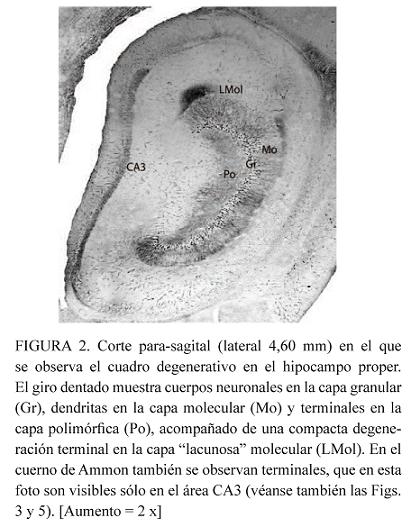
<ref-list>
<ref id="B1">
<nlm-citation citation-type="book">
<collab>A.P.A.</collab>
<source><![CDATA[Trastornos relacionados con sustancias: Manual diagnóstico y estadístico de los trastornos mentales]]></source>
<year>1995</year>
<page-range>181-278</page-range><publisher-name><![CDATA[Masson]]></publisher-name>
</nlm-citation>
</ref>
<ref id="B2">
<nlm-citation citation-type="book">
<person-group person-group-type="author">
<name>
<surname><![CDATA[Bentivoglio]]></surname>
<given-names><![CDATA[M.]]></given-names>
</name>
<name>
<surname><![CDATA[Kultas-Ilinsky]]></surname>
<given-names><![CDATA[K.]]></given-names>
</name>
<name>
<surname><![CDATA[Ilinsky]]></surname>
<given-names><![CDATA[I.]]></given-names>
</name>
</person-group>
<source><![CDATA[Limbic thalamus: Structure, intrinsic organization, and connections]]></source>
<year>1993</year>
<page-range>71-122</page-range><publisher-name><![CDATA[Vogt and Gabriel]]></publisher-name>
</nlm-citation>
</ref>
<ref id="B3">
<nlm-citation citation-type="journal">
<person-group person-group-type="author">
<name>
<surname><![CDATA[Broca]]></surname>
<given-names><![CDATA[P.]]></given-names>
</name>
</person-group>
<article-title xml:lang="fr"><![CDATA[Anatomie comparée des circonvolutions cérébrales: Le grand lobe limbique et la scissure limbique dans la série des mammiféres]]></article-title>
<source><![CDATA[Rev Anthrop]]></source>
<year>1878</year>
<volume>21</volume>
<page-range>384-498</page-range></nlm-citation>
</ref>
<ref id="B4">
<nlm-citation citation-type="book">
<person-group person-group-type="author">
<name>
<surname><![CDATA[Brodal]]></surname>
<given-names><![CDATA[A.]]></given-names>
</name>
</person-group>
<source><![CDATA[Neurological anatomy in relation to clinical medicine]]></source>
<year>1969</year>
<publisher-name><![CDATA[Oxford University Press]]></publisher-name>
</nlm-citation>
</ref>
<ref id="B5">
<nlm-citation citation-type="journal">
<person-group person-group-type="author">
<name>
<surname><![CDATA[Carlsson]]></surname>
<given-names><![CDATA[M.]]></given-names>
</name>
<name>
<surname><![CDATA[Carlsson]]></surname>
<given-names><![CDATA[A.]]></given-names>
</name>
</person-group>
<article-title xml:lang="en"><![CDATA[Schizophrenia: A subcortical imbalance syndrome?]]></article-title>
<source><![CDATA[Schizophrenia Bull]]></source>
<year>1990</year>
<volume>18</volume>
<page-range>425-532</page-range></nlm-citation>
</ref>
<ref id="B6">
<nlm-citation citation-type="journal">
<person-group person-group-type="author">
<name>
<surname><![CDATA[de Olmos]]></surname>
<given-names><![CDATA[J.]]></given-names>
</name>
<name>
<surname><![CDATA[Beltramino]]></surname>
<given-names><![CDATA[C.]]></given-names>
</name>
<name>
<surname><![CDATA[de Olmos]]></surname>
<given-names><![CDATA[S.]]></given-names>
</name>
</person-group>
<article-title xml:lang="en"><![CDATA[Use of Amino-Cupric-Silver technique for the detection of early and semiacute neuronal degeneration caused by neurotoxicants, hypoxia, and phisical trauma]]></article-title>
<source><![CDATA[Neurotoxicol Teratol]]></source>
<year>1994</year>
<volume>16</volume>
<page-range>545-561</page-range></nlm-citation>
</ref>
<ref id="B7">
<nlm-citation citation-type="book">
<person-group person-group-type="author">
<name>
<surname><![CDATA[de Olmos]]></surname>
<given-names><![CDATA[J.]]></given-names>
</name>
<name>
<surname><![CDATA[Beltramino]]></surname>
<given-names><![CDATA[C.]]></given-names>
</name>
<name>
<surname><![CDATA[Alheid]]></surname>
<given-names><![CDATA[G.]]></given-names>
</name>
</person-group>
<source><![CDATA[Amygdala and Extended Amygdala of the Rat: A Cytoarchitectonical, Fibroarchitectonical, and Chemoarchitectonical Survey]]></source>
<year>2004</year>
<page-range>509-603</page-range><publisher-name><![CDATA[Elsevier]]></publisher-name>
</nlm-citation>
</ref>
<ref id="B8">
<nlm-citation citation-type="journal">
<person-group person-group-type="author">
<name>
<surname><![CDATA[Ellison]]></surname>
<given-names><![CDATA[G.]]></given-names>
</name>
</person-group>
<article-title xml:lang="en"><![CDATA[The NMDA antagonist phenciclidine, ketamine and dizocilpine as both behavioral and anatomical models of the dementias]]></article-title>
<source><![CDATA[Brain Res. Rev]]></source>
<year>1995</year>
<volume>20</volume>
<page-range>250-267</page-range></nlm-citation>
</ref>
<ref id="B9">
<nlm-citation citation-type="journal">
<person-group person-group-type="author">
<name>
<surname><![CDATA[Farber]]></surname>
<given-names><![CDATA[N.]]></given-names>
</name>
<name>
<surname><![CDATA[Wozniak]]></surname>
<given-names><![CDATA[D.]]></given-names>
</name>
<name>
<surname><![CDATA[Price]]></surname>
<given-names><![CDATA[M.]]></given-names>
</name>
<name>
<surname><![CDATA[Labruyere]]></surname>
<given-names><![CDATA[J.]]></given-names>
</name>
<name>
<surname><![CDATA[Huss]]></surname>
<given-names><![CDATA[J.]]></given-names>
</name>
<name>
<surname><![CDATA[Peter]]></surname>
<given-names><![CDATA[H.]]></given-names>
</name>
<name>
<surname><![CDATA[Olney]]></surname>
<given-names><![CDATA[J.]]></given-names>
</name>
</person-group>
<article-title xml:lang="en"><![CDATA[Age-specific neurotoxicity in the rat associated with NMDA receptor blockade: potential relevance to schizophrenia?]]></article-title>
<source><![CDATA[Biol Psychiatry]]></source>
<year>1995</year>
<volume>38</volume>
<page-range>788-796</page-range></nlm-citation>
</ref>
<ref id="B10">
<nlm-citation citation-type="journal">
<person-group person-group-type="author">
<name>
<surname><![CDATA[Fix]]></surname>
<given-names><![CDATA[A.]]></given-names>
</name>
<name>
<surname><![CDATA[Ross]]></surname>
<given-names><![CDATA[J.]]></given-names>
</name>
<name>
<surname><![CDATA[Stitzel]]></surname>
<given-names><![CDATA[S.]]></given-names>
</name>
<name>
<surname><![CDATA[Switzer]]></surname>
<given-names><![CDATA[R.]]></given-names>
</name>
</person-group>
<article-title xml:lang="en"><![CDATA[Integrated evaluation of central nervous system lesions: stains for neurons, astrocytes, and microglia reveal the spatial and temporal features of MK801-induced neuronal necrosis in the rat cerebral cortex]]></article-title>
<source><![CDATA[Toxicol Pathol]]></source>
<year>1996</year>
<volume>24</volume>
<page-range>291-304</page-range></nlm-citation>
</ref>
<ref id="B11">
<nlm-citation citation-type="book">
<person-group person-group-type="author">
<name>
<surname><![CDATA[Gloor]]></surname>
<given-names><![CDATA[P.]]></given-names>
</name>
</person-group>
<source><![CDATA[The temporal lobe and limbic system]]></source>
<year>1997</year>
<publisher-name><![CDATA[Oxford]]></publisher-name>
</nlm-citation>
</ref>
<ref id="B12">
<nlm-citation citation-type="book">
<person-group person-group-type="author">
<name>
<surname><![CDATA[Guyton]]></surname>
<given-names><![CDATA[A.]]></given-names>
</name>
</person-group>
<source><![CDATA[Anatomía y fisiología del sistema nervioso]]></source>
<year>1999</year>
<publisher-name><![CDATA[Médica Panamericana]]></publisher-name>
</nlm-citation>
</ref>
<ref id="B13">
<nlm-citation citation-type="journal">
<person-group person-group-type="author">
<name>
<surname><![CDATA[Heimer]]></surname>
<given-names><![CDATA[L.]]></given-names>
</name>
<name>
<surname><![CDATA[Harlan]]></surname>
<given-names><![CDATA[R.]]></given-names>
</name>
<name>
<surname><![CDATA[Alheid]]></surname>
<given-names><![CDATA[G.]]></given-names>
</name>
<name>
<surname><![CDATA[García]]></surname>
<given-names><![CDATA[M.]]></given-names>
</name>
<name>
<surname><![CDATA[de Olmos]]></surname>
<given-names><![CDATA[J.]]></given-names>
</name>
</person-group>
<article-title xml:lang="en"><![CDATA[Substantia innominada: A notion which impedes clinical-anatomical correlations in neuropsychiatric disorders]]></article-title>
<source><![CDATA[Neurosci]]></source>
<year>1997</year>
<volume>76</volume>
<page-range>957-1006</page-range></nlm-citation>
</ref>
<ref id="B14">
<nlm-citation citation-type="journal">
<person-group person-group-type="author">
<name>
<surname><![CDATA[Heimer]]></surname>
<given-names><![CDATA[L.]]></given-names>
</name>
<name>
<surname><![CDATA[van Hoesen]]></surname>
<given-names><![CDATA[G.]]></given-names>
</name>
</person-group>
<article-title xml:lang="en"><![CDATA[The limbic lobe and its output channels: implications for emocional functions and adaptative behavior]]></article-title>
<source><![CDATA[Neurosci Biobehav Rev]]></source>
<year>2006</year>
<volume>30</volume>
<page-range>126-147</page-range></nlm-citation>
</ref>
<ref id="B15">
<nlm-citation citation-type="journal">
<person-group person-group-type="author">
<name>
<surname><![CDATA[Horváth]]></surname>
<given-names><![CDATA[Z.]]></given-names>
</name>
<name>
<surname><![CDATA[Czopf]]></surname>
<given-names><![CDATA[J.]]></given-names>
</name>
<name>
<surname><![CDATA[Buzsáki]]></surname>
<given-names><![CDATA[G.]]></given-names>
</name>
</person-group>
<article-title xml:lang="en"><![CDATA[MK801-induced neuronal damage in rats]]></article-title>
<source><![CDATA[Brain Res]]></source>
<year>1997</year>
<volume>753</volume>
<page-range>181-195</page-range></nlm-citation>
</ref>
<ref id="B16">
<nlm-citation citation-type="journal">
<person-group person-group-type="author">
<name>
<surname><![CDATA[Hur]]></surname>
<given-names><![CDATA[G.]]></given-names>
</name>
<name>
<surname><![CDATA[Son]]></surname>
<given-names><![CDATA[W.]]></given-names>
</name>
<name>
<surname><![CDATA[Shin]]></surname>
<given-names><![CDATA[S.]]></given-names>
</name>
<name>
<surname><![CDATA[Kang]]></surname>
<given-names><![CDATA[J.]]></given-names>
</name>
<name>
<surname><![CDATA[Kim]]></surname>
<given-names><![CDATA[Y.]]></given-names>
</name>
</person-group>
<article-title xml:lang="en"><![CDATA[Sex differences in dizocilpine (MK801) neurotoxicity in rats]]></article-title>
<source><![CDATA[Environm Toxicol Pharmacol]]></source>
<year>1999</year>
<volume>7</volume>
<page-range>143-146</page-range></nlm-citation>
</ref>
<ref id="B17">
<nlm-citation citation-type="journal">
<person-group person-group-type="author">
<name>
<surname><![CDATA[Kemp]]></surname>
<given-names><![CDATA[J.]]></given-names>
</name>
<name>
<surname><![CDATA[Foster]]></surname>
<given-names><![CDATA[A.]]></given-names>
</name>
<name>
<surname><![CDATA[Wong]]></surname>
<given-names><![CDATA[E.]]></given-names>
</name>
</person-group>
<article-title xml:lang="en"><![CDATA[Non-competitive antagonists of excitatory aminoacid receptors]]></article-title>
<source><![CDATA[Trends Neurosci]]></source>
<year>1987</year>
<volume>10</volume>
<page-range>294-298</page-range></nlm-citation>
</ref>
<ref id="B18">
<nlm-citation citation-type="journal">
<person-group person-group-type="author">
<name>
<surname><![CDATA[Lahti]]></surname>
<given-names><![CDATA[A.]]></given-names>
</name>
<name>
<surname><![CDATA[Holcomb]]></surname>
<given-names><![CDATA[H.]]></given-names>
</name>
<name>
<surname><![CDATA[Medoff]]></surname>
<given-names><![CDATA[C.]]></given-names>
</name>
<name>
<surname><![CDATA[Tamminga]]></surname>
<given-names><![CDATA[C.]]></given-names>
</name>
</person-group>
<article-title xml:lang="en"><![CDATA[Ketamine activates psychosis in schizophrenia and alters blood flow in human limbic cortex]]></article-title>
<source><![CDATA[NeuroReport]]></source>
<year>1995</year>
<volume>6</volume>
<page-range>869-872</page-range></nlm-citation>
</ref>
<ref id="B19">
<nlm-citation citation-type="book">
<person-group person-group-type="author">
<name>
<surname><![CDATA[Lautin]]></surname>
<given-names><![CDATA[A.]]></given-names>
</name>
</person-group>
<source><![CDATA[The limbic brain]]></source>
<year>2002</year>
<publisher-name><![CDATA[Kluwer Academic Publishers]]></publisher-name>
</nlm-citation>
</ref>
<ref id="B20">
<nlm-citation citation-type="journal">
<person-group person-group-type="author">
<name>
<surname><![CDATA[McLean]]></surname>
<given-names><![CDATA[P.]]></given-names>
</name>
</person-group>
<article-title xml:lang="en"><![CDATA[Some psychiatric implications of physiological studies on the frontotemporal portion of the limbic system (visceral brain)]]></article-title>
<source><![CDATA[Electroencephalogr Clin Neurophysiol]]></source>
<year>1952</year>
<volume>4</volume>
<page-range>407-418</page-range></nlm-citation>
</ref>
<ref id="B21">
<nlm-citation citation-type="book">
<person-group person-group-type="author">
<name>
<surname><![CDATA[McLean]]></surname>
<given-names><![CDATA[P.]]></given-names>
</name>
</person-group>
<source><![CDATA[The triune brain, emotion and scientific bias, in the neurosciences: second study program]]></source>
<year>1970</year>
<page-range>336-349</page-range><publisher-name><![CDATA[F. Schmitt]]></publisher-name>
</nlm-citation>
</ref>
<ref id="B22">
<nlm-citation citation-type="journal">
<person-group person-group-type="author">
<name>
<surname><![CDATA[Mega]]></surname>
<given-names><![CDATA[M.]]></given-names>
</name>
<name>
<surname><![CDATA[Cummings]]></surname>
<given-names><![CDATA[J.]]></given-names>
</name>
<name>
<surname><![CDATA[Salloway]]></surname>
<given-names><![CDATA[S.]]></given-names>
</name>
<name>
<surname><![CDATA[Malloy]]></surname>
<given-names><![CDATA[P.]]></given-names>
</name>
</person-group>
<article-title xml:lang="en"><![CDATA[The limbic system: an anatomic, phylogenetic, and clinical perspective]]></article-title>
<source><![CDATA[J Neuropsychiat Clin Neurosci]]></source>
<year>1997</year>
<volume>9</volume>
<page-range>315-330</page-range></nlm-citation>
</ref>
<ref id="B23">
<nlm-citation citation-type="journal">
<person-group person-group-type="author">
<name>
<surname><![CDATA[Nauta]]></surname>
<given-names><![CDATA[W.]]></given-names>
</name>
</person-group>
<article-title xml:lang="en"><![CDATA[Hipocampal projections and related neural pathways to the mid-brain in the cat]]></article-title>
<source><![CDATA[Brain]]></source>
<year>1958</year>
<volume>81</volume>
<page-range>319-340</page-range></nlm-citation>
</ref>
<ref id="B24">
<nlm-citation citation-type="journal">
<person-group person-group-type="author">
<name>
<surname><![CDATA[Olney]]></surname>
<given-names><![CDATA[J.]]></given-names>
</name>
<name>
<surname><![CDATA[Labruyere]]></surname>
<given-names><![CDATA[J.]]></given-names>
</name>
<name>
<surname><![CDATA[Price]]></surname>
<given-names><![CDATA[M.]]></given-names>
</name>
</person-group>
<article-title xml:lang="en"><![CDATA[Pathological changens induced in cerebrocortical neurons by phenciclidine and related drugs]]></article-title>
<source><![CDATA[Science]]></source>
<year>1989</year>
<volume>244</volume>
<page-range>1360-1362</page-range></nlm-citation>
</ref>
<ref id="B25">
<nlm-citation citation-type="journal">
<person-group person-group-type="author">
<name>
<surname><![CDATA[Olney]]></surname>
<given-names><![CDATA[J.]]></given-names>
</name>
<name>
<surname><![CDATA[Newcomer]]></surname>
<given-names><![CDATA[J.]]></given-names>
</name>
<name>
<surname><![CDATA[Farber]]></surname>
<given-names><![CDATA[N.]]></given-names>
</name>
</person-group>
<article-title xml:lang="en"><![CDATA[NMDA receptor hypofunction model of schizophrenia]]></article-title>
<source><![CDATA[J Psychiatr Res]]></source>
<year>1999</year>
<volume>33</volume>
<page-range>523-533</page-range></nlm-citation>
</ref>
<ref id="B26">
<nlm-citation citation-type="book">
<person-group person-group-type="author">
<name>
<surname><![CDATA[Palomero-Gallagher]]></surname>
<given-names><![CDATA[N.]]></given-names>
</name>
<name>
<surname><![CDATA[Zilles]]></surname>
<given-names><![CDATA[K.]]></given-names>
</name>
</person-group>
<source><![CDATA[Isocortex: The rat nervous system]]></source>
<year>2004</year>
<page-range>729-757</page-range><publisher-name><![CDATA[Elsevier]]></publisher-name>
</nlm-citation>
</ref>
<ref id="B27">
<nlm-citation citation-type="journal">
<person-group person-group-type="author">
<name>
<surname><![CDATA[Papez]]></surname>
<given-names><![CDATA[J.]]></given-names>
</name>
</person-group>
<article-title xml:lang="en"><![CDATA[A proposed mechanism of emotion]]></article-title>
<source><![CDATA[Arch Neurol Psychiatry]]></source>
<year>1937</year>
<volume>38</volume>
<page-range>725-733</page-range></nlm-citation>
</ref>
<ref id="B28">
<nlm-citation citation-type="book">
<person-group person-group-type="author">
<name>
<surname><![CDATA[Paxinos]]></surname>
<given-names><![CDATA[G.]]></given-names>
</name>
<name>
<surname><![CDATA[Watson]]></surname>
<given-names><![CDATA[C.]]></given-names>
</name>
</person-group>
<source><![CDATA[The rat brain in stereotaxic coordinates]]></source>
<year>2006</year>
<publisher-name><![CDATA[Academic Press]]></publisher-name>
</nlm-citation>
</ref>
<ref id="B29">
<nlm-citation citation-type="book">
<person-group person-group-type="author">
<name>
<surname><![CDATA[Reichert]]></surname>
<given-names><![CDATA[K.]]></given-names>
</name>
</person-group>
<source><![CDATA[Der Baus des Menschlichen Gehirns durch Abbildung mit erlauterndem]]></source>
<year>1859</year>
<publisher-loc><![CDATA[Leipzig ]]></publisher-loc>
<publisher-name><![CDATA[Engelmann]]></publisher-name>
</nlm-citation>
</ref>
<ref id="B30">
<nlm-citation citation-type="journal">
<person-group person-group-type="author">
<name>
<surname><![CDATA[Reil]]></surname>
<given-names><![CDATA[J.]]></given-names>
</name>
</person-group>
<article-title xml:lang="de"><![CDATA[Untersuchungen über den Bau des grossen Gehirn im Menschen]]></article-title>
<source><![CDATA[Arch Physiol]]></source>
<year>1809</year>
<volume>9</volume>
<page-range>136-208</page-range></nlm-citation>
</ref>
<ref id="B31">
<nlm-citation citation-type="book">
<person-group person-group-type="author">
<name>
<surname><![CDATA[Risold]]></surname>
<given-names><![CDATA[P.]]></given-names>
</name>
</person-group>
<source><![CDATA[The Septal Region: The rat nervous system]]></source>
<year>2004</year>
<page-range>605-632</page-range><publisher-name><![CDATA[Elsevier]]></publisher-name>
</nlm-citation>
</ref>
<ref id="B32">
<nlm-citation citation-type="journal">
<person-group person-group-type="author">
<name>
<surname><![CDATA[Switzer III]]></surname>
<given-names><![CDATA[R.]]></given-names>
</name>
</person-group>
<article-title xml:lang="en"><![CDATA[Application of silver degeneration stains for neurotoxicity testing]]></article-title>
<source><![CDATA[Toxicol Pathol]]></source>
<year>2000</year>
<volume>28</volume>
<page-range>70-83</page-range></nlm-citation>
</ref>
<ref id="B33">
<nlm-citation citation-type="journal">
<person-group person-group-type="author">
<name>
<surname><![CDATA[Tamminga]]></surname>
<given-names><![CDATA[C.]]></given-names>
</name>
<name>
<surname><![CDATA[Vogel]]></surname>
<given-names><![CDATA[M.]]></given-names>
</name>
<name>
<surname><![CDATA[Gao]]></surname>
<given-names><![CDATA[X.]]></given-names>
</name>
<name>
<surname><![CDATA[Lahti]]></surname>
<given-names><![CDATA[A.]]></given-names>
</name>
<name>
<surname><![CDATA[Holcomb]]></surname>
<given-names><![CDATA[H.]]></given-names>
</name>
</person-group>
<article-title xml:lang="en"><![CDATA[The limbic cortex in schizophrenia: focus on the anterior cingulate]]></article-title>
<source><![CDATA[Brain Res Rev]]></source>
<year>2000</year>
<volume>31</volume>
<page-range>364-370</page-range></nlm-citation>
</ref>
<ref id="B34">
<nlm-citation citation-type="book">
<person-group person-group-type="author">
<name>
<surname><![CDATA[Vogt]]></surname>
<given-names><![CDATA[B.]]></given-names>
</name>
<name>
<surname><![CDATA[Vogt]]></surname>
<given-names><![CDATA[L.]]></given-names>
</name>
<name>
<surname><![CDATA[Farber]]></surname>
<given-names><![CDATA[N.]]></given-names>
</name>
</person-group>
<source><![CDATA[Cingulate cortex and disease models: The rat nervous system]]></source>
<year>2004</year>
<page-range>705-726</page-range><publisher-name><![CDATA[Elsevier]]></publisher-name>
</nlm-citation>
</ref>
<ref id="B35">
<nlm-citation citation-type="journal">
<person-group person-group-type="author">
<name>
<surname><![CDATA[Yakovlev]]></surname>
<given-names><![CDATA[P.]]></given-names>
</name>
</person-group>
<article-title xml:lang="en"><![CDATA[Motility, behavior, and the brain]]></article-title>
<source><![CDATA[J Nerv ment Dis]]></source>
<year>1948</year>
<volume>107</volume>
<page-range>313-335</page-range></nlm-citation>
</ref>
<ref id="B36">
<nlm-citation citation-type="book">
<person-group person-group-type="author">
<name>
<surname><![CDATA[Yakovlev]]></surname>
<given-names><![CDATA[P.]]></given-names>
</name>
<name>
<surname><![CDATA[Locke]]></surname>
<given-names><![CDATA[S.]]></given-names>
</name>
<name>
<surname><![CDATA[Angevine]]></surname>
<given-names><![CDATA[J.]]></given-names>
</name>
</person-group>
<source><![CDATA[The limbus of the cerebral hemisphere, limbic nuclei of the thalamus, and the cingulum bundle: The Thalamus]]></source>
<year>1966</year>
<page-range>77-97</page-range><publisher-name><![CDATA[Columbia University Press]]></publisher-name>
</nlm-citation>
</ref>
</ref-list>
</back>
</article>