<?xml version="1.0" encoding="ISO-8859-1"?><article xmlns:mml="http://www.w3.org/1998/Math/MathML" xmlns:xlink="http://www.w3.org/1999/xlink" xmlns:xsi="http://www.w3.org/2001/XMLSchema-instance">
<front>
<journal-meta>
<journal-id>1688-4221</journal-id>
<journal-title><![CDATA[Ciencias Psicológicas]]></journal-title>
<abbrev-journal-title><![CDATA[Cienc. Psicol.]]></abbrev-journal-title>
<issn>1688-4221</issn>
<publisher>
<publisher-name><![CDATA[Universidad Católica del Uruguay.]]></publisher-name>
</publisher>
</journal-meta>
<article-meta>
<article-id>S1688-42212009000100006</article-id>
<title-group>
<article-title xml:lang="es"><![CDATA[Las habilidades sociales en niños preescolares en contextos de pobreza]]></article-title>
<article-title xml:lang="en"><![CDATA[Social abilities in pre-school children in poverty environments]]></article-title>
</title-group>
<contrib-group>
<contrib contrib-type="author">
<name>
<surname><![CDATA[Lacunza]]></surname>
<given-names><![CDATA[Ana Betina]]></given-names>
</name>
<xref ref-type="aff" rid="A01"/>
</contrib>
<contrib contrib-type="author">
<name>
<surname><![CDATA[Contini de González]]></surname>
<given-names><![CDATA[Norma]]></given-names>
</name>
<xref ref-type="aff" rid="A02"/>
</contrib>
</contrib-group>
<aff id="A01">
<institution><![CDATA[,Universidad Nacional de Tucumán  ]]></institution>
<addr-line><![CDATA[ ]]></addr-line>
<country>Argentina</country>
</aff>
<aff id="A02">
<institution><![CDATA[,Universidad Nacional de Tucumán  ]]></institution>
<addr-line><![CDATA[ ]]></addr-line>
<country>Argentina</country>
</aff>
<pub-date pub-type="pub">
<day>00</day>
<month>05</month>
<year>2009</year>
</pub-date>
<pub-date pub-type="epub">
<day>00</day>
<month>05</month>
<year>2009</year>
</pub-date>
<volume>3</volume>
<numero>1</numero>
<fpage>57</fpage>
<lpage>66</lpage>
<copyright-statement/>
<copyright-year/>
<self-uri xlink:href="http://www.scielo.edu.uy/scielo.php?script=sci_arttext&amp;pid=S1688-42212009000100006&amp;lng=en&amp;nrm=iso"></self-uri><self-uri xlink:href="http://www.scielo.edu.uy/scielo.php?script=sci_abstract&amp;pid=S1688-42212009000100006&amp;lng=en&amp;nrm=iso"></self-uri><self-uri xlink:href="http://www.scielo.edu.uy/scielo.php?script=sci_pdf&amp;pid=S1688-42212009000100006&amp;lng=en&amp;nrm=iso"></self-uri><abstract abstract-type="short" xml:lang="es"><p><![CDATA[Las investigaciones han encontrado sólidas relaciones entre la competencia social en la infancia y el funcionamiento social posterior. El estudio de las habilidades sociales en la infancia está centrado en prevenir dificultades de adaptación y posibilitar el desarrollo de recursos personales en diferentes contextos. El objetivo de este trabajo fue describir una serie de habilidades sociales en 318 niños de 3 a 5 años de S.M. de Tucumán (Argentina) en situación de pobreza. Se aplicó una Escala de Habilidades Sociales a los padres y una encuesta sociodemográfica, considerándose el nivel socioeconómico. Los resultados no identificaron diferencias estadísticas significativas según los niveles de pobreza y el sexo de los niños. Posteriormente se analizó la cualidad de las habilidades sociales descriptas. Los resultados permiten afirmar que a pesar del contexto de pobreza, los niños participantes mostraron una serie de habilidades sociales positivas, por lo que se las considera un recurso de salud]]></p></abstract>
<abstract abstract-type="short" xml:lang="en"><p><![CDATA[Research has shown a close relationship between social competence in childhood and the subsequent social performance. The study of social abilities in childhood focuses on preventing difficulties with adaption and facilitating the development of personal resources in different contexts. The aim of this work was to describe a series of social abilities in 318 children between 3 and 5 years old from San Miguel de Tucumán, Argentina who live under poverty conditions. Taking into consideration the socioeconomic level, a Scale on Social Abilities and a sociodemographic survey were administered to parents. The results showed no statistically significant differences in relation to poverty levels and the children&rsquo;s sex. The quality of the social abilities described was subsequently analyzed. The results show that, despite the context of poverty, the children involved showed positive social abilities; therefore, these abilities are considered as a health resource]]></p></abstract>
<kwd-group>
<kwd lng="es"><![CDATA[habilidades sociales]]></kwd>
<kwd lng="es"><![CDATA[niño preescolar]]></kwd>
<kwd lng="es"><![CDATA[pobreza]]></kwd>
<kwd lng="en"><![CDATA[social abilities]]></kwd>
<kwd lng="en"><![CDATA[pre-school children]]></kwd>
<kwd lng="en"><![CDATA[poverty]]></kwd>
</kwd-group>
</article-meta>
</front><body><![CDATA[ <div class="Section1">      <p style="margin: 2.85pt 134.25pt 0.0001pt 27pt; text-align: center; line-height: 120%;" align="center"><b><span style="font-size: 16pt; line-height: 120%; font-family: Arial;" lang="ES-UY">LAS HABILIDADES SOCIALES EN NI&Ntilde;OS PREESCOLARES EN CONTEXTOS DE POBREZA</span></b><span style="font-size: 16pt; line-height: 120%; font-family: Arial;" lang="ES-UY"><o:p></o:p></span></p>       <p style="margin: 5pt 134.25pt 0.0001pt 27pt; text-align: center; line-height: 120%;" align="center"><span style="font-size: 16pt; line-height: 120%; font-family: Arial;" lang="ES-UY"><o:p>&nbsp;</o:p></span></p>       <p style="margin: 5pt 134.25pt 0.0001pt 27pt; text-align: center; line-height: 120%;" align="center"><b><span style="font-size: 16pt; line-height: 120%; font-family: Arial;" lang="EN-US">SOCIAL ABILITIES IN PRE-SCHOOL CHILDREN IN POVERTY ENVIRONMENTS</span></b><span style="font-size: 16pt; line-height: 120%; font-family: Arial;" lang="EN-US"><o:p></o:p></span></p>       <p style="margin: 5pt 134.25pt 0.0001pt 27pt; text-align: center; line-height: 120%;" align="center"><span style="font-family: Arial;" lang="EN-GB"><o:p>&nbsp;</o:p></span></p>       <p style="margin: 5pt 134.25pt 0.0001pt 27pt; text-align: center; line-height: 120%;" align="center"><span style="font-family: Arial;" lang="EN-GB"><o:p>&nbsp;</o:p></span></p>       <p style="margin: 5pt 134.25pt 0.0001pt 27pt; text-align: center; line-height: 120%;" align="center"><b><span style="font-family: Arial;" lang="ES-UY">Ana Betina Lacunza</span></b><span style="font-family: Arial;" lang="ES-UY"><o:p></o:p></span></p>       <p style="margin: 5pt 134.25pt 0.0001pt 27pt; text-align: center; line-height: 120%;" align="center"><span style="font-family: Arial;" lang="ES-UY">Universidad Nacional de Tucum&aacute;n, Argentina<o:p></o:p></span></p>       <p style="margin: 2.85pt 134.25pt 0.0001pt 27pt; text-align: center; line-height: 120%;" align="center"><b><span style="font-family: Arial;" lang="ES-UY"><o:p>&nbsp;</o:p></span></b></p>       <p style="margin: 2.85pt 134.25pt 0.0001pt 27pt; text-align: center; line-height: 120%;" align="center"><b><span style="font-family: Arial;" lang="ES-UY">Norma Contini de Gonz&aacute;lez</span></b><span style="font-family: Arial;" lang="ES-UY"><o:p></o:p></span></p>       ]]></body>
<body><![CDATA[<p style="margin: 5pt 134.25pt 0.0001pt 27pt; text-align: center; line-height: 120%;" align="center"><span style="font-family: Arial;" lang="ES-UY">Universidad Nacional de Tucum&aacute;n, Argentina<o:p></o:p></span></p>       <p style="margin: 5pt 134.25pt 0.0001pt 27pt; text-align: justify; line-height: 120%;"><span style="font-family: Arial;" lang="ES-UY"><o:p>&nbsp;</o:p></span></p>       <p style="margin: 5pt 134.25pt 0.0001pt 27pt; text-align: justify; line-height: 120%;"><span style="font-family: Arial;" lang="ES-UY"><o:p>&nbsp;</o:p></span></p>       <p style="margin: 5pt 134.25pt 0.0001pt 27pt; text-align: justify; line-height: 120%;"><b><span style="font-family: Arial;" lang="ES-UY">Resumen: </span></b><span style="font-family: Arial;" lang="ES-UY">Las investigaciones han encontrado s&oacute;lidas relaciones entre la competencia social en la infancia y el funcionamiento social posterior. El estudio de las habilidades sociales en la infancia est&aacute; centrado en prevenir dificultades de adaptaci&oacute;n y posibilitar el desarrollo de recursos personales en diferentes contextos. <o:p></o:p></span></p>       <p style="margin: 5pt 134.25pt 0.0001pt 27pt; text-align: justify; line-height: 120%;"><span style="font-family: Arial;" lang="ES-UY">El objetivo de este trabajo fue describir una serie de habilidades sociales en 318 ni&ntilde;os de 3 a 5 a&ntilde;os de S.M. de Tucum&aacute;n (Argentina) en situaci&oacute;n de pobreza.<o:p></o:p></span></p>       <p style="margin: 5pt 134.25pt 0.0001pt 27pt; text-align: justify; line-height: 120%;"><span style="font-family: Arial;" lang="ES-UY">Se aplic&oacute; una Escala de Habilidades Sociales a los padres y una encuesta sociodemogr&aacute;fica, consider&aacute;ndose el nivel socioecon&oacute;mico.<o:p></o:p></span></p>       <p style="margin: 5pt 134.25pt 0.0001pt 27pt; text-align: justify; line-height: 120%;"><span style="font-family: Arial;" lang="ES-UY">Los resultados no identificaron diferencias estad&iacute;sticas significativas seg&uacute;n los niveles de pobreza y el sexo de los ni&ntilde;os. Posteriormente se analiz&oacute; la cualidad de las habilidades sociales descriptas. Los resultados permiten afirmar que a pesar del contexto de pobreza, los ni&ntilde;os participantes mostraron una serie de habilidades sociales positivas, por lo que se las considera un recurso de salud. <o:p></o:p></span></p>       <p style="margin: 5pt 134.25pt 0.0001pt 27pt; text-align: justify; line-height: 120%;"><b><span style="font-family: Arial;" lang="ES-UY">Palabras clave:</span></b><span style="font-family: Arial;" lang="ES-UY"> habilidades sociales, ni&ntilde;o preescolar, pobreza.<o:p></o:p></span></p>       <p style="margin: 5pt 134.25pt 0.0001pt 27pt; text-align: justify; line-height: 120%;"><span style="font-family: Arial;" lang="ES-UY"><o:p>&nbsp;</o:p></span></p>       <p style="margin: 5pt 134.25pt 0.0001pt 27pt; text-align: justify; line-height: 120%;"><b><span style="font-family: Arial;" lang="EN-US">Abstract: </span></b><span style="font-family: Arial;" lang="EN-US">Research has shown a close relationship between social competence in childhood and the subsequent social performance. The study of social abilities in childhood focuses on preventing difficulties with <span class="SpellE">adaption</span> and facilitating the development of personal resources in different contexts. </span><span style="font-family: Arial;" lang="EN-GB"><o:p></o:p></span></p>       ]]></body>
<body><![CDATA[<p style="margin: 5pt 134.25pt 0.0001pt 27pt; text-align: justify; line-height: 120%;"><span style="font-family: Arial;" lang="EN-US">The aim of this work was to describe a series of social abilities in 318 children between 3 and 5 years old from </span><st1:place><st1:city><span style="font-family: Arial;" lang="EN-US">San Miguel de <span class="SpellE">Tucum&aacute;n</span></span></st1:city><span style="font-family: Arial;" lang="EN-US">, </span><st1:country-region><span style="font-family: Arial;" lang="EN-US">Argentina</span></st1:country-region></st1:place><span style="font-family: Arial;" lang="EN-US"> who live under poverty conditions.<o:p></o:p></span></p>       <p style="margin: 5pt 134.25pt 0.0001pt 27pt; text-align: justify; line-height: 120%;"><span style="font-family: Arial;" lang="EN-US">Taking into consideration the socioeconomic level, a Scale on Social Abilities and a <span class="SpellE">sociodemographic</span> survey were administered to parents.<o:p></o:p></span></p>       <p style="margin: 5pt 134.25pt 0.0001pt 27pt; text-align: justify; line-height: 120%;"><span style="font-family: Arial;" lang="EN-US">The results showed no statistically significant differences in relation to poverty levels and the children&rsquo;s sex. The quality of the social abilities described was subsequently analyzed. The results show that, despite the context of poverty, the children involved showed positive social abilities; therefore, these abilities are considered as a health resource.<o:p></o:p></span></p>       <p style="margin: 5pt 134.25pt 0.0001pt 27pt; text-align: justify; line-height: 120%;"><b><span style="font-family: Arial;" lang="EN-US">Keywords:</span></b><span style="font-family: Arial;" lang="EN-US"> social abilities, pre-school children, poverty.</span><span style="font-family: Arial;" lang="EN-GB"><o:p></o:p></span></p>       <p class="western" style="margin: 5pt 134.25pt 12pt 27pt; text-align: justify;"><span style="font-size: 12pt; line-height: 115%; font-family: Arial;" lang="EN-GB"><o:p>&nbsp;</o:p></span></p>       <p style="margin: 5pt 134.25pt 0.0001pt 27pt; text-align: justify; line-height: 120%;"><span style="font-size: 11pt; line-height: 120%; font-family: Arial;" lang="ES-UY">Correspondencia: Ana Betina Lacunza. Consejo Nacional de Investigaciones Cient&iacute;ficas y T&eacute;cnicas (CONICET). Fac. de Ciencias de la Salud, Universidad del Norte Santo Tom&aacute;s de Aquino, Argentina. Correo Electr&oacute;nico: <a href="mailto:file:///C:/SciELO/serial/cp/v3n1/Body/anabetinalacunza@ciudad.com.ar">anabetinalacunza@ciudad.com.ar</a>.<o:p></o:p></span></p>       <p class="western" style="margin: 5pt 134.25pt 0.0001pt 27pt; text-align: justify; text-indent: 14.2pt; line-height: 150%;"><span style="font-size: 12pt; line-height: 150%; font-family: Arial;" lang="ES-UY"><o:p>&nbsp;</o:p></span></p>       <p class="western" style="margin: 5pt 134.25pt 0.0001pt 27pt; text-align: justify; text-indent: 14.2pt; line-height: 150%;"><span style="font-size: 12pt; line-height: 150%; font-family: Arial;" lang="ES-UY"><o:p>&nbsp;</o:p></span></p>       <p class="western" style="margin: 5pt 134.25pt 0.0001pt 27pt; text-align: center; text-indent: 14.2pt; line-height: 150%;" align="center"><b><span style="font-size: 12pt; line-height: 150%; font-family: Arial;" lang="ES-UY">INTRODUCCI&Oacute;N<o:p></o:p></span></b></p>       <p class="western" style="margin: 5pt 134.25pt 0.0001pt 27pt; text-align: center; text-indent: 14.2pt; line-height: 150%;" align="center"><span style="font-size: 12pt; line-height: 150%; font-family: Arial;" lang="ES-UY"><o:p>&nbsp;</o:p></span></p>       ]]></body>
<body><![CDATA[<p class="western" style="margin: 8.5pt 134.25pt 0.0001pt 27pt; text-align: justify; text-indent: 14.2pt; line-height: 150%;"><span style="font-size: 12pt; line-height: 150%; font-family: Arial;" lang="ES-UY">Las habilidades sociales constituyen un amplio campo de investigaci&oacute;n, con importantes desarrollos te&oacute;ricos y metodol&oacute;gicos en las &uacute;ltimas d&eacute;cadas, y han despertado gran inter&eacute;s en diferentes &aacute;reas de la Psicolog&iacute;a por sus aplicaciones.<o:p></o:p></span></p>       <p class="western" style="margin: 8.5pt 134.25pt 0.0001pt 27pt; text-align: justify; text-indent: 14.2pt; line-height: 150%;"><span style="font-size: 12pt; line-height: 150%; font-family: Arial;" lang="ES-UY"><o:p>&nbsp;</o:p></span></p>       <p class="western" style="margin: 5pt 134.25pt 0.0001pt 27pt; text-align: justify; text-indent: 14.2pt; line-height: 150%;"><span style="font-size: 12pt; line-height: 150%; font-family: Arial;" lang="ES-UY">Las destrezas sociales son una parte esencial de la actividad humana ya que el discurrir de la vida est&aacute; determinado, al menor parcialmente, por el rango de las habilidades sociales (<a name="Caballo2005."></a><a href="#Caballo2">Caballo</a>, 2005). Distintos estudios se&ntilde;alan que las habilidades sociales inciden en la autoestima, en la adopci&oacute;n de roles, en la autorregulaci&oacute;n del comportamiento y en el rendimiento acad&eacute;mico, entre otros aspectos, tanto en la infancia como en la vida adulta (<a name="Gil1995."></a><a href="#Gil">Gil Rodr&iacute;guez, Le&oacute;n Rubio &amp; Jarana Exp&oacute;sito</a>, 1995; <a name="Kennedy1992."></a><a href="#Kennedy">Kennedy</a>, 1992; <a href="#Monjas2">Monjas </a><a name="Casares2002."></a><a href="#Monjas2">Casares</a>, 2002; <a name="Ovejero1998."></a><a href="#Ovejero">Ovejero Bernal</a>, 1998). <o:p></o:p></span></p>       <p class="western" style="margin: 5pt 134.25pt 0.0001pt 27pt; text-align: justify; text-indent: 14.2pt; line-height: 150%;"><span style="font-size: 12pt; line-height: 150%; font-family: Arial;" lang="ES-UY"><o:p>&nbsp;</o:p></span></p>       <p class="western" style="margin: 5pt 134.25pt 0.0001pt 27pt; text-align: justify; text-indent: 14.2pt; line-height: 150%;"><span style="font-size: 12pt; line-height: 150%; font-family: Arial;" lang="ES-UY">Se considera que las habilidades sociales son un medio excepcional de protecci&oacute;n y promoci&oacute;n de la salud ya que los comportamientos sociales positivos favorecen la adaptaci&oacute;n, la aceptaci&oacute;n de los otros, los refuerzos positivos y el bienestar del sujeto (<a name="Crespo2006."></a><a href="#Crespo">Crespo Rica</a>, 2006; <a name="Prieto2000."></a><a href="#Prieto">Prieto Ursua</a>, 2000). <o:p></o:p></span></p>       <p class="western" style="margin: 5pt 134.25pt 0.0001pt 27pt; text-align: justify; text-indent: 14.2pt; line-height: 150%;"><span style="font-size: 12pt; line-height: 150%; font-family: Arial;" lang="ES-UY"><o:p>&nbsp;</o:p></span></p>       <p class="western" style="margin: 5pt 134.25pt 0.0001pt 27pt; text-align: justify; text-indent: 14.2pt; line-height: 150%;"><span style="font-size: 12pt; line-height: 150%; font-family: Arial;" lang="ES-UY">Los comportamientos sociales se aprenden a lo largo del ciclo vital, por lo que ciertas conductas de los ni&ntilde;os para relacionarse con sus pares, ser amable con los adultos o reaccionar agresivamente, entre otras, depende del proceso de socializaci&oacute;n. Diferentes enfoques evolutivos coinciden en se&ntilde;alar que este proceso se inicia con el nacimiento del ni&ntilde;o. Por ejemplo, desde una perspectiva conductista se han encontrado indicios de una interacci&oacute;n social primaria ya en los primeros meses de vida. El estudio de <a name="Kaye1982."></a><a href="#Kaye">Kaye</a> (1982) ha demostrado que durante el amamantamiento se configura una especie de di&aacute;logo entre el comportamiento de la madre y el ni&ntilde;o; las madres tienden a interactuar con sus hijos siguiendo un modelo actividad-pausa de la succi&oacute;n. Esta evidencia se&ntilde;ala que la base de la interacci&oacute;n social primaria se produce en relaci&oacute;n a dos factores: a) el comportamiento espont&aacute;neo del ni&ntilde;o, organizado temporalmente seg&uacute;n mecanismos end&oacute;genos y b) la sensibilidad de la madre para esta periodicidad y su disponibilidad para adaptarse a este modelo (<a name="Schaffer1990."></a><a href="#Shaffer">Schaffer</a>, 1990). Por su parte, las investigaciones longitudinales de&nbsp;<a name="Dunn1988."></a><a href="#Dunn">Dunn</a> (1988) en ni&ntilde;os brit&aacute;nicos muestran que la comprensi&oacute;n social de aquellos se inicia antes de la adquisici&oacute;n plena del lenguaje. Esta autora trata de mostrar c&oacute;mo los ni&ntilde;os van conformando capacidades cognitivas que hacen posible experimentar y comprender posteriormente las situaciones sociales. A los dos o tres a&ntilde;os de vida, el ni&ntilde;o vivencia una serie de situaciones que le permite organizar el mundo social y comprender normas, prohibiciones tanto como la expresi&oacute;n de sus propios derechos. Esto lo lleva a percibirse a si mismo y a los otros y, por lo tanto, a adquirir una competencia social (1994). <o:p></o:p></span></p>       <p class="western" style="margin: 5pt 134.25pt 0.0001pt 27pt; text-align: justify; text-indent: 14.2pt; line-height: 150%;"><span style="font-size: 12pt; line-height: 150%; font-family: Arial;" lang="ES-UY"><o:p>&nbsp;</o:p></span></p>       <p class="western" style="margin: 5pt 134.25pt 0.0001pt 27pt; text-align: justify; text-indent: 14.2pt; line-height: 150%;"><span style="font-size: 12pt; line-height: 150%; font-family: Arial;" lang="ES-UY">Estos estudios evolutivos destacan c&oacute;mo la socializaci&oacute;n de un ni&ntilde;o en sus primeros a&ntilde;os de vida se produce gracias a la interrelaci&oacute;n de factores biol&oacute;gicos, cognitivos y emocionales. Respecto al factor biol&oacute;gico cabe destacar la estructura corp&oacute;rea (por ejemplo, el aparato oral, los &oacute;rganos de los sentidos, entre otros) y funcional que facilitan la utilizaci&oacute;n de dichas estructuras. Ahora bien, el uso de estas estructuras est&aacute; regulado por la sensibilidad materna ante el comportamiento del ni&ntilde;o. Por otro lado, los factores cognitivos son necesarios para el comportamiento social, ya que la memoria y las reestructuraciones cognitivas logradas hacia fines del primer a&ntilde;o de vida tienen efecto en el comportamiento social. <o:p></o:p></span></p>       <p class="western" style="margin: 5pt 134.25pt 0.0001pt 27pt; text-align: justify; text-indent: 14.2pt; line-height: 150%;"><span style="font-size: 12pt; line-height: 150%; font-family: Arial;" lang="ES-UY"><o:p>&nbsp;</o:p></span></p>       ]]></body>
<body><![CDATA[<p class="western" style="margin: 5pt 134.25pt 0.0001pt 27pt; text-align: justify; text-indent: 14.2pt; line-height: 150%;"><span style="font-size: 12pt; line-height: 150%; font-family: Arial;" lang="ES-UY">Entre estos desarrollos cognitivos se encuentran la capacidad de superar la situaci&oacute;n inmediata, la capacidad para considerar varios acontecimientos simult&aacute;neamente, la diferenciaci&oacute;n medio-fin y una mayor flexibilidad en el despliegue de la atenci&oacute;n, principalmente a partir del cuatro y quinto estadio del desarrollo sensoriomotriz (<a name="Oiberman2002."></a><a href="#Oiberman">Oiberman, Mansilla &amp; Orellana</a>, 2002; <a name="Piaget2000."></a><a href="#Piaget">Piaget &amp; Inhelder</a>, 2000/ 1969). A esto se agrega el lenguaje verbal, m&aacute;s desarrollado a los dos a&ntilde;os. Entre los aspectos emocionales se destaca la conformaci&oacute;n de una conducta de apego, puesto que distintos autores (<a name="Ainsworth1974."></a><a href="#Ainsworth">Ainsworth</a>, 1974; <a name="Bowlby1983."></a><a href="#Bowlby1">Bowlby, 1983</a>, <a name="Bowlby1986."></a><a href="#Bowlby2">1986</a>, <a name="Bowlby1989."></a><a href="#Bowlby3">1989</a>, <a name="Casullo2005."></a><a href="#Casullo">Casullo &amp; Fern&aacute;ndez Liporace</a>, 2005) afirman que la internalizaci&oacute;n de experiencias vinculares dan lugar a modelos de comportamiento psicosocial, puesto que se ha comprobado, siempre y cuando el desarrollo evolutivo sea normal, que la conducta de apego lleva al establecimiento de v&iacute;nculos afectivos entre el ni&ntilde;o y su cuidador, en un principio, como entre los adultos, tiempo m&aacute;s tarde. El apego tiene una funci&oacute;n adaptativa para el ni&ntilde;o, los padres y el grupo familiar, como as&iacute; tambi&eacute;n para la especie. Desde una visi&oacute;n objetiva, su sentido &uacute;ltimo es favorecer la supervivencia, manteniendo pr&oacute;ximos y en contacto a las cr&iacute;as y a los progenitores (o quienes cumplan esta funci&oacute;n), ya que estos son los que protegen y ofrecen los cuidados durante la infancia. Por otro lado, desde lo subjetivo, la funci&oacute;n del apego va a proporcionar una seguridad emocional. El ni&ntilde;o quiere a las figuras de apego porque con ellas se siente seguro, aceptado incondicionalmente, protegido y con los recursos emocionales y sociales necesarios para su bienestar (<a name="Ortiz1999."></a><a href="#Ortiz">Ortiz, Fuentes &amp; L&oacute;pez</a>, 1999). <o:p></o:p></span></p>       <p class="western" style="margin: 2.85pt 134.25pt 0.0001pt 27pt; text-align: justify; text-indent: 14.2pt; line-height: 150%;"><span style="font-size: 12pt; line-height: 150%; font-family: Arial;" lang="ES-UY"><o:p>&nbsp;</o:p></span></p>       <p class="western" style="margin: 2.85pt 134.25pt 0.0001pt 27pt; text-align: justify; text-indent: 14.2pt; line-height: 150%;"><span style="font-size: 12pt; line-height: 150%; font-family: Arial;" lang="ES-UY">En s&iacute;ntesis, el proceso de socializaci&oacute;n desplegado desde la temprana infancia posibilita en el ni&ntilde;o el conocimiento de pautas, reglas, prohibiciones, entre otros, la conformaci&oacute;n de los v&iacute;nculos afectivos, la adquisici&oacute;n de comportamientos socialmente aceptables y la participaci&oacute;n de los otros en la construcci&oacute;n de su personalidad (<a name="L&oacute;pez1994."></a><a href="#Lopez">L&oacute;pez &amp; Fuentes Rebollo</a>, 1994). <o:p></o:p></span></p>       <p class="western" style="margin: 5pt 134.25pt 0.0001pt 27pt; text-align: justify; text-indent: 14.2pt; line-height: 150%;"><span style="font-size: 12pt; line-height: 150%; font-family: Arial;" lang="ES-UY"><o:p>&nbsp;</o:p></span></p>       <p class="western" style="margin: 5pt 134.25pt 0.0001pt 27pt; text-align: justify; text-indent: 14.2pt; line-height: 150%;"><span style="font-size: 12pt; line-height: 150%; font-family: Arial;" lang="ES-UY">De all&iacute; que resulte esencial identificar c&oacute;mo aparecen los comportamientos sociales en los a&ntilde;os preescolares, puesto que el aprendizaje y pr&aacute;ctica de habilidades sociales posibilita la adaptaci&oacute;n del ni&ntilde;o a diferentes grupos y contextos. <o:p></o:p></span></p>       <p class="western" style="margin: 5pt 134.25pt 0.0001pt 27pt; text-align: justify; text-indent: 14.2pt; line-height: 150%;"><span style="font-size: 12pt; line-height: 150%; font-family: Arial;" lang="ES-UY"><o:p>&nbsp;</o:p></span></p>       <p class="western" style="margin: 5pt 134.25pt 0.0001pt 27pt; text-align: justify; text-indent: 14.2pt; line-height: 150%;"><span style="font-size: 12pt; line-height: 150%; font-family: Arial;" lang="ES-UY">La elecci&oacute;n de ni&ntilde;os pertenecientes a contextos de pobreza obedece a que se trata de una poblaci&oacute;n vulnerable. <o:p></o:p></span></p>       <p class="western" style="margin: 5pt 134.25pt 0.0001pt 27pt; text-align: justify; text-indent: 14.2pt; line-height: 150%;"><span style="font-size: 12pt; line-height: 150%; font-family: Arial;" lang="ES-UY"><o:p>&nbsp;</o:p></span></p>       <p class="western" style="margin: 5pt 134.25pt 0.0001pt 27pt; text-align: justify; text-indent: 14.2pt; line-height: 150%;"><span style="font-size: 12pt; line-height: 150%; font-family: Arial;" lang="ES-UY">Diversos autores, desde la Psicolog&iacute;a, han dedicado sus investigaciones a determinar cu&aacute;nto y c&oacute;mo la falta de acceso a los bienes de la cultura en un sentido amplio y la exclusi&oacute;n social que ello implica afecta las capacidades psicol&oacute;gicas del ni&ntilde;o. Restringe considerablemente la posibilidad del sujeto en crecimiento de aprehender su realidad m&aacute;s pr&oacute;xima y de hacer aprendizajes significativos que aseguren calidad de vida e inclusi&oacute;n en un grupo. <o:p></o:p></span></p>       <p class="western" style="margin: 5pt 134.25pt 0.0001pt 27pt; text-align: justify; text-indent: 14.2pt; line-height: 150%;"><span style="font-size: 12pt; line-height: 150%; font-family: Arial;" lang="ES-UY"><o:p>&nbsp;</o:p></span></p>       ]]></body>
<body><![CDATA[<p class="western" style="margin: 5pt 134.25pt 0.0001pt 27pt; text-align: justify; text-indent: 14.2pt; line-height: 150%;"><span style="font-size: 12pt; line-height: 150%; font-family: Arial;" lang="ES-UY">Sin embargo, el valor de este estudio es haber identificado no s&oacute;lo los d&eacute;ficits sino las potencialidades de ni&ntilde;os preescolares insertos en contextos de pobreza. Estos recursos potenciales &ndash;las habilidades sociales&ndash; pueden considerarse un factor protector de la salud, en la medida que act&uacute;en como un amortiguador del impacto de est&iacute;mulos estresantes derivados de la pobreza.<o:p></o:p></span></p>       <p class="western" style="margin: 5pt 134.25pt 0.0001pt 27pt; text-align: justify; text-indent: 14.2pt; line-height: 150%;"><span style="font-size: 12pt; line-height: 150%; font-family: Arial;" lang="ES-UY"><o:p>&nbsp;</o:p></span></p>       <p class="western" style="margin: 5pt 134.25pt 0.0001pt 27pt; text-align: center; line-height: 150%;" align="center"><b><span style="font-size: 12pt; line-height: 150%; font-family: Arial;" lang="ES-UY">LAS HABILIDADES SOCIALES EN LOS A&Ntilde;OS PREESCOLARES</span></b><span style="font-size: 12pt; line-height: 150%; font-family: Arial;" lang="ES-UY"><o:p></o:p></span></p>       <p class="western" style="margin: 5pt 134.25pt 0.0001pt 27pt; text-align: justify; text-indent: 14.2pt; line-height: 150%;"><span style="font-size: 12pt; line-height: 150%; font-family: Arial;" lang="ES-UY"><o:p>&nbsp;</o:p></span></p>       <p class="western" style="margin: 5pt 134.25pt 0.0001pt 27pt; text-align: justify; text-indent: 14.2pt; line-height: 150%;"><span style="font-size: 12pt; line-height: 150%; font-family: Arial;" lang="ES-UY"><a name="Monjas2002."></a><a href="#Monjas2">Monjas Casares</a> (2002) se&ntilde;ala que una tarea evolutiva esencial del ni&ntilde;o es la de relacionarse adecuadamente con pares y adultos, conformando v&iacute;nculos interpersonales. Para ello es necesario que &eacute;ste adquiera, practique e incluya en su comportamiento una serie de capacidades sociales que le permitan un ajuste a su entorno m&aacute;s pr&oacute;ximo.<o:p></o:p></span></p>       <p class="western" style="margin: 5pt 134.25pt 0.0001pt 27pt; text-align: justify; text-indent: 14.2pt; line-height: 150%;"><span style="font-size: 12pt; line-height: 150%; font-family: Arial;" lang="ES-UY"><o:p>&nbsp;</o:p></span></p>       <p class="western" style="margin: 5pt 134.25pt 0.0001pt 27pt; text-align: justify; text-indent: 14.2pt; line-height: 150%;"><span style="font-size: 12pt; line-height: 150%; font-family: Arial;" lang="ES-UY">Estas capacidades se denominan habilidades sociales y se definen como un conjunto de conductas que permiten al individuo desarrollarse en un contexto individual o interpersonal expresando sentimientos, actitudes, deseos, opiniones o derechos de un modo adecuado a la situaci&oacute;n (<a name="Caballo1993."></a><a href="#Caballo1">Caballo</a>, 1993). Generalmente, posibilitan la resoluci&oacute;n de los problemas inmediatos como la probabilidad de reducir problemas futuros en la medida que el individuo respeta las conductas de los otros. <o:p></o:p></span></p>       <p class="western" style="margin: 2.85pt 134.25pt 0.0001pt 27pt; text-align: justify; text-indent: 14.2pt; line-height: 150%;"><span style="font-size: 12pt; line-height: 150%; font-family: Arial;" lang="ES-UY">Las habilidades sociales son un conjunto de comportamientos aprendidos que incluyen aspectos conductuales, cognitivos y afectivos. La caracter&iacute;stica esencial de estas habilidades es que se adquieren principalmente a trav&eacute;s del aprendizaje por lo que no pueden consider&aacute;rselas un rasgo de personalidad. No obstante, investigaciones espa&ntilde;olas (<a name="Garaigordobil2006."></a><a href="#Garaigordobil">Garaigordobil &amp; Garc&iacute;a de Galdeano</a>, 2006; <a name="P&eacute;rez2004."></a><a href="#Perez">P&eacute;rez Fern&aacute;ndez &amp; Garaigordobil Landazabal</a>, 2004) destacan conexiones estrechas entre comportamientos emp&aacute;ticos -habilidades sociales positivas- y aspectos estrucutrales de la personalidad, como es el autoconcepto.<o:p></o:p></span></p>       <p class="western" style="margin: 5pt 134.25pt 0.0001pt 27pt; text-align: justify; text-indent: 14.2pt; line-height: 150%;"><span style="font-size: 12pt; line-height: 150%; font-family: Arial;" lang="ES-UY"><o:p>&nbsp;</o:p></span></p>       <p class="western" style="margin: 5pt 134.25pt 0.0001pt 27pt; text-align: justify; text-indent: 14.2pt; line-height: 150%;"><span style="font-size: 12pt; line-height: 150%; font-family: Arial;" lang="ES-UY">Tal como se plante&oacute;, el aprendizaje de las habilidades sociales se inicia desde el nacimiento a trav&eacute;s del proceso de socializaci&oacute;n. Diversos enfoques evolutivos coinciden en se&ntilde;alar que en los a&ntilde;os preescolares o de ni&ntilde;ez temprana (<a name="Papalia2001."></a><a href="#Papalia">Papalia, Wendkos Olds &amp; Feldman</a>, 2001) las adquisiciones motrices y mentales favorecen el desarrollo social y emocional del ni&ntilde;o, por lo que la ense&ntilde;anza y pr&aacute;ctica de habilidades sociales resulta fundamental. Alrededor de los 3 a&ntilde;os, los ni&ntilde;os adelgazan y crecen tanto el tronco como las piernas y los brazos, aunque la cabeza es relativamente m&aacute;s grande que otras partes del cuerpo, las que a su vez, siguen su crecimiento tomando cada vez m&aacute;s el aspecto de un adulto (<a href="#Papalia">Papal&iacute;a et al</a>., 2001). Esto posibilita que deje de ser mirado como un beb&eacute; y pueda separarse del v&iacute;nculo simbi&oacute;tico psicol&oacute;gico con la madre, con el afianzamiento de los v&iacute;nculos fraternos y el descubrimiento de la relaci&oacute;n paterna (<a name="Griffa2005."></a><a href="#Griffa">Griffa &amp; Moreno</a>, 2005). Es un periodo en el que el juego ocupa un lugar clave para la socializaci&oacute;n, ya que el ni&ntilde;o est&aacute; volcado al mundo exterior, aunque todav&iacute;a mantiene una actitud cognitiva egoc&eacute;ntrica. <o:p></o:p></span></p>       ]]></body>
<body><![CDATA[<p class="western" style="margin: 5pt 134.25pt 0.0001pt 27pt; text-align: justify; text-indent: 14.2pt; line-height: 150%;"><span style="font-size: 12pt; line-height: 150%; font-family: Arial;" lang="ES-UY"><o:p>&nbsp;</o:p></span></p>       <p class="western" style="margin: 5pt 134.25pt 0.0001pt 27pt; text-align: justify; text-indent: 14.2pt; line-height: 150%;"><span style="font-size: 12pt; line-height: 150%; font-family: Arial;" lang="ES-UY">El periodo de los tres a los cinco a&ntilde;os es fundamental para el desarrollo de las capacidades sociales, ya que el ni&ntilde;o vivencia y registra una serie de situaciones que le permiten organizar su mundo social, comprender normas y prohibiciones como expresar sus propios derechos. Esto permite que el ni&ntilde;o pueda percibirse a si mismo y a los otros de un modo m&aacute;s integrado, adquiriendo una competencia social.<o:p></o:p></span></p>       <p class="western" style="margin: 5pt 134.25pt 0.0001pt 27pt; text-align: justify; text-indent: 14.2pt; line-height: 150%;"><span style="font-size: 12pt; line-height: 150%; font-family: Arial;" lang="ES-UY"><o:p>&nbsp;</o:p></span></p>       <p class="western" style="margin: 5pt 134.25pt 0.0001pt 27pt; text-align: justify; text-indent: 14.2pt; line-height: 150%;"><span style="font-size: 12pt; line-height: 150%; font-family: Arial;" lang="ES-UY">Durante este periodo, el ni&ntilde;o efect&uacute;a una transici&oacute;n desde el juego paralelo hacia un juego m&aacute;s interactivo y cooperativo, por lo que las interacciones con otros ni&ntilde;os suelen ser m&aacute;s frecuentes y duraderas. Surge as&iacute; la necesidad del ni&ntilde;o de desarrollar habilidades para resolver exitosamente conflictos con pares o poder jugar con ni&ntilde;os desconocidos. Seg&uacute;n <a name="Gottman1983."></a><a href="#Gottman">Gottman</a> (1983) estas habilidades son predictoras de la capacidad del ni&ntilde;o para hacer nuevas amistades.<o:p></o:p></span></p>       <p class="western" style="margin: 5pt 134.25pt 0.0001pt 27pt; text-align: justify; text-indent: 14.2pt; line-height: 150%;"><span style="font-size: 12pt; line-height: 150%; font-family: Arial;" lang="ES-UY"><o:p>&nbsp;</o:p></span></p>       <p class="western" style="margin: 5pt 134.25pt 0.0001pt 27pt; text-align: justify; text-indent: 14.2pt; line-height: 150%;"><span style="font-size: 12pt; line-height: 150%; font-family: Arial;" lang="ES-UY">Desde la perspectiva socio-cognitiva, autores como <a name="Flavell1993."></a><a href="#Flavell">Flavell</a> (1993), <a name="Wellman1990."></a><a href="#Wellman">Wellman</a> (1990), entre otros, sostienen que alrededor de los tres a&ntilde;os, el ni&ntilde;o puede comprender la mente de los otros y distinguirla respecto al mundo material. Estos avances del pensamiento son fundamentales en las habilidades sociales, particularmente en el desarrollo de la empat&iacute;a.<o:p></o:p></span></p>       <p class="western" style="margin: 5pt 134.25pt 0.0001pt 27pt; text-align: justify; text-indent: 14.2pt; line-height: 150%;"><span style="font-size: 12pt; line-height: 150%; font-family: Arial;" lang="ES-UY"><o:p>&nbsp;</o:p></span></p>       <p class="western" style="margin: 5pt 134.25pt 0.0001pt 27pt; text-align: justify; text-indent: 14.2pt; line-height: 150%;"><span style="font-size: 12pt; line-height: 150%; font-family: Arial;" lang="ES-UY">Adem&aacute;s, las relaciones con los otros suelen ir asociadas a expresiones emocionales por lo que, sobre todo despu&eacute;s de los dos a&ntilde;os, los ni&ntilde;os son capaces de reconocer sus propios estados emotivos como tambi&eacute;n de los dem&aacute;s. <o:p></o:p></span></p>       <p class="western" style="margin: 5pt 134.25pt 0.0001pt 27pt; text-align: justify; text-indent: 14.2pt; line-height: 150%;"><span style="font-size: 12pt; line-height: 150%; font-family: Arial;" lang="ES-UY"><o:p>&nbsp;</o:p></span></p>       <p class="western" style="margin: 5pt 134.25pt 0.0001pt 27pt; text-align: justify; text-indent: 14.2pt; line-height: 150%;"><span style="font-size: 12pt; line-height: 150%; font-family: Arial;" lang="ES-UY">En este periodo se acrecientan las interacciones sociales del ni&ntilde;o, sobre todo por su ingreso al &aacute;mbito escolar. La vinculaci&oacute;n con los otros le posibilita no s&oacute;lo el manejo de las emociones sino la internalizaci&oacute;n de pautas y roles, elementos esenciales para un desenvolvimiento eficaz en periodos posteriores. Adem&aacute;s, el ni&ntilde;o paulatinamente va conformando modelos sobre el funcionamiento mental de las otras personas, estableciendo as&iacute; una especie de causalidad psicol&oacute;gica sobre las relaciones sociales (Delval, 1994). <o:p></o:p></span></p>       ]]></body>
<body><![CDATA[<p class="western" style="margin: 5pt 134.25pt 0.0001pt 27pt; text-align: justify; text-indent: 14.2pt; line-height: 150%;"><span style="font-size: 12pt; line-height: 150%; font-family: Arial;" lang="ES-UY"><o:p>&nbsp;</o:p></span></p>       <p class="western" style="margin: 5pt 134.25pt 0.0001pt 27pt; text-align: justify; text-indent: 14.2pt; line-height: 150%;"><span style="font-size: 12pt; line-height: 150%; font-family: Arial;" lang="ES-UY">Si bien las investigaciones han encontrado s&oacute;lidas relaciones entre las competencias sociales y el funcionamiento psicol&oacute;gico, la mayor&iacute;a de los estudios centraron su inter&eacute;s en poblaci&oacute;n adulta (v&eacute;ase <a href="#Caballo1">Caballo</a>, 1993; <a name="DeMiguel1993."></a><a href="#DeMiguel">De Miguel &amp; Pelechano Barber&aacute;</a>, 1996; <a href="#Ovejero">Ovejero Bernal</a>, 1998). S&oacute;lo en los &uacute;ltimos a&ntilde;os surgieron investigaciones respecto al estudio de las habilidades sociales en la infancia y adolescencia, particularmente con poblaci&oacute;n en edad escolar (<a name="Ison1997."></a><a href="#Ison">Ison</a>, 1997;&nbsp;Michelson, Sugai, Wood &amp; Kazdin, 1983; <a name="Monjas1998."></a><a href="#Monjas1">Monjas Casares, Gonz&aacute;lez Moreno &amp; col.</a>, 1998). <o:p></o:p></span></p>       <p class="western" style="margin: 5pt 134.25pt 0.0001pt 27pt; text-align: justify; text-indent: 14.2pt; line-height: 150%;"><span style="font-size: 12pt; line-height: 150%; font-family: Arial;" lang="ES-UY"><o:p>&nbsp;</o:p></span></p>       <p class="western" style="margin: 5pt 134.25pt 0.0001pt 27pt; text-align: justify; text-indent: 14.2pt; line-height: 150%;"><span style="font-size: 12pt; line-height: 150%; font-family: Arial;" lang="ES-UY">Todav&iacute;a son escasos los autores que han trabajado con poblaci&oacute;n infantil, particularmente preescolar, sobre el desarrollo de las habilidades sociales. Por ejemplo, <a href="#Alvarez">&Aacute;lvarez, </a><a name="&Aacute;lvarez1990."></a><a href="#Alvarez">&Aacute;lvarez-Monteser&iacute;n, Ca&ntilde;as, Jim&eacute;nez &amp; Petit</a> (1990) sostienen que las habilidades sociales b&aacute;sicas para ni&ntilde;os preescolares (tres a cinco a&ntilde;os) incluyen aquellas vinculadas a la interacci&oacute;n con el juego, la expresi&oacute;n de emociones, la autoafirmaci&oacute;n y la conversaci&oacute;n. Estos autores espa&ntilde;oles han dise&ntilde;ado un programa para el desarrollo de tales habilidades con el objetivo de que los ni&ntilde;os aprendan a ser cr&iacute;ticos, libres, responsables y solidarios. <o:p></o:p></span></p>       <p class="western" style="margin: 5pt 134.25pt 0.0001pt 27pt; text-align: justify; text-indent: 14.2pt; line-height: 150%;"><span style="font-size: 12pt; line-height: 150%; font-family: Arial;" lang="ES-UY">Por su parte, <a name="Merrell2002."></a><a href="#Merrell2">Merrell</a> (2002) considera a las habilidades sociales como conductas positivas o de adaptaci&oacute;n que permiten el &oacute;ptimo desarrollo personal y social de ni&ntilde;os preescolares. En su escala Preschool and Kindergarten Behavior Scales (PKBS-2) las operacionaliza en cooperaci&oacute;n social, interacci&oacute;n social e independencia social. <o:p></o:p></span></p>       <p class="western" style="margin: 5pt 134.25pt 0.0001pt 27pt; text-align: justify; text-indent: 14.2pt; line-height: 150%;"><span style="font-size: 12pt; line-height: 150%; font-family: Arial;" lang="ES-UY"><o:p>&nbsp;</o:p></span></p>       <p class="western" style="margin: 5pt 134.25pt 0.0001pt 27pt; text-align: justify; text-indent: 14.2pt; line-height: 150%;"><span style="font-size: 12pt; line-height: 150%; font-family: Arial;" lang="ES-UY">Puede afirmarse que la insuficiencia de estudios emp&iacute;ricos en poblaci&oacute;n preescolar podr&iacute;a deberse no s&oacute;lo a las dificultades intr&iacute;nsecas a la definici&oacute;n del constructo habilidad social, tal como planteara <a name="Fern&aacute;ndez1994."></a><a href="#Fernandez">Fern&aacute;ndez Ballesteros</a> (1994), sino tambi&eacute;n a la complejidad metodol&oacute;gica que exige la evaluaci&oacute;n de dichas competencias en la infancia (<a name="Forns1993."></a><a href="#Forns">Forns i Santacana,</a> 1993; <a name="Gresham1988."></a><a href="#Gresham">Gresham</a>, 1988; <a name="Maganto2001."></a><a href="#Maganto">Maganto Mateo &amp; Cruz Saez</a>, 2001; <a name="Send&iacute;n2000."></a><a href="#Send%EDn">Send&iacute;n</a>, 2000), ya que el &eacute;nfasis debe estar puesto en una perspectiva m&uacute;ltim&eacute;todo y multicontexto. <o:p></o:p></span></p>       <p class="western" style="margin: 5pt 134.25pt 0.0001pt 27pt; text-align: justify; text-indent: 14.2pt; line-height: 150%;"><span style="font-size: 12pt; line-height: 150%; font-family: Arial;" lang="ES-UY"><o:p>&nbsp;</o:p></span></p>       <p class="western" style="margin: 5pt 134.25pt 0.0001pt 27pt; text-align: justify; line-height: 150%;"><b><span style="font-size: 12pt; line-height: 150%; font-family: Arial;" lang="ES-UY">OBJETIVOS</span></b><span style="font-size: 12pt; line-height: 150%; font-family: Arial;" lang="ES-UY"><o:p></o:p></span></p>       <p class="western" style="margin: 5pt 134.25pt 0.0001pt 27pt; text-align: justify; text-indent: 14.2pt; line-height: 150%;"><span style="font-size: 12pt; line-height: 150%; font-family: Arial;" lang="ES-UY"><o:p>&nbsp;</o:p></span></p>       ]]></body>
<body><![CDATA[<p class="western" style="margin: 5pt 134.25pt 0.0001pt 27pt; text-align: justify; line-height: 150%;"><span style="font-size: 12pt; line-height: 150%; font-family: Arial;" lang="ES-UY">&bull; Describir una serie de habilidades sociales en ni&ntilde;os de 3 a 5 a&ntilde;os de S.M. de Tucum&aacute;n (Argentina) seg&uacute;n el sexo y los niveles de pobreza.<o:p></o:p></span></p>       <p class="western" style="margin: 5pt 134.25pt 0.0001pt 27pt; text-align: justify; line-height: 150%;"><span style="font-size: 12pt; line-height: 150%; font-family: Arial;" lang="ES-UY">&bull; Analizar la cualidad de las habilidades sociales m&aacute;s recurrentes en este grupo.<o:p></o:p></span></p>       <p class="western" style="margin: 5pt 134.25pt 0.0001pt 27pt; text-align: justify; text-indent: 14.2pt; line-height: 150%;"><span style="font-size: 12pt; line-height: 150%; font-family: Arial;" lang="ES-UY"><o:p>&nbsp;</o:p></span></p>       <p class="western" style="margin: 5pt 134.25pt 0.0001pt 27pt; text-align: justify; line-height: 150%;"><b><span style="font-size: 12pt; line-height: 150%; font-family: Arial;" lang="ES-UY">M&Eacute;TODO</span></b><span style="font-size: 12pt; line-height: 150%; font-family: Arial;" lang="ES-UY"><o:p></o:p></span></p>       <p class="western" style="margin: 5pt 134.25pt 0.0001pt 27pt; text-align: justify; text-indent: 14.2pt; line-height: 150%;"><span style="font-size: 12pt; line-height: 150%; font-family: Arial;" lang="ES-UY"><o:p>&nbsp;</o:p></span></p>       <p class="western" style="margin: 5pt 134.25pt 0.0001pt 27pt; text-align: justify; text-indent: 14.2pt; line-height: 150%;"><span style="font-size: 12pt; line-height: 150%; font-family: Arial;" lang="ES-UY">Participantes: 318 padres y/o cuidadores de ni&ntilde;os, entre 3 y 5 a&ntilde;os, asistentes a Centros de Atenci&oacute;n Primaria de la Salud (CAPS) de San Miguel de Tucum&aacute;n (Argentina). Todos los participantes pertenec&iacute;an a contextos de pobreza.<o:p></o:p></span></p>       <p class="western" style="margin: 5pt 134.25pt 0.0001pt 27pt; text-align: justify; text-indent: 14.2pt; line-height: 150%;"><span style="font-size: 12pt; line-height: 150%; font-family: Arial;" lang="ES-UY"><o:p>&nbsp;</o:p></span></p>       <p class="western" style="margin: 5pt 134.25pt 0.0001pt 27pt; text-align: justify; text-indent: 14.2pt; line-height: 150%;"><span style="font-size: 12pt; line-height: 150%; font-family: Arial;" lang="ES-UY">A nivel operacional, dos variables definieron a la pobreza: el nivel educativo alcanzado y la ocupaci&oacute;n actual de ambos padres del ni&ntilde;o. La inclusi&oacute;n de los datos de la madre, y no solo del padre (generalmente el jefe del hogar y principal sost&eacute;n) obedece a la necesidad de describir aquellas caracter&iacute;sticas maternas que se relacionen con el proceso de desarrollo infantil. De la combinaci&oacute;n de ambas variables se ha establecido un nivel mayor y otro menor de pobreza.<o:p></o:p></span></p>       <p class="western" style="margin: 5pt 134.25pt 0.0001pt 27pt; text-align: justify; text-indent: 14.2pt; line-height: 150%;"><span style="font-size: 12pt; line-height: 150%; font-family: Arial;" lang="ES-UY"><o:p>&nbsp;</o:p></span></p>       <p class="western" style="margin: 5pt 134.25pt 0.0001pt 27pt; text-align: justify; text-indent: 14.2pt; line-height: 150%;"><span style="font-size: 12pt; line-height: 150%; font-family: Arial;" lang="ES-UY">El nivel de menor pobreza incluy&oacute; a aquellos padres con una escolaridad superior a primaria completa y con ocupaciones estables de baja calificaci&oacute;n. Por su parte, el nivel mayor incluy&oacute; a aquellos progenitores que presentaran un nivel educativo m&iacute;nimo y ocupaciones inestables o s&oacute;lo ligadas a planes sociales. <o:p></o:p></span></p>       ]]></body>
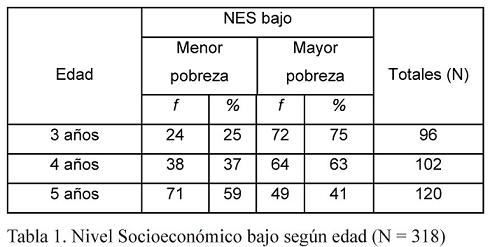
<body><![CDATA[<p class="western" style="margin: 5pt 134.25pt 0.0001pt 27pt; text-align: justify; text-indent: 14.2pt; line-height: 150%;"><span style="font-size: 12pt; line-height: 150%; font-family: Arial;" lang="ES-UY"><o:p>&nbsp;</o:p></span></p>       <p class="western" style="margin: 5pt 134.25pt 0.0001pt 27pt; text-align: justify; text-indent: 14.2pt; line-height: 150%;"><span style="font-size: 12pt; line-height: 150%; font-family: Arial;" lang="ES-UY">La determinaci&oacute;n de tales categor&iacute;as se debi&oacute; a la gran heterogeneidad de los datos obtenidos en la encuesta sociodemogr&aacute;fica. Este m&eacute;todo dio lugar a una categorizaci&oacute;n abreviada del NES bajo. <o:p></o:p></span></p>       <p class="western" style="margin: 5pt 134.25pt 0.0001pt 27pt; text-align: justify; text-indent: 14.2pt; line-height: 150%;"><span style="font-size: 12pt; line-height: 150%; font-family: Arial;" lang="ES-UY"><o:p>&nbsp;</o:p></span></p>       <p class="western" style="margin: 5pt 134.25pt 0.0001pt 27pt; text-align: justify; text-indent: 14.2pt; line-height: 150%;"><span style="font-size: 12pt; line-height: 150%; font-family: Arial;" lang="ES-UY">Se encontr&oacute; que el 58% de los ni&ntilde;os y sus familias incluidas en este estudio presentaron un nivel mayor de pobreza, mientras que el 42% restante de los ni&ntilde;os presentaba un menor nivel de pobreza (padres que hab&iacute;an completado sus estudios primarios y desempe&ntilde;aban ocupaciones estables de baja calificaci&oacute;n) (v&eacute;ase <a href="#t1">tabla 1</a>). <o:p></o:p></span></p>       <p class="western" style="margin: 8.5pt 134.25pt 0.0001pt 27pt; text-align: justify; line-height: 150%;"><span style="font-size: 12pt; line-height: 150%; font-family: Arial;" lang="ES-UY"><o:p>&nbsp;</o:p></span></p>       <p class="western" style="margin: 8.5pt 134.25pt 0.0001pt 27pt; text-align: justify; line-height: 150%;"><span style="font-size: 12pt; line-height: 150%; font-family: Arial;" lang="ES-UY"><o:p>&nbsp;</o:p></span></p>       <p class="western" style="margin: 8.5pt 134.25pt 0.0001pt 27pt; text-align: justify; line-height: 150%;"><a name="t1"></a><img id="_x0000_i1025" src="../../../../../img/revistas/cp/v3n1/1a06t1.jpg" style="border-style: solid; border-width: 1px; height: 247px; width: 497px;" border="0" height="32" width="32"><span style="font-size: 12pt; line-height: 150%; font-family: Arial;" lang="ES-UY"><o:p></o:p></span></p>       <p class="western" style="margin: 8.5pt 134.25pt 0.0001pt 27pt; text-align: justify; line-height: 150%;"><span style="font-size: 12pt; line-height: 150%; font-family: Arial;" lang="ES-UY"><o:p>&nbsp;</o:p></span></p>       <p class="western" style="margin: 8.5pt 134.25pt 0.0001pt 27pt; text-align: justify; line-height: 150%;"><span style="font-size: 12pt; line-height: 150%; font-family: Arial;" lang="ES-UY"><o:p>&nbsp;</o:p></span></p>       <p class="western" style="margin: 8.5pt 134.25pt 0.0001pt 27pt; text-align: justify; line-height: 150%;"><b><span style="font-size: 12pt; line-height: 150%; font-family: Arial;" lang="ES-UY">INSTRUMENTOS</span></b><span style="font-size: 12pt; line-height: 150%; font-family: Arial;" lang="ES-UY"><o:p></o:p></span></p>       ]]></body>
<body><![CDATA[<p class="western" style="margin: 5pt 134.25pt 0.0001pt 27pt; text-align: justify; line-height: 150%;"><span style="font-size: 12pt; line-height: 150%; font-family: Arial;" lang="ES-UY"><o:p>&nbsp;</o:p></span></p>       <p class="western" style="margin: 5pt 134.25pt 0.0001pt 27pt; text-align: justify; text-indent: 14.2pt; line-height: 150%;"><span style="font-size: 12pt; line-height: 150%; font-family: Arial;" lang="ES-UY">&bull; Escala de Habilidades Sociales (<a name="Lacunza2005."></a><a href="#Lacunza1">Lacunza</a>, 2005): dise&ntilde;ada para evaluar las habilidades sociales a partir de la percepci&oacute;n de padres y/o cuidadores del ni&ntilde;o. Se tratan de escalas con tres opciones de respuesta, cuyo puntaje total discrimina un alto o bajo nivel de habilidades sociales. La escala para 3 a&ntilde;os est&aacute; integrada por 12 &iacute;tems (fiabilidad global de .72) como as&iacute; tambi&eacute;n la de 4 a&ntilde;os (fiabilidad global de .77), en tanto, la de 5 a&ntilde;os tiene tambi&eacute;n 16 &iacute;tems (fiabilidad global de .85) (<a name="Lacunza2008."></a><a href="#Lacunza3">Lacunza, Castro Solano &amp; Contini</a>, 2008). Los instrumentos han sido validados con poblaci&oacute;n perteneciente a contextos de pobreza (<a name="Lacunza2007."></a><a href="#Lacunza2">Lacunza</a>, 2007).<o:p></o:p></span></p>       <p class="western" style="margin: 5pt 134.25pt 0.0001pt 27pt; text-align: justify; text-indent: 14.2pt; line-height: 150%;"><span style="font-size: 12pt; line-height: 150%; font-family: Arial;" lang="ES-UY"><o:p>&nbsp;</o:p></span></p>       <p class="western" style="margin: 5pt 134.25pt 0.0001pt 27pt; text-align: justify; text-indent: 14.2pt; line-height: 150%;"><span style="font-size: 12pt; line-height: 150%; font-family: Arial;" lang="ES-UY">&bull; Encuesta sociodemogr&aacute;fica (dise&ntilde;ada para el presente estudio).<o:p></o:p></span></p>       <p class="western" style="margin: 8.5pt 134.25pt 0.0001pt 27pt; text-align: justify; line-height: 150%;"><span style="font-size: 12pt; line-height: 150%; font-family: Arial;" lang="ES-UY"><o:p>&nbsp;</o:p></span></p>       <p class="western" style="margin: 8.5pt 134.25pt 0.0001pt 27pt; text-align: justify; line-height: 150%;"><b><span style="font-size: 12pt; line-height: 150%; font-family: Arial;" lang="ES-UY">PROCEDIMIENTO</span></b><span style="font-size: 12pt; line-height: 150%; font-family: Arial;" lang="ES-UY"><o:p></o:p></span></p>       <p class="western" style="margin: 5pt 134.25pt 0.0001pt 27pt; text-align: justify; text-indent: 14.2pt; line-height: 150%;"><span style="font-size: 12pt; line-height: 150%; font-family: Arial;" lang="ES-UY"><o:p>&nbsp;</o:p></span></p>       <p class="western" style="margin: 5pt 134.25pt 0.0001pt 27pt; text-align: justify; text-indent: 14.2pt; line-height: 150%;"><span style="font-size: 12pt; line-height: 150%; font-family: Arial;" lang="ES-UY">Los padres de los ni&ntilde;os participantes respondieron las escalas de habilidades sociales y la encuesta sociodemogr&aacute;fica en los CAPS cuando realizaban el control pedi&aacute;trico de sus hijos. <o:p></o:p></span></p>       <p class="western" style="margin: 5pt 134.25pt 0.0001pt 27pt; text-align: justify; text-indent: 14.2pt; line-height: 150%;"><span style="font-size: 12pt; line-height: 150%; font-family: Arial;" lang="ES-UY"><o:p>&nbsp;</o:p></span></p>       <p class="western" style="margin: 5pt 134.25pt 0.0001pt 27pt; text-align: justify; text-indent: 14.2pt; line-height: 150%;"><span style="font-size: 12pt; line-height: 150%; font-family: Arial;" lang="ES-UY">La aplicaci&oacute;n fue individual con un tiempo aproximado de 10 minutos. En el presente trabajo s&oacute;lo se consideraron de la encuesta sociodemogr&aacute;fica aquellas variables vinculadas al nivel socioecon&oacute;mico (NES). <o:p></o:p></span></p>       ]]></body>
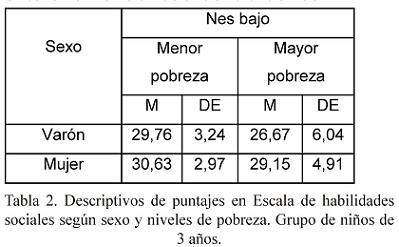
<body><![CDATA[<p class="western" style="margin: 5pt 134.25pt 0.0001pt 27pt; text-align: justify; text-indent: 14.2pt; line-height: 150%;"><span style="font-size: 12pt; line-height: 150%; font-family: Arial;" lang="ES-UY"><o:p>&nbsp;</o:p></span></p>       <p class="western" style="margin: 5pt 134.25pt 0.0001pt 27pt; text-align: justify; text-indent: 14.2pt; line-height: 150%;"><span style="font-size: 12pt; line-height: 150%; font-family: Arial;" lang="ES-UY">Se realiz&oacute; un an&aacute;lisis cuantitativo de los instrumentos seg&uacute;n la franja de edad, discrimin&aacute;ndose el puntaje total de la escala y las diferencias entre cada grupo evaluado (varones-mujeres y ni&ntilde;os de menor-mayor pobreza) a partir de un an&aacute;lisis univariado de la varianza (ANOVA). Posteriormente se establecieron las frecuencias de los &iacute;tems de las escalas. <o:p></o:p></span></p>       <p class="western" style="margin: 5pt 134.25pt 0.0001pt 27pt; text-align: justify; text-indent: 14.2pt; line-height: 150%;"><span style="font-size: 12pt; line-height: 150%; font-family: Arial;" lang="ES-UY"><o:p>&nbsp;</o:p></span></p>       <p class="western" style="margin: 5pt 134.25pt 0.0001pt 27pt; text-align: justify; text-indent: 14.2pt; line-height: 150%;"><span style="font-size: 12pt; line-height: 150%; font-family: Arial;" lang="ES-UY">Los an&aacute;lisis fueron realizados con el paquete estad&iacute;stico SPSS-11.5.<o:p></o:p></span></p>       <p class="western" style="margin: 5pt 134.25pt 0.0001pt 27pt; text-align: justify; text-indent: 14.2pt; line-height: 150%;"><span style="font-size: 12pt; line-height: 150%; font-family: Arial;" lang="ES-UY"><o:p>&nbsp;</o:p></span></p>       <p class="western" style="margin: 5pt 134.25pt 0.0001pt 27pt; text-align: justify; line-height: 150%;"><b><span style="font-size: 12pt; line-height: 150%; font-family: Arial;" lang="ES-UY">RESULTADOS</span></b><span style="font-size: 12pt; line-height: 150%; font-family: Arial;" lang="ES-UY"><o:p></o:p></span></p>       <p class="western" style="margin: 5pt 134.25pt 0.0001pt 27pt; text-align: justify; text-indent: 14.2pt; line-height: 150%;"><span style="font-size: 12pt; line-height: 150%; font-family: Arial;" lang="ES-UY"><o:p>&nbsp;</o:p></span></p>       <p class="western" style="margin: 5pt 134.25pt 0.0001pt 27pt; text-align: justify; text-indent: 14.2pt; line-height: 150%;"><span style="font-size: 12pt; line-height: 150%; font-family: Arial;" lang="ES-UY">El primer objetivo fue describir una serie de habilidades sociales en ni&ntilde;os de 3 a 5 a&ntilde;os de S.M. de Tucum&aacute;n (Argentina) en situaci&oacute;n de pobreza. <o:p></o:p></span></p>       <p class="western" style="margin: 5pt 134.25pt 0.0001pt 27pt; text-align: justify; text-indent: 14.2pt; line-height: 150%;"><span style="font-size: 12pt; line-height: 150%; font-family: Arial;" lang="ES-UY"><o:p>&nbsp;</o:p></span></p>       <p class="western" style="margin: 5pt 134.25pt 0.0001pt 27pt; text-align: justify; text-indent: 14.2pt; line-height: 150%;"><span style="font-size: 12pt; line-height: 150%; font-family: Arial;" lang="ES-UY">En el grupo de ni&ntilde;os de tres a&ntilde;os el puntaje m&aacute;ximo de la escala fue de 36 puntos. Se encontr&oacute; que, seg&uacute;n la percepci&oacute;n parental, las ni&ntilde;as de menor y mayor pobreza presentaban m&aacute;s habilidades sociales respecto a sus pares varones (v&eacute;ase <a href="#t2">tabla 2</a>). Los an&aacute;lisis univariados no mostraron diferencias estad&iacute;sticamente significativas con relaci&oacute;n al <b>sexo</b> de los ni&ntilde;os participantes (F (1, 50.15) = 1.99, p &gt; 0.05) y el <b>nivel socioecon&oacute;mico bajo</b> (F (1, 93.47) = 3.71, p &gt; 0.05). Tampoco se observ&oacute; interacci&oacute;n entre el sexo y el nivel socioecon&oacute;mico (F (1, 11.65) = 0.46, ns) ya que se encontr&oacute; que la variabilidad total se debi&oacute; fundamentalmente a la variabilidad dentro de los grupos. <o:p></o:p></span></p>       ]]></body>
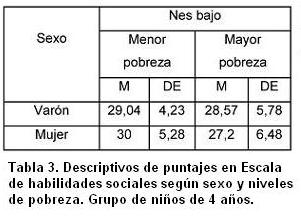
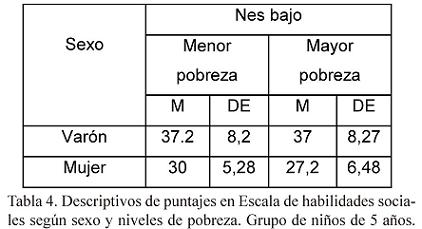
<body><![CDATA[<p class="western" style="margin: 5pt 134.25pt 0.0001pt 27pt; text-align: justify; text-indent: 14.2pt; line-height: 150%;"><span style="font-size: 12pt; line-height: 150%; font-family: Arial;" lang="ES-UY"><o:p>&nbsp;</o:p></span></p>       <p class="western" style="margin: 5pt 134.25pt 0.0001pt 27pt; text-align: justify; text-indent: 14.2pt; line-height: 150%;"><span style="font-size: 12pt; line-height: 150%; font-family: Arial;" lang="ES-UY"><o:p>&nbsp;</o:p></span></p>       <p class="western" style="margin: 5pt 134.25pt 0.0001pt 27pt; text-align: justify; text-indent: 14.2pt; line-height: 150%;"><a name="t2"></a><img id="_x0000_i1026" src="../../../../../img/revistas/cp/v3n1/1a06t2.jpg" style="border-style: solid; border-width: 1px; height: 247px; width: 399px;" border="0" height="32" width="32"><span style="font-size: 12pt; line-height: 150%; font-family: Arial;" lang="ES-UY"><o:p></o:p></span></p>       <p class="western" style="margin: 5pt 134.25pt 0.0001pt 27pt; text-align: justify; text-indent: 14.2pt; line-height: 150%;"><span style="font-size: 12pt; line-height: 150%; font-family: Arial;" lang="ES-UY"><o:p>&nbsp;</o:p></span></p>       <p class="western" style="margin: 5pt 134.25pt 0.0001pt 27pt; text-align: justify; text-indent: 14.2pt; line-height: 150%;"><span style="font-size: 12pt; line-height: 150%; font-family: Arial;" lang="ES-UY"><o:p>&nbsp;</o:p></span></p>       <p class="western" style="margin: 5.65pt 134.25pt 0.0001pt 27pt; text-align: justify; text-indent: 14.2pt; line-height: 150%;"><span style="font-size: 12pt; line-height: 150%; font-family: Arial;" lang="ES-UY">En el grupo de ni&ntilde;os de cuatro a&ntilde;os el puntaje m&aacute;ximo de la escala tambi&eacute;n fue de 36 puntos. Se observ&oacute; que las ni&ntilde;as de menor pobreza obtuvieron puntajes mas altos en la prueba, por lo que su repertorio de habilidades sociales era mayor respecto a sus pares (v&eacute;ase <a href="#t3">tabla 3</a>). Los an&aacute;lisis univariados no mostraron diferencias estad&iacute;sticamente significativas con relaci&oacute;n al <b>sexo</b> de los ni&ntilde;os participantes (F (1, 2.27) = 0.08, p &gt; 0.05) y el <b>nivel socioecon&oacute;mico bajo </b>(F (1, 25) = 0.87, p &gt; 0.05). Tampoco se observ&oacute; interacci&oacute;n entre el sexo y el nivel socioecon&oacute;mico (F (1,69.24) = 2.42, ns) ya que se encontr&oacute; que la variabilidad total se debi&oacute; fundamentalmente a la variabilidad dentro de los grupos.<o:p></o:p></span></p>       <p class="western" style="margin: 5pt 134.25pt 0.0001pt 27pt; text-align: justify; text-indent: 14.2pt; line-height: 150%;"><span style="font-size: 12pt; line-height: 150%; font-family: Arial;" lang="ES-UY"><o:p>&nbsp;</o:p></span></p>       <p class="western" style="margin: 5pt 134.25pt 0.0001pt 27pt; text-align: justify; text-indent: 14.2pt; line-height: 150%;"><span style="font-size: 12pt; line-height: 150%; font-family: Arial;" lang="ES-UY">En el grupo de ni&ntilde;os de cinco a&ntilde;os se mantuvo una tendencia similar respecto a sus pares de cuatro a&ntilde;os, ya que la ni&ntilde;as con un menor nivel de pobreza presentaron las puntuaciones m&aacute;s altas en la escala (M = 38.96, DE= 7.06) (ver<a href="#t4"> tabla 4</a>), aunque ninguno de los grupos alcanz&oacute; el puntaje m&aacute;ximo de la prueba (48 puntos). <o:p></o:p></span></p>       <p class="western" style="margin: 5pt 134.25pt 0.0001pt 27pt; text-align: justify; text-indent: 14.2pt; line-height: 150%;"><span style="font-size: 12pt; line-height: 150%; font-family: Arial;" lang="ES-UY"><o:p>&nbsp;</o:p></span></p>       <p class="western" style="margin: 5pt 134.25pt 0.0001pt 27pt; text-align: justify; text-indent: 14.2pt; line-height: 150%;"><span style="font-size: 12pt; line-height: 150%; font-family: Arial;" lang="ES-UY"><o:p>&nbsp;</o:p></span></p>       ]]></body>
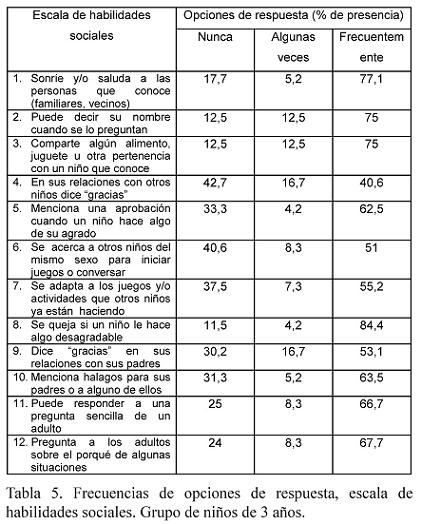
<body><![CDATA[<p class="western" style="margin: 5pt 134.25pt 0.0001pt 27pt; text-align: justify; text-indent: 14.2pt; line-height: 150%;"><a name="t3"></a><img id="_x0000_i1027" src="../../../../../img/revistas/cp/v3n1/1a06t3.jpg" style="border-style: solid; border-width: 1px; height: 216px; width: 301px;" border="0" height="32" width="32"><span style="font-size: 12pt; line-height: 150%; font-family: Arial;" lang="ES-UY"><o:p></o:p></span></p>       <p class="western" style="margin: 5pt 134.25pt 0.0001pt 27pt; text-align: justify; line-height: 150%;"><span style="font-size: 12pt; line-height: 150%; font-family: Arial;" lang="ES-UY">&nbsp;<o:p></o:p></span></p>       <p class="western" style="margin: 5pt 134.25pt 0.0001pt 27pt; text-align: justify; line-height: 150%;"><span style="font-size: 12pt; line-height: 150%; font-family: Arial;" lang="ES-UY"><o:p>&nbsp;</o:p></span></p>       <p class="western" style="margin: 5pt 134.25pt 0.0001pt 27pt; text-align: justify; text-indent: 14.2pt; line-height: 150%;"><span style="font-size: 12pt; line-height: 150%; font-family: Arial;" lang="ES-UY">Los an&aacute;lisis univariados no mostraron diferencias estad&iacute;sticamente significativas con relaci&oacute;n al <b>sexo</b> de los ni&ntilde;os participantes (F (1, 2.64) = 0.04, p &gt; 0.05) y el <b>nivel socioecon&oacute;mico bajo</b> (F (1, 59.25) = 0.97, p &gt; 0.05). Tampoco se observ&oacute; <u>interacci&oacute;n </u>entre el sexo y el nivel socioecon&oacute;mico (F (1, 78.73) = 1.29, ns) ya que se encontr&oacute; que la variabilidad total se debi&oacute; fundamentalmente a la variabilidad dentro de los grupos. <o:p></o:p></span></p>       <p class="western" style="margin: 5pt 134.25pt 0.0001pt 27pt; text-align: justify; text-indent: 14.2pt; line-height: 150%;"><span style="font-size: 12pt; line-height: 150%; font-family: Arial;" lang="ES-UY"><o:p>&nbsp;</o:p></span></p>       <p class="western" style="margin: 5pt 134.25pt 0.0001pt 27pt; text-align: justify; text-indent: 14.2pt; line-height: 150%;"><span style="font-size: 12pt; line-height: 150%; font-family: Arial;" lang="ES-UY">El segundo objetivo fue analizar la cualidad de las habilidades sociales m&aacute;s recurrentes en este grupo. En el grupo de ni&ntilde;os de 3 a&ntilde;os la opci&oacute;n de respuesta frecuentemente fue la m&aacute;s recurrente, excepto en el &iacute;tem 4: En sus relaciones con otros ni&ntilde;os dice gracias, donde la mayor recurrencia fue para la opci&oacute;n nunca, elecci&oacute;n que obedeci&oacute; a ciertas caracter&iacute;sticas culturales de la muestra. En tanto, el 40% de los informantes refirieron que sus hijos no sol&iacute;an acercarse a otros ni&ntilde;os del mismo sexo para iniciar juegos o conversar (&iacute;tem 6) (ver <a href="#t5">tabla 5</a>).<o:p></o:p></span></p>       <p class="western" style="margin: 5pt 134.25pt 0.0001pt 27pt; text-align: justify; line-height: 150%;"><span style="font-size: 12pt; line-height: 150%; font-family: Arial;" lang="ES-UY"><o:p>&nbsp;</o:p></span></p>       <p class="western" style="margin: 5pt 134.25pt 0.0001pt 27pt; text-align: justify; line-height: 150%;"><span style="font-size: 12pt; line-height: 150%; font-family: Arial;" lang="ES-UY"><o:p>&nbsp;</o:p></span></p>       <p class="western" style="margin: 5pt 134.25pt 0.0001pt 27pt; text-align: justify; line-height: 150%;"><a name="t4"></a><img id="_x0000_i1028" src="../../../../../img/revistas/cp/v3n1/1a06t4.jpg" style="border-style: solid; border-width: 1px; height: 229px; width: 422px;" border="0" height="32" width="32"><span style="font-size: 12pt; line-height: 150%; font-family: Arial;" lang="ES-UY"><o:p></o:p></span></p>       <p class="western" style="margin: 5pt 134.25pt 0.0001pt 27pt; text-align: justify; line-height: 150%;"><span style="font-size: 12pt; line-height: 150%; font-family: Arial;" lang="ES-UY"><o:p>&nbsp;</o:p></span></p>       ]]></body>
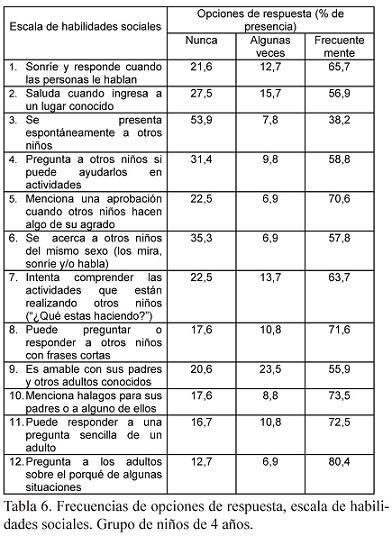
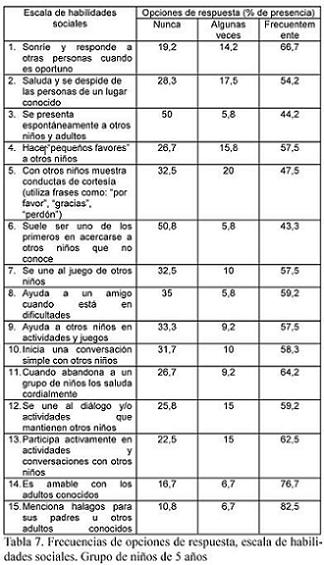
<body><![CDATA[<p class="western" style="margin: 5pt 134.25pt 0.0001pt 27pt; text-align: justify; line-height: 150%;"><span style="font-size: 12pt; line-height: 150%; font-family: Arial;" lang="ES-UY"><o:p>&nbsp;</o:p></span></p>       <p class="western" style="margin: 5pt 134.25pt 0.0001pt 27pt; text-align: justify; line-height: 150%;"><a name="t5"></a><span style="font-size: 12pt; line-height: 150%; font-family: Arial;" lang="ES-UY"><img id="_x0000_i1029" src="../../../../../img/revistas/cp/v3n1/1a06t5.jpg" style="border-style: solid; border-width: 1px; height: 524px; width: 422px;" border="0" height="32" width="32"><o:p></o:p></span></p>       <p class="western" style="margin: 5pt 134.25pt 0.0001pt 27pt; text-align: justify; line-height: 150%;"><span style="font-size: 12pt; line-height: 150%; font-family: Arial;" lang="ES-UY"><o:p>&nbsp;</o:p></span></p>       <p class="western" style="margin: 5pt 134.25pt 0.0001pt 27pt; text-align: justify; line-height: 150%;"><span style="font-size: 12pt; line-height: 150%; font-family: Arial;" lang="ES-UY"><o:p>&nbsp;</o:p></span></p>       <p class="western" style="margin: 5pt 134.25pt 0.0001pt 27pt; text-align: justify; text-indent: 14.2pt; line-height: 150%;"><span style="font-size: 12pt; line-height: 150%; font-family: Arial;" lang="ES-UY">En el grupo de de ni&ntilde;os de 4 a&ntilde;os la opci&oacute;n de respuesta frecuentemente tambi&eacute;n fue la m&aacute;s recurrente, menos en el &iacute;tem 3 (se presenta espont&aacute;neamente a otros ni&ntilde;os), donde el 54% de los padres eligieron la opci&oacute;n de respuesta nunca. Por su parte, el 23% de los ni&ntilde;os s&oacute;lo algunas veces era amable con sus padres o cuidadores, seg&uacute;n la percepci&oacute;n de &eacute;stos (&iacute;tem 9) (ver <a href="#t6">tabla 6</a>). Tambi&eacute;n en el grupo de ni&ntilde;os de 5 a&ntilde;os la opci&oacute;n de respuesta frecuentemente fue la m&aacute;s recurrente.<o:p></o:p></span></p>       <p class="western" style="margin: 5pt 134.25pt 0.0001pt 27pt; text-align: justify; text-indent: 14.2pt; line-height: 150%;"><span style="font-size: 12pt; line-height: 150%; font-family: Arial;" lang="ES-UY"><o:p>&nbsp;</o:p></span></p>       <p class="western" style="margin: 5pt 134.25pt 0.0001pt 27pt; text-align: justify; text-indent: 14.2pt; line-height: 150%;"><span style="font-size: 12pt; line-height: 150%; font-family: Arial;" lang="ES-UY">Cabe destacar que el 50% de los ni&ntilde;os participantes no sol&iacute;a presentarse espont&aacute;neamente a otros ni&ntilde;os y adultos (&iacute;tem 3) ni ser uno de los primeros en acercarse a otros ni&ntilde;os que no conoce (&iacute;tem 6). Las dificultades en la interacci&oacute;n con pares se vio reflejada en las repuestas a los &iacute;tems 8, 9 y 10, ya que m&aacute;s del 30% de los ni&ntilde;os no empleaba habilidades vinculadas al dialogo y acercamiento a otros ni&ntilde;os (ver <a href="#t7">tabla 7</a>).<o:p></o:p></span></p>       <p class="western" style="margin: 5pt 134.25pt 0.0001pt 27pt; text-align: justify; text-indent: 14.2pt; line-height: 150%;"><span style="font-size: 12pt; line-height: 150%; font-family: Arial;" lang="ES-UY"><o:p>&nbsp;</o:p></span></p>       <p class="western" style="margin: 5pt 134.25pt 0.0001pt 27pt; text-align: justify; text-indent: 14.2pt; line-height: 150%;"><span style="font-size: 12pt; line-height: 150%; font-family: Arial;" lang="ES-UY"><o:p>&nbsp;</o:p></span></p>       <p class="western" style="margin: 5pt 134.25pt 0.0001pt 27pt; text-align: justify; text-indent: 14.2pt; line-height: 150%;"><a name="t6"></a><img id="_x0000_i1030" src="../../../../../img/revistas/cp/v3n1/1a06t6.jpg" style="border-style: solid; border-width: 1px; height: 536px; width: 392px;" border="0" height="32" width="32"></p>       ]]></body>
<body><![CDATA[<p class="western" style="margin: 5pt 134.25pt 0.0001pt 27pt; text-align: justify; line-height: 150%;"><span style="font-size: 12pt; line-height: 150%; font-family: Arial;" lang="ES-UY"><o:p>&nbsp;</o:p></span></p>       <p class="western" style="margin: 5pt 134.25pt 0.0001pt 27pt; text-align: justify; line-height: 150%;"><span style="font-size: 12pt; line-height: 150%; font-family: Arial;" lang="ES-UY"><o:p>&nbsp;</o:p></span></p>       <p style="margin: 5pt 134.25pt 0.0001pt 27pt; text-align: justify; line-height: 120%;"><b><span style="font-family: Arial;" lang="ES-UY">DISCUSI&Oacute;N</span></b><span style="font-family: Arial;" lang="ES-UY"><o:p></o:p></span></p>       <p style="margin: 5pt 134.25pt 0.0001pt 27pt; text-align: justify; line-height: 120%;"><span style="font-family: Arial;" lang="ES-UY"><o:p>&nbsp;</o:p></span></p>       <p style="margin: 5pt 134.25pt 0.0001pt 27pt; text-align: justify; text-indent: 14.2pt; line-height: 120%;"><span style="font-family: Arial;" lang="ES-UY">Este trabajo tuvo como objetivos describir una serie de habilidades sociales en ni&ntilde;os de 3 a 5 a&ntilde;os de San Miguel de Tucum&aacute;n (Argentina) en situaci&oacute;n de pobreza y analizar la cualidad de las habilidades sociales m&aacute;s recurrentes.<o:p></o:p></span></p>       <p class="western" style="margin: 5pt 134.25pt 0.0001pt 27pt; text-align: justify; text-indent: 14.2pt; line-height: 150%;"><span style="font-size: 12pt; line-height: 150%; font-family: Arial;" lang="ES-UY"><o:p>&nbsp;</o:p></span></p>       <p class="western" style="margin: 5pt 134.25pt 0.0001pt 27pt; text-align: justify; text-indent: 14.2pt; line-height: 150%;"><span style="font-size: 12pt; line-height: 150%; font-family: Arial;" lang="ES-UY"><o:p>&nbsp;</o:p></span></p>       <p class="western" style="margin: 5pt 134.25pt 0.0001pt 27pt; text-align: justify; text-indent: 14.2pt; line-height: 150%;"><a name="t7"></a><span style="font-size: 12pt; line-height: 150%; font-family: Arial;" lang="ES-UY"><img id="_x0000_i1031" src="../../../../../img/revistas/cp/v3n1/1a06t7.jpg" style="border-style: solid; border-width: 1px; height: 565px; width: 324px;" border="0" height="32" width="32"><o:p></o:p></span></p>       <p class="western" style="margin: 5pt 134.25pt 0.0001pt 27pt; text-align: justify; text-indent: 14.2pt; line-height: 150%;"><span style="font-size: 12pt; line-height: 150%; font-family: Arial;" lang="ES-UY"><o:p>&nbsp;</o:p></span></p>       <p class="western" style="margin: 5pt 134.25pt 0.0001pt 27pt; text-align: justify; text-indent: 14.2pt; line-height: 150%;"><span style="font-size: 12pt; line-height: 150%; font-family: Arial;" lang="ES-UY"><o:p>&nbsp;</o:p></span></p>       ]]></body>
<body><![CDATA[<p class="western" style="margin: 2.85pt 134.25pt 0.0001pt 27pt; text-align: justify; line-height: 150%;"><span style="font-size: 12pt; line-height: 150%; font-family: Arial;" lang="ES-UY">Los resultados mostraron que tanto ni&ntilde;os y ni&ntilde;as, de contextos de pobreza, cuentan con habilidades sociales para afrontar situaciones cotidianas, ya que no se observaron diferencias estad&iacute;sticamente significativas en las puntuaciones del instrumento dise&ntilde;ado para este estudio. A pesar de la adversidad asociada a la pobreza, estos ni&ntilde;os han logrado adquirir una serie de habilidades sociales, tales como saludar, mencionar su nombre, adaptarse a los juegos de otros ni&ntilde;os, halagar a sus padres, denunciar cuando otro ni&ntilde;o le hace algo desagradable, iniciativa para vincularse con pares no conocidos, comportamientos cooperativos, expresi&oacute;n de sentimientos positivos en sus interacciones con adultos, entre otros. <o:p></o:p></span></p>       <p style="margin: 5pt 134.25pt 0.0001pt 27pt; text-align: justify; line-height: 150%;"><span style="font-family: Arial;" lang="ES-UY">Las habilidades sociales entre los tres y los cinco a&ntilde;os implican la interacci&oacute;n con los pares, las manifestaciones prosociales, la exploraci&oacute;n de reglas, la comprensi&oacute;n de las emociones, entre otros indicadores. Estos han sido relevantes en diversos estudios sobre comportamientos sociales infantiles (<a name="David2007."></a><a href="#David">David &amp; Murphy</a>, 2007; <a name="Garner1997."></a><a href="#Garner2">Garner, Robertson &amp; Smith</a>, 1997; <a name="Larsen2007."></a><a href="#Larsen">Larsen, To &amp; Fireman</a>, 2007).<o:p></o:p></span></p>       <p style="margin: 5pt 134.25pt 0.0001pt 27pt; text-align: justify; text-indent: 14.2pt; line-height: 150%;"><span style="font-family: Arial;" lang="ES-UY">En los ni&ntilde;os preescolares, las habilidades sociales dan cuenta de un aprendizaje de pautas y modelos que le permiten relacionarse con los otros de una forma efectiva y satisfactoria.<o:p></o:p></span></p>       <p style="margin: 5pt 134.25pt 0.0001pt 27pt; text-align: justify; text-indent: 14.2pt; line-height: 150%;"><span style="font-family: Arial;" lang="ES-UY">A los tres a&ntilde;os aproximadamente, el ni&ntilde;o va adquiriendo habilidades ligadas a la interacci&oacute;n con su grupo primario (padres y hermanos) y con pares. Estas habilidades se observaron en indicadores como: menciona una aprobaci&oacute;n cuando un ni&ntilde;o hace algo de su agrado (&iacute;tem 5), se acerca a otros ni&ntilde;os del mismo sexo para iniciar juegos o conversar (&iacute;tem 6), se adapta a los juegos y/o actividades que otros ni&ntilde;os ya est&aacute;n haciendo (&iacute;tem 7), los que fueron descriptos como comportamientos recurrentes en este grupo de ni&ntilde;os. <a name="Hartup1992."></a><a href="#Hartup">Hartup</a> (1992) sostiene que la relaci&oacute;n del ni&ntilde;o con otros peque&ntilde;os contribuye tanto a su desarrollo social como cognitivo; las relaciones de amistad son comprendidas desde la temprana infancia ya que los pares sirven como recursos emocionales al actuar como soportes ante acontecimientos vivenciados como negativos para el ni&ntilde;o (por ejemplo, el ingreso al &aacute;mbito escolar o a la guarder&iacute;a maternal). <o:p></o:p></span></p>       <p style="margin: 2.85pt 134.25pt 0.0001pt 27pt; text-align: justify; text-indent: 14.2pt; line-height: 150%;"><span style="font-family: Arial;" lang="ES-UY"><o:p>&nbsp;</o:p></span></p>       <p style="margin: 2.85pt 134.25pt 0.0001pt 27pt; text-align: justify; text-indent: 14.2pt; line-height: 150%;"><span style="font-family: Arial;" lang="ES-UY">Este autor sostiene que los pares tambi&eacute;n act&uacute;an como recursos cognitivos, ya que ellos transmiten el sentido de la cooperaci&oacute;n y la colaboraci&oacute;n. As&iacute;, estas primeras relaciones pueden actuar como modelos para las subsiguientes. Si bien, a los tres a&ntilde;os el ni&ntilde;o mantiene un pensamiento egoc&eacute;ntrico, lo que se manifiesta tambi&eacute;n en sus juegos, la utilizaci&oacute;n de la ficci&oacute;n para comprender la realidad, el como s&iacute; propio de este tipo de juegos le permite al ni&ntilde;o el desarrollo del &aacute;rea social e intelectual (<a name="Berk1995."></a><a href="#Berk">Berk &amp; Winsler</a>, 1995). Aunque el egocentrismo puede continuar hasta los cinco o los seis a&ntilde;os, ya a los cuatro a&ntilde;os, los comportamientos cooperativos suelen ser m&aacute;s constantes en la medida que estas habilidades sean valoradas en su contexto m&aacute;s pr&oacute;ximo. No debe olvidarse que la socializaci&oacute;n no s&oacute;lo implica la interacci&oacute;n con otros sino que es un proceso progresivo de asimilaci&oacute;n de actitudes, valores y costumbres de una sociedad, por lo que el ni&ntilde;o aprende qu&eacute; comportamientos son aceptables dentro de su grupo (<a name="Hoffman1995."></a><a href="#Hoffman">Hoffman, Paris &amp; Hall</a>, 1995). <o:p></o:p></span></p>       <p style="margin: 2.85pt 134.25pt 0.0001pt 27pt; text-align: justify; text-indent: 14.2pt; line-height: 150%;"><span style="font-family: Arial;" lang="ES-UY">A los cuatro a&ntilde;os, la cooperaci&oacute;n se expresa en el cumplimiento de normas y ayuda a pares o adultos, entre otros observables. <o:p></o:p></span></p>       <p style="margin: 2.85pt 134.25pt 0.0001pt 27pt; text-align: justify; text-indent: 14.2pt; line-height: 150%;"><span style="font-family: Arial;" lang="ES-UY"><o:p>&nbsp;</o:p></span></p>       <p style="margin: 2.85pt 134.25pt 0.0001pt 27pt; text-align: justify; text-indent: 14.2pt; line-height: 150%;"><span style="font-family: Arial;" lang="ES-UY">En la presente investigaci&oacute;n aparecieron como muy frecuentemente practicados ciertos comportamientos cooperativos (&iacute;tem 4: pregunta a otros ni&ntilde;os si puede ayudarlos en actividades e &iacute;tem 9: es amable con sus padres y otros adultos conocidos), resultados que coinciden con los estudios de <a name="McClelland2003."></a><a href="#McClelland">McClelland &amp; Morrison</a> (2003) y <a name="Nabors1999."></a><a href="#Nabors">Nabors, Willoughby &amp; Badawi</a> (1999) en ni&ntilde;os preescolares y con necesidades educativas especiales. A los cinco a&ntilde;os, los indicios de la cooperaci&oacute;n son m&aacute;s constantes ya que el ni&ntilde;o ha adquirido conductas prosociales tales como ayudar o compartir; &eacute;stas aparecieron como frecuentes en el presente estudio, sobre todo en la respuesta a indicadores como: hace &ldquo;peque&ntilde;os favores&rdquo; a otros ni&ntilde;os (&iacute;tem 4), ayuda a un amigo cuando est&aacute; en dificultades (&iacute;tem 8), ayuda a otros ni&ntilde;os en actividades y juegos (&iacute;tem 9), es amable con los adultos conocidos (&iacute;tem 14).<o:p></o:p></span></p>       <p style="margin: 2.85pt 134.25pt 0.0001pt 27pt; text-align: justify; text-indent: 14.2pt; line-height: 150%;"><span style="font-family: Arial;" lang="ES-UY"><o:p>&nbsp;</o:p></span></p>       ]]></body>
<body><![CDATA[<p style="margin: 2.85pt 134.25pt 0.0001pt 27pt; text-align: justify; text-indent: 14.2pt; line-height: 150%;"><span style="font-family: Arial;" lang="ES-UY">Las habilidades sociales est&aacute;n relacionadas con la expresi&oacute;n y comprensi&oacute;n de estados emocionales, todo lo cual le permite al ni&ntilde;o preescolar tener un control respecto a c&oacute;mo demostrar sus sentimientos y c&oacute;mo responder ante los sentimientos de los dem&aacute;s, principalmente su grupo familiar (<a name="Garner1996."></a><a href="#Garner1">Garner &amp; Power</a>, 1996). Los ni&ntilde;os participantes mostraron alta capacidad de expresar sentimientos negativos (por ejemplo, quejarse si un par le hace algo desagradable) o manifestar emociones positivas hacia sus padres (por ejemplo, halagar a sus padres o a alguno de ellos). Est&aacute; comprobado que la expresi&oacute;n de tales comportamientos deriva de la influencia social y de las caracter&iacute;sticas de personalidad parentales (<a name="Roa2003."></a><a href="#Roa">Roa Capilla &amp; Del Barrio G&aacute;ndara</a>, 2003). <o:p></o:p></span></p>       <p style="margin: 5pt 134.25pt 0.0001pt 27pt; text-align: justify; text-indent: 14.2pt; line-height: 150%;"><span style="font-family: Arial;" lang="ES-UY"><o:p>&nbsp;</o:p></span></p>       <p style="margin: 5pt 134.25pt 0.0001pt 27pt; text-align: justify; text-indent: 14.2pt; line-height: 150%;"><span style="font-family: Arial;" lang="ES-UY">Aquellos comportamientos sociales vinculados a la expresi&oacute;n de emociones positivas, principalmente de elogios hacia los adultos, aparecieron con una mayor frecuencia en todas las edades estudiadas. Las madres encuestadas refirieron habilidades de cortes&iacute;a y amabilidad con el adulto, no s&oacute;lo por responder a preguntas de personas mayores sino por utilizar palabras y gestos adecuados a las figuras parentales. <o:p></o:p></span></p>       <p style="margin: 2.85pt 134.25pt 0.0001pt 27pt; text-align: justify; text-indent: 14.2pt; line-height: 150%;"><span style="font-family: Arial;" lang="ES-UY"><o:p>&nbsp;</o:p></span></p>       <p style="margin: 2.85pt 134.25pt 0.0001pt 27pt; text-align: justify; text-indent: 14.2pt; line-height: 150%;"><span style="font-family: Arial;" lang="ES-UY">Los resultados mostraron la ausencia de diferencias estad&iacute;sticas en el empleo de las habilidades sociales seg&uacute;n el sexo, aunque algunos estudios emp&iacute;ricos (<a name="Merrell1998."></a><a href="#Merrell1">Merrell &amp; Gimpell</a>, 1998; <a name="Navarro2004."></a><a href="#Navarro">Navarro</a>, 2004) se&ntilde;alan que existe un patr&oacute;n de comportamiento femenino y otro masculino de relaciones interpersonales tanto en la infancia como en la adolescencia. <o:p></o:p></span></p>       <p style="margin: 5pt 134.25pt 0.0001pt 27pt; text-align: justify; text-indent: 14.2pt; line-height: 150%;"><span style="font-family: Arial;" lang="ES-UY"><o:p>&nbsp;</o:p></span></p>       <p style="margin: 5pt 134.25pt 0.0001pt 27pt; text-align: justify; text-indent: 14.2pt; line-height: 150%;"><span style="font-family: Arial;" lang="ES-UY">Si bien no se encontraron diferencias estad&iacute;sticas respecto al nivel de habilidades sociales seg&uacute;n los niveles de NES bajo, el contexto es clave para el aprendizaje de las habilidades sociales. El aprendizaje de las habilidades sociales est&aacute; muy vinculado a las caracter&iacute;sticas del entorno como a la relevancia que presenten ciertos comportamientos sociales considerados exitosos, por lo que la cultura contribuye en este sentido (<a name="Gardner1994."></a><a href="#Gardner">Gardner</a>, 1994). <o:p></o:p></span></p>       <p style="margin: 2.85pt 134.25pt 0.0001pt 27pt; text-align: justify; text-indent: 14.2pt; line-height: 150%;"><span style="font-family: Arial;" lang="ES-UY"><o:p>&nbsp;</o:p></span></p>       <p style="margin: 2.85pt 134.25pt 0.0001pt 27pt; text-align: justify; text-indent: 14.2pt; line-height: 150%;"><span style="font-family: Arial;" lang="ES-UY">Seg&uacute;n <a href="#Caballo2">Caballo</a> (2005), la adaptaci&oacute;n y participaci&oacute;n en diferentes contextos, est&aacute; determinada, al menos parcialmente, por el tipo de habilidades sociales. Sin embargo, <a href="#Monjas2">Monjas Casares</a> (2002) considera que la sola presencia de comportamientos sociales no determina que un ni&ntilde;o sea socialmente competente, sino que debe poner en juego este repertorio de habilidades sociales en una situaci&oacute;n espec&iacute;fica y ser valorado positivamente, para que su actuaci&oacute;n sea competente. De all&iacute;, que no es m&aacute;s h&aacute;bil el ni&ntilde;o que m&aacute;s conductas posea, sino el que sea capaz de percibir y discriminar las se&ntilde;ales del contexto y elegir una combinaci&oacute;n de comportamientos adecuados para esa situaci&oacute;n determinada. Aqu&iacute; entran en juego recursos internos del ni&ntilde;o, particularmente cognitivos y afectivos, los que a su vez, se desarrollan con recursos externos vinculados a la interacci&oacute;n con pares y adultos, particularmente los estilos de crianza y los sistemas de valores asociados a la cultura parental.<o:p></o:p></span></p>       <p style="margin: 2.85pt 134.25pt 0.0001pt 27pt; text-align: justify; text-indent: 14.2pt; line-height: 150%;"><span style="font-family: Arial;" lang="ES-UY"><o:p>&nbsp;</o:p></span></p>       ]]></body>
<body><![CDATA[<p style="margin: 2.85pt 134.25pt 0.0001pt 27pt; text-align: justify; text-indent: 14.2pt; line-height: 150%;"><span style="font-family: Arial;" lang="ES-UY">En definitiva, los ni&ntilde;os participantes desde la percepci&oacute;n de sus padres, mostraron comportamientos sociales necesarios para el desenvolvimiento en su vida diaria, los que les permit&iacute;an un ajuste psicol&oacute;gico en su contexto m&aacute;s pr&oacute;ximo. Las relaciones sociales que establec&iacute;an estos ni&ntilde;os pueden considerarse como un factor protector de la salud, en la medida que el empleo de las habilidades sociales positivas contribuya al funcionamiento adaptativo. <o:p></o:p></span></p>       <p style="margin: 2.85pt 134.25pt 0.0001pt 27pt; text-align: justify; text-indent: 14.2pt; line-height: 150%;"><span style="font-family: Arial;" lang="ES-UY"><o:p>&nbsp;</o:p></span></p>       <p style="margin: 2.85pt 134.25pt 0.0001pt 27pt; text-align: justify; text-indent: 14.2pt; line-height: 150%;"><span style="font-family: Arial;" lang="ES-UY">Hay que recordar que el ni&ntilde;o en situaci&oacute;n de pobreza debe enfrentar un ambiente caracterizado por la incertidumbre y los est&iacute;mulos estresantes. Si bien los recursos para afrontarlos suelen ser escasos, este estudio comprob&oacute; que las habilidades sociales positivas son capacidades que permiten la adaptaci&oacute;n activa y, por lo tanto, pueden actuar como un amortiguador de los efectos negativos propios de la pobreza y la desigualdad social. <o:p></o:p></span></p>       <p style="margin: 2.85pt 134.25pt 0.0001pt 27pt; text-align: justify; text-indent: 14.2pt; line-height: 150%;"><span style="font-family: Arial;" lang="ES-UY"><o:p>&nbsp;</o:p></span></p>       <p style="margin: 2.85pt 134.25pt 0.0001pt 27pt; text-align: justify; text-indent: 14.2pt; line-height: 150%;"><span style="font-family: Arial;" lang="ES-UY">Estos datos constituyen un paso previo para la formulaci&oacute;n de programas de estimulaci&oacute;n y potenciaci&oacute;n de dichas capacidades sociales, las que operan como factores protectores de la salud.<o:p></o:p></span></p>       <p style="margin: 5pt 134.25pt 0.0001pt 27pt; text-align: justify; line-height: 150%;"><span style="font-family: Arial;" lang="ES-UY"><o:p>&nbsp;</o:p></span></p>       <p style="margin: 5pt 134.25pt 0.0001pt 27pt; text-align: justify; line-height: 150%;"><span style="font-family: Arial;" lang="ES-UY"><o:p>&nbsp;</o:p></span></p>       <p style="margin: 5pt 134.25pt 0.0001pt 27pt; text-align: center; line-height: 150%;" align="center"><b><span style="font-family: Arial;" lang="EN-US">REFERENCIAS</span></b><span style="font-family: Arial;" lang="EN-US"><o:p></o:p></span></p>       <p style="margin: 5pt 134.25pt 0.0001pt 27pt; text-align: justify; text-indent: 14.2pt; line-height: 120%;"><span style="font-family: Arial;" lang="EN-US"><o:p>&nbsp;</o:p></span></p>       <!-- ref --><p style="margin: 5pt 134.25pt 0.0001pt 27pt; text-align: justify; text-indent: -14.2pt; line-height: 120%;"><a name="Ainsworth"></a><span style="font-family: Arial;" lang="EN-US"><a href="#Ainsworth1974.">Ainsworth, M. (1974)</a>. The development of Infant- Mother Attachment. Review of Child Development. </span><st1:city><st1:place><span style="font-family: Arial;" lang="EN-US">Chicago</span></st1:place></st1:city><span style="font-family: Arial;" lang="EN-US">: </span><st1:city><st1:place><span style="font-family: Arial;" lang="EN-US">Chicago</span></st1:place></st1:city><span style="font-family: Arial;" lang="EN-US"> Press.    </span><span style="font-family: Arial;" lang="EN-GB"><o:p></o:p></span></p>       <!-- ref --><p style="margin: 5pt 134.25pt 0.0001pt 27pt; text-align: justify; text-indent: -14.2pt; line-height: 120%;"><span class="GramE"><span style="font-family: Arial;" lang="EN-GB">Alvarez, A., Alvarez-<span class="SpellE">Monteser&iacute;n</span>, M., <span class="SpellE">Ca&ntilde;as</span>, A., <span class="SpellE">Jim&eacute;nez</span>, S. &amp; Petit, M. (1990).</span></span><span style="font-family: Arial;" lang="EN-GB"> </span><span style="font-family: Arial;" lang="ES-UY">Desarrollo de las habilidades sociales en ni&ntilde;os de 3-6 a&ntilde;os. Gu&iacute;a pr&aacute;ctica para padres y profesores. </span><st1:state><st1:place><span style="font-family: Arial;" lang="EN-US">Madrid</span></st1:place></st1:state><span style="font-family: Arial;" lang="EN-US">: <span class="SpellE">Aprendizaje</span> Visor.    </span><span style="font-family: Arial;" lang="EN-GB"><o:p></o:p></span></p>       <p style="margin: 5pt 134.25pt 0.0001pt 27pt; text-align: justify; text-indent: -14.2pt; line-height: 120%;"><a name="Berk"></a><a href="#Berk1995."><span class="SpellE"><span class="GramE"><span style="font-family: Arial;" lang="EN-US">Berk</span></span></span></a><span class="GramE"><span style="font-family: Arial;" lang="EN-US"><a href="#Berk1995.">, L. &amp; <span class="SpellE">Winsler</span>, A. (1995)</a>.</span></span><span style="font-family: Arial;" lang="EN-US"> Scaffolding children&rsquo;s learning: <span class="SpellE">Vygotsky</span> and early childhood education. Washington, D. C.: National Association for the Education of Young Children.</span><span style="font-family: Arial;" lang="EN-GB"><o:p></o:p></span></p>       <!-- ref --><p style="margin: 5pt 134.25pt 0.0001pt 27pt; text-align: justify; text-indent: -14.2pt; line-height: 120%;"><a name="Bowlby1"></a><span style="font-family: Arial;" lang="ES-UY"><a href="#Bowlby1983.">Bowlby, J. (1983)</a>. La p&eacute;rdida afectiva. Tristeza y depresi&oacute;n. Buenos Aires: Paidos.    <o:p></o:p></span></p>       <!-- ref --><p style="margin: 5pt 134.25pt 0.0001pt 27pt; text-align: justify; text-indent: -14.2pt; line-height: 120%;"><a name="Bowlby2"></a><span style="font-family: Arial;" lang="ES-UY"><a href="#Bowlby1986.">Bowlby, J. (1986)</a>. V&iacute;nculos afectivos: formaci&oacute;n, desarrollo y p&eacute;rdida. Madrid: Morata.    <o:p></o:p></span></p>       <!-- ref --><p style="margin: 5pt 134.25pt 0.0001pt 27pt; text-align: justify; text-indent: -14.2pt; line-height: 120%;"><a name="Bowlby3"></a><span style="font-family: Arial;" lang="ES-UY"><a href="#Bowlby1989.">Bowlby, J. (1989)</a>. Una base segura. Aplicaciones cl&iacute;nicas de una teor&iacute;a del apego. Buenos Aires: Paidos.    <o:p></o:p></span></p>       ]]></body>
<body><![CDATA[<!-- ref --><p style="margin: 5pt 134.25pt 0.0001pt 27pt; text-align: justify; text-indent: -14.2pt; line-height: 120%;"><a name="Caballo1"></a><span style="font-family: Arial;" lang="ES-UY"><a href="#Caballo1993.">Caballo, V. (1993)</a>. Relaciones entre diversas medidas conductuales y de autoinforme de las habilidades sociales. Psicolog&iacute;a Conductual, 1, 73-99.    <o:p></o:p></span></p>       <!-- ref --><p style="margin: 5pt 134.25pt 0.0001pt 27pt; text-align: justify; text-indent: -14.2pt; line-height: 120%;"><a name="Caballo2"></a><span style="font-family: Arial;" lang="ES-UY"><a href="#Caballo2005.">Caballo, V. (2005)</a>. Manual de Evaluaci&oacute;n y entrenamiento de las habilidades sociales. (6&deg; Edici&oacute;n). Madrid: Siglo XXI Editores.    <o:p></o:p></span></p>       <!-- ref --><p style="margin: 5pt 134.25pt 0.0001pt 27pt; text-align: justify; text-indent: -14.2pt; line-height: 120%;"><a name="Casullo"></a><span style="font-family: Arial;" lang="ES-UY"><a href="#Casullo2005.">Casullo, M. &amp; Fern&aacute;ndez Liporace, M. (2005)</a>. Los estilos de apego. Teor&iacute;a y medici&oacute;n. Buenos Aires: JVE ediciones.    <o:p></o:p></span></p>       <p style="margin: 5pt 134.25pt 0.0001pt 27pt; text-align: justify; text-indent: -14.2pt; line-height: 120%;"><a name="Crespo"></a><span style="font-family: Arial;" lang="ES-UY"><a href="#Crespo2006.">Crespo Rica, S. (2006)</a>. Comportamiento social en la infancia. Trabajo presentado en el V Congreso Internacional &ldquo;Educaci&oacute;n y Sociedad&rdquo;. Disponible en: <a href="http://www.codoli.com/">http://congreso.codoli.org/area3/Crespo-Rica3.pdf</a><o:p></o:p></span></p>       <p style="margin: 5pt 134.25pt 0.0001pt 27pt; text-align: justify; text-indent: -14.2pt; line-height: 120%;"><a name="David"></a><span style="font-family: Arial;">David, K. &amp; Murphy, B. (2007). </span><span class="SpellE"><span style="font-family: Arial;" lang="EN-US">Interparental</span></span><span style="font-family: Arial;" lang="EN-US"> conflict and preschoolers&rsquo; peer relations. The moderating roles of temperament and gender. Social development, 16 (1), 1-23.</span><span style="font-family: Arial;" lang="EN-GB"><o:p></o:p></span></p>       <!-- ref --><p style="margin: 5pt 134.25pt 0.0001pt 27pt; text-align: justify; text-indent: -14.2pt; line-height: 120%;"><a name="DeMiguel"></a><span style="font-family: Arial;" lang="EN-US"><a href="#DeMiguel1993.">De Miguel, A. &amp; <span class="SpellE">Pelechano</span> <span class="SpellE">Barber&aacute;</span>, V. (1996)</a>. </span><span style="font-family: Arial;" lang="ES-UY">Programa de entrenamiento en fases de soluci&oacute;n de problemas para ancianos. En V. Pelechano Barber&aacute; (Coord.) (1996), Habilidades interpersonales: teor&iacute;a m&iacute;nima y programas de intervenci&oacute;n (pp. 743-766). Vol III. Valencia: Promolibro.     <o:p></o:p></span></p>       ]]></body>
<body><![CDATA[<p style="margin: 5pt 134.25pt 0.0001pt 27pt; text-align: justify; text-indent: -14.2pt; line-height: 120%;"><span style="font-family: Arial;" lang="ES-UY">&nbsp;J. (1994). El desarrollo humano. Madrid: Siglo XXI Editores.<o:p></o:p></span></p>       <!-- ref --><p style="margin: 5pt 134.25pt 0.0001pt 27pt; text-align: justify; text-indent: -14.2pt; line-height: 120%;"><a name="Dunn"></a><span style="font-family: Arial;" lang="ES-UY"><a href="#Dunn1988.">Dunn, J. (1988)</a>. Los comienzos de la comprensi&oacute;n social. Buenos Aires: Nueva Visi&oacute;n.    <o:p></o:p></span></p>       <!-- ref --><p style="margin: 5pt 134.25pt 0.0001pt 27pt; text-align: justify; text-indent: -14.2pt; line-height: 120%;"><a name="Fernandez"></a><span style="font-family: Arial;" lang="ES-UY"><a href="#Fern%E1ndez1994.">Fern&aacute;ndez Ballesteros, R. (1994)</a>. Evaluaci&oacute;n conductual hoy. Un enfoque para el cambio en psicolog&iacute;a cl&iacute;nica y de la salud. Madrid: Pir&aacute;mide.    <o:p></o:p></span></p>       <!-- ref --><p style="margin: 5pt 134.25pt 0.0001pt 27pt; text-align: justify; text-indent: -14.2pt; line-height: 120%;"><a name="Flavell"></a><span style="font-family: Arial;" lang="ES-UY"><a href="#Flavell1993.">Flavell, J. (1993)</a>. El desarrollo cognitivo. Madrid: Visor.     <o:p></o:p></span></p>       <!-- ref --><p style="margin: 5pt 134.25pt 0.0001pt 27pt; text-align: justify; text-indent: -14.2pt; line-height: 120%;"><a name="Forns"></a><span style="font-family: Arial;" lang="ES-UY"><a href="#Forns1993.">Forns i Santacana, M. (1993)</a>. Evaluaci&oacute;n psicol&oacute;gica infantil. Barcelona: Barcanova.    <o:p></o:p></span></p>       <!-- ref --><p style="margin: 5pt 134.25pt 0.0001pt 27pt; text-align: justify; text-indent: -14.2pt; line-height: 120%;"><a name="Garaigordobil"></a><span style="font-family: Arial;" lang="ES-UY"><a href="#Garaigordobil2006.">Garaigordobil, M. &amp; Garc&iacute;a de Galdeano, P. (2006)</a>. Empat&iacute;a en ni&ntilde;os de 10 a 12 a&ntilde;os. Psicothema, 18 (2), 180-186.    <o:p></o:p></span></p>       <!-- ref --><p style="margin: 5pt 134.25pt 0.0001pt 27pt; text-align: justify; text-indent: -14.2pt; line-height: 120%;"><a name="Gardner"></a><span style="font-family: Arial;" lang="ES-UY"><a href="#Gardner1994.">Gardner, H. (1994)</a>. Estructuras de la mente. La teor&iacute;a de las inteligencias m&uacute;ltiples. </span><span class="SpellE"><span style="font-family: Arial;" lang="EN-US">M&eacute;jico</span></span><span style="font-family: Arial;" lang="EN-US">: <span class="SpellE">Fondo</span> de <span class="SpellE">Cultura</span> <span class="SpellE">Econ&oacute;mica</span>.    </span><span style="font-family: Arial;" lang="EN-GB"><o:p></o:p></span></p>       <!-- ref --><p style="margin: 5pt 134.25pt 0.0001pt 27pt; text-align: justify; text-indent: -14.2pt; line-height: 120%;"><a name="Garner1"></a><span style="font-family: Arial;" lang="EN-US"><a href="#Garner1996.">Garner, P. &amp; Power, T. (1996)</a>. Preschoolers Emotional Control in the Disappointment Paradigm and its relation to Temperament, Emotional Knowledge and Family Expressiveness. Child Development, 67 (4), 1406-1419.    </span><span style="font-family: Arial;" lang="EN-GB"><o:p></o:p></span></p>       <p style="margin: 5pt 134.25pt 0.0001pt 27pt; text-align: justify; text-indent: -14.2pt; line-height: 120%;"><a name="Garner2"></a><span style="font-family: Arial;" lang="EN-US"><a href="#Garner1997.">Garner, P., Robertson, S. &amp; Smith, G. (1997)</a>. Preschool Children&rsquo;s Emotional Expressions with peers: the roles of gender and emotion socialization. </span><span style="font-family: Arial;" lang="ES-UY">Journal Sex Roles, 36 (11-12), 675-691.<o:p></o:p></span></p>       <!-- ref --><p style="margin: 5pt 134.25pt 0.0001pt 27pt; text-align: justify; text-indent: -14.2pt; line-height: 120%;"><a name="Gil"></a><span style="font-family: Arial;" lang="ES-UY"><a href="#Gil1995.">Gil Rodr&iacute;guez, F., Le&oacute;n Rubio, J. &amp; Jarana Exp&oacute;sito, L. (Eds). (1995)</a>. Habilidades sociales y salud. Madrid: Pir&aacute;mide.    <o:p></o:p></span></p>       <!-- ref --><p style="margin: 5pt 134.25pt 0.0001pt 27pt; text-align: justify; text-indent: -14.2pt; line-height: 120%;"><a name="Gottman"></a><a href="#Gottman1983."><span class="SpellE"><span style="font-family: Arial;" lang="EN-US">Gottman</span></span></a><span style="font-family: Arial;" lang="EN-US"><a href="#Gottman1983.">, J..M. (1983)</a>. How children become friends. Monograph of the Society for Research in Child Development, 48 (3, Serial No. 108).     </span><span style="font-family: Arial;" lang="EN-GB"><o:p></o:p></span></p>       ]]></body>
<body><![CDATA[<!-- ref --><p style="margin: 5pt 134.25pt 0.0001pt 27pt; text-align: justify; text-indent: -14.2pt; line-height: 120%;"><a name="Gresham"></a><span style="font-family: Arial;" lang="EN-US"><a href="#Gresham1988.">Gresham, F. (1988)</a>. Social skills: Conceptual and applied aspects of assessment, training and social validation. En J. Witt, S. Elliott &amp; F. Gresham (Comps.), Handbook of Behavior Therapy in Education, (pp. pp. 523-546). </span><span style="font-family: Arial;" lang="ES-UY">Nueva York: Plenum Press.     <o:p></o:p></span></p>       <!-- ref --><p style="margin: 5pt 134.25pt 0.0001pt 27pt; text-align: justify; text-indent: -14.2pt; line-height: 120%;"><a name="Griffa"></a><span style="font-family: Arial;" lang="ES-UY"><a href="#Griffa2005.">Griffa, M. &amp; Moreno, J. (2005)</a>. Claves para una Psicolog&iacute;a del Desarrollo. Vida prenatal. Etapas de la ni&ntilde;ez. Buenos Aires: Lugar Editorial. </span><span class="SpellE"><span style="font-family: Arial;" lang="EN-US">Volumen</span></span><span style="font-family: Arial;" lang="EN-US"> 1.    </span><span style="font-family: Arial;" lang="EN-GB"><o:p></o:p></span></p>       <!-- ref --><p style="margin: 5pt 134.25pt 0.0001pt 27pt; text-align: justify; text-indent: -14.2pt; line-height: 120%;"><a name="Hartup"></a><a href="#Hartup1992."><span class="SpellE"><span style="font-family: Arial;" lang="EN-US">Hartup</span></span></a><span style="font-family: Arial;" lang="EN-US"><a href="#Hartup1992.">, W. (1992)</a>. Having friends, making friends, and keeping friends: Relationships as educational contexts. ERIC Digest. </span><st1:place><st1:city><span style="font-family: Arial;" lang="EN-US">Champaign</span></st1:city><span style="font-family: Arial;" lang="EN-US">, </span><st1:state><span style="font-family: Arial;" lang="EN-US">IL</span></st1:state></st1:place><span style="font-family: Arial;" lang="EN-US">: ERIC Clearinghouse on Elementary and Early Childhood Education</span><span style="font-family: Arial;    " lang="EN-GB"><o:p></o:p></span></p>       <!-- ref --><p style="margin: 5pt 134.25pt 0.0001pt 27pt; text-align: justify; text-indent: -14.2pt; line-height: 120%;"><a name="Hoffman"></a><span class="GramE"><span style="font-family: Arial;" lang="EN-US"><a href="#Hoffman1995.">Hoffman, L., Paris, S. &amp; Hall, E. (1995)</a>.</span></span><span style="font-family: Arial;" lang="EN-US"> </span><span style="font-family: Arial;" lang="ES-UY">Psicolog&iacute;a del Desarrollo hoy. Madrid: Mc Graw-Hill. Volumen 1 (6&ordm; Edici&oacute;n).    <o:p></o:p></span></p>       <!-- ref --><p style="margin: 5pt 134.25pt 0.0001pt 27pt; text-align: justify; text-indent: -14.2pt; line-height: 120%;"><a name="Ison"></a><span style="font-family: Arial;" lang="ES-UY"><a href="#Ison1997.">Ison, M (1997)</a>. D&eacute;ficits en habilidades sociales en ni&ntilde;os con conductas problema. </span><span class="SpellE"><span style="font-family: Arial;" lang="EN-US">Revista</span></span><span style="font-family: Arial;" lang="EN-US"> <span class="SpellE">Interamericana</span> de <span class="SpellE">Psicolog&iacute;a</span>, 3 (2), 243-255.    </span><span style="font-family: Arial;" lang="EN-GB"><o:p></o:p></span></p>       ]]></body>
<body><![CDATA[<!-- ref --><p style="margin: 5pt 134.25pt 0.0001pt 27pt; text-align: justify; text-indent: -14.2pt; line-height: 120%;"><a name="Kaye"></a><span style="font-family: Arial;" lang="EN-US"><a href="#Kaye1982.">Kaye, K. (1982)</a>. The mental and social life of babies. <span class="SpellE">Londres</span>: </span><st1:city><st1:place><span style="font-family: Arial;" lang="EN-US">Methuen</span></st1:place></st1:city><span style="font-family: Arial;    " lang="EN-US">.</span><span style="font-family: Arial;" lang="EN-GB"><o:p></o:p></span></p>       <!-- ref --><p style="margin: 5pt 134.25pt 0.0001pt 27pt; text-align: justify; text-indent: -14.2pt; line-height: 120%;"><a name="Kennedy"></a><span style="font-family: Arial;" lang="EN-US"><a href="#Kennedy1992.">Kennedy, J. (1992)</a>. Relationship of maternal beliefs and childrearing strategies to social competence in preschool children. </span><span style="font-family: Arial;" lang="ES-UY">Child Study Journal, 22 (1), 39-61.    <o:p></o:p></span></p>       <!-- ref --><p style="margin: 5pt 134.25pt 0.0001pt 27pt; text-align: justify; text-indent: -14.2pt; line-height: 120%;"><a name="Lacunza1"></a><span style="font-family: Arial;" lang="ES-UY"><a href="#Lacunza2005.">Lacunza, A. (2005)</a>. Escala de Habilidades Sociales para ni&ntilde;os de 5 a&ntilde;os. Instrumento in&eacute;dito.    <o:p></o:p></span></p>       <!-- ref --><p style="margin: 5pt 134.25pt 0.0001pt 27pt; text-align: justify; text-indent: -14.2pt; line-height: 120%;"><a name="Lacunza2"></a><span style="font-family: Arial;" lang="ES-UY"><a href="#Lacunza2007.">Lacunza, A. (2007)</a>. Inteligencia y Desnutrici&oacute;n. La evaluaci&oacute;n de las habilidades cognitivas y sociales en ni&ntilde;os de Tucum&aacute;n en contextos de pobreza. Tesis Doctoral.    <o:p></o:p></span></p>       <!-- ref --><p style="margin: 5pt 134.25pt 0.0001pt 27pt; text-align: justify; text-indent: -14.2pt; line-height: 120%;"><a name="Lacunza3"></a><span style="font-family: Arial;" lang="ES-UY"><a href="#Lacunza2008.">Lacunza, A., Castro Solano, A. &amp; Contini, N. (2008)</a>. Las habilidades sociales preescolares: construcci&oacute;n y validaci&oacute;n de una escala para ni&ntilde;os de contextos de&nbsp;pobreza. Revista de Psicolog&iacute;a, Pontificia Universidad Cat&oacute;lica del Per&uacute; (en prensa).     <o:p></o:p></span></p>       ]]></body>
<body><![CDATA[<p style="margin: 5pt 134.25pt 0.0001pt 27pt; text-align: justify; text-indent: -14.2pt; line-height: 120%;"><a name="Larsen"></a><span style="font-family: Arial;" lang="EN-US"><a href="#Larsen2007.">Larsen, J., To, Y. &amp; Fireman, G. (2007)</a>. Children&rsquo;s understanding and experience of mixed emotions. </span><span style="font-family: Arial;" lang="ES-UY">Psychological Science, 18 (2), 186-191.<o:p></o:p></span></p>       <!-- ref --><p style="margin: 5pt 134.25pt 0.0001pt 27pt; text-align: justify; text-indent: -14.2pt; line-height: 120%;"><a name="Lopez"></a><span style="font-family: Arial;" lang="ES-UY"><a href="#L%F3pez1994.">L&oacute;pez, F. &amp; Fuentes Rebollo, M. (1994)</a>. Revisi&oacute;n, an&aacute;lisis y clasificaci&oacute;n de los estudios sobre desarrollo social. Infancia y Aprendizaje, 67-68, 163-185.    <o:p></o:p></span></p>       <!-- ref --><p style="margin: 5pt 134.25pt 0.0001pt 27pt; text-align: justify; text-indent: -14.2pt; line-height: 120%;"><a name="Maganto"></a><span style="font-family: Arial;" lang="ES-UY"><a href="#Maganto2001.">Maganto Mateo, C. &amp; Cruz Saez, S. (2001)</a>. Multit&eacute;cnicas y multim&eacute;todos en la evaluaci&oacute;n de la primera infancia. Revista Iberoamericana de Diagn&oacute;stico y Evaluaci&oacute;n Psicol&oacute;gica, 12, (2), 149-181.    <o:p></o:p></span></p>       <!-- ref --><p style="margin: 5pt 134.25pt 0.0001pt 27pt; text-align: justify; text-indent: -14.2pt; line-height: 120%;"><a name="McClelland"></a><span style="font-family: Arial;" lang="ES-UY"><a href="#McClelland2003.">McClelland, M. &amp; Morrison, F. (2003)</a>. </span><span style="font-family: Arial;" lang="EN-US">The emergent of learning- related social skills in preschool children. Early Childhood Research Quarterly, 18 (2), 206-224.    </span><span style="font-family: Arial;" lang="EN-GB"><o:p></o:p></span></p>       <!-- ref --><p style="margin: 5pt 134.25pt 0.0001pt 27pt; text-align: justify; text-indent: -14.2pt; line-height: 120%;"><a name="Merrell1"></a><span style="font-family: Arial;" lang="EN-US"><a href="#Merrell1998.">Merrell, K. &amp; <span class="SpellE">Gimpel</span>, G. (1998)</a>. Social skills of children and adolescents: Conceptualization, assessment, treatment. </span><st1:place><st1:city><span class="SpellE"><span style="font-family: Arial;" lang="EN-US">Mahwa</span></span></st1:city><span style="font-family: Arial;" lang="EN-US">, </span><st1:state><span style="font-family: Arial;" lang="EN-US">NJ</span></st1:state></st1:place><span style="font-family: Arial;" lang="EN-US">: </span><st1:city><st1:place><span style="font-family: Arial;" lang="EN-US">Lawrence</span></st1:place></st1:city><span style="font-family: Arial;" lang="EN-US"> <span class="SpellE">Earlbaum</span> Associates.    </span><span style="font-family: Arial;" lang="EN-GB"><o:p></o:p></span></p>       <!-- ref --><p style="margin: 5pt 134.25pt 0.0001pt 27pt; text-align: justify; text-indent: -14.2pt; line-height: 120%;"><a name="Merrell2"></a><span style="font-family: Arial;" lang="EN-US"><a href="#Merrell2002.">Merrell, K.W. (2002)</a>. Preschool and Kindergarten <span class="SpellE">Behaviour</span> Rating Scales (PKBS-2). </span><st1:place><st1:city><span style="font-family: Arial;" lang="EN-US">Austin</span></st1:city><span style="font-family: Arial;" lang="EN-US">, </span><st1:state><span style="font-family: Arial;" lang="EN-US">TX</span></st1:state></st1:place><span style="font-family: Arial;" lang="EN-US">: PRO-ED.     </span><span style="font-family: Arial;" lang="EN-GB"><o:p></o:p></span></p>       <!-- ref --><p style="margin: 5pt 134.25pt 0.0001pt 27pt; text-align: justify; text-indent: -14.2pt; line-height: 120%;"><span class="GramE"><span style="font-family: Arial;" lang="EN-US">Michelson, L., <span class="SpellE">Sugai</span>, D., Wood, R. &amp; <span class="SpellE">Kazdin</span>, A. (1987).</span></span><span style="font-family: Arial;" lang="EN-US"> </span><span style="font-family: Arial;" lang="ES-UY">Las habilidades sociales en la infancia: Evaluaci&oacute;n y tratamiento. Barcelona: Mart&iacute;nez Roca.    <o:p></o:p></span></p>       <!-- ref --><p style="margin: 5pt 134.25pt 0.0001pt 27pt; text-align: justify; text-indent: -14.2pt; line-height: 120%;"><a name="Monjas1"></a><span style="font-family: Arial;" lang="ES-UY"><a href="#Monjas1998.">Monjas Casares, M. &amp; Gonz&aacute;lez Moreno, B. (1998)</a>. Las habilidades sociales en el curriculo (Serie Colecci&oacute;n N&deg; 146). Espa&ntilde;a: Centro de Investigaci&oacute;n y Documentaci&oacute;n Educativa- CIDE. Espa&ntilde;a, N&ordm; 146.     <o:p></o:p></span></p>       <!-- ref --><p style="margin: 5pt 134.25pt 0.0001pt 27pt; text-align: justify; text-indent: -14.2pt; line-height: 120%;"><a name="Monjas2"></a><span style="font-family: Arial;" lang="ES-UY"><a href="#Monjas2002.">Monjas Casares, M. (2002)</a>. Programa de ense&ntilde;anza de habilidades de interacci&oacute;n social (PEHIS) para ni&ntilde;os y ni&ntilde;as en edad escolar. </span><st1:state><st1:place><span style="font-family: Arial;" lang="EN-US">Madrid</span></st1:place></st1:state><span style="font-family: Arial;" lang="EN-US">: CEPE.    </span><span style="font-family: Arial;" lang="EN-GB"><o:p></o:p></span></p>       <!-- ref --><p style="margin: 5pt 134.25pt 0.0001pt 27pt; text-align: justify; text-indent: -14.2pt; line-height: 120%;"><a name="Nabors"></a><a href="#Nabors1999."><span class="SpellE"><span class="GramE"><span style="font-family: Arial;" lang="EN-US">Nabors</span></span></span><span class="GramE"><span style="font-family: Arial;" lang="EN-US">, L., </span></span><st1:city><st1:place><span class="GramE"><span style="font-family: Arial;" lang="EN-US">Willoughby</span></span></st1:place></st1:city></a><span class="GramE"><span style="font-family: Arial;" lang="EN-US"><a href="#Nabors1999.">, J. &amp; <span class="SpellE">Badawi</span>, M. (1999)</a>.</span></span><span style="font-family: Arial;" lang="EN-US"> <span class="GramE">Relations between Activities and Cooperative Playground Interactions for Preschool-Age Children with Special Needs.</span> </span><span style="font-family: Arial;" lang="ES-UY">Journal of Developmental and Physical Disabilities, 11 (4), 339-352.    <o:p></o:p></span></p>       <!-- ref --><p style="margin: 5pt 134.25pt 0.0001pt 27pt; text-align: justify; text-indent: -14.2pt; line-height: 120%;"><a name="Navarro"></a><span style="font-family: Arial;" lang="ES-UY"><a href="#Navarro2004.">Navarro, E. (2004)</a>. G&eacute;nero y relaciones personales &iacute;ntimas. En E. Barber&aacute;, y I. Mart&iacute;nez (Coord.), Psicolog&iacute;a y G&eacute;nero (pp. 171-192). Madrid: Pearson Educaci&oacute;n.    <o:p></o:p></span></p>       <!-- ref --><p style="margin: 5pt 134.25pt 0.0001pt 27pt; text-align: justify; text-indent: -14.2pt; line-height: 120%;"><a name="Oiberman"></a><span style="font-family: Arial;" lang="ES-UY"><a href="#Oiberman2002.">Oiberman, A. Mansilla, M. &amp; Orellana, L. (2002)</a> Nacer y Pensar. Construcci&oacute;n de la Escala de Inteligencia Sensorio-motriz (EAIS) de 6 meses a 2 a&ntilde;os. Vol.1 Buenos Aires: Ediciones CIIPME-CONICET.     <o:p></o:p></span></p>       <!-- ref --><p style="margin: 5pt 134.25pt 0.0001pt 27pt; text-align: justify; text-indent: -14.2pt; line-height: 120%;"><a name="Ortiz"></a><span style="font-family: Arial;" lang="ES-UY"><a href="#Ortiz1999.">Ort&iacute;z, M, Fuentes, M. &amp; L&oacute;pez, F. (1999)</a>. Desarrollo socioafectivo en la primera infancia. En J. Palacios, A. Marchesi &amp; C. Coll (Comps.), Desarrollo psicol&oacute;gico y Educaci&oacute;n (pp. 151-175). Madrid: Alianza (2&ordm; edici&oacute;n).    <o:p></o:p></span></p>       <!-- ref --><p style="margin: 5pt 134.25pt 0.0001pt 27pt; text-align: justify; text-indent: -14.2pt; line-height: 120%;"><a name="Ovejero"></a><span style="font-family: Arial;" lang="ES-UY"><a href="#Ovejero1998.">Ovejero Bernal, A. (1998)</a>. Las habilidades sociales y su entrenamiento en el &aacute;mbito escolar. En Gil, F. &amp; Le&oacute;n, J. (comp.), Habilidades sociales. Teor&iacute;a, investigaci&oacute;n e intervenci&oacute;n (pp. 169-185). Madrid: S&iacute;ntesis Psicol&oacute;gica.    <o:p></o:p></span></p>       <!-- ref --><p style="margin: 5pt 134.25pt 0.0001pt 27pt; text-align: justify; text-indent: -14.2pt; line-height: 120%;"><a name="Papalia"></a><span style="font-family: Arial;" lang="ES-UY"><a href="#Papalia2001.">Papalia, D, Wendkos Olds, S. &amp; Feldman, R. (2001)</a> Psicolog&iacute;a del desarrollo. Colombia: Mc Graw- Hill (8&ordm; edici&oacute;n).    <o:p></o:p></span></p>       <!-- ref --><p style="margin: 5pt 134.25pt 0.0001pt 27pt; text-align: justify; text-indent: -14.2pt; line-height: 120%;"><a name="Perez"></a><span style="font-family: Arial;" lang="ES-UY"><a href="#P%E9rez2004.">P&eacute;rez Fern&aacute;ndez, J. &amp; Garaigordobil Landazabal, M. (2004)</a>. Relaciones de la socializaci&oacute;n con inteligencia, autoconcepto y otros rasgos de la personalidad en ni&ntilde;os de 6 a&ntilde;os. Apuntes de Psicolog&iacute;a, 22 (2), 153-169.    <o:p></o:p></span></p>       <!-- ref --><p style="margin: 5pt 134.25pt 0.0001pt 27pt; text-align: justify; text-indent: -14.2pt; line-height: 120%;"><a name="Piaget"></a><span style="font-family: Arial;" lang="ES-UY"><a href="#Piaget2000.">Piaget, J. &amp; Inhelder, B. (2000)</a>. Psicolog&iacute;a del ni&ntilde;o. Madrid: Morata. Publicado por primera vez en 1969.    <o:p></o:p></span></p>       <!-- ref --><p style="margin: 5pt 134.25pt 0.0001pt 27pt; text-align: justify; text-indent: -14.2pt; line-height: 120%;"><a name="Prieto"></a><span style="font-family: Arial;" lang="ES-UY"><a href="#Prieto2000.">Prieto Ursua, M. (2000)</a>. Variables psicol&oacute;gicas relevantes en el estudio de los menores con trastornos ps&iacute;quicos. Ponencia presentada en el I Congreso Hispano-Portugu&eacute;s de Psicolog&iacute;a, 21 al 23 de setiembre, Santiago de Compostela. Disponible en: <a href="http://www.fedap.es/congresosantiago/trabajos/mprieto2.htm">http://www.fedap.es/congresosantiago/trabajos/mprieto2.htm</a>.    <o:p></o:p></span></p>       <!-- ref --><p style="margin: 5pt 134.25pt 0.0001pt 27pt; text-align: justify; text-indent: -14.2pt; line-height: 120%;"><a name="Roa"></a><span style="font-family: Arial;" lang="ES-UY"><a href="#Roa2003.">Roa Capilla, M. &amp; Del Barrio G&aacute;ndara, M. (2003)</a>. Estructuras de personalidad materna: su implicaci&oacute;n en los problemas infantiles. Revista Iberoamericana de Diagnostico y Evaluaci&oacute;n Psicol&oacute;gica, 16 (2), 53- 69.    <o:p></o:p></span></p>       <!-- ref --><p style="margin: 5pt 134.25pt 0.0001pt 27pt; text-align: justify; text-indent: -14.2pt; line-height: 120%;"><a name="Send&iacute;n"></a><span style="font-family: Arial;" lang="ES-UY"><a href="#Send%EDn2000.">Send&iacute;n, M. (2000)</a>. Diagn&oacute;stico psicol&oacute;gico. Bases conceptuales y gu&iacute;a pr&aacute;ctica en los contextos cl&iacute;nico y educativo. </span><st1:state><st1:place><span style="font-family: Arial;" lang="EN-US">Madrid</span></st1:place></st1:state><span style="font-family: Arial;" lang="EN-US">: <span class="SpellE">Psim&aacute;tica</span>.    </span><span style="font-family: Arial;" lang="EN-GB"><o:p></o:p></span></p>       <!-- ref --><p style="margin: 5pt 134.25pt 0.0001pt 27pt; text-align: justify; text-indent: -14.2pt; line-height: 120%;"><a name="Shaffer"></a><span style="font-family: Arial;" lang="EN-US"><a href="#Schaffer1990.">Shaffer, H. (1990)</a>. Making decisions about children. </span><st1:city><st1:place><span style="font-family: Arial;" lang="EN-US">Oxford</span></st1:place></st1:city><span style="font-family: Arial;" lang="EN-US">: Blackwell Publishers.     </span><span style="font-family: Arial;" lang="EN-GB"><o:p></o:p></span></p>       <p style="margin: 5pt 134.25pt 0.0001pt 27pt; text-align: justify; text-indent: -14.2pt; line-height: 120%;"><a name="Wellman"></a><span style="font-family: Arial;" lang="EN-US"><a href="#Wellman1990.">Wellman, H. (1990)</a>. The child&rsquo;s theory of mind. </span><span style="font-family: Arial;" lang="ES-UY">Cambridge, Mass.: MIT Press.<o:p></o:p></span></p>       <p style="margin: 5pt 134.25pt 0.0001pt 27pt; text-align: justify; text-indent: -14.2pt; line-height: 120%;"><span style="font-family: Arial;" lang="ES-UY"><o:p>&nbsp;</o:p></span></p>       <p style="margin: 5pt 134.25pt 0.0001pt 27pt; text-align: justify; text-indent: -14.2pt; line-height: 120%;"><span style="font-family: Arial;" lang="ES-UY"><o:p>&nbsp;</o:p></span></p>       <p style="margin: 5pt 134.25pt 0.0001pt 27pt; text-align: justify; text-indent: -14.2pt; line-height: 120%;"><span style="font-family: Arial;" lang="ES-UY"><o:p>&nbsp;</o:p></span></p>       <p style="margin: 5pt 134.25pt 0.0001pt 27pt; text-align: justify; text-indent: -14.2pt; line-height: 120%;"><span style="font-family: Arial;" lang="ES-UY"><o:p>&nbsp;</o:p></span></p>       <p style="margin: 5pt 134.25pt 0.0001pt 27pt; text-align: justify; text-indent: -14.2pt; line-height: 120%;"><span style="font-family: Arial;" lang="ES-UY"><o:p>&nbsp;</o:p></span></p>       <p class="western" style="margin: 5pt 134.25pt 12pt 27pt; text-align: justify;"><span style="font-size: 12pt; line-height: 115%; font-family: Arial;" lang="ES-UY"><o:p>&nbsp;</o:p></span></p>       <p class="western" style="margin: 5pt 134.25pt 12pt 27pt; text-align: justify;"><span style="font-size: 12pt; line-height: 115%; font-family: Arial;" lang="ES-UY"><o:p>&nbsp;</o:p></span></p>   </div>        ]]></body><back>
<ref-list>
<ref id="B1">
<nlm-citation citation-type="book">
<person-group person-group-type="author">
<name>
<surname><![CDATA[Ainsworth]]></surname>
<given-names><![CDATA[M.]]></given-names>
</name>
</person-group>
<source><![CDATA[The development of Infant- Mother Attachment: Review of Child Development.]]></source>
<year>1974</year>
<publisher-loc><![CDATA[Chicago ]]></publisher-loc>
<publisher-name><![CDATA[Chicago Press]]></publisher-name>
</nlm-citation>
</ref>
<ref id="B2">
<nlm-citation citation-type="book">
<person-group person-group-type="author">
<name>
<surname><![CDATA[Alvarez]]></surname>
<given-names><![CDATA[A.]]></given-names>
</name>
<name>
<surname><![CDATA[Alvarez-Monteserín]]></surname>
<given-names><![CDATA[M.]]></given-names>
</name>
<name>
<surname><![CDATA[Cañas]]></surname>
<given-names><![CDATA[A.]]></given-names>
</name>
<name>
<surname><![CDATA[Jiménez]]></surname>
<given-names><![CDATA[S.]]></given-names>
</name>
<name>
<surname><![CDATA[Petit]]></surname>
<given-names><![CDATA[M.]]></given-names>
</name>
</person-group>
<source><![CDATA[Desarrollo de las habilidades sociales en niños de 3-6 años: Guía práctica para padres y profesores]]></source>
<year>1990</year>
<publisher-loc><![CDATA[Madrid ]]></publisher-loc>
<publisher-name><![CDATA[Aprendizaje Visor]]></publisher-name>
</nlm-citation>
</ref>
<ref id="B3">
<nlm-citation citation-type="book">
<person-group person-group-type="author">
<name>
<surname><![CDATA[Berk]]></surname>
<given-names><![CDATA[L.]]></given-names>
</name>
<name>
<surname><![CDATA[Winsler]]></surname>
<given-names><![CDATA[A.]]></given-names>
</name>
</person-group>
<source><![CDATA[Scaffolding children&rsquo;s learning: Vygotsky and early childhood education]]></source>
<year>1995</year>
<publisher-loc><![CDATA[Washington, D. C. ]]></publisher-loc>
<publisher-name><![CDATA[National Association for the Education of Young Children]]></publisher-name>
</nlm-citation>
</ref>
<ref id="B4">
<nlm-citation citation-type="book">
<person-group person-group-type="author">
<name>
<surname><![CDATA[Bowlby]]></surname>
<given-names><![CDATA[J.]]></given-names>
</name>
</person-group>
<source><![CDATA[La pérdida afectiva: Tristeza y depresión]]></source>
<year>1983</year>
<publisher-loc><![CDATA[Buenos Aires ]]></publisher-loc>
<publisher-name><![CDATA[Paidos]]></publisher-name>
</nlm-citation>
</ref>
<ref id="B5">
<nlm-citation citation-type="book">
<person-group person-group-type="author">
<name>
<surname><![CDATA[Bowlby]]></surname>
<given-names><![CDATA[J.]]></given-names>
</name>
</person-group>
<source><![CDATA[Vínculos afectivos: formación, desarrollo y pérdida]]></source>
<year>1986</year>
<publisher-loc><![CDATA[Madrid ]]></publisher-loc>
<publisher-name><![CDATA[Morata]]></publisher-name>
</nlm-citation>
</ref>
<ref id="B6">
<nlm-citation citation-type="book">
<person-group person-group-type="author">
<name>
<surname><![CDATA[Bowlby]]></surname>
<given-names><![CDATA[J.]]></given-names>
</name>
</person-group>
<source><![CDATA[Una base segura: Aplicaciones clínicas de una teoría del apego]]></source>
<year>1989</year>
<publisher-loc><![CDATA[Buenos Aires ]]></publisher-loc>
<publisher-name><![CDATA[Paidos]]></publisher-name>
</nlm-citation>
</ref>
<ref id="B7">
<nlm-citation citation-type="journal">
<person-group person-group-type="author">
<name>
<surname><![CDATA[Caballo]]></surname>
<given-names><![CDATA[V.]]></given-names>
</name>
</person-group>
<article-title xml:lang="es"><![CDATA[Relaciones entre diversas medidas conductuales y de autoinforme de las habilidades sociales]]></article-title>
<source><![CDATA[Psicología Conductual]]></source>
<year>1993</year>
<volume>1</volume>
<page-range>73-99</page-range></nlm-citation>
</ref>
<ref id="B8">
<nlm-citation citation-type="book">
<person-group person-group-type="author">
<name>
<surname><![CDATA[Caballo]]></surname>
<given-names><![CDATA[V.]]></given-names>
</name>
</person-group>
<source><![CDATA[Manual de Evaluación y entrenamiento de las habilidades sociales]]></source>
<year>2005</year>
<edition>6°</edition>
<publisher-loc><![CDATA[Madrid ]]></publisher-loc>
<publisher-name><![CDATA[Siglo XXI Editores]]></publisher-name>
</nlm-citation>
</ref>
<ref id="B9">
<nlm-citation citation-type="book">
<person-group person-group-type="author">
<name>
<surname><![CDATA[Casullo]]></surname>
<given-names><![CDATA[M.]]></given-names>
</name>
<name>
<surname><![CDATA[Fernández Liporace]]></surname>
<given-names><![CDATA[M.]]></given-names>
</name>
</person-group>
<source><![CDATA[Los estilos de apego: Teoría y medición]]></source>
<year>2005</year>
<publisher-loc><![CDATA[Buenos Aires ]]></publisher-loc>
<publisher-name><![CDATA[JVE ediciones]]></publisher-name>
</nlm-citation>
</ref>
<ref id="B10">
<nlm-citation citation-type="confpro">
<person-group person-group-type="author">
<name>
<surname><![CDATA[Crespo Rica]]></surname>
<given-names><![CDATA[S.]]></given-names>
</name>
</person-group>
<source><![CDATA[Comportamiento social en la infancia]]></source>
<year>2006</year>
<conf-name><![CDATA[V Congreso Internacional &ldquo;Educación y Sociedad&rdquo;]]></conf-name>
<conf-loc> </conf-loc>
</nlm-citation>
</ref>
<ref id="B11">
<nlm-citation citation-type="journal">
<person-group person-group-type="author">
<name>
<surname><![CDATA[David]]></surname>
<given-names><![CDATA[K.]]></given-names>
</name>
<name>
<surname><![CDATA[Murphy]]></surname>
<given-names><![CDATA[B.]]></given-names>
</name>
</person-group>
<article-title xml:lang="en"><![CDATA[Interparental conflict and preschoolers&rsquo; peer relations: The moderating roles of temperament and gender]]></article-title>
<source><![CDATA[Social development]]></source>
<year>2007</year>
<volume>16</volume>
<numero>1</numero>
<issue>1</issue>
<page-range>1-23</page-range></nlm-citation>
</ref>
<ref id="B12">
<nlm-citation citation-type="book">
<person-group person-group-type="author">
<name>
<surname><![CDATA[De Miguel]]></surname>
<given-names><![CDATA[A.]]></given-names>
</name>
<name>
<surname><![CDATA[Pelechano Barberá]]></surname>
<given-names><![CDATA[V.]]></given-names>
</name>
</person-group>
<article-title xml:lang="es"><![CDATA[Programa de entrenamiento en fases de solución de problemas para ancianos]]></article-title>
<person-group person-group-type="editor">
<name>
<surname><![CDATA[Pelechano Barberá]]></surname>
<given-names><![CDATA[V.]]></given-names>
</name>
</person-group>
<source><![CDATA[Habilidades interpersonales: teoría mínima y programas de intervención]]></source>
<year>1996</year>
<month>19</month>
<day>96</day>
<volume>III</volume>
<page-range>743-766</page-range><publisher-loc><![CDATA[Valencia ]]></publisher-loc>
<publisher-name><![CDATA[Promolibro]]></publisher-name>
</nlm-citation>
</ref>
<ref id="B13">
<nlm-citation citation-type="book">
<person-group person-group-type="author">
<name>
<surname><![CDATA[Delval]]></surname>
<given-names><![CDATA[J.]]></given-names>
</name>
</person-group>
<source><![CDATA[El desarrollo humano]]></source>
<year>1994</year>
<publisher-loc><![CDATA[Madrid ]]></publisher-loc>
<publisher-name><![CDATA[Siglo XXI Editores]]></publisher-name>
</nlm-citation>
</ref>
<ref id="B14">
<nlm-citation citation-type="book">
<person-group person-group-type="author">
<name>
<surname><![CDATA[Dunn]]></surname>
<given-names><![CDATA[J.]]></given-names>
</name>
</person-group>
<source><![CDATA[Los comienzos de la comprensión social]]></source>
<year>1988</year>
<publisher-loc><![CDATA[Buenos Aires ]]></publisher-loc>
<publisher-name><![CDATA[Nueva Visión]]></publisher-name>
</nlm-citation>
</ref>
<ref id="B15">
<nlm-citation citation-type="book">
<person-group person-group-type="author">
<name>
<surname><![CDATA[Fernández Ballesteros]]></surname>
<given-names><![CDATA[R.]]></given-names>
</name>
</person-group>
<source><![CDATA[Evaluación conductual hoy: Un enfoque para el cambio en psicología clínica y de la salud]]></source>
<year>1994</year>
<publisher-loc><![CDATA[Madrid ]]></publisher-loc>
<publisher-name><![CDATA[Pirámide]]></publisher-name>
</nlm-citation>
</ref>
<ref id="B16">
<nlm-citation citation-type="book">
<person-group person-group-type="author">
<name>
<surname><![CDATA[Flavell]]></surname>
<given-names><![CDATA[J.]]></given-names>
</name>
</person-group>
<source><![CDATA[El desarrollo cognitivo]]></source>
<year>1993</year>
<publisher-loc><![CDATA[Madrid ]]></publisher-loc>
<publisher-name><![CDATA[Visor]]></publisher-name>
</nlm-citation>
</ref>
<ref id="B17">
<nlm-citation citation-type="book">
<person-group person-group-type="author">
<name>
<surname><![CDATA[Forns i Santacana]]></surname>
<given-names><![CDATA[M.]]></given-names>
</name>
</person-group>
<source><![CDATA[Evaluación psicológica infantil]]></source>
<year>1993</year>
<publisher-loc><![CDATA[Barcelona ]]></publisher-loc>
<publisher-name><![CDATA[Barcanova]]></publisher-name>
</nlm-citation>
</ref>
<ref id="B18">
<nlm-citation citation-type="journal">
<person-group person-group-type="author">
<name>
<surname><![CDATA[Garaigordobil]]></surname>
<given-names><![CDATA[M.]]></given-names>
</name>
<name>
<surname><![CDATA[García de Galdeano]]></surname>
<given-names><![CDATA[P.]]></given-names>
</name>
</person-group>
<article-title xml:lang="es"><![CDATA[Empatía en niños de 10 a 12 años]]></article-title>
<source><![CDATA[Psicothema]]></source>
<year>2006</year>
<volume>18</volume>
<numero>2</numero>
<issue>2</issue>
<page-range>180-186</page-range></nlm-citation>
</ref>
<ref id="B19">
<nlm-citation citation-type="book">
<person-group person-group-type="author">
<name>
<surname><![CDATA[Gardner]]></surname>
<given-names><![CDATA[H.]]></given-names>
</name>
</person-group>
<source><![CDATA[Estructuras de la mente: La teoría de las inteligencias múltiples]]></source>
<year>1994</year>
<publisher-loc><![CDATA[Méjico ]]></publisher-loc>
<publisher-name><![CDATA[Fondo de Cultura Económica]]></publisher-name>
</nlm-citation>
</ref>
<ref id="B20">
<nlm-citation citation-type="journal">
<person-group person-group-type="author">
<name>
<surname><![CDATA[Garner]]></surname>
<given-names><![CDATA[P.]]></given-names>
</name>
<name>
<surname><![CDATA[Power]]></surname>
<given-names><![CDATA[T.]]></given-names>
</name>
</person-group>
<article-title xml:lang="en"><![CDATA[Preschoolers Emotional Control in the Disappointment Paradigm and its relation to Temperament, Emotional Knowledge and Family Expressiveness]]></article-title>
<source><![CDATA[Child Development]]></source>
<year>1996</year>
<volume>67</volume>
<numero>4</numero>
<issue>4</issue>
<page-range>1406-1419</page-range></nlm-citation>
</ref>
<ref id="B21">
<nlm-citation citation-type="journal">
<person-group person-group-type="author">
<name>
<surname><![CDATA[Garner]]></surname>
<given-names><![CDATA[P.]]></given-names>
</name>
<name>
<surname><![CDATA[Robertson]]></surname>
<given-names><![CDATA[S.]]></given-names>
</name>
<name>
<surname><![CDATA[Smith]]></surname>
<given-names><![CDATA[G.]]></given-names>
</name>
</person-group>
<article-title xml:lang="en"><![CDATA[Preschool Children&rsquo;s Emotional Expressions with peers: the roles of gender and emotion socialization]]></article-title>
<source><![CDATA[Journal Sex Roles]]></source>
<year>1997</year>
<volume>36</volume>
<numero>11-12</numero>
<issue>11-12</issue>
<page-range>675-691</page-range></nlm-citation>
</ref>
<ref id="B22">
<nlm-citation citation-type="book">
<person-group person-group-type="author">
<name>
<surname><![CDATA[Gil Rodríguez]]></surname>
<given-names><![CDATA[F.]]></given-names>
</name>
<name>
<surname><![CDATA[León Rubio]]></surname>
<given-names><![CDATA[J.]]></given-names>
</name>
<name>
<surname><![CDATA[Jarana Expósito]]></surname>
<given-names><![CDATA[L.]]></given-names>
</name>
</person-group>
<source><![CDATA[Habilidades sociales y salud]]></source>
<year>1995</year>
<publisher-loc><![CDATA[Madrid ]]></publisher-loc>
<publisher-name><![CDATA[Pirámide]]></publisher-name>
</nlm-citation>
</ref>
<ref id="B23">
<nlm-citation citation-type="journal">
<person-group person-group-type="author">
<name>
<surname><![CDATA[Gottman]]></surname>
<given-names><![CDATA[J.M.]]></given-names>
</name>
</person-group>
<article-title xml:lang="en"><![CDATA[How children become friends]]></article-title>
<source><![CDATA[Monograph of the Society for Research in Child Development]]></source>
<year>1983</year>
<volume>48</volume>
<numero>3</numero>
<issue>3</issue>
</nlm-citation>
</ref>
<ref id="B24">
<nlm-citation citation-type="book">
<person-group person-group-type="author">
<name>
<surname><![CDATA[Gresham]]></surname>
<given-names><![CDATA[F.]]></given-names>
</name>
</person-group>
<article-title xml:lang="en"><![CDATA[Social skills: Conceptual and applied aspects of assessment, training and social validation]]></article-title>
<person-group person-group-type="editor">
<name>
<surname><![CDATA[Witt]]></surname>
<given-names><![CDATA[J.]]></given-names>
</name>
<name>
<surname><![CDATA[Elliott]]></surname>
<given-names><![CDATA[S.]]></given-names>
</name>
<name>
<surname><![CDATA[Gresham]]></surname>
<given-names><![CDATA[F.]]></given-names>
</name>
</person-group>
<source><![CDATA[Handbook of Behavior Therapy in Education]]></source>
<year>1988</year>
<page-range>523-546</page-range><publisher-loc><![CDATA[Nueva York ]]></publisher-loc>
<publisher-name><![CDATA[Plenum Press]]></publisher-name>
</nlm-citation>
</ref>
<ref id="B25">
<nlm-citation citation-type="book">
<person-group person-group-type="author">
<name>
<surname><![CDATA[Griffa]]></surname>
<given-names><![CDATA[M.]]></given-names>
</name>
<name>
<surname><![CDATA[Moreno]]></surname>
<given-names><![CDATA[J.]]></given-names>
</name>
</person-group>
<source><![CDATA[Claves para una Psicología del Desarrollo: Vida prenatal. Etapas de la niñez]]></source>
<year>2005</year>
<volume>1</volume>
<publisher-loc><![CDATA[Buenos Aires ]]></publisher-loc>
<publisher-name><![CDATA[Lugar Editorial]]></publisher-name>
</nlm-citation>
</ref>
<ref id="B26">
<nlm-citation citation-type="book">
<person-group person-group-type="author">
<name>
<surname><![CDATA[Hartup]]></surname>
<given-names><![CDATA[W.]]></given-names>
</name>
</person-group>
<source><![CDATA[Having friends, making friends, and keeping friends: Relationships as educational contexts. ERIC Digest]]></source>
<year>1992</year>
<publisher-loc><![CDATA[Champaign, IL ]]></publisher-loc>
<publisher-name><![CDATA[ERIC Clearinghouse on Elementary and Early Childhood Education]]></publisher-name>
</nlm-citation>
</ref>
<ref id="B27">
<nlm-citation citation-type="book">
<person-group person-group-type="author">
<name>
<surname><![CDATA[Hoffman]]></surname>
<given-names><![CDATA[L.]]></given-names>
</name>
</person-group>
<source><![CDATA[Psicología del Desarrollo hoy]]></source>
<year>1995</year>
<volume>1</volume>
<edition>6º</edition>
<publisher-loc><![CDATA[ParisMadrid ]]></publisher-loc>
<publisher-name><![CDATA[Mc Graw-Hill]]></publisher-name>
</nlm-citation>
</ref>
<ref id="B28">
<nlm-citation citation-type="journal">
<person-group person-group-type="author">
<name>
<surname><![CDATA[Ison]]></surname>
<given-names><![CDATA[M.]]></given-names>
</name>
</person-group>
<article-title xml:lang="es"><![CDATA[Déficits en habilidades sociales en niños con conductas problema]]></article-title>
<source><![CDATA[Revista Interamericana de Psicología]]></source>
<year>1997</year>
<volume>3</volume>
<numero>2</numero>
<issue>2</issue>
<page-range>243-255</page-range></nlm-citation>
</ref>
<ref id="B29">
<nlm-citation citation-type="book">
<person-group person-group-type="author">
<name>
<surname><![CDATA[Kaye]]></surname>
<given-names><![CDATA[K.]]></given-names>
</name>
</person-group>
<source><![CDATA[The mental and social life of babies]]></source>
<year>1982</year>
<publisher-loc><![CDATA[Londres ]]></publisher-loc>
<publisher-name><![CDATA[Methuen]]></publisher-name>
</nlm-citation>
</ref>
<ref id="B30">
<nlm-citation citation-type="journal">
<person-group person-group-type="author">
<name>
<surname><![CDATA[Kennedy]]></surname>
<given-names><![CDATA[J.]]></given-names>
</name>
</person-group>
<article-title xml:lang="en"><![CDATA[Relationship of maternal beliefs and childrearing strategies to social competence in preschool children]]></article-title>
<source><![CDATA[Child Study Journal]]></source>
<year>1992</year>
<volume>22</volume>
<numero>1</numero>
<issue>1</issue>
<page-range>39-61</page-range></nlm-citation>
</ref>
<ref id="B31">
<nlm-citation citation-type="">
<person-group person-group-type="author">
<name>
<surname><![CDATA[Lacunza]]></surname>
<given-names><![CDATA[A.]]></given-names>
</name>
</person-group>
<source><![CDATA[Escala de Habilidades Sociales para niños de 5 años: Instrumento inédito]]></source>
<year>2005</year>
</nlm-citation>
</ref>
<ref id="B32">
<nlm-citation citation-type="">
<person-group person-group-type="author">
<name>
<surname><![CDATA[Lacunza]]></surname>
<given-names><![CDATA[A.]]></given-names>
</name>
</person-group>
<source><![CDATA[Inteligencia y Desnutrición: La evaluación de las habilidades cognitivas y sociales en niños de Tucumán en contextos de pobreza]]></source>
<year>2007</year>
</nlm-citation>
</ref>
<ref id="B33">
<nlm-citation citation-type="journal">
<person-group person-group-type="author">
<name>
<surname><![CDATA[Lacunza]]></surname>
<given-names><![CDATA[A.]]></given-names>
</name>
<name>
<surname><![CDATA[Castro Solano]]></surname>
<given-names><![CDATA[A.]]></given-names>
</name>
<name>
<surname><![CDATA[Contini]]></surname>
<given-names><![CDATA[N.]]></given-names>
</name>
</person-group>
<article-title xml:lang="es"><![CDATA[Las habilidades sociales preescolares: construcción y validación de una escala para niños de contextos de pobreza]]></article-title>
<source><![CDATA[Revista de Psicología]]></source>
<year>2008</year>
<publisher-name><![CDATA[Pontificia Universidad Católica del Perú]]></publisher-name>
</nlm-citation>
</ref>
<ref id="B34">
<nlm-citation citation-type="journal">
<person-group person-group-type="author">
<name>
<surname><![CDATA[Larsen]]></surname>
<given-names><![CDATA[J.]]></given-names>
</name>
<name>
<surname><![CDATA[To]]></surname>
<given-names><![CDATA[Y.]]></given-names>
</name>
<name>
<surname><![CDATA[Fireman]]></surname>
<given-names><![CDATA[G.]]></given-names>
</name>
</person-group>
<article-title xml:lang="en"><![CDATA[Children&rsquo;s understanding and experience of mixed emotions]]></article-title>
<source><![CDATA[Psychological Science]]></source>
<year>2007</year>
<volume>18</volume>
<numero>2</numero>
<issue>2</issue>
<page-range>186-191</page-range></nlm-citation>
</ref>
<ref id="B35">
<nlm-citation citation-type="journal">
<person-group person-group-type="author">
<name>
<surname><![CDATA[López]]></surname>
<given-names><![CDATA[F.]]></given-names>
</name>
<name>
<surname><![CDATA[Fuentes Rebollo]]></surname>
<given-names><![CDATA[M.]]></given-names>
</name>
</person-group>
<article-title xml:lang="es"><![CDATA[Revisión, análisis y clasificación de los estudios sobre desarrollo social]]></article-title>
<source><![CDATA[Infancia y Aprendizaje]]></source>
<year>1994</year>
<volume>67-68</volume>
<page-range>163-185</page-range></nlm-citation>
</ref>
<ref id="B36">
<nlm-citation citation-type="journal">
<person-group person-group-type="author">
<name>
<surname><![CDATA[Maganto Mateo]]></surname>
<given-names><![CDATA[C.]]></given-names>
</name>
<name>
<surname><![CDATA[Cruz Saez]]></surname>
<given-names><![CDATA[S.]]></given-names>
</name>
</person-group>
<article-title xml:lang="es"><![CDATA[Multitécnicas y multimétodos en la evaluación de la primera infancia]]></article-title>
<source><![CDATA[Revista Iberoamericana de Diagnóstico y Evaluación Psicológica]]></source>
<year>2001</year>
<volume>12</volume>
<numero>2</numero>
<issue>2</issue>
<page-range>149-181</page-range></nlm-citation>
</ref>
<ref id="B37">
<nlm-citation citation-type="journal">
<person-group person-group-type="author">
<name>
<surname><![CDATA[McClelland]]></surname>
<given-names><![CDATA[M.]]></given-names>
</name>
<name>
<surname><![CDATA[Morrison]]></surname>
<given-names><![CDATA[F.]]></given-names>
</name>
</person-group>
<article-title xml:lang="en"><![CDATA[The emergent of learning- related social skills in preschool children: Early Childhood]]></article-title>
<source><![CDATA[Research Quarterly]]></source>
<year>2003</year>
<volume>18</volume>
<numero>2</numero>
<issue>2</issue>
<page-range>206-224</page-range></nlm-citation>
</ref>
<ref id="B38">
<nlm-citation citation-type="book">
<person-group person-group-type="author">
<name>
<surname><![CDATA[Merrell]]></surname>
<given-names><![CDATA[K.]]></given-names>
</name>
<name>
<surname><![CDATA[Gimpel]]></surname>
<given-names><![CDATA[G.]]></given-names>
</name>
</person-group>
<source><![CDATA[Social skills of children and adolescents: Conceptualization, assessment, treatment]]></source>
<year>1998</year>
<publisher-loc><![CDATA[Mahwa^eNJ NJ]]></publisher-loc>
<publisher-name><![CDATA[Lawrence Earlbaum Associates]]></publisher-name>
</nlm-citation>
</ref>
<ref id="B39">
<nlm-citation citation-type="book">
<person-group person-group-type="author">
<name>
<surname><![CDATA[Merrell]]></surname>
<given-names><![CDATA[K.W.]]></given-names>
</name>
</person-group>
<source><![CDATA[Preschool and Kindergarten Behaviour Rating Scales (PKBS-2)]]></source>
<year>2002</year>
<publisher-loc><![CDATA[Austin, TX ]]></publisher-loc>
<publisher-name><![CDATA[PRO-ED]]></publisher-name>
</nlm-citation>
</ref>
<ref id="B40">
<nlm-citation citation-type="book">
<person-group person-group-type="author">
<name>
<surname><![CDATA[Michelson]]></surname>
<given-names><![CDATA[L.]]></given-names>
</name>
<name>
<surname><![CDATA[Sugai]]></surname>
<given-names><![CDATA[D.]]></given-names>
</name>
<name>
<surname><![CDATA[Wood]]></surname>
<given-names><![CDATA[R.]]></given-names>
</name>
<name>
<surname><![CDATA[Kazdin]]></surname>
<given-names><![CDATA[A.]]></given-names>
</name>
</person-group>
<source><![CDATA[Las habilidades sociales en la infancia: Evaluación y tratamiento]]></source>
<year>1987</year>
<publisher-loc><![CDATA[Barcelona ]]></publisher-loc>
<publisher-name><![CDATA[Martínez Roca]]></publisher-name>
</nlm-citation>
</ref>
<ref id="B41">
<nlm-citation citation-type="book">
<person-group person-group-type="author">
<name>
<surname><![CDATA[Monjas Casares]]></surname>
<given-names><![CDATA[M.]]></given-names>
</name>
<name>
<surname><![CDATA[González Moreno]]></surname>
<given-names><![CDATA[B.]]></given-names>
</name>
</person-group>
<source><![CDATA[Las habilidades sociales en el curriculo]]></source>
<year>1998</year>
<volume>146</volume>
<publisher-loc><![CDATA[EspañaEspaña ]]></publisher-loc>
<publisher-name><![CDATA[Centro de Investigación y Documentación Educativa- CIDE]]></publisher-name>
</nlm-citation>
</ref>
<ref id="B42">
<nlm-citation citation-type="book">
<person-group person-group-type="author">
<name>
<surname><![CDATA[Monjas Casares]]></surname>
<given-names><![CDATA[M.]]></given-names>
</name>
</person-group>
<source><![CDATA[Programa de enseñanza de habilidades de interacción social (PEHIS) para niños y niñas en edad escolar]]></source>
<year>2002</year>
<publisher-loc><![CDATA[Madrid ]]></publisher-loc>
<publisher-name><![CDATA[CEPE]]></publisher-name>
</nlm-citation>
</ref>
<ref id="B43">
<nlm-citation citation-type="journal">
<person-group person-group-type="author">
<name>
<surname><![CDATA[Nabors]]></surname>
<given-names><![CDATA[L.]]></given-names>
</name>
<name>
<surname><![CDATA[Willoughby]]></surname>
<given-names><![CDATA[J.]]></given-names>
</name>
<name>
<surname><![CDATA[Badawi]]></surname>
<given-names><![CDATA[M.]]></given-names>
</name>
</person-group>
<article-title xml:lang="en"><![CDATA[Relations between Activities and Cooperative Playground Interactions for Preschool-Age Children with Special Needs]]></article-title>
<source><![CDATA[Journal of Developmental and Physical Disabilities]]></source>
<year>1999</year>
<volume>11</volume>
<numero>4</numero>
<issue>4</issue>
<page-range>339-352</page-range></nlm-citation>
</ref>
<ref id="B44">
<nlm-citation citation-type="book">
<person-group person-group-type="author">
<name>
<surname><![CDATA[Navarro]]></surname>
<given-names><![CDATA[E.]]></given-names>
</name>
</person-group>
<article-title xml:lang="es"><![CDATA[Género y relaciones personales íntimas]]></article-title>
<person-group person-group-type="editor">
<name>
<surname><![CDATA[Barberá]]></surname>
<given-names><![CDATA[E.]]></given-names>
</name>
<name>
<surname><![CDATA[Martínez]]></surname>
<given-names><![CDATA[I.]]></given-names>
</name>
</person-group>
<source><![CDATA[Psicología y Género]]></source>
<year>2004</year>
<page-range>171-192</page-range><publisher-loc><![CDATA[Madrid ]]></publisher-loc>
<publisher-name><![CDATA[Pearson Educación]]></publisher-name>
</nlm-citation>
</ref>
<ref id="B45">
<nlm-citation citation-type="book">
<person-group person-group-type="author">
<name>
<surname><![CDATA[Oiberman]]></surname>
<given-names><![CDATA[A.]]></given-names>
</name>
<name>
<surname><![CDATA[Mansilla]]></surname>
<given-names><![CDATA[M.]]></given-names>
</name>
<name>
<surname><![CDATA[Orellana]]></surname>
<given-names><![CDATA[L.]]></given-names>
</name>
</person-group>
<source><![CDATA[Nacer y Pensar: Construcción de la Escala de Inteligencia Sensorio-motriz (EAIS) de 6 meses a 2 años]]></source>
<year>2002</year>
<volume>1</volume>
<publisher-loc><![CDATA[Buenos Aires ]]></publisher-loc>
<publisher-name><![CDATA[Ediciones CIIPME-CONICET]]></publisher-name>
</nlm-citation>
</ref>
<ref id="B46">
<nlm-citation citation-type="book">
<person-group person-group-type="author">
<name>
<surname><![CDATA[Ortíz]]></surname>
<given-names><![CDATA[M]]></given-names>
</name>
<name>
<surname><![CDATA[Fuentes]]></surname>
<given-names><![CDATA[M.]]></given-names>
</name>
<name>
<surname><![CDATA[López]]></surname>
<given-names><![CDATA[F.]]></given-names>
</name>
</person-group>
<article-title xml:lang="es"><![CDATA[Desarrollo socioafectivo en la primera infancia]]></article-title>
<person-group person-group-type="editor">
<name>
<surname><![CDATA[Palacios]]></surname>
<given-names><![CDATA[J.]]></given-names>
</name>
<name>
<surname><![CDATA[Marchesi]]></surname>
<given-names><![CDATA[A.]]></given-names>
</name>
<name>
<surname><![CDATA[Coll]]></surname>
<given-names><![CDATA[C.]]></given-names>
</name>
</person-group>
<source><![CDATA[Desarrollo psicológico y Educación]]></source>
<year>1999</year>
<edition>2º</edition>
<page-range>151-175</page-range><publisher-loc><![CDATA[Madrid ]]></publisher-loc>
<publisher-name><![CDATA[Alianza]]></publisher-name>
</nlm-citation>
</ref>
<ref id="B47">
<nlm-citation citation-type="book">
<person-group person-group-type="author">
<name>
<surname><![CDATA[Ovejero Bernal]]></surname>
<given-names><![CDATA[A.]]></given-names>
</name>
</person-group>
<article-title xml:lang="es"><![CDATA[Las habilidades sociales y su entrenamiento en el ámbito escolar]]></article-title>
<person-group person-group-type="editor">
<name>
<surname><![CDATA[Gil]]></surname>
<given-names><![CDATA[F.]]></given-names>
</name>
<name>
<surname><![CDATA[León]]></surname>
<given-names><![CDATA[J.]]></given-names>
</name>
</person-group>
<source><![CDATA[Habilidades sociales: Teoría, investigación e intervención]]></source>
<year>1998</year>
<page-range>169-185</page-range><publisher-loc><![CDATA[Madrid ]]></publisher-loc>
<publisher-name><![CDATA[Síntesis Psicológica]]></publisher-name>
</nlm-citation>
</ref>
<ref id="B48">
<nlm-citation citation-type="book">
<person-group person-group-type="author">
<name>
<surname><![CDATA[Papalia]]></surname>
<given-names><![CDATA[D.]]></given-names>
</name>
<name>
<surname><![CDATA[Wendkos Olds]]></surname>
<given-names><![CDATA[S.]]></given-names>
</name>
<name>
<surname><![CDATA[Feldman]]></surname>
<given-names><![CDATA[R.]]></given-names>
</name>
</person-group>
<source><![CDATA[Psicología del desarrollo]]></source>
<year>2001</year>
<edition>8º</edition>
<publisher-name><![CDATA[Mc Graw- Hill]]></publisher-name>
</nlm-citation>
</ref>
<ref id="B49">
<nlm-citation citation-type="journal">
<person-group person-group-type="author">
<name>
<surname><![CDATA[Pérez Fernández]]></surname>
<given-names><![CDATA[J.]]></given-names>
</name>
<name>
<surname><![CDATA[Garaigordobil Landazabal]]></surname>
<given-names><![CDATA[M.]]></given-names>
</name>
</person-group>
<article-title xml:lang="es"><![CDATA[Relaciones de la socialización con inteligencia, autoconcepto y otros rasgos de la personalidad en niños de 6 años]]></article-title>
<source><![CDATA[Apuntes de Psicología]]></source>
<year>2004</year>
<volume>22</volume>
<numero>2</numero>
<issue>2</issue>
<page-range>153-169</page-range></nlm-citation>
</ref>
<ref id="B50">
<nlm-citation citation-type="book">
<person-group person-group-type="author">
<name>
<surname><![CDATA[Piaget]]></surname>
<given-names><![CDATA[J.]]></given-names>
</name>
<name>
<surname><![CDATA[Inhelder]]></surname>
<given-names><![CDATA[B.]]></given-names>
</name>
</person-group>
<source><![CDATA[Psicología del niño]]></source>
<year>2000</year>
<publisher-loc><![CDATA[Madrid ]]></publisher-loc>
<publisher-name><![CDATA[Morata]]></publisher-name>
</nlm-citation>
</ref>
<ref id="B51">
<nlm-citation citation-type="confpro">
<person-group person-group-type="author">
<name>
<surname><![CDATA[Prieto Ursua]]></surname>
<given-names><![CDATA[M.]]></given-names>
</name>
</person-group>
<source><![CDATA[Variables psicológicas relevantes en el estudio de los menores con trastornos psíquicos]]></source>
<year>2000</year>
<conf-name><![CDATA[I Congreso Hispano-Portugués de Psicología]]></conf-name>
<conf-date>21 al 23 de setiembre</conf-date>
<conf-loc>Santiago de Compostela </conf-loc>
</nlm-citation>
</ref>
<ref id="B52">
<nlm-citation citation-type="journal">
<person-group person-group-type="author">
<name>
<surname><![CDATA[Roa Capilla]]></surname>
<given-names><![CDATA[M.]]></given-names>
</name>
<name>
<surname><![CDATA[Del Barrio Gándara]]></surname>
<given-names><![CDATA[M.]]></given-names>
</name>
</person-group>
<article-title xml:lang="es"><![CDATA[Estructuras de personalidad materna: su implicación en los problemas infantiles]]></article-title>
<source><![CDATA[Revista Iberoamericana de Diagnostico y Evaluación Psicológica]]></source>
<year>2003</year>
<volume>16</volume>
<numero>2</numero>
<issue>2</issue>
<page-range>53- 69</page-range></nlm-citation>
</ref>
<ref id="B53">
<nlm-citation citation-type="book">
<person-group person-group-type="author">
<name>
<surname><![CDATA[Sendín]]></surname>
<given-names><![CDATA[M.]]></given-names>
</name>
</person-group>
<source><![CDATA[Diagnóstico psicológico]]></source>
<year>2000</year>
<publisher-loc><![CDATA[Madrid ]]></publisher-loc>
<publisher-name><![CDATA[Psimática]]></publisher-name>
</nlm-citation>
</ref>
<ref id="B54">
<nlm-citation citation-type="book">
<person-group person-group-type="author">
<name>
<surname><![CDATA[Shaffer]]></surname>
<given-names><![CDATA[H.]]></given-names>
</name>
</person-group>
<source><![CDATA[Making decisions about children]]></source>
<year>1990</year>
<publisher-loc><![CDATA[Oxford ]]></publisher-loc>
<publisher-name><![CDATA[Blackwell Publishers]]></publisher-name>
</nlm-citation>
</ref>
<ref id="B55">
<nlm-citation citation-type="book">
<person-group person-group-type="author">
<name>
<surname><![CDATA[Wellman]]></surname>
<given-names><![CDATA[H.]]></given-names>
</name>
</person-group>
<source><![CDATA[The child&rsquo;s theory of mind]]></source>
<year>1990</year>
<publisher-loc><![CDATA[Cambridge, Mass ]]></publisher-loc>
<publisher-name><![CDATA[MIT Press]]></publisher-name>
</nlm-citation>
</ref>
</ref-list>
</back>
</article>