<?xml version="1.0" encoding="ISO-8859-1"?><article xmlns:mml="http://www.w3.org/1998/Math/MathML" xmlns:xlink="http://www.w3.org/1999/xlink" xmlns:xsi="http://www.w3.org/2001/XMLSchema-instance">
<front>
<journal-meta>
<journal-id>1688-4221</journal-id>
<journal-title><![CDATA[Ciencias Psicológicas]]></journal-title>
<abbrev-journal-title><![CDATA[Cienc. Psicol.]]></abbrev-journal-title>
<issn>1688-4221</issn>
<publisher>
<publisher-name><![CDATA[Universidad Católica del Uruguay.]]></publisher-name>
</publisher>
</journal-meta>
<article-meta>
<article-id>S1688-42212009000100004</article-id>
<title-group>
<article-title xml:lang="es"><![CDATA[Un estudio de la representación social «de la LEY» entre los adolescentes]]></article-title>
<article-title xml:lang="en"><![CDATA[A study of the social representation of «the Law» aMONG teenagers]]></article-title>
<article-title xml:lang="fr"><![CDATA[Une étude de la représentation sociale « du droit » chez les adolecents]]></article-title>
</title-group>
<contrib-group>
<contrib contrib-type="author">
<name>
<surname><![CDATA[Masclet]]></surname>
<given-names><![CDATA[Johanne]]></given-names>
</name>
<xref ref-type="aff" rid="A01"/>
</contrib>
</contrib-group>
<aff id="A01">
<institution><![CDATA[,Universidad Lille III  ]]></institution>
<addr-line><![CDATA[ ]]></addr-line>
<country>Francia</country>
</aff>
<pub-date pub-type="pub">
<day>00</day>
<month>05</month>
<year>2009</year>
</pub-date>
<pub-date pub-type="epub">
<day>00</day>
<month>05</month>
<year>2009</year>
</pub-date>
<volume>3</volume>
<numero>1</numero>
<fpage>29</fpage>
<lpage>42</lpage>
<copyright-statement/>
<copyright-year/>
<self-uri xlink:href="http://www.scielo.edu.uy/scielo.php?script=sci_arttext&amp;pid=S1688-42212009000100004&amp;lng=en&amp;nrm=iso"></self-uri><self-uri xlink:href="http://www.scielo.edu.uy/scielo.php?script=sci_abstract&amp;pid=S1688-42212009000100004&amp;lng=en&amp;nrm=iso"></self-uri><self-uri xlink:href="http://www.scielo.edu.uy/scielo.php?script=sci_pdf&amp;pid=S1688-42212009000100004&amp;lng=en&amp;nrm=iso"></self-uri><abstract abstract-type="short" xml:lang="es"><p><![CDATA[El actual contexto social nos lleva a plantear la temática de la relación existente entre los adolescentes y la ley. A comienzos del siglo pasado, Piaget intentó comprenderla por medio del estudio del juicio moral en el niño. Desde entonces, los trabajos sobre el tema no han cesado de evolucionar. Para este estudio relacionamos Ley/Derecho y Psicología y hemos estudiado la representación social de la Ley en tres poblaciones: alumnos de secundaria, profesores de secundaria y abogados. Presentamos la hipótesis de que, dependiendo del contexto y experiencia social, las representaciones sociales de la Ley de las diferentes muestras, contribuirán a la diferenciación entre éstas últimas, así como entre diferentes niveles de contenido o estructura. La muestra empleada para este estudio está compuesta por 338 sujetos distribuidos de la siguiente manera: 196 estudiantes de secundaria de 3er año, 78 profesores de secundaria, 64 abogados. Desde el punto de vista metodológico, optamos por emplear la teoría del núcleo central de la escuela Aixois, adaptada para nuestra investigación. Se empleó un método de asociación de palabras, conteniendo la frase &ldquo;la Ley&rdquo; para la recogida de datos. El método fila/frecuencia (Cañas, 1972; Abric, 2003) fue el seleccionado para la implementación. Por último, utilizando el índice de Jaccard, intentamos comprender la estructura de las representaciones sociales]]></p></abstract>
<abstract abstract-type="short" xml:lang="en"><p><![CDATA[The current social context brings arround the subject of the relationship between teenagers and the Law. At the beginning of the last century, Piaget already sought to understand it through the study of the moral judgment of the child. Since then, work on the subject did not cease evolving. For this study we connected Law and Psychology and we studied the social representation of Law on three different populations: secondary school pupils, high school teachers and lawyers. We put forward the assumption that, depending on their context and social experience, sample&rsquo;s social representations of Law shall contribute to distinguishing between them as well as between different levels of contents or structure. The sample of this study is composed of 338 subjects distributed as follows: 196 high school students of 3rd year, 78 high school teachers, 64 lawyers. From the methodological point of view, we chose to use the Aixoise School&rsquo;s theory of central core, adapted for our research. A word association method, containing the phrase &ldquo;the Law&rdquo; was used in order to collect our data. Subsequently, the row/frequency method (Rods, 1972; Abric, 2003) imposed itself for the implementation. Finally, using the Jaccard index, we attempted to understand the structure of the social representations]]></p></abstract>
<kwd-group>
<kwd lng="es"><![CDATA[Derecho]]></kwd>
<kwd lng="es"><![CDATA[adolescentes]]></kwd>
<kwd lng="es"><![CDATA[representación social]]></kwd>
<kwd lng="en"><![CDATA[Law]]></kwd>
<kwd lng="en"><![CDATA[teenager]]></kwd>
<kwd lng="en"><![CDATA[social representation]]></kwd>
</kwd-group>
</article-meta>
</front><body><![CDATA[ <div class="Section1">      <p style="margin: 2.85pt 134.25pt 0.0001pt 27pt; text-align: center; line-height: 120%;" align="center"><b><span style="font-size: 16pt; line-height: 120%; font-family: Arial;" lang="ES-UY">Un estudio de la representaci&oacute;n social &laquo;de la LEY&raquo;</span></b><span style="font-size: 16pt; line-height: 120%; font-family: Arial;" lang="ES-UY"><o:p></o:p></span></p>        <p style="margin: 5pt 134.25pt 0.0001pt 27pt; text-align: center; line-height: 120%;" align="center"><b><span style="font-size: 16pt; line-height: 120%; font-family: Arial;" lang="EN-US">entre los adolescentes</span></b><span style="font-size: 16pt; line-height: 120%; font-family: Arial;" lang="EN-US"><o:p></o:p></span></p>        <p style="margin: 5pt 134.25pt 0.0001pt 27pt; text-align: center; line-height: 120%;" align="center"><span style="font-size: 16pt; line-height: 120%; font-family: Arial;" lang="EN-US"><o:p>&nbsp;</o:p></span></p>        <p style="margin: 5pt 134.25pt 0.0001pt 27pt; text-align: center; line-height: 120%;" align="center"><b><span style="font-size: 16pt; line-height: 120%; font-family: Arial;" lang="EN-US">A study of the social representation of &laquo;the Law&raquo; aMONG teenagers</span></b><span style="font-size: 16pt; line-height: 120%; font-family: Arial;" lang="EN-GB"><o:p></o:p></span></p>        <p style="margin: 5pt 134.25pt 0.0001pt 27pt; text-align: center; line-height: 120%;" align="center"><span style="font-size: 16pt; line-height: 120%; font-family: Arial;" lang="EN-US"><o:p>&nbsp;</o:p></span></p>        <p style="margin: 5pt 134.25pt 0.0001pt 27pt; text-align: center; line-height: 120%;" align="center"><b><span style="font-size: 16pt; line-height: 120%; font-family: Arial;" lang="ES-UY">Une &eacute;tude de la repr&eacute;sentation sociale &laquo; du droit &raquo; chez les adolecents</span></b><span style="font-size: 16pt; line-height: 120%; font-family: Arial;" lang="ES-UY"><o:p></o:p></span></p>        <p style="margin: 5pt 134.25pt 0.0001pt 27pt; text-align: center; line-height: 120%;" align="center"><span style="font-family: Arial;" lang="ES-UY"><o:p>&nbsp;</o:p></span></p>        <p style="margin: 5pt 134.25pt 0.0001pt 27pt; text-align: center; line-height: 120%;" align="center"><b><span style="font-family: Arial;" lang="ES-UY">Johanne Masclet</span></b><span style="font-family: Arial;" lang="ES-UY"><o:p></o:p></span></p>        <p style="margin: 5pt 134.25pt 0.0001pt 27pt; text-align: center; line-height: 120%;" align="center"><span style="font-family: Arial;" lang="ES-UY">Universidad Lille III, Francia<o:p></o:p></span></p>        ]]></body>
<body><![CDATA[<p style="margin: 5pt 134.25pt 0.0001pt 27pt; text-align: justify; line-height: 120%;"><span style="font-family: Arial;" lang="ES-UY"><o:p>&nbsp;</o:p></span></p>        <p style="margin: 5pt 134.25pt 0.0001pt 27pt; text-align: justify; line-height: 120%;"><span style="font-family: Arial;" lang="ES-UY"><o:p>&nbsp;</o:p></span></p>        <p style="margin: 5pt 134.25pt 0.0001pt 27pt; text-align: justify; line-height: 120%;"><b><span style="font-family: Arial;" lang="ES-UY">Resumen: </span></b><span style="font-family: Arial;" lang="ES-UY">El actual contexto social nos lleva a plantear la tem&aacute;tica de la relaci&oacute;n existente entre los adolescentes y la ley. A comienzos del siglo pasado, Piaget intent&oacute; comprenderla por medio del estudio del juicio moral en el ni&ntilde;o. Desde entonces, los trabajos sobre el tema no han cesado de evolucionar. Para este estudio relacionamos Ley/Derecho y Psicolog&iacute;a y hemos estudiado la representaci&oacute;n social de la Ley en tres poblaciones: alumnos de secundaria, profesores de secundaria y abogados. <o:p></o:p></span></p>        <p style="margin: 5pt 134.25pt 0.0001pt 27pt; text-align: justify; line-height: 120%;"><span style="font-family: Arial;" lang="ES-UY">Presentamos la hip&oacute;tesis de que, dependiendo del contexto y experiencia social, las representaciones sociales de la Ley de las diferentes muestras, contribuir&aacute;n a la diferenciaci&oacute;n entre &eacute;stas &uacute;ltimas, as&iacute; como entre diferentes niveles de contenido o estructura. La muestra empleada para este estudio est&aacute; compuesta por 338 sujetos distribuidos de la siguiente manera: 196 estudiantes de secundaria de 3er a&ntilde;o, 78 profesores de secundaria, 64 abogados. Desde el punto de vista metodol&oacute;gico, optamos por emplear la teor&iacute;a del n&uacute;cleo central de la escuela Aixois, adaptada para nuestra investigaci&oacute;n.<o:p></o:p></span></p>        <p style="margin: 5pt 134.25pt 0.0001pt 27pt; text-align: justify; line-height: 120%;"><span style="font-family: Arial;" lang="ES-UY">Se emple&oacute; un m&eacute;todo de asociaci&oacute;n de palabras, conteniendo la frase &ldquo;la Ley&rdquo; para la recogida de datos. El m&eacute;todo fila/frecuencia (Ca&ntilde;as, 1972; <a name="Abric2003"></a><a href="#Abric3">Abric</a>, 2003) fue el seleccionado para la implementaci&oacute;n. Por &uacute;ltimo, utilizando el &iacute;ndice de Jaccard, intentamos comprender la estructura de las representaciones sociales. <o:p></o:p></span></p>        <p style="margin: 5pt 134.25pt 0.0001pt 27pt; text-align: justify; line-height: 120%;"><b><span style="font-family: Arial;" lang="ES-UY">Palabras clave</span></b><span style="font-family: Arial;" lang="ES-UY">: Derecho, adolescentes, representaci&oacute;n social.<o:p></o:p></span></p>        <p style="margin: 5pt 134.25pt 0.0001pt 27pt; text-align: justify; line-height: 120%;"><span style="font-family: Arial;" lang="ES-UY"><o:p>&nbsp;</o:p></span></p>        <p style="margin: 5pt 134.25pt 0.0001pt 27pt; text-align: justify; line-height: 120%;"><b><span style="font-family: Arial;" lang="EN-US">Abstract: </span></b><span style="font-family: Arial;" lang="EN-US">The current social context brings arround the subject of the relationship between teenagers and the Law. At the beginning of the last century, Piaget already sought to understand it through the study of the moral judgment of the child. Since then, work on the subject did not cease evolving. For this study we connected Law and Psychology and we studied the social representation of Law on three different populations: secondary school pupils, high school teachers and lawyers. We put forward the assumption that, depending on their context and social experience, sample&rsquo;s social representations of Law shall contribute to distinguishing between them as well as between different levels of contents or structure. The sample of this study is composed of 338 subjects distributed as follows: 196 high school students of 3rd year, 78 high school teachers, 64 lawyers. From the methodological point of view, we chose to use the </span><st1:place><st1:placename><span style="font-family: Arial;" lang="EN-US">Aixoise</span></st1:placename><span style="font-family: Arial;" lang="EN-US"> </span><st1:placetype><span style="font-family: Arial;" lang="EN-US">School</span></st1:placetype></st1:place><span style="font-family: Arial;" lang="EN-US">&rsquo;s theory of central core, adapted for our research.</span><span style="font-family: Arial;" lang="EN-GB"><o:p></o:p></span></p>        <p style="margin: 5pt 134.25pt 0.0001pt 27pt; text-align: justify; line-height: 120%;"><span style="font-family: Arial;" lang="EN-US">A word association method, containing the phrase &ldquo;the Law&rdquo; was used in order to collect our data. Subsequently, the row/frequency method (Rods, 1972; <a href="#Abric3">Abric</a>, 2003) imposed itself for the implementation. Finally, using the Jaccard index, we attempted to understand the structure of the social representations.<o:p></o:p></span></p>        <p style="margin: 5pt 134.25pt 0.0001pt 27pt; text-align: justify; line-height: 120%;"><b><span style="font-family: Arial;" lang="EN-US">Keywords:</span></b><span style="font-family: Arial;" lang="EN-US"> Law, teenager, social representation.</span><span style="font-family: Arial;" lang="EN-GB"><o:p></o:p></span></p>        ]]></body>
<body><![CDATA[<p style="margin: 5pt 134.25pt 0.0001pt 27pt; text-align: justify; line-height: 120%;"><span style="font-family: Arial;" lang="EN-GB"><o:p>&nbsp;</o:p></span></p>        <p style="margin: 5pt 134.25pt 0.0001pt 27pt; text-align: justify; line-height: 120%;"><span style="font-size: 11pt; line-height: 120%; font-family: Arial;" lang="ES-UY">Correspondencia: Johanne Masclet. Universidad Lille III, Francia. Correo electr&oacute;nico:<a href="mailto:j.masclet@neuf.fr"> j.masclet@neuf.fr</a>.<o:p></o:p></span></p>        <p style="margin: 5pt 134.25pt 0.0001pt 27pt; text-align: justify; line-height: 120%;"><span style="font-family: Arial;"><o:p>&nbsp;</o:p></span></p>        <p class="western" style="margin: 5pt 134.25pt 0.0001pt 27pt; text-align: justify; text-indent: 14.2pt; line-height: 150%;"><span style="font-size: 12pt; line-height: 150%; font-family: Arial;" lang="ES-UY"><o:p>&nbsp;</o:p></span></p>        <p class="western" style="margin: 5pt 134.25pt 0.0001pt 27pt; text-align: justify; text-indent: 14.2pt; line-height: 150%;"><span style="font-size: 12pt; line-height: 150%; font-family: Arial;" lang="ES-UY"><o:p>&nbsp;</o:p></span></p>        <p class="western" style="margin: 5pt 134.25pt 0.0001pt 27pt; text-align: center; text-indent: 14.2pt; line-height: 150%;" align="center"><b><span style="font-size: 12pt; line-height: 150%; font-family: Arial;" lang="ES-UY">INTRODUCCI&Oacute;N</span></b><span style="font-size: 12pt; line-height: 150%; font-family: Arial;" lang="ES-UY"><o:p></o:p></span></p>        <p style="margin: 5pt 134.25pt 0.0001pt 27pt; text-align: justify; line-height: 120%;"><span style="font-family: Arial;"><o:p>&nbsp;</o:p></span></p>        <p class="western" style="margin: 5pt 134.25pt 0.0001pt 27pt; text-align: justify; text-indent: 14.2pt; line-height: 150%;"><span style="font-size: 12pt; line-height: 150%; font-family: Arial;" lang="ES-UY">El contexto social actual nos ha llevado a planteamos la cuesti&oacute;n de la relaci&oacute;n que mantienen los adolescentes con el derecho (se mencionar&aacute; indistintamente derecho o ley, salvo cuando se los defina expl&iacute;citamente, N. E.). En efecto, las cuestiones de violencia, de incivilidad, de no respeto del otro parecen ser una preocupaci&oacute;n del entorno educativo. Es en este marco donde hemos llevado una investigaci&oacute;n entre adolescentes de 14 a&ntilde;os. <o:p></o:p></span></p>        <p class="western" style="margin: 2.85pt 134.25pt 0.0001pt 27pt; text-align: justify; text-indent: 14.2pt; line-height: 150%;"><span style="font-size: 12pt; line-height: 150%; font-family: Arial;" lang="ES-UY"><o:p>&nbsp;</o:p></span></p>        <p class="western" style="margin: 2.85pt 134.25pt 0.0001pt 27pt; text-align: justify; text-indent: 14.2pt; line-height: 150%;"><span style="font-size: 12pt; line-height: 150%; font-family: Arial;" lang="ES-UY">La cuesti&oacute;n de la relaci&oacute;n con la regla y la ley la plantearon ya numerosos autores. En 1932, <a name="Piaget1932."></a><a href="#Piaget">Piaget</a> intentaba entender el desarrollo del juicio moral en el ni&ntilde;o. <o:p></o:p></span></p>        ]]></body>
<body><![CDATA[<p class="western" style="margin: 2.85pt 134.25pt 0.0001pt 27pt; text-align: justify; text-indent: 14.2pt; line-height: 150%;"><span style="font-size: 12pt; line-height: 150%; font-family: Arial;" lang="ES-UY"><o:p>&nbsp;</o:p></span></p>        <p class="western" style="margin: 5pt 134.25pt 0.0001pt 27pt; text-align: justify; text-indent: 14.2pt; line-height: 150%;"><span style="font-size: 12pt; line-height: 150%; font-family: Arial;" lang="ES-UY">Desde entonces los estudios sobre el tema no han dejado de desarrollarse: <a name="Kohlberg1971."></a><a href="#Kohlberg">Kohlberg</a> (1971), <a name="Kourilsky1991-2002."></a><a href="#Kourilsky1">Kourilsky (1991</a>-<a href="#Kourilsky2">2002</a>), <a name="Tostain1999."></a><a href="#Tostain">Tostain</a> (1999), <a name="Lehalle2004."></a><a href="#Lehalle">Lehalle, H., Aris, C., Buelga, S y Musitu, G.</a> (2004). <a name="Gangloff2006."></a><a href="#Gangloff">Gangloff y Hardy-Massard</a> (2006) han establecido as&iacute; una relaci&oacute;n directa entre derecho y psicolog&iacute;a. Estudiaron m&aacute;s particularmente la noci&oacute;n de sanci&oacute;n y sus criterios de atribuci&oacute;n. Para el presente estudio pusimos tambi&eacute;n en relaci&oacute;n derecho y psicolog&iacute;a, pero hemos enfocado el problema de otra manera, utilizando el concepto de Representacion Social. Bien se sabe que dicho concepto abarca tanto las creencias como los conocimientos, las opiniones, las actitudes producidas y compartidas por individuos de un mismo grupo ante un objeto social dado. Pensamos que en tomo al objeto social &laquo;derecho&raquo;, podr&iacute;an existir desaf&iacute;os y hasta conflictos de representaciones entre adolescentes y adultos. Pensamos que esta diferencia puede ser el origen de ciertos pasos a la acci&oacute;n de adolescente. Las especulaciones te&oacute;ricas relativas al derecho nos lo ense&ntilde;an pero estamos dispuestos a demostrarlo mediante un enfoque experimental. Esperamos recoger bastantes datos para dar respuesta a los problemas inicialmente planteados. <o:p></o:p></span></p>        <p class="western" style="margin: 5pt 134.25pt 0.0001pt 27pt; text-align: justify; text-indent: 14.2pt; line-height: 150%;"><span style="font-size: 12pt; line-height: 150%; font-family: Arial;" lang="ES-UY"><o:p>&nbsp;</o:p></span></p>        <p class="western" style="margin: 5pt 134.25pt 0.0001pt 27pt; text-align: justify; text-indent: 14.2pt; line-height: 150%;"><span style="font-size: 12pt; line-height: 150%; font-family: Arial;" lang="ES-UY"><o:p>&nbsp;</o:p></span></p>        <p class="western" style="margin: 5pt 134.25pt 0.0001pt 27pt; text-align: center; line-height: 150%;" align="center"><b><span style="font-size: 12pt; line-height: 150%; font-family: Arial;" lang="ES-UY">MARCO TE&Oacute;RICO DEL ESTUDIO</span></b><span style="font-size: 12pt; line-height: 150%; font-family: Arial;" lang="ES-UY"><o:p></o:p></span></p>        <p class="western" style="margin: 5pt 134.25pt 0.0001pt 27pt; text-align: justify; text-indent: 14.2pt; line-height: 150%;"><span style="font-size: 12pt; line-height: 150%; font-family: Arial;" lang="ES-UY"><o:p>&nbsp;</o:p></span></p>        <p class="western" style="margin: 5pt 134.25pt 0.0001pt 27pt; text-align: justify; line-height: 150%;"><b><span style="font-size: 12pt; line-height: 150%; font-family: Arial;" lang="ES-UY">EL MARCO JUR&Iacute;DICO</span></b></p>        <p class="western" style="margin: 5pt 134.25pt 0.0001pt 27pt; text-align: justify; text-indent: 14.2pt; line-height: 150%;"><span style="font-size: 12pt; line-height: 150%; font-family: Arial;" lang="ES-UY">Para <a name="Planiol1934."></a><a href="#Planiol">Planiol</a> (1934) &laquo;La palabra derecho abarca el conjunto de leyes, es decir reglas juridicas aplicables a los actos de los hombres&raquo; (p.l). Seg&uacute;n <a name="Carbonnier1991."></a><a href="#Carbonnier">Carbonnier (</a>1991), &laquo;el derecho es el conjunto de las reglas de derecho, tal y coma se ve expresado en las fuentes formales, ley y costumbres ... &raquo; (p.3). No se puede pues definir como conjunto de las reglas de conducta que en la sociedad rigen las relaciones de los hombres entre s&iacute;. Adem&aacute;s la especificidad de estas reglas es que ellas se imponen a ellos, incluso mediante el imperativo estatal. De hecho, se diferencian de otras reglas de conducta que estructuran la vida en la sociedad, particularmente las reglas de urbanidad, religiosa o tambi&eacute;n moral. Pues si la regla de derecho se impone al hombre, parece necesario interrogarse sobre su definici&oacute;n y su fundamento. <o:p></o:p></span></p>        <p class="western" style="margin: 5pt 134.25pt 0.0001pt 27pt; text-align: justify; text-indent: 14.2pt; line-height: 150%;"><span style="font-size: 12pt; line-height: 150%; font-family: Arial;" lang="ES-UY"><o:p>&nbsp;</o:p></span></p>        <p class="western" style="margin: 5pt 134.25pt 0.0001pt 27pt; text-align: justify; text-indent: 14.2pt; line-height: 150%;"><span style="font-size: 12pt; line-height: 150%; font-family: Arial;" lang="ES-UY">Su definici&oacute;n suscita controversia. A mediados del siglo pasado, el Pr <a name="Dabin1969."></a><a href="#Dabin">Dabin</a> (1969) comprob&oacute; cuan dificil resultaba dar de ella una defnici&oacute;n satisfactoria, tan inagotables parec&iacute;an ser los debates ideol&oacute;gicos sobre el tema. <o:p></o:p></span></p>        ]]></body>
<body><![CDATA[<p class="western" style="margin: 5pt 134.25pt 0.0001pt 27pt; text-align: justify; text-indent: 14.2pt; line-height: 150%;"><span style="font-size: 12pt; line-height: 150%; font-family: Arial;" lang="ES-UY"><o:p>&nbsp;</o:p></span></p>        <p class="western" style="margin: 5pt 134.25pt 0.0001pt 27pt; text-align: justify; text-indent: 14.2pt; line-height: 150%;"><span style="font-size: 12pt; line-height: 150%; font-family: Arial;" lang="ES-UY">As&iacute; por ejemplo <a name="Buffelan-Lanore2007."></a><a href="#Buffelan">Buffelan-Lanore</a> (2007) explica que la regla de derecho responde a dos necesidades: necesidad de seguridad y necesidad de justicia. En cuanto a la primera necesidad, ella permite diferenciar lo que podemos hacer de lo que hemos de tolerar por parte de los dem&aacute;s. En cuanto a la segunda, la idea es que el hombre tolera que una regla de derecho limite sus deseos a condici&oacute;n de que &eacute;sta sea justa. Entonces dos preguntas surgen, &iquest;puede dicha necesidad de justicia verse cumplida por la regla de derecho y puede basarse el derecho en la justicia? <o:p></o:p></span></p>        <p class="western" style="margin: 2.85pt 134.25pt 0.0001pt 27pt; text-align: justify; text-indent: 14.2pt; line-height: 150%;"><span style="font-size: 12pt; line-height: 150%; font-family: Arial;" lang="ES-UY"><o:p>&nbsp;</o:p></span></p>        <p class="western" style="margin: 2.85pt 134.25pt 0.0001pt 27pt; text-align: justify; text-indent: 14.2pt; line-height: 150%;"><span style="font-size: 12pt; line-height: 150%; font-family: Arial;" lang="ES-UY">Los debates sobre el tema son complejos pero podemos dar unas pistas de reflexiones que podr&iacute;an aclararlos: Para contestar a estas dos preguntas, dos doctrinas suelen oponerse: la doctrina idealista o escuela del derecho natural y la doctrina positivista. Seg&uacute;n la escuela de derecho natural, la regla de derecho tiene su fundamento en la justicia. Esta corriente de pensamiento es muy antigua y aparece ya en la filosofia griega. As&iacute; cuando el Rey Cre&oacute;n le reprocha a Ant&iacute;gona haber enterrado a su hermano a pesar de que se le hubiera prohibido terminantemente, S&oacute;focles le mand&oacute; contestar: &laquo;No pensaba yo, dijo Ant&iacute;gona, que sus &oacute;rdenes pudiesen prevalecer frente a la voluntad de los inmortales, frente a estas leyes que no est&aacute;n escritas y que no podr&iacute;an ser borradas. No es nada nuevo la existencia de estas leyes: son de todas las &eacute;pocas y nadie puede decir cu&aacute;ndo nacieron&raquo;. <o:p></o:p></span></p>        <p class="western" style="margin: 2.85pt 134.25pt 0.0001pt 27pt; text-align: justify; text-indent: 14.2pt; line-height: 150%;"><span style="font-size: 12pt; line-height: 150%; font-family: Arial;" lang="ES-UY"><o:p>&nbsp;</o:p></span></p>        <p class="western" style="margin: 2.85pt 134.25pt 0.0001pt 27pt; text-align: justify; text-indent: 14.2pt; line-height: 150%;"><span style="font-size: 12pt; line-height: 150%; font-family: Arial;" lang="ES-UY">Esta teor&iacute;a va a desarrollarse con el cristianismo y los antiguos autores franceses. Podemos citar en particular a Santo Tom&aacute;s de Aquino quien difunde y profundiza el pensamiento de Arist&oacute;teles y distingue tres leyes: la lex aeterna (o ley divina); la lex naturalis (ley de la raz&oacute;n: lo que conoce el hombre de la ley divina gracias a su raz&oacute;n); la lex humana que es el derecho positivo. El principio de cualquier ley humana ha de contribuir al bien com&uacute;n. <o:p></o:p></span></p>        <p class="western" style="margin: 2.85pt 134.25pt 0.0001pt 27pt; text-align: justify; text-indent: 14.2pt; line-height: 150%;"><span style="font-size: 12pt; line-height: 150%; font-family: Arial;" lang="ES-UY"><o:p>&nbsp;</o:p></span></p>        <p class="western" style="margin: 2.85pt 134.25pt 0.0001pt 27pt; text-align: justify; text-indent: 14.2pt; line-height: 150%;"><span style="font-size: 12pt; line-height: 150%; font-family: Arial;" lang="ES-UY">Esta teor&iacute;a va a laicizarse en los siglos XVII y XVIII, en particular con el holand&eacute;s Grotius y m&aacute;s tarde con J.J. Rousseau. En el Contrato social, &eacute;ste explica que los hombres vivieron en un primer tiempo en el estado de naturaleza, y luego por el &laquo;contrato social&raquo; han abandonado al poder social una parte de su prerrogativa, pero s&oacute;lo una parte. Han guardado ciertas latitudes, inherentes a la naturaleza humana tales como el respeto de la vida, la libertad de ir y venir, de conciencia, etc. <o:p></o:p></span></p>        <p class="western" style="margin: 5pt 134.25pt 0.0001pt 27pt; text-align: justify; text-indent: 14.2pt; line-height: 150%;"><span style="font-size: 12pt; line-height: 150%; font-family: Arial;" lang="ES-UY"><o:p>&nbsp;</o:p></span></p>        <p class="western" style="margin: 5pt 134.25pt 0.0001pt 27pt; text-align: justify; text-indent: 14.2pt; line-height: 150%;"><span style="font-size: 12pt; line-height: 150%; font-family: Arial;" lang="ES-UY">Estos derechos son derechos naturales y el poder no puede atentar contra ellos. Al origen de este &laquo;contrato social&raquo;, est&aacute; la idea de que los gobernantes s&oacute;lo act&uacute;an seg&uacute;n los poderes que les otarg&oacute; el pueblo. <o:p></o:p></span></p>        ]]></body>
<body><![CDATA[<p class="western" style="margin: 2.85pt 134.25pt 0.0001pt 27pt; text-align: justify; text-indent: 14.2pt; line-height: 150%;"><span style="font-size: 12pt; line-height: 150%; font-family: Arial;" lang="ES-UY"><o:p>&nbsp;</o:p></span></p>        <p class="western" style="margin: 2.85pt 134.25pt 0.0001pt 27pt; text-align: justify; text-indent: 14.2pt; line-height: 150%;"><span style="font-size: 12pt; line-height: 150%; font-family: Arial;" lang="ES-UY">La Declaraci&oacute;n de los derechos del hombre y del ciudadano de 1789 por cierto adopta estos derechos naturales. El art&iacute;culo 6 de la Declaraci&oacute;n de los derechos del hombre y del ciudadano precisa que la ley es &laquo;la expresi&oacute;n de la voluntad general&raquo;. <o:p></o:p></span></p>        <p class="western" style="margin: 2.85pt 134.25pt 0.0001pt 27pt; text-align: justify; text-indent: 14.2pt; line-height: 150%;"><span style="font-size: 12pt; line-height: 150%; font-family: Arial;" lang="ES-UY"><o:p>&nbsp;</o:p></span></p>        <p class="western" style="margin: 2.85pt 134.25pt 0.0001pt 27pt; text-align: justify; text-indent: 14.2pt; line-height: 150%;"><span style="font-size: 12pt; line-height: 150%; font-family: Arial;" lang="ES-UY">Esta teor&iacute;a del derecho natural fue criticada en los siglos XVII y XVIII pero sobre todo en el siglo XIX bajo la, influencia del jurisconsulto alem&aacute;n Savigny as&iacute; como de la Escuela hist&oacute;rica. Seg&uacute;n ellos, el derecho no es m&aacute;s que el resultado de la evoluci&oacute;n hist&oacute;rica de un pa&iacute;s. El ideal que concebimos se ve sometido a la evoluci&oacute;n. Lo que anta&ntilde;o parec&iacute;a injusto puede parecer justo hoy dia. No significa esto que el Ideal de justicia no existe sino que la concepci&oacute;n que tenemos de &eacute;ste evoluciona. <o:p></o:p></span></p>        <p class="western" style="margin: 2.85pt 134.25pt 0.0001pt 27pt; text-align: justify; text-indent: 14.2pt; line-height: 150%;"><span style="font-size: 12pt; line-height: 150%; font-family: Arial;" lang="ES-UY"><o:p>&nbsp;</o:p></span></p>        <p class="western" style="margin: 2.85pt 134.25pt 0.0001pt 27pt; text-align: justify; text-indent: 14.2pt; line-height: 150%;"><span style="font-size: 12pt; line-height: 150%; font-family: Arial;" lang="ES-UY">La cr&iacute;tica esencial resulta de la dificultad de estar de acuerdo sobre el contenido del derecho natural. Adem&aacute;s, los que tratan de definirlo necesariamente se ven influenciados por sus opiniones filos&oacute;ficas, sus creencias religiosas. Pascal dec&iacute;a &laquo;Graciosa justicia a la cual limitan un r&iacute;o o una monta&ntilde;a! Verdad aqui es error tras los Pirineos&raquo;. Como lo recuerda <a href="#Buffelan">Buffelan-Lanore</a> (2007), es verdad que ciertos principios que parec&iacute;an fundamentales como el respeto de la vida humana, no siempre lo han sido, asi el pater familias romano ten&iacute;a derecho de vida y de muerte sobre sus hijos. Era lo mismo a prop&oacute;sito de la esclavitud. Ahora bien, esta variabilidad deI derecho natural est&aacute; en oposici&oacute;n con su definici&oacute;n como derecho universal e inmutable. En realidad cuando en la pr&aacute;ctica se lleva al paroxismo la teoria deI Derecho Natural, que justifica la resistencia frente a cualquier ley injusta, &eacute;sta puede llevar a la anarqu&iacute;a. <o:p></o:p></span></p>        <p class="western" style="margin: 4.25pt 134.25pt 0.0001pt 27pt; text-align: justify; text-indent: 14.2pt; line-height: 150%;"><span style="font-size: 12pt; line-height: 150%; font-family: Arial;" lang="ES-UY"><o:p>&nbsp;</o:p></span></p>        <p class="western" style="margin: 4.25pt 134.25pt 0.0001pt 27pt; text-align: justify; text-indent: 14.2pt; line-height: 150%;"><span style="font-size: 12pt; line-height: 150%; font-family: Arial;" lang="ES-UY">Opuesta a esta visi&oacute;n est&aacute; la concepci&oacute;n positivista la que no reconoce otro derecho sino el derecho positivo, es decir el conjunto de las reglas de derecho objetivas vigentes en un Estado en un momento dado. Lo que cuenta es la eficacia: la ley ha de ser respetada, no porque es justa, sino porque es la regla la que garantiza la seguridad, el bien com&uacute;n, de ser necesario por la fuerza. Este derecho no se justifica por el recurso a un ideal, en particular el Ideal de justicia, se impone por el mero hecho de que lo decrete un soberano. <o:p></o:p></span></p>        <p class="western" style="margin: 2.85pt 134.25pt 0.0001pt 27pt; text-align: justify; text-indent: 14.2pt; line-height: 150%;"><span style="font-size: 12pt; line-height: 150%; font-family: Arial;" lang="ES-UY"><o:p>&nbsp;</o:p></span></p>        <p class="western" style="margin: 2.85pt 134.25pt 0.0001pt 27pt; text-align: justify; text-indent: 14.2pt; line-height: 150%;"><span style="font-size: 12pt; line-height: 150%; font-family: Arial;" lang="ES-UY">Este positivismo se manifiesta esencialmente por tres corrientes de pensamiento: el positivismo estatalista o jur&iacute;dico, el positivismo sociol&oacute;gico, el positivismo marxista. <o:p></o:p></span></p>        ]]></body>
<body><![CDATA[<p class="western" style="margin: 2.85pt 134.25pt 0.0001pt 27pt; text-align: justify; text-indent: 14.2pt; line-height: 150%;"><span style="font-size: 12pt; line-height: 150%; font-family: Arial;" lang="ES-UY"><o:p>&nbsp;</o:p></span></p>        <p class="western" style="margin: 2.85pt 134.25pt 0.0001pt 27pt; text-align: justify; text-indent: 14.2pt; line-height: 150%;"><span style="font-size: 12pt; line-height: 150%; font-family: Arial;" lang="ES-UY">La primera corriente de pensamiento considera al Estado como &uacute;nica fuente de derecho positivo, que es el &uacute;nico derecho. <a name="Courbe2003."></a><a href="#Courbe">Courbe</a> (2003) explica que en el signlo XIX, para Ihering, jurista alem&aacute;n, el derecho es el fruto de un combate permanente, es &laquo;la pol&iacute;tica de la fuerza&raquo;. En una sociedad, los imperativos del Estado priman sobre todos los dem&aacute;s. Es &uacute;nica fuente del derecho. <a href="#Courbe">Courbe</a> (2003) recuerda igualmente que en el siglo XX, seg&uacute;n Kelsen, las normas jur&iacute;dicas se organizan en una pir&aacute;mide. Cada norma saca su fuerza obligatoria de su conformidad con la norma superior. El Estado es la &uacute;nica entidad que designa esta planificaci&oacute;n jur&iacute;dica y la concepci&oacute;n del derecho tiene que estar depurada de cualquier clase de ideolog&iacute;a. <o:p></o:p></span></p>        <p class="western" style="margin: 2.85pt 134.25pt 0.0001pt 27pt; text-align: justify; text-indent: 14.2pt; line-height: 150%;"><span style="font-size: 12pt; line-height: 150%; font-family: Arial;" lang="ES-UY"><o:p>&nbsp;</o:p></span></p>        <p class="western" style="margin: 2.85pt 134.25pt 0.0001pt 27pt; text-align: justify; text-indent: 14.2pt; line-height: 150%;"><span style="font-size: 12pt; line-height: 150%; font-family: Arial;" lang="ES-UY">Para los positivistas sociol&oacute;gicos, se plantea la cuesti&oacute;n del derecho de otro modo. El franc&egrave;s Auguste Comte es uno de los fundadores de esta Escuela y Durkheim adopt&oacute; sus ideas despu&eacute;s. Para ellos, el fundamento de la regla de derecho ya no se busca en la voluntad del Estado sino en la conciencia de las masas. El derecho dentro de esta concepci&oacute;n es un hecho social, es el reflejo de la observaci&oacute;n de una realidad social, no emana de la voluntad discrecional de los gobemantes, sino que lo impone la conciencia colectiva del grupo. En efecto, en la pr&aacute;ctica, resulta dif&iacute;cil imponer una regla de derecho que no sea admitida por el cuerpo social y el legislador se ve a veces llevado a modificar una regla vigente para volverla de conformidad con los deseos del cuerpo social. <o:p></o:p></span></p>        <p class="western" style="margin: 2.85pt 134.25pt 0.0001pt 27pt; text-align: justify; text-indent: 14.2pt; line-height: 150%;"><span style="font-size: 12pt; line-height: 150%; font-family: Arial;" lang="ES-UY"><o:p>&nbsp;</o:p></span></p>        <p class="western" style="margin: 2.85pt 134.25pt 0.0001pt 27pt; text-align: justify; text-indent: 14.2pt; line-height: 150%;"><span style="font-size: 12pt; line-height: 150%; font-family: Arial;" lang="ES-UY">El derecho entonces es un producto de la evoluci&oacute;n del pueblo y la ley tan s&oacute;lo consagra el resultado de esta creaci&oacute;n hist&oacute;rica. Por fin, para la &uacute;ltima corriente de pensamiento, resultante de la ideologia Marxista, el derecho es un producto de la economia. <a href="#Courbe">Courbe</a> (2003) explica que para Marx el derecho positivo expresa los intereses de la clase dominante, la que es propietaria de los medios de producci&oacute;n. La idea es que la evoluci&oacute;n de las relaciones de producci&oacute;n (factores econ&oacute;micos) es la que constituye la infraestructura de la sociedad, y la que determina las transformaciones de la superestructura (las ideolog&iacute;as) y por lo tanto, el derecho. Entonces si la lucha de clases se acaba por la liberaci&oacute;n del proletariado, las clases desaparecen; ya no existe pues imperativo ni desestimaci&oacute;n del derecho en la sociedad comunista ideal. <o:p></o:p></span></p>        <p class="western" style="margin: 5pt 134.25pt 0.0001pt 27pt; text-align: justify; text-indent: 14.2pt; line-height: 150%;"><span style="font-size: 12pt; line-height: 150%; font-family: Arial;" lang="ES-UY"><o:p>&nbsp;</o:p></span></p>        <p class="western" style="margin: 5pt 134.25pt 0.0001pt 27pt; text-align: justify; text-indent: 14.2pt; line-height: 150%;"><span style="font-size: 12pt; line-height: 150%; font-family: Arial;" lang="ES-UY">Estas doctrinas positivistas por cierto provocaron varias cr&iacute;ticas y acarrearon ciertas preguntas. Para unos, &iquest;puede la sola evoluci&oacute;n social justificar que un Estado imponga tal regla y no otra? Por otra parte, admitir la concepci&oacute;n del derecho tal y como la enfocan los positivistas et&aacute;ticos, lleva a decir que tendr&iacute;amos que aceptar entonces las reglas m&aacute;s desp&oacute;ticas sin preguntarnos si son justas o no. Encontrar&iacute;a as&iacute; el totalitarismo toda su justificaci&oacute;n. <o:p></o:p></span></p>        <p class="western" style="margin: 5pt 134.25pt 0.0001pt 27pt; text-align: justify; text-indent: 14.2pt; line-height: 150%;"><span style="font-size: 12pt; line-height: 150%; font-family: Arial;" lang="ES-UY"><o:p>&nbsp;</o:p></span></p>        <p class="western" style="margin: 5pt 134.25pt 0.0001pt 27pt; text-align: justify; text-indent: 14.2pt; line-height: 150%;"><span style="font-size: 12pt; line-height: 150%; font-family: Arial;" lang="ES-UY">Frente a las corrientes de pensamiento que todo parece oponer, la primera con tendencia individualista, en que la sociedad no tiene existencia propia y en la cual el objetivo buscado es el respeto de la actividad de cada individuo; la otra m&aacute;s socialista, en la cual s&oacute;lo la sociedad tiene valor permanente y donde el objetivo buscado es el inter&eacute;s social; &iquest;Qu&eacute; actitud adoptar? <o:p></o:p></span></p>        ]]></body>
<body><![CDATA[<p class="western" style="margin: 5pt 134.25pt 0.0001pt 27pt; text-align: justify; text-indent: 14.2pt; line-height: 150%;"><span style="font-size: 12pt; line-height: 150%; font-family: Arial;" lang="ES-UY"><o:p>&nbsp;</o:p></span></p>        <p class="western" style="margin: 5pt 134.25pt 0.0001pt 27pt; text-align: justify; text-indent: 14.2pt; line-height: 150%;"><span style="font-size: 12pt; line-height: 150%; font-family: Arial;" lang="ES-UY">Para <a href="#Buffelan">Buffdan-Lanore</a> (2007) hay que buscar de hecho un equilibrio entre el inter&eacute;s general y los intereses individuales para garantizar los objetivos econ&oacute;micos, sociales pol&iacute;ticos deseados por el Estado, o sea el bien com&uacute;n. <o:p></o:p></span></p>        <p class="western" style="margin: 5pt 134.25pt 0.0001pt 27pt; text-align: justify; text-indent: 14.2pt; line-height: 150%;"><span style="font-size: 12pt; line-height: 150%; font-family: Arial;" lang="ES-UY"><o:p>&nbsp;</o:p></span></p>        <p class="western" style="margin: 5pt 134.25pt 0.0001pt 27pt; text-align: justify; text-indent: 14.2pt; line-height: 150%;"><span style="font-size: 12pt; line-height: 150%; font-family: Arial;" lang="ES-UY">En el siglo XVIII, Portalis dec&iacute;a del derecho natural que hab&iacute;a de ser como una br&uacute;jula para el derecho positivo. En cierto modo, dec&iacute;a &eacute;l que el derecho natural ser&iacute;a un valor moral, un elemento de comparaci&oacute;n que permitiera interpretar las leyes y guiar&iacute;a al legislador. <o:p></o:p></span></p>        <p class="western" style="margin: 5pt 134.25pt 0.0001pt 27pt; text-align: justify; text-indent: 14.2pt; line-height: 150%;"><span style="font-size: 12pt; line-height: 150%; font-family: Arial;" lang="ES-UY"><o:p>&nbsp;</o:p></span></p>        <p class="western" style="margin: 5pt 134.25pt 0.0001pt 27pt; text-align: justify; text-indent: 14.2pt; line-height: 150%;"><span style="font-size: 12pt; line-height: 150%; font-family: Arial;" lang="ES-UY">Esta breve exposici&oacute;n permite constatar que el derecho es de verdad un objeto complejo. El equilibrio entre estos dos puntos de vista puede resultar dif&iacute;cil en la pr&aacute;ctica, cuando se trata de posicionarse en uno de los dos platillos de la balanza, s&iacute;mbolo de justicia. <o:p></o:p></span></p>        <p class="western" style="margin: 5pt 134.25pt 0.0001pt 27pt; text-align: justify; text-indent: 14.2pt; line-height: 150%;"><span style="font-size: 12pt; line-height: 150%; font-family: Arial;" lang="ES-UY"><o:p>&nbsp;</o:p></span></p>        <p class="western" style="margin: 5pt 134.25pt 0.0001pt 27pt; text-align: justify; text-indent: 14.2pt; line-height: 150%;"><span style="font-size: 12pt; line-height: 150%; font-family: Arial;" lang="ES-UY">Este objeto de estudio no lo han olvidado las ciencias humanas. En efecto si el derecho forma parte de nuestra organizaci&oacute;n social, los individuos tendr&aacute;n de &eacute;l inevitablemente una percepci&oacute;n, una representaci&oacute;n. Es lo que ciertos investigadores en psicolog&iacute;a han tratado de estudiar. <o:p></o:p></span></p>        <p class="western" style="margin: 5pt 134.25pt 0.0001pt 27pt; text-align: justify; text-indent: 14.2pt; line-height: 150%;"><span style="font-size: 12pt; line-height: 150%; font-family: Arial;" lang="ES-UY"><o:p>&nbsp;</o:p></span></p>        <p class="western" style="margin: 5pt 134.25pt 0.0001pt 27pt; text-align: center; line-height: 150%;" align="center"><b><span style="font-size: 12pt; line-height: 150%; font-family: Arial;" lang="ES-UY">EL MARCO PSICOL&Oacute;GICO</span></b><span style="font-size: 12pt; line-height: 150%; font-family: Arial;" lang="ES-UY"><o:p></o:p></span></p>        ]]></body>
<body><![CDATA[<p class="western" style="margin: 5pt 134.25pt 0.0001pt 27pt; text-align: justify; text-indent: 14.2pt; line-height: 150%;"><span style="font-size: 12pt; line-height: 150%; font-family: Arial;" lang="ES-UY"><o:p>&nbsp;</o:p></span></p>        <p class="western" style="margin: 5pt 134.25pt 0.0001pt 27pt; text-align: justify; line-height: 150%;"><b><span style="font-size: 12pt; line-height: 150%; font-family: Arial;" lang="ES-UY">EL ENFOQUE COGNITO DE LA SOCIALIZACI&Oacute;N JUR&Iacute;DICA</span></b><span style="font-size: 12pt; line-height: 150%; font-family: Arial;" lang="ES-UY"><o:p></o:p></span></p>        <p class="western" style="margin: 5pt 134.25pt 0.0001pt 27pt; text-align: justify; text-indent: 14.2pt; line-height: 150%;"><span style="font-size: 12pt; line-height: 150%; font-family: Arial;" lang="ES-UY">Para <a href="#Piaget">Piaget</a> (1932), la idea de justicia es en primer lugar una cuest&iacute;&oacute;n de moral. Seg&uacute;n &eacute;l, existe un paralelismo entre desarrollo moral y desarrollo intelectual del ni&ntilde;o. Sus estudios han puesto de realce una relaci&oacute;n entre la naturaleza de las reglas de juego de los ni&ntilde;os y su juicio moral. <o:p></o:p></span></p>        <p class="western" style="margin: 2.85pt 134.25pt 0.0001pt 27pt; text-align: justify; text-indent: 14.2pt; line-height: 150%;"><span style="font-size: 12pt; line-height: 150%; font-family: Arial;" lang="ES-UY"><o:p>&nbsp;</o:p></span></p>        <p class="western" style="margin: 2.85pt 134.25pt 0.0001pt 27pt; text-align: justify; text-indent: 14.2pt; line-height: 150%;"><span style="font-size: 12pt; line-height: 150%; font-family: Arial;" lang="ES-UY">Lo llevaron a la conclusi&oacute;n de que podr&iacute;an existir dos fases en el desarrollo moral del individuo. La primera es la heteronom&iacute;a, en la cual obedece el ni&ntilde;o a las reglas deI adulto sin conciencia de la necesidad social. La obediencia a la regla se basa en el respeto unilateral deI ni&ntilde;o para con los mayores. En la segunda fase, el ni&ntilde;o va tomando conciencia de los principios de reciprocidad y de igualdad. La obediencia se basa entonces en el respeto mutuo entre individuos considerados como iguales. <a name="Pagoni-Andreani1999."></a><a href="#Pagoni">Pagoni-Andreani</a> (1999) explica que los fundamentos de esta autonom&iacute;a son esencialmente racionales y &eacute;sta se apoya en un sistema formal de relaciones interpersonales construido en la interacci&oacute;n de la persona con su entorno. Esto lleva a una concepci&oacute;n revolucionaria de la educaci&oacute;n moral, tradicionalmente basada en la aceptaci&oacute;n pasiva de las reglas sociales ya vigentes. <a name="Tappy1971."></a><a href="#Tapp1">Tapp y Kohlberg</a> (1971) al inspirarse en estos trabajos, van a descubrir los estados de la conciencia moral y jur&iacute;dica. Pagoni-Andr&eacute;ani (1990) explica que, seg&uacute;n ellos, existen tres niveles de desarrollo, cada uno de &eacute;stos dividido en dos fases. <o:p></o:p></span></p>        <p class="western" style="margin: 2.85pt 134.25pt 0.0001pt 27pt; text-align: justify; text-indent: 14.2pt; line-height: 150%;"><span style="font-size: 12pt; line-height: 150%; font-family: Arial;" lang="ES-UY"><o:p>&nbsp;</o:p></span></p>        <p class="western" style="margin: 2.85pt 134.25pt 0.0001pt 27pt; text-align: justify; text-indent: 14.2pt; line-height: 150%;"><span style="font-size: 12pt; line-height: 150%; font-family: Arial;" lang="ES-UY">Al primer nivel lo suelen llamar &laquo;pre-convencional&raquo;. La fase 1, se ve marcada por el egocentrismo del individuo quien admite con dificultad un punto de vista diferente del suyo. Una acci&oacute;n es justa si est&aacute; de conformidad con la regla. En la fase 2, la perspectiva es individualista, con la posibilidad de reconocer el punto de vista ajeno. La acci&oacute;n justa es la que respeta las reglas, y que adem&aacute;s est&aacute; en conformidad con sus propios intereses. <o:p></o:p></span></p>        <p class="western" style="margin: 2.85pt 134.25pt 0.0001pt 27pt; text-align: justify; text-indent: 14.2pt; line-height: 150%;"><span style="font-size: 12pt; line-height: 150%; font-family: Arial;" lang="ES-UY"><o:p>&nbsp;</o:p></span></p>        <p class="western" style="margin: 2.85pt 134.25pt 0.0001pt 27pt; text-align: justify; text-indent: 14.2pt; line-height: 150%;"><span style="font-size: 12pt; line-height: 150%; font-family: Arial;" lang="ES-UY">Al segundo nivel lo suelen llamar &laquo;convencional&raquo;. En la fase 3, el ni&ntilde;o tiene la idea de que lo que hay que hacer no s&oacute;lo est&aacute; relacionado con su propio inter&eacute;s o con una autoridad cualquiera. Una acci&oacute;n justa es la que est&aacute; en adecuaci&oacute;n con los papeles atribuidos por el entomo. En la fase 4, el individuo se interroga sobre el objetivo y el papel social de las leyes. La acci&oacute;n justa es la que sostiene el orden social y el individuo sigue su conciencia social para cumplir su deber con respecto a la sociedad. <o:p></o:p></span></p>        <p class="western" style="margin: 2.85pt 134.25pt 0.0001pt 27pt; text-align: justify; text-indent: 14.2pt; line-height: 150%;"><span style="font-size: 12pt; line-height: 150%; font-family: Arial;" lang="ES-UY"><o:p>&nbsp;</o:p></span></p>        ]]></body>
<body><![CDATA[<p class="western" style="margin: 2.85pt 134.25pt 0.0001pt 27pt; text-align: justify; text-indent: 14.2pt; line-height: 150%;"><span style="font-size: 12pt; line-height: 150%; font-family: Arial;" lang="ES-UY">Al tercer nivel lo suelen llamar &laquo;post-convencional&raquo;. En la fase 5, el individuo se adhiere libremente al principio de las sociedades democr&aacute;ticas. <a href="#Tostain">Tostain</a> (1999) habla de &laquo;crisis del relativismo&raquo; (p. 108). La persona, frente a otros grupos o sociedades, toma conciencia de que existen normas y sistemas de valores distintos de los vigentes en su propia sociedad. <o:p></o:p></span></p>        <p class="western" style="margin: 5pt 134.25pt 0.0001pt 27pt; text-align: justify; text-indent: 14.2pt; line-height: 150%;"><span style="font-size: 12pt; line-height: 150%; font-family: Arial;" lang="ES-UY"><o:p>&nbsp;</o:p></span></p>        <p class="western" style="margin: 5pt 134.25pt 0.0001pt 27pt; text-align: justify; text-indent: 14.2pt; line-height: 150%;"><span style="font-size: 12pt; line-height: 150%; font-family: Arial;" lang="ES-UY">Aqu&iacute; la acci&oacute;n justa es la que defiende las reglas sociales establecidas, pero el individuo tiene conciencia de que cada grupo social tiene sus propios valores. <o:p></o:p></span></p>        <p class="western" style="margin: 2.85pt 134.25pt 0.0001pt 27pt; text-align: justify; text-indent: 14.2pt; line-height: 150%;"><span style="font-size: 12pt; line-height: 150%; font-family: Arial;" lang="ES-UY"><o:p>&nbsp;</o:p></span></p>        <p class="western" style="margin: 2.85pt 134.25pt 0.0001pt 27pt; text-align: justify; text-indent: 14.2pt; line-height: 150%;"><span style="font-size: 12pt; line-height: 150%; font-family: Arial;" lang="ES-UY">Por fin en la fase 6, seg&uacute;n <a href="#Tostain">Tostain</a> (1999), las personas consideran las leyes como v&aacute;lidas cuando se apoyan en el respeto de principios &eacute;ticos universales. Estos giran en tome a ideas m&aacute;s generales de justicia tales como la vida, la libertad, la igualdad de los derechos de los hombres.<o:p></o:p></span></p>        <p class="western" style="margin: 2.85pt 134.25pt 0.0001pt 27pt; text-align: justify; text-indent: 14.2pt; line-height: 150%;"><span style="font-size: 12pt; line-height: 150%; font-family: Arial;" lang="ES-UY"><o:p>&nbsp;</o:p></span></p>        <p class="western" style="margin: 5pt 134.25pt 0.0001pt 27pt; text-align: justify; text-indent: 14.2pt; line-height: 150%;"><span style="font-size: 12pt; line-height: 150%; font-family: Arial;" lang="ES-UY">Para <a href="#Kohlberg">Kohlberg</a> (1971), no todos los individuos alcanzar&aacute;n necesariamente la fase 6. Adem&aacute;s, seg&uacute;n &eacute;l, para acceder a una fase, el paso por las fases inferiores es inevitable. <o:p></o:p></span></p>        <p class="western" style="margin: 2.85pt 134.25pt 0.0001pt 27pt; text-align: justify; text-indent: 14.2pt; line-height: 150%;"><span style="font-size: 12pt; line-height: 150%; font-family: Arial;" lang="ES-UY"><o:p>&nbsp;</o:p></span></p>        <p class="western" style="margin: 2.85pt 134.25pt 0.0001pt 27pt; text-align: justify; text-indent: 14.2pt; line-height: 150%;"><span style="font-size: 12pt; line-height: 150%; font-family: Arial;" lang="ES-UY">Los modelos que se han inspirado en estas investigaciones han sido criticados, en particular por el hecho de que consideren dicho modelo como universal. <a href="#Tostain">Tostain</a> (1999) explica que varios estudios (<a name="Sampson1977."></a><a href="#Sampson">Sampson</a>, 1977; <a name="Simmson1974."></a><a href="#Simmson">Simmson</a>, 1974; <a name="Shcweder1982."></a><a href="#Shweder">Shcweder</a>, 1982; <a name="Sullivan1977."></a><a href="#Sullivan">Sullivan</a>, 1977) afirman que el modelo de Kohlberg podr&iacute;a conllevar una perspectiva etnoc&eacute;ntrica pro-occidental. En este marco <a name="Snarey1985."></a><a href="#Snarey">Snarey</a> (1985), al desear quedarse en el plano puramente cognitivo, propone una s&iacute;ntesis de de los trabajos de Kohlberg a prop&oacute;sito de la invariancia de la secuencia de adquisicion de las fases, a partir del estudio de 27 &aacute;reas culturales distintas. Muestra que en el 85% de los casos la adquisici&oacute;n se hace en el orden previsto por Kholberg. Concluye que las fases 1 a 4 pueden ser consideradas como universales pero que la presencia de las fases 5 y 6 es escasa. <o:p></o:p></span></p>        <p class="western" style="margin: 2.85pt 134.25pt 0.0001pt 27pt; text-align: justify; text-indent: 14.2pt; line-height: 150%;"><span style="font-size: 12pt; line-height: 150%; font-family: Arial;" lang="ES-UY"><o:p>&nbsp;</o:p></span></p>        ]]></body>
<body><![CDATA[<p class="western" style="margin: 2.85pt 134.25pt 0.0001pt 27pt; text-align: justify; text-indent: 14.2pt; line-height: 150%;"><span style="font-size: 12pt; line-height: 150%; font-family: Arial;" lang="ES-UY">Seg&uacute;n <a name="Lehalleet2004."></a><a href="#Lehalle">Lehalle et al.</a> ( 2004 ) se han utilizando los procedimientos de Kholberg en el Moral Judgment Interview ( MTI ) (<a name="Colby1987."></a><a href="#Colby1">Colby &amp; Kholberg</a>, 1987; <a href="#Colby2">Colby, Kholberg, Speicher, Hewer,&nbsp;</a><a href="#Colby2">Candee, Gibbs &amp; Power</a>, 1987). 0 sea, utilizando el cuestonario - test de Rest le DIT- Defining Issues Test - (<a name="Rest1979."></a><a href="#Rest1">Rest</a>, 1979 ; <a name="Rest1978."></a><a href="#Rest2">Rest, Davison y Robbins</a>, 1978; <a name="Rest1999."></a><a href="#Rest3">Rest, Narvaez, Bebeau &amp; Thomas</a>, 1999) los estudios demostraron efectivamente la d&eacute;bil frecuencia de las fases 5 y 6 dentro de la poblaci&oacute;n general ( adolescentes y adultos ). <o:p></o:p></span></p>        <p class="western" style="margin: 2.85pt 134.25pt 0.0001pt 27pt; text-align: justify; text-indent: 14.2pt; line-height: 150%;"><span style="font-size: 12pt; line-height: 150%; font-family: Arial;" lang="ES-UY"><o:p>&nbsp;</o:p></span></p>        <p class="western" style="margin: 5pt 134.25pt 0.0001pt 27pt; text-align: justify; text-indent: 14.2pt; line-height: 150%;"><span style="font-size: 12pt; line-height: 150%; font-family: Arial;" lang="ES-UY">Seg&uacute;n <a href="#Lehalle">Lehalle et al.</a> (2004), sin embargo, desde un punto de vista estrictamente desarrollista, la descripci&oacute;n de una evoluci&oacute;n no puede ser tachada de inv&aacute;lida con el pretexto de que las fases &uacute;ltimas de un desarrollo suelen ser poco frecuentes. En efecto, un sistema de fases indica un modo de abrirse camino necesario, si la persistencia de los ruegos medioambientales adecuados lo hace posible. <o:p></o:p></span></p>        <p class="western" style="margin: 5pt 134.25pt 0.0001pt 27pt; text-align: justify; text-indent: 14.2pt; line-height: 150%;"><span style="font-size: 12pt; line-height: 150%; font-family: Arial;" lang="ES-UY"><o:p>&nbsp;</o:p></span></p>        <p class="western" style="margin: 2.85pt 134.25pt 0.0001pt 27pt; text-align: justify; text-indent: 14.2pt; line-height: 150%;"><span style="font-size: 12pt; line-height: 150%; font-family: Arial;" lang="ES-UY">No se trata pues en absoluto de una evoluci&oacute;n predeterminada que tenga que producirse a edades bien identificadas. <a href="#Lehalle">Lehalle et al.</a> (2004) piensan que el nivel de educaci&oacute;n podria influir en su emergencia.<o:p></o:p></span></p>        <p class="western" style="margin: 5pt 134.25pt 0.0001pt 27pt; text-align: justify; text-indent: 14.2pt; line-height: 150%;"><span style="font-size: 12pt; line-height: 150%; font-family: Arial;" lang="ES-UY"><o:p>&nbsp;</o:p></span></p>        <p class="western" style="margin: 5pt 134.25pt 0.0001pt 27pt; text-align: center; line-height: 150%;" align="center"><b><span style="font-size: 12pt; line-height: 150%; font-family: Arial;" lang="ES-UY">LA INFLUENCIA DEL CONTEXTO SOCIAL EN LA SOCIALIZACI&Oacute;N JUR&Iacute;DICA</span></b><span style="font-size: 12pt; line-height: 150%; font-family: Arial;" lang="ES-UY"><o:p></o:p></span></p>        <p class="western" style="margin: 5pt 134.25pt 0.0001pt 27pt; text-align: justify; line-height: 150%;"><span style="font-size: 12pt; line-height: 150%; font-family: Arial;" lang="ES-UY"><o:p>&nbsp;</o:p></span></p>        <p class="western" style="margin: 5pt 134.25pt 0.0001pt 27pt; text-align: justify; text-indent: 14.2pt; line-height: 150%;"><span style="font-size: 12pt; line-height: 150%; font-family: Arial;" lang="ES-UY"><a name="Percheron1991."></a><a href="#Percheron">Percheron</a> (1991) con respecto a los trabajos de Piaget explica que el desarrollo que describe no puede considerarse como dependiente s&oacute;lo deI mundo cognitivo. Adem&aacute;s, ella precisa que las personas estudiadas por &eacute;ste se hallaban en la ni&ntilde;ez o al principio de la adolescencia. Ahora bien, la socializaci&oacute;n no siempre se detiene con la adolescencia. Apoy&aacute;ndose en los datos de una encuesta de opini&oacute;n de 1987, entre franceses de 16 a 21 a&ntilde;os, ella muestra la evoluci&oacute;n de la concepci&oacute;n de las leyes entre estas personas. Ella se&ntilde;ala la acci&oacute;n de diversas variables en el fen&oacute;meno de socializaci&oacute;n: el sexo, la pertenencia sociocultural, la experiencia, etc. Deduce de ello que la identidad social y las experiencias de la vida de la persona podr&iacute;an influir en sus percepciones de la ley y de la justicia, y por consiguiente en sus actitudes. Kourilsky (1990) se interes&oacute; por el fen&oacute;meno de socializaci&oacute;n jur&iacute;dica. Lo define como el proceso mediante el cual la persona asimila los principios fundamentales del Derecho que rige su sociedad, en su sistema de representaciones y de conocimientos. Mediante este proceso la persona haria suya su identidad jur&iacute;dica, su identidad como persona del Derecho y persona de derechos. Esta apropiaci&oacute;n se produce en dos etapas. En un primer lugar, la persona interiorizar&iacute;a las representaciones dominantes del Derecho en la cultura de su sociedad. Luego habr&iacute;a una especie de aculturaci&oacute;n por la persona de los conceptos juridicos. Dicho de otro modo la persona volver&iacute;a a crear dichos conceptos en funci&oacute;n de sus propios valores con el prop&oacute;sito de darles un sentido en su propia cultura. <o:p></o:p></span></p>        <p class="western" style="margin: 5pt 134.25pt 0.0001pt 27pt; text-align: justify; text-indent: 14.2pt; line-height: 150%;"><span style="font-size: 12pt; line-height: 150%; font-family: Arial;" lang="ES-UY"><o:p>&nbsp;</o:p></span></p>        ]]></body>
<body><![CDATA[<p class="western" style="margin: 5.65pt 134.25pt 0.0001pt 27pt; text-align: justify; text-indent: 14.2pt; line-height: 150%;"><span style="font-size: 12pt; line-height: 150%; font-family: Arial;" lang="ES-UY">En resumen, la persona juega entre la cultura jur&iacute;dica dominante y su propia cultura. La primera concieme las normas y los saberes colectivos, relativos al derecho de un pa&iacute;s. La segunda se refiere a sus propias representaciones, construidas a partir de saberes y valores transmitidos por el grupo al cual pertenezca. As&iacute;, muy pronto, el ni&ntilde;o aprende lo que tiene el derecho de hacer o no, lo que ha de hacer, como ni&ntilde;o. <o:p></o:p></span></p>        <p class="western" style="margin: 5.65pt 134.25pt 0.0001pt 27pt; text-align: justify; text-indent: 14.2pt; line-height: 150%;"><span style="font-size: 12pt; line-height: 150%; font-family: Arial;" lang="ES-UY"><o:p>&nbsp;</o:p></span></p>        <p class="western" style="margin: 5.65pt 134.25pt 0.0001pt 27pt; text-align: justify; text-indent: 14.2pt; line-height: 150%;"><span style="font-size: 12pt; line-height: 150%; font-family: Arial;" lang="ES-UY">Despu&eacute;s, sus aportaciones sociales se enriquecen y se vuelven m&aacute;s complejas y le permiten ir entendiendo durante conversaciones o cursos cu&aacute;les son los derechos, deberes, la relaci&oacute;n con el derecho, en la sociedad en la cual vive. Va construy&eacute;ndose pues a medida que las recibe y en funci&oacute;n de las lecciones adquiridas en su entorno familiar y escolar as&iacute; como por sus experiencias personales, un sistema de valores y de representaciones personales, entre las cuales figuran en particular las que est&aacute;n relacionadas con el derecho. <o:p></o:p></span></p>        <p class="western" style="margin: 2.85pt 134.25pt 0.0001pt 27pt; text-align: justify; text-indent: 14.2pt; line-height: 150%;"><span style="font-size: 12pt; line-height: 150%; font-family: Arial;" lang="ES-UY"><o:p>&nbsp;</o:p></span></p>        <p class="western" style="margin: 2.85pt 134.25pt 0.0001pt 27pt; text-align: justify; text-indent: 14.2pt; line-height: 150%;"><span style="font-size: 12pt; line-height: 150%; font-family: Arial;" lang="ES-UY">En otra investigaci&oacute;n realizada en Francia y Polonia entre poblaciones similares de 11-12 a&ntilde;os, de 13-14 a&ntilde;os y de 16-18 a&ntilde;os, relativas a la evoluci&oacute;n desarrollista seg&uacute;n la edad de la aculturaci&oacute;n juridica, <a name="Kourilsky1991."></a><a href="#Kourilsky1">Kourilsky</a> (1991) se&ntilde;ala una diferencia de concepci&oacute;n del derecho entre los j&oacute;venes de 13-14 a&ntilde;os franceses y polacos. En efecto, en Francia, los adolescentes asocian en un primer tiempo el derecho a &laquo;la libertad&raquo;, y despu&eacute;s al &laquo;permiso&raquo;. En Polonia, por el contrario, el derecho est&aacute; m&aacute;s asociado a &laquo;la autoridad&raquo;. <o:p></o:p></span></p>        <p class="western" style="margin: 2.85pt 134.25pt 0.0001pt 27pt; text-align: justify; text-indent: 14.2pt; line-height: 150%;"><span style="font-size: 12pt; line-height: 150%; font-family: Arial;" lang="ES-UY"><o:p>&nbsp;</o:p></span></p>        <p class="western" style="margin: 2.85pt 134.25pt 0.0001pt 27pt; text-align: justify; text-indent: 14.2pt; line-height: 150%;"><span style="font-size: 12pt; line-height: 150%; font-family: Arial;" lang="ES-UY">Por otra parte, aunque en las dos culturas la ley est&aacute; mayormente representada, entre los 11-12 a&ntilde;os y los 13-14 a&ntilde;os, como algo imperativo y que se impone a todos, mediante obligaciones y prohibiciones, esta representaci&oacute;n parece ser m&aacute;s fuerte entre los 16-18 polacos cuando se modifica entre los franceses. En &eacute;stos, la noci&oacute;n de norma aceptada se impone sobre la noci&oacute;n de ley imperativa. <o:p></o:p></span></p>        <p class="western" style="margin: 2.85pt 134.25pt 0.0001pt 27pt; text-align: justify; text-indent: 14.2pt; line-height: 150%;"><span style="font-size: 12pt; line-height: 150%; font-family: Arial;" lang="ES-UY"><o:p>&nbsp;</o:p></span></p>        <p class="western" style="margin: 2.85pt 134.25pt 0.0001pt 27pt; text-align: justify; text-indent: 14.2pt; line-height: 150%;"><span style="font-size: 12pt; line-height: 150%; font-family: Arial;" lang="ES-UY">Esta desemejanza podr&iacute;a explicarse, seg&uacute;n <a href="#Kourilsky1">Kourilsky</a> (1991) por la diferencia de r&eacute;gimen pol&iacute;tico, ya que conoci&oacute; Polonia durante todo un periodo un sistema pol&iacute;tico autoritario. <o:p></o:p></span></p>        <p class="western" style="margin: 2.85pt 134.25pt 0.0001pt 27pt; text-align: justify; text-indent: 14.2pt; line-height: 150%;"><span style="font-size: 12pt; line-height: 150%; font-family: Arial;" lang="ES-UY"><o:p>&nbsp;</o:p></span></p>        ]]></body>
<body><![CDATA[<p class="western" style="margin: 2.85pt 134.25pt 0.0001pt 27pt; text-align: justify; text-indent: 14.2pt; line-height: 150%;"><span style="font-size: 12pt; line-height: 150%; font-family: Arial;" lang="ES-UY">En un estudio longitudinal llevado desde 1993 hasta 2000 <a name="Kourilsky2002."></a><a href="#Kourilsky2">Kourilsky</a> (2002) muestra por otra parte que el cambio de contexto social ha sido una variable fundamental en la representaci&oacute;n del derecho en el ciudadano ruso. La representaci&oacute;n penalista y represiva deI derecho, predominante observada en &eacute;ste en el 93 y que se podia comparar con la fase preconvencional de Kohlberg y de la fase de la heteronomia de Piaget va difumin&aacute;ndose y en el 2000 la reemplaza una representaci&oacute;n m&aacute;s parecida a la de los franceses en el 93. <o:p></o:p></span></p>        <p class="western" style="margin: 2.85pt 134.25pt 0.0001pt 27pt; text-align: justify; text-indent: 14.2pt; line-height: 150%;"><span style="font-size: 12pt; line-height: 150%; font-family: Arial;" lang="ES-UY"><o:p>&nbsp;</o:p></span></p>        <p class="western" style="margin: 2.85pt 134.25pt 0.0001pt 27pt; text-align: justify; text-indent: 14.2pt; line-height: 150%;"><span style="font-size: 12pt; line-height: 150%; font-family: Arial;" lang="ES-UY">En efecto, <a href="#Kourilsky2">Kourilsky</a> (2002) se&ntilde;ala un desarrollo a lo largo de la adolescencia que va hacia una concepci&oacute;n &laquo;socializada&raquo; y &laquo;juridicalizada&raquo; de la igualdad (igualdad ante la ley, igualdad de los derechos), de una libertad vista con el enfoque de las libertades c&iacute;vicas (libertad de opini&oacute;n, libertad de pensamiento) y sobre todo de la aparici&oacute;n de reflexiones sobre la necesidad de los l&iacute;mites aportados a la libertad de uno por la libertad de otro. El ciudadano enuncia y reivindica sus derechos y libertades. <o:p></o:p></span></p>        <p class="western" style="margin: 2.85pt 134.25pt 0.0001pt 27pt; text-align: justify; text-indent: 14.2pt; line-height: 150%;"><span style="font-size: 12pt; line-height: 150%; font-family: Arial;" lang="ES-UY"><o:p>&nbsp;</o:p></span></p>        <p class="western" style="margin: 2.85pt 134.25pt 0.0001pt 27pt; text-align: justify; text-indent: 14.2pt; line-height: 150%;"><span style="font-size: 12pt; line-height: 150%; font-family: Arial;" lang="ES-UY">El inter&eacute;s de tales estudios es mostrar que la aprehensi&oacute;n del derecho puede evolucionar. Si Piaget y Kholberg demuestran que esta evoluci&oacute;n no se hace por casualidad y que podr&iacute;an existir fases de desarrollo concomitante al desarrollo intelectual, otros se&ntilde;alan que dicho desarrollo se ve estimulado por variables del entomo, tales como el contexto educativo o tambi&eacute;n el contexto social del individuo. En nuestra opini&oacute;n, estos contextos no son independientes unos de otros, en la medida que el contexto educativo institucional de un pa&iacute;s suele depender del contexto social y pol&iacute;tico del propio pa&iacute;s. <o:p></o:p></span></p>        <p class="western" style="margin: 2.85pt 134.25pt 0.0001pt 27pt; text-align: justify; text-indent: 14.2pt; line-height: 150%;"><span style="font-size: 12pt; line-height: 150%; font-family: Arial;" lang="ES-UY"><o:p>&nbsp;</o:p></span></p>        <p class="western" style="margin: 2.85pt 134.25pt 0.0001pt 27pt; text-align: justify; text-indent: 14.2pt; line-height: 150%;"><span style="font-size: 12pt; line-height: 150%; font-family: Arial;" lang="ES-UY">Este an&aacute;lisis te&oacute;rico lleva a decir que si tuvi&eacute;ramos que volver a situar el enfoque positivista y el enfoque idealista del desarrollo de la socializaci&oacute;n jur&iacute;dica, dir&iacute;amos que el primero est&aacute; m&aacute;s cerca de la fase convencional de Kholberg y el segundo de su fase post-convencional. <o:p></o:p></span></p>        <p class="western" style="margin: 2.85pt 134.25pt 0.0001pt 27pt; text-align: justify; text-indent: 14.2pt; line-height: 150%;"><span style="font-size: 12pt; line-height: 150%; font-family: Arial;" lang="ES-UY"><o:p>&nbsp;</o:p></span></p>        <p class="western" style="margin: 2.85pt 134.25pt 0.0001pt 27pt; text-align: justify; text-indent: 14.2pt; line-height: 150%;"><span style="font-size: 12pt; line-height: 150%; font-family: Arial;" lang="ES-UY">Fue con esta idea con la que hemos emprendido el estudio de la representaci&oacute;n del derecho de tres poblaciones distintas: es decir una poblaci&oacute;n de adolescentes, una poblaci&oacute;n de docentes, una poblaci&oacute;n de juristas. <o:p></o:p></span></p>        <p class="western" style="margin: 2.85pt 134.25pt 0.0001pt 27pt; text-align: justify; text-indent: 14.2pt; line-height: 150%;"><span style="font-size: 12pt; line-height: 150%; font-family: Arial;" lang="ES-UY"><o:p>&nbsp;</o:p></span></p>        ]]></body>
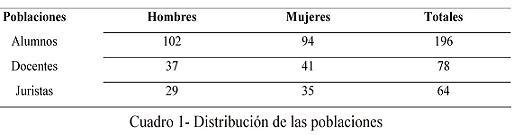
<body><![CDATA[<p class="western" style="margin: 2.85pt 134.25pt 0.0001pt 27pt; text-align: justify; line-height: 150%;"><b><span style="font-size: 12pt; line-height: 150%; font-family: Arial;" lang="ES-UY">M&Eacute;TODO</span></b><span style="font-size: 12pt; line-height: 150%; font-family: Arial;" lang="ES-UY"><o:p></o:p></span></p>        <p class="western" style="margin: 2.85pt 134.25pt 0.0001pt 27pt; text-align: justify; text-indent: 14.2pt; line-height: 150%;"><span style="font-size: 12pt; line-height: 150%; font-family: Arial;" lang="ES-UY">En funci&oacute;n de lo que est&aacute; expuesto mas arriba, tomamos como hip&oacute;tesis que la representaci&oacute;n social de adolescentes de tercero de BUP se diferencia de la de los docentes del colegio y la de los juristas. La poblaci&oacute;n de los juristas est&aacute; compuesta esencialmente de profesores no-titulares de la universidad que tienen una actividad de juristas en terrenos pr&oacute;ximos a los colegios escogidos. Esta elecci&oacute;n ha permitido una movilizaci&oacute;n m&aacute;s f&aacute;cil de estos profesionales. Nuestro trabajo consistir&aacute; tambi&eacute;n en poner de realce los campos de esta diversidad y en volver a situarla en nuestro contexto te&oacute;rico. <o:p></o:p></span></p>        <p class="western" style="margin: 2.85pt 134.25pt 0.0001pt 27pt; text-align: justify; text-indent: 14.2pt; line-height: 150%;"><span style="font-size: 12pt; line-height: 150%; font-family: Arial;" lang="ES-UY"><o:p>&nbsp;</o:p></span></p>        <p class="western" style="margin: 2.85pt 134.25pt 0.0001pt 27pt; text-align: justify; line-height: 150%;"><b><span style="font-size: 12pt; line-height: 150%; font-family: Arial;" lang="ES-UY"><o:p>&nbsp;</o:p></span></b></p>        <p class="western" style="margin: 2.85pt 134.25pt 0.0001pt 27pt; text-align: justify; line-height: 150%;"><b><span style="font-size: 12pt; line-height: 150%; font-family: Arial;" lang="ES-UY">PARTICIPANTES<o:p></o:p></span></b></p>        <p class="western" style="margin: 2.85pt 134.25pt 0.0001pt 27pt; text-align: justify; line-height: 150%;"><span style="font-size: 12pt; line-height: 150%; font-family: Arial;" lang="ES-UY">La muestra se compone de 338 personas dividas de la manera siguiente (ver <a href="#t1">cuadro 1</a>) <o:p></o:p></span></p>        <p class="western" style="margin: 2.85pt 134.25pt 0.0001pt 27pt; text-align: justify; line-height: 150%;"><span style="font-size: 12pt; line-height: 150%; font-family: Arial;" lang="ES-UY"><o:p>&nbsp;</o:p></span></p>        <p class="MsoNormal" style="margin-right: 134.25pt;"><span style="font-family: Arial; color: windowtext;" lang="ES-UY"><o:p>&nbsp;</o:p></span></p>        <p class="western" style="margin: 8.5pt 134.25pt 0.0001pt 27pt; text-align: justify; line-height: 150%;"><a name="t1"></a><span style="font-size: 12pt; line-height: 150%; font-family: Arial;" lang="ES-UY"><img id="_x0000_i1025" src="../../../../../img/revistas/cp/v3n1/1a04t1.jpg" style="border-style: solid; border-width: 1px; height: 135px; width: 512px;" border="0" height="32" width="32"><o:p></o:p></span></p>        <p class="western" style="margin: 8.5pt 134.25pt 0.0001pt 27pt; text-align: justify; line-height: 150%;"><span style="font-size: 12pt; line-height: 150%; font-family: Arial;" lang="ES-UY"><o:p>&nbsp;</o:p></span></p>        ]]></body>
<body><![CDATA[<p class="western" style="margin: 8.5pt 134.25pt 0.0001pt 27pt; text-align: justify; line-height: 150%;"><span style="font-size: 12pt; line-height: 150%; font-family: Arial;" lang="ES-UY"><o:p>&nbsp;</o:p></span></p>        <p class="western" style="margin: 8.5pt 134.25pt 0.0001pt 27pt; text-align: justify; line-height: 150%;"><b><span style="font-size: 12pt; line-height: 150%; font-family: Arial;" lang="ES-UY">INSTRUMENTOS</span></b><span style="font-size: 12pt; line-height: 150%; font-family: Arial;" lang="ES-UY"><o:p></o:p></span></p>        <p class="western" style="margin: 2.85pt 134.25pt 0.0001pt 27pt; text-align: justify; line-height: 150%;"><span style="font-size: 12pt; line-height: 150%; font-family: Arial;" lang="ES-UY"><o:p>&nbsp;</o:p></span></p>        <p class="western" style="margin: 2.85pt 134.25pt 0.0001pt 27pt; text-align: center; line-height: 150%;" align="center"><b><span style="font-size: 12pt; line-height: 150%; font-family: Arial;" lang="ES-UY">ELECCI&Oacute;N TE&Oacute;RICA DE LOS ELEMENTOS UTILZADOS PARA LA INVESTIGACI&Oacute;N : LA NOCI&Oacute;N DE</span></b><span style="font-size: 12pt; line-height: 150%; font-family: Arial;" lang="ES-UY"><o:p></o:p></span></p>        <p class="western" style="margin: 5pt 134.25pt 0.0001pt 27pt; text-align: center; line-height: 150%;" align="center"><b><span style="font-size: 12pt; line-height: 150%; font-family: Arial;" lang="ES-UY">&laquo; REPRESENTACI&Oacute;N SOCIAL&raquo;</span></b><span style="font-size: 12pt; line-height: 150%; font-family: Arial;" lang="ES-UY"><o:p></o:p></span></p>        <p class="western" style="margin: 5pt 134.25pt 0.0001pt 27pt; text-align: justify; line-height: 150%;"><span style="font-size: 12pt; line-height: 150%; font-family: Arial;" lang="ES-UY"><o:p>&nbsp;</o:p></span></p>        <p class="western" style="margin: 2.85pt 134.25pt 0.0001pt 27pt; text-align: justify; text-indent: 14.2pt; line-height: 150%;"><span style="font-size: 12pt; line-height: 150%; font-family: Arial;" lang="ES-UY">La representaci&oacute;n es &laquo;el producto y el proceso de una actividad mental mediante la cual individuos vuelven a construir la realidad y le atribuyen una significaci&oacute;n especif&iacute;ca &raquo; (<a name="Abric1976."></a><a href="#Abric1">Abric</a>, 1976).<o:p></o:p></span></p>        <p class="western" style="margin: 5pt 134.25pt 0.0001pt 27pt; text-align: justify; text-indent: 14.2pt; line-height: 150%;"><span style="font-size: 12pt; line-height: 150%; font-family: Arial;" lang="ES-UY"><o:p>&nbsp;</o:p></span></p>        <p class="western" style="margin: 5pt 134.25pt 0.0001pt 27pt; text-align: justify; text-indent: 14.2pt; line-height: 150%;"><span style="font-size: 12pt; line-height: 150%; font-family: Arial;" lang="ES-UY">El pensamiento social est&aacute; centrado en la comunicaci&oacute;n, en la noci&oacute;n de interracci&oacute;n. Si un objeto constituye un desaf&iacute;o social (aunque que sea limitado), la representaci&oacute;n correspondiente ser&aacute; el producto de un amplio conjunto de interracciones (internas en el mismo grupo). La representaci&oacute;n social est&aacute; generada pues de manera colectiva, y por lo tanto est&aacute; compartida. <o:p></o:p></span></p>        <p class="western" style="margin: 5pt 134.25pt 0.0001pt 27pt; text-align: justify; text-indent: 14.2pt; line-height: 150%;"><span style="font-size: 12pt; line-height: 150%; font-family: Arial;" lang="ES-UY"><o:p>&nbsp;</o:p></span></p>        ]]></body>
<body><![CDATA[<p class="western" style="margin: 5pt 134.25pt 0.0001pt 27pt; text-align: justify; text-indent: 14.2pt; line-height: 150%;"><span style="font-size: 12pt; line-height: 150%; font-family: Arial;" lang="ES-UY">En cuanto a la cuesti&oacute;n de la estructuraci&oacute;n de las representaciones sociales, existen dos grandes campos te&oacute;ricos que no son en absoluto antagonistas: la escuela de Ginebra con su teor&iacute;a de los principios generadores de postura y la escuela de Aix con su teor&iacute;a del n&uacute;cleo central. <o:p></o:p></span></p>        <p class="western" style="margin: 5pt 134.25pt 0.0001pt 27pt; text-align: justify; text-indent: 14.2pt; line-height: 150%;"><span style="font-size: 12pt; line-height: 150%; font-family: Arial;" lang="ES-UY"><o:p>&nbsp;</o:p></span></p>        <p class="western" style="margin: 5pt 134.25pt 0.0001pt 27pt; text-align: justify; text-indent: 14.2pt; line-height: 150%;"><span style="font-size: 12pt; line-height: 150%; font-family: Arial;" lang="ES-UY">La presentaci&oacute;n de estos dos campos nos permite argumentar nuestra elecci&oacute;n preferente de la teor&iacute;a del n&uacute;cleo central, m&aacute;s adaptada a nuestra investigaci&oacute;n. <o:p></o:p></span></p>        <p class="western" style="margin: 2.85pt 134.25pt 0.0001pt 27pt; text-align: justify; text-indent: 14.2pt; line-height: 150%;"><span style="font-size: 12pt; line-height: 150%; font-family: Arial;" lang="ES-UY"><o:p>&nbsp;</o:p></span></p>        <p class="western" style="margin: 2.85pt 134.25pt 0.0001pt 27pt; text-align: justify; text-indent: 14.2pt; line-height: 150%;"><span style="font-size: 12pt; line-height: 150%; font-family: Arial;" lang="ES-UY"><o:p>&nbsp;</o:p></span></p>        <p class="western" style="margin: 2.85pt 134.25pt 0.0001pt 27pt; text-align: center; line-height: 150%;" align="center"><b><span style="font-size: 12pt; line-height: 150%; font-family: Arial;" lang="ES-UY">LA TEOR&Iacute;A DE LOS PRINCIPIOS GENERADORES DE POSTURAS</span></b><span style="font-size: 12pt; line-height: 150%; font-family: Arial;" lang="ES-UY"><o:p></o:p></span></p>        <p class="western" style="margin: 2.85pt 134.25pt 0.0001pt 27pt; text-align: justify; line-height: 150%;"><span style="font-size: 12pt; line-height: 150%; font-family: Arial;" lang="ES-UY"><o:p>&nbsp;</o:p></span></p>        <p class="western" style="margin: 5.65pt 134.25pt 0.0001pt 27pt; text-align: justify; text-indent: 14.2pt; line-height: 150%;"><span style="font-size: 12pt; line-height: 150%; font-family: Arial;" lang="ES-UY">Para <a name="Doise2002."></a><a href="#Doise">Doise y Palmonari</a> (2002) las representaciones sociales son &laquo;principios generadores de posturas vinculadas a intenciones espec&iacute;ficas en un conjunto de relaciones sociales y organizan los procesos simb&oacute;licos que intervienen en dichas relaciones&raquo; (p. 124). Este doble origen nos lleva a evocar una noci&oacute;n clave para Bourdieu, la noci&oacute;n de campo, campo que se entiende como conjunto de objetos sociales que tienen entre s&iacute; relaciones de jerarqu&iacute;a y de oposici&oacute;n, que estructuran &laquo;la repartici&oacute;n de un capital espec&iacute;fico de valor social&raquo;. <o:p></o:p></span></p>        <p class="western" style="margin: 22.7pt 134.25pt 0.0001pt 27pt; text-align: justify; text-indent: 14.2pt; line-height: 150%;"><span style="font-size: 12pt; line-height: 150%; font-family: Arial;" lang="ES-UY">La gran diferencia entre la teor&iacute;a del n&uacute;cleo central (<a href="#Abric1">Abric</a>, 1976) y la teoria de los principios generadores de postura (Doise ,1986) se sit&uacute;a en la noci&oacute;n de estructura. Para Doise, la estructura de la representaci&oacute;n es una estructura de datos (an&aacute;lisis factorial) , o sea las relaciones entre elementos de un campo representacional. Esto se manifiesta por: <o:p></o:p></span></p>        <p class="western" style="margin: 2.85pt 134.25pt 0.0001pt 27pt; text-align: justify; line-height: 150%;"><span style="font-size: 12pt; line-height: 150%; font-family: Arial;" lang="ES-UY"><o:p>&nbsp;</o:p></span></p>        ]]></body>
<body><![CDATA[<p class="western" style="margin: 2.85pt 134.25pt 0.0001pt 27pt; text-align: justify; line-height: 150%;"><span style="font-size: 12pt; line-height: 150%; font-family: Arial;" lang="ES-UY">- relaciones de interdependencia o de analog&iacute;a <o:p></o:p></span></p>        <p class="western" style="margin: 2.85pt 134.25pt 0.0001pt 27pt; text-align: justify; line-height: 150%;"><span style="font-size: 12pt; line-height: 150%; font-family: Arial;" lang="ES-UY">- relaciones de independencia o antagonismo. <o:p></o:p></span></p>        <p class="western" style="margin: 5pt 134.25pt 0.0001pt 27pt; text-align: justify; text-indent: 14.2pt; line-height: 150%;"><span style="font-size: 12pt; line-height: 150%; font-family: Arial;" lang="ES-UY"><o:p>&nbsp;</o:p></span></p>        <p class="western" style="margin: 5pt 134.25pt 0.0001pt 27pt; text-align: justify; text-indent: 14.2pt; line-height: 150%;"><span style="font-size: 12pt; line-height: 150%; font-family: Arial;" lang="ES-UY">El inter&eacute;s de esta teor&iacute;a se basa en el hecho de que ponga un v&iacute;nculo directo entre la representaci&oacute;n social y la postura, es decir de hecho la actitud de un individuo ante un objeto social dado. La actitud es, seg&uacute;n Moscovici &laquo;la dimensi&oacute;n primera de la representaci&oacute;n&raquo;. Es decir el mediador entre la representaci&oacute;n y las pr&aacute;cticas sociales de un individuo o de un grupo. <o:p></o:p></span></p>        <p class="western" style="margin: 2.85pt 134.25pt 0.0001pt 27pt; text-align: justify; line-height: 150%;"><span style="font-size: 12pt; line-height: 150%; font-family: Arial;" lang="ES-UY"><o:p>&nbsp;</o:p></span></p>        <p class="western" style="margin: 2.85pt 134.25pt 0.0001pt 27pt; text-align: justify; line-height: 150%;"><span style="font-size: 12pt; line-height: 150%; font-family: Arial;" lang="ES-UY"><o:p>&nbsp;</o:p></span></p>        <p class="western" style="margin: 2.85pt 134.25pt 0.0001pt 27pt; text-align: justify; line-height: 150%;"><span style="font-size: 12pt; line-height: 150%; font-family: Arial;" lang="ES-UY"><o:p>&nbsp;</o:p></span></p>        <p class="western" style="margin: 2.85pt 134.25pt 0.0001pt 27pt; text-align: center; line-height: 150%;" align="center"><b><span style="font-size: 12pt; line-height: 150%; font-family: Arial;" lang="ES-UY">LA TEOR&Iacute;A DEL N&Uacute;CLEO CENTRAL</span></b><span style="font-size: 12pt; line-height: 150%; font-family: Arial;" lang="ES-UY"><o:p></o:p></span></p>        <p class="western" style="margin: 2.85pt 134.25pt 0.0001pt 27pt; text-align: justify; text-indent: 14.2pt; line-height: 150%;"><span style="font-size: 12pt; line-height: 150%; font-family: Arial;" lang="ES-UY"><o:p>&nbsp;</o:p></span></p>        <p class="western" style="margin: 2.85pt 134.25pt 0.0001pt 27pt; text-align: justify; text-indent: 14.2pt; line-height: 150%;"><span style="font-size: 12pt; line-height: 150%; font-family: Arial;" lang="ES-UY">La teor&iacute;a del n&uacute;cleo central (<a href="#Abric1">Abric</a>, 1976) enriquece el cuadro te&oacute;rico de Moscovici y vuelve a utilizar la idea del n&uacute;cleo figurativo. Vamos a considerar que la representaci&oacute;n funciona como una entidad (<a href="#Abric1">Abric</a> 1976) que est&aacute; organizada alrededor de un n&uacute;cleo central cuya funci&oacute;n es estructurante. Los elementos que componen este n&uacute;cleo tienen entre s&iacute; relaciones con fuerte conexidad y constituyen por lo tanto un n&uacute;cleo de significaciones preponderantes. <o:p></o:p></span></p>        ]]></body>
<body><![CDATA[<p class="western" style="margin: 2.85pt 134.25pt 0.0001pt 27pt; text-align: justify; text-indent: 14.2pt; line-height: 150%;"><span style="font-size: 12pt; line-height: 150%; font-family: Arial;" lang="ES-UY"><o:p>&nbsp;</o:p></span></p>        <p class="western" style="margin: 2.85pt 134.25pt 0.0001pt 27pt; text-align: justify; text-indent: 14.2pt; line-height: 150%;"><span style="font-size: 12pt; line-height: 150%; font-family: Arial;" lang="ES-UY">El n&uacute;cleo central permite pues la gesti&oacute;n del sentido y proporciona los medios de su coherencia. Nunerosas experiencias muestran por otra parte que el replanteamiento de los elementos centrales genera un desplome del sentido en el individuo. <o:p></o:p></span></p>        <p class="western" style="margin: 2.85pt 134.25pt 0.0001pt 27pt; text-align: justify; text-indent: 14.2pt; line-height: 150%;"><span style="font-size: 12pt; line-height: 150%; font-family: Arial;" lang="ES-UY"><o:p>&nbsp;</o:p></span></p>        <p class="western" style="margin: 2.85pt 134.25pt 0.0001pt 27pt; text-align: justify; text-indent: 14.2pt; line-height: 150%;"><span style="font-size: 12pt; line-height: 150%; font-family: Arial;" lang="ES-UY">Sin embargo, la representaci&oacute;n social funciona gracias a dos componentes distintos, pero complementarios: el sistema central y el sistema perif&eacute;rico. <o:p></o:p></span></p>        <p class="western" style="margin: 2.85pt 134.25pt 0.0001pt 27pt; text-align: justify; text-indent: 14.2pt; line-height: 150%;"><span style="font-size: 12pt; line-height: 150%; font-family: Arial;" lang="ES-UY"><o:p>&nbsp;</o:p></span></p>        <p class="western" style="margin: 2.85pt 134.25pt 0.0001pt 27pt; text-align: justify; text-indent: 14.2pt; line-height: 150%;"><span style="font-size: 12pt; line-height: 150%; font-family: Arial;" lang="ES-UY">El sistema central es el fundamento de la estructuraci&oacute;n de la representaci&oacute;n. Por esta raz&oacute;n va a desempe&ntilde;ar un papel espec&iacute;fico y fundamental, en particular por principio de econom&iacute;a, para la gesti&oacute;n de la representaci&oacute;n. <o:p></o:p></span></p>        <p class="western" style="margin: 5pt 134.25pt 0.0001pt 27pt; text-align: justify; text-indent: 14.2pt; line-height: 150%;"><span style="font-size: 12pt; line-height: 150%; font-family: Arial;" lang="ES-UY"><o:p>&nbsp;</o:p></span></p>        <p class="western" style="margin: 5pt 134.25pt 0.0001pt 27pt; text-align: justify; text-indent: 14.2pt; line-height: 150%;"><span style="font-size: 12pt; line-height: 150%; font-family: Arial;" lang="ES-UY">En cuanto al sistema perif&eacute;rico est&aacute; bajo la dependencia del sistema central. Los elementos que lo componen est&aacute;n ponderados y su valor lo determina en gran parte el sistema central. <o:p></o:p></span></p>        <p class="western" style="margin: 5pt 134.25pt 0.0001pt 27pt; text-align: justify; text-indent: 14.2pt; line-height: 150%;"><span style="font-size: 12pt; line-height: 150%; font-family: Arial;" lang="ES-UY"><o:p>&nbsp;</o:p></span></p>        <p class="western" style="margin: 5pt 134.25pt 0.0001pt 27pt; text-align: justify; text-indent: 14.2pt; line-height: 150%;"><span style="font-size: 12pt; line-height: 150%; font-family: Arial;" lang="ES-UY">Los elementos de conocimiento de ambos sistemas se llaman creencias centrales y creencias perif&eacute;ricas. <o:p></o:p></span></p>        ]]></body>
<body><![CDATA[<p class="western" style="margin: 2.85pt 134.25pt 0.0001pt 27pt; text-align: justify; text-indent: 14.2pt; line-height: 150%;"><span style="font-size: 12pt; line-height: 150%; font-family: Arial;" lang="ES-UY"><o:p>&nbsp;</o:p></span></p>        <p class="western" style="margin: 2.85pt 134.25pt 0.0001pt 27pt; text-align: justify; text-indent: 14.2pt; line-height: 150%;"><span style="font-size: 12pt; line-height: 150%; font-family: Arial;" lang="ES-UY">Much&iacute;simas experiencias y publicaciones tratan de la oposici&oacute;n entre creencias centrales y creencias perif&eacute;ricas (<a name="Abric1994."></a><a href="#Abric2">Abric</a> 1994). Podemos resumir la funci&oacute;n de las dos dimensiones de la representaci&oacute;n de la manera siguiente: <o:p></o:p></span></p>        <p class="western" style="margin: 5pt 134.25pt 0.0001pt 27pt; text-align: justify; text-indent: 14.2pt; line-height: 150%;"><span style="font-size: 12pt; line-height: 150%; font-family: Arial;" lang="ES-UY"><o:p>&nbsp;</o:p></span></p>        <p class="western" style="margin: 5pt 134.25pt 0.0001pt 27pt; text-align: justify; text-indent: 14.2pt; line-height: 150%;"><span style="font-size: 12pt; line-height: 150%; font-family: Arial;" lang="ES-UY">El sistema central es: <o:p></o:p></span></p>        <p class="western" style="margin: 5pt 134.25pt 0.0001pt 27pt; text-align: justify; line-height: 150%;"><span style="font-size: 12pt; line-height: 150%; font-family: Arial;" lang="ES-UY">- estable, coherente y r&iacute;gido <o:p></o:p></span></p>        <p class="western" style="margin: 5pt 134.25pt 0.0001pt 27pt; text-align: justify; line-height: 150%;"><span style="font-size: 12pt; line-height: 150%; font-family: Arial;" lang="ES-UY">- vinculado a la historia deI grupo <o:p></o:p></span></p>        <p class="western" style="margin: 5pt 134.25pt 0.0001pt 27pt; text-align: justify; line-height: 150%;"><span style="font-size: 12pt; line-height: 150%; font-family: Arial;" lang="ES-UY">- vinculado a la memoria colectiva <o:p></o:p></span></p>        <p class="western" style="margin: 5pt 134.25pt 0.0001pt 27pt; text-align: justify; line-height: 150%;"><span style="font-size: 12pt; line-height: 150%; font-family: Arial;" lang="ES-UY">- &laquo;el lugar de consenso de las representaciones sociales&raquo;, define la homogeneidad del grupo resistente al cambio <o:p></o:p></span></p>        <p class="western" style="margin: 5pt 134.25pt 0.0001pt 27pt; text-align: justify; line-height: 150%;"><span style="font-size: 12pt; line-height: 150%; font-family: Arial;" lang="ES-UY">- garante de la perennidad de la representaci&oacute;n<o:p></o:p></span></p>        <p class="western" style="margin: 5pt 134.25pt 0.0001pt 27pt; text-align: justify; line-height: 150%;"><span style="font-size: 12pt; line-height: 150%; font-family: Arial;" lang="ES-UY">- poco sensible, hasta insensible al contexto inmediato<o:p></o:p></span></p>        ]]></body>
<body><![CDATA[<p class="western" style="margin: 5pt 134.25pt 0.0001pt 27pt; text-align: justify; text-indent: 14.2pt; line-height: 150%;"><span style="font-size: 12pt; line-height: 150%; font-family: Arial;" lang="ES-UY"><o:p>&nbsp;</o:p></span></p>        <p class="western" style="margin: 5pt 134.25pt 0.0001pt 27pt; text-align: justify; text-indent: 14.2pt; line-height: 150%;"><span style="font-size: 12pt; line-height: 150%; font-family: Arial;" lang="ES-UY">El sistema perif&eacute;rico es: <o:p></o:p></span></p>        <p class="western" style="margin: 5pt 134.25pt 0.0001pt 27pt; text-align: justify; line-height: 150%;"><span style="font-size: 12pt; line-height: 150%; font-family: Arial;" lang="ES-UY">- flexible y suave, soporta la contradicci&oacute;n <o:p></o:p></span></p>        <p class="western" style="margin: 5pt 134.25pt 0.0001pt 27pt; text-align: justify; line-height: 150%;"><span style="font-size: 12pt; line-height: 150%; font-family: Arial;" lang="ES-UY">- permite la integraci&oacute;n de las experiencias y de las historias individuales <o:p></o:p></span></p>        <p class="western" style="margin: 5pt 134.25pt 0.0001pt 27pt; text-align: justify; line-height: 150%;"><span style="font-size: 12pt; line-height: 150%; font-family: Arial;" lang="ES-UY">- soporta la heterogeneidad y la diversidad en el sena del grupo <o:p></o:p></span></p>        <p class="western" style="margin: 5pt 134.25pt 0.0001pt 27pt; text-align: justify; line-height: 150%;"><span style="font-size: 12pt; line-height: 150%; font-family: Arial;" lang="ES-UY">- evolutivo, adaptativo <o:p></o:p></span></p>        <p class="western" style="margin: 5pt 134.25pt 0.0001pt 27pt; text-align: justify; line-height: 150%;"><span style="font-size: 12pt; line-height: 150%; font-family: Arial;" lang="ES-UY">- sensible al contexto inmediato <o:p></o:p></span></p>        <p class="western" style="margin: 2.85pt 134.25pt 0.0001pt 27pt; text-align: justify; text-indent: 14.2pt; line-height: 150%;"><span style="font-size: 12pt; line-height: 150%; font-family: Arial;" lang="ES-UY"><o:p>&nbsp;</o:p></span></p>        <p class="western" style="margin: 2.85pt 134.25pt 0.0001pt 27pt; text-align: justify; text-indent: 14.2pt; line-height: 150%;"><span style="font-size: 12pt; line-height: 150%; font-family: Arial;" lang="ES-UY">Es importante constatar que el sistema perif&eacute;rico desempe&ntilde;a el papel de &laquo;tamp&oacute;n&raquo; que permite conservar la estructura del sistema central. Adem&aacute;s, el hecho de que sea evolutivo permite defender la representaci&oacute;n, seg&uacute;n el contexto, y concretar el sistema central (cuyas creencias han de seguir consensuales y estructuradas para que no se pierda el sentido de la representaci&oacute;n). El sistema perif&eacute;rico juega tambi&eacute;n un papel de mediaci&oacute;n con el entorno; gracias a los elementos perif&eacute;ricos es coma la representaci&oacute;n se arraiga en la realidad. <o:p></o:p></span></p>        <p class="western" style="margin: 2.85pt 134.25pt 0.0001pt 27pt; text-align: justify; line-height: 150%;"><span style="font-size: 12pt; line-height: 150%; font-family: Arial;" lang="ES-UY"><o:p>&nbsp;</o:p></span></p>        ]]></body>
<body><![CDATA[<p class="western" style="margin: 2.85pt 134.25pt 0.0001pt 27pt; text-align: center; line-height: 150%;" align="center"><b><span style="font-size: 12pt; line-height: 150%; font-family: Arial;" lang="ES-UY"><o:p>&nbsp;</o:p></span></b></p>        <p class="western" style="margin: 2.85pt 134.25pt 0.0001pt 27pt; text-align: center; line-height: 150%;" align="center"><b><span style="font-size: 12pt; line-height: 150%; font-family: Arial;" lang="ES-UY">JUSTIFICACI&Oacute;N DE LA ELECCI&Oacute;N TE&Oacute;RICA DE AIX</span></b><span style="font-size: 12pt; line-height: 150%; font-family: Arial;" lang="ES-UY"><o:p></o:p></span></p>        <p class="western" style="margin: 2.85pt 134.25pt 0.0001pt 27pt; text-align: justify; line-height: 150%;"><span style="font-size: 12pt; line-height: 150%; font-family: Arial;" lang="ES-UY"><o:p>&nbsp;</o:p></span></p>        <p class="western" style="margin: 2.85pt 134.25pt 0.0001pt 27pt; text-align: justify; text-indent: 14.2pt; line-height: 150%;"><span style="font-size: 12pt; line-height: 150%; font-family: Arial;" lang="ES-UY">Como tuvimos ya la oportunidad de justificarlo en la exposici&oacute;n te&oacute;rica, no buscamos por qu&eacute; la representaci&oacute;n social del derecho justificar&iacute;a la postura de los adolescentes a prop&oacute;sito de su objeto, sino c&oacute;mo ella lo hace leg&iacute;timo, es decir la actitud de un individuo ante este objeto social. <o:p></o:p></span></p>        <p class="western" style="margin: 2.85pt 134.25pt 0.0001pt 27pt; text-align: justify; text-indent: 14.2pt; line-height: 150%;"><span style="font-size: 12pt; line-height: 150%; font-family: Arial;" lang="ES-UY"><o:p>&nbsp;</o:p></span></p>        <p class="western" style="margin: 2.85pt 134.25pt 0.0001pt 27pt; text-align: justify; line-height: 150%;"><b><span style="font-size: 12pt; line-height: 150%; font-family: Arial;" lang="ES-UY">PROCEDIMIENTO</span></b><span style="font-size: 12pt; line-height: 150%; font-family: Arial;" lang="ES-UY"><o:p></o:p></span></p>        <p class="western" style="margin: 2.85pt 134.25pt 0.0001pt 27pt; text-align: center; line-height: 150%;" align="center"><b><span style="font-size: 12pt; line-height: 150%; font-family: Arial;" lang="ES-UY">EL N&Uacute;CLEO CENTRAL DE LA REPRESENTACI&Oacute;N</span></b><span style="font-size: 12pt; line-height: 150%; font-family: Arial;" lang="ES-UY"><o:p></o:p></span></p>        <p class="western" style="margin: 2.85pt 134.25pt 0.0001pt 27pt; text-align: justify; line-height: 150%;"><span style="font-size: 12pt; line-height: 150%; font-family: Arial;" lang="ES-UY"><o:p>&nbsp;</o:p></span></p>        <p class="western" style="margin: 2.85pt 134.25pt 0.0001pt 27pt; text-align: justify; text-indent: 14.2pt; line-height: 150%;"><span style="font-size: 12pt; line-height: 150%; font-family: Arial;" lang="ES-UY">Existen tres diferentes t&eacute;cnicas que permiten identificar el n&uacute;cleo central de una representaci&oacute;n: <o:p></o:p></span></p>        <p class="western" style="margin: 5pt 134.25pt 0.0001pt 27pt; text-align: justify; line-height: 150%;"><span style="font-size: 12pt; line-height: 150%; font-family: Arial;" lang="ES-UY"><o:p>&nbsp;</o:p></span></p>        ]]></body>
<body><![CDATA[<p class="western" style="margin: 5pt 134.25pt 0.0001pt 27pt; text-align: justify; line-height: 150%;"><span style="font-size: 12pt; line-height: 150%; font-family: Arial;" lang="ES-UY">- el m&eacute;todo clasificaci&oacute;n / frecuencia (<a name="Verges1992."></a><a href="#Verges">Verges</a>, 1992) <o:p></o:p></span></p>        <p class="western" style="margin: 5pt 134.25pt 0.0001pt 27pt; text-align: justify; line-height: 150%;"><span style="font-size: 12pt; line-height: 150%; font-family: Arial;" lang="ES-UY">- el m&eacute;todo de los esquemas cognitivos de base (<a name="Guimelli1992."></a><a href="#Guimelli">Guimelli &amp; Rouquette</a>, 1992) <o:p></o:p></span></p>        <p class="western" style="margin: 5pt 134.25pt 0.0001pt 27pt; text-align: justify; line-height: 150%;"><span style="font-size: 12pt; line-height: 150%; font-family: Arial;" lang="ES-UY">- la inducci&oacute;n por gui&oacute;n ambiguo (<a name="Moliner1993."></a><a href="#Moliner">Moliner</a>, 1993) <o:p></o:p></span></p>        <p class="western" style="margin: 5pt 134.25pt 0.0001pt 27pt; text-align: justify; line-height: 150%;"><span style="font-size: 12pt; line-height: 150%; font-family: Arial;" lang="ES-UY">- el an&aacute;lisis de similitud (Falment, 1962) <o:p></o:p></span></p>        <p class="western" style="margin: 5pt 134.25pt 0.0001pt 27pt; text-align: justify; line-height: 150%;"><span style="font-size: 12pt; line-height: 150%; font-family: Arial;" lang="ES-UY">- la t&eacute;cnica de planteamiento (Moliner, 1988). <o:p></o:p></span></p>        <p class="western" style="margin: 2.85pt 134.25pt 0.0001pt 27pt; text-align: justify; text-indent: 14.2pt; line-height: 150%;"><span style="font-size: 12pt; line-height: 150%; font-family: Arial;" lang="ES-UY"><o:p>&nbsp;</o:p></span></p>        <p class="western" style="margin: 2.85pt 134.25pt 0.0001pt 27pt; text-align: justify; text-indent: 14.2pt; line-height: 150%;"><span style="font-size: 12pt; line-height: 150%; font-family: Arial;" lang="ES-UY">Por motivos de comodidad y de eficacia, un m&eacute;todo de asociaci&oacute;n de palabras, con el t&eacute;rmino&laquo;el derecho&raquo; ha sido utilizado para la recopilaci&oacute;n de nuestros datos. Se utiliza este m&eacute;todo en numerosos estudios sobre las representaciones sociales. Entonces fue el m&eacute;todo clasificaci&oacute;n/frecuencia el que se impuso con m&aacute;s evidencia para llevar a cabo el an&aacute;lisis de los resultados. <o:p></o:p></span></p>        <p class="western" style="margin: 2.85pt 134.25pt 0.0001pt 27pt; text-align: justify; text-indent: 14.2pt; line-height: 150%;"><span style="font-size: 12pt; line-height: 150%; font-family: Arial;" lang="ES-UY"><o:p>&nbsp;</o:p></span></p>        <p class="western" style="margin: 2.85pt 134.25pt 0.0001pt 27pt; text-align: justify; text-indent: 14.2pt; line-height: 150%;"><span style="font-size: 12pt; line-height: 150%; font-family: Arial;" lang="ES-UY">Seg&uacute;n <a href="#Verges">Verges</a> (1992), es el puesto de aparici&oacute;n de las palabras asociadas el que hay que tomar en cuenta para la construcci&oacute;n experimental de la representaci&oacute;n. Pero la t&eacute;cnica deI puesto de importancia, seg&uacute;n estudios m&aacute;s recientes, parece adecuarse mejor en la hip&oacute;tesis de la existencia de una zona muda de las representaciones sociales (<a name="Abric2003."></a><a href="#Abric3">Abric</a>, 2003). <o:p></o:p></span></p>        <p class="western" style="margin: 2.85pt 134.25pt 0.0001pt 27pt; text-align: justify; text-indent: 14.2pt; line-height: 150%;"><span style="font-size: 12pt; line-height: 150%; font-family: Arial;" lang="ES-UY"><o:p>&nbsp;</o:p></span></p>        ]]></body>
<body><![CDATA[<p class="western" style="margin: 2.85pt 134.25pt 0.0001pt 27pt; text-align: justify; text-indent: 14.2pt; line-height: 150%;"><span style="font-size: 12pt; line-height: 150%; font-family: Arial;" lang="ES-UY">Con el objetivo de adoptar esta tesis se les pidi&oacute; a las personas interrogadas un trabajo de tipo metacognativo sobre sus respuestas. Les invitamos a jerarquizar sus respuestas de 1 a 10, del t&eacute;rmino m&aacute;s pr&oacute;ximo al t&eacute;rmino menos pr&oacute;ximo de la palabra derecho (1 correspondiendo al t&eacute;rmino m&aacute;s pr&oacute;ximo y 10 correspondiendo al t&eacute;rmino m&aacute;s alejado). <o:p></o:p></span></p>        <p class="western" style="margin: 2.85pt 134.25pt 0.0001pt 27pt; text-align: justify; text-indent: 14.2pt; line-height: 150%;"><span style="font-size: 12pt; line-height: 150%; font-family: Arial;" lang="ES-UY"><o:p>&nbsp;</o:p></span></p>        <p class="western" style="margin: 2.85pt 134.25pt 0.0001pt 27pt; text-align: justify; text-indent: 14.2pt; line-height: 150%;"><span style="font-size: 12pt; line-height: 150%; font-family: Arial;" lang="ES-UY">As&iacute;, fueron seleccionados primero los elementos del campo representacional por un criterio preconizado en la mayor parte de los estudios (es decir los elementos cuya frecuencia N&gt;10: elementos citados por m&aacute;s del 10% de las personas). <o:p></o:p></span></p>        <p class="western" style="margin: 2.85pt 134.25pt 0.0001pt 27pt; text-align: justify; text-indent: 14.2pt; line-height: 150%;"><span style="font-size: 12pt; line-height: 150%; font-family: Arial;" lang="ES-UY"><o:p>&nbsp;</o:p></span></p>        <p class="western" style="margin: 2.85pt 134.25pt 0.0001pt 27pt; text-align: justify; text-indent: 14.2pt; line-height: 150%;"><span style="font-size: 12pt; line-height: 150%; font-family: Arial;" lang="ES-UY">Despu&eacute;s, seg&uacute;n el m&eacute;todo clasificaci&oacute;n/frecuencia, los elementos centrales de la representaci&oacute;n son elementos con fuerte frecuencia de aparici&oacute;n y un puesto de importancia medio bajo. Pues, para ello, conviene calcular la media de las frecuencias de los elementos de representaci&oacute;n y la media de los puestos medios. <o:p></o:p></span></p>        <p class="western" style="margin: 5pt 134.25pt 0.0001pt 27pt; text-align: justify; text-indent: 14.2pt; line-height: 150%;"><span style="font-size: 12pt; line-height: 150%; font-family: Arial;" lang="ES-UY">Los elementos del n&uacute;cleo central son los que cumplen con la doble exigencia siguiente:<o:p></o:p></span></p>        <p class="western" style="margin: 5pt 134.25pt 0.0001pt 27pt; text-align: justify; text-indent: 14.2pt; line-height: 150%;"><span style="font-size: 12pt; line-height: 150%; font-family: Arial;" lang="ES-UY"><o:p>&nbsp;</o:p></span></p>        <p class="western" style="margin: 5pt 134.25pt 0.0001pt 27pt; text-align: justify; text-indent: 14.2pt; line-height: 150%;"><span style="font-size: 12pt; line-height: 150%; font-family: Arial;" lang="ES-UY">- Frecuencia&gt; frecuencia media <o:p></o:p></span></p>        <p class="western" style="margin: 5pt 134.25pt 0.0001pt 27pt; text-align: justify; text-indent: 14.2pt; line-height: 150%;"><span style="font-size: 12pt; line-height: 150%; font-family: Arial;" lang="ES-UY">- Puesto medio&lt; media de los puestos medios <o:p></o:p></span></p>        <p class="western" style="margin: 5pt 134.25pt 0.0001pt 27pt; text-align: justify; text-indent: 14.2pt; line-height: 150%;"><span style="font-size: 12pt; line-height: 150%; font-family: Arial;" lang="ES-UY"><o:p>&nbsp;</o:p></span></p>        ]]></body>
<body><![CDATA[<p class="western" style="margin: 5pt 134.25pt 0.0001pt 27pt; text-align: justify; text-indent: 14.2pt; line-height: 150%;"><span style="font-size: 12pt; line-height: 150%; font-family: Arial;" lang="ES-UY">El <a href="#t2">cuadro 2</a> nos permite clasificar as&iacute; los t&eacute;rminos del campo representacional de nuestras poblaciones en 4 zonas distintas explicitadas en la parte &laquo;metodolog&iacute;a&raquo;: el n&uacute;cleo central, la primera periferia, la zona de los elementos contrastados y la segunda periferia. <o:p></o:p></span></p>        <p class="western" style="margin: 5pt 134.25pt 0.0001pt 27pt; text-align: justify; text-indent: 14.2pt; line-height: 150%;"><span style="font-size: 12pt; line-height: 150%; font-family: Arial;" lang="ES-UY"><o:p>&nbsp;</o:p></span></p>        <p class="western" style="margin: 5pt 134.25pt 0.0001pt 27pt; text-align: justify; text-indent: 14.2pt; line-height: 150%;"><span style="font-size: 12pt; line-height: 150%; font-family: Arial;" lang="ES-UY">Esta t&eacute;cnica nos permitir&aacute; valorar la existencia o no de diferencias entre las representaciones de las personas participantes en la experiencia. Con la ayuda deI indicio de Jaccard trataremos de entender en qu&eacute; consisten dichas diferencias de representaciones, y en particular qu&eacute; dimensiones las estructuran.</span></p>        <p class="western" style="margin: 5pt 134.25pt 0.0001pt 27pt; text-align: justify; text-indent: 14.2pt; line-height: 150%;"><span style="font-size: 12pt; line-height: 150%; font-family: Arial;" lang="ES-UY"><o:p>&nbsp;</o:p></span></p>        <p class="western" style="margin: 5pt 134.25pt 0.0001pt 27pt; text-align: justify; text-indent: 14.2pt; line-height: 150%;"><span style="font-size: 12pt; line-height: 150%; font-family: Arial;" lang="ES-UY"><o:p>&nbsp;</o:p></span></p>        <p class="western" style="margin: 5pt 134.25pt 0.0001pt 27pt; text-align: justify; line-height: 150%;"><a name="t2"></a><img id="_x0000_i1026" src="../../../../../img/revistas/cp/v3n1/1a04t2.jpg" style="border-style: solid; border-width: 1px; height: 452px; width: 371px;" border="0" height="32" width="32"><span style="font-size: 12pt; line-height: 150%; font-family: Arial;" lang="ES-UY"><o:p></o:p></span></p>        <p class="western" style="margin: 5pt 134.25pt 0.0001pt 27pt; text-align: justify; line-height: 150%;"><span style="font-size: 12pt; line-height: 150%; font-family: Arial;" lang="ES-UY"><o:p>&nbsp;</o:p></span></p>        <p class="western" style="margin: 5pt 134.25pt 0.0001pt 27pt; text-align: justify; line-height: 150%;"><span style="font-size: 12pt; line-height: 150%; font-family: Arial;" lang="ES-UY"><o:p>&nbsp;</o:p></span></p>        <p class="western" style="margin: 2.85pt 134.25pt 0.0001pt 27pt; text-align: center; line-height: 150%;" align="center"><b><span style="font-size: 12pt; line-height: 150%; font-family: Arial;" lang="ES-UY">LA ESTRUCTURA DE LA REPRESENTACI&Oacute;N</span></b><span style="font-size: 12pt; line-height: 150%; font-family: Arial;" lang="ES-UY"><o:p></o:p></span></p>        <p class="western" style="margin: 5.65pt 134.25pt 0.0001pt 27pt; text-align: justify; text-indent: 14.2pt; line-height: 150%;"><span style="font-size: 12pt; line-height: 150%; font-family: Arial;" lang="ES-UY"><o:p>&nbsp;</o:p></span></p>        ]]></body>
<body><![CDATA[<p class="western" style="margin: 5.65pt 134.25pt 0.0001pt 27pt; text-align: justify; text-indent: 14.2pt; line-height: 150%;"><span style="font-size: 12pt; line-height: 150%; font-family: Arial;" lang="ES-UY">El objetivo de este an&aacute;lisis va a consistir en valorar la fuerza del v&iacute;nculo entre las unidades de sentido de la representaci&oacute;n. Para ello hemos utilizado pues el indicio de Jaccard. Este indicio valora, para cada par de unidades, con qu&eacute; frecuencia una est&aacute; presente cuando una de las dos por lo menos est&aacute; presente. La matriz de asociaciones obtenida de este modo se ver&aacute; simplificada por el an&aacute;lisis en Grafo de Extensi&oacute;n M&iacute;nima (Minimum Spanning Tree Analysis). Este permite elaborar un grafo no orientado de las asociaciones interunidades. <o:p></o:p></span></p>        <p class="western" style="margin: 5.65pt 134.25pt 0.0001pt 27pt; text-align: justify; text-indent: 14.2pt; line-height: 150%;"><span style="font-size: 12pt; line-height: 150%; font-family: Arial;" lang="ES-UY"><o:p>&nbsp;</o:p></span></p>        <p class="western" style="margin: 5.65pt 134.25pt 0.0001pt 27pt; text-align: justify; text-indent: 14.2pt; line-height: 150%;"><span style="font-size: 12pt; line-height: 150%; font-family: Arial;" lang="ES-UY">Esto nos dar&aacute; una imagen muy sint&eacute;tica de las asociaciones semanticas m&aacute;s fuertes. El grafo obtenido ser&aacute; codificado bajo la forma de una matriz sim&eacute;trica, en la cual cada unidad aparecer&aacute; a la vez en l&iacute;nea y en columna, y en la cual se codificar&aacute; con unos 1 y unos 0 la presencia o la ausencia de un v&iacute;nculo entre dos unidades. Para tener una representaci&oacute;n gr&aacute;fica de la red asi obtenida, se utilizar&aacute; un analisis de correspondencias en la matriz de grafo. Se llama &laquo; an&aacute;lisis de la contig&uuml;idad&raquo; esta aplicaci&oacute;n particular del an&aacute;lisis de correspondencias a las matrices de grafo. <o:p></o:p></span></p>        <p class="western" style="margin: 5pt 134.25pt 0.0001pt 27pt; text-align: justify; text-indent: 14.2pt; line-height: 150%;"><span style="font-size: 12pt; line-height: 150%; font-family: Arial;" lang="ES-UY"><o:p>&nbsp;</o:p></span></p>        <p class="western" style="margin: 2.85pt 134.25pt 0.0001pt 27pt; text-align: justify; line-height: 150%;"><span style="font-size: 12pt; line-height: 150%; font-family: Arial;" lang="ES-UY"><o:p>&nbsp;</o:p></span></p>        <p class="western" style="margin: 2.85pt 134.25pt 0.0001pt 27pt; text-align: justify; line-height: 150%;"><span style="font-size: 12pt; line-height: 150%; font-family: Arial;" lang="ES-UY"><o:p>&nbsp;</o:p></span></p>        <p class="western" style="margin: 2.85pt 134.25pt 0.0001pt 27pt; text-align: justify; line-height: 150%;"><b><span style="font-size: 12pt; line-height: 150%; font-family: Arial;" lang="ES-UY">RESULTADOS</span></b><span style="font-size: 12pt; line-height: 150%; font-family: Arial;" lang="ES-UY"><o:p></o:p></span></p>        <p class="western" style="margin: 2.85pt 134.25pt 0.0001pt 27pt; text-align: center; line-height: 150%;" align="center"><b><span style="font-size: 12pt; line-height: 150%; font-family: Arial;" lang="ES-UY">LAS REPRESENTACIONES SOCIALES DE LOS GRUPOS DE ESTUDIO A PROP&Oacute;SITO DE LA NOCI&Oacute;N DE &laquo;DERECHO&raquo;</span></b></p>        <p class="western" style="margin: 2.85pt 134.25pt 0.0001pt 27pt; text-align: center; line-height: 150%;" align="center"><span style="font-size: 12pt; line-height: 150%; font-family: Arial;"><o:p>&nbsp;</o:p></span></p>        <p class="western" style="margin: 5pt 134.25pt 0.0001pt 27pt; text-align: justify; text-indent: 14.2pt; line-height: 150%;"><span style="font-size: 12pt; line-height: 150%; font-family: Arial;" lang="ES-UY">Como aparece anteriormente el m&eacute;todo clasificaci&oacute;n/frecuencia (Verges 1972; <a href="#Abric3">Abric</a> 2003) se impuso con m&aacute;s evidencia para llevar a cabo el trato de los resultados que permit&iacute;an evidenciar la diversidad de las Representaciones. <o:p></o:p></span></p>        ]]></body>
<body><![CDATA[<p class="western" style="margin: 5pt 134.25pt 0.0001pt 27pt; text-align: justify; line-height: 150%;"><span style="font-size: 12pt; line-height: 150%; font-family: Arial;" lang="ES-UY"><o:p>&nbsp;</o:p></span></p>        <p class="western" style="margin: 5pt 134.25pt 0.0001pt 27pt; text-align: justify; line-height: 150%;"><b><span style="font-size: 12pt; line-height: 150%; font-family: Arial;" lang="ES-UY">LOS ALUMNOS</span></b><span style="font-size: 12pt; line-height: 150%; font-family: Arial;" lang="ES-UY"><o:p></o:p></span></p>        <p class="western" style="margin: 5pt 134.25pt 0.0001pt 27pt; text-align: justify; line-height: 150%;"><span style="font-size: 12pt; line-height: 150%; font-family: Arial;" lang="ES-UY"><o:p>&nbsp;</o:p></span></p>        <p class="western" style="margin: 5pt 134.25pt 0.0001pt 27pt; text-align: justify; text-indent: 14.2pt; line-height: 150%;"><span style="font-size: 12pt; line-height: 150%; font-family: Arial;" lang="ES-UY">El <a href="#t3">cuadro 3</a> permite descubrir los distintos elementos del campo representacional de los alumnos de tercero de BUP: <o:p></o:p></span></p>        <p class="western" style="margin: 5pt 134.25pt 0.0001pt 27pt; text-align: justify; text-indent: 14.2pt; line-height: 150%;"><span style="font-size: 12pt; line-height: 150%; font-family: Arial;" lang="ES-UY"><o:p>&nbsp;</o:p></span></p>        <p class="western" style="margin: 5pt 134.25pt 0.0001pt 27pt; text-align: justify; text-indent: 14.2pt; line-height: 150%;"><span style="font-size: 12pt; line-height: 150%; font-family: Arial;" lang="ES-UY">El <u>n&uacute;cleo central</u> del campo representacional est&aacute; compuesto de los t&eacute;rminos siguientes: Justicia, derecho deI hombre, libertad. <o:p></o:p></span></p>        <p class="western" style="margin: 5pt 134.25pt 0.0001pt 27pt; text-align: justify; text-indent: 11.35pt; line-height: 150%;"><span style="font-size: 12pt; line-height: 150%; font-family: Arial;" lang="ES-UY">Los <u>elementos perif&eacute;ricos</u> del campo representacional pueden clasificarse de la manera siguiente: <o:p></o:p></span></p>        <p class="western" style="margin: 5pt 134.25pt 0.0001pt 27pt; text-align: justify; text-indent: 11.35pt; line-height: 150%;"><span style="font-size: 12pt; line-height: 150%; font-family: Arial;" lang="ES-UY"><o:p>&nbsp;</o:p></span></p>        <p class="western" style="margin: 5pt 134.25pt 0.0001pt 27pt; text-align: justify; line-height: 150%;"><span style="font-size: 12pt; line-height: 150%; font-family: Arial;" lang="ES-UY">&bull; 1era periferia: Abogado, juzgado, polic&iacute;a, juez.<o:p></o:p></span></p>        <p class="western" style="margin: 2.85pt 134.25pt 0.0001pt 27pt; text-align: justify; line-height: 150%;"><span style="font-size: 12pt; line-height: 150%; font-family: Arial;" lang="ES-UY">&bull; Zona de los elementos contrastados: derecho de expresi&oacute;n, derecho del ni&ntilde;o, igualdad, leyes, ley, CPE, reglas, derechos de la mujer.<o:p></o:p></span></p>        ]]></body>
<body><![CDATA[<p class="western" style="margin: 2.85pt 134.25pt 0.0001pt 27pt; text-align: justify; line-height: 150%;"><span style="font-size: 12pt; line-height: 150%; font-family: Arial;" lang="ES-UY">&bull; 2nda periferia: derecho de voto, respeto, c&aacute;rcel, pol&iacute;tico.</span></p>        <p class="western" style="margin: 2.85pt 134.25pt 0.0001pt 27pt; text-align: justify; line-height: 150%;"><span style="font-size: 12pt; line-height: 150%; font-family: Arial;" lang="ES-UY"><o:p>&nbsp;</o:p></span></p>        <p class="western" style="margin: 2.85pt 134.25pt 0.0001pt 27pt; text-align: justify; line-height: 150%;"><span style="font-size: 12pt; line-height: 150%; font-family: Arial;" lang="ES-UY"><o:p>&nbsp;</o:p></span></p>        <p class="western" style="margin: 2.85pt 134.25pt 0.0001pt 27pt; text-align: justify; line-height: 150%;"><a name="t3"></a><img id="_x0000_i1027" src="../../../../../img/revistas/cp/v3n1/1a04t3.jpg" style="border-style: solid; border-width: 1px; height: 537px; width: 425px;" border="0" height="32" width="32"><span style="font-size: 12pt; line-height: 150%; font-family: Arial;" lang="ES-UY"><o:p></o:p></span></p>        <p class="western" style="margin: 8.5pt 134.25pt 0.0001pt 27pt; text-align: justify; line-height: 150%;"><span style="font-size: 12pt; line-height: 150%; font-family: Arial;" lang="ES-UY"><o:p>&nbsp;</o:p></span></p>        <p class="western" style="margin: 8.5pt 134.25pt 0.0001pt 27pt; text-align: justify; line-height: 150%;"><span style="font-size: 12pt; line-height: 150%; font-family: Arial;" lang="ES-UY"><o:p>&nbsp;</o:p></span></p>        <p class="western" style="margin: 8.5pt 134.25pt 0.0001pt 27pt; text-align: justify; line-height: 150%;"><b><span style="font-size: 12pt; line-height: 150%; font-family: Arial;" lang="ES-UY">LOS DOCENTES</span></b><span style="font-size: 12pt; line-height: 150%; font-family: Arial;" lang="ES-UY"><o:p></o:p></span></p>        <p class="western" style="margin: 8.5pt 134.25pt 0.0001pt 27pt; text-align: justify; line-height: 150%;"><span style="font-size: 12pt; line-height: 150%; font-family: Arial;" lang="ES-UY">Del mismo modo que en el cuadro anterior, el <a href="#t4">cuadro 4</a> permite descubrir los distintos elementos deI campo representacional de los docentes: <o:p></o:p></span></p>        <p class="western" style="margin: 8.5pt 134.25pt 0.0001pt 27pt; text-align: justify; line-height: 150%;"><span style="font-size: 12pt; line-height: 150%; font-family: Arial;" lang="ES-UY"><o:p>&nbsp;</o:p></span></p>        <p class="western" style="margin: 2.85pt 134.25pt 0.0001pt 27pt; text-align: justify; text-indent: 14.2pt; line-height: 150%;"><span style="font-size: 12pt; line-height: 150%; font-family: Arial;" lang="ES-UY">El <u>n&uacute;cleo central</u> del campo representacional est&aacute; compuesto de los t&eacute;rminos siguientes: justicia, respeto, deber, derechos del hombre, deberes, ley, leyes.<o:p></o:p></span></p>        ]]></body>
<body><![CDATA[<p class="western" style="margin: 2.85pt 134.25pt 0.0001pt 27pt; text-align: justify; text-indent: 14.2pt; line-height: 150%;"><span style="font-size: 12pt; line-height: 150%; font-family: Arial;" lang="ES-UY">Los <u>elementos perif&eacute;ricos</u> del campo representacional pueden clasificarse de la manera siguiente: <o:p></o:p></span></p>        <p class="western" style="margin: 2.85pt 134.25pt 0.0001pt 27pt; text-align: justify; text-indent: 14.2pt; line-height: 150%;"><span style="font-size: 12pt; line-height: 150%; font-family: Arial;" lang="ES-UY"><o:p>&nbsp;</o:p></span></p>        <p class="western" style="margin: 2.85pt 134.25pt 0.0001pt 27pt; text-align: justify; line-height: 150%;"><span style="font-size: 12pt; line-height: 150%; font-family: Arial;" lang="ES-UY">&bull; 1era periferia: libertad, abogado, juez, c&oacute;digo penal.<o:p></o:p></span></p>        <p class="western" style="margin: 2.85pt 134.25pt 0.0001pt 27pt; text-align: justify; line-height: 150%;"><span style="font-size: 12pt; line-height: 150%; font-family: Arial;" lang="ES-UY">&bull; Zona de los elementos contrastados: reglas, derechos y deberes, igualdad, derecho del ni&ntilde;o, democracia, derecho de la mujer.<o:p></o:p></span></p>        <p class="western" style="margin: 2.85pt 134.25pt 0.0001pt 27pt; text-align: justify; line-height: 150%;"><span style="font-size: 12pt; line-height: 150%; font-family: Arial;" lang="ES-UY">&bull; 2nda periferia: juzgado, prohibiciones, c&oacute;digo civil, permiso, estudios de derecho, derecho laboral, sanciones, sociedad, tener el derecho.<o:p></o:p></span></p>        <p class="western" style="margin: 2.85pt 134.25pt 0.0001pt 27pt; text-align: justify; line-height: 150%;"><span style="font-size: 12pt; line-height: 150%; font-family: Arial;" lang="ES-UY"><o:p>&nbsp;</o:p></span></p>        <p class="western" style="margin: 2.85pt 134.25pt 0.0001pt 27pt; text-align: justify; line-height: 150%;"><span style="font-size: 12pt; line-height: 150%; font-family: Arial;" lang="ES-UY"><o:p>&nbsp;</o:p></span></p>        <p class="western" style="margin: 2.85pt 134.25pt 0.0001pt 27pt; text-align: justify; line-height: 150%;"><a name="t4"></a><img id="_x0000_i1028" src="../../../../../img/revistas/cp/v3n1/1a04t4.jpg" style="border-style: solid; border-width: 1px; height: 552px; width: 382px;" border="0" height="32" width="32"><span style="font-size: 12pt; line-height: 150%; font-family: Arial;" lang="ES-UY"><o:p></o:p></span></p>        <p class="western" style="margin: 2.85pt 134.25pt 0.0001pt 27pt; text-align: justify; line-height: 150%;"><span style="font-size: 12pt; line-height: 150%; font-family: Arial;" lang="ES-UY"><o:p>&nbsp;</o:p></span></p>        <p class="western" style="margin: 2.85pt 134.25pt 0.0001pt 27pt; text-align: justify; line-height: 150%;"><span style="font-size: 12pt; line-height: 150%; font-family: Arial;" lang="ES-UY"><o:p>&nbsp;</o:p></span></p>        ]]></body>
<body><![CDATA[<p class="western" style="margin: 2.85pt 134.25pt 0.0001pt 27pt; text-align: justify; line-height: 120%;"><b><span style="font-size: 12pt; line-height: 120%; font-family: Arial;" lang="ES-UY">LOS JURISTAS </span></b><span style="font-size: 12pt; line-height: 120%; font-family: Arial;" lang="ES-UY"><o:p></o:p></span></p>        <p class="western" style="margin: 5pt 134.25pt 0.0001pt 27pt; text-align: justify; line-height: 120%;"><span style="font-size: 12pt; line-height: 120%; font-family: Arial;" lang="ES-UY"><o:p>&nbsp;</o:p></span></p>        <p class="western" style="margin: 5.65pt 134.25pt 0.0001pt 27pt; text-align: justify; text-indent: 14.2pt; line-height: 120%;"><span style="font-size: 12pt; line-height: 120%; font-family: Arial;" lang="ES-UY">Del mismo modo que en el cuadro anterior, el <a href="#t5">cuadro 5</a> permite descubrir los distintos elementos del campo representacional de los juristas: <o:p></o:p></span></p>        <p class="western" style="margin: 2.85pt 134.25pt 0.0001pt 27pt; text-align: justify; text-indent: 14.2pt; line-height: 120%;"><span style="font-size: 12pt; line-height: 120%; font-family: Arial;" lang="ES-UY">El <u>n&uacute;cleo central</u> del campo representacional est&aacute; compuesto de los t&eacute;rminos siguientes: justicia, abogado, ley, juzgado.<o:p></o:p></span></p>        <p class="western" style="margin: 2.85pt 134.25pt 0.0001pt 27pt; text-align: justify; text-indent: 14.2pt; line-height: 120%;"><span style="font-size: 12pt; line-height: 120%; font-family: Arial;" lang="ES-UY">Los <u>elementos perif&eacute;ricos</u> deI campo representacional pueden clasificarse de la manera siguiente: <o:p></o:p></span></p>        <p class="western" style="margin: 2.85pt 134.25pt 0.0001pt 27pt; text-align: justify; text-indent: 14.2pt; line-height: 120%;"><span style="font-size: 12pt; line-height: 120%; font-family: Arial;" lang="ES-UY"><o:p>&nbsp;</o:p></span></p>        <p class="western" style="margin: 2.85pt 134.25pt 0.0001pt 27pt; text-align: justify; line-height: 120%;"><span style="font-size: 12pt; line-height: 120%; font-family: Arial;" lang="ES-UY">&bull; 1era periferia: sociedad. <o:p></o:p></span></p>        <p class="western" style="margin: 2.85pt 134.25pt 0.0001pt 27pt; text-align: justify; line-height: 120%;"><span style="font-size: 12pt; line-height: 120%; font-family: Arial;" lang="ES-UY">&bull; Zona de los elementos contrastados: juristas, reglas, libertad, equidad, defensa, igualdad.<o:p></o:p></span></p>        <p style="margin: 2.85pt 134.25pt 0.0001pt 27pt; text-align: justify; line-height: 150%;"><span style="font-family: Arial;" lang="ES-UY">&bull; 2nda periferia: juez, magistrado, leyes, c&oacute;digo, jurisprudencia, contrato, estudios de derecho.</span></p>        <p style="margin: 2.85pt 134.25pt 0.0001pt 27pt; text-align: justify; line-height: 150%;"><span style="font-family: Arial;" lang="ES-UY"><o:p>&nbsp;</o:p></span></p>        ]]></body>
<body><![CDATA[<p style="margin: 2.85pt 134.25pt 0.0001pt 27pt; text-align: justify; line-height: 150%;"><span style="font-family: Arial;" lang="ES-UY"><o:p>&nbsp;</o:p></span></p>        <p style="margin: 5pt 134.25pt 0.0001pt 27pt; text-align: justify; line-height: 150%;"><a name="t5"></a><img id="_x0000_i1029" src="../../../../../img/revistas/cp/v3n1/1a04t5.jpg" style="border-style: solid; border-width: 1px; height: 437px; width: 433px;" border="0" height="32" width="32"><span style="font-family: Arial;" lang="ES-UY"><o:p></o:p></span></p>        <p style="margin: 5pt 134.25pt 0.0001pt 27pt; text-align: justify; line-height: 150%;"><span style="font-family: Arial;" lang="ES-UY"><o:p>&nbsp;</o:p></span></p>        <p style="margin: 5pt 134.25pt 0.0001pt 27pt; text-align: justify; line-height: 150%;"><span style="font-family: Arial;" lang="ES-UY"><o:p>&nbsp;</o:p></span></p>        <p style="margin: 5pt 134.25pt 0.0001pt 27pt; text-align: center; line-height: 150%;" align="center"><b><span style="font-family: Arial;" lang="ES-UY">ESTRUCTURA DE LAS REPRESENTACIONES</span></b></p>        <p style="margin: 5pt 134.25pt 0.0001pt 27pt; text-align: center; line-height: 150%;" align="center"><span style="font-family: Arial;" lang="ES-UY"><o:p>&nbsp;</o:p></span></p>        <p style="margin: 8.5pt 134.25pt 0.0001pt 27pt; text-align: justify; text-indent: 14.2pt; line-height: 150%;"><span style="font-family: Arial;" lang="ES-UY">Como lo hemos evocado ya, hemos identificado la estructura de las representaciones mediante el indicio de Jaccard y la hemos representado mediante un Grafo de Extensi&oacute;n M&iacute;nimo (Minimum Spanning Tree Analysis) que permite elaborar un grafo no orientado de las asociaciones. Gracias a este m&eacute;todo, cada persona se ve proyectada seg&uacute;n la media de puestos de las palabras que ha utilizado.<o:p></o:p></span></p>        <p style="margin: 5pt 134.25pt 0.0001pt 27pt; text-align: justify; line-height: normal;"><span style="font-family: Arial;" lang="ES-UY"><o:p>&nbsp;</o:p></span></p>        <p style="margin: 5pt 134.25pt 0.0001pt 27pt; text-align: justify; line-height: normal;"><span style="font-family: Arial;" lang="ES-UY">Al representar los estatutos de las personas (Docentes, Alumnos, Peritos) por s&iacute;mbolos gr&aacute;ficos, resulta posible observar puntos de vista diferentes sobre un mismo espacio sem&aacute;ntico (no m&eacute;trico). <o:p></o:p></span></p>        <p style="margin: 5.65pt 134.25pt 0.0001pt 27pt; text-align: justify; text-indent: 14.2pt; line-height: 150%;"><span style="font-family: Arial;" lang="ES-UY"><o:p>&nbsp;</o:p></span></p>        ]]></body>
<body><![CDATA[<p style="margin: 5.65pt 134.25pt 0.0001pt 27pt; text-align: justify; text-indent: 14.2pt; line-height: 150%;"><span style="font-family: Arial;" lang="ES-UY">No existe ning&uacute;n cuestionario- test estad&iacute;stico asociado a este procedimiento ya que la representaci&oacute;n por an&aacute;lisis de contig&uuml;idad es pura comodidad que garantiza que las aristas deI grafo no se superponen y no tiene sentido m&eacute;trico. <o:p></o:p></span></p>        <p style="margin: 5.65pt 134.25pt 0.0001pt 27pt; text-align: justify; text-indent: 14.2pt; line-height: 150%;"><span style="font-family: Arial;" lang="ES-UY"><o:p>&nbsp;</o:p></span></p>        <p style="margin: 5.65pt 134.25pt 0.0001pt 27pt; text-align: justify; text-indent: 14.2pt; line-height: 150%;"><span style="font-family: Arial;" lang="ES-UY">No hay pues modelo de distribuci&oacute;n natural para estos objetos. El an&aacute;lisis pretende dar una visualizaci&oacute;n inmediata y en dos dimensiones de una estructura sem&aacute;ntica compleja. <o:p></o:p></span></p>        <p style="margin: 5.65pt 134.25pt 0.0001pt 27pt; text-align: justify; text-indent: 14.2pt; line-height: 150%;"><span style="font-family: Arial;" lang="ES-UY"><o:p>&nbsp;</o:p></span></p>        <p style="margin: 5.65pt 134.25pt 0.0001pt 27pt; text-align: justify; text-indent: 14.2pt; line-height: 150%;"><span style="font-family: Arial;" lang="ES-UY">Por analog&iacute;a con la interpretaci&oacute;n de los factores en los an&aacute;lisis dimensionales, indicaremos en los gr&aacute;ficos interpretaciones de sub-regiones de la figura, en funci&oacute;n de las unidades que se encuentren reunidas.</span></p>        <p style="margin: 5.65pt 134.25pt 0.0001pt 27pt; text-align: justify; text-indent: 14.2pt; line-height: 150%;"><span class="western1"><span style="font-family: Arial;"><a href="../../../../../img/revistas/cp/v3n1/1a04f1.jpg">Figura - Naturaleza de la estructura de las diferentes poblaciones observadas</a>.</span></span><span style="font-family: Arial;"> <span lang="ES-UY"><o:p></o:p></span></span></p>        <p style="margin: 2.85pt 134.25pt 0.0001pt 27pt; text-align: justify; text-indent: 14.2pt; line-height: 150%;"><span style="font-family: Arial;" lang="ES-UY"><o:p>&nbsp;</o:p></span></p>        <p style="margin: 2.85pt 134.25pt 0.0001pt 27pt; text-align: justify; line-height: 150%;"><span style="font-family: Arial;" lang="ES-UY"><o:p>&nbsp;</o:p></span></p>        <p style="margin: 2.85pt 134.25pt 0.0001pt 27pt; text-align: justify; line-height: 150%;"><b><span style="font-family: Arial;" lang="ES-UY">DISCUSI&Oacute;N</span></b><span style="font-family: Arial;" lang="ES-UY"><o:p></o:p></span></p>        <p style="margin: 5pt 134.25pt 0.0001pt 27pt; text-align: justify; line-height: 150%;"><span style="font-family: Arial;" lang="ES-UY"><o:p>&nbsp;</o:p></span></p>        ]]></body>
<body><![CDATA[<p style="margin: 2.85pt 134.25pt 0.0001pt 27pt; text-align: justify; text-indent: 14.2pt; line-height: 150%;"><span style="font-family: Arial;" lang="ES-UY">Como podemos constatarlo, el n&uacute;mero y el tipo de &iacute;tem recogidos por el m&eacute;todo de asociaci&oacute;n de palabras (es decir el tama&ntilde;o y la naturaleza del campo representacional) difieren para cada grupo. &iquest;C&oacute;mo puede explicarse? El campo representacional m&aacute;s amplio es el de los docentes de colegio. <o:p></o:p></span></p>        <p style="margin: 2.85pt 134.25pt 0.0001pt 27pt; text-align: justify; text-indent: 14.2pt; line-height: 150%;"><span style="font-family: Arial;" lang="ES-UY"><o:p>&nbsp;</o:p></span></p>        <p style="margin: 2.85pt 134.25pt 0.0001pt 27pt; text-align: justify; text-indent: 14.2pt; line-height: 150%;"><span style="font-family: Arial;" lang="ES-UY">Varios factores pueden explicarlo tales como la diversidad de las asignaturas ense&ntilde;adas por los docentes de nuestra muestra (remitiendo a carreras escolares fuertemente diversificadas); o bien porque el hecho de ense&ntilde;ar necesita conocer numerosos objetos sociales en su globalidad para adaptarse mejor a un p&uacute;blico heter&oacute;clito y de nivel variable (6<sup>&ordm;</sup>-3<sup>&ordm;</sup>). <o:p></o:p></span></p>        <p style="margin: 2.85pt 134.25pt 0.0001pt 27pt; text-align: justify; text-indent: 14.2pt; line-height: 150%;"><span style="font-family: Arial;" lang="ES-UY"><o:p>&nbsp;</o:p></span></p>        <p style="margin: 2.85pt 134.25pt 0.0001pt 27pt; text-align: justify; text-indent: 14.2pt; line-height: 150%;"><span style="font-family: Arial;" lang="ES-UY">El campo representacional m&aacute;s restringido es el de los juristas. De hecho, parece que la peritaci&oacute;n en el sector permite elaborar una representaci&oacute;n fuertemente consensual del objeto (vinculada a la cultura jur&iacute;dica, basada en la adquisici&oacute;n de nociones y valores comunes) y por lo tanto m&aacute;s operacional. <o:p></o:p></span></p>        <p style="margin: 2.85pt 134.25pt 0.0001pt 27pt; text-align: justify; text-indent: 14.2pt; line-height: 150%;"><span style="font-family: Arial;" lang="ES-UY"><o:p>&nbsp;</o:p></span></p>        <p style="margin: 2.85pt 134.25pt 0.0001pt 27pt; text-align: justify; text-indent: 14.2pt; line-height: 150%;"><span style="font-family: Arial;" lang="ES-UY">El campo representacional de los alumnos es tambi&eacute;n poco amplio. Como <a name="Tapp1977."></a><a href="#Tapp2">Tapp y L&eacute;vine</a> (1977), podemos considerar que &eacute;ste no es definitivo vista la edad de la muestra del estudio. En realidad, se puede considerar que su representaci&oacute;n del objeto &laquo;derecho&raquo; resulta todav&iacute;a incompleta y/o fuertemente normativa. <o:p></o:p></span></p>        <p style="margin: 2.85pt 134.25pt 0.0001pt 27pt; text-align: justify; text-indent: 14.2pt; line-height: 150%;"><span style="font-family: Arial;" lang="ES-UY"><o:p>&nbsp;</o:p></span></p>        <p style="margin: 2.85pt 134.25pt 0.0001pt 27pt; text-align: justify; text-indent: 14.2pt; line-height: 150%;"><span style="font-family: Arial;" lang="ES-UY">Adem&aacute;s, la similitud de campo representacional intergrupo es bastante d&eacute;bil en la medida que un poco m&aacute;s del 6/10 de los &iacute;tems no son comunes a nuestras tres poblaciones. Esto confirma que &laquo;el derecho&raquo; es un objeto social no consensual, a prop&oacute;sito del cual existe discrepancia de puntos de vista seg&uacute;n las categorias sociales. <o:p></o:p></span></p>        <p style="margin: 2.85pt 134.25pt 0.0001pt 27pt; text-align: justify; text-indent: 14.2pt; line-height: 150%;"><span style="font-family: Arial;" lang="ES-UY"><o:p>&nbsp;</o:p></span></p>        ]]></body>
<body><![CDATA[<p style="margin: 2.85pt 134.25pt 0.0001pt 27pt; text-align: justify; text-indent: 14.2pt; line-height: 150%;"><span style="font-family: Arial;" lang="ES-UY">As&iacute;, el n&uacute;cleo central de la muestra de alumnos parece constituido de los t&eacute;rminos siguientes: &laquo;justicia&raquo;, &laquo;derecho del hombre&raquo; y &laquo;libertad&raquo;. <o:p></o:p></span></p>        <p style="margin: 2.85pt 134.25pt 0.0001pt 27pt; text-align: justify; text-indent: 14.2pt; line-height: 150%;"><span style="font-family: Arial;" lang="ES-UY"><o:p>&nbsp;</o:p></span></p>        <p style="margin: 2.85pt 134.25pt 0.0001pt 27pt; text-align: justify; text-indent: 14.2pt; line-height: 150%;"><span style="font-family: Arial;" lang="ES-UY">El n&uacute;cleo central de los docentes, el m&aacute;s amplio de los tres, parece constituido de los t&eacute;rminos siguientes: &laquo;justicia&raquo;, &laquo;respeto&raquo;, &laquo;deber&raquo;, &laquo;derecho del hombre&raquo;, &laquo;leyes&raquo;, &laquo;ley&raquo; y &laquo;deberes&raquo;. <o:p></o:p></span></p>        <p style="margin: 2.85pt 134.25pt 0.0001pt 27pt; text-align: justify; text-indent: 14.2pt; line-height: 150%;"><span style="font-family: Arial;" lang="ES-UY">Por fin, el n&uacute;cleo central de los peritos parece constituido por los t&eacute;rminos siguientes: &laquo;justicia&raquo;, &laquo;abogado&raquo;, &laquo;ley&raquo; y &laquo;juzgado&raquo;. <o:p></o:p></span></p>        <p style="margin: 2.85pt 134.25pt 0.0001pt 27pt; text-align: justify; text-indent: 14.2pt; line-height: 150%;"><span style="font-family: Arial;" lang="ES-UY"><o:p>&nbsp;</o:p></span></p>        <p style="margin: 2.85pt 134.25pt 0.0001pt 27pt; text-align: justify; text-indent: 14.2pt; line-height: 150%;"><span style="font-family: Arial;" lang="ES-UY">Podemos notarlo, el t&eacute;rmino &laquo;justicia&raquo; aparece dentro del n&uacute;cleo central de cada una de las tres poblaciones. El t&eacute;rmino &laquo;derecho del hombre&raquo; aparece en el n&uacute;cleo central de las poblaciones de alumnos y de los docentes y el t&eacute;rmino &laquo;ley&raquo; aparece en el n&uacute;cleo central de las poblaciones de docentes y peritos. En vista de nuestros datos te&oacute;ricos, estas primeras observaciones permiten hacer dos constataciones: primero, en lo que a los adolescentes se refiere, comprobamos como lo se&ntilde;alaban ya los trabajos de <a href="#Kourilsky1">Kourilsky (1991</a> ,<a href="#Kourilsky2">2002</a>) que asocian el derecho a la &laquo;libertad&raquo;. En vista de los datos te&oacute;ricos del derecho, una cuesti&oacute;n queda sin respuesta en lo que se refiere al t&eacute;rmino &laquo;justicia&raquo; recurrente en nuestras tres poblaciones. Detr&aacute;s del uso de este mismo t&eacute;rmino &iquest;habr&aacute; la misma visi&oacute;n de la justicia? Porque, seg&uacute;n nuestros datos te&oacute;ricos, la pregunta que se nos ocurre enseguida es: &iquest;Estamos en una visi&oacute;n idealista o en una visi&oacute;n positivista? <o:p></o:p></span></p>        <p style="margin: 2.85pt 134.25pt 0.0001pt 27pt; text-align: justify; text-indent: 14.2pt; line-height: 150%;"><span style="font-family: Arial;" lang="ES-UY"><o:p>&nbsp;</o:p></span></p>        <p style="margin: 2.85pt 134.25pt 0.0001pt 27pt; text-align: justify; text-indent: 14.2pt; line-height: 150%;"><span style="font-family: Arial;" lang="ES-UY">El an&aacute;lisis mediante el &iacute;ndice de Jaccard puede ayudamos a entender en qu&eacute; aspectos difieren los campos representacionales de nuestras poblaciones. <o:p></o:p></span></p>        <p style="margin: 2.85pt 134.25pt 0.0001pt 27pt; text-align: justify; text-indent: 14.2pt; line-height: 150%;"><span style="font-family: Arial;" lang="ES-UY"><o:p>&nbsp;</o:p></span></p>        <p style="margin: 2.85pt 134.25pt 0.0001pt 27pt; text-align: justify; text-indent: 14.2pt; line-height: 150%;"><span style="font-family: Arial;" lang="ES-UY">En efecto el de los docentes parece articularse m&aacute;s en tomo a los grandes temas que son la libertad, la democracia, el respeto, los derechos del hombre en general y la referencia a los c&oacute;digos (civil y penal) fruto de la revoluci&oacute;n francesa. El campo representacional de los peritos se expresa m&aacute;s en tomo a la pr&aacute;ctica del derecho. <o:p></o:p></span></p>        ]]></body>
<body><![CDATA[<p style="margin: 2.85pt 134.25pt 0.0001pt 27pt; text-align: justify; text-indent: 14.2pt; line-height: 150%;"><span style="font-family: Arial;" lang="ES-UY"><o:p>&nbsp;</o:p></span></p>        <p style="margin: 2.85pt 134.25pt 0.0001pt 27pt; text-align: justify; text-indent: 14.2pt; line-height: 150%;"><span style="font-family: Arial;" lang="ES-UY">Se encuentran en particular actores y lugares tales como los magistrados, jueces, abogados y juzgado. Se halla tambi&eacute;n la dimension pr&aacute;ctica del derecho, con la referencia al contrato, a la regla y a la jurisprudencia. Por fin, decubrimos tambi&eacute;n la referencia a diversos principios tales como la defensa, la igualdad y la equidad. <o:p></o:p></span></p>        <p style="margin: 2.85pt 134.25pt 0.0001pt 27pt; text-align: justify; text-indent: 14.2pt; line-height: 150%;"><span style="font-family: Arial;" lang="ES-UY"><o:p>&nbsp;</o:p></span></p>        <p style="margin: 2.85pt 134.25pt 0.0001pt 27pt; text-align: justify; text-indent: 14.2pt; line-height: 150%;"><span style="font-family: Arial;" lang="ES-UY">En cuanto a los alumnos, tienen ellos un campo representacional muy distinto y que se arraiga m&aacute;s en la realidad cotidiana con conocimientos concretos y palpables. As&iacute;, hacen referencia a la polic&iacute;a, a la c&aacute;rcel y a datos muy relacionadas con un contexto dado: el CPE. Evocan tambi&eacute;n dos principios, el del derecho de voto y del derecho de expresi&oacute;n. <o:p></o:p></span></p>        <p style="margin: 2.85pt 134.25pt 0.0001pt 27pt; text-align: justify; text-indent: 14.2pt; line-height: 150%;"><span style="font-family: Arial;" lang="ES-UY"><o:p>&nbsp;</o:p></span></p>        <p style="margin: 2.85pt 134.25pt 0.0001pt 27pt; text-align: justify; text-indent: 14.2pt; line-height: 150%;"><span style="font-family: Arial;" lang="ES-UY">Estas diferentes observaciones nos llevan a comprobar que aunque ciertos t&eacute;rminos sean comunes al nivel de los n&uacute;cleos centrales, el estudio de los campos representacionales muestra que la visi&oacute;n global del objeto permanece distinta. La representaci&oacute;n de los docentes se refiere a ciertos grandes principios que han fundado la rep&uacute;blica, tiende a acercarse a la visi&oacute;n idealista dei derecho. La representaci&oacute;n del jurista se arraiga en una realidad que se articula en torno a nociones m&aacute;s concretas propias al ejercicio de su profesi&oacute;n. <o:p></o:p></span></p>        <p style="margin: 2.85pt 134.25pt 0.0001pt 27pt; text-align: justify; text-indent: 14.2pt; line-height: 150%;"><span style="font-family: Arial;" lang="ES-UY"><o:p>&nbsp;</o:p></span></p>        <p style="margin: 2.85pt 134.25pt 0.0001pt 27pt; text-align: justify; text-indent: 14.2pt; line-height: 150%;"><span style="font-family: Arial;" lang="ES-UY">Esto puede interpretarse como relativo a una visi&oacute;n m&aacute;s positivista que pretende ser m&aacute;s eficaz. <o:p></o:p></span></p>        <p style="margin: 2.85pt 134.25pt 0.0001pt 27pt; text-align: justify; text-indent: 14.2pt; line-height: 150%;"><span style="font-family: Arial;" lang="ES-UY"><o:p>&nbsp;</o:p></span></p>        <p style="margin: 2.85pt 134.25pt 0.0001pt 27pt; text-align: justify; text-indent: 14.2pt; line-height: 150%;"><span style="font-family: Arial;" lang="ES-UY">En cuanto a los adolescentes, parece que su representaci&oacute;n se encuentre m&aacute;s arraigada en &laquo;una realidad factual de proximidad&raquo; que podria pues evolucionar con la experiencia. Es lo que ya nos ense&ntilde;aban los trabajos de investigadores en psicolog&iacute;a en particular <a href="#Piaget">Piaget</a> (1932), <a href="#Percheron">Percheron</a> (1991). <o:p></o:p></span></p>        ]]></body>
<body><![CDATA[<p style="margin: 2.85pt 134.25pt 0.0001pt 27pt; text-align: justify; text-indent: 14.2pt; line-height: 150%;"><span style="font-family: Arial;" lang="ES-UY"><o:p>&nbsp;</o:p></span></p>        <p style="margin: 2.85pt 134.25pt 0.0001pt 27pt; text-align: justify; text-indent: 14.2pt; line-height: 150%;"><span style="font-family: Arial;" lang="ES-UY">Estas diferentes observaciones llevan a pensar que si el derecho, como objeto social, est&aacute; percibido de distintas maneras por grupos sociales que suelen encontrarse en el marco de transmisiones (docentes-adolescentes), de sanciones (juristas-adolescentes) o en un marco cientifico (juristas-docentes), es necesario que sea objeto de mediaciones para que la comprensi&oacute;n y la comunicaci&oacute;n entre estos grupos sean realmentes eficaces. <o:p></o:p></span></p>        <p style="margin: 2.85pt 134.25pt 0.0001pt 27pt; text-align: justify; text-indent: 14.2pt; line-height: 150%;"><span style="font-family: Arial;" lang="ES-UY"><o:p>&nbsp;</o:p></span></p>        <p style="margin: 4.25pt 134.25pt 0.0001pt 27pt; text-align: justify; text-indent: 14.2pt; line-height: 150%;"><span style="font-family: Arial;" lang="ES-UY">Otra pregunta se plantea tambi&eacute;n: &iquest;Tienen los adolescentes que evolucionar? &iquest;Y hacia qu&eacute;?, &iquest;La fase 6 que describe <a href="#Kohlberg">Kohlberg</a> (1971) y que se acerca a la visi&oacute;n idealista del derecho puede constituir un t&eacute;rmino hacia el cual es preciso que tiendan ellos? <o:p></o:p></span></p>        <p style="margin: 4.25pt 134.25pt 0.0001pt 27pt; text-align: justify; text-indent: 14.2pt; line-height: 150%;"><span style="font-family: Arial;" lang="ES-UY"><o:p>&nbsp;</o:p></span></p>        <p style="margin: 2.85pt 134.25pt 0.0001pt 27pt; text-align: justify; text-indent: 14.2pt; line-height: 150%;"><span style="font-family: Arial;" lang="ES-UY">Si como <a href="#Lehalle">Lehalle et al.</a> (2004) pensamos que el nivel de educaci&oacute;n podr&iacute;a tener una influencia en su emergencia, se trata entonces de una verdadera cuesti&oacute;n de sociedad y de un verdadero problema de formaci&oacute;n. <o:p></o:p></span></p>        <p style="margin: 2.85pt 134.25pt 0.0001pt 27pt; text-align: justify; text-indent: 14.2pt; line-height: 150%;"><span style="font-family: Arial;" lang="ES-UY"><o:p>&nbsp;</o:p></span></p>        <p style="margin: 2.85pt 134.25pt 0.0001pt 27pt; text-align: justify; text-indent: 14.2pt; line-height: 150%;"><span style="font-family: Arial;" lang="ES-UY"><o:p>&nbsp;</o:p></span></p>        <p style="margin: 5.65pt 134.25pt 0.0001pt 27pt; text-align: center; line-height: 150%;" align="center"><b><span style="font-family: Arial;" lang="ES-UY">CONCLUSIONES</span></b><span style="font-family: Arial;" lang="ES-UY"><o:p></o:p></span></p>        <p style="margin: 2.85pt 134.25pt 0.0001pt 27pt; text-align: justify; text-indent: 14.2pt; line-height: 150%;"><span style="font-family: Arial;" lang="ES-UY"><o:p>&nbsp;</o:p></span></p>        ]]></body>
<body><![CDATA[<p style="margin: 2.85pt 134.25pt 0.0001pt 27pt; text-align: justify; text-indent: 14.2pt; line-height: 150%;"><span style="font-family: Arial;" lang="ES-UY">El estudio realizado ten&iacute;a sobre todo un car&aacute;cter descriptivo y exploratorio. Permite no obstante comprobar entre un n&uacute;mero no desde&ntilde;able de personas que las poblaciones estudiadas es decir alumnos de 3ro, docentes de colegio y juristas no tienen la misma representaci&oacute;n del derecho. Unos se hallan en lo vivido, los otros en la filosof&iacute;a y los &uacute;ltimos en la pr&aacute;ctica a menudo abstracta. <o:p></o:p></span></p>        <p style="margin: 2.85pt 134.25pt 0.0001pt 27pt; text-align: justify; text-indent: 14.2pt; line-height: 150%;"><span style="font-family: Arial;" lang="ES-UY"><o:p>&nbsp;</o:p></span></p>        <p style="margin: 2.85pt 134.25pt 0.0001pt 27pt; text-align: justify; text-indent: 14.2pt; line-height: 150%;"><span style="font-family: Arial;" lang="ES-UY">Ahora bien, se da por cierto que los individuos buscan cierta coherencia entre lo que piensan y lo que hacen. Los trabajos sobre la disonancia cognitiva (<a name="Festinger1957."></a><a href="#Festinger1">Festinger, 1957</a>,<a name="Festinger1959."></a><a href="#Festinger2">1959</a>) han mostrado por otra parte que el individuo, en una situaci&oacute;n dada, intenta actuar de conformidad con lo que opina. <o:p></o:p></span></p>        <p style="margin: 2.85pt 134.25pt 0.0001pt 27pt; text-align: justify; text-indent: 14.2pt; line-height: 150%;"><span style="font-family: Arial;" lang="ES-UY"><o:p>&nbsp;</o:p></span></p>        <p style="margin: 2.85pt 134.25pt 0.0001pt 27pt; text-align: justify; text-indent: 14.2pt; line-height: 150%;"><span style="font-family: Arial;" lang="ES-UY">Las representaciones sociales, coma lo sugiere <a name="Moscovici1976."></a><a href="#Moscovici1">Moscovici</a> (1976) constituyen pues una gu&iacute;a para la acci&oacute;n. En efecto, a pr&oacute;posito de un objeto social dado, ellas van a orientar de manera significativa las pr&aacute;cticas de los individuos y de los grupos para con &eacute;ste. <o:p></o:p></span></p>        <p style="margin: 2.85pt 134.25pt 0.0001pt 27pt; text-align: justify; text-indent: 14.2pt; line-height: 150%;"><span style="font-family: Arial;" lang="ES-UY"><o:p>&nbsp;</o:p></span></p>        <p style="margin: 2.85pt 134.25pt 0.0001pt 27pt; text-align: justify; text-indent: 14.2pt; line-height: 150%;"><span style="font-family: Arial;" lang="ES-UY">El sistema central de la representaci&oacute;n, al canalizar de modo no negociable las pr&aacute;cticas de un grupo dado, va a organizar y acondicionar las pr&aacute;cticas empleadas para con un objeto social. Por otra parte, para el observador c&aacute;ndido, las pr&aacute;cticas de un individuo exterior a un grupo pueden parecer extrafias o contradictorias, cuando &eacute;ste trata de integrarse en &eacute;l. <o:p></o:p></span></p>        <p style="margin: 2.85pt 134.25pt 0.0001pt 27pt; text-align: justify; text-indent: 14.2pt; line-height: 150%;"><span style="font-family: Arial;" lang="ES-UY"><o:p>&nbsp;</o:p></span></p>        <p style="margin: 2.85pt 134.25pt 0.0001pt 27pt; text-align: justify; text-indent: 14.2pt; line-height: 150%;"><span style="font-family: Arial;" lang="ES-UY">Pueden explicarse estos comportamientos inadecuados por las diferencias de representaciones del grupo o dei individuo. <o:p></o:p></span></p>        <p style="margin: 2.85pt 134.25pt 0.0001pt 27pt; text-align: justify; text-indent: 14.2pt; line-height: 150%;"><span style="font-family: Arial;" lang="ES-UY"><o:p>&nbsp;</o:p></span></p>        ]]></body>
<body><![CDATA[<p style="margin: 2.85pt 134.25pt 0.0001pt 27pt; text-align: justify; text-indent: 14.2pt; line-height: 150%;"><span style="font-family: Arial;" lang="ES-UY">Es exactamente lo que, en materia de justicia social en el seno de la escuela, puede explicar los desfases entre los juicios de los alumnos y los de los docentes y provocar incompresiones mutuas. <o:p></o:p></span></p>        <p style="margin: 2.85pt 134.25pt 0.0001pt 27pt; text-align: justify; text-indent: 14.2pt; line-height: 150%;"><span style="font-family: Arial;" lang="ES-UY"><o:p>&nbsp;</o:p></span></p>        <p style="margin: 2.85pt 134.25pt 0.0001pt 27pt; text-align: justify; text-indent: 14.2pt; line-height: 150%;"><span style="font-family: Arial;" lang="ES-UY">&iquest;Qu&eacute; ocurre pues cuando la justicia oficial frecuentemente desencamada ya que con demasiadas referencias a los textos, desea ajustar los comportamientos?<o:p></o:p></span></p>        <p style="margin: 2.85pt 134.25pt 0.0001pt 27pt; text-align: justify; text-indent: 14.2pt; line-height: 150%;"><span style="font-family: Arial;" lang="ES-UY"><o:p>&nbsp;</o:p></span></p>        <p style="margin: 2.85pt 134.25pt 0.0001pt 27pt; text-align: center; text-indent: 14.2pt; line-height: 120%;" align="center"><b><span style="font-family: Arial;" lang="ES-UY">REFERENCIAS</span></b><span style="font-family: Arial;" lang="ES-UY"><o:p></o:p></span></p>        <p style="margin: 5pt 134.25pt 0.0001pt 27pt; text-align: justify; text-indent: 14.2pt; line-height: 120%;"><span style="font-family: Arial;" lang="ES-UY"><o:p>&nbsp;</o:p></span></p>        <!-- ref --><p style="margin: 5pt 134.25pt 0.0001pt 27pt; text-align: justify; text-indent: -14.2pt; line-height: 120%;"><a name="Abric1"></a><span style="font-family: Arial;" lang="ES-UY"><a href="#Abric1976.">Abric, J.C. (1976)</a>. Jeux, conflits et repr&eacute;sentations sociales, Th&egrave;se de Doctorat &egrave;s Lettres, Universit&eacute;s de Provence.    <o:p></o:p></span></p>        <!-- ref --><p style="margin: 5pt 134.25pt 0.0001pt 27pt; text-align: justify; text-indent: -14.2pt; line-height: 120%;"><a name="Abric2"></a><span style="font-family: Arial;" lang="EN-US"><a href="#Abric1994.">Abric, J.C. (1994)</a>. Pratiques sociales et repr&eacute;sentation, </span><st1:city><st1:place><span style="font-family: Arial;" lang="EN-US">Paris</span></st1:place></st1:city><span style="font-family: Arial;" lang="EN-US">: PUF.    </span><span style="font-family: Arial;" lang="EN-GB"><o:p></o:p></span></p>        ]]></body>
<body><![CDATA[<p style="margin: 5pt 134.25pt 0.0001pt 27pt; text-align: justify; text-indent: -14.2pt; line-height: 120%;"><a name="Abric3"></a><span style="font-family: Arial;" lang="EN-US"><a href="#Abric2003.">Abric, C. (2003)</a>. M&eacute;thodes d&rsquo;&eacute;tude des repr&eacute;sentations sociales, Ramonville-Saint-Agne : ERES</span><span style="font-family: Arial;" lang="EN-GB"><o:p></o:p></span></p>        <p style="margin: 5pt 134.25pt 0.0001pt 27pt; text-align: justify; text-indent: -14.2pt; line-height: 120%;"><a name="Buffelan"></a><span style="font-family: Arial;" lang="ES-UY"><a href="#Buffelan-Lanore2007.">Buffelan-Lanore, Y. &amp;Larribau-Tereyre, V (2007)</a>. </span><span style="font-family: Arial;" lang="EN-US">Droit civil. Premi&egrave;re ann&eacute;e introduction, </span><st1:city><st1:place><span style="font-family: Arial;" lang="EN-US">Paris</span></st1:place></st1:city><span style="font-family: Arial;" lang="EN-US"> : SIREY, 3 &ndash; 9</span><span style="font-family: Arial;" lang="EN-GB"><o:p></o:p></span></p>        <!-- ref --><p style="margin: 5pt 134.25pt 0.0001pt 27pt; text-align: justify; text-indent: -14.2pt; line-height: 120%;"><a name="Carbonnier"></a><span style="font-family: Arial;" lang="EN-US"><a href="#Carbonnier1991.">Carbonnier, J. (1991)</a>. Droit civil introduction, </span><st1:city><st1:place><span style="font-family: Arial;" lang="EN-US">Paris</span></st1:place></st1:city><span style="font-family: Arial;" lang="EN-US">: Presses Universitaires de France, p81</span><span style="font-family: Arial;    " lang="EN-GB"><o:p></o:p></span></p>        <!-- ref --><p style="margin: 5pt 134.25pt 0.0001pt 27pt; text-align: justify; text-indent: -14.2pt; line-height: 120%;"><a name="Colby1"></a><span style="font-family: Arial;" lang="EN-US"><a href="#Colby1987.">Colby,A., &amp; Kohlberg, L. (1987)</a>. The measurement of moral judgment (Vol 1) </span><st1:city><st1:place><span style="font-family: Arial;" lang="EN-US">Cambridge</span></st1:place></st1:city><span style="font-family: Arial;" lang="EN-US"> </span><st1:country-region><st1:place><span style="font-family: Arial;" lang="EN-US">UK</span></st1:place></st1:country-region><span style="font-family: Arial;" lang="EN-US">: Cambridge University Press.    </span><span style="font-family: Arial;" lang="EN-GB"><o:p></o:p></span></p>        <!-- ref --><p style="margin: 5pt 134.25pt 0.0001pt 27pt; text-align: justify; text-indent: -14.2pt; line-height: 120%;"><a name="Colby2"></a><span style="font-family: Arial;" lang="EN-US"><a href="#Colby1987.">Colby,A., &amp; Kohlberg, L., Speicher, B., Hewer, A., Candee, D., Gibbs, J.C., &amp; Power, C. (1987)</a>. The measurement of moral judgment (Vol 2). </span><st1:city><st1:place><span style="font-family: Arial;" lang="EN-US">Cambridge</span></st1:place></st1:city><span style="font-family: Arial;" lang="EN-US"> </span><st1:country-region><st1:place><span style="font-family: Arial;" lang="EN-US">UK</span></st1:place></st1:country-region><span style="font-family: Arial;" lang="EN-US">: </span><st1:place><st1:placename><span style="font-family: Arial;" lang="EN-US">Cambridge</span></st1:placename><span style="font-family: Arial;" lang="EN-US"> </span><st1:placetype><span style="font-family: Arial;" lang="EN-US">University</span></st1:placetype></st1:place><span style="font-family: Arial;" lang="EN-US"> Press.    </span><span style="font-family: Arial;" lang="EN-GB"><o:p></o:p></span></p>        <!-- ref --><p style="margin: 5pt 134.25pt 0.0001pt 27pt; text-align: justify; text-indent: -14.2pt; line-height: 120%;"><a name="Courbe"></a><span style="font-family: Arial;" lang="EN-US"><a href="#Courbe2003.">Courbe, P. (2003)</a>. Introduction g&eacute;n&eacute;rale au droit. </span><st1:city><st1:place><span style="font-family: Arial;" lang="EN-US">Paris</span></st1:place></st1:city><span style="font-family: Arial;" lang="EN-US"> : Dalloz</span><span style="font-family: Arial;    " lang="EN-GB"><o:p></o:p></span></p>        ]]></body>
<body><![CDATA[<!-- ref --><p style="margin: 5pt 134.25pt 0.0001pt 27pt; text-align: justify; text-indent: -14.2pt; line-height: 120%;"><a name="Dabin"></a><span style="font-family: Arial;" lang="EN-US"><a href="#Dabin1969.">Dabin, J. (1969)</a>. Th&eacute;orie g&eacute;n&eacute;rale du droit. </span><st1:city><st1:place><span style="font-family: Arial;" lang="EN-US">Paris</span></st1:place></st1:city><span style="font-family: Arial;" lang="EN-US"> : Dalloz.     </span><span style="font-family: Arial;" lang="EN-GB"><o:p></o:p></span></p>        <p style="margin: 5pt 134.25pt 0.0001pt 27pt; text-align: justify; text-indent: -14.2pt; line-height: 120%;"><a name="Doise"></a><span style="font-family: Arial;" lang="EN-US"><a href="#Doise2002.">Doise, W., Palmonari, A. (2002)</a>. </span><span style="font-family: Arial;" lang="ES-UY">L&rsquo;&eacute;tude des repr&eacute;sentations sociales, Lausanne: Delachaux Niestle<o:p></o:p></span></p>        <!-- ref --><p style="margin: 5pt 134.25pt 0.0001pt 27pt; text-align: justify; text-indent: -14.2pt; line-height: 120%;"><a name="Festinger1"></a><span style="font-family: Arial;" lang="EN-US"><a href="#Festinger1957.">Festinger, L. &nbsp;(1957)</a>. A theory of cognitive dissonance, </span><st1:city><st1:place><span style="font-family: Arial;" lang="EN-US">Evanston</span></st1:place></st1:city><span style="font-family: Arial;" lang="EN-US"> : Row, Peterson</span><span style="font-family: Arial;    " lang="EN-GB"><o:p></o:p></span></p>        <!-- ref --><p style="margin: 5pt 134.25pt 0.0001pt 27pt; text-align: justify; text-indent: -14.2pt; line-height: 120%;"><a name="Festinger2"></a><span style="font-family: Arial;" lang="EN-US"><a href="#Festinger1959.">Festinger, L., Carlsmith, J. M. (1959)</a>. Cognitive consequences of forced compliance, Journal of Abnormal and Social Psychology, 58, 203-210</span><span style="font-family: Arial;    " lang="EN-GB"><o:p></o:p></span></p>        <!-- ref --><p style="margin: 5pt 134.25pt 0.0001pt 27pt; text-align: justify; text-indent: -14.2pt; line-height: 120%;"><span style="font-family: Arial;" lang="EN-US">Flament, C. (1962). L'analyse de similitude, Cahiers du Centre de Recherche op&eacute;rationnelle, 4, 63-97.    </span><span style="font-family: Arial;" lang="EN-GB"><o:p></o:p></span></p>        <!-- ref --><p style="margin: 5pt 134.25pt 0.0001pt 27pt; text-align: justify; text-indent: -14.2pt; line-height: 120%;"><a name="Gangloff"></a><span style="font-family: Arial;" lang="EN-US"><a href="#Gangloff2006.">Gangloff, B. &amp; Hardy-Massard, S (2006)</a>. Crit&egrave;res Attributifs de Sanction et &laquo;Culture de M&eacute;tier&raquo; Approche Comparative dans la Justice Na&iuml;ve Versus &laquo;Experte&raquo; Revista Interamericana de Psicologia/Interamerican Journal of Psychology - 2006, Vol. 40 -1, 21-36 <o:p></o:p></span><!-- ref --><p style="margin: 5pt 134.25pt 0.0001pt 27pt; text-align: justify; text-indent: -14.2pt; line-height: 120%;"><a name="Guimelli"></a><span style="font-family: Arial;" lang="EN-US"><a href="#Guimelli1992.">Guimelli, C., Rouquette, M.-L. (1992)</a>. Contribution du mod&egrave;le associatif des sch&egrave;mes cognitifs de base &agrave; l'analyse structurale des repr&eacute;sentations sociales, Bulletin de Psychologie, XLV, 405, 196-202</span><span style="font-family: Arial;    " lang="EN-GB"><o:p></o:p></span></p>        <!-- ref --><p style="margin: 5pt 134.25pt 0.0001pt 27pt; text-align: justify; text-indent: -14.2pt; line-height: 120%;"><a name="Kohlberg"></a><span style="font-family: Arial;" lang="EN-US"><a href="#Kohlberg1971.">Kohlberg, L. (1971)</a>. From is to ought: How to commit the naturalistic fallacy and get away with the study of moral development, in T.H. Mischel, Cognitive Development and Epistemology, New-York: Academic Press, 151-235.    </span><span style="font-family: Arial;" lang="EN-GB"><o:p></o:p></span></p>        <!-- ref --><p style="margin: 5pt 134.25pt 0.0001pt 27pt; text-align: justify; text-indent: -14.2pt; line-height: 120%;"><a name="Kourilsky1"></a><span style="font-family: Arial;" lang="EN-US"><a href="#Kourilsky1991.">Kourilsky, C. (1991)</a>. Socialisation juridique et identit&eacute; du sujet, Droit et soci&eacute;t&eacute;, 19-1991, 273-291</span><span style="font-family: Arial;    " lang="EN-GB"><o:p></o:p></span></p>        <p style="margin: 5pt 134.25pt 0.0001pt 27pt; text-align: justify; text-indent: -14.2pt; line-height: 120%;"><a name="Kourilsky2"></a><span style="font-family: Arial;" lang="EN-US"><a href="#Kourilsky2002.">Kourilsky, C. (2002)</a>. Le citoyen russe aujourd&rsquo;hui : appartenir &agrave; la Russie et regarder l&rsquo;Europe, Droit et culture, 43,2002/1, 177-204</span><span style="font-family: Arial;" lang="EN-GB"><o:p></o:p></span></p>        <p style="margin: 5pt 134.25pt 0.0001pt 27pt; text-align: justify; text-indent: -14.2pt; line-height: 120%;"><a name="Lehalle"></a><span style="font-family: Arial;" lang="EN-US"><a href="#Lehalle2004.">Lehalle, H., Aris, C., Buelga, S &amp; Musitu, G. (2004)</a>. D&eacute;veloppement socio-cognitif et jugement moral. </span><span style="font-family: Arial;" lang="ES-UY">De Kohlberg &agrave; la recherche des d&eacute;terminants de la diff&eacute;renciation du d&eacute;veloppement moral. L&rsquo;Orientation Scolaire et Professionnelle, 33(2), 289-314 <o:p></o:p></span></p>        <!-- ref --><p style="margin: 5pt 134.25pt 0.0001pt 27pt; text-align: justify; text-indent: -14.2pt; line-height: 120%;"><a name="Moliner"></a><span style="font-family: Arial;" lang="ES-UY"><a href="#Moliner1993.">Moliner, P. (1993)</a>. Cinq questions &agrave; propos des repr&eacute;sentations sociales, Les Cahiers Internationaux de Psychologie Sociale, 20, 5-14.    <o:p></o:p></span></p>        ]]></body>
<body><![CDATA[<!-- ref --><p style="margin: 5pt 134.25pt 0.0001pt 27pt; text-align: justify; text-indent: -14.2pt; line-height: 120%;"><a name="Moscovici1"></a><span style="font-family: Arial;" lang="EN-GB"><a href="#Moscovici1976.">Moscovici, S. (1961/1976)</a>. </span><span style="font-family: Arial;" lang="EN-US">La psychanalyse, son image et son public, Paris : PUF</span><span style="font-family: Arial;    " lang="EN-GB"><o:p></o:p></span></p>        <!-- ref --><p style="margin: 5pt 134.25pt 0.0001pt 14.25pt; text-align: justify; line-height: 120%;"><span style="font-family: Arial;" lang="EN-US">Moscovici, S .(1984). </span><span style="font-family: Arial;">Psychologie sociale, Paris : PUF</span><span style="font-family: Arial;    " lang="ES-UY"><o:p></o:p></span></p>        <!-- ref --><p style="margin: 5pt 134.25pt 0.0001pt 27pt; text-align: justify; text-indent: -14.2pt; line-height: 120%;"><a name="Pagoni"></a><span style="font-family: Arial;"><a href="#Pagoni-Andreani1999.">Pagoni-Andr&eacute;ani, M. (1999)</a>. Le d&eacute;veloppement socio-moral, des th&eacute;ories &agrave; l'&eacute;ducation civique, Villeneuve d'asq: Presses Universitaires du Septentrion.    </span><span style="font-family: Arial;" lang="ES-UY"><o:p></o:p></span></p>        <!-- ref --><p style="margin: 5pt 134.25pt 0.0001pt 27pt; text-align: justify; text-indent: -14.2pt; line-height: 120%;"><a name="Percheron"></a><span style="font-family: Arial;"><a href="#Percheron1991.">Percheron, A. (1991)</a>. </span><span style="font-family: Arial;" lang="ES-UY">Repr&eacute;sentations de la loi et de la justice chez les fran&ccedil;ais de 16 &agrave; 21 ans, Droit et soci&eacute;t&eacute;, 19-1991, 385-397<o:p></o:p></span><!-- ref --><p style="margin: 5pt 134.25pt 0.0001pt 27pt; text-align: justify; text-indent: -14.2pt; line-height: 120%;"><a name="Piaget"></a><span style="font-family: Arial;" lang="EN-US"><a href="#Piaget1932.">Piaget, J. (1932)</a>. Le jugement moral chez l'enfant, </span><st1:city><st1:place><span style="font-family: Arial;" lang="EN-US">Paris</span></st1:place></st1:city><span style="font-family: Arial;" lang="EN-US"> : Presses Universitaires de France</span><span style="font-family: Arial;    " lang="EN-GB"><o:p></o:p></span></p>        <!-- ref --><p style="margin: 5pt 134.25pt 0.0001pt 27pt; text-align: justify; text-indent: -14.2pt; line-height: 120%;"><a name="Planiol"></a><span style="font-family: Arial;" lang="EN-US"><a href="#Planiol1934.">Planiol, M. (1934)</a>. Trait&eacute; pratique de droit civil, </span><st1:city><st1:place><span style="font-family: Arial;" lang="EN-US">Paris</span></st1:place></st1:city><span style="font-family: Arial;" lang="EN-US"> : Dalloz</span><span style="font-family: Arial;    " lang="EN-GB"><o:p></o:p></span></p>        <!-- ref --><p style="margin: 5pt 134.25pt 0.0001pt 27pt; text-align: justify; text-indent: -14.2pt; line-height: 120%;"><a name="Rest1"></a><span style="font-family: Arial;" lang="EN-US"><a href="#Rest1979.">Rest, J.R. (1979)</a>. Revised manual for the Defining Issues Test. An objective test moral judgment development. </span><st1:place><st1:city><span style="font-family: Arial;" lang="EN-US">Minneapolis</span></st1:city><span style="font-family: Arial;" lang="EN-US">, </span><st1:country-region><span style="font-family: Arial;" lang="EN-US">U.S.A.</span></st1:country-region></st1:place><span style="font-family: Arial;" lang="EN-US">: </span><st1:state><st1:place><span style="font-family: Arial;" lang="EN-US">Minnesota</span></st1:place></st1:state><span style="font-family: Arial;" lang="EN-US"> Moral Research Projects.    </span><span style="font-family: Arial;" lang="EN-GB"><o:p></o:p></span></p>        <!-- ref --><p style="margin: 5pt 134.25pt 0.0001pt 27pt; text-align: justify; text-indent: -14.2pt; line-height: 120%;"><a name="Rest2"></a><span style="font-family: Arial;" lang="EN-US"><a href="#Rest1978.">Rest, J.R., Davison, M.L., &amp; Robbins, S. (1978)</a>. Age trends in judging moral issues: A review of cross- sectional, longitudinal, and sequential studies of the Defining Issues Test, Child Development, 49, 263-279</span><span style="font-family: Arial;    " lang="EN-GB"><o:p></o:p></span></p>        <!-- ref --><p style="margin: 5pt 134.25pt 0.0001pt 27pt; text-align: justify; text-indent: -14.2pt; line-height: 120%;"><a name="Rest3"></a><span style="font-family: Arial;" lang="EN-US"><a href="#Rest1999.">Rest J.R., Narvaez, D., Bebeau, M.J., &amp; Thoma, S.J. (1999)</a>. Postconventional moral thinking. A neo-kohlbergiean approach. </span><st1:place><st1:city><span style="font-family: Arial;" lang="EN-US">Mahwah</span></st1:city><span style="font-family: Arial;" lang="EN-US"> </span><st1:state><span style="font-family: Arial;" lang="EN-US">NJ</span></st1:state><span style="font-family: Arial;" lang="EN-US">, </span><st1:country-region><span style="font-family: Arial;" lang="EN-US">USA</span></st1:country-region></st1:place><span style="font-family: Arial;" lang="EN-US">: </span><st1:city><st1:place><span style="font-family: Arial;" lang="EN-US">Lawrence</span></st1:place></st1:city><span style="font-family: Arial;" lang="EN-US"> Erlbaum</span><span style="font-family: Arial;    " lang="EN-GB"><o:p></o:p></span></p>        <!-- ref --><p style="margin: 5pt 134.25pt 0.0001pt 27pt; text-align: justify; text-indent: -14.2pt; line-height: 120%;"><a name="Sampson"></a><span style="font-family: Arial;" lang="EN-US"><a href="#Sampson1977.">Sampson, E.E (1977)</a>. Psychologie and the American ideal, Journal of Personality and social Psychology, 35, 11, 767-782</span><span style="font-family: Arial;    " lang="EN-GB"><o:p></o:p></span></p>        <!-- ref --><p style="margin: 5pt 134.25pt 0.0001pt 27pt; text-align: justify; text-indent: -14.2pt; line-height: 120%;"><a name="Shweder"></a><span style="font-family: Arial;" lang="EN-US"><a href="#Shcweder1982.">Shweder, R.A. (1982b)</a>. Liberalism as a destiny: A review of Lawrence Kohlberg, Contemporary Psychology, 27, 6, 421-424</span><span style="font-family: Arial;    " lang="EN-GB"><o:p></o:p></span></p>        <p style="margin: 5pt 134.25pt 0.0001pt 27pt; text-align: justify; text-indent: -14.2pt; line-height: 120%;"><a name="Simmson"></a><span style="font-family: Arial;" lang="EN-US"><a href="#Simmson1974.">Simmson, E.L. (1974)</a>. Moral development research: A case of scientific cultural bias, Human Development, 17, 81-106</span><span style="font-family: Arial;" lang="EN-GB"><o:p></o:p></span></p>        <!-- ref --><p style="margin: 5pt 134.25pt 0.0001pt 27pt; text-align: justify; text-indent: -14.2pt; line-height: 120%;"><a name="Snarey"></a><span style="font-family: Arial;" lang="EN-US"><a href="#Snarey1985.">Snarey, J.R. (1985)</a>. Cross-cultural universality of social moral development: A critical review of kohhlbergian research, Psychological Bulletin, 97, 2, p 202-232</span><span style="font-family: Arial;    " lang="EN-GB"><o:p></o:p></span></p>        <p style="margin: 5pt 134.25pt 0.0001pt 27pt; text-align: justify; text-indent: -14.2pt; line-height: 120%;"><a name="Sullivan"></a><span style="font-family: Arial;" lang="EN-US"><a href="#Sullivan1977.">Sullivan, E.V. (1977)</a>. A study of Kohlberg&rsquo;s structural theory of moral development: A critique of liberal social science ideology, Human Development, 20, 352-376</span><span style="font-family: Arial;" lang="EN-GB"><o:p></o:p></span></p>        <!-- ref --><p style="margin: 5pt 134.25pt 0.0001pt 27pt; text-align: justify; text-indent: -14.2pt; line-height: 120%;"><a name="Tapp1"></a><span style="font-family: Arial;" lang="EN-US"><a href="#Tappy1971.">Tapp, J.L. &amp; Kohlberg, L. (1971)</a>. Developing senses of law and legal justice, Journal of social issues, 27, 2, 65-92</span><span style="font-family: Arial;    " lang="EN-GB"><o:p></o:p></span></p>        <!-- ref --><p style="margin: 5pt 134.25pt 0.0001pt 27pt; text-align: justify; text-indent: -14.2pt; line-height: 120%;"><a name="Tapp2"></a><span style="font-family: Arial;" lang="EN-US"><a href="#Tapp1977.">Tapp, J.L. &amp; Levine F.J.(1977)</a>. Law, justice, and the individual in society: Psychological and legal issues, </span><st1:state><st1:place><span style="font-family: Arial;" lang="EN-US">New York</span></st1:place></st1:state><span style="font-family: Arial;" lang="EN-US">, Holt, Rinehart.    </span><span style="font-family: Arial;" lang="EN-GB"><o:p></o:p></span></p>        <!-- ref --><p style="margin: 5pt 134.25pt 0.0001pt 27pt; text-align: justify; text-indent: -14.2pt; line-height: 120%;"><a name="Tostain"></a><span style="font-family: Arial;" lang="ES-UY"><a href="#Tostain1999.">Tostain, M. (1999)</a>. Psychologie, morale et culture, l'&eacute;volution de la morale de l'enfance &agrave; l'&acirc;ge adulte, Grenoble : Presses universitaires de Grenoble<o:p></o:p></span><!-- ref --><p style="margin: 5pt 134.25pt 0.0001pt 27pt; text-align: justify; text-indent: -14.2pt; line-height: 120%;"><a name="Verges"></a><span style="font-family: Arial;" lang="ES-UY"><a href="#Verges1992.">Verges, P. (1992)</a>. L'&eacute;vocation de l'argent : une m&eacute;thode pour la d&eacute;finition du noyau central d'une repr&eacute;sentation, Bulletin de psychologie, XLV, 405, 203-209<o:p></o:p></span> ]]></body><back>
<ref-list>
<ref id="B1">
<nlm-citation citation-type="">
<person-group person-group-type="author">
<name>
<surname><![CDATA[Abric]]></surname>
<given-names><![CDATA[J.C.]]></given-names>
</name>
</person-group>
<source><![CDATA[Jeux, conflits et représentations sociales]]></source>
<year>1976</year>
</nlm-citation>
</ref>
<ref id="B2">
<nlm-citation citation-type="book">
<person-group person-group-type="author">
<name>
<surname><![CDATA[Abric]]></surname>
<given-names><![CDATA[J.C.]]></given-names>
</name>
</person-group>
<source><![CDATA[Pratiques sociales et représentation]]></source>
<year>1994</year>
<publisher-loc><![CDATA[Paris ]]></publisher-loc>
<publisher-name><![CDATA[PUF]]></publisher-name>
</nlm-citation>
</ref>
<ref id="B3">
<nlm-citation citation-type="book">
<person-group person-group-type="author">
<name>
<surname><![CDATA[Abric]]></surname>
<given-names><![CDATA[C.]]></given-names>
</name>
</person-group>
<source><![CDATA[Méthodes d&rsquo;étude des représentations sociales]]></source>
<year>2003</year>
<publisher-loc><![CDATA[Ramonville-Saint-Agne ]]></publisher-loc>
<publisher-name><![CDATA[ERES]]></publisher-name>
</nlm-citation>
</ref>
<ref id="B4">
<nlm-citation citation-type="book">
<person-group person-group-type="author">
<name>
<surname><![CDATA[Buffelan-Lanore]]></surname>
<given-names><![CDATA[Y.]]></given-names>
</name>
<name>
<surname><![CDATA[Larribau-Tereyre]]></surname>
<given-names><![CDATA[V.]]></given-names>
</name>
</person-group>
<source><![CDATA[Droit civil: Première année introduction]]></source>
<year>2007</year>
<volume>3 - 9</volume>
<publisher-loc><![CDATA[Paris ]]></publisher-loc>
<publisher-name><![CDATA[SIREY]]></publisher-name>
</nlm-citation>
</ref>
<ref id="B5">
<nlm-citation citation-type="book">
<person-group person-group-type="author">
<name>
<surname><![CDATA[Carbonnier]]></surname>
<given-names><![CDATA[J.]]></given-names>
</name>
</person-group>
<source><![CDATA[Droit civil introduction]]></source>
<year>1991</year>
<page-range>81</page-range><publisher-loc><![CDATA[Paris ]]></publisher-loc>
<publisher-name><![CDATA[Presses Universitaires de France]]></publisher-name>
</nlm-citation>
</ref>
<ref id="B6">
<nlm-citation citation-type="book">
<person-group person-group-type="author">
<name>
<surname><![CDATA[Colby]]></surname>
<given-names><![CDATA[A.]]></given-names>
</name>
<name>
<surname><![CDATA[Kohlberg]]></surname>
<given-names><![CDATA[L.]]></given-names>
</name>
</person-group>
<source><![CDATA[The measurement of moral judgment]]></source>
<year>1987</year>
<volume>Vol 1</volume>
<publisher-loc><![CDATA[Cambridge UK ]]></publisher-loc>
<publisher-name><![CDATA[Cambridge University Press]]></publisher-name>
</nlm-citation>
</ref>
<ref id="B7">
<nlm-citation citation-type="book">
<person-group person-group-type="author">
<name>
<surname><![CDATA[Colby]]></surname>
<given-names><![CDATA[A.]]></given-names>
</name>
<name>
<surname><![CDATA[Kohlberg]]></surname>
<given-names><![CDATA[L.]]></given-names>
</name>
<name>
<surname><![CDATA[Speicher]]></surname>
<given-names><![CDATA[B.]]></given-names>
</name>
<name>
<surname><![CDATA[Hewer]]></surname>
<given-names><![CDATA[A.]]></given-names>
</name>
<name>
<surname><![CDATA[Candee]]></surname>
<given-names><![CDATA[D.]]></given-names>
</name>
<name>
<surname><![CDATA[Gibbs]]></surname>
<given-names><![CDATA[J.C.]]></given-names>
</name>
<name>
<surname><![CDATA[Power]]></surname>
<given-names><![CDATA[C.]]></given-names>
</name>
</person-group>
<source><![CDATA[The measurement of moral judgment]]></source>
<year>1987</year>
<volume>Vol 2</volume>
<publisher-loc><![CDATA[Cambridge UK ]]></publisher-loc>
<publisher-name><![CDATA[Cambridge University Press]]></publisher-name>
</nlm-citation>
</ref>
<ref id="B8">
<nlm-citation citation-type="book">
<person-group person-group-type="author">
<name>
<surname><![CDATA[Courbe]]></surname>
<given-names><![CDATA[P.]]></given-names>
</name>
</person-group>
<source><![CDATA[Introduction générale au droit]]></source>
<year>2003</year>
<publisher-loc><![CDATA[Paris ]]></publisher-loc>
<publisher-name><![CDATA[Dalloz]]></publisher-name>
</nlm-citation>
</ref>
<ref id="B9">
<nlm-citation citation-type="book">
<person-group person-group-type="author">
<name>
<surname><![CDATA[Dabin]]></surname>
<given-names><![CDATA[J.]]></given-names>
</name>
</person-group>
<source><![CDATA[Théorie générale du droit]]></source>
<year>1969</year>
<publisher-loc><![CDATA[Paris ]]></publisher-loc>
<publisher-name><![CDATA[Dalloz]]></publisher-name>
</nlm-citation>
</ref>
<ref id="B10">
<nlm-citation citation-type="book">
<person-group person-group-type="author">
<name>
<surname><![CDATA[Doise]]></surname>
<given-names><![CDATA[W.]]></given-names>
</name>
<name>
<surname><![CDATA[Palmonari]]></surname>
<given-names><![CDATA[A.]]></given-names>
</name>
</person-group>
<source><![CDATA[L&rsquo;étude des représentations sociales]]></source>
<year>2002</year>
<publisher-loc><![CDATA[Lausanne ]]></publisher-loc>
<publisher-name><![CDATA[Delachaux Niestle]]></publisher-name>
</nlm-citation>
</ref>
<ref id="B11">
<nlm-citation citation-type="book">
<person-group person-group-type="author">
<name>
<surname><![CDATA[Festinger]]></surname>
<given-names><![CDATA[L.]]></given-names>
</name>
</person-group>
<source><![CDATA[A theory of cognitive dissonance]]></source>
<year>1957</year>
<publisher-loc><![CDATA[Evanston ]]></publisher-loc>
<publisher-name><![CDATA[Row, Peterson]]></publisher-name>
</nlm-citation>
</ref>
<ref id="B12">
<nlm-citation citation-type="journal">
<person-group person-group-type="author">
<name>
<surname><![CDATA[Festinger]]></surname>
<given-names><![CDATA[L.]]></given-names>
</name>
<name>
<surname><![CDATA[Carlsmith]]></surname>
<given-names><![CDATA[J. M.]]></given-names>
</name>
</person-group>
<article-title xml:lang="en"><![CDATA[Cognitive consequences of forced compliance]]></article-title>
<source><![CDATA[Journal of Abnormal and Social Psychology]]></source>
<year>1959</year>
<volume>58</volume>
<page-range>203-210</page-range></nlm-citation>
</ref>
<ref id="B13">
<nlm-citation citation-type="">
<person-group person-group-type="author">
<name>
<surname><![CDATA[Flament]]></surname>
<given-names><![CDATA[C.]]></given-names>
</name>
</person-group>
<source><![CDATA[L'analyse de similitude, Cahiers du Centre de Recherche opérationnelle]]></source>
<year>1962</year>
<volume>4</volume>
<page-range>63-97</page-range></nlm-citation>
</ref>
<ref id="B14">
<nlm-citation citation-type="journal">
<person-group person-group-type="author">
<name>
<surname><![CDATA[Gangloff]]></surname>
<given-names><![CDATA[B.]]></given-names>
</name>
<name>
<surname><![CDATA[Hardy-Massard]]></surname>
<given-names><![CDATA[S]]></given-names>
</name>
</person-group>
<article-title xml:lang="fr"><![CDATA[Critères Attributifs de Sanction et «Culture de Métier» Approche Comparative dans la Justice Naïve Versus «Experte» Revista Interamericana de Psicologia/Interamerican]]></article-title>
<source><![CDATA[Journal of Psychology]]></source>
<year>2006</year>
<month>20</month>
<day>06</day>
<volume>40-1</volume>
<page-range>21-36</page-range></nlm-citation>
</ref>
<ref id="B15">
<nlm-citation citation-type="journal">
<person-group person-group-type="author">
<name>
<surname><![CDATA[Guimelli]]></surname>
<given-names><![CDATA[C.]]></given-names>
</name>
<name>
<surname><![CDATA[Rouquette]]></surname>
<given-names><![CDATA[M.-L.]]></given-names>
</name>
</person-group>
<article-title xml:lang="fr"><![CDATA[Contribution du modèle associatif des schèmes cognitifs de base à l'analyse structurale des représentations sociales]]></article-title>
<source><![CDATA[Bulletin de Psychologie]]></source>
<year>1992</year>
<volume>XLV</volume>
<numero>405</numero>
<issue>405</issue>
<page-range>196-202</page-range></nlm-citation>
</ref>
<ref id="B16">
<nlm-citation citation-type="journal">
<person-group person-group-type="author">
<name>
<surname><![CDATA[Kohlberg]]></surname>
<given-names><![CDATA[L.]]></given-names>
</name>
</person-group>
<article-title xml:lang="en"><![CDATA[From is to ought: How to commit the naturalistic fallacy and get away with the study of moral development, in T.H. Mischel]]></article-title>
<source><![CDATA[Cognitive Development and Epistemology]]></source>
<year>1971</year>
<page-range>151-235</page-range><publisher-loc><![CDATA[New-York ]]></publisher-loc>
<publisher-name><![CDATA[Academic Press]]></publisher-name>
</nlm-citation>
</ref>
<ref id="B17">
<nlm-citation citation-type="journal">
<person-group person-group-type="author">
<name>
<surname><![CDATA[Kourilsky]]></surname>
<given-names><![CDATA[C.]]></given-names>
</name>
</person-group>
<article-title xml:lang="fr"><![CDATA[Socialisation juridique et identité du sujet]]></article-title>
<source><![CDATA[Droit et société]]></source>
<year>1991</year>
<month>19</month>
<day>91</day>
<volume>19</volume>
<page-range>273-291</page-range></nlm-citation>
</ref>
<ref id="B18">
<nlm-citation citation-type="journal">
<person-group person-group-type="author">
<name>
<surname><![CDATA[Kourilsky]]></surname>
<given-names><![CDATA[C.]]></given-names>
</name>
</person-group>
<article-title xml:lang="fr"><![CDATA[Le citoyen russe aujourd&rsquo;hui: appartenir à la Russie et regarder l&rsquo;Europe]]></article-title>
<source><![CDATA[Droit et culture]]></source>
<year>2002</year>
<month>20</month>
<day>02</day>
<volume>43</volume>
<page-range>177-204</page-range></nlm-citation>
</ref>
<ref id="B19">
<nlm-citation citation-type="journal">
<person-group person-group-type="author">
<name>
<surname><![CDATA[Lehalle]]></surname>
<given-names><![CDATA[H.]]></given-names>
</name>
<name>
<surname><![CDATA[Aris]]></surname>
<given-names><![CDATA[C.]]></given-names>
</name>
<name>
<surname><![CDATA[Buelga]]></surname>
<given-names><![CDATA[S.]]></given-names>
</name>
<name>
<surname><![CDATA[Musitu]]></surname>
<given-names><![CDATA[G.]]></given-names>
</name>
</person-group>
<article-title xml:lang="fr"><![CDATA[Développement socio-cognitif et jugement moral: De Kohlberg à la recherche des déterminants de la différenciation du développement moral]]></article-title>
<source><![CDATA[L&rsquo;Orientation Scolaire et Professionnelle]]></source>
<year>2004</year>
<volume>33</volume>
<numero>2</numero>
<issue>2</issue>
<page-range>289-314</page-range></nlm-citation>
</ref>
<ref id="B20">
<nlm-citation citation-type="journal">
<person-group person-group-type="author">
<name>
<surname><![CDATA[Moliner]]></surname>
<given-names><![CDATA[P.]]></given-names>
</name>
</person-group>
<article-title xml:lang="fr"><![CDATA[Cinq questions à propos des représentations sociales]]></article-title>
<source><![CDATA[Les Cahiers Internationaux de Psychologie Sociale]]></source>
<year>1993</year>
<volume>20</volume>
<page-range>5-14</page-range></nlm-citation>
</ref>
<ref id="B21">
<nlm-citation citation-type="book">
<person-group person-group-type="author">
<name>
<surname><![CDATA[Moscovici]]></surname>
<given-names><![CDATA[S.]]></given-names>
</name>
</person-group>
<source><![CDATA[La psychanalyse, son image et son public]]></source>
<year>1961</year>
<publisher-loc><![CDATA[Paris ]]></publisher-loc>
<publisher-name><![CDATA[PUF]]></publisher-name>
</nlm-citation>
</ref>
<ref id="B22">
<nlm-citation citation-type="book">
<person-group person-group-type="author">
<name>
<surname><![CDATA[Moscovici]]></surname>
<given-names><![CDATA[S.]]></given-names>
</name>
</person-group>
<source><![CDATA[Psychologie sociale]]></source>
<year>1984</year>
<publisher-loc><![CDATA[Paris ]]></publisher-loc>
<publisher-name><![CDATA[PUF]]></publisher-name>
</nlm-citation>
</ref>
<ref id="B23">
<nlm-citation citation-type="book">
<person-group person-group-type="author">
<name>
<surname><![CDATA[Pagoni-Andréani]]></surname>
<given-names><![CDATA[M.]]></given-names>
</name>
</person-group>
<source><![CDATA[]]></source>
<year>1999</year>
<publisher-loc><![CDATA[Villeneuve d'asq ]]></publisher-loc>
<publisher-name><![CDATA[Presses Universitaires du Septentrion]]></publisher-name>
</nlm-citation>
</ref>
<ref id="B24">
<nlm-citation citation-type="journal">
<person-group person-group-type="author">
<name>
<surname><![CDATA[Percheron]]></surname>
<given-names><![CDATA[A.]]></given-names>
</name>
</person-group>
<article-title xml:lang="fr"><![CDATA[Représentations de la loi et de la justice chez les français de 16 à 21 ans]]></article-title>
<source><![CDATA[Droit et société]]></source>
<year>1991</year>
<month>19</month>
<day>91</day>
<volume>19</volume>
<page-range>385-397</page-range></nlm-citation>
</ref>
<ref id="B25">
<nlm-citation citation-type="book">
<person-group person-group-type="author">
<name>
<surname><![CDATA[Piaget]]></surname>
<given-names><![CDATA[J.]]></given-names>
</name>
</person-group>
<source><![CDATA[Le jugement moral chez l'enfant]]></source>
<year>1932</year>
<publisher-loc><![CDATA[Paris ]]></publisher-loc>
<publisher-name><![CDATA[Presses Universitaires de France]]></publisher-name>
</nlm-citation>
</ref>
<ref id="B26">
<nlm-citation citation-type="book">
<person-group person-group-type="author">
<name>
<surname><![CDATA[Planiol]]></surname>
<given-names><![CDATA[M.]]></given-names>
</name>
</person-group>
<source><![CDATA[Traité pratique de droit civil]]></source>
<year>1934</year>
<publisher-loc><![CDATA[Paris ]]></publisher-loc>
<publisher-name><![CDATA[Dalloz]]></publisher-name>
</nlm-citation>
</ref>
<ref id="B27">
<nlm-citation citation-type="book">
<person-group person-group-type="author">
<name>
<surname><![CDATA[Rest]]></surname>
<given-names><![CDATA[J.R.]]></given-names>
</name>
</person-group>
<source><![CDATA[Revised manual for the Defining Issues Test: An objective test moral judgment development]]></source>
<year>1979</year>
<publisher-loc><![CDATA[Minneapolis ]]></publisher-loc>
<publisher-name><![CDATA[Minnesota Moral Research Projects]]></publisher-name>
</nlm-citation>
</ref>
<ref id="B28">
<nlm-citation citation-type="journal">
<person-group person-group-type="author">
<name>
<surname><![CDATA[Rest]]></surname>
<given-names><![CDATA[J.R.]]></given-names>
</name>
<name>
<surname><![CDATA[Davison]]></surname>
<given-names><![CDATA[M.L.]]></given-names>
</name>
<name>
<surname><![CDATA[Robbins]]></surname>
<given-names><![CDATA[S.]]></given-names>
</name>
</person-group>
<article-title xml:lang="en"><![CDATA[Age trends in judging moral issues: A review of cross- sectional, longitudinal, and sequential studies of the Defining Issues Test]]></article-title>
<source><![CDATA[Child Development]]></source>
<year>1978</year>
<volume>49</volume>
<page-range>263-279</page-range></nlm-citation>
</ref>
<ref id="B29">
<nlm-citation citation-type="book">
<person-group person-group-type="author">
<name>
<surname><![CDATA[Rest]]></surname>
<given-names><![CDATA[J.R.]]></given-names>
</name>
<name>
<surname><![CDATA[Narvaez]]></surname>
<given-names><![CDATA[D.]]></given-names>
</name>
<name>
<surname><![CDATA[Bebeau]]></surname>
<given-names><![CDATA[M.J.]]></given-names>
</name>
<name>
<surname><![CDATA[Thoma]]></surname>
<given-names><![CDATA[S.J.]]></given-names>
</name>
</person-group>
<source><![CDATA[Postconventional moral thinking: A neo-kohlbergiean approach]]></source>
<year>1999</year>
<publisher-loc><![CDATA[Mahwah NJ ]]></publisher-loc>
<publisher-name><![CDATA[Lawrence Erlbaum]]></publisher-name>
</nlm-citation>
</ref>
<ref id="B30">
<nlm-citation citation-type="journal">
<person-group person-group-type="author">
<name>
<surname><![CDATA[Sampson]]></surname>
<given-names><![CDATA[E.E.]]></given-names>
</name>
</person-group>
<article-title xml:lang="en"><![CDATA[Psychologie and the American ideal]]></article-title>
<source><![CDATA[Journal of Personality and social Psychology]]></source>
<year>1977</year>
<volume>35</volume>
<numero>11</numero>
<issue>11</issue>
<page-range>767-782</page-range></nlm-citation>
</ref>
<ref id="B31">
<nlm-citation citation-type="journal">
<person-group person-group-type="author">
<name>
<surname><![CDATA[Shweder]]></surname>
<given-names><![CDATA[R.A.]]></given-names>
</name>
</person-group>
<article-title xml:lang="en"><![CDATA[Liberalism as a destiny: A review of Lawrence Kohlberg]]></article-title>
<source><![CDATA[Contemporary Psychology]]></source>
<year>1982</year>
<volume>27</volume>
<numero>6</numero>
<issue>6</issue>
<page-range>421-424</page-range></nlm-citation>
</ref>
<ref id="B32">
<nlm-citation citation-type="journal">
<person-group person-group-type="author">
<name>
<surname><![CDATA[Simpson]]></surname>
<given-names><![CDATA[E.L.]]></given-names>
</name>
</person-group>
<article-title xml:lang="en"><![CDATA[Moral development research: A case of scientific cultural bias]]></article-title>
<source><![CDATA[Human Development]]></source>
<year>1974</year>
<volume>17</volume>
<page-range>81-106</page-range></nlm-citation>
</ref>
<ref id="B33">
<nlm-citation citation-type="journal">
<person-group person-group-type="author">
<name>
<surname><![CDATA[Snarey]]></surname>
<given-names><![CDATA[J.R.]]></given-names>
</name>
</person-group>
<article-title xml:lang="en"><![CDATA[Cross-cultural universality of social moral development]]></article-title>
<source><![CDATA[A critical review of kohhlbergian research]]></source>
<year>1985</year>
<volume>97</volume>
<numero>2</numero>
<issue>2</issue>
<page-range>202-232</page-range></nlm-citation>
</ref>
<ref id="B34">
<nlm-citation citation-type="journal">
<person-group person-group-type="author">
<name>
<surname><![CDATA[Sullivan]]></surname>
<given-names><![CDATA[E.V.]]></given-names>
</name>
</person-group>
<article-title xml:lang="en"><![CDATA[A study of Kohlberg&rsquo;s structural theory of moral development: A critique of liberal social science ideology]]></article-title>
<source><![CDATA[Human Development]]></source>
<year>1977</year>
<volume>20</volume>
<page-range>352-376</page-range></nlm-citation>
</ref>
<ref id="B35">
<nlm-citation citation-type="journal">
<person-group person-group-type="author">
<name>
<surname><![CDATA[Tapp]]></surname>
<given-names><![CDATA[J.L.]]></given-names>
</name>
<name>
<surname><![CDATA[Kohlberg]]></surname>
<given-names><![CDATA[L.]]></given-names>
</name>
</person-group>
<article-title xml:lang="en"><![CDATA[Developing senses of law and legal justice]]></article-title>
<source><![CDATA[Journal of social issues]]></source>
<year>1971</year>
<volume>27</volume>
<numero>2</numero>
<issue>2</issue>
<page-range>65-92</page-range></nlm-citation>
</ref>
<ref id="B36">
<nlm-citation citation-type="book">
<person-group person-group-type="author">
<name>
<surname><![CDATA[Tapp]]></surname>
<given-names><![CDATA[J.L.]]></given-names>
</name>
<name>
<surname><![CDATA[Levine]]></surname>
<given-names><![CDATA[F.J.]]></given-names>
</name>
</person-group>
<source><![CDATA[Law, justice, and the individual in society]]></source>
<year>1977</year>
<publisher-loc><![CDATA[New York ]]></publisher-loc>
<publisher-name><![CDATA[Holt, Rinehart]]></publisher-name>
</nlm-citation>
</ref>
<ref id="B37">
<nlm-citation citation-type="book">
<person-group person-group-type="author">
<name>
<surname><![CDATA[Tostain]]></surname>
<given-names><![CDATA[M.]]></given-names>
</name>
</person-group>
<source><![CDATA[Psychologie, morale et culture, l'évolution de la morale de l'enfance à l'âge adulte]]></source>
<year>1999</year>
<publisher-loc><![CDATA[Grenoble ]]></publisher-loc>
<publisher-name><![CDATA[Presses Universitaires de Grenoble]]></publisher-name>
</nlm-citation>
</ref>
<ref id="B38">
<nlm-citation citation-type="journal">
<person-group person-group-type="author">
<name>
<surname><![CDATA[Verges]]></surname>
<given-names><![CDATA[P.]]></given-names>
</name>
</person-group>
<article-title xml:lang="fr"><![CDATA[L'évocation de l'argent: une méthode pour la définition du noyau central d'une représentation]]></article-title>
<source><![CDATA[Bulletin de psychologie]]></source>
<year>1992</year>
<volume>XLV</volume>
<numero>405</numero>
<issue>405</issue>
<page-range>203-209</page-range></nlm-citation>
</ref>
</ref-list>
</back>
</article>